Student Voices: A Posivite Among Negatives: Pollution during COVID-19 by Zack L., 8th Grade

Share

A Posivite Among Negatives: Pollution during COVID-19 by Zack L., 8th Grade, with assistance from Kellee

COVID-19 put a pause on the world, and although its effects have been primarily negative, the effect on our environment has been primarily positive.

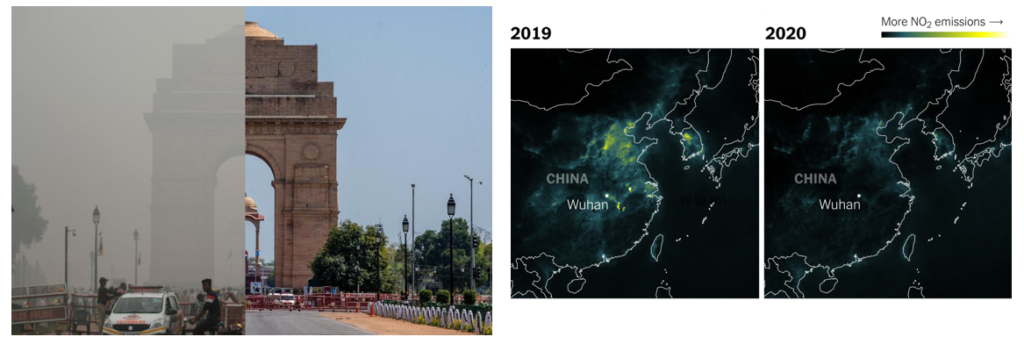
Since we have all been in quarantine, pollution has changed dramatically around the world. The stay at home order around the world has been keepings us away from our cars and onto our bikes. Our pollution levels have dropped due to the large number of people not using their cars. The EPA has said, “motor vehicles collectively cause 75 percent of carbon monoxide pollution in the U.S.” Because of the world wide quarantine efforts, we have all been off the roads and reducing this amount of pollution. These images are good representations of before and afters the quarantine:

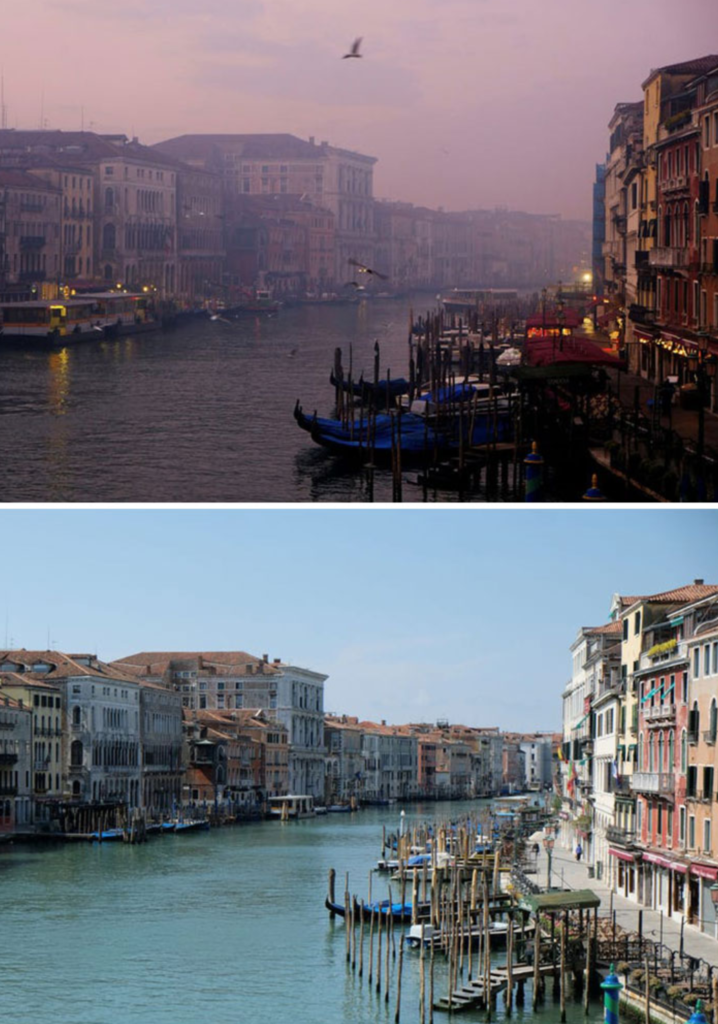
Additionally, water pollution has been affected positively by the lessening of carbon pollution levels and other pollution. For example, the Venice Canal, which is normally polluted to where few animals exist and the water is murky became clear and swans, dolphins, and octopuses are spending their time in the canal.

See other examples of positive effects on pollution during the quarantine here: https://www.boredpanda.com/cities-air-pollution-coronavirus-lockdown

The effects of pollution are huge. As we emit more gases into the air, the temperature slowly increases. Due to the increase, things like wildfires become more common. The temperature increase can  also cause glaciers to melt meaning the water levels will rise and possibly even flood some places. Air pollution affects our lungs, heart, and brain. We don’t feel it at first, but later on, our bodies will have taken in so much pollution that we’ll get really sick. Air pollution kills 4 million people a year and many are living with polluted water, but we can stop that. This change shows that our polluted world is reversible.

We can all keep these levels lower by using our bikes or walking instead of driving everywhere we go. We can also keep these levels low by reducing the amount of plastic we use or recycling more. There are many clean up groups out there to help pick up plastic or trash from our streets or plant trees to produce more oxygen. These groups get donations from people to go do more. There is so much we can do to keep this positive effects on the planet from reversing:

If we all join together to keep our Earth healthy, this could be the begining of a better future.

Thank you, Zack, for this inspiring piece!

The Blue Giant by Katie Cottle

Share

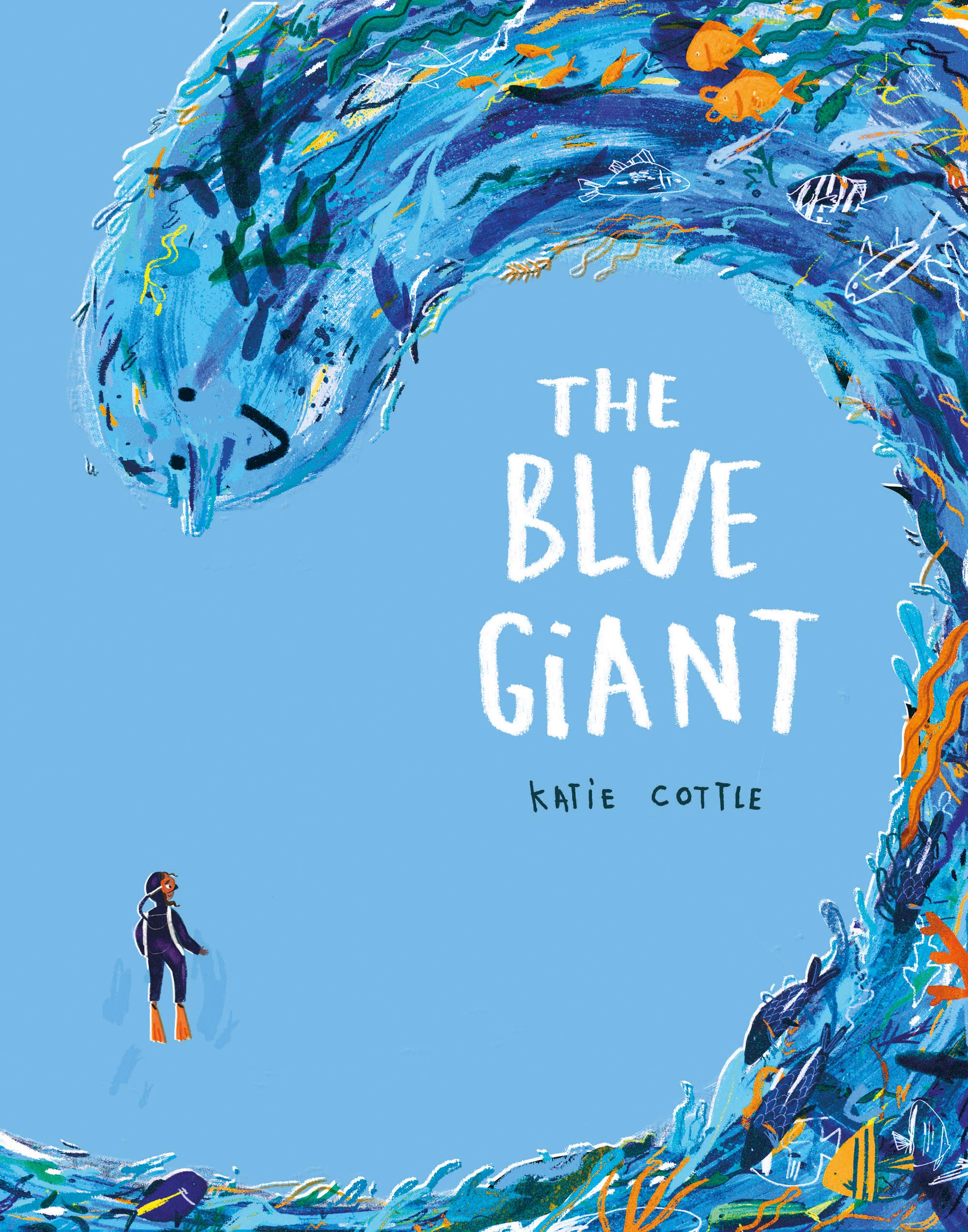
The Blue Giant
Author & Illustrator: Katie Cottle
Published May 26th, 2020 by Pavilion Books Ltd.

Summary: A poignant and timely picture book introducing children to the issue of ocean pollution, with ideas to help the world become a better, cleaner place.

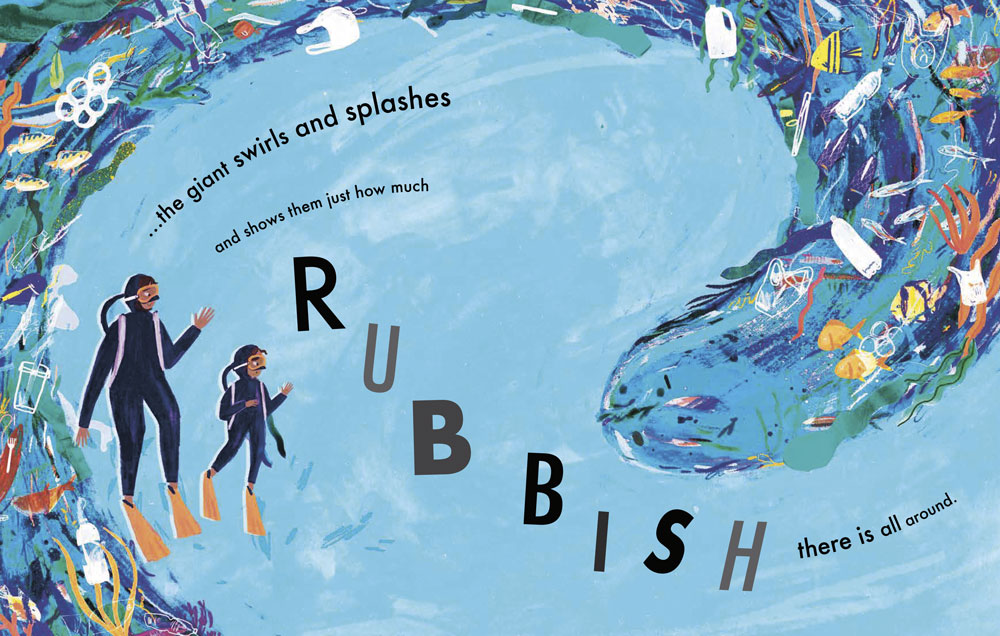
Coral and her mom are enjoying a break at the seaside. Until a creature emerges from the waves! It’s a giant. A blue giant. It is made of water, fish, and sea plants and has a stirring plea to help clean up the ocean.

Coral and her mom agree to help, donning their scuba-diving outfits and setting off to sea. But they can’t do it alone…can they?

This stunning follow-up to Katie Cottle’s debut picture book The Green Giant is another entertaining and beautiful eco-tale from the 2017 winner of the Batsford Prize. It introduces children to the issues of pollution, waste management, and the oceans, with suggestions of lifestyle changes to help clean up our seas.

About the Author: Katie Cottle is an illustrator and printmaker living and working in Bristol, U.K. Her work is often informed by the marks and colors created through traditional lithography. She also works digitally, using an iPad, and occasionally paints with gouache. The Blue Giant is her second book, following on from The Green Giant.

Review: Katie Cottle has caught onto something big with the format of this and her Green Giant book: it truly brings our environment to life and shows the harm that we are doing to it. The anthropomorphism of the ocean makes it even easier to connect to it as an entity as it shows how we are hurting it, and it shows what Meera DOES to try to reverse the effects we’ve caused.

In addition to the theme and story, I also really liked the illustrations. The author’s use of line is used expertly to show movement, and I loved all of the colors to really bring the story to life.

Teachers’ Tools for Navigation: This book is perfect for any discussion of water pollution and the environment. It shows a problem, a potential soultion, and hope for the future. It also specifically talks about single-use plastics which may be a new topic for many students.

Discussion Questions: 

  • What is something you can do to help the ocean?
  • What does Meera do to help the ocean?
  • How does our actions effect the ocean?
  • What is an animal that is effected by our pollution?
  • What is a single-use plastic that you use that you could replace?
  • What was the author’s purpose in writing this book?
  • Why did the author give the ocean a voice in the book?

Flagged Passages: 

Read This If You Love: Learning about the environment

Recommended For: 
classroomlibrarybuttonsmall

Signature

**Thank you to Media Master Publicity for providing a copy for review!**

Black Lives Matter: Anti-Racist Strategies

Share

Black Americans: We see you, we hear you, we support you, and we condemn the violent acts against Black Americans that happen too frequently in the United States including the murders most recently of Ahmaud Arbery, George Floyd, David McAtee, Tony McDade, and Breonna Taylor. Black. Lives. Matter.

Racism is a long-standing virus in our country. Because of racism, Black people are brutalized, murdered, and unjustly treated. This virus is not new—it is engrained in our history. And what is happening in our country now (and throughout our time as a nation) is motivated by the White systemic racism that permeates structures and motivations of this country.

As Dr. Ibram X. Kendi states in How to Be an Antiracist, “The opposite of racist isn’t ‘not racist.’ It is ‘anti-racist.’ What’s the difference? One endorses either the idea of a racial hierarchy as a racist, or racial equality as an anti-racist. One either believes problems are rooted in groups of people, as a racist, or locates the roots of problems in power and policies, as an anti-racist. One either allows racial inequities to persevere, as a racist, or confronts racial inequities, as an anti-racist. There is no in-between safe space of ‘not racist.'”

So to combat racism, we must be actively anti-racist.

Educate ourselves about the history of racism, race relations, and the act of anti-racism. 

  • Anti-Racism Booklist from @idealbookshelf
  • Anti-Racism Book List from Candace Greene McManus including gateway books and books to dig deeper.
  • Educators: Educate on race in education and in literature.
    • Books to share from The Brown Book Shelf and KidLit Community Rally for Black Lives:
      • We Got This: Equity, Access, and the Quest to Be Who Our Students Need Us to Be by Cornelius Minor
      • Being the Change: Lessons and Strategies to Teach Social Comprehension by Sara K. Ahmed
      • Teacher for Black Lives by Dyan Watson, Jesse Hagopian, and Wayne Au
      • Libraries, Literacy, and African American Youth edited by Dr. Paulette Brown Bracy, Sandra Hughes-Hassell, and Casey H. Rawson
      • The Dark Fantastic: Race and the Imagination from Harry Potter to the Hunger Games by Ebony Elizabeth Thomas

Educate ourselves about what IS racist. 

  • Learn about passive/covert racism as well as active/overt racism and take action on what.
  • Educators: Learn about how schools are racist and how they have the potential to get even worse (from The Progressive). (The links in this article provide further background, as well.)
    • Then, apply what you have learned to your own context. What can you do to make a change? How can you stop being complicit and start being anti-racist?

Make sure we understand our own implicit biases and White privilege. 

It’s time to start doing. Remember: educating ourselves is critical, but it is only the first step. Action must follow.

Share posts from Black activists or organizations that inform about, fight against, and educate on police brutality.

Support works produced by Black artists and creatives. 

Donate, join, support, and participate in organizations (a few are noted below).

Support Black businesses.

Highlight the history and contributions of the Black community. Below, we offer a list of contributions to education and books. 

Call your local and state reps and demand change.

Discuss race, race relations, and anti-racism with students, kids, family, etc. 

Read and share books by BIPOC authors and about BIPOC characters with our students, kids, family, etc. 

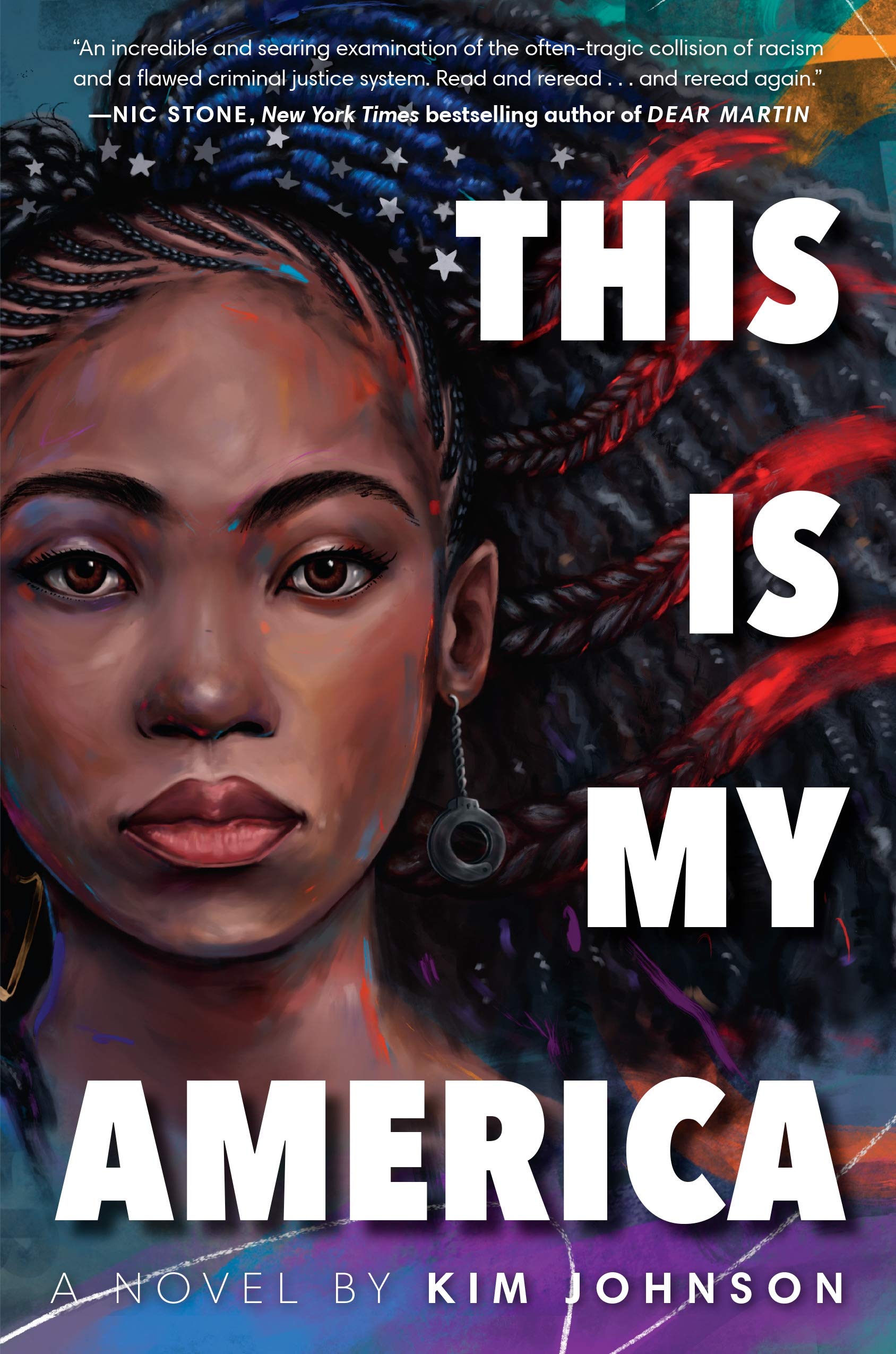
  • Book recommendations by Black authors (This is a list of books we have especially loved and recommend. This list is limited. Please be sure to click the links throughout the post for more book recommendations, and keep your finger on the pulse of new releases to constantly learn and grow.)
    • Picture Books
      • Mae Among the Stars by Roda Ahmed, illustrated by Stasia Burrington
      • Out of Wonder: Poems Celebrating Poets by Kwame Alexander
      • The 5 O’Clock Band by Troy Andrews, illustrated by Bryan Collier
      • Trombone Shorty by Troy Andrews, illustrated by Bryan Collier
      • Preaching to the Chickens: The Story of Young John Lewis by Jabari Asim, illustrated by E.B. Lewis
      • Crown: An Ode to the Fresh Cut by Derrick Barnes, illustrated by Gordon C. James
      • The King of Kindergarten by Derrick Barnes, illustrated by Vanessa Brantley-Newton
      • Knock Knock: My Dad’s Dream for Me by Daniel Beaty, illustrated by Bryan Collier
      • The Patchwork Bike by Maxine Beneba, illustrated by Van Thanh Rudd
      • Rocket Says Look Up! by Nathan Bryon, illustrated by Dapo Adeloa
      • Firebird by Misty Copeland, illustrated by Christopher Myers
      • Jabari Jumps by Gaia Cornwall
      • Shortcut by Donald Crews
      • Freight Train by Donald Crews
      • Just Like a Mama by Alice Faye Duncan, illustrated by Charnelle Pinkney Barlow
      • Memphis, Martin, and the Mountaintop: The Sanitation Strike of 1968 by Alice Faye Duncan, illustrated by R. Gregory Christie
      • Bedtime for Sweet Creatures by Nikki Grimes, illustrated by Elizabeth Zunon
      • Going Down Home with Daddy by Kelly Starling Lyons, illustrated by Daniel Minter
      • Hands Up! by Breanna J. McDaniel, illustrated by Shane W. Evans
      • Fresh Princess by Denene Millner, illustrated by Gladys Jose
      • Thank You, Omu! by Oge Mora
      • H.O.R.S.E.: A Game of Basketball and Imagination by Christopher Myers
      • Harlem by Walter Dean Myers, illustrated by Christopher Myers
      • Muhammad Ali: The People’s Champion by Walter Dean Myers, illustrated by Alix Delinois
      • Heart and Soul: The Story of America and African Americans by Kadir Nelson
      • Nelson Mandela by Kadir Nelson
      • My Brother Charlie by Holly Robinson Peete & Ryan Elizabeth Peete, illustrated by Shane W. Evans
      • Boycott Blues: How Rosa Parks Inspired a Nation by Andrea Davis Pinkney, illustrated by Brian Pinkney
      • Duke Ellington: The Piano Prince and his Orchestra by Andrea Davis Pinkey, illustrated by Brian Pinkney
      • Ella Fitzgerald: The Tale of a Vocal Virtuosa by Andrea Davis Pinkney, illustrated by Brian Pinkney
      • Sit-In: How Four Friends Stood Up by Sitting Down by Andrea Davis Pinkney, illustrated by Brian Pinkney
      • Sojourner Truth’s Step-Stomping Stride by Andrea Davis Pinkney, illustrated by Brian Pinkney
      • A Day at the Museum by Christina Platt, illustrated by Sharon Sordo (chapter book)
      • Tar Beach by Faith Ringgold
      • Another by Christian Robinson
      • You Matter by Christian Robinson
      • Little Melba and her Big Trombone by Katheryn Russell-Brown, illustrated by Frank Morrison
      • Hidden Figures: The True Story of Four Black Women and the Space Race by Margot Lee Shetterly, illustrated by Laura Freeman
      • Radiant Child: The Story of Young Artist Jean-Michel Basquiat by Javaka Steptoe
      • Poet: The Remarkable Story of George Moses Horton by Don Tate
      • Be A King: Dr. Martin Luther King Jr.’s Dream and You by Carole Boston Weatherford, illustrated by James E. Ransom
      • Freedom in Congo Square by Carole Boston Weatherford, illustrated by R. Gregory Christie
      • The Day You Begin by Jacqueline Woodson, illustrated by Rafael López
      • Each Kindness by Jacqueline Woodson, illustrated by E.B. Lewis
      • This is the Rope: A Story from the Great Migration by Jacqueline Woodson, illustrated by James E. Ransom
    • Middle Grade
      • Crossover by Kwame Alexander
      • Booked by Kwame Alexander
      • The Usual Suspect by Maurice Broaddus
      • New Kid by Jerry Craft
      • Bud, Not Buddy by Christopher Paul Curtis
      • Elijah of Buxton by Christopher Paul Curtis
      • The Watsons Go to Burmingham – 1963 by Christopher Paul Curtis
      • Out of My Mind by Sharon Draper
      • Stella By Starlight by Sharon Draper
      • The Last-Last-Day of Summer by Lamar Giles
      • Great Greene Heist series by Varian Johnson
      • Robyn Hoodlum series by Kekla Magoon
      • Somewhere in the Darkness by Walter Dean Myers
      • Ghetto Cowboy by G. Neri
      • Yummy: The Last Days of a Southside Shorty by G. Neri
      • Long Way Down by Jason Reynolds
      • Look Both Ways by Jason Reynolds
      • Miles Morales: Spider-Man by Jason Reynolds
      • Track series by Jason Reynolds
      • Ghost Boys by Jewell Parker Rhodes
      • Louisiana Girls Trilogy by Jewell Parker Rhodes
      • Two Naomis by Olugbemisola Rhuday-Perkovich and Audrewy Vernick
      • Clean Getaway by Nic Stone
      • Logan series by Mildred D. Taylor
      • Gaither Sisters series by Rita Williams-Garcia
      • Brown Girl Dreaming by Jacqueline Woodson
      • Locomotion series by Jacqueline Woodson
      • Harbor Me by Jacqueline Woodson
    • Young Adult
      • Clap When You Land by Elizabeth Acevedo
      • The Poet X by Elizabeth Acevedo
      • With Fire on High by Elizabeth Acevedo
      • Swing by Kwame Alexander
      • Solo by Kwame Alexander
      • Kendra by Coe Booth
      • Tyrell series by Coe Booth
      • Fist Stick Knife Gun: A Personal History of Violence, A True Story of Black and White by Geoffrey Canada, illustrated by Jamar Nicholas
      • The Belles series by Dhonielle Clayton
      • Tyler Johnson was Here by Jay Coles
      • Say Her Name by Zetta Elliott
      • Fresh Ink: An Anthology edited by Lamar Giles
      • Bronx Masquerade by Nikki Grimes
      • Allegedly by Tiffany D. Jackson
      • Monday’s Not Coming by Tiffany D. Jackson
      • A Certain October by Angela Johnson
      • First Part Last by Angela Johnson
      • I’m Not Dying With You Tonight by Kimberly Jones and Gilly Segal
      • March series by John Lewis
      • How It Went Down by Kekla Magoon
      • Tyrell by Coe Booth
      • Dope Sick by Walter Dean Myers
      • It Ain’t All for Nonthin’ by Walter Dean Myers
      • Monster by Walter Dean Myers
      • Knockout Games by G. Neri
      • It’s Trevor Noah: Born a Crime by Trevor Noah
      • All American Boys by Jason Reynolds and Brendan Kiely
      • When I Was the Greatest by Jason Reynolds
      • Dear Martin by Nic Stone
      • Odd One Out by Nic Stone
      • The Hate You Give by Angie Thomas
      • On the Come Up by Angie Thomas
      • Jumped by Rita Williams-Garcia
      • Beneath a Meth Moon by Jacqueline Woodson
      • The Sun is Also a Star by Nicola Yoon
      • American Street by Ibi Zoboi

Educate ourselves about the system we are part of.

Talk about anti-racism. Speak up when others are being racist. Educators, teach about being anti-racist. This is your job–in order to support young people. Just so we are clear, this includes teachers in predominantly White classrooms.

Continue to listen to Black voices, do not stop educating yourself, and focus your learning on anti-racist ACTIONS. White Americans, if you feel exhausted, keep in mind that Black Americans don’t have opportunity to shut off the effects of racism. This is a privilege.

Educators, we must frame everything we do to be anti-racist.

What anti-racist work are you doing?

and

**Please note: These links have been widely shared on social media, and we curated them here and added many others to give them a concrete place. This is shared work.**

Camp Candlewick

Share

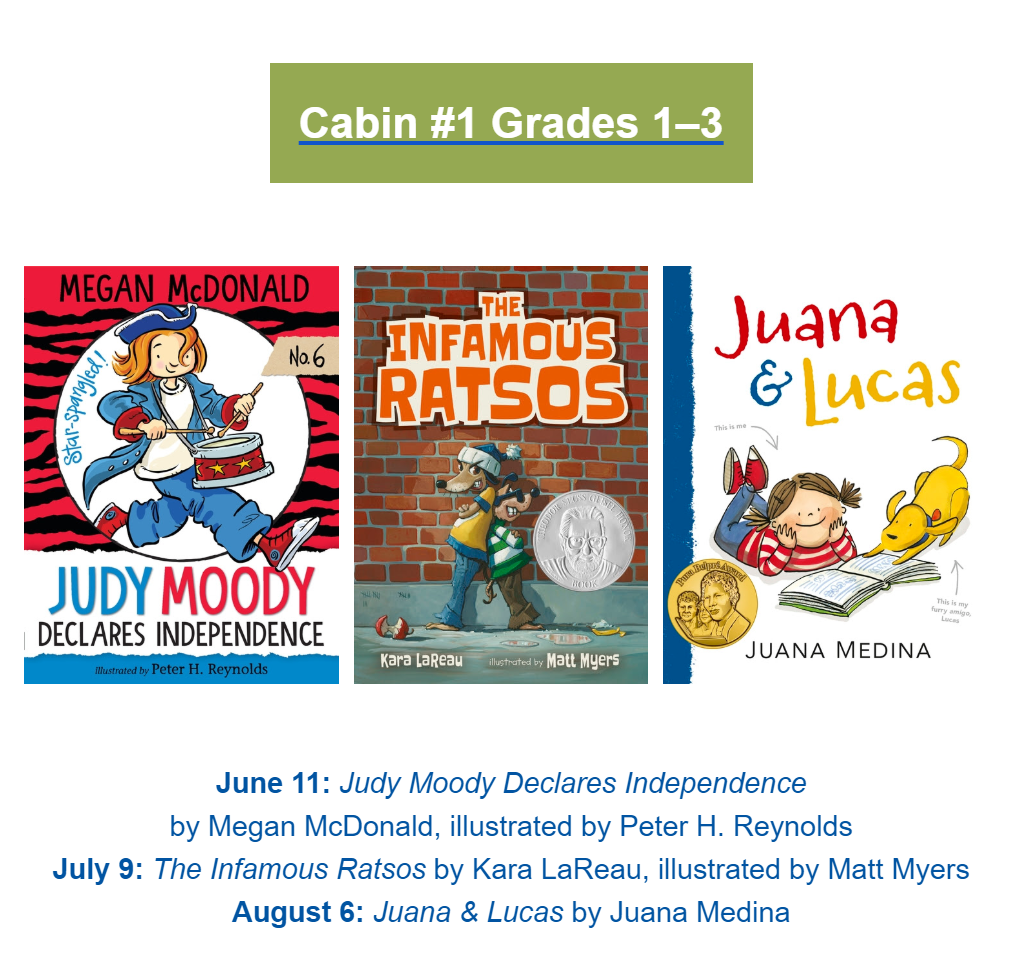
We’re excited to share Camp Candlewick, a new online reading program! Over the course of twelve weeks, young people of all ages will be encouraged to take part in shared reads, activities, and virtual events with prominent creators.

Via website content (at https://stayhome.candlewick.com/) and email newsletters as well as robust support resources on sites such as Pinterest, “campers” will be alerted to reading suggestions, prompts, and activities for the “cabins” appropriate for their age.

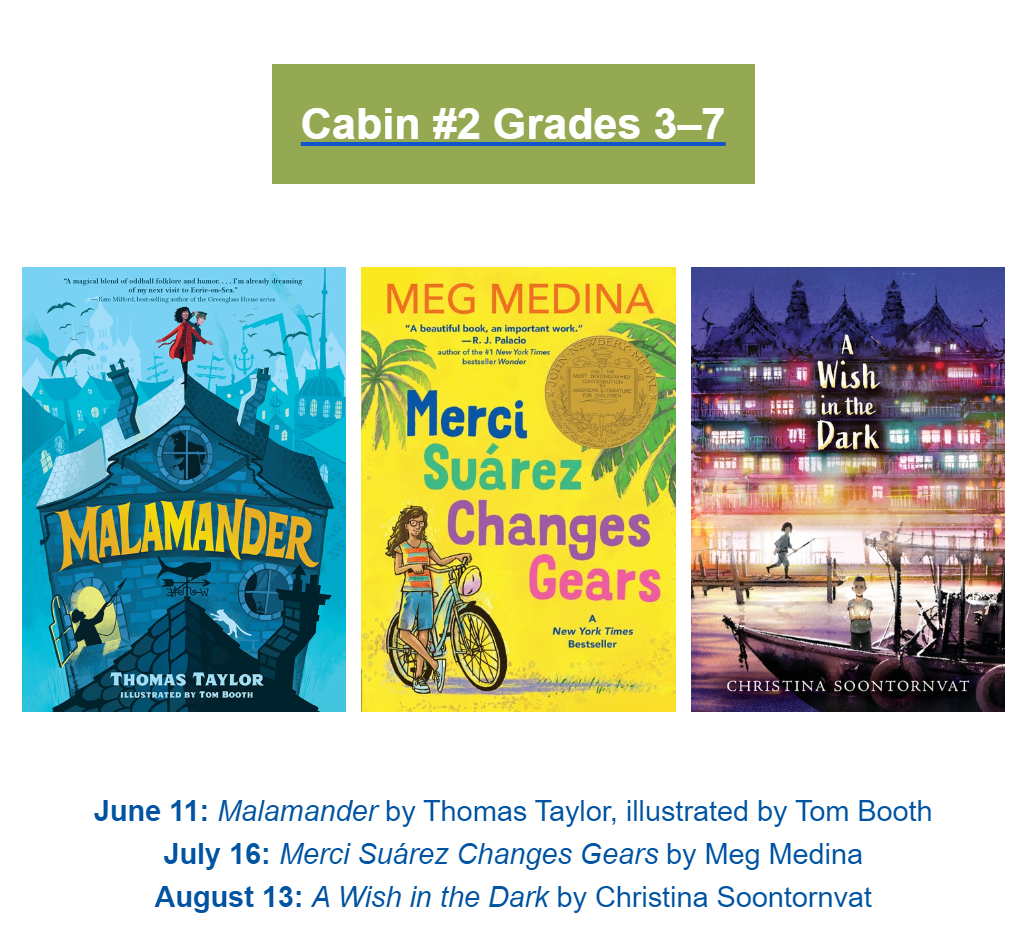
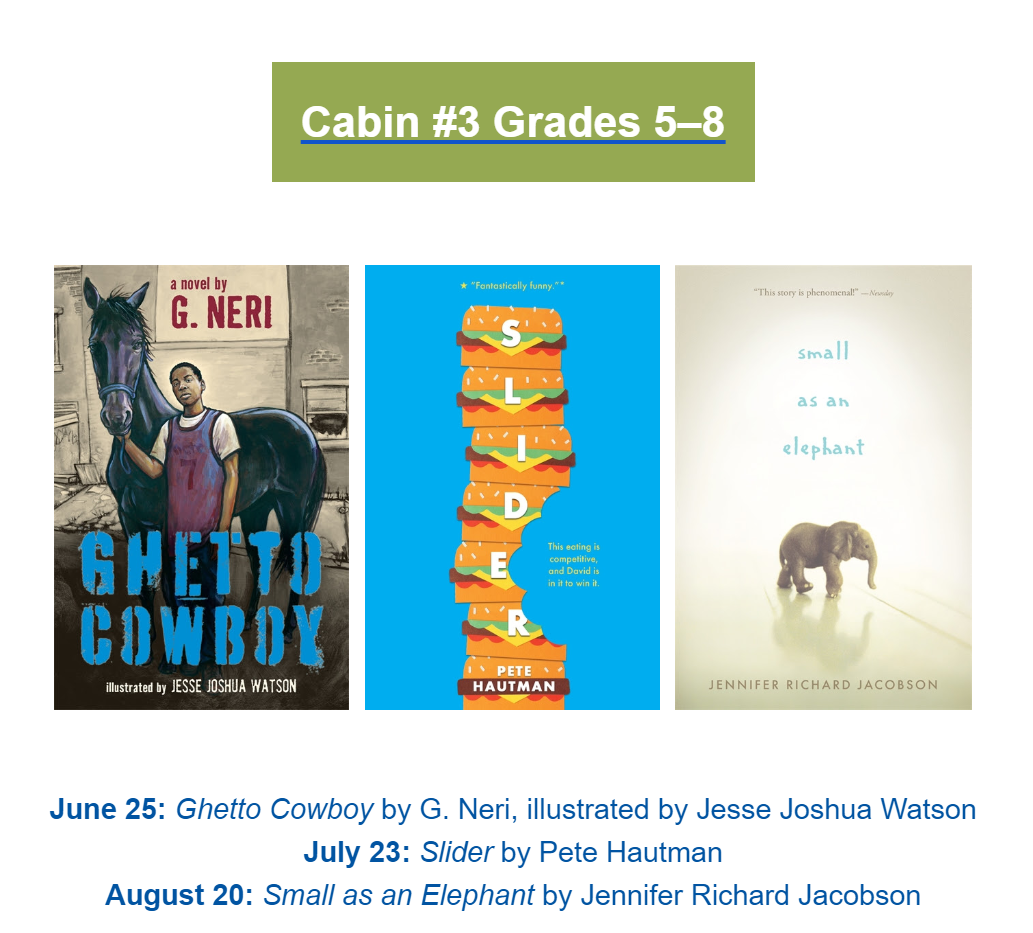
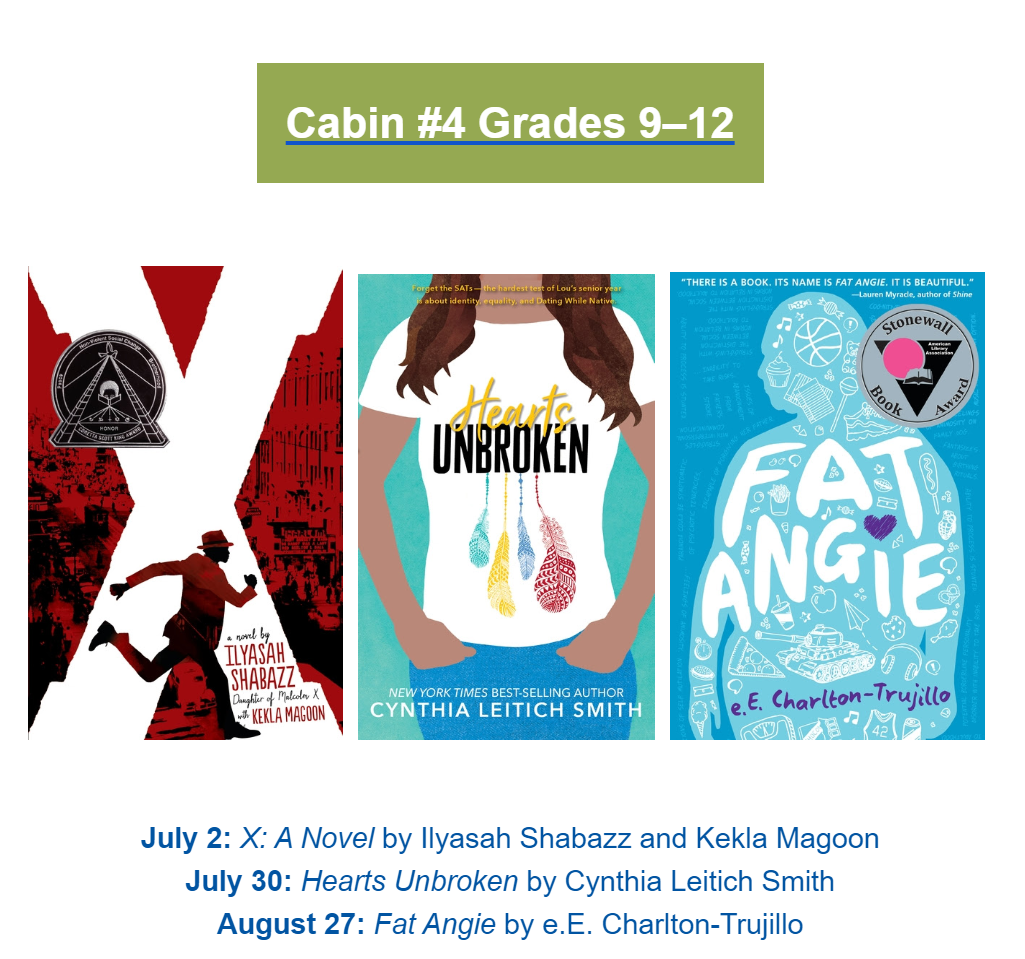
Here are the four cabins! Each are hyperlinked to take you to the cabin’s Pinterest board:

From the press release: The idea for the summer camp grew out of the success of the publisher’s Stay Home with Candlewick Press initiative, which has provided resources and support to families during the transition to remote learning. “We realized that families might feel even more in need of diversion over the summer, when the school year has ended and many camps will be closed,” said Kathleen Rourke, executive director of educational library sales and marketing at Candlewick.

“Preventing the loss of skills is more critical than ever this year,” Rourke said. “We hope that these 12 weeks of activities will provide connection and enrichment when young readers need it most.”

We look forward to our sons taking part in Camp Candlewick as well as sharing the opportunity with our students!

The Refuge by Sandra Le Guen, Illustrated by Stéphane Nicolet

Share

The Refuge
Author: Sandra Le Guen
Translator: Daniel Hahn
Illustrator:  Stéphane Nicolet
Published June 1, 2020 by Amazon Crossing Kids

Summary: “There’s a new girl at school. She never stops looking up at the sky! She likes the stars and comets.”

Jeannette tells her mom about her new classmate, who also loves astronomy but seems sad. She realizes it’s not easy to move to a new place. So the next day, at recess, Jeannette asks Iliana to play.

At first, it’s a little hard to communicate because Iliana is learning a new language. The girls have to use their hands and their drawings. But they keep trying, and, soon, Iliana tells Jeannette about her difficult journey as a refugee who had to leave her country. Then their families meet, and Iliana’s parents share their story too. The girls’ friendship blooms, as limitless as the sky and their imaginations.

Originally published in France and brought to life with wonderfully expressive artwork, this is a book about sharing stories and finding refuge in friendship, family, and a new home.

Kellee’s Review: This book is beautiful. It shows pure empathy for a young girl, and her family, who needs all love in the scary new situation she is in. Their journey was harrowing and being in a new place where they do not speak the language must be completely overwhelming; however, this was something they felt no choice in doing because of the horrors of war back at their home. But sadly, refugees have been villainized–once again fear winning over empathy. However, The Refuge puts a narrative to the journey that many children and families face just to stay safe. And it is such a well-crafted narrative with beautiful illustrations–just an overall excellent book. A must read for ALL ages. 

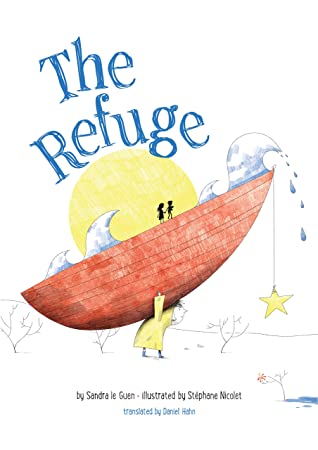
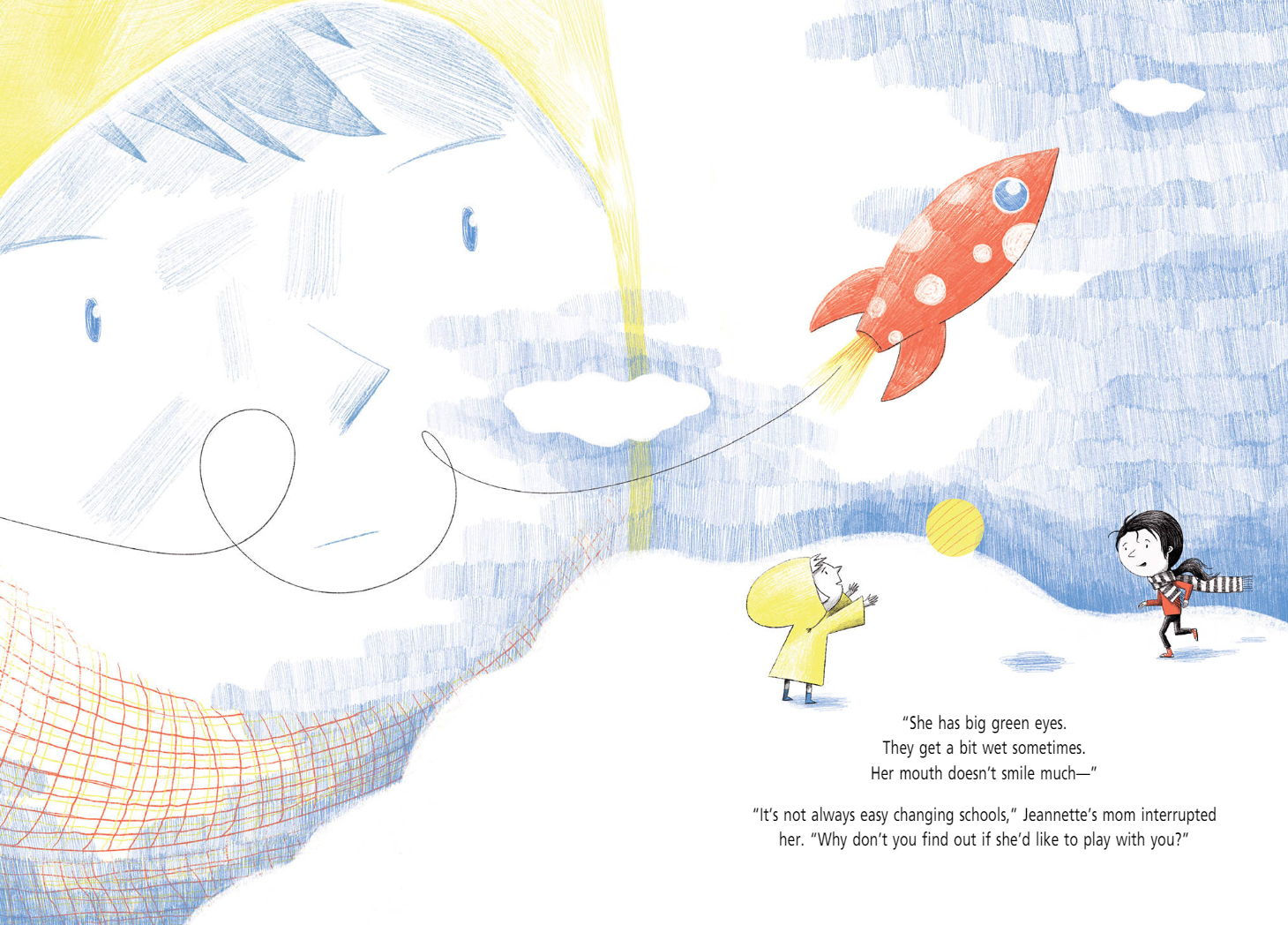
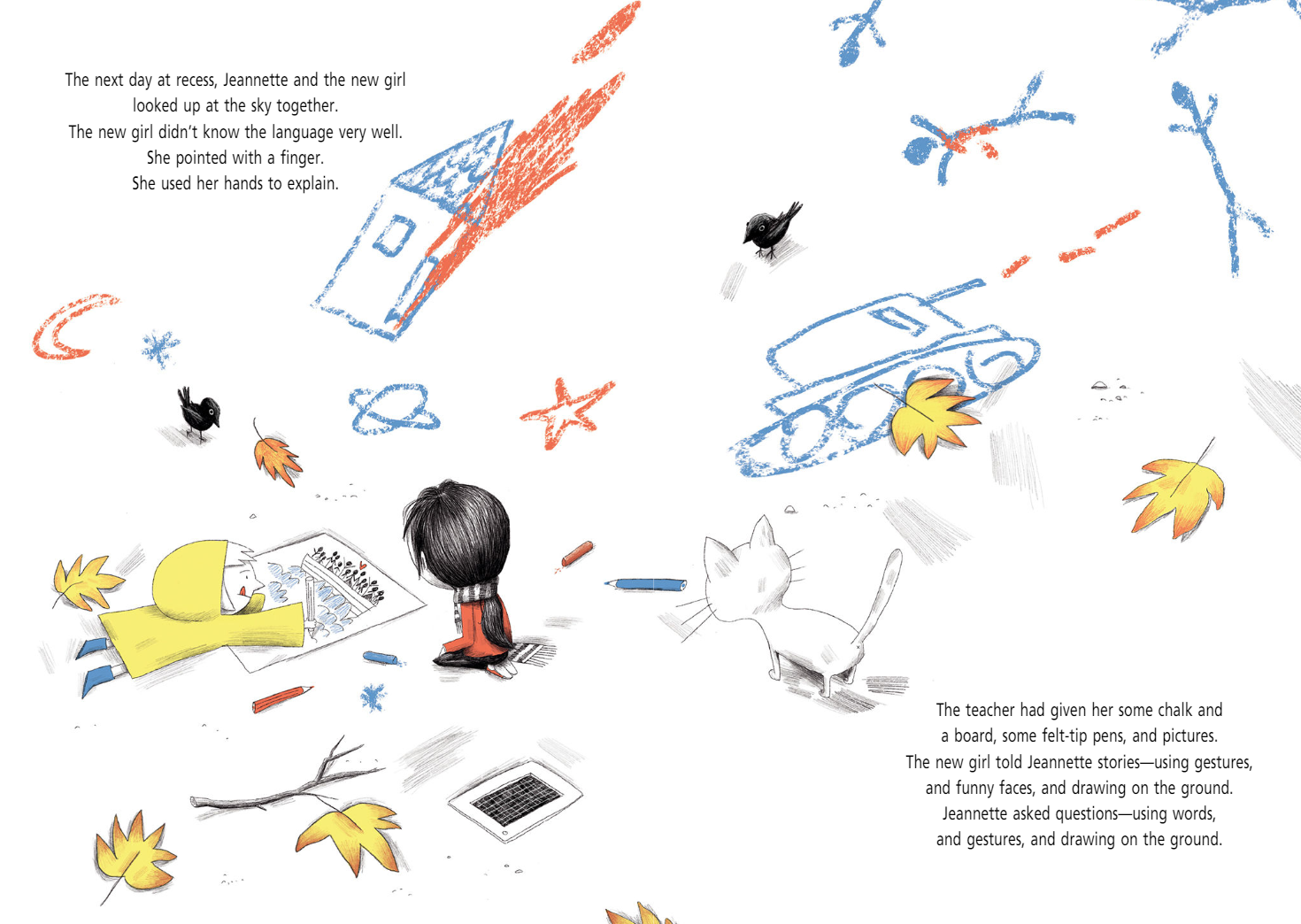
Ricki’s Review: Magnificent. This book is truly and utterly magnificent. I am quite hopeful it will win some of the major literary awards. Whew! The writing depicts the myriad emotions that Iliana might have experienced on her journey, and Jeannette has such deep empathy for her classmate. The illustrations take the book to the next level. I would purchase a spread of this book and frame it for the wall in my office—the illustrations are that captivating. We share some of the illustrations below. There’s one illustration in which Iliana is carrying a giant boat on her back, and a star hangs from a string on the front. Two small children walk up the top of the steep boat. The words match the illustrations, and yet the illustrations have deeper, metaphoric meaning. This would be a terrific book to study at the high school and college level. It would sustain several classes of discussion. I plan to purchase a copy to use in my Teaching Reading class. If you haven’t read this book, I recommend it highly.

Teachers’ Tools for Navigation: Metaphor is powerfully used in this text (both in the writing and illustrations). This would be a magnificent text to use as a mentor text for the instruction of metaphor. Students might select a written metaphor to illustrate and an illustrated metaphor to write in words to consider the flexibility and power of the use of metaphor. Then, they might craft their own metaphors related to the story.

Discussion Questions: 

  • Choose one illustration that you like. What is the surface level meaning? What is the deeper meaning attached to the image?
  • How does Jeannette demonstrate empathy for Iliana?
  • What did you learn about refugees?
  • Why do you believe the author titled the book The Refuge instead of Refugee?
  • How do the illustrations and writing work together?
  • What creative techniques does the author use?
  • What creative techniques does the illustrator use?

Flagged Passages: 

Read This If You Love: The Arrival by Shaun Tan, Refugee by Alan Gratz, Dreamers by Yuyi Morales, The Name Jar by Yangsook Choi, Each Kindness by Jacqueline Woodson

Recommended For: 
classroomlibrarybuttonsmall 

Signatureand

**Thank you, Barbara at Blue Slip Media, for providing copies for review!**

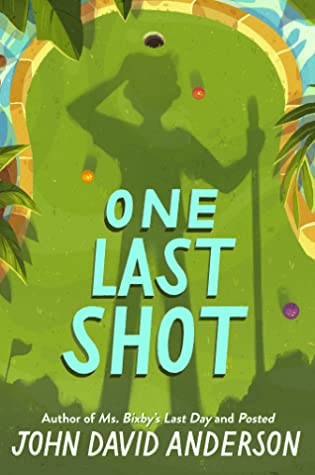
Blog Tour with Q&A and Readers’ Guide!: One Last Shot by John David Anderson

Share

One Last Shot
Author: John David Anderson
Published May 5th, 2020 by Walden Pond Press

Summary: For as long as he can remember, Malcolm has never felt like he was good enough. Not for his parents, who have always seemed at odds with each other, with Malcolm caught in between. And especially not for his dad, whose competitive drive and love for sports Malcolm has never shared.

That is, until Malcolm discovers miniature golf, the one sport he actually enjoys. Maybe it’s the way in which every hole is a puzzle to be solved. Or the whimsy of the windmills and waterfalls that decorate the course. Or maybe it’s the slushies at the snack bar. But whatever the reason, something about mini golf just clicks for Malcolm. And best of all, it’s a sport his dad can’t possibly obsess over.

Or so Malcolm thinks.

Soon he is signed up for lessons and entered in tournaments. And yet, even as he becomes a better golfer and finds unexpected friends at the local course, be wonders if he might not always be a disappointment. But as the final match of the year draws closer, the tension between Malcolm’s parents reaches a breaking point, and it’s up to him to put the puzzle of his family back together again.

About the Author: John David Anderson is the author of some of the most beloved and highly acclaimed books for kids in recent memory, including the New York Times Notable Book Ms. Bixby’s Last Day, Granted, Sidekicked, and The Dungeoneers. A dedicated root beer connoisseur and chocolate fiend, he lives with his wonderful wife and two frawsome kids in Indianapolis, Indiana. He’s never eaten seven scoops of ice cream in a single sitting, but he thinks it sounds like a terrific idea. You can visit him online at www.johndavidanderson.org.

Q&A: Thank you so much to John David Anderson for answering these questions for us!

What was your inspiration for writing this novel?

One Last Shot is somewhat autobiographical in nature. As an adolescent once myself (so many eons ago) I can empathize with Malcolm’s (the protagonist’s) conflicts and concerns: the desire (or is it burden?) to please others, the need to find something you’re good at, anxiety over a potential parent split, the ache for a friend that just gets you—these are all feelings I struggled with as well. So think the emotional core of the book is definitely informed by my childhood.

At the same time, I literally just sat down one day and said, “I’m going to write a sports novel. Hold up…I don’t play sports! But I do play miniature golf. Wouldn’t it be cool if somebody—i.e. me–wrote a book about miniature golf and made it exactly eighteen chapters?” I think a lot of my stories start this way, as artistic challenges or experiments, though the real challenge is turning these exercises into full-fledged narratives.

Why mini golf?

Um…because it’s awesome! Honestly I picked mini-golf because it worked well as a metaphor for the coming-of-age story I was telling. On the one hand it’s so whimsical and random—windmills, barns, pirate ships—but at the same time its so methodical and predictable. It’s basic geometry. For Malcolm that’s appealing because it’s something he can control; it’s a problem with an easily discernable solution—the cup is right there. It’s also individualistic. Nobody is counting on him to catch the fly ball or safely get on base. His successes and failures are entirely his own—though that comes with its own pressures, of course.

Could you tell us some about your writing process?

Anyone who knows me already knows that chocolate is involved. Beyond that, though, it’s 6-8 weeks of pure writing fury followed by 6-8 months of torturous revision. My initial drafts are explorations—my editor says they are me laying out miles and miles of track hoping that it leads somewhere (it doesn’t always)— but the most important thing for me is to maintain momentum so I can push through the difficult middles to get to the rewarding ends. I just have to trust myself that the exhaustive revision process will bang all the pieces firmly into place, fashioning my mess of a first draft into something presentable.

I also have come to realize that the process never really stops. Even if I’m not in front of the laptop, I’m still writing. When I’m working on a novel my brain never fully steps out of that world. So much of the process happens in the ongoing dialogue I have with the characters inside my head (much like the voices Malcolm hears in his).

Of course this particular book afforded me the chance to do some fun hands-on research: I’ve visited my fair share of mini-golf courses in the last couple of years.

What is one thing you hope readers take away from ONE LAST SHOT?

The world is unpredictable. It throws obstacles at you right and left. You don’t get to make the course, you just have to play it.

But you also have more than one shot. Not everything is going to be a hole-in-one. You are going to doink off the rock or stick yourself in the corner or even hit it way too hard, somehow jump the wall and end up in the parking lot. But that’s okay. I want my readers to know its okay. You learn from your mistakes, and you take a better shot next time.

Readers’ Guide:

Blog Tour:

May 4   Nerdy Book Club
May 7   Teachers Who Read
May 8    A Library Mama
Kirsti Call
May 10 Bluestocking Thinking
May 12 Unleashing Readers
Maria’s Mélange
May 14 The Book Monsters

Giveaway!:

a Rafflecopter giveaway

Signature

**Thank you to Walden Pond Press for providing the Q&A and a copy for giveaway!**

It Is (Not) Perfect by Anna Kang, Illustrated by Christopher Weyant

Share

It Is (Not) Perfect
Author: Anna Kang
Illustrator: Christopher Weyant
Expected publication: May 12th, 2020

Summary: Two fuzzy creatures are happily putting the finishing touches on their sandcastle when each of them thinks of something that would make it even better. As they work furiously to incorporate each new change, their tiny sandcastle becomes an over-the-top palace…but is it really perfect?

This latest book in the beloved series featuring the pals from Theodor Seuss Geisel Award winner You Are (Not) Small reminds us that perfection is in the eye—and heart—of the beholder.

Praise:

“Colorful cartoon illustrations add a lightheartedness to what could be a stressful real-life situation for kids. Another life lesson neatly packaged in child centric humor.” —Kirkus Reviews

“This award-winning duo have created a lovely tribute to the old adage that perfect is the enemy of good. Recommended for purchase for all collections.” —School Library Journal

About the Creators: Anna Kang and Christopher Weyant are the creators of Theodor Seuss Geisel Award winner You Are (Not) Small as well as series titles That’s (Not) Mine, I Am (Not) Scared, and We Are (Not) Friends. They also wrote and illustrated Eraser, Can I Tell You a Secret?, and Will You Help Me Fall Asleep? Christopher’s work can also be seen in The New Yorker, and his cartoons are syndicated worldwide. This husband-and-wife team lives in New Jersey with their two daughters and their rescue dog. Visit them at www.annakang.com and www.christopherweyant.com.

Twitter: @annakang27 @chrisweyant05
Instagram: annakangbookschristopherweyant
Facebook: Anna Kang – Author; Christopher Weyant

Review: This series is one of my favorites. Although the simplicity of the texts makes the books seem straightforward, they are actually multi-tiered and can be used for so many different ages to discuss illustrations as part of the narrative, moral issues, friendship, perspective, and much more. All while following the stories for two super cute monster friends!

Discussion Questions: 

  • What ended up actually being perfect?
  • What did trying to please all cause?
  • Who gets to decide what is perfect?
  • Does everything you do need to be perfect?
  • How did trying to make it perfect ruin the fun?

Flagged Passages: 

Read This If You Love: Not series by Kang and Weyant including You Are (Not) SmallThat’s (Not) MineI Am (Not) Scared, and We Are (Not) Friends; How to Code a Sandcastle by Josh Funk, Dexter series by Lindsay Ward including Don’t Forget Dexter and It’s Show and Tell, Dexter

Recommended For: 

classroomlibrarybuttonsmall

Giveaway!:

a Rafflecopter giveaway

Signature

**Thank you to Blue Slip Media for providing a copy for review and giveaway!**