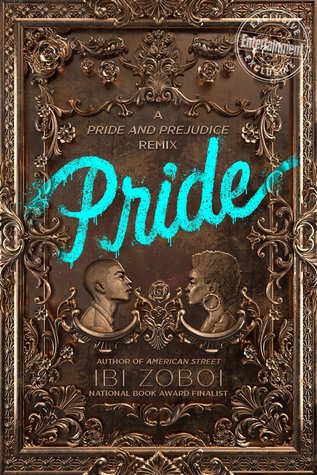
Pride by Ibi Zoboi

Share

Pride
Author: Ibi Zoboi
Published: September 18, 2018 by Balzer + Bray

Summary: Pride and Prejudice gets remixed in this smart, funny, gorgeous retelling of the classic, starring all characters of color, from Ibi Zoboi, National Book Award finalist and author of American Street.

Zuri Benitez has pride. Brooklyn pride, family pride, and pride in her Afro-Latino roots. But pride might not be enough to save her rapidly gentrifying neighborhood from becoming unrecognizable.

When the wealthy Darcy family moves in across the street, Zuri wants nothing to do with their two teenage sons, even as her older sister, Janae, starts to fall for the charming Ainsley. She especially can’t stand the judgmental and arrogant Darius. Yet as Zuri and Darius are forced to find common ground, their initial dislike shifts into an unexpected understanding.

But with four wild sisters pulling her in different directions, cute boy Warren vying for her attention, and college applications hovering on the horizon, Zuri fights to find her place in Bushwick’s changing landscape, or lose it all.

In a timely update of Jane Austen’s Pride and Prejudice, critically acclaimed author Ibi Zoboi skillfully balances cultural identity, class, and gentrification against the heady magic of first love in her vibrant reimagining of this beloved classic.

Teaching Pride

I love retellings of classics, and I would argue that this retelling is far superior to the original. Ibi presented at the NCTE convention, and she is absolutely brilliant. She talked about how she values the inclusion of the pantheon in literature and how she does so in her own texts. She also shared how different poems within Pride are retellings of classic poems. I love her work and will read anything she writes.

Love stories are tricky. They can get sappy quickly. This book is so much more than a love story. It interrogates themes related to economics, race, education, and gender.

Gentrification

“It’s a truth universally acknowledged that when rich people move into the hood, where it’s a little bit broken and a little bit forgotten, the first thing they want to do is clean it up. But it’s not just the junky stuff they’ll get rid of. People can be thrown away too, like last night’s trash left out on sidewalks or pushed to the edge of wherever all broken things go. What those rich people don’t always know is that broken and forgotten neighborhoods were first built out of love” (p. 1).

Teaching Idea: As a class, explore the impacts of gentrification and displacement. Using this knowledge develop your own form of political art (https://youtu.be/JMVd5k2a2IM) to make a statement.

Culture

If Madrina’s basement is where the tamboras, los espíritus, and old ancestral memories live, the roof is where the wind chimes, dreams, and possibilities float with the stars, where Janae and I share our secrets and plan to travel all over the world, Haiti and the Dominican Republic being our first stop” (p. 23).

Teaching Idea: Pick a place in your life, and Use Zoboi’s writing as a mentor text to share that place with others (e.g. “If [place] is where_________, [another place] is where__________, where________.”

Equity

“Sometimes love is not enough to keep a community together. There needs to be something more tangible, like fair housing, opportunities, and access to resources” (p. 33).

Teaching Idea: As a class, discuss whether love is enough and whether tangible aspects must exist in order to keep a community together. Generate a concept or brain map that depicts tangible aspects that can impact communities.

Male/Female Gender Roles

I don’t need no knights in shining armor

Ain’t no horses in the hood

I killed chivalry myself with a pocketknife…” (p. 243).

Teaching idea: The teachers finds materials/advertisements that are gender-specific, and students rewrite the materials to remove gender from the text. Students evaluate how the meaning or the impact has changed.

Education

“There is more to learn

about my old, old self, and black and brown girls like me

from hoods all over this country want to

take over the world,

but there’s something missing

in our history books the public schools give us” (p. 147).

Teaching idea: Consider the school curricula. Whose voices are honored? Whose are missing? Rewrite a course to be more inclusive.

Home

“I have always thought of Bushwick as home, but in that moment, I realize that home is where the people I love are, wherever that is” (p. 270).

Teaching idea: Where is home? Create a visual depiction of your own home, and below it, write, “Home is…” How do our interpretations of home differ? What do they have in common?

Read This If You Loved: American Street by Ibi Zoboi, Pride and Prejudice by Jane Austen, Piecing Me Together by Renée Watson

Recommended For: 

classroomlibrarybuttonsmall 

RickiSig

The Astonishing Color of After by Emily X. R. Pan

Share

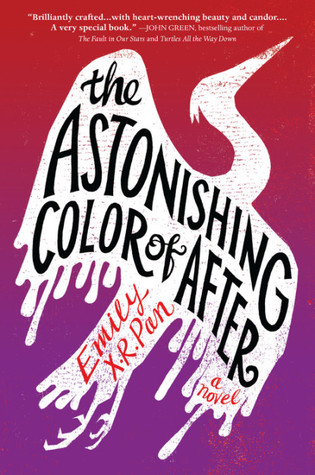
The Astonishing Color of After
Author: Emily X. R. Pan
Published: March 20, 2018 by Little, Brown

Goodreads Summary: Leigh Chen Sanders is absolutely certain about one thing: When her mother died by suicide, she turned into a bird.

Leigh, who is half Asian and half white, travels to Taiwan to meet her maternal grandparents for the first time. There, she is determined to find her mother, the bird. In her search, she winds up chasing after ghosts, uncovering family secrets, and forging a new relationship with her grandparents. And as she grieves, she must try to reconcile the fact that on the same day she kissed her best friend and longtime secret crush, Axel, her mother was taking her own life.

Alternating between real and magic, past and present, friendship and romance, hope and despair, The Astonishing Color of After is a novel about finding oneself through family history, art, grief, and love.

My Review: I just finished discussing this book with my class, and they loved it. It is a bit of a longer book and moves somewhat slowly, but even my students who didn’t finish it in time insisted that I should use it again next year. The writing is absolutely stunning. Pan depicts humanity in ways that are very powerful. She integrates color and emotion to connect readers to the characters. We had two one-hour class periods to discuss this book, and there were so many things to talk about. Discussion was easy, and students made meaningful connections with the book. This book is simply unforgettable. I recommend it highly and hope it wins some awards in January!

Teachers’ Tools for Navigation: My students said that they Googled the colors within the text as they read. We spent a lot of time talking about the colors as an effective writing tool. I asked students to think of a moment in their lives that they’d be willing to share. Then, I asked them to attach a color with the moment. They shared beautiful stories of working at drive-ins, meeting their SOs, visiting places with friends, etc. The colors they attached with the images were fascinating and made the stories come alive.

Discussion Questions: 

  • How does the author incorporate magical realism in the text? Is it effective?
  • Did Leigh and Axel’s relationship feel realistic to you? Why or why not?
  • Which scenes are beautifully written, and how do they demonstrate excellent writing?
  • Should we forgive Leigh’s father? Why might he make the decisions he makes?

We Flagged: “Once you figure out what matters, you’ll figure out how to be brave.”

Read This If You Loved: Goodbye Days by Jeff Zentner, When the Moon Was Ours by Anna-Marie McLemore, Miles Away From You by A. B. Rutledge, All the Bright Places by Jennifer Niven, Looking for Alaska by John Green, Forgive Me, Leonard Peacock by Matthew Quick

Recommended For:classroomlibrarybuttonsmall

  RickiSig

When the Moon Was Ours by Anna-Marie McLemore

Share

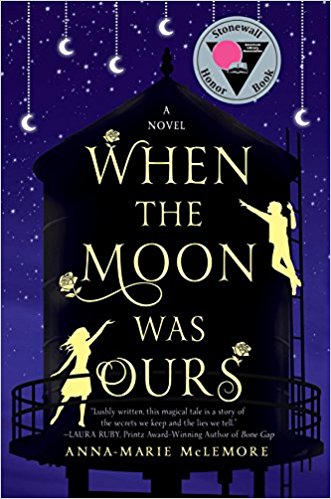
When the Moon Was Ours
Author: Anna-Marie McLemore
Published October 4, 2016 by Thomas Dunne

Goodreads Summary: To everyone who knows them, best friends Miel and Sam are as strange as they are inseparable. Roses grow out of Miel’s wrist, and rumors say that she spilled out of a water tower when she was five. Sam is known for the moons he paints and hangs in the trees, and for how little anyone knows about his life before he and his mother moved to town. But as odd as everyone considers Miel and Sam, even they stay away from the Bonner girls, four beautiful sisters rumored to be witches. Now they want the roses that grow from Miel’s skin, convinced that their scent can make anyone fall in love. And they’re willing to use every secret Miel has fought to protect to make sure she gives them up.

My Review: This book appears again and again on English department lists for courses about gender and sexuality. After I saw it for the dozenth time, I realized that I had to read it. I loved it so much that I adopted it for my course, and my students read it along with three other texts when we talked about gender and sexuality as they pertain to adolescence. I will admit that a few of my students had difficulty with the magical realism of the book, but overall, they found this book to be incredibly powerful and recommended I continue to use it in the course. There is so much to discuss, and it offers beautiful insight. I attach so many emotions to this book, which proves how much I cared deeply for the characters and content. If you missed this one, you should read it. I promise it will be different than any other book that you’ve read.

Teachers’ Tools for Navigation: The third of my class that read this book developed a great activity to inspire their peers to want to read it. They asked the students: “If an egg could cure your heartsickness, what color would it be? If a flower grew from your wrist, what type of flower would it be? If you could hang a moon from the trees to help you sleep at night, what would it look like? Or, pick another object to connect with.” We had a lot of fun discussing the great possibilities.

Discussion Questions: 

  • Why is this book used often in college English courses? What makes it so impactful?
  • What does this book teach you about people, places, life, and quite frankly, humanity as a whole?
  • There are a very many magically realistic objects in the text. If you examine them closely, what does each mean? For example, why are glass pumpkins growing in the town?

We Flagged: “Miel was a handful of foil stars, but they were the fire that made constellations” (p. 12).

Read This If You Love: Magical realism, books that make you think, books that push binary traditions of gender

Recommended For: 

closereadinganalysisbuttonsmall classroomlibrarybuttonsmall litcirclesbuttonsmall

RickiSig

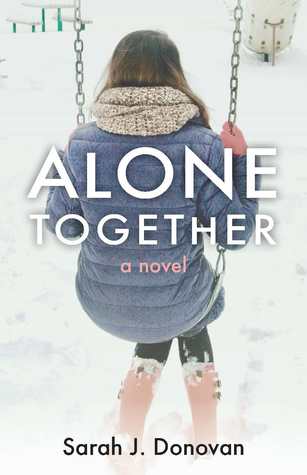
Alone Together by Sarah Donovan

Share

Alone Together
Author: Sarah J. Donovan
Published: May 1, 2018 by Seela Books

Summary: Sadie Carter’s life is a mess, as wavy and tangled as her unruly hair. At 15, she is barely surviving the chaos of her large Catholic family. When one sister becomes pregnant and another is thrown out, her unemployed dad hides his depression, and her mom hides a secret. Sadie, the peacekeeper and rule-follower, has had enough. The empty refrigerator, years of hand-me-downs, and all the secrets have to stop. She longs for something more and plans her escape.

However, getting arrested was not her plan. Falling in love was not her plan. With the help of three mysterious strangers—a cop, a teacher, and a cute boy—maybe Sadie will find the strength to defy the rules and do the unexpected.

Told in verse, Sarah J. Donovan’s debut Alone Together has secrets, romance, struggle, sin, and redemption, all before Sadie blows out her 16 candles. It’s a courageously honest look at growing up in a big family.

Review: Sarah’s writing shows that she has a firm grasp on adolescence. The book is a beautiful book in verse. I found myself thinking about the characters long after I had closed the text. Sadie lives in a Catholic household, and she is struggling emotionally. She is the only one of the eleven people in her family to sit at the breakfast table, and one of the few siblings who hasn’t left the family altogether. She is the peacemaker and is sick of the empty fridge and bad choices that others seem to make for her. I think that Sadie has a life that many young people will relate to. She is left wondering about the ways in which people exist alone together. This is a great read, and I will be using it (in part and in whole) in my classes.

Teacher’s Tools for Navigation: The title of this book is quite inspiring. Students might be asked to reflect on all of the ways that we are “alone together” in this world. Teachers can offer space and place for students to critically analyze whether we are alone together or whether we are something else. I’d love to hear students’ thoughts about this.

Discussion Questions: 

  • In this text, what is the role of family? In our world, what role does family play? How are we tied and not tied to our families?
  • How does Sadie’s family impact her life?
  • How does Sadie grow within the timeframe of the book? What does she learn?
  • Which verse resonated with you? How does it connect (or not connect) with your life?

Flagged Passage: 

“The only one of eleven

who sets the table every morning

with cereal bowls and spoons,

who matches mounds of socks

without complaint or disdain,

who obeys every stand, kneel, sing in mass

without sneaking out after communion” (6).

Read This If You Love: Because I Am Furniture by Thalia Chaltas; Stop Pretending by Sonia Sones; The House on Mango Street by Sandra Cisneros

Recommended For:

closereadinganalysisbuttonsmall classroomlibrarybuttonsmall

RickiSig

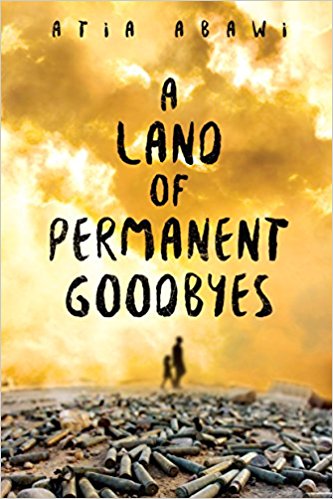
A Land of Permanent Goodbyes by Atia Abawi

Share


A Land of Permanent Goodbyes
Author: Atia Abawi
Published: January 23, 2018 by Philomel

Guest Review by Rachel Krieger

Summary: In a country ripped apart by war, Tareq lives with his big and loving family . . . until the bombs strike. His city is in ruins. His life is destroyed. And those who have survived are left to figure out their uncertain future.

In the wake of destruction, he’s threatened by Daesh fighters and witnesses a public beheading. Tareq’s family knows that to continue to stay alive, they must leave. As they travel as refugees from Syria to Turkey to Greece, facing danger at every turn, Tareq must find the resilience and courage to complete his harrowing journey.

But while this is one family’s story, it is also the timeless tale of all wars, of all tragedy, and of all strife. When you are a refugee, success is outliving your loss.

Review: This book is astonishing. In a world where people like to avoid talking about awkward things or situations that make us sad, this novel is completely, unapologetically honest. With every horror that Tareq experiences, you will find yourself crying with him, hoping with him, and loving with him. You will wish you could be with Alexia helping these people to find new lives. It is impossible to read Abawi’s story without reflecting on your own life, wondering what destiny would write about you.

If you know nothing about the refugee crises happening all over the world, this story will give you a glimpse into the lives of people struggling every day. Although it only looks into the lives of a few refugees, it gave me an idea of how different the life of a refugee is to my own. Atia Abawi’s story will make you reflect on your own humanity and actions, changing the way you think about the world and your own privilege.

Teacher’s Tool For Navigation: This is the perfect book to start a discussion about the situation in Syria. Since it is so essential to address current events regardless of the sensitive nature of those events, teachers should start conversations about this war-torn region. There are many young adult novels that address immigration, however, this one specifically follows the process of that immigration. It would be very beneficial to have students read a book like this and a book like American Street to look at very different stories of immigration with a few similar characteristics. This book in conjunction with others about immigration could be the perfect opportunity to discuss the idea of the danger of a single story.

This novel also offers a very interesting twist on narration. Since destiny is the narrator of this novel rather than one of the characters, there are small parts of the story that reflect broadly on war and humanity. It could be interesting to have students think about how this odd source of narration changes the story. They could even experiment with their own unique narrators, discussing how these odd points of view add or detract from stories.

Discussion Questions: What does the perspective switch add to the novel? Do you think a book like this is likely to encourage people to support this cause? How does Destiny as the narrator change this story? How would this story change if Tareq was a woman?

We Flagged: “Making it to Germany ended Tareq’s crossing and escape from war, but his new life as a refugee is just beginning. There are millions of Tareq’s, Susans and Fayeds, all in search of safety and kindness. I hope you will provide that warmth, be that helper, do what you can to make that world a better place. Because when I meet you—and I will—there will be reckoning. There always is.”

Read This If You Loved: Between Shades of Gray by Ruta Supetys, American Street by Ibi Zoboi, Picture Us in the Light by Kelly Loy Gilbert

Recommended For: 

classroomlibrarybuttonsmall 

RickiSig

Miles Away from You by A. B. Rutledge

Share

Miles Away from You
Author: A. B. Rutledge
Published: March 20, 2018 by HMH Books for Young Readers

Guest Review by Kaari von Bernuth

Goodreads Summary: It’s been three years since Miles fell for Vivian, a talented and dazzling transgender girl. Eighteen months since a suicide attempt left Vivian on life support. Now Miles isn’t sure who he is without her, but knows it’s time to figure out how to say goodbye.

He books a solo trip to Iceland but then has a hard time leaving the refuge of his hotel room. After a little push from Oskar, a local who is equal parts endearing and aloof, Miles decides to honor Vivian’s life by photographing her treasured Doc Martens standing empty against the surreal landscapes. With each step he takes, Miles finds his heart healing–even as he must accept that Vivian, still in a coma, will never recover.

Told through a series of instant messages to Vivian, this quirky and completely fresh novel explores love, loss, and the drastic distances we sometimes have to travel in order to move on.

Kaari’s Review: I’d like to preface this blog post by saying that I do not identify as LGBTQ in any way, so I don’t have personal experiences to say whether or not this novel presents an accurate representation of what it is like to be an LGBTQ person. But, I think that this book does provide a compelling and interesting perspective that non-LGBTQ people can understand and connect with. I liked that the entire story was written in a messaging format. It placed an interesting lens over the story because, as readers, we always know that the story is being written to someone, even if they can’t respond. The format also lends itself to casual language, which makes it an entertaining and engaging read that students will love.

This book was certainly entertaining, and I loved reading it. I loved cheering for Miles and hurting for Miles when it was appropriate. I think that Miles’ approach to grief is also an approach that many teens can connect with, and maybe learn from as well. However, this book has a lot going on in it. The main character, Miles, is coping with the loss of his transgender girlfriend. His two lesbian moms are very supportive of the LGBTQ community, and even run a summer camp for LGBTQ kids. And, Miles himself is unsure of his sexuality, which he explores more as the novel goes on. Because there are so many LGBTQ elements the author tried to fit in, it feels a little bit contrived at times, and distracts from the overall messages of acceptance of personal identity, and also of the LGBTQ community, and dealing with the intricate and complicated loss of a loved one.

Teachers’ Tools for Navigation: I think this book poses a lot of really interesting questions about suicide, grief, overcoming grief, acceptance, identity, potential abuse (between Oskar and his boyfriend), love, gender, and sexuality that could spark a lot of discussions for students. For these reasons, I think that this book should definitely be included in classroom libraries, and used as a literature circle book. However, if someone is looking to teach an lgbtq book to an entire classroom, I’d choose one that didn’t have quite as many lgbtq aspects, as I mentioned in the review, because it makes the book feel somewhat cluttered and contrived, and there are many other novels that would be better for teaching to a large classroom.

Discussion Questions: 

  • How is identity explored in this novel?
  • How is discrimination portrayed in this novel?
  • What kinds of violence/abuse do we see in the novel?
  • How is death/dying portrayed?
  • How does Miles cope with grief? What ways are productive and what ways are unproductive?

We Flagged: “This is the Mid-Atlantic Ridge, the place where the North American and Eurasian tectonic plates are slowly, slowly tearing apart. It sounds so destructive, doesn’t it? Like the world could just keep spreading and eventually it’ll just crack in half and bleed out into the universe. But the good news is that it doesn’t actually work like that. When the earth splits, lava rises and cools, creating new land where there wasn’t any before. It heals as it tears. I think humans do that, too. So, anyway, this is the tenth photo I’ve taken of Vivian’s boots, and it might be my last for a little while. I do want to keep connecting and keep exploring this new scar tissue.” -Advanced Reading Copy page 224

Read This If You Loved: Beautiful Music for Ugly Children by Kirstin Cronn-Mills; Symptoms of Being Human by Jeff Garvin; If I Was Your Girl by Meredith Russo; Suicide Notes by Michael Thomas Ford

Recommended For:

classroomlibrarybuttonsmall

  RickiSig

**Thank you to Kaari for reviewing this book!**

Forest of a Thousand Lanterns by Julie C. Dao

Share

Forest of a Thousand Lanterns
Author: Julie C. Dao
Published: October 10, 2017 by Philomel

Guest Review by Kaari von Bernuth

Goodreads Summary: An East Asian fantasy reimagining of The Evil Queen legend about one peasant girl’s quest to become Empress–and the darkness she must unleash to achieve her destiny.

Eighteen-year-old Xifeng is beautiful. The stars say she is destined for greatness, that she is meant to be Empress of Feng Lu. But only if she embraces the darkness within her. Growing up as a peasant in a forgotten village on the edge of the map, Xifeng longs to fulfill the destiny promised to her by her cruel aunt, the witch Guma, who has read the cards and seen glimmers of Xifeng’s majestic future. But is the price of the throne too high?

Because in order to achieve greatness, she must spurn the young man who loves her and exploit the callous magic that runs through her veins–sorcery fueled by eating the hearts of the recently killed. For the god who has sent her on this journey will not be satisfied until his power is absolute.

Kaari’s Review: The entire time, I wasn’t entirely sure if the  protagonist was the hero or the villain. And, that isn’t necessarily a bad thing! I appreciated this book because it made me think. I’d be cheering for Xifeng and wanting her to win, and then she’d do an awful thing to help her win, and I’d be repulsed by her. This book highlights the struggle of ambition, and how difficult it is for a woman to achieve the dreams she has. And, while I am off put by Xifeng’s methods and don’t necessarily think they were the right decisions, her actions and the way she achieves power could spark great discussions.

The setting and the plot of this book was thrilling, and I Ioved the way that fantasy was woven into a world so seamlessly. The creatures and ideas introduced were thought provoking and had amazing descriptions that made me feel like I was living in the enchanted world with the characters. I do wish that there had been some more resolution regarding some of the magical beings and the warnings they gave, but I think that Dao intends for this to be the first in a series, and I’m sure that more resolution will come in later novels.

Teachers’ Tools for Navigation: I would definitely include this book in a classroom library for kids to check out if they want to read it. However, while this book is interesting, and explores an interesting take on female empowerment, I don’t think I would teach this book in a classroom setting, or use it in literature circles. I am a huge advocate for female empowerment, and discussing the paths for women to claim their power. However, I think that because Xifeng’s methods were so morally questionable, and readers aren’t sure if Xifeng is a hero or a villain, that Forest of a Thousand Lanterns is not the best novel to discuss for this topic. There are many other books that discuss female empowerment in a much more productive light. So, I’d include it in a classroom library, but not necessarily teach it in any way.

Discussion Questions: Do you think Xifeng’s methods were justifiable?; What does the social hierarchy look like in this novel?; Is Xifeng a hero or a villain in this story?; What is the effect of portraying a strong female protagonist in this way?; How is the fantasy world characterized?

We Flagged: “‘I’m a good man, Xifeng. I let you have your own way and speak your mind…’

‘You think I don’t know that? That I’m so blind and stupid?’

‘Yes, I do!’ he shouted, his face bright red. ‘I offer you the world…’

‘Yes, the world as you see it!’

‘I saved you from that evil woman!’

‘Only to trap me yourself.’ She watched him turn away and run a trembling hand over his head. ‘I was Guma’s, and now you want me to be yours. I have my own soul and my own destiny, and I’m tired of belonging to someone else’” (Advanced Reader Copy p. 125).

Read This If You Loved: Monstress by Marjorie M. Liu; Gunpowder Alchemy by Jeannie Lin; Girls Made of Snow and Glass by Melissa Bashardoust

Recommended For:

classroomlibrarybuttonsmall

  RickiSig

**Thank you to Kaari for reviewing this book!**