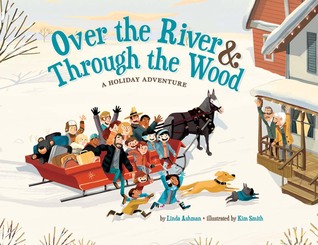
Over the River & Through the Wood: A Holiday Adventure Author: Linda Ashman
Illustrator: Kim Smith
Published October 6th, 2015 by Sterling Children’s Books
Summary:
Pack up the pooches and load the van. We need to leave by eight! There’s so much to bring. Do we have everything? Come on, we can’t be late!
The classic song gets a fresh new twist! The fun begins when Grandma and Grandpa send invitations to their far-flung, modern, and multiracial family: Come to our house for the holidays—and bring your favorite pie!Off everyone goes, driving down snowy roads, riding the train, boarding a plane . . . even sailing along in a hot-air balloon. As each family faces an obstacle that delays their trip, they learn that sometimes the most old-fashioned form of transportation works best . . . NEIGH!
About the Author: Linda Ashman has written more than 20 children’s books, including Creaky Old House; Stella, Unleashed; No Dogs Allowed!, and TheTwelve Days of Christmas in Colorado (all Sterling). She lives in Chapel Hill, NC. Visit Linda online at lindaashman.com.
About the Illustrator: Kim Smith has a fun and vibrant extended family, perfect as inspiration for this book. This is the fourth children’s book she has illustrated, along with A Ticket Around the World (Owlkids Books), The Raven and the Loon (Inhabit Media), and The Twelve Days of Christmas in Canada (Sterling, NYP). Kim lives in Calgary, Alberta, with her husband, Eric, and their one-eyed goldfish named Goulash.
Kellee’s Review:Holidays are a great time to celebrate spending time with families, and Over the River & Through the Wood highlights the highs and lows of traveling to see family for the holidays. Told in the same rhythm as the original song, the book has been modernized to include families coming from all different places to go visit family. I also loved the different types of families that were represented in the book. It shows real families and how they are all so different.
Ricki’s Review:This text emanates warmth. I pulled my little guy onto my lap, and we cuddled as we read it together. I enjoyed the sense of adventure, and I might read this book before we go on a big family trip. While my son is only two, I had a nice time discussing what the family was doing and how our family holidays are similar and different. As a teacher I might include this with other holiday books to give a rich sense of different customs and practices of holidays.
Teachers’ Tools for Navigation: Since the book is written to match the original song, it’d be fun to have students write their own version of the song that fits their experiences at the holidays. Or, they might take another song (holiday or not) and adjust the words to fit their culture/customs/experiences.
Discussion Questions: How do different families’ experiences differ during the holidays in the book? In real life?; What different types of families are in the book? In real life?; What differences are there between the original song and the book?
We Flagged:
Read This If You Loved: Other versions of Over the River and Through the Wood including those by Lydia Maria Francis Child or John Steven Gurney
Recommended For:
and
**Thank you to Sterling for providing copies for review!**
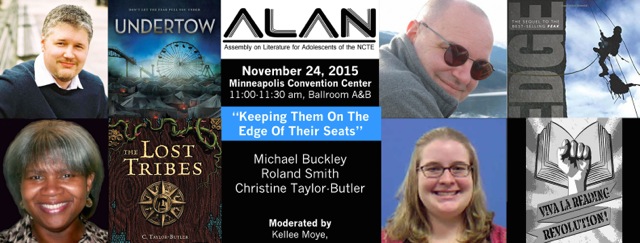
In addition to my NCTE sessions about Bridging the Gender Gap with humor and the Amelia Elizabeth Walden Award, I am also moderating an action/adventure panel during the 2015 ALAN Workshop! During the panel, we’ll be touching on how to add suspense to novels, writing techniques when writing action/adventure, characterization vs. plot in action/adventure novels, and how to keep an action story fresh through a series.
I am looking forward to presenting with these authors, and I wanted to take a day to share their wonderful (and action-packed!) books with you all.
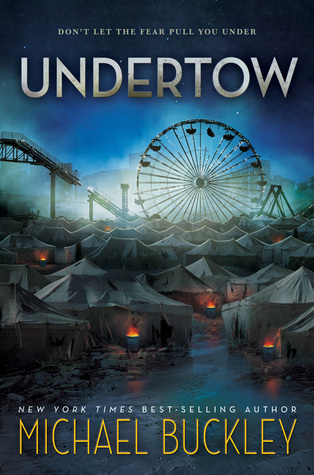
Undertow Author: Michael Buckley
Published May 5th, 2015 by HMH Books for Young Readers
Goodreads Summary: Sixteen-year-old Lyric Walker’s life is forever changed when she witnesses the arrival of 30,000 Alpha, a five-nation race of ocean-dwelling warriors, on her beach in Coney Island. The world’s initial wonder and awe over the Alpha quickly turns ugly and paranoid and violent, and Lyric’s small town transforms into a military zone with humans on one side and Alpha on the other. When Lyric is recruited to help the crown prince, a boy named Fathom, assimilate, she begins to fall for him. But their love is a dangerous one, and there are forces on both sides working to keep them apart. Only, what if the Alpha are not actually the enemy? What if they are in fact humanity’s only hope of survival? Because the real enemy is coming. And it’s more terrifying than anything the world has ever seen.
Action, suspense, and romance whirlpool dangerously in this cinematic saga, a blend of District 9 and The Outsiders.
My Review: What a unique book! I was intrigued with the whole concept from the very beginning, and I had to know what was going to happen to the characters. Mer-people have begun living on the beaches of Coney Island, and Americans, instead of trying to understand, have fought and banished them; however, as Undertow starts, we learn they are trying to integrate the schools. Lyric is our protagonist and has a secret that makes this integration dangerous for her. Her adventure through Undertow definitely held my attention! Although Buckley built an entire new mythology of merpeople within the book, the characters and plot are strong enough to make the mythology seem seamlessly part of the world Buckley has created. Lyric is quite an interesting character, but the more you learn about her, the more it makes sense. I also found the integration aspect of the novel a bit reminiscent of school integration in the 60’s and would love to know if that is what Buckley intended.
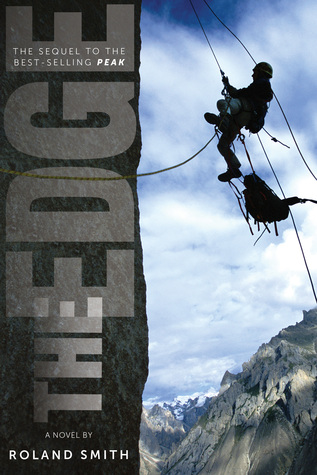
Peak: The Edge Author: Roland Smith
Published October 6th, 2015 by HMH Books for Young Readers
Goodreads Summary: The International Peace Ascent is the brainchild of billionaire Sebastian Plank: Recruit a global team of young climbers and film an inspiring, world-uniting documentary. The adventure begins when fifteen-year-old Peak Marcello and his mountaineer mother are helicoptered to a remote base camp in the Hindu Kush Mountains on the Afghanistan-Pakistan border. When the camp is attacked and his mother taken, Peak has no choice but to track down the perpetrators to try to save her.
My Review: Though The Edge is the sequel to Peak, it could definitely be read as a stand-alone, though I highly recommend reading Peak as well. The Edge was one of the most intense reads I’ve read in a while. As soon as the attacks happen, I could not put the book down because I needed to know what, why, and how: what happened?!; Why did they do it?!; and How are they going to save them?! Smith’s ability to write characters the reader cares about mixed with his ability to build suspense just makes this a book that definitely keeps you on the edge of your seat!
The Lost Tribes Author: C. Taylor-Butler
Published March 25th, 2015 by Move Books
Goodreads Summary: Five friends are in a race against time in this action-adventure story involving ancient tribal artifacts that hold the fate of the universe in the balance. None of these trailblazers imagined their ordinary parents as scientists on a secret mission. But when their parents go missing, they are forced into unfathomable circumstances and learn of a history that is best left unknown, for they are catalysts in an ancient score that must be settled. As the chaos unfolds, opportunities arise that involve cracking codes and anticipating their next moves. This book unfolds sturdy, accurate scientific facts and history knowledge where readers will surely become participants.
My Review: This book surprised me! I cannot tell you what surprised me because I want it to surprise you, but the book ended up being very different than what I thought it was going to be. The book introduces us to Ben who is given a computer game to solve from his Uncle Henry. Ben just wants to impress Henry, so he vows to complete the game. Along with his 3 friends and his sister, Ben immerses himself in the game only to find out it is more than he could even imagine. The book has riddles, codes, and information throughout, and I definitely could see fans of Tombquest or 39 Clues enjoying this adventure. But, once again, this book isn’t as it seems!
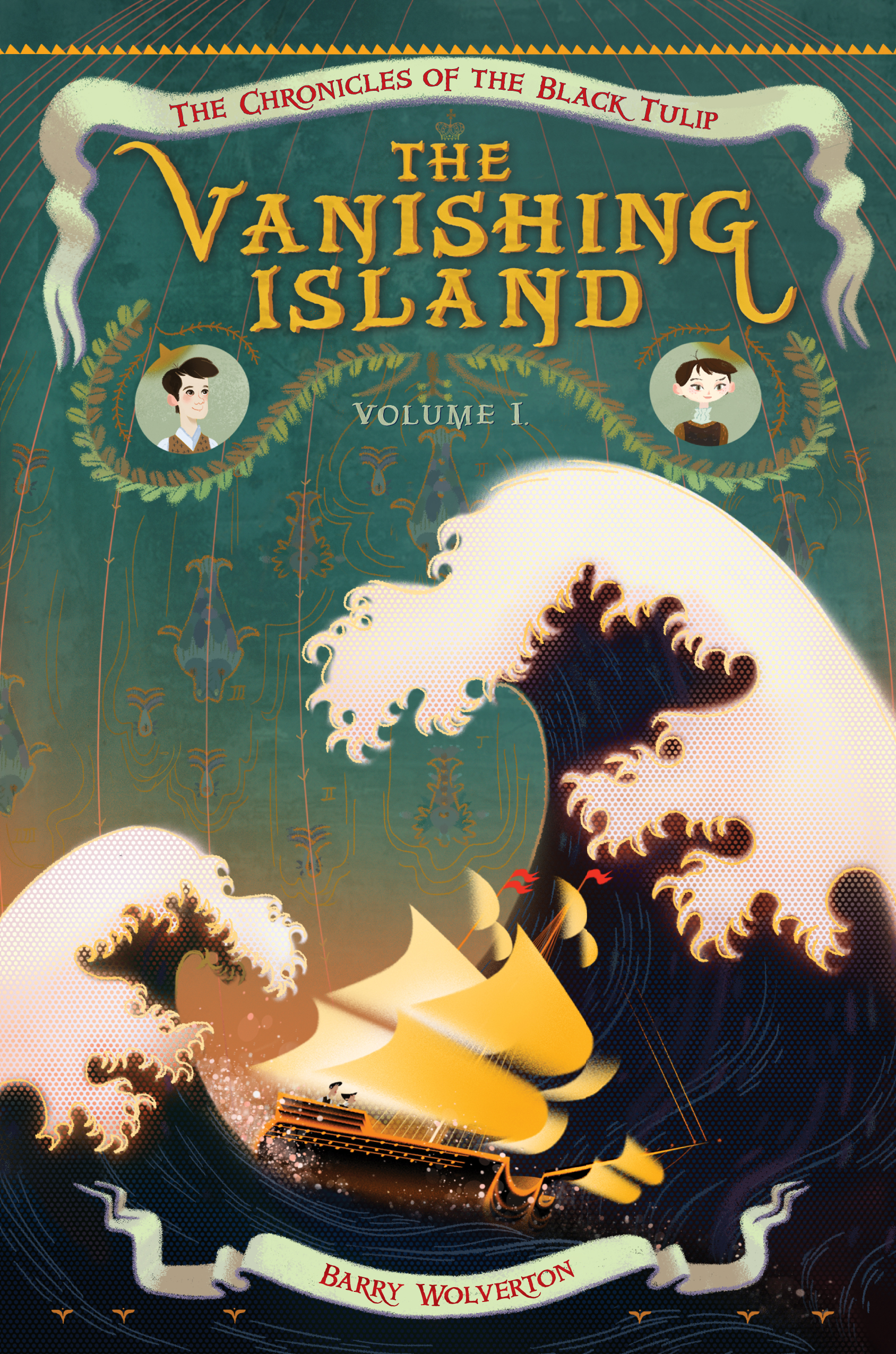
The Chronicles of the Black Tulip: The Vanishing Island Author: Barry Wolverton
Published September 1st, 2015 by Walden Pond Press
Goodreads Summary: Does the Vanishing Island really exist? And if so, what treasure—or terrible secret—was hidden by its disappearance?
It’s 1599, the Age of Discovery in Europe. But for Bren Owen, growing up in the small town of Map on the coast of Britannia has meant anything but adventure. Enticed by the tales sailors have brought through Map’s port, and inspired by the arcane maps his father creates as a cartographer for the cruel and charismatic map mogul named Rand McNally, Bren is convinced that fame and fortune await him elsewhere. That is, until his repeated attempts to run away land him a punishment worse than death—cleaning up the town vomitorium.
It is there that Bren meets a dying sailor, who gives him a strange gift that hides a hidden message. Cracking the code could lead Bren to a fabled lost treasure that could change his life forever, and that of his widowed father. But to get there he will have to tie his fate to a mysterious Dutch admiral obsessed with a Chinese legend about an island that long ago disappeared from any map.
Before long, Bren is in greater danger than he ever imagined, and will need the help of an unusual friend named Mouse to survive. Barry Wolverton’s thrilling adventure spans oceans and cultures, brings together the folklore of East and West, and proves that fortune is always a double-edged sword.
My Review: Whoa! Quite a book! Part swashbuckling adventure, part historical fiction, part folklore, part fantasy, part ghost story, Barry Wolverton has given us quite an intense adventure. I couldn’t predict anything that happened in the book. There were twists and turns throughout, and I never knew who to trust (though I am happy to say my favorite sailor was trustworthy). There were some really gruesome parts (blood and guts and vomit) and there were some really beautiful fairy tales. Overall, quite an adventure! (Though I warn: by gruesome, I mean gruesome!)
Discussion Questions: How did the author use folklore throughout the story to move along the plot?; What parts of history that were shared within the book were true? Fictional?; Throughout the book, stop and try to predict what you think is going to happen next then check your predictions as you read more.; As you read, make a list of all of the seafaring vocabulary that is used within The Vanishing Islands then illustrate each of the vocabulary words as they are used in the book.; Wolverton used Marco Polo’s written works throughout the book–what allusions to Polo’s text can you find in The Vanishing Island?
We Flagged: “The summer began with the grim warning that the wolves were running again. In Britannia, this was code. It meant that Her Majesty’s navy was in need of fresh bodies to replace all of the seamen lost during the year to disease, desertion, or battle. Crimping, they called it. Men and older boys kidnapped and forced to enlist, of the good of God, queen, and country. Britannia, after all, was just one of many nations fighting for nothing less than to control the world.
One boy who didn’t have to worry about being crimped was Bren Owens of Map, the dirtiest, noisiest, smelliest city in all of Britannia. (He had heard rotten things about London, too, but he’d never been there.) Bren was what they called spindly–tall for his age, but unsteady, like a chair you might be afraid to sit on. He had been born in Map because he’d had no choice in the matter.
But that didn’t mean he had to stay here. And now, too skinny for the wolves, he had been forced to take matters into his own hands.” (p. 9-10)
Author Guest Post:
“Be Careful What You Read, or Why Books Are Dangerous” by Barry Wolverton
Beginning in 1978, when Metrocenter mall opened near my home in Jackson, Miss., my family would go to the mall every Friday night. We would have dinner at one of the fine mall establishments, and then my mother would go clothes shopping, my brother would go nerd out at Radio Shack or Spencer’s, my father would go sit somewhere and smoke (you could do that then), and I would plop myself down in an aisle at Waldenbooks. I remember exactly how it felt to have that to look forward to, which is why Black’s Antique Books and Collectibles is Bren’s home away from home in The Vanishing Island. (Although the way I describe Black’s is more like I remembered Shakespeare and Co. in Paris, the ur-bookstore.)
But for a curious, receptive mind, books can do mischievous things. As I describe it in the book, “the bookstore was a blessing and a curse for [Bren]. Every few weeks seemed to bring in new adventure books, travelogues, and epic poems of war and conquest that were so popular these days. Tales from other lands and other times. For Bren, they offered proof that all things exotic and exciting lay anywhere but here.”
Books give Bren ideas. Ideas about places he’d rather be, things he’d rather be doing, possibilities that his current life doesn’t offer. Books also give him information. For instance, information about ships and the routines of their crew, so that an enterprising young man might figure out the best time to sneak aboard a ship and the best places to hide.
And it was undoubtedly in Black’s that Bren first found a copy of Travels by Marco Polo, the book that National Geographic described as “the founding adventure book of the modern world. Polo gave to the age of exploration that followed the marvels of the East, the strange customs, the fabulous riches, the tribes with gold teeth. It was a Book of Dreams, an incentive, a goad. Out of it came Columbus (whose own copy of the book was heavily annotated), Magellan, Vasco da Gama, and the rest of modern history.”
Wow, some book. Especially considering how much of it is considered dubious. Polo dictated his stories to a fiction writer named Rustichello while both were in prison during the Venice-Genoa war, and between Polo’s possible exaggerations and Rustichello’s flare for embellishment, we can be pretty sure Marco Polo didn’t really see a unicorn. (He may have seen a Sumatran rhino, though, which is still magical.)
Given all that, I hope you’ll appreciate why the Polo legend figures prominently in The Vanishing Island, without making light of the terrible cost of exploration and colonialism.
About the Author: Barry Wolverton is the author of Neversink. He has more than fifteen years’ experience creating books, documentary television scripts, and website content for international networks and publishers, including National Geographic, Scholastic.com, the Library of Congress, and the Discovery Networks. He lives in Memphis, Tennessee. You can visit him online at www.barrywolverton.com.
Read This If You Loved: The True Confessions of Charlotte Doyle by Avi, The Graveyard Book by Neil Gaiman, Emerald Atlas by John Stephens, The Dungeoneers by John David Anderson
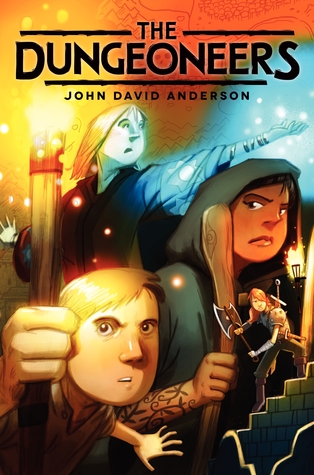
The Dungeoneers Author: John David Anderson
Published June 23, 2015 by Walden Pond Press
Publishers Summary: The Dungeoneers is an action-packed, funny, and heartbreaking middle grade fantasy-adventure from the author of the acclaimed Sidekicked and Minion, John David Anderson.
The world is not a fair place, and Colm Candorly knows it. While his parents and eight sisters seem content living on a lowly cobbler’s earnings, Colm can’t help but feel that everyone has the right to a more comfortable life. It’s just a question of how far you’re willing to go to get it.
In an effort to help make ends meet, Colm uses his natural gift for pickpocketing to pilfer a pile of gold from the richer residents of town, but his actions place him at the mercy of a mysterious man named Finn Argos, a gilded-toothed, smooth-tongued rogue who gives Colm a choice: he can be punished for his thievery, or he can become a member of Thwodin’s Legions, a guild of dungeoneers who take what they want and live as they will. Colm soon finds himself part of a family of warriors, mages, and hunters, learning to work together in their quest for endless treasure. But not all families are perfect, and even as Colm hones his skills with fellow recruits, it becomes clear that something from outside threatens the dungeoneers–and perhaps something from inside as well.
My Review: This is one of those fantasy novels that transports you to another place and throws you into an adventure that keeps you guessing and reading. In The Dungeoneers, I loved going to school with Colm and learning all about dungeoneering ways including how to be the best rogue, history of dungeoneering, swordplay, and all about monsters. This aspect reminded me a bit of Harry Potter because I got so sucked into his schooling and education, like I did with Harry’s, because I wanted to know everything I could about this world. The Dungeoneers also has some majorly suspenseful moments which makes sense in a book about stealing treasure from dungeons. In addition to his world building, he really knows how to build some characters! The three other members of Colm’s guild are such well-rounded characters and all so different. I can picture each of them, and I so want to be their friends (even Lena, who is a bit barbaric). I also loved the plot twist at the climax of the book! I did not see it coming! Just wait for it everyone!
Teachers’ Tools for Navigation/We Flagged: First and foremost, if you teach middle school, you should probably buy this for your classroom. High fantasy and adventure lovers are going to eat this one up.
Also, if you want to talk to students about building characters or setting, this book can definitely be a help with either. There are specific sections in this book that could be pulled out and used to discuss imagery, word choice, and characterization:
“In the flickering torchlight it was hard to make out all of her features clearly, but he couldn’t miss the sharp chisel of her chin, like a weapon itself. Her crimson hair was cropped short in the back, falling across one eye in front, the other shining brown in the flicker of light. Her lips were pursed, pulled tight against her teeth in a determined smirk.” (p. 93)
“Except Quinn didn’t look like he could call lightning from the sky or produce fireballs from his fingers. Colm had expected the first wizard he met to be more in keeping with the descriptions from his book–white-bearded and billowing and larger than life. Quinn looked barely big enough to summon his own shadow.” (p. 96)
“In contrast to the dreary tunnel behind them, the great hall before them was filled with light. Huge chandeliers hung from chains of gold, the flicker of a thousand candles casting fiery halos against the ceiling. Giant marble pillars anchored the four corners of the room, and a hug winding staircase with gold rails led both up and down in its center like a vortex. The floors were polished marble as well, dark green and buffed to a mirror sheen. A strange clock with twenty-four separate hourglasses hung over a set of huge double doors…” (p. 115)
Discussion Questions: If you were Colm, would you have gone with Finn?; What secret do you think Wolfe is keeping?; Lena is expected by her family to do well as a barbarian because of her upbringing. How would it feel to have that type of pressure put on you?; Colm makes a decision at the end of the book–do you agree with it or not?
Book Trailer:
John David Anderson’s Top Five Dungeoneers
Obviously The Dungeoneers owes a lot to fantasy tropes and conventions that have been around since Gandalf packed his first pipe. In fact, while writing it I sometimes felt like I should roll a d20 to see what my characters would do next (here’s hoping the book is a critical hit—ah, nerd humor). Afternoons spent playing Baldur’s Gate or reading Mercedes Lackey (or in my younger days, Lloyd Alexander) coalesced into a love of sword-swinging, lock-picking, monster-bashing rogues who risk everything on the hopes of finding that fabled cache of riches at the end of the corridor. In short, I was raised by dragons. Maybe I’m a Targaryen.
Obviously popular culture is not hurting for dungeoneers of interest, but I thought I would pick five key dungeon divers that had a distinct influence on me and the book. Note: I am defining a dungeoneer as anyone who willingly enters into some dank, creature-and-trap-infested cavern, catacomb, crypt, tomb or lair with the express purpose of taking whatever shiny, valuable objects are to be had. In other words, I’m kind of liberal with my use of the word.
5. Minsc and Boo: If you’ve ever played the game Baldur’s Gate, you will know these two. Minsc, the butt-kicking, infinitely quotable ranger, and his trusty hamster, Boo. Minsc was a tank and liked to carry big swords. More than that he had a big heart and recognized a noble enterprise, especially when it required some head bashing. Favorite quote: “Make way evil! I’m armed to the teeth and packing a hamster!
4. Ellen Ripley. All right, this one is a stretch, I admit, but in Aliens she does go down into a lair and fight off monsters (lots of them, including a queen) to rescue something she treasures (the little girl, Newt). Plus ever since I saw Aliens I’ve been drawn to tough female characters. I won’t lie—there’s a little bit of warrant officer Ripley’s feistiness in The Dungeoneers’ Lena Proudmore, though Lena doesn’t get to fire a grenade launcher (much to her chagrin).
3. Bilbo Baggins. You could name several characters from Tolkien’s mythos that fought their way out of dungeons, but Bilbo gets the cake for not coming out empty-handed. In fact, it’s the Burglar’s snatching of the Precious that drives the mythology. What did you find down there in the goblin caves, Bilbo? Oh—just the makings of a gazillion-dollar franchise. Finn Argos would be proud.
2. Link. Yes, it’s another video game, but for me, Link was the start of my love affair with dungeoneering. Link never met a rupee he didn’t like and spelunking through monster-infested lairs in search of Zelda was in his spritely 8-bit blood. I can still remember playing the original Zelda and getting eaten by an undulating stack of pancakes or impaled by a triceratops all because I didn’t know I was supposed to feed it bombs. To this day I still carry around a candle and a big stick of meat. Thank you Nintendo for stimulating my imagination and sucking away my time.
1. Indiana Jones. No sword (except in the second movie, and then it’s more of a machete). No armor. No dragons or ogres or orcs (though the Nazis are monstrous enough). But Indy, for me, is the archetypal treasure-hunter. Not only was he the dashing film hero of my childhood (and what I wanted to be when I grew up until I realized that everything cool had already been dug up already), he also helped engender my love for wise-cracking, whip-smart, ruggedly-charming, and occasionally flawed protagonists. His make-it-up-as-you go philosophy and daredevil antics were often replicated by a young, eight year old boy named Dave, who would pretend the floor was made of lava as he jumped from dining room table to couch and back again. Plus Indy knew that the greatest treasures always came at a price, a lesson that struck a chord with me.
So those are my top five. I’m sure your list is different. That’s the cool thing about inspiration—there are a lot of wells, and we get to drink from whichever ones we please. Who knows, maybe in twenty years some kid will be making a list of his favorite dungeoneers and put Colm Candorly somewhere near the top.
Read This If You Loved:Hero’s Guide (series) by Christopher Healy, Harry Potter (series) by J.K. Rowling, Foiled (series) by Jane Yolen, Giants Beware! (series) by Jorge Aguirre
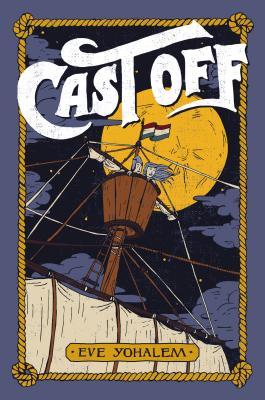
Cast Off: The Strange Adventures of Petra de Winter and Bram Broen Author: Eve Yohalem
Published: March 10, 2015 by Calkins Creek
GoodReads Summary: It’s 1663 and there is an extra passenger on board a Dutch merchant ship setting sail for the East Indies. Twelve-year-old Petra has stowed away to escape her abusive father. But she quickly realizes that surviving for months at sea will be impossible without help. So when Bram, the half-Dutch / Half-Javanese son of the ship’s carpenter, finds her hiding spot, Petra convinces him to help her stay hidden . . .and help disguise her as a boy.
If Petra is discovered and exposed as a girl, she could be tossed overboard, or worse . . . returned to her father. And if Bram is exposed for helping her, he could lose the only home—and family—he has. As tensions rise on the ship, with pirates attacking, deadly illness, and even mutiny, Petra and Bram face impossible decisions that test their friendship and threaten their dreams of freedom.
Told in alternating voices and filled with secrets and intrigue, this richly researched novel is historical fiction at its best.
Review: Take me away! This book whisked me off on a marvelous adventure filled with grave dangers, stow aways, tall ships, and mutiny. I couldn’t help but be reminded of one of my childhood favorites, The True Confessions of Charlotte Doyle by Avi. Petra escapes from a horribly abusive relationship with her father, and her bravery is an excellent model for young readers. She is discovered by Bram, the illegitimate son of the ship’s carpenter, and they form a very special friendship. This book delivers richly realized themes—particularly those of loyalty, heroism, sexism, and racism—that are very relevant to readers across time. I imagine a wide variety of audiences would appreciate this text because it touches on so many fascinating topics. It is clear that the author did her homework, and the result is magnificently entertaining.
Teachers’ Tools for Navigation: This book is an excellent example of a text that could be analyzed with a critical theorist lens. (See Appleman’s book about teaching critical theory to students of all levels.) I imagine rich classroom discussions would evolve from the application of gender theory or race theory, for instance, to this text. This is a compliment to the author and the depth of this book.
Discussion Questions: In what ways do gender and race play a role in this text?; How does the author weave history into the story?; What does Petra and Bram’s friendship teach us about humans in general?; How do the main characters display qualities of bravery?
Read This If You Loved: The True Confessions of Charlotte Doyle by Avi; Leviathan by Scott Westerfeld; Secrets of the Realm by Bev Stout; Peter Pan by J.M. Barrie
Recommended For:
Giveaway!
One lucky winner will receive a copy of CAST OFF: The Strange Adventures of Petra De Winter and Bram Broen (U.S. addresses; allow 4-6 weeks for delivery; offer ends 7/10/15).
In 2009 I got this great idea for a seafaring adventure about two kids who sail from Amsterdam to the East Indies in the seventeenth century. There was just one problem: I knew next to nothing about the seventeenth century. Or the Netherlands. Or the East Indies. Or sailing.
No matter. I like a challenge. I researched for a full year before I started writing, and after I started writing, I kept researching. I’m still researching. (I like researching.)
Today my Cast Off file has more than four hundred different source notes. I read lots of books: scholarly academic stuff, journalistic stuff, fiction, memoirs, journals, every first person account I could find. I spoke to people who knew much more than me—VOC scholars, maritime scholars, curators, my husband (he sails), surgeons, and dentists. I hung out in oddball museums. I traveled to Indonesia, where I slept in the jungle and held baby orangutans, and to the Netherlands, where I retraced every step of my characters that I could and explored the dark nooks of two different full-scale East Indiamen replicas.
I have no research training. It would have helped if I’d majored in history in college, but I didn’t. Mostly, I followed my nose. I knew that my story would begin in Amsterdam and take place mostly at sea on an East Indiaman bound for Batavia. I knew two of my characters: a Dutch girl and an East Indian boy, both twelve years old. That’s a lot to get started with.
What’s surgery like by candlelight below deck on a rocking ship before the invention of anesthesia? How do you fire a 4,000 pound canon without getting crushed by the recoil? These were the kinds of questions I tried to answer.
I tried to convey what it felt like to cram three hundred men onto a 150-foot long vessel for six months (damp, dark, and airless below, smelled bad, no privacy). The layout of the ship is based on actual ships of the period, as are the various jobs, daily schedule, terrible food.
For my characters’ medical knowledge, I have to thank John Woodall’s The Surgeon’s Mate, a seventeenth century medical guide no ship’s surgeon would have been without.
And in case anyone’s wondering, I got most of my slang from the always entertaining A New Dictionary of the Terms Ancient and Modern of the Canting Crew: In Its Several Tribes of Gypsies, Beggars, Thieves, Cheats, &c., with an Addition of Some Proverbs, Phrases, Figurative Speeches, &c. by B. E. Gent, c 1698. In my opinion, some of these terms should be brought back into everyday use. Please help make “Kiss my blind cheeks!” go viral!
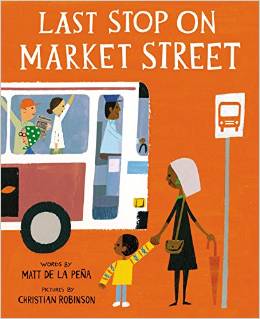
Last Stop on Market Street
Author: Matt de la Peña
Illustrator: Christian Robinson
Published: January 8, 2015 by Putnam Juvenile
Summary: Every Sunday after church, CJ and his grandma ride the bus across town. But today, CJ wonders why they don’t own a car like his friend Colby. Why doesn’t he have an iPod like the boys on the bus? How come they always have to get off in the dirty part of town? Each question is met with an encouraging answer from grandma, who helps him see the beauty—and fun—in their routine and the world around them.
This energetic ride through a bustling city highlights the wonderful perspective only grandparent and grandchild can share, and comes to life through Matt de la Pena’s vibrant text and Christian Robinson’s radiant illustrations.
Ricki’s Review: Matt de la Peña is a literary genius. I pre-ordered this book because I knew it would be excellent, but the story and illustrations blew me away. CJ wonders why he doesn’t have a car, and Nana reassures him that they are better off without one. They take an adventure on a bus to a soup kitchen. Nana sees the beauty in life, and her words are powerful. This is a story about giving back and appreciating what we have. My son and I have read this book dozens of times since we received it. My mother-in-law and husband also enjoyed reading it with him!
Kellee’s Review: This book is a celebration. A celebration of the little things we sometimes miss, of diversity, of kindness, of family, and of beauty. Matt de la Peña’s story is well written and beautifully illustrated with amazing collages by Christian Robinson. Although I haven’t read it with Trent yet, I feel that this book is an important one for him and all kids to read.
Teacher’s Tool For Navigation: What a perfect book for a field trip on a bus to the soup kitchen? Students can describe the people and things they see. This would also make a great homework assignment. Alternatively, teachers might ask students to go to a public place with their parents and describe the people and things they see—they should be instructed to find the beautiful things in their environment.
Discussion Questions: What is Nana’s attitude about life? How do her words show this?; What kinds of things does CJ see on his trip?; How do the illustrations make this story stand out?
We Flagged: “The outside air smelled like freedom, but it also smelled like rain, which freckled CJ’s shirt and dripped down his nose.”
From Matt de la Pena’s website
Read This If You Loved:Nana in the City by Lauren Castillo, Each Kindness by Jacqueline Woodson, A Bus Called Heaven by Bob Graham, Harlem by Walter Dean Myers
Recommended For:
and
**Thank you to Penguin for providing a copy for review**
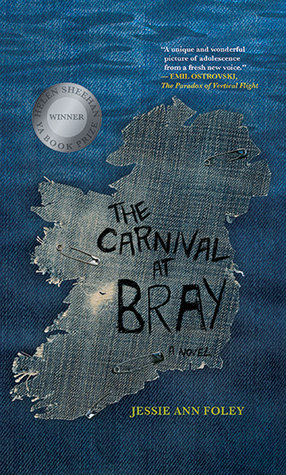
The Carnival at Bray Author: Jessie Ann Foley
Published: October 1, 2014 by Elephant Rock Books
Goodreads Summary: It’s 1993, and Generation X pulses to the beat of Kurt Cobain and the grunge movement. Sixteen-year-old Maggie Lynch is uprooted from big-city Chicago to a windswept town on the Irish Sea. Surviving on care packages of Spin magazine and Twizzlers from her rocker uncle Kevin, she wonders if she’ll ever find her place in this new world. When first love and sudden death simultaneously strike, a naive but determined Maggie embarks on a forbidden pilgrimage that will take her to a seedy part of Dublin and on to a life- altering night in Rome to fulfill a dying wish. Through it all, Maggie discovers an untapped inner strength to do the most difficult but rewarding thing of all, live.
The Carnival at Bray is an evocative ode to the Smells Like Teen Spirit Generation and a heartfelt exploration of tragedy, first love, and the transformative power of music. The book won the 2014 Helen Sheehan YA Book Prize.
Ricki’s Review: When I read the back of this book, I thought, “Hmm.” It felt like a (recent) historical fiction with its emphasis on ’90s grunge music and the highlights of Kurt Cobain’s life. Because my teen years spanned through part of the ’90s, I was intrigued.
My favorite aspect of this book was the fact that the writing felt effortless. Too often, books’ messages or prose feel forced, and with this book, I felt as if I was whisked along for the (very bumpy) ride. As a former high school teacher, I enjoyed the myriad, richly realized themes. The reader feels a wild sense of adventure, the uneasiness that comes with living in a new environment, the loyalty that is tied with love, the heartbreak that emerges with loss and grief, and the utter purity that comes with finding oneself. At times, YA texts feature absent (or horrid) parents, but the complexity of Maggie’s mother was realistic to many parents, I believe. This will leave teens (and adults!) pondering their own relationships with their parents. The intricacies of this text will allow for book groups, students, and readers to have much to ponder and discuss.
Teacher’s Tools for Navigation: This would be a great novel to discuss theme. As stated in my review above, there are many themes to ponder. I would put butcher paper around the room and write a different theme on each paper. Students could travel around the room, discussing each theme, placing post-it notes with evidence from the text. Or, the teacher might discuss a different theme on each day. Beyond the classroom setting, I think this would be an excellent selection for book clubs.
Download the comprehensive study guide (from Elephant Rock Books) here.
Discussion Questions: How does Maggie handle the challenges she faces? Do you think she makes the right choices? Is she brave?; What does her uncle teach her? Was he an admirable character?; What role does the setting (both time and place) play in this novel?; Is Maggie’s mother a positive or negative role in her life?
We Flagged: “But don’t you think that never suffering at all—is its own form of suffering?” (p. 150).
I am not sure whether or not I agree with this quote, but weeks later, I am still thinking about it.
Read This If You Loved: Love Letters to the Dead by Ava Dellaira, Timely Persuasion by Jacob LaCivita, Five Flavors of Dumb by Antony John, The Perks of Being a Wallflower by Stephen Chbosky, Time Between Us by Tamara Ireland Stone, The Future of Us by Jay Asher and Carolyn Mackler,Get Happy by Mary Amato
**A special thank you to Jessica Powers at Cinco Puntos Press for organizing this blog hop and to Elephant Rock Books for providing this book for review!**



 and
and