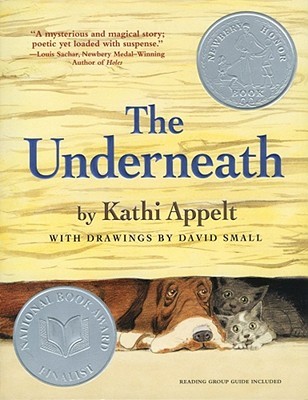
10th Anniversary Celebration of The Underneath by Kathi Appelt with an Interview with the Author, Book Trailer, and Giveaway!

Share

The Underneath
Author: Kathi Appelt
Illustrator: David Small
Published May 6th, 2008 by Atheneum Books for Young Readers
Newbery Honor (2009), National Book Award Finalist (2009)

Summary: There is nothing lonelier than a cat who has been loved, at least for a while, and then abandoned on the side of the road.

A calico cat, about to have kittens, hears the lonely howl of a chained-up hound deep in the backwaters of the bayou. She dares to find him in the forest, and the hound dares to befriend this cat, this feline, this creature he is supposed to hate. They are an unlikely pair, about to become an unlikely family. Ranger urges the cat to hide underneath the porch, to raise her kittens there because Gar-Face, the man living inside the house, will surely use them as alligator bait should he find them. But they are safe in the Underneath…as long as they stay in the Underneath.

Kittens, however, are notoriously curious creatures. And one kitten’s one moment of curiosity sets off a chain of events that is astonishing, remarkable, and enormous in its meaning. For everyone who loves Sounder, Shiloh, and The Yearling, for everyone who loves the haunting beauty of writers such as Marjorie Kinnan Rawlings, Flannery O’Connor, and Carson McCullers, Kathi Appelt spins a harrowing yet keenly sweet tale about the power of love, and its opposite, hate; the fragility of happiness; and the importance of making good on your promises.
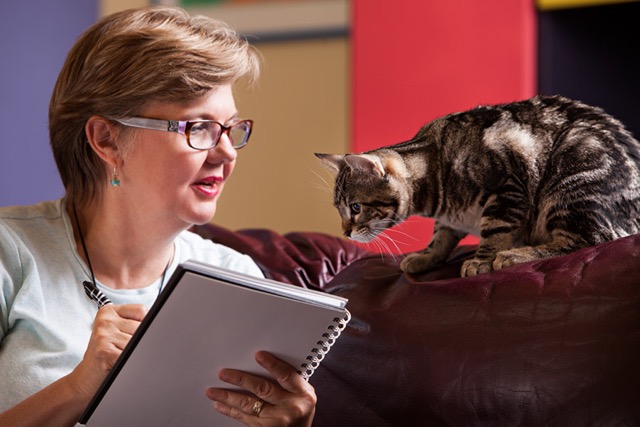
Author: Kathi Appelt is the New York Times best-selling author of more than forty books for children and young adults. Her first novel, The Underneath, was a National Book Award Finalist and a Newbery Honor Book. It also received the PEN USA Award. Her other novels include The True Blue Scouts of Sugar Man Swamp, a National Book Award finalist, and Maybe a Fox, one of the Bank Street Books Best Children’s Books of the Year. In addition to writing, Ms. Appelt is on the faculty in the Masters of Creative Writing for Children and Young Adults at Vermont College of Fine Arts. She lives in College Station, Texas. To learn more, and to find curriculum materials and activity pages, visit her website at kathiappelt.com.

Review: Anyone who has read a Kathi Appelt book knows that she is amazing at two things: weaving a story together in a way that only she can & pulling at heart strings causing definite mood swings while reading. The Underneath is the epitome of her excellence, and I am sad it took me so long to get to this book. Once done, I was very excited to ask Kathi about this masterpiece, and my questions and her answers show more about what makes this book the award winner that it is.

Interview: 

Kellee: How do you work to weave different elements into your story such as mythology, the natural world, and contemporary stories? 

Kathi: It’s always interesting to me to learn what sets a story off. Some authors swear that they start with characters. And I would say that characters are definitely a good place to start. But when I reflect over my many years of writing, I feel like I mostly start with place. I ask, what is it about this place that lends itself to story? What is the history of it? The social and cultural importance of it? Who has lived here? Who was here a thousand years ago? What were they doing? How did they survive? What impact did natural forces play on this place? What is the flora and fauna? Are there ghosts? Are there particular features of it? So, it seems to me that place creates the basis for most of my stories.

In The Underneath, one of my story lines occurs a thousand years ago, which means that my mythological characters (who were interlopers), would have encountered members of the Caddo/Hasinai nation. Theirs was a sophisticated, highly organized society. But a couple of things happened. One was a massive earthquake that caused a devastating flood which wiped out an entire city, thousands of people. Another was the encroachment of European settlers who brought in disease and ultimately drove the Caddo/Hasinai out of their ancestral lands.

The Caddo were—and still are—known for their pottery, so it made sense to feature a significant jar in my story. That way, I could more clearly link the characters to each other across time periods. One thing leads to another. But in the end, it goes back to place.

Kellee: The Underneath has multiple stories that are interwoven and meet at the end. How do you plan writing a novel like this? 

Kathi: Extended narrative has always been difficult for me. I started my professional writing life as a poet and picture book author. As a result, it seemed like everything I wrote tended to finish at the bottom of page three. It was why writing a novel eluded me for such a long time. I always thought that a novel meant writing long chapters, strung together chronologically, and moving from point A to a final point Z. But it wasn’t in my nature to write like that. Long chapters weren’t the way I rolled. Finally, after many failed attempts, I figured out that if I was ever going to write a novel, I would have to go with my grain as opposed to going against my grain. So, I adapted to “writing by snapshot.” In other words, I write in small, significant scenes—I call them SSS’s. I can get a lot done that way without worrying about word counts or chapter lengths, or even transitions. Plus, they’re easy to manipulate. A small scene can be moved hither and yon until it finds the right place in the story.

I think that one of the reasons that writers fail is because they haven’t found their own natural way of working. Long narrative passages aren’t my strength. I’m not saying that I can’t write them, only that they’re not where my strengths lie.

So, finding the form that fits both our natural strengths and that suits the story, is one of the keys to unlocking a book . . . and a writer. Not all of us are meant to be poets. Not all of us are meant to be soaring prose practitioners. It could be that I’m a little ADD, and the short scenes suit me.

At any rate, making this discovery was how I finally finished a novel.

I also want to say in regard to planning, I do make very loose outlines when I embark upon a new project. Those outlines tend to flex as I move through the draft. But I always try to at least have a vague idea of how the story will end. Otherwise, I’ll just write myself right off the cliff. If I can see the destination, I can get there eventually.

Kellee: Personification allows the setting to become its own character in the story. How do you plan this and implement it well when you are writing? 

Kathi: I spend tons of time researching the plants and animals that populate the setting. And to me, a living organism, such as a tree, is just that—living. If you spend enough time around trees, it seems like they each have their own personalities, their own needs, and their own ideas. I’m just saying. So, unless something is inanimate—like a rock, say—I can usually find the heart of that living organism. That is always my goal.

Kellee: What about The Underneath do you think resonated with readers 10 years ago and still remains today? 

My true hope with The Underneath is that my young readers can see the value of making a good choice. In my story, both the hero Ranger and the antagonist Gar Face have similar experiences, similar fates if you will. They’ve both been badly treated, both been isolated, and yet only one of them turns towards love. Grandmother too, finally, at long last—after the longest time out in history—chooses love. I think that young readers are tuned in to this. I think they’re built for love. What I hope my story does is to give them the courage to make that choice.

Kellee: What feedback have you gotten from readers over the years about The Underneath? What stands out about what the book means to them? 

Gosh, it’s hard to say just one thing, but it seems to me that mostly what I hear over and over from them is how much they love the relationship between Ranger and the kittens. That small sweetness seems to be the key that opens the story up. To me, it’s proof that we don’t all have to be the same or look the same or smell the same or whatever to become best friends. And no matter how small we are, we can make a difference for those we love.

Book Trailer: 

GIVEAWAY!

Fifteen lucky winners will receive an autographed paperback copy of The Underneath. In addition, one Grand Prize winner will win a classroom set of 20 copies of the book PLUS a 30-40 minute Skype visit for her/his school, classroom, or library with award-winning author Kathi Appelt. Enter here!

Recommended For: 

Thank you, Kathi, for your thorough and beautiful answers to my interview questions, and thank you to Blue Slip Media for the giveaway and trailer!

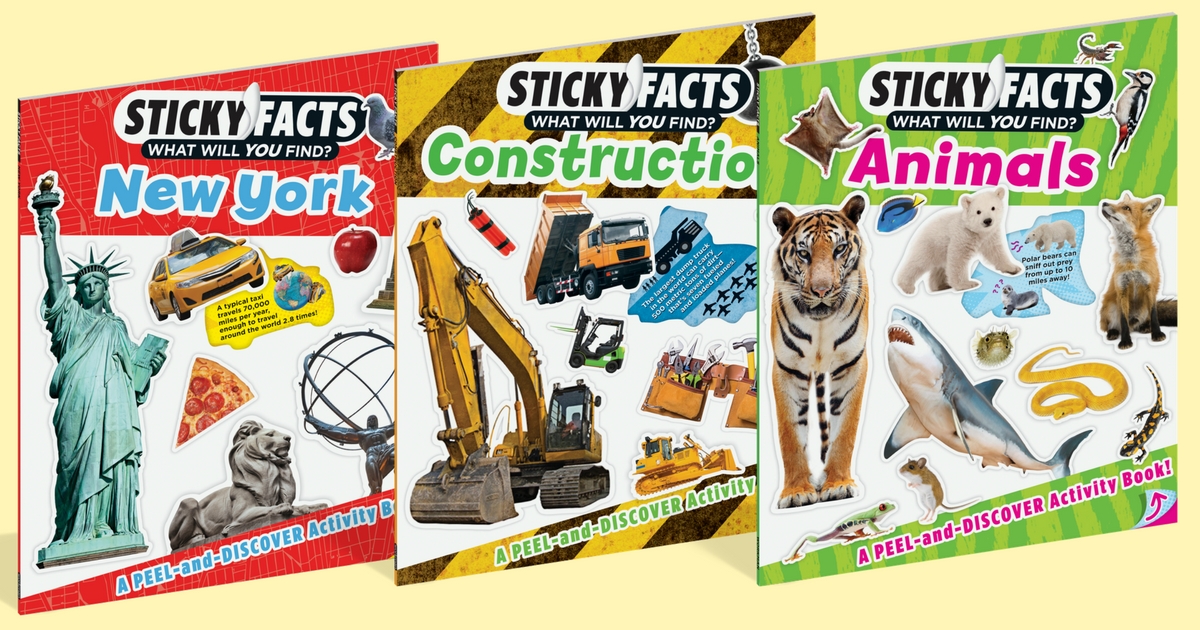


Sticky Facts: What Will You Find?: A Peel-and-Discover Activity Book

Share

Sticky Facts: What Will You Find?
New York, Construction, Animals
Published: December 12, 2017 by Workman

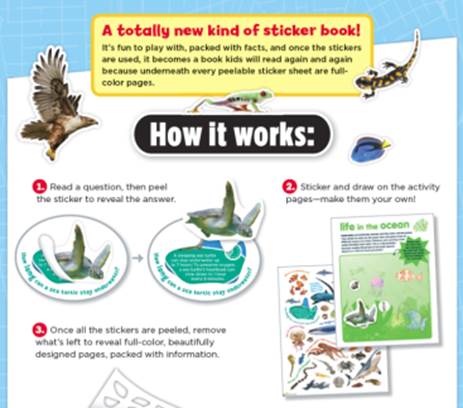
Summary: Sticky Facts is an innovative, kid-friendly approach to beloved topics for ages 6 and up, featuring a cutting-edge sticker sheet design that allows for text and color images to appear underneath the sticker.

Unlike average sticker books, each sticker page features questions with facts hidden underneath the relevant sticker. Once the sticker is peeled o­ff, the fascinating factis revealed. Activity pages with corresponding prompts are featured next to the sticker pages for readers to use as fuel for sticker landscapes, adding hours of fun to the whole experience!

ReviewWhile the book is marketed for ages 6 and up, my 4-year-old had a blast with these books. I had to read the facts beneath the stickers to him, but he loved peeling them off of the pages and finding their matching places within the book. As a parent, sometimes it gets to the point that I am looking for something new and different, and this clever idea was very impressive to me. The books are well-made and fun. I overheard my son sharing one of the construction facts with a friend at preschool, so it really works! These books make great gifts and add a new twist to kids’ love of stickers.

Teachers’ Tools for Navigation: Teachers might group students by interest to allow them to learn and work together on a book of their choosing. This allows students to learn nonfiction facts on a topic that they are interested about!

Discussion Questions: Which was your favorite sticky fact?; What are some new facts that you learned? What kinds of facts are featured below the stickers?

We Flagged: 

Read This If You Loved: Nonfiction; Sticker Books

Recommended For: 

classroomlibrarybuttonsmall

**Thank you to Christy at Workman for providing a copy for review**

Blog Tour with Review!: Don’t Ask a Dinosaur by Deborah Bruss & Matt Forrest Esenwine

Share

Don’t Ask a Dinosaur
Author: Deborah Bruss & Matt Forrest Esenwine
Illustrator: Louie Chin
Published April 17th by POW!

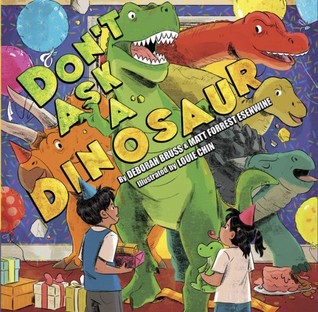
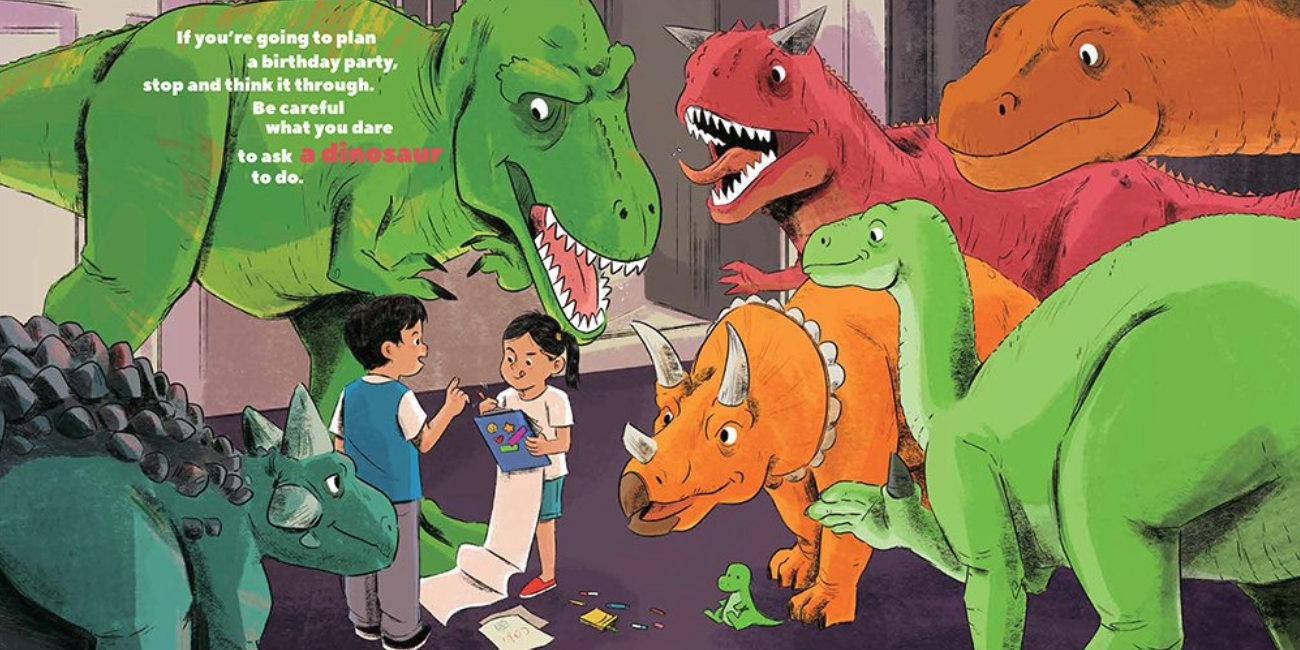
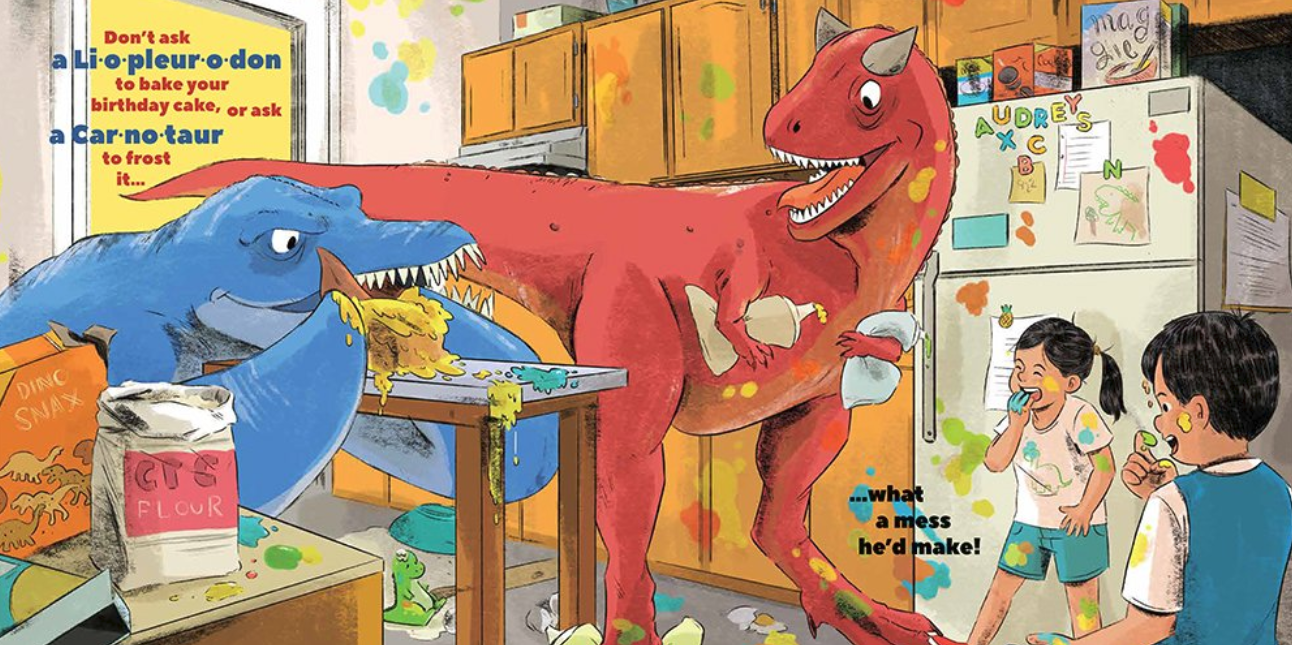
Summary: Don’t Ask a Dinosaur is about a party that goes wildly awry when a pack of dinosaurs with very unique physical attributes attempt to help set up.

“Don’t ask Deinocheirus to set the forks and spoons,” because his hands were enormous, “Therizinosaurus cannot blow up balloons,” because he had very long claws. In the end they find the one thing everyone can help do is to blow out the candles on the cake…but will it create yet another mess?

ReviewDon’t ask a dinosaur what he thinks about this book! Unless he says it is awesome, funny, and informative. Then ask him, and trust his answer.

I was introduced to Esenwine’s work when I read Flashlight Night, and I was immediately impressed with his work–he just had a way with words! While this picture book is quite different, it is not going to let Esenwine fans down. It for sure didn’t let Trent down; he already has had us read this multiple times with different questions each time we read. He also thinks it is hilarious, finding something silly each time he reads.

I also loved the book for a couple other specific reasons. First, I loved that the story included some pretty unknown dinosaurs to help the readers get introduced to them in a fun way. Esenwine and Bruss also did a fantastic job with their rhyming using syllable count to make it even more rhythmic than it would be without. And the addition of phonetic spellings of the dinosaur names was a nice touch to help with the pronunciation for the adult reader and for the child as they learn about the dinosaurs.

Teachers’ Tools for Navigation: On the surface, this text will be a way to introduce a bunch of different types of dinosaurs in a fun, rhyming text; however, this can just be a jumping off point for either a creative writing activity or a science activity (or both!). Because of Esenwine & Bruss’s specific syllables and rhyming, it would be quite challenging and fun to ask students to pick dinosaurs and try to think of other things that they may not be good at and ask them to write their own mini-dino poems. Or students can take the dinosaurs that are introduced in the book and research them to find out what they really wouldn’t be able to do in real life.

Discussion Questions: 

  • Why did the certain dino get chosen for each activity?
  • What dinosaur was new to you?
  • If you could have one dinosaur at your birthday party, what dinosaur would you pick? What would you make sure not to have it do?
  • How does the phonetic spelling of the dinosaur names help with the rhythm of the text?
  • What is going on in the background, in the illustrations, as the narrator helps you see what dinosaurs shouldn’t do?

Flagged Passages: 

Read This If You Love: Dinosaurs!, Jane Yolen & Mark Teague “How Does a Dinosaur” series, PBS’s Dinosaur Train

Recommended For: 

classroomlibrarybuttonsmall closereadinganalysisbuttonsmall 

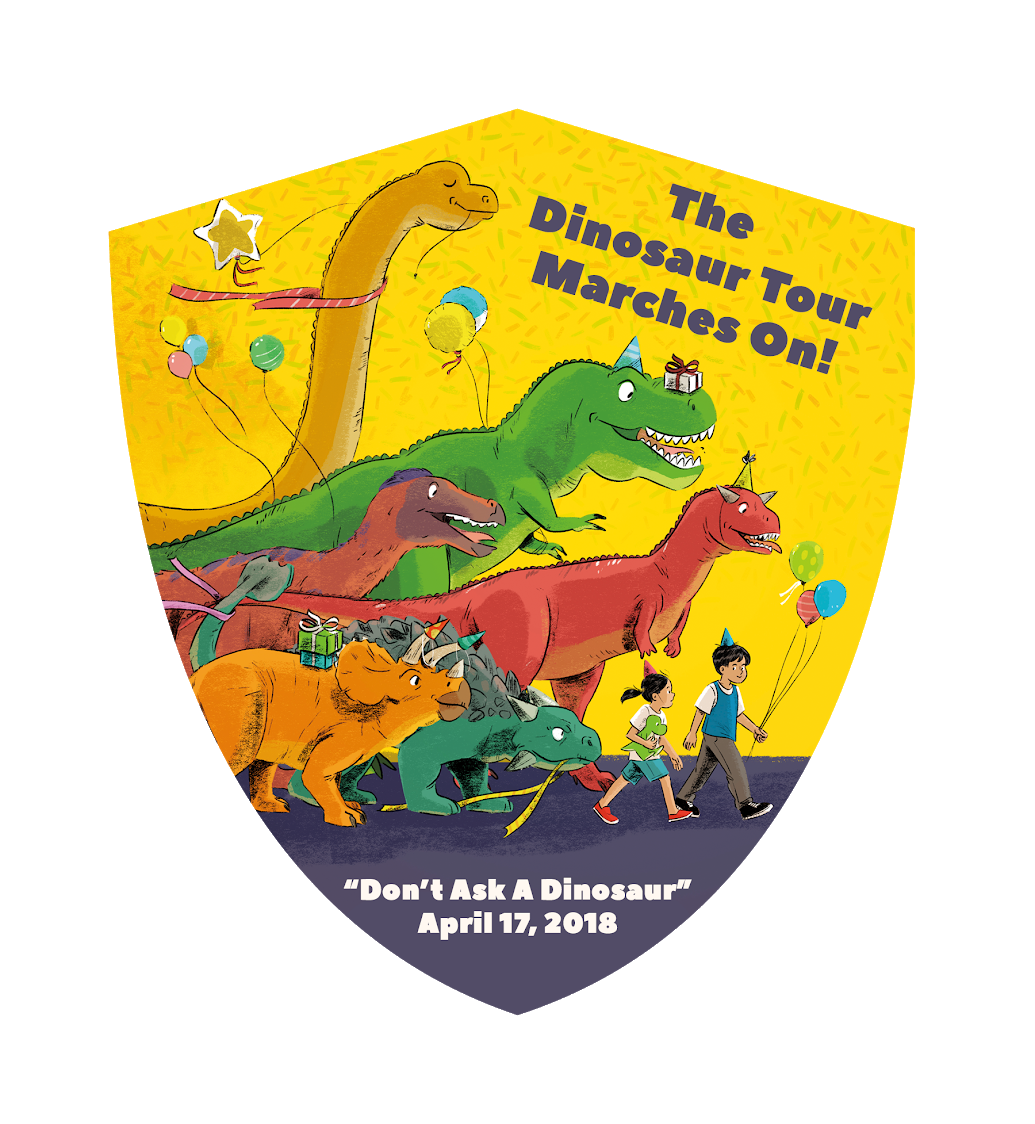
Make sure to stop by other stops on the Dinosaur Tour!

April 6:        Michelle H. Barnes (Interview w/month-long writing prompt)
April 8:        Kate Narita (Trailer & activity sheet spotlight)
April 11:      Deborah Kalb (Interview w/Matt Forrest Esenwine & Deborah Bruss)
April 13:      Radio, Rhythm, & Rhyme (Interview w/Louie Chin)
April 16:      KidLit Exchange (Blog post re: process of illustration)
April 17:      Momma’s Bacon
April 18:      Bonnie Ferrante
April 19:      Brenda Harsham
April 25:      Bonnie Ferrante (Interview)
May 2:         Unleashing Readers

Signature

**Thank you to POW! and Matt Forrest Esenwine for making this blog tour happen!**

Teaching Tuesday: Random Thoughts From a Teacher Circulating During Testing

Share

Approximately 480 minutes of my life over the last couple of weeks has been circulating a room while students took their standardized tests. I not only accumulated approximately 20,000 steps, I had many random thoughts. Here are some of them:

Exercise

  • Does circulating a room in a regular circle or a zig-zag pattern give more steps in one lap? (Zig-zag.)
  • What ways could I get extra exercise while circulating and not being distracting?
    • Answers: Toe raises/calf raises, squats, glut squeezes, wall sit, standing crunches, seated leg raises, standing leg curl, lunges, and I’m sure there are more!
  • Do I get more steps on testing days than on normal days now that we have Lanschool to monitor computers instead of having to circulate our rooms as much? (Yes.)

Technology

  • Since the world is so technologically embedded, is testing students on a computer the best even though some studies have found that reading paper-based texts is still more efficient?
  • Are these studies ignoring the future? Isn’t it counter productive to focus on how the past may have been better when the world is moving in a forward, not a backwards, direction?
  • Instead of saying that one-on-one or technology isn’t as good as ____, couldn’t we instead just teach students how to use new tools as well as we were taught to use the old? For example, there are many complaints about kids not knowing how to take notes; why don’t we teach them? Or kids not knowing how to research; why don’t we teach them? We were taught to do those things. Just because kids are technology natives doesn’t mean they don’t need to be taught the best ways to use the tools.

Change

  • So many adults say things about “kids these days,” but weren’t we “kids these days” at some point? Doesn’t every generation complain about the changes in the next generation?
  • Isn’t change what makes the world get better?
  • Just because things are done differently doesn’t mean they are bad.
  • For example, the SAT is now more text-based instead of random vocabulary and analogies–that is pretty awesome! And I wish it was like that when I took it.
  • Some change isn’t necessary though. Was our education system so bad when I went through it? The push for “rigor” is so intense now pushing kids into AP classes as early as 8th grade, but I feel like that takes away the growing up part and doesn’t give kids the foundation needed to be successful.
  • And what happened to kids having the chance to be kids?!

Disney

  • The Little Mermaid came out when I was 7 which was 29 years ago. Hundred and One Dalmations came out about 28 years before The Little Mermaid, so how old 101 Dalmations seemed to me is how old The Little Mermaid seems to them.
  • Frozen came out when these kids were 7. Elsa and Anna are their Ariel. These girls had princesses that were pretty kick butt to look up to their whole life while Ariel changed EVERYTHING about her for a man.
  • Or it could be looked at as Ariel had a dream and wouldn’t give up until she attained it and wouldn’t let others tell her she couldn’t do it.
  • Belle changed Disney princesses though. Except for Pocahontas, ever since Beauty and the Beast, the princesses are more than just someone looking for a man.
  • Was the book that Belle was reading during the song “Belle” her own story and the song writers were putting in dramatic irony for the audience?

Science and Pop Culture

  • If we now know that dinosaurs are more related to birds than reptiles and it is pretty common-scientific knowledge, why hasn’t the look of dinosaurs in pop culture changed? For example, a new Jurassic Park is coming out, but the dinosaurs still look like how we thought they looked before.
  • Though I do know that it takes a very long time for pop culture to catch up with science. For example, Curious George is still called a monkey even though in the 1940s or so the distinction between apes and monkeys were found, and scientifically I think everyone would agree that he is an ape.
  • Monkeys and apes are different animals and people can just not figure out the difference. We don’t get pachyderms or canines or felines or other groups of animals confused, why do we get primates confused?
  • But I wish big companies and movies wouldn’t help spread the ignorance. For example, Coca-Cola should be ashamed of themselves for spreading the ignorance that penguins and polar bears live in the same area. (P.S. They don’t! Not even the same hemisphere!)
  • This must be how Neil Degrasse Tyson feels about, well, everything.

What random thoughts do you have while monitoring testing (or any other time)? 

It’s Monday! What Are You Reading? #IMWAYR 4/30/18

Share

IMWAYR 2015 logo

It’s Monday! What Are You Reading? From Picture Books to YA!

It’s Monday! What are you Reading? is a meme started by Sheila at Book Journeys and now hosted by Kathryn at The Book Date. It is a great way to recap what you read and/or reviewed the previous week and to plan out your reading and reviews for the upcoming week. It’s also a great chance to see what others are reading right now…you just might discover the next “must-read” book!

Kellee and Jen, of Teach Mentor Texts, decided to give It’s Monday! What Are You Reading? a kidlit focus. If you read and review books in children’s literature – picture books, chapter books, middle grade novels, young adult novels, anything in the world of kidlit – join us! We love this meme and think you will, too.

We encourage everyone who participates to support the blogging community by visiting at least three of the other book bloggers that link up and leave comments for them.

Bold_line

Last Week’s Posts

Tuesday: Grading is Complicated: Ruminations of an English Teacher Educator

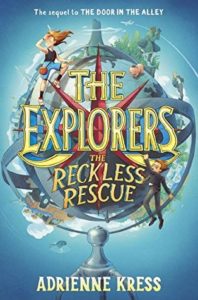
Wednesday: Blog Tour with Review: The Reckless Rescue (The Explorers #2) by Adrienne Kress

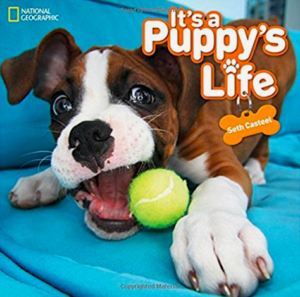
Thursday: It’s a Puppy’s Life from National Geographic

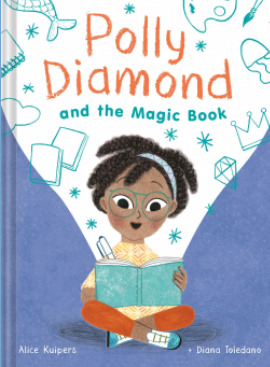
Friday: Teaching Guide with Discussion Questions and Activities for Polly Diamond and the Magic Book by Alice Kuipers

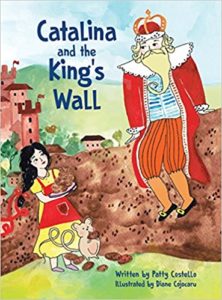
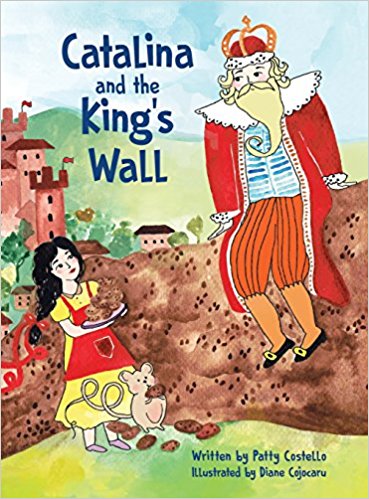
Sunday: Author Guest Post!: “What Kinds of Storybook Characters Teach the Best Lessons” by Patty Costello, Author of Catalina and the King’s Wall

**Click on any picture/link to view the post**

Bold_line

 Last Week’s Journeys

Kellee

Hello, everyone! Sunday, April 29th is my husband’s birthday, so even though I originally planned on getting this post written, we just got home, and it is bedtime! I will catch everyone up next week 🙂

 Ricki

Apparently, it’s not a good week for us. I was falling asleep in bed and realized I didn’t write this post! Ha!

My son and I read the Sticky Facts books. There are facts below each picture, and they are delightful to read. I’ll be reviewing these later in the week.

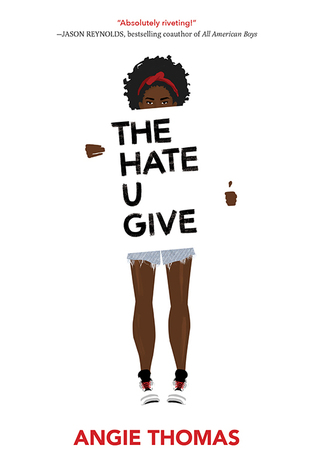
I REREAD The Hate U Give by Angie Thomas for the fifth time. My students are broken into three groups tomorrow. Twelve students are in each group, and they are discussing this book, Dear Martin, and All American Boys. I am excited to talk within the groups and across the groups.

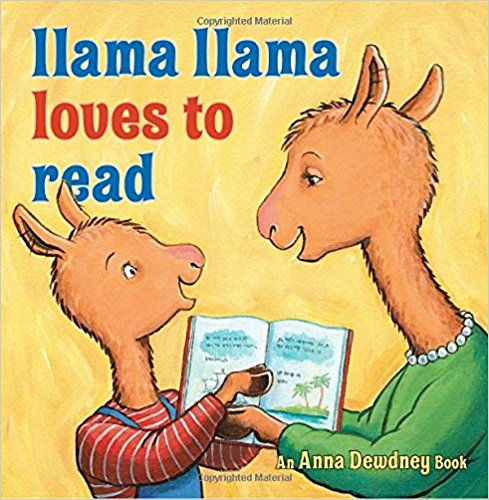
Llama Llama Loves to Read is a great addition to the Anna Dewdney series. Published posthumously, this book features Reed Duncan as the second author. Duncan is her longtime partner, and he seeks to honor the work she left behind in various stages. I think that Dewdney would be proud of the way this one turned out. It is beautifully done.

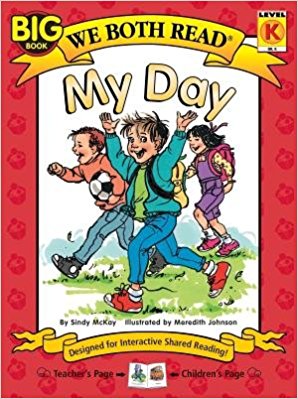
My son and I are loving the We Both Read series. My Day by Sindy McKay is one of several books in this series that we’ve read together. For those of you who are unfamiliar with the series, the left page is the parent page (with more words) and the right page is the child page (with simpler words). In this book, there is just one word on the child page. In the more advanced book that we read earlier in the week, the parent page bolds new words, and the child page includes that word (among others). I try to avoid early readers, but my son really likes this one, so we have been taking them out of the library quite often.

Bold_line

This Week’s Expeditions
Ricki

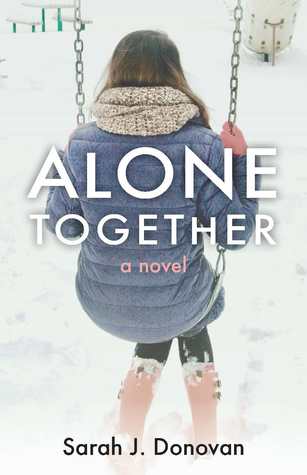
I am loving Alone Together by Sarah J. Donovan. She is well-known and well-loved in the blogger world, and this book shows her deep knowledge of adolescence.

Bold_line

Upcoming Week’s Posts

Tuesday: Teaching Tuesday: Random Thoughts From a Teacher Circulating During Testing

Wednesday: Blog Tour with Review!: Don’t Ask a Dinosaur by Deborah Bruss & Matt Forrest Esenwine

Thursday: Sticky Facts series from Workman Press

Friday: 10 Year Anniversary Celebration of The Underneath by Kathi Appelt with an Interview with the Author, Book Trailer, and Giveaway!

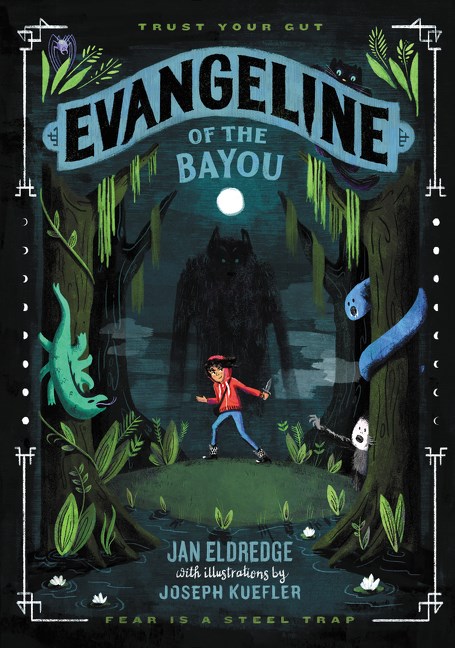
Sunday: Author Guest Post!: “Defeat Your Fear of Writing” by Jan Eldredge, Author of Evangeline of the Bayou

Bold_line

 So, what are you reading?

Link up below and go check out what everyone else is reading. Please support other bloggers by viewing and commenting on at least 3 other blogs. If you tweet about your Monday post, tag the tweet with #IMWAYR!

 Signature andRickiSig

Author Guest Post!: “What Kinds of Storybook Characters Teach the Best Lessons” by Patty Costello, Author of Catalina and the Kind’s Wall

Share

“What Kinds of Storybook Characters Teach the Best Lessons?”

Do you want to teach your students prosocial behaviors? What are good ways to teach children about sharing, caring, helping, honesty, fairness, and responsibility? One popular way is through storybooks, which have been a part of children’s lives and schooling for hundreds of years. Storybooks entertain, but they can also teach important life and moral lessons. But what are the best kind of characters in storybooks to teach children prosocial behavior? Does one type of character work better than another? Many stories for young children often contain animal characters who are anthropomorphized: they take on human characteristics and can talk, walk, eat, and get into all sorts of mischief too. A group of researchers at the Jackman Institute of Child Study in Toronto found that in a review of over 1000 children’s books, more than half the books featured animals, and only 2% were realistic depictions of the animals; in other words, 98% of the animals in over half of picture books feature anthropomorphized animals. People on all sides of the picture book equation – teachers, students, parents, authors, and illustrators – all have assumed that children are naturally attracted to animals and therefore in using anthropomorphized animals, a story may be more enchanting and its lessons more accessible to children’s young minds. And the bigger assumption is that children may be more likely to act in agreement with the moral of the anthropomorphized animal story.

But is this true? These same researchers – Nicole Larsen, Kang Lee and Patricia Ganea – realized in 2017 that no direct psychological or child development study had ever asked this question – are anthropomorphized animals better at promoting prosocial behavior in children compared to a book featuring human characters? The researchers realized that it was unclear as to whether children can learn prosocial moral lessons from stories with anthropomorphized animal characters and then act accordingly.

The researchers designed a study to help answer this very question: Can children learn prosocial moral lessons from stories with anthropomorphized animal characters? Do stories with anthropomorphized animal characters work better than stories with human characters at teaching kids lessons?

How did they study this? They first picked a book called Little Racoon Learns to Share by Mary Pacard. The book has a sharing theme and a moral lesson – that sharing makes you feel good. The story features anthropomorphized animals as the main characters. The researchers took the book and used Photoshop to create the same book, only with human characters instead.

All children in the study (males and females ages 4 – 6) had a vocabulary test first to make sure that they were all at a similar language ability level. Next, the children were allowed to choose 10 of their favorite stickers from a huge pile of stickers. They were then told that there was a child their same age that could not be there that day and therefore would not get any stickers. The children were told that they could share some of their stickers with this (imaginary) child by putting them into an envelope when no one would be looking. This was the pre-test or baseline measure to get a sense of their sharing level before they heard the book about sharing.

Next, students were divided into three groups of 32 children each. The first group heard the sharing story with the human characters. The second group heard the same story, but with the original animal characters. The third group, the control group, heard a story about seeds. The children in the control condition were also asked to choose between reading either a book about human characters or a book about animal characters. This question was asked to determine whether children would prefer to read the animal book or the human book when given a choice. If the argument that using anthropomorphized animal characters makes a story more captivating to young children is correct, then children should be more likely to choose the book about animal characters. I’ll cut to the chase on this one – the children in this control group picked each book equally – there was not a clear preference for the animal book over the human book.

After the three groups heard the book, the same sticker sharing task was given with new stickers (post-test). The researchers measured the differences in sticker donation before and after the story reading. Again, the researchers were wondering whether reading storybooks with a sharing theme could significantly increase children’s generous giving relative to reading the control story about seeds. More importantly, they examined whether the story in the animal condition with anthropomorphized animal characters and the story in the human condition with real human characters would have differential effects in promoting generosity in young children, that is, would the children share more stickers after hearing the sharing story with animals or humans, or would it even matter?

What happened? I bet you are very curious by now! Reading a book about sharing had an immediate effect on children’s sharing behavior: Children who read the book with human characters became more generous with how many stickers they donated to the fictional child. In contrast, there was no difference in generosity between children who read the book with anthropomorphized animal characters and the control book; both groups decreased how many stickers they gave.

Here is the chart I adopted from the study:

Condition Before the book: How many stickers did they donate? After hearing the book: How many stickers did they donate?
Human characters 2.03 stickers 3 stickers ↑
Animals characters 2.31 stickers 1.7 stickers ↓
Control condition – book about seeds 2.14 stickers 2 stickers ↓

Why did the researchers think this happened? Maybe children see anthropomorphic characters more as animals than humans. Maybe they are not able to interpret the anthropomorphic characters as being similar to themselves, and as a result, the lesson in the story is not absorbed. This does not mean that children should never hear stories with animal characters, but it’s important to keep this in mind.

Future research future should look at whether anthropomorphism in books has the same effect on older children as on younger children as this study was done on 4 – 6-year olds.

It’s fun (at least for me as a cognitive neuroscientist!) to think about storybooks from an academic perspective – maybe the assumptions we hold are not true – studying these assumptions in a systematic way can provide real answers and guidance for future generations of teachers and parents.

This post was adopted from the following article should you like to read it yourself: Larsen, N.E., Lee, K., Ganea, P.A. (2017). Do storybooks with anthropomorphized animal characters promote prosocial behaviors in young children? Developmental Science, pp. 1-9.

About the Author: Patty lives in Boise, Idaho with her husband, a zany awesome toddler, a dog named Pippa, and a dog named Spencer. She grew up in the Twin Cities and is a Minnesotan at heart (you betcha!). She has a BS in Psychology from the University of St Thomas and a PhD in Neuroscience from the University of Minnesota. She currently works in higher education. Her first book, Catalina and the King’s Wall, released May 5th, 2018 from Eifrig Publishing. At all hours of the day (and night) she can be found standing at her desk, helping her university run smoothly and working on her next children’s book. For fun, she likes to trail run, mountain bike, cross country ski, and hike. She is also a voracious volunteer for various local organizations.

Catalina and the King’s Wall
Author: Patty Costello
Illustrator: Diana Cojocaru
Expected publication: May 5th, 2018 by Eifrig Publishing

About Catalina and the King’s WallWhen Catalina overhears the king planning to build a wall, she fears her family won’t ever be able to visit. Catalina tricks the king into building walls that droop, drip, swirl, and swoosh away. But now the king demands an impenetrable wall. Luckily, Catalina has the perfect ingredients to bake up a family reunion! Through beautiful illustrations and enjoyable prose, kids learn how to stand by their convictions of inclusivity and kindness even when powerful people tell them not to.

Thank you, Patty, for a look at this study and for sharing your book!

Teaching Guide with Activities and Discussion Questions for Polly Diamond and the Magic Book by Alice Kuipers

Share

Polly Diamond and the Magic Book
Author: Alice Kuipers
Illustrator: Diana Toledano
Expected Publication May 1st, 2018 by Chronicle

Summary: Polly loves words. And she loves writing stories. So when a magic book appears on her doorstep that can make everything she writes happen in real life, Polly is certain all of her dreams are about to come true. But she soon learns that what you write and what you mean are not always the same thing! Funny and touching, this new chapter book series will entertain readers and inspire budding writers.

Teachers’ Tools for Navigation: Activities for Polly Diamond include:

Color Poem

On page one, Polly says that her teacher said her color poem was fantastic.

Have your students use the Read. Write. Think. template to create their own color poem.

Template

Finish her perfect house story

On page 3, Polly is interrupted while writing her perfect house story.

Finish her story with what your perfect house would include.

Wishes

When Polly realizes her book is magical, she thinks of many things she can wish for such as a cell phone, not frizzy hair, more books, a flat screen TV, and world peace.

Using a brainstorming graphic organizer, have your students think of all the things they wish for.

After brainstorming all of their wishes, have them circle your top three.

Using the five-paragraph format for informative essays, have students write explaining their three wishes.

Measuring

For Polly’s grandmother’s recipe for pancakes called for a cup of flour and a cup of milk. Many times, when baking, you do not have what you need to make the recipe, and not just ingredients—you may not have the right measuring cup.

Bring in one cup measuring cups along with 1/4, 1/3, 1/2, 3/4, tablespoon, and teaspoon measuring cups/spoons. Break students into groups and give each group one of each measuring cup/spoon as well as something to measure (water, rice, flour), and have them answering the following questions:

  • If you only had 1/4 cup, how could you get one cup of flour?
  • If you only had 1/3 cup, how could you get one cup of flour?
  • If you only had 1/2 cup, how could you get one cup of flour?
  • If you only had 3/4 cup, how could you get one cup of flour?
  • If you only had a tablespoon, how could you get one cup of flour?
  • If you only had a teaspoon, how could you get one cup of flour?

Favorite words

Polly has a lot of favorite words: words with double letters like doozy and mutli-meaning words like basil.

Have students make a list of three words that they really like.

For each word, they should define it and also explain why they like the word.

When finished, students should do a word meet and greet. Using clock buddies or some other buddy system, have students meet with other students in the classroom and learn about their favorite words. They should add the favorite words they learn about to their list.

Paint names

On page 29, Polly makes up names for paint that describes the color such as muddy pond, lunch bag, and baboon butt.

First, have students look at the colors Polly described on page 29 and find the corresponding color in either a crayon box or a color exploration site online.

Then, have students create color names using imagery. Either have them use the color exploration site online or the colors from Microsoft Word.

Affixes

Show students how there are different word parts (affixes) that can be put together to make new words. They are like puzzle pieces! Share with them the different types of word parts (prefix, suffix, root, and base) and how they fit together.

On page 56, Polly explains how adding un- to the beginning of a word gives it an opposite meaning. The word she uses as an example is unobservant. Share with your students that un- is a prefix that means NOT which does make a word the opposite. Have student brainstorm a list of words with un- at the beginning and define them using NOT as the definition for un.

Extension: dis-, il-, im-, in-, and ir- also mean NOT. Students can also explore words with these
prefixes.

Extension: On page 57, Polly also talks about adding –fully to the end a word to make it bigger,
but it does more than that. Share with your students that –fully is actually a combination of ful, a root word that means full of, and –ly, a suffix that turns an adjective to an adverb, so her example of sorrowfully means full of sorrow (adv).

After showing students how words break apart and how affixes help with word meanings, give students words with un- and –ful (or any other affix you taught) and have them mark the different word parts and define the word.

Coloring Sheets

Coloring sheets can also be downloaded from Chonricle’s website here.

See the Teaching Guide Created by Me (Kellee) for even more activities! 

You can also access the teaching guide through Chronicle’s website here.

Recommended For: 

readaloudbuttonsmall classroomlibrarybuttonsmall closereadinganalysisbuttonsmall

Kellee Signature