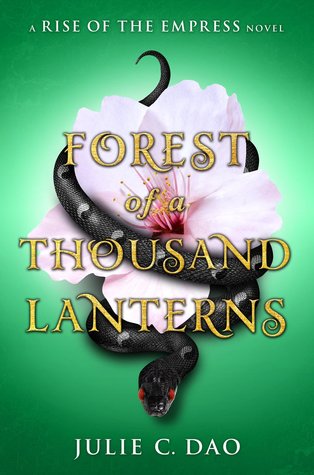
Forest of a Thousand Lanterns by Julie C. Dao

Share

Forest of a Thousand Lanterns
Author: Julie C. Dao
Published: October 10, 2017 by Philomel

Guest Review by Kaari von Bernuth

Goodreads Summary: An East Asian fantasy reimagining of The Evil Queen legend about one peasant girl’s quest to become Empress–and the darkness she must unleash to achieve her destiny.

Eighteen-year-old Xifeng is beautiful. The stars say she is destined for greatness, that she is meant to be Empress of Feng Lu. But only if she embraces the darkness within her. Growing up as a peasant in a forgotten village on the edge of the map, Xifeng longs to fulfill the destiny promised to her by her cruel aunt, the witch Guma, who has read the cards and seen glimmers of Xifeng’s majestic future. But is the price of the throne too high?

Because in order to achieve greatness, she must spurn the young man who loves her and exploit the callous magic that runs through her veins–sorcery fueled by eating the hearts of the recently killed. For the god who has sent her on this journey will not be satisfied until his power is absolute.

Kaari’s Review: The entire time, I wasn’t entirely sure if the  protagonist was the hero or the villain. And, that isn’t necessarily a bad thing! I appreciated this book because it made me think. I’d be cheering for Xifeng and wanting her to win, and then she’d do an awful thing to help her win, and I’d be repulsed by her. This book highlights the struggle of ambition, and how difficult it is for a woman to achieve the dreams she has. And, while I am off put by Xifeng’s methods and don’t necessarily think they were the right decisions, her actions and the way she achieves power could spark great discussions.

The setting and the plot of this book was thrilling, and I Ioved the way that fantasy was woven into a world so seamlessly. The creatures and ideas introduced were thought provoking and had amazing descriptions that made me feel like I was living in the enchanted world with the characters. I do wish that there had been some more resolution regarding some of the magical beings and the warnings they gave, but I think that Dao intends for this to be the first in a series, and I’m sure that more resolution will come in later novels.

Teachers’ Tools for Navigation: I would definitely include this book in a classroom library for kids to check out if they want to read it. However, while this book is interesting, and explores an interesting take on female empowerment, I don’t think I would teach this book in a classroom setting, or use it in literature circles. I am a huge advocate for female empowerment, and discussing the paths for women to claim their power. However, I think that because Xifeng’s methods were so morally questionable, and readers aren’t sure if Xifeng is a hero or a villain, that Forest of a Thousand Lanterns is not the best novel to discuss for this topic. There are many other books that discuss female empowerment in a much more productive light. So, I’d include it in a classroom library, but not necessarily teach it in any way.

Discussion Questions: Do you think Xifeng’s methods were justifiable?; What does the social hierarchy look like in this novel?; Is Xifeng a hero or a villain in this story?; What is the effect of portraying a strong female protagonist in this way?; How is the fantasy world characterized?

We Flagged: “‘I’m a good man, Xifeng. I let you have your own way and speak your mind…’

‘You think I don’t know that? That I’m so blind and stupid?’

‘Yes, I do!’ he shouted, his face bright red. ‘I offer you the world…’

‘Yes, the world as you see it!’

‘I saved you from that evil woman!’

‘Only to trap me yourself.’ She watched him turn away and run a trembling hand over his head. ‘I was Guma’s, and now you want me to be yours. I have my own soul and my own destiny, and I’m tired of belonging to someone else’” (Advanced Reader Copy p. 125).

Read This If You Loved: Monstress by Marjorie M. Liu; Gunpowder Alchemy by Jeannie Lin; Girls Made of Snow and Glass by Melissa Bashardoust

Recommended For:

classroomlibrarybuttonsmall

  RickiSig

**Thank you to Kaari for reviewing this book!**

There’s Someone Inside Your House by Stephanie Perkins

Share

There’s Someone Inside Your House
Author: Stephanie Perkins
Published: September 26, 2017 by Dutton

Guest Review by Kaari von Bernuth

Goodreads Summary: One-by-one, the students of Osborne High are dying in a series of gruesome murders, each with increasing and grotesque flair. As the terror grows closer and the hunt intensifies for the killer, the dark secrets among them must finally be confronted.

International bestselling author Stephanie Perkins returns with a fresh take on the classic teen slasher story that’s fun, quick-witted, and completely impossible to put down.

My Review: This book was gripping from the first page. I found myself getting sucked into it, trying to figure out the mystery of who the killer was, but also of what Makani’s past entailed. The author, Stephanie Perkins, did an amazing job of planting foreshadowing and clues that hinted toward the answers to the multiple mysteries that kept my brain working the entire time that I was reading.

I also loved the emphasis on friendship groups, feeling like an outsider, and bullying/hazing as many adolescents face these topics every day. The way that these topics were portrayed in Makani’s friend group, and the way that the friends help Makani to deal with her hazing trials were something that I appreciated. However, there were two things that I wish were approached differently in this book. 1. Even though this is a small point, one of the characters was a stereotypical, loud Christian character who tried to force his beliefs on everyone else, including a mention of how he managed to get rid of any mention of evolution in his school textbooks. He was characterized as a Lutheran. While this probably wouldn’t mean much to other people, I am a Lutheran, and all of the Lutherans I know believe and support evolution, and don’t at all act like this negative christian stereotype character does. But, this book makes it look like all Lutherans act this way. I wish that there had been no mention of the character’s denomination.  2. I wish that more emphasis had been placed on dealing with the deaths that occurred in the books, as well as the motivations of the killer, as those were both just glanced over. This is problematic as it leaves a huge hole in understanding of the novel, and makes it harder to talk about some of the prominent events in the story. Overall though, it was a very entertaining novel.

Teachers’ Tools for Navigation: This would be a great book to have in a classroom library for kids to enjoy. Given the graphic, violent nature of some of the scenes, I wouldn’t recommend teaching to an entire class. However, it will appeal to students who enjoy the horror genre. This book also has great potential in literature circles. Perkins does a great job of foreshadowing and giving hints not only as to what is going to happen, but to stories that have already happened that the readers don’t know about yet. As I was reading, I loved being able to piece together the clues that were given to try to guess what had happened and also what was going to happen. A literature circle could have a lot of fun trying to piece those clues together as a group. This book also touches on other important topics such as bullying/hazing and family struggles which could be discussed in a literature circle, as well as the elements of forgiving oneself/dealing with guilt (which Makani experiences as a result of the hazing incident). The one thing that I found this book lacking was any form of dealing/acknowledging grief and death, as well as an acknowledgement of mental health issues (which the killer would have to have). These failings in the book could also be discussed in relation as to how to acknowledge those topics in a healthy way.

Discussion Questions: Where do you see foreshadowing in the early parts of the books?; How does Perkins create suspense in her novel?; What is Makani’s relationship with her parents like?; What was Makani’s experience with hazing like? Have you experienced something similar?; How does blame and justice appear in this book? Is it always fair?

We Flagged: “Sharing her story now, however, had opened a valve of tremendous internal pressure. Her secret- this self-inflicted burden- had finally been released.” (page 207 of Advanced Reading Copy)

Read This If You Loved: The Merciless by Danielle Vega; Dead by Morning by Kayla Krantz; The Forest Dweller by Deborah McClatchey; Confessions: The Private School Murders by James Patterson

Recommended For:

classroomlibrarybuttonsmall  

  RickiSig

**Thank you to Kaari for reviewing this book!**

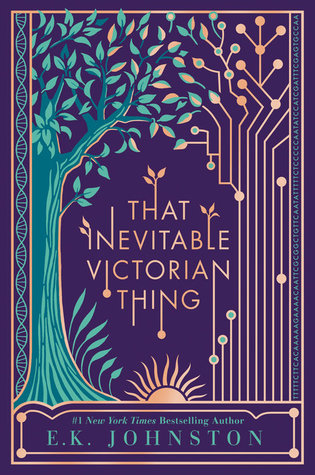
That Inevitable Victorian Thing by E. K. Johnston

Share

That Inevitable Victorian Thing
Author: E. K. Johnston
Published: October 3, 2017 by Dutton

Guest Review by Kaari von Bernuth

Goodreads Summary: Set in a near-future world where the British Empire was preserved, not by the cost of blood and theft but by effort of repatriation and promises kept, That Inevitable Victorian Thing is a novel of love, duty, and the small moments that can change people and the world.

Victoria-Margaret is the crown princess of the empire, a direct descendent of Victoria I, the queen who changed the course of history two centuries earlier. The imperial practice of genetically arranged matchmaking will soon guide Margaret into a politically advantageous marriage like her mother before her, but before she does her duty, she’ll have one summer incognito in a far corner of empire. In Toronto, she meets Helena Marcus, daughter of one of the empire’s greatest placement geneticists, and August Callaghan, the heir apparent to a powerful shipping firm currently besieged by American pirates. In a summer of high-society debutante balls, politically charged tea parties, and romantic country dances, Margaret, Helena, and August discover they share an unusual bond and maybe a one in a million chance to have what they want and to change the world in the process —just like the first Queen Victoria.

My Review: The futuristic setting of this novel that wasn’t a dystopia was very intriguing to me. Most of the futuristic novels that I’ve read have featured dystopian societies, so it was refreshing to have something that worked. I really enjoyed the multiple perspectives from the different characters, and became personally invested in their lives and experiences. I’d find myself hurting for Helena as she struggled to reconcile her identity, and rooting for August to do the right thing. In some way, all of the characters have to struggle to come of age and develop their identity based on who they want to be. 

However, I wish that this novel had placed a little more effort on the ending. While the rest of the novel had dealt with realistic challenges that an adolescent might face, the ending seemed rather contrived, and less realistic like the rest of the novel. The solution proposed at the end of the novel is not a solution that an adolescent in current society could replicate and learn from, which was disappointing.

Teachers’ Tools for Navigation: This book poses great questions about racism (or rather the eradication of racism), as well as questions of morality. It also would be great for discussions about the influence that society can have on your life verses the influence that you decide for your life. I think that this book would be a great addition to a classroom library for kids to enjoy, or a book to be used in a reading circle. It’s engaging and could lead to interesting discussions, especially about the futuristic government and setting of the novel, and the aforementioned topics of racism, morality, and societal influence vs self. However, I do think that other novels cover these topics in a better way, which is why I wouldn’t recommend it for large classroom discussions.  

Discussion Questions: Is this novel a utopia? Dystopia? Does it fit either criteria?; How is race approached in this novel? Is there racism in the society?; What is the role of colonialism in this novel?; What is the role of the Computer? Do you think this is a good advancement?; What does the computer lack?; What morality questions does this novel pose?

We Flagged: “The Computer is sufficient if you want to know your future without taking into account your soul. I don’t mean in the eternal sense, but in the worldly. The Computer can tell you if your genes are prone to carcinoma or if you might be six feet tall, but it cannot tell you if you will enjoy dancing or if you will prefer cake to pie. I would argue that the latter is more important in terms of a long and healthy relationship” (p. 254).

Read This If You Loved: Matched by Allie Condie; Delirium by Lauren Oliver; The Luxe by Anna Godbersen; The Selection by Kiera Cass

Recommended For:

classroomlibrarybuttonsmall  

  RickiSig

**Thank you to Kaari for reviewing this book!**

Children of Exile (#1) & Children of Refuge (#2) by Margaret Peterson Haddix

Share

Children of Exile
Published September 13th, 2016 by Simon & Schuster for Young Readers

Children of Refuge
Published September 12th, 2017 by Simon & Schuster for Young Readers

Author: Margaret Peterson Haddix

Children of Exile Summary: For the past twelve years, adults called “Freds” have raised Rosi, her younger brother Bobo, and the other children of their town, saying it is too dangerous for them to stay with their parents, but now they are all being sent back. Since Rosi is the oldest, all the younger kids are looking to her with questions she doesn’t have the answers to. She’d always trusted the Freds completely, but now she’s not so sure.

And their home is nothing like she’d expected, like nothing the Freds had prepared them for. Will Rosi and the other kids be able to adjust to their new reality?

Children of Refuge Summary: After Edwy is smuggled off to Refuge City to stay with his brother and sister, Rosi, Bobo, and Cana are stuck alone—and in danger—in Cursed Town in the thrilling follow-up to Children of Exile from New York Times bestselling author, Margaret Peterson Haddix.

It’s been barely a day since Edwy left Fredtown to be with his parents and, already, he is being sent away. He’s smuggled off to boarding school in Refuge City, where he will be with his brother and sister, who don’t even like him very much. The boarding school is nothing like the school that he knew, there’s no one around looking up to him now, and he’s still not allowed to ask questions!

Alone and confused, Edwy seeks out other children brought back from Fredtown and soon discovers that Rosi and the others—still stuck in the Cursed Town—might be in danger. Can Edwy find his way back to his friends before it’s too late?

ReviewOne thing you can always guarantee when you read a Haddix book is that it will suck you in and will be super unique! The Children of Exile series did not disappoint. I will admit, it is really hard to review either of the books without spoiling. The summaries above both did a really great job, but everything that happens after that suspense-building summary happens would spoil something for you. But I will promise you these things:

  • You will be on the edge of your seat and not be able to figure out what is going on for 90% of the first book.
  • You will be disgusted by the treatment of the children once they are returned to their parents.
  • You will want to help Edwy and his friends so badly throughout the entire second book.
  • You will have to stop reading when the reveal happens in the first book just to process it. Then you’ll reread. Then you’ll text someone who has read it.
  • You will want to know more than book 2 tells you, so we’ll all be waiting impatiently for #3.
  • You will realize that these books are actually a bit older and darker than they first seem.

Teachers’ Tools for Navigation: Like other Haddix books, you will find the best home for these books in the hands of kids. They are going to be talking about these books after they read them!

Discussion Questions: Discussion questions are available on Haddix’s website.

Flagged Passages: “‘Remember to be good little children!’

Good little children, good little children, good little children…

I saw children crying and clinging to their Fred-parents’ legs. I saw men yanking babies from their Fred-parents’ arms. I turned my back to my own Fred-mama and Fred-daddy — maybe to grab them as hard as I could — but the crowd surged just then, pushing Bobo and me up the stairs. I couldn’t see my Fred-parents anymore. I hadn’t even had a chance to tell them a proper good-bye.” (Children of Exile, Chapter 3)

“I’d been counting on being able to run fast enough no one caught up.

‘Good,’ an oily voice whispered in my ear. ‘Now you understand that screaming is useless.’

‘No, I was just–‘ Before I could add deciding what to scream next, a thick hand slid over my mouth. It smelled of onions and sweat and mud and, I don’t know, maybe puke as well.” (Children of Exile, Prologue)

Read This If You Love: Knife of Never Letting Go by Patrick Ness, Tesla’s Attic by Neal Shusterman, Masterminds by Gordon Korman, Spillzone by Scott Westerfeld

Recommended For: 

Signature

**Thank you to Casey at Media Masters for providing copies for review!**

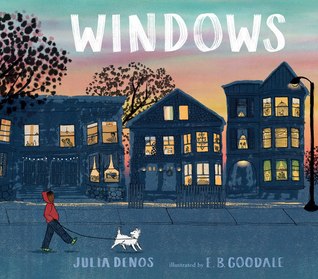
Windows by Julia Denos

Share

Windows
Author: Julia Denos; Illustrator: E. B. Goodale
Published: October 17, 2017 by Candlewick

Goodreads Summary: Walking his dog at dusk, one boy catches glimpses of the lives around him in this lovely ode to autumn evenings, exploring your neighborhood, and coming home.

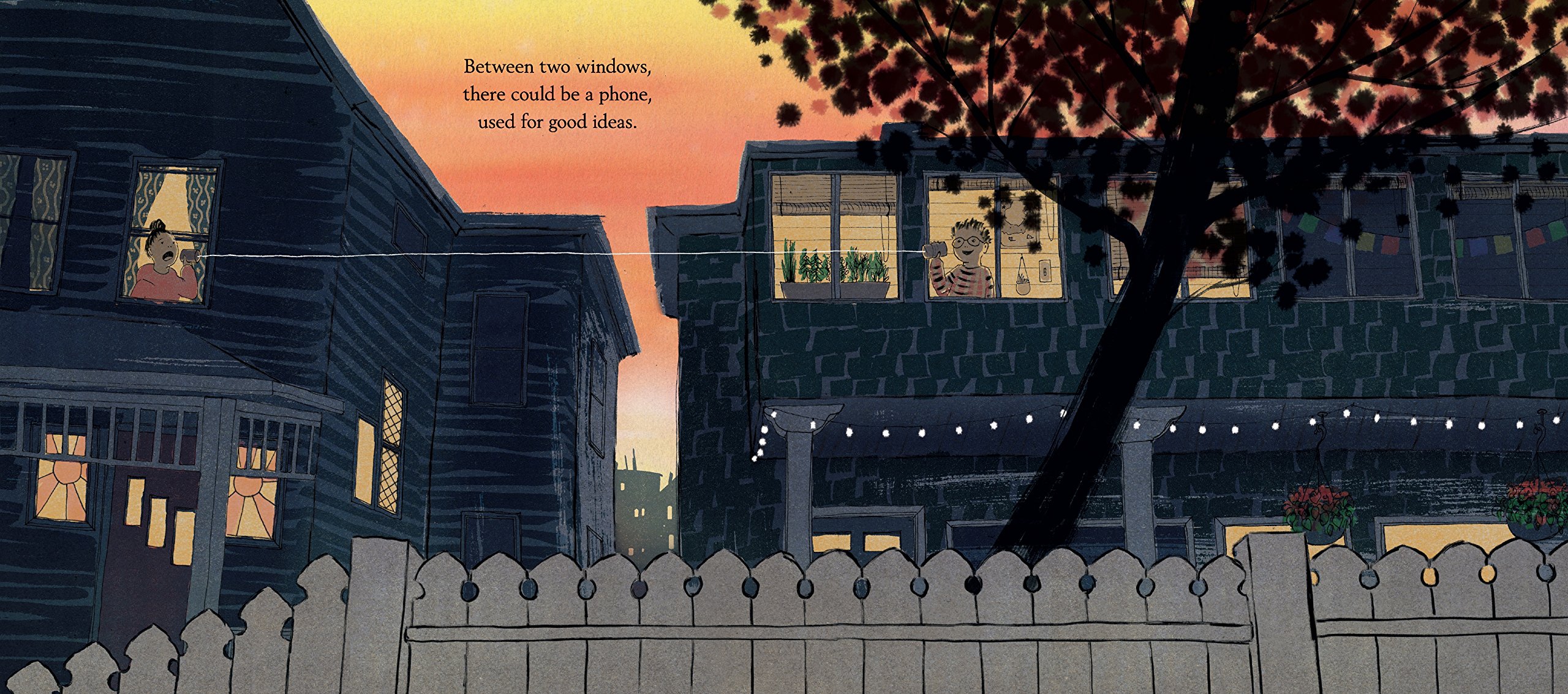
Before your city goes to sleep, you might head out for a walk, your dog at your side as you go out the door and into the almost-night. Anything can happen on such a walk: you might pass a cat, or a friend, or even an early raccoon. And as you go down your street and around the corner, the windows around you light up one by one until you are walking through a maze of paper lanterns, each one granting you a brief, glowing snapshot of your neighbors as families come together and folks settle in for the night. With a setting that feels both specific and universal and a story full of homages to The Snowy Day, Julia Denos and E. B. Goodale have created a singular book — at once about the idea of home and the magic of curiosity, but also about how a sense of safety and belonging is something to which every child is entitled.

My Review: This quiet book captured my heart. My husband used to live in Somerville, and this text beautifully captures the beauty of the city—and the beauty of many cities. I love the way that the author and illustrator reveal that peaking into windows allows us to view a slice of someone else’s world. We don’t see their entire world, but we see the sliver that they allow us to see. This book reminds us to pause and look around us. I am saving this book to give to my son for his birthday because I know he will love it. It’s a book that any person of any age will appreciate.

Teachers’ Tools for Navigation: Teachers might start by asking students to draw a window and the people inside of it. Then, students could move to writing about that family. Perhaps, the window reflects the beauty of those individuals’ world, or perhaps, it doesn’t show the truth. I love the possibilities that this book allows for teachers.

Discussion Questions: What would a window to your house look like? How might each room appear a bit different?; What do we see through the windows of others? What might we miss?

We Flagged:

Read This If You Loved: Last Stop on Market Street by Matt de la Peña; Each Kindness by Jacqueline Woodson, A Bus Called Heaven by Bob Graham, Harlem by Walter Dean Myers

Recommended For:

classroomlibrarybuttonsmall readaloudbuttonsmall 

  RickiSig

**Thank you to Candlewick for providing a copy for review!**

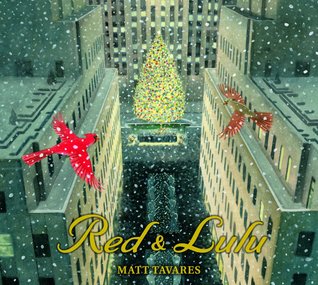
Red & Lulu by Matt Tavares

Share

Red & Lulu
Author & Illustrator: Matt Tavares
Published September 19th, 2017 by Candlewick Press

Summary: Separation and miles cannot keep a determined cardinal from his loved one in an ode to serendipity and belief that is destined to be a new Christmas classic.

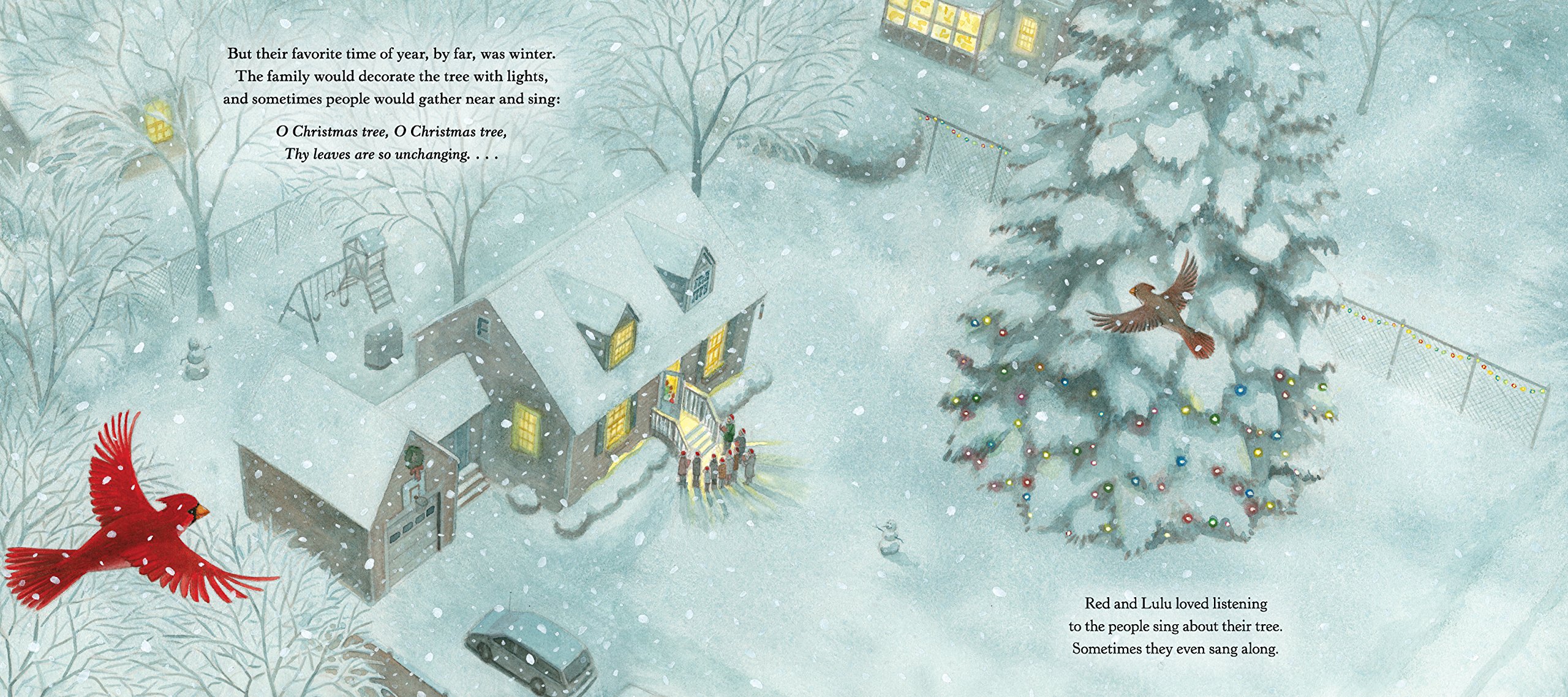
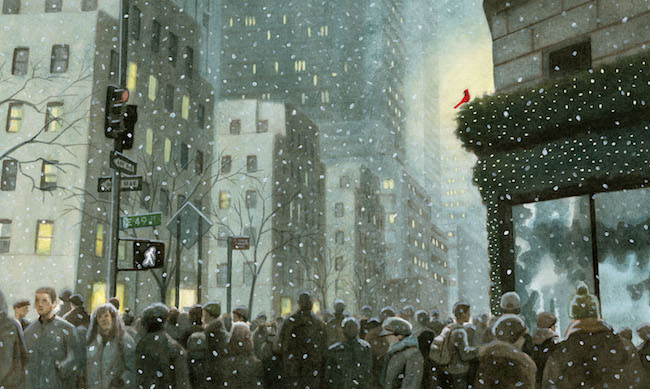
Red and Lulu make their nest in a particularly beautiful evergreen tree. It shades them in the hot months and keeps them cozy in the cold months, and once a year the people who live nearby string lights on their tree and sing a special song: O Christmas Tree, O Christmas Tree. But one day, something unthinkable happens, and Red and Lulu are separated. It will take a miracle for them to find each another again. Luckily, it’s just the season for miracles. . . .

From Matt Tavares comes a heart-tugging story combining the cheer of Christmas, the magic of New York City, and the real meaning of the holiday season: how important it is to be surrounded by love.

Review: Wow, Matt Tavares! So much is going on in this book, and it is all beautiful. First, we meet the stars of our book: Red & Lulu, and you’ll love them right away. Their love flies off the page. And the scene when they are separated broke my heart! And since I don’t read summaries, I had no idea what was going to happen, and it was so sad, but Red would not give up.

In addition to the story of love and separation, it is also a story of the Rockefeller Christmas Tree. Tavares includes back matter about the tree, its history, and traditions. Through its inclusion and the repetition of “O, Christmas Tree,” the mood is set and you are transported to NYC at Christmas time.

Finally, I cannot forget to mention the AMAZINGLY BEAUTIFUL illustrations. They took my breath away. They are edge to edge, inclusive, and so detailed.

Teachers’ Tools for Navigation: Red & Lulu is going to be an instantaneous Christmas classic! And I loved the discussion of Rockefeller Center which allows for a historical and American tradition conversation around the book.

Discussion Questions: 

  • What is so special about the very final page of the book?
  • How can you tell the difference between Red & Lulu? Why did the author choose to illustrate them that way?
  • How did the author’s repetition of “O, Christmas Tree” affect the mood of the book? And what did the lyrics indicate in the story?
  • Before you knew where Lulu ended up, what clues did Matt Tavares include to foreshadow where Lulu was?
  • Which spread of illustrations is your favorite? Why?
  • What did you learn about Rockefeller Center and its Christmas Tree from the book? What would you like to learn more about?

Flagged Passages: 

Book Trailer: 


Read This If You Love: CHRISTMAS!, Birds by Kevin Henkes, Bluebird by Bob Staake, A Christmas Wish for Corduroy by B.G. Hennessy, Other titles on my student Maria’s Top Christmas Books List

Recommended For: 

Signature

**Thank you to Candlewick Press for providing a copy for review!**


Musnet Series by Kickliy

Share

Musnet series
1. The Mouse of Monet
2. Impressions of the Master
3. The Flames of Limelight
4. The Tears of the Painter

Author: Kickliy
Published August 2nd, 2016; November 1st, 2016; April 11th, 2017; October 10th, 2017 by odod books

Summary: A young boy mouse travels the country side looking for work and happens upon the Monet’s garden. He takes on a job and becomes inspired to learn to paint. Will he paint in the classical ways, or in the new style of the impressionist? Which way will his brush sway?

Musnet wants to be the best mouse painter that ever was. But, he’s caught between two worlds. On one paw, Musnet loves the classical style of his old teacher, the squirrel Remi. On the other paw, Musnet can’t help to be drawn to the fresh and new art of the human master, Monet. Which path will the Mus choose?

It’s dark season in Musnet’s world. His adoptive family faces eviction, his Master Remi is deathly ill, he’s chased by snakes, cats, and vampire bats, and—on top of all that—Musnet faces the most challenging painting commission of his life! Can he rise to challenges and brush them all away?

As snow and ice chill Monet’s garden, even colder things await Musnet this winter season. Mya, Musnet’s best friend, gets her own adventure. Chiby, the Japanese spider, gets in a tangle with a certain muscular rat. Is there even any room left for our vagabond mouse? Drama, action, adventure, abound in the final volume of the award nominated series.

Musnet is drawn and painted in a beautiful, lush and inky style popularized by Paul Pope and French comics masters such Blutch and Christophe Blain.

“It’s a really enjoyable story that brings Monet’s paintings to life through some incredibly sweet and memorable characters. It’s challenging and imaginative, and I’m sure it will spark an obsession with painting (and maybe also mice).”—Girls Like Comics

“This new series revolves around a painting mouse found in Monet’s famous gardens in Giverny: the nameless, orphan mouse is befriended by Mya and her mouse family, who live inside the artist’s house. Introduced to painting after he begins working for Remy, an old squirrel painter, he is enchanted by Monet’s work. Beautifully painted […] charming tale of humour, art, and adventure, as the little mouse grows to find his meaning and place in the world.”—The Guardian

Musnet: The Mouse of Monet is a gorgeous and friendly story about a mouse discovering his calling in life and also what he wants to be called. Take a friendly and likable orphaned mouse, place him in a beautifully rendered watercolor and ink medium with miniature Monet masterpieces and you get a stunning and engaging story of a mouse learning to become an artist. He makes friends, finds a mentor, and even gets to sneak a peek inside Monet’s studio. It’s incredibly well executed, entertaining, informative, and absolutely absorbing. It is one of the best books I’ve read this year.” —The Picture Book Review

Review: After I read book one of this series, I could not wait to share it with everyone I talked to: “I love when books include art history in them because it makes me feel at home since I grew up in art museums as a museum director’s daughter. Musnet is no different. As soon as I realized that Musnet had ended up in Monet’s famous garden, I was fascinated with Musnet’s story and his journey to becoming an artist. Kickliy’s artwork pays perfect homage to Monet’s work and is a beautiful backdrop to Musnet’s story.” And I was really excited to read the rest of the books in the series.

Luckily they did not disappoint! Book one was just an introduction to the characters who continued to mature throughout the arc of the story. Musnet’s situation fluctuates causing the reader to quickly move from relief to panic which ensures the reader wants to keep going through the series. Although the series begins with Musnet just looking for a home, it ends with Musnet looking for what life has in store for him as an artist.

But what makes this series even more unique is the level of graphics. Kickliy’s ink, watercolor, and oil illustrations are reminiscent of the period in which Monet lived–it is like reading art. Kickliy even paints little oil paintings for the book for whenever a Musnet or Monet work is shown.

Teachers’ Tools for Navigation: “Musnet lives in Monet’s garden. Was there a roach under Van Gogh’s bed? Or a fish behind Munch’s Scream? If so, what would their story be like?” Have students create stories of animals that ‘live’ in the background of famous paintings. They’d need to research the art styles for illustrations and the time period/place of the painting for their setting, so this activity would be a perfect cross-curricular for writing, reading, art, and history.

Parts of the book would also be really great assets for engagement and information in art classrooms. Remi, Monet, and Musnet are talented artists who share insight throughout the series.

Discussion Questions: 

  • After book one, did you think Musnet was going to become a successful artist?
  • How does Kickliy’s illustrations fit the period of the book’s setting?
  • Which conflict in Musnet’s story affected Musnet’s conclusion the most?
  • Why do you think Kickliy chose Monet as the artist inspiration for his book?
  • What artist would you want to meet?
  • How did meeting Mya change Musnet’s life? Remi? Chiby?

Flagged Passages: 

Read This If You Love: Art, Graphic Novels, Monet, Mira’s Diary by Marissa Moss, The Museum by Susan Verde, Babymouse series by Jennifer and Matthew Holm, The Tale of Despereaux by Kate DiCamillo, Redwall by Brian Jacques, The Museum by Susan Verde

Recommended For: 

Signature