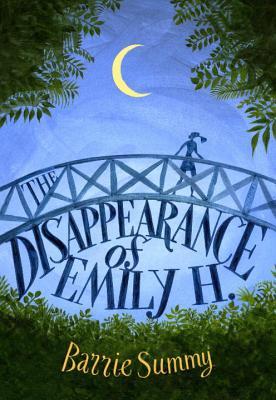
The Disappearance of Emily H. Author: Barrie Summy
Published May 12th, 2015 by Delacorte Books for Young Readers
Goodreads Summary: A girl who can see the past tries to save the future in this compelling tween mystery.
A girl is missing. Three girls are lying. One girl can get to the truth.
Emily Huvar vanished without a trace. And the clues are right beneath Raine’s fingertips. Literally. Raine isn’t like other eighth graders. One touch of a glittering sparkle that only Raine can see, and she’s swept into a memory from the past. If she touches enough sparkles, she can piece together what happened to Emily.
When Raine realizes that the cliquey group of girls making her life miserable know more than they’re letting on about Emily’s disappearance, she has to do something. She’ll use her supernatural gift for good . . . to fight evil.
But is it too late to save Emily?
About the Author: Barrie Summy is the author of the I So Don’t Do mystery series starring thirteen-year-old detective Sherry Holmes Baldwin and the recently released The Disappearance of Emily H. Barrie lives in Southern California with her husband, their four children, two dogs, a veiled chameleon, and a fish. There was once a dwarf hamster, but let’s not go there. Visit her online atbarriesummy.com. Facebook: https://www.facebook.com/Barrie.Cox.Summy
My Review: Raine has moved from town to town throughout her life as her mother tries to find the man of her dreams; however, her mom promises that this last move is finally where they are going to settle. When Raine starts school though, she finds that this may not be where she wants to stay. On top of all of this, she has moved into a missing girl’s home which throws her in the center of Emily H’s disappearance. When Raine finds herself investigating Emily, she ends up in the middle of more than she bargained form.
I often find myself struggling with magical realism books because I can’t grasp the magic that the author is trying to throw in the real world. With this book, however, I really liked the magical twist that was put on this mystery book. Raine has the ability to grab memories. She sees sparkles that show her where the memories lie, and she is transported into the memory. I really liked this addition because it reminded me a little bit of Medium the TV show–just some more clues in a mystery.
Overall a book that I read in one sitting and had twists and turns that made me want to keep reading, and the mystery itself had a satisfying ending.
Teachers’ Tools for Navigation: This book will find its most success in a middle school classroom or school library. It is one of those books that one student is going to read and is going to make his/her friend read so they can talk about it.
In a classroom, I, personally, would use this book to talk about bullying and best choices. Sections of the book could be pulled out that will definitely start conversations.
Discussion Questions: Do you think Raine made the right choice when she discovered the secret?; Do you think Raine made the right choice when dealing with Jennifer?; Why do you think Jennifer is so mean?; What caused ____ to make the choice s/he did?; Do you believe that Raine’s mother can change?
We Flagged: “I reach into my front pocket for the small, scratched-up silver heart with a dent in the side where I once dropped it on the sidewalk. I balance the heart in my palm and watch as tiny sparkles dance across it, sparkles only I can see.
I need a memory from my first day of kindergarten. A shot of courage for facing Yielding Middle and all the yuck that goes along with being the new girl.
I close my hand to trap the sparkles, then shut my eyes, drifting into the memory.” (p. 2)
Read This If You Loved: The Face on the Milk Carton by Caroline B. Cooney, A Snicker of Magic by Natalie Lloyd
Recommended For:
Don’t miss out on the other stops of the blog tour!
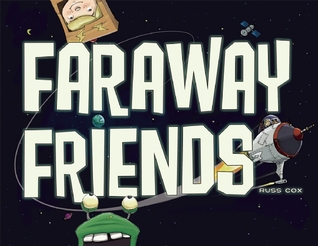
Faraway Friends Author and Illustrator: Russ Cox
Published May 5th, 2015 by Sky Pony Press
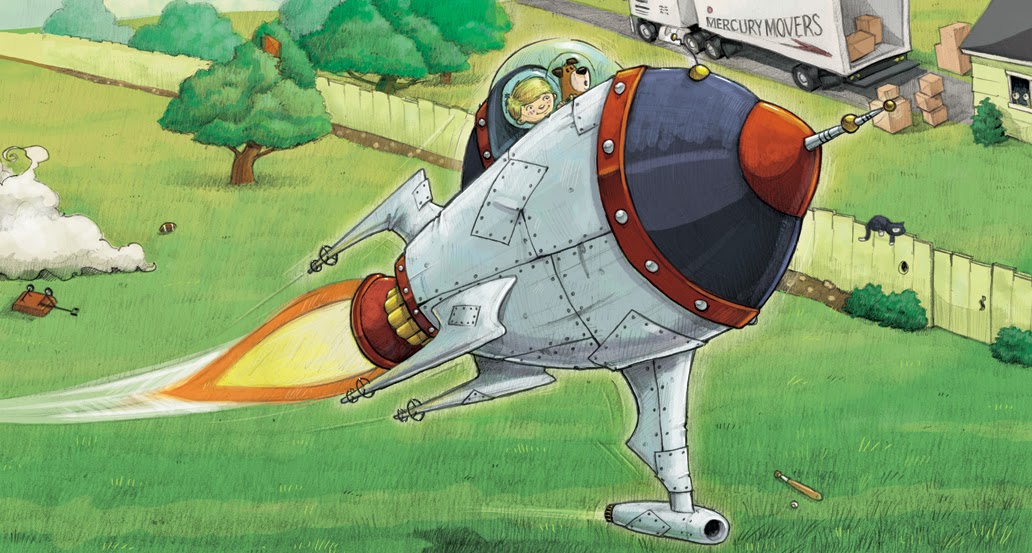
Goodreads Summary: This is the story of the adventure of a little boy named Sheldon and his dog, Jet. When Sheldon’s best friend moves away, Sheldon spies the word “Jupiter” painted on the side of the moving truck. Sheldon feels sad at first, but realizes that this is a sign—what he needs is a rocket ship! So Sheldon and Jet do some sketching and some scrounging, and, with a wagon full of equipment and supplies, the two future astronauts head to the backyard. With a glop and a wham, piece by piece the ship begins to take form, and soon it’s Commander Sheldon A. Flyer and Space Cadet Jet ready for takeoff! The duo jets around satellites, zooms by planets, speeds through space storms, and zips past other flying saucers . . . untilplop, they’ve arrived, somewhere with a green, alien life-form and a furry black blob.
This book encourages children to channel loneliness and boredom with creativity and imagination, and ultimately it is a story of new friendship. Featuring vibrant illustrations by debut author and illustrator Russ Cox, this action-packed story is sure to appeal to young readers in search of something that is out of this world!
My Review: I loved this story! It promotes imagination, has science elements, and is about the tough subject of friends moving away. When Sheldon’s best friend moves away, he believes he has moved to Jupiter so the only solution is to build a spaceship for himself and his dog, Jet, to go to Jupiter to see his friend. I adored that Sheldon went through a planning and sketching phase before building and “blasting off” with Jet. They then fly through outer space until a ship malfunction and a visiting alien change their plans. Children will love the colorful illustrations, fun adventure, and comic relief of Jet all while exploring themes of friendship, loss, and imagination.
P.S. The cover glows in the dark!!!!
Teachers’ Tools for Navigation: Like I shared above, there are some deep themes that can be addressed while/after reading this book. I also think it will promote a want to build a space ship, and it would be great to have students plan and build a spaceship (maybe not life size, but for an egg or pipe cleaner person?). The book also has onomatopoeias throughout which always makes me happy as they may be my favorite type of figurative language, and there is also great vocabulary words throughout to learn about.
Discussion Questions: Before reading, look at the cover and predict what you think the book is about. After reading, look back at the cover. What did you predict correctly and incorrectly based on the cover?; Has a friend of yours ever moved away? How did it make you feel? What did you do to help deal with the loss?; If you could build a spaceship and visit anywhere, where would you go?; When Sheldon and Jet blasted off into space, did you catch the clue for the ending in the background?
We Flagged:
(c) Russ Cox 2014
“BLAST OFF! In a spectacular plume of smoke Sheldon and Jet roared into space.”
Read This If You Loved: The Most Magnificent Thing by Ashley Spires, Journey by Aaron Becker
Recommended For:
**Thank you to Sara at Skyhorse Publishing for providing a copy for review!**
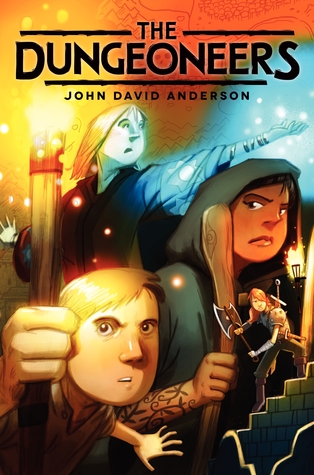
The Dungeoneers Author: John David Anderson
Published June 23, 2015 by Walden Pond Press
Publishers Summary: The Dungeoneers is an action-packed, funny, and heartbreaking middle grade fantasy-adventure from the author of the acclaimed Sidekicked and Minion, John David Anderson.
The world is not a fair place, and Colm Candorly knows it. While his parents and eight sisters seem content living on a lowly cobbler’s earnings, Colm can’t help but feel that everyone has the right to a more comfortable life. It’s just a question of how far you’re willing to go to get it.
In an effort to help make ends meet, Colm uses his natural gift for pickpocketing to pilfer a pile of gold from the richer residents of town, but his actions place him at the mercy of a mysterious man named Finn Argos, a gilded-toothed, smooth-tongued rogue who gives Colm a choice: he can be punished for his thievery, or he can become a member of Thwodin’s Legions, a guild of dungeoneers who take what they want and live as they will. Colm soon finds himself part of a family of warriors, mages, and hunters, learning to work together in their quest for endless treasure. But not all families are perfect, and even as Colm hones his skills with fellow recruits, it becomes clear that something from outside threatens the dungeoneers–and perhaps something from inside as well.
My Review: This is one of those fantasy novels that transports you to another place and throws you into an adventure that keeps you guessing and reading. In The Dungeoneers, I loved going to school with Colm and learning all about dungeoneering ways including how to be the best rogue, history of dungeoneering, swordplay, and all about monsters. This aspect reminded me a bit of Harry Potter because I got so sucked into his schooling and education, like I did with Harry’s, because I wanted to know everything I could about this world. The Dungeoneers also has some majorly suspenseful moments which makes sense in a book about stealing treasure from dungeons. In addition to his world building, he really knows how to build some characters! The three other members of Colm’s guild are such well-rounded characters and all so different. I can picture each of them, and I so want to be their friends (even Lena, who is a bit barbaric). I also loved the plot twist at the climax of the book! I did not see it coming! Just wait for it everyone!
Teachers’ Tools for Navigation/We Flagged: First and foremost, if you teach middle school, you should probably buy this for your classroom. High fantasy and adventure lovers are going to eat this one up.
Also, if you want to talk to students about building characters or setting, this book can definitely be a help with either. There are specific sections in this book that could be pulled out and used to discuss imagery, word choice, and characterization:
“In the flickering torchlight it was hard to make out all of her features clearly, but he couldn’t miss the sharp chisel of her chin, like a weapon itself. Her crimson hair was cropped short in the back, falling across one eye in front, the other shining brown in the flicker of light. Her lips were pursed, pulled tight against her teeth in a determined smirk.” (p. 93)
“Except Quinn didn’t look like he could call lightning from the sky or produce fireballs from his fingers. Colm had expected the first wizard he met to be more in keeping with the descriptions from his book–white-bearded and billowing and larger than life. Quinn looked barely big enough to summon his own shadow.” (p. 96)
“In contrast to the dreary tunnel behind them, the great hall before them was filled with light. Huge chandeliers hung from chains of gold, the flicker of a thousand candles casting fiery halos against the ceiling. Giant marble pillars anchored the four corners of the room, and a hug winding staircase with gold rails led both up and down in its center like a vortex. The floors were polished marble as well, dark green and buffed to a mirror sheen. A strange clock with twenty-four separate hourglasses hung over a set of huge double doors…” (p. 115)
Discussion Questions: If you were Colm, would you have gone with Finn?; What secret do you think Wolfe is keeping?; Lena is expected by her family to do well as a barbarian because of her upbringing. How would it feel to have that type of pressure put on you?; Colm makes a decision at the end of the book–do you agree with it or not?
Book Trailer:
John David Anderson’s Top Five Dungeoneers
Obviously The Dungeoneers owes a lot to fantasy tropes and conventions that have been around since Gandalf packed his first pipe. In fact, while writing it I sometimes felt like I should roll a d20 to see what my characters would do next (here’s hoping the book is a critical hit—ah, nerd humor). Afternoons spent playing Baldur’s Gate or reading Mercedes Lackey (or in my younger days, Lloyd Alexander) coalesced into a love of sword-swinging, lock-picking, monster-bashing rogues who risk everything on the hopes of finding that fabled cache of riches at the end of the corridor. In short, I was raised by dragons. Maybe I’m a Targaryen.
Obviously popular culture is not hurting for dungeoneers of interest, but I thought I would pick five key dungeon divers that had a distinct influence on me and the book. Note: I am defining a dungeoneer as anyone who willingly enters into some dank, creature-and-trap-infested cavern, catacomb, crypt, tomb or lair with the express purpose of taking whatever shiny, valuable objects are to be had. In other words, I’m kind of liberal with my use of the word.
5. Minsc and Boo: If you’ve ever played the game Baldur’s Gate, you will know these two. Minsc, the butt-kicking, infinitely quotable ranger, and his trusty hamster, Boo. Minsc was a tank and liked to carry big swords. More than that he had a big heart and recognized a noble enterprise, especially when it required some head bashing. Favorite quote: “Make way evil! I’m armed to the teeth and packing a hamster!
4. Ellen Ripley. All right, this one is a stretch, I admit, but in Aliens she does go down into a lair and fight off monsters (lots of them, including a queen) to rescue something she treasures (the little girl, Newt). Plus ever since I saw Aliens I’ve been drawn to tough female characters. I won’t lie—there’s a little bit of warrant officer Ripley’s feistiness in The Dungeoneers’ Lena Proudmore, though Lena doesn’t get to fire a grenade launcher (much to her chagrin).
3. Bilbo Baggins. You could name several characters from Tolkien’s mythos that fought their way out of dungeons, but Bilbo gets the cake for not coming out empty-handed. In fact, it’s the Burglar’s snatching of the Precious that drives the mythology. What did you find down there in the goblin caves, Bilbo? Oh—just the makings of a gazillion-dollar franchise. Finn Argos would be proud.
2. Link. Yes, it’s another video game, but for me, Link was the start of my love affair with dungeoneering. Link never met a rupee he didn’t like and spelunking through monster-infested lairs in search of Zelda was in his spritely 8-bit blood. I can still remember playing the original Zelda and getting eaten by an undulating stack of pancakes or impaled by a triceratops all because I didn’t know I was supposed to feed it bombs. To this day I still carry around a candle and a big stick of meat. Thank you Nintendo for stimulating my imagination and sucking away my time.
1. Indiana Jones. No sword (except in the second movie, and then it’s more of a machete). No armor. No dragons or ogres or orcs (though the Nazis are monstrous enough). But Indy, for me, is the archetypal treasure-hunter. Not only was he the dashing film hero of my childhood (and what I wanted to be when I grew up until I realized that everything cool had already been dug up already), he also helped engender my love for wise-cracking, whip-smart, ruggedly-charming, and occasionally flawed protagonists. His make-it-up-as-you go philosophy and daredevil antics were often replicated by a young, eight year old boy named Dave, who would pretend the floor was made of lava as he jumped from dining room table to couch and back again. Plus Indy knew that the greatest treasures always came at a price, a lesson that struck a chord with me.
So those are my top five. I’m sure your list is different. That’s the cool thing about inspiration—there are a lot of wells, and we get to drink from whichever ones we please. Who knows, maybe in twenty years some kid will be making a list of his favorite dungeoneers and put Colm Candorly somewhere near the top.
Read This If You Loved:Hero’s Guide (series) by Christopher Healy, Harry Potter (series) by J.K. Rowling, Foiled (series) by Jane Yolen, Giants Beware! (series) by Jorge Aguirre
Nonfiction Picture Book Wednesday is hosted by Kid Lit Frenzy and was started to help promote the reading of nonfiction texts. Most Wednesdays, we will be participating and will review a nonfiction text (though it may not always be a picture book).
Be sure to visit Kid Lit Frenzy and see what other nonfiction books are shared this week!
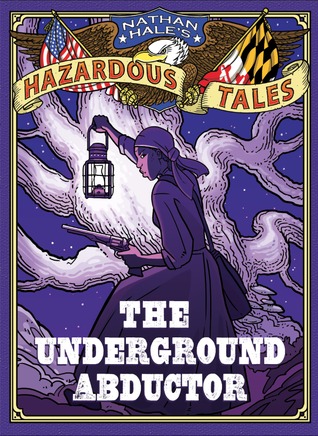
The Underground Abductor
Author and Illustrator: Nathan Hale
Published April 21st, 2015 by Amulet Books
Goodreads Summary: Araminta Ross was born a slave in Delaware in the early 19th century. Slavery meant that her family could be ripped apart at any time, and that she could be put to work in dangerous places and for abusive people. But north of the Mason-Dixon line, slavery was illegal. If she could run away and make it north without being caught or killed, she’d be free. Facing enormous danger, Araminta made it, and once free, she changed her name to Harriet Tubman. Tubman spent the rest of her life helping slaves run away like she did, every time taking her life in her hands. Nathan Hale tells her incredible true-life story with the humor and sensitivity he’s shown in every one of the Hazardous Tales—perfect for reluctant readers and classroom discussions.
My Review: I love this entire series! Nathan Hale has taken history and made it accessible (with a dash of humor!). If you don’t the concept of the series, it revolves around Nathan Hale the Revolutionary War spy who, in the first book, was eaten by a history book so now knows all that has happened in history and is sharing it with the hangman and British officer who are guarding him before he is executed. The first book is Hale’s own story and then each of the following are his telling of different times in history.
This installment of Hale’s graphic novel series may be my favorite so far. I found it to be the most intense of his stories even though it is up against stories of wars, but Harriet Tubman’s story is one of one person’s resilience in the face of pure doom. Although it is evident through any story you hear of Harriet how truly brave she was, Nathan Hale’s story immerses you into Harriet’s life and shows you how much she truly did and faced.
Teachers’ Tools for Navigation: This book is written to start discussions (in reading/language arts OR social studies)! I was lucky enough to write the teaching guide for The Underground Abductor (as well as the rest of the series!), and I have included some of my discussion questions below.
I could also see Hale’s Hazardous Tales being used in lit circles with each group reading a different one of the tales. This could lead to wonderful discussions about each time in history. Students could then present their history to the rest of the class.
Discussion Questions:
When Araminta heard the story of Moses and the pharaoh, she envisioned Moses as a slave and the pharaoh as an owner (page 15). How does Moses’s story compare to a traditional story of a slave? Harriet is later called “Moses” or “Black Moses.” How does Harriet’s story compare to Moses’s?
How did Nat Turner’s rebellion affect slave laws (page 21)? He meant to make a positive change, but it actually turned negative. How? Why?
On page 44, Nathan Hale personifies debt as the ghosts and men Minty had been dreaming about. Why is debt shown as a terrifying thing? How did Mr. Brodess’s debt affect Mindy and her family?
Complete a character web with adjectives describing Harriet Tubman. What type of person was she that allowed her to overcome a debilitating injury and slavery?
Book Trailer:
Read This If You Loved: Hazardous Tales series by Nathan Hale, March by John Robert Lewis, Stolen Into Slavery by Judith Bloom Fradin, Elijah Buxton by Christopher Paul Curtis
Recommended For:
**Thank you to Morgan at Abrams Books for providing a copy of the book!**
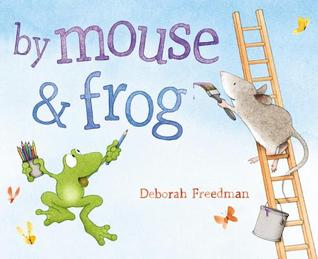
By Mouse & Frog Author and Illustrator: Deborah Freedman Published April 14th, 2015 by Viking Books for Young Readers
Goodreads Summary: Fastidious Mouse has one idea about how to tell a story. Free-spirited Frog has another. What happens when Frog crashes into Mouse’s story with some wild ideas? Chaos!…followed by the discovery that working together means being willing to compromise—and that listening to one another can lead to the most beautiful stories of all.
Kellee’s Review and Teachers’ Tools for Navigation:I love this book. There is so much wonderful in these pages. First, the book is just so funny! Mouse and Frog are so different and the back and forth is laugh-out-loud comedic. Second, the story really makes you look at personality types and think about how to work together. Frog and Mouse’s story would be a wonderful one to read and then talk about norms when working in groups on projects/assignments. Third, the book also looks at story writing and narrative elements. What is needed in a good story? Do all stories have to have the same things? All in all, this book is fun to read and will be a good jumping off point for all sorts of discussions. I think this book is going to find some major love in homes, schools, and libraries alike.
Ricki’s Review and Teachers’ Tools for Navigation: This magical story is about two friends who co-write a book together. It would be a great book to teach kids about the importance of listening and valuing others’ opinions. I would use this in the classroom at times when there is a lot of conflict. Very few students benefit from a pamphlet about conflict resolution. Instead, I would read this book aloud to students, and we could talk about the value of listening to and understanding each other. Overall, this is a great book to get students’ creative juices flowing. The whimsical creativeness of this title reminds me a bit of The Dot by Peter Reynolds, another picture book favorite.
Discussion Questions: What is needed in a good story? Do all stories have to have to have the same things?; Why didn’t Mouse and Frog get along at first? How did they compromise at the end?
We Flagged:
Read This If You Loved: Look! by Jeff Mack, The Story of Fish and Snail by Deborah Freedman, Little Red Writing by Joan Holub; The Dot by Peter Reynolds
Recommended For:
and
**Thank you to Penguin Young Readers for providing a copy for review!**
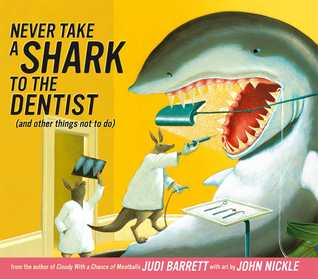
Never Take a Shark to the Dentist (and other things not to do)
Author: Judi Barrett
Illustrator: John Nickle
Published March 4th, 2008 by Atheneum Books for Young Readers
Goodreads Summary: There are many things you should never, ever, ever do. Like sit next to a porcupine on the subway (ouch!). Or hold hands with a lobster (double ouch!). Or take a shark to the dentist (triple ouch!).
Bestselling author JUDI BARRETT and imaginative illustrator JOHN NICKLE give us a raucous look at the perils of taking giraffes to the movies, goats to the library, and pigs out to lunch…and other such silly stuff.
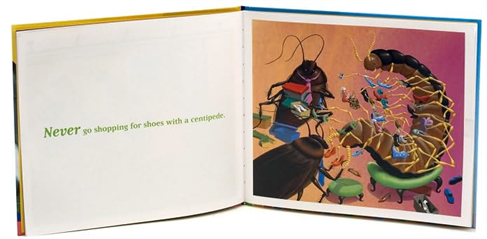
My Review and Teachers’ Tools for Navigation: The combination of Judi Barrett’s humorous DO NOTs and John Nickle’s fantastic illustrations, this book just cracked me up! It is not only a perfect read aloud to suck students in, it is definitely a book that can be used in the classroom. First, each instance has something not to do (Never take a shark to the dentist) with cartoony illustrations, but doesn’t elaborate after that. What would happen? Why wouldn’t you ____? A great cause and effect discussion. These little DO NOTs would also be perfect prompts to get students writing. It can be a prompt for a humorous narrative or for an expository essay about why not do to do these things.
Discussion Questions: What would happen next? Why wouldn’t you ____? What would cause you to need to ____?
Read This Book If You Loved: Cloudy with a Chance of Meatballs by Judi Barrett, This Is Not My Hat & I Want My Hat Back by Jon Klassen, Press Here by Herve Tullet, Battle Bunny by Jon Sciezska, The Book of Bad Ideas by Laura Huliska-Beith
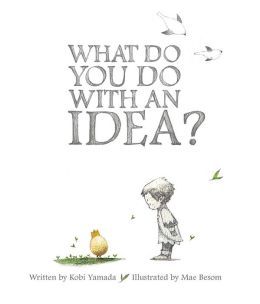
What Do You Do with an Idea? Author: Kobi Yamada; Illustrator: Mae Besom
Published: February 1, 2014 by Compendium Inc.
Summary: This is the story of one brilliant idea and the child who helps to bring it into the world. As the child’s confidence grows, so does the idea itself. And then, one day, something amazing happens. This is a story for anyone, at any age, who’s ever had an idea that seemed a little too big, too odd, too difficult. It’s a story to inspire you to welcome that idea, to give it some space to grow, and to see what happens next. Because your idea isn’t going anywhere. In fact, it’s just getting started.
Review: I read this book slowly and purposefully. By page two, I realized I had come upon something very special, and I wanted to savor the moment—because while we can enjoy books over and over again, we can never read a book for the first time twice. When I think of this book, I will remember reading it quietly aloud (cross-legged on the floor of the bookstore) as my son played with trains beside me. What Do You Do with an Idea? illustrates the complexity of ideas, which are inherently imbued with feelings of self-doubt. The child in this book learns to treasure his idea and comes to realize the beauty of its potential. After I read this book, I immediately mailed a copy to my younger sister (who works at Google) because her mind brims with ideas. This book is inspirational for people of all ages. I hope you find it to be inspirational, too.
Teacher’s Tools for Navigation: The author and illustrator combine efforts to illustrate an abstract idea as a physical thing. Readers might consider how they do this with words and illustrations. Then, they could try to illustrated a different abstract idea in a story of their own.
Discussion Questions: Why might the illustrator have chosen to characterize the idea as an egg with a crown?; How is color intentionally used to tell the story?; Why might the author have chosen to use a first person point-of-view? How might the story have been different otherwise?; What is the author’s purpose?; Why/How might this book resonate with readers of all ages?