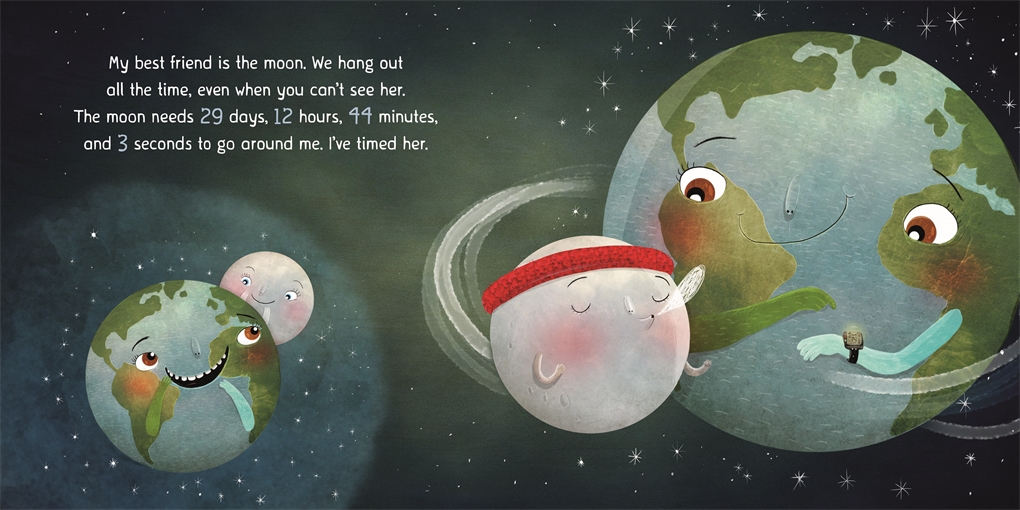
Earth! My First 4.54 Billion Years by Stacy McAnulty

Share

nfpb2017

Nonfiction Wednesday

Nonfiction Picture Book Wednesday is hosted by Kid Lit Frenzy and was started to help promote the reading of nonfiction texts. Most Wednesdays, we will be participating and will review a nonfiction text (though it may not always be a picture book).
Be sure to visit Kid Lit Frenzy and see what other nonfiction books are shared this week!
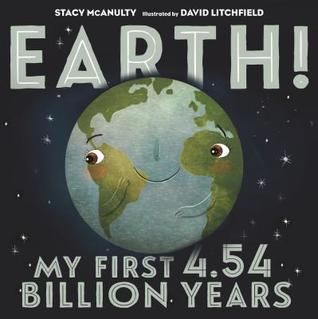
Earth! My First 4.54 Billion Years
Author: Stacy McAnulty
Illustrator: David Litchfield
Published October 24th, 2017

Summary: “Hi, I’m Earth! But you can call me Planet Awesome.”

Prepare to learn all about Earth from the point-of-view of Earth herself! In this funny yet informative book, filled to the brim with kid-friendly facts, readers will discover key moments in Earth’s life, from her childhood more than four billion years ago all the way up to present day. Beloved children’s book author Stacy McAnulty helps Earth tell her story, and award-winning illustrator David Litchfield brings the words to life. The book includes back matter with even more interesting tidbits.

ReviewWow! This book went above and beyond my expectations! Think of it as Earth’s humorous autobiography. The voice that Stacy McAnulty gave Earth is perfect, and you learn things too! Although the book is silly and is told from Earth’s point of view, it is still a book that should be taken seriously because the knowledge it (and the back matter) holds is tremendous. It goes through the history of Earth is a truthful yet understandable way. Kids will leave the book knowing more than they did before but also really interested in learning more. Stacy McAnulty’s narrative with David Litchfield’s cartoonish illustrations lends itself to the perfect picture book for entertainment and information. Just check out the flagged passages to see why I say this is a must-get book!

Teachers’ Tools for Navigation: When Earth’s history is first introduced in elementary school, Earth! would be the perfect introduction book because it goes over the entire history in a way that students will pay attention to but also without dumbing down any of the information.

Discussion Questions: 

  • How did the author use text features throughout the book?
  • How did the author’s use of an unconventional narrator help you understand the history of Earth better?
  • What humorous parts of the book were your favorite? Why?
  • Using the ruler visual within the book, how much of Earth’s history have human’s inhabited? What else do you learn from this visual?
  • Read the back matter of the book. What else did Stacy McAnulty teach you in the back of the book?
  • What is something new you learned about Earth or the solar system in Earth!?
  • Would you classify the book as fiction or non-fiction? Why?

Flagged Passages: 

Read This If You Love: Science, Space, Picture books with humorous narrators like It’s Not Jack and the Beanstalk by Josh FunkNothing Rhymes with Orange by Adam Rex

Recommended For: 

classroomlibrarybuttonsmall closereadinganalysisbuttonsmall

Signature

**Thank you to Kelsey at MacMillan for setting up the blog tour for Earth!**
Blog Tour with Author Guest Post with Activities and Discussion Questions!: Dragonfly Song by Wendy Orr

Share

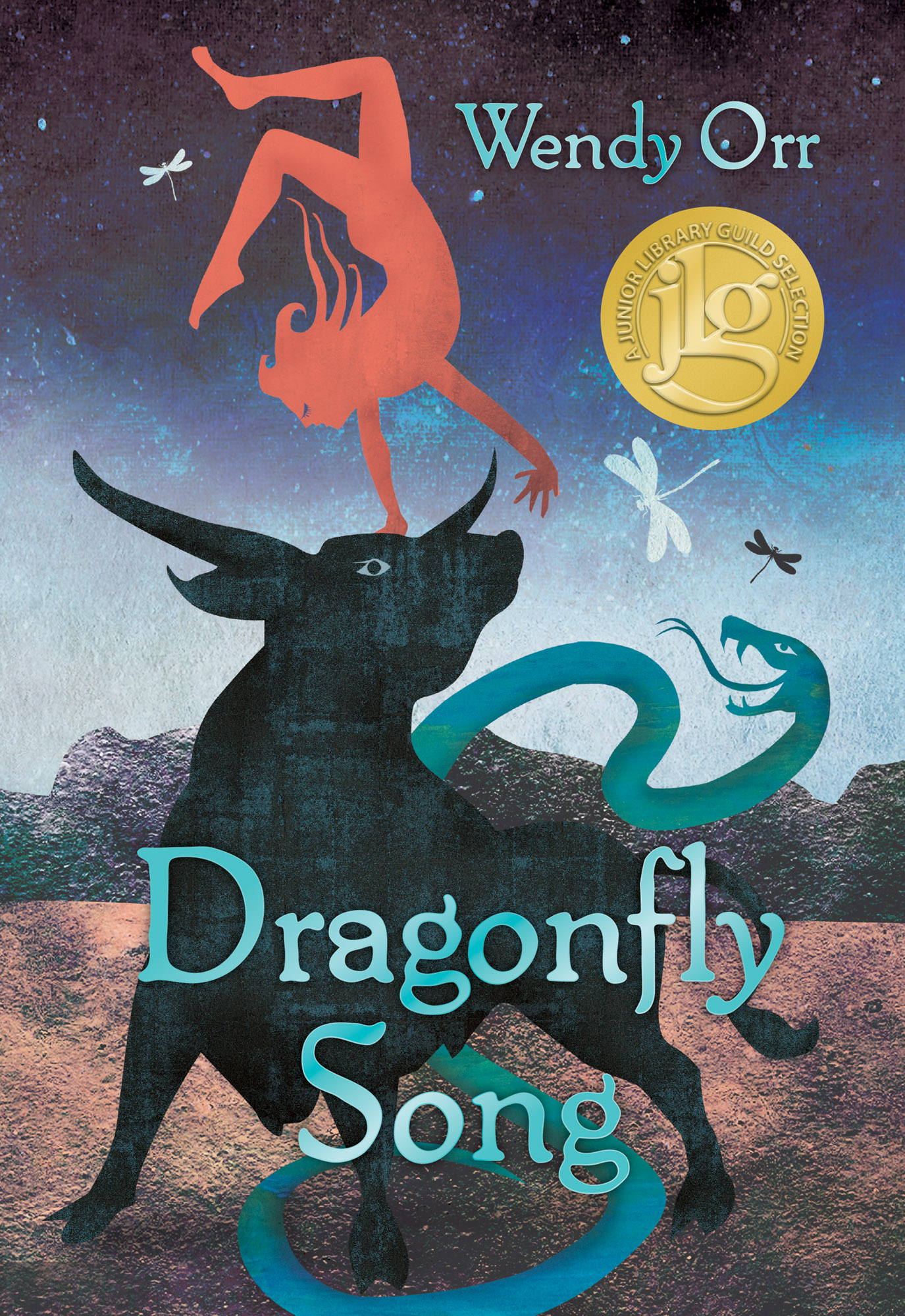
Dragonfly Song
Author: Wendy Orr
Published October 27th, 2017 by Pajama Press

Summary: The whispers say it’s not true that the Lady’s firstborn died at birth. They say it’s worse—the baby was born with an extra thumb dangling from each wrist. If she’s not perfect, she can never follow in her mother’s footsteps.

Nobody but the old wise-woman knows what truly happened to Aissa, the firstborn daughter of the priestess. If they saw the half-moon scars on the servant girl’s wrists they would find it out, but who would look twice at lowly, mute No-Name? Then the soldiers of Crete come to the island, demanding children as tribute for their god-king’s bull dances as they do every year. Aissa is determined to seize this chance to fight for her own worth and change her destiny once and for all.

Lyrically written and refreshingly unpredictable, Dragonfly Song is a compelling Bronze Age fantasy that suggests a fascinating origin for the legend of the Minotaur and his dark tribute.

“As mesmerizing as a mermaid’s kiss, the story dances with emotion, fire, and promise.” -Kirkus Reviews, starred review

More information about Dragonfly Song: http://pajamapress.ca/book/dragonfly_song/

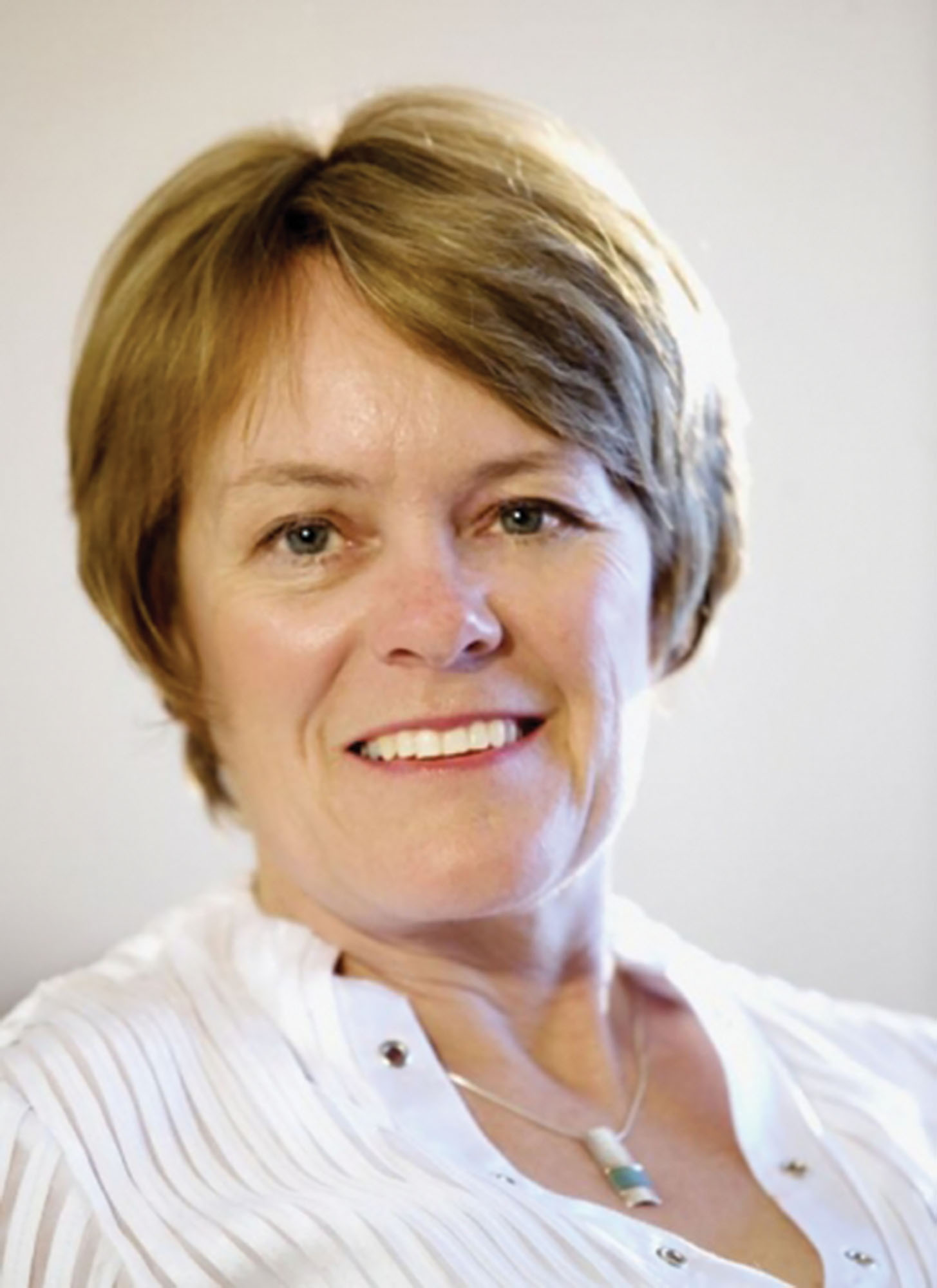
About the Author: Wendy Orr was born in Edmonton, Canada, but grew up in various places across Canada, France, and the USA. She studied occupational therapy in the UK, married an Australian farmer, and moved to Australia. She’s the author of many award-winning books, including Nim’s Island, Nim at Sea, Rescue on Nim’s Island, Raven’s Mountain, and Peeling the Onion.

More information about Wendy Orr: http://www.wendyorr.com/

Author-Created Activity Guide:

  • Art: In Chapter 2, Aissa and the potter’s daughter make ‘circles of flowers
    in a ring of stones.’ Later, Aissa makes patterns of flowers and shells for the fishers’ goddess (the first in Chapter 9) and patterns of rocks and her small treasures for the goddess in her sanctuary cave. Patterns are used in some religions and meditative practices; Indian or Tibetan mandalas and Navajo sandpaintings are probably the best known now.
    To draw a mandala: http://www.art-is-fun.com/how-to-draw-a-mandala/
    Ideas for mandala-type patterns using fresh flowers: http://twistedsifter.com/2014/07/flower-mandalas-by-kathy-klein/
    Make your own patterns with sea shells, flowers, pebbles, leaves, seeds, or other natural materials. Glue them into place on card, or photograph them.
  • Writing: In Chapter 24, Aissa learns to write on the clay tablets used for taxation records. The writing she used was called Linear B, and was a combination of a ‘syllabary’ – each symbol representing a syllable of a word – and ‘logograms,’ which are symbols of whole words. These tablets were supposed to be temporary, but were baked into pottery when the palaces burned down. Have students make their own clay tablets using real clay or as in these instructions: http://www.ehow.com/how_12110304_make-egyptian-hieroglyphics-tablet.html
    For some of the Linear B logograms: http://www.omniglot.com/writing/linearb.htm
  • Time Capsule: Without written historical records, interpreting archaeological finds can be very difficult. Put together ‘time capsules’ of small items – e.g. a birthday card, Barbie doll, shopping list, old iPod, CD… Break the class into small groups and have them use the items to ‘interpret’ questions such as this society’s religion, dress code, and social structure.

Author-Created Discussion Questions: 

  • Like The Hunger Games, Dragonfly Song draws on the Greek myth of Theseus, in which seven youths and seven maidens are sent as tribute from Athens to Crete, to be eaten by the monstrous half-man, half-bull Minotaur. However, Dragonfly Song looks back to the possible origins of the myth in Bronze Age Greece, and the palace of Knossos in Crete. The bull was obviously a very important symbol, probably even a god – even though the real animals would be sacrificed to their god – and there were many scenes, on paintings, vases, and gold jewellery, showing young acrobats somersaulting over the backs of bulls. What if these acrobats were part of a payment to Crete in return for protection by – or from – their powerful navy? If so, the tribute would have come from as far as the Minoan navy reached. Discuss the power of myth – why have some stories lasted for thousands of years?
  • Discuss how the physical setting of Aissa’s home is a metaphor for the grimness of her life there. (e.g. The island is rocky, poor and isolated; buildings are dark, built of rock or burrowed into the side of the mountain.) What about the springtime when she develops new strengths after being cast out of the servants’ kitchen?
  • In the Bull King’s palace, the buildings are awe-inspiring, filled with light and extraordinary art. The culture appears to be obsessed with beauty – but is there a darkness underpinning it?
  • Dragonfly Song is set in the Bronze Age, but the ordinary people of Aissa’s island still use stone tools as well. Why do you think that would be?
  • In the prologue, The Firstborn Daughter, what are the clues to tell us that this is a matriarchal society? How does it differ from a patriarchal society? The Mosuo of China are an example of a matriarchal society in the present day. https://www.youtube.com/watch?v=eoTrARDa8BU
  • Chapter 8 mentions that the chief killed the last lion for his cloak when he married the Lady. Why might he have wanted a lionskin cloak rather than a deerskin? Why do you think the islanders didn’t worry about conservation and keeping all their native species alive?
  • In Chapter 9, the servants are ‘screaming with joy at their game of hate.’ Why do you think the author described bullying Aissa as a game? How does bullying Aissa make the servants feel?
  • Aissa is an ‘elective mute’ because there is nothing physical or intellectual preventing her from speaking. However, that doesn’t mean that she could speak if she wanted to: Mama’s command, ‘Stay quiet, still as stone till I come back,’ is buried so deep in her subconscious, and is so mixed with the trauma of the family’s death and disappearance, that Aissa can’t simply decide to start talking, even when she’s safe. Would she have been more accepted by the other servants if she could talk? How might it have changed the story if she had regained her speech after singing the snake away from Luki? Do you think she could have regained her speech if she had been treated kindly after being rescued? Do you think that meeting Mama again was the only reason she regained her speech, or might it have been partly because she’d faced death in the bull ring, and was safe now? A real-life example of a child choosing to become mute after trauma is Maya Angelou’s story (summarized in Goodnight Stories for Rebel Girls).
  • Discuss the book’s structure with the students. What was their reaction to the combination of free verse and prose?
  • Wendy Orr says that using free verse made it easier for her to access and portray Aissa’s emotions. Have the students choose an emotion, e.g. rage, grief, or joy – and write about it in free verse. Next, have them write a short story using the ideas and images that arose from the verse.
  • Why do you think the author chose to write in free verse rather than rhyming, like the children’s rhyme in Chapter 10?
    Here comes rabbit, hippity hop
    See his ears flap and flop;
    Here comes hedgehog, curled up small
    Roll him over like a ball.
  • Wendy Orr says that she normally writes in silence, on the computer, but found that the verse sections for this story had to be written by hand, playing the album Agaetis Byrjun by the Icelandic band Sigur Ros. Experiment with playing different types of music as the students write verse.
  • For useful images and links, see the Pinterest board: https://www.pinterest.com/wendyorr1/dragonfly-song-bits-of-background-and-teaching-ideas/

Don’t Miss Out On the Rest of the Tour!

October 22: Unleashing Readers, Activity Guide and Discussion Questions https://www.unleashingreaders.com/
October 23: YA and Kids Book Central, Book Playlist http://www.yabookscentral.com/blog/
October 24: Log Cabin Library, Guest Post http://logcabinlibrary.blogspot.com/
October 25: The Children’s Book Review, Character Interview https://www.thechildrensbookreview.com/
October 26: Bluestocking Thinking, Review http://bluestockingthinking.blogspot.com/
October 27: Charlotte’s Library, Interview http://charlotteslibrary.blogspot.com/
October 28: A Foodie Bibliophile in Wanderlust, Interview http://www.foodiebibliophile.com/
October 29: Writers’ Rumpus, Guest Post https://writersrumpus.com/

Recommended For: 

Thank you to Wendy Orr for her fantastic activities and questions!

Review with Giveaway and YouTube Video!: Bruce’s Big Move by Ryan T. Higgins

Share

We’re so excited to be partnered with Disney-Hyperion to bring you this review and giveaway of Bruce’s Big Move! 

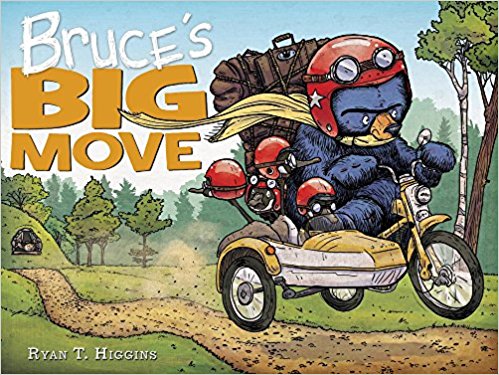
Bruce’s Big Move
Author & Illustrator: Ryan T. Higgins
Published September 27th, 2017 by Disney-Hyperion

Summary: After the events of Hotel Bruce, our favorite curmudgeonly bear shares his home with not only his four geese, but three rowdy mice besides! Fed up with their shenanigans, Bruce sets off to find a rodent-free household. But as usual, nothing goes quite according to plan…

A hilarious sequel for fans of the previous Bruce books, as well as a standalone discovery for new readers, Bruce’s next reluctant adventure is sure to keep kids giggling.

About the Author: Ryan T. Higgins (ryanthiggins.com) is an author and illustrator who likes the outdoors and cheese sandwiches. He is NOT a grumpy old black bear, but he DOES like making books about one—starting with the best-selling Mother Bruce, which received the E. B. White Read-Aloud Award and the Ezra Jack Keats New Illustrator Honor. He lives in Maine with his wife and kids… and too many pets.

LEARN MORE
Visit books.disney.com
Follow Disney-Hyperion on TwitterFacebook, and Instagram
#BrucesBigMove #FollowBruce

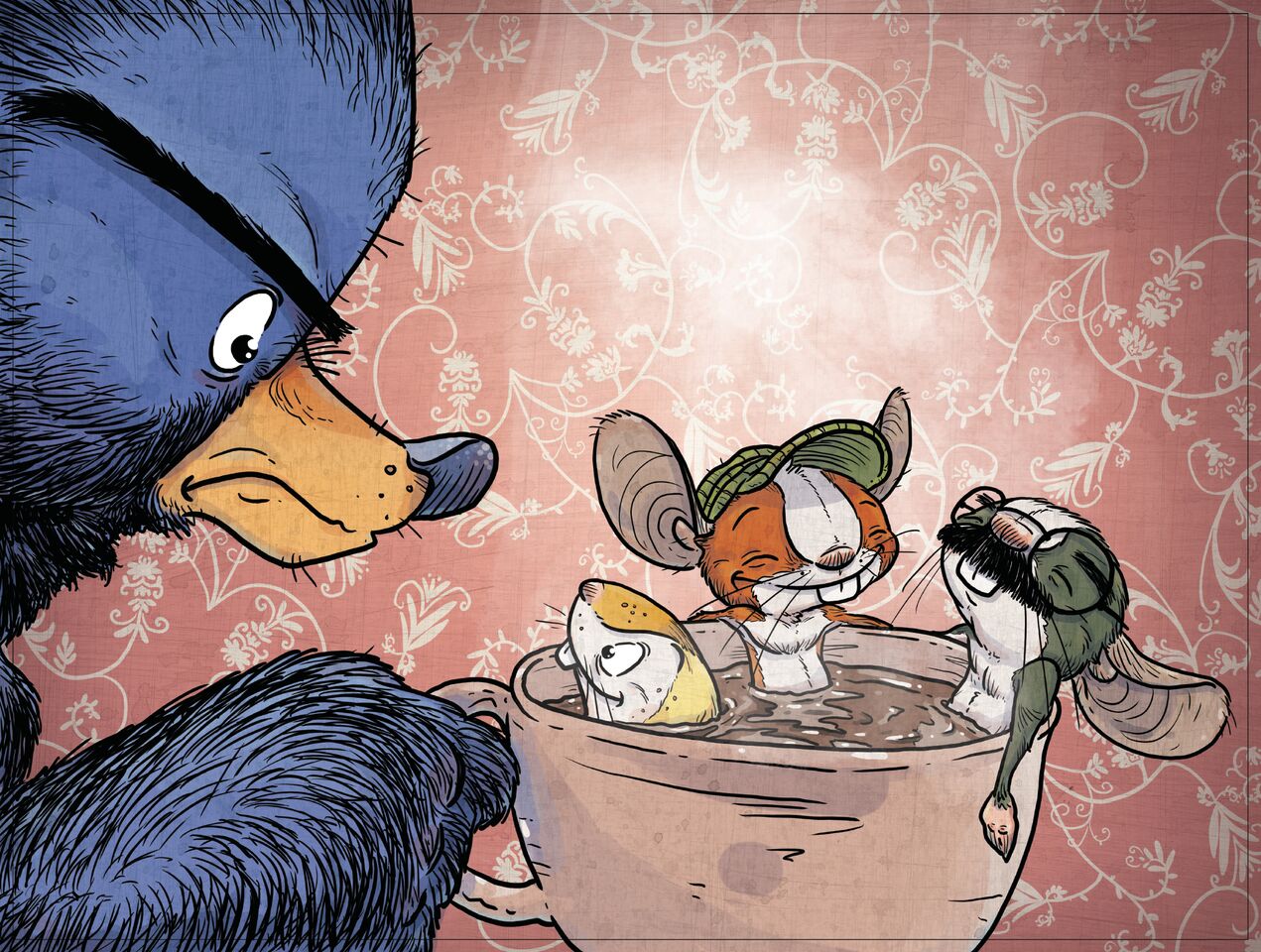
Kellee’s Review: Bruce is back and still a curmudgeon. Following the events in Mother Bruce where he becomes the mother to 4 geese and Hotel Bruce when 3 mice move in, Bruce decides enough is enough and wants to get away from the rodents once and for all, and he is willing to go to the extreme (moving) to get away. 

One of my favorite things about the Bruce books are the character’s expressions! Bruces’ stories are one only half told in the words, the rest can be found in the illustrations. The illustrations are so expressive and detailed giving each character a personality without it having to be explained.

And just like in the first two Bruce books, there is a definite message in the end! What do you think will make Bruce happy?

Ricki’s Review: I can’t decide whether I like the words or the illustrations more in this book. They are both hysterical! I absolutely adore Bruce. He makes me smile. Ryan T. Higgins is incredibly talented—I will read anything he writes!

Kellee is spot on. Bruce’s facial expressions make me laugh and laugh. I wish I captured my 4-year-old reading this book. He kept laughing and pointing to the pictures. I like the Bruce books because Higgins incorporates clear messages for readers, and he masterfully creates books that make great classroom read alouds!

Teachers’ Tools for Navigation: Use Bruce’s Big Move, and the other Bruce books, as read alouds to discuss illustrations’ purpose in stories, theme, and characterization with students. Alternatively, consider asking students to create their own Bruce fanfiction!

Discussion Questions: 

  • Why does Bruce want to get rid of the rodents?
  • On each page, look at the characters’ expressions and discuss what clues they give the reader about the character.
  • What do you think will make Bruce happy?; Did you predict the ending of the book?
  • What do you think the author’s message was at the end of the book?

Flagged Passages: 

“Bruce wished there was a way to get rid of the pesky rodents. But there wasn’t.”

Realtor Ryan help his bear friend Bruce find the perfect rodent-free home: 

Read This If You Love: The first two books in the Bruce series, You Will Be My Friend! by Peter Brown, This is a Moose by Richard T. Morris, Be Quiet by Ryan T. Higgins, Here Comes Teacher Cat by Deborah Underwood, Nibbles by Emma Yarlett

Recommended For: 

classroomlibrarybuttonsmall 

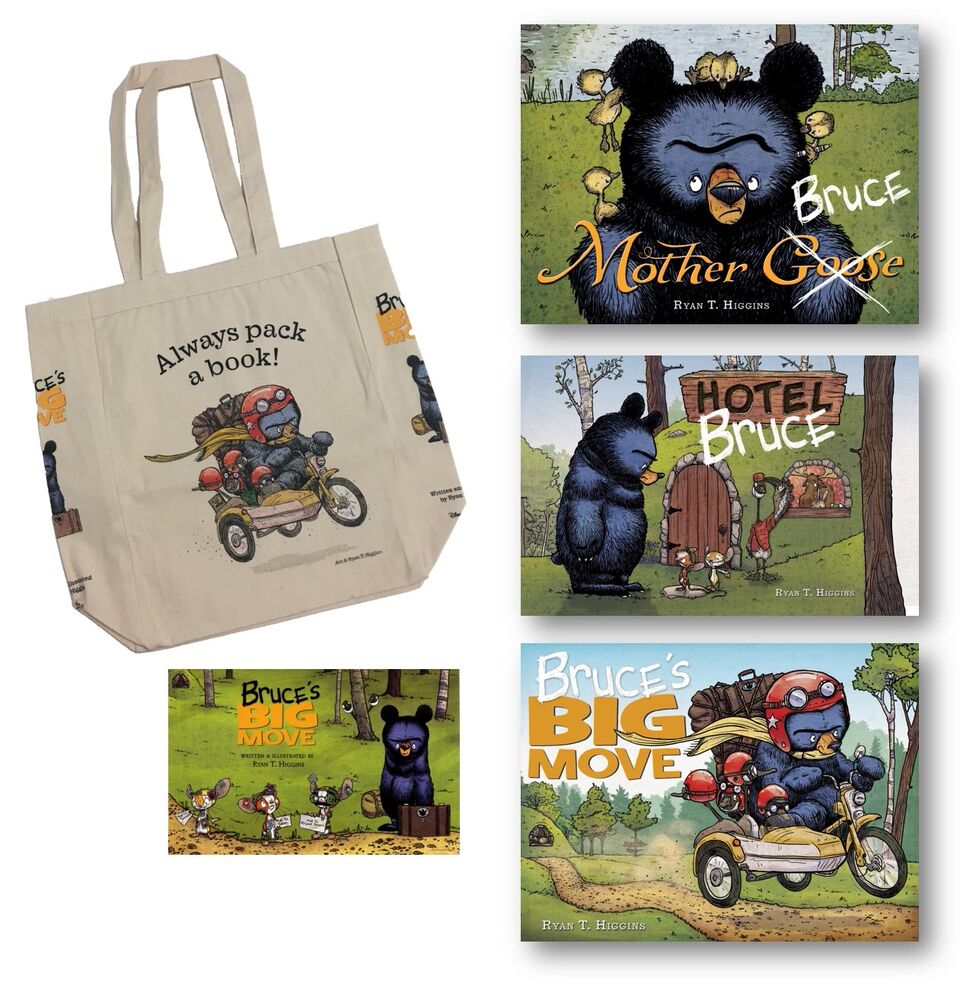
Disney-Hyperion is partnering with us for a Whole Lotta Bruce GIVEAWAY!
One (1) winner receives:
Copies of Bruce’s Big Move, Hotel Bruce, and Mother Bruce
Branded tote bag and stickers

a Rafflecopter giveaway

Signatureand 

**Thank you to Alex at Big Honcho Media for providing copies for review!**

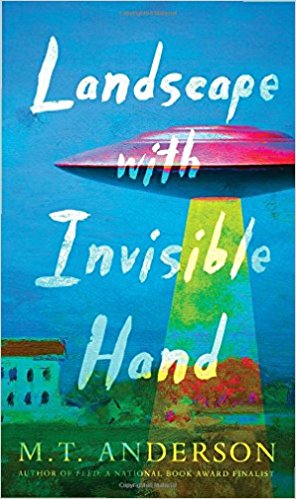
Landscape with Invisible Hand by M. T. Anderson

Share

Landscape with Invisible Hand
Author: M. T. Anderson
Published: September 12, 2017 by Candlewick

Summary: National Book Award winner M. T. Anderson returns to future Earth in a sharply wrought satire of art and truth in the midst of colonization.

When the vuvv first landed, it came as a surprise to aspiring artist Adam and the rest of planet Earth – but not necessarily an unwelcome one. Can it really be called an invasion when the vuvv generously offered free advanced technology and cures for every illness imaginable? As it turns out, yes. With his parents’ jobs replaced by alien tech and no money for food, clean water, or the vuvv’s miraculous medicine, Adam and his girlfriend, Chloe, have to get creative to survive. And since the vuvv crave anything they deem “classic” Earth culture (doo-wop music, still-life paintings of fruit, true love), recording 1950s-style dates for the vuvv to watch in a pay-per-minute format seems like a brilliant idea. But it’s hard for Adam and Chloe to sell true love when they hate each other more with every passing episode. Soon enough, Adam must decide how far he’s willing to go – and what he’s willing to sacrifice – to give the vuvv what they want.

Review: 

  • Futuristic, dark satire that is an unusual, intelligent social commentary
  • Forces readers to think deeply about their personal, social, and political lives
  • Somewhat non-linear story with an interesting layout: each chapter has a title that corresponds with the artwork created by the main character
  • Stylistically, Anderson chooses every word with intention. The text is a 149-page novella that features chapters that can be taught instructionally as vignettes.

Teachers’ Tools for Navigation:  Teachers might ask students to begin by looking closely at the text for short passages that they find particularly interesting or inspiring. Students might write a one-pager that a) unpacks the passage they chose, and b) examines the passage through the lens of a topic that they find particularly interesting and relevant. For example, they might connect a passage to the following topics which are relevant in the text:

Art

Automation

Capitalism

Classism

Economy

Entrepreneurship

Existentialism

Extraterrestrial Life

Health Care

Immigration

Love

Politics

Poverty

Sickness

Nostalgia

Unemployment

After the students have written several one-pagers and explored a variety of topics, they might select one topic that interests them most. They can research scholarship about the topic and look across the entire text for relevant passages.

Sample research paper topics:

Examining economic disparities and classism within Landscape with Invisible Hand

Finding the soul: M.T. Anderson’s treatment of love and art in Landscape with Invisible Hand

Discussion Questions: Do you think M. T. Anderson had a purpose for writing this text?; What kind of social commentary does this text offer?; What does it tell us about love? Society? Humanity?; How does Anderson use art to enhance the story?; How is the text structured? How does this enhance your reading?

Flagged Passage: “We are tiny figures, faceless, pointing at wonders, provided for scale, no lives of our own, surveying the landscape that has engulfed us all.”

Read This If You Loved: Feed by M. T. Anderson; Books by Scott Westerfeld; The House of the Scorpion by Nancy Farmer

Recommended For:
 classroomlibrarybuttonsmall

Thank you, Candlewick!

RickiSig

National Geographic Kids: What Would Happen? by Crispin Boyer

Share

nfpb2017

Nonfiction Wednesday

Nonfiction Picture Book Wednesday is hosted by Kid Lit Frenzy and was started to help promote the reading of nonfiction texts. Most Wednesdays, we will be participating and will review a nonfiction text (though it may not always be a picture book).
Be sure to visit Kid Lit Frenzy and see what other nonfiction books are shared this week!

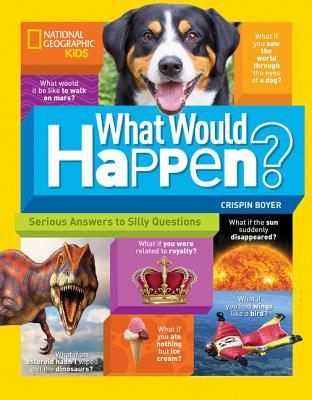
National Geographic Kids: What Would Happen? 
Author: Crispin Boyer
Published July 11th, 2017 by National Geographic Society

Summary: Ever wondered what would happen if some cool or crazy things were possible? Like what would happen if: you got sucked into a black hole; dinosaurs still existed; humans could fly; you could communicate with dolphins; or you could dig a hole through to the center of the Earth?

Get ready to explore all kinds of scenarios that would or could happen if the world was just a slightly different place. Each scenario is examined with real scientific, historical, and cultural facts in mind. This out-of-the-box book encourages readers to cultivate a better understanding of the world as it is – and as it could be!

ReviewA favorite book of mine and my husband’s that we read years ago was Why do Men have Nipples?, and we really loved getting answers to questions that you may not even know to ask yet are really intriguing. What Would Happenis the middle grade equivalent! So many interesting questions are answered! Do you want to know about global warming? Honeybees? Time machines? You will find answers in this book. Each question’s answer is set up to give the reader background knowledge, potential outcomes, extenuating circumstances, etc. to fill in any blanks and curiosities there may be. And as with all National Geographic books, the photographs are superb!

Teachers’ Tools for Navigation: I love that so many of the National Geographic books touch on such a variety of topics, but also in the books that are like What Would Happen?, the information only touches the surface. This book would be a perfect jump start to passion or inquiry projects. What do students want to learn more about? They can start by reading the spread in What Would Happen? then research more to prepare a presentation about everything they learn.

The book also definitely has a place in libraries: school, classroom, and home. It is a wonderful book filled with questions that kids will love to learn the answers to!

Discussion Questions: Every page in this book has a discussion question!

Flagged Passages: 

Read This If You Love: Getting answers to burning questions

Recommended For: 

classroomlibrarybuttonsmall closereadinganalysisbuttonsmall

Signature

**Thank you to Karen from Media Masters Publicity for providing a copy for review!**

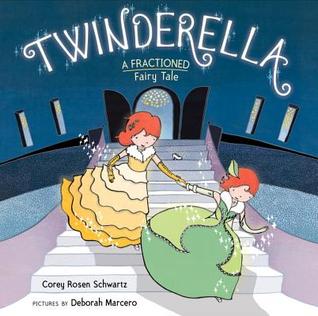
Twinderella: A Fractioned Fairy Tale by Corey Rosen Schwartz

Share

Twinderella: A Fractioned Fairy Tale
Author: Corey Rosen Schwartz
Illustrator: Deborah Marcero
Published September 5th, 2017 by G.P. Putnam’s Sons Books for Young Readers

Summary: Have you heard the story of Cinderella? Well, you don’t know the half of it.

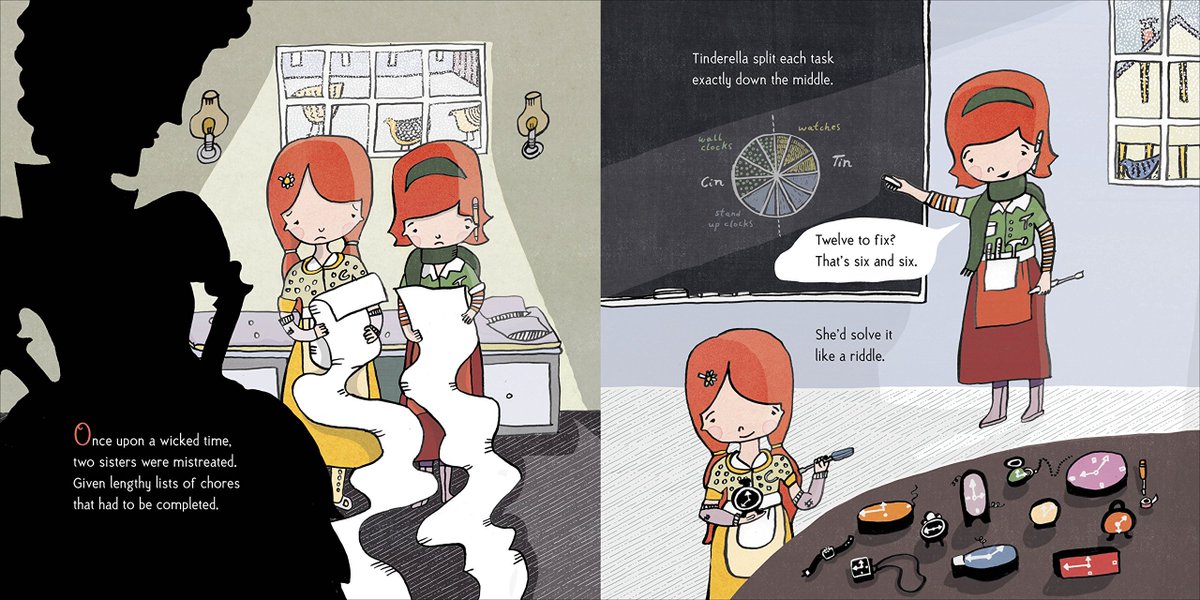
Cinderella and her lesser-known twin, Tinderella, split everything right down the middle. They each do half the housework, half the mending, and half the mean step-sister tending. When the Prince throws a ball, their fairy godmother sends them both, and they dance the night away with the prince. But he simply can’t choose between Cin and Tin, and they are in need of some clever thinking and just a pinch of magic. The Prince agrees to share his kingdom half and half, and the fairy-godmother makes him a twin too, so they can all live happily ever after. Cin and the Prince rule the kingdom, while Tin and the Twin win all the kingdom’s math competitions. It truly is a happily ever half-ter.

Review: I am a huge fan of fairy tale retellings. I think they are a perfect way to bring attention to something, tell a unique story, or teach students because it is set in a basis of prior knowledge that most students already have thus allowing for a comfortable base to scaffold up from. With Twinderella, the story of Cinderella is used to teach about fractions and division while also telling a story of two sisters that find a way to make sure they can live happily ever half-ter.

Schwartz and Marcero are a perfect team to tell these twins’ story in a way that not only teaches but entertains. The balance was done so well between the math concepts and narrative. You learn how the twins make it all work, and you root for them to be happy.

Teachers’ Tools for Navigation: When I finished this book, I immediately texted my friend who teaches 2nd grade because I know that it is perfect for the classroom! It meets standards for second grade because of the focus on fairy tales and retellings and is a perfect introduction to easy fractions that they will begin looking at in 3rd grade.

Discussion Questions: 

  • How is Twinderella different from the traditional Cinderella stories?
  • How did Tinderella make sure that everything was split equally between the two sisters?
  • What math concepts were taught in the story?
  • With the quadruplets, how would chores and such needed to be divided?

Flagged Passages: 

Read This If You Love: Math, Fairy Tale Retellings

Recommended For: 

classroomlibrarybuttonsmall 

Signature

**Thank you to Penguin Young Readers for providing a copy for review!**

Nerdy Birdy by Aaron Reynolds

Share

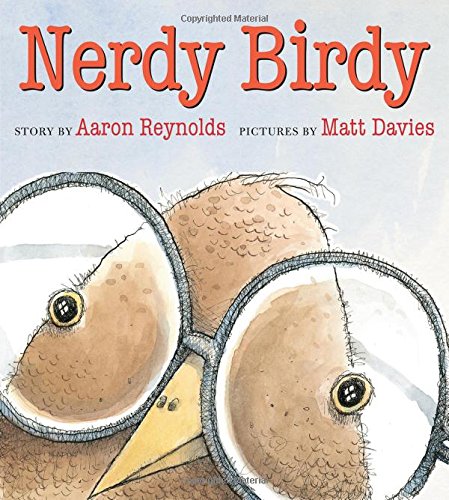
Nerdy Birdy
Author: Aaron Reynolds; Illustrator: Matt Davies
Published September 22, 2015 by Roaring Brook Press

GoodReads Summary: Nerdy Birdy likes reading, video games, and reading about video games, which immediately disqualifies him for membership in the cool crowd.

One thing is clear: being a nerdy birdy is a lonely lifestyle.

When he’s at his lowest point, Nerdy Birdy meets a flock just like him. He has friends and discovers that there are far more nerdy birdies than cool birdies in the sky.

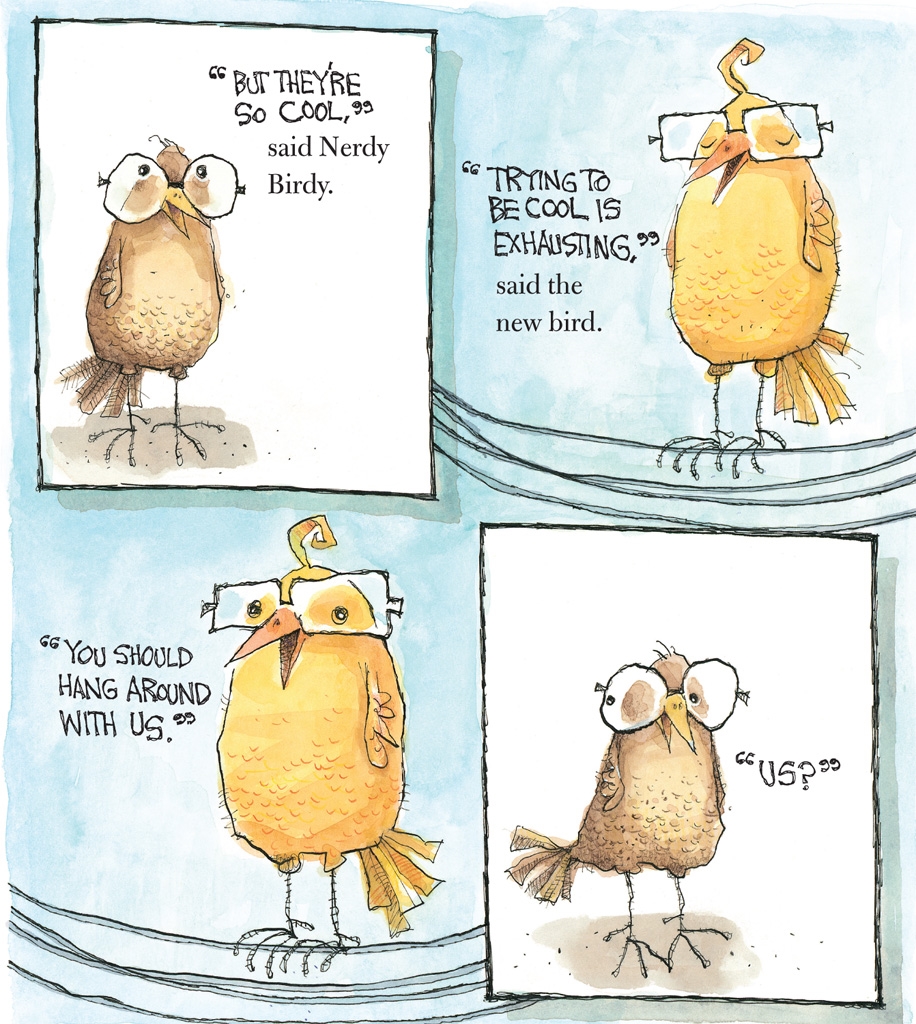
Ricki’s Review: I absolutely adored this book. I don’t usually review books that are more than a year old, but my love for this book, compelled me to write a review. The book is about a nerdy bird whose physical appearance makes him feel lonely. He meets other birds who share his physical appearance, and he finds comfort in this. But then a very, very different bird comes along (a vulture), and Nerdy Birdy is forced to consider his values and whether or not the nerdy bird club might be just as exclusive themselves. This book provided an avenue for an excellent discussion with my son. We talked about his class and about how some of his peers might feel left out. I’d love to use this book in an elementary school classroom.

Teachers’ Tools for Navigation: This is a great book to read on the first day of school or at a time when students are leaving one or some students left out. It provides a great opportunity for critical discussions of cliques.

Discussion Questions: Why does Nerdy Birdy feel left out? How does he find solace in other birds that look like him?; How does the vulture differ from him? What does this teach him about friendship, groups, and personal appearances?

We Flagged: 

Image from: https://us.macmillan.com/nerdybirdy/aaronreynolds/9781626721272/

Read This If You Loved: Counting Crows by Kathi Appelt; Giraffes Can’t Dance by Giles Andreae, Unicorn Thinks He’s Pretty Great by Bob SheaThe Magic of Maxwell and His Tail by Maureen Stolar Kanefield

Recommended For: 

readaloudbuttonsmall classroomlibrarybuttonsmall

RickiSig