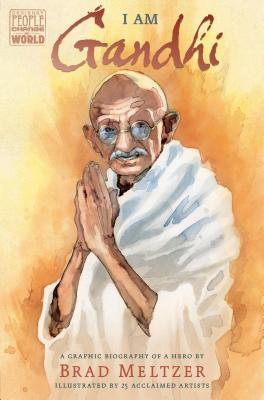
I Am Gandhi: A Graphic Biography of a Hero by Brad Meltzer

Share

I Am Gandhi
Author: Brad Meltzer
Illustrator: 25 Acclaimed Artists
Published May 8th, 2018 by Dial Books

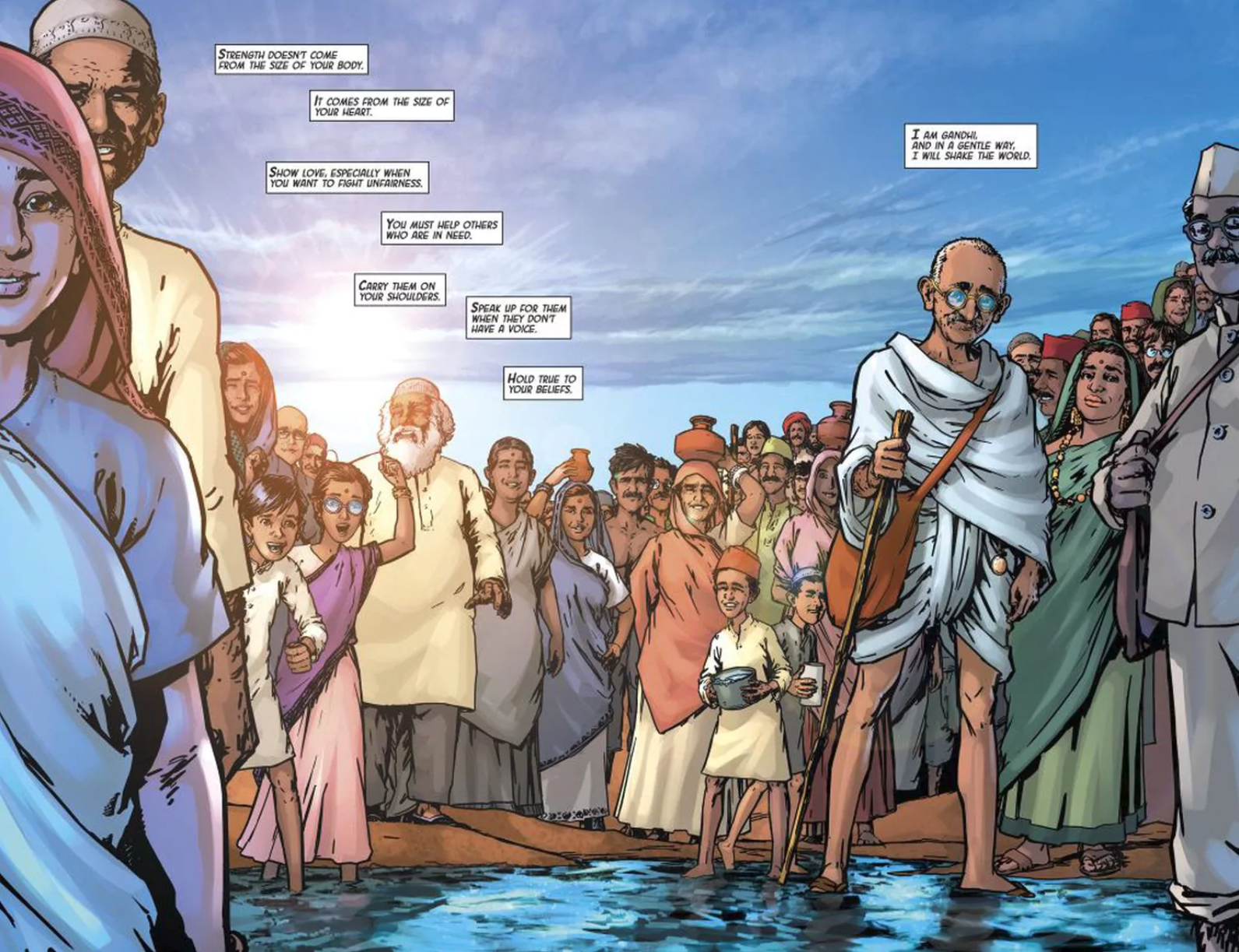
Summary: Twenty-five exceptional comic book creators join forces to share the heroic story of Gandhi in this inspiring graphic novel biography.

As a young man in India, Gandhi saw firsthand how people were treated unfairly. Refusing to accept injustice, he came up with a brilliant way to fight back through quiet, peaceful protest. He used his methods in South Africa and India, where he led a nonviolent revolution that freed his country from British rule. Through his calm, steady heroism, Gandhi changed the lives of millions and inspired civil rights movements all over the world, proving that the smallest of us can be the most powerful.

Galvanized by Gandhi’s example of gentle, peaceful activism, New York Times bestselling author Brad Meltzer asked his friends in the comic book world to help him make a difference by creating this philanthropic graphic novel. Twenty-four illustrators–including many of the most acclaimed artists in comics today–enthusiastically joined the project, agreeing to donate their work so that their royalties can go to Seeds of Peace, a non-profit organization that inspires and cultivates new generations of global leaders. This extraordinary biography is a glorious team effort that truly exemplifies Gandhi’s selflessness and love for humanity.

The illustrators included are: Art Adams, John Cassaday, Jim Cheung, Amanda Connor, Carlos D’Anda, Michael Gaydos, Gene Ha, Stephanie Hans, Bryan Hitch, Phil Jimenez, Siddharth Kotian, David LaFuente, David Mack, Alex Maleev, Francis Manapul, David Marquez, Steve McNiven, Rags Morales, Saumin Patel, Nate Powell, Stephane Roux, Marco Rudy, Kamome Shirahama, Bill Sienkiewicz, and Abhishek Singh.

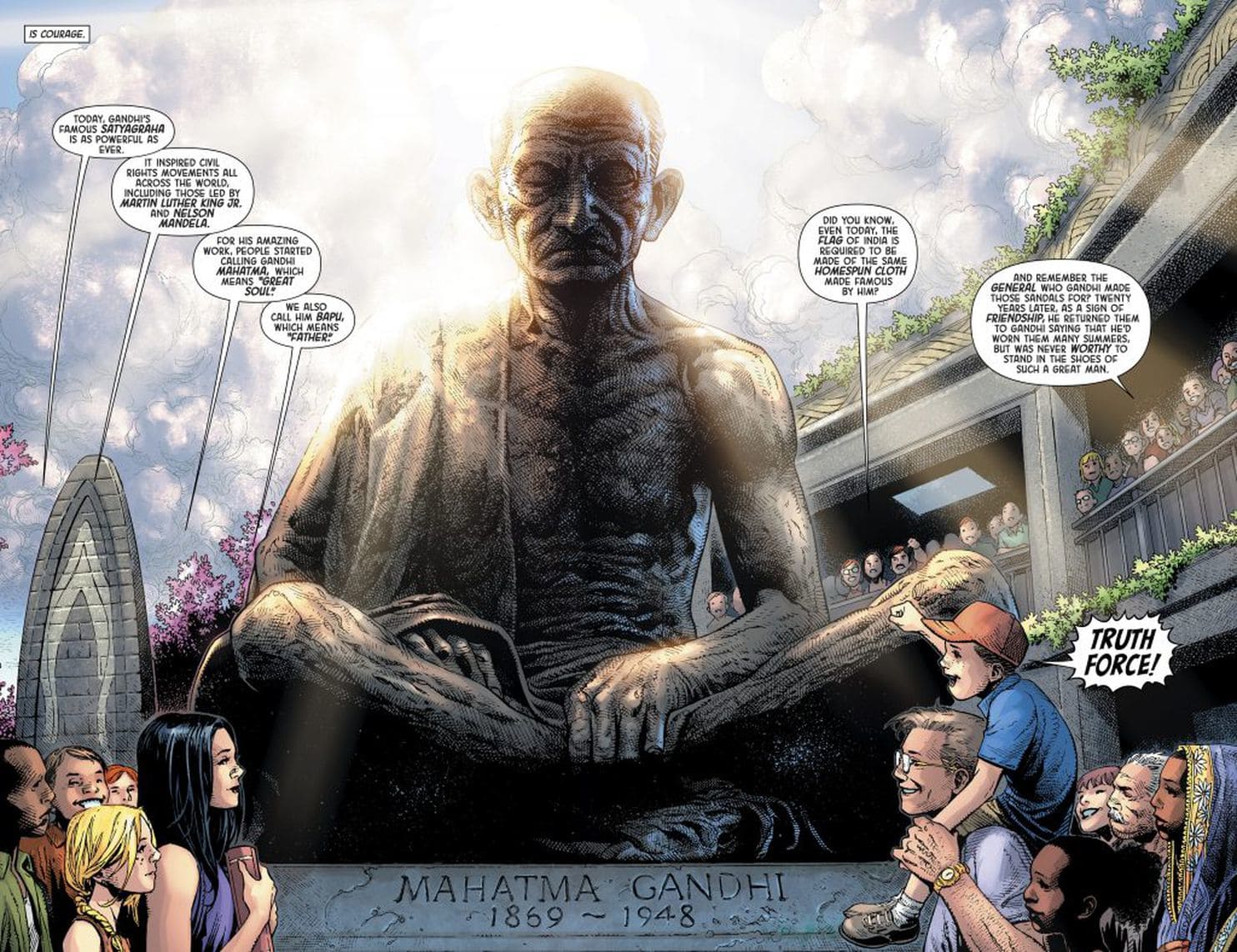
Kellee’s ReviewI’ll be honest–when I first read on the cover that 25 different artists illustrated this graphic biography, I was worried that the stagnation of illustration styles would hinder the narrative of Gandhi’s life, but I was so wrong. Instead, by allowing each illustrator to give us their interpretation of Gandhi, his spirit instead flowed through the pages as it was obvious that his story had touched each and every artist, and the author, taking part in this graphic biography.

While reading, it was clear to me that Meltzer wanted Gandhi’s message of equality, peace, and kindness to scream at the reader, and this was confirmed when I read the Washington Post article about Meltzer’s inspiration. I believe Meltzer did a beautiful job not only telling Gandhi’s story but also showing that peace is possible in a time of tumultuous relationships but that the only way to truly achieve it is through similar activism as Gandhi.

Ricki’s Review: I read this graphic novel twice to myself and twice with my son. Further, I’ve read portions of it to my students. I can’t stop sharing it! I was blown away by the amalgamation of the 25 graphic novelists—it made for an absolutely stunning text. I appreciate the historical perspective that extends throughout the graphic novel, and I loved that the illustrations really make Ghandi’s story come alive. This is a book that I will share often and widely. If you haven’t read it, I recommend it highly—even if you already know a lot about Ghandi’s life.

Teachers’ Tools for Navigation: Have students connect Gandhi’s philosophies to those who influenced him and those he influenced. For example, in one of my literature classes, one person picked an author who was influenced by another (for example, Woody Guthrie was influenced by Walt Whitman) then the next student built on that (for example, Bob Dylan was influenced by Woody Guthrie OR Ralph Waldo Emerson influenced Walt Whitman) until a complete chain of influences were made. Then each student wrote an analysis paper showing how they were influenced then presented their findings (in order of influences) to the class. This same idea could be done here: Henry David Thoreau influenced Gandhi who influenced Martin Luther King, Jr. who influenced Barack Obama who influenced Cory Booker, etc. This idea could also be used just to look at the idea of peaceful protests that have changed the course of history: Gandhi, MLK, Black Lives Matter, Never Again, etc.

Discussion Questions: 

  • What is the theme of Meltzer’s story of Gandhi?
  • How did Gandhi change the course of history for Indians in South Africa and India?
  • How did the 25 different artists illustrating the graphic novel affect the reading of the biography?
  • How did Thoreau influence Gandhi? Can you infer how Gandhi influence Martin Luther King, Jr.?
  • What was the importance of Gandhi’s march to the sea to hold salt?
  • Why do you believe Meltzer chose the specific quotes he included in the back matter of the book?

Flagged Passages: 

Read This If You Love: The Ordinary People Change the World series (ex. I am Lucille Ball, I am Jackie Robinson), Nonfiction graphic novels such as Drowned City by Don Brown

Recommended For: 
classroomlibrarybuttonsmall closereadinganalysisbuttonsmall

Signatureand 

Mary’s Monster by Lita Judge

Share

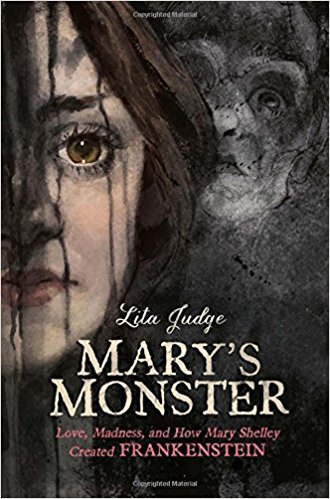
Mary’s Monster: Love, Madness, and How Mary Shelley Created Frankenstein
Author: Lita Judge
Published: January 30th, 2018 by Roaring Book Press

Summary: A young adult biography of Frankenstein’s profound young author, Mary Shelley, coinciding with the 200th anniversary of its publication, told through free verse and 300+ full-bleed illustrations.

Mary Shelley first began penning Frankenstein as part of a dare to write a ghost story, but the seeds of that story were planted long before that night. Mary, just nineteen years old at the time, had been living on her own for three years and had already lost a baby days after birth. She was deeply in love with famed poet Percy Bysshe Shelley, a mad man who both enthralled and terrified her, and her relationship with him was rife with scandal and ridicule. But rather than let it crush her, Mary fueled her grief, pain, and passion into a book that the world has still not forgotten 200 years later.

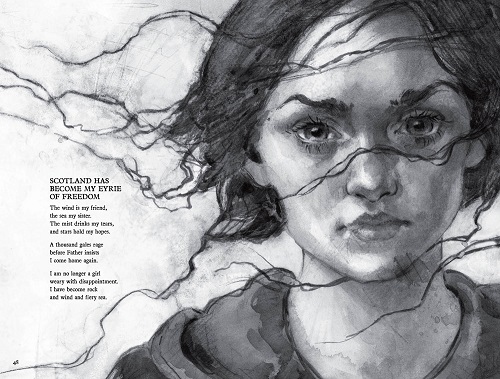
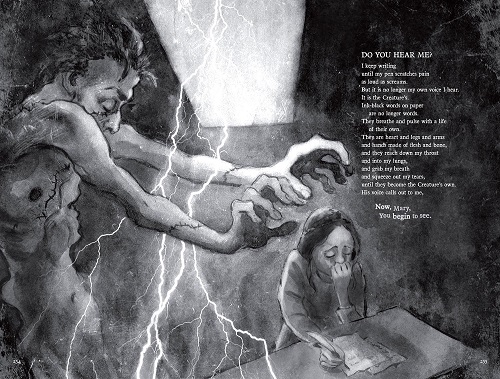
Dark, intense, and beautiful, this free-verse novel with over 300 pages of gorgeous black-and-white watercolor illustrations is a unique and unforgettable depiction of one of the greatest authors of all time.

Review and Teachers’ Tools for Navigation: Whew. I felt so many emotions as I read this book. I kept thinking, “My goodness, my students are going to love this book.” I was fortunate to receive two copies of this book in the mail, and those two copies have passed from student’s hand to student’s hand. The book doesn’t even make its way back up to my desk before another student snags it. This book defies genre sorting. It’s nonfiction, it’s horror, it’s romance, it’s an illustrated book in verse. I’ve already added it to my book list to teach next semester in my Adolescents’ Literature course.

Students will read this book and want immediately to read Frankenstein. The book reads fairly quickly because it contains verse and illustrations, but readers will struggle not to pause for several minutes to enjoy the beautiful illustrations on the pages.

I’m most excited about the classroom potential for this book. It offers so much to talk about regarding characterization, mood, and poetry. But it also offers a beautiful bridge to read with Frankenstein. I thought I knew a lot about Mary Shelley’s life, but this book told me so much more about it. Reading her story on these pages made me feel as if I was experiencing her life alongside her. If you haven’t read this book yet, I recommend it highly.

Discussion Questions: What factors may have influenced Mary Shelley’s Frankenstein? In what ways does the author use metaphor and symbolism to help us understand her experiences?; What might be the author’s purpose? Is she successful, in your opinion?; What textual features helped you understand Mary’s story? How might this book read differently if the author had used another form?

We Flagged: 

Read This If You Loved: Frankenstein by Mary Shelley; Horror; Gothic Literature

Recommended For:
classroomlibrarybuttonsmall

RickiSig

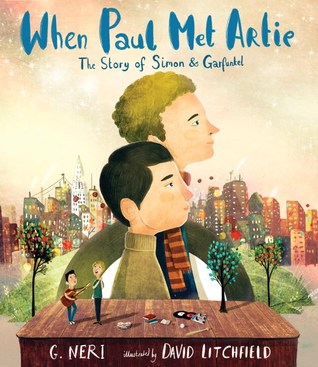
When Paul Met Artie: The Story of Simon & Garfunkel by G. Neri

Share

When Paul Met Artie: The Story of Simon & Garfunkel
Author: G. Neri
Illustrator: David Litchfield
Expected Publication on March 20th, 2018 by Candlewick Press

Summary: From childhood friendship to brief teenage stardom, from early failures to musical greatness — the incredible story of how Simon & Garfunkel became a cherished voice of their generation.

Long before they became one of the most beloved and successful duos of all time, Paul Simon and Art Garfunkel were just two kids growing up in Queens, New York — best friends who met in a sixth-grade production of Alice in Wonderland and bonded over girls, baseball, and rock ’n’ roll. As teens, they practiced singing into a tape recorder, building harmonies that blended their now-famous voices until they sounded just right. They wrote songs together, pursued big-time music producers, and dreamed of becoming stars, never imagining how far their music would take them. Against a backdrop of street-corner doo-wop gangs, the electrifying beginnings of rock ’n’ roll, and the rise of the counterculture folk music scene, G. Neri and David Litchfield chronicle the path that led two young boys from Queens to teenage stardom and back to obscurity, before finding their own true voices and captivating the world with their talent. Back matter includes an afterword, a discography, a bibliography, and a fascinating list of song influences.

ReviewWow. G. Neri and David Litchfield have captured the story of Simon & Garfunkel and released it into the world in a way that oozes the same beauty that their music does. Neri’s lyrical narrative flows and is perfect for a biography of one of the most beloved duos ever while Litchfield’s illustrations have the tone and coloring that just fit Simon & Garfunkel’s music–a bit dreamy yet raw and colorful. Their two pieces of artwork put together make for a beautiful picture book biography.

P.S. Make sure you take off the cover and look at the book design. BEAUTIFUL!

Teachers’ Tools for Navigation: While I’m not sure if such a class exists, this text would be perfect for a history of rock and roll class. It really goes through how the time period was changing when it came to music and how each artist influenced each other. If this class doesn’t exist, I wish it did, and I wish I could take it!

The structure of the text also lends to a great lesson looking at both why the author chose verse instead of prose as well as why he chose the timeline that he did. What was his purpose?

Discussion Questions: 

  • How did the author structure the book?
  • Why do you believe that the author chose to write the narrative in verse?
  • Paul and Artie, as children, are both different and similar. Explain.
  • How did Artie use his interest in math to help the duo?
  • How did music around Paul and Artie affect their music?
  • Why is this time period so important for the history of rock and roll?
  • What other artists does the author and illustrator highlight during the book as influences for Simon & Garfunkel?
  • What would have happened if Paul and Artie had given up after all of the rejection?
  • How did the duo go from rejection to success?
  • What clues can the musical connections give to us about the duo’s musical journey?

Flagged Passages: 

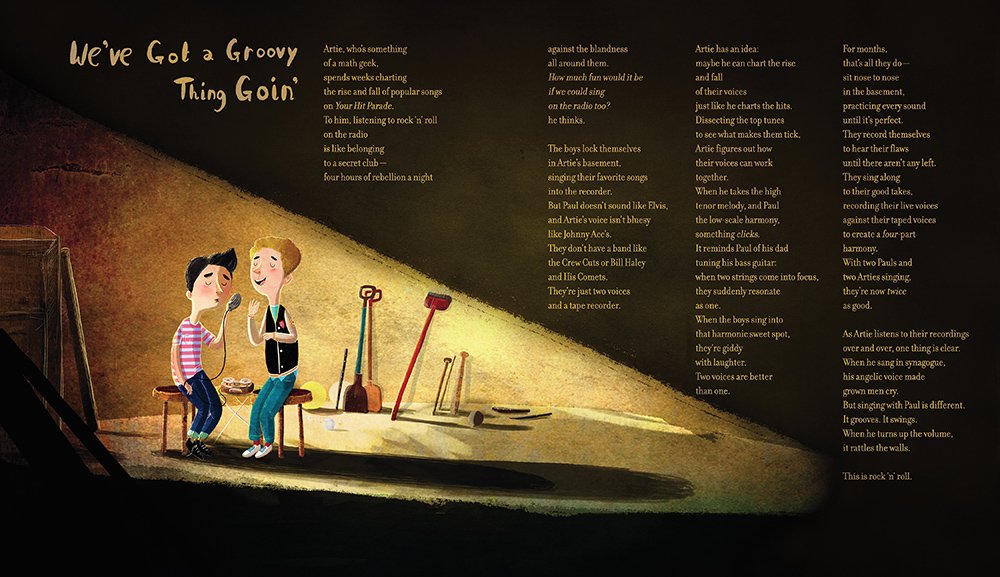
“We’ve Got a Groovy Thing Goin’

…When he takes the high
tenor melody, and Paul
the low-scale harmony,
something clicks.
It reminds Paul of his dad
tuning his bass guitar:
when two strings come into focus,
they suddenly resonate
as one…”

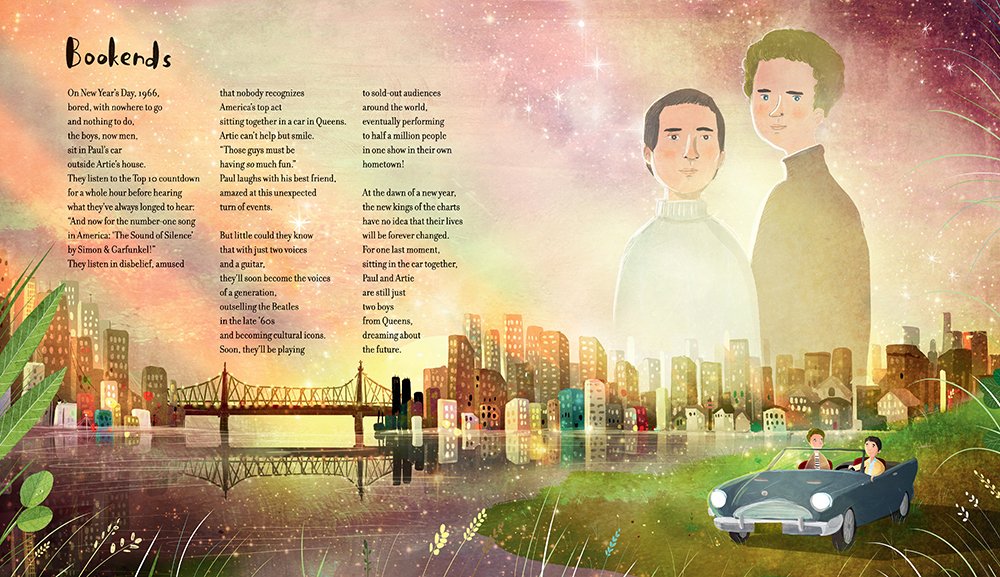
“Bookends

…At the dawn of a new year,
the new kinds of the charts
have no idea that their lives
will be forever changed.
For one last moment,
sitting int he car together,
Paul and Artie
are still just
two boys
from Queens
dreaming about
the future.”

Read This If You Love: Music, the 60s, Rock and Roll, biographies

Recommended For: 
classroomlibrarybuttonsmall closereadinganalysisbuttonsmall 

Signature

**Thank you to Raquel at Candlewick for providing a copy for review!!**

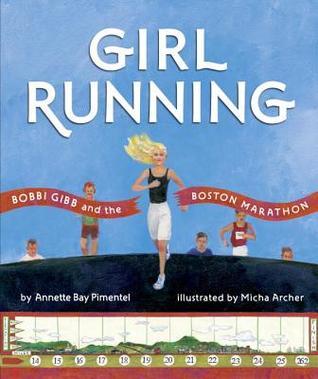
Girl Running: Bobbi Gibb and the Boston Marathon by Annette Bay Pimentel

Share

Girl Running: Bobbi Gibb and the Boston Marathon
Author: Annette Bay Pimentel
Illustrator: Micha Archer
Published February 6th, 2018 by Nancy Paulsen Books

Summary: The inspiring story of the first female to run the Boston Marathon comes to life in stunningly vivid collage illustrations.
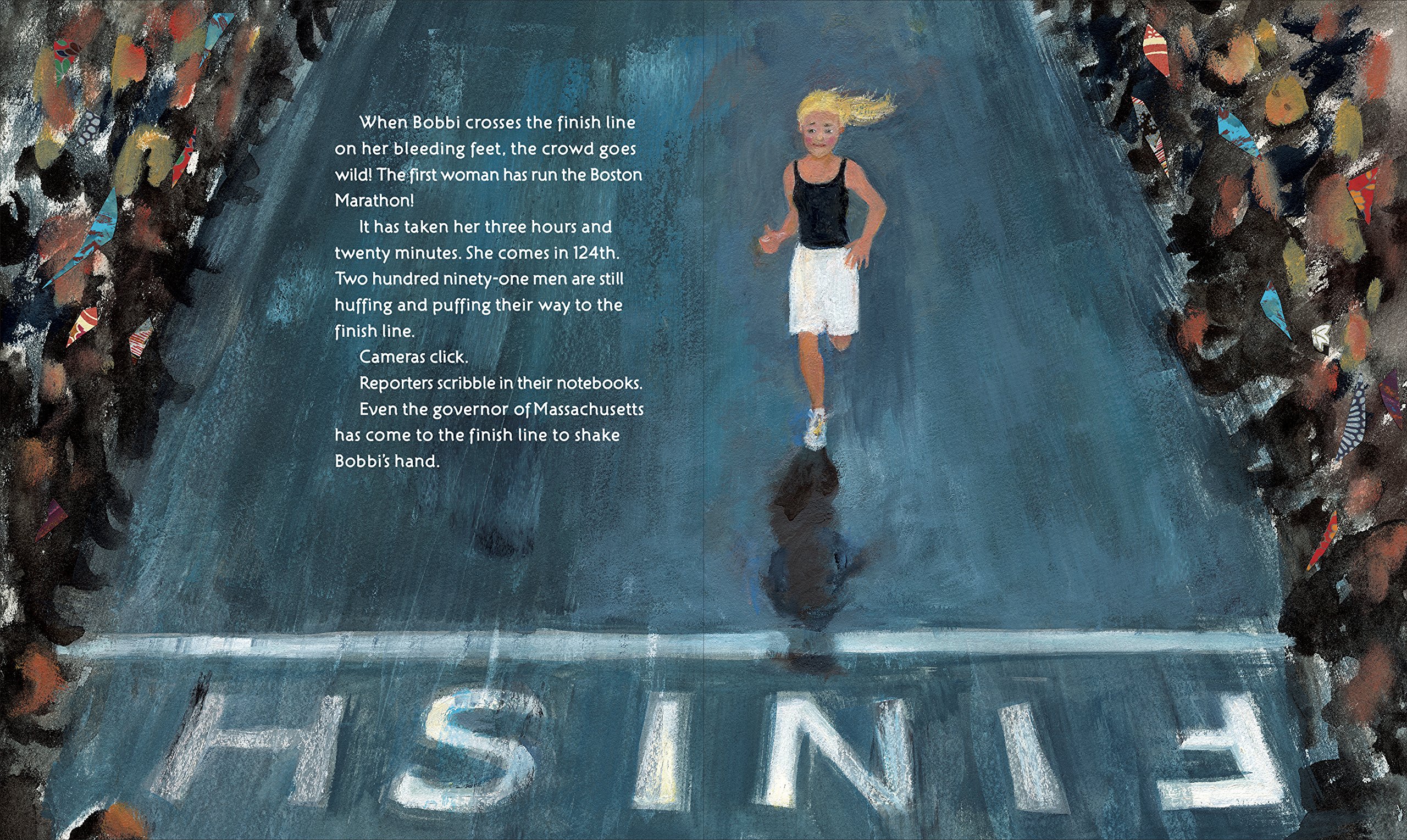
Because Bobbi Gibb is a girl, she’s not allowed to run on her school’s track team. But after school, no one can stop her–and she’s free to run endless miles to her heart’s content. She is told no yet again when she tries to enter the Boston Marathon in 1966, because the officials claim that it’s a man’s race and that women are just not capable of running such a long distance. So what does Bobbi do? She bravely sets out to prove the naysayers wrong and show the world just what a girl can do.

* “A bright salutation of a story, with one determined woman at its center.”–Kirkus Reviews, starred review

ReviewI first learned about Bobbi Gibb when I read The Girl Who Ran by Frances Poletti & Kristina Yee and after reading it, I knew I wanted to learn more about Bobbi Gibb because she did so much for women’s progress when it came to running. Without her standing up and going against everyone, it would have taken longer for women to be accepted as marathoners.

Pimentel does a beautiful job showing Gibb’s inspiration, determination, and journey. I loved seeing more about what happened during the marathon than what I knew before and especially was verklempt by the support she found when ran by Wellesley College and the women at the college came out and cheered for her. I also loved learning that the other runners supported her!

Through the afterwords, I also found out that Gibb had to wait 30 years before she was listed as the female winner of the Boston Marathon in 1966, 1967, and 1968 races because the officials wouldn’t honor her as a runner. This shows that so often even when the masses support something, it is a systemic issue that needs to be fixed.

Last but not least, I must share how much I adore Archer’s artwork. I was a big fan of her work in Daniel Finds a Poem, and once again I found that her illustrations were the perfect addition to the story being told.

Teachers’ Tools for Navigation: Gibb is one example of an American that changed history but may not be well known. I think it would be fascinating to introduce Gibb using Pimentel’s picture book as a way to start discussions about normal people changing the world. I would then share other stories about heroes like Rosa Parks, Malala Yousafzai, and Jesse Owens. I’d also reference other books like Be a Changemaker and 31 Ways to Change the World. The research could also be narrowed down to just sports; however, I think it is a wonderful discussion to have about how Gibb may have “only” changed marathons, it is part of a bigger movement.

Discussion Questions: 

  • Why did people think that women couldn’t run marathons?
  • How did Bobbi Gibb prepare for her first official marathon?
  • Did the other runners react the way you had expected? Explain.
  • How did Archer’s artwork support Pimentel’s story of Gibb?
  • What traits does Gibb show that helped her be successful?
  • When Gibb began to get blisters, were you afraid that she wasn’t going to finish? Explain your thinking and reactions as the story continued.

Flagged Passages: 

Read This If You Love: Picture book biographies, Women’s rights

Recommended For: 
classroomlibrarybuttonsmall closereadinganalysisbuttonsmall 

Signature

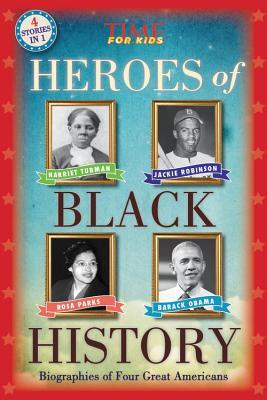
Heroes of Black History: Biographies of Four Great Americans by the Editors of Time for Kids

Share

Heroes of Black History: Biographies of Four Great Americans
Author: The Editors of Times for Kids
Introduction by Charlayne Hunter-Gault
Published December 19th, 2017 by Times for Kids

Blog Tour Week 4’s Feature American:
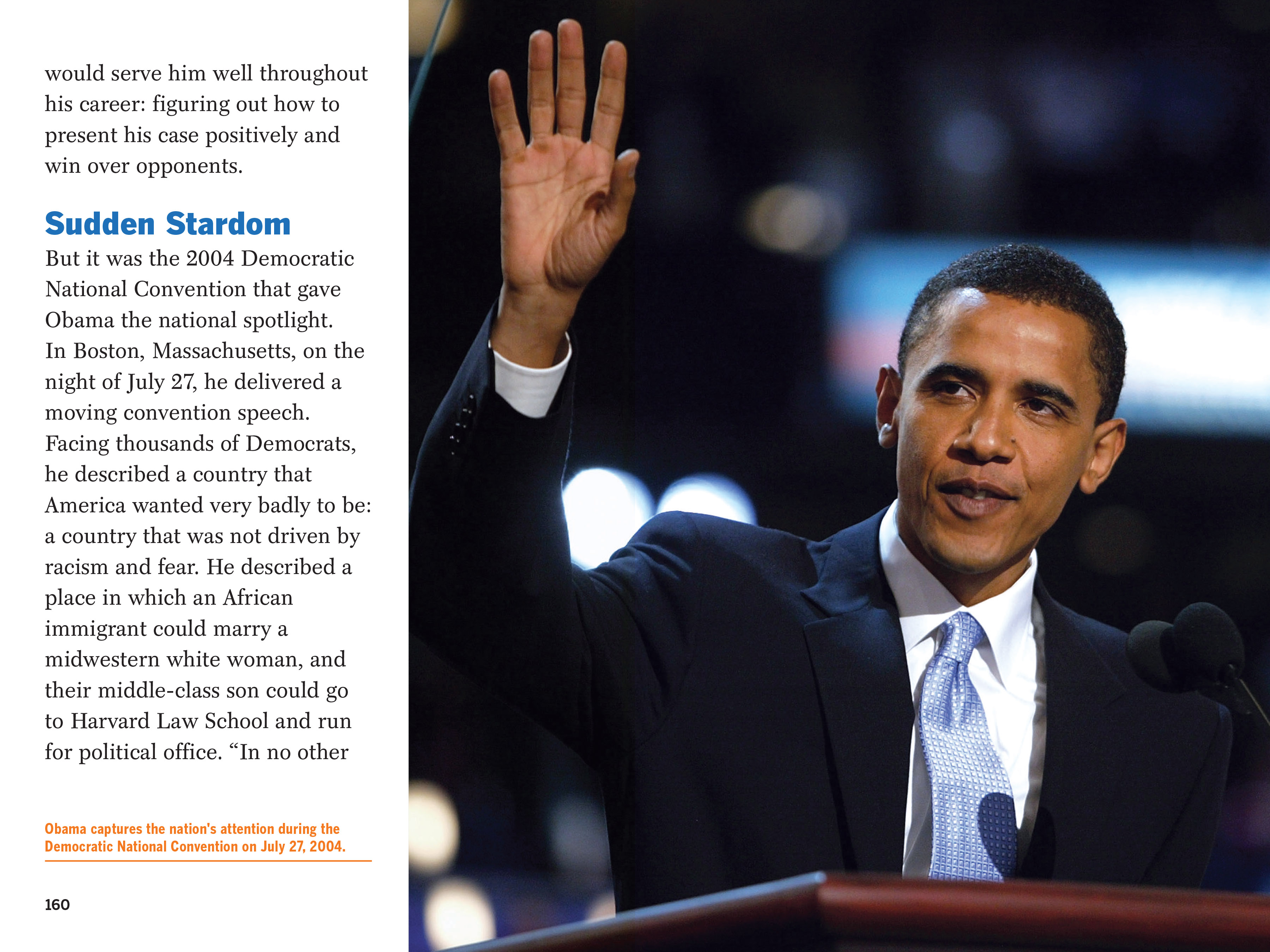
Barack Obama

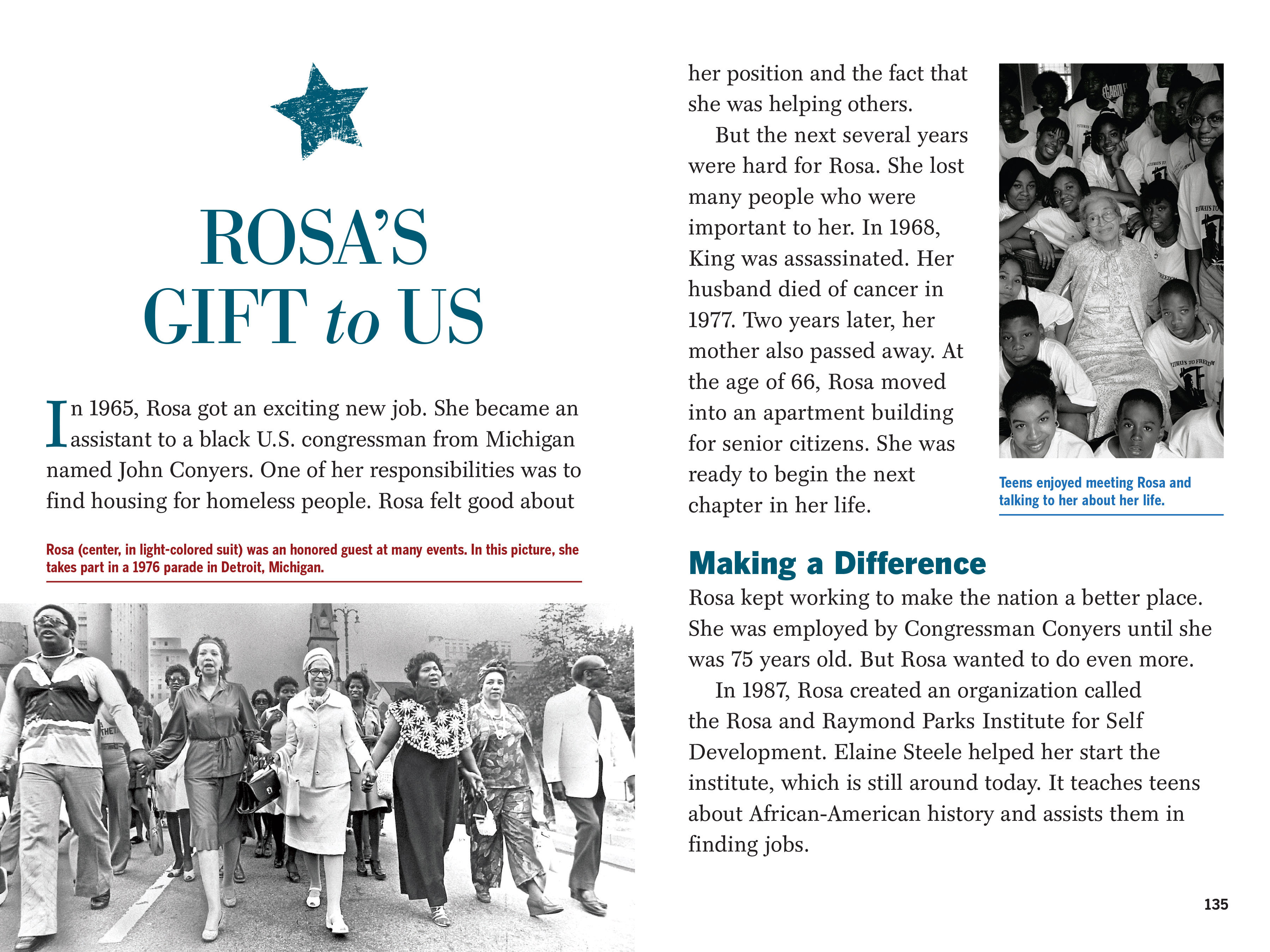
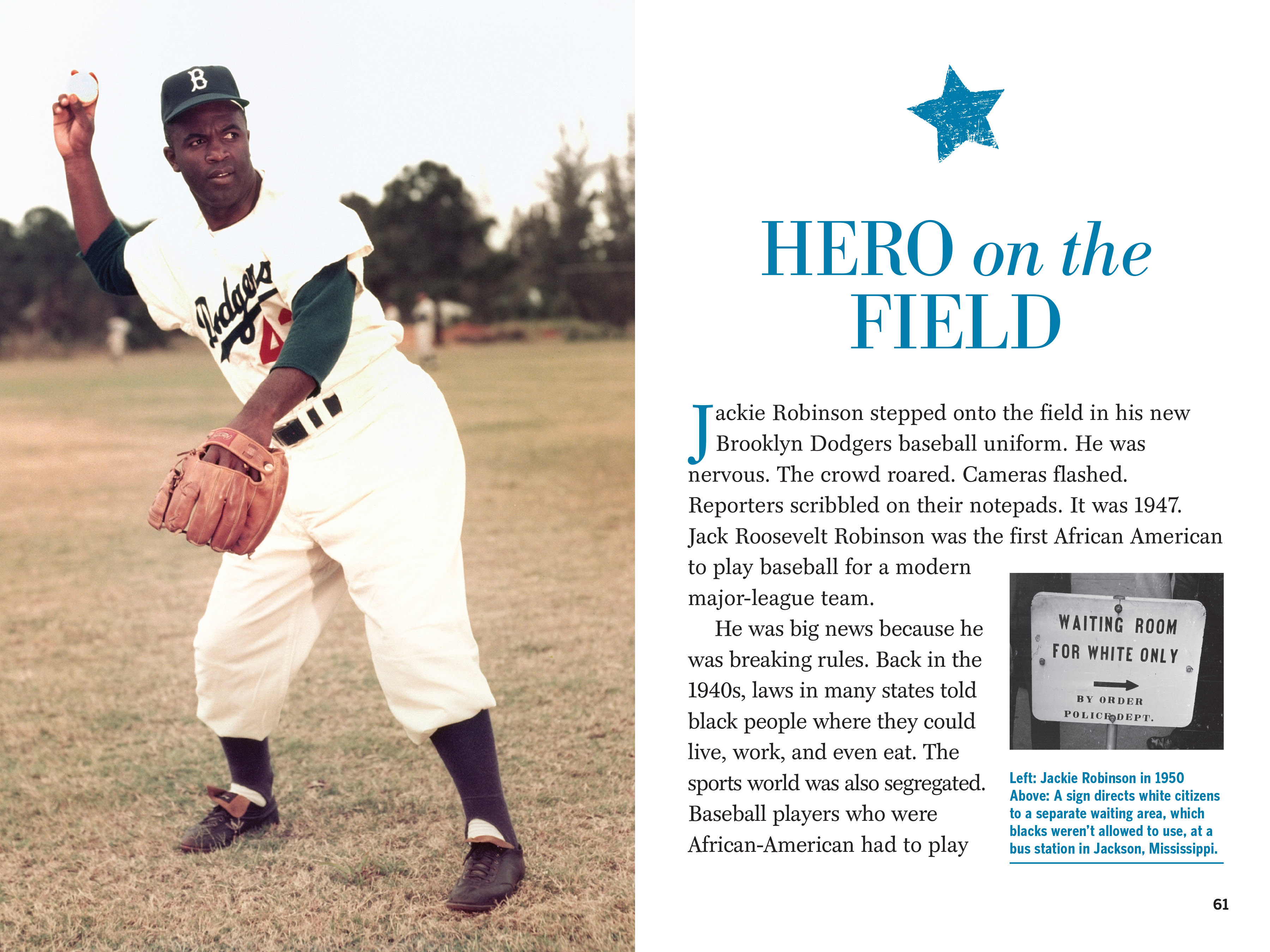
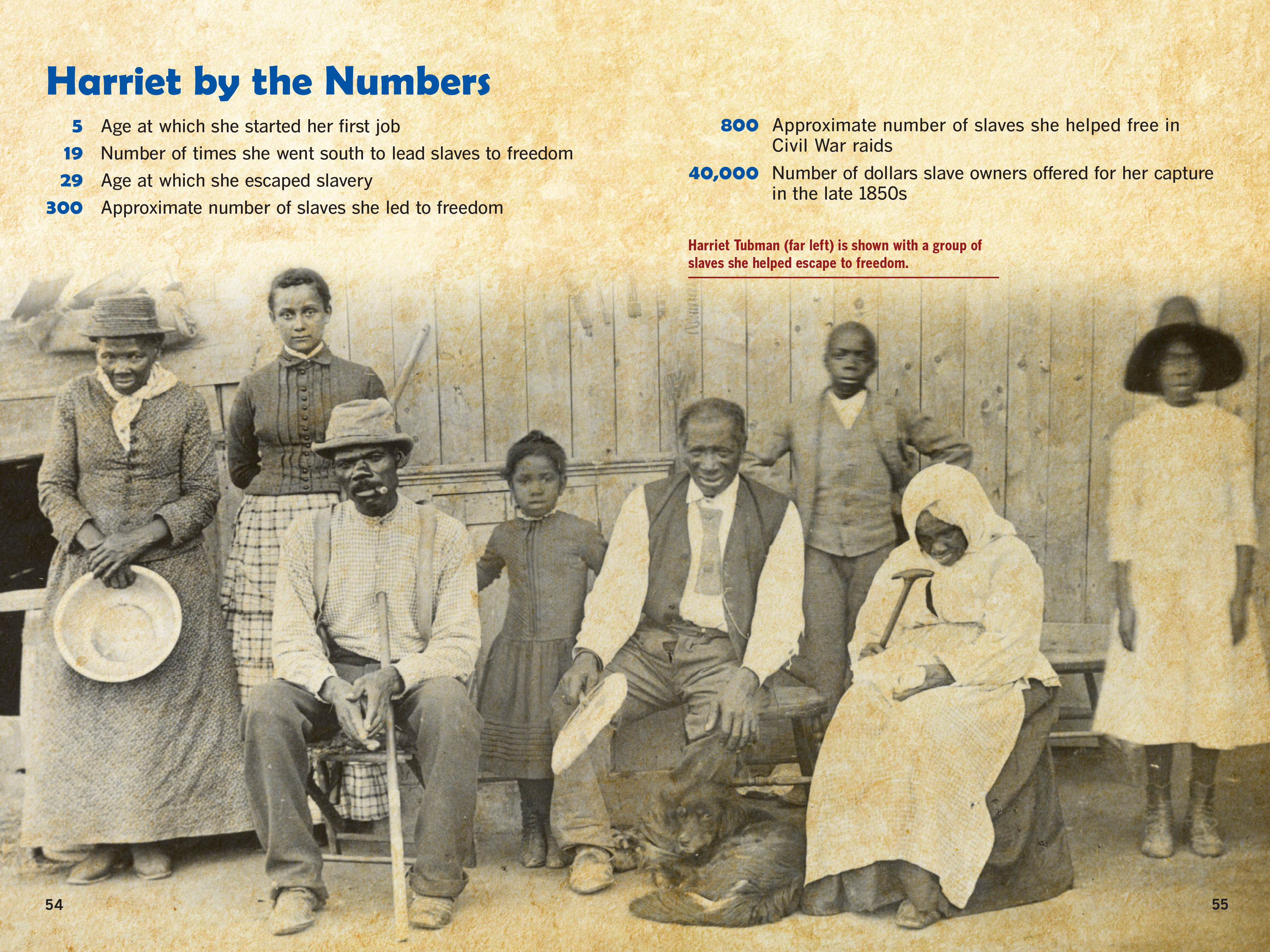
Summary: TIME for Kids Heroes of Black History presents the stories of four great American heroes every child should know about in one volume: Harriet Tubman, Jackie Robinson, Rosa Parks, and Barack Obama. Featuring an introduction by journalist and civil rights activist Charlayne Hunter-Gault, Heroes of Black History shines a light on the long fight for social justice in the United States as it highlights the accomplishments and personal histories of these four pivotal Americans.

Young readers learn about the life of Harriet Tubman—born a slave around 1820, she escaped to the North, but returned to the South nineteen times as a conductor on the Underground Railroad to lead 300 slaves to freedom. An incredibly gifted athlete, Jackie Robinson endured taunts, slurs, and death threats when he broke the color barrier in Major League Baseball in 1947. Rosa Parks refused to give up her seat to a white man on an Alabama bus in 1955 and paved the way for a Supreme Court decision that declared segregation on Alabama’s public buses was unconstitutional. On January 20, 2009, Barack Obama took the oath of office as our country’s first African American president. 

Illustrated with a dynamic mix of photographs and illustrations, the biographies of these Americans delve deeper than their accomplishments to reveal details on their childhoods, early experiences, schooling, family life, and more. Sidebars about related topics—Underground Railroad routes, sports firsts, the Harlem Renaissance, and more—give context and additional insights for young readers. Heroes of Black History also gives readers a timeline overview of three centuries of African American history, beginning with the slave trade, touching upon the formation of the NAACP, the civil rights movement, the March on Washington, and other pivotal events, up through the beginning of the Black Lives Matter movement. Brief profiles of more than twenty additional heroes of black history, a glossary of key terms, and a detailed index are also included in this comprehensive book.

ReviewWhen I was asked to take part in this blog tour, I knew right away that I wanted to be part of week 4 of the tour to focus on Barack Obama for a few reasons: 1) I need a reminder of modern heroism; 2) I’ve featured the other three Americans on Unleashing Readers before (Harriet Tubman, Jackie Robinson, Rosa Parks); 3) The Obamas, in my opinion, are the perfect couple to feature on a Valentine’s Day post.

Obama’s biography within this text reminded me that hard work, high ethics, kindness, love, and intelligence can lead to success and that being cutthroat or brutal are not the key features in heroes of mine. The biography, overall, was quite simple and focused on the main points of Obama’s life and presidency; however, it is a wonderful introduction to his life thus far and really ensures that readers understand how he got to where he is and how he changed history. It was so refreshing to read about a person that faced discrimination and resistance with such grace and resilience.

I also got to glimpse into the upbringing of Obama which I ended up knowing less about than I thought. I hadn’t realized he hardly knew his father nor that he lived in Indonesia for a while before returning to live with his grandparents in Hawaii. All of this lead to Michelle and him meeting while he was completing an internship–her stability appealed to him. And that was the beginning of a beautiful romance. And the beginning of a journey that neither of them probably saw coming.

The other sections in this text follow similar suits in that they are wonderful introductions of each historically significant American.

Teachers’ Tools for Navigation and Discussion Questions: This four-stories-in-one biography from Time has so many applicable uses in classrooms! The publisher created teaching guide shares discussion questions, topics for writing, a scavenger hunt, more heroes of Black history, activities for students for each biography, a cloze read book review, and fast facts for each hero.

The teaching guide can be accessed here.

Flagged Passages: 

Read This If You Love: Biographies, History

Recommended For: 
classroomlibrarybuttonsmall closereadinganalysisbuttonsmall 

Signature

**Thank you to Barbara at Blue Slip Media for hosting the blog tour and providing a copy for review!**

Nina: Jazz Legend and Civil-Rights Activist Nina Simone by Alice Brière-Haquet

Share

nfpb2017

Nonfiction Wednesday

Nonfiction Picture Book Wednesday is hosted by Kid Lit Frenzy and was started to help promote the reading of nonfiction texts. Most Wednesdays, we will be participating and will review a nonfiction text (though it may not always be a picture book).
Be sure to visit Kid Lit Frenzy and see what other nonfiction books are shared this week!

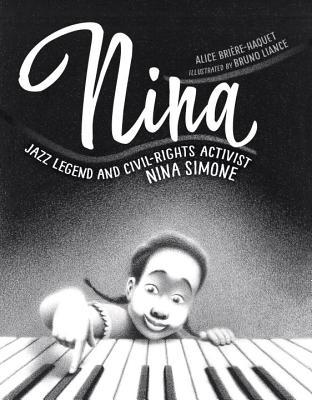
Nina: Jazz Legend and Civil-Rights Activist Nina Simone
Author: Alice Brière-Haquet
Illustrator: Bruno Liance
Published December 5th, 2017 by Charlesbridge Publishing

Summary: “To be young, gifted, and black.”

A stunning picture-book biography of the High Priestess of Soul and one of the greatest voices of the 20th century.

With evocative black-and-white illustrations and moving prose, readers are introduced to Nina Simone, jazz-music legend and civil-rights activist. Shared as a lullaby to her daughter, a soulful song recounts Simone’s career, the trials she faced as an African American woman, and the stand she took during the Civil Rights Movement. This poignant picture book offers a melodic tale that is both a historic account of an iconic figure and an extraordinary look at how far we’ve come and how far we still need to go for social justice and equality. A timeless and timely message aptly appropriate for today’s social and political climates.

ReviewAlthough Nina is just a taste into who Nina Simone was as it only introduces her talent as a pianist and shares her beliefs in regards to civil rights. Set up as a lullaby that Nina is singing to her child, the story recounts her love of music and learning about the racism within our nation as well as a story where she stood up to inequality at one of her piano concerts. The lyrics and illustrations are dreamy and perfectly fit the purpose of the story: to introduce and intrigue the reader when it comes to Nina Simone.

Teachers’ Tools for Navigation: I do wish that there had been back matter that went more in depth into Simone’s contribution to jazz and civil rights; however, without them existing, this nonfiction picture book allows for a perfect change for inquiry. Now that students have been introduced to Nina, have stations/centers focusing on different parts of her life, jazz, or the Civil Rights Movement.

Discussion Questions: 

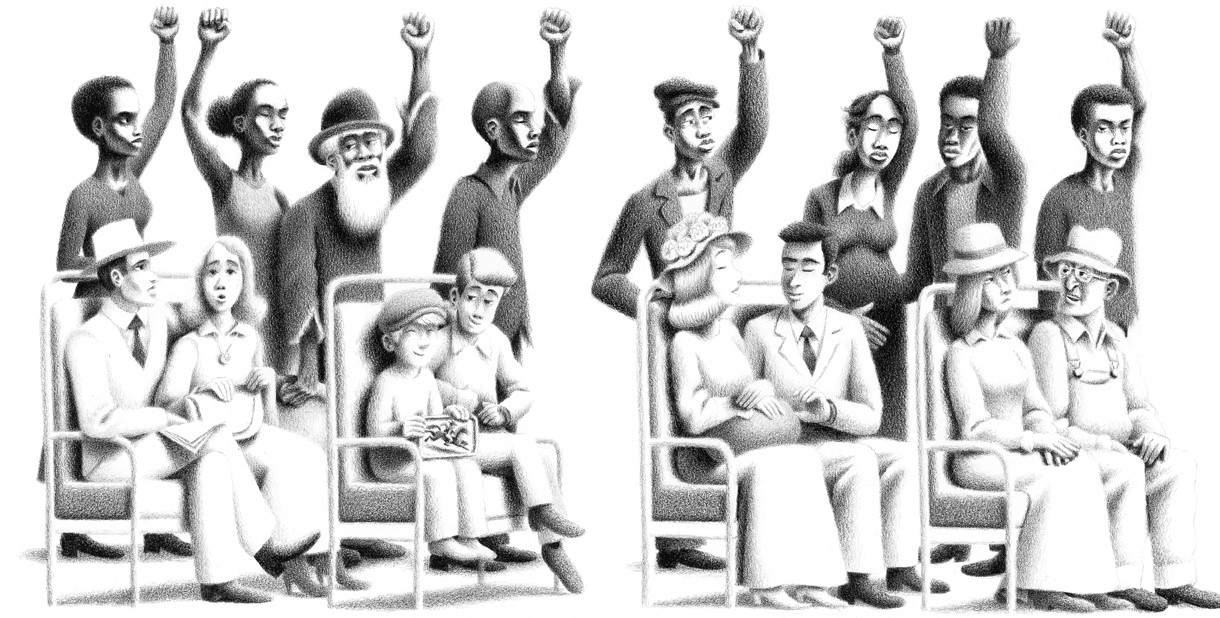
  • How does the illustration on the bus use the idea of the piano to symbolize the relationship between White and Black citizens in the early 1900s?
  • What techniques do the author and illustrator use to make the book seem lullaby-eque?
  • How did the imagery of the single black chair symbolize the racism that occurred at Simone’s concert?
  • How does the author tie in Martin Luther King, Jr. and the Civil Rights Movement?

Flagged Passages: 

“‘The white keys are whole notes and the black keys are flats, or half notes,’ my teacher explained.

I asked why.

‘Because that’s just the way it is.’

Yes, that’s the way it was. White was whole. Black was half. It was that way everywhere and for everyone.

I could have held it against people. Or worse, I couldn’t believed I was worth less than other people.

Black people were nothing but half notes on a huge ivory keyboard.

But no. I did not agree with this.

The notes had to mingle and dance together in the air so these lies would disappear.”

Read This If You Love: Andrea Davis Pinkney picture book biographies, Jazz, Learning about the Civil Rights Movement

Recommended For: 
classroomlibrarybuttonsmall closereadinganalysisbuttonsmall  

Signature

Teaching Guide with Activities and Discussion Questions for Maya Lin: Thinking With Her Hands by Susan Goldman Rubin

Share

Nonfiction Wednesday

Nonfiction Picture Book Wednesday is hosted by Kid Lit Frenzy and was started to help promote the reading of nonfiction texts. Most Wednesdays, we will be participating and will review a nonfiction text (though it may not always be a picture book).
Be sure to visit Kid Lit Frenzy and see what other nonfiction books are shared this week!

Maya Lin: Thinking With Her Hands
Author: Susan Goldman Rubin
Published November 7th, 2017 by Chronicle

Summary: In the tradition of DELICIOUS, WIDENESS & WONDER, and EVERYBODY PAINTS!, this is Susan Goldman Rubin’s extensively researched and very accessible biography of civic activist Maya Lin, most famous for her design of the Vietnam Veterans Memorial. The Vietnam Veterans Memorial in Washington, D.C., is one of the most famous pieces of civic architecture in the world. But most people are not as familiar with the reserved college student who entered and won the design competition to build it. This accessible biography tells the story of Maya Lin, from her struggle to stick with her vision of the memorial to the wide variety of works she has created since then. Illustrated extensively with photos and drawings, the carefully researched text crosses multiple interests–American history, civic activism, art history, and cultural diversity–and offers a timely celebration of the memorial’s 35th anniversary, as well as contributing to the current, important discussion of the role of women and minorities in American society.

Activities include: 

Pre-Reading

  • Building Historical and Scientific Background Knowledge: To better understand much of Maya Lin’s extensive work, background knowledge of certain historical and scientific events are needed. Before reading Maya Lin’s biography, separate the class into five groups and assign each group one of these events:
    1. Vietnam War
    2. Civil Rights Movement
    3. Chinese-American Immigration
    4. Endangered and threatened animals
    5. Lewis and Clark’s expedition and the effect on the Indigenous People of Washington State

    Have each group create a timeline using an interactive timeline creator that showcases their event chronologically.  Within the timeline, the students should not only have important dates but they should incorporate visuals, the impact of each event on history/science, and any other supplemental information/media that will increase the knowledge of their event.

    Students then will present their timelines to their classmates to allow for all students to possess knowledge of all five historical and scientific events before beginning Maya Lin’s biography.

Post-Reading

  • Symbolism: Unlike traditional minimalists, Maya Lin uses symbolism in her work. Begin with working with students on symbolism within familiar stories they know. Show students What is Symbolism? at https://www.youtube.com/watch?v=8Vwek28P9Gk then read the Story of William Tell (http://www.mainlesson.com/display.php?author=baldwin&book=fifty&story=tell) and discuss what the apple symbolizes. After this discussion tell students that symbolism in art is the same–symbolism is when a piece of art or an aspect of a piece of art represents something more than its literal meaning.Then, have students analyze her pieces of work for symbols within them. Students should then create a symbolism T-chart showing their found symbolism.Some examples:
    The ark shape of the Riggio-Lynch Chapel Symbolizes that the chapel is a safe place just as Noah’s Ark was.
    The water on the Civil Rights memorial Symbolizes the justice rolling down like waters and righteousness like a mighty stream mentioned in “I Have a Dream” speech by Martin Luther King, Jr.
  • Cumulative Writing Assignment: Legacy
    Maya Lin states, “You need to see me whole as an artist. What I’m doing is art, architecture, and memorials.” Have students write an informative essay explaining how Lin has fulfilled her legacy as an artist, architect, and memorial designer. Have students use evidence from the text, as well as other provided resources if you choose, to support their claim.Other resources:
    http://www.whatismissing.net/
    http://www.mayalin.com
    http://www.biography.com/people/maya-lin-37259
    http://www.theartstory.org/artist-lin-maya.htm

Discussion Questions include: 

  • From a young age, Maya Lin did not like the color red. Why does she not like the color red? What does red represent to her? The color red was included in the Museum of Chinese in America, however. Why was the color included in this project even though Maya Lin does not like it?
  • After completing the Vietnam War Memorial, Lin felt like she was boxed in as a “monument designer,” and refused many invitations to complete more memorials. Why do you think the Civil Rights Memorial was the work that she finally agreed to complete?
  • Maya Lin’s message of sustainability (avoiding the depletion of natural resources to maintain a balance within nature) reaches us through not only her What is Missing? project but through many of her other pieces of work. She states, “A lot of my work is not very glorious. If I succeed, you may never know I was here.” How did Maya Lin’s message of sustainability come through her works?
  • Susan Goldman Rubin’s chapter titles are very specific word choices. Looking at the titles (Clay, Granite, Water, Earth, Glass, Celadon, Dunes and Driftwood, Wood, and Memories), why do you believe the author choose these words to title each chapter?

Teaching Guide Created by Me (Kellee): 

You can also access the teaching guide through Chronicle’s website here.

Recommended For: 
readaloudbuttonsmall classroomlibrarybuttonsmall closereadinganalysisbuttonsmall

Kellee Signature