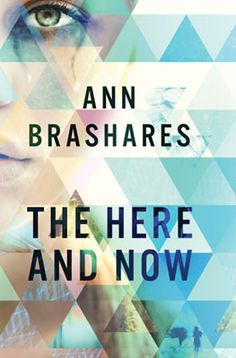
The Here and Now by Ann Brashares

Share

the here and now

The Here and Now
Author: Ann Brashares
Published: April 8, 2014 by Delacorte Press

Summary: An unforgettable epic romantic thriller about a girl from the future who might be able to save the world… if she lets go of the one thing she’s found to hold on to.

Follow the rules. Remember what happened. Never fall in love.

This is the story of seventeen-year-old Prenna James, who immigrated to New York when she was twelve. Except Prenna didn’t come from a different country. She came from a different time—a future where a mosquito-borne illness has mutated into a pandemic, killing millions and leaving the world in ruins. 

Prenna and the others who escaped to the present day must follow a strict set of rules: never reveal where they’re from, never interfere with history, and never, ever be intimate with anyone outside their community. Prenna does as she’s told, believing she can help prevent the plague that will one day ravage the earth. But everything changes when Prenna falls for Ethan Jarves.

Review: I particularly loved the first half of this book. While time travel is at the heart of this text, I think it would be a great book to give to readers who love dystopian fiction. Prenna’s memory of her futuristic world was fascinating to me. At times, I found Brashares to be a bit didactic, but overall, the book is very well-written and will entice readers from the first page. I always enjoy reading books about time travel because my mind spins as I try to grapple with the paradox time travel provides. If we change the past, will we exist in the future? And how can this work, if we are living in this previous time? Ah! My brain hurts. I enjoyed this book because it made me think.

Teacher’s Tools for Navigation: Similar to my review of All Our Yesterdays, I think students would have a lot of fun selecting a time period to travel to, and perhaps, picking one event in history they would change and how it might impact the future. This could develop into a research project, and I can imagine there would be fantastic interdisciplinary connections with the subject of history. Alternatively (or additionally), teachers could link this text with the subject of science–where students research ways we are destroying our planet.

Discussion Questions: How are we destroying our planet? Do you think Ann Brashares’ prediction of the future is accurate? What is Brashares’ tone in this text?; If you could travel in time, what is one event in history that you would change and why? How might it change events in the future?

We Flagged: “People here act like the great things have already been lost, but they are wrong. They have so much still to lose” (Chapter Three).

“I guess memory is a deep well, and you don’t know what’s down there until you lower the bucket and start hauling it up” (Chapter Fifteen).

Please note: The above quotes are from the advanced reader copy. The quotes may have changed with publication.

Read This If You Loved: All Our Yesterdays by Cristin Terrill, When You Reach Me by Rebecca Stead, The Time Machine by H.G. Wells, The Giver by Lois Lowry, Legend by Marie Lu, Divergent by Veronica Roth

Recommended For:
 closereadinganalysisbuttonsmall litcirclesbuttonsmall classroomlibrarybuttonsmall

RickiSig

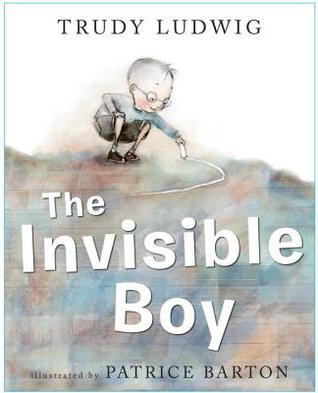
The Invisible Boy by Trudy Ludwig

Share

invisible

The Invisible Boy
Author: Trudy Ludwig
Illustrator: Patrice Barton
Published October 8th, 2013 by Alfred A. Knopf

Goodreads Summary: Meet Brian, the invisible boy. Nobody ever seems to notice him or think to include him in their group, game, or birthday party . . . until, that is, a new kid comes to class.

When Justin, the new boy, arrives, Brian is the first to make him feel welcome. And when Brian and Justin team up to work on a class project together, Brian finds a way to shine.

From esteemed author and speaker Trudy Ludwig and acclaimed illustrator Patrice Barton, this gentle story shows how small acts of kindness can help children feel included and allow them to flourish. Any parent, teacher, or counselor looking for material that sensitively addresses the needs of quieter children will find The Invisible Boy a valuable and important resource. 

Includes backmatter with discussion questions and resources for further reading. 

Review: Wow. This book affected me, so I know it would affect students. Although this is a book aimed at helping students think about how they affect others, there was one scene, early on, that shows Brian being ignored by everyone including his teacher which made me even sadder. It is so important for everyone, adults included, to think about how they treat or ignore others.

The other thing that I thought was brilliant was the way the illustrations were done. Brian comes to life actually right in front of our eyes. Such a smart way to visually show the moral of the story.

If you have not read this book yet, get it from your library or just go ahead and purchase it. You will not regret it.

Teachers’ Tools for Navigation: This book needs to be added to any kindness or empathy units out there right now. When I go back into the classroom, I will include it when I read Each Kindness, Because Amelia Smiled, and Stand Tall, Molly Lou Melon (check out my post on how I use Each Kindness in my middle school classroom. Invisible Boy will fit perfectly.)

The author also includes recommended reading for adults and kids as well as wonderful Questions for Discussion in the back of the book.

Discussion Questions: (Found in the backmatter of the book) How many kids did it take in this story to help Brian begin to feel less invisible?; What specifically did Justin do to make Brian feel less invisible?; Are there kids in your class, grade, or school who you see being treated as if they are invisible? If yes, what could you do to make them feel more valued and appreciated?

We Flagged: 

Read This If You Loved: Each Kindness by Jacqueline Woodson, Stand Tall, Molly Lou Melon by Patty Lovell, Because Amelia Smiled by David Ezra Stein, Unicorn Thinks He’s Pretty Great by Bob Shea

Recommended For: 

readaloudbuttonsmall litcirclesbuttonsmall classroomlibrarybuttonsmall

Signature

Amulet Books Graphic Novel Teaching Guide

Share

abrams

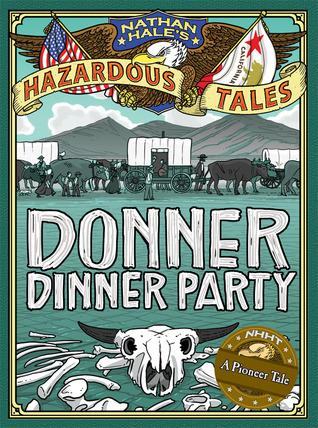
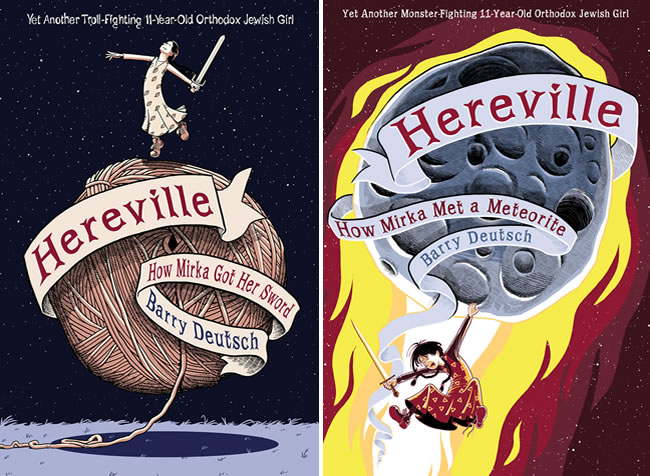
In January, I was contacted by a publicity and marketing associate from Abrams Books/Amulet Books out of the blue. In this email, I was asked to work on a teaching guide about their graphic novels: The Misadventures of Salem Hyde, Nathan Hale’s Hazardous Tales, Hereville, and the Explorer series.

1729025518405488 

13591161135911621729026018405492

1283377017290285

I was beyond honored! And, of course, I said that I would definitely love to do it as I had read all of the graphic novels, and I am a huge fan of them.

First, they asked me to write an introduction about graphic novels and their importance in the classroom. I am a huge advocate for using graphic novels in schools, so I immediately began researching and writing. Here is the introduction:

What are graphic novels? The easiest way to describe graphic novels is to say that they are book-length comic books. However, a more complex definition that educators and librarians use is “book-length narratives told using a combination of words and sequential art, often presented in comic book style” (Fletcher-Spear, 37). Graphic novels are not written in just one genre; they can be in any genre, since graphic novels are a format/medium. Graphic novels are much like novels, but they’re told through words and visuals. They have all narrative elements, including characters, a complete plot, a conflict, etc.

Middle grade and young adult graphic novels cover a wide spectrum of themes and topics. Some common themes found in graphic novels for this age include the hero’s journey; overcoming hardship; and finding one’s identity. For example, in Hereville, we meet Mirka, an everyday girl who learns to use her brains and brawn to overcome her foes. In The Misadventures of Salem Hyde, Salem is working on finding out just who she is (both as a witch and as a person) with the help of her friend Whammy. Graphic novels can cross curricular lines. One example is the Nathan Hale’s Hazardous Tales series—comical nonfiction that takes historical events and presents them in interesting ways, using graphics and humor that will make students want to learn even more about the historical time periods. In the Explorer series, stories include topics such as animal adaptation, volcanic eruptions, and the fate of humanity. Like novels, graphic novels offer opportunities in all subject areas to extend students’ thinking.

Over the past few years, graphic novels have become a hot topic, growing in popularity with both children and educators. While many teachers are beginning to include them in the classroom, there are still teachers, administrators, and librarians who struggle with including this format in their schools. So, why should you use them in your classroom and have them available for students?

  • Graphic novels can make a difficult subject interesting and relatable. (Cohen)
  • Students are visual learners, and today’s students have a much wider visual vocabulary than students in the past. (Karp)
  • Graphic novels can help foster complex reading skills by building a bridge from what students know to what they still have to learn. (NCTE)
  • Graphic novels can help with scaffolding when trying to teach higher-order thinking skills or other complex ideas.
  • For students who struggle to visualize while they read, graphic novels provide visuals that shows what good readers do. (NCTE)
  • Many graphic novels rely on symbol, allusion, satire, parody, irony, and characters/plot and can be used to teach these, and other, literary devices. (Miller; NCTE)
  • Often, in between panels (called the gutter), the reader must make inferences to understand how the events in one panel lead to the events in the next. (McCloud)
  • Graphic novels can make differentiating easier. (Miller)
  • Graphic novels can help ELL (English Language Learners) and reluctant and struggling readers since they divide the text into manageable chunks, use images (which help students understand unknown vocabulary), and are far less daunting than prose. (Haines)
  • Graphic novels do not reduce the vocabulary demand; instead, they provide picture support, quick and appealing story lines, and less text, which allow the reader to understand the vocabulary more easily. (Haines)
  • Research shows that comic books are linguistically appropriate reading material, bearing no negative impact on school achievement or language acquisition. (Krashen)
  • Students love them.

Although you can find graphic novel readers at all reading levels, graphic novels can truly be a gateway to the joys of reading for reluctant and struggling readers. Reluctant readers often find reading to be less fun than video games, movies, and other media, but many will gravitate toward graphic novels because of the visuals and the fast pace. Struggling readers will pick up graphic novels for these reasons as well but also because the graphic novel includes accommodations directly in the book: images, less text, etc.

All in all, graphic novels can interest your most reluctant and struggling readers and also extend all of your readers, including your most gifted.  

Resources

  • Cohen, Lisa S. “But This Book Has Pictures! The Case for Graphic Novels in an AP Classroom.” AP Central. CollegeBoard.
  • Fletcher-Spear, Kristin, Merideth Jenson-Benjamin, and Teresa Copeland. “The Truth About Graphic Novels: A Format, Not a Genre.” The ALAN Review Winter (2005): 37­–44.
  • Haines, Jennifer. “Why Use Comics in The Classroom?” Comic Book Daily. N.p., 20 Mar. 2012.
  • Karp, Jesse. “The Case for Graphic Novels in Education.” American Libraries. N.p., 1 Aug. 2011.
  • Krashen, Stephen. The Power of Reading. Englewood, CO: Libraries Unlimited, Inc. 1993.
  • McCloud, Scott. Understanding Comics. Northampton, Mass.: Kitchen Sink, 1993. 
  • Miller, Andrew. “Using Graphic Novels and Comics in the Classroom.” Edutopia. N.p., 11 Jan. 2012.
  • NCTE, comp. “Using Comics and Graphic Novels in the Classroom.” The Council Chronicle September (2005) http://www.ncte.org/magazine/archives/122031.

 I then began reading and rereading the graphic novels and planning activities and discussion questions that could go along with each book. I was asked to come up with activities for all subjects, so this pushed me out of my comfort zone a bit; however, I loved trying to figure out how these amazing books could be used throughout all classes.  Some examples:

  • Salem Hyde [Science]: At the end of Spelling Trouble, Salem and Whammy have to rescue a whale, but it is done in a very unconventional way. How would real scientists rescue a whale in distress?
  • Hazardous Tales [Language Arts/History]: The Provost (a British soldier) and Nathan Hale disagree about the cause of the Revolutionary War. Based on One Dead Spy, what events caused the Americans to revolt? Do you agree with the Provost or with Nathan Hale about the causes of the war? (This could also be used as a debate question in class.)
  • Hereville [Math]: On pages 31–32 [of Hereville 1], Mirka is given a math problem: Three people are splitting a cake, so they cut it into thirds. But then a fourth person shows up. How can they cut the cake so that each person gets an equalamount of cake? (Mirka comes up with a solution, but are there others?) What if two more people had shown up? Three more? Four more? 
  • Explorer [History]: On page 84 [of The Mystery Boxes], in The Soldier’s Daughter, the man says, “War is a dark power.” Where in history have we seen war consume someone? Have there been wars that did not need to be fought? Research past wars and determine if a war was started because of the need for power or if there was a legitimate reason for it. 

These are just some examples.

I am happy to share the entire teaching guide with you. It can be found at http://www.abramsbooks.com/academic-resources/teaching-guides/ along with other teaching guides. The direct link to the PDF is http://www.abramsbooks.com/pdfs/academic/GraphicNovels_TeachingGuide.pdf.

I hope you find it useful as I am very proud of it,

Signature

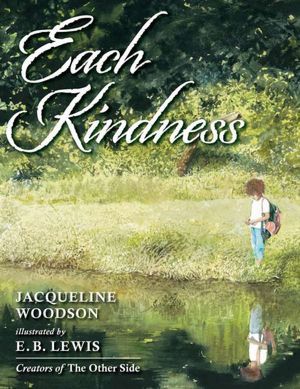
Each Kindness by Jacqueline Woodson (Ricki’s Review)

Share

Each Kindness

Each Kindness
Author: Jacqueline Woodson
Illustrator: E.B. Lewis
Published October 2nd, 2012 by Nancy Paulsen Books

Summary: Each kindness makes the world a little better

Chloe and her friends won’t play with the new girl, Maya. Maya is different–she wears hand-me-downs and plays with old-fashioned toys. Every time Maya tries to join Chloe and her gang, they reject her. Eventually, Maya plays alone, and then stops coming to school altogether. When Chloe’s teacher gives a lesson about how even small acts of kindness can change the world, Chloe is stung by the lost opportunity for friendship, and thinks about how much better it could have been if she’d shown a little kindness toward Maya.

This unforgettable book is written and illustrated by the award-winning team that created The Other Side and the Caldecott Honor winner Coming On Home Soon. With its powerful message and striking art, it will resonate with readers long after they’ve put it down.

Review: This is a beautiful story that would be FANTASTIC for the classroom. Students of any age can learn from this book, and I would read it to my class on the very first day of school. It is easy to get caught up in drama and gossip, and Jackie Woodson reminds us how hurtful this can be. I am so glad that I own a copy of this book. I plan to read it to my son very often because the lessons are so important, and the story is simply stunning. Usually, I don’t review a book that Kellee has also reviewed on Unleashing Readers, but I couldn’t help but share my thoughts about this incredible text.

Teacher’s Tool For Navigation: I would be remiss if I didn’t direct you to Kellee’s post about this book. She did a fantastic activity with her class that used multi-flow maps.

One of my favorite parts about this book is that it doesn’t have a happy ending. I would love to discuss this with students–why might this be? Is Woodson teaching us something? Then, we might explore other books that don’t have happy endings and discuss why authors might do this intentionally and how it might impact readers’ feelings about the books. Students are notorious for disliking sad endings, so I think this would provoke much discussion.

This book can be both preventative and reactionary to bullying issues in the classroom/school community. While I would read it at the beginning of the school year, I could also see it as an effective tool for teachers who are having issues with bullying during the school year.  This book makes us want to be better people.
Discussion Questions: Why is Chloe so mean to Maya?; What do we know about Maya? Why do you think Woodson characterizes her this way?; Why does this book end in an unhappy way? What does it teach us?; How might we spread kindness?

We Flagged: “And on that first day, Maya turned to me and smiled. But I didn’t smile back. I moved my chair, myself and my books a little farther away from her. When she looked my way, I turned to the window and stared out at the snow” (6).

Read This If You Loved:  Unicorn Thinks He’s Pretty Great by Bob Shea, Endgame by Nancy Garden, Thirteen Reasons Why by Jay Asher,  The Silver Linings Playbook by Matthew Quick, Burn by Suzanne Phillips, The Perks of Being a Wallflower by Stephen Chbosky, Twisted by Laurie Halse Anderson, Everybody Sees the Ants by A.S. King, The Spectacular Now by Tim Tharp, Inexcusable by Chris Lynch

Recommended For: 
readaloudbuttonsmall classroomlibrarybuttonsmall 

RickiSig


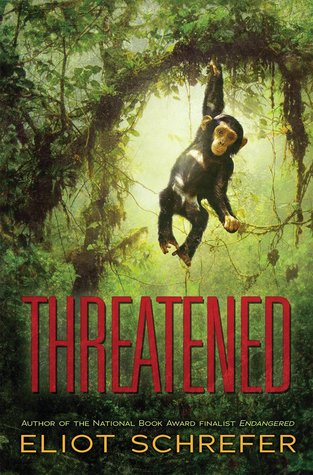
Threatened by Eliot Schrefer

Share

threatened

Threatened
Author: Eliot Schrefer
Published: February 25th, 2014 by Scholastic Press

GoodReads Summary: Into the jungle. Into the wild. Into harm’s way. When he was a boy, Luc’s mother would warn him about the “mock men” living in the trees by their home — chimpanzees whose cries would fill the night. Luc is older now, his mother gone. He lives in a house of mistreated orphans, barely getting by. Then a man calling himself Prof comes to town with a mysterious mission. When Luc tries to rob him, the man isn’t mad. Instead, he offers Luc a job. Together, Luc and Prof head into the rough, dangerous jungle in order to study the elusive chimpanzees. There, Luc finally finds a new family — and must act when that family comes under attack.

As he did in his acclaimed novel Endangered, a finalist for the National Book Award, Eliot Schrefer takes us somewhere fiction rarely goes, introducing us to characters we rarely get to meet. The unforgettable result is the story of a boy fleeing his present, a man fleeing his past, and a trio of chimpanzees who are struggling not to flee at all.

Review: If you follow this blog, you know that Kellee and I are advocates for Eliot Schrefer’s writing. He is an incredibly talented writer; his settings feel authentic in that he makes far away places seem very close to home. I develop a strong kinship with his characters—animal or human. Kellee has been raving about Threatened since the ALAN conference, and I knew I wanted to read it as soon as I got a hang of being a new mom. It didn’t disappoint. The writing is stunning.

I expected Threatened to be very similar to Endangered, but I was wrong. Endangered is about an American girl visiting her mother in a Congolese bonobo sanctuary when a civil war breaks out. Threatened, on the other hand, is about an orphan boy from Gabon who goes into the wild with a professor in order to learn more about chimpanzees. But these books are more than their settings and the animals. They teach us about what it means to be human. Threatened, in particular, made me think about humanity’s evolution and the difficulties that come from living in the wild. I couldn’t help but think about how far humanity has strayed from nature. Even when Luc feels that he wants for nothing, he is ashamed that he still holds material desires. This book makes readers think critically, and it would be a great book to use in the classroom.

Teacher’s Tools for Navigation: After reading this book, I wanted to learn more about chimpanzees and how they are different from humans. Schrefer’s book has a call to action. He gives suggestions of how we might help these endangered animals. In particular, he discusses the sad state of animal testing and provides readers with ways to take action. This book will help students become critical thinkers, and hopefully, teachers will help students enact social justice for these animals which are so genetically close to us.

Discussion Questions: Are humans too far removed from nature?; How does Luc become more animalistic after he lives for extensive time in the wild? Are his changes mental? Physical?; What do the chimpanzees teach us about humanity? How are they similar and different from us?; What can we do to help these endangered species?

We Flagged: “We can try so hard, but in some basic way we’re bound by how we’re raised. There’s no escaping it. We can love someone and want to be open to the feeling but fail because our hearts got wired one way long before we knew it was happening. We can break our own hearts because of what our souls believe” (Chapter 10).

**Please note: This quote is taken from the NetGalley. It may be different in the published version of the book.**

Read This If You Loved: Endangered by Eliot Schrefer, Into That Forest by Louis Nowra, Dog Boy by Eva Hornung, Second Nature by Alice Hoffman, Into the Wild by Jon Krakauer

Recommended For:
 readaloudbuttonsmalllitcirclesbuttonsmallclassroomlibrarybuttonsmall

RickiSig

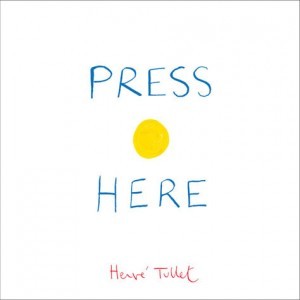
Press Here by Hervé Tullet

Share

press here

Press Here
Author: Hervé Tullet
Translator: Christopher Franceschelli
Published March 20th, 2011 by Chronicle Books

Goodreads Summary: Press the yellow dot on the cover of this book, follow the instructions within, and embark upon a magical journey! Each page of this surprising book instructs the reader to press the dots, shake the pages, tilt the book, and who knows what will happen next! Children and adults alike will giggle with delight as the dots multiply, change direction, and grow in size! Especially remarkable because the adventure occurs on the flat surface of the simple, printed page, this unique picture book about the power of imagination and interactivity will provide read-aloud fun for all ages!

Review: This is a wonderfully innovative book. It asks the child to interact with the story—pressing, tilting, shaking, etc. at each page. I am not ashamed to admit that I was smiling and following the instructions, eagerly wondering what awaited me on the next pages. I suspect I am going to have a very active child (based on the stories about my husband), and this book will allow him to wiggle and jump as he reads. This is a book that makes reading fun.

Teacher’s Tools for Navigation: I could see this being a great book for buddy/paired reading. It will evoke a lot of laughter and giggles from kids. I also wonder how this might be used to teach writing to middle and high schoolers. It is certainly innovative, and I bet teachers might use it to teach creativity and breaking the mold of typical writing.

Discussion Questions: What might the author’s purpose be for writing this book?; How does the author creatively reach readers? How can this be incorporated into your own writing?

We Flagged: “There. Well done. Now tilt the page to the left…just to see what happens.”

Read This If You Loved: Perfect Square by Michael Hall, Green by Laura Vaccaro Seeger, Is Everyone Ready for Fun? by Jan Thomas

Recommended For: 

litcirclesbuttonsmall classroomlibrarybuttonsmall

RickiSig

Dolphin Sky by Ginny Rorby

Share

This week I am celebrating with my friend and author Ginny Rorby as she receives her award from the Florida Association for Media in Education (FAME) for winning the Sunshine State Young Readers Award (as voted by 6-8 grade students in Florida) for Lost in the River of Grass. To celebrate, I will be reviewing all of her books this week:

dolphin

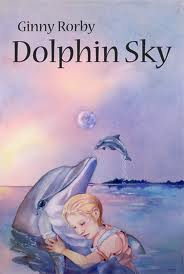
Dolphin Sky
Author: Ginny Rorby
Published July 29th, 2013 (first published 1996)

Goodreads Summary: When the captive dolphins that she has befriended are threatened, Buddy risks her father’s condemnation and the law to save their lives in this powerful story about a dyslexic child, trapped by the limitations of her learning disability, who discovers that real freedom comes from being true to your heart.

My Review: I know you have heard this from me all week, but Ginny Rorby just has a way of sucking me in and pulling on my heart strings. Dolphin Sky is Ginny’s first book which she has rereleased as an ebook, so I grabbed it as soon as she let me know. Once again, I cried, I cheered, I laughed. I loved every second of the book.

Ginny knows how to intertwine human issues and animal issues into a seemlessly touching story. Buddy, our young protagonist, is bullied at school and has a very tough time keeping up. A specific bully is relentless making her feel stupid specifically when she has to read outloud and cannot. The only time Buddy feels like she can be herself is around her grandfather, The Admiral, who, after an accident, is in a wheelchair. Even her father is very distant and her mother is dead. Buddy also finds relief when she is around nature and she specifically loves dolphins, so when she befriends Annie, a captive dolphin at a small roadside attraction, she knows she has found a friend for life.

One of the things that Ginny does so well is voice- unique per book, but also consistent between. Though this book is in 3rd person, the narrator has a specific voice throughout and they are different between every book (though I can always tell it is Ginny writing). She has a style to her descriptions and prose that is perfect for the books she writes. In this book, specifically the setting comes alive because of Ginny’s writing.

The other thing I think Ginny does well in all of her books is characterization of not only the human characters, but the animals as well. Annie the dolphin is as much a character as anyone else in this book. So is Osceola, the crab, who ended up being one of my favorite characters.

Lastly, again, Ginny pays homage to good teachers who can make a difference. Miss Conroy, the doctorate student who meets and mentors Buddy, as well as Miss Daniels, Buddy’s teacher, are great advocates for Buddy and really show how a good teacher or mentor can make a difference.

Teacher’s Tools for Navigation: Especially for those of us in Florida, there are many different sections of this book that would be great for read alouds to discuss some tough topics; however, it will find its home in students’ hands.

Discussion Questions: (Writing) Just as Buddy’s teacher assigns, research an animal native to your area and determine how humans are affecting its population and what we can do to help.

We Flagged: “She puts out her hand and Annie comes slowly toward her, but sinks away before Buddy touches her. The dolphin circles, and Buddy feels her pass, feels the pressure that the movement of her tail makes in the water. She turns, trying to keep track of where Annie is… Buddy lets herself bob to the surface, takes a breath, then dangles face down, making a slow circle, trying to find the dolphin. From directly beneath her, Annie looms up out of the murky water. That monstrous form moving slowly toward her floods Buddy with the same fear she felt when she first fell into the water. Panic wells in her, flattening her lungs against her ribs until her breath leaves her in a gasp. But she doesn’t move or scream and, in that moment, realizes that her fear exploded on the surface in that bubble of air. The emptiness in her chest fills with love.” (Location 1598-1591, 1608-1612)

Read This If You Loved: Carl Hiaasen novels Hoot, Scat, Chomp, and Flush; Island of the Blue Dolphins by Scott O’Dell

Recommended For: 

classroomlibrarybuttonsmall

Signature