The Wolf Girls: An Unsolved Mystery from History by Jane Yolen and Heidi Elisabet Yolen Stemple

Share

NF PB 2013

Nonfiction Picture Book Wednesday

Nonfiction Picture Book Wednesday is hosted by Kid Lit Frenzy and was started to help promote the reading of nonfiction texts. Most Wednesdays, we will be participating and will review a nonfiction text (though it may not always be a picture book).
Be sure to visit Kid Lit Frenzy and see what other nonfiction books are shared this week!

wolf

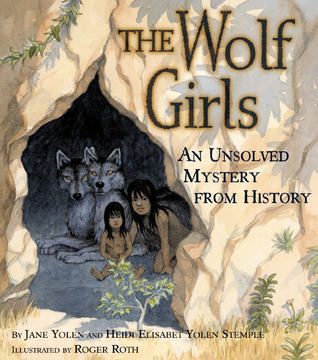
The Wolf Girls: An Unsolved Mystery from History
Authors: Jane Yolen and Heidi Elisabet Yolen Stemple
Illustrator: Roger Roth
Published August 1st, 2000 by Simon & Schuster Books for Young Readers

Goodreads Summary: In 1920 a missionary brought two young girls to an orphanage in India. The girls didn’t know how to talk, walk, or eat from a plate. Some people thought the girls had been abandoned by their parents. Some people said the girls were brought up by wolves in the wild. Still others thought that the missionary who ran the orphanage made up the story about the girls. No one knows for sure.

Become a detective as you read this true story, study the clues, and try to figure out the fate of the wolf girls of Midnapore. The Unsolved Mystery from History series is written by acclaimed author Jane Yolen and former private investigator Heidi Elisabet Yolen Stemple. Read carefully and check your clues. You might be the first to solve a puzzle that has baffled people for years.

My Review: This story was fascinating as I had never heard of the wolf girls and came in with no prior knowledge about the mystery. It was so much fun to be full on submerged in the mystery and following the clues that are given throughout the “case notebook”.

Teacher’s Tools for Navigation: This book is set up just like the Salem Witch Trials: An Unsolved Mystery from History and could be used the same way in the classroom: This book promotes studying history, inquiry, and vocabulary. The book begins with an introduction to a young girl who enjoys unsolved mysteries from history and then the book is set up like her case notebook. Each page of the case notebook includes a narrative nonfiction section, an informational nonfiction section where facts about the story are explained even more in detail, and then there are vocabulary words from the two sections defined for the reader. Finally, in the back of the book the different theories about what could be the answer to the unsolved mystery are shared and briefly discussed. The set up of this book leads to infinite possibilities of being used in the classroom. Students could debate, write research papers, could do their very own case notebook about a different mystery, etc. Another option is to get all of the Unsolved Mystery from History books and have students get into lit circle groups and have each group read a different mystery then research and share.

What I like particularly about this one is that there is so much to debate as there aren’t many clues given throughout the story. Many of the eye witnesses are unreliable and there aren’t many facts shared throughout the book. I think this book would lead to a great discussion about primary and secondary sources as well as reliability.

Discussion Questions: Which theory do you believe about the wolf girls?; Do you think a journal written a year after an incident is reliable?; Many of the scientific facts and theories shared are from the 18th and 19th century, are these facts still what science believes?; Why do you think the missionary’s wife never spoke of the wolf girls?; Why do you think that Singh’s accounts were different than his daughter’s?; Singh said he did not want to exploit the girls yet he let people come to see her – is this exploitation? Do you think what he did was wrong?

We Flagged: Narrative nonfiction “After nursing the two girls back to health, the Reverend Singh loaded them into the cart and drove them for eight days to his orphanage in Midnapore. But the wolf girls were so weak and emaciated, they could not move about, so at first no one outside of the orphanage saw them. Singh wrote in his journal, ‘They were accepted simply as neglected children.’

Informational Nonfiction Singh wrote in his journal that the girls were mud-covered, with scratches, scars, and fleas. The heels of their hands were callused from running on all fours. Their ears trembled like a dog’s when they were excited. Their brows were bushy and long. Each had arms almost reaching their knees. Their teeth were close-set, uneven, with fine, sharp edges, the canines longer and more pointed than is usual in humans. However, Singh took no scientific measurements and invited no scientists to examine the girls. He took photographs that were fuzzy and indistinct. Years later, his own daughter, when interviewed, did not remember the distinctive teeth or exceptional ears or terrifically bushy brows.

Vocabulary Emaciated: thin and feeble due to disease or poor food; Neglected: not take proper care of” (p. 20-21)

Read This If You Loved: Yolen’s other Unsolved Mystery from History books

Recommended For: 

classroomlibrarybuttonsmall litcirclesbuttonsmall

closereadinganalysisbuttonsmall readaloudbuttonsmall

What mystery from history do you wish Jane Yolen had written about? 

Signature

Crankee Doodle by Tom Angleberger

Share

crankee
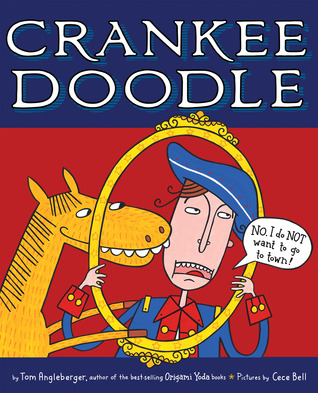
Crankee Doodle
Author: Tom Angelberger
Illustrator: Cece Bell
Published June 4th, 2013 by Clarion Books

Goodreads Summary: “Yankee Doodle went to town / a-riding on a pony / stuck a feather in his hat / and called it macaroni.” Many know the song “Yankee Doodle Dandy,” but few understand it. This unapologetically silly picture book reveals that the legendary ride to town (and the whole macaroni thing) was all suggested by Mr. Doodle’s overeager pony. This just makes Mr. Doodle cranky: “I do not want macaroni. I do not want a feather. I do not want any other clothing, any other pasta, or any other parts of a bird. I do not want anything that they have in town!” A historical note ends this colorful, comical take on a nonsensical old song.

My Review: Tom Angleberger and Cece Bell are a match made in heaven (good think they found each other)! This book is funny from page one and will definitely get the reader giggling.  The hilarious story line mixed with the colorful, exaggerated, silly illustrations make the reader purely engaged in the book.  This book will definitely make the reader sing “Yankee Doodle” and want to read the book again.

Teacher’s Tools For Navigation: What I love about this book is that it’ll be a perfect read aloud, but it also connects to history by having a historical note in the back. Who wrote “Yankee Doodle”? No one knows, but what a great conversation started and a way to introduce Colonial America.

In the story, the word macaroni is also discussed. Macaroni used to mean fancy, but now it obviously doesn’t. What a way to begin a discussion of how words change meaning over time. There are TONS of words that have changed their meaning.  Going over this and giving would really start a great discussion and could lead to some amazing activities.

Discussion Questions: Why would the British want to make fun of Americans during Colonial America?; How did the horse persuade Doodle to go to town?; How would this story have been different if the pony was the lazy and Doodle wasn’t?

We Flagged: Pony: “Macaroni is just another word for fancy.”
Doodle: “Says you. That’s the silliest thing I ever heard. Macaroni isn’t fancy. It’s macaroni. You know what’s fancy? Lasagna. Lasagna is fancy. Lasagna has all those little ripples in it, and then it gets baked with cheese and tomatoes and vegetables. Then you eat it with some garlic bread. Now, that’s fancy!” (p. 14-15)

Read This If You Loved: Imogene’s Last Stand by Candace Fleming, Rabbit and Robot by Cece Bell, Those Rebels, John and Tom by Barbara Kerley

Recommended For: 

readaloudbuttonsmall classroomlibrarybuttonsmall

Signature

The Boy Who Loved Math by Deborah Heiligman

Share

NF PB 2013

Nonfiction Picture Book Wednesday

Nonfiction Picture Book Wednesday is hosted by Kid Lit Frenzy and was started to help promote the reading of nonfiction texts. Most Wednesdays, we will be participating and will review a nonfiction text (though it may not always be a picture book).
Be sure to visit Kid Lit Frenzy and see what other nonfiction books are shared this week!

lovedmath

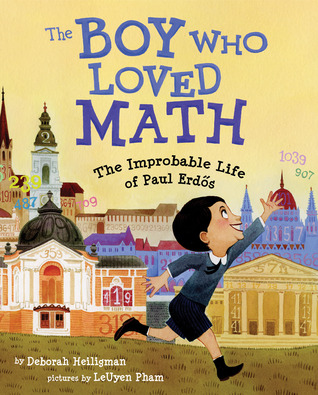
The Boy Who Loved Math: The Improbable Life of Paul Erdos
Author: Deborah Heiligman
Illustrator: LeUyen Pham
Published June 25th, 2013 by Roaring Brook Press

Goodreads Review: Most people think of mathematicians as solitary, working away in isolation. And, it’s true, many of them do. But Paul Erdos never followed the usual path. At the age of four, he could ask you when you were born and then calculate the number of seconds you had been alive in his head. But he didn’t learn to butter his own bread until he turned twenty. Instead, he traveled around the world, from one mathematician to the next, collaborating on an astonishing number of publications. With a simple, lyrical text and richly layered illustrations, this is a beautiful introduction to the world of math and a fascinating look at the unique character traits that made “Uncle Paul” a great man.

My Review: I have been on a great streak of picture book narrative biographies and this is another one. I love how the author so cleverly combined Erdos’s story and mathematics without ever overloading the story with numbers. This book is so much fun (and the colorful illustrations add even more playfulness to it) yet teaches so much within its story.  What impresses me the most is just how much the book makes you think about math, want to learn more math, and want to play with numbers. Even in book form, Erdos is making math understandable.

Teacher’s Tools For Navigation: What a great book to use in a math classroom (or elementary classroom). This book makes math sound fun and would definitely be a jumping off point for many different mathematical ideas (such as prime numbers, harmonic primes, amicable numbers, odd/even numbers, Euclid’s Proof of the Infinity of Prime Numbers, Sieve of Eratosthenes, Euler’s map of Konigsburg, negative numbers, the Party Problem, Erdos distinct distances problem, Erdos number, epsilon). Many of the ideas are shared in a fun way and would help be a foundation for scaffolding.

Discussion Questions: What math idea/activity do you find to be the most fun?; Use math to complete Paul’s trick- how old are you in seconds? Minutes? Hours? Days?; What are the answers to Paul’s questions about prime numbers? Do they go on forever? Is there a pattern to them? Why is it that the higher you go up, the farther apart the prime numbers are?

We Flagged: “Paul played with numbers. He added them together and subtracted them. One day he subtracted a bigger number from a smaller number.
The answer was less than 0.
How could a nubmer be <0?
Mama told him numbers below zero are called NEGATIVE NUMBERS. Paul thought that was so cool.
Now he knew for sure he wanted to be a mathematician when he grew up. But first he had to tackle another big problem…” (p. 9)

Read This If You Loved: On a Beam of Light: A Story of Albert Einstein by Jennifer Berne, Jim Henson: The Guy Who Played with Puppets by Kathleen Krull, Lost Boy: The Story of the Man who Created Peter Pan by Jane Yolen, Odd Boy Out: Young Albert Einstein by Don Brown, A Wizard from the Start: The Incredible Boyhood and Amazing Inventions of Thomas Edison by Don Brown, Sandy’s Circus: A Story about Alexander Calder by Tanya Lee StoneMe…Jane by Patrick McDonnell

Recommended For: 

readaloudbuttonsmall classroomlibrarybuttonsmall

This book just makes me want to learn more!

Signature

Hitler Youth: Growing Up in Hitler’s Shadow & The Boy Who Dared by Susan Campbell Bartoletti

Share

These two books are my favorite fiction/nonfiction companion books, so I wanted to share them with you together. 

hitleryouth

Hitler Youth: Growing Up in Hitler’s Shadow
Author: Susan Campbell Bartoletti
Published April 1st, 2005 by Scholastic Nonfiction

Goodreads Summary: In her first full-length nonfiction title since winning the Robert F. Sibert Award, Susan Campbell Bartoletti explores the riveting and often chilling story of Germany’s powerful Hitler Youth groups.

“I begin with the young. We older ones are used up . . . But my magnificent youngsters! Look at these men and boys! What material! With them, I can create a new world.” –Adolf Hitler, Nuremberg 1933

By the time Hitler became Chancellor of Germany in 1933, 3.5 million children belonged to the Hitler Youth. It would become the largest youth group in history. Susan Campbell Bartoletti explores how Hitler gained the loyalty, trust, and passion of so many of Germany’s young people. Her research includes telling interviews with surviving Hitler Youth members.

My Review: During World War II, Hitler controlled more than just the military; he controlled the entire country of Germany. Much of what this book explains are parts of the WWII history that is not taught in our schools and shows the true extent of the power that Hitler had over everyone.

The Hitler Youth began as a voluntary organization to support Hitler, but it quickly became a way for Hitler to control the youth. Soon the Hitler Youth was not voluntary and they were being used in much the same way as the military.

This book tells true stories of children in the Hitler Youth and children that were brave enough to speak up. It is truly horrific and fascinating. Susan Campbell Bartoletti uses a combination of narrative and expository writing to take her reader on a journey through Nazi controlled Germany starting with their depression and taking us through the the end of World War II. By intertwining true stories of the youth of Germany with historical fact, Bartoletti pulls at your heart strings and shows the true effect that Hitler had on the entire nation. It also takes you through the steps that Hitler took to brainwash the entire population, starting with the most desperate citizens, including the youth.

Although many nonfiction books are hard to get through and are dry, this one has a voice to it that is deeper and more sensitive than most. You become connected to the people of Germany and the youth of the story, so it doesn’t matter if that I already know the outcome- you have to know how they make it out of their deceit filled situation.

boywho

The Boy Who Dared
Author: Susan Campbell Bartoletti
Published February 1st, 2008 by Scholastic Press

Goodreads Summary: Bartoletti has taken one episode from her Newbery Honor Book, HITLER YOUTH, and fleshed it out into thought-provoking novel. When 16-year-old Helmut Hubner listens to the BBC news on an illegal short-wave radio, he quickly discovers Germany is lying to the people. But when he tries to expose the truth with leaflets, he’s tried for treason. Sentenced to death and waiting in a jail cell, Helmut’s story emerges in a series of flashbacks that show his growth from a naive child caught up in the patriotism of the times , to a sensitive and mature young man who thinks for himself.

My Review: Helmuth Hubener thought that Hitler was going to fix Germany, but the longer Hitler was in power, the more Helmuth realized that there was social injustice happening.

Based on a true story, The Boy Who Dared, accounts Helmuth’s life and the choices he makes. Told in flashback, I felt that some of the suspense is taken away since you know Helmuth’s current situation right from the beginning of the story; however, even with knowing the outcome, I wanted to read to figure out how Helmuth got there.

The exposition of the book helped me understand the extent of Helmuth’s society at the time which made me even more sympathetic then I would have been just jumping into Helmuth’s life. Although we all know about World War II and the Holocaust, unless you have read other books on World War II Germany, you may not understand the extent of Hitler’s power and brainwashing. With The Boy Who Dared, we follow Helmuth through his feelings about Hitler and the decisions he made.

This book is fabulous to read with the nonfiction book by Susan Campbell Bartoletti, Hitler Youth, which recounts the history around the Hitler Youth and what Helmuth was living through.

*     *     *     *     *

Teacher’s Tools For Navigation: If I taught a grade level where the Holocaust or WWII was taught in history, I would love to use these books supplementally in English class. These books tell a story within WWII that isn’t normally taught in history and really shines a light on a different side of the story. It would be a great way to discuss point of view, persuasion, and propaganda. I can also see these being used in thematic sets and then in lit circles. Each book adds to a whole look at WWII.

Discussion Questions: After reading both books, why was Hitler able to manipulate and affect the youth of Germany the way he did?; How did Helmuth affect those around him? History?

We Flagged: “The dark streets were already flooded with thousands of excited people, who, like Melita, were running out to watch the victory parade in honor of Adolf Hitler… Melita couldn’t understand why her parents didn’t support a great man like Adolf Hitler, who said that a person’s money and titles didn’t matter.  All that mattered was whether a person contributed to the well-being of the people.” (Hitler Youth p. 15-16)

“It’s morning.  Soft gray lights slips over the tall redbrick wall.  It stretches across the exercise yard and reaches through the high, barred windows.  In a cell on the ground floor, the light shifts dark shapes into a small stool, a scrawny table, and a bed made of wooden boards with no mattress or blanket.  On that bed, a thin, huddled figure, Helmuth, a boy of seventeen, lies awake.  Shivering. Trembling.
It’s Tuesday.
The executioner works on Tuesday.” (The Boy who Dared p. 1)

Read These If You Loved: Parallel Journeys by Eleanor Ayers, Alfons Heck & Helen Waterford, Briar Rose by Jane Yolen, The Book Thief by Markus Zusak, Resistance (series) by Carla Jablonski, London Calling by Edward Bloor, Once (series) by Morris Gleitzman, The Berlin Boxing Club by Robert Sharenow, Between Shades of Gray by Ruta Sepetys

Recommended For: 

classroomlibrarybuttonsmall litcirclesbuttonsmall closereadinganalysisbuttonsmall

Signature

Review and Interview!: Star Challengers: Moonbase Crisis by Rebecca Moesta and Kevin J. Anderson

Share

moonbase

June Scobee Rodgers presents
Star Challengers: Moonbase Crisis
Authors: Rebecca Moesta and Kevin J. Anderson
Published October 22nd, 2010 by Catalyst Game Labs

Goodreads Summary: After an exhilarating space simulation field trip at the local Challenger Center, a group of students are hand-picked by the mysterious Commander Zota for a special adventure: to travel to the future and a real moonbase in trouble, where they will learn skills to save the human race.

My Review: Since I live in Florida, I am right in the middle of the NASA debate. Some feel that the science behind NASA and space exploration is not worth the money where others completely disagree. There are others who are somewhere in the middle, not knowing. To me, losing the space program is terrifying and the authors of this book take the same stance as me.

Moonbase Crisis is a book written by Rebecca Moesta and Kevin J. Anderson but it is presented by June Scobee Rodgers, the widow of a commander on the Challenger, and endorsed by many NASA legends such as Buzz Aldrin, Neil Armstrong and Sally Ride. It is also a direct endorsement for Challenger Centers which are centers across the US that teach kids about space and hope to inspire them by letting them experience simulated space missions. That is where this book begins.

JJ and Dylan Wren are invited to a special space simulation after going on a field trip to the Challenger Center. When they arrive the find out that they are 2 of 4 young people chosen to be part of this mission. They are taught how to use actual communication devices and even put on real space suits. Then Commander Zota, the man who invited them, asks them to step into a room and next thing they know they find themselves on a Moonbase. In the future.

Then on top of all of this, it is a pretty good story with some major suspense. I look forward to the 2nd book as this was obviously an exposition for more to come.

Teacher’s Tools For Navigation: Throughout this book, science is definitely a main topic. It is sprinkled throughout discussing astronomy, botanical sciences, chemistry, and more I am sure. Though the book is science fiction, the science within in pure fact. The book shows a future where science and space exploration are not priorities and hopes to promote science by showing how important it is.

My father gave me this book as a gift and was kind enough to connect me with Ms. June Scobee Rodgers who helped make this book happen. Ms. Scobee Rodgers is the widow of Challenger Space Shuttle Commander Dick Scobee and has spent her life making sure his legacy and NASA continue for years to come. I was lucky enough to be given an opportunity to interview her about the Star Challengers series and the Challenger Center programs:

Kellee: After the Challenger tragedy, yourself and other family members of lost Challenger astronauts opened the Challenger Center to honor them. Why was it decided to use their memory to focus on the education of children?

Ms. Scobee Rodgers: The Challenger 51-L mission soon became the “Teacher in Space” mission. The teacher Christa McAuliffe and I had a great deal in common as teachers. My husband Dick Scobee the Commander had always been mission oriented.  So after we lost the “mission” the other family members of the shuttle crew joined with me to create an opportunity to reach the students and teachers around the globe still waiting for their lessons from the beloved school teacher who died along with my husband.

Kellee: What is your goal when it comes to the Challenger Centers?

JSR: Our board of directors and staff as well as all the Challenger Learning Centers all want to continue to reach students to inspire them with the importance of STEM education and the pursuit of careers with a tremendous shortage in those fields.

Kellee: How did the Star Challengers books come about?

JSR: Introduced through a mutual friend to famous author Kevin Anderson and his wife Rebecca, we explored opportunities to tell the Challenger story and STEM education with real science fiction that would both entertain and teach as well as inspire our youth across the country.

Kellee: As an educator and advocate for children’s education, what do you say to those who don’t believe that NASA and space exploration is beneficial for the future?

JSR: The largest concerns facing us as citizens right now are jobs and the economy. Job and economy growth is the direct outcome of new businesses, products and processes which since the end of World War II were created from our focus and investments in technology, engineering, research and science. And that can only happen when you have a citizenry and workforce with the talent to perform this vital role. Since 50% of all potential future scientists, engineers, technicians and similar key workforce tend to decide by the early age of 10-13 years that they either cannot do it or do not want to, we need to continue to expand our efforts to inspire and engage all of them. Even if they choose not to enter those fields. We need a STEM literate citizenry to ensure we hold the correct values for our society.

Kellee: What do you hope comes from the publication of the Star Challenger books?

JSR: I hope to inspire a whole new generation of “Star Challengers” – young people like our main characters who want to make a difference for our planet and who will reach for the stars no matter their circumstances.

Kellee: How do you hope they are used in the classroom? With children?

JSR: Students are now creating book reports and reading the books for pleasure. It would be terrific if the books could be made available in classroom sets to allow for classroom discussion.

Kellee: I loved Moon Base Crisis and cannot wait to read the second one- how many books are planned in the series?

JSR: The second book is titled Space Station Crisis, and the third is Asteroid Crisis. We need students to write the follow on books.  For example, Mars City Crisis is waiting to be written by an enterprising young person.

 **Thank you so much to Ms. Scobee Rodgers for taking part in this interview!**
Links to information about the Challenger Centers and NASA For Educators:


Discussion Questions: 

  • Currently, there is a search for a young writer to write Mars City Crisis for the Star Challengers series- what would you make the book about?
  • If you had the chance to go live on the space station, would you? 

We Flagged: “Also,” the commander pointed out, “the Moon is near a quarter of a million miles from Earth, while the speed of our signal – the speed of light – is a mere 186,282 miles per second. Therefore it takes 1.3 seconds for a message to travel from Earth to the Moon, which will produce a noticeable lag when you talk to anyone at Moonbase Magellan.” (p. 26)

“Zota continued as if he hadn’t heard. “Because of the Moon’s lack of atmosphere, walking on its surface will be like stepping out into a hard vacuum  Your spacesuit maintains your body’s integrity. If your suit fails, your tissues explode and freeze. We wouldn’t want that now, would we?” The cadets shook their heads.” (p. 37)

Read This If You Loved: Zita the Spacegirl by Ben Hatke, The Softwire by PJ Haarsma, C.H.A.O.S. by Jon S. Lewis, Nonfiction books about space

Recommended For: 

readaloudbuttonsmall classroomlibrarybuttonsmall litcirclesbuttonsmall

 I think this book is a great resource for the classroom;
I hope you fill find a way to use it!

Signature

Barbed Wire Baseball by Marissa Moss

Share

NF PB 2013

Nonfiction Picture Book Wednesday

Nonfiction Picture Book Wednesday is hosted by Kid Lit Frenzy and was started to help promote the reading of nonfiction texts. Most Wednesdays, we will be participating and will review a nonfiction text (though it may not always be a picture book).
Be sure to visit Kid Lit Frenzy and see what other nonfiction books are shared this week!

barbed

Barbed Wire Baseball
Author: Marissa Moss
Illustrated by: Yuko Shimizu
Published April 9th, 2013 by Harry N. Abrams

Goodreads Summary: As a boy, Kenichi “Zeni” Zenimura dreams of playing professional baseball, but everyone tells him he is too small. Yet he grows up to be a successful player, playing with Babe Ruth and Lou Gehrig! When the Japanese attack Pearl Harbor in 1941, Zeni and his family are sent to one of ten internment camps where more than 110,000 people of Japanese ancestry are imprisoned without trials. Zeni brings the game of baseball to the camp, along with a sense of hope.

This true story, set in a Japanese internment camp during World War II, introduces children to a little-discussed part of American history through Marissa Moss’s rich text and Yuko Shimizu’s beautiful illustrations. The book includes author and illustrator notes, archival photographs, and a bibliography.

Review: World War II is the most infamous war and it is taught to all students at some point in their career. They learn about Pearl Harbor and the Atomic Bomb and the Holocause and Hitler, but way too often what happened here in the US is not discussed. All of the Japanese Americans living on the West Coast of the US (62% were US citizens) were interned because our fear overwhelmed us so much that it was the only solution that seemed plausible. I felt that the fear that was felt after the Pearl Harbor bombings is very similar to what was felt 12 years ago today.

Barbed Wire Baseball does discuss the internment camps, but I think that the theme of this book is not about the camps but about how a love of something can turn a poor situation into something else if you are determined.

The story is just one part of the book. What moves it to a higher level is the author and illustrator. Marissa Moss has someone captured the tone of the story. It begins with hopefulness then to hopelessness and finally back to joyousness. Her ability to manipulate the tone throughout makes the story touch the reader even more. Yuko Shimizu’s illustrations are done with a Japenese calligraphy brush and ink adding to the connection the reader will feel with the story. Just beautiful.

Teacher’s Tools for Navigation: I think this book mostly leads to a discussion about the historical event that is shared in the book. In my classroom, I would share it as a read aloud and then jump into a discussion about Zeni, baseball, the internment camps, and World War II. The bibliography in the back of the book gives great websites to visit to continue the discussion.

Discussion Questions: Zeni doesn’t listen to his parents and went for what he wanted: baseball. He overcame his height and those who didn’t believe in him and was able to work towards his dreams. What is something that you’ve overcome even though others didn’t believe in you?; How can you compare/contrast how US citizens responded to Japanese Americans after Pearl Harbor to how US citizens responded to American Muslims after 9/11?

We Flagged: “Zeni stood staring at the dry earth, which was broken up every now and then by a few scrubby bits of green. In all the brown and gray, with a dull, coppery sky overhead, he felt as if he were shrinking into a tiny hard ball.

There was only one thing that could make the desert camp a home – baseball. Zeni unpacked his favorite photo, the one that showed him in uniform, lined up with baseball legends Babe Ruth and Lou Gehrig towering like redwood trees beside him. He had played with the Yankee stars in an exhibition game back home in Fresno, and he hadn’t felt small at all. He pinned the picture up over his bed. He was going to play baseball again. Here, in the desolate middle of nowhere.” (p. 9-10)

Read This If You Loved: Something to Prove by Robert Skead, Silent Star by Bill Wise, Brothers at Bat by Audrey Vernick, Keeping Score by Linda Sue Park, Nonfiction books about World War II or Japanese Internment Camps

Recommended For: 

readaloudbuttonsmall classroomlibrarybuttonsmall closereadinganalysisbuttonsmall

Signature

Waluk by Emilio Ruiz

Share

waluk

Waluk
Author: Emilio Ruiz
Illustrator: Ana Miralles
Expected publication November 1st, 2013 by Delcourt

Goodreads Summary: Young Waluk is all alone. His mother has abandoned him, as is the way of polar bears, and now he must fend for himself. But he doesn’t know much about the world—and unfortunately, his Arctic world is changing quickly. The ice is melting, and food is hard to find.

Luckily, Waluk meets Manitok, a wise old bear with missing teeth and a bad sense of smell. Manitok knows many survival tricks, and he teaches Waluk about seals, foxes, changing seasons, and—when Manitok is caught in a trap—human beings. Has Waluk learned enough from his friend to find a way to save him?

My Review: I’m always a big fan of books that books that tell a great story, but also teaches the reader something – Waluk fits this description.

I love that this story is told in a graphic novel because it allows us to see what Waluk is experiencing. I think this is really important because many readers will not be familiar with the setting and animals.

Additionally, there are nonfiction aspects where global warming and human impact on polar bears is discussed even with a bibliography in the end for students who want to learn more.

Teacher’s Tools For Navigation: I would love to read this graphic novel aloud to my class just to discuss with them the environmental aspects of the book. I think the story really brings global warming and the threat polar bears feel to life. Also, the story would be a great way to discuss point of view/perspective since the story is told from Waluk’s point of view.

Discussion Questions: How is global warming threatening polar bears?; What type of character traits must Waluk have to be willing to go save Manitok?

We Flagged: Manitok “If you want to be like the great Nanook, you’ll have to feed on seal blubber and whale fat.”
Waluk “Sure. Like it’s that easy. The seals laugh at me. Not even the puny lemmings are afraid of me.”
Manitok “Nah, that’s no problem, Buddy. I’m Manitok! Descended from the legend of the great whit bears. I know how to hunt anything.”
Waluk “Really?”
Manitok “Of course! Seals, walruses, belugas, lemmings, razorbills, humans–”
Waluk “Then why are you so thin?”
Manitok “Well, it’s age… see, I’m not as good as I used to be. Frankly, it’s been a while since I’ve gorged on sea lion – taken him down with my fangs, ya know, like it’s no big deal.” (p. 18)

Read This If You Loved: Seekers (series) by Erin Hunter, Nonfiction books about global warming or polar bears, Neversink by Barry Wolverton, [For further POV discussions] Who Stole Mona Lisa? by Ruthie Knapp and The Day the Crayons Quit by Drew Daywalt

Recommended For: 

classroomlibrarybuttonsmall readaloudbuttonsmall

Signature

**Thank you to Netgalley and Lerner Publishing Group (Graphic Universe) for providing the e-galley!**