Author Guest Post: “Understand the Rules, Then Forget Them” by Erin Entrada Kelly, Author of Surely Surely Marisol Rainey

Share

“Understand the Rules, Then Forget Them”

I run a kids book club at my local library. It’s for ages eight to twelve. Each month, we read and discuss a middle grade book then complete a related activity. After we read The Year I Flew Away by Marie Arnold, we created a mural inspired by Haitian art. For Jennifer L. Holm’s The Lion of Mars, one of the students crafted a clay astronaut. To celebrate Gregor the Overlander by Suzanne Collins, we excavated bugs.

One afternoon, as we prepared to discuss Dan Santat’s The Aquanaut, I pulled paper and pencils out of my bag. One of the young readers, Anthony, wrinkled his nose.

“Oh, no,” he said. “We’re not gonna write, are we?”

As a lifelong writer, it’s difficult for me to imagine not wanting to write. But over the years I have come to accept a disappointing reality: A lot of kids really hate writing. For them, it feels like work.

“I’m not good at it,” Anthony said. With a tilted whine to his voice, he added: “I haaaate writing.”

While it’s true that some young people hate writing, will forever hate writing, and will instead excel in some other trade or craft, it’s my mission, as a lifelong wordsmith, to make them hate it a little less.

One of the ways to do that is to eliminate all the qualities about writing that feel like work. Anything that shackles them. Anything that limits their imagination. When our goal is to simply create something, without worrying whether it’s grammatically correct or good or even readable, we are suddenly free to make mistakes. And if there’s one thing I know about young people—they don’t like making mistakes. It’s the mistakes that often prevent them from trying. It’s the mistakes that make them think they’re not good at something.

What if we limit the possibility of error? What if we create simply for the joy of creating?

Here are a few things I’ve done with students.

  • Toss the rules. Give students a writing prompt and encourage them to respond however they want. Tell them not to worry about any rules of grammar or spelling. They won’t be graded on either. In fact, they won’t be graded at all. It will be a ten-minute writing sprint and that’s it. Afterward, give them the freedom of choice: They can keep what they wrote, share it with a friend, or toss it in the trash.
  • Encourage storythinking. When you read books together, stop at the end of each chapter and ask them what they think will happen next. If too many students answer at once, take differing answers from two or three students then take a poll with the rest of the class. If you want to incorporate writing, ask your students to write one or two sentences with their predictions. They don’t need to show their predictions to anyone if they don’t want to.
  • Encourage storytelling. When you finish reading a chapter or a book, ask them how they would have written it to make it more interesting. I ask my book club these questions all the time. Their answer is almost always the same: “More dragons.” In their opinion, dragons always make things more interesting. If your students say “more dragons,” your instinct may be similar to mine—you’ll find yourself explaining why dragons aren’t logical in a story like Charlotte’s Web. But instead of launching into your logical explanation, why not embrace all their ideas? That’s what I did with my book club, and they were immediately engaged, firing off one idea after another, until they reached the end of their own story. For me, the importance of the moment wasn’t to force them to think critically about Charlotte’s Web. It was to get them excited about stories and all the possibilities they offer.

To develop a love of writing, we must develop a love of creativity, a love of storytelling, and an appreciation of how words create stories. Rules, logic, grammar, spelling—all of these sound like work. Because they are work. They serve a purpose, certainly, but they also confine us.

There are times when it’s okay to prioritize creativity above all else, and let the work come later. As grown-ups, we often forget that.

Published August 9th, 2022 by Greenwillow Books

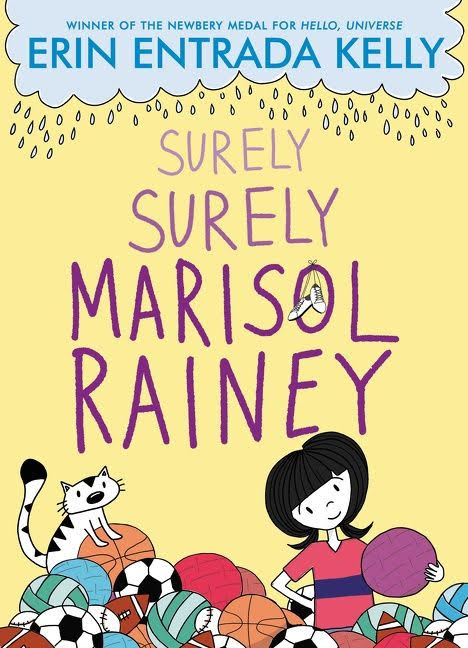
About the Book: Everyone loves sports . . . except Marisol! The stand-alone companion to Newbery Medal winner and New York Times-bestselling Erin Entrada Kelly’s Maybe Maybe Marisol Rainey is an irresistible and humorous story about friendship, family, and fitting in. Fans of Clementine, Billy Miller Makes a Wish, and Ramona the Pest will find a new friend in Marisol.

Marisol Rainey’s two least-favorite things are radishes and gym class. She avoids radishes with very little trouble, but gym is another story–especially when Coach Decker announces that they will be learning to play kickball.

There are so many things that can go wrong in kickball. What if Marisol tries to kick the ball . . . but falls down? What if she tries to catch the ball and gets smacked in the nose? What if she’s the worst kickballer in the history of kickball? Marisol and her best friend Jada decide to get help from the most unlikely–and most annoying–athlete in the world: Marisol’s big brother, Oz.

Told in short chapters with illustrations by the author on almost every page, Erin Entrada Kelly’s stand-alone companion novel to Maybe Maybe Marisol Rainey celebrates the small but mighty Marisol, the joys of friendship, the power of being different, and the triumph of persevering.

About the Author: New York Times–bestselling author Erin Entrada Kelly was awarded the Newbery Medal for Hello, Universe and a Newbery Honor for We Dream of Space. She grew up in Lake Charles, Louisiana, and now lives in Delaware. She is a professor of children’s literature in the graduate fiction and publishing programs at Rosemont College, where she earned her MFA, and is on the faculty at Hamline University. Her short fiction has been nominated for the Philippines Free Press Literary Award for Short Fiction and the Pushcart Prize. Erin Entrada Kelly’s debut novel, Blackbird Fly, was a Kirkus Best Book, a School Library Journal Best Book, an ALSC Notable Book, and an Asian/Pacific American Literature Honor Book. She is also the author of The Land of Forgotten Girls, winner of the Asian/Pacific American Award for Literature; You Go First, a Spring 2018 Indie Next Pick; Lalani of the Distant Sea, an Indie Next Pick; and Maybe Maybe Marisol Rainey which she also illustrated.

Thank you, Erin, for this reminder to allow kids to write freely!

Guest Review: A Butterfly is Patient by Dianna Hutts Aston, Illustrated by Sylvia Long

Share

Guest Reviewer: Natalia, UCF Elementary Education Student

A Butterfly is Patient
Author: Dianna Hutts Aston
Illustrator: Sylvia Long
Published May 18th, 2011 by Chronicle Books

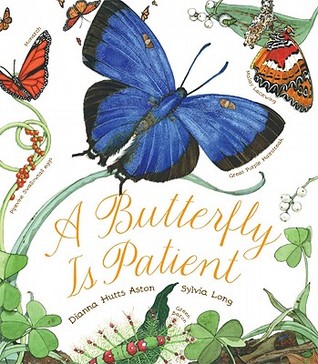
Summary: The creators of the award-winning An Egg Is Quiet and A Seed Is Sleepy have teamed up again to create this gorgeous and informative introduction to the world of butterflies. From iridescent blue swallowtails and brilliant orange monarchs to the worlds tiniest butterfly (Western Pygmy Blue) and the largest (Queen Alexandra’s Birdwing), an incredible variety of butterflies are celebrated here in all of their beauty and wonder. Perfect for a child’s bedroom bookshelf or for a classroom reading circle!  (Summary from Goodreads)

About the Creators: 

Dianna Hutts Aston is the author of many books for children and is the founder of the nonprofit foundation for disadvantaged children, The Oz Project. She lives in San Miguel de Allende, Mexico.

Sylvia Long is the illustrator of many best-selling books for children, including Sylvia Long’s Mother Goose and Hush Little Baby. She lives in Scottsdale, Arizona, with her husband and their dogs.

Review: I loved this beautifully illustrated book by Dianna Hutts Aston and Sylvia Long!  There is a wide variety of butterflies depicted in this nonfiction picture book about the life cycle and anatomy of butterflies.  Not only can it be enjoyed for its visual aspects, but the descriptive vocabulary shares basic facts about butterflies as well as more unusual information.  Did you know butterflies taste with their feet?  Some butterflies eat plants that are poisonous to their predators when they are caterpillars, so they will be poisonous as adults.  For such a seemingly delicate creature, A Butterfly is Patient shares that butterflies are so much more than they seem.

Teachers’ Tools for Navigation:

In addition to providing beautiful, life-like illustrations of a variety of butterflies, this nonfiction picture book follows the life cycle of a butterfly.  There are many opportunities to infuse reading, ELA, math, art, and science and more using this book.  There is a rich descriptive vocabulary and uses key terms like anatomy, metamorphosis, migration, coloration/camouflage, and more.  I can see using these words cross-curricular lessons, from an ELA-based writing exercise to science-based compare/contrast activity with other animals and insects.  Math and geography activities can be used to calculate and track the migratory paths that different species of butterflies travel in their lifetimes.  Take it a step further, compare/contrast how many hours/days/weeks that would take a person using different modes of transportation.  Students can use what they have learned about butterfly camouflage and anatomy, to create their own butterfly.  They can describe why they chose the colors and features, then use art supplies to create a painting, drawing, or model of their “newly discovered” species.

Something I love to do with my children and students, is purchase milkweed plants.  They attract Monarch Butterflies.  Sometimes the plants already have tiny eggs or caterpillars living on them.  Other times, if I wait long enough, Monarchs will lay eggs on my plants.  We love to watch the caterpillars grow from teeny tiny slivers, to thick, fat caterpillars, which in turn, change into gorgeous jade chrysalis.  If we are lucky enough, we get to see the butterfly when it hatches.  There are butterfly net cages you can use in the classroom or just keep the plants outdoors if there is a safe place.  Students can track the growth and changes throughout the process with drawings and/or written descriptions.

Discussion Questions: 

  • Why does a butterfly lay its egg under a leaf?
  • What does it mean to “molt?”
  • What is “metamorphosis?”
  • How does a caterpillar protect itself during metamorphosis?
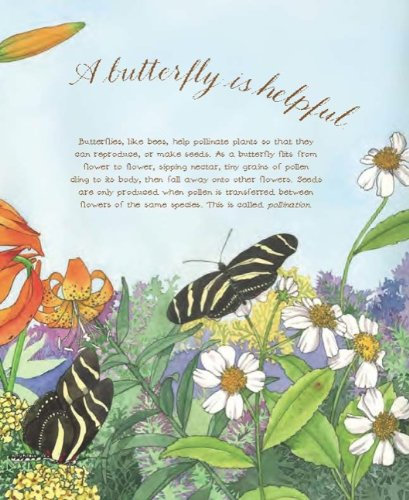
  • How do butterflies help pollinate flowers?
  • What are some ways that butterflies use their wings to protect themselves?
  • How does a butterfly use its probiscis?
  • Are butterflies all the same size?
  • What would happen if a butterfly didn’t have scales?
  • How are butterflies’ scales helpful to them?
  • Where do Monarch butterflies migrate to and from?

Flagged Passages: 

Read This If You Love: The Very Hungry Caterpillar by Eric Carle

Recommended For: 

classroomlibrarybuttonsmall

Thank you, Natalia, for your review!

Author Guest Post: “Five Tips to Excite Students About Writing” by Laurel Solorzano, Author of The Land of Fake Believe

Share

“Five Tips to Excite Students About Writing”

One of the most difficult parts of teaching writing is convincing all students to be involved in the various activities. Some of my students have reached the end of the writing period with NOTHING on their paper. How many distractions could they possibly have had? These five tips should help you get those students not only involved but excited to tell their story.

Tip #1

Allow Alternative Ways to Tell Their Story. Most of the time, my students who have trouble putting words on paper are the ones who talk. Everyone else may be working quietly, but they are talking- to me, to the other students, to themselves. It doesn’t matter if anyone is responding or not, their mouths are moving.

One way I’ve been able to get these students involved is by using a recording device (a phone or an app on a tablet works well). I move them out into the hall and have them record themselves telling their story or answering the prompt. I usually tell them that they have two minutes to record it (any longer than that, and transcription takes a while).

They LOVE doing this, because they can talk and avoid writing for a few minutes with the teacher’s permission!

Once they’ve recorded themselves, depending on the student’s age, I can either use an online program to transcribe it for them (I then have them read what they “wrote” and fix the errors), OR I’ll have them transcribe it themselves.

Tip #2

SHARE their writing. Some of my students have disliked writing because they don’t get the chance to talk/share with their classmates. They prefer to tell the story out loud rather than write it down and pass it to me.

Whenever I’ve given them the chance to read their story/writing out loud, then they get more excited about writing it. They can’t wait to make their classmates laugh!

I give other students the chance to share too, but don’t force it on the quieter ones who already enjoy the writing.

Tip #3

Give them creative freedom. While mentor texts or examples that students can follow is helpful for SOME students, it can make others struggle. How can they make their writing sound like that writing? They become overwhelmed trying to make it perfect, so they either don’t try at all or copy the example writing and just change a word or two.

For example, if you give them the topic of writing about a favorite memory, then give them subject examples, but not paragraph examples. “Did you ever receive a special Christmas or birthday present? What made it special? Where have you gone that you really enjoyed? The zoo, amusement park?” This can get their ideas pumping without feeling like they have to churn out a perfect paragraph.

Tip #4

Don’t compare writing. You probably already know this, and you wouldn’t do it on purpose. However, sometimes, comments slip out accidentally. “Wow! Did everyone see what a great paragraph Johnny wrote?” or maybe even something that you think is more subtle because you are just speaking to the student. “Johnny, that was really great. I don’t know how you do it!”

Written feedback helps avoid this comparison. I always write one thing each student did well and one thing they can improve. Instead of writing that one student needs to fix their verb tenses and their quotation marks, indent their paragraphs, not use fragments, and. . . well, you get the idea. That would be overwhelming as an adult.

Pick one, concrete thing that they can improve, and write that one. For example, “Don’t start sentences with ‘and’” or “Use an apostrophe to show possession.” That way, they can improve and not be overwhelmed.

Tip #5

Connect reading and writing. A lot of students who don’t necessarily enjoy writing do enjoy listening to stories. Even when students can read on their own, they aren’t too old to be read to as well.

Once they have a story in their head, writing prompts related to the story can turn on their creativity.

Read-aloud continues in my classroom even through fifth grade, which is why I love picking stories that are fun not only for the kids but for me to read year after year as well. Check out my book below for a fun classroom read!

Fun Writing Ideas

Now that you have some ideas about how to involve the non-writers in writing time, here are some prompts to use in your class.

  • If you could meet one fairy tale character, who would it be? What would happen when you meet them?
  • (After reading a book or part of a book together) What do you think should happen in the next chapter?
  • Pick one notoriously bad guy (the Joker, the Big Bad Wolf, or Maleficent for example) and write about them as if they were good.

Published September 1st, 2022

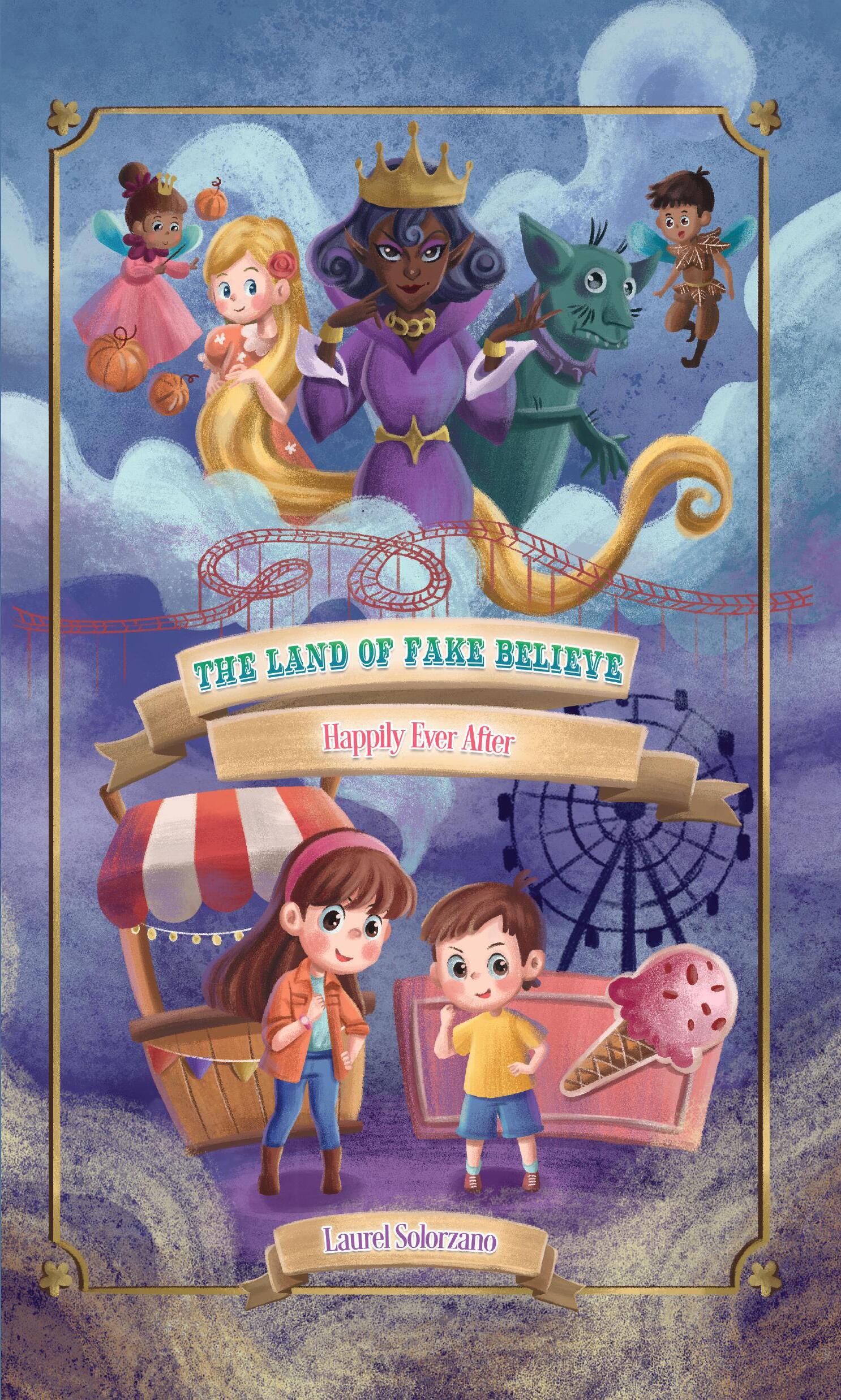
About the Book: The Land of Fake Believe is a twisted fairy tale about two siblings and their fateful encounter with real amusement park characters. It is geared to children ages eight to twelve, but can be read aloud to younger children.

In this fractured fairy tale story, twelve-year-old Taylan is angry when her mom scolds her for telling her five-year-old sister, Judy, that Cinderella isn’t real, just as the little girl is about to meet her favorite princess at the famed Happily Ever After amusement park. Relegated to their vacation hotel room for the evening as a punishment, Taylan enlists the help of her ten-year-old brother, Colby, to prove her mom wrong. What they discover in the park after dark is beyond their wildest dreams—or nightmares.

Soon, the siblings find themselves in the middle of a secret century-long battle among the park’s characters—the good Ever Afters and the dark Ever Afters—and are in a race to help their new friends before the Evil Queen takes over the park for good. With Beauty, Cindy, and Peter Pan on their side, will they be able to survive the conflict before it’s too late?

Fun activities after reading the book including a coloring sheet, quiz, and maze: https://www.laurelsolorzano.com/activities

About the Author: Children’s book author Laurel Solorzano has been creating stories since she first learned how to write, completing her first full-length novel while in middle school. Her love for fairy tales is what inspired her to write The Land of Fake Believe.

Hailing from Raleigh, North Carolina, where she lives with her husband, Yader, Laurel is a Spanish and English teacher. When she’s not penning creative stories for young readers, Laurel enjoys reading and spending time with her two dogs. Also the published author of five young adult books, Laurel’s book The Land of Fake Believe is the debut book in a series of twisted fairy tales including book 2-Once Upon a Climb and book 3- The Princess and the Key.

Author Q&A can be seen here. https://www.laurelsolorzano.com/about

Facebook- https://www.facebook.com/laurelsbooks

Signing up for her newsletter on her website is the best way to stay connected!

Thank you, Laurel, for these amazing engaging tips!

Guest Post: Classroom Uses for New Kid by Jerry Craft, Other Words for Home by Jasmine Warga, Stella Díaz Has Something to Say by Angela Dominguez, and From the Desk of Zoe Washington by Janae Marks

Share

One of the assignments during my Spring Children’s Literature course at UCF was creating a mini-teaching guide for the books we read for book clubs. We started with picture books for practice then students created them in their book clubs each week. The course was structured by genre as were the book clubs.

Today, I am happy to share the classroom uses and discussion questions found by my UCF Elementary Education students about these realistic fiction books.
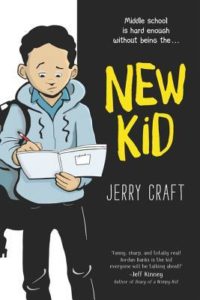
New Kid
Author: Jerry Craft
Published February 5th, 2019 by Quill Tree Books

Summary: A graphic novel about starting over at a new school where diversity is low and the struggle to fit in is real.

Seventh grader Jordan Banks loves nothing more than drawing cartoons about his life. But instead of sending him to the art school of his dreams, his parents enroll him in a prestigious private school known for its academics, where Jordan is one of the few kids of color in his entire grade.

As he makes the daily trip from his Washington Heights apartment to the upscale Riverdale Academy Day School, Jordan soon finds himself torn between two worlds—and not really fitting into either one. Can Jordan learn to navigate his new school culture while keeping his neighborhood friends and staying true to himself?

Teachers’ Tools for Navigation: You can cover social topics like: Inclusion for BIPOC students and new kids, microaggressions, and stereotyping. If you have a new student in the class, maybe they could read and relate to this book. How to like the way Liam treated Jordan. Maybe you could also use Andy as an example of how not to treat others, since he is the antagonist of the story. Jordan also learned throughout the book how to be more confident, outspoken, stand up for others (telling the teacher that Andy was in the wrong over Drew in the lunch room scene), and how to be a bigger person (Jordan signing Andy’s yearbook at the end of the year).

Some topics for navigation would be using this text to discuss family dynamics and friendships. It would be great to also bring up the topic of diversity, bullying, and respect in the classrooms. Most of the characters in the book have some kind of conflict going on. Draw these conflicts to the students as some of these conflicts may mirror conflicts they could be personally dealing with. Open up the discussion for them to make connections to the story and its characters. Have the students discuss in what ways the conflicts in the book are fueled by social, racial, economic, and cultural differences? Using the book, have students do some freewriting about how to navigate through their emotions, just as Jordan found a way to cope. Teachers can also use the book to have students explore the ways the neighborhood Jordan speaks about is portrayed in the illustrations and words. They can investigate Washington Heights where Jordan and his family live and discuss how or why Jordan would camouflage.

Interdisciplinary options:

  • Geography: have students work with maps and have them draw a way that Jordan would have gone to school every day on the bus.
  • History: teach about how diversity is viewed now vs what it was in the past and why it is important to have it within our school and classroom.
  • Art: Jordan has great drawing skills and he loves to draw about what is going on in his life, maybe the students could try to draw what there day/week has looked like.

Discussion Questions: 

  • Which of the many pressures that Jordan faced can you relate to the most?
  • How do you handle having a new kid at your school?
  • How does Jordan handle the impacts of race on his friendships?
  • Which character in the book do you identify with the most? Why?
  • Why do you think Jordan saying something when the altercation between Drew and Andy happened, made others step up to report the truth, too?
  • Jordan states that when he has to ride the bus to school he has to be like a chameleon. In your own words, explain what this simile means.
  • In your own opinion, explain why you think the teacher keeps calling Jordan by the wrong name.
  • If you were a character in this book, who would you be and why?
  • Why do you think Jordan at the end of the book decided to write in Andy’s yearbook?
  • Have you ever lost touch with a friend after moving? Why do you think that happens?
  • Have you ever been the new kid? What was that like?
  • How would you have handled the situation like Jordan where the teacher had his notebook? And why?
  • Do you think that Jordan Moving helped develop his character in the book? Why?
  • Why do you think Drew reacted upset towards his teacher calling him Deandre?
  • Write about a time that you didn’t fit in. What happened? How did this make you feel? Did anyone notice and include you?
  • How do you handle having a new kid at your school? Classroom?

Recommended For: 

classroomlibrarybuttonsmall


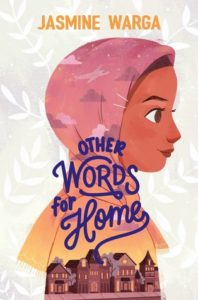
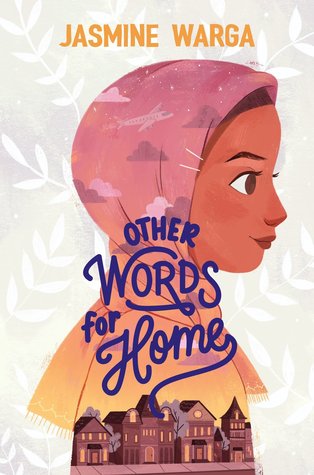
Other Words for Home
Author: Jasmine Warga
Published May 7th, 2019 by Balzer + Bray

Summary: I am learning how to be
sad
and happy
at the same time.

Jude never thought she’d be leaving her beloved older brother and father behind, all the way across the ocean in Syria. But when things in her hometown start becoming volatile, Jude and her mother are sent to live in Cincinnati with relatives.

At first, everything in America seems too fast and too loud. The American movies that Jude has always loved haven’t quite prepared her for starting school in the US—and her new label of “Middle Eastern,” an identity she’s never known before. But this life also brings unexpected surprises—there are new friends, a whole new family, and a school musical that Jude might just try out for. Maybe America, too, is a place where Jude can be seen as she really is.

Teachers’ Tools for Navigation: This book does a great job of taking a situation that is happening in the world and putting it into context in a way that resonates with students as is easy to understand.

A great activity for this book would be “Webbing what’s on my mind.” Students would take moments to write down key concepts throughout the book and talk about how they feel about the themes and issues that they read about. This will also give students time to research issues in the book, research it and then reflect. This will allow students to easily see key concepts in the books and compare their thoughts to the thoughts of their peers. This will allow a group discussion on key elements throughout the story.

Interdisciplinary opportunities:

Social Studies- Students will take this book as an opportunity to research about different countries and cultures to learn more about the characters and what they have gone through. This will also allow the students to understand the differences between the United States and Syria and the changes that Jude went through in the book.

Outreach/Humanitarian Aid- Students can learn about different organizations within their community and learn how to help those around them. Students can participate in drives to help refugees and those displaced by conflict.

Discussion Questions: 

  • Put yourself in Judes shoes. How would you have felt if you had to move across the country and leave your loved ones behind?
  • How does Baba feel when Mama and Jude say goodbye? Provide some examples from the book.
  • Why does Issa believe that he should protest?
  • Whose side do you understand more, the brothers or the parents?
  • Why did Jude have to move away?
  • How did Jude’s relationships with the other ELL students affect her confidence in school?
  • How did Mama and Jude first describe Cincinnati when they landed?
  • How did people treat Layla and Jude differently as one was born in America and spoke fluent English while the other struggled communicating and was seen as more of an outsider?
  • How did the behavior of those around Jude change after she began wearing a hijab. What evidence supports this?
  • The first time Jude is reminded of home in the US iis when she enters Layla’s family restaurant. How does this affect her relationship with Layla and her comfort level within Layla’s restaurant.

Recommended For: 

classroomlibrarybuttonsmall


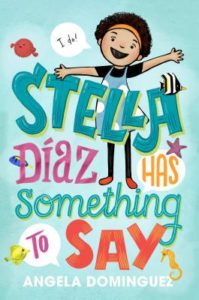
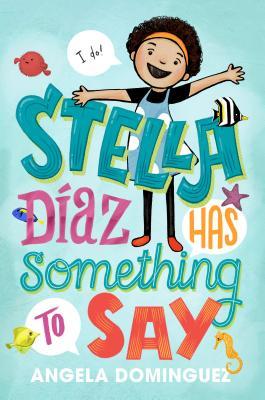
Stella Díaz Has Something to Say
Author: Angela Dominguez
Published January 16th, 2018 by Roaring Brook Press

Summary: In her first middle-grade novel, award-winning picture book author and illustrator Angela Dominguez tells a heartwarming story based on her own experiences growing up Mexican-American.

Stella Díaz loves marine animals, especially her betta fish, Pancho. But Stella Díaz is not a betta fish. Betta fish like to be alone, while Stella loves spending time with her mom and brother and her best friend Jenny. Trouble is, Jenny is in another class this year, and Stella feels very lonely.

When a new boy arrives in Stella’s class, she really wants to be his friend, but sometimes Stella accidentally speaks Spanish instead of English and pronounces words wrong, which makes her turn roja. Plus, she has to speak in front of her whole class for a big presentation at school! But she better get over her fears soon, because Stella Díaz has something to say!

Stella Díaz Has Something to Say introduces an infectiously charming new character with relatable writing and adorable black-and-white art throughout. Simple Spanish vocabulary is also integrated within the text, providing a bilingual element.

Teachers’ Tools for Navigation: This book would be useful by helping students know that they can overcome the fear of speaking and sharing  opinions, beliefs or ideas to other people, even if it means that those opinions may be different from other people. It also has bilingual opportunities!

Discussion Questions: 

  • Have you ever been the new students at school, if you have, how did you begin to make friends? If you haven’t, did you still feel nervous on your first day, why or why not?
  • If you moved to a different state and had to introduce yourself to the class, what would you say? Would you bring gifts for your classmates?
  • Do you think it’s an important best friend rule to match one another and no one else or do you think Stella was being over-protective of her best friend?
  • List some questions you would ask a new classmate to get to know them. What would you share with a classmate for them to get to know you?
  • How does Jenny suggest Stella start conversations with people? Do you think it is good advice?
  • Why do you think Stella doesn’t let people see her artwork until it’s perfect?
  • Why do you think Stella was afraid of speaking in public?
  • How did the spelling bee or marine report help Stella overcome her fear of speaking in public? What has helped you overcome the fear of speaking in public?
  • Stella and her family celebrate the new year with a trip to Wisconsin, how does your family celebrate special occasions or holidays?

Recommended For: 

classroomlibrarybuttonsmall


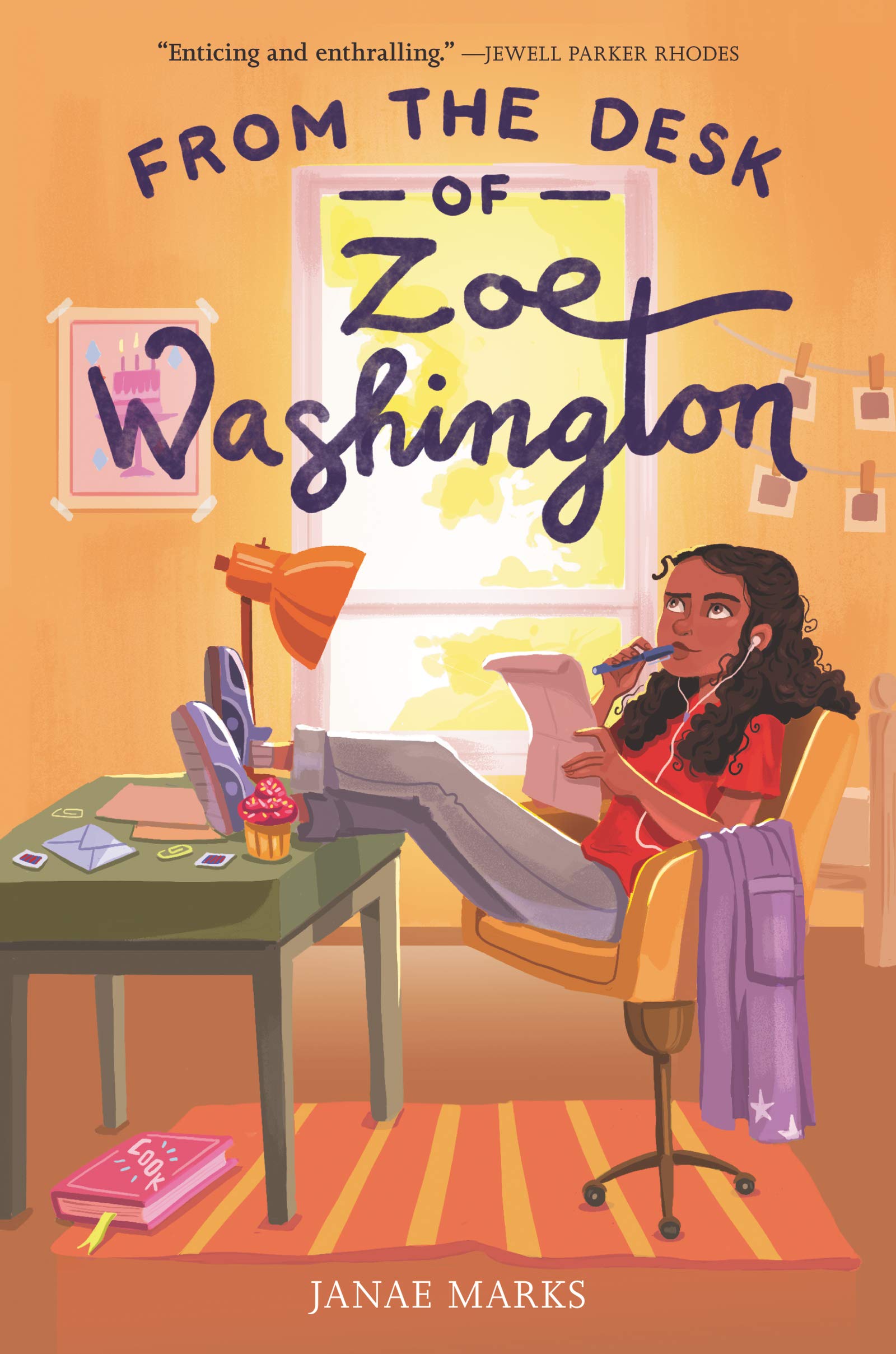
From the Desk of Zoe Washington
Author: Janae Marks
Published January 14th, 2020 by Katherine Tegen Books

Summary: Zoe Washington isn’t sure what to write. What does a girl say to the father she’s never met, hadn’t heard from until his letter arrived on her twelfth birthday, and who’s been in prison for a terrible crime?

A crime he says he never committed.

Could Marcus really be innocent? Zoe is determined to uncover the truth. Even if it means hiding his letters and her investigation from the rest of her family. Everyone else thinks Zoe’s worrying about doing a good job at her bakery internship and proving to her parents that she’s worthy of auditioning for Food Network’s Kids Bake Challenge.

But with bakery confections on one part of her mind, and Marcus’s conviction weighing heavily on the other, this is one recipe Zoe doesn’t know how to balance. The only thing she knows to be true: Everyone lies.

Teachers’ Tools for Navigation: This book is AMAZING, and is recommended for all to young readers to dive in. This story is also relatable and a lot of young readers can relate to this story and have a special bond with this book. This story also teaches the lesson to fight for what you believe in which is a great lesson to teach students.

This book would be useful to teach kids to fight for what they believe in. Even though Zoe didn’t know her father, she still fought to prove his innocence and was willing to uncover hard truths.

A great tool to use for this story is chronological order journals and open discussions. This book talks about a tough topic that may be hard for other students and this would be the perfect opportunity for teachers to connect with students and have an honest discussion about how the book makes them feel, what they think, and if they are open to sharing stories. You can also have a “mailbox” where students can send you mail and let them know that whatever mail  they send is only for your eyes, if they are uncomfortable with the conversation.

Discussion Questions: 

  • What is the theme of the book from the desk of Zoe Washington?
  • Describe where “From The Desk of Zoe Washington” take place.
  • How did the letter’s in the novel make you feel while reading the book?
  • What would you have done in Zoe’s  mother’s shoes? Why? What about other characters?
  • How do you think Zoe’s grandmother handles the situation?
  • Why do you think Zoe was so eager to rebuild her friendship with Trevor after he found out about Marcus?
  • Describe your favorite scene in the book and the way you imagined it while reading.
  • Why do you think it was so important for Zoe to build a relationship with his biological father?
  • Describe the conflicts that came up in Zoe and her mothers relationship when Zoe found the letter on her 12th birthday.

Recommended For: 

classroomlibrarybuttonsmall


Guest Post: Classroom Uses for Jo Jo Makoons by Dawn Quigley, Length of a String by Elissa Brent Weissman, Melissa by Alex Gino, and Merci Suarez Changes Gears by Meg Medina

Share

One of the assignments during my Spring Children’s Literature course at UCF was creating a mini-teaching guide for the books we read for book clubs. We started with picture books for practice then students created them in their book clubs each week.

Today, I am happy to share the classroom uses and discussion questions found by my UCF Elementary Education students about these realistic fiction books.

Jo Jo Makoons: The Used-to-be Best Friend
Author: Dawn Quigley
Illustrator: Tara Audibert
Published May 11th, 2021 by Heartdrum

Summary: Hello/Boozhoo—meet Jo Jo Makoons, a spunky young Ojibwe girl who loves who she is.

Jo Jo Makoons Azure is a spirited seven-year-old who moves through the world a little differently than anyone else on her Ojibwe reservation. It always seems like her mom, her kokum (grandma), and her teacher have a lot to learn—about how good Jo Jo is at cleaning up, what makes a good rhyme, and what it means to be friendly.

Even though Jo Jo loves her #1 best friend Mimi (who is a cat), she’s worried that she needs to figure out how to make more friends. Because Fern, her best friend at school, may not want to be friends anymore…

Teachers’ Tools for Navigation: This book can be used in the classroom as a tool to show the students that it’s important not to assume what another student is thinking. It is always best to vocalize concerns

Discussion Questions: 

  • Describe what a reservation is according to the book?
  • Why did Kokum (grandma) move in with Jo Jo and her mom?
  • In what ways are cats and balloons different?
  • Why did Jo Jo Makoons cut the toes out of her socks? What did she do with them?
  • What happens when Jo Jo takes Mimi to school?
  • What did the new girl, Susan do when she saw Mimi in the classroom?  How did JoJo feel about Susan’s reaction?
  • What are some ways you may relate to Jo Jo?
  • Has anybody ever felt like they might lose their best friend? Why?
  • How do Jo Jo’s classmates help her see that they are friends at the end of the story.
  • What does it mean to be a good friend to you?
  • What are some positive traits we could learn from Jo Jo?
  • In the Book Jo Jo cut out the toes in her socks. Why did she do this?
  • Why do you feel that Jo Jo felt left out at school?
  • Why was it so important for Jo Jo to bring MiMi to school with her?
  • What ways could JoJo have approached her classmates at lunch before getting upset about eating alone?
  • Why do you feel it’s important for Jo Jo and her family to learn and know the language of her Ojibwe tribe?
  • What could JoJo have done better for her original rhyme to make it better?
  • Like Jo Jo if you had to bring your best friend to class with you, who would it be and why?
  • How did you feel about the nickname Jo Jo made for Chuck?
  • Why do you think Jo Jo thought the Gym teacher’s name was Jim?

Recommended For: 

classroomlibrarybuttonsmall


The Length of a String
Author: Elissa Brent Weissman
Published May 1st, 2018 by Dial Books

Summary: Imani is adopted, and she’s ready to search for her birthparents. But when she discovers the diary her Jewish great-grandmother wrote chronicling her escape from Holocaust-era Europe, Imani begins to see family in a new way.

Imani knows exactly what she wants as her big bat mitzvah gift: to meet her birthparents. She loves her family and her Jewish community in Baltimore, but she has always wondered where she came from, especially since she’s black and almost everyone she knows is white. When her mom’s grandmother–Imani’s great-grandma Anna–passes away, Imani discovers an old diary among her books. It’s Anna’s diary from 1941, the year she was twelve–the year she fled Nazi-occupied Luxembourg alone, sent by her parents to seek refuge in Brooklyn. Written as a series of letters to the twin sister she had to leave behind, Anna’s diary records her journey to America and her new life with an adopted family. Anna’s diary and Imani’s birthparent search intertwine to tell the story of two girls, each searching for family and identity in her own time and in her own way.

Teachers’ Tools for Navigation: Use this book to discuss and learn about History-World War II/Holocaust, the Jewish faith, and adoption.

This book is educational because it discusses the Holocaust from the point of view of someone who experienced it. It also has an engaging story line that makes readers want to read more to find out what will happen. This book would be very useful when teaching about the Holocaust.

Discussion Questions: 

  • How do you think Imani felt when she started to read about Anna’s life in her diary?
  • Think of a time you felt out of place and write about how that made you feel.
  • Why do you think Imani’s mom cries so much?
  • Have you ever felt a special connection with someone in you family?
  • If you were Imani, would you continue to look for your birth parents?
  • Suppose you wrote a diary about something that you want people/family in the future to know. What would it be about and why?
  • What are some special celebrations that you do with your family?
  • If you were Imani’s friend, what advice would you give her as she goes through this journey?
  • What is something you have that is special that you think you will give to someone in the future?
  • Why do you think people living around Imani insensitive questions?

Recommended For: 

classroomlibrarybuttonsmall


Melissa
Author: Alex Gino
Published August 25th, 2018 by Scholastic

Summary: When people look at George, they think they see a boy. But she knows she’s not a boy. She knows she’s a girl.

George thinks she’ll have to keep this a secret forever. Then her teacher announces that their class play is going to be Charlotte’s Web. George really, really, REALLY wants to play Charlotte. But the teacher says she can’t even try out for the part . . . because she’s a boy.

With the help of her best friend, Kelly, George comes up with a plan. Not just so she can be Charlotte — but so everyone can know who she is, once and for all.

Teachers’ Tools for Navigation: This story is a good teachable book where certain themes can be brought up and talked about within the classroom setting. Where students can ask questions that may push boundaries but can be answered in a professional setting. This novel would be useful in the classroom to teach and promote gender diversity. This book would also be great as a classroom library so that students who may be facing these issues will have something relatable to read.

Discussion Questions: 

  • Identify some ways Melissa being trans affected their life.
  • Think about a moment when someone in the book was bullied. What could have been done differently?
  • Why do you think Melissa was so scared to tell her parents about who she is?
  • What does it mean to be an Ally?
  • Describe two ways someone else helped Melissa.
  • Describe Melissa’s disposition throughout the book. How did it change?
  • Do you think that it was a good idea to talk to a therapist about the issues between Melissa and her mom?
  • Write about a time you felt scared to tell someone the truth.
  • If you were in Melissa’s class what would you do to make her feel welcome?
  • Sketch a scene from the book. Why did you pick that scene?
  • Why do you think the author chose to use the pronoun “she” when describing or referring to George?  Does this make a difference to the way you feel about the character?
  • How do you think George feels having to keep this big secret inside?  (Use text evidence to support your claims.)  Have you had to keep a secret about yourself — how does this make you feel?  Without revealing the secret (unless you feel comfortable), share or write about this experience and how you were affected.
  • George eventually reveals her secret to those she cares about.  How does this make her feel?  (Use text evidence to support your claims.)  What are some consequences of “hiding” vs. “being yourself”?
  • What do you think it takes to “be yourself”? What are some pros and cons of being who you are?  What are some other examples of “being yourself” that might be scary for kid?
  • Share or write about a time where you had to be brave enough to be who you are.  What made you finally do it, and what effects did the experience have on your life?
  • People reacted differently to George’s revelation. Discuss how they differed and possible reasons why (try to think about this from the person’s point of view).  How do you think you would react if you were each of these individuals?
    1. Classmates
    2. George’s mom and big brother
    3. School teacher/principal
    4. George’s best friend Kelly
    5. Kelly’s dad and uncle
  • Discuss diversity, acceptance/tolerance, prejudice, bullying, compassion, etc.  Come up with real-life examples. What are some way your classroom/school/family/community could be more accepting of those who might be different from you?
  • Towards the end of the book, the author switches to the name Melissa when referring to George.  Why do you think they chose to do that?
  • How does Melissa feel in the first few chapters of the book?
  • How does Melissa feel at the end of the book?
  • Why did Ms.Udell not let Melissa play Charlotte?
  • Have you ever felt lost or scared to tell the truth? If so, how did that make you feel?
  • If Melissa was in your class, what are some ways you could make her feel welcomed?
  • Name a few things that Melissa had to struggle with, because she wanted to be trans.

Recommended For: 
classroomlibrarybuttonsmall


Merci Suárez Changes Gears
Author: Meg Medina
Published September 11th, 2018 by Candlewick Press

Summary: Thoughtful, strong-willed sixth-grader Merci Suarez navigates difficult changes with friends, family, and everyone in between in a resonant new novel from Meg Medina.

Merci Suarez knew that sixth grade would be different, but she had no idea just how different. For starters, Merci has never been like the other kids at her private school in Florida, because she and her older brother, Roli, are scholarship students. They don’t have a big house or a fancy boat, and they have to do extra community service to make up for their free tuition. So when bossy Edna Santos sets her sights on the new boy who happens to be Merci’s school-assigned Sunshine Buddy, Merci becomes the target of Edna’s jealousy. Things aren’t going well at home, either: Merci’s grandfather and most trusted ally, Lolo, has been acting strangely lately — forgetting important things, falling from his bike, and getting angry over nothing. No one in her family will tell Merci what’s going on, so she’s left to her own worries, while also feeling all on her own at school. In a coming-of-age tale full of humor and wisdom, award-winning author Meg Medina gets to the heart of the confusion and constant change that defines middle school — and the steadfast connection that defines family.

Teachers’ Tools for Navigation: This book would be useful in a classroom for teachers to expose a lot of topics to students such as bullying, family relations, and relatable school interactions like wanting to play sports or friendships and grades. As well as students that are nervous about their 6th grade year or also starting sixth grade read about someone going through the same things as them.

Discussion Questions: 

  • What do you think caused Lolo to pick up the wrong twins?
  • Why do you think Merci and Edna are not friends?
  • Why do you think Edna is worried about appearances and mercy is not?
  • After their first interaction, do you think Merci will end up enjoying Michael as a sunshine buddy?
  • If you were a new kid would you want a sunshine buddy? Would you want to be a sunshine buddy? Why or why not?
  • Do you think Merci handled her situations maturely? Why or why not ?
  • Why did Merci’s parents hide Lolo’s conditions from her ?
  • How would you describe Merci’s relationship with her grandfather?
  • Do you think Merci’s culture made her feel different from her peers at school ? Why or Why not ?
  • How would you handle being falsely accused of something you didn’t do like Merci when edna destroyed the mask ?

Recommended For: 
classroomlibrarybuttonsmall


Author Guest Post: “In Praise of the Standalone Book” by Stacy Nockowitz, Author of The Prince of Steel Pier

Share

“In Praise of the Standalone Book”

In 2010, I switched careers. I had been a middle school language arts teacher for many years, and I decided it was time for a change. So, I became a school librarian. It’s the perfect career for someone who loves kids, books, and kids’ books. It’s also a great job choice for someone who doesn’t want to grade even one more essay written by a 12-year-old. And because of this shift to the library, I was able to pursue my lifelong dream of writing books. The Prince of Steel Pier is my debut novel.

You know which parts of my job I love the most? First, I thoroughly enjoy matching students with the perfect book for them. This process is called Readers’ Advisory in librarian lingo. It’s a mini-interview and discussion that helps the librarian connect readers with great book choices specific to their likes and needs. I start off every Readers’ Advisory by asking what I think is the most telling question: What’s the last book you read that you really loved?

The other best part of my job? Filling the shelves! I get to order ALL the books and materials. It’s like a childhood fantasy come true! Yes, I’ll order that one and that one, and oh, I have to get the new book by that author, and I must order that one. It’ll fly off the shelves! Between being a middle school librarian and being a children’s book author, I know what kids like.

And what they like is a long book series. They like getting comfortable with a set of characters and reading about those characters again and again and again. Investing time and emotion in a new protagonist is hard! The path of least resistance, which, honestly, kids are prone to take, means they’ll reach for Diary of a Wimpy Kid #5 and #8 and #16, and on and on. I have reserve lists five-kids deep every time Stuart Gibbs publishes the next Spy School novel. In kids’ minds, long book series rule.

Or do they?

Let’s go back to my Readers’ Advisory opening question: What’s the last book you read that you really loved? Last year, I received an answer from a sixth grader that caught me off guard in the best way. She said, “The last book I really loved was A Night Divided by Jennifer Nielsen. I don’t really want to read another series. After, like, the third book, they all get repetitive and boring.”

I wanted to hug her when she said that.

Stand-alone books make me smile. And as a writer, I understand how difficult a great stand-alone is to pull off. Stand-alone books do all their own heavy lifting. They work their 250-page tails off (or 350 or 180; you get the idea). The author of a stand-alone knows she only has one shot at capturing her audience. None of this “You’ll find out in book 4 why he and his dad don’t get along” or “It will all make sense once you finish book 7” stuff. Good stand-alone books give readers a satisfying character arc and a complete storyline. A reader can finish the last page of a stand-alone and close the book with a gratified exhale. Nothing more is needed. It’s like leaving the dinner table sated after a delicious meal. Sure, you can raid the fridge for leftovers later, but the experience just isn’t the same, is it?

Historical fiction is especially well-suited for the stand-alone format. Authors of historical fiction evoke a moment in time, the only moment when that story could have happened to that person in that place. Thanhha Lai didn’t need to make Inside Out & Back Again into a six-book series. This National Book Award-winning stand-alone tells us one story: Hà’s story, as her family flees war-torn Vietnam and comes to the United States. There’s no need for us to see what happens to Hà the following year, or the year after that, or the year after that. Inside Out & Back Again beautifully presents the family’s traumas and triumphs of that singular experience. Lai leaves it to us, her readers, to imagine Hà’s future, rather than simply telling us everything that happens to her. That stand-alone novel, that no more-no less story, is enough.

This is exactly what I hope I’ve achieved with The Prince of Steel Pier. The main character, 13-year-old Joey Goodman, doesn’t cease to exist after the last page of the book. I’m sure he goes on to have more adventures and more experiences. But you’ll have to envision them for yourself. Joey’s story from two weeks in August of 1975 stands alone. His moments of happiness and moments of fear, his epiphanies and realizations, can only happen in that one special time in his life. Making my book into an endless series would take away from the power of what Joey learns about himself and his world in The Prince of Steel Pier.

I’m not calling for the abolishment of the long children’s book series. Not at all! Kids need to be able to rely on Percy Jackson getting himself into another mythological mess. They love the continuing escapades of Dogman and The Last Kids on Earth.

But here’s to the stand-alone book, the book that needs no sequels, no books #3-#10. Here’s to a story that thrills kids from its inciting incident all the way through its climax and denouement, and that’s it. Here’s to the books that have no more to say because they’ve said it all, perfectly, the first time around.

Some of my favorite stand-alone middle grade books:

The Magical Imperfect by Chris Baron
Where the Watermelons Grow by Cindy Baldwin
A Place to Hang the Moon by Kate Albus
Alone by Megan Freeman
Orphan Island by Laurel Snyder
Too Bright to See by Kyle Lukoff
When You Reach Me by Rebecca Stead
Red, White, and Whole by Rajani LaRocca
Some Kind of Happiness by Claire Legrand
One Jar of Magic by Corey Ann Haydu

The Prince of Steel Pier
Published September 1st, 2022 by Kar-Ben Publishing

About the Book:

Poor 13-year-old Joey Goodman is not suited for 1975 Atlantic City: he’s anxious, fearful, and prone to puking at any moment. On top of it all, his tight-knit Jewish family babies him more than they do his younger brother! With wanting to prove his mettle top of mind, Joey ends up working for kingpin Artie Bishop, whose gangsters are impressed by how Joey handles thieves who steal his prize tickets. Joey suddenly feels important as he runs around with Artie and his crew – but after a streak of deceiving his loved ones and dangerous jobs that put his family at risk, Joey’s resolve will be put to the test. This adventure-filled middle grade will have young readers relating to Joey as he goes through his fair share of feelings (like a crush!), goons, and finding that his place was with his real family all along.

Advance Praise for THE PRINCE OF STEEL PIER:

  • “What a wonderful book! I loved the sense of atmosphere, all the things that Joey struggles with, and most of all, that big, beautiful family.” —Rajani LaRocca, Newbery Honor-winning author of Red, White, and Whole 
  • “I love the funny voice of Joey/Joseph/Squirt Goodman. (Who wouldn’t fall for a Skeeball champion with a big heart and a nervous stomach?) I was captivated by Joey’s large lovable family and the authentic rendering of the 1970’s Atlantic City setting complete with gangsters, gangster’s daughters, lucky frog fountains, sinister business and mysterious packages. A fun read from start to finish.” —Gennifer Choldenko, Newbery Honor-winning author of the Alcatraz series
  • The Prince of Steel Pier has everything a great book needs: an engaging main character, a blooming crush, page-turning adventure, and a loving, quirky family that owns a hotel on the delightfully nostalgic Atlantic City boardwalk. Oh, and don’t forget to throw in some just-short-of-too-scary gangsters and a huge helping of heart.” —Nora Raleigh Baskin, ALA Schneider Family Book Award–winning author of Anything But Typical

About the Author: Stacy Nockowitz is a middle school librarian and former language arts teacher with more than 25 years of experience in middle school education. Stacy received her BA from Brandeis University and holds Master’s Degrees from Columbia University Teachers College and Kent State University. She is also an MFA candidate in Writing for Children and Young Adults at Vermont College of Fine Arts. Stacy received a PJ Library Writer’s Incentive Award in 2020 for her debut novel THE PRINCE OF STEEL PIER, coming in September 2022 from Kar-Ben Publishing. An unrepentant Jersey Girl, Stacy still teases her hair and uses plenty of spray. When she’s not writing or matching great kids with great books, Stacy can most likely be found reading or rooting on her beloved Philadelphia Eagles. Her kids have flown the coop, so Stacy lives in central Ohio with her husband and their cat, Queen Esther. Find her on Twitter @snockowitz or at www.stacynockowitz.com

Thank you, Stacy, for sharing the joy in the standalone!

Guest Post: Classroom Uses for Front Desk by Kelly Yang, Indian No More by Charlene Willing McManis with Traci Sorell, Lucky Broken Girl by Ruth Behar, Mary and the Trail of Tears by Andrea L. Rogers, and Night Diary by Veera Hiranandani

Share

One of the assignments during my Spring Children’s Literature course at UCF was creating a mini-teaching guide for the books we read for book clubs. We started with picture books for practice then students created them in their book clubs each week.

Today, I am happy to share the classroom uses and discussion questions found by my UCF Elementary Education students for some historical fiction books they read.

Front Desk
Author: Kelly Yang
Published May 29th, 2018 by Arthur A. Levine Books

Summary: Mia Tang has a lot of secrets.

Number 1: She lives in a motel, not a big house. Every day, while her immigrant parents clean the rooms, ten-year-old Mia manages the front desk of the Calivista Motel and tends to its guests.

Number 2: Her parents hide immigrants. And if the mean motel owner, Mr. Yao, finds out they’ve been letting them stay in the empty rooms for free, the Tangs will be doomed.

Number 3: She wants to be a writer. But how can she when her mom thinks she should stick to math because English is not her first language?

It will take all of Mia’s courage, kindness, and hard work to get through this year. Will she be able to hold on to her job, help the immigrants and guests, escape Mr. Yao, and go for her dreams?

Teachers’ Tools for Navigation: This book would be useful in a classroom because it discusses real life topics like immigration, racism, poverty, bullying and even fraud. It gives a message to students on how important it is to fight for what’s right and to learn to treat others with respect, regardless of what they look like. It can be used as a platform for students to discuss issues that they can relate to.

Discussion Questions: 

  • What was Mia’s job at the hotel? What characteristics she have to make her flourish doing that job?
  • Mia’s mom mothers says, were immigrants. Our lives are never fair,” what does she mean by that?
  • How did Mia change and grow throughout the book?
  • Within the book, Mias mother wanted her to practice her math skills despite how Mia felt. Has there ever been a time where you felt like you were in the same position as Mia?
  • Mia and her dad discuss the value of a penny. He says, “A mistake isn’t always a mistake. Sometimes a mistake is actually an opportunity. What does he mean by that?
  • Would you try to help immigrants the same way Mia’s family did or would you try to come up with a different solution? What would you do if you were caught by your employer?
  • If you were part of an immigrant family would you stay to work at this motel or would you leave to try better opportunities? Why would you stay or leave?
  • If you ran a motel how would you handle customers?
  • Do you think Mia’s mother was right to have her focus more on math or should she have been supportive of her daughter’s interest in writing? Why do you think one way or the other.

Recommended For: 
classroomlibrarybuttonsmall


Indian No More
Author: Charlene Willing McManis with Traci Sorell
Published September 24th 2019 by Tu Books

Summary: Regina Petit’s family has always been Umpqua, and living on the Grand Ronde reservation is all ten-year-old Regina has ever known. Her biggest worry is that Sasquatch may actually exist out in the forest. But when the federal government signs a bill into law that says Regina’s tribe no longer exists, Regina becomes “Indian no more” overnight–even though she was given a number by the Bureau of Indian Affairs that counted her as Indian, even though she lives with her tribe and practices tribal customs, and even though her ancestors were Indian for countless generations.

With no good jobs available in Oregon, Regina’s father signs the family up for the Indian Relocation program and moves them to Los Angeles. Regina finds a whole new world in her neighborhood on 58th Place. She’s never met kids of other races, and they’ve never met a real Indian. For the first time in her life, Regina comes face to face with the viciousness of racism, personally and toward her new friends.

Meanwhile, her father believes that if he works hard, their family will be treated just like white Americans. But it’s not that easy. It’s 1957 during the Civil Rights Era. The family struggles without their tribal community and land. At least Regina has her grandmother, Chich, and her stories. At least they are all together.

Teachers’ Tools for Navigation: This book is useful for teaching about the US Government and US History. This book also teaches about how people from diverse identities showed solidarity with each other in the face of white supremacy, which is a core value of US democracy. The book also teaches that one’s identity is personal and they cannot be defined by other people.

Discussion Questions: 

  • Describe the significance of storytelling in Umpqua culture.
  • This book examines how identity is very complicated and mixed but the US government imposes very rigid categories on people. Discuss how the categories the US government attempts to put people in, then and now, can harm people and are inaccurate.
  • Describe the Grande Ronde Reservation from Regina’s point of view, is this different from other depictions of reservations you have seen?
  • What made the Thanksgiving and the Thanksgiving play so hard on Regina and her family?
  • Compare and Contrast the Indian Agency School on Grande Ronde Reservation and Budlong Elementary School in Los Angeles.
  • Reflect on Regina’s first Halloween off the Reservation. What went wrong and how do you think Regina and her friends felt? Think about how it could affect them even after the attack.
  • How did the passing of Chich affect the family? Why do you think Regina’s father reacted the way he did?
  • Regina connects to her culture and identity by storytelling. Write about a significant event that happened to you.
  • How does Regina’s father struggle with his identity after they move to Los Angeles?
  • Within the story Regina Petit called her grandmother and grandfather Chich and Chup. What do you call your grandparents where you’re from? Why do you think it differs from Regina?
  • Within the story, Regina was prideful of her long hair. It represented their culture back home. When Regina’s father cut it off, she was very upset. How do you think you would have reacted if someone took something that means alot in your culture and why?
  • Chich would keep the story of their homeland alive through her story telling. What stories do you have of your own culture that represents you? Why did you chose this?
  • Looking back at the story of the beaver, how can this relate to you in your life?
  • Have you ever experienced/seen someone experience what Regina and her friends did on Halloween? How would you react if you were in this situation? Do you think this was a fair treatment?
  • When Regina and her family wanted to celebrate her father promotion at work, they were denied service due to the color of their skin and appearance. Have you or someone you know experienced not being served at a restaurant just because of your appearance? Do you think this treatment of people of color is correct and just? How would you react if it were you in this very same situation?
  • What did you know about this time period prior to reading this book? Do you believe you learned more about the time period from the book after reading it? What have you learned?
  • How do you think Regina’s life differs from your own life? Do you think the time period has anything to do with that?
  • Have you ever experienced a great loss like Regina and her sister did towards the end of the book? How did you react to it?
  • If there was anything about the events in the book that you would change what would it be? Why did you choose this event to change?

Recommended For: 
classroomlibrarybuttonsmall


Lucky Broken Girl
Author: Ruth Behar
Published April 11th 2017 by Nancy Paulsen Books

Summary: Based on the author’s childhood in the 1960s, a young Cuban-Jewish immigrant girl is adjusting to her new life in New York City when her American dream is suddenly derailed.

Ruthie Mizrahi and her family recently emigrated from Castro’s Cuba to New York City. Just when she’s finally beginning to gain confidence in her mastery of English and enjoying her reign as her neighborhood’s hopscotch queen, a horrific car accident leaves her in a body cast and confined her to her bed for a long recovery. As Ruthie’s world shrinks because of her inability to move, her powers of observation and her heart grow larger. She comes to understand how fragile life is, how vulnerable we all are as human beings, and how friends, neighbors, and the power of the arts can sweeten even the worst of times.

Teachers’ Tools for Navigation: This book would be useful in the classroom for group discussions about overcoming hardships. It is also useful in the classroom to help students who are learning English relate to Ruthie.

This book will be a good choice for a classroom library. This book represents the story of a strong girl living through a difficult time in her life. She had to move to a new country but also had a bad accident that left her physically and emotionally drained. This book can help children learn to face loss and have hope for a better future.

Discussion Questions: 

  • Ruthie faced hardship and she found it difficult to stay positive but her family and friends tried helping in the best way they could. How have your friends and family helped you when facing difficulties?
  • What is the theme of Lucky Broken Girl and how can you relate to the theme?
  • How are characters helping and not helping Ruthie cope during her recovery?
  • Was Chico a good friend to Ruthie? Why? What did he do during Ruthie’s recovery?
  • What did Ruthie learn about the immigration stories of the people around her?
  • Ruthie has been reading a lot during her recovery, especially Nancy Drew. How are these books helping her and encouraging her?
  • How was Ruthie “Lucky” while being bedridden for ten months?
  • What connection can you make with Ruthie or her family?
  • The painting of Frida Kahlo and the poems of Emily Dickerson help Ruthie understand her situation. What poems, books, or artists have helped you through a hard time, and why?

Recommended For: 

classroomlibrarybuttonsmall


Mary and the Trail of Tears: A Cherokee Removal Survival Story
Author: Andrea L. Rogers
Published January 1st 2020 by Stone Arch Books

Summary: Twelve-year-old Mary and her Cherokee family are forced out of their home in Georgia by U.S. soldiers in May 1838. From the beginning of the forced move, Mary and her family are separated from her father. Facing horrors such as internment, violence, disease, and harsh weather, Mary perseveres and helps keep her family and friends together until they can reach the new Cherokee nation in Indian Territory. Featuring nonfiction support material, a glossary, and reader response questions, this Girls Survive story explores the tragedy of forced removals following the Indian Removal Act of 1830.

Teachers’ Tools for Navigation: The story goes into great detail from the time Mary learns what is happening and the journey across the land.  The characters face many different challenges on their journey, and the book does a great job at providing dates and locations.  Also, the drama response of the news reporter would be fun, as it is clear the characters in the story have many opinions and emotions.

This book could also be used as a read-aloud book. It would be great to read a chapter a day as a class, even having children popcorn read paragraphs.  After reading, students can do several different activities about the culture, history, and even character perspectives

Discussion Questions: 

  • In what ways would you try to communicate to the soldiers if you didn’t speak English like Mary.
  • In what ways would you try to comfort your younger family members knowing you had no home to return to?
  • When Mary and her family are trapped in the mud caused by the non-sto prain, they begin to sing a song they all remember. Do you have a song your whole family knows? What song(s) do you sing to make yourself feel better?
  • While reading this book what emotions trigger you the most: sad, happy, confused?
  • In what ways do you relate to Mary?
  • How does not being able to speak the language with the soldiers create a conflict for Mary?
  • We’ve all felt alone at some point whether its been when we lost our mom at the grocery store for a second or what have you, name a similar situation in which you felt alone like Mary. Elaborate.
  • When was there a time where you felt scared like Mary? What did you do to overcome this fear?
  • How do you think that this situation of being forcefully kicked out of your house would play out today because you were of a certain racial group? What would be the effects?
  • Explain a time you cried tears of joy?

Recommended For: 

classroomlibrarybuttonsmall


The Night Diary
Author: Veera Hiranandani
Published March 6th 2018 by Kokila

Summary: It’s 1947, and India, newly independent of British rule, has been separated into two countries: Pakistan and India. The divide has created much tension between Hindus and Muslims, and hundreds of thousands are killed crossing borders.

Half-Muslim, half-Hindu twelve-year-old Nisha doesn’t know where she belongs, or what her country is anymore. When Papa decides it’s too dangerous to stay in what is now Pakistan, Nisha and her family become refugees and embark first by train but later on foot to reach her new home. The journey is long, difficult, and dangerous, and after losing her mother as a baby, Nisha can’t imagine losing her homeland, too. But even if her country has been ripped apart, Nisha still believes in the possibility of putting herself back together.

Told through Nisha’s letters to her mother, The Night Diary is a heartfelt story of one girl’s search for home, for her own identity…and for a hopeful future.

Teachers’ Tools for Navigation: This book can be useful in the classroom when talking about and learning about different cultures around the world. Students will have a better understanding of the differences of two close religions and cultures, as I learned when reading the book.

This book would also be useful when it comes to the topic of World History. After reading this book, students would have had insight to another culture and perspective from a standpoint of someone of a different culture in a different country.

Discussion Questions: 

  • How do you think Nisha felt when she had to move?
  • What do you think you would have done if you or a family member were attacked on a train like Nisha and her family was?
  • Nisha kept a diary, what kind of thing do you think you would put in yours if you had one? Would your diary be similar to Nishas?
  • Do you think Papa made the right decision on moving away? Explain why or why not.
  • Do you think Nisha preferred one religion to the other? Hindu or muslim?
  • Kazi was Nisha’s best friend but she had to leave her behind. Do you think they would still keep in touch if they could?
  • Why do you think there was so much division in India?
  • How did the book make you feel after and during reading? Was it what you expected? Explain.
  • Nisha is half Muslim and half Hindu. Do you only have one religion in your household, or do you come from two like Nisha?
  • How did reading about Nisha’s journey make you feel when she was attacked on the train? What would you do in that situation ?
  • What are two lessons you learned from reading this book that are specific to Nisha’s Journey?
  • Do you think Papa made a good choice by leaving? Why or why not?
  • If you had to be a character from the book, who would you choose? Why?
  • How did moving away affect Nisha?
  • Name one character that contributed to Nisha’s life and journey to find herself.
  • Does anyone have a diary? If so, do you think that you can relate to Nisha because she had one to? Why?
  • Why do you think Papa didn’t want his son to smile in the beginning? What does this say about their culture?
  • Think about your bond with your siblings if you have any. Do you find it to be similar to Nisha and her brothers in any way?
  • When Nisha had to leave Kazi behind she was very sad. Have you ever lost a friend the way Nisha did, if so what was that like ?

Recommended For: 

classroomlibrarybuttonsmall