Last Stop on Market Street by Matt de la Pena

Share

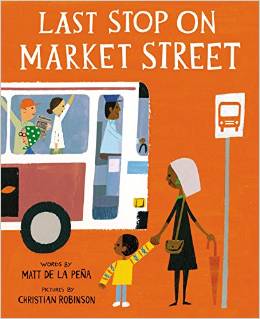
last stop on market street

Last Stop on Market Street
Author: Matt de la Peña
Illustrator: Christian Robinson
Published: January 8, 2015 by Putnam Juvenile

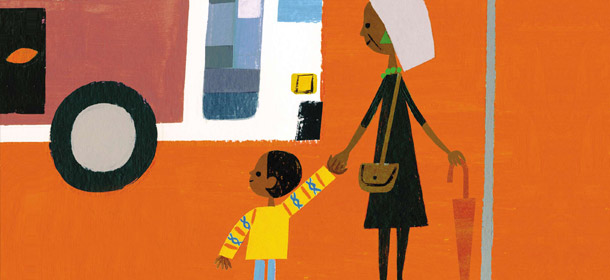
Summary: Every Sunday after church, CJ and his grandma ride the bus across town. But today, CJ wonders why they don’t own a car like his friend Colby. Why doesn’t he have an iPod like the boys on the bus? How come they always have to get off in the dirty part of town? Each question is met with an encouraging answer from grandma, who helps him see the beauty—and fun—in their routine and the world around them.

This energetic ride through a bustling city highlights the wonderful perspective only grandparent and grandchild can share, and comes to life through Matt de la Pena’s vibrant text and Christian Robinson’s radiant illustrations.

Ricki’s Review: Matt de la Peña is a literary genius. I pre-ordered this book because I knew it would be excellent, but the story and illustrations blew me away. CJ wonders why he doesn’t have a car, and Nana reassures him that they are better off without one. They take an adventure on a bus to a soup kitchen. Nana sees the beauty in life, and her words are powerful. This is a story about giving back and appreciating what we have. My son and I have read this book dozens of times since we received it. My mother-in-law and husband also enjoyed reading it with him!

Kellee’s Review: This book is a celebration. A celebration of the little things we sometimes miss, of diversity, of kindness, of family, and of beauty. Matt de la Peña’s story is well written and beautifully illustrated with amazing collages by Christian Robinson. Although I haven’t read it with Trent yet, I feel that this book is an important one for him and all kids to read. 

Teacher’s Tool For Navigation: What a perfect book for a field trip on a bus to the soup kitchen? Students can describe the people and things they see. This would also make a great homework assignment. Alternatively, teachers might ask students to go to a public place with their parents and describe the people and things they see—they should be instructed to find the beautiful things in their environment.

Discussion Questions: What is Nana’s attitude about life? How do her words show this?; What kinds of things does CJ see on his trip?; How do the illustrations make this story stand out?

We Flagged: “The outside air smelled like freedom, but it also smelled like rain, which freckled CJ’s shirt and dripped down his nose.”

From Matt de la Pena’s website


Read This If You Loved:  Nana in the City by Lauren Castillo, Each Kindness by Jacqueline Woodson, A Bus Called Heaven by Bob Graham, Harlem by Walter Dean Myers

Recommended For: 

readaloudbuttonsmall classroomlibrarybuttonsmall 

RickiSig andSignature

**Thank you to Penguin for providing a copy for review**

YALSA Morris Finalists’ Blog Hop: The Carnival at Bray by Jessie Ann Foley

Share

carnival at bray

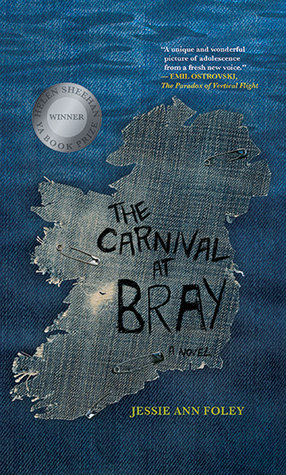
The Carnival at Bray
Author: Jessie Ann Foley
Published: October 1, 2014 by Elephant Rock Books

Goodreads Summary: It’s 1993, and Generation X pulses to the beat of Kurt Cobain and the grunge movement. Sixteen-year-old Maggie Lynch is uprooted from big-city Chicago to a windswept town on the Irish Sea. Surviving on care packages of Spin magazine and Twizzlers from her rocker uncle Kevin, she wonders if she’ll ever find her place in this new world. When first love and sudden death simultaneously strike, a naive but determined Maggie embarks on a forbidden pilgrimage that will take her to a seedy part of Dublin and on to a life- altering night in Rome to fulfill a dying wish. Through it all, Maggie discovers an untapped inner strength to do the most difficult but rewarding thing of all, live.

The Carnival at Bray is an evocative ode to the Smells Like Teen Spirit Generation and a heartfelt exploration of tragedy, first love, and the transformative power of music. The book won the 2014 Helen Sheehan YA Book Prize.

Ricki’s Review: When I read the back of this book, I thought, “Hmm.” It felt like a (recent) historical fiction with its emphasis on ’90s grunge music and the highlights of Kurt Cobain’s life. Because my teen years spanned through part of the ’90s, I was intrigued.

My favorite aspect of this book was the fact that the writing felt effortless. Too often, books’ messages or prose feel forced, and with this book, I felt as if I was whisked along for the (very bumpy) ride. As a former high school teacher, I enjoyed the myriad, richly realized themes. The reader feels a wild sense of adventure, the uneasiness that comes with living in a new environment, the loyalty that is tied with love, the heartbreak that emerges with loss and grief, and the utter purity that comes with finding oneself. At times, YA texts feature absent (or horrid) parents, but the complexity of Maggie’s mother was realistic to many parents, I believe. This will leave teens (and adults!) pondering their own relationships with their parents. The intricacies of this text will allow for book groups, students, and readers to have much to ponder and discuss.

Teacher’s Tools for Navigation: This would be a great novel to discuss theme. As stated in my review above, there are many themes to ponder. I would put butcher paper around the room and write a different theme on each paper. Students could travel around the room, discussing each theme, placing post-it notes with evidence from the text. Or, the teacher might discuss a different theme on each day. Beyond the classroom setting, I think this would be an excellent selection for book clubs.

Download the comprehensive study guide (from Elephant Rock Books) here.

Discussion Questions: How does Maggie handle the challenges she faces? Do you think she makes the right choices? Is she brave?; What does her uncle teach her? Was he an admirable character?; What role does the setting (both time and place) play in this novel?; Is Maggie’s mother a positive or negative role in her life?

We Flagged: “But don’t you think that never suffering at all—is its own form of suffering?” (p. 150).

I am not sure whether or not I agree with this quote, but weeks later, I am still thinking about it.

Read This If You Loved: Love Letters to the Dead by Ava Dellaira, Timely Persuasion by Jacob LaCivita, Five Flavors of Dumb by Antony John, The Perks of Being a Wallflower by Stephen Chbosky, Time Between Us by Tamara Ireland Stone, The Future of Us by Jay Asher and Carolyn Mackler, Get Happy by Mary Amato

Recommended For:

 litcirclesbuttonsmall classroomlibrarybuttonsmall

Make sure to stop by Cinco Puntos Press blog to see the other stops on the tour!

RickiSig

**A special thank you to Jessica Powers at Cinco Puntos Press for organizing this blog hop and to Elephant Rock Books for providing this book for review!**

YALSA Morris Finalists’ Blog Hop: Gabi, a Girl in Pieces by Isabel Quintero

Share

gabit

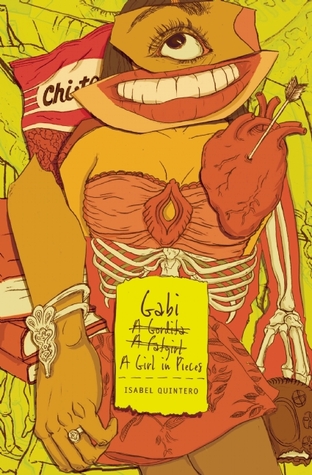
Gabi, A Girl in Pieces
Author: Isabel Quintero
Published October 14th, 2014 by Cinco Puntos Press

Goodreads Summary: For all the gorditas, flaquitas, and in-between girls trying to make their space in the world. Don’t worry, you got this.

Gabi Hernandez chronicles her last year in high school in her diary: college applications, Cindy’s pregnancy, Sebastian’s coming out, the cute boys, her father’s meth habit, and the food she craves. And best of all, the poetry that helps forge her identity.

Author Bio: Isabel Quintero is a library technician in the Inland Empire. She is also the events coordinator for Orange Monkey and helps edit the poetry journal Tin Cannon. Gabi is her debut novel.

Kellee’s Review: What I found in this book was a book of truth. While I normally find a book that has so many topics in it to be cumbersome (just some of the topics hit were: pregnancy, abortion, meth, family, religion, ethnicity, school, homosexuality, sex, death, poetry, college, rape, and gender expectations), I felt that Gabi was just truthful. Her story was just a story full of real life which just happens to be messy. I enjoyed the unique format, the diversity (not just race/ethnicity, but lbgt, body size, class, ELL, etc.), and the amazing cast of characters. Gabi’s voice rang true throughout, and even got stronger as she became more independent within the story. Well done.

Teacher’s Tools for Navigation: Parts of Gabi’s story could easily be pulled out to be a mentor text for many different literary elements; however, I feel like one of the best ways it could be used is to have students emulate Gabi’s writing. For example, Gabi writes letters to her father sharing how she really feels. Students could write to someone sharing something with them that they are keeping from them. You could also use Gabi’s magazine and poetry the same way. Gabi’s writing is very raw, and I think that students will definitely connect with it.

Discussion Questions: Gabi makes a choice towards the end of the book that makes Cindy be upset with Gabi. Do you agree with what Gabi did?; Gabi’s mother is very protective of her. Why do you think she is so hard on Gabi?; Gabi deals with body issues throughout the book. How do you think our society affects how she pictures herself?; Sebastian and Cindy’s parents are both disappointed in their kids for different reasons and deal differently with their disappointment. Do you agree with how they treat their children?

We Flagged: “My brother is fifteen. He knows many things. He knows how to make a pipe out of an apple, and he knows how to make beautiful murals on public property. He likes wresting and biking and skateboarding but doesn’t like school because school doesn’t understand kids like us. My brother–the brat, the crybaby, the quite one, the brown one, Mami’s favorite: where will he go? I ask myself the question over and over. Y no se. I don’t know where he will go, but I hope wherever it is it’s better than here.” (p. 94)

Read This If You Loved: Yaqui Delgado Wants To Kick Your Ass by Meg Medina, Jumped In by Patrick Flores-Scott, What Can(t) Wait by Ashley Hope Perez, Under the Mesquite by Guadalupe Garcia MacCall, Bridget Jones Diary by Helen Fielding

Recommended For:

 litcirclesbuttonsmall classroomlibrarybuttonsmall

Make sure to stop by Cinco Puntos Press blog to see the other stops on the tour!

Signature

**A special thank you to Jessica Powers at Cinco Puntos Press for organizing this blog hop!**

How It Went Down by Kekla Magoon

Share

how it went down

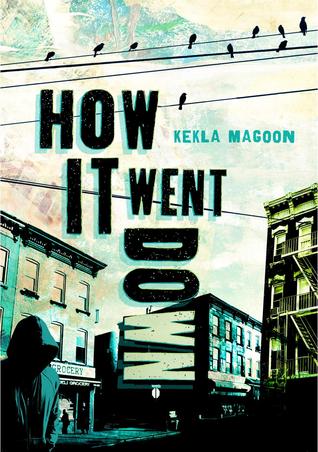
How It Went Down
Author: Kekla Magoon
Published: October 21, 2014 by Henry Holt and Co.

Goodreads Summary: When sixteen-year-old Tariq Johnson dies from two gunshot wounds, his community is thrown into an uproar. Tariq was black. The shooter, Jack Franklin, is white.

In the aftermath of Tariq’s death, everyone has something to say, but no two accounts of the events line up. Day by day, new twists further obscure the truth.

Tariq’s friends, family, and community struggle to make sense of the tragedy, and to cope with the hole left behind when a life is cut short. In their own words, they grapple for a way to say with certainty: This is how it went down.

Ricki’s Review: In light of the recent protests, this is an incredibly insightful book that is very important. The point-of-view shifts every 2-3 pages, which was very thought-provoking. Too often, books depict stereotypical portrayals of members of cultures, and the gamut of characters within this text felt very realistic. For some, this book may be too gritty and too uncomfortable. There is nothing comfortable about discussions regarding inequities and privilege in society. But if you walk down the halls of my high school, there is nothing in the book that is not a concern in schools. This is not a feel-good read, but it made me think. And thinking…is a very good thing.

Teacher’s Tools for Navigation: There is much to discuss in this book. Teachers could use it to start conversations about power and privilege. There are a lot of discrepancies between the characters’ perceptions of the shootings, and I imagine students would disagree about what happened. Teachers might elect to hold a verbal or silent debate. Also, I would love to discuss the structure of the text. The creativity in the form is purposeful, and it would be interesting for students to investigate why Magoon structured it in the way she did.

Discussion Questions: Why does Magoon structure the novel with alternating voices? How is the novel structured as a whole?; Does this story serve as a counter-narrative? If so, how? If not, why not?; Did Tariq have a gun in his hand? Why do/don’t you think so?; How does the story evolve as time passes?

We Flagged: “As a black man, you have to keep your head down. You have to keep yourself steady. You have to follow every rule that’s ever been written, plus a few that have always remained unspoken.”

Read This If You Loved: The Outsiders by S.E. Hinton, On the Run by Alice Goffman, The New Jim Crow: Mass Incarceration in the Age of Colorblindness by Michelle Alexander, Monster by Walter Dean Myers, The Brothers Torres by Coert Voorhees, Autobiography of my Dead Brother by Walter Dean Myers

Recommended For:

 litcirclesbuttonsmall classroomlibrarybuttonsmall

RickiSig

Blog Tour with Review, Giveaway, and Author’s Guest Post!: Emmanuel’s Dream: The True Story of Emmanuel Ofosu Yeboah by Laurie Ann Thompson

Share

NFPB2015

Nonfiction Picture Book Wednesday is hosted by Kid Lit Frenzy and was started to help promote the reading of nonfiction texts. Most Wednesdays, we will be participating and will review a nonfiction text (though it may not always be a picture book).
Be sure to visit Kid Lit Frenzy and see what other nonfiction books are shared this week!

emmanuel

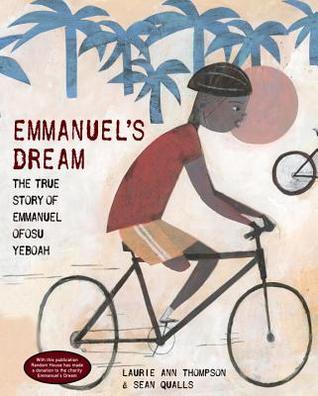
Emmanuel’s Dream: The True Story of Emmanuel Ofosu Yeboah
Author: Laurie Ann Thompson
Illustrator: Sean Qualls
Published January 6th, 2015 by Schwartz & Wade

Goodreads Summary: Emmanuel Ofosu Yeboah’s inspiring true story—which was turned into a film, Emmanuel’s Gift, narrated by Oprah Winfrey—is nothing short of remarkable.

Born in Ghana, West Africa, with one deformed leg, he was dismissed by most people—but not by his mother, who taught him to reach for his dreams. As a boy, Emmanuel hopped to school more than two miles each way, learned to play soccer, left home at age thirteen to provide for his family, and, eventually, became a cyclist. He rode an astonishing four hundred miles across Ghana in 2001, spreading his powerful message: disability is not inability. Today, Emmanuel continues to work on behalf of the disabled.

Thompson’s lyrical prose and Qualls’s bold collage illustrations offer a powerful celebration of triumphing over adversity.

Includes an author’s note with more information about Emmanuel’s charity.

Emmanuel Ofosu Yeboah quote_Unleashing Readers

Author’s Bio: Laurie Ann Thompson is the author of Be a Changemaker: How to Start Something That Matters, a how-to guide for teens who want to change the world. An advocate for social justice, Laurie is dedicated to inspiring and empowering young readers. Emmanuel’s Dream is her picture-book debut. Visit her at lauriethompson.com.

lauriethompson_PhotoByMaryBalmaceda (2)

Kellee’s Review and Teachers’ Tools for Navigation: Emmanuel is inspiring. It is no wonder that Laurie Ann Thompson wrote this story: Emmanuel is truly a changemaker. What gets me about Emmanuel’s story is that he never gives up even when faced with challenges that most of us would crumble under. He proves that kids can make a tremendous difference and that we should be strong in the face of hardships.

Laurie Ann Thompson and Sean Qualls did an amazing job on this text. The story is perfectly paced and truly takes readers on Emmanuel’s journey with him. Additionally, the illustrations are pieces of artwork. I think mixed media was the perfect form for the story.

Please read this story to your students. Talk about Emmanuel, talk about the theme of his story, talk about how he changed the world, and talk about how anyone can do the same.

Ricki’s Review and Teachers’ Tools for Navigation: As Kellee said, this is an inspirational story about a boy who refuses to be overcome by his disability. Others tell him he should just become a beggar, but he is determined to be the best he can be. The illustrations are absolutely beautiful, and the story flows well. Students will find hope and strength in Emmanuel’s strong, resilient spirit.

There aren’t enough books about disabilities in classrooms, and this frustrates me as a teacher. Frankly, there aren’t enough books being published about disabilities–both physical and mental. After reading this book, students could be encouraged to research about different individuals who have been strong in the face of disability. Then, as students share these stories with the class, students will learn lessons of bravery and resilience.

A CCSS-aligned curriculum guide is available at http://www.scribd.com/doc/251881365/Emmanuel-s-Dream-Curriculum-Guide#scribd

Discussion Questions: What adjectives would describe Emmanuel?; How has Emmanuel changed life for himself and other people with disabilities in Ghana or worldwide?; How does Emmanuel show strength—both physically and emotionally? Can you relate him to anyone in your life?

We Flagged: “…He would honor them by showing everyone that being disabled does not mean being unable. It was a big dream, but Emmanuel had a plan.”

Read This If You Loved: Be a Changemaker by Laurie Ann Thompson, A Long Walk to Water by Linda Sue Park, So Long a Letter by Mariama Ba, The Queen of Water by Laura Resau, Now is the Time for Running by Michael Williams, Soccer Star by Mina Javaherbin, Mama Miti by Donna Jo Napoli

Recommended For: 

readaloudbuttonsmall classroomlibrarybuttonsmall litcirclesbuttonsmall

Author Guest Post

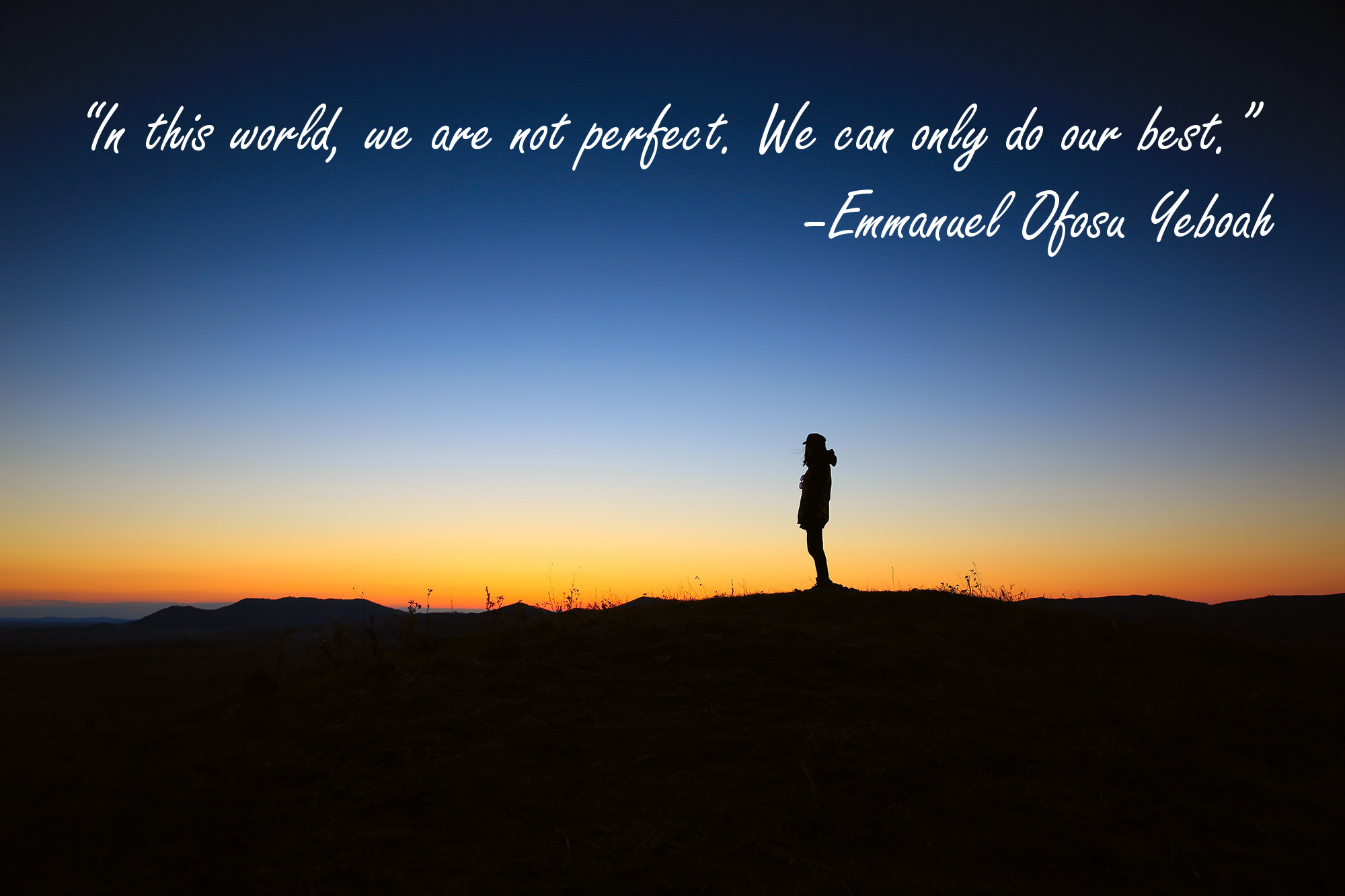
At the very end of Emmanuel’s Dream, you’ll find this quote:

“In this world, we are not perfect. We can only do our best.” –Emmanuel Ofosu Yeboah

I chose to include that quote from Emmanuel because I think it exemplifies Emmanuel’s attitude toward life, but also because it was an important lesson for me to learn in my life… and it’s one I still need to be reminded of sometimes.

When I was a child, I was a perfectionist. I would never raise my hand in class. I always chose comfortable options over more challenging ones. I lived in constant fear of making a mistake—any mistake, in any area of my life. Of course, I still made them, and each one haunted me.

After college I got a job as a software engineer. In programming, I soon discovered, there’s no such thing as perfect. Every decision comes with a trade-off: better performance vs. flashy bells-and-whistles, a sooner delivery date vs. adding more features, a clean and simple design vs. a complex and robust one, cross-platform portability vs. the benefits of customization. You learn to do the best you can for the user in the time you have available. And, always, you know there will be bugs.

When I got involved in entrepreneurship, imperfection still ruled. Most startups fail, and successful entrepreneurs accept that, preparing themselves mentally (and financially) to try and try again until they find something that sticks. Even then, they’re often forced to make decisions quickly without having all the relevant information but knowing that to wait would also risk failure.

And now, with writing, perfection is just as hard to come by. Deadlines can cause us to put things out before we’re ready. Even without the pressure of a deadline, knowing when something is good enough to take to the next level is a guessing game. And what’s “good,” anyway? Despite years of working on them and dozens—if not hundreds—of revisions, copyedits, and proofs, there are still things I wish I could go back and change about each of my published books. I love them, but they can never be perfect.

What all of this has taught me is that it’s far better to do something and fail than to do nothing at all just because you were too worried about making a mistake. Worrying never does anyone any good, and the stress from it can actually harm you. But when you DO something, you learn, whether you succeed or not. You move forward, and you help everyone else following along behind. It’s not about perfection: it’s about progress.

I hope readers of Emmanuel’s Dream (and readers of this blog post!) will be inspired to follow their own dreams,  that they’ll accept that they’re not perfect but resolve to do their best anyway. Maybe just doing our best is—in its own way—the very perfection we are seeking.

Follow all the stops on Laurie’s blog tour!
 
Mon, Jan 12
Great Kid Books
Tues, Jan 13
5 Minutes for Books
Wed, Jan 14
Unleashing Readers
Thurs, Jan 15
Sharpread
Fri, Jan 16
Cracking the Cover
Sat, Jan 17
Booking Mama
Mon, Jan 19 (MLK Jr bday)
Once Upon a Story
Tues, Jan 20
Proseandkahn
Wed, Jan 21
Geo Librarian
Thurs, Jan 22
Nonfiction Detectives
Fri, Jan 23
The Fourth Musketeer
Mon, Jan 26
NC Teacher Stuff
Tues, Jan 27
Teach Mentor Texts

GIVEAWAY

a Rafflecopter giveaway

Signature andRickiSig

**Thank you to Barbara at Blue Slip Media for providing copies for review and to Laurie Ann Thompson for her guest post!**

Blog Tour with Review and Guest Post!: When Otis Courted Mama by Kathi Appelt

Share

When Otis Courted Mama  cover

When Otis Courted Mama
Author: Kathi Appelt
Illustrator: Jill McElmurry
Published: January 6, 2015 by HMH Books for Young Readers

Goodreads Summary: Apart from sticker burrs and sand fleas, Cardell’s life is mostly wonderful. He knows he’s loved through and through by his perfectly good mama and his perfectly good daddy. They live in different parts of the desert, but that’s okay—Cardell is mostly used to it. Then Otis comes calling, and Cardell feels a grrr form in his throat. Otis can’t make jalapeño flapjacks or play Zig-the-Zag anything like Cardell’s daddy. And so Cardell waits for Mama to say “Adiós, Otis.” But what will happen if she doesn’t?

Ricki’s Review and Teachers’ Tools for Navigation: On a recent Top Ten Tuesday post, I wrote that I would love to see more picture books about different kinds of families. A week later, I found this gem. I absolutely adored Cardell the coyote and think kids will identify with his spunk. Cardell isn’t thrilled when his mother begins dating a new man, and he suspects Otis (the new guy) will be gone quickly, just like the others. This is a great resource to teach kids about accepting and adjusting to life with a new stepparent. I would also use it to teach setting and creative writing–the Southwest flavor adds a beautiful sense of culture that spices up both the text on the page and the illustrations. There is much to discuss with this book, and I think it would make a great read-aloud. I had a lot of fun reading it to my son.

Kellee’s Review and Teachers’ Tools for Navigation: Ricki said it so well! This is a book that was needed, and it is a good one at that. Too often, a lack of empathy occurs because one person doesn’t understand the other. I love picture books that help kids understand other people’s situations (but without being preachy), and this book does just that; however, it is also a very universal picture book because it shows a kid having to deal with a new situation. At one point or another, everyone must face the unknown or something s/he dislikes, and that is exactly what Cardell is going through.

This book will become a favorite read aloud for classroom teachers! Cardell’s voice rings true, and it will be so much fun to read aloud. I really loved Kathi Appelt’s writing as well. Her use of descriptive words is spot on and would be a great mentor text for imagery. Teachers could also discuss how her words were translated into illustrations.

Teaching Materials: Curriculum guide and Activities

Bonus!: Find a full-color door hanger and other fun downloadables at kathiappelt.com.

Discussion Questions: Do you think Cardell treated Otis fairly?; What are some of the different types of families in our world? What makes your family different?; How do you treat new people you meet?

Book Trailer: 

Read This if You Loved: ABC A Family Alphabet Book by Bobbie Combs, Donovan’s Big Day by Lesléa Newman, The Family Book by Todd Parr, And Tango Makes Three by Justin RichardsonTwo Cool Coyotes by Jillian Lund, Girl Who Loved Wild Horses by Paul Goble, A Tale of Two Daddies and A Tale of Two Mommies by Vanita Oelschlager

Recommended For: 

readaloudbuttonsmall closereadinganalysisbuttonsmall classroomlibrarybuttonsmall

Kathi Appelt photo

Guest Post by Kathi Appelt

When I was in the fifth grade, my parents got divorced. It wasn’t a sudden thing, but it was a sad thing. We went from a whole family to a broken family. Moreover, my father left us—my mom and my two younger sisters and me—to start a brand new family. All at once, I had a stepmother and two stepbrothers, not to mention step-grandparents, step cousins, step uncles and aunts. Lots of steps. It was confusing.

The thing is, whenever life got to be too much, I could duck into the pages of a book and find some refuge there. It’s always been that way for me.

But in that tumultuous time, when my family was becoming something that seemed both smaller and larger, I could really have used a book that gave me some faith that life would eventually be “mostly wonderful.” I could have used a book that had non-antagonistic stepparents. There were—and still are—few picture books that celebrate step families, a notable exception being When We Married Gary, by Anna Grossnickle Hines.

In fact, for the most part, stepparents in children’s literature, are fairly villainous. (I’m reminded of the evil stepmother in Cinderella). In reality, I know that there are many stepparents in the world who are doing their best, and who are making a positive difference in the lives of their stepchildren. I had the great fortune of having George. He came into my mother’s life like a breath of fresh air. And he had the courage to marry her when my sisters and I were sixteen, fourteen, and thirteen. Imagine marrying someone who had three teenagers!

Looking back, I believe that the best thing about George was his ability to spin a yarn. He was a master at telling tales. In a matter of minutes, he’d have all of us laughing right out loud. And that felt perfectly wonderful.

So, when it comes to using my book in classrooms, I have four main hopes for it:

(1) that it can be used to feature an all-too-common modern family—divided, but working it all out; (2) that it honestly portrays a youngster who is having to make adjustments; (3) that it can serve as a way to talk about jealousy and other mixed emotions; and finally (4) with its Southwestern flora and fauna and landscape, that it can just be plain fun to read out loud. That last is my biggest hope.

And if it can offer up a character who is not a stereotype of Cinderella’s wicked stepmother, that will just be a bonus.

Kathi Appelt guest post - George, Kathi, Jacob

Photo of George, Kathi’s stepfather

(He’s with Kathi and her oldest child, Jacob, on his first birthday.)

About the Author: Kathi Appelt’s perfectly wonderful stepfather was a terrific storyteller, and she grew up to become a teller of stories, too. She is the New York Times best-selling author of more than forty books for children and young adults. Her picture books include Oh My Baby, Little One, illustrated by Jane Dyer, and the Bubba and Beau series, illustrated by Arthur Howard. Her novels for older readers include two National Book Award finalists: The True Blue Scouts of Sugar Man Swamp and The Underneath, which was also a Newbery Honor Book. In addition to writing, Ms. Appelt is on the faculty in the Masters of Creative Writing for Children and Young Adults at Vermont College of Fine Arts. She lives in College Station, Texas. To download a free, CCSS-aligned curriculum guide, visit Kathi’s website at kathiappelt.com.

Follow sweet Cardell on all of the tour stops!
 
Date
Blog
Blog URL
Mon, Jan 5
5 Minutes for Books
Tues, Jan 6
Cracking the Cover
Wed, Jan 7
Sharpread
Thurs, Jan 8
Unleashing Readers
Fri, Jan 9
Once Upon a Story
Sat, Jan 10
Booking Mama
Mon, Jan 12
Geo Librarian
Tues, Jan 13
The Late Bloomer’s Book Blog AND NC Teacher Stuff
Wed, Jan 14
Teach Mentor Texts
Thurs, Jan 15
Kid Lit Frenzy
Fri, Jan 16
The Fourth Musketeer

RickiSigandSignature

**Thank you to Barbara at Blue Slip Media for providing copies for review!**

All the Bright Places by Jennifer Niven

Share

all the bright places

All the Bright Places
Author: Jennifer Niven
Published: January 6, 2015 by Knopf

Goodreads Summary: The Fault in Our Stars meets Eleanor and Park in this compelling, exhilarating, and beautiful story about a girl who learns to live from a boy who intends to die.

Theodore Finch is fascinated by death, and he constantly thinks of ways he might kill himself. But each time, something good, no matter how small, stops him.

Violet Markey lives for the future, counting the days until graduation, when she can escape her Indiana town and her aching grief in the wake of her sister’s recent death.

When Finch and Violet meet on the ledge of the bell tower at school, it’s unclear who saves whom. And when they pair up on a project to discover the “natural wonders” of their state, both Finch and Violet make more important discoveries: It’s only with Violet that Finch can be himself—a weird, funny, live-out-loud guy who’s not such a freak after all. And it’s only with Finch that Violet can forget to count away the days and start living them. But as Violet’s world grows, Finch’s begins to shrink.

This is an intense, gripping novel perfect for fans of Jay Asher, Rainbow Rowell, John Green, Gayle Forman, and Jenny Downham from a talented new voice in YA, Jennifer Niven.

Ricki’s Review: A publishing representative who I deem to be a friend pressed this book into my hand. “Read it,” she insisted. She told me I would want to curl up into a ball in my bed and fall into this book. I fell hard. The writing is incredible. I hate to compare books with others because it creates a sense of expectation that often goes unfulfilled for future readers, but I couldn’t help but consider comparisons with my all-time favorite YA texts. The quirky nature of the characters reminded me of Pudge, Alaska, Charlie, Eleanor, and Park. The direction of the plot reminded me of other titles (which will remain unnamed to prevent spoilers). But I cannot compare this book to others because while it allowed to me reminisce about my favorite titles, it was quite different. The deep, honest, hard-hitting depiction of mental illness was enough to take my breath away. I felt rage that made me want to punch my mattress; I felt sadness that made me feel a hopeless sense of emptiness; but above all, I felt the power of love, loyalty, and friendship that made my heart both ache and swell. This is an unforgettable book. I suspect it will be the book that everyone will be talking about this year and for years to come.

Teacher’s Tools for Navigation: Mental illness and bullying are pervasive in our schools. We can’t teach enough books about these themes because they are incredibly relevant for young people. As a former teacher, I was jealous of the teacher who created the assignment for Violet and Finch, and I wanted to do it with my former students. It would be so neat to duplicate this project while students read the book. Additionally, I think students would benefit from creating their own version of the post-it collages that Violet and Finch make. As an alternative, I would consider having students research the warning signs of suicide and finding these instances in the text. There are so many themes for the students to consider, the teaching categories at the top and tags at the bottom of this post show a variety of different directions a teacher might take with the instruction of this text.

Access the book’s website to share your bright place or read Germ MagazineThe educator guide also has CCSS tie-ins.

Discussion Questions: What is the end message of this book? What is the author’s purpose?; What foreshadowing does Niven provide?; How do Violet’s family members show their grief in different ways?; Do you agree with the ending? Would you change it? Why do you think Niven ended the book in the way she did?

We Flagged: “It’s my experience that people are a lot more sympathetic if they can see you hurting, and for the millionth time in my life I wish for measles or smallpox or some other easily understood disease just to make it easier on me and also on them.”

**Please note: The above quotation is from an advanced reader copy. The quotation may change in the final published form of the text.**

Read This If You Loved: Looking for Alaska by John Green, Eleanor and Park by Rainbow Rowell, Dr. Bird’s Advice for Sad Poets by Evan Roskos, The Fault in Our Stars by John Green, Forgive Me, Leonard Peacock by Matthew Quick, It’s Kind of a Funny Story by Ned Vizzini, The Perks of Being a Wallflower by Stephen Chbosky, Twisted by Laurie Halse Anderson, Everybody Sees the Ants by A.S. King, Burn by Suzanne Phillips

Recommended For:

 closereadinganalysisbuttonsmall litcirclesbuttonsmall classroomlibrarybuttonsmall

RickiSig