Animal Planet’s Animal Bites: Ocean Animals and Polar Animals

Share

NFPB2016

Nonfiction Wednesday

Nonfiction Picture Book Wednesday is hosted by Kid Lit Frenzy and was started to help promote the reading of nonfiction texts. Most Wednesdays, we will be participating and will review a nonfiction text (though it may not always be a picture book).
Be sure to visit Kid Lit Frenzy and see what other nonfiction books are shared this week!
animal planet 2

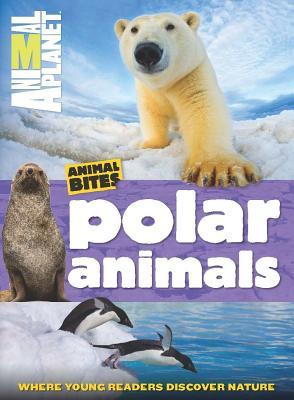
Polar Animals

animal planet 1

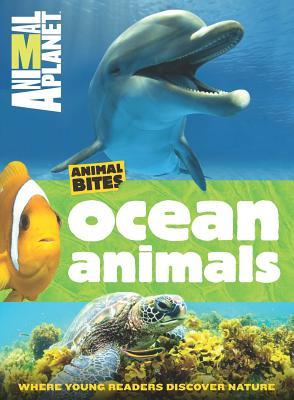
Ocean Animals

Animal Planet
Published March 1st, 2016 by Animal Planet

Polar Animals Summary: With more than 200 gorgeous animal photos of penguins, polar bears, sea lions, walruses, reindeer and others, Animal Planet Polar Animals is a fun, habitat-by-habitat guide that provides kids in the first years of schooling with the perfect bite-sized view of their favorite animals living in both polar climates. Arranged thematically with focus on animal behavior and family relationships, young readers will explore sections about animal bodies, baby animals, food, play time, conservation, and more. Special book features designed for this age group include Quick Bites sidebars with cool animal facts, simple infographics, and illustrated maps of the coldest places on Earth.

Ocean Animals Summary: With more than 200 gorgeous animal photos of sharks, whales, clown fish, jelly fish, dolphins, and others, Animal Planet Ocean Animals is a fun, habitat-by-habitat guide that provides kids in the first years of schooling with the perfect bite-sized view of their favorite ocean-dwelling animals. Arranged thematically with focus on animal behavior and family relationships, young readers will explore sections about animal bodies, baby animals, food, play time, conservation and more. Special book features designed for this age group include Quick Bites sidebars with cool animal facts, simple infographics, and illustrated maps of Earth’s watery environments.

A portion of the proceeds will benefit Animal Planet’s R.O.A.R. (Reach Out. Act. Respond.) project which partners with leading animal organization to make the world a better place for domestic and wild animals.

Kellee’s Review: Like National Geographic nonfiction books for kids, Animal Planet’s books have some of the most stunning photographs of animals that I’ve ever seen. They take the reader to the animals’ home and shows the reader the ins and outs of the animal and how and where they live.   

Ricki’s Review: My toddler adores these books. My husband was watching him when I started this post, and he said, “Henry have those! Henry have those!” They are intended for an older audience, but that doesn’t stop him. The pictures are gorgeous and there is so much to learn. Each page is brimming with facts! These are great books for readers of all ages.

Teachers’ Tools for Navigation: The Animal Bites series uses colorful tabs and other text features to organize the information throughout the book. The tabs are: Where They Live, How They Live, Vista (awesome photos that show the places animals live), Big Data, Animal Gallery, Living/working, Conservation, and specific animal tabs. They also have Just Like Mes thrown throughout the book showing how the animals are similar to humans. The way the book is set up is perfect to discussing biology and zoology. While you use these books in science, you can do comparisons/contrasts and text features in language arts, and find the animals’ habitats in geography. These are perfect books for cross-curricular lessons and inquiry projects.

Activities Created by Time Inc.: 
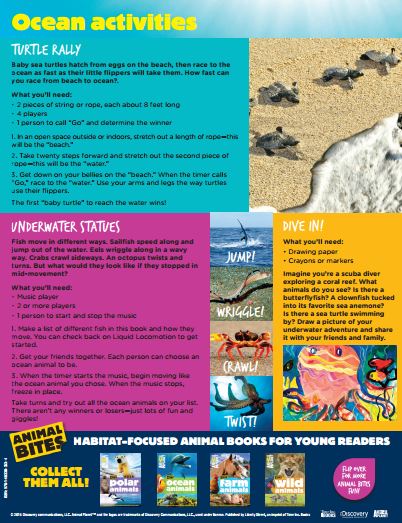
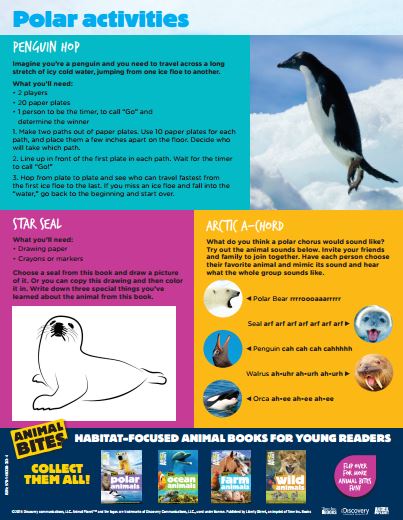
ocean activitiespolar activities

Ocean and Polar Animals Activity Sheets PDF

Discussion Questions: What other Animal Bites books would you like to see?; What are some examples of ways that some animals are like us?; Which animal that you learned about is the best at camouflaging? Fastest? Best predator? etc.; What text features does the author use to help you understand the text?; How did the author structure the text?; What are the differences/similarities of some of the animals within the books?

We Flagged: 
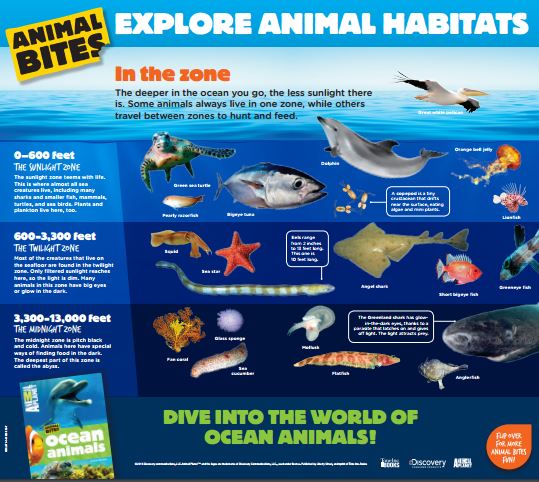
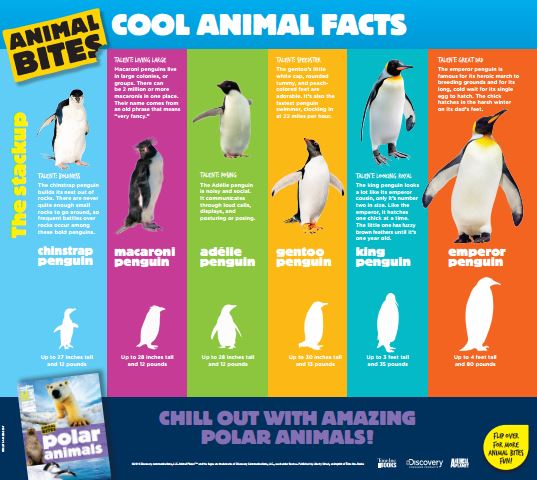
ocean poster polar poster

Ocean and Polar Animals Posters PDF

Animal Planet has also created FUN FACT cards for each of their Animal Bites books that can be accessed fore free HERE.
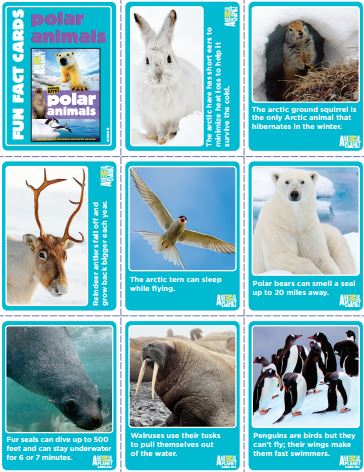
animal-fun-fact-cards-2

Read This If You Loved: National Geographic nonfiction texts, Seymour Simon animal texts, Extreme Ocean Records by Seymour Simon 

Recommended For: 

classroomlibrarybuttonsmall closereadinganalysisbuttonsmall

SignatureandRickiSig

Teeny Tiny Toady by Jill Esbaum

Share

teeny tiny toad

Teeny Tiny Toady
Author: Jill Esbaum
Illustrator: Keika Yamaguchi
Published: March 1, 2016 by Sterling Children’s Books

Goodreads Summary: When a giant hand scoops up her mama and puts her in a pail, a terrified tiny toad named Teeny hops faster than she ever did in her life. “Mama’s stuck inside a bucket! Help me get her out!” she begs her big, clumsy brothers. “Don’t you worry, kid. We’ll save her!” they promise, bumbling and stumbling and jumbling out the door. But as the boys rush headlong to the rescue, pushing their little sister aside, it becomes clear: brawn isn’t always better than brains—and the smallest of the family may just be the smartest one of all.  Written in lilting verse.

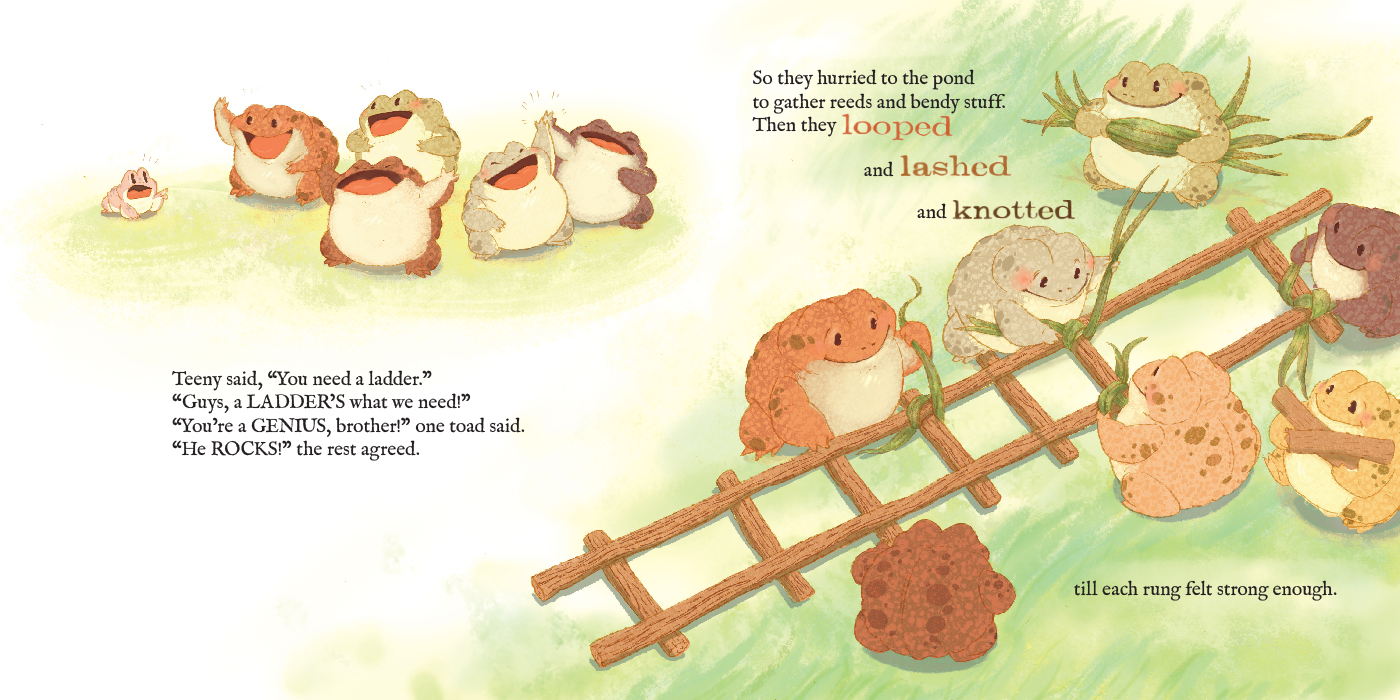
Ricki’s Review: I should be honest that frogs and toads are my favorite animal. I love everything about them! Reading this book was such a joy. I loved how the words danced across the page. If you look at the image below, you will see the way the words pop. The toads are personified in a way that makes me smile. They high five, cheer, hold each other up, etc. Teeny may be little, but she is fierce. It takes her some time to realize that she has valuable ideas. I enjoy teaching my son to be critical of gender as we read this book, and I particularly enjoyed the feminist theme.

Kellee’s Review: I should be honest that frogs and toads are one of my least favorite animals. However, that did not keep me from loving this book! Ricki touched on much of what is superb about the book including the onomatopoeias throughout, the way the words hop like toads all over the page, and the joyousness of these toads’ family. I also particularly enjoyed the theme of this book–it definitely shows how you shouldn’t underestimate people especially if you are basing it off of a prejudicial stereotype. It also  I plan on using this for one of my precept/theme activities with my students because I feel there is so much that could be discussed in this teeny, tiny book. 

Teachers’ Tools for Navigation: This story would be great to use in a creative writing class. The author and illustrator cleverly craft the phrasing and presentation of the story, and this will be inspirational for writers and illustrators. Teachers might also use this text to teach personification, onomatopoeias, and effective use of rhyme.

Discussion Questions: When does Teeny realize that her ideas are valuable? How does her size impact how she feels about herself?; Are there other ways that Teeny could have gotten her family out of the bucket? Try to think of as many ways as you can and how they would have impact the telling of the story.

Flagged Passage:

teeny passageSpread from: http://andreacmiller.com/projects/teeny-tiny-toady/

Read This If You Loved: The Frog and Toad series; Stick by Steve Green; Green Wilma by Tedd Arnold

Recommended For: 

readaloudbuttonsmall classroomlibrarybuttonsmall

RickiSigand Kellee Signature

**Thank you to Josh at Sterling Books for providing copies for review!**

“Giving Writing a Try” by Andrea Young, Author of Finny and the Boy from Horse Mountain

Share

“Giving Writing a Try”

A teacher once told me I should give writing a try.

Fast-forward 20 years. I was giving a horseback-riding lesson when I overheard someone say that there are not enough good horse books out there for kids these days.

Having always remembered what that teacher said and after teaching kids to ride for almost 30 years, I figured who better than me to give it a try?

Luckily (because it made it easy), I had absolutely no expectations about writing a book when I sat down at my computer and went for it.

What I found out was that I truly loved to write. I would get so lost in the story I’d not realize hours had passed. Many times I only stopped typing because my arms grew too sore. Painful limbs aside, I had found a new passion.

Finny, the heroine in Finny and the Boy from Horse Mountain, finally got the horse she so desperately wanted. The description in the book of the still standing, but near dead, skeleton of a horse was exactly what I found when I was given a free horse at fifteen years old.

I was dropped off at an abandoned ranch to pick up my new horse. The plan was for me to ride it back home. After seeing her, and the state she was in, that certainty wasn’t going to happen. Fearing she wouldn’t survive, but having no other choice. We slowly began the eleven-mile walk home and the journey that would change my life.

That event was a defining moment for me. Not only did the horse survive, she thrived and turned out to be an amazing animal any kid would be blessed to have.

I hoped I could portray in my story how an event like that can bring so much happiness and change a life for the better.

There were two elements in my book that I wanted to stay true to. First, that all the equine information was accurate. I wanted anyone who read the book to also learn from it. That was very important to me because I teach horsemanship and safety around horses. I have read numerous horse books where the information is actually incorrect or misleading.

Second, I wanted to show that the good guys don’t always win just because they’re good and the bad guys didn’t always lose because they’re bad. I wanted to do that because that is how the world works. Another lessons kids should learn.

Finny gets a horse named Sky. Her dream is that someday he’ll become a champion jumping horse. As their story progresses, she has to modify her plans since Sky is proving to be so difficult. I didn’t want this to be a crushing end to a dream, just the beginning of a new one. I wanted my readers, like I do my students, to learn the journey is the joy, not the ribbons from the show arena.

Joe, the male hero in the story, is already years ahead of Finny when it comes to being set as the person he is. His background has been tough, but the sense of self he has gotten from working with horses is enough to get him through the bad times. Finny sees this in him, and admires him for it.

Ultimately, my characters absorb their life lessons from their experiences with horses and each other. All the bad thrown their way, they handle due to the strengths they’ve gained. I hope my real life students can achieve that, too.


Finny cover copy

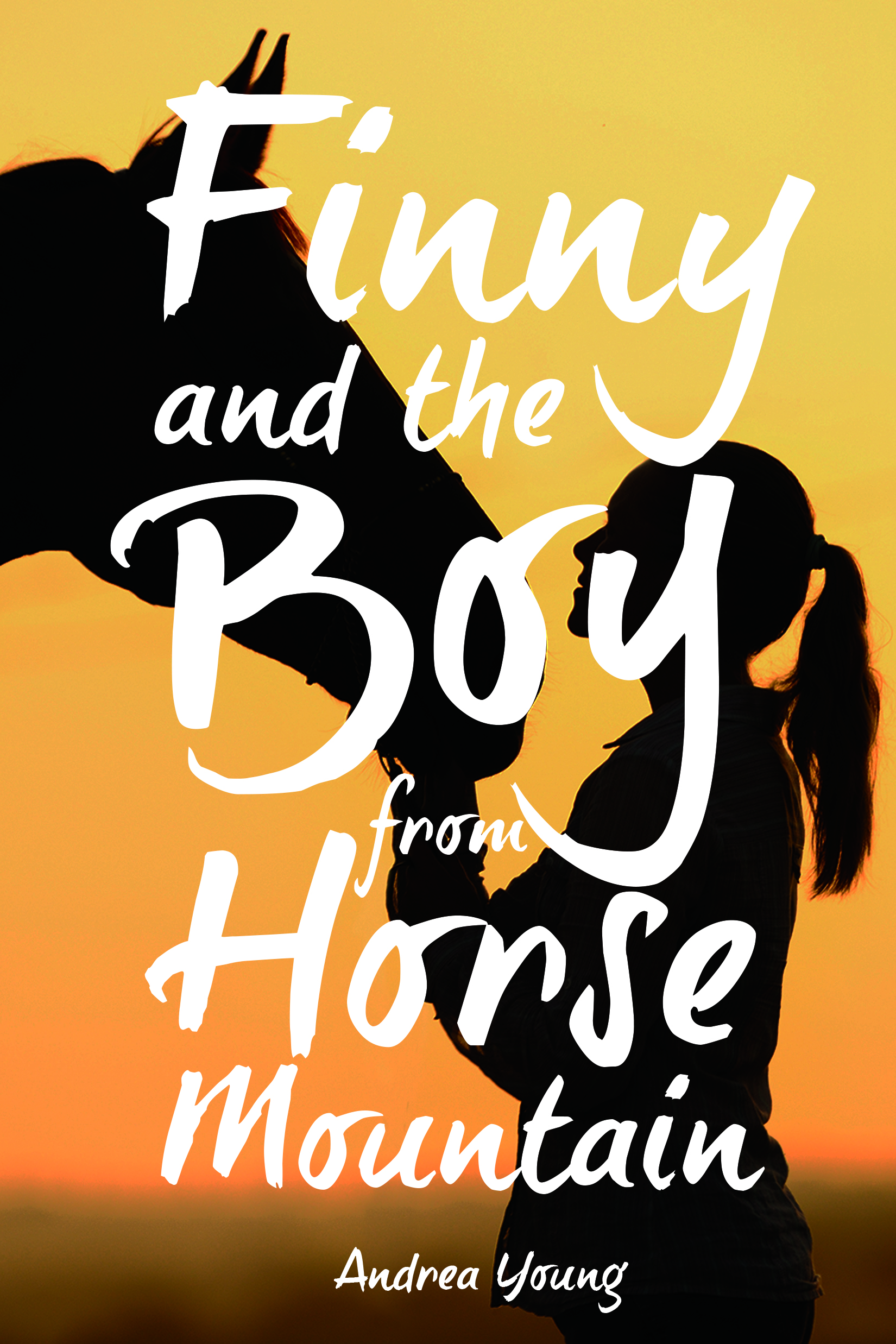
Finny and the Boy from Horse Mountain

About the Book: Against the backdrop of the high-stakes and intensely competitive equestrian sport of show jumping, Finny, a fifteen-year-old girl in California, adopts an emaciated, untrained horse without her parents’ knowledge. Soon after adopting Sky, Finny meets Joe, a sixteen-year-old, who has run away from his cruel uncle in Montana. His love for horses and desire to be a trainer matches Finny’s dream of competing in the show jumping arena—against rich girls on fancier horses—and together, they train Sky to become a first-rate show jumper.

But the path is fraught with danger. Sky is not like other horses and is so destructive and difficult he gets them kicked out of the barn where Finny has been working and training. Helped by a kind woman who owns a horse rescue, Joe is able to prove both his and Sky’s incredible talents. When Joe is kidnapped by his violent uncle, Finny and Sky are the only ones who can save him. In a breathtaking finale, Sky and Finny must enter the underworld of the rodeo circuit, an after-hours, illegal race, where they will risk their lives to save the boy they love. Young demonstrates a masterful ability to set a breakneck pace and keep it up until the end of the novel. Finny and Joe are enduring characters who are sure to appear in upcoming sequels.

About the Author: Andrea Young is a highly respected riding instructor at Elvenstar in Malibu, one of Southern California’s top hunter-jumper barns. Her innovative work has been featured in Practical Horseman, Hunter/Jumper magazine,Show Circuit Magazine, Chronicle of the Horse, and others. She is currently writing a trilogy featuring Finny and Joe, the boy from Horse Mountain. She lives in Simi Valley, California.

Thank you to Andrea for this honest post. We hope it will inspire readers and writers!

Thank you to Cheryl from Sky Pony Press for connecting us with Andrea!

RickiSigandKellee Signature

Mother Bruce by Ryan T. Higgins

Share

Mother Bruce

Mother Bruce
Author: Ryan T. Higgins
Published November 24, 2015 by Disney-Hyperion

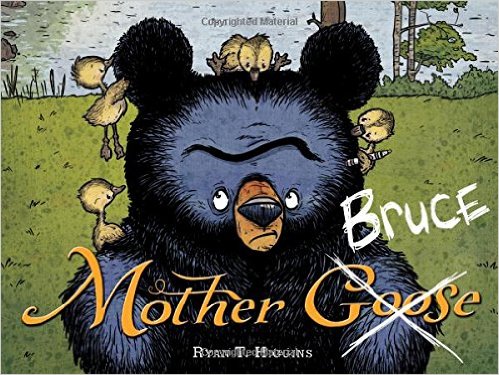
Goodreads Summary: Bruce the bear likes to keep to himself. That, and eat eggs. But when his hard-boiled goose eggs turn out to be real, live goslings, he starts to lose his appetite. And even worse, the goslings are convinced he’s their mother. Bruce tries to get the geese to go south, but he can’t seem to rid himself of his new companions. What’s a bear to do?

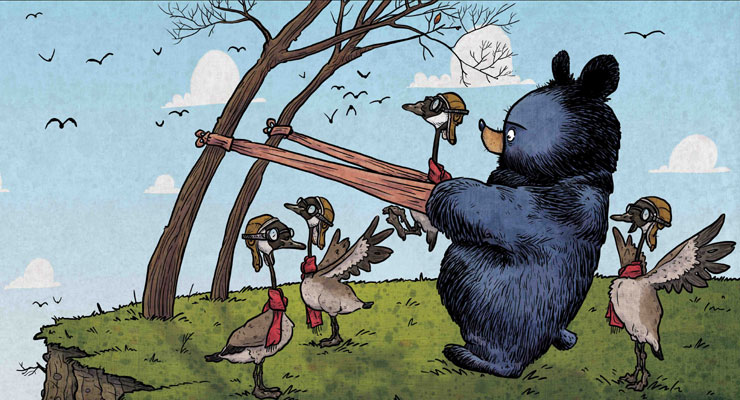
Ricki’s Review: I dare you to try reading this book without smiling. I had so much fun reading this book with my son. It tells the story of a grumpy bear who accidentally hatches goslings instead of hard-boiled eggs for his newest recipe. The goslings imprint on him, and he can’t get rid of them! As you can see below, the illustrations are hilarious. The author is very clever. I will be reading more of his work!

Teachers’ Tools for Navigation: It is always fun to look at original fairy tales and the ways they compare to fairy tale retellings. This book is a bit different because Mother Goose is the imaginary author of fairy tales. The title of this book is a pun on the Mother Goose name. ‘d love to hear the ways that kids can compare this story to other fairy tales. I imagine they would come up with some really clever ideas!

Discussion Questions: What strategies does Bruce use to try to get rid of the goslings?; How does Bruce change throughout the story?; In what ways does the author add humor to the story in both the language and illustrations?; What does the title mean?

We Flagged: 

Mother-Bruce-2

**Image from: http://www.modernmom.com/mother-bruce-giveaway-100-visa-gift-card-116459.html. **

Read This If You Loved: Wilfred by Ryan T. Higgins, Wolfie the Bunny by Ame Dyckman, No Fits, Nilson by Zacharia Ohora, Sylvester and the Magic Pebble by William Steig, This Is Not My Hat by Jon Klassen

Recommended For: 

readaloudbuttonsmall classroomlibrarybuttonsmall

RickiSig

The SLOWEST Book EVER by April Pulley Sayre

Share

NFPB2016

Nonfiction Wednesday

Nonfiction Picture Book Wednesday is hosted by Kid Lit Frenzy and was started to help promote the reading of nonfiction texts. Most Wednesdays, we will be participating and will review a nonfiction text (though it may not always be a picture book).
Be sure to visit Kid Lit Frenzy and see what other nonfiction books are shared this week!

slowest book ever

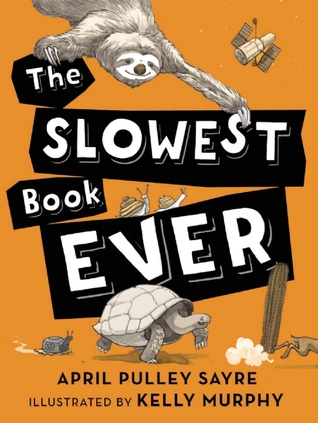
The SLOWEST Book EVER
Author: April Pulley Sayre
Illustrator: Kelly Murphy
Published April 5th, 2016 by Boyds Miller Press

Goodreads Summary: April Pulley Sayre’s wry, quirky storytelling tone shines from the warning on the first page (“This is a S-L-O-W book. Do not read it while surfing, water skiing, or running to escape giant weasels.”) right through to the glossary at the end. In between, readers will explore an astounding variety of information about all things slow—in nature, geology, art, outer space, etc. Throughout, The SLOWEST Book EVER playfully encourages readers to slow down and savor everything. As Sayre shows: “If you think slowly enough, the entire world is amazing.” This innovative nonfiction work is a treasure trove of information that begs for multiple readings.  

Kellee’s Review: Anyone who teaches knows that the most popular nonfiction books are the ones that have a ton of information in short segments with fun pictures. Well, Sayre’s The SLOWEST Book EVER is exactly that but even better than you are picturing. Sayre does such a great job of having a small amount of information that packs a very big punch. Although each fact is over only a 2-page spread, the information is thorough, interesting, and specific. I loved the wide range of topics that were all covered under the big idea of SLOW, and I think students will be fascinated with all of the information.

Ricki’s Review: I read a lot of books, and I don’t think I’ve read a book that is quite like this one! It is a compilation of fascinating information that will compel readers to want to learn more about their world. It is apparent that a lot of thought and care went into the crafting and production of this book. Each page is a bit different, so if a reader is uninterested in a topic, he or she can flip the page and find something else entirely different. This book would make a great gift because all children will find sections that intrigue them, regardless of their interests. I’d look forward to going to a class where a teacher used this book used as a read-aloud, reading a few sections each day. This book makes learning fun!

Teachers’ Tools for Navigation: Since The SLOWEST Book EVER includes tidbits of information on many different topics, each spread could easily be used as a jumping off point for an inquiry project. Students browse through the book to determine which spread of information interests them the most then they do more research (using the back matter as a place to start) then share the extra information with their classmates.

The SLOWEST Book EVER also does an amazing thing by looking at all the different ways that SLOW can be defined. After finishing the book as a class, revisit all of the different ways slow was used then brainstorm different meanings of other subjective adjectives such as fast, large, and small. Then student, as a class, could write their own fact book using a different adjective but showing different meanings of that word.

Discussion Questions: Which fact surprised you the most?; The book doesn’t only focus on slow speeds–what ever definitions of slow did the author focus on?; What topics would you like to learn more about? Where could you go to get more information?

We Flagged: “Chewy Nature Thoughts
Read them. Think about them. S l o w l y.
Slow thoughts are often big thoughts. So don’t fret if it takes a while to understand them. Don’t worry if you need to read them twice. -Traveling in a circle is, after all, still traveling.” (p. 8-9)

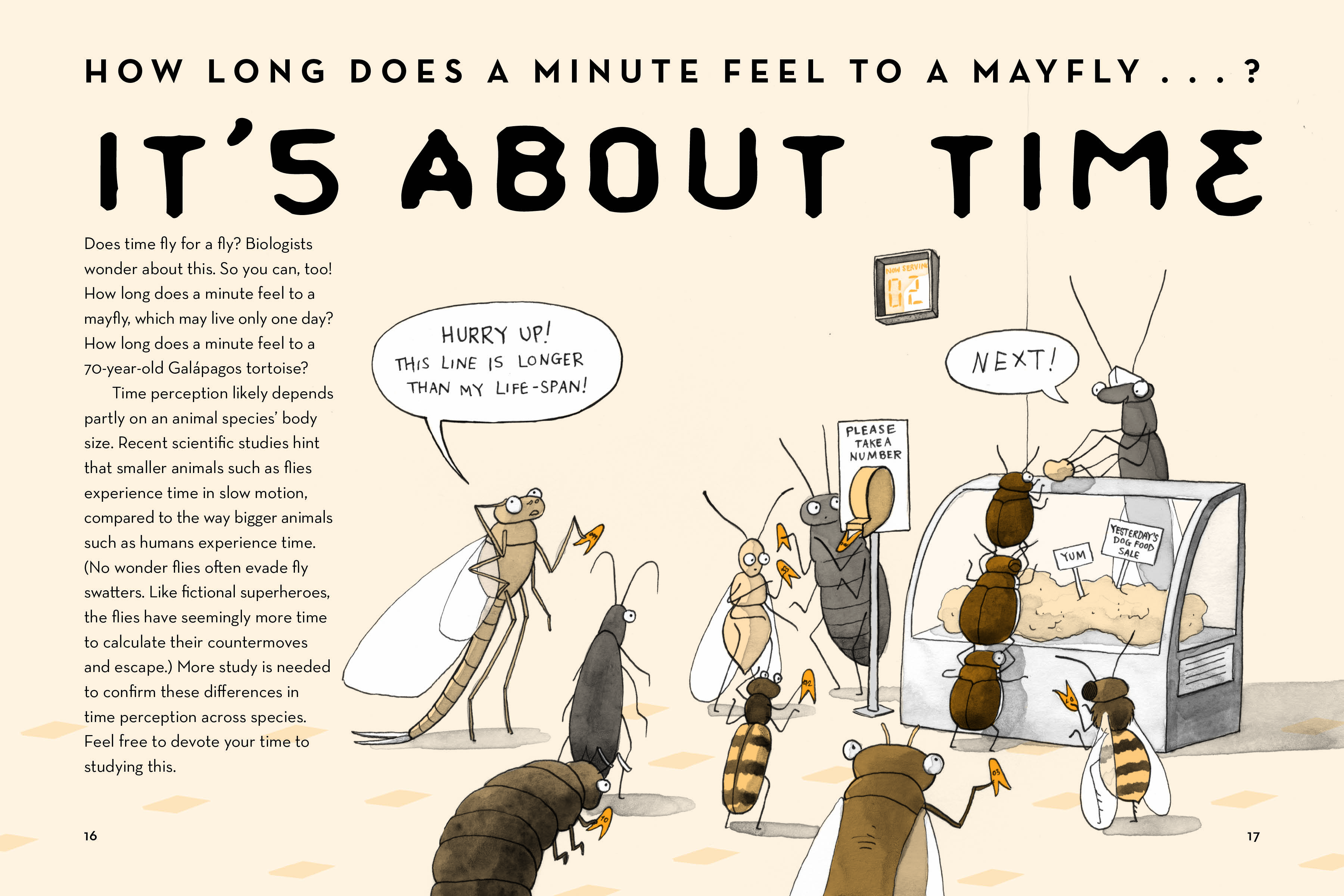
“How long does a minute feel to a mayfly…?
It’s About Time

Does time fly for a fly? Biologists wonder about this. So you can, too! How long does a minute feel to a mayfly, which may live only one day? How long does a minute feel to a 70-year-old Galápagos Tortoise?” (p. 16-17)

SLOWESTBOOK_16-17

Read This If You Loved: Nonfiction books such as Weird but True by National Geographic, Lifetime by Lola M. SchaeferExtreme Oceans and Extreme Earth Records by Seymour SimonIsland by Jason Chin, The Guinness Book of World Records

Recommended For: 

classroomlibrarybuttonsmall readaloudbuttonsmall closereadinganalysisbuttonsmall

Signatureand RickiSig

Bartholomew Quill: A Crow’s Quest to Know Who’s Who by Thor Hanson

Share

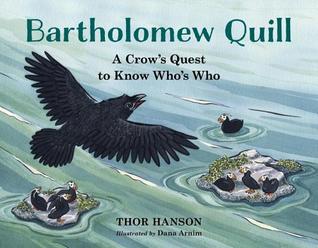
bartholomew quill

Bartholomew Quill: A Crow’s Quest to Know Who’s Who
Author: Thor Hanson
Illustrator: Dana Arnim
Expected publication April 5th, 2016 by Little Bigfoot

Goodreads Summary: Bartholomew Quill is clever and curious, but he doesn’t know who or what he is. He has feathers not fur, so he can’t be a moose; he is black like a puffin but his beak is the wrong color. This determined bird won’t stop asking questions until he discovers what the reader knows–Bartholomew Quill is a crow!

Acclaimed biologist Thor Hanson takes us on a journey through the animal kingdom, and Dana Arnim’s exuberant watercolor and ink illustrations add to the magic.

About the Author: Thor Hanson is a biologist and author renowned for his adult books about nature (The Impenetrable Forest, The Triumph of Seeds, and Feathers). He won a PNBA Award and The John Burroughs Medal for Feathers, which was also a finalist for the Washington State Book Award. Hanson is a Guggenheim Fellow, a Switzer Environmental Fellow, and sought-after public speaker.

About the Illustrator: Dana Arnim, a northwest native, earned her art degree from the University of Washington. She lives with her husband and family in Seattle and helps lead the Society of Children’s Book Writers and Illustrators (SCBWI) Western Washington chapter.

Kellee’s Review: Bartholomew Quill’s journey is a bit different than other books because the reader already knows the answer to the question the protagonist seeks. I can see reading this with students and students shouting answers and information to Bartholomew as he goes about his journey. What I think is quite wonderful about this book is that although the book is anthropomorphic, the animal information is still factual since it was written by a biologist. Arnim did a beautiful job with the illustrations as well, bringing the animals to life. 

Ricki’s Review: This book touched me in the way that it reminded me of the Native American creation myths my grandfather used to tell when I was a young child. He’d pull me onto his lap and tell me how the river became a river or why the wind whistles. I am sure that these myths made me the reader I am today. Bartholomew Quill is a beautiful story that will leave children to dream about other fictional connections with Mother Nature. It inspires me to get outside and look for animals like Bartholomew in order to learn their stories, too.

Teachers’ Tools for Navigation: Throughout the book, Bartholomew compares and contrasts himself with other animals to help figure out what animal he is. This book would be a great introduction to compare and contrast using the conversations Bartholomew has as well as the illustrations of the different animals.

Students could also use this book as a jumping off point for an animal study of one of the animals within the book. Each animals is quickly discussed, so students could pick the animal that interests them and complete an inquiry project about the animal.

Discussion Questions: How does Bartholomew determine that he is a crow?; How is he different from ______?; How is he the same as ______?

We Flagged: 

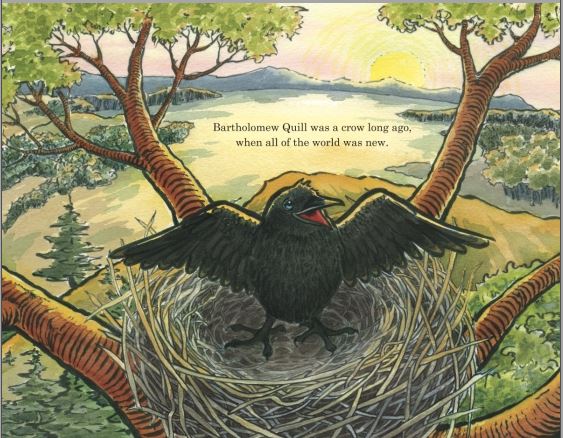
bartholomew quill illustration

Read This If You Loved: Frozen Wild by Jim Arnosky, Winter Bees by Joyce Sidman, Feathers by Melissa Stewart

Recommended For: 

readaloudbuttonsmall classroomlibrarybuttonsmall

Kellee Signature andRickiSig

**Thank you Nicole at Sasquatch Books for providing copies for review!**

Finding Winnie: The True Story of the World’s Most Famous Bear by Lindsay Mattick

Share

NFPB2016

Nonfiction Wednesday

Nonfiction Picture Book Wednesday is hosted by Kid Lit Frenzy and was started to help promote the reading of nonfiction texts. Most Wednesdays, we will be participating and will review a nonfiction text (though it may not always be a picture book).
Be sure to visit Kid Lit Frenzy and see what other nonfiction books are shared this week!

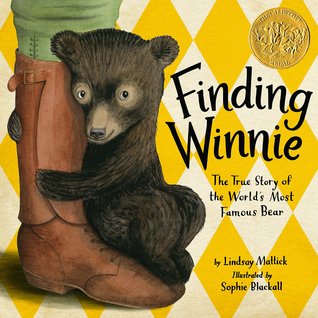
finding winnie

Finding Winnie: The True Story of the World’s Most Famous Bear
Author: Lindsay Mattick
Illustrator: Sophie Blackall
Published October 20, 2015 by Little, Brown Books for Young Readers

Goodreads Summary: Before Winnie-the-Pooh, there was a real bear named Winnie.

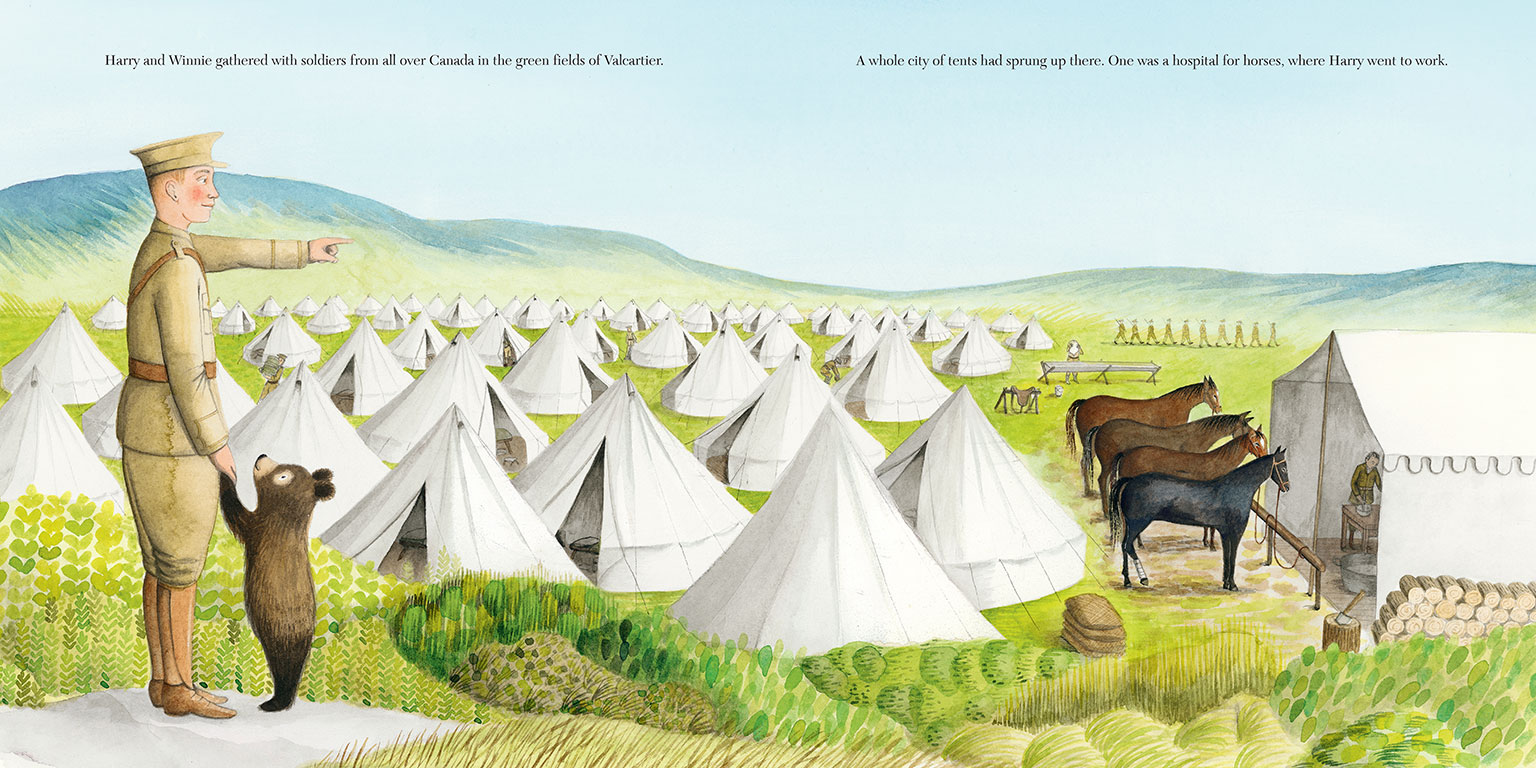
In 1914, Harry Colebourn, a veterinarian on his way to tend horses in World War I, followed his heart and rescued a baby bear. He named her Winnie, after his hometown of Winnipeg, and he took the bear to war.

Harry Colebourn’s real-life great-granddaughter tells the true story of a remarkable friendship and an even more remarkable journey–from the fields of Canada to a convoy across the ocean to an army base in England…

And finally to the London Zoo, where Winnie made another new friend: a real boy named Christopher Robin.

Here is the remarkable true story of the bear who inspired Winnie-the-Pooh.

Ricki’s Review: Many of my blogger friends raved about this book. I knew I needed to read it, but my library hold list was very long. When I saw it won the Caldecott Award, I took action. I drove my son to the bookstore and read the book to him while he sat on my lap. My aunt came with me, and she cried through the entire book.

When we reached the end, we just stared at each other and she said, “Ricki, you have to buy this book. Henry needs to have this special story.” And this is how I broke my rule about buying books. Finding Winnie sits elegantly on my son’s bookshelf, and I don’t regret breaking my rule. We love reading it together. The story is captivating from the beginning to the end, and the author and illustrator paint the scene in a remarkable way that readers will be unable to put the book down. Depicting history in picture books is very difficult, and Mattick and Blackall nail it. I highly recommend this charming book if you haven’t read it yet. It will stay close to your heart.

Kellee’s Review: One of the things I particularly loved about Finding Winnie, that Ricki didn’t mention in her beautiful review above, was that the book was written by the great-granddaughter of Captain Coleburn, the serviceman who owned Winnie originally. Having Lindsay Mattick’s close knowledge of the story helped her delve into the story and transport the reader into Winnie’s stories. The backmatter filled with photos and other primary documents also make it feel like we are peaking into the family’s scrap book.

I also want to praise Sophie Blackall’s illustrations. I love Sophie’s soft style with what seems like pencil and paints just is angelic and brings Mattick’s story to life. Although they both would shine separately, they are stellar together.

Teachers’ Tools for Navigation: As a teacher, I’d love to do two things with this book. First, I’d want to compare it to the Winnie the Pooh stories by A. A. Milne. It would be great to compare and contrast the stories to make connections about how Milne might have been inspired. Then, I’d put this book in semi-literature circles. Students might read all of the books (in the “Read This If You Loved” section below) in small groups, and rotate the books across groups. Then, they could discuss the topic and depiction of animals during wars throughout literature. They could compare and contrast the stylistic choices of the authors and also delve into potential ways that animals might be symbolic of each particular war.

Discussion Questions: How do the author and illustrator depict Winnie? How does Winnie’s story evolve?; What does Harry’s friendship with Winnie teach us about human nature?; How might this story have inspired the fictional Winnie the Pooh story?; Why do you think it won the Caldecott? What qualities make it an award winner?

We Flagged: 

Finding WInnie Spread

**Image from: https://thewalrus.ca/finding-winnie/. We recommend this site, which includes many great images related to the text!**

Read This If You Loved: Winnie: The True Story of the Bear That Inspired Winnie-the-Pooh by Sally M. Walker, Winnie the Pooh  by A. A. Milne, Midnight, A True Story of Loyalty in World War I by Mark Greenwood, Stubby, the War Dog by Ann Bausum, Dogs of War by Sheila Keenan, Faithful Elephants by Yukio Tsuchiya

Recommended For: 

readaloudbuttonsmall classroomlibrarybuttonsmall litcirclesbuttonsmall

RickiSigandSignature