Review and Giveaway: The Caiman by María Eugenia Manrique, Illustrated by Ramón París, Translated by Amy Brill

Share

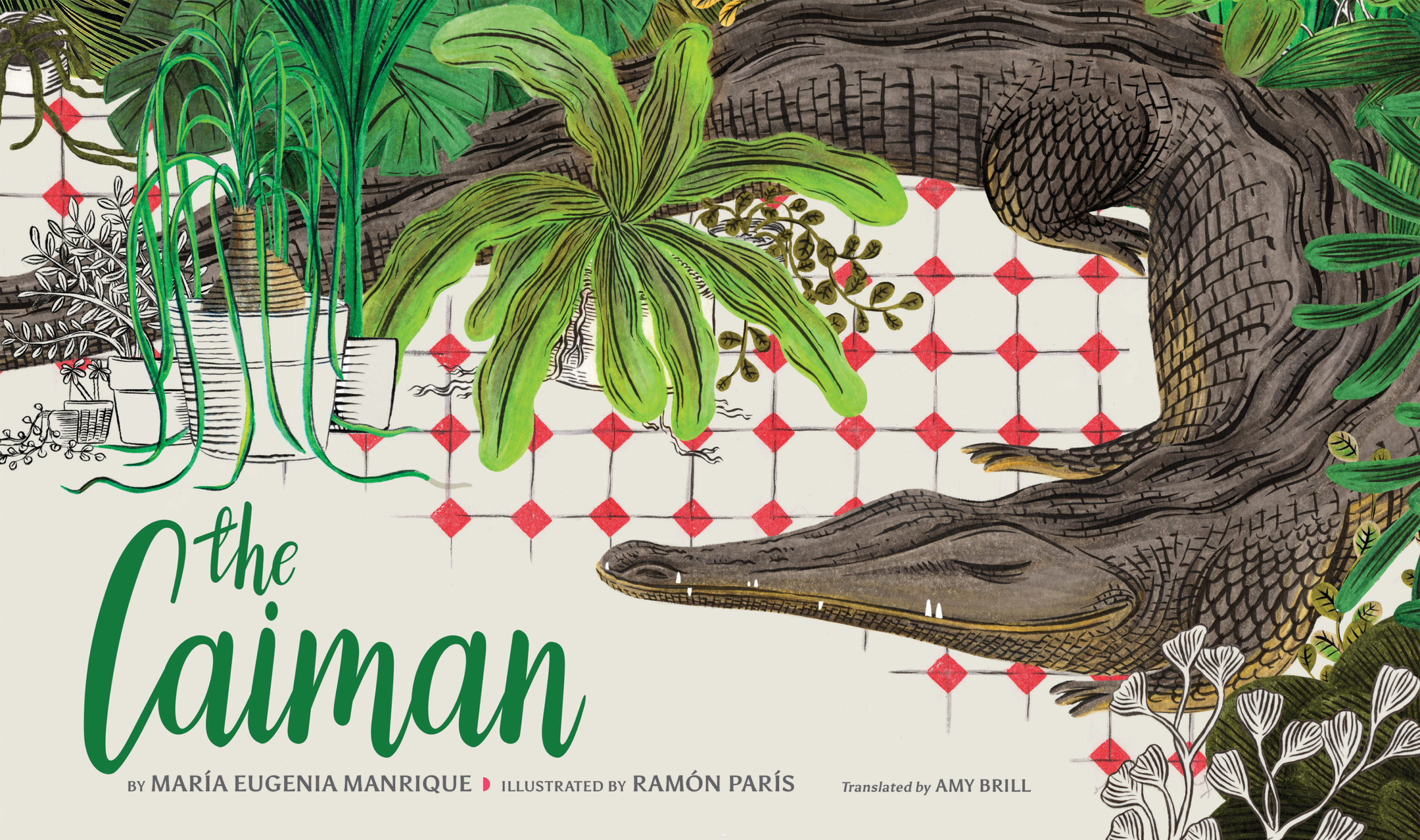
The Caiman
Author: María Eugenia Manrique
Illustrator: Ramón París
Translator: Amy Brill
Published: July 1, 2021 by Amazon Crossing Kids

Summary: The unforgettable story of a man and his alligator.

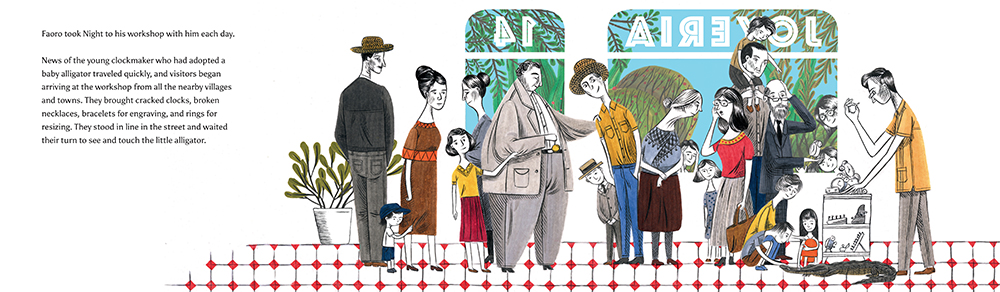
When Faoro the clockmaker adopts a baby alligator, he has no idea that someday their story will travel far and wide. But the town of San Fernando de Apure would never forget this kind young man and his adoring alligator, who played with the neighborhood children, took part in Faoro’s wedding, and, eventually, mourned his loss. Now their story is being shared with the world.

In this delightful picture book first published in Venezuela, the author brings us back to her own childhood in Venezuela, as one of the children who used to visit this famous caiman, to tell the story of a man who loved animals and how his friendship with his alligator sparked a lasting legacy.

A New York Times Globetrotting Pick!

★“The striking illustrations…have a wild and whimsical feel about them, featuring lush foliage and expressive characters, including the eventually enormous caiman. It’s a memorable and unexpected demonstration of the universality of love, grief, and kindness.” —Booklist (starred review)

María Eugenia Manrique is one of the girls portrayed in this story. She rode the caiman when she visited her family in San Fernando de Apure. She was born in Caracas, Venezuela, and currently lives in Barcelona, Spain. She studied fine art in Mexico City, specializing in xylography and engraving; Eastern painting at Nankín University, China; and sumi-e and calligraphy at the Nihon Shuji Kyoiku Zaidan Foundation in Japan. Her work has been exhibited in museums and galleries around the world. The Caiman is her first children’s book. For more information, visit her website: https://mariaeugeniamanrique.wordpress.com/.

Instagram: @mem.manrique

Ramón París was born in Caracas, Venezuela, and as a child lived in Barinas, a plains state like Apure, where he also heard the story of the caiman. He currently lives in Barcelona, Spain. Hismost recent book for children, Duermevela, was selected for the Bologna Book Fair Illustrators Exhibition. His books have been recognized with honors including Los Mejores del Banco del Libro and  the IBBY Honor List, among others, and they have been translated into numerous languages. Visit him at: ramon.paris.

Instagram: @ramon_paris_ilustrador

Amy Brill’s fiction and nonfiction have appeared in numerous publications including the Washington Post, Medium, Real Simple, Oprah.com, and One Story. Her first novel, The Movement of Stars, was published by Riverhead Books. A native New Yorker, Amy lives in Brooklyn with her husband and two daughters.

Ricki’s Review: It’s NONFICTION. I read this book and couldn’t believe that the story was true, and it made me love it even more! The author beautifully tells the story of Jose Faoro, who adopts a baby alligator when it is just days old. My children have always dreamed of adopting a large animal such as this, so it offered a wonderfully intriguing read. Although, I might add that they now think that we can take in an alligator in our house (ha!). This is the story of a great man who loved animals and loved those around him. I absolutely adored the gentle telling, and it felt like a book that would be translated because children all over the world would be captivated by this story. The illustrations stand out to me because they are timeless. They feel contemporary to my boys, but they also filled my heart with a softness because they reminded me of the classic illustrations of the stories I read and loved as a child. Ahhh, I just adore this book.

Teachers’ Tools for Navigation: This book is accessible to all levels, but I’d love to see it in elementary school classrooms, where teachers ask their students to research examples of other people who did something out of the ordinary. They could write their own picture books.

Discussion Questions: 

  • How do the words and illustrations work together to form a cohesive story?
  • Does Faoro’s story surprise you? Why or why not?
  • What does Faoro’s life tell you about him?
  • What did you learn from the story?

Flagged Passages: 

Read This If You Love: Nonfiction Picture Books; Timeless Stories; Books about Animals

Giveaway:

a Rafflecopter giveaway

Recommended For: 

classroomlibrarybuttonsmall   

**Thank you to Barbara at Blue Slip Media for Providing a Copy for Review!**

Charming as a Verb by Ben Philippe

Share

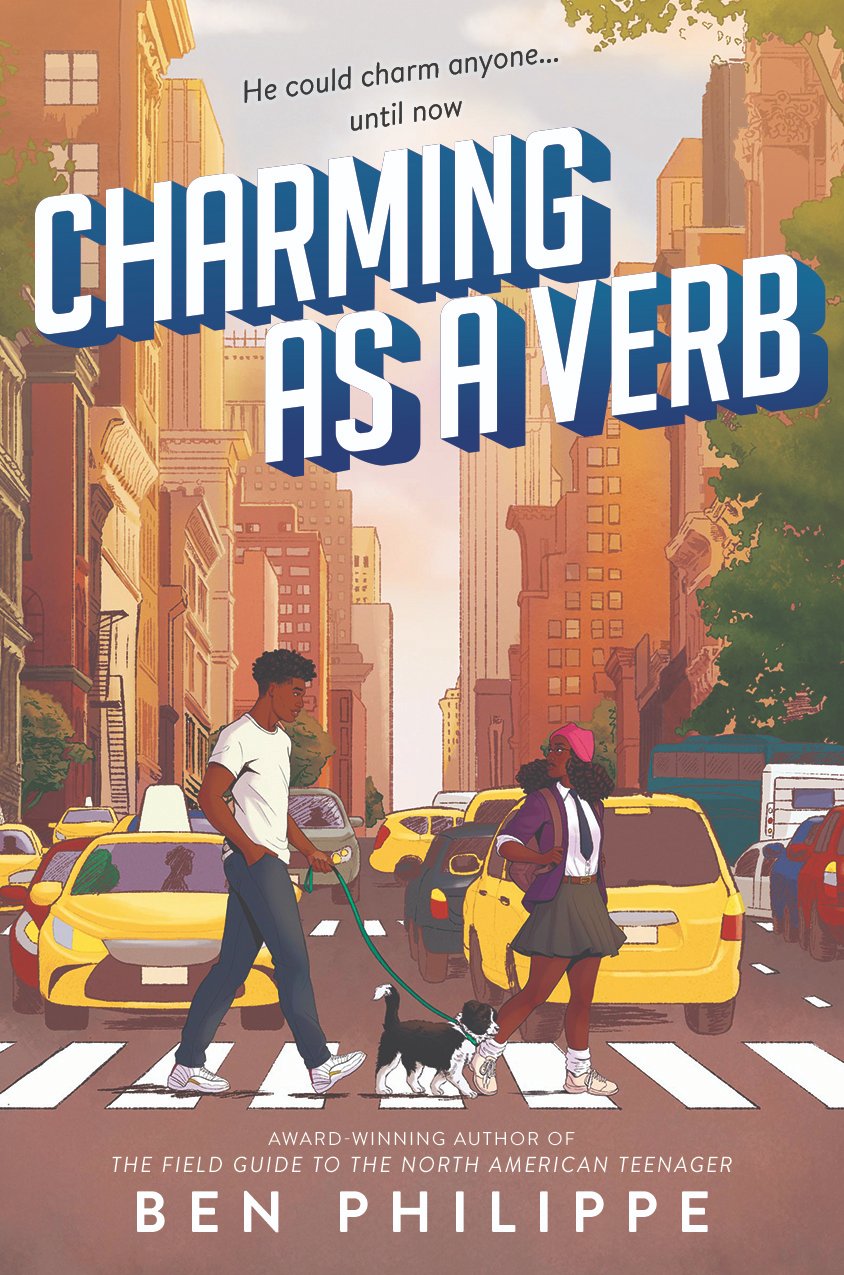
Charming as a Verb
Author: Ben Philippe
Published October 13, 2020 by Balzer + Bray

Summary: Henri “Halti” Haltiwanger can charm just about anyone. He is a star debater and popular student at the prestigious FATE academy, the dutiful first-generation Haitian son, and the trusted dog walker for his wealthy New York City neighbors. But his easy smiles mask a burning ambition to attend his dream college, Columbia University.

There is only one person who seems immune to Henri’s charms: his “intense” classmate and neighbor Corinne Troy. When she uncovers Henri’s less-than-honest dog-walking scheme, she blackmails him into helping her change her image at school. Henri agrees, seeing a potential upside for himself.

Soon what started as a mutual hustle turns into something more surprising than either of them ever bargained for. . . .

This is a sharply funny and insightful novel about the countless hustles we have to keep from doing the hardest thing: being ourselves.

Review: This is one of the best examples of characterization that I’ve read in a book. I fell in love with so many characters (even minor ones!), which drew me into the story even more. Henri reminds me of some of my favorite students that I’ve had. He’s charming, driven, and likable. There’s a lot that happens in this book that I don’t want to spoil—but I should write that it teaches an incredibly powerful lesson. There’s one scene that made my stomach do flips, and I will think of that scene often. This would be a great text to use to explore concepts of ethics. It also offers a lot of insight about the college prep experiences for teens. I highly recommend this book to readers. It’s a powerful story and one that will stick with me.

Discussion Questions: 

  • How does the characterization of the text add to the story? Who were your favorite characters, and why?
  • Which minor characters really stand out to you? How does the author make them so noteworthy?
  • What did you learn from this book?
  • What does this book teach us about ethics? About humanity?

Flagged Passage: 

“There’s no use complaining about it and wishing the world was different. This isn’t how we change things for ourselves.”

Read this if You Loved: Love is a Revolution by Renée Watson; The Field Guide to the North American Teenager by Ben Philippe; I Crawl Through It by A.S. King

Recommended For: 

classroomlibrarybuttonsmall  

Love is a Revolution by Renée Watson

Share

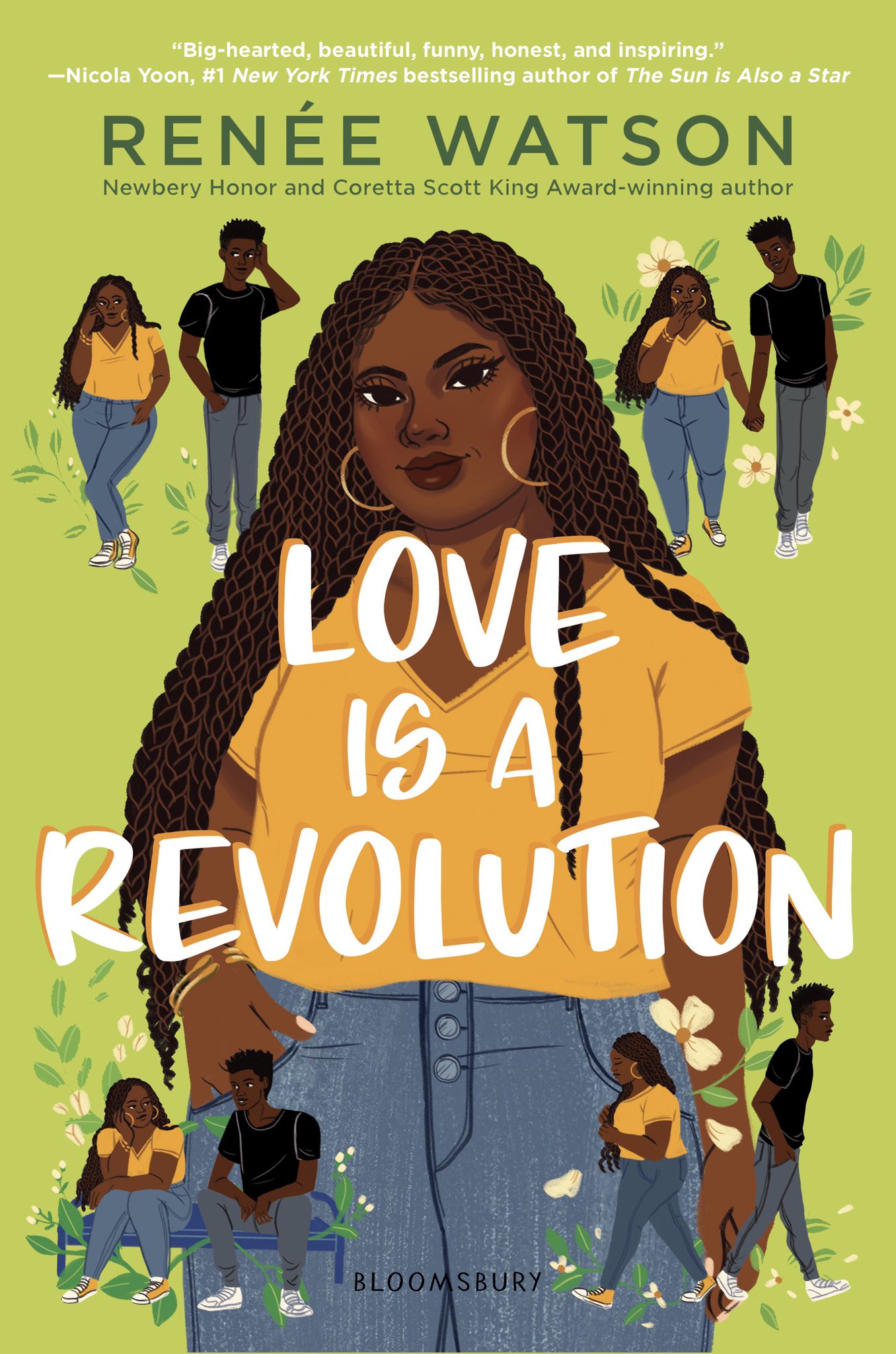
Love is a Revolution
Author: Renée Watson
Published February 2, 2021 by Bloomsbury

Summary: From New York Times bestselling and award-winning author Renée Watson comes a new YA–a love story about not only a romantic relationship but how a girl finds herself and falls in love with who she really is.

When Nala Robertson reluctantly agrees to attend an open mic night for her cousin-sister-friend Imani’s birthday, she finds herself falling in instant love with Tye Brown, the MC. He’s perfect, except . . . Tye is an activist and is spending the summer putting on events for the community when Nala would rather watch movies and try out the new seasonal flavors at the local creamery. In order to impress Tye, Nala tells a few tiny lies to have enough in common with him. As they spend more time together, sharing more of themselves, some of those lies get harder to keep up. As Nala falls deeper into keeping up her lies and into love, she’ll learn all the ways love is hard, and how self-love is revolutionary.

In Love Is a Revolution, plus size girls are beautiful and get the attention of the hot guys, the popular girl clique is not shallow but has strong convictions and substance, and the ultimate love story is not only about romance but about how to show radical love to the people in your life, including to yourself.

Ricki’s Review: There is so much to write about this book! First, I loved the way it elevated body positivity. The comments (implicit and explicit) about Nala’s size felt, at times, infuriating. I was so proud of the way she handled these comments. I also loved the idea that everyone doesn’t need to be a loud activist to be doing amazing work. Nala was keenly focused on her family, and the work that she did was important work. I admired her greatly. The book made me think a lot about my own convictions and what I value most. This is a book that belongs in all classrooms, and I recommend it highly. 

Discussion Questions: 

  • How is Nala different from the other characters in the book? What do we learn from her?
  • What does Tye value? What do we learn from him?
  • How is Nala and Tye’s relationship perceived?
  • How do different characters in this book perceive family? Which characters reflect your own values, and why?

Flagged Passage: 

I can’t stand when people don’t follow through. Make a plan, stick to it. Say what you mean and mean what you say.”

Read This If You Love: Piecing Me Together by Renée Watson; Fat Chance, Charlie Vega by Crystal Maldonado

Recommended For: 

classroomlibrarybuttonsmall  

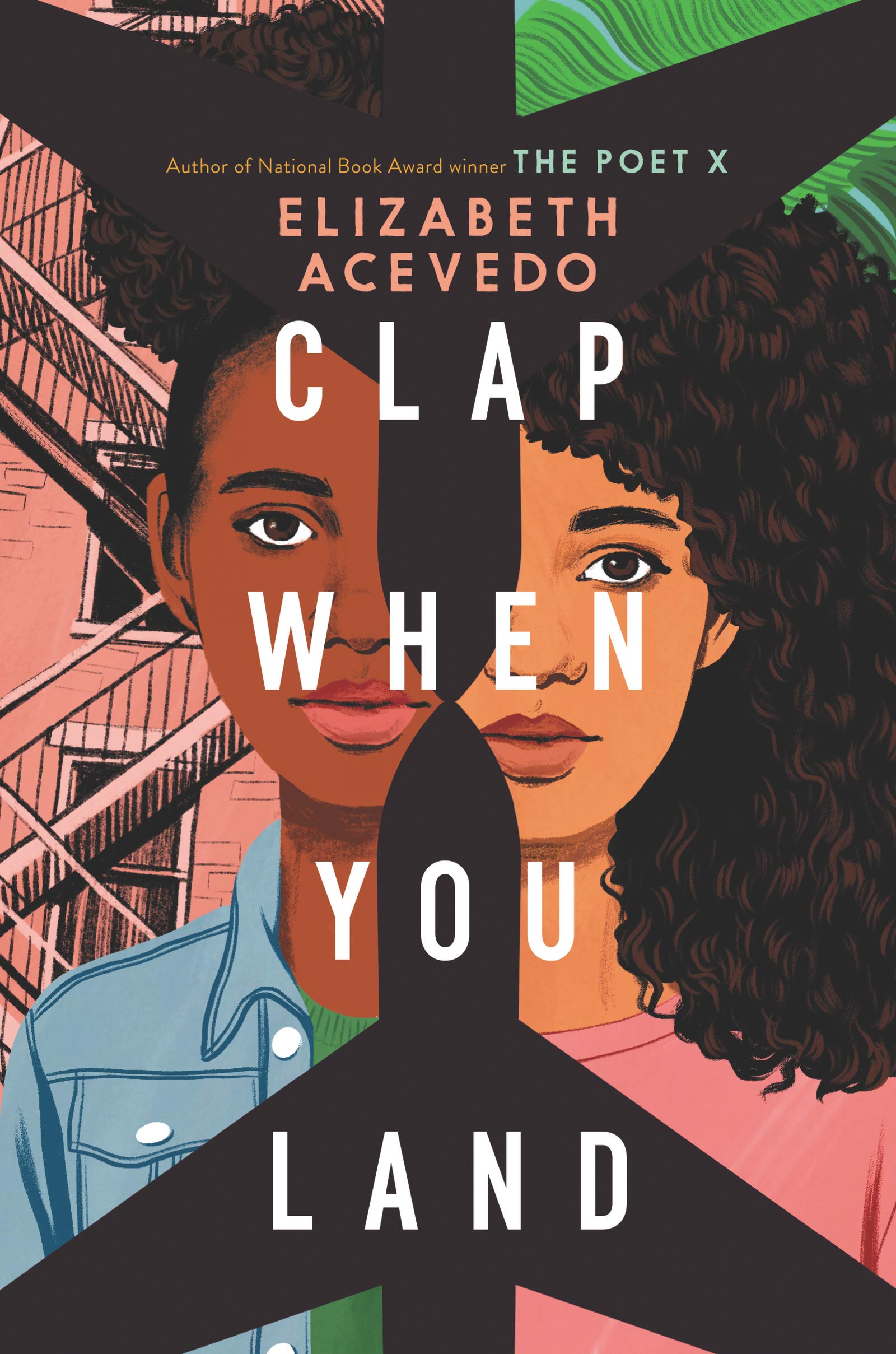
Clap When You Land by Elizabeth Acevedo

Share

Clap When You Land
Author: Elizabeth Acevedo
Published March 5, 2020 by HarperTeen

Summary: In a novel-in-verse that brims with grief and love, National Book Award-winning and New York Times bestselling author Elizabeth Acevedo writes about the devastation of loss, the difficulty of forgiveness, and the bittersweet bonds that shape our lives.

Camino Rios lives for the summers when her father visits her in the Dominican Republic. But this time, on the day when his plane is supposed to land, Camino arrives at the airport to see crowds of crying people…

In New York City, Yahaira Rios is called to the principal’s office, where her mother is waiting to tell her that her father, her hero, has died in a plane crash.

Separated by distance—and Papi’s secrets—the two girls are forced to face a new reality in which their father is dead and their lives are forever altered.

And then, when it seems like they’ve lost everything of their father, they learn of each other.

Ricki’s Review: I was so happy to see that this book won the Amelia Elizabeth Walden Award. It is one of the most beautifully written books that I have ever read. It made me laugh, it made me weep, and it filled me with so many emotions and so many wonderings. The book is beautifully lyrical, and the voices are so strong. There’s a scene in the book that simply took my breath away. If you haven’t read this book yet, I recommend you head out and purchase it now. It’s absolutely magnificent.

Discussion Questions: 

  • How do the two perspectives of the story work together? How did it enhance your reading of the story?
  • How does place function in the story?
  • Where is home for the characters?
  • How do the characters in the story grieve? What understandings did it offer about grief and loss?
  • How do the characters in this book show strength in many different ways?

Flagged Passage: 

“Can you be from a place
you have never been?

You can find the island stamped all over me,
but what would the island find if I was there?

Can you claim a home that does not know you,
much less claim you as its own?”

Read This If You Love: Books. Seriously, it would be very difficult not to see the beauty of this book. Elizabeth Acevedo is one of the greatest writers of our time.

Recommended For: 

classroomlibrarybuttonsmall   

Educators’ Guide for The Rock from the Sky by Jon Klassen

Share

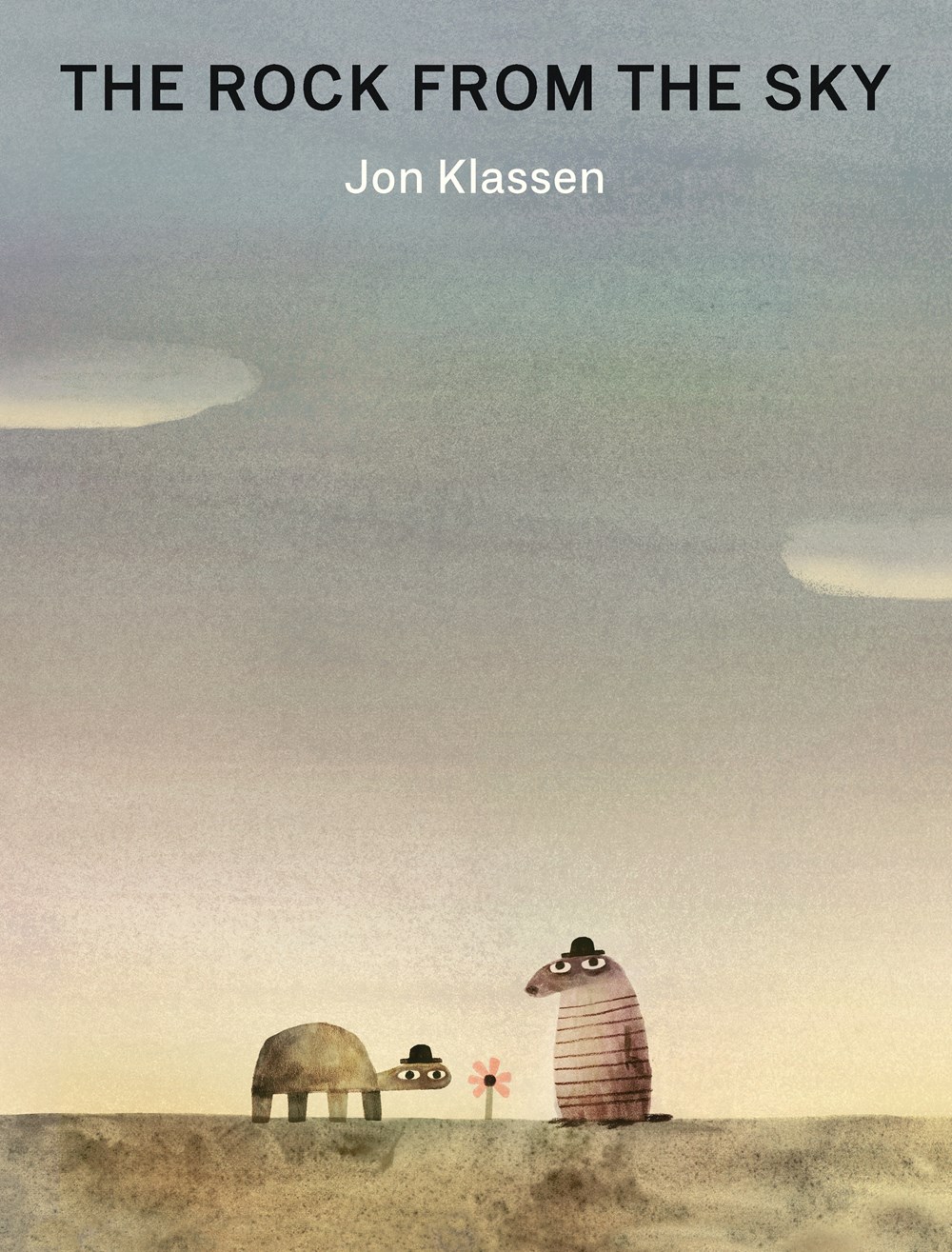
The Rock from the Sky
Author & Illustrator: Jon Klassen
Published: April 13, 2021 by Candlewick Press

Summary: Look up!

Turtle really likes standing in his favorite spot. He likes it so much that he asks his friend Armadillo to come over and stand in it, too. But now that Armadillo is standing in that spot, he has a bad feeling about it . . .

Here comes The Rock from the Sky, a meditation on the workings of friendship, fate, shared futuristic visions, and that funny feeling you get that there’s something off somewhere, but you just can’t put your finger on it.

Teachers’ Tools for Navigation and Discussion Questions: 

Please view and enjoy the teachers’ guide I created for Candlewick Press for The Rock from the Sky:

You can also access the teaching guide here.

You can learn more about The Rock in the Sky on Candlewick’s page.

Recommended For: 

readaloudbuttonsmall classroomlibrarybuttonsmall litcirclesbuttonsmall closereadinganalysisbuttonsmall

Kellee Signature

Already a Butterfly: A Meditation Story by Julia Alvarez, Illustrated by Raúl Colón

Share

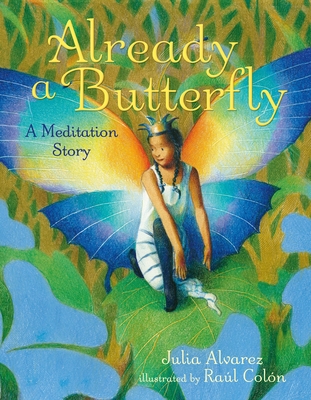
Already a Butterfly: A Meditation Story
Author: Julia Alvarez
Illustrator: Raúl Colón
Published June 16, 2020 by Henry Holt and Co.

Summary: Already a Butterfly is a gentle picture book tale about self-soothing practices and self-confidence beliefs.

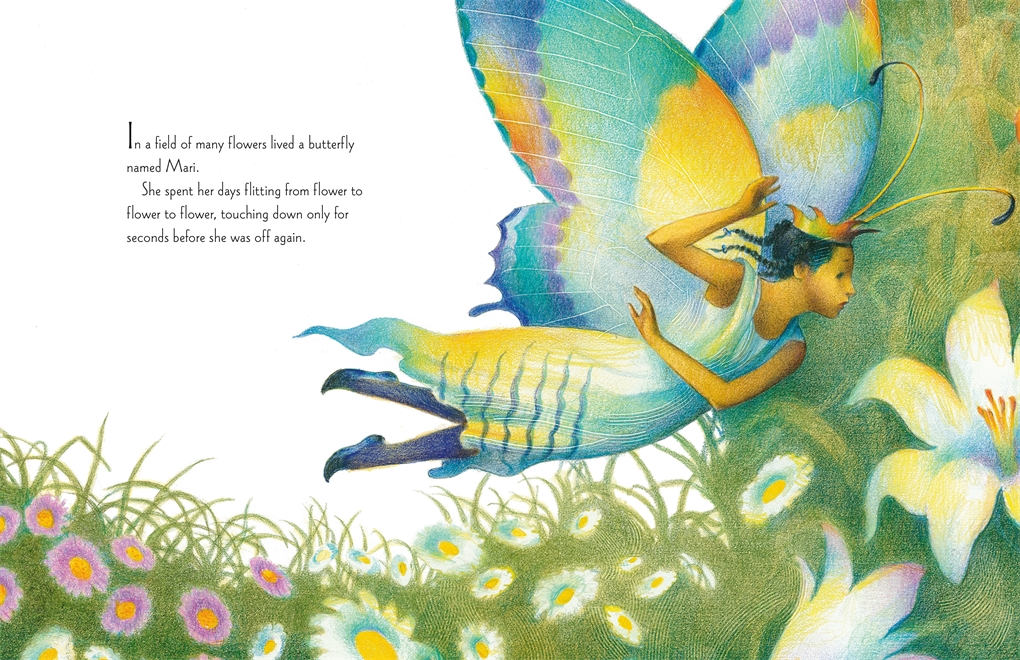
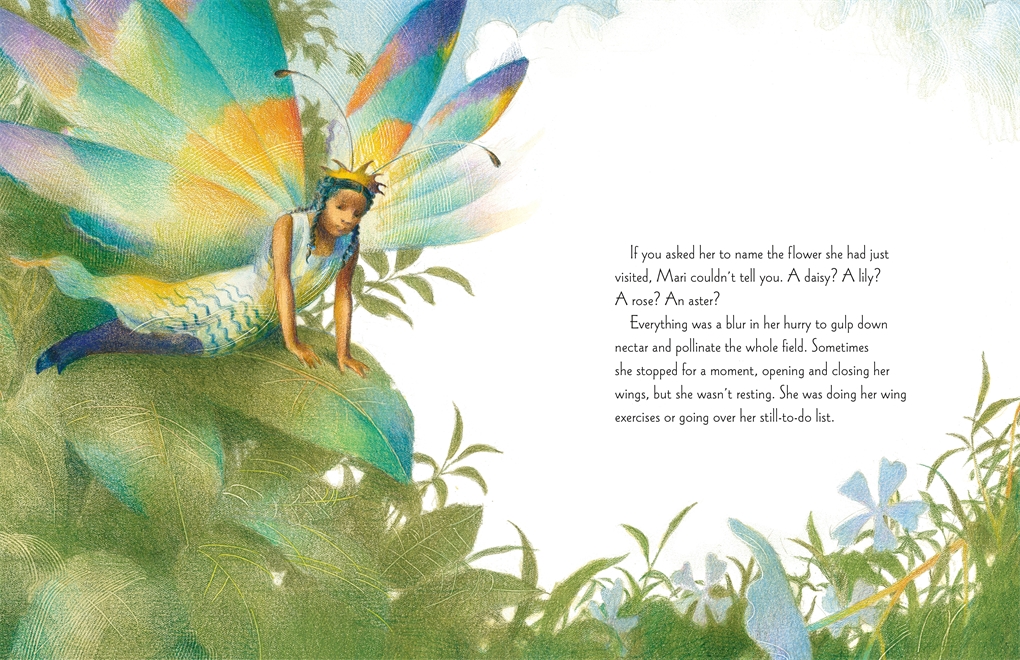
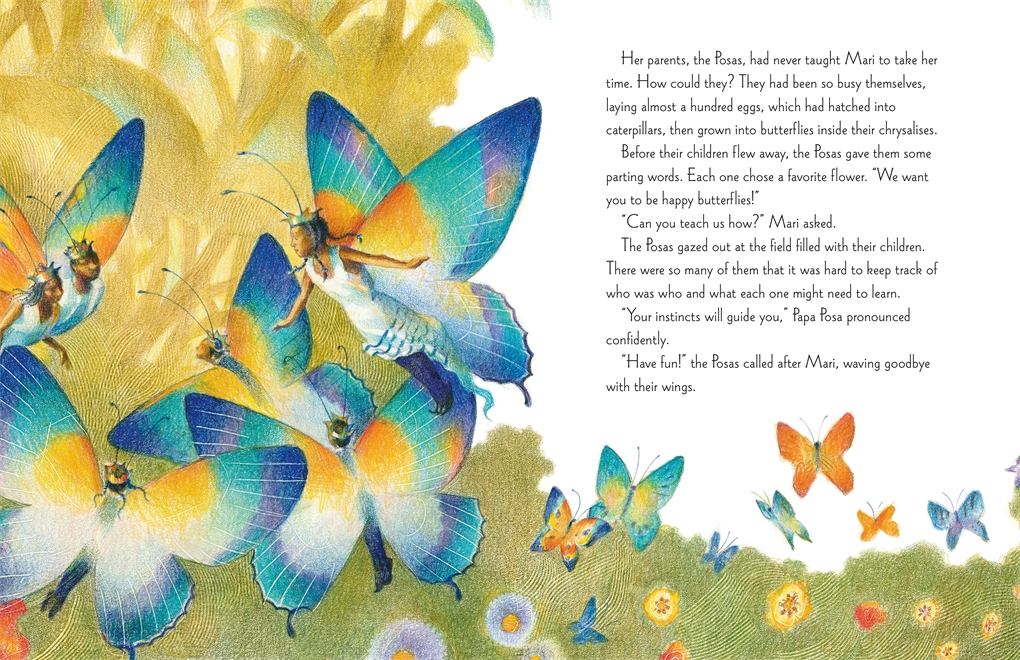
With so much to do in so little time, Mari is constantly on the move, flitting from flower to flower, practicing her camouflage poses, and planning for migration. She’s the busiest butterfly around. But does being productive mean she is happy? Mari couldn’t say. The only way she feels like a butterfly is by acting like one. Little does Mari know, the secret to feeling like herself is simply to focus her breath, find her quiet place, and follow her instincts. With the guidance of a thoughtful flower bud, Mari soon learns to meditate and appreciate that she was a butterfly all along.

Acclaimed author Julia Alvarez extolls the importance of mindfulness, reflection, and self-care for young children in this gratifying picture book, stunningly illustrated by award-winning artist Raúl Colón.

About the Author: 

Julia Alvarez is the author of numerous bestselling and award-winning novels including How the García Girls Lost Their Accents and In the Time of Butterflies, collections of poems, and works of nonfiction as well as picture books. She has won the Pura Belpré Award, the Américas Award, the Hispanic Heritage Award in Literature, the F. Scott Fitzgerald Award for Outstanding Achievement in American Literature, and the National Medal of Arts.

Raúl Colón has illustrated several highly acclaimed picture books, including Draw!; the New York Times-bestselling Angela and the Baby Jesus by Frank McCourt; Susanna Reich’s José! Born to Dance; and Jill Biden’s Don’t Forget, God Bless Our Troops. Mr. Colón lived in Puerto Rico as a young boy and now resides in New City, New York, with his family.

Praise:

“Soft, textured illustrations full of floral elements match the gentle quality of the tale. In a world that can’t seem to slow down, this story reminds readers to trust their instincts and breathe.” —Kirkus Reviews

“This is a tale about learning to be joyful in a world that seems to demand more and more of individuals. Young readers will find the prose and the dreamlike pictures of Mari’s journey soothing—and something to meditate on.” —Booklist

“Alvarez pens this introduction to meditation with advisory zeal, focusing on explanations that will appeal to caretakers who seek to support young meditation practitioners. Jewel-toned spreads by Colón provide scope for dreaming: Mari’s distinctive features—her black braids, her elflike shoes, her golden crown—give readers a fantasy heroine to linger over.” —Publishers Weekly

Review: At first glance, Mari seems like the perfect butterfly. She is beautiful, busy, efficient… but is she happy? She is doing what she things she should do but is she embracing who she is? These are the types of questions that this book is asking.

To be honest, reading this book may have hit home more for me than for Trent. The book is about slowing down and taking the time to be happy. Trent is still young and knows how to enjoy time, but it is important for me to show him that I too have time for the small things and also help him continue to do so. But just like the book made me think about passions, being busy, and how we come off, it will do the same for most readers.

I really loved the backmatter as well, learning how the author was inspired by the Mariposa DR Foundation’s Center for Girls and her granddaughters. It truly brought the book together and shows how the ideas within the book can be used in the real world.

Now, take all of this beautifulness in words and story and add in Colón’s beautiful watercolor illustrations that bring Mari to life, and this book clearly is a must have when discussing mindfulness with all ages!

Teachers’ Tools for Navigation: Use Already a Butterfly and the ideas in the “Growing Your Own Wings” backmatter to bring meditation into your classroom. A great day to introduce this would be World Meditation Day which is May 21st!

An extension reflection activity that would be fun is to have students make their own butterfly wings and write items, moments, people, etc. on their wings that make them truly happy. These wings can be a symbol to remind them to cherish those things.

Tips for Mindful Meditation: 

Discussion Questions: 

  • Why did the author choose Mari as the butterfly’s name?
  • How was the author inspired by her time with the Mariposa DR Foundation’s Center for Girls?
  • How could Mari’s story be compared to your life?
  • What did Bud teach Mari?
  • Why was Mari happier in her chrysalis?
  • Do you think what Bud taught Mari will make her happier?

Flagged Passages: 

Read This If You Love: I am Peace by Susan Verde, Calm with the Very Hungry Caterpillar by Eric Carle, My Magic Breath by Nick OrntnerGood Morning Yoga by Miriam Gates

Recommended For: 

classroomlibrarybuttonsmall 

Signature

**Thank you to Barbara at Blue Slip Media for providing a copy for review!**

Review and Giveaway!: Rescue at Lake Wild by Terry Lynn Johnson

Share

Rescue at Lake Wild
Author: Terry Lynn Johnson
Published April 27, 2021 by HMH Books for Young Readers

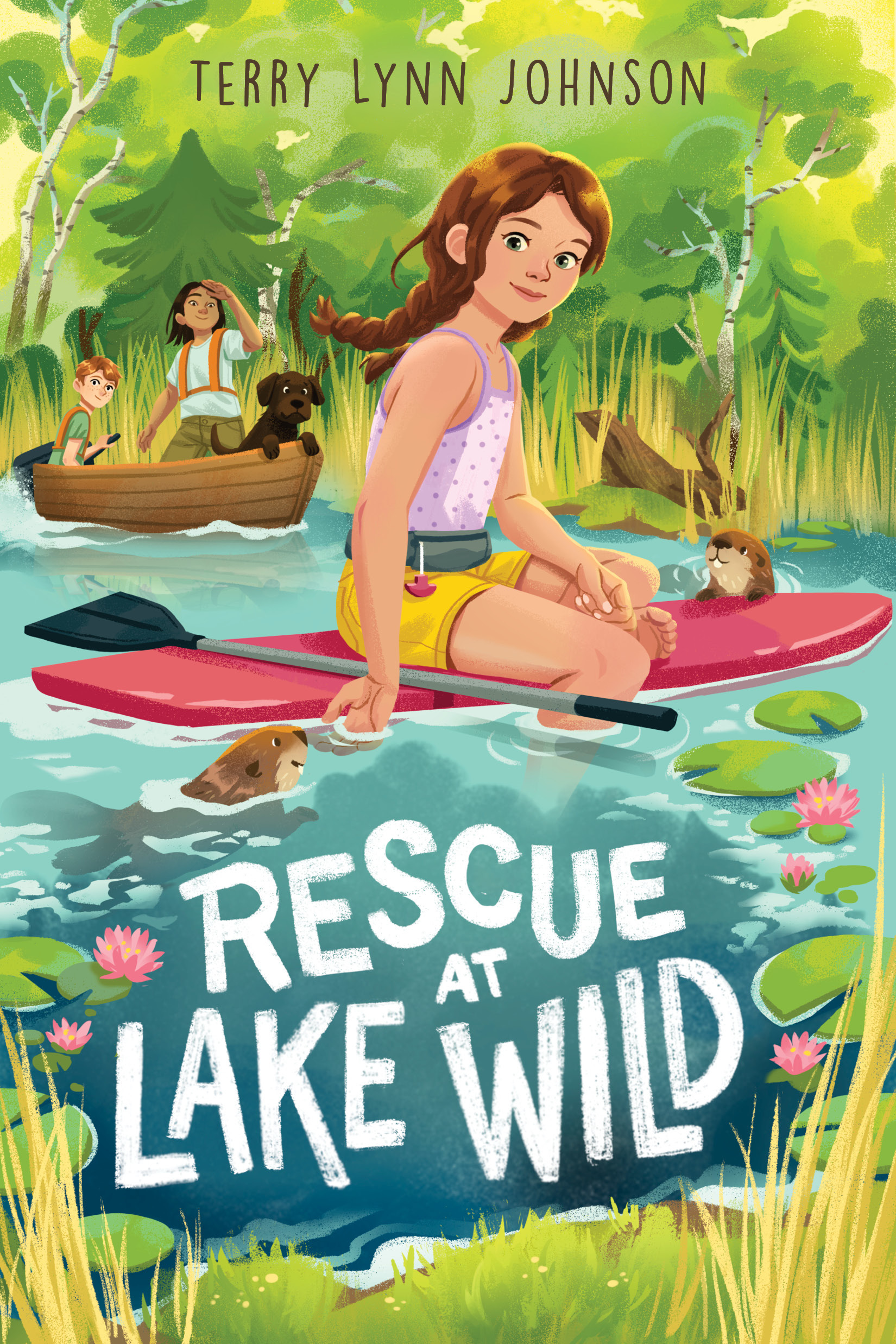
Summary: In this funny and moving animals-in-peril adventure, a twelve-year-old girl and her two best friends determine to rescue two orphaned beaver kits—and soon find themselves trying to solve a local environmental crisis.

Everyone knows that twelve-year-old Madison “Madi” Lewis is not allowed to bring home any more animals. After she’s saved hairless mice, two birds, a rabbit, and a stray tom cat that ended up destroying the front porch, Madi’s parents decide that if they find one more stray animal in the house, she won’t be allowed to meet Jane Goodall at an upcoming gala event.

But when Madi and her two best friends, Aaron and Jack, rescue beaver kits whose mother was killed, they find themselves at the center of a local conspiracy that’s putting the beavers and their habitats in danger. As Madi and her friends race to uncover the threat targeting the beavers, Madi must put her animal whisperer skills to the test in both raising the orphaned beaver kits and staying out of trouble long enough.

About the Author: Terry Lynn Johnson writes about the wild with the wisdom and passion of someone who has spent her life working to preserve and protect it – both as a backcountry canoe ranger in Quetico Provincial Park and in her current job as a conservation officer with the Ontario Ministry of Natural Resources and Forestry. She lives at the edge of a lake in northern Ontario, Canada, where she loves watching all wildlife, including beavers. Visit her online at terrylynnjohnson.com

Twitter: @TerryLynnJ
Instagram: terry_lynn_johnson

Review: This book is everything the summary promises and more. I read it in one sitting because I couldn’t put it down. It was so interesting learning about beavers and conservation, but also watching Madi and her friends figure out the solution to a problem that adults automatically went to the extreme about.

Kids are going to love Madi and her friends. Their banter is so funny yet right on point for their age. I also love seeing how close they are even as they grow up and change.

In addition to the main story about the beaver rescue, Madi’s family situation will bring about good conversation about different types of families.

But truly, the real stars of this book are the beavers. I never knew as much about them as I do now, and they are such interesting animals. This book definitely led to inquiry as I wanted to learn so much more about environmental conservation and beavers.

Teachers’ Tools for Navigation: In addition to being a book that so many kids are going to want to pick up and read, this book lends itself perfectly to so much in the classroom!

Madi talks often in the book about her grandmother and Jane Goodall and all of the work they did to help preserve animals; however, there are tons of other scientists who help converse nature and animals’ habitats. Have students research these scientists, and remind them to think about local and smaller rescue facilities who do work that often aren’t recognized.

Madi LOVES animals and we learn so much about beavers in this book. Use the idea of Madi’s notebook to have students pick an animal and research it.

Madi solves a problem by going step by step through the problem solving process. Look at the six-step problem solving process and work through how Madi made her way through to help her town and the beavers.

Finally, learn about Terry Lynn Johnson’s inspiration for Rescue at Lake Wild here. This would lend to a great discussion about author’s purpose and point of view.

Discussion Questions: 

  • Why do the adults of the town automatically start killing beavers?
  • How does Madi figure out a solution to the problem?
  • How did the setting play a part in the story?
  • Which character did you most relate to and why?
  • Who do you look up to like Madi looks up to Jane Goodall?
  • What is your passion and how can you pursue it in your life?
  • How did having her two friends to help her lend to Madi being successful?
  • How did Madi’s grandmother inspire her? Who has inspired you in your life?
  • Madi’s mother said no more animals, which Madi obviously disagreed with, and although it seems harsh, she has her reasons. What do you feel about this? Can someone be right and wrong at the same time?

Flagged Passages: Chapter 1

I hear it again.

Urgent chattering reaches us from the mound of sticks and mud just off the bow of our boat.

“We’re going to have to do it,” I say, and then can’t help add, “I told you they were here.”

As an animal whisperer, I know these things, but sometimes I have to remind certain people.

A breeze catches the boat and swings us around the anchor line. The channel’s empty except for the beaver lodge, the three of us, and one bored dog.

“We’re sure the parents aren’t coming back, Madi?” Aaron asks.

“You saw their parents,” I say. “They’re not coming.” We’ve been here almost two hours to make sure there were no other adults in the lodge.

Finally Jack says, “Let’s do it already.”

“Before you say I should do it because I’m smallest,” Aaron says, “let me remind you I’ve been the rescuer the last two times.”

He’s talking about when we boosted him into a tree to save a raccoon that turned out not to need saving. Okay, I was wrong that one time. But the day we lowered him from the window by his feet to save the baby bird? That bird would have died without us.

“Out of the three of us, you’re the easiest to hang by the feet,” I say reasonably.

“It’s not my turn.” Aaron shifts on the aluminum seat. “And I’m not that small.”

“We’ve never done this before,” Jack says. “So it starts over.”

“What starts over?”

“Turns,” Jack says.

Adjusting the tiller handle, I move to sit next to Aaron in the middle of the boat. “We should play for it.” I hold up a fist, the universal sign for rock-paper-scissors. “So it’s fair.”

The three of us stick our fists together. Jack’s black Lab, Lid, pokes his nose into the circle too, ever hopeful that we’re about to unveil food.

“One, two, three!

“No!” Aaron yells at our scissors to his paper. “Rigged!”

“I’d take your shirt off if I were you,” Jack advises. “So it doesn’t get stuck and snag you down there. We probably wouldn’t be able to pull you up.”

Aaron pales but tries to look brave. “I always end up doing it,” he grumbles, reaching behind his back to pull off his T-shirt. The hot July sun bounces off his blinding white torso.

Aaron scowls at us and then glances over the side of the boat. He studies the brown water and mutters something about leeches.

“Maybe you should keep your shirt on for protection,” I suggest, eyeing his stick-thin arms covered in rust-brown freckles, and his pale shoulder blades that could cut a breakfast sausage.

“Are they even still alive?” Aaron says. “I can’t hear them anymore.”

He’s right. There’d been no sounds from the lodge in the last few minutes we’ve been sitting here arguing.

Earlier, we’d found two adult beavers floating dead on the other side of the channel. Jack, as usual, had wanted to investigate the crime scene immediately. But the noises from the lodge mean babies inside. Those babies will starve to death if we don’t rescue them.

We’ve been waiting here long enough to know there are no other adult beavers coming to take care of them. But how long have the young ones been alone in there? Maybe they’re starved already.

“Shhh!” I say. “Listen.”

We still our movements in the boat and drift. An enthusiastic frog trills next to us. The wind rustles the leaves of trembling aspen towering above. The water gently laps at the aluminum beneath us. We strain to hear anything. The silence stretches.

A long, high-pitched noise erupts from Lid’s rear end. It echoes strangely from the bottom of the boat, sounding like an optimistic elephant. Surprised, Lid looks behind him.

Aaron and Jack both burst out laughing. It’s so hard to keep boys focused.

“Guys, I don’t hear them. Maybe we waited too long.” Maybe the little beavers are just too weak now to make noise and desperately need help right this very second. I grab the anchor and haul it up. “We have to hurry!”

I yank at the oars and thrust the boat up onto the muddy bank of the lodge. Lid jumps out first, followed by Jack, who ties us off on a log. Aaron warms up, swinging his arms, further accentuating his shoulder blades.

Stepping onto the latticed sticks, I peer at a section of the lodge’s roof that’s been ripped apart, most likely by wolves. But the predators haven’t gotten through. The only way into an indestructible beaver lodge is underwater.

“Okay. You’re looking for the opening to the tunnel,” I say to Aaron. “It’ll be hidden among all the sticks. Hopefully it’ll be wide enough for you to fit. You can breathe once you get into the chamber. It’ll be a room above water like a den. That’s where you’ll find the baby beavers.”

Aaron nods while staring at the lodge. He examines the murky water.

I watch him uneasily and think about when we’d boosted him into that tree. He’d spent most of the time clutching the trunk and yelling for us to bring him down. And when we’d lowered him for the bird he insisted over and over, “Pull me up!”

This is actually dangerous. If Aaron panics, he could drown for real. He could get lost under there, or get caught on something, like Jack said.

A fluttery feeling builds inside my chest. Did Jane Goodall let someone else face aggressive chimps at the Tanzania research center? No.

It should be me.

Read This If You Love: Lost in the River of Grass and Hurt Go Happy by Ginny Rorby; Song for a Whale by Lynne Kelly;  Vet Volunteers by Laurie Halse Anderson; Primates: The Fearless Science of Jane Goodall, Dian Fossey, and Biruté Galdikas by Jim Ottaviani

Recommended For: 

classroomlibrarybuttonsmall

Giveaway!

a Rafflecopter giveaway

Signature

**Thank you to Barbara at Blue Slip Media for providing a copy for review and giveaway!**