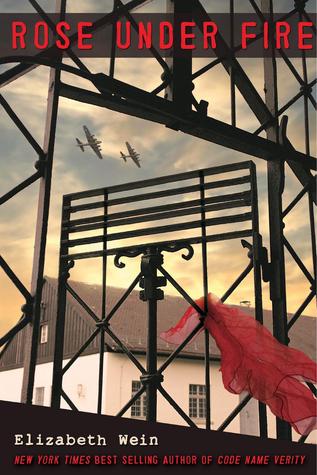
Rose Under Fire by Elizabeth Wein

Share

17262236
Title: Rose under Fire
Author: Elizabeth Wein
Expected Publication: September 10th, 2013 by Miramax (Disney)

Summary: While flying an Allied fighter plane from Paris to England, American ATA pilot and amateur poet, Rose Justice, is captured by the Nazis and sent to Ravensbrück, the notorious women’s concentration camp. Trapped in horrific circumstances, Rose finds hope in the impossible through the loyalty, bravery and friendship of her fellow prisoners. But will that be enough to endure the fate that’s in store for her?

Elizabeth Wein, author of the critically-acclaimed and best-selling Code Name Verity, delivers another stunning WWII thriller. The unforgettable story of Rose Justice is forged from heart-wrenching courage, resolve, and the slim, bright chance of survival.

Review: Out of the thousands of books I’ve read, this one is going to sit among my all-time favorites. There is a phenomenal balance of history and narrative that will engage readers while offering harrowing lessons in history. I am not an air and space girl. My husband loves planes, and he was giddy when we went to the Smithsonian Air and Space Museum in Washington D.C. As much as I want to love planes, I don’t find them to be interesting. This book changed my outlook.

Rose under Fire has many similarities with Wein’s Code Name Verity. They are both written in an epistolary format, involve pilots/airplanes, and are set during World War II. Both offer wonderfully complex themes about friendship, loyalty, and the strength of women. However, Rose under Fire focuses more on concentration camps, while Code Name Verity dealt more with the interrogation techniques used during World War II. Neither of these two elements drove the novels, but they are two plot features that make the texts quite different from one other. I found CNV to be a bit slow in the beginning (which isn’t the case with all readers), but I was hooked to Rose under Fire from the very first page. Wein writes characters so vividly that I still feel their presence in my life, long after I finish the books. I recommend this book to everyone. It will appeal to readers of all ages, backgrounds, genders, and interest levels.

Teacher’s Tools for Navigation: Teachers, this is a MUST-HAVE book. It is phenomenally written and shows the truly complexity of young adult literature. It can be used to teach elements like setting, character, dialogue, the epistolary format, imagery, voice, and theme. Students might write letters back to Rose, or they could analyze one of the many well-developed characters in this story. It would also make for a great research unit of topics like the Nuremberg Trials, female WWII pilots, flying bombs, or the experimentation on Holocaust prisoners. History teachers will also find this text to be invaluable.

Discussion Questions: What loyalties did the Holocaust prisoners have for each other? What are some examples of incidents that showed this loyalty?; Why were the Rabbits so important to the concentration camp? What did they add to the story as a whole?; How does Maddie’s friendship with Rose differ from her friendship with Julie?; Why was Nick’s character important throughout the story? How does his level of importance change, and why?; Rose has very different friendships with many of the characters. Describe how three of these friendships differ from one another.; Does the novel end in a hopeful way? Why or why not?

We Flagged: I marked so many passages that it is hard to choose just a few, so I selected two longer quotes that show the quality of Wein’s writing.

Incredible Imagery:

“…and the reason everyone in there was trying to get out in the rain was because they were dying of thirst.

Really dying of it, I think.

Hands and arms and heads stuck out anywhere there was a gap—cupped hands collecting rainwater, some holding bowls or even just a piece of cloth to collect moisture—I saw one woman lying on her back with her hair in the black cinder mud at the tent’s edge, her mouth open, letting a rivulet of water stream down the canvas and into her mouth.”

And Beautiful Figurative Language:

“Hope—you think of hope as a bright thing, a strong thing, sustaining. But it’s not. It’s the opposite. It’s simply this: lumps of stale bread stuck down your shirt. Stale gray bread eked out with ground fish bones, which you won’t eat because you’re going to give it away, and maybe you’ll get a message through to your friend. That’s all you need.

God, I was hungry.”

Please note: The above quotes are from the Advanced Reader Copy. The e-book (a galley) did not provide page or chapter numbers. The quotes may change when the book is published.

Read This If You Loved: Code Name Verity by Elizabeth Wein, Between Shades of Gray by Ruta Sepetys, Nazi Hunters by Neal Bascomb, Night by Elie Wiesel

Recommended For:

 litcirclesbuttonsmall closereadinganalysisbuttonsmall classroomlibrarybuttonsmall

026F3FBCC8C3913BD3A4D3F6920340D5

Thank you to NetGalley and Disney for sending me the Advanced Reader Copy!

Barbed Wire Baseball by Marissa Moss

Share

NF PB 2013

Nonfiction Picture Book Wednesday

Nonfiction Picture Book Wednesday is hosted by Kid Lit Frenzy and was started to help promote the reading of nonfiction texts. Most Wednesdays, we will be participating and will review a nonfiction text (though it may not always be a picture book).
Be sure to visit Kid Lit Frenzy and see what other nonfiction books are shared this week!

barbed

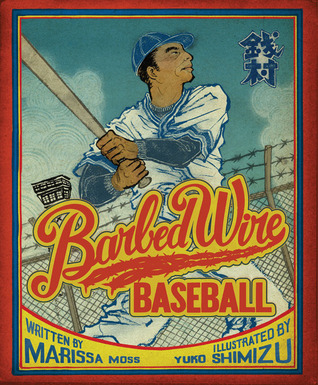
Barbed Wire Baseball
Author: Marissa Moss
Illustrated by: Yuko Shimizu
Published April 9th, 2013 by Harry N. Abrams

Goodreads Summary: As a boy, Kenichi “Zeni” Zenimura dreams of playing professional baseball, but everyone tells him he is too small. Yet he grows up to be a successful player, playing with Babe Ruth and Lou Gehrig! When the Japanese attack Pearl Harbor in 1941, Zeni and his family are sent to one of ten internment camps where more than 110,000 people of Japanese ancestry are imprisoned without trials. Zeni brings the game of baseball to the camp, along with a sense of hope.

This true story, set in a Japanese internment camp during World War II, introduces children to a little-discussed part of American history through Marissa Moss’s rich text and Yuko Shimizu’s beautiful illustrations. The book includes author and illustrator notes, archival photographs, and a bibliography.

Review: World War II is the most infamous war and it is taught to all students at some point in their career. They learn about Pearl Harbor and the Atomic Bomb and the Holocause and Hitler, but way too often what happened here in the US is not discussed. All of the Japanese Americans living on the West Coast of the US (62% were US citizens) were interned because our fear overwhelmed us so much that it was the only solution that seemed plausible. I felt that the fear that was felt after the Pearl Harbor bombings is very similar to what was felt 12 years ago today.

Barbed Wire Baseball does discuss the internment camps, but I think that the theme of this book is not about the camps but about how a love of something can turn a poor situation into something else if you are determined.

The story is just one part of the book. What moves it to a higher level is the author and illustrator. Marissa Moss has someone captured the tone of the story. It begins with hopefulness then to hopelessness and finally back to joyousness. Her ability to manipulate the tone throughout makes the story touch the reader even more. Yuko Shimizu’s illustrations are done with a Japenese calligraphy brush and ink adding to the connection the reader will feel with the story. Just beautiful.

Teacher’s Tools for Navigation: I think this book mostly leads to a discussion about the historical event that is shared in the book. In my classroom, I would share it as a read aloud and then jump into a discussion about Zeni, baseball, the internment camps, and World War II. The bibliography in the back of the book gives great websites to visit to continue the discussion.

Discussion Questions: Zeni doesn’t listen to his parents and went for what he wanted: baseball. He overcame his height and those who didn’t believe in him and was able to work towards his dreams. What is something that you’ve overcome even though others didn’t believe in you?; How can you compare/contrast how US citizens responded to Japanese Americans after Pearl Harbor to how US citizens responded to American Muslims after 9/11?

We Flagged: “Zeni stood staring at the dry earth, which was broken up every now and then by a few scrubby bits of green. In all the brown and gray, with a dull, coppery sky overhead, he felt as if he were shrinking into a tiny hard ball.

There was only one thing that could make the desert camp a home – baseball. Zeni unpacked his favorite photo, the one that showed him in uniform, lined up with baseball legends Babe Ruth and Lou Gehrig towering like redwood trees beside him. He had played with the Yankee stars in an exhibition game back home in Fresno, and he hadn’t felt small at all. He pinned the picture up over his bed. He was going to play baseball again. Here, in the desolate middle of nowhere.” (p. 9-10)

Read This If You Loved: Something to Prove by Robert Skead, Silent Star by Bill Wise, Brothers at Bat by Audrey Vernick, Keeping Score by Linda Sue Park, Nonfiction books about World War II or Japanese Internment Camps

Recommended For: 

readaloudbuttonsmall classroomlibrarybuttonsmall closereadinganalysisbuttonsmall

Signature

Battling Boy by Paul Pope

Share

battling

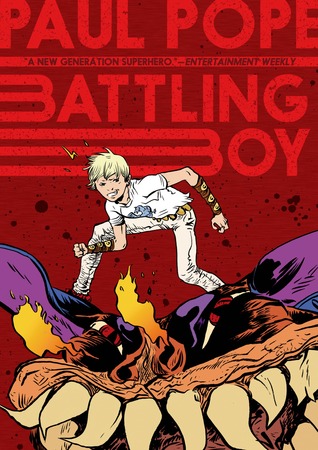
Battling Boy
Author and Illustrator: Paul Pope
Expected publication October 8th, 2013 by First Second

Goodreads Summary: The adventure begins in the new graphic novel by comics legend Paul Pope.

Monsters roam through Arcopolis, swallowing children into the horrors of their shadowy underworld. Only one man is a match for them – the genius vigilante Haggard West.

Unfortunately, Haggard West is dead.

Arcopolis is desperate, but when its salvation comes in the form of a twelve-year-old demigod, nobody is more surprised than Battling Boy himself.

IT’S TIME TO MEET AN ELECTRIFYING NEW HERO.

My Review: I am always impressed when an author can not only make an entire new world, but also new mythology. That is exactly what Paul Pope does in his new graphic novel (will be a series).  Arcopolis is a terrifying apocalyptic-esque town where you cannot walk around at night and you are always being watched by monsters. The setting is what makes this story really able to happen.

When reading, I could tell that Paul Pope is a “comic mastermind” because this story is set up very much like a traditional comic (good vs. evil, superheroes); however, there is a new twist on it because our hero is an underdog. This makes the reader root for him even more.

Warning: Cliffhanger ending! Battling Boy better be the first in a series, because I am dying to know what happens!

Teacher’s Tools For Navigation: This book will be loved in middle and high school classroom libraries. Pure comic book fans will love it, fantasy fans will love it, and adventure fans will love it.

Discussion Questions: Battling Boy lets the town believe he did something that he really didn’t – was this the right choice?; How do you think Aurora will play a part in the adventure?; Do you think Battling Boy is going to be able to save Arcopolis?

We Flagged: “The public ceremony of mourning for Haggard West was scheduled for one day… It was extended to three. The private funeral followed. A somber affair by necessity closed-casket.. and it rained. The tomb of the fallen hero. She stood under the umbrella wearing her public face… She learned long ago the special responsbilities of being a hero’s daughter… She wouldn’t allow herself to cry in public. Waves of faces in the rain.” (p. 52-53)

Check out Previews World’s Sneak Peek of Battling Boy to see some of the epic artwork.

Read This If You Loved: Amulet (series) by Kazu Kibuishi, Olympians (series) by George O’Connor, Foiled (series) by Jane Yolen, The Last Dragon by Jane Yolen
[These are adult graphic novels, but very similar feeling with mythology and epic stories] Sandman (series) by Neil Gaiman, Fables (series) by Bill Willingham, The Book of Magic by Neil Gaiman

Recommended For: 

classroomlibrarybuttonsmall

Signature

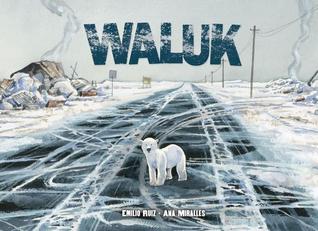
Waluk by Emilio Ruiz

Share

waluk

Waluk
Author: Emilio Ruiz
Illustrator: Ana Miralles
Expected publication November 1st, 2013 by Delcourt

Goodreads Summary: Young Waluk is all alone. His mother has abandoned him, as is the way of polar bears, and now he must fend for himself. But he doesn’t know much about the world—and unfortunately, his Arctic world is changing quickly. The ice is melting, and food is hard to find.

Luckily, Waluk meets Manitok, a wise old bear with missing teeth and a bad sense of smell. Manitok knows many survival tricks, and he teaches Waluk about seals, foxes, changing seasons, and—when Manitok is caught in a trap—human beings. Has Waluk learned enough from his friend to find a way to save him?

My Review: I’m always a big fan of books that books that tell a great story, but also teaches the reader something – Waluk fits this description.

I love that this story is told in a graphic novel because it allows us to see what Waluk is experiencing. I think this is really important because many readers will not be familiar with the setting and animals.

Additionally, there are nonfiction aspects where global warming and human impact on polar bears is discussed even with a bibliography in the end for students who want to learn more.

Teacher’s Tools For Navigation: I would love to read this graphic novel aloud to my class just to discuss with them the environmental aspects of the book. I think the story really brings global warming and the threat polar bears feel to life. Also, the story would be a great way to discuss point of view/perspective since the story is told from Waluk’s point of view.

Discussion Questions: How is global warming threatening polar bears?; What type of character traits must Waluk have to be willing to go save Manitok?

We Flagged: Manitok “If you want to be like the great Nanook, you’ll have to feed on seal blubber and whale fat.”
Waluk “Sure. Like it’s that easy. The seals laugh at me. Not even the puny lemmings are afraid of me.”
Manitok “Nah, that’s no problem, Buddy. I’m Manitok! Descended from the legend of the great whit bears. I know how to hunt anything.”
Waluk “Really?”
Manitok “Of course! Seals, walruses, belugas, lemmings, razorbills, humans–”
Waluk “Then why are you so thin?”
Manitok “Well, it’s age… see, I’m not as good as I used to be. Frankly, it’s been a while since I’ve gorged on sea lion – taken him down with my fangs, ya know, like it’s no big deal.” (p. 18)

Read This If You Loved: Seekers (series) by Erin Hunter, Nonfiction books about global warming or polar bears, Neversink by Barry Wolverton, [For further POV discussions] Who Stole Mona Lisa? by Ruthie Knapp and The Day the Crayons Quit by Drew Daywalt

Recommended For: 

classroomlibrarybuttonsmall readaloudbuttonsmall

Signature

**Thank you to Netgalley and Lerner Publishing Group (Graphic Universe) for providing the e-galley!**

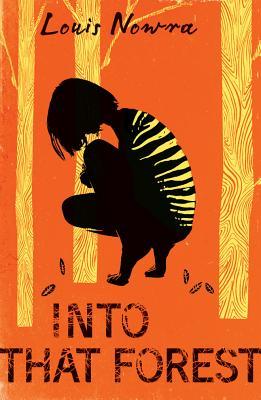
Into That Forest by Louis Nowra

Share

17870105
Title: Into That Forest
Author: Louis Nowra
Expected Publication: September 3th, 2013 by Amazon Children’s Publishing

Summary: Hannah and Becky are traveling down a river in Tasmania, Australia with Hannah’s parents when a storm erupts. Their boat overturns, and Hannah and Becky are left to survive in the wild. Two Tasmanian tigers are nearby, and because they’ve recently lost their pups, the tigers adopt Hannah and Becky as their own children. The two girls slowly adapt to the tigers’ ways, adopting their habits and forgetting words. It isn’t long before they become feral children, acting only as animals would.

Review: I have never read a book quite like this one. When I tried to compare it to other books I’ve read, I immediately thought of Endangered (Eliot Schrefer), which describes bonobos rather than tigers. With both books, I developed a fondness for the animals and their habits. Also, they both roped me into their beautiful settings and imagery. The only other books I could compare this to were those about abuse and neglect, as the children slowly developed animalistic ways, as abandoned children do.

The language is a bit peculiar at first, as Hannah is writing the story as an elderly woman, and she admits her language isn’t very good. I found myself slipping into the beautiful wording by the third or fourth page, and I didn’t find that it distracted my reading, and instead, it added to the experience. If I could change anything, I might alter the ending a bit, but perhaps, I am being too particular. I loved learning about the tigers’ lifestyle, and I was hooked to this survival story from the very first page. The sisterly bond that develops between Hannah and Becky is remarkable, and the story teaches themes of loyalty and companionship. Readers will be left pondering humanity and the differences between animals and humans.

Teacher’s Tools for Navigation: Students may find the language to be a bit difficult to understand at first, so the teacher may need to provide some close readings at first. I suspect most students quickly adjust to the language and will no longer be distracted by the wording after the first few pages, and they will likely find that it adds a lot of color to the text. Teachers could have students select their favorite descriptions of the setting and imagery, as these elements are very well-developed and would serve as a great model for students. Upon completion of the text, students might research topics like Tasmania, feral children, and tigers. I was left wanting to learn more about the Tasmanian wilderness and lifestyle, and I imagine that students will also find this book to pique their curiosity.

Discussion Questions: What does it mean to be human? How do the girls lose their humanity?; What are some of the patterns of the tigers’ behavior that the girls adopt? Why is this necessary?; How do you imagine Hannah’s life today? How has this experience changed her?

We Flagged: “As the water boiled and foamed, we bounced along with me father, unable to steer the boat toward the shore. The river were so wild that all we could do were to cling on tight to the sides of the boat or each other as we were flung back and forward like puppets with no strings. The rain chucked down and we were soaked, so soggy it were like the rain were drilling through our skin into our marrow.”

“The more I looked at its black eyes, the more I seen kindness […] I knew it were saying to us, Come, I’ll take you home.”

Please note: The above quotes are from the Advanced Reader Copy. The e-book (a galley) did not provide page or chapter numbers. The quotes may change when the book is published.

Read This If You Loved: Endangered by Eliot Schrefer, Never Fall Down by Patricia McCormick, Dog Boy by Eva Hornung, Second Nature by Alice Hoffman, Into the Wild by Jon Krakauer

Recommended For:

readaloudbuttonsmall litcirclesbuttonsmall closereadinganalysisbuttonsmall classroomlibrarybuttonsmall

026F3FBCC8C3913BD3A4D3F6920340D5

Thank you to NetGalley and Amazon Children’s Publishing for sending me the Advanced Reader Copy!

Blog Tour and Author Guest Post!: The Year of Shadows by Claire Legrand

Share

YoS_blogtour_banner

Today, I am so happy to be part of The Year of Shadows blog tour! First, let me tell you a bit about the book: 

shadows

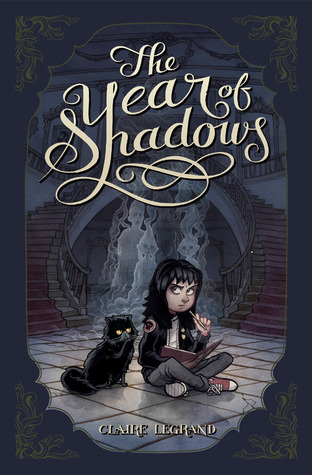
The Year of Shadows
Author: Claire Legrand
Published August 27th, 2013 by Simon & Schuster Books for Young Readers

Goodreads Summary: Olivia Stellatella is having a rough year.

Her mother left, her neglectful father — the maestro of a failing orchestra — has moved her and her grandmother into his dark, broken-down concert hall to save money, and her only friend is Igor, an ornery stray cat.

Just when she thinks life couldn’t get any weirder, she meets four ghosts who haunt the hall. They need Olivia’s help — if the hall is torn down, they’ll be stuck as ghosts forever, never able to move on.

Olivia has to do the impossible for her shadowy new friends: Save the concert hall. But helping the dead has powerful consequences for the living . . . and soon it’s not just the concert hall that needs saving.

I am so excited to read this! One of the things that intrigues me the most is the setting of a concert hall; reminds me of Phantom of the Opera

clairelegrand_authorphoto2

Today we are so lucky to have author Claire Legrand as a guest blogger. Claire Legrand used to be a musician until she realized she couldn’t stop thinking about the stories in her head. Now a writer, Ms. Legrand can often be found typing with purpose at her keyboard, losing herself in the stacks at her local library, or embarking upon spontaneous adventures to lands unknown. Her first novel is The Cavendish Home for Boys and Girls, a New York Public Library Best Book for Children in 2012. Her second novel, The Year of Shadows, releases August 27, 2013, with her third novel, Winterspell, to follow in fall 2014. She is one of the four authors behind The Cabinet of Curiosities, an anthology of dark middle grade fiction due out in July 2014 from Greenwillow Books/HarperCollins. Claire lives in New Jersey with a dragon and two cats. Visit her at claire-legrand.com and at enterthecabinet.com.

Here at Unleashing Readers, one of our goals is helping educators find books that will help them teach their students about different literary elements. We are so excited for Claire Legrand to discuss the literary elements of setting, characterization, and language, and how she utilized those elements to bring the world of The Year of Shadows to life! I think you all will find this post interesting and so useful.

SETTING

The sense of place in The Year of Shadows was one of the first story elements I established. Olivia’s world is an isolated one—she lives at Emerson Hall, she goes to school, she works after school at the tea shop across the street called The Happy Place. We don’t see a lot of Olivia’s city beyond those three locations, and the time spent at Olivia’s school and The Happy Place are relatively minimal. The Year of Shadows is really all about Emerson Hall. It’s not only where Olivia spends the majority of her time; it’s also her new home. I therefore knew I would have to make the Hall as vibrant a character as Olivia herself, full of moods and memories. The Hall needed to feel like a whole new world, one that Olivia explores in the new lens of “home” just as the readers are exploring it for the first time. The state of the Hall, and how Olivia perceives it, represents Olivia’s state of mind.

At the beginning of the story, Emerson Hall is decrepit, shabby, old. Its paint has faded, its carpet is torn, and the once-grand stone angels on the building’s façade have been vandalized. Like Olivia and her broken family, Emerson Hall has seen better days. Olivia directs her hatred of what her life has become at the Hall itself; to her, Emerson Hall and its orchestra lie at the root of her troubles. She doesn’t realize until much later that her refusal to reach out to friends for help and her destructive tendency to isolate herself are more problematic than living in Emerson Hall. Like Olivia and her family, Emerson Hall literally starts to fall apart as the story progresses. Both Olivia and her home undergo crises that could make or break them. It is Olivia’s realization that she and the Hall need each other if they are going to survive that marks a turning point in the story, and allows her to find a peace that, at the beginning of The Year of Shadows, she can’t imagine finding ever again.

CHARACTERIZATION

Imagine for a moment that you are twelve years old. You have enjoyed a comfortable, happy life with your father, mother, and grandmother. Art is in your blood; you are never without your trusty sketchpad, and you studied symphonies with your conductor father from the time you could crawl.

Then, things start to go wrong. Your mother and father start to fight; you lie awake at night listening to them. Your father spends more and more time working and less and less time with you and your mother. The orchestra isn’t doing well; lots of businesses aren’t doing well, and who wants to spend money they don’t have on coming to hear an increasingly crummy orchestra perform? Your stomach is in constant knots.

One day, a day that should have been like any other day, you wake up to find that your mother is gone. She left in the middle of the night without a clue as to her destination. It’s just you and your father now—your father who seems to care more than ever about work, much more than he cares about you. He lets bills and letters from your school pile up. (You’re not doing well in school these days.) He sells your house and moves you into the backstage storage rooms of a music hall that should probably be condemned.

You hate him. You hate everything. Sometimes, you even hate yourself.

This is Olivia. This is the girl whose story I sat down to tell when I wrote The Year of Shadows. She was a difficult character to bring to life; as you can see, her story isn’t a happy one. I needed to both communicate her (righteous, justified) anger and grief while still keeping her sympathetic. To achieve this, I balanced her darker moments—berating her father, insulting people who try to help her—with lighter ones. I felt it was even more important with Olivia than it was for some of my other, more immediately sympathetic characters, to give the reader peeks of the true her, beneath all the hurt that consumes her.

Olivia is an artist. There are beautiful worlds inside her, worlds she brings to life in her sketchpad even when—especially when—nothing else makes sense.

Olivia is kindhearted, devoted to her frail grandmother. She is determined to transform the backstage rooms of Emerson Hall into something like a home—decorating the bare gray walls with pictures from her sketchbook, spending the limited money she earns from working after school to buy her grandmother scarves and a nice warm rug for the cold floor.

Olivia is brave. She will face down ghosts—even the distinctly unfriendly ones—if it means defending her father, as much as she thinks she hates him. (But finding the courage to trust again? That she doesn’t find so easily.)

Creating Olivia was all about finding the right balance between her good moments and her bad ones, and ensuring that even her worst moments came from a place readers could understand.

The other characters in The Year of Shadows help Olivia in different ways. They are like rungs on the ladder Olivia must climb to pull herself out of her depression. Henry is trusting and loyal, traits Olivia can no longer see in herself or in her family. Joan is not afraid of being herself, or of letting others see her, while Olivia is constantly trying to hide. Mr. and Mrs. Barsky are the loving couple Olivia used to see in her parents. Trumpet player Richard Ashley is the love of music Olivia once had, and has now lost.

Even the ghosts play their part. I like to think of the four main ghosts in The Year of Shadows as fulfilling a function similar to that of the Ghosts of Christmas Past, Present, and Future in Dickens’s A Christmas Carol, each of which teach Ebenezer Scrooge something about himself. Olivia’s ghosts do the same, each “lesson” increasing in importance. Violinist Frederick helps Olivia rediscover her love of music. Best friends Tillie and Jax remind Olivia of the power and value of friendship. And poor Mr. Worthington, with his horrible secret, shows Olivia that even her family, as dysfunctional as it is, is worth saving.

 LANGUAGE

Establishing just the right blend of language to tell Olivia’s story was a tricky process for me. I wanted the language of The Year of Shadows to feel contemporary yet classic, homey yet eerie. The reader needed to feel at home in Emerson Hall, but still feel as unsettled as Olivia does. There are horror elements in this book, but it is not a horror novel; it is ultimately a story about family and friendship. The language needed to both accurately describe intense issues—financial trouble, death and the afterlife, parental abandonment and neglect, bullying, depression—while still being accessible to young readers. Through the narration, I needed Olivia to identify and explore complex emotions; at the same time, I needed her to describe them in such a way that felt authentic for an emotionally confused twelve-year-old.

I think it’s impossible to discuss a story’s language without addressing voice, and establishing Olivia’s voice was essential in developing the right language for The Year of Shadows. I was fortunate to quickly “hear” Olivia’s voice—informal but poetic, intelligent but not book-smart, sarcastic yet brimming with emotion too overwhelming to share. Her voice is conversational, peppered with fragments.

Ultimately, I wanted the language of The Year of Shadows to evoke just that—shadows. Dark, shifting shapes on the wall created by fleeting sweeps of light. Shadows, while they might seem frightening at first, are ultimately hopeful things, because you can’t have a shadow without light. For Olivia, it takes a while to find her light—but she does in the end, even if it wasn’t quite what she was expecting.

Below are a few brief (spoiler-free!) selections from The Year of Shadows that are representative of the book’s overall language:

“The picture I had of them in my head was pretty fuzzy, so I kept drawing them over and over, trying to capture the memory of them on the page. It wasn’t working very well; it’s harder than you might think to draw just the right amount of transparency, of driftiness.”

“The Maestro didn’t cry. The Maestro was made of stone and numbers and anger, and mostly he was made of music—cold, unfeeling, metal-tubed music.”

“Mr. Worthington stared. His eyes and mouth were the largest, hanging open like gateways to some secret, dark place. His head didn’t hang quite right, like someone had screwed it on wrong, and he was skinny as a bundle of twigs.”

“The shades overhead scampered away, but one lingered above me, its face cocked to the side like a bird. It opened its mouth and groaned, this low, rumbling sound that made my ears hurt.”

“In a week and a half, we’d know the Hall’s fate. No, not its fate. Its destiny. I liked that word better. It sounded softer, like something Mom would say. It sounded like stars.”

“Henry didn’t say anything more after that. I think he was afraid to talk to me, afraid that I would crack. He might have been right. All I knew was the tip of my charcoal on my sketchpad, like I was sewing myself back together.”

I can see this post being used in reading or writing workshop; what a great resource for teachers! Also, doesn’t it make you want to read the book even more?!

I want to thank Claire Legrand for stopping by, and I hope you found the post as useful as I did!

Signature

Rump by Liesl Shurtliff

Share

rump

Rump: The True Story of Rumpelstiltskin
Author: Liesl Shurtliff
Published April 9th, 2013 by Alfred A. Knopf for Young Readers

Goodreads Summary: In a magical kingdom where your name is your destiny, 12-year-old Rump is the butt of everyone’s joke. But when he finds an old spinning wheel, his luck seems to change. Rump discovers he has a gift for spinning straw into gold. His best friend, Red Riding Hood, warns him that magic is dangerous, and she’s right. With each thread he spins, he weaves himself deeper into a curse.

To break the spell, Rump must go on a perilous quest, fighting off pixies, trolls, poison apples, and a wickedly foolish queen. The odds are against him, but with courage and friendship—and a cheeky sense of humor—he just might triumph in the end.

Review: I love fairy tale retellings! They are so clever and I am so impressed with how an author can read a story and then think up a prequel or a different version of it. This specific retelling has jumped to become one of my favorites because I felt that she has made a wonderful, fantastical world and was able to see Rumpelstiltskin as more than just an antagonist.

I also felt that the book did have a moral, as all fairy tales should, but it is one that creeps up on you at the end and is such a great discussion starter.

Teacher’s Tools For Navigation: This book would make a fantastic read aloud! All students will enjoy it and it is just so fun! It will also find a home in many students’ hands by being in the classroom library.

Discussion Questions: Before reading the book, look at the chapter titles and predict what you think each title/the book will be about.; What do you think the moral of Rump is?; Look back at the original story of Rumpelstiltskin. How does the new information that Liesl Shurtliff has given us in Rump change how you view the original story?

We Flagged: “My mother named me after a cow’s read end. It’s the favorite village joke, and probably the only one, but it’s not really true. At least I don’t think it’s true, and neither does Gran. Really, my mother had another name for me, a wonderful name, but no on ever hear it. They only heard the first part. The worst part.” (p. 1)

Read This If You Loved: Rumpelstiltskin by The Grimm Brothers, A Tale Dark and Grimm by Adam Gidwitz, Ella Enchanted by Gail Carson Levine, The Dodgeball Chronicles by Frank Cammuso, Into the Wild by Sarah Beth Durst, The Frog Princess by E.D. Baker, A Hero’s Guide to Saving Your Kingdom by Christopher Healy, The Other Slipper by Kenechi Udogu

Recommended For: 

classroomlibrarybuttonsmall readaloudbuttonsmall

Rump was a #virtualbookclub book on Twitter. Did you take part in the chat?
What did you learn from the chat? How are you going to use Rump in your class?

Signature