Review and Author Interview: Camp Rolling Hills series by Stacy Davidowitz

Share

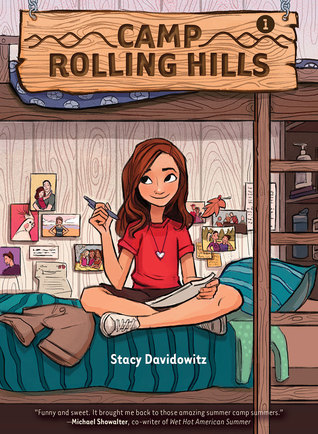
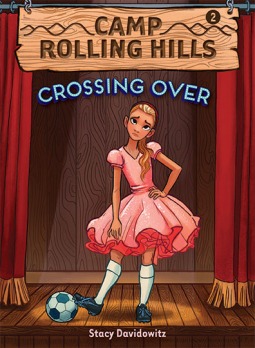
camp rolling hills camp crossing over

Camp Rolling Hills
Camp Rolling Hills: Crossing Over

Author: Stacy Davidowitz
Published May 10th, 2016 by Amulet Paperbacks

Camp Rolling Hills’s Goodreads Summary: A hilarious and heartfelt series about the particular magic of summer camp—a place where reinvention is possible and friends are like family—from a sparkling debut talent.

Finally, it’s summer! Stephanie—aka Slimey—has been counting the days until she can return to her favorite place in the entire world, Camp Rolling Hills. And this year she’s especially happy to be back—she’ll have eight blissful weeks away from home, where life has been decidedly rocky.

New kid Bobby, on the other hand, is pretty sure he’s in for the worst summer of his life. He does not understand his weirdo cabinmates, the group singing, and the unfortunate nicknames (including his: Smelly). But he does understand Slimey, and the two soon fall in crush. This summer might not be so bad after all!

But then a fight sets off an epic, campwide, girls-versus-boys prank war. Bunks are raided! Boxer shorts are stolen! And it’s up to Slimey and Smelly to keep the peace.

Crossing Over’s Goodreads Summary: There’s only one thing Melman loves more than soccer: her summers at Camp Rolling Hills. So she’s pumped to be back—until she realizes her bunkmates have gone totally boy-crazy over the school year and plastered their cabin in pink. Pink posters, pink t-shirts…it seems that the only not-pink thing in the cabin is Melman herself. That is, until she’s given a dare in front of the entire camp: wear a pink princess dress. For Three. Whole. Days.

Steinberg’s summer gets off to a rough start, too, when his robot (usually his area of expertise) blows up during a camp-wide robotics contest. Steinberg might feel like a loser at home, but camp’s supposed to be his place to shine.

Steinberg without robots? Melman in pink? This whole summer feels turned upside down! To set things right, Steinberg and Melman team up and hatch a fail-proof plan. The plan’s secret ingredient? Hamburgers.

About the Author: Stacy Davidowitz is a camp-obsessed writer of books, plays, and screenplays. She also enjoys acting, singing, running long distances, and teaching theater all over New York City. Her alma maters are Tufts University, Columbia University, and Tyler Hill Camp. The Camp Rolling Hills series marks her debut as an author. Visit Stacy at www.stacydavidowitz.com and www.camprollinghills.com.

Author Q&A: Thank you to Stacy Davidowitz for answering some questions I had about the books and her writing!

Kellee: You share in your author’s note that your time at camp inspired these books. Can you tell us more about what inspired you, and how it directly affected the novels?

Stacy: I love camp. Truly, deeply love it. Experiencing it as a camper and then counselor and then head staff, I really got to understand its in and outs, and most importantly, the kind of positive impact it can have on a kid. So of course plots and activities and even the camp‘s layout are derived from my experiences, but also the bigger themes: friendship, being true to who you are, firsts–that’s the heart of the inspiration. I made such fantastic friends and helped nurture friendships among campers when I worked as a counselor; I experienced life-changing firsts I could never experience at home; and I learned to embrace my quirkiness with my bunkmates by my side.

Kellee: The sequel to Camp Rolling Hills is told from different perspectives than the first. Why did you decide to switch point of views? Will the next books go through the other campers’ POVs? 

Stacy: When I wrote the initial draft of the first book, it was actually told from five perspectives: Slimey, Smelly, Play Dough, Jenny, and Steinberg. But when Abrams picked it up to be a series, we talked about what would work best. Ultimately we decided that each book should be told from the perspective of a different boy and girl. So Book One is Slimey and Smelly. Book Two is Melman and Steinberg. Book Three is Jenny and Play Dough. And Book Four is Missi and Wiener. If Abrams extends the series to six books, then we’ll get the perspectives of Sophie, Jamie, Totle, and Dover, too! Camp Rolling Hills is such an ensemble piece that having the series narrated by all the kids just feels right. 

Kellee: You are a teacher of theater in NYC. How has your time teaching kids influenced you to want to write and want to write specifically these books? 

Stacy: I teach a lot of playwriting and creative writing, even in the theater classes I lead. My students inspire me every day. Their ideas are so uninhibited. Exciting. Fresh. Alive. Honest. So of course that makes me want to do the same! It’s really cool to be able to write wacky, sweet, and adventurous characters my students can identify with. Also, writing middle grade is just so fun! Kids are smart and silly and it’s rewarding to be able to shine that light on them.

Kellee: Other than (hopeful) sequels, what’s next?

Stacy: I’m working on a dark young adult novel at the moment called Leper. I’m also co-writing a musical for Big Block Entertainment, the producers of Rock of Ages. Camp Rolling Hills the Musical (yup, it’s a musical, too!) is getting two productions this summer. One in Westport, Connecticut at Center Stage and another in NYC at New York Musical Festival (NYMF). Plus a play of mine called Sacred Water is being workshopped at Symphony Space, NYC in early July through a festival about social change!

My Review: The crazy cast of characters are what really make this book. Oh, and the reminiscing of camp. Camp really is something that is hard to explain unless you go yourself, but Stacy Davidowitz does a great job bringing the reader into Camp Rolling Hills and all of its quirkiness. And to add to the quirkiness, the characters in the books are so much fun! They are quite the mix of personalities. From stereotypical girly-girls to a cat-obsessed, sweet girl to a do gooder to a philosophical jock. Their interactions and characterization are what keep you reading the most! I also love the mix of letters home throughout the books.

Teachers’ Tools for Navigation: The Camp Rolling Hills books would be a fun way to get letter writing into the classroom conversation. First, I’d use the letters as conversation starters into characterization asking the students, “What can you tell about these characters based on their letters?” And discuss what clues the students used to figure it out. I’d then move to a RAFT (Role, Audience, Format, Topic) activity asking each student to write a letter as a made up character they were assigned. The Camp Rolling Hills website even has stationery!

Discussion Questions: Although each cabin is filled with friends, each character is quite unique. How do the characters differ? Compare?; What would your camp nickname be?; What makes camp so special?; How did the campers change between books?

Flagged Passages: “Things to Do No that I’m in Anita Hill Cabin (Upper Camp!)

  1. Be a good role model.
  2. Make a special camp collage of my friends and our inside jokes.
  3. Box-stitch extra lanyard key chains for Mom, since stress makes her lose her keys.
  4. Spend A LOT of time with my camp sister/soul sister/BFF.

Slimey had always wanted a sister, and she treasured the times she and Melman pretended they were fraternal twins separated at birth. Fraternal, because they looked nothing alike. Twins, because their birthdays were only three days apart, and they’d always understood exactly how the other felt.” (Camp Rolling Hills, p. 2)

“‘Well, how do you like camp so far?’
‘It’s fine.’
Fine? No one describes camp as fine. Amazing, incredible, life-changing, maybe. But never fine.”

‘The first time I came here,’ she offered, ‘it took me a couple of days to realize how much I loved it, but once you do, you love it forever. You’ll see.'” (Camp Rolling Hills, p. 41)

Read This If You Loved: Honor Girl by Maggie ThrashHidden by Helen Frost, Brain Camp by Susan Kim, Breakfast Served Anytime by Sarah Combs, Lumberjanes by Noelle Stevenson, Like Bug Juice on a Burger by Julie Sternberg

Recommended For: 

classroomlibrarybuttonsmall

Signature

**Thank you to Caitlin at Abrams for providing copies for review!!**

Blog Tour, Author Guest Post, and Review!: Cici Reno #MiddleSchoolMatchmaker by Kristina Springer

Share

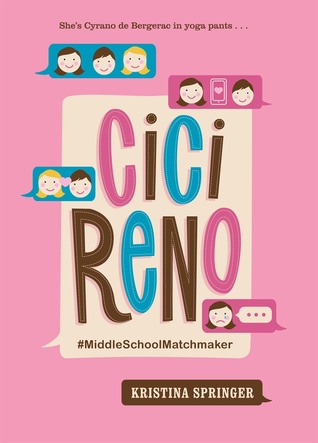
cici reno

Cici Reno #MiddleSchoolMatchmaker
Author: Kristina Springer
Published April 16th, 2016 by Sterling Children’s Books

Goodreads Summary: Middle school is a test, but Cici Reno has all the answers. She’s the go-to girl for advice. She’s cool, she’s funny, and she’s enlightened (thanks to yoga classes at her mom’s studio). So when her pretty BFF, Aggie, is too shy to speak to the boy she’s crushing on, Cici goes online and does the talking for her. The only problem is, Cici starts to fall for the guy herself! For the first time in her life. she doesn’t have a clue.

My Review: Cici Reno is a refreshing addition to middle grade romance. As a middle school teacher, I am always happy when there is a romance novel that actually features middle school kids instead of high schoolers. The thinking and feelings differ so much between 6th and 9th grade that sometimes the YA romance novels are a bit mature for the middle schoolers that want to read about crushes and dating. And Cici Reno is a book that middle schoolers will flock to not only because of the romance but because of the humor, Cici’s true voice, and the story of friendship.

Teachers’ Tools for Navigation (Teachers’ Tools for Navigation):
“Using Classic Retellings in the Middle Grade Classroom” by Kristina Springer

As readers, we love a good classic retelling. Renée Ahdieh reimagined The Arabian Nights in her #1 NYT Bestseller, The Wrath and the Dawn. The Coming of the Dragon by Rebecca Barnhouse was inspired by Beowulf. The Real Boy by Anne Ursu offered a new look at Pinnocchio. My first young adult novel, The Espressologist, was a twist on Jane Austen’s Emma. (In my book, the main character is a coffee shop barista who discovers a talent for matchmaking her customers based on their favorite coffee drinks.) And of course, Romeo and Juliet has been remade again and again and again (my favorite being Gnomeo and Juliet!).

With my newest middle grade book, Cici Reno #MiddleSchoolMatchmaker, I decided to do a modern twist of the Cyrano de Bergerac story, set in middle school and with Twitter instead of balconies and bushes.

Cici Reno, is the 12 ¾-year old enlightened daughter of a Yogi. When she’s not helping out at her mom’s beloved Peony Lane Yoga Studio or taking a class herself, she’s solving all of the 7th grade’s problems, be it boy trouble or BFF drama. When her shy best friend Aggie asks for Cici’s help in getting the attention of the boy she likes, Cici goes online and does the talking for her. Only the more they talk, the more she falls for him herself. What’s a girl to do?

Studying a classic story and some of its retellings could be a fun and creative activity for middle grade classrooms. Here’s a suggestion of how you can approach this:

  • Start with talking about the original classic tale. Let’s say you choose Cyrano de Bergerac as I did. Talk about the original play written by Edmond Rostand in 1897. Show pictures of the real Cyrano de Bergerac for which the play is based on. More info here: https://en.wikipedia.org/wiki/Cyrano_de_Bergerac_(play) And show this really cute 1 minute, 35 second YouTube Last Minute Book Report clip of Cyrano de Bergerac to get an overall sense of the story. https://www.youtube.com/watch?v=-u52OLtAws8
  • Have your class read through a bit of the play together out loud to get a sense of the relationship between Roxane, Christian, and Cyrano. Perhaps the balcony scene in Act 3, Scenes 6 and 7 where we see Christian bumbling for his words and Cyrano stepping in to rescue him. You can find the play this here: http://www.poetryintranslation.com/PITBR/French/Cyranoact3.htm
  • Talk about some of the movie adaptions of Cyrano de Bergerac over the years like Roxanne and The Truth about Cats and Dogs. If time and interest allows, show the 2012 Disney Original Movie, Let it Shine. https://en.wikipedia.org/wiki/Let_It_Shine_(film)
  • Read my book, Cici Reno #MiddleSchoolMatchmaker, and discuss the similarities and differences between the original and this modern retelling. Consider having the students use a Venn Diagram to do this. Have them discuss why they think I, as the author, made certain changes and if those changes improved the story or not.
  • Have the students try writing their own modern short story re-telling of Cyrano de Bergerac. And have fun sharing them with each other!

About the Author: Kristina Springer is the author of Cici Reno #MiddleSchoolMatchmaker (Sterling Children’s/April 19, 2016), My Fake Boyfriend Is Better Than Yours (Macmillan/FSG), a Scholastic Bestseller and 2012 YALSA Quick Pick book; The Espressologist (Macmillan,/FSG), a 2010 Society of School Librarians International Honor Book and 2014 Illinois Reads Book that has been purchased for film by Michael Eisner’s Vuguru; and Just Your Average Princess (Macmillan/FSG). She has a Masters in Writing from DePaul University and resides in a suburb of Chicago with her husband and children. Learn more about Kristina on her website: http://KristinaSpringer.com.

Flagged Passages: “‘Wow, you think of everything,’ Aggie says. ‘It sounds completely perfect. Only one thing.’

‘What’s that?’

‘I can’t talk to him, Cici! You heard me at the bonfire. I go from zero to dork in 2.3 seconds.’

‘But you’ll be online,’ I tell her. ‘You can take your time typing, really form your thoughts.’

‘Yeah. I guess.’ She pauses. ‘Or you could talk to him for me. Please? You’re so much better around guys than I am. Always so relaxed and cool. And funny,’ she adds.” (p. 35)

Read This If You Loved: Cyrano de Bergerac, Camp Rolling Hills by Stacy Davidowitz, Audition & Subtraction by Amy Fellner Dominy, Drama by Raina Telgemeier

Recommended For: 

classroomlibrarybuttonsmall closereadinganalysisbuttonsmall

Kellee Signature

Cody and the Mysteries of the Universe by Tricia Springstubb

Share

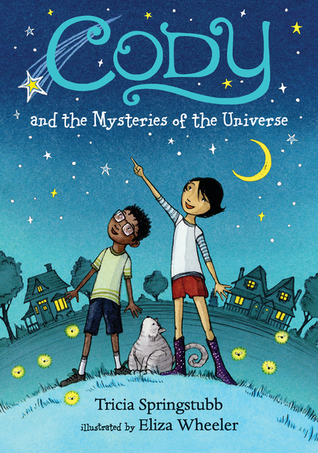
cody and the mysteries of the

Cody and the Mysteries of the Universe
Author: Tricia Springstubb
Illustrator: Eliza Wheeler
Published April 12th, 2016 by Candlewick Press

 Goodreads Summary: Not everything turns out to be as it first appears when Cody and her best friend, Spencer, navigate a neighborhood mystery and the start of a new school year.

Cody’s best friend, Spencer, and his parents are moving in with his grandmother right around the corner, and Cody can’t wait. For one thing, Cody needs Spencer to help solve the mystery of the never-seen Mr. Meen, who lives on the other side of the porch with a skull-and-crossbones sign in the window and an extermination truck out front. How’s Cody to know that a yellow jacket would sting her, making her scream “Ow! Ow!” just as they start spying? Or that the ominous window sign would change overnight to “Welcome home,” only deepening the mystery? In this second adventure, Spencer’s new-school jitters, an unexpected bonding with a teacher over Mozart, and turf-claiming kids next door with a reason for acting out are all part of Cody’s experiences as summer shifts into a new year at school.

My Review: I loved this one as much as the first one. (P.S. You don’t have to read the first one to enjoy this one, but they are both so good you should read both.) What I love most about the books is that Cody and Spencer and their families and the secondary characters are just so flawed and familiar and real. What I love second most about the book is how Tricia Springstubb writes. It is lyrical yet to the point. Beautiful yet not fluffy. See my example below. What I love third most about the book is the humor. Cody is one funny young lady!

Cody’s story this time revolves around two things: Spencer moving nearby and things not going as expected and the mystery behind the Meens, the bullying girls who live next to Spencer. Springstubb navigates both of these topics (bullying and friendship) with ease along with other minor topics like family and identity which makes Cody’s story perfect for all young readers because they will either relate or be able to use the story to help them in the future.

Teachers’ Tools for Navigation: Cody’s story represents so many different types of people: different races, different families, different situations, different popularity, different talents, etc., so her stories are perfect for reading aloud to a class/child.

It could also be used as a mentor text for language during a writing workshop’s narrative unit.

Discussion Questions: What does Cody mean by the baton of love?; Is it ever okay to fight?; Why does Payton’s behavior affect Wyatt so much?; How did Cody expect Spencer being at her school to be? How did it end up?

Flagged Passages: “He [Spencer] was getting ready to practice his violin. Mom and Cody sat down to listen. The song he played was called ‘Go Tell Aunt Rhody.’ The music was complicated. Was it sad? Was it happy? Could it be both at the same time? Cody decided it was perfect night-before-school music. All the while he played, her hand un-itched.” (p. 32)

Read This If You Loved: Cody and the Fountain of Happiness by Tricia Springstubb, The Trouble with Ants by Claudia Mills, Marty McGuire series by Kate Messner, Eleanor series by Julie Sternberg, Lola series by Christine Pakkala, The Top-Secret Diary of Cecile Valentine by Julie Sternberg

Recommended For: 

readaloudbuttonsmall classroomlibrarybuttonsmall

Kellee Signature
**Thank you to Candlewick for providing a copy for review!!**

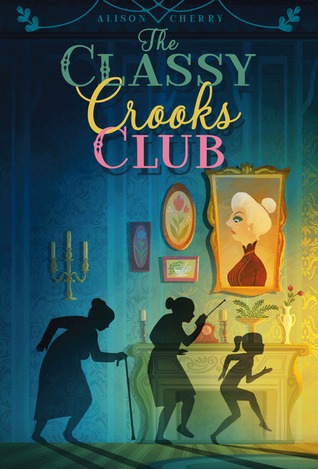
Blog Tour, Author Guest Post, and Review!: The Classy Crooks Club by Alison Cherry

Share

classy crooks club

The Classy Crooks Club
Author: Alison Cherry
Published March 29th, 2016 by Aladdin

Goodreads Summary: Twelve-year-old AJ dreads spending an entire month living with her strict Grandma Jo. Not only does her grandmother dictate how she walks, what she eats, and which rooms she can enter, she fills all AJ’s free time with boring sewing lessons. Grandma Jo wants nothing more than to transform her adventurous, fun-loving granddaughter into a prim and proper lady.

But AJ’s dull summer takes a sharp turn when she discovers that her grandmother’s “bridge group” is actually a heist club. When Grandma Jo offers to let AJ learn lock-picking instead of embroidery in exchange for help with a few capers, AJ is happy to join her grandmother’s madcap band of thieves, who claim to steal only for ethical reasons. But even the most respectable ladies can hide truly surprising secrets, and AJ finds she must decide for herself what it means to be one of the good guys.

My Review: I love AJ. She is a perfect protagonist because she is just a real middle schooler. She is multi-faceted, funny, has quite a personality, has fears, makes mistakes, and is overall likeable. And she is not the only well-crafted character. Each of the characters, main, secondary, or supporting, are so fully developed that you feel like you know everyone in AJ’s life. I often am skeptical about first person POV because it is always tough to get a character/narrator’s voice perfect while also developing the characters, but Cherry does a great job of both. AJ is a normal middle school girl that is dealing with a quite terrible grandmother who happens to have an unexpected hobby.

Another thing that blew me away about this novel is that something happened that was completely unexpected! Usually when I am reading middle grade novels, I love them but am not often surprised because I can sense foreshadowing and predict; however, Cherry really caught me off guard in this one! You’ll have to let me know if you see it coming!

And finally, I loved the unique premise of the book! Who ever thought there’d be a book about a bunch of old ladies who “liberate” *cough* steal *cough* exotic birds and anything else that suits their fancy?!

Teachers’ Tools for Navigation: Alison’s guest post, below, made me really think about how grandparents play the role in different books, so Classy Crooks Club and the books listed below could be part of a grandparent-focused lit circle. How do the grandparents in the book differ from the parents (if they are present)? How are the grandparents different than stereotypical grandparents? How do the grandparents influence the main character?

Discussion Questions: Did you predict the climax of the story?; Why do you think the author chose first person point of view?; Why do you think the author doesn’t share what us about Betty’s past?; How does AJ overcome her fear?; Which of the Classy Crooks Club ladies would you want to hang out with and why?; What does Brianna teach AJ about not judging a book by its cover?; Why do you think Brianna is so mean to Maddie?; Why does Maddie get so mad at AJ? Would you have reacted the same way?

We Flagged: “Every single piece of furniture in my grandmother’s house has a name with too many syllables.

At home we have chairs. We have a couch. We have tables. But right now my grandmother is pointing at this hulking wooden thing in the corner of one of her guest bedrooms — my bedroom, for the next month — and calling it a ‘mission chifforobe.’ It looks like what might happen if a dresser and a closet had a really ugly baby. ‘I trust you’ll be very careful with this chiffrobe while you’re here,’ Grandma Jo says, like it’s some fragile, spindly thing I could possibly break by accident. ‘It was once owned by Buckminster Fuller, as was that ottoman.'” (p. 1)

Read This If You Loved: Wig in the WindowTiara on the Terrace by Kristen KittscherHeist Society by Ally Carter, Peter Nimble and his Fantastic Eyes by Jonathan Auxier

“Five Books I Loved That Featured Grandparents” by Alison Cherry: 

The Witches, Roald Dahl:

This creepy novel from 1983 features a boy who is sent to live with his grandmother after the death of his parents. Grandmother is a retired witch-hunter, and she makes sure her grandson knows how to recognize witches by their unusual traits: bald heads that they cover with wigs, square feet with no toes, clawed hands, and blue spit. Unfortunately, this doesn’t prevent the boy from having a run-in with witches while on vacation, and they turn him into a mouse. Grandmother is presented as incredibly kind and accepting—she doesn’t love her grandson any less once he’s a mouse. She’s also very clever and helps devise a plan to get revenge on the witches. The scene that sticks with me most is one in which Grandmother tells the boy that being a mouse will significantly shorten his lifespan, and he says he doesn’t mind because he doesn’t want to outlive her. I read this book over and over as a child!

Tortilla Sun, Jennifer Cervantes:

When her mother gets a grant to study in Costa Rica for the summer, twelve-year-old Izzy is sent to live with her nana in her tiny, rural New Mexican village. Izzy knows nothing about her Latina heritage or her dead father, whom her mother has always refused to discuss, and her summer with Nana is her first opportunity to learn where she comes from and who she is. Izzy’s nana is patient, wise, warm, and loving, and she lets her granddaughter discover pieces of her past slowly, when she’s ready and able to handle them. Reading this book is a rich sensory experience; the descriptions of Nana’s colorful house, the food she teaches Izzy to cook, and the rest of the characters in the neighborhood are beautifully drawn. It made me want to hang out in the world of the story long after it was over.

You’re Invited, Jen Malone and Gail Nall

This novel from four points of view is about a group of girls who start a party-planning business in their small seaside town. While the book isn’t centered around a grandparent like the other four on this list, Lauren’s grandmother Bubby is my favorite part of the story. Bubby is loud, opinionated, bubbly, and a total flirt—she spends most of the book zooming around on her bright red scooter, Wanda, and trying to catch the eye of “hot” Mr. Vernon from her retirement community. Despite her advanced age, Bubby tries her best to act and speak like a teenager—she’s active on “the Tweeter” and constantly refers to things as “amazeballs” and “ubercute.” This horrifies Lauren, who is significantly more dignified, but it delights me to no end. I sincerely wish I had a grandmother like Bubby.

The Lightning Queen, Laura Resau:

This gorgeous novel is about Teo, an indigenous Mexican boy, and Esma, a Romani girl who comes through his village with her caravan each summer. Despite their differences, a fortune teller states that they are destined to be friends for life, however unlikely it may seem. Because the story is told primarily in flashbacks, the reader gets to meet Teo as both a child and as an elderly healer who has lost touch with his lifelong friend and needs his grandson’s help to find her again. Teo is a delight in both incarnations—he’s kind and gentle and incredibly smart, the only boy in his village who braves school and learns to read. Teo also has a soft spot for rescuing animals—as a child, his constant companions are a duck, a blind goat, and a three-legged skunk. Both the Mixteco and Romani communities are treated with great sensitivity, and the writing is captivating.

The Secret Hum of a Daisy, Tracy Holczer:

When her mother dies suddenly, Grace is forced to move in with her estranged grandmother, who sent Grace’s mother away when she got pregnant as a teenager. Grace automatically assumes her grandmother is a horrible person and sets out to be a complete brat, hoping she’ll be sent away. Grace’s grandmother isn’t warm, but she’s patient and steady and gives Grace the space she needs to work out her grief; she’s there every time Grace needs her, but she doesn’t try to force her into a relationship before she’s ready. Grace eventually begins to respect her grandmother’s honesty, forthrightness, and willingness to take responsibility for mistakes she made in the past, even when it makes her look bad. The writing in this book is beautiful, lyrical, and deeply felt—it feels as if Tracy Holczer dug this story up from deep in her soul and pasted it directly onto the page. It’s one of my favorite depictions of two people who have suffered deep losses taking a chance on loving each other, even though it’s hard and painful.

Recommended For: 

classroomlibrarybuttonsmall litcirclesbuttonsmall

Don’t miss out on the other blog tour stops!

March 28-29: Pop! Goes the Reader (http://www.popgoesthereader.com/)
March 30: The Hiding Spot (http://thehidingspot.blogspot.com/)
March 31: Mundie Kids (http://mundiekids.blogspot.com/)
April 1: Unleashing Readers
April 4: Kidsmomo (http://www.kidsmomo.com/)
April 5: KidLit Frenzy (http://www.kidlitfrenzy.com/)
April 6: Kidliterati (http://www.kidliterati.com/)

Kellee Signature

**Thank you to Alison for providing a copy for review and the guest post!**

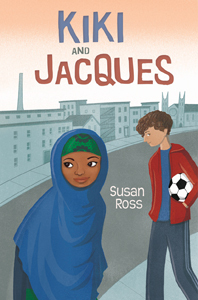
Kiki and Jacques by Susan Ross

Share

kiki and jacques

Kiki and Jacques
Author: Susan Ross
Published October 15th, 2015 by Holiday House

Goodreads Summary: Preteens prove that cultural differences can be overcome in this middle-grade novel about a native Mainer and a Somali girl who form an unlikely and supportive friendship.

Twelve-year-old Jacques’s mother has passed away, his father is jobless and drinking again and his grandmother’s bridal store is on the verge of going out of business. Plus he’s under pressure from an older boy to join in some illegal activities. At least Jacques can look forward to the soccer season. After all, he’s a shoe-in for captain.

But the arrival of Somali refugees shakes up nearly everything in Jacques’s Maine town, including the soccer team. So Jacques is surprised to find himself becoming friends with Kiki, a cheerful and strong-minded Somali immigrant. Despite their many differences they are able to help one another triumph over problems with friends, family and growing up.

About the Author: Susan Ross lives in Connecticut. She was born and grew up in the Lewiston, Maine, area. Susan was inspired to write this story by incidents in her childhood hometown when refugees from Somalia began to settle there in the early 2000s. Kiki and Jacques is her first novel.

Susan Ross recently was interviewed by HuffPost Live and wrote an article on the HuffPost Blog about Kiki and Jacques and the amazing refugee kids in Lewiston, Maine — and especially, the vital importance of teaching tolerance/ multiculturalism to children!

My Review: Kiki and Jacques is a perfect introduction to refugees for middle grade students. What makes the story work so well is that Jacques is just like so many middle school boys, so reading about Kiki and Mohammad from his point of view makes the story easy to connect with. The reader also gets to learn about the refugees and their lives and situations along with Jacques which makes it so students with no prior knowledge can live Kiki and Jacques story with them.

Teachers’ Tools for Navigation: Kiki and Jacques is a book that many different students are going to love reading for many different reasons. It is a book for sports lovers, realistic fiction fans, and students who want to learn about something and make a difference. It is a great book for classroom libraries.

Additionally, you can view a teaching guide for Kiki and Jacques which has many ideas for classroom uses: Kiki and Jacques Education Guide

Additionally, Mr. Gorman did an amazing activity with this novel using a mood meter. His blog post includes a wonderful writing activity.

Discussion Questions: How does soccer play a role in the story?; What did you learn about refugees in Kiki and Jacques?; What do you think the theme of the book is?; How does Jacques stay positive and “good” through everything that is going on in his life?; How does Jacques help Mohammad and Kiki?

We Flagged: “Frank Boucher broke out from the back and dribbled the ball toward the goal; in a minute he sliced it in. Boucher was tall, and broader than most of the kids. His bleach-blond hair was spiked marine-style, making him look even longer.

‘Holy crap.’ Jacques whistled. ‘That wasn’t bad.’

‘You’ll be captain,’ Sammy said. ‘Don’t worry. Boucher’s got muscle but your footwork’s better. And nobody trusts him.’

‘Wait up–who’s that kid?’Jacques nodded toward the far end of the field. ‘That big dude…is he one of the Somalis?’

A slim black teenager was dribbling toward them. Fast and accurate, the ball skipped effortlessly from side to side. The boy balanced the ball between his shin and knees, spun around and took a wild shot from mid-field. Tim O’Shea knocked his glasses off trying to stop it, but the ball slipped right past him into the goal.” (p. 6-7)

Read This If You Loved: Booked by Kwame Alexander, Soccer Star by Mina Javaherbin, Out of Nowhere by Maria Padian; also middle grade books about refugees including Inside Out & Back Again by Thanhha Lai and A Long Walk to Water by Linda Sue Park

Recommended For: 

readaloudbuttonsmall classroomlibrarybuttonsmall

Q&A with the Author from Holiday House: 

Susan, this is the first novel you’ve written. Please tell us about it.

KIKI AND JACQUES is a story about kids from very different backgrounds growing up in a small Maine town. It’s about finding common ground and friendship in spite of cultural differences and challenges.

You were inspired to write this book when your hometown in Maine began to see an influx of Somali refugees in the early 2000s. Tell us a little bit about that experience and how the addition of Somalis to your home town changed the cultural landscape.

When I was growing up, we lived in the “twin cities” in Maine—the old mill town of Lewiston and its sister city, Auburn. My great-grandparents came from Russia and opened a store. Three generations later, my parents had a bridal shop in downtown Lewiston. The majority of the population was of French Canadian descent, and my parents often sold dresses speaking basic French. When I read a magazine article about the wave of Somali immigration to Lewiston, I thought that a small Maine town experiencing such profound cultural change would be an amazing setting for a middle-grade novel.

What kind of research did you do for this book? In researching, what did you find most interesting or surprising?

As with most things in life, I found the very best place to start my research was at the library. In this case, I went to the library in Lewiston and met with a librarian, who told me something very important: in her experience, teenagers of all cultures were more alike than they were different.

I spoke with a few Somali kids that day, who were at the library using the computers. I saw that they were on Facebook, just like my teenagers at home. Later, I met with other Somali teens and asked them to read chapters of my book. I was greatly inspired by how strong and ambitious these kids were, and I was touched by how glad they were to have an author listen and learn about their lives.

KIKI AND JACQUES focuses on the importance of two kids respecting cultural, religious and racial differences, but still becoming friends. What do you hope young readers learn from this novel?

I hope that I’ve written a story that kids can relate to. Kiki and her brother Mohamed’s lives are very different than Jacques’s in many respects, but they also have a surprising amount in common—soccer, strong loyalty to family, and great loss (Kiki’s dad was killed in the war in Somalia and Jacques’ mom died in a car accident). Each kid is looking for a safe and permanent sense of home and  belonging.

When did you know you wanted to become an author?

I knew I wanted to become an author when I was in the fourth grade and liked to stay inside at recess and write. My first book was called Diablo, and it was about a wild horse with cruel masters. Not so coincidentally, I had just finished reading one of my  favorite books, Black Beauty. I became a lawyer, but after I stopped practicing law and my kids got older, I learned about the Somali immigration to Maine and thought, wow, this would be a wonderful and important topic to write about.

If you could give any advice to young authors, what would it be?

My best advice is simply that writers must write! Start a journal and keep it close, or take notes on your laptop or phone. Find a writing buddy and send ideas back and forth. Get your words down, whenever and however you’re inspired. Even if your writing isn’t close to perfect at first, it will get better, and you will learn and grow in the process—I promise!

Kellee Signature

**Thank you to Susan for providing a copy of the book for review and for sharing the teachers’ guide and Q&A!**

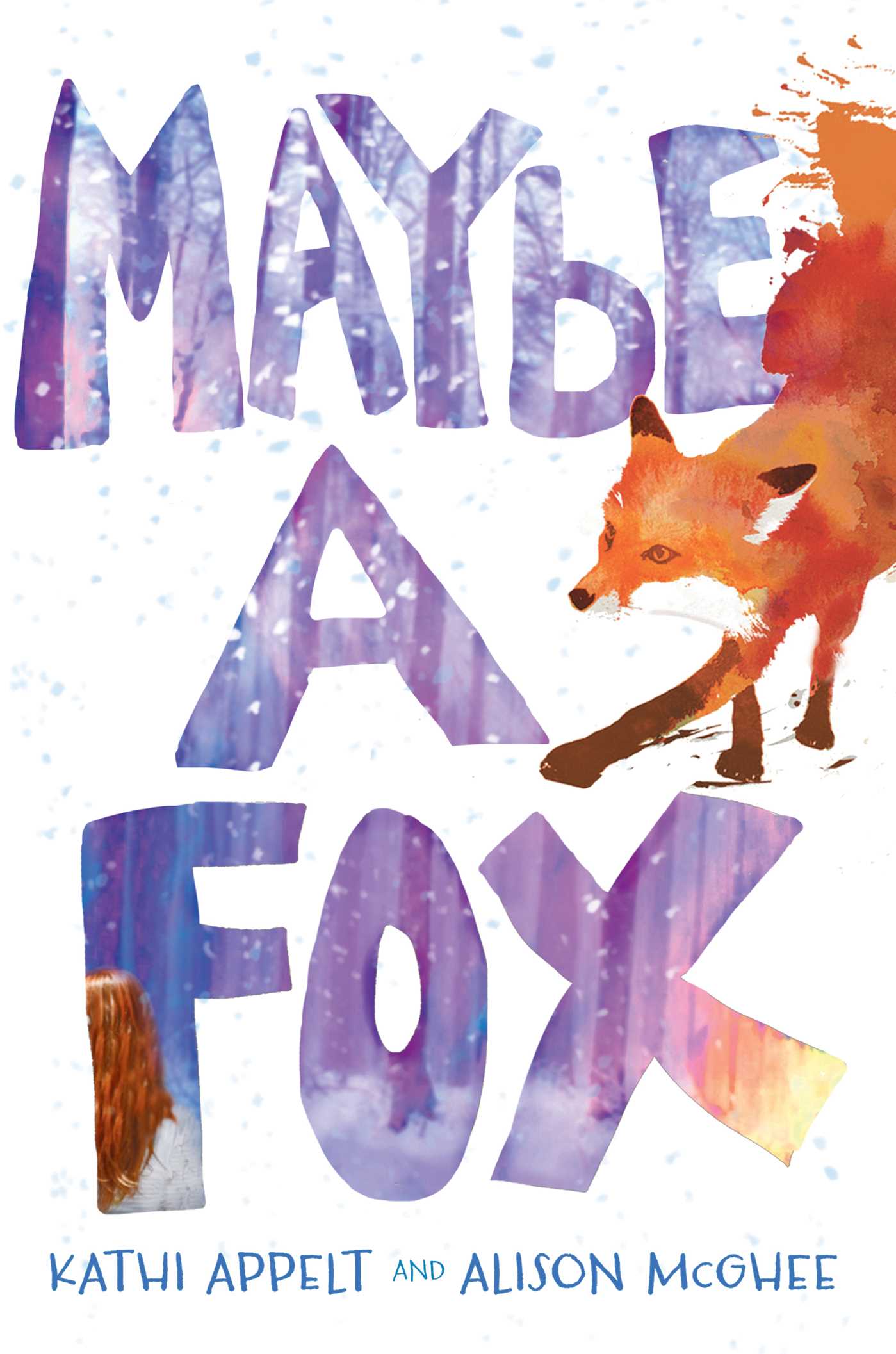
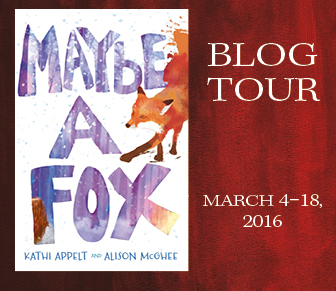
Blog Tour, Author Guest Post, Giveaway, and Review!: Maybe a Fox by Kathi Appelt and Alison McGhee

Share

maybe a fox

Maybe a Fox
Author: Kathi Appelt and Alison McGhee
Published: March 8, 2016 by Atheneum/Caitlyn Dlouhy Books

Goodreads Summary: A tale about two sisters, a fox cub, and what happens when one of the sisters disappears forever.

Sylvie and Jules, Jules and Sylvie. Better than just sisters, better than best friends, they’d be identical twins if only they’d been born in the same year. And if only Sylvie wasn’t such a fast—faster than fast—runner. But Sylvie is too fast, and when she runs to the river they’re not supposed to go anywhere near to throw a wish rock just before the school bus comes on a snowy morning, she runs so fast that no one sees what happens…and no one ever sees her again. Jules is devastated, but she refuses to believe what all the others believe, that—like their mother—her sister is gone forever.

At the very same time, in the shadow world, a shadow fox is born—half of the spirit world, half of the animal world. She too is fast—faster than fast—and she senses danger. She’s too young to know exactly what she senses, but she knows something is very wrong. And when Jules believes one last wish rock for Sylvie needs to be thrown into the river, the human and shadow worlds collide.

Writing in alternate voices—one Jules’s, the other the fox’s—Kathi Appelt and Alison McGhee tell the tale of one small family’s moment of heartbreak.

Ricki’s Review: I read this entire book in one sitting because, quite simply, I could not put it down. I sobbed through the entire book because I connected so strongly with these characters. As a mom, I couldn’t imagine my son experiencing the pain that these sisters felt from the loss of their mother. As a sister, I can’t imagine my own sister disappearing. These two connections, along with the stunning portrayal of character and story, made this book feel deeply personal for me. While younger students won’t be moms, and thus, won’t have this personal connection I had with the text, they will be sons and daughters. Regardless of a reader’s point of view, they will connect with this book because it is written so beautifully. I won’t forget this book, and I don’t think other readers will forget it, either.

Kellee’s Review: This book is one I’ll be talking about for a while. I will say it is probably the saddest book that I’ve ever read; however, it is beautiful. It is very hard to explain unless you’ve experienced because it gives hope while also being so terribly sad. The characters, animal and humans, are so thought out and detailed that as you read you feel with them and for them. I was also in awe of the way Kathi and Alison were able to tell such a unique story without the reader ever feeling like it was an odd scenario. Whenever I try to describe this book to someone, they give me quite a weird look, so I just stop trying and tell them they should read it because it is a heart print book. There is no other way to describe it. Like Ricki said, every reader will feel for someone in the book. And every reader won’t be able to deny how beautifully written the prose is. 

Teachers’ Tools for Navigation: As you will read in Kathi and Alison’s guest post below, point-of-view makes this story quite powerful. Teachers might ask students to consider the varying perspectives of this story and how they work together to form a cohesive whole. The teacher might provide other examples of texts that feature different points-of-view to compare and contrast authors’ styles. Students might then try their hand at writing in various, connected points-of-view and subsequently analyze how this enhances a narrative.

Discussion Questions: How do the authors unfold the plot in the narrative?; What predictions did you make while reading this story? How might the story have turned out quite differently?; How does Senna’s point-of-view enhance the story for you?; Were there any allusions within the text?; What theme do you take away from Maybe a Fox?

We Flagged: “The baby girl fox, Senna, came into the world in darkness, thirty feet below ground in the end dug out of cool brown earth. She was the middle child, born between her older and younger brothers, the three of them separated by minutes.

The first thing she knew was the feel of her mother’s tongue. Shhh shhh shhh, cleaning her off, licking her into life and warmth and love and safety.

The second thing she knew was the feel and smell of her brothers’ bodies pressed against hers as their mother nursed them, their front paws kneading her belly.

The third thing she knew was that there was someone waiting for her, someone she needed to find.” (p. 75-76)

Read This if You Loved: The House of Purple Cedar by Tim TinglePax by Sara PennyPacker, Counting Crows by Kathi Appelt

Recommended For: 

litcirclesbuttonsmall closereadinganalysisbuttonsmall readaloudbuttonsmall classroomlibrarybuttonsmall

Giveaway!
A Guest Post from Kathi and Alison about Point-of-View

Finding the best possible point of view for a story is one of the most important choices that a writer can make. The point of view, more than any other aspect of literature, dictates the distance created between the character and the reader. When we embarked upon this story, Alison chose to write from the fox’s story and she decided early on that she wanted to write from an omniscient point of view. This allowed her to place Senna deeply within the pocket of her fox family, and to give our readers an intimate sense of their world. It gave her a way to present the fox-world via the senses of all five members of their family, and put the readers squarely inside of the natural landscape.

When we were first drafting, Kathi chose to write Jules from a first person point of view. However, it didn’t take long before she realized that the first person was too limiting. Yes, first person is quite intimate and there are good reasons to use it, but in this case it felt as though it created too many blind spots. Jules needed a bigger canvas and so Kathi switched to third person. That allowed her to broaden the scope of Jules’ experience, and to let Jules, as well as the omniscient narrator, experience the events as they unfolded.

We always knew that Sam’s point of view would be from the third person too, and he stepped into the story in a way that let the reader get a more objective perspective. We also hoped to show that even though Sylvie’s death primarily impacted Jules and her dad, her loss was felt strongly by the entire community. As well, Sam’s earnest desire for the return of the catamount helped to create a sense of possibility that the other characters couldn’t, simply because of their closeness to Sylvie.

The landscape also gave us a perspective. The woods and rocks, and of course the Slip itself with its local legends, provided not only a backdrop, but its own wild voice, a voice that spoke to each of our characters—fox, Jules, Sam, Elk, Sylvie, Zeke, Dad, and the catamount—in a way that only a wild place can speak.

All this to say that the multiple points of view hopefully helped to create stories within stories that, when woven together, made a single story that was enriched by the viewpoints of each character.

Kathi and Alison.

About the Authors:

Kathi Appelt photo 2015_credit Igor Kraguljak

Kathi Appelt is the New York Times best-selling author of more than forty books for children and young adults. Her picture books include Oh My Baby, Little One, illustrated by Jane Dyer, and the Bubba and Beau series, illustrated by Arthur Howard. Her novels for older readers include two National Book Award finalists: The True Blue Scouts of Sugar Man Swamp and The Underneath, which was also a Newbery Honor Book. In addition to writing, Ms. Appelt is on the faculty in the Masters of Creative Writing for Children and Young Adults at Vermont College of Fine Arts. She lives in College Station, Texas. To learn  more, visit Kathi’s website at kathiappelt.com.
Alison McGhee photo 2015 credit Dani Werner
Alison McGhee is the New York Times bestselling author of Someday, as well as Firefly Hollow, Little Boy, So Many Days, Bye-Bye Crib, Always, A Very Brave Witch, and the Bink and Gollie books. Her other children’s books include All Rivers Flow to the Sea, Countdown to Kindergarten, and Snap. Alison is also the author of the Pulitzer Prize–nominated adult novel Shadowbaby, which was also a Today show book club selection. She lives in Minneapolis, Minnesota, and you can visit her at AlisonMcGhee.com.

MaybeAFox_banner

Follow the blog and book tour!

See Another Guest Post by Kathi Appelt Here!

RickiSigandSignature

**Thank you to Barbara at Blue Slip Media for providing copies for review and the giveaway. Also, thank you to Kathi and Alison for the wonderfully insightful guest post!**

Not if I See You First by Eric Lindstrom

Share

not if i see you first

Not If I See You First
Authors: Eric Lindstrom
Published: December 1, 2015 by Poppy

GoodReads Summary: The Rules:

Don’t deceive me. Ever. Especially using my blindness. Especially in public.

Don’t help me unless I ask. Otherwise you’re just getting in my way or bothering me.

Don’t be weird. Seriously, other than having my eyes closed all the time, I’m just like you only smarter.

Parker Grant doesn’t need 20/20 vision to see right through you. That’s why she created the Rules: Don’t treat her any differently just because she’s blind, and never take advantage. There will be no second chances. Just ask Scott Kilpatrick, the boy who broke her heart.

When Scott suddenly reappears in her life after being gone for years, Parker knows there’s only one way to react—shun him so hard it hurts. She has enough on her mind already, like trying out for the track team (that’s right, her eyes don’t work but her legs still do), doling out tough-love advice to her painfully naive classmates, and giving herself gold stars for every day she hasn’t cried since her dad’s death three months ago. But avoiding her past quickly proves impossible, and the more Parker learns about what really happened—both with Scott, and her dad—the more she starts to question if things are always as they seem. Maybe, just maybe, some Rules are meant to be broken.

Combining a fiercely engaging voice with true heart, debut author Erid Lindstrom’s Not If I See You First illuminates those blind spots that we all have in life, whether visually impaired or not.

Review: The story is about a girl who is blind and a runner. I feel like I learned so much for this book from the physical and mental strength of this young girl. Frankly, I can’t quite find the words to express how much it taught me about life. The narrator is feisty, and I appreciated her candor about her disability. I came to realize how incredibly frustrating it would be to deal with the same reactions from strangers every day, particularly when she feels perfectly capable. This is a great book to teach empathy.

Teachers’ Tools for Navigation: We don’t talk about disability in literature enough. I would love to put students in literature circles, with all of the texts focusing on disability. It would be interesting to have whole-class discussions about the way disability is present in each text. It might be particularly interesting to include texts that feature mental and physical disability. This might lead to good discussions, like: What is disability? Is a disability always visible to others? What is normal?

Discussion Questions: The narrator of the text is unlikable. How does this add to the story? Why might the author have written the text in this way?; Do you think Parker’s rules are fair? Why do you think she has this list of rule?

We Flagged: I flagged this section because it shows Parker’s dry humor:

“‘So you’re blind, huh?’

I cock my head toward the unfamiliar male voice coming from the seat directly in front of me. Low-pitched a bit thick around the vowels. The voice of a jock, but I just keep that as a working hypothesis awaiting more evidence.”

Read This If You Loved: The Running Dream by Wendelin Van Draanen, Girl, Stolen by April Henry, Blind by Rachel DeWoskin, Wonder by R.J. Palacio, Out of My Mind by Sharon Draper

Recommended For:

litcirclesbuttonsmall classroomlibrarybuttonsmall

RickiSig