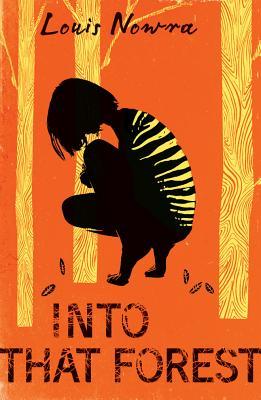
Into That Forest by Louis Nowra

Share

17870105
Title: Into That Forest
Author: Louis Nowra
Expected Publication: September 3th, 2013 by Amazon Children’s Publishing

Summary: Hannah and Becky are traveling down a river in Tasmania, Australia with Hannah’s parents when a storm erupts. Their boat overturns, and Hannah and Becky are left to survive in the wild. Two Tasmanian tigers are nearby, and because they’ve recently lost their pups, the tigers adopt Hannah and Becky as their own children. The two girls slowly adapt to the tigers’ ways, adopting their habits and forgetting words. It isn’t long before they become feral children, acting only as animals would.

Review: I have never read a book quite like this one. When I tried to compare it to other books I’ve read, I immediately thought of Endangered (Eliot Schrefer), which describes bonobos rather than tigers. With both books, I developed a fondness for the animals and their habits. Also, they both roped me into their beautiful settings and imagery. The only other books I could compare this to were those about abuse and neglect, as the children slowly developed animalistic ways, as abandoned children do.

The language is a bit peculiar at first, as Hannah is writing the story as an elderly woman, and she admits her language isn’t very good. I found myself slipping into the beautiful wording by the third or fourth page, and I didn’t find that it distracted my reading, and instead, it added to the experience. If I could change anything, I might alter the ending a bit, but perhaps, I am being too particular. I loved learning about the tigers’ lifestyle, and I was hooked to this survival story from the very first page. The sisterly bond that develops between Hannah and Becky is remarkable, and the story teaches themes of loyalty and companionship. Readers will be left pondering humanity and the differences between animals and humans.

Teacher’s Tools for Navigation: Students may find the language to be a bit difficult to understand at first, so the teacher may need to provide some close readings at first. I suspect most students quickly adjust to the language and will no longer be distracted by the wording after the first few pages, and they will likely find that it adds a lot of color to the text. Teachers could have students select their favorite descriptions of the setting and imagery, as these elements are very well-developed and would serve as a great model for students. Upon completion of the text, students might research topics like Tasmania, feral children, and tigers. I was left wanting to learn more about the Tasmanian wilderness and lifestyle, and I imagine that students will also find this book to pique their curiosity.

Discussion Questions: What does it mean to be human? How do the girls lose their humanity?; What are some of the patterns of the tigers’ behavior that the girls adopt? Why is this necessary?; How do you imagine Hannah’s life today? How has this experience changed her?

We Flagged: “As the water boiled and foamed, we bounced along with me father, unable to steer the boat toward the shore. The river were so wild that all we could do were to cling on tight to the sides of the boat or each other as we were flung back and forward like puppets with no strings. The rain chucked down and we were soaked, so soggy it were like the rain were drilling through our skin into our marrow.”

“The more I looked at its black eyes, the more I seen kindness […] I knew it were saying to us, Come, I’ll take you home.”

Please note: The above quotes are from the Advanced Reader Copy. The e-book (a galley) did not provide page or chapter numbers. The quotes may change when the book is published.

Read This If You Loved: Endangered by Eliot Schrefer, Never Fall Down by Patricia McCormick, Dog Boy by Eva Hornung, Second Nature by Alice Hoffman, Into the Wild by Jon Krakauer

Recommended For:

readaloudbuttonsmall litcirclesbuttonsmall closereadinganalysisbuttonsmall classroomlibrarybuttonsmall

026F3FBCC8C3913BD3A4D3F6920340D5

Thank you to NetGalley and Amazon Children’s Publishing for sending me the Advanced Reader Copy!

Who Stole Mona Lisa? by Ruthie Knapp

Share

NF PB 2013

Nonfiction Picture Book Wednesday

Nonfiction Picture Book Wednesday is hosted by Kid Lit Frenzy and was started to help promote the reading of nonfiction texts. Most Wednesdays, we will be participating and will review a nonfiction text (though it may not always be a picture book).
Be sure to visit Kid Lit Frenzy and see what other nonfiction books are shared this week!
mona

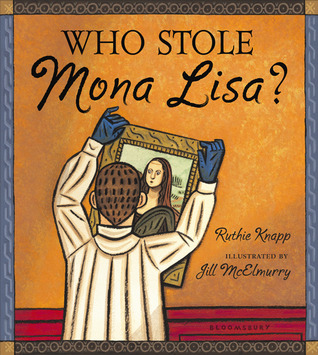
Who Stole Mona Lisa?
Author: Ruthie Knapp
Illustrated by: Jill McElmurry
Published by September 1st, 2010 by Bloombury USA Childrens

Goodreads Summary: She has a legendary smile, and millions come to see her every day. Some say she is the most famous painting in the world. Who is she? Why, the Mona Lisa, of course! But did you know that she was once stolen from her wall at the Louvre? Who took her? Why? Where was she hidden? How was she found? Someone call the police!

Narrated by the lady of the enigmatic smile herself—and brought to life with gorgeous paintings that take the reader from da Vinci’s renaissance right up to the present day—this is a stylishly whimsical account of the glorious, wonderful, sometimes dangerous life of the best recognized painting of all time. Discover the secrets behind her mysterious smile, and hear for yourself the amazing true story of her kidnapping.

Review: How fascinating! First, let me tell you a little bit about my background. My father has a BA in Art History and an MFA in Museumology. These studies led him to become an executive director of art museums (he is currently directing the Hunter Museum of American Art in Chattanooga, TN) thus impacting my life greatly. My entire childhood has been surrounded by the arts (my mother is a photographer as well). This has made art history something that I am very interested in which then made this book so fascinating for me and I believe it will be incredibly fascinating for all readers.

Mona Lisa is probably the most famous painting of all time, but many, including me, do not know her history. She is more of a mystery that we all are enthralled with than a piece of artwork that is talked about in history class; however, Ruthie Knapp’s book shows us that Mona Lisa’s history is a lot more interesting than we probably thought. And what I think makes this book one that will draw in all sorts of readers is the way she tells the story. The story is told from Mona Lisa’s point of view which makes it more of a caper, mystery type story instead of just informational nonfiction.

Teacher’s Tools For Navigation: As soon as I read this book, I saw how I could use it in the classroom. Seeing things from different points of view and perspectives is something that, as a teacher, I am always trying to help my students achieve. This book, since it is told from Mona Lisa’s point of view, is a perfect example of seeing a situation from a different point of view. After reading Who Stole Mona Lisa? I would start a discussion on how others in the story might have viewed the situation. How would the director of the Louvre have told the story differently? How about Vincenzo Perugia? Parisians? All of these people would have viewed the loss of Mona Lisa differently. These thoughts then could be transferred to anything. Maybe have students choose a historical event and think about it from a different person’s point of view: Babe Ruth’s huge “called” home run from the pitchers point of view, atomic bombings of Japan from a Japanese citizen’s point of view, an event in a book from a different character’s point of view, etc. The options are infinite.

Discussion Questions: How would the director of the Louvre have told the story differently? How about Vincenzo Perugia? Parisians?; Look up other stolen pieces of art. What happened to them?

We Flagged: “Leonardo da Vinci is the artist who painted me. It took him four years! Leonardo loved me. He looked at me while he ate past. He would not travel without me. He said I was his masterpiece. I was famous because Leonardo was famous. Fans jammed his studio to watch him paint.” (p. 10-11)

“The man with the mustache loved me too. He said I reminded him of someone special. He looked at me at every meal: over apples, eggs, and trout; cake and prunes and piglet snout. He looked at me on rainy days, on snowy days, and during summer squalls. He looked at me when he bathed. He looked at me when he shaved. He looked at me for TWO years. I was tired of the man with the mustache. I missed my wall. I missed people staring. I missed children looking sideways and upside down. (p. 24-25)

Read This If You Loved: Nonfiction books about Leonardo da Vinci or Mona Lisa, any books told from inanimate objects’ points of view, Seen Art?  by Jon Sciezska, Capture the Flag by Kate Messner, Linnea in Monet’s Garden by Christina Bjork

Recommended For: 

classroomlibrarybuttonsmall closereadinganalysisbuttonsmall readaloudbuttonsmall

Signature

Rump by Liesl Shurtliff

Share

rump

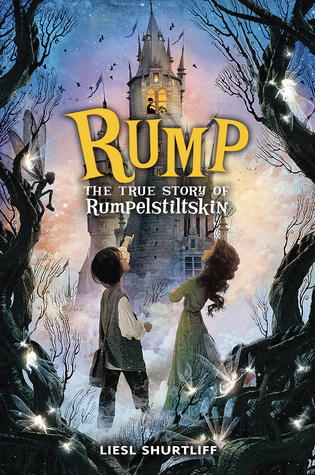
Rump: The True Story of Rumpelstiltskin
Author: Liesl Shurtliff
Published April 9th, 2013 by Alfred A. Knopf for Young Readers

Goodreads Summary: In a magical kingdom where your name is your destiny, 12-year-old Rump is the butt of everyone’s joke. But when he finds an old spinning wheel, his luck seems to change. Rump discovers he has a gift for spinning straw into gold. His best friend, Red Riding Hood, warns him that magic is dangerous, and she’s right. With each thread he spins, he weaves himself deeper into a curse.

To break the spell, Rump must go on a perilous quest, fighting off pixies, trolls, poison apples, and a wickedly foolish queen. The odds are against him, but with courage and friendship—and a cheeky sense of humor—he just might triumph in the end.

Review: I love fairy tale retellings! They are so clever and I am so impressed with how an author can read a story and then think up a prequel or a different version of it. This specific retelling has jumped to become one of my favorites because I felt that she has made a wonderful, fantastical world and was able to see Rumpelstiltskin as more than just an antagonist.

I also felt that the book did have a moral, as all fairy tales should, but it is one that creeps up on you at the end and is such a great discussion starter.

Teacher’s Tools For Navigation: This book would make a fantastic read aloud! All students will enjoy it and it is just so fun! It will also find a home in many students’ hands by being in the classroom library.

Discussion Questions: Before reading the book, look at the chapter titles and predict what you think each title/the book will be about.; What do you think the moral of Rump is?; Look back at the original story of Rumpelstiltskin. How does the new information that Liesl Shurtliff has given us in Rump change how you view the original story?

We Flagged: “My mother named me after a cow’s read end. It’s the favorite village joke, and probably the only one, but it’s not really true. At least I don’t think it’s true, and neither does Gran. Really, my mother had another name for me, a wonderful name, but no on ever hear it. They only heard the first part. The worst part.” (p. 1)

Read This If You Loved: Rumpelstiltskin by The Grimm Brothers, A Tale Dark and Grimm by Adam Gidwitz, Ella Enchanted by Gail Carson Levine, The Dodgeball Chronicles by Frank Cammuso, Into the Wild by Sarah Beth Durst, The Frog Princess by E.D. Baker, A Hero’s Guide to Saving Your Kingdom by Christopher Healy, The Other Slipper by Kenechi Udogu

Recommended For: 

classroomlibrarybuttonsmall readaloudbuttonsmall

Rump was a #virtualbookclub book on Twitter. Did you take part in the chat?
What did you learn from the chat? How are you going to use Rump in your class?

Signature

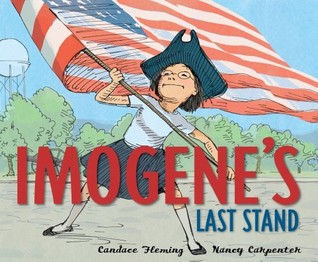
Imogene’s Last Stand by Candace Fleming

Share

6399414

Imogene’s Last Stand
Author: Candace Fleming
Illustrator: Nancy Carpenter
Published October 13th, 2009 by Schwartz & Wade

Goodreads Summary: Meet Imogene, a plucky heroine with a passion for history.

As a baby, Imogene’s first words were “Four score and seven years ago.” In preschool, she fingerpainted a map of the Oregon Trail. So it’s not surprising that when the mayor wants to tear down the long-neglected Liddleton Historical Society to make room for a shoelace factory, Imogene is desperate to convince the town how important its history is. But even though she rides through the streets in her Paul Revere costume shouting, “The bulldozers are coming, the bulldozers are coming!” the townspeople won’t budge. What’s a history-loving kid to do?

Filled with quotes from history’s biggest players—not to mention mini-bios on the endpapers—and lots of humor, here’s the perfect book for budding historians.

Review: Imogene is awesome! Her whole life she has loved history and has promoted history. History is her passion. When she finds out that the Liddleville Historical Center is up for demolition, she does everything in her power to save the history center. This, in a nutshell, is what makes her awesome: she is intelligent, passionate, and willing to stand up for her passion. Because of this, and the history allusions throughout the book, make this such an excellent book to use in classrooms. Imogene is such a great role model for any child.

The history aspects of this book were done so cleverly. Throughout Imogene’s story, she uses famous historical quotes to express how she feels at certain points. For example, when she was trying to get others to stop the bulldozing of the historical center dressed in her Paul Revere costume, she rode around Main Street (on her stick horse) yelling, “The bulldozers are coming! The bulldozers are coming!” These clever quotes are throughout the book. Then in the back and front end sheets Imogene’s historical tidbits are shared explaining all of the quotes.

Teacher’s Tools for Navigation: Like I said in the review, this book is a great for promoting history, intelligence, and passion. Like many of the amazing picture books I’ve been reading lately, it also promotes inquiry because it makes history interesting and fun.

Discussion Questions: What is a historical landmark in your city? Find out about what made it a landmark.; Imogene is passionate about history. What are you passionate about? Share the essentials of your passion.

We Flagged: “Imogene loved history. When she was a baby, her first words were “Four score and seven years ago.” As a preschooler, she finger-painted an accurate map of the Oregon Trail. And as a kindergartner, she used her show-and-tell time to give a series of lectures on important woman in history.” (p. 6)

To see a preview of the illustrations, visit Amazon’s “Look Inside” for Imogene’s Last Stand.

Read This If You Loved: Abe Lincoln’s Dream and John, Paul, George, & Ben by Lane Smith, Of Thee I Sing by Barack Obama,  Looking at Lincoln by Maira Kalman, Nonfiction books about the historical figures mentioned

Recommended For: 

readaloudbuttonsmall classroomlibrarybuttonsmall

Signature

On a Beam of Light: A Story of Albert Einstein by Jennifer Berne

Share

NF PB 2013

Nonfiction Picture Book Wednesday

Nonfiction Picture Book Wednesday is hosted by Kid Lit Frenzy and was started to help promote the reading of nonfiction texts. Most Wednesdays, we will be participating and will review a nonfiction text (though it may not always be a picture book).
Be sure to visit Kid Lit Frenzy and see what other nonfiction books are shared this week!

on a beam

On a Beam of Light: A Story of Albert Einstein
Author: Jennifer Berne
Illustrator: Vladimir Radunsky
Published April 23rd, 2013 by Chronicle Books

Summary: Albert wasn’t like other children. He didn’t speak; he thought. He didn’t play with others; he was fascinated with everything around him. But it is all of this curiosity that led to his revolutionary ideas.

Review: I love how this book focuses on how Albert’s creativity is one of the keys to what made him the amazing scientist that he is. Also, as a teacher of struggling and gifted students, I love the focus on how he didn’t do well in school. It shows how just because a student is different or a disturbance or thinks differently doesn’t mean that they aren’t intelligent. The book definitely promotes wonderings, thinking, and imagination!

I also loved learning about the fun side of Einstein and how he likes to not wear socks, he liked to eat ice cream cones, and overall he just did what he want to have time to think.

Finally, the Author’s Note puts all of Einstein’s theories together so that the reader also gets this information.

Teacher’s Tools for Navigation: This book is perfect for a read aloud to promote creativity and intelligence. It also has a direct connection to science since it is about Albert Einstein. It would be a great discussion starter for an elementary classroom and is also a great jumping off point for discussing the basic Einstein theories.

Discussion Questions: After knowing about Albert’s experiences in school, what would you go back and tell Albert’s teachers? What does his experience and then who he became tell us about behavior, students, and teachers?; Albert said, “Imagination is more important than knowledge.” What parts of this book supports this quote?

We Flagged: “Albert started asking questions. Questions at home. Questions at school. So many questions taht some of his teachers told him he was a disruption to his class. They said he would never amount to anything unless he learned to behave like the other students. But Albert didn’t want to be like other students. He wanted to discover the hidden mysteries in the world.” (p. 14-15)

To see a preview of the illustrations, visit Amazon’s “Look Inside” for On a Beam of Light.

Read This If You Loved: Odd Boy Out by Don Brown, Who Was Albert Einstein? by Jess M. Brallier, Me…Jane by Patrick McDonnell, Jim Henson by Kathleen Krull, A Boy Called Dickens by Deborah Hopkinson

Recommended For: 

readaloudbuttonsmall

Signature

Walden Award Winner!: A Review

Share

Today we are happy to share our review of the winner of the

2013 Amelia Elizabeth Walden Award!

fault

The Fault in our Stars
Author: John Green
Published January 10th, 2012 by Dutton Books

Summary: Hazel has been preparing to die since she was thirteen and was diagnosed with Stage IV Thyroid Cancer. Now, she is sixteen, a modern medical miracle and living with the side effects of the medication and of the cancer. Hazel finds herself between the levels of normalcy and dying. When she meets Augustus Waters, she begins to feel normal for the first time in a long time. Through this amazing friendship, both Hazel and Augustus learn how to truly live.

Ricki’s Review: Every once in a while, a book comes around that changes you. Admittedly, I am a huge fan of John Green and am always biased toward his books. While others may not agree with me, I would argue that this is definitely his best work. I have twenty books on my “favorite books” shelf, and this addition was a no-brainer. (I won’t tell you which one I removed to put this one on the shelf.) The characters are intelligent and witty, and I was continually laughing out loud. This book sends readers on a roller-coaster of emotions. It is the first book in a long time that made me truly feel a sense of catharsis. And Augustus recognizes my emotions as both worthy and real: “‘That’s the thing about pain,’ Augustus said, and then glanced back at me. ‘It demands to be felt'” (p. 63). The language and word choice make dozens of pages flag-worthy, and teachers will love doing close readings with this text. It is liquid gold for classroom teachers.

This is not a predictable cancer story because it is incredibly honest. Hazel recognizes the “perks” she gets as a cancer patient, and she has no trouble admitting that she doesn’t really have friends. When she goes shopping with her one female friend, she secretly wants to be anti-social and pull out a book to read. But when she meets Augustus, everything changes. If you haven’t read this book yet, be grateful–I am envious of you because I want to read this book again for the first time

Kellee’s Review: I’ll be honest—I had a really hard time writing a review of this book. I just don’t know if I am going to be able to do it justice. It is one of those books that as you read, there are so many good things and so much you love, and you know that it is something so special. Even now, as I sit here, I don’t know what to say. I know that I wish that it was more appropriate for middle schoolers so I could share it with more students, I know that it is a book that everyone should read, and I know that it is a book that I am glad to be sharing.

The Fault in our Stars is not only an emotional and funny book, it is beautifully written. As I read, I knew I wanted to mark quotes for a review, but it was hard to find a page to not mark.

TFIOS

John Green has a way with words. If you have read anything by him, you know what I am talking about. I think what makes this book even more powerful is that it is a combination of John Green’s voice and a deep, amazing story. Put the two together, and you get a masterpiece.

Discussion Questions: Hazel has a book that is her favorite and means so much to her; what book do you love that you could not live without? Choose your favorite line or quote from the book and discuss why  you connected with it so much.; Who is someone who made an impression on you but who you have lost touch with?

We Flagged: “Sometimes you read a book and it fills you with this weird evangelical zeal and you become convinced that the shattered world will never be put back together unless and until all living humans read that book” (p. 33).

“It wasn’t even that the book was so good or anything; it was just that the author, Peter Van Houten, seemed to understand me in weird and impossible ways. An Imperial Affliction was my book, in the way my body was my body and my thoughts were my thoughts” (p. 36).

“My thoughts are stars I can’t fathom into constellations” (p. 311).

Read This If You Loved: Looking for Alaska by John Green, Will Grayson, Will Grayson by David Levithan and John Green, Drums, Girls, and Dangerous Pie by Jordan Sonnenblick, The Survival Kit by Donna Freitas, A Monster Calls by Patrick Ness, If I Stay by Gayle Forman, Julius Caesar by William Shakespeare, Romeo and Juliet by William Shakespeare

Recommended For: 

readaloudbuttonsmall closereadinganalysisbuttonsmall

classroomlibrarybuttonsmall litcirclesbuttonsmall

Have you read The Fault in our Stars? Did it affect you the way that it did us? 

RickiSig andSignature

Walden Award 2014 Finalists: Reviews

Share

Today, we are excited to review the three Amelia Elizabeth Walden Award finalists, and tomorrow, we can’t wait to review the winner! Please join us in the celebration of these three extraordinary texts which are very deserving of this recognition. We’ll see you tomorrow for our review of the winner!


aristotleand

Aristotle and Dante Discover the Secrets of the Universe
Author: Benjamin Alire Saenz
Published February 21st, 2012 by Simon & Schuster Books for Young Readers

Summary: Aristotle is an angry teen who doesn’t have friends until he meets Dante. Through Dante, he learns about friendship, life, and loyalty. These two boys develop an unbreakable bond that helps them discover themselves.

Kellee’s Review: So beautifully written. This is one of those books that you want to tell everyone to read because it is so literary and lyrical. While reading, I felt I had to keep stopping to take notes because I had so much I wanted to share with you all; Aristotle & Dante reminded me of John Green’s characters in that way. His characters are so intelligent, the voice so pure and mesmerizing, and the story so enthralling- all aspects of a literary young adult novel. I am not surprised at all of the awards that Aristotle & Dante took home from the ALA Awards as it deserved each and every one of them (Stonewall Book Award, Printz Honor, Pura Belpre Author Award). I know this seems mighty gushy, but I really fell in love with this novel.

There were so many passages throughout that could be used for exemplar pieces of writing (specifically while reading I picked up on the literary devices, characterization, and voice) and can be used to practice reading strategies.  The book might not automatically be popular because I could see students thinking it was pretty slow because it is more character-driven than plot-driven. It is about Aristotle & Dante growing up and finding themselves (once again, reminds me a bit of a John Green Novel). Though I can see students who give it a chance being as touched by the book as I am.

Ricki’s Review: This beautiful, quiet book is well-deserving of all of the awards it has received. The characters are very special and will stick with readers long after the last page. Adolescents will identify with the boys’ feelings of loneliness and longing, and will be carried away by the magic of their friendship. Saenz’s lyrical language is strong and powerful, delivering undeniable messages to the readers. Readers will grow with Aristotle and Dante and learn what it means to be accepted, to be loyal, and to be a good person.

When I read this book for the first time, I wondered if it would appeal to all types of readers as the beautiful language takes precedent over an action-filled plot. We chose it for our school’s book club before it won the awards, so I was unsure about the students’ reaction. They absolutely adored the characters, and it was one of the most well-received books we’ve done in book club. This text would make for a great choice for literature circles, book clubs, and close analysis, as the language is remarkable.

Discussion Questions: Aristotle and Dante love to make up stories about the people on the bus (see p. 21); go and sit outside where you can people watch and spontaneously write short stories about a handful of them.; What does it mean to be alone? Can another person cure loneliness, or is it something that must be healed from within?; What makes a good friend? What makes a good person?; How do your family dynamics influence who you are as a person?

We Flagged:  “I felt alone, but not in a bad way. I really liked being alone. Maybe I liked it too much. Maybe my father was like that too. I thought of Dante and wondered about him.  And it seemed to me that Dante’s face was a map of the world. A world without darkness. Wow, a world without darkness. How beautiful was that?” (p. 56)

Read This If You Loved: Personal Effects by EM Kokie, Looking for Alaska by John Green, Shine by Lauren Myracle, Ask the Passengers by A.S. King, The Perks of Being a Wallflower by Stephen Chbosky

Recommended For: 

 closereadinganalysisbuttonsmall litcirclesbuttonsmall classroomlibrarybuttonsmall


endangered

Endangered
Author: Eliot Schrefer
Published October 1st, 2013 by Scholastic Press

Summary: Sophie is a normal teenager who travels between her divorced parents who live in completely different cultural situations–her father has an office job in America and her mother runs a bonobo sanctuary in Congo. Though she was born in the Congo, the last few years have been spent in America with her father and return trips to her mother’s sanctuary. The book begins with Sophie waiting in a check point, where she spots a baby bonobo who is not being treated well and, against everyone’s wishes, she buys him.

Kellee’s Review: With Sophie’s purchase, Otto enters into her life and ours. He becomes the co-star of the book and begins to change Sophie’s feelings about being at the sanctuary. But then, right before she is about to leave, chaos at the hand of revolutionaries envelopes Congo and Sophie finds herself in a completely type of situation.

Now if you follow me here or on Twitter, you know that I am a sucker for ape books and I have been lucky that many people who care a lot about apes write some amazing ape books – this is a book to add to that list. It left me with even more of a passion for saving these animals who are our closest relative. I. Love. This. Book. It quickly moved into my favorites list even while I was only half way through with it. It is such a journey that you take with this young lady and the growth you see in her (and Otto) is incredible. On top of that, Eliot Schrefer is an author who not only can tell a good story, but he can help you become part of the story and visualize and feel everything that is happening. And I am not alone in this love. Endangered was a finalist for The National Book Award and Walden Award, Eliot Schrefer was a hit at the Scholastic Brunch at NCTE, and it is being gushed about on Twitter.

On top of all of this, I read it with my 8th graders this year and they adored it! Check out my End of (School) Year Reflection to see my reflections on teaching the novel as well as Skyping with Eliot.

Ricki’s Review: This is a beautifully crafted novel, one which will stick with me. I learned a lot about the horrors that exist within the war-torn country of the Democratic Republic of Congo, a place which I had limited knowledge about—but it also gave me a look into the life of bonobos. Each year, I give very few books a 5-star rating on GoodReads, but this one is well deserving. I wish I could give it more than five stars, to be frank. Eliot Schrefer does a brilliant job describing the powerful bond between humans and animals. There are so many elements of this text that teachers can use in the classroom that it feels like a gold mine. I’ve recommended it to adults and teens again and again—and with the confidence that I know they will appreciate the intricate beautiful of this novel. Endangered will always rank as one of the best books I have ever read. When my student returned this book, she handed it to me and paused. I waited in anticipation of her response, as she reads over a hundred books a year and is very critical. She chose her words slowly and carefully. “I don’t like animals, so I didn’t want to read this. You kept talking about it, so I finally decided to just go for it. This isn’t a book about animals, and really, it isn’t a book about war. It is a book that is about being human.”

Discussion Questions: Sophie makes many decisions throughout the book that many people, specifically her parents, would not have agreed with. Would you have made the same decisions as her? Were there any you would have done differently? Do you think her decisions were worth it? Use textual evidence to back your answers.; What does this book teach us about being human?; In what ways do the bonobos reflect humanity?; How does the war-torn setting add to this story?

We Flagged: “The man released the bonobo. The little ape sat down tiredly in the dirt and lowered his arms, wincing as his sore muscles relaxed. I kneeled and reached out to him. The bonobo glanced at his master before working up the energy to stand and toddle over to me. He leaned against my shin for a moment, then extended his arms to be picked up. I lift him easily and hugged himself to me, his fragile arms as light as a necklace. I could make out his individual ribs under my figures, could feel his heart flutter against my throat. He pressed his lips against my check , I guess to get as close as possible to my skin, and only then did I hear his faint cries; he’d been making them for so long that his voice was gone.” (p. 3-4)

Read This If You Loved: Half Brother by Kenneth Oppel, Hurt Go Happy by Ginny Rorby, The One and Only Ivan by Katherine Applegate, The Chimpanzees I Love by Jane Goodall, Tree Girl by Ben Mikaelsen, Heart of Darkness by Joseph Conrad, Faithful Elephants by Yukio Tsuchiya, Non-fiction books about bonobos or the Democratic Republic of Congo

Recommended For: 

readaloudbuttonsmall closereadinganalysisbuttonsmall

litcirclesbuttonsmall classroomlibrarybuttonsmall


passengers

Ask the Passengers
Author: A.S. King
Published October 23rd, 2012 by Little, Brown Books for Young Readers

Summary: Astrid is very cerebral–she can get lost in philosophical theories and questions about the world. Her favorite pastime is laying on the bench in her backyard so she can send her love to the passengers on the airplanes that fly overhead. At her catering job, Astrid meets Dee, and she falls in love. She isn’t sure if this makes her a lesbian, as she has never loved another girl, and society wants to fit her in a box that she isn’t quite sure describes her.

Kellee’s Review: I am fascinated with the setting of this book. It seems like a perfect place to live, but really everyone is living a lie. It reminds me a bit of “Stepford Wives.” What a sad existence. Maybe I am (the opposite of) sheltered because my parents and my friends always supported me to be who I am. However, because of King’s perfect depiction of Astrid’s experiences, it transplants me right into Astrid’s shoes.

Besides the setting, the characters are what makes this book a star. Astrid is a character that every reader will connect with in one way or another: she doesn’t exactly fit in though she doesn’t stick out, she has a secret she feels like she can’t tell anyone, and as a teenager she doesn’t exactly get along with her family. While Astrid is strong, so are the secondary characters. You know that if you want to jump into a book and just go off on a character that the author has done their job (UGH! The mom will drive you crazy too!).  This book would not move without its secondary characters; although Astrid is our protagonist, it is the secondary characters that drive much of the story. It is amazing how all of the characters are so fleshed out.

Finally, like all King novels, the way it is written just adds that element that pushes this book to being an award winner. King’s ability to give her characters a voice is phenomenal. Each of her novels have such a unique personality and she is able to give them each a unique voice. She also adds humor and intelligence to each of her books.

Ricki’s Review: Astrid’s character felt very real to me. Despite the heartache and lack of love in her own life, she manages to send all of her love to people she doesn’t even know–strangers in the sky. I can’t help but peer up at airplanes now and send my love to the passengers. Astrid is not a typical high school student. She lives by her principles and stays true to herself amidst the pressures that teens face. She is an unbelievable role model for both adolescents and adults.

Astrid teaches us to give our love away when we aren’t feeling any ourselves. She connects herself with complete strangers when those who are closest to her are emotionally failing her. Teens will learn to reach out and grasp love in the most unconventional places. The warmth that emanates from this book makes it incredibly special.

Discussion Questions: How do the passengers’ stories add to the richness of this text?; How does the setting influence aspects of the book?; Does society expect us to fit into neat boxes with labels?; What complications exist in Astrid’s life? Which coping mechanisms does she use to relieve her pain? Which other coping mechanisms might she use?

We Flagged: “I mean to say: Everybody’s always looking for the person they’re better than.” (page 231)

Read This If You Loved: Please Ignore Vera Deitz by A.S. King, Everybody Sees the Ants by A.S. King, Personal Effects by E.M. Kokie, The Perks of Being a Wallflower by Stephen Chbosky, Luna by Julie Anne Peters, Almost Perfect by Brian Katcher

Recommended For: 

 closereadinganalysisbuttonsmall litcirclesbuttonsmall classroomlibrarybuttonsmall

Which of these finalists have you read? What did you think of them?
We’re so excited to review the winner tomorrow!

Signature andRickiSig