Amulet Books Graphic Novel Teaching Guide

Share

abrams

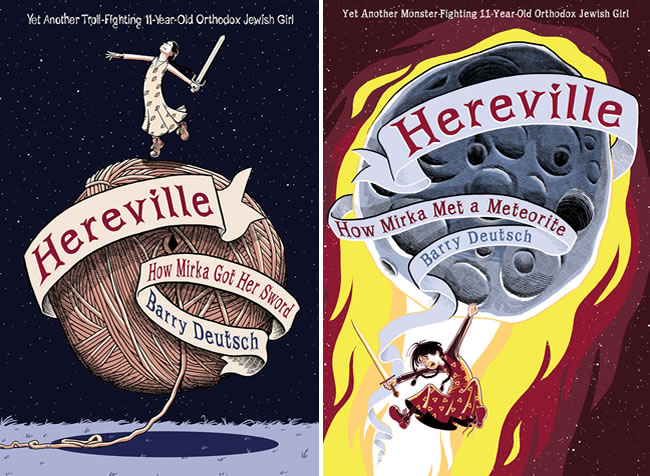
In January, I was contacted by a publicity and marketing associate from Abrams Books/Amulet Books out of the blue. In this email, I was asked to work on a teaching guide about their graphic novels: The Misadventures of Salem Hyde, Nathan Hale’s Hazardous Tales, Hereville, and the Explorer series.

1729025518405488 

13591161135911621729026018405492

1283377017290285

I was beyond honored! And, of course, I said that I would definitely love to do it as I had read all of the graphic novels, and I am a huge fan of them.

First, they asked me to write an introduction about graphic novels and their importance in the classroom. I am a huge advocate for using graphic novels in schools, so I immediately began researching and writing. Here is the introduction:

What are graphic novels? The easiest way to describe graphic novels is to say that they are book-length comic books. However, a more complex definition that educators and librarians use is “book-length narratives told using a combination of words and sequential art, often presented in comic book style” (Fletcher-Spear, 37). Graphic novels are not written in just one genre; they can be in any genre, since graphic novels are a format/medium. Graphic novels are much like novels, but they’re told through words and visuals. They have all narrative elements, including characters, a complete plot, a conflict, etc.

Middle grade and young adult graphic novels cover a wide spectrum of themes and topics. Some common themes found in graphic novels for this age include the hero’s journey; overcoming hardship; and finding one’s identity. For example, in Hereville, we meet Mirka, an everyday girl who learns to use her brains and brawn to overcome her foes. In The Misadventures of Salem Hyde, Salem is working on finding out just who she is (both as a witch and as a person) with the help of her friend Whammy. Graphic novels can cross curricular lines. One example is the Nathan Hale’s Hazardous Tales series—comical nonfiction that takes historical events and presents them in interesting ways, using graphics and humor that will make students want to learn even more about the historical time periods. In the Explorer series, stories include topics such as animal adaptation, volcanic eruptions, and the fate of humanity. Like novels, graphic novels offer opportunities in all subject areas to extend students’ thinking.

Over the past few years, graphic novels have become a hot topic, growing in popularity with both children and educators. While many teachers are beginning to include them in the classroom, there are still teachers, administrators, and librarians who struggle with including this format in their schools. So, why should you use them in your classroom and have them available for students?

  • Graphic novels can make a difficult subject interesting and relatable. (Cohen)
  • Students are visual learners, and today’s students have a much wider visual vocabulary than students in the past. (Karp)
  • Graphic novels can help foster complex reading skills by building a bridge from what students know to what they still have to learn. (NCTE)
  • Graphic novels can help with scaffolding when trying to teach higher-order thinking skills or other complex ideas.
  • For students who struggle to visualize while they read, graphic novels provide visuals that shows what good readers do. (NCTE)
  • Many graphic novels rely on symbol, allusion, satire, parody, irony, and characters/plot and can be used to teach these, and other, literary devices. (Miller; NCTE)
  • Often, in between panels (called the gutter), the reader must make inferences to understand how the events in one panel lead to the events in the next. (McCloud)
  • Graphic novels can make differentiating easier. (Miller)
  • Graphic novels can help ELL (English Language Learners) and reluctant and struggling readers since they divide the text into manageable chunks, use images (which help students understand unknown vocabulary), and are far less daunting than prose. (Haines)
  • Graphic novels do not reduce the vocabulary demand; instead, they provide picture support, quick and appealing story lines, and less text, which allow the reader to understand the vocabulary more easily. (Haines)
  • Research shows that comic books are linguistically appropriate reading material, bearing no negative impact on school achievement or language acquisition. (Krashen)
  • Students love them.

Although you can find graphic novel readers at all reading levels, graphic novels can truly be a gateway to the joys of reading for reluctant and struggling readers. Reluctant readers often find reading to be less fun than video games, movies, and other media, but many will gravitate toward graphic novels because of the visuals and the fast pace. Struggling readers will pick up graphic novels for these reasons as well but also because the graphic novel includes accommodations directly in the book: images, less text, etc.

All in all, graphic novels can interest your most reluctant and struggling readers and also extend all of your readers, including your most gifted.  

Resources

  • Cohen, Lisa S. “But This Book Has Pictures! The Case for Graphic Novels in an AP Classroom.” AP Central. CollegeBoard.
  • Fletcher-Spear, Kristin, Merideth Jenson-Benjamin, and Teresa Copeland. “The Truth About Graphic Novels: A Format, Not a Genre.” The ALAN Review Winter (2005): 37­–44.
  • Haines, Jennifer. “Why Use Comics in The Classroom?” Comic Book Daily. N.p., 20 Mar. 2012.
  • Karp, Jesse. “The Case for Graphic Novels in Education.” American Libraries. N.p., 1 Aug. 2011.
  • Krashen, Stephen. The Power of Reading. Englewood, CO: Libraries Unlimited, Inc. 1993.
  • McCloud, Scott. Understanding Comics. Northampton, Mass.: Kitchen Sink, 1993. 
  • Miller, Andrew. “Using Graphic Novels and Comics in the Classroom.” Edutopia. N.p., 11 Jan. 2012.
  • NCTE, comp. “Using Comics and Graphic Novels in the Classroom.” The Council Chronicle September (2005) http://www.ncte.org/magazine/archives/122031.

 I then began reading and rereading the graphic novels and planning activities and discussion questions that could go along with each book. I was asked to come up with activities for all subjects, so this pushed me out of my comfort zone a bit; however, I loved trying to figure out how these amazing books could be used throughout all classes.  Some examples:

  • Salem Hyde [Science]: At the end of Spelling Trouble, Salem and Whammy have to rescue a whale, but it is done in a very unconventional way. How would real scientists rescue a whale in distress?
  • Hazardous Tales [Language Arts/History]: The Provost (a British soldier) and Nathan Hale disagree about the cause of the Revolutionary War. Based on One Dead Spy, what events caused the Americans to revolt? Do you agree with the Provost or with Nathan Hale about the causes of the war? (This could also be used as a debate question in class.)
  • Hereville [Math]: On pages 31–32 [of Hereville 1], Mirka is given a math problem: Three people are splitting a cake, so they cut it into thirds. But then a fourth person shows up. How can they cut the cake so that each person gets an equalamount of cake? (Mirka comes up with a solution, but are there others?) What if two more people had shown up? Three more? Four more? 
  • Explorer [History]: On page 84 [of The Mystery Boxes], in The Soldier’s Daughter, the man says, “War is a dark power.” Where in history have we seen war consume someone? Have there been wars that did not need to be fought? Research past wars and determine if a war was started because of the need for power or if there was a legitimate reason for it. 

These are just some examples.

I am happy to share the entire teaching guide with you. It can be found at http://www.abramsbooks.com/academic-resources/teaching-guides/ along with other teaching guides. The direct link to the PDF is http://www.abramsbooks.com/pdfs/academic/GraphicNovels_TeachingGuide.pdf.

I hope you find it useful as I am very proud of it,

Signature

Locomotive by Brian Floca (Kellee’s Review)

Share

NF PB 2014

Nonfiction Picture Book Wednesday

Nonfiction Picture Book Wednesday is hosted by Kid Lit Frenzy and was started to help promote the reading of nonfiction texts. Most Wednesdays, we will be participating and will review a nonfiction text (though it may not always be a picture book).
Be sure to visit Kid Lit Frenzy and see what other nonfiction books are shared this week!

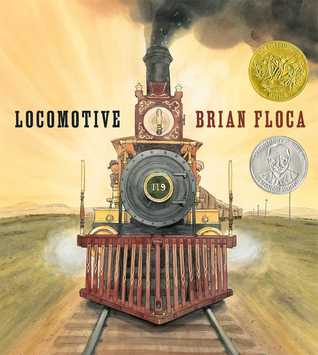
locomotive

Locomotive
Author and Illustrator: Brian Floca
Published September 3rd, 2013 by Atheneum Books for Young Readers

Goodreads Summary: The Caldecott Medal Winner, Sibert Honor Book, and New York Timesbestseller Locomotive is a rich and detailed sensory exploration of America’s early railroads, from the creator of the “stunning” (Booklist)Moonshot.

It is the summer of 1869, and trains, crews, and family are traveling together, riding America’s brand-new transcontinental railroad. These pages come alive with the details of the trip and the sounds, speed, and strength of the mighty locomotives; the work that keeps them moving; and the thrill of travel from plains to mountain to ocean.

Come hear the hiss of the steam, feel the heat of the engine, watch the landscape race by. Come ride the rails, come cross the young country!

My Review: Rhythm. Onomatopoeias. (Well-researched) History. Gorgeous (and historically accurate) illustrations. Lyrical narrative. Unique point of view. This book has everything.

YOU (second person POV!) are a passenger on a train cross America with your family in 1869. Throughout the book, you will encounter many different landmarks, experience things on a train very few had at this time in history, and learn about the intricacies of the train. So fascinating! And all told in rich, beautiful language. It is hard to even share much more about the book because it is such an experience.

Check out Ricki’s review of Locomotive as well HERE.

Teachers’ Tools for Navigation: I would LOVE to read this to kids. There are so many places to stop and discuss and research and learn, but never without an enthralling story accompanying.  It would be a great book to use across subjects. There are definitely opportunities for all subjects: social studies (trans-continental travel, history, trains); science (the science of steam engines); math (travel); reading/writing (onomatopoeia, point of view, rhythm).

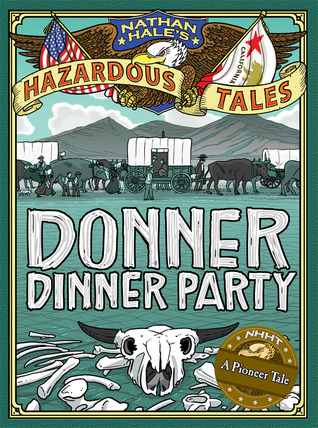
Also, and this is fresh on my mind because I just read it, but I would love to read this and The Donner Dinner Party and then look at the two journeys. How long did each take? Dangers? It would be an interesting look at how trains truly changed transportation.

Discussion Questions: How does having the book in 2nd point of view make it more enthralling?; What onomatopoeias were used in the book? How did these words help suck you into the story?; How did the author’s rhythm make you feel like you are actually on the train?; What are the landmarks that were passed on the trans-continental railroad? Why are these landmarks significant?; How does a steam engine work? What are the jobs of all of the different people on board?

We Flagged:
“Here is how this road was built,
with a grunt and a heave and a swing,
with the ring of shovels on stone,
the ring of hammers on spikes:

CLANK CLANK CLANK!

Men came from far away
to build from the East,
to build from the West,
to meet in the middle.

They cleared the rocks
and dug the tunnels.
They raised the hammers
and brought them down—

“Three strokes to the spike,
ten spikes to the rail!”

CLANK CLANK CLANK!”

Read This If You Loved: The Donner Dinner Party by Nathan Hale, Train by Elisha Cooper

Recommended For: 

readaloudbuttonsmall closereadinganalysisbuttonsmall classroomlibrarybuttonsmall

Signature

Bruised by Sarah Skilton

Share

bruised

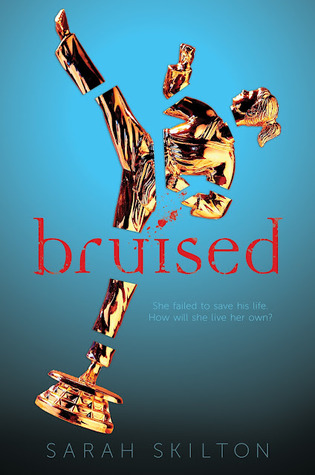
Bruised
Author: Sarah Skilton
Published March 5, 2013 by Amulet/Abrams

Goodreads Summary: Imogen has always believed that her black belt in Tae Kwon Do made her stronger than everyone else–more responsible, more capable. But when she witnesses a holdup in a diner, she freezes. The gunman is shot and killed by the police. And it’s all her fault.

Now she’s got to rebuild her life without the talent that made her special and the beliefs that made her strong. If only she could prove herself in a fight–a real fight–she might be able to let go of the guilt and shock. She’s drawn to Ricky, another witness to the holdup, both romantically and because she believes he might be able to give her the fight she’s been waiting for.

But when it comes down to it, a fight won’t answer Imogen’s big questions: What does it really mean to be stronger than other people? Is there such a thing as a fair fight? And can someone who’s beaten and bruised fall in love?

My Review and Teachers’ Tools for Navigation: Imogen is broken and she must overcome this feeling of hopelessness that surrounds her constantly. What an intense way to introduce us to a character? We then go on a journey with Imogen as she tries to rebuild her life, her memories, her friendships, and her family.

At first I struggled with this book because the timeline was choppy, and Imogen was hard to pinpoint. But then, through the flashbacks, Imogen starts to become clearer to us, the reader, and Imogen’s memories start to become clearer to her. Then you are so sucked into wanting to know everything, and you can only know everything if you stick with the book and see Imogen’s memories as they are revealed. This is a pretty brilliant tactic in making the reader feel like they are in the protagonist’s brain.

Bruised actually reminds me a lot of Speak by Laurie Halse Anderson. Both young ladies are thrown into a tragedy, let that tragedy eat away at their hearts and souls, and have to figure out how to find themselves again. Truly a remarkable journey to go on with a character.  And, like Speak, there are some intense topics/themes dealt with in Bruised that will definitely grab a teen’s attention: sibling rivalry, a disabled parent, disconnected family, friendship, sex, love, survival, and martial arts. It is one of those books that teens need to read, so they can learn to become resilient and to overcome whatever is in their path.

Discussion Questions: Is it ever okay to lie?; Would you have been able to forgive your best friend if she’d done what Shelly did?; Was it right of Imogen to call Grant down during the demonstration?; Why was having Ricky there such an important part of Imogen’s recovery?

We Flagged: “Don’t you recognize me?” says Ricky after a moment.
Confused, I force myself to look up from the floor, up his legs and along his body, until I’m looking him in the eyes.
I hear gunshots, the cashier crying, and the police sirens, but I don’t look away.
He’s my friend from under the table.” (p. 60)

“Today, eleven days later, I slide down the wall of my own shower and curl up in a ball, tuck my knees under my chin, and wrap my arms around my head. I’ve taken showers since the diner, but this one’s different. Get smaller. Small as you can be. Low to the ground is comforting, standing up is bad. Why is standing up bad? What happins if you stand up? (You don’t want to know.) Reset button. Start at the beginning. Gretchen’s in the bathroom when the gunman comes in. I see the glint of his gun, and I hide under the table. There’s Ricky, under a different table, he brings his finger to his lips. Shh…” (p. 95-96)

Read This If You Loved: Speak by Laurie Halse Anderson, Stained by Cheryl Rainfield, Rape Girl by Alina Klein

Recommended For: 

classroomlibrarybuttonsmall

Signature

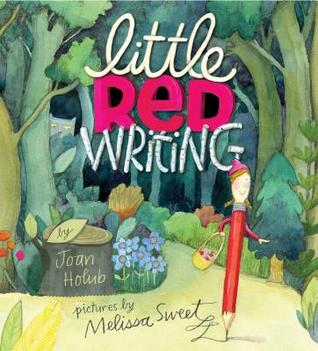
Little Red Writing by Joan Holub

Share

little

Little Red Writing
Author: Joan Holub
Illustrator: Melissa Sweet
Published September 24th, 2013 by Chronicle Books

Goodreads Summary: Acclaimed writer Joan Holub and Caldecott Honoree Melissa Sweet team up in this hilarious and exuberant retelling of Little Red Riding Hood, in which a brave, little red pencil finds her way through the many perils of writing a story, faces a ravenous pencil sharpener (the Wolf 3000)… and saves the day.

My Review and Teachers’ Tools for Navigation: I really think these wonderful woman created this book for just for teachers. It is a perfect, perfect, perfect book for a read aloud AND for a mentor text!

First, the book is a direct allusion to Red Riding Hood and is a great book to throw into the mix when looking at different versions of Red Riding Hood. I can just picture this book, with a version of the original story, Hoodwinked the movie, and Lon Po Po. Wow! What great discussions and activities you could do with this.

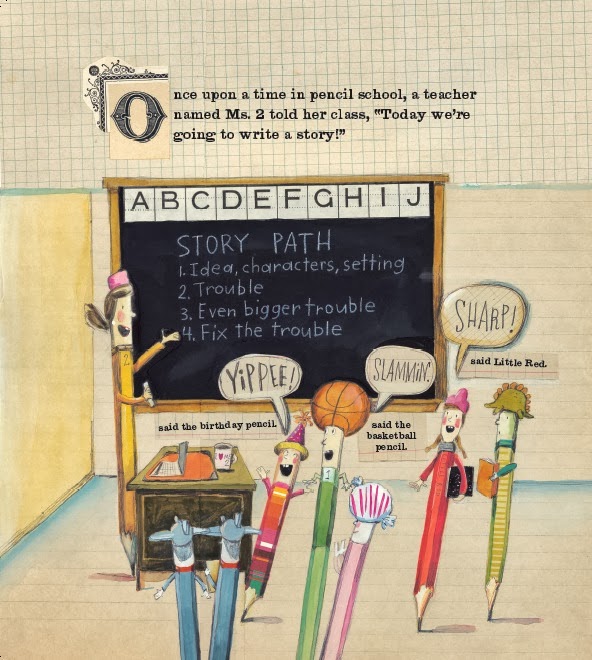
Second, this book is not just an awesome narrative and it includes a great lesson about writing a narrative. Red, our main character, is given the job to write a story and the book takes us through her journey of writing the story where she needs to include characters, setting, trouble, and fixing the trouble. A perfect opportunity to discuss narrative elements.  Taking this even further, it would be so much fun to look at the ideas that each of the other pencils had for their stories and write the entire story. You would have to look at each pencil’s personality and think about how s/he would write the story.

Finally, the book also deals with some parts of speech and how to use them. First are verbs where Red looks for more interesting verbs. She then looks for adjectives to add description. Then learns the importance of conjunctions (but watch out! They can lead to run-on sentences). Finally came adverbs with a bit of punctuation and capitalization discussion. Each part of speech is discussed in a nonboring way and the introduction could be a jumping off point to a deeper discussion.

Discussion Questions: How did Red use adjectives throughout the story to help you visualize the action?; What ended up being Red’s trouble, how did it get worse, and how did she fix it?; Pick one of the other pencils’ stories. How do you think it would end?

We Flagged: 

Read This If You Loved: Red Riding Hood by Brothers Grimm, Lon Po Po by Ed Young, The Day the Crayons Quit by Drew Daywalt

Recommended For: 

readaloudbuttonsmall closereadinganalysisbuttonsmall classroomlibrarybuttonsmall

Signature

Locomotive by Brian Floca (Ricki’s Review)

Share

locomotive

Locomotive
Author and Illustrator: Brian Floca
Published September 3rd, 2013 by Atheneum Books for Young Readers

Goodreads Summary: The Caldecott Medal Winner, Sibert Honor Book, and New York Timesbestseller Locomotive is a rich and detailed sensory exploration of America’s early railroads, from the creator of the “stunning” (BooklistMoonshot.

It is the summer of 1869, and trains, crews, and family are traveling together, riding America’s brand-new transcontinental railroad. These pages come alive with the details of the trip and the sounds, speed, and strength of the mighty locomotives; the work that keeps them moving; and the thrill of travel from plains to mountain to ocean.

Come hear the hiss of the steam, feel the heat of the engine, watch the landscape race by. Come ride the rails, come cross the young country!

My Review: Filled with a beautiful array images (watercolor, ink, acrylic, etc.), this incredibly well-researched book takes readers on a journey through the summer of 1869. It took my husband and me three nights to read this title to our son because we needed to pause and take in its magic. After I closed the last page of the book, a library copy, my husband looked at me and mouthed (because our son was asleep), “Let’s buy this one.” There is a wonderful balance of factual information about the train and lyrical language that brims with gorgeous figurative language. This book is a standout and well-deserving of the accolades it has received.

**A special thanks to Kellee, who texted me that I had to read this one. You can read her review here.**

Teachers’ Tools for Navigation: I would use this text in any grade level. I envision the eager eyes of elementary school students as their curiosity is piqued… middle schoolers, suddenly interested in trains and this time in our history…or high schoolers, researching the different parts of the train and learning how effective figurative language can be in writing. This book would be a great mentor text to teach creativity. The layout of the pages is so very purposeful, which pave the way for great classroom discussions.

Discussion Questions: How does Brian Floca grab the readers’ attention? How is his writing purposeful?; In what ways does Floca manipulate language?; How does the second person point-of-view add to the story?; What does this book teach us? Go beyond the obvious.; How do the pages differ in their visual appeal? Why do you think this is?

We Flagged:

Rather than including a quote here, I wanted to show you a few of the gorgeous spreads with this book. These pages are pulled from images posted on Amazon.

locomotive1 locomotive2 locomotive4 locomotive3

Read This If You Loved: The Polar Express by Chris Van Allsburg

Recommended For: 

readaloudbuttonsmall closereadinganalysisbuttonsmall classroomlibrarybuttonsmall

RickiSig

Period 8 by Chris Crutcher

Share

period

Period 8
Author: Chris Crutcher
Published March 26th, 2013 by Harper Collins

Goodreads Summary: In this full-length novel from Chris Crutcher, his first since the best-selling Deadline, the ultimate bully and the ultimate good guy tangle during Period 8.

Paul “the Bomb” Baum tells the truth. No matter what. It was something he learned at Sunday School. But telling the truth can cause problems, and not minor ones. And as Paulie discovers, finding the truth can be even more problematic. Period 8 is supposed to be that one period in high school where the truth can shine, a safe haven. Only what Paulie and Hannah (his ex-girlfriend, unfortunately) and his other classmates don’t know is that the ultimate bully, the ultimate liar, is in their midst.

Terrifying, thought-provoking, and original, this novel combines all the qualities of a great thriller with the controversy, ethics, and raw emotion of a classic Crutcher story.

My ReviewNow, this is not a “normal” Chris Crutcher book, but like all of his books, it is raw, true, and sports plays a role of some sort. And this one is SO full of suspense for the last 25%. It is a hold your breath, read as quickly as you can kind of book there at the end. (I do wish that this suspense had been spread out to 50% of the book. This would have helped the pacing a bit and I think it would have given Crutcher more time to give information into the crime. Although the quick pacing at the end adds to the suspense, I think spreading it out a bit would have kept the suspense and given more time to delve further into the bad guys and the mystery.)

Teacher’s Tools for Navigation: I, personally, really loved how he chose to tell the story in 3rd person. Although it doesn’t give as much insight into one character, it gives you a little bit of insight into each one, and as you are trying to figure out what is going one, it is really fun to hear from all the different characters. (Some readers and reviewers have stated that having the multiple 3rd person point of views made it so the reader didn’t really know anyone, but I think it actually helped me get to know everyone a little bit. It also allows for the reader to get snippets of not just the mystery but of the characters allowing you to build the complete character in your head.)

Another brilliant think Crutcher did was include foreshadowing scenes right at the beginning of the novel that did not make sense until the end and then I had to go back and read it. Well done!

Also, if you ever need a mentor text on complex sentence structure or descriptive language–Crutcher is for you!

Mostly, though, this book will find its home in teens’ hands. It will be as loved as other Crutcher books.

Discussion Questions: How does swimming help Paulie deal with his problems?; At what point did you figure out who the “bad guy” in the group was?

We Flagged: “He hits the water, involuntarily sucking air as the cold leaks in. The colder the better. He deserves this. Even so, he pees in self-defense, his only means to counter the ice-watery fingers creeping around his ribcage and into his crotch. He swims away from shore for about a hundred yards as his body heat warms the water inside the suit. He turns parallel to the shore and strokes, finding a candence he can hold over the next two hours. He knows how to play games to allay the monotony; fifty stroke hard, fifty strokes easy; a hundred strokes hard, fifty easy; a hundred-fifty hard, fifty easy, and on and on. An hour up and an hour back. He has taught himself to breathe on either side in order to keep the shore in sight and swim a relatively straight line. On this morning, working on zero sleep, he holds an even pace; no intervals. Just his sweet Hannah wedged in his frontal lobe. His gone Hannah.” (p. 3-4)

Read This If You Loved: Any other Chris Crutcher book, Shine by Lauren Myracle, Red Kayak by Priscilla Cummings

Recommended For: 

classroomlibrarybuttonsmall closereadinganalysisbuttonsmall

Signature

Let it Snow by John Green, Maureen Johnson, and Lauren Myracle

Share

letitsnow

Let it Snow
Authors: John Green, Maureen Johnson, Lauren Myracle
Published October 2nd, 2008 by Speak

Goodreads Summary: Sparkling white snowdrifts, beautiful presents wrapped in ribbons, and multicolored lights glittering in the night through the falling snow. A Christmas Eve snowstorm transforms one small town into a romantic haven, the kind you see only in movies. Well, kinda. After all, a cold and wet hike from a stranded train through the middle of nowhere would not normally end with a delicious kiss from a charming stranger. And no one would think that a trip to the Waffle House through four feet of snow would lead to love with an old friend. Or that the way back to true love begins with a painfully early morning shift at Starbucks. Thanks to three of today’s bestselling teen authors—John Green, Maureen Johnson, and Lauren Myracle—the magic of the holidays shines on these hilarious and charming interconnected tales of love, romance, and breathtaking kisses.

My Review: You cannot go wrong with those authors! What I found was not only a romantic, funny book, but a perfect holiday read! Let it Snow is like those movies where you follow three very different stories and then eventually they intertwine and everything seems to follow into place. I loved reading each story, wanting to learn more about a certain character and then realizing the next story was about them! The authors also did a fantastic job throwing in aspects of Christmas and pushing the holiday cheer without shoving it down your throat. Let is Snow is one of those books that I want to curl up and read by the fire while it snows outside.

Teacher’s Tools for Navigation: I would love to read this book in its entirety with students and then try to make a timeline of the three stories and how they overlap. It would be a great discussion of connections and sequence. Also, you could look at the voice of characters and how each author made theirs distinct (and how the others authors kept them distinct in their sections). This could also lead to a great discussion about style.

This book is also loved by students and should definitely be in teen libraries.

Discussion Questions: Think of a time when you were stuck somewhere that you didn’t want to be and couldn’t really do anything about it, how did you feel? What did you do to keep yourself busy? Did something happen that you would not have expected or that wouldn’t have happened if you weren’t stuck or stranded? 

We Flagged:
From “The Jubilee Express” by Maureen Johnson

“‘Oh my god!’ said one of the Ambers. ‘Is this not the worst trip ever? Did you see the snow?’
She was a sharp one, this Amber. What would she notice next? The train? The moon? The hilarious vagaries of human existence? Her own head?
I didn’t say any of that, because death by cheerleader is not really the way I want to go.” p. 22

From “A Cheertastic Christmas Miracle” by John Green

“I dashed upstairs, my socks sliding on the hardwood floor in the kitchen, and stumbled into my bedroom. I tore open the closet door and began feverishly sorting through the shirts piled on the floor in the vain hope that inside that pile there might be some wondrously perfect shirt down there, a nice striped button-down with no wrinkles that said, ‘I’m strong and tough but I’m also a surprisingly good listener with a true and abiding passion for cheers and those who lead them.’ Unfortunately, there was no such shirt to be found. I quickly settled on a dirty but cool yellow Threadless T-shirt under a black v-neck sweater. I kicked off my watching-James-Bond-movies-with-the-Duke-and-JP jeans and hurriedly wiggled into my pair of nice, dark jeans.” p. 131-132

From “The Patron Saint of Pigs” by Lauren Myracle

     “Being me sucked. Being me on this supposedly gorgeous night, with the supposedly gorgeous snow looming in five-foot drifts outside my bedroom window, double-sucked. Add the fact that today was Christmas, and my score was up to triple-suck. And add in the sad, aching, devastating lack of Jeb, and ding-ding-ding! The bell at the top of the Suckage Meter couldn’t ring any louder. Instead of jingle bells, I had suckage bells. Lovely.” p. 215
Read This If You Loved:
Recommended For: 
classroomlibrarybuttonsmall closereadinganalysisbuttonsmall
Signature