Hitler Youth: Growing Up in Hitler’s Shadow & The Boy Who Dared by Susan Campbell Bartoletti

Share

These two books are my favorite fiction/nonfiction companion books, so I wanted to share them with you together. 
hitleryouth

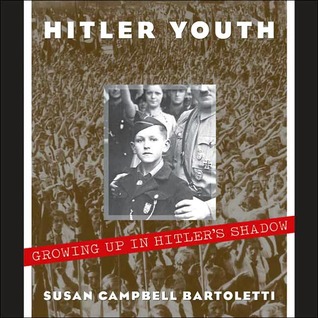
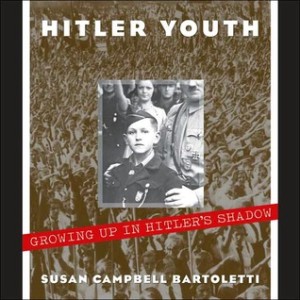
Hitler Youth: Growing Up in Hitler’s Shadow
Author: Susan Campbell Bartoletti
Published April 1st, 2005 by Scholastic Nonfiction

Goodreads Summary: In her first full-length nonfiction title since winning the Robert F. Sibert Award, Susan Campbell Bartoletti explores the riveting and often chilling story of Germany’s powerful Hitler Youth groups.

“I begin with the young. We older ones are used up . . . But my magnificent youngsters! Look at these men and boys! What material! With them, I can create a new world.” –Adolf Hitler, Nuremberg 1933

By the time Hitler became Chancellor of Germany in 1933, 3.5 million children belonged to the Hitler Youth. It would become the largest youth group in history. Susan Campbell Bartoletti explores how Hitler gained the loyalty, trust, and passion of so many of Germany’s young people. Her research includes telling interviews with surviving Hitler Youth members.

My Review: During World War II, Hitler controlled more than just the military; he controlled the entire country of Germany. Much of what this book explains are parts of the WWII history that is not taught in our schools and shows the true extent of the power that Hitler had over everyone.

The Hitler Youth began as a voluntary organization to support Hitler, but it quickly became a way for Hitler to control the youth. Soon the Hitler Youth was not voluntary and they were being used in much the same way as the military.

This book tells true stories of children in the Hitler Youth and children that were brave enough to speak up. It is truly horrific and fascinating. Susan Campbell Bartoletti uses a combination of narrative and expository writing to take her reader on a journey through Nazi controlled Germany starting with their depression and taking us through the the end of World War II. By intertwining true stories of the youth of Germany with historical fact, Bartoletti pulls at your heart strings and shows the true effect that Hitler had on the entire nation. It also takes you through the steps that Hitler took to brainwash the entire population, starting with the most desperate citizens, including the youth.

Although many nonfiction books are hard to get through and are dry, this one has a voice to it that is deeper and more sensitive than most. You become connected to the people of Germany and the youth of the story, so it doesn’t matter if that I already know the outcome- you have to know how they make it out of their deceit filled situation.
boywho

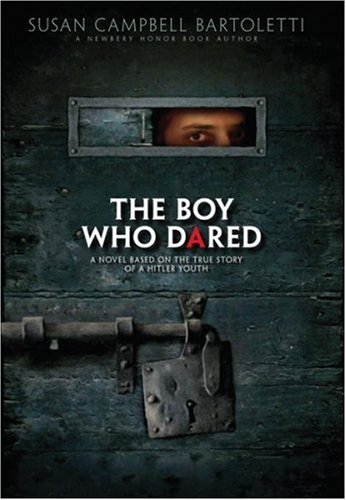
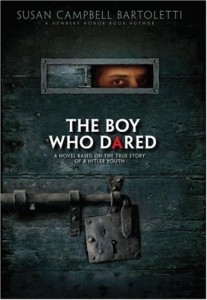
The Boy Who Dared
Author: Susan Campbell Bartoletti
Published February 1st, 2008 by Scholastic Press

Goodreads Summary: Bartoletti has taken one episode from her Newbery Honor Book, HITLER YOUTH, and fleshed it out into thought-provoking novel. When 16-year-old Helmut Hubner listens to the BBC news on an illegal short-wave radio, he quickly discovers Germany is lying to the people. But when he tries to expose the truth with leaflets, he’s tried for treason. Sentenced to death and waiting in a jail cell, Helmut’s story emerges in a series of flashbacks that show his growth from a naive child caught up in the patriotism of the times , to a sensitive and mature young man who thinks for himself.

My Review: Helmuth Hubener thought that Hitler was going to fix Germany, but the longer Hitler was in power, the more Helmuth realized that there was social injustice happening.

Based on a true story, The Boy Who Dared, accounts Helmuth’s life and the choices he makes. Told in flashback, I felt that some of the suspense is taken away since you know Helmuth’s current situation right from the beginning of the story; however, even with knowing the outcome, I wanted to read to figure out how Helmuth got there.

The exposition of the book helped me understand the extent of Helmuth’s society at the time which made me even more sympathetic then I would have been just jumping into Helmuth’s life. Although we all know about World War II and the Holocaust, unless you have read other books on World War II Germany, you may not understand the extent of Hitler’s power and brainwashing. With The Boy Who Dared, we follow Helmuth through his feelings about Hitler and the decisions he made.

This book is fabulous to read with the nonfiction book by Susan Campbell Bartoletti, Hitler Youth, which recounts the history around the Hitler Youth and what Helmuth was living through.

*     *     *     *     *

Teacher’s Tools For Navigation: If I taught a grade level where the Holocaust or WWII was taught in history, I would love to use these books supplementally in English class. These books tell a story within WWII that isn’t normally taught in history and really shines a light on a different side of the story. It would be a great way to discuss point of view, persuasion, and propaganda. I can also see these being used in thematic sets and then in lit circles. Each book adds to a whole look at WWII.

Discussion Questions: After reading both books, why was Hitler able to manipulate and affect the youth of Germany the way he did?; How did Helmuth affect those around him? History?

We Flagged: “The dark streets were already flooded with thousands of excited people, who, like Melita, were running out to watch the victory parade in honor of Adolf Hitler… Melita couldn’t understand why her parents didn’t support a great man like Adolf Hitler, who said that a person’s money and titles didn’t matter.  All that mattered was whether a person contributed to the well-being of the people.” (Hitler Youth p. 15-16)

“It’s morning.  Soft gray lights slips over the tall redbrick wall.  It stretches across the exercise yard and reaches through the high, barred windows.  In a cell on the ground floor, the light shifts dark shapes into a small stool, a scrawny table, and a bed made of wooden boards with no mattress or blanket.  On that bed, a thin, huddled figure, Helmuth, a boy of seventeen, lies awake.  Shivering. Trembling.
It’s Tuesday.
The executioner works on Tuesday.” (The Boy who Dared p. 1)

Read These If You Loved: Parallel Journeys by Eleanor Ayers, Alfons Heck & Helen Waterford, Briar Rose by Jane Yolen, The Book Thief by Markus Zusak, Resistance (series) by Carla Jablonski, London Calling by Edward Bloor, Once (series) by Morris Gleitzman, The Berlin Boxing Club by Robert Sharenow, Between Shades of Gray by Ruta Sepetys

Recommended For: 

classroomlibrarybuttonsmall litcirclesbuttonsmall closereadinganalysisbuttonsmall

Signature

Waluk by Emilio Ruiz

Share

waluk

Waluk
Author: Emilio Ruiz
Illustrator: Ana Miralles
Expected publication November 1st, 2013 by Delcourt

Goodreads Summary: Young Waluk is all alone. His mother has abandoned him, as is the way of polar bears, and now he must fend for himself. But he doesn’t know much about the world—and unfortunately, his Arctic world is changing quickly. The ice is melting, and food is hard to find.

Luckily, Waluk meets Manitok, a wise old bear with missing teeth and a bad sense of smell. Manitok knows many survival tricks, and he teaches Waluk about seals, foxes, changing seasons, and—when Manitok is caught in a trap—human beings. Has Waluk learned enough from his friend to find a way to save him?

My Review: I’m always a big fan of books that books that tell a great story, but also teaches the reader something – Waluk fits this description.

I love that this story is told in a graphic novel because it allows us to see what Waluk is experiencing. I think this is really important because many readers will not be familiar with the setting and animals.

Additionally, there are nonfiction aspects where global warming and human impact on polar bears is discussed even with a bibliography in the end for students who want to learn more.

Teacher’s Tools For Navigation: I would love to read this graphic novel aloud to my class just to discuss with them the environmental aspects of the book. I think the story really brings global warming and the threat polar bears feel to life. Also, the story would be a great way to discuss point of view/perspective since the story is told from Waluk’s point of view.

Discussion Questions: How is global warming threatening polar bears?; What type of character traits must Waluk have to be willing to go save Manitok?

We Flagged: Manitok “If you want to be like the great Nanook, you’ll have to feed on seal blubber and whale fat.”
Waluk “Sure. Like it’s that easy. The seals laugh at me. Not even the puny lemmings are afraid of me.”
Manitok “Nah, that’s no problem, Buddy. I’m Manitok! Descended from the legend of the great whit bears. I know how to hunt anything.”
Waluk “Really?”
Manitok “Of course! Seals, walruses, belugas, lemmings, razorbills, humans–”
Waluk “Then why are you so thin?”
Manitok “Well, it’s age… see, I’m not as good as I used to be. Frankly, it’s been a while since I’ve gorged on sea lion – taken him down with my fangs, ya know, like it’s no big deal.” (p. 18)

Read This If You Loved: Seekers (series) by Erin Hunter, Nonfiction books about global warming or polar bears, Neversink by Barry Wolverton, [For further POV discussions] Who Stole Mona Lisa? by Ruthie Knapp and The Day the Crayons Quit by Drew Daywalt

Recommended For: 

classroomlibrarybuttonsmall readaloudbuttonsmall

Signature

**Thank you to Netgalley and Lerner Publishing Group (Graphic Universe) for providing the e-galley!**

The Day the Crayons Quit by Drew Daywalt

Share

crayons

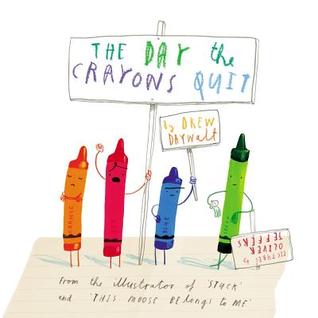
The Day the Crayons Quit
Author: Drew Daywalt
Illustrator: Oliver Jeffers
Published June 27th, 2013 by Philomel

Goodreads Summary: Crayons have feelings, too, in this funny back-to-school story illustrated by the creator of Stuck and This Moose Belongs to Me 

Poor Duncan just wants to color. But when he opens his box of crayons, he finds only letters, all saying the same thing: His crayons have had enough! They quit! Beige Crayon is tired of playing second fiddle to Brown Crayon. Black wants to be used for more than just outlining. Blue needs a break from coloring all those bodies of water. And Orange and Yellow are no longer speaking—each believes he is the true color of the sun.

What can Duncan possibly do to appease all of the crayons and get them back to doing what they do best?

Review: Told through letters, this story of revolt reminds me a bit of Toy Story in that when I finished, I felt like I needed to get out my crayons and use each one and let them know they are loved. This is probably one of my favorite picture books this year (maybe in general) because it promotes so much that I believe in: art, imagination, and caring. This book would be a great addition to Dot Day activities (Sept. 15, 2013).

Teacher’s Tools for Navigation: Automatically, after reading, I saw that the best way to use this book in the classroom is to first use it to promote imagination. Too many kids aren’t told to use their imagination often any more.

Also, I would use the inanimate object point of views to have students participate in a RAFT writing activity which helps students think about different perspectives. RAFT stands for R: Role, A: Audience, F: Format, T: Topic. In the book, Drew Daywalt was writing as a crayon (R) to their owner (A) in a letter (F) about their use (T). The students could pick their own toy and write a letter to themselves about their use.  So many possibilities!

Discussion Questions: What toy do you use at home more than others? What would this toy say to you? What about a toy you don’t use?; Draw a picture of a zoo or ocean scene, but use your imagination when it comes to size, color, and placement.

We Flagged: “Dear Duncan, It has been great being your FAVORITE color this PAST year. And the year before. And the YEAR before THAT! I have really enjoyed all those oceans, lakes, rivers, raindrops, rain clouds, and clear skies. but the BAD NEWS is that I am so short and stubby, I can’t even see over the railing in the crayon box anymore! I need a break! Your very stubby friend, Blue Crayon”

Read This If You Loved: Who Stole Mona Lisa? by Ruthie Knapp, The Dot and Sky Color by Peter H. Reynolds, Chalk by Bill Thomson, Art & Max by David Weisner, Not a… series by Antoinette Portis, Art by Patrick McDonnell, Perfect Square by Michael Hall, Cloudette by Tom Lichtenheld

Recommended For: 

readaloudbuttonsmall classroomlibrarybuttonsmall

I think we should all get out some crayons today and color; enjoy your crayons, but make sure to use imagination and don’t show favoritism! 

Signature

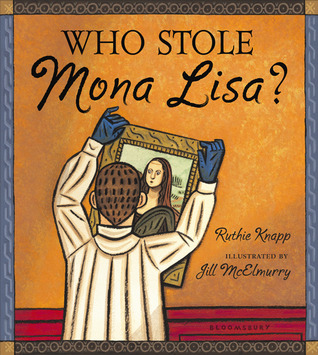
Who Stole Mona Lisa? by Ruthie Knapp

Share

NF PB 2013

Nonfiction Picture Book Wednesday

Nonfiction Picture Book Wednesday is hosted by Kid Lit Frenzy and was started to help promote the reading of nonfiction texts. Most Wednesdays, we will be participating and will review a nonfiction text (though it may not always be a picture book).
Be sure to visit Kid Lit Frenzy and see what other nonfiction books are shared this week!

mona

Who Stole Mona Lisa?
Author: Ruthie Knapp
Illustrated by: Jill McElmurry
Published by September 1st, 2010 by Bloombury USA Childrens

Goodreads Summary: She has a legendary smile, and millions come to see her every day. Some say she is the most famous painting in the world. Who is she? Why, the Mona Lisa, of course! But did you know that she was once stolen from her wall at the Louvre? Who took her? Why? Where was she hidden? How was she found? Someone call the police!

Narrated by the lady of the enigmatic smile herself—and brought to life with gorgeous paintings that take the reader from da Vinci’s renaissance right up to the present day—this is a stylishly whimsical account of the glorious, wonderful, sometimes dangerous life of the best recognized painting of all time. Discover the secrets behind her mysterious smile, and hear for yourself the amazing true story of her kidnapping.

Review: How fascinating! First, let me tell you a little bit about my background. My father has a BA in Art History and an MFA in Museumology. These studies led him to become an executive director of art museums (he is currently directing the Hunter Museum of American Art in Chattanooga, TN) thus impacting my life greatly. My entire childhood has been surrounded by the arts (my mother is a photographer as well). This has made art history something that I am very interested in which then made this book so fascinating for me and I believe it will be incredibly fascinating for all readers.

Mona Lisa is probably the most famous painting of all time, but many, including me, do not know her history. She is more of a mystery that we all are enthralled with than a piece of artwork that is talked about in history class; however, Ruthie Knapp’s book shows us that Mona Lisa’s history is a lot more interesting than we probably thought. And what I think makes this book one that will draw in all sorts of readers is the way she tells the story. The story is told from Mona Lisa’s point of view which makes it more of a caper, mystery type story instead of just informational nonfiction.

Teacher’s Tools For Navigation: As soon as I read this book, I saw how I could use it in the classroom. Seeing things from different points of view and perspectives is something that, as a teacher, I am always trying to help my students achieve. This book, since it is told from Mona Lisa’s point of view, is a perfect example of seeing a situation from a different point of view. After reading Who Stole Mona Lisa? I would start a discussion on how others in the story might have viewed the situation. How would the director of the Louvre have told the story differently? How about Vincenzo Perugia? Parisians? All of these people would have viewed the loss of Mona Lisa differently. These thoughts then could be transferred to anything. Maybe have students choose a historical event and think about it from a different person’s point of view: Babe Ruth’s huge “called” home run from the pitchers point of view, atomic bombings of Japan from a Japanese citizen’s point of view, an event in a book from a different character’s point of view, etc. The options are infinite.

Discussion Questions: How would the director of the Louvre have told the story differently? How about Vincenzo Perugia? Parisians?; Look up other stolen pieces of art. What happened to them?

We Flagged: “Leonardo da Vinci is the artist who painted me. It took him four years! Leonardo loved me. He looked at me while he ate past. He would not travel without me. He said I was his masterpiece. I was famous because Leonardo was famous. Fans jammed his studio to watch him paint.” (p. 10-11)

“The man with the mustache loved me too. He said I reminded him of someone special. He looked at me at every meal: over apples, eggs, and trout; cake and prunes and piglet snout. He looked at me on rainy days, on snowy days, and during summer squalls. He looked at me when he bathed. He looked at me when he shaved. He looked at me for TWO years. I was tired of the man with the mustache. I missed my wall. I missed people staring. I missed children looking sideways and upside down. (p. 24-25)

Read This If You Loved: Nonfiction books about Leonardo da Vinci or Mona Lisa, any books told from inanimate objects’ points of view, Seen Art?  by Jon Sciezska, Capture the Flag by Kate Messner, Linnea in Monet’s Garden by Christina Bjork

Recommended For: 

classroomlibrarybuttonsmall closereadinganalysisbuttonsmall readaloudbuttonsmall

Signature