Candlewick Nonfiction Picture Books: Who’s Like Me? by Nicola Davies; Can We Help? by George Ancona; Belle, the Last Mule at Gee’s Bend by Calvin Alexander Ramsey & Bettye Stroud; and The Boy Who Fell Off the Mayflower by P.J. Lynch

Share

NFPB2016

Nonfiction Wednesday

Nonfiction Picture Book Wednesday is hosted by Kid Lit Frenzy and was started to help promote the reading of nonfiction texts. Most Wednesdays, we will be participating and will review a nonfiction text (though it may not always be a picture book).
Be sure to visit Kid Lit Frenzy and see what other nonfiction books are shared this week!
who's like me

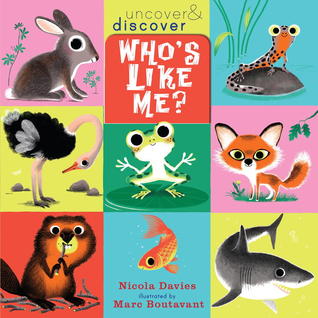
Who’s Like Me?
Author: Nicola Davis
Illustrator: Marc Boutavant
Published February 28th, 2012 by Candlewick Press

Goodreads Summary: Lift the flaps and learn about animal life in this fresh, fun-filled book for curious preschoolers.

A bunny is furry and breathes air. Who else is like that — a pigeon, a fish, a chameleon, or a fox? Some animals have fins to swim with, some have feathers and a beak, some have skin that is scaly, or smooth and wet. But whatever features a creature has, someone else has them, too. Can you guess who? Big flaps and a matching spread at the end make animal classification fun.

My Thoughts: This flap book is going to be a big hit in my house both because it is entertaining and because it is informative. First, the author does a great job making the identification of animal types a game including flaps and comparisons/contrasts then she ensures that factual information follows the matching to explain the type of animal and the characteristics of the type.
can we help

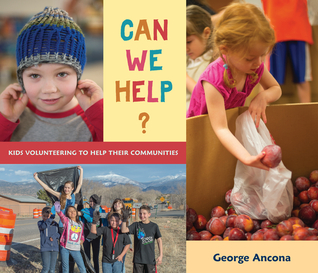
Can We Help? Kids Volunteering to Help their Communities
Author: George Ancona
Published August 25th, 2015 by Candlewick Press

Goodreads Summary: Real kids make a real difference in their communities in this vibrantly photographed chronicle by George Ancona.

George Ancona celebrates the joy of kids giving back. In one after-school program, middle-school students mentor and tutor younger children. Via a special partnership, schoolchildren help professionals train assistance dogs for people with disabilities. At a community farm, families plant, grow, and harvest produce for soup kitchens and charities. In these and other examples of volunteering, kids of all ages work together knitting hats and scarves for those who could use warm clothes, packing hot meals to deliver to housebound people, and keeping roadways clean. Young humanitarians reading these accounts may well be inspired to find ways that they can help, too.

My Thoughts: I think this picture book would be a wonderful one to read in conjunction with the 31 Ways to Change the World because that book includes suggestions while this one gives us narratives about those actually making a difference. I love the variety of ways the author highlights: from knitting to a community farm to training dogs and mentoring. These stories are inspiring and will make the reader (adult or child) want to do something to make a difference!
belle last mule

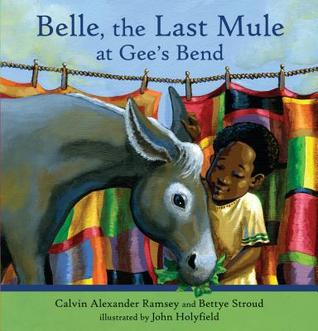
Belle, the Last Mule at Gee’s Bend
Authors: Calving Alexander Ramsey and Bettye Stroud
Illustrator: John Holyfield
Published September 13th, 2011 by Candlewick Press

Goodreads Summary: A true story inspires the moving tale of a mule that played a key role in the civil rights movement– and a young boy who sees history anew.

Sitting on a bench waiting for his mother, Alex spies a mule chomping on greens in someone’s garden, and he can’t help but ask about it.””Ol Belle?” says Miz Pettway next to him. “She can have all the collards she wants. She’s earned it.” And so begins the tale of a simple mule in Gee’s Bend, Alabama, who played a singular part in the civil rights movement of the 1960s. When African-Americans in a poor community– inspired by a visit from Dr. Martin Luther King, Jr.– defied local authorities who were trying to stop them from registering to vote, many got around a long detour on mule-drawn wagons. Later, after Dr. King’s assassination, two mules from Gee’s Bend pulled the farm wagon bearing his casket through the streets of Atlanta. As Alex looks into the eyes of gentle Belle, he begins to understand a powerful time in history in a very personal way.

My Thoughts: This story adds an extra truth to the story of Martin Luther King that many of us know. MLK was an advocate and leader and activist for all African and Black Americans and this meant a lot to so many communities of people around America including Gee’s Bend. To learn about Belle and King’s reason for having Belle pull his coffin really just shows how true his intentions of being a man of the people while fighting for the rights of all. And I loved how this story was told as a story from a Bender to a young boy visiting the town. Gee’s Bend is such a historical place, and I love this new part of their history that I didn’t know. (I love the quilts produced in Gee’s Bend! If you haven’t viewed them, Google it now!)
boy who fell

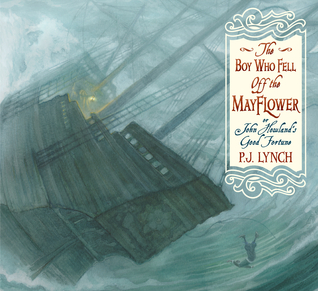
The Boy Who Fell Off the Mayflower or John Howland’s Good Fortune
Author and Illustrator: P.J. Lynch
Published September 22nd, 2015 by Candlewick Press

Goodreads Summary: In the first book he has both written and illustrated, master artist P.J. Lynch brings a Mayflower voyager’s story to vivid life.

At a young age, John Howland learned what it meant to take advantage of an opportunity. Leaving the docks of London on the Mayflower as an indentured servant to Pilgrim John Carver, John Howland little knew that he was embarking on the adventure of a lifetime. By his great good fortune, John survived falling overboard on the crossing of the Atlantic Ocean, and he earned his keep ashore by helping to scout a safe harbor and landing site for his bedraggled and ill shipmates. Would his luck continue to hold amid the dangers and adversity of the Pilgrims’ lives in New England? John Howland’s tale is masterfully told in his own voice, bringing an immediacy and young perspective to the oft-told Pilgrims’ story. P.J. Lynch captures this pivotal moment in American history in precise and exquisite detail, from the light on the froth of a breaking wave to the questioning voice of a teen in a new world.

My Thoughts: I have to start my review with discussing the art work. Describing P.J. Lynch as a master artist is a perfect statement. His watercolor and gouache full page plus illustrations are so lifelike and beautiful that the reader will spend time on each page viewing the art in addition to reading the text. And what makes the book even better is that the text is interesting. Told in first person from John Howland’s point of view, we travel from London to America through storms, a fall off the Mayflower, death, disease, famine, and shows how friendship and kindness pay. In the classroom, this text would be an informational and interesting introduction to the Mayflower voyage and Plymouth.


All Recommended For: 

classroomlibrarybuttonsmall readaloudbuttonsmall litcirclesbuttonsmall

Kellee Signature

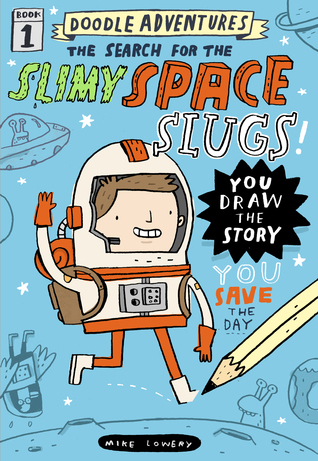
Doodle Adventures: The Search for the Slimy Space Slubs by Mike Lowery

Share

Doodle Adventures

Doodle Adventures: The Search for the Slimy Space Slugs
Author: Mike Lowery
Illustrator: Mike Lowery and YOU!
Published May 17th, 2016 by Workman Publishing Company

Summary: Draw your way through the story!

Doodle Adventures: The Search for the Slimy Space Slugs! is a lighthearted fantasy where the reader first draws him- or herself into the story, and then continues by following prompts and adding more illustrations and doodles. Set in space, the book invites the reader to join Carl, a duck and member of a super-secret international group of explorers, on a journey in search of a very important grail-like object. The book is sturdy paper over board with beautiful cream paper—perfect for defacing! And by the end, the reader will have co-written a tale to return to again and again, and show off to family and friends.

Kellee’s Review: I cannot wait to see this book completed by students. I think so many kids of all sorts of ages will enjoy this book. It is silly enough for young elementary students, and its plot is interesting enough for middle school students. I love the narrator, Carl, who is a puny and out spoken duck who takes the reader on a journey to the Slug Planet (in 2nd person point of view!). The  illustrations are also so well done for what the book is trying to do. They are comic-esque and funny. I truly enjoyed my journey with Carl, but I am really looking forward to watching a kid complete this book in the interactive way that it is made for. 

Ricki’s Review: After I review books, I almost always give them away to schools. I couldn’t help but think it would be such a great book for the boys who live next door. They are always adventuring in their backyard, and they will surely be captivated by this book. The narrator Carl (a duck) is highly entertaining, and I couldn’t help but laugh as I read the book. He talks to the reader, and the second-person narrative makes the book particularly funny. The reader will be catapulted into the story because of its interactive nature. Even kids who don’t enjoy drawing will want to put their pens to the pages.

Teachers’ Tools for Navigation: This book promotes creativity, plot development, and humor. There are so many different ways that a teacher could utilize this book, one for each of our recommendations below. First, it could be a class read aloud where the teacher does the drawing based on the class’s votes or students can take turn drawing. It could also be a lit circle/book club book where students complete the book in groups then they can jigsaw into new groups to share their newly created book. Lastly, the book could definitely be an independent read or class read where students draw in their own books and each student will have their own unique book.

Discussion Questions: How does drawing help you interact with the story? Which drawings were particularly fun to draw?; How does the second person narration make this story engaging? What other stories are written in this point of view?; Why might the book be narrated by a duck? What does this do for you, the reader?

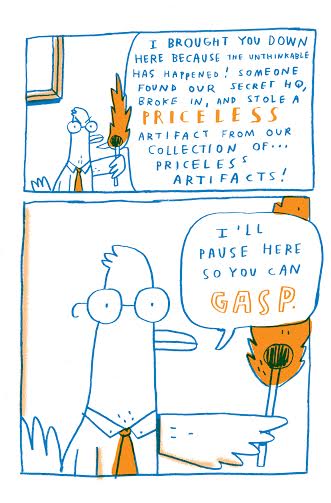
Flagged Passages: “I brought you down here because the unthinkable has happened! Someone found our secret HQ, broke in, and stole a PRICELESS artifact from our collection of…priceless artifacts!

I’ll pause here so you can GASP!” (p. 26)

Doodle Adventures spread

See more at www.mikelowery.com or the author’s Instagram @mikelowerystudio

Read This If You Loved: Captain Underpants series by Dav Pilkey, Diaper Baby series by Dav Pilkey, Choose Your Own Adventure books, Drawing/Illustrating books

Recommended For:

  readaloudbuttonsmall litcirclesbuttonsmall

Kellee Signatureand RickiSig

**Thank you to Estelle at Workman Publishing for providing copies for review!**

Review and Teaching Guide!: Poptropica: Mystery of the Map by Jack Chabert

Share

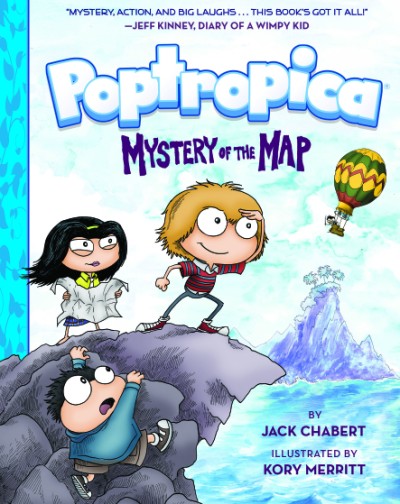
Poptropica 1

Poptrpica: Mystery of the Map
Author: Jack Chabert
Illustrator: Kory Merritt
Idea: Jeff Kinney
Published March 1st, 2016 by Amulet Books

Goodreads Summary: Based on a concept by Wimpy Kid author Jeff Kinney comes Poptropica, a brand-new graphic novel adventure series by Jack Chabert and Kory Merritt. In “Mystery of the Map,” Oliver, Mya, and Jorge take a ride in a hot-air balloon, only to crash-land on an unknown island filled with extinct animals and a horde of angry Vikings. Welcome to Poptropica, an uncharted group of islands whose existence is hidden from the rest of the world. As the three friends embark on a perilous search for a way home, they quickly discover the shocking reason they were brought there something that threatens the very existence of Poptropica and their ability to ever make it off the island!

My Review: I love learning about new graphic novels because they are so popular in my classroom, and I think this one will be another one that will be loved by students. Although the Poptropica idea was made by Jeff Kinney, I see it more as a ladder rung for late elementary school/early middle school before students jump to Amulet or Doug TenNapel books. I also know that there are millions of Poptropica users who will love to explore Poptropica through Oliver, Mya, and Jorge’s journey.

Although, I hadn’t played Poptropica when I first heard about the book, as soon as I knew I was getting it, I went onto the website to play, and I loved it! I can see why so many kids/teens like it–it is a role-playing game with adventure, puzzles, and a great story.  However, I will say that when I read the book, it would not have mattered if I’d played the game or not. I think that is the beauty of it. It can be an extension of the game, an intro to the game, or an adventure-filled graphic novel separate from the game.

The graphic novel itself is very well done. The graphics are fun and easy to read, the story is a page turner filled with adventure and humor, and it has fun history facts. I look forward to the rest of the series.

Teachers’ Tools for Navigation, Discussion Questions, and Flagged Passages: 

The teaching guide below that I wrote for Abrams Books includes vocabulary, cross-curricular activities, and cross-curricular discussion questions as well as example passages.

You can also access the teaching guide here.

Read This If You Loved: Bird & Squirrel series by James Burk, Rutabaga series by Eric Colossal, The Great Pet Escape by Victoria Jamieson, Little Robot by Ben Hatke, Salem Hyde series by Frank Cammuso

Recommended For: 

readaloudbuttonsmall classroomlibrarybuttonsmall

Kellee Signature

Review and Author Interview: Camp Rolling Hills series by Stacy Davidowitz

Share

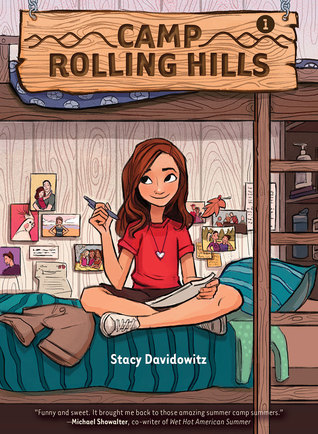
camp rolling hills camp crossing over

Camp Rolling Hills
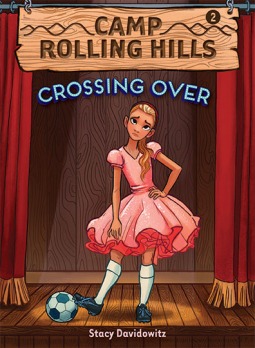
Camp Rolling Hills: Crossing Over

Author: Stacy Davidowitz
Published May 10th, 2016 by Amulet Paperbacks

Camp Rolling Hills’s Goodreads Summary: A hilarious and heartfelt series about the particular magic of summer camp—a place where reinvention is possible and friends are like family—from a sparkling debut talent.

Finally, it’s summer! Stephanie—aka Slimey—has been counting the days until she can return to her favorite place in the entire world, Camp Rolling Hills. And this year she’s especially happy to be back—she’ll have eight blissful weeks away from home, where life has been decidedly rocky.

New kid Bobby, on the other hand, is pretty sure he’s in for the worst summer of his life. He does not understand his weirdo cabinmates, the group singing, and the unfortunate nicknames (including his: Smelly). But he does understand Slimey, and the two soon fall in crush. This summer might not be so bad after all!

But then a fight sets off an epic, campwide, girls-versus-boys prank war. Bunks are raided! Boxer shorts are stolen! And it’s up to Slimey and Smelly to keep the peace.

Crossing Over’s Goodreads Summary: There’s only one thing Melman loves more than soccer: her summers at Camp Rolling Hills. So she’s pumped to be back—until she realizes her bunkmates have gone totally boy-crazy over the school year and plastered their cabin in pink. Pink posters, pink t-shirts…it seems that the only not-pink thing in the cabin is Melman herself. That is, until she’s given a dare in front of the entire camp: wear a pink princess dress. For Three. Whole. Days.

Steinberg’s summer gets off to a rough start, too, when his robot (usually his area of expertise) blows up during a camp-wide robotics contest. Steinberg might feel like a loser at home, but camp’s supposed to be his place to shine.

Steinberg without robots? Melman in pink? This whole summer feels turned upside down! To set things right, Steinberg and Melman team up and hatch a fail-proof plan. The plan’s secret ingredient? Hamburgers.

About the Author: Stacy Davidowitz is a camp-obsessed writer of books, plays, and screenplays. She also enjoys acting, singing, running long distances, and teaching theater all over New York City. Her alma maters are Tufts University, Columbia University, and Tyler Hill Camp. The Camp Rolling Hills series marks her debut as an author. Visit Stacy at www.stacydavidowitz.com and www.camprollinghills.com.

Author Q&A: Thank you to Stacy Davidowitz for answering some questions I had about the books and her writing!

Kellee: You share in your author’s note that your time at camp inspired these books. Can you tell us more about what inspired you, and how it directly affected the novels?

Stacy: I love camp. Truly, deeply love it. Experiencing it as a camper and then counselor and then head staff, I really got to understand its in and outs, and most importantly, the kind of positive impact it can have on a kid. So of course plots and activities and even the camp‘s layout are derived from my experiences, but also the bigger themes: friendship, being true to who you are, firsts–that’s the heart of the inspiration. I made such fantastic friends and helped nurture friendships among campers when I worked as a counselor; I experienced life-changing firsts I could never experience at home; and I learned to embrace my quirkiness with my bunkmates by my side.

Kellee: The sequel to Camp Rolling Hills is told from different perspectives than the first. Why did you decide to switch point of views? Will the next books go through the other campers’ POVs? 

Stacy: When I wrote the initial draft of the first book, it was actually told from five perspectives: Slimey, Smelly, Play Dough, Jenny, and Steinberg. But when Abrams picked it up to be a series, we talked about what would work best. Ultimately we decided that each book should be told from the perspective of a different boy and girl. So Book One is Slimey and Smelly. Book Two is Melman and Steinberg. Book Three is Jenny and Play Dough. And Book Four is Missi and Wiener. If Abrams extends the series to six books, then we’ll get the perspectives of Sophie, Jamie, Totle, and Dover, too! Camp Rolling Hills is such an ensemble piece that having the series narrated by all the kids just feels right. 

Kellee: You are a teacher of theater in NYC. How has your time teaching kids influenced you to want to write and want to write specifically these books? 

Stacy: I teach a lot of playwriting and creative writing, even in the theater classes I lead. My students inspire me every day. Their ideas are so uninhibited. Exciting. Fresh. Alive. Honest. So of course that makes me want to do the same! It’s really cool to be able to write wacky, sweet, and adventurous characters my students can identify with. Also, writing middle grade is just so fun! Kids are smart and silly and it’s rewarding to be able to shine that light on them.

Kellee: Other than (hopeful) sequels, what’s next?

Stacy: I’m working on a dark young adult novel at the moment called Leper. I’m also co-writing a musical for Big Block Entertainment, the producers of Rock of Ages. Camp Rolling Hills the Musical (yup, it’s a musical, too!) is getting two productions this summer. One in Westport, Connecticut at Center Stage and another in NYC at New York Musical Festival (NYMF). Plus a play of mine called Sacred Water is being workshopped at Symphony Space, NYC in early July through a festival about social change!

My Review: The crazy cast of characters are what really make this book. Oh, and the reminiscing of camp. Camp really is something that is hard to explain unless you go yourself, but Stacy Davidowitz does a great job bringing the reader into Camp Rolling Hills and all of its quirkiness. And to add to the quirkiness, the characters in the books are so much fun! They are quite the mix of personalities. From stereotypical girly-girls to a cat-obsessed, sweet girl to a do gooder to a philosophical jock. Their interactions and characterization are what keep you reading the most! I also love the mix of letters home throughout the books.

Teachers’ Tools for Navigation: The Camp Rolling Hills books would be a fun way to get letter writing into the classroom conversation. First, I’d use the letters as conversation starters into characterization asking the students, “What can you tell about these characters based on their letters?” And discuss what clues the students used to figure it out. I’d then move to a RAFT (Role, Audience, Format, Topic) activity asking each student to write a letter as a made up character they were assigned. The Camp Rolling Hills website even has stationery!

Discussion Questions: Although each cabin is filled with friends, each character is quite unique. How do the characters differ? Compare?; What would your camp nickname be?; What makes camp so special?; How did the campers change between books?

Flagged Passages: “Things to Do No that I’m in Anita Hill Cabin (Upper Camp!)

  1. Be a good role model.
  2. Make a special camp collage of my friends and our inside jokes.
  3. Box-stitch extra lanyard key chains for Mom, since stress makes her lose her keys.
  4. Spend A LOT of time with my camp sister/soul sister/BFF.

Slimey had always wanted a sister, and she treasured the times she and Melman pretended they were fraternal twins separated at birth. Fraternal, because they looked nothing alike. Twins, because their birthdays were only three days apart, and they’d always understood exactly how the other felt.” (Camp Rolling Hills, p. 2)

“‘Well, how do you like camp so far?’
‘It’s fine.’
Fine? No one describes camp as fine. Amazing, incredible, life-changing, maybe. But never fine.”

‘The first time I came here,’ she offered, ‘it took me a couple of days to realize how much I loved it, but once you do, you love it forever. You’ll see.'” (Camp Rolling Hills, p. 41)

Read This If You Loved: Honor Girl by Maggie ThrashHidden by Helen Frost, Brain Camp by Susan Kim, Breakfast Served Anytime by Sarah Combs, Lumberjanes by Noelle Stevenson, Like Bug Juice on a Burger by Julie Sternberg

Recommended For: 

classroomlibrarybuttonsmall

Signature

**Thank you to Caitlin at Abrams for providing copies for review!!**

Exclusive Reveal!: Teaching Guide for Raymie Nightingale by Kate DiCamillo

Share

raymie

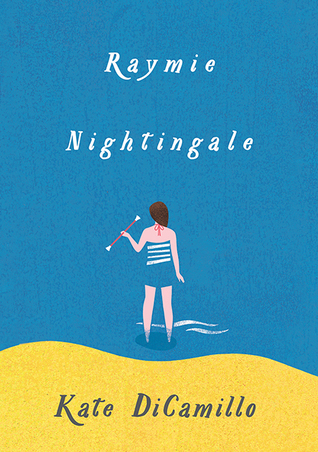
Raymie Nightingale by Kate DiCamillo is out today!

And we are happy to be able to be able to exclusively reveal the teaching guide.

Kate DiCamillo writes heartprint stories, and Raymie Nightingale is no different. Raymie Nightingale shares with the reader a story of three very different girls who all are enveloped in sadness for different reasons and need each other to find their way out. You will love Raymie and the Three Rancheros!

I had so much fun writing this guide, and I hope that many of you find the activities and discussion questions within it useful to you and your students!

Please note: There are some spoilers in the guide, so please be aware if you are reading the guide before reading the book.

You can also access the teaching guide here.

You can learn more about Raymie on Candlewick Press’s Raymie Nightingale page.

Recommended For: 

readaloudbuttonsmall classroomlibrarybuttonsmall litcirclesbuttonsmall closereadinganalysisbuttonsmall

Don’t miss out on this one!

Kellee Signature

Blog Tour, Author Guest Post, and Review!: The Classy Crooks Club by Alison Cherry

Share

classy crooks club

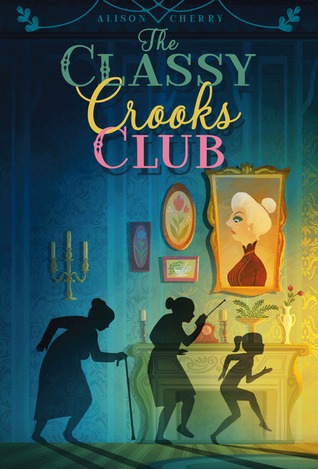
The Classy Crooks Club
Author: Alison Cherry
Published March 29th, 2016 by Aladdin

Goodreads Summary: Twelve-year-old AJ dreads spending an entire month living with her strict Grandma Jo. Not only does her grandmother dictate how she walks, what she eats, and which rooms she can enter, she fills all AJ’s free time with boring sewing lessons. Grandma Jo wants nothing more than to transform her adventurous, fun-loving granddaughter into a prim and proper lady.

But AJ’s dull summer takes a sharp turn when she discovers that her grandmother’s “bridge group” is actually a heist club. When Grandma Jo offers to let AJ learn lock-picking instead of embroidery in exchange for help with a few capers, AJ is happy to join her grandmother’s madcap band of thieves, who claim to steal only for ethical reasons. But even the most respectable ladies can hide truly surprising secrets, and AJ finds she must decide for herself what it means to be one of the good guys.

My Review: I love AJ. She is a perfect protagonist because she is just a real middle schooler. She is multi-faceted, funny, has quite a personality, has fears, makes mistakes, and is overall likeable. And she is not the only well-crafted character. Each of the characters, main, secondary, or supporting, are so fully developed that you feel like you know everyone in AJ’s life. I often am skeptical about first person POV because it is always tough to get a character/narrator’s voice perfect while also developing the characters, but Cherry does a great job of both. AJ is a normal middle school girl that is dealing with a quite terrible grandmother who happens to have an unexpected hobby.

Another thing that blew me away about this novel is that something happened that was completely unexpected! Usually when I am reading middle grade novels, I love them but am not often surprised because I can sense foreshadowing and predict; however, Cherry really caught me off guard in this one! You’ll have to let me know if you see it coming!

And finally, I loved the unique premise of the book! Who ever thought there’d be a book about a bunch of old ladies who “liberate” *cough* steal *cough* exotic birds and anything else that suits their fancy?!

Teachers’ Tools for Navigation: Alison’s guest post, below, made me really think about how grandparents play the role in different books, so Classy Crooks Club and the books listed below could be part of a grandparent-focused lit circle. How do the grandparents in the book differ from the parents (if they are present)? How are the grandparents different than stereotypical grandparents? How do the grandparents influence the main character?

Discussion Questions: Did you predict the climax of the story?; Why do you think the author chose first person point of view?; Why do you think the author doesn’t share what us about Betty’s past?; How does AJ overcome her fear?; Which of the Classy Crooks Club ladies would you want to hang out with and why?; What does Brianna teach AJ about not judging a book by its cover?; Why do you think Brianna is so mean to Maddie?; Why does Maddie get so mad at AJ? Would you have reacted the same way?

We Flagged: “Every single piece of furniture in my grandmother’s house has a name with too many syllables.

At home we have chairs. We have a couch. We have tables. But right now my grandmother is pointing at this hulking wooden thing in the corner of one of her guest bedrooms — my bedroom, for the next month — and calling it a ‘mission chifforobe.’ It looks like what might happen if a dresser and a closet had a really ugly baby. ‘I trust you’ll be very careful with this chiffrobe while you’re here,’ Grandma Jo says, like it’s some fragile, spindly thing I could possibly break by accident. ‘It was once owned by Buckminster Fuller, as was that ottoman.'” (p. 1)

Read This If You Loved: Wig in the WindowTiara on the Terrace by Kristen KittscherHeist Society by Ally Carter, Peter Nimble and his Fantastic Eyes by Jonathan Auxier

“Five Books I Loved That Featured Grandparents” by Alison Cherry: 

The Witches, Roald Dahl:

This creepy novel from 1983 features a boy who is sent to live with his grandmother after the death of his parents. Grandmother is a retired witch-hunter, and she makes sure her grandson knows how to recognize witches by their unusual traits: bald heads that they cover with wigs, square feet with no toes, clawed hands, and blue spit. Unfortunately, this doesn’t prevent the boy from having a run-in with witches while on vacation, and they turn him into a mouse. Grandmother is presented as incredibly kind and accepting—she doesn’t love her grandson any less once he’s a mouse. She’s also very clever and helps devise a plan to get revenge on the witches. The scene that sticks with me most is one in which Grandmother tells the boy that being a mouse will significantly shorten his lifespan, and he says he doesn’t mind because he doesn’t want to outlive her. I read this book over and over as a child!

Tortilla Sun, Jennifer Cervantes:

When her mother gets a grant to study in Costa Rica for the summer, twelve-year-old Izzy is sent to live with her nana in her tiny, rural New Mexican village. Izzy knows nothing about her Latina heritage or her dead father, whom her mother has always refused to discuss, and her summer with Nana is her first opportunity to learn where she comes from and who she is. Izzy’s nana is patient, wise, warm, and loving, and she lets her granddaughter discover pieces of her past slowly, when she’s ready and able to handle them. Reading this book is a rich sensory experience; the descriptions of Nana’s colorful house, the food she teaches Izzy to cook, and the rest of the characters in the neighborhood are beautifully drawn. It made me want to hang out in the world of the story long after it was over.

You’re Invited, Jen Malone and Gail Nall

This novel from four points of view is about a group of girls who start a party-planning business in their small seaside town. While the book isn’t centered around a grandparent like the other four on this list, Lauren’s grandmother Bubby is my favorite part of the story. Bubby is loud, opinionated, bubbly, and a total flirt—she spends most of the book zooming around on her bright red scooter, Wanda, and trying to catch the eye of “hot” Mr. Vernon from her retirement community. Despite her advanced age, Bubby tries her best to act and speak like a teenager—she’s active on “the Tweeter” and constantly refers to things as “amazeballs” and “ubercute.” This horrifies Lauren, who is significantly more dignified, but it delights me to no end. I sincerely wish I had a grandmother like Bubby.

The Lightning Queen, Laura Resau:

This gorgeous novel is about Teo, an indigenous Mexican boy, and Esma, a Romani girl who comes through his village with her caravan each summer. Despite their differences, a fortune teller states that they are destined to be friends for life, however unlikely it may seem. Because the story is told primarily in flashbacks, the reader gets to meet Teo as both a child and as an elderly healer who has lost touch with his lifelong friend and needs his grandson’s help to find her again. Teo is a delight in both incarnations—he’s kind and gentle and incredibly smart, the only boy in his village who braves school and learns to read. Teo also has a soft spot for rescuing animals—as a child, his constant companions are a duck, a blind goat, and a three-legged skunk. Both the Mixteco and Romani communities are treated with great sensitivity, and the writing is captivating.

The Secret Hum of a Daisy, Tracy Holczer:

When her mother dies suddenly, Grace is forced to move in with her estranged grandmother, who sent Grace’s mother away when she got pregnant as a teenager. Grace automatically assumes her grandmother is a horrible person and sets out to be a complete brat, hoping she’ll be sent away. Grace’s grandmother isn’t warm, but she’s patient and steady and gives Grace the space she needs to work out her grief; she’s there every time Grace needs her, but she doesn’t try to force her into a relationship before she’s ready. Grace eventually begins to respect her grandmother’s honesty, forthrightness, and willingness to take responsibility for mistakes she made in the past, even when it makes her look bad. The writing in this book is beautiful, lyrical, and deeply felt—it feels as if Tracy Holczer dug this story up from deep in her soul and pasted it directly onto the page. It’s one of my favorite depictions of two people who have suffered deep losses taking a chance on loving each other, even though it’s hard and painful.

Recommended For: 

classroomlibrarybuttonsmall litcirclesbuttonsmall

Don’t miss out on the other blog tour stops!

March 28-29: Pop! Goes the Reader (http://www.popgoesthereader.com/)
March 30: The Hiding Spot (http://thehidingspot.blogspot.com/)
March 31: Mundie Kids (http://mundiekids.blogspot.com/)
April 1: Unleashing Readers
April 4: Kidsmomo (http://www.kidsmomo.com/)
April 5: KidLit Frenzy (http://www.kidlitfrenzy.com/)
April 6: Kidliterati (http://www.kidliterati.com/)

Kellee Signature

**Thank you to Alison for providing a copy for review and the guest post!**

National Geographic Kids: Celebrate Easter by Deborah Heiligman

Share

NFPB2016

Nonfiction Wednesday

Nonfiction Picture Book Wednesday is hosted by Kid Lit Frenzy and was started to help promote the reading of nonfiction texts. Most Wednesdays, we will be participating and will review a nonfiction text (though it may not always be a picture book).
Be sure to visit Kid Lit Frenzy and see what other nonfiction books are shared this week!

easter

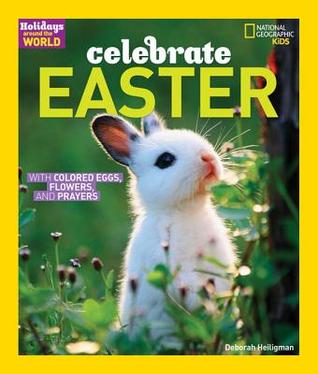
Holidays Around the World: Celebrate Easter with Colored Eggs, Flowers, and Prayer
Author: Deborah Heiligman
Photographs from National Geographic
Published February 9th, 2016 by National Geographic Children’s Books

Goodreads Summary: The joyous celebration of Easter is seen through a global perspective in this National Geographic volume featuring over 25 vibrant photographs. Witness the holiest day on the Christian calendar as it is celebrated throughout the world: from the famous Easter Egg Roll at the White House to the traditional bonfires throughout Europe, to colorful customs, to the universally popular dying of eggshells worldwide.

The first-person narrative leads young readers through the origins and traditions of this springtime festival of rebirth and hope. Reverend George Handzo gives parents and teachers a historical and cultural background in his informative note.

Kellee’s Review: This text is a wonderful informative introduction to Easter. It goes through not only the religious aspects of the holiday but also the traditions and secular parts. Although I think it could have gone into more detail about where the traditions came from (answered the WHY a bit more), it did a very good job of sharing all the different things that go along with Easter. I also loved the diversity within the book. The photos were from all over the world. And I am excited about the series Holidays Around the World because that means there are others within the series that will touch on holidays of other religions. This will help with understanding of holidays and religions that the reader may not be. 

Ricki’s Review: I completely agree with Kellee’s review! This book taught me a lot, and I enjoyed reading it. I would have loved to have read more about the WHY, but I found this to be quite a fun and interesting read, overall. Kids will really enjoy reading it, and it will be a resource for parents. Readers travel to many places in this single text, and it teaches an international appreciation. Like Kellee, I am really excited to see where this series goes, and I plan to read more books that National Geographic publishes! I love learning about international traditions and diverse cultures, so I appreciated all of the information in this book.

Teachers’ Tools for Navigation: I think it would be a powerful activity in a classroom to have many Holidays Around the World books and use them in both social studies, reading, and writing. Students could read about all of the different holidays, and they could then choose one to further research and share. Then there could be a walk-about in the classroom where different groups would have displays highlighting the different holidays.

Discussion Questions: What is the basis of Easter?; If you celebrate Easter, what are some traditions your family has?; What are some traditions around the world?; Why do you think the author chose to write the text in first person?

We Flagged: “Easter mornings brings special treats, too. Could it be the Easter Bunny was here? We get baskets of eggs–colored, decorated, and chocolate! Yummmm. In Germany, it’s the Easter Hare who brings us eggs. Bunnies, chicks, and eggs are symbols of new life.” (p. 16)

Read This If You Loved: Learning about religions, traditions, and holidays; Happy Easter, Mouse! by Laura Joffe Numeroff; Pete the Cat: Big Easter Adventure by Kimberly Dean

Recommended For: 

classroomlibrarybuttonsmall litcirclesbuttonsmall

Happy Easter to all who celebrate!

Signatureand RickiSig

**Thank you to Karen at Media Masters Publicity for providing copies for review!**