Rescued by Eliot Schrefer

Share

rescued

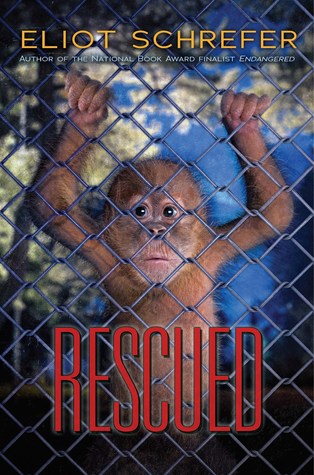
Rescued
Author: Eliot Schrefer
Published April 26th, 2016 by Scholastic

Goodreads Summary: The third entry in the taut, heart-wrenching quartet that made Eliot Schrefer a two-time National Book Award finalist introduces us to an orangutan held captive in suburban America.

John grows up with everything he could possibly want. His father is a businessman who travels far and wide. One day, he comes home with a rare gift for his son, a baby orangutan, and the two become inseparable friends. But as the orangutan gets older, stronger, less cute, the family relegates the animal to a locked trailer in the backyard. Until John’s father finally decides to sell the ape to a roadside zoo. Coming to the defense of his childhood friend, John resolves to smuggle the orangutan back to Indonesia, and the two set out on a journey far more dangerous than John bargained for.

My Review: I think out of the three Ape Quartet books published so far, this is the one that is going to hit closest to home for many. It will make many readers uncomfortable and want to make a change. First, it takes place in the United States unlike Africa like the first two. Second, it really digs into an issue that is still very much prominent here–animal injustice.

I find Schrefer’s writing to be so beautiful yet so easy to read. He can pull you into his stories and makes you feel for not only his human characters but also his animal characters. He does such a tremendous amount of research for all of his books and with this one it brings the injustice of Raja alive.

I am a sucker for ape books. I find apes to be the most fascinating animals, and orangutans may be my favorite because they have these amazing eyes that just show me that they are so intelligent and deep thinkers. They are also introverts; I think I just relate to them in that way. This book brings orangutans to life through Raja.

Teachers’ Tools for Navigation: As evident from Schrefer’s status as a two-time National Book Award finalist, his books can be used as a mentor text for just about any aspect of writing that you are looking for: characterization, imagery, voice, conflict, etc. Read any of his books, and you can pull out so much to discuss and use within the classroom. Additionally, there are some amazing ape books, including Schrefer’s other Ape Quartet books, that would make for an amazing lit circle opportunity or text set.

Discussion Questions: Why does John feel obligated to help Raja?; What would you have done if you were John or John’s mom when the divorce happened? Or when John’s father showed up with Raja?; Why is it better for wild animals to be in the wild?

Flagged Passages: “Every family’s got something weird about it, and mine was no different. We just had to try harder than most to hide it. All it took was someone to walk in the door to see that we had an orangutan. A real-live, orange-brown, TV-obsessed, drinking-grapefruit-juice-from-the-carton orangutan.” (p. 11)

“The truck’s engine rumbled, and the trailer pulled away. I watched it go, stunned.

You did this, I scolded myself. You let this happen.

Sweat had soaked my shirt, ran from the pits down my arms. The heat radiating up from the pavement made me dizzy, even though the perspiration on my brow was chill. I bent over, hands on my knees. I could feel the cords of my neck stand out, straining. Getting ready to start my stomach, at least, back at zero.

I heaved in air, and it sounded like a sob. Then it was a sob. Something huge and dark and terrible came out of me, something that had tamped down for so long that it had become even more huge and dark and terrible.

One last sob came out of me, then all was quiet.

There, slumped in the dirt, was Raja’s old blue elephant. (p. 69-70)

Read This If You Loved: Endangered and Threatened by Eliot Schrefer (Ape Quartet #1 and #2 yet are all stand alone novels), Hurt Go Happy by Ginny Rorby, One and Only Ivan by Kathering Applegate, Ivan: The Remarkable True Story of the Shopping Mall Gorilla by Katherine Applegate, Top Ten Ape Book list from Nerdy Book Club (I’ll be updating here on Unleashing Readers soon)

Recommended For: 

classroomlibrarybuttonsmall closereadinganalysisbuttonsmall litcirclesbuttonsmall

Signature

Review, Signed Hard Copy Giveaway, and Author Interview: Invisible Fault Lines by Kristen-Paige Madonia

Share

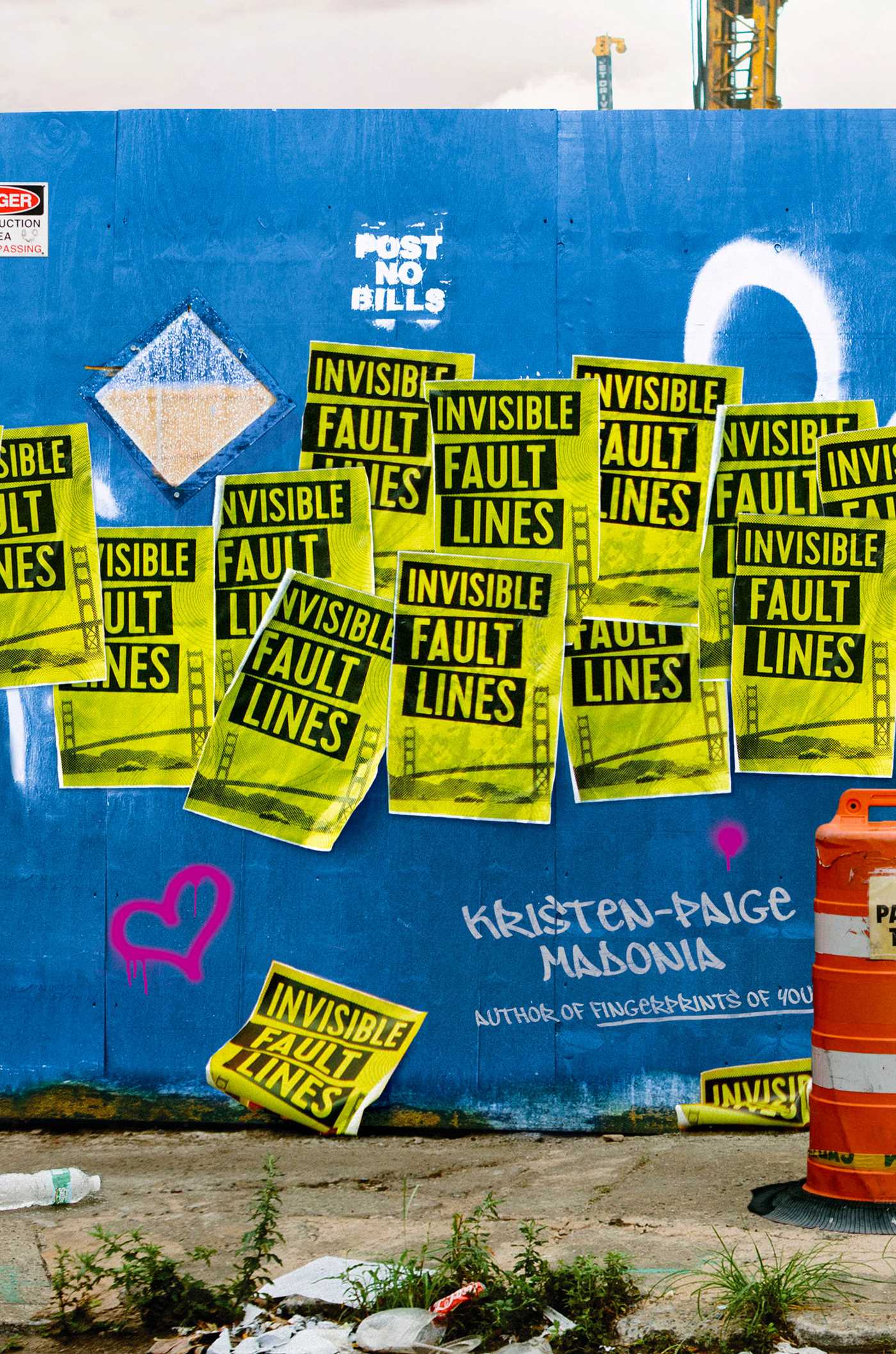
Invisible Fault Lines

Invisible Fault Lines
Authors: Kristin-Paige Madonia
Anticipated Publication: May 3, 2016 by Simon & Schuster Books for Young Readers

Summary: Tired of living in limbo, Callie finally decides to investigate her father’s disappearance for herself. Maybe there was an accident at the construction site that he oversaw? Maybe he doesn’t remember who he is and is lost wandering somewhere? But after seeing a familiar face in a photo from the Great San Francisco Earthquake of 1906, she wonders if the answer is something else entirely.

Hailed by Judy Blume as a “remarkable young novelist,” Kristen-Paige Madonia, author of Fingerprints of You, explores how to rebuild a life after everything seems lost.

My Review: This book kept me guessing! From the very first page, I wondered what happened to the narrator’s father. About halfway through, I realized that it didn’t matter what happened to him because this is a story about character. It is an emotional ride through the trauma of a young girl’s life after her father goes missing. I felt all of her emotions right along with her—guilt, fear, anger. I particularly enjoyed the evolvement of her friendship with her best friend Beckett. I appreciate authors who feature characters who happen to be gay—rather than making this the sole focus of a story. I recommend this book to readers who enjoy strong character development. 

Teachers’ Tools for Navigation: Teachers might consider tying this story into a study of missing persons. This investigation could go beyond children as missing persons and extend into adults who are missing. Students might research local missing persons in their area, and this could lead to advocacy efforts.

Discussion Questions: What do you think happened to Callie’s father? What different potential realities does Callie explore in the story?; How does the author switch the point-of-view effectively to deepen our understanding of the story?; What emotions does Callie experience in the story? How might we tie these into the stages of grief? Should she feel guilty that she doesn’t start looking for her father immediately? Why or why not?

Flagged Passage: “My father disappeared on a Tuesday that should’ve been like any Tuesday, but eventually became the Tuesday my father disappeared.”

Read This Series If You Loved: Fingerprints of You by Kristen-Paige Madonia; If I Stay by Gayle Forman; Vanishing Girls by Lauren Oliver; Where Things Come Back by John Corey Whaley, The Body of Christopher Creed by Carol Plum-Ucci

Recommended For: 

  litcirclesbuttonsmall  classroomlibrarybuttonsmall


Interview with Kristen-Paige Madonia
Kristen-Paige Madonia

Can you tell us a little bit about your writing process/ How has writing this book been different from writing Fingerprints of You

The most important thing I learned from writing Invisible Fault Lines is that my process will inevitably change depending on the project. My first book, Fingerprints of You, was a fairly straightforward novel with a traditional structure and timeline, so I wrote it start to finish and was able to create the first draft in less than two months — of course it took much longer to revise and polish, but in general is was quick and relatively easy to write. My new novel is much more complicated, as it blends a contemporary mystery set in 2006 with bits and pieces set one-hundred years earlier, as the 1906 San Francisco Earthquake plays a large role in the novel. It’s a hybrid novel, and the narrative arc is a bit more intricate, so though I initially tried to use the same process I used when writing Fingerprints of You, it just didn’t work. Eventually I wrote the book out of order and then went back, during revision, and braided the two storylines together. So in terms of process, I suppose it’s ever changing! And of course that’s one of the reasons that I write – there are no rules and there’s no one way to do it. It’s about experimenting, about doing something different each time you sit down to work.

Where/How did you come up with the premise of this book? 

Like most writers, I write from a place of curiosity. With Fingerprints of You, I was curious about the ways we define family, but this novel stemmed from my curiosity about grief and the various modes we use to manage and process loss. I began writing it after hearing David Levithan read from his novel Two Boys Kissing, specifically honing in on the sentence that eventually became the epigraph of Invisible Fault Lines: “How beautiful the ordinary becomes once it disappears.” We were both at Wordstock Book Festival in Portland, and I was in between projects, hoping to find inspiration while traveling to publicize Fingerprints of You. And there it was. That line. I couldn’t get it out of my head. I tend to begin stories with an event after which nothing will be the same for the character, and that idea of ordinary, of how our version of ordinary can shift in an instant, intrigued me. So I wanted to write about that kind of shift and about the possibility of the impossible being possible, which is where the link to the historical event, the earthquake of 1906, originated. I knew I wanted to do something completely different than Fingerprints of You and that I wanted to experiment with form and genre while staying true to my character-driven style of writing.

From the outset, we wonder what happened to Callie’s father, and at one point, Callie and her friends explore potential reasons for his disappearance. We obviously won’t spoil the book for readers, but did you know how the book would end from the very beginning?

I did. I knew that I wanted to invite the reader to participate in the novel in a more active role than my last novel allowed. I believe all books are collaborative projects between the author and the reader, but this novel leans heavily on what the reader brings to the story, on what they want to believe and how they want to interpret the events in the book. When I first imagined the story, I decided that I wanted to write a book that honors the fact that not all questions have clear answers – I think it’s part of our job, as YA authors, to be realistic and honest with our readers while also allowing for and portraying hope, so that was one of my original goals, and it inevitably shaped the ending.

Beck is a wonderfully crafted character. Did you base him on anyone in your life?

Oh, he’s such a scene-stealer, isn’t he?! Every time he showed up in the novel, I fell a little bit more in love with him. No, he’s not based on anyone I know, but I imagine him to be a compilation of my best friends from high school and also my current best friends: honest, hilarious, and one-hundred percent golden-hearted.

You are a professor of YA Lit and creative writing. How has this impacted your position as an author or thoughts as a writer? Do you get feedback from students, or do you keep your work private?

This is such a complicated question, so in attempt to not write a fifteen-page essay here, I’ll simply say that I love what I do. I find great inspiration from working with students who hope to pursue a creative life, who find value in literature and the arts. But the reality is that every moment I spend teaching and planning and grading is one less moment that I spend writing my own work, and that’s the hard part. Teaching reminds me why I write and what my tools are in terms of craft, and actively publishing new work reminds me how important it is to be a positive literary citizen, to serve as a mentor and encourage and inspire young authors. It’s a hard balance, of course, but it’s also a privilege to be both a professor and a published author, so I could never complain about the challenges.

Are you working on anything new?

I am! And I’m in that bizarre and dreamlike phase of being equally terrified and excited by my new project. It’s also a protective phase in terms of not wanting to talk much about it yet, but I will say that it’s a project based on my curiosity about our reliance on technology and the environmental and creative effects of that reliance.

Thanks so much for having me on your blog – it’s been lovely to visit with you!


**Thank you to Kristen-Paige Madonia for providing an copy for review and a signed hard copy for the giveaway!**

 RickiSig

Blog Tour, Character Interview, Giveaway, and Review!: The Mechanical Mind of John Coggin by Elinor Teele

Share

Mechanical Mind Blog Tour Banner

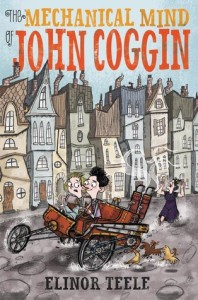
mechanical mind

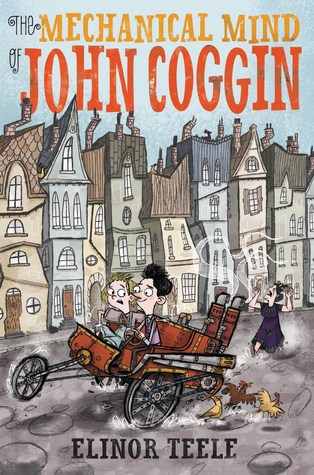
The Mechanical Mind of John Coggin
Author: Elinor Teele
Illustrator: Ben Whithouse
Published April 12th, 2016 Walden Pond Press

Goodreads Summary: A quirky, humorous, whimsical, and heartwarming middle grade debut about a young boy who runs away from home with his sister to escape working in the family coffin business—and discovers even more adventure than he bargained for.

John Coggin is no ordinary boy. He is devising an invention that nobody has ever seen before, something that just might change the world, or at least make life a little bit better for him and his litter sister, Page. But that’s only when he can sneak a break from his loathsome job: building coffins for the family business under the beady gaze of his cruel great-aunt Beauregard. Having lost their parents when Page was a baby, how else are they supposed to survive?

Perhaps by taking an enormous risk—a risk that arrives in the form of a red-haired scamp named Boz. When Great-Aunt Beauregard informs John that she’s going to make him a permanent partner in Coggin Family Coffins—and train Page to be an undertaker—John and Page sign on with Boz and hit the road. Before long, they’ve fallen in with a host of colorful characters, all of whom, like John and Page, are in search of a place they can call home. But home, they realize, isn’t something you find so much as something you fight for, and John soon realizes that he and Page are in for the fight of their lives.

Elinor Teele’s picaresque debut is a rollicking tale filled with wild adventures, daring escapes, and—thanks to Boz—more than a little catastrophe.

My Review: One thing I’ve noticed is that so many orphans in stories seem to always get into some sort of trouble and then go on amazing adventures. Like Annie, Grubb from Alistair Grim, and Peter Nimble before him, John Coggin, a recent orphan, finds himself in quite a predicament of a situation when he is forced to work for his great aunt’s funeral home. It is the last straw when Great Aunt Beauregard tries to force Page, John’s sister, to go to work with them, and that begins the adventure! Elinor Teele takes us on quite a journey! With Boz, the comic relief with an amazing vocabulary, our three main characters meet some unique characters along the way.

Teele’s ability to weave such an odd story together and make it seem seamless is remarkable. John, Page, and Boz have about 5 stops along their journey all with a wide-variety of characters who all are a bit quirky but also relatable and you end up loving all of them. Although everything that happens is quite farfetched, you end up believing it all because you just want John and Page to be successful!

Teachers’ Tools for Navigation: In the classroom, I think this book would be a perfect opportunity to discuss ways to determine unknown vocabulary within a text. Boz has QUITE a vocabulary and uses words that will be unknown to many of the middle grade readers the book is aimed for; however, the author does a fabulous job of having context clues or restatements of what the words mean. I would love to use passages of this book for vocabulary instruction.

It could also be used as a mentor text for imagery, specifically character description. Like I said, throughout the book we meet some very odd characters, but they are all described so well you can picture them. Same with John’s contraptions and the setting. Elinor Teele’s specific word choice really brings the story to life.

Lastly, I think it would be fun to compare/contrast the orphans within middle grade novels and discuss why orphans are chosen for so many adventurous books. Peter Nimble and Alistair Grim along with John Coggin would definitely be a great place to start, and you could even tie it in with “Annie.”

Also check out the Educational Activity Kit based on the book for more ways to use the book in the classroom or library.

We Flagged: “”Up and at ‘em, troops! The back of a new day is already broken, and time marches on!’

Boz blew into the barn like a category five hurricane and came to rest at John’s feet. ‘Where are the foundations of your perambulation?’ His baffled face collapsed even further into itself.

‘Where are the what?’ John asked blearily. The bright summer sun was making fireflies of the dust around Page’s hair.

‘Your shoes, young man, your shoes.’

‘I threw them outside.’

‘Well, find them! We go, we see, we conquer!’” (p. 58)

Special Guest! Q&A with Boz (by Elinor Teele): Boz may, in fact, be the worst interviewee on the planet. It was barely possible to get him into a hotel lounge and almost impossible to keep him there. And his hair! It seemed to have a life of its own. After this experience, I am firmly convinced his only future is a career as a human firework.  
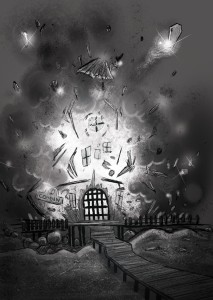
mechanical illustration

Q. So, first I’d like to ask… Boz? Boz! Could you please stop swinging from the chandelier?
A. Of course, profuse apologies my Fallonesque friend. I was merely trying to pump some blood to my knee joints. I ingested a box of sugar-coated hookoo grubs yesterday and I fear they have inflamed my rheumatics.

Q. Where did you get a box of hookoo grubs?
A. A gift from the Queen of Samarrand. She says she misses my winsome ways.

Q. How did you become friends with a Queen?
A. Oh, I have roamed the bureaus and boards of many a parliament. From the sweat-soaked slums to the blasted heaths, I have crisscrossed this great globe itself in eighty days and under. “A wandering minstrel, I…”

At this point in the interview, Boz yanked open the door to the lobby and vaulted onto the hotel’s front desk. From there, he sang operettas to incoming guests until security guards brought him back into the lounge. 

Q. I don’t think the concierge enjoyed your singing.
A. It’s a waste of vitriol trying to please critics. Besides, it gave me an opportunity to relieve him of his time commitments.

Q. You stole his watch?!
A. You may say that, but I couldn’t possibly clarify.

Q. Well, what can you comment on?
A. Anything that tickles your pearly whites.

Q. Okay, how about this? Some people have said that your way of speaking is far too complicated to understand. They point out many kids have enough trouble with basics, so why make it harder?
A. I grant you that my vocabulary may be a little bewildering, but why not be wild? There are so many beautiful words in this world that go a’begging. As my dear friend Dodo Dodgson often opines, “Look after the senses and the sounds will look after themselves.”

Q. Yes, I noticed you tend to appropriate phrases from famous writers.
A. Who was it that said that bad artists copy and great men steal? Or was it that the immature youth imitates and the mature matron plagiarizes? I can’t remember. 

At this point in the interview, Boz once again made a grab at the chandelier. This time – thanks to the force of his liftoff – he was hurled round and round the room like a demented tornado.

Q. Are you insane? Should I call the fire brigade?
A. Wouldn’t do that, my dear boy. They’re still irked about the incident with the propane and the propellers.

Q. What did that involve?!
A. A gaggle of insurance investigators, apparently.  

Q. I give up. I don’t know how John Coggin put up with you.
A. But John and I are friends! Buddies of the bosom. Compadres of the cabana. Say what you will about my ethical standards, but I always believe in my friends!

This was a revealing comment, and I would have liked to ask Boz more about it. Unfortunately, he had let go of the chandelier and was already rocketing skyward through one of the open windows. I last saw him passing a goshawk.

Walden TV Features John Cogginhttp://waldentv.com/video/rtwt-john-coggin/

elinor-teele

Find Elinor Teele at her website.

Recommended For: 

classroomlibrarybuttonsmall closereadinganalysisbuttonsmall litcirclesbuttonsmall

Giveaway!
Enter to win!

a Rafflecopter giveaway

Don’t miss out on the other blog tour stops!

April 11 – Bluestocking Thinking
April 12 – Novel Novice
April 13 – This Kid Reviews Books
April 14 – Maria’s Melange
April 15Unleashing Reader
April 18Next Best Book
April 19Foodie Bibliophile
April 20For Those About to Mock
April 21 – Walden Media Tumblr
April 22Charlotte’s Library
April 25Flashlight Reader
April 26Teach Mentor Texts
April 27Librarian’s Quest
April 28Kid Lit Frenzy
April 29Novel Novice

Kellee Signature

**Thank you to Walden Pond Press for providing a copy for review and giveaway!!**

Blog Tour, Author Guest Post, and Review!: The Classy Crooks Club by Alison Cherry

Share

classy crooks club

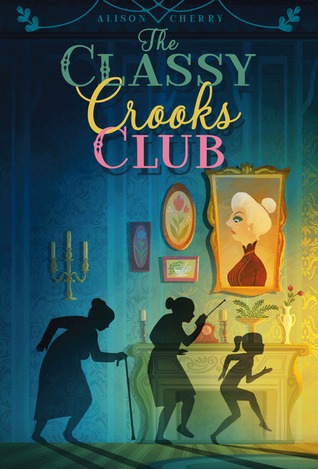
The Classy Crooks Club
Author: Alison Cherry
Published March 29th, 2016 by Aladdin

Goodreads Summary: Twelve-year-old AJ dreads spending an entire month living with her strict Grandma Jo. Not only does her grandmother dictate how she walks, what she eats, and which rooms she can enter, she fills all AJ’s free time with boring sewing lessons. Grandma Jo wants nothing more than to transform her adventurous, fun-loving granddaughter into a prim and proper lady.

But AJ’s dull summer takes a sharp turn when she discovers that her grandmother’s “bridge group” is actually a heist club. When Grandma Jo offers to let AJ learn lock-picking instead of embroidery in exchange for help with a few capers, AJ is happy to join her grandmother’s madcap band of thieves, who claim to steal only for ethical reasons. But even the most respectable ladies can hide truly surprising secrets, and AJ finds she must decide for herself what it means to be one of the good guys.

My Review: I love AJ. She is a perfect protagonist because she is just a real middle schooler. She is multi-faceted, funny, has quite a personality, has fears, makes mistakes, and is overall likeable. And she is not the only well-crafted character. Each of the characters, main, secondary, or supporting, are so fully developed that you feel like you know everyone in AJ’s life. I often am skeptical about first person POV because it is always tough to get a character/narrator’s voice perfect while also developing the characters, but Cherry does a great job of both. AJ is a normal middle school girl that is dealing with a quite terrible grandmother who happens to have an unexpected hobby.

Another thing that blew me away about this novel is that something happened that was completely unexpected! Usually when I am reading middle grade novels, I love them but am not often surprised because I can sense foreshadowing and predict; however, Cherry really caught me off guard in this one! You’ll have to let me know if you see it coming!

And finally, I loved the unique premise of the book! Who ever thought there’d be a book about a bunch of old ladies who “liberate” *cough* steal *cough* exotic birds and anything else that suits their fancy?!

Teachers’ Tools for Navigation: Alison’s guest post, below, made me really think about how grandparents play the role in different books, so Classy Crooks Club and the books listed below could be part of a grandparent-focused lit circle. How do the grandparents in the book differ from the parents (if they are present)? How are the grandparents different than stereotypical grandparents? How do the grandparents influence the main character?

Discussion Questions: Did you predict the climax of the story?; Why do you think the author chose first person point of view?; Why do you think the author doesn’t share what us about Betty’s past?; How does AJ overcome her fear?; Which of the Classy Crooks Club ladies would you want to hang out with and why?; What does Brianna teach AJ about not judging a book by its cover?; Why do you think Brianna is so mean to Maddie?; Why does Maddie get so mad at AJ? Would you have reacted the same way?

We Flagged: “Every single piece of furniture in my grandmother’s house has a name with too many syllables.

At home we have chairs. We have a couch. We have tables. But right now my grandmother is pointing at this hulking wooden thing in the corner of one of her guest bedrooms — my bedroom, for the next month — and calling it a ‘mission chifforobe.’ It looks like what might happen if a dresser and a closet had a really ugly baby. ‘I trust you’ll be very careful with this chiffrobe while you’re here,’ Grandma Jo says, like it’s some fragile, spindly thing I could possibly break by accident. ‘It was once owned by Buckminster Fuller, as was that ottoman.'” (p. 1)

Read This If You Loved: Wig in the WindowTiara on the Terrace by Kristen KittscherHeist Society by Ally Carter, Peter Nimble and his Fantastic Eyes by Jonathan Auxier

“Five Books I Loved That Featured Grandparents” by Alison Cherry: 

The Witches, Roald Dahl:

This creepy novel from 1983 features a boy who is sent to live with his grandmother after the death of his parents. Grandmother is a retired witch-hunter, and she makes sure her grandson knows how to recognize witches by their unusual traits: bald heads that they cover with wigs, square feet with no toes, clawed hands, and blue spit. Unfortunately, this doesn’t prevent the boy from having a run-in with witches while on vacation, and they turn him into a mouse. Grandmother is presented as incredibly kind and accepting—she doesn’t love her grandson any less once he’s a mouse. She’s also very clever and helps devise a plan to get revenge on the witches. The scene that sticks with me most is one in which Grandmother tells the boy that being a mouse will significantly shorten his lifespan, and he says he doesn’t mind because he doesn’t want to outlive her. I read this book over and over as a child!

Tortilla Sun, Jennifer Cervantes:

When her mother gets a grant to study in Costa Rica for the summer, twelve-year-old Izzy is sent to live with her nana in her tiny, rural New Mexican village. Izzy knows nothing about her Latina heritage or her dead father, whom her mother has always refused to discuss, and her summer with Nana is her first opportunity to learn where she comes from and who she is. Izzy’s nana is patient, wise, warm, and loving, and she lets her granddaughter discover pieces of her past slowly, when she’s ready and able to handle them. Reading this book is a rich sensory experience; the descriptions of Nana’s colorful house, the food she teaches Izzy to cook, and the rest of the characters in the neighborhood are beautifully drawn. It made me want to hang out in the world of the story long after it was over.

You’re Invited, Jen Malone and Gail Nall

This novel from four points of view is about a group of girls who start a party-planning business in their small seaside town. While the book isn’t centered around a grandparent like the other four on this list, Lauren’s grandmother Bubby is my favorite part of the story. Bubby is loud, opinionated, bubbly, and a total flirt—she spends most of the book zooming around on her bright red scooter, Wanda, and trying to catch the eye of “hot” Mr. Vernon from her retirement community. Despite her advanced age, Bubby tries her best to act and speak like a teenager—she’s active on “the Tweeter” and constantly refers to things as “amazeballs” and “ubercute.” This horrifies Lauren, who is significantly more dignified, but it delights me to no end. I sincerely wish I had a grandmother like Bubby.

The Lightning Queen, Laura Resau:

This gorgeous novel is about Teo, an indigenous Mexican boy, and Esma, a Romani girl who comes through his village with her caravan each summer. Despite their differences, a fortune teller states that they are destined to be friends for life, however unlikely it may seem. Because the story is told primarily in flashbacks, the reader gets to meet Teo as both a child and as an elderly healer who has lost touch with his lifelong friend and needs his grandson’s help to find her again. Teo is a delight in both incarnations—he’s kind and gentle and incredibly smart, the only boy in his village who braves school and learns to read. Teo also has a soft spot for rescuing animals—as a child, his constant companions are a duck, a blind goat, and a three-legged skunk. Both the Mixteco and Romani communities are treated with great sensitivity, and the writing is captivating.

The Secret Hum of a Daisy, Tracy Holczer:

When her mother dies suddenly, Grace is forced to move in with her estranged grandmother, who sent Grace’s mother away when she got pregnant as a teenager. Grace automatically assumes her grandmother is a horrible person and sets out to be a complete brat, hoping she’ll be sent away. Grace’s grandmother isn’t warm, but she’s patient and steady and gives Grace the space she needs to work out her grief; she’s there every time Grace needs her, but she doesn’t try to force her into a relationship before she’s ready. Grace eventually begins to respect her grandmother’s honesty, forthrightness, and willingness to take responsibility for mistakes she made in the past, even when it makes her look bad. The writing in this book is beautiful, lyrical, and deeply felt—it feels as if Tracy Holczer dug this story up from deep in her soul and pasted it directly onto the page. It’s one of my favorite depictions of two people who have suffered deep losses taking a chance on loving each other, even though it’s hard and painful.

Recommended For: 

classroomlibrarybuttonsmall litcirclesbuttonsmall

Don’t miss out on the other blog tour stops!

March 28-29: Pop! Goes the Reader (http://www.popgoesthereader.com/)
March 30: The Hiding Spot (http://thehidingspot.blogspot.com/)
March 31: Mundie Kids (http://mundiekids.blogspot.com/)
April 1: Unleashing Readers
April 4: Kidsmomo (http://www.kidsmomo.com/)
April 5: KidLit Frenzy (http://www.kidlitfrenzy.com/)
April 6: Kidliterati (http://www.kidliterati.com/)

Kellee Signature

**Thank you to Alison for providing a copy for review and the guest post!**

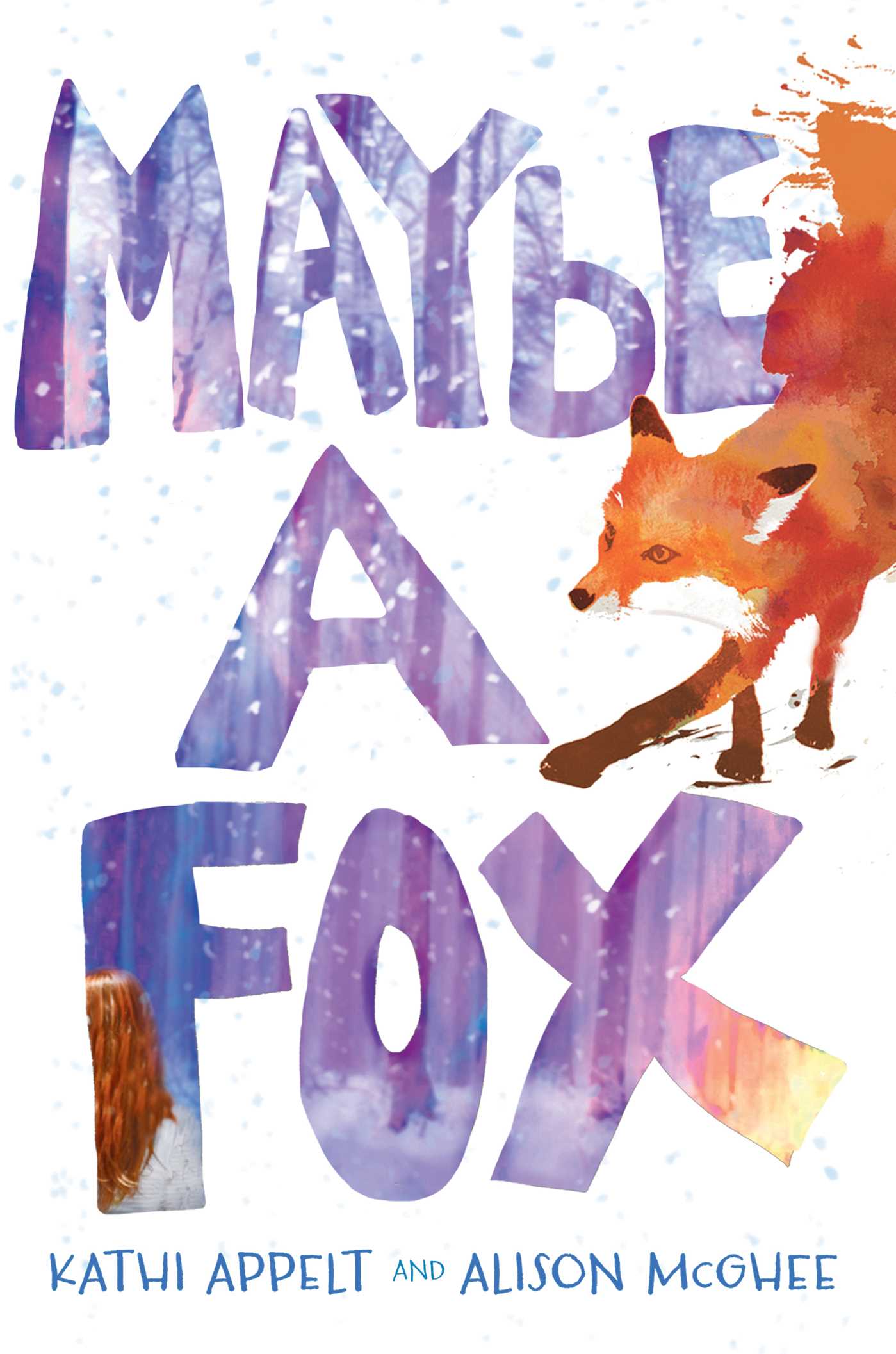
Blog Tour, Author Guest Post, Giveaway, and Review!: Maybe a Fox by Kathi Appelt and Alison McGhee

Share

maybe a fox

Maybe a Fox
Author: Kathi Appelt and Alison McGhee
Published: March 8, 2016 by Atheneum/Caitlyn Dlouhy Books

Goodreads Summary: A tale about two sisters, a fox cub, and what happens when one of the sisters disappears forever.

Sylvie and Jules, Jules and Sylvie. Better than just sisters, better than best friends, they’d be identical twins if only they’d been born in the same year. And if only Sylvie wasn’t such a fast—faster than fast—runner. But Sylvie is too fast, and when she runs to the river they’re not supposed to go anywhere near to throw a wish rock just before the school bus comes on a snowy morning, she runs so fast that no one sees what happens…and no one ever sees her again. Jules is devastated, but she refuses to believe what all the others believe, that—like their mother—her sister is gone forever.

At the very same time, in the shadow world, a shadow fox is born—half of the spirit world, half of the animal world. She too is fast—faster than fast—and she senses danger. She’s too young to know exactly what she senses, but she knows something is very wrong. And when Jules believes one last wish rock for Sylvie needs to be thrown into the river, the human and shadow worlds collide.

Writing in alternate voices—one Jules’s, the other the fox’s—Kathi Appelt and Alison McGhee tell the tale of one small family’s moment of heartbreak.

Ricki’s Review: I read this entire book in one sitting because, quite simply, I could not put it down. I sobbed through the entire book because I connected so strongly with these characters. As a mom, I couldn’t imagine my son experiencing the pain that these sisters felt from the loss of their mother. As a sister, I can’t imagine my own sister disappearing. These two connections, along with the stunning portrayal of character and story, made this book feel deeply personal for me. While younger students won’t be moms, and thus, won’t have this personal connection I had with the text, they will be sons and daughters. Regardless of a reader’s point of view, they will connect with this book because it is written so beautifully. I won’t forget this book, and I don’t think other readers will forget it, either.

Kellee’s Review: This book is one I’ll be talking about for a while. I will say it is probably the saddest book that I’ve ever read; however, it is beautiful. It is very hard to explain unless you’ve experienced because it gives hope while also being so terribly sad. The characters, animal and humans, are so thought out and detailed that as you read you feel with them and for them. I was also in awe of the way Kathi and Alison were able to tell such a unique story without the reader ever feeling like it was an odd scenario. Whenever I try to describe this book to someone, they give me quite a weird look, so I just stop trying and tell them they should read it because it is a heart print book. There is no other way to describe it. Like Ricki said, every reader will feel for someone in the book. And every reader won’t be able to deny how beautifully written the prose is. 

Teachers’ Tools for Navigation: As you will read in Kathi and Alison’s guest post below, point-of-view makes this story quite powerful. Teachers might ask students to consider the varying perspectives of this story and how they work together to form a cohesive whole. The teacher might provide other examples of texts that feature different points-of-view to compare and contrast authors’ styles. Students might then try their hand at writing in various, connected points-of-view and subsequently analyze how this enhances a narrative.

Discussion Questions: How do the authors unfold the plot in the narrative?; What predictions did you make while reading this story? How might the story have turned out quite differently?; How does Senna’s point-of-view enhance the story for you?; Were there any allusions within the text?; What theme do you take away from Maybe a Fox?

We Flagged: “The baby girl fox, Senna, came into the world in darkness, thirty feet below ground in the end dug out of cool brown earth. She was the middle child, born between her older and younger brothers, the three of them separated by minutes.

The first thing she knew was the feel of her mother’s tongue. Shhh shhh shhh, cleaning her off, licking her into life and warmth and love and safety.

The second thing she knew was the feel and smell of her brothers’ bodies pressed against hers as their mother nursed them, their front paws kneading her belly.

The third thing she knew was that there was someone waiting for her, someone she needed to find.” (p. 75-76)

Read This if You Loved: The House of Purple Cedar by Tim TinglePax by Sara PennyPacker, Counting Crows by Kathi Appelt

Recommended For: 

litcirclesbuttonsmall closereadinganalysisbuttonsmall readaloudbuttonsmall classroomlibrarybuttonsmall

Giveaway!
A Guest Post from Kathi and Alison about Point-of-View

Finding the best possible point of view for a story is one of the most important choices that a writer can make. The point of view, more than any other aspect of literature, dictates the distance created between the character and the reader. When we embarked upon this story, Alison chose to write from the fox’s story and she decided early on that she wanted to write from an omniscient point of view. This allowed her to place Senna deeply within the pocket of her fox family, and to give our readers an intimate sense of their world. It gave her a way to present the fox-world via the senses of all five members of their family, and put the readers squarely inside of the natural landscape.

When we were first drafting, Kathi chose to write Jules from a first person point of view. However, it didn’t take long before she realized that the first person was too limiting. Yes, first person is quite intimate and there are good reasons to use it, but in this case it felt as though it created too many blind spots. Jules needed a bigger canvas and so Kathi switched to third person. That allowed her to broaden the scope of Jules’ experience, and to let Jules, as well as the omniscient narrator, experience the events as they unfolded.

We always knew that Sam’s point of view would be from the third person too, and he stepped into the story in a way that let the reader get a more objective perspective. We also hoped to show that even though Sylvie’s death primarily impacted Jules and her dad, her loss was felt strongly by the entire community. As well, Sam’s earnest desire for the return of the catamount helped to create a sense of possibility that the other characters couldn’t, simply because of their closeness to Sylvie.

The landscape also gave us a perspective. The woods and rocks, and of course the Slip itself with its local legends, provided not only a backdrop, but its own wild voice, a voice that spoke to each of our characters—fox, Jules, Sam, Elk, Sylvie, Zeke, Dad, and the catamount—in a way that only a wild place can speak.

All this to say that the multiple points of view hopefully helped to create stories within stories that, when woven together, made a single story that was enriched by the viewpoints of each character.

Kathi and Alison.

About the Authors:

Kathi Appelt photo 2015_credit Igor Kraguljak

Kathi Appelt is the New York Times best-selling author of more than forty books for children and young adults. Her picture books include Oh My Baby, Little One, illustrated by Jane Dyer, and the Bubba and Beau series, illustrated by Arthur Howard. Her novels for older readers include two National Book Award finalists: The True Blue Scouts of Sugar Man Swamp and The Underneath, which was also a Newbery Honor Book. In addition to writing, Ms. Appelt is on the faculty in the Masters of Creative Writing for Children and Young Adults at Vermont College of Fine Arts. She lives in College Station, Texas. To learn  more, visit Kathi’s website at kathiappelt.com.
Alison McGhee photo 2015 credit Dani Werner
Alison McGhee is the New York Times bestselling author of Someday, as well as Firefly Hollow, Little Boy, So Many Days, Bye-Bye Crib, Always, A Very Brave Witch, and the Bink and Gollie books. Her other children’s books include All Rivers Flow to the Sea, Countdown to Kindergarten, and Snap. Alison is also the author of the Pulitzer Prize–nominated adult novel Shadowbaby, which was also a Today show book club selection. She lives in Minneapolis, Minnesota, and you can visit her at AlisonMcGhee.com.

MaybeAFox_banner

Follow the blog and book tour!

See Another Guest Post by Kathi Appelt Here!

RickiSigandSignature

**Thank you to Barbara at Blue Slip Media for providing copies for review and the giveaway. Also, thank you to Kathi and Alison for the wonderfully insightful guest post!**

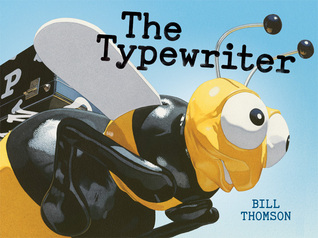
Blog Tour, Giveaway, and Review!: The Typewriter by Bill Thomson

Share

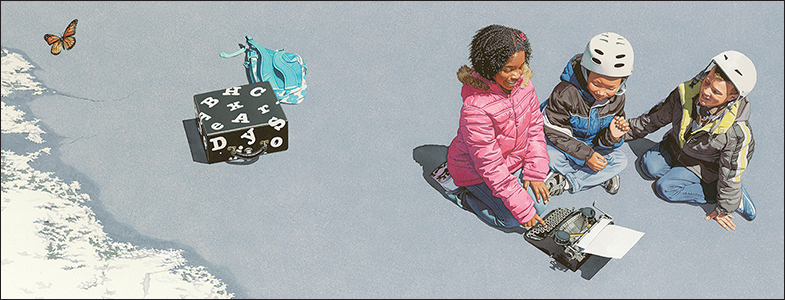
Thomson_TheTypewriter_6603_JK_FL_ v3.indd

The Typewriter
Author & Illustrator: Bill Thomson
Published March 8th, 2016 by Two Lions

Goodreads Summary: Using just nine words, the award-winning creator of Chalk takes readers on another unforgettable journey. When three children discover a typewriter on a carousel, they are transported on an adventure of their own creation—complete with a giant beach ball and a threatening crab. Stunning, richly colored artwork is paired with limited text so children can tell their own version of the story.

About the Author: Bill Thomson is the creator of Chalk and Fossil and the illustrator of Baseball Hour, Karate Hour, Soccer Hour, and Building with Dad, all written by Carol Nevius. Thomson’s books have received many accolades: the National Parenting Publications Gold Award, designation as a Notable Children’s Book by the American Library Association, a Teacher’s Choice selection from the International Reading Association, a Booklist Editor’s Choice, the Connecticut Book Award for Children’s Illustrator, Kentucky’s Bluegrass Award, Ohio’s Buckeye Children’s Book Award, and the Prix Livrentête in Paris, France. Thomson’s artwork has also received more than 75 awards in the country’s most prestigious juried illustration competitions.

Bill Thomson RGB photo (2)

Thomson lives with his family in Southington, Connecticut and is also a professor of illustration at the University of Hartford. To see more of his artwork, visit: www.billthomson.com.

Kellee’s Review: I often hear that it is best to show not tell in writing, and this is taken to another level with this wordless picture book. I’m always blown away by excellent wordless picture books because there are illustrators that can take you on such an amazing journey without telling you anything. Although Bill Thomson does use nine words in The Typewriter, it is his illustrations that transport you into the story. He is an incredibly talented illustrator. Just like with Chalk, I am in awe of how realistic his illustrations are!

Ricki’s Review: This book is very innovative in the way it shares story. Readers will zoom into and out of the scenes on each page and will be pulled right into the book. My son has read this book several times, and I love how he carefully and slowly examines all of the illustrations on the pages. When he gets a bit older, I plan to ask him to tell his own story that connects the illustrations. We can change the story just a bit each night. Thomson creates the story to be interpretive for readers, and I can’t wait to hear what my son comes up with! This would be a great story for the classroom. The magic of this book will not be lost on readers.

Teachers’ Tools for Navigation: The Typewriter is a wonderful jumping off point for a creative writing unit. There are two different directions that it can be taken. First, as with all wordless picture books, you can have students narrate The Typewriter. I also would love to see what students would do if they had the magic typewriter. The Typewriter could be used as a prompt for students to write their own story as a sequel when they find the magic typewriter on the carousel.

Other classroom activities can be found in the free curriculum guide.

Discussion Questions: Without using words, how does the author show how the characters feel during the story?; What do you think the backstory of the typewriter is? How did it get there? Where did it come from?; What is the turning point in the story?; What caused the kids to put the typewriter back?

We Flagged: 

Thomson-TheTypewriter-8-9 (2)
Illustration from THE TYPEWRITER copyright © 2016 by Bill Thomson Published by Two Lions

Read This If You Loved: Chalk by Bill Thomson, Journey by Aaron Becker, Float by Daniel Miyares, Mr. Wuffles by David Wiesner

Recommended For: 

classroomlibrarybuttonsmall readaloudbuttonsmall

Follow All the Stops on the Tour: 

Fri, Mar 4
Teach Mentor Texts
Mon, Mar 7
The Book Monsters
Tues, Mar 8
Kid Lit Frenzy
Wed, Mar 9
5 Minutes for Books
Thur, Mar 10
Cracking the Cover
Fri, Mar 11
Unleashing Readers
Mon, Mar 14
Sharpread
Tues, Mar 15
Jean Little Library
Wed, Mar 16
NC Teacher Stuff
Thur, Mar 17
A Rup Life
Fri, Mar 18
A Foodie Bibliophile in Wanderlust
Tues, Mar 22
Library Fanatic

And Don’t Forget to Enter the Giveaway!

a Rafflecopter giveaway

Kellee Signature andRickiSig

**Thank you to Barbara for sending us this book and for allowing us to host the giveaway!**

More Happy Than Not by Adam Silvera

Share

more happy than not

More Happy Than Not
Authors: Adam Silvera
Published: June 2, 2015 by Soho Teen

GoodReads Summary: In his twisty, gritty, profoundly moving debut—called “mandatory reading” by the New York Times—Adam Silvera brings to life a charged, dangerous near-future summer in the Bronx.

In the months after his father’s suicide, it’s been tough for 16-year-old Aaron Soto to find happiness again–but he’s still gunning for it. With the support of his girlfriend Genevieve and his overworked mom, he’s slowly remembering what that might feel like. But grief and the smile-shaped scar on his wrist prevent him from forgetting completely.

When Genevieve leaves for a couple of weeks, Aaron spends all his time hanging out with this new guy, Thomas. Aaron’s crew notices, and they’re not exactly thrilled. But Aaron can’t deny the happiness Thomas brings or how Thomas makes him feel safe from himself, despite the tensions their friendship is stirring with his girlfriend and friends. Since Aaron can’t stay away from Thomas or turn off his newfound feelings for him, he considers turning to the Leteo Institute’s revolutionary memory-alteration procedure to straighten himself out, even if it means forgetting who he truly is.

Why does happiness have to be so hard?

Review: After Aaron’s father commits suicide, he finds it difficult to find his place in the world, and the smile-shaped scar on his wrist is just one reminder of this struggle. Aaron considers turning to an institute that has the capability to alter his memory—because he wants to forget that he is gay. The text is heart-wrenching, emotionally profound, and deeply moving. Weeks after I read it, I found that I was still referencing it in daily conversations with teacher friends. I also designed a conference proposal based on a concept from this book. This is an important book that belongs in classrooms.

Teachers’ Tools for Navigation: Students will enjoy debating the ethics of the Leteo Institute’s procedure. My book club had a heated debate, and at the end, I still didn’t know where I stood! Teachers might bring in other examples from the media of people who have experienced trauma and ask students—would it be okay for this person to have the procedure done? When is it ethically okay (if ever)?

Discussion Questions: How does the author unfold the plot for the reader? How does this impact the telling of the story?; Which of Aaron’s friends are loyal? Why?; What does this procedure say about humanity? Do you think people would undergo the procedure? Who might be most likely to undergo the procedure?; How does the author end the novel? What does this teach us?

We Flagged: “Memories: some can be sucker punching, others carry you forward; some stay with you forever, others you forget on your own. You can’t really know which ones you’ll survive if you don’t stay on the battlefield, bad times shooting at you like bullets. But if you’re lucky, you’ll have plenty of good times to shield you.”

Read This If You Loved: Simon vs. the Homo Sapiens Agenda by Becky Albertalli, None of the Above by I. W. Gregorio, Aristotle and Dante Discover the Secrets of the Universe by Benjamin Alire Sáenz

Recommended For:

litcirclesbuttonsmall classroomlibrarybuttonsmall

RickiSig