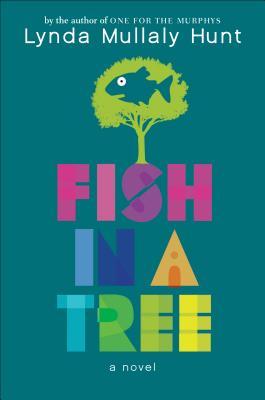
Fish in a Tree by Lynda Mullaly Hunt

Share

fish

Fish in a Tree
Author: Lynda Mullaly Hunt
Published February 5th, 2015 by Nancy Paulsen Books

Goodreads Summary: The author of the beloved One for the Murphys gives readers an emotionally-charged, uplifting novel that will speak to anyone who’s ever thought there was something wrong with them because they didn’t fit in.

“Everybody is smart in different ways. But if you judge a fish by its ability to climb a tree, it will live its life believing it is stupid.”

Ally has been smart enough to fool a lot of smart people. Every time she lands in a new school, she is able to hide her inability to read by creating clever yet disruptive distractions.  She is afraid to ask for help; after all, how can you cure dumb? However, her newest teacher Mr. Daniels sees the bright, creative kid underneath the trouble maker. With his help, Ally learns not to be so hard on herself and that dyslexia is nothing to be ashamed of. As her confidence grows, Ally feels free to be herself and the world starts opening up with possibilities. She discovers that there’s a lot more to her—and to everyone—than a label, and that great minds don’t always think alike.

My Review: I adore so much about this book.
Ally is so many students that I have had over the years that just needed a teacher to take the time.
Mr. Daniels is the teacher that I hope I am, that I wish I could be, that I want all teachers to be, and that I want to be friends with.
Ally’s journey is one that I hope I inspire my students to have.
Keisha is the friend I wish I’d had.
Albert is so many student in our schools that are just a bit different thus leading to a life of sorrows.
Shay shows that meanness often is because of meanness.
Travis shows that it is never too late to change a kid’s life.
So many special characters, and such a special story.
Once again, Lynda Mullaly Hunt made me cry. Well done!

Teachers’ Tools for Navigation: This book is written to be read by teachers and kids. Its home is in classrooms and libraries. Buy it, read it, and share it with some kids.

Discussion Questions: Why does Ally get in trouble so much at the beginning of the book?; What clues are given that Travis struggles with reading as well?; How does Keisha’s friendship help Ally?; Have you had a teacher like Mr. Daniels who changed your life? Tell us about him/her.

We Flagged: “Seven schools in seen years, and they’re all the same. Whenever I do my best, they tell me I don’t try hard enough. Too messy. Careless spelling. Annoyed that the same word is spelled different ways on the same page. And the headaches. I always get headaches from looking at the brightness of dark letters on white pages for too long.

Mrs. Hall clears her throat.

The rest of the class is getting tired of me again. Chairs slide. Loud sighs. Maybe they think I can’t hear their words: Freak. Dumb. Loser.” (p. 2-3)

Read This If You Loved: Bluefish by Pat Schmatz, The Secret Hum of Daisy by Tracy Holczer, Rain Reign by Ann M. Martin, Wonder by RJ Palacio

Recommended For: 

classroomlibrarybuttonsmall readaloudbuttonsmall

Signature

**Thank you to Penguin and Susan Dee for providing copies for review**

Never Fall Down by Patricia McCormick

Share

NFPB2015

Nonfiction Picture Book Wednesday

Nonfiction Picture Book Wednesday is hosted by Kid Lit Frenzy and was started to help promote the reading of nonfiction texts. Most Wednesdays, we will be participating and will review a nonfiction text (though it may not always be a picture book).
Be sure to visit Kid Lit Frenzy and see what other nonfiction books are shared this week!
**This book is technically historical fiction, but I felt it was pretty darn close to nonfiction**

never fall down

Never Fall Down
Author: Patricia McCormick
Published May 8th, 2012 by Balzer + Bray

Goodreads Summary: This National Book Award nominee from two-time finalist Patricia McCormick is the unforgettable story of Arn Chorn-Pond, who defied the odds to survive the Cambodian genocide of 1975-1979 and the labor camps of the Khmer Rouge.

Based on the true story of Cambodian advocate Arn Chorn-Pond, and authentically told from his point of view as a young boy, this is an achingly raw and powerful historical novel about a child of war who becomes a man of peace. It includes an author’s note and acknowledgments from Arn Chorn-Pond himself.

When soldiers arrive in his hometown, Arn is just a normal little boy. But after the soldiers march the entire population into the countryside, his life is changed forever.

Arn is separated from his family and assigned to a labor camp: working in the rice paddies under a blazing sun, he sees the other children dying before his eyes. One day, the soldiers ask if any of the kids can play an instrument. Arn’s never played a note in his life, but he volunteers.

This decision will save his life, but it will pull him into the very center of what we know today as the Killing Fields. And just as the country is about to be liberated, Arn is handed a gun and forced to become a soldier.

My Review: When I started Never Fall Down, I had no idea what I was getting myself into. I began it because Ricki recommended it to me, but I didn’t read the back or have any prior knowledge about the book. So, when I began, I had no idea how tough this book was going to be.

I also have to preface with my ignorance of the Cambodian Genocide. I blame my lack of world history education because this is a time of history that should be taught. It, along with the Holocaust and Armenian Genocide, was based in racism and the attempt to purify a country. Reading Arn’s story throws you right in the middle of the genocide, and Patricia McCormick doesn’t hold anything back. Every time you think nothing can get worse for Arn and the Cambodians, something does, but you also have such hope for Arn’s survival as you seen him overcome every obstacle he faces. Even though death actually stares him in the face throughout the book, this young boy somehow continues. He continues through starvation, excessive work, lack of sleep, and murder surrounding him.  Arn stated in interviews with McCormick that music saved his life, but I think it was more about his willingness to do whatever was needed to survive and especially anything to help those he cared for to survive.

Patricia McCormick tells our story in a broken English dialect that was influenced by “Arn’s own beautiful, improvised English” that McCormick heard in her head after interviewing him and traveling with him to Cambodia over a couple of years.  The extent that Ms. McCormick went to ensure that Arn’s story was a true representation of his trials and heroism is honorable.

Teachers’ Tools For Navigation: This would be a perfect cross-curricular text! It could be read in a world history class in full or in parts. Although it is McCormick’s writing, it is definitely Arn’s story, and Arn’s story is one that needs to be shared. This book could also be used in lit circles where each group has a different book about a piece of history or an individual who/that is not usually learned about (maybe with Between Shades of Gray by Ruta Sepetys, Sold, Caminar by Skila Brown, The Glass Collector by Anna Perera, Son of a Gun by Anne de Graaf, Inside Out & Back Again by Thanhha Lai, Guantanamo Boy by Anna Perera, A Long Walk to Water by Linda Sue Park, The Queen of Water by Laura Resau, or Now is the Time for Running by Michael Williams).

One of my amazing 8th grade students read this book recently, and she was as enthralled with it as I was. Immediately after finishing, she got online and started learning more about Arn and Cambodia. She came across an amazing video with both Patricia McCormick and Arn in it. It is 27 minutes long, but it is so worth watching:

Discussion Questions: What do you think ultimately helped Arn survive?; How did Sombo save Arn’s life at the orphan camp? When the war with the Vietnamese started? At the killing fields?; Do you think music is what saved Arn?; How were the Khmer Rouge able to make their prisoners do whatever they wanted them to?; Why did the Khmer Rouge kill all the educated Cambodians?; Why was Sombo so unsure about the Coca Cola?

We Flagged: “All the time now we hear girl screaming, girl running, girl crying. At night but also sometime in the daytime. All the tie, the Khmer Rouge they chase the girl, cut the hair. Sometime with scissor, sometime with knife. Chop short, to the chin, like boy. The girl, they cry and sometime they run. They run, it’s no good. The Khmer Rouge may shoot them, maybe take them to the bushes, do whatever they want. A lot of the girl afterward, they pull on their hair, pull like maybe they can stretch it, make it long, make it beautiful again.

My number two big sister, Maly, her hair like silk. Most proud thing about her, her hair. Shiny black, like blue, like a crow has. Every night she brush her hair, every morning. Sometime even she brush her hair not thinking, just dreaming maybe about the boy she love. One morning I wake up before everyone and see her making rice. Her neck, it’s bare now, her skin there is pale, never saw the sun, her long hair gone. Last night while I was asleep, the soldier, they cut her beauty. So now when she give me a bowl of rice soup, her eyes stay on the ground.” (p. 29-30)

Read This If You Loved: Titles listed above in Teachers’ Tools for Navigation

Recommended For: 

classroomlibrarybuttonsmall litcirclesbuttonsmall closereadinganalysisbuttonsmall

Signature

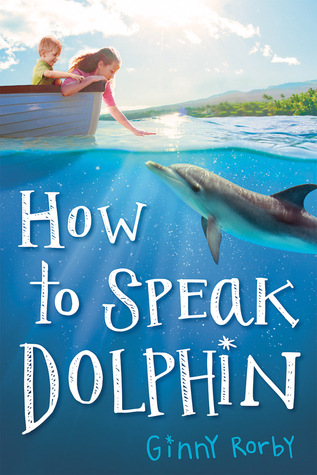
How To Speak Dolphin by Ginny Rorby

Share

howtospeakdolphin

How to Speak Dolphin
Author: Ginny Rorby
Expected Publication May 26th, 2015 by Scholastic Press
(Though available in Spring Scholastic Book Fairs)

Goodreads Summary: Schneider Family Book Award-winning author Ginny Rorby has created an irresistible dolphin story about a girl’s struggle to help her autistic brother and herself.

Lily loves her half-brother, Adam, but she has always struggled with him, too. He’s definitely on the autism spectrum–though her step-father, Don, can barely bring himself to admit it–and caring for him has forced Lily to become as much mother as sister. All Lily wants is for her step-father to acknowledge that Adam has a real issue, that they need to find some kind of program that can help him. Then maybe she can have a life of her own.

Adam’s always loved dolphins, so when Don, an oncologist, hears about a young dolphin with cancer, he offers to help. He brings Lily and Adam along, and Adam and the dolphin–Nori–bond instantly.

But though Lily sees how much Adam loves Nori, she also sees that the dolphin shouldn’t spend the rest of her life in captivity, away from her family. Can Adam find real help somewhere else? And can Lily help Nori regain her freedom without betraying her family?

My Review: How to Speak Dolphin is a tale that looks at the struggles and triumphs of growing up with an autistic family member. Lily has lost her mom and is still mourning when we meet her, yet she is being expected to pretty much be her brother Adam’s caretaker. Because of this, Lily has very few friends and finds herself lonely and sad often. Her stepfather is lost in fantasy thinking that Adam is less work and less autistic than he really is. Lily is lost and tired though knows something needs to be done. She just wants her brother to be taken care of correctly, and she needs her stepfather to see it as well. It is through Lily’s guiding, and a bit of help from Adam’s new caretaker Suzanne, that Don finally seeks getting treatment for Adam through DAT, dolphin-assisted therapy, with a young dolphin named Nori recovering from cancer. During Lily’s journey through helping her brother (and herself), she becomes friends with Zoe, a young girl who lost her sight due to retinoblastoma, who also helps her realize that her life may not be what she’d expected, but it can still be good. This book, like all of Ginny’s, is quite a ride and makes the reader think about animal and human issues that are often ignored. Ginny Rorby has done it again.

Teachers’ Tools For Navigation: There are many books that look at autism or animal rights. I can definitely see this book being in a lit circle set (with the titles listed below) where students in groups can each read a book about the topic then share what they have learned from their book at the end. This could be done beautifully with most of Ginny’s titles (Hurt Go HappyOutside of a Horse, and Dolphin Sky) because they each look at a human and animal struggle. Additionally, this book is going to be loved by students who love RulesOut of My MindWonder, and other books that look at overcoming differences.

I could also see inquiry projects blossoming out of the lit circles or a whole-class read of How to Speak Dolphin. In Dolphin alone, students could find themselves questioning animal captivity, DAT, autism, retinoblastoma, sign language, oil spill, and more.

Discussion Questions: Do you agree with the choice that is made with Nori at the end of the book?; Zoe was quite pushy with Lily when they disagree. Do you agree with how Zoe dealt with the situation?; Do you think it was Lily’s responsibility to care for Adam after her mother died?; Practice walking using echoing like Zoe does. How easy/hard is it?; Zoe is a very positive person. How does how she is dealing with her blindness help Lily be more optimistic about Adam and her life?; Why do you think Don had such a hard time admitting to himself that Adam may need help outside what he and Lily could give?

We Flagged: “Don holds Adam pressed to his chest, one arm around his legs and the other pinning his arms to his sides as I test the water temerature and start filling the tub. Don’s eyes are closed. I think from the pain of Adam’s screaming in his ear, but decided maybe it’s because his heart is broken. I was seven and a half when Mom and Don found out she was pregnant and that the baby would be a boy. Don was so over-the-top thrilled that Mom looked at me and said she’d wanted another girl. She was trying to make sure my feelings weren’t hurt, but it made me wonder if my real father had wished fora  boy, too.” (p. 8)

Read This If You Loved: Rules by Cynthia Lord, Rain Reign by Ann M. Martin, Mockingbird by Kathryn Erskine, Dolphin Sky by Ginny Rorby, Wonder by RJ Palacio, Hurt Go Happy by Ginny Rorby

Recommended For: 

readaloudbuttonsmall litcirclesbuttonsmall classroomlibrarybuttonsmall

Signature

Blog Tour with Review, Giveaway, and Author’s Guest Post!: Emmanuel’s Dream: The True Story of Emmanuel Ofosu Yeboah by Laurie Ann Thompson

Share

NFPB2015

Nonfiction Picture Book Wednesday is hosted by Kid Lit Frenzy and was started to help promote the reading of nonfiction texts. Most Wednesdays, we will be participating and will review a nonfiction text (though it may not always be a picture book).
Be sure to visit Kid Lit Frenzy and see what other nonfiction books are shared this week!

emmanuel

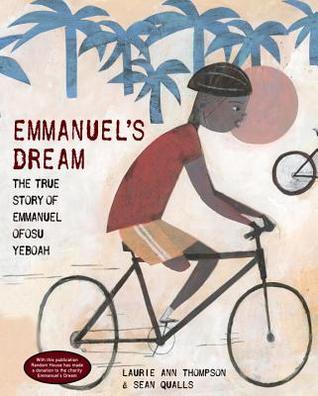
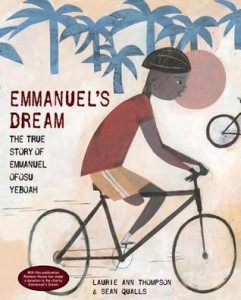
Emmanuel’s Dream: The True Story of Emmanuel Ofosu Yeboah
Author: Laurie Ann Thompson
Illustrator: Sean Qualls
Published January 6th, 2015 by Schwartz & Wade

Goodreads Summary: Emmanuel Ofosu Yeboah’s inspiring true story—which was turned into a film, Emmanuel’s Gift, narrated by Oprah Winfrey—is nothing short of remarkable.

Born in Ghana, West Africa, with one deformed leg, he was dismissed by most people—but not by his mother, who taught him to reach for his dreams. As a boy, Emmanuel hopped to school more than two miles each way, learned to play soccer, left home at age thirteen to provide for his family, and, eventually, became a cyclist. He rode an astonishing four hundred miles across Ghana in 2001, spreading his powerful message: disability is not inability. Today, Emmanuel continues to work on behalf of the disabled.

Thompson’s lyrical prose and Qualls’s bold collage illustrations offer a powerful celebration of triumphing over adversity.

Includes an author’s note with more information about Emmanuel’s charity.

Emmanuel Ofosu Yeboah quote_Unleashing Readers

Author’s Bio: Laurie Ann Thompson is the author of Be a Changemaker: How to Start Something That Matters, a how-to guide for teens who want to change the world. An advocate for social justice, Laurie is dedicated to inspiring and empowering young readers. Emmanuel’s Dream is her picture-book debut. Visit her at lauriethompson.com.

lauriethompson_PhotoByMaryBalmaceda (2)

Kellee’s Review and Teachers’ Tools for Navigation: Emmanuel is inspiring. It is no wonder that Laurie Ann Thompson wrote this story: Emmanuel is truly a changemaker. What gets me about Emmanuel’s story is that he never gives up even when faced with challenges that most of us would crumble under. He proves that kids can make a tremendous difference and that we should be strong in the face of hardships.

Laurie Ann Thompson and Sean Qualls did an amazing job on this text. The story is perfectly paced and truly takes readers on Emmanuel’s journey with him. Additionally, the illustrations are pieces of artwork. I think mixed media was the perfect form for the story.

Please read this story to your students. Talk about Emmanuel, talk about the theme of his story, talk about how he changed the world, and talk about how anyone can do the same.

Ricki’s Review and Teachers’ Tools for Navigation: As Kellee said, this is an inspirational story about a boy who refuses to be overcome by his disability. Others tell him he should just become a beggar, but he is determined to be the best he can be. The illustrations are absolutely beautiful, and the story flows well. Students will find hope and strength in Emmanuel’s strong, resilient spirit.

There aren’t enough books about disabilities in classrooms, and this frustrates me as a teacher. Frankly, there aren’t enough books being published about disabilities–both physical and mental. After reading this book, students could be encouraged to research about different individuals who have been strong in the face of disability. Then, as students share these stories with the class, students will learn lessons of bravery and resilience.

A CCSS-aligned curriculum guide is available at http://www.scribd.com/doc/251881365/Emmanuel-s-Dream-Curriculum-Guide#scribd

Discussion Questions: What adjectives would describe Emmanuel?; How has Emmanuel changed life for himself and other people with disabilities in Ghana or worldwide?; How does Emmanuel show strength—both physically and emotionally? Can you relate him to anyone in your life?

We Flagged: “…He would honor them by showing everyone that being disabled does not mean being unable. It was a big dream, but Emmanuel had a plan.”

Read This If You Loved: Be a Changemaker by Laurie Ann Thompson, A Long Walk to Water by Linda Sue Park, So Long a Letter by Mariama Ba, The Queen of Water by Laura Resau, Now is the Time for Running by Michael Williams, Soccer Star by Mina Javaherbin, Mama Miti by Donna Jo Napoli

Recommended For: 

readaloudbuttonsmall classroomlibrarybuttonsmall litcirclesbuttonsmall

Author Guest Post

At the very end of Emmanuel’s Dream, you’ll find this quote:

“In this world, we are not perfect. We can only do our best.” –Emmanuel Ofosu Yeboah

I chose to include that quote from Emmanuel because I think it exemplifies Emmanuel’s attitude toward life, but also because it was an important lesson for me to learn in my life… and it’s one I still need to be reminded of sometimes.

When I was a child, I was a perfectionist. I would never raise my hand in class. I always chose comfortable options over more challenging ones. I lived in constant fear of making a mistake—any mistake, in any area of my life. Of course, I still made them, and each one haunted me.

After college I got a job as a software engineer. In programming, I soon discovered, there’s no such thing as perfect. Every decision comes with a trade-off: better performance vs. flashy bells-and-whistles, a sooner delivery date vs. adding more features, a clean and simple design vs. a complex and robust one, cross-platform portability vs. the benefits of customization. You learn to do the best you can for the user in the time you have available. And, always, you know there will be bugs.

When I got involved in entrepreneurship, imperfection still ruled. Most startups fail, and successful entrepreneurs accept that, preparing themselves mentally (and financially) to try and try again until they find something that sticks. Even then, they’re often forced to make decisions quickly without having all the relevant information but knowing that to wait would also risk failure.

And now, with writing, perfection is just as hard to come by. Deadlines can cause us to put things out before we’re ready. Even without the pressure of a deadline, knowing when something is good enough to take to the next level is a guessing game. And what’s “good,” anyway? Despite years of working on them and dozens—if not hundreds—of revisions, copyedits, and proofs, there are still things I wish I could go back and change about each of my published books. I love them, but they can never be perfect.

What all of this has taught me is that it’s far better to do something and fail than to do nothing at all just because you were too worried about making a mistake. Worrying never does anyone any good, and the stress from it can actually harm you. But when you DO something, you learn, whether you succeed or not. You move forward, and you help everyone else following along behind. It’s not about perfection: it’s about progress.

I hope readers of Emmanuel’s Dream (and readers of this blog post!) will be inspired to follow their own dreams,  that they’ll accept that they’re not perfect but resolve to do their best anyway. Maybe just doing our best is—in its own way—the very perfection we are seeking.

Follow all the stops on Laurie’s blog tour!
 
Mon, Jan 12
Great Kid Books
Tues, Jan 13
5 Minutes for Books
Wed, Jan 14
Unleashing Readers
Thurs, Jan 15
Sharpread
Fri, Jan 16
Cracking the Cover
Sat, Jan 17
Booking Mama
Mon, Jan 19 (MLK Jr bday)
Once Upon a Story
Tues, Jan 20
Proseandkahn
Wed, Jan 21
Geo Librarian
Thurs, Jan 22
Nonfiction Detectives
Fri, Jan 23
The Fourth Musketeer
Mon, Jan 26
NC Teacher Stuff
Tues, Jan 27
Teach Mentor Texts

GIVEAWAY

a Rafflecopter giveaway

Signature andRickiSig

**Thank you to Barbara at Blue Slip Media for providing copies for review and to Laurie Ann Thompson for her guest post!**

Holiday Blog Hop with Reviews!: Mira’s Diary series by Marissa Moss

Share

mira1 mira2 bombs

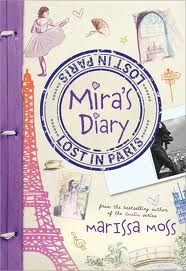
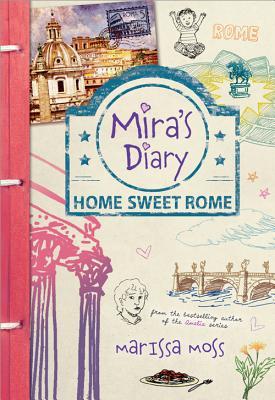
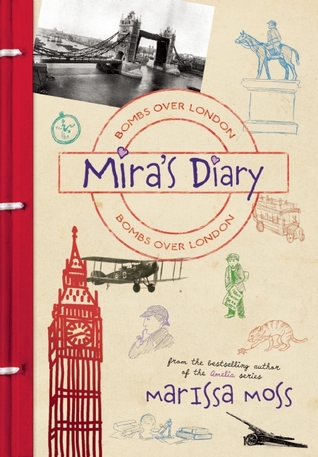
Mira’s Diary
Author: Marissa Moss
Lost in Paris Published September 4th, 2012 by Sourcebooks
Home Sweet Rome Published April 2nd, 2013 by Sourcebooks
Bombs Over London Published August 26th, 2014 by Creston Books

Lost in Paris Goodreads Summary: Mira is shocked when she receives a postcard from her missing mother from Paris. Her father decides it’s time for a trip to France to search for her. While visiting Notre Dame, Mira touches a gargoyle and is whirled into the past. There she meets the famous painter Degas and catches a brief, shocking glimpse of her mother. Mira begins to suspect that her mom didn’t run out on them but is a prisoner of the past. Can one family on an incredible worldwide adventure stop a plot in time?

Home Sweet Rome Goodreads Summary: As if traveling to a new country in search of her missing mother weren’t difficult enough, Mira has to do it dressed as a boy. In a different century.

A new postcard from her time-traveling mother points Mira to the 16th century Rome. But before she can rescue her mom, she must follow the clues left around the city to find Giordano Bruno, a famous thinker and mathematician, who discovered something so shocking that important Italian officials don’t want it revealed. All the while avoiding the Watchers–time-traveling police who want Mira back in her own time.

It’s another whirlwind adventure for Mira, and this time she is determined to bring her mother out of the past.

Bombs Over London Goodreads Summary: In the third book of the popular time-travel series, Mira navigates her way through WWI London, meeting famous suffragists and writers like Sir Arthur Conan Doyle. Instructed by her time-traveling mother to steal a German spy’s briefcase full of secrets and pass on the information to British Intelligence, Mira struggles with whether the changes she has been working for are the right thing to do after all. How much control do we really want of history? When is it best to leave our fate in destiny’s hands?

My Review of Lost in Paris:  I was enthralled by this smart, yet still accessible middle grade novel. Once I began it, I did not want to put it down.

The book was not only packed with an interesting concept (Mira and her mother travel through time to try to right wrongs that haven’t happened yet), but the book was filled with information about late 19th century Paris, French history, and art. Although some may feel like there was information overload, I found it all so fascinating. I am primarily sucked in when a book includes history that is less well known and that is exactly what this book did. Do you know about the Dreyfus Affair? After reading you will. I was also so excited to read a book so full of art history and art elements. Each page includes sketches from Mira and throughout the book you meet incredible artists such as Degas, Monet and Rodin. A cast of characters that is better than any fiction. This part of the book actually reminds me a lot of Woody Allen’s Midnight in Paris except Mira is trying to fix something instead of fixing herself.

My Review of Home Sweet Rome and Bombs Over LondonI don’t want to share too much about these titles as my thoughts are a bit spoilery, but I want to say that they did not disappoint. After reading book 1, all I wanted was to know what happened to Mira next, and I was not disappointed in her next adventures. I know book 4 is going to be in our future, and I cannot wait to read that one as well.

Teachers’ Tools for Navigation: One wish I had while reading books 1 & 2 was wanting to see the artists’ works as each artist was introduced. I was blessed enough to have an art-filled childhood so I could picture many of the pieces; however, many students do not have that background knowledge. This would be a great thing to do when reading the novel–share the artwork with students as you encounter them in the story. It would also be meaningful to find primary sources from the time period to share with students as you read Mira’s story.  This will make learning about the time period even more impactful.

Additionally, Marissa Moss’s writing is one that can definitely be used as an example of imagery and descriptive writing during writing workshop or other writing lessons. She actually sucks you in when Mira time travels, and deposits you in history that you can visualize.

Discussion Questions: Research one of the artists mentioned in book 1 or 2, write about his or her life, artwork, beliefs, etc.; Write about a time in your life when you had to trust your instincts, when you weren’t sure what to do but had to make a decision based on what felt right to you in the moment.; Was there a time when you had a feeling your parents were incorrect? What happened?; Which of the three places that Mira has visited would you have liked to go? Why?

We Flagged: “Dad was right – [Notre Dame is] truly a wonder of the world…

Usually when you go into a building, it’s lighter or darker, cooler or warmer than outdoors, but it’s still part of the same world. Stepping into Notre Dame was like changing time zones or countries, crossing some magical border. A hush filled the cavernous, echoey space of the cathedral, despite all of the voices of tourists murmuring and people praying, as if the sound was absorbed into the bones of the building itself.

Light streamed in from the windows like a physical presence, the kind of light you think you can reach out and touch…The air itself felt still and chilled by the stone all around. The walls were stretched thin between the pillars that soared into a vault overhead, like the skin of a massive beast taut between its ribs.” (Lost in Paris, p. 14-15)

“The day was gray and cold. I found myself in a busy street lined with crumbling brick buildings, shabby tenements with darkened windows. Dingy laundry hung in lines across the narrow alleyways. This may have been historical London, but there was nothing charming here. Just three-story houses of shuddering poverty with narrow doors and small pinched windows, as if sunlight cost money. The whole place was dark, muddy, broken-down, stinking of fish and rot and some indefinable yuck. The stench was so thick it had a physical presence, like a filthy hand pressed against my nose.”  (Bombs Over London, p. 26)

Read This If You Loved: Ruby Red (series) by Kerstin Gier, All Our Yesterdays by Cristin Terrill, When You Reach Me by Rebecca Stead, Blue Balliet novels

Recommended For: 

classroomlibrarybuttonsmall closereadinganalysisbuttonsmall

Signature

**Thank you to Gina and Samantha at JKSCommunications for having us as part of the blog hop!**

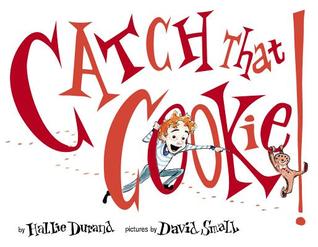
Blog Tour and Review!: Catch that Cookie! by Hallie Durand

Share

cookie

Catch That Cookie!
Author: Hallie Durand
Illustrator: David Small
Published August 14th, 2014 by Dial

Publisher Summary: Gingerbread men can play a mean game of sneaky tag!  Don’t believe it? Marshall didn’t either no matter how much his teacher, Ms. Gray, told him. But when the cookies go missing from the oven and the students find clues all around the classroom, Marshall can deny it no longer: Gingerbread men are real and they’re on the run!

From the author of the Dessert First Trilogy and Mitchell books, Hallie Durand, and Caldecott winner and two time honoree illustrator David Small, comes a tantalizing new tale that will have readers racing through the pages, eager to see where the gingerbread men have gone.

My Review and Teachers’ Tools for Navigation: This book has the potential to not only be a fun, interactive read for kids, but one that could definitely be used in a classroom. Since the reader, along with Mitchell, are given clues throughout the book, the reader can work with Mitchell to try to figure out where the gingerbread men went. It would be so much fun to read this with kids. The clues are rhyming with words left out, so they must use the context clues and rhyming skills to figure out the missing word. Also, to complete track the men down in the end, Mitchell has to make some inferences which would be a great discussion on how he figured it out. So, either in the classroom or at home, this book is definitely going to get some laughs and start good conversations.

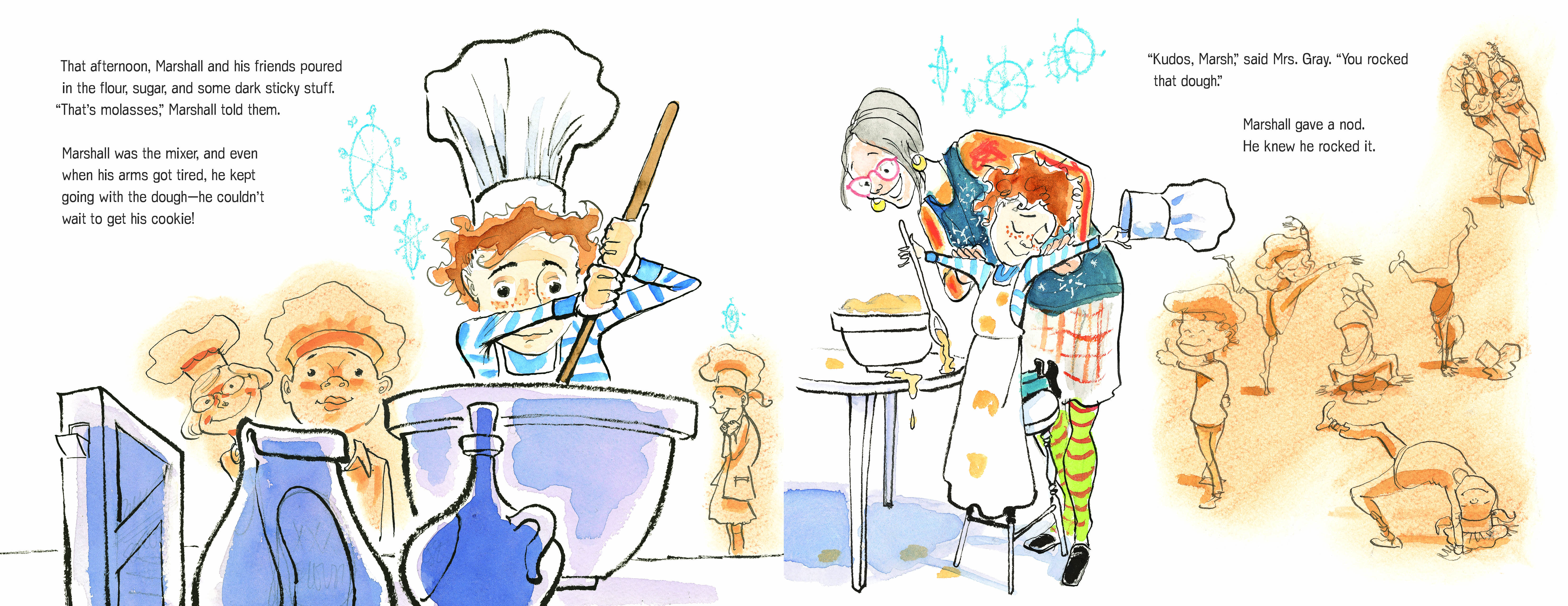
Discussion Questions: If your gingerbread man could run, where do you think he would go?; Marshall gave his cookie six raisin eyes! Tell us how you would design your own gingerbread man.

I would make my gingerbread man look like a ninja so that he would be the hardest gingerbread man to find and he would always be where ever you weren’t looking!

Comment below OR share through Twitter using #catchthatcookie!

We Flagged: 

Cookie_10-11

Read This If You Loved: Mitchell books by Hallie Durand, Help! We Need a Title by Herve Tullet 

Recommended For: 

classroomlibrarybuttonsmall readaloudbuttonsmall

Signature

**Thank you to Rachel at Penguin for having us as a stop on the blog tour!**

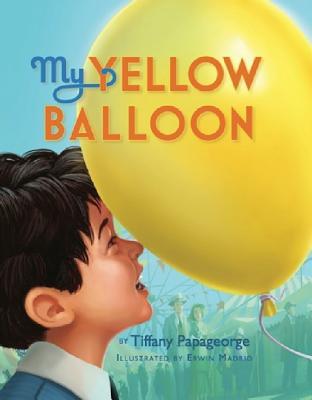
My Yellow Balloon by Tiffany Papageorge

Share

yellowballoon

My Yellow Balloon
Author: Tiffany Papageorge
Illustrator: Erwin Madrid
Published October 1st, 2014 by Minoan Moon Publishing

Publisher’s Summary:  It all started at the carnival…That’s where Joey makes a new friend: a bright yellow balloon. Joey and his beloved balloon do everything together, until the balloon accidentally slips off Joey’s wrist and flies far, far away. What will Joey do without his special friend?

Tiffany Papageorge has crafted a poignant tale of love, loss, and letting go that will serve as a comforting guide to children who are navigating the complicated emotions of grief. Learn more about Tiffany at her Facebook page or Linkedin.

Kellee’s Review: This book’s illustrations blew my mind. They are beautiful! Before I can talk about anything else, I definitely have to address how impressed I was by them.  Luckily, the story is just as good as the illustrations. My Yellow Balloon is about Joey and his yellow balloon and the loss of the balloon he became attached to. This is the second book I’ve read recently about loss and grief. I think it is so important that there are picture books out there for kids dealing with tough situations. I like the way that this book symbolizes the loss by showing that Joey’s world lost color and using a fold out to show perspective as the balloon is lost. It was very well done.

Ricki’s Review: I agree with Kellee that the text features of this book are remarkable. When the color of the illustrations shift, my stomach felt like they were tied in knots, and I felt Joey’s sorrow. The language used to depict the ways Joey comes to terms with his grief are realistic and will be very helpful for children. This book should be a staple in classrooms. Even if students are not experiencing grief at the time of the story, it will help them cope with, unfortunately, the inevitability of this topic.

Teachers’ Tools for Navigation: This book could be used to talk about the concept of theme. The theme is quite evident and would inspire great discussions. Loss and grief are something that all children can connect to, and My Yellow Balloon would be a great jumping off point for this discussion.

Discussion Questions: Have you lost anything special to you? How did you feel?; Why did the author take away the colors after Joey lost his balloon?; How is the sun symbolic for Joey? Can the balloon be considered a symbol?

We Flagged: 

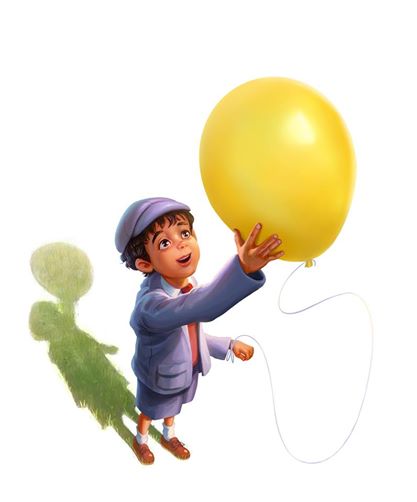
yellowballoon1

“The balloon man wrapped the string around Joey’s wrist and said, ‘Here, let me tie you two together.’ From that moment on, they were never apart.”

Read This If You Loved: Knock, Knock by Daniel Beaty, I’ll Always Love You by Hans Wilhem, Each Kindness by Jacqueline Woodson

Recommended For: 

classroomlibrarybuttonsmall readaloudbuttonsmall

Signature andRickiSig

**Thank you to Christine at New Shelves Distribution for providing copies for review!**