Review and Teaching Guide!: Frank Einstein and the Antimatter Motor by Jon Scieszka, Illustrated by Brian Biggs

Share

frank

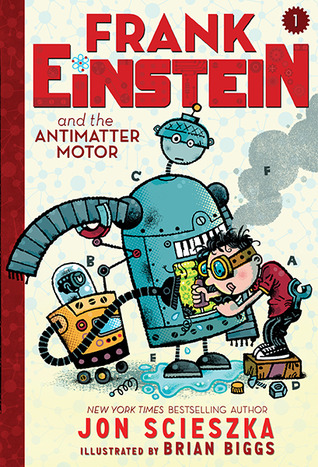
Frank Einstein and the Antimatter Motor
Author: Jon Sciezska
Illustrator: Brian Biggs
Published August 19, 2014 by Amulet Books

Goodreads Summary: Frank Einstein loves figuring out how the world works by creating household contraptions that are part science, part imagination, and definitely unusual. After an uneventful experiment in his garage-lab, a lightning storm and flash of electricity bring Frank’s inventions—the robots Klink and Klank—to life! Not exactly the ideal lab partners, the wisecracking Klink and the overly expressive Klank nonetheless help Frank attempt to perfect his Antimatter Motor . . . until Frank’s archnemesis, T. Edison, steals Klink and Klank for his evil doomsday plan! Using real science, Jon Scieszka has created a unique world of adventure and science fiction—an irresistible chemical reaction for middle-grade readers.

My Review: In the world of illustrated novels, we have many a class clown: Greg, Nate, George & Harold. But now we have our very own genius, and he is a genius that kids are going to love! This book combines the humor and fun plot that Diary of a Wimpy Kid, Big Nate, and Captain Underpants have, but adds in science (though the kids reading it will be none the wiser). The way that Sciezska combines humor, adventure, twists & turns, and science is perfection that will have a whole slew of readers waiting for the next Frank Einstein book.

Teachers’ Tools for Navigation: This book has so much that a teacher could touch on while reading it. It would be a perfect book for a read aloud in reading with cross-curricular activities based on the book in science.  I was very lucky to once again be able to write a teaching guide, this time for Frank Einstein. To see more specific class activities and discussion questions, view my teaching guide at the Abrams website. (I also wrote the teaching guide for Frank Einstein and the Electro-Finger!)


Discussion Questions: 

  • Frank has a double helix DNA slide. What would this look like?; Grandpa Al uses the phrase “Blow this pop stand” (p. 112). This is an idiom meaning “Let’s get out of here.”
  • What are idioms? What are some idioms you use in your daily life?
  • Frank’s parents are in Antarctica, where the ozone is getting a hole in it (p. 110). What is causing this hole? Frank mentions CFCs. What are they? How do they affect the ozone?
  • In Fig 1.1, Frank shows us that every second between light and sound equals 1/5 of a mile, because of the difference between the speed of light and the speed of sound. So, if there are 5 seconds between thunder and lightning, that means the storm is 1 mile away. What if there are 10 seconds between? 15 seconds? 12 seconds? 100 seconds?; On page 109, we learn that corn flakes were an accidental invention. Are there other accidental inventions?

We Flagged: “Night. Darkness. Flash! A bright bolt of lightning splits the dark and flickers over the skylight. Frank Einstein looks up from his work. He counts out loud, “One thousand one. One thousand two. One thousand three. One thousand four. One thousand five–” Craack boom! The sound-wave vibration of the thunder rattles the old iron-framed windows of Frank’s workshop and science laboratory. “Five seconds between light and sound for every mile. . . One mile away,” Frank calculates, using the difference between the almost-instant speed of light and the much slower speed of sound. “Right on time.”

Read This If You Loved: Series: Frankie Pickle by Eric Wight, Diary of a Wimpy Kid by Jeff Kinney, Captain Underpants by Dav Pilkey, Big Nate by Lincoln Peirce

Recommended For:

classroomlibrarybuttonsmall readaloudbuttonsmall closereadinganalysisbuttonsmall

Signature

**Thank you to Abrams Books for providing a copy for review**

The Milk of Birds by Sylvia Whitman

Share

milkofbirds

The Milk of Birds
Author: Sylvia Whitman
Published April 16th, 2013 by Atheneum Books for Young Readers

Goodreads Summary: This timely, heartrending novel tells the moving story of a friendship between two girls: one an American teen, one a victim of the crisis in Darfur.

Know that there are many words behind the few on this paper…

Fifteen-year-old Nawra lives in Darfur, Sudan, in a camp for refugees displaced by the Janjaweed’s trail of murder and destruction. Nawra cannot read or write, but when a nonprofit organization called Save the Girls pairs her with an American donor, Nawra dictates her thank-you letters. Putting her experiences into words begins to free her from her devastating past—and to brighten the path to her future.

K. C. is an American teenager from Richmond, Virginia, who hates reading and writing—or anything that smacks of school. But as Nawra pours grief and joy into her letters, she inspires K. C. to see beyond her own struggles. And as K. C. opens her heart in her responses to Nawra, she becomes both a dedicated friend and a passionate activist for Darfur.

In this poetic tale of unlikely sisterhood, debut author Sylvia Whitman captures the friendship between two girls who teach each other compassion and share a remarkable bond that bridges two continents.

My Review: This is a special book. First, because of the characters who tell the story. K.C. is a young girl with learning disabilities which have caused her to hate reading, writing, and school. Nawra is a refugee in Darfur who continues to have an optimistic view of the world even after she has been surrounded by horrors that I can’t even imagine. Both of these girls are not represented very often in books, and they are both so important to know.  Through this book, the reader gets to see the intensity of the situation in Sudan and refugees’ power in overcoming however they can. They also get to see the brilliance of students with learning disabilities. There are so many students in our school just like K.C., and too many of their peers would judge them by their struggles instead of by their heart and soul.

Second, this book is special because of the way the author is able to intertwine these two stories in a flawless way, and a way that keeps the reader engaged in both stories simultaneously. Third, the lyrical writing of Whitman makes this story not only interesting and important, but also beautiful to read. Last, the power of this book lies in the book, and how the book will change those who read it.

Teachers’ Tools for Navigation: This book has some incredibly lyrical aspects which would be perfect for mentor texts for imagery and other descriptive language. I also love the idea of written pen pals, and I would love to see this book being used to start pen pals in a classroom. Finally, K.C.’s friendship with Nawra helps her become an advocate for refugees in Darfur. This would be a great way to talk about ways to make a difference in the world. I would pair it with A Long Walk to Water which shows the same thing. Powerful.

Discussion Questions: What does K.C. teach us about students with learning disabilities?; What does Nawra teach us about Sudanese refugees?; What is your favorite Nawra saying? Why?; How does life here compare to life in the Sudan?; What is a way you could help the refugees in Sudan?; What is another cause in the world that you could help?

We Flagged: “My mother is sitting on the mat where I left her. She shows no surprise that Adeeba and I return so soon with nothing but more words from the khawaja. She does not protest when I lift her.

I carry my mother as I used to carry wounded animals from pasture, arms on one side, legs on the other, her body draped behind my neck and across my shoulders. She is not much heavier than a goat.” (Nawra, p. 3)

“When she explains things, they make sense, for a while. Who cares about the area of a trapezoid, though? That question stumped my teacher for a minute, and then he launched into this spiel about geometry in everyday life, and if I were someone with a trapezoidal yard, I might need to figure out how much fertilizer to spread. As if. Hook up your hose to a bottle of Miracle-Gro, point, and shoot.” (K.C., p. 12)

Read This If You Love: A Long Walk to Water by Linda Sue Park, Golden Boy by Tara Sullivan, Out of Nowhere by Maria Padian

Recommended For: 

classroomlibrarybuttonsmall closereadinganalysisbuttonsmall litcirclesbuttonsmall

Signature

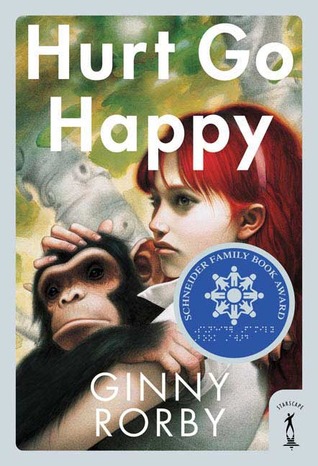
Schneider Family Book Award 10th Anniversary: Celebrating Hurt Go Happy by Ginny Rorby with Author Interview and Giveaway

Share

schneider_blogtour

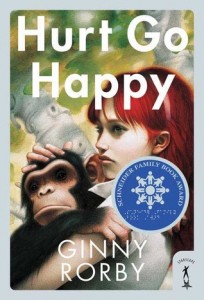
The Schneider Family Book Award is celebrating its tenth anniversary! Since 2004, the Schneider award has focused on highlighting the best pieces of literature that “embodies an artistic expression of the disability experience for child and adolescent audiences.”  An author or illustrator can be honored and there are teen, middle school, and children’s  awards.  One of my favorite books, Hurt Go Happy won in 2008, and I am so excited to share it with you today to help celebrate the award’s anniversary.
hurt

I know that many teachers have gotten away from class novels over the years and lean more towards books of choice all year long with some read alouds along the way.  Although I mostly believe in this as well, there was are a couple of novels keeping me from completely abandoning a class novel, specifically Hurt Go Happy. This is one of the those books that I finished reading, and I knew right away that I had to share it with anyone who would listen. Luckily, each year I have a bunch of middle schoolers that will listen, so I started reading this novel yearly with them.

Goodreads Summary: Thirteen-year-old Joey Willis is used to being left out of conversations. Though she’s been deaf since the age of six, Joey’s mother has never allowed her to learn sign language. She strains to read the lips of those around her, but often fails.

Everything changes when Joey meets Dr. Charles Mansell and his baby chimpanzee, Sukari. Her new friends use sign language to communicate, and Joey secretly begins to learn to sign. Spending time with Charlie and Sukari, Joey has never been happier. She even starts making friends at school for the first time. But as Joey’s world blooms with possibilities, Charlie’s and Sukari’s choices begin to narrow–until Sukari’s very survival is in doubt.

Why is this novel so important? One of the things I think is so important during the middle school years is to talk about empathy and caring for others. We read The Lorax to talk about caring for the earth, we read Each Kindness to talk about treating each other with kindness, we read The Dot to discuss open mindness, we read Endangered to build our world view, and we read Hurt Go Happy to talk about empathy for animals, children, and for people with disabilities.

Hurt Go Happy truly pushes my students to think more about how their actions effect everyone around them. The book truly puts them in Joey’s shoes and Joey goes through so much in this book. Through our reading of this book, we grow even closer as a community of readers. While reading we discuss deafness, sign language, chimpanzees, abuse, research facilities, animal abuse, wild animals as pets, survival, parents, school, death, fear, and their future. The conversations get so deep. Much deeper than you would ever expect from middle school students.

Why did was this novel honored by Schneider? Not once in this book do you think Joey is incompetent because of her disability. Although her mother may try to keep her from growing, she has learned how to survive and succeed in the world she lives in. Joey may seem like a normal kid, but she is more than that. She has learned to live in a world with no sound without really, truly being able to communicate. Then when ASL is introduced into Joey’s life, you begin to learn how intricate of a language ASL is, and the reader begins to build even more respect for the deaf.

In My Classroom: This book gives me opportunities to work with setting, characterization, cause/effect, prediction, compare/contrast, sequence, and analogies. I try to avoid making the analysis of the book tedious, so throughout we discuss the story as needed and make predictions. We also complete Thinking Maps (a type of graphic organizer) looking at the characterization, plot development, and specific events throughout the book. I found that stopping sometimes and having these discussions helped ensure my students are comprehending and thinking about everything that is going on. Since Hurt Go Happy deals with some tough subjects, and subjects many of the students have never even thought about, it is important to talk about them. We also discuss our essential questions throughout: “Do you think animal testing is necessary? Defend your answer.” and “How would being deaf affect your life? How does it affect Joey’s?” Both which lead to some debate and, once again, deep discussions.

Following the reading of the novel, my students are lucky enough to be able to take part in an interview with the author of  Hurt Go Happy, Ginny Rorby. The students generate the questions, vote on which ones to ask and even ask her the questions. Ginny even allows us to send her extra questions and answers them for my students. Often times, this is the first author my students have ever interacted with, so this becomes a very special moment for them. Ginny was actually able to come visit my school once as well. See how amazing an experience that was here.

The part that really makes students connect to the novel is the field trip that we go on.  At the end of the book, the setting changes to a rehab facility called The Center for Great Apes (@CFGA) which, while in the book was in Miami, has moved to Wauchula, FL which is 90 minutes from my school.  In the book, you even meet Noelle, a chimp who knows sign language, Kenya, another chimpanzee, and Christopher, an orangutan, who are actually at the center. It is an amazing experience to take the story and turn it into reality.

Hurt Go Happy is a book that I feel not only bring our class together but teaches my students some of the most important lessons for life: to care about every living thing.

Thoughts from the author: I am lucky enough to call Ginny Rorby a friend. We met at a signing at a Barnes and Noble here in Orlando, stayed in touch through me teaching her book, and soon moved to friends. She is an amazing person, and such a talented author. Today I am happy to share with you Ginny’s thoughts about winning the Schneider.

Unleashing Readers: What’s your best memory from winning a Schneider Family Book Award?

Ginny Rorby: That was my first national award, (and so far only) and for a book I spent 18 years working on. When the call came I hope I didn’t say, ‘you’re kidding’ but I conveniently can’t recall. I do clearly remember tears welling, my voice cracking, and the lovely women on the other end of the call saying, ‘Ohhhh.’

UR: What did winning a Schneider Family Book Award mean to you?

GR: For the first time in my then two-book career I could legitimately be referred to as an award winning author. There was a ten year gap between the publication of my first novel, Dolphin Sky, and Hurt Go Happy. The Schneider Family Book Award made me feel credible, and literally gave me the courage to keep at it.

UR: If Joey was alive, how do you think she would respond to knowing her story was honored?

GR: As long as kids are still reading Hurt Go Happy, Joey is alive. But if we could ask her, I think she’d say it wasn’t just her story. It was Sukari’s, too. She’d be happy to know that well over a hundred thousand kids have had the opportunity to rethink our treatment of animals, and each other. She’s glad for that.

UR: Why did you decide to make Joey deaf, and what did you do to prepare writing a story about her?

GR: Hurt Go Happy is about how closely related child abuse is to animal abuse. For Joey to soar above her disablity, she had to be tougher than the world around her. Her love for Sukari gave her the strength to reach her full potential. In essence, Joey and Sukari rescued each other.

I went back to college when I was 33. If I’d known that it would take me 8 years to finish, I might never have started. To educate myself enough to write a believable deaf character was a lot like that. I began by taking ASL classes followed by reading everything I could find written about being deaf and raising a deaf child. I watched every movie with a deaf character. It took years longer than I would have ever dreamed. Worth it? Absolutely. Would I do it again? Probably not. But then again, my love for Joey and Sukari gave me the strength to reach my full potential, too.

UR: Anything you’d like to say about the Schneider Family Book Award on its 10th anniversary?  

GR: I truly believe that HGH is still being read and taught in schools across the country because of that award. It was an honor to receive, and I’m forever grateful. The beautifully framed award is hanging on my book case. Whenever I feel like I can’t write one more real emotion, I’m free to glance at it and remember that I did and I still can. 

UR: Thank you Ginny for taking part in this celebration of the Schneider award and Hurt Go Happy!

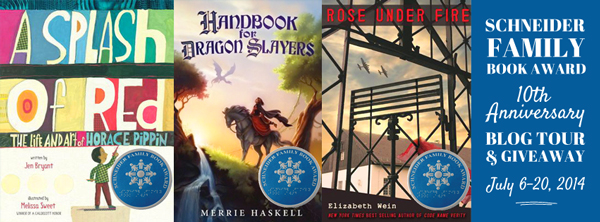
Giveaway: To help celebrate this special anniversary, one person can win a set of all 3 Schneider Family Book Award Winners from 2014.  Participants must be 13 years or older and have a US or Canadian mailing address.

a Rafflecopter giveaway

Blog Tour: Check out all of the links of the Schneider Family Book Award 10th Anniversary Blog Tour & Giveaway

July 6, 2014    Nerdy Book Club  http://nerdybookclub.wordpress.com/

July 6, 2014    Kid Lit Frenzy  http://www.kidlitfrenzy.com/

July 7, 2014    Nonfiction Detectives  http://www.nonfictiondetectives.com/

July 9, 2014    Teach Mentor Texts  http://www.teachmentortexts.com/

July 10, 2014    There’s a Book For That  http://thereisabookforthat.com/

July 11, 2014    Kathie Comments  http://kathiecomments.wordpress.com/

July 12, 2014    Disability in Kidlit  http://disabilityinkidlit.wordpress.com/

July 14, 2014    Librarian in Cute Shoes  http://librarianincuteshoes.blogspot.com/

July 15, 2014    The Late Bloomer’s Book Blog  http://thelatebloomersbookblog.blogspot.com/

July 16, 2014    Read, Write, and Reflect  http://readwriteandreflect.blogspot.com/

July 17, 2014    Read Now Sleep Later  http://www.readnowsleeplater.com/

July 18, 2014    Unleashing Readers  http://www.unleashingreaders.com/

July 19, 2014    Great Kid Books http://greatkidbooks.blogspot.com/

July 20, 2014    Maria’s Mélange  http://www.mariaselke.com/

Happy anniversary Schneider!
Keep honoring such amazing books as this one!

Signature

 **Some of this information was post previously in my Hurt Go Happy review. View it here to see additional information.**

The Here and Now by Ann Brashares

Share

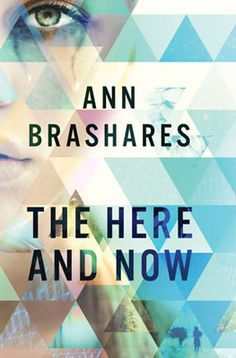
the here and now

The Here and Now
Author: Ann Brashares
Published: April 8, 2014 by Delacorte Press

Summary: An unforgettable epic romantic thriller about a girl from the future who might be able to save the world… if she lets go of the one thing she’s found to hold on to.

Follow the rules. Remember what happened. Never fall in love.

This is the story of seventeen-year-old Prenna James, who immigrated to New York when she was twelve. Except Prenna didn’t come from a different country. She came from a different time—a future where a mosquito-borne illness has mutated into a pandemic, killing millions and leaving the world in ruins. 

Prenna and the others who escaped to the present day must follow a strict set of rules: never reveal where they’re from, never interfere with history, and never, ever be intimate with anyone outside their community. Prenna does as she’s told, believing she can help prevent the plague that will one day ravage the earth. But everything changes when Prenna falls for Ethan Jarves.

Review: I particularly loved the first half of this book. While time travel is at the heart of this text, I think it would be a great book to give to readers who love dystopian fiction. Prenna’s memory of her futuristic world was fascinating to me. At times, I found Brashares to be a bit didactic, but overall, the book is very well-written and will entice readers from the first page. I always enjoy reading books about time travel because my mind spins as I try to grapple with the paradox time travel provides. If we change the past, will we exist in the future? And how can this work, if we are living in this previous time? Ah! My brain hurts. I enjoyed this book because it made me think.

Teacher’s Tools for Navigation: Similar to my review of All Our YesterdaysI think students would have a lot of fun selecting a time period to travel to, and perhaps, picking one event in history they would change and how it might impact the future. This could develop into a research project, and I can imagine there would be fantastic interdisciplinary connections with the subject of history. Alternatively (or additionally), teachers could link this text with the subject of science–where students research ways we are destroying our planet.

Discussion Questions: How are we destroying our planet? Do you think Ann Brashares’ prediction of the future is accurate? What is Brashares’ tone in this text?; If you could travel in time, what is one event in history that you would change and why? How might it change events in the future?

We Flagged: “People here act like the great things have already been lost, but they are wrong. They have so much still to lose” (Chapter Three).

“I guess memory is a deep well, and you don’t know what’s down there until you lower the bucket and start hauling it up” (Chapter Fifteen).

Please note: The above quotes are from the advanced reader copy. The quotes may have changed with publication.

Read This If You Loved: All Our Yesterdays by Cristin Terrill, When You Reach Me by Rebecca Stead, The Time Machine by H.G. Wells, The Giver by Lois Lowry, Legend by Marie Lu, Divergent by Veronica Roth

Recommended For:

 closereadinganalysisbuttonsmall litcirclesbuttonsmall classroomlibrarybuttonsmall

RickiSig

The Invisible Boy by Trudy Ludwig

Share

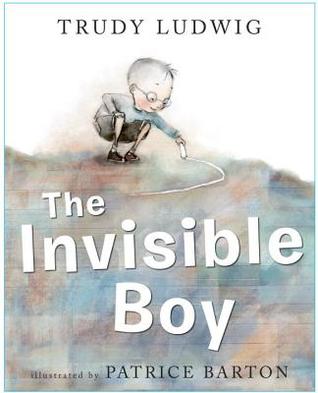
invisible

The Invisible Boy
Author: Trudy Ludwig
Illustrator: Patrice Barton
Published October 8th, 2013 by Alfred A. Knopf

Goodreads Summary: Meet Brian, the invisible boy. Nobody ever seems to notice him or think to include him in their group, game, or birthday party . . . until, that is, a new kid comes to class.

When Justin, the new boy, arrives, Brian is the first to make him feel welcome. And when Brian and Justin team up to work on a class project together, Brian finds a way to shine.

From esteemed author and speaker Trudy Ludwig and acclaimed illustrator Patrice Barton, this gentle story shows how small acts of kindness can help children feel included and allow them to flourish. Any parent, teacher, or counselor looking for material that sensitively addresses the needs of quieter children will find The Invisible Boy a valuable and important resource. 

Includes backmatter with discussion questions and resources for further reading. 

Review: Wow. This book affected me, so I know it would affect students. Although this is a book aimed at helping students think about how they affect others, there was one scene, early on, that shows Brian being ignored by everyone including his teacher which made me even sadder. It is so important for everyone, adults included, to think about how they treat or ignore others.

The other thing that I thought was brilliant was the way the illustrations were done. Brian comes to life actually right in front of our eyes. Such a smart way to visually show the moral of the story.

If you have not read this book yet, get it from your library or just go ahead and purchase it. You will not regret it.

Teachers’ Tools for Navigation: This book needs to be added to any kindness or empathy units out there right now. When I go back into the classroom, I will include it when I read Each Kindness, Because Amelia Smiled, and Stand Tall, Molly Lou Melon (check out my post on how I use Each Kindness in my middle school classroomInvisible Boy will fit perfectly.)

The author also includes recommended reading for adults and kids as well as wonderful Questions for Discussion in the back of the book.

Discussion Questions: (Found in the backmatter of the book) How many kids did it take in this story to help Brian begin to feel less invisible?; What specifically did Justin do to make Brian feel less invisible?; Are there kids in your class, grade, or school who you see being treated as if they are invisible? If yes, what could you do to make them feel more valued and appreciated?

We Flagged: 

Read This If You Loved: Each Kindness by Jacqueline Woodson, Stand Tall, Molly Lou Melon by Patty Lovell, Because Amelia Smiled by David Ezra Stein, Unicorn Thinks He’s Pretty Great by Bob Shea

Recommended For: 

readaloudbuttonsmall litcirclesbuttonsmall classroomlibrarybuttonsmall

Signature

A Long Walk to Water by Linda Sue Park

Share

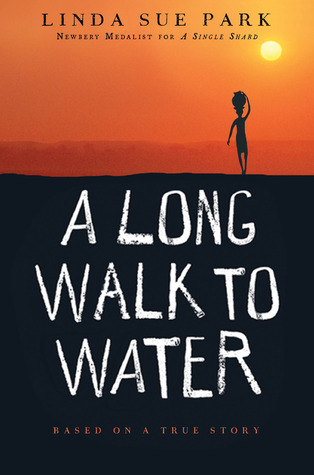
longwalk

A Long Walk to Water
Author: Linda Sue Park
Published November, 2010 by Houghton Mifflin Harcourt

Goodreads Summary: A Long Walk to Water begins as two stories, told in alternating sections, about a girl in Sudan in 2008 and a boy in Sudan in 1985. The girl, Nya, is fetching water from a pond that is two hours’ walk from her home: she makes two trips to the pond every day. The boy, Salva, becomes one of the “lost boys” of Sudan, refugees who cover the African continent on foot as they search for their families and for a safe place to stay. Enduring every hardship from loneliness to attack by armed rebels to contact with killer lions and crocodiles, Salva is a survivor, and his story goes on to intersect with Nya’s in an astonishing and moving way.

My Review and Teachers’ Tools for Navigation: The wars in Sudan and Darfur are the most violent and long lasting wars in the world; however, most Americans are unaware that they are even occurring. Linda Sue Park took a true story of a lost boy’s survival (watch a video about the true story here) after being chased from his village because of war and transformed it into a novel that will leave the reader with a feeling of awe. Awe of the bravery and pure fearlessness of Salva and the other Lost boys of Sudan and awe of the world of riches and blindness we live in while a horrendous war wages on the other side of the world. I love this book because it is very accessible to children, it won’t bog them down with too much history; however, it will definitely make them aware of the situation in Sudan.

Discussion Questions: What is a way that you could share what you learned about the Lost Boys of Sudan? How can you help? 

We Flagged: “Salva took a few steps towards the men.
‘Hey!’
A soldier approached Salva and raised his gun.
Salva froze. All he could see was the gun’s huge barrel, black and gleaming, as it moved toward his face.
The end of the barrel touched his chin.
Salva felt his knees turn to water. He closed his eyes.
If I die now, I will never see my family again.
Somehow, this thought strengthened him enough to keep him from collapsing in terror.
He took a deep breath and opened his eyes.” (p. 11)

“Going was easy.
Going, the big plastic container held only air… There was little weight, going. There was only heat, the sun already baking the air, even though it was long before noon. It would take her half the morning if she didn’t stop on the way.
Heat. Time. And thorns…
Nya filled the container all the way to the top. Then she tied the gourd in back in place and took the padded cloth doughnut from her pocked. The doughnut went on her head first, followed by the heavy container of water, which she would hold in place with one hand.
With the water balanced on her head, and her foot still sore from the thorn, Nya knew that going home would take longer than coming had. But she might reach home by noon, if all went well.” (p. 1, 14-15)

Read This If You Loved: The Queen of Water by Laura Resau, Now is the Time for Running by Michael Williams, Sold by Patricia McCormick, Diamonds in the Shadows by Caroline B. Cooney, Shabanu by Suzanne Fisher Staples, So Long a Letter by Mariama Ba

Recommended For: 
readaloudbuttonsmall closereadinganalysisbuttonsmall
classroomlibrarybuttonsmall litcirclesbuttonsmall
Signature

All Our Yesterdays by Cristin Terrill [Kellee’s Review]

Share

yesterdays

All Our Yesterdays
Author: Cristin Terrill
Published September 3rd, 2013 by Disney Hyperion

Goodreads Summary: What would you change?

Imprisoned in the heart of a secret military base, Em has nothing except the voice of the boy in the cell next door and the list of instructions she finds taped inside the drain.

Only Em can complete the final instruction. She’s tried everything to prevent the creation of a time machine that will tear the world apart. She holds the proof: a list she has never seen before, written in her own hand. Each failed attempt in the past has led her to the same terrible present—imprisoned and tortured by a sadistic man called the doctor while war rages outside.

Marina has loved her best friend, James, since they were children. A gorgeous, introverted science prodigy from one of America’s most famous families, James finally seems to be seeing Marina in a new way, too. But on one disastrous night, James’s life crumbles, and with it, Marina’s hopes for their future. Marina will protect James, no matter what. Even if it means opening her eyes to a truth so terrible that she may not survive it… at least, not as the girl she once was. Em and Marina are in a race against time that only one of them can win.

All Our Yesterdays is a wrenching, brilliantly plotted story of fierce love, unthinkable sacrifice, and the infinite implications of our every choice.

My Review and Teachers’ Tools for Navigation: This is a book that keeps you reading. I couldn’t put it down. I found myself reading whenever I could (including times when I was holding my sleeping son or when I should have been sleeping).  When you find out how Marina and Em are connected, it just blew my mind! I then had to find out how everything was going to turn out. I was just so impressed with everything:

First, the plot. It is so complex and intricate. You have to pay attention to keep up with the timeline, but it isn’t so bad that you’ll get lost. It is so admirable that the author was able to craft such intense timelines and intertwine them seamlessly.

Second, the language. I loved how Cristin Terrill wrote. The imagery throughout transported you into the story.

Third, the suspense. I just HAD to know what was going to happen!

Fourth, the characters. In a way that I’ve never experience before, Cristin Terrill truly gets you into the minds and hearts of the characters. You understand their motives, who they used to be, who they’ll become, all because of the way that Terrill tells the story and crafts her characters. You feel their heartbreak with them (and one particular realization that you find out in the very end just broke my heart and blew my mind), and you are so invested in everything they do.

Finally, the themes. The discussions that would come from this novel would be so interesting. Just the idea of power and corruption that is dealt with would lead to quite a debate.

Ricki also pointed out in her review how fun it would be to have students imagine what they would change if time travel existed.

This text would be a wonderful mentor text to discuss plot and character development, theme, and style. And most importantly, it will be a text that students will be intrigued with, not want to put down, and share with everyone.

Discussion Questions: What would you change if you had the ability to change time?; How far would you go to protect your best friend?; How did Cristin Terrill build suspense throughout the novel?; Why does power lead to corruption? Where have we seen this happen in history?

We Flagged: “Far down the hallway, I hear the clink of a door. Someone is approaching. I bolt upright and lunge for the drain. No telling what the doctor will do if he finds me breaking into it, and if he sees the sheet of paper… The though sends ice through my veins. He’ll kill me for sure. Hands clumsy with rushing, I break the spoon into several pieces and drop them down the drain. I can now make out a pair of heavy boots against the cement. I jam the grating back onto the drain and replace the screws as best I can with fingertips and nails. I swipe up the plastic bag and piece of paper and throw myself at my mattress. I show them both underneath just as Kessler’s face appears at the small window in my cell door.” (p. 9-10)

Read This If You Loved: Chronal Engine by Greg Leitich Smith, Ruby Red by Kerstin Gier, Awaken by Katie Kacvinsky, Lost Time by Susan Maupin Schmid, When You Reach Me by Rebecca Stead, Found by Margaret Peterson Haddix, London Calling by Edward Bloor

Recommended For: 

closereadinganalysisbuttonsmall classroomlibrarybuttonsmall litcirclesbuttonsmall

Signature