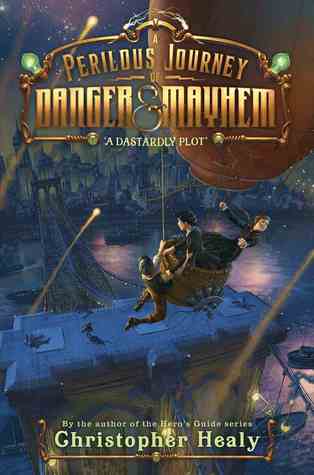
Blog Tour with Review and Giveaway!: A Perilous Journey of Danger and Mayhem: A Dastardly Plot by Christopher Healy

Share

A Perilous Journey of Danger & Mayhem: A Dastardly Plot
Author: Christopher Healy
Published September 25th, 2018

Summary: It is 1883—the Age of Invention! A time when great men like Thomas Edison, Alexander Graham Bell, Nicola Tesla, and George Eastman work to turn the country into a mechanical-electrical-industrial marvel: a land of limitless opportunity. And it all happens at the world famous Inventors Guild headquarters in New York City—a place where a great idea, a lot of hard work, and a little bit of luck can find you rubbing elbows with these gods of industry who will usher humanity into the bright promise of the future.

Unless, of course, you’re a woman.

Molly Pepper, daughter of brilliant but unknown inventor Cassandra Pepper, lives with her mother in New York. By day, they make ends meet running a small pickle shop; but by night, they toil and dream of Cassandra shattering the glass ceiling of the Inventors Guild and taking her place among the most famous inventors in America. In an attempt to find a way to exhibit Cassandra’s work at the 1883 World’s Fair, they break into the Inventors Guild—and discover a mysterious and dastardly plot to destroy New York. The evidence points to the involvement of one of the world’s most famous inventors, and now it’s up to Molly, Cassandra, and a shop hand named Emmett Lee to uncover the truth—even if no one will ever know it was they who did it.

Christopher Healy, author of the acclaimed Hero’s Guide series, returns with the first book in a rip-roaring adventure about the inventors history remembers—and more than a few that it’s forgotten.

About the Author: Christopher Healy is the author of The Hero’s Guide to Saving Your Kingdom, New York Times Book Review Editor’s Choice, as well as its two sequels, The Hero’s Guide to Storming the Castle and The Hero’s Guide to Being an Outlaw. Before becoming a writer, he worked as an actor, an ad copywriter, a toy store display designer, a fact-checker, a dishwasher, a journalist, a costume shop clothing stitcher, a children’s entertainment reviewer, and a haunted house zombie. He lives in New Jersey with his wife, two children, and a dog named Duncan. You can visit him online at www.christopherhealy.com

Praise: 

“A zany, rollicking series opener.”– Kirkus Reviews

“Plot twists and banter hit at breakneck speeds in this heartfelt yet tongue-in-cheek look at the tumultuous Age of Invention, and its focus on two often marginalized groups—immigrants and women—allows for relevant social commentary.”– Publishers Weekly

“Healy has created a steampunk-inspired alternative history featuring some of the greatest minds in invention (including a number of women) in this series opener. A solid choice for adventurous readers.”– Booklist

“Christopher Healy, author of the Hero’s Guide series knows how to tell a good story. He’s done it again with the adventures of a determined girl named Molly Pepper.”– Brightly

Review: This is the exact book the world needed! Our traditionally told history is lacking in all things diversity because it was told by bias individuals who left out people who made huge differences despite their gender or race. I love that Christopher Healy was able to take this fact, show the ridiculousness of lack of great female minds being included in history and create this book filled with humor, adventure, heart, and a bit of history. He also includes prejudice against immigrants in the story in a way that will make any reader realize how undeserving these humans just looking for a life are of this prejudice.

Now starting my review that way may make you think that the book is preachy or boring, but it is anything but. Right from the beginning, you want to see if Cassandra and her brilliant inventions will ever be acknowledged and if they are going to be able to stop New York from being destroyed. Now throw in deceit from men the Peppers and Emmett trust, inventions of all sorts, a gang of men trying to kill whomever get in their way, and a group of brilliant women who won’t let anything stop them, and you will get this crazy adventure of Molly’s and Emmett’s.

Teachers’ Tools for Navigation: Although the book is fiction, much of what is included is shrouded in fact. The author includes “What’s Real and Not…” in the back matter which allows for inquiry into the historical elements of the story. This also allows teachers to see what parts of the story include more fact than fiction and different aspects could be pulled out when learning about the different historical elements.

An educator’s guide is also for the book from the publisher!

Discussion Questions: 

  • What part of the books were historical and what parts were fiction?
  • Would you consider the book historical fiction or science fiction or steam punk?
  • What invention would you want to make?
  • Research Edison. Do you think he deserves as much recognition as he gets?
  • Research the World’s Fair. Why do we not have them anymore?
  • Which deceitful events in the story surprised you? Were your predictions correct?
  • How did meeting Emmett and the MOI change Molly’s life trajectory?
  • Other than for entertainment, why do you think the author chose to write this story?

Flagged Passages: Check out this clip from the audiobook! You can also read a sample here!

Read This If You Love: The Invention of Hugo Cabret by Brian Selznick, The Mechanical Mind of John Coggin by Elinor TeeleExplorers: Door in the Alley by Adrienne Kress

Recommended For: 

classroomlibrarybuttonsmall 

GIVEAWAY!

a Rafflecopter giveaway

Don’t miss out on the other blog tour stops!

24-Sep Novel Novice  Post by Christopher Healy https://novelnovice.com/
25-Sep A Foodie Bibliophile in Wanderlust http://www.foodiebibliophile.com/
26-Sep Unleashing Readers https://www.unleashingreaders.com
27-Sep Teach Mentor Texts http://www.teachmentortexts.com
28-Sep Novel Novice  Review https://novelnovice.com/
29-Sep Maria’s Melange http://www.mariaselke.com/
1-Oct The Flashlight Reader http://www.theflashlightreader.com/
2-Oct Nerdy Book Club https://nerdybookclub.wordpress.com/
3-Oct Book Monsters https://thebookmonsters.com/
3-Oct Novel Novice Q and A with Chris https://novelnovice.com/
4-Oct Bluestocking Thinking http://bluestockingthinking.blogspot.com/

Signature

**Thank you to Walden Pond Press for providing copies for review and giveaway!**

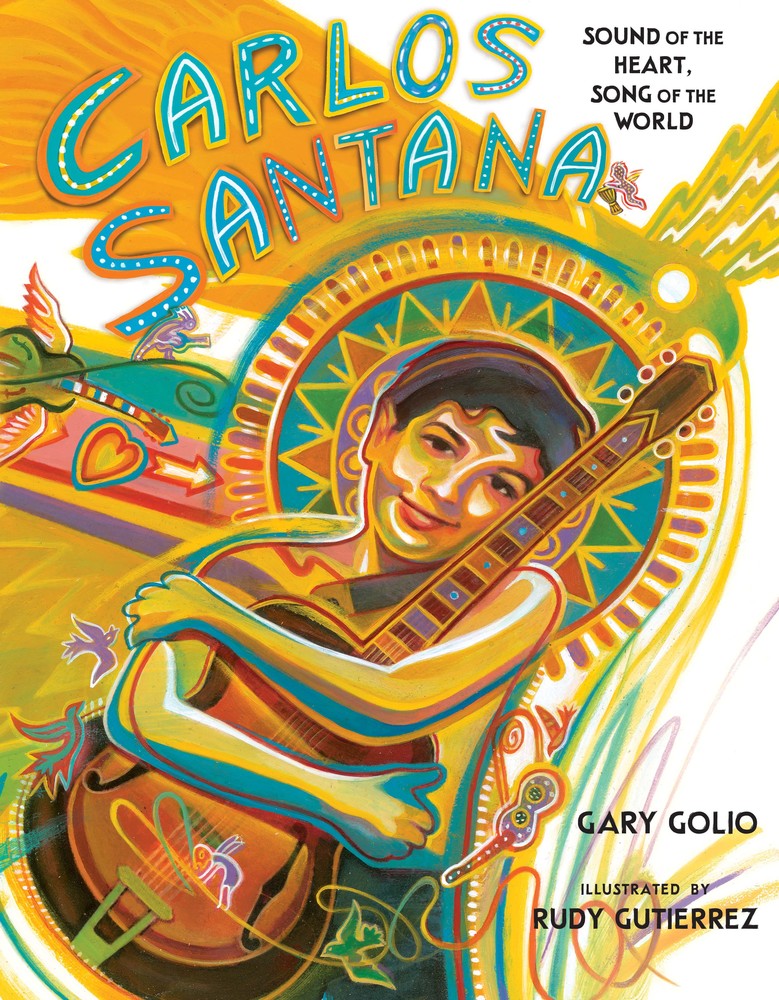
Carlos Santana: Sound of the Heart, Song of the World by Gary Golio

Share

Carlos Santana: Sound of the Heart, Song of the World
Author: Gary Golio
Illustrator: Rudy Gutierrez
Published: September 4, 2018 by Henry Holt

Summary: Discover the childhood story of Carlos Santana in Gary Golio’s Sound of the Heart, Song of the World, featuring illustrations by Rudy Gutierrez,the internationally celebrated artist who created the iconic Carlos Santana Shaman CD cover.

Carlos Santana grew up surrounded by music. His father, a beloved mariachi performer, teaches his son how to play the violin when he is only six years old. But when Carlos discovers American blues, he is captivated by the raw honesty of the music. Unable to think of anything else, he loses all interest in the violin. When Carlos finally receives his first guitar, his whole life begins to change.

From his early exposure to mariachi to his successful fusing of rock, blues, jazz, and Latin influences, here is the childhood story of a legendary musician.

My Review: I absolutely loved this book. My son and I had so much fun reading it, and then he asked to listen to some of Carlos Santana’s music. A few days later, we heard a Carlos Santana song on the radio, and my husband excitedly reminded my son about the book. It feels good to connect him with such a powerful man in our history. He shaped music in powerful ways. The book is beautifully written. I liked how it focused predominantly on Santana’s childhood. This kept my son’s interest and helped him connect with Santana. The art flows beautifully and looks like visual music on the page.

Teachers’ Tools for Navigation: I would love to use this book in literature circles with kids. Students could each read a picture book about a famous person in our history of music (see some of the options below). They could share out to their peers and play a clip from the music. These interdisciplinary activities would make for a warm, powerful learning environment.

Discussion Questions: 

  • Describe Carlos Santana’s childhood.
  • What inspired Santana?
  • What was Santana’s relationship with his parents? How do you think this may have shaped his life? What did working beside his father teach him about himself?
  • Describe Santana’s journey into music. What influenced him?

Flagged Passage: Check out the beautiful interiors on the book’s Macmillan page.

Read This If You Love: How Pete Seeger Got America Singing by Leda SchubertStand Up and Sing! by Susanna ReichWhen Bob Met Woody by Gary Golio, Jimi: Sounds Like a Rainbow by Gary Golio

Recommended For: 

classroomlibrarybuttonsmall 

**Thank you to Madison at Macmillan for providing the book for review!**

Eavesdropping on Elephants: How Listening Helps Conservation by Patricia Newman

Share

Eavesdropping on Elephants: How Listening Helps Conservation
Author: Patricia Newman
Published August 1st, 2018 by Millbrook Press

Summary: Deep in the Central African Republic, forest elephants trumpet and rumble along with the forest’s symphony. And scientists are listening.

Scientist Katy Payne started Cornell University’s Elephant Listening Project to learn more about how forest elephants communicate and what they’re saying. But the project soon grew to be about so much more.

Poaching, logging, mining, and increasing human populations threaten the survival of forest elephants. Katy and other members of the Elephant Listening Project’s team knew they needed to do something to protect these majestic animals. By eavesdropping on elephants, the Elephant Listening Project is doing its part to save Africa’s forest elephants and preserve the music in the forest.

About the Author: Patricia Newman has a passion for uncovering fascinating aspects about our world and crafting books that lead children on an adventure of discovery. She gravitates toward stories about animals and conservation science and enjoys sharing her excitement with readers. Books include Sibert Honor title Sea Otter Heroes: The Predators That Saved an Ecosystem; Junior Library Guild Selection Eavesdropping on Elephants; Bank Street College Best Book Zoo Scientists to the Rescue; Booklist Editor’s Choice Ebola: Fears and Facts; and Green Earth Book Award winner Plastic, Ahoy! Investigating the Great Pacific Garbage Patch. She frequently speaks at schools, libraries, and conferences about writing and conservation. Visit her at www.patriciamnewman.com.

Praise: 

“…this book does an excellent job of transporting readers and providing a clear, multifaceted picture of African forest elephants…The more you listen to wildlife, the more your mind opens up to new ideas about why the world is a place worth saving… VERDICT: A great pick for middle school nonfiction collections.” —School Library Journal

“Fascinating for earnest conservationists.” —Kirkus Reviews

Review: I am never disappointed when I read a Patricia Newman book. Each of her books are filled with fascinating information told in a way that will make any reader feel the passion that Newman obviously feels about her topics.

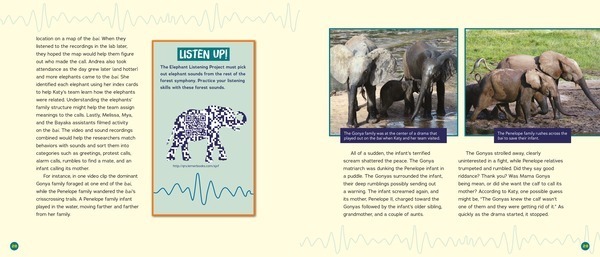
Her newest, Eavesdropping on Elephants, takes it to a whole new level! Not only does the book still include informational and narrative nonfiction, sidebars, glossaries, and classroom connections all well-researched and interesting, but it also includes QR codes (or links if you do not have a QR reader) to actually see and/or hear the elephants that are being discussed in the book. This really makes the book come to life in a way that I haven’t seen before.

Like all of her books, by the end I wanted to talk to people about what I read, wanted to go make a difference, and wanted to keep learning. If this isn’t a testament to how good her nonfiction is then I don’t know what is.

Teachers’ Tools for Navigation: “Consider an Authors for Earth Day visit in conjunction with Eavesdropping on Elephants. Students research a list of five conservation nominees selected by Patricia Newman and then vote for their favorite. Newman writes a check to the winning organization. The mission? To empower young readers to shape the world around them!”  –https://www.patriciamnewman.com/books/eavesdropping-on-elephants/ 

Research, reading, and writing activities for the classroom in conjunction with Eavesdropping on Elephants can be found on Patricia Newman’s Elephants Pinterest Board!

I, personally, am going to use Newman’s texts in my passion project research unit this year. I’m going to use her texts to show mentor texts of a nonfiction picture book and students are going to make their own nonfiction book or video. I also hope to have my lunch book club read Newman’s books as one of their month choices.

Discussion Questions: 

  • How do the videos/recordings help with the understanding of the book?
  • What is a keystone species? And how are the forest elephants a keystone species of their habitat?
  • What is the difference between ultrasound and infrasound? What does this have to do with elephants?
  • What figurative journey did Katy take to finally make it to Africa to study elephants in the wild?
  • What did the scientists learn by listening to the elephants?
  • Why are elephants’ ears the shape that they are?
  • How is what Katy did with elephant sounds similar to a dictionary?
  • How are humans a threat to forest elephants?
  • What did Teagan Yardley do when she learned about these threats?

Book Trailer: 

Flagged Passages: 

Read This If You Love: Nonfiction about animals, Nonfiction titles by Patricia Newman

Recommended For: 

classroomlibrarybuttonsmall 

Signature

**Thank you to Lerner Publishing and Patricia for providing a copy for review!**

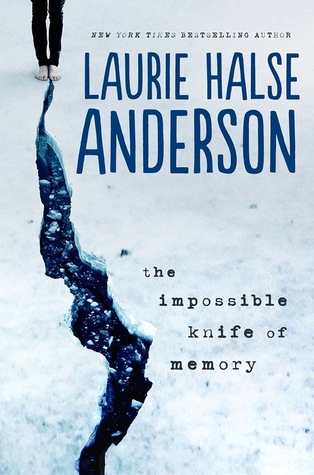
Complexity in The Impossible Knife of Memory by Laurie Halse Anderson

Share

The Impossible Knife of Memory
Author: Laurie Halse Anderson
Published January 7th, 2014

ALAN Walden Award Finalist 2015
National Book Award Longlist 2014
School Library Journal Best Young Adult Book of 2014

Summary: For the past five years, Hayley Kincain and her father, Andy, have been on the road, never staying long in one place as he struggles to escape the demons that have tortured him since his return from Iraq. Now they are back in the town where he grew up so Hayley can attend school. Perhaps, for the first time, Hayley can have a normal life, put aside her own painful memories, even have a relationship with Finn, the hot guy who obviously likes her but is hiding secrets of his own.

Will being back home help Andy’s PTSD, or will his terrible memories drag him to the edge of hell, and drugs push him over? The Impossible Knife of Memory is Laurie Halse Anderson at her finest: compelling, surprising, and impossible to put down.


Complexity in Young Adult Literature

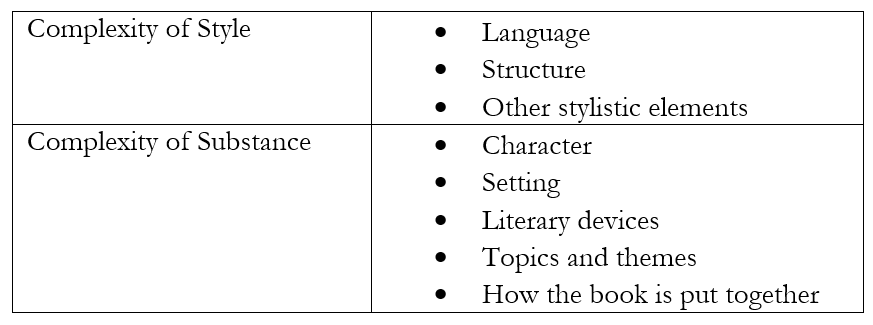
In Teaching Reading with YA Literature: Complex Text, Complex Lives by Jennifer Buehler, Chapter 2 looks at Young Adult Literature and Text Complexity and gives 8 different elements to think about to help analyze the complexity of a text:

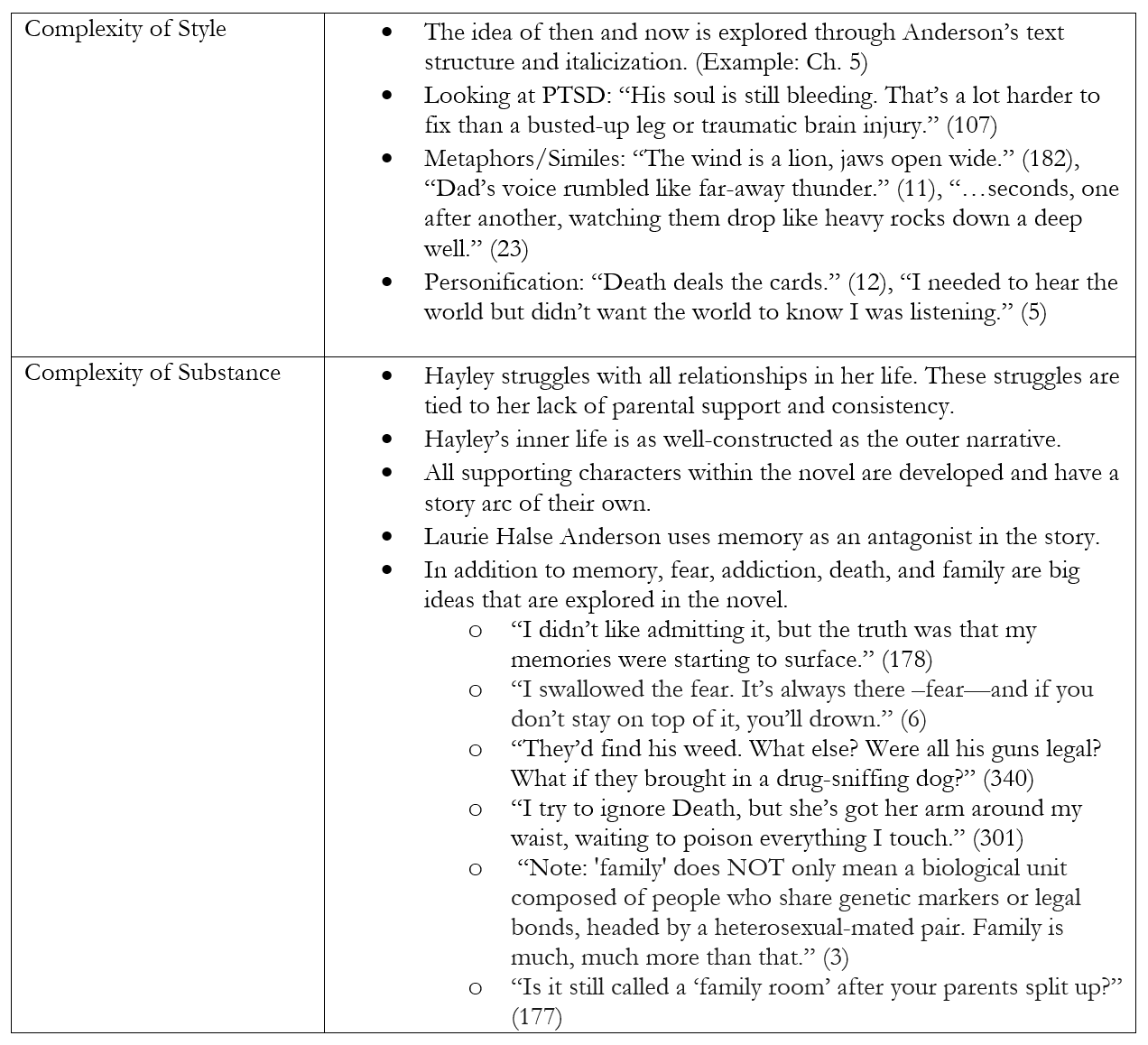
Examples of complexity in The Impossible Knife of Memory by Laurie Halse Anderson

Other questions that could be asked while reading to find complexity in YAL
(Examples from Teacher Reading with YA Literature, Buehler 36-37)

  • Language: Are the sentences artfully constructed? Are the words carefully chosen? Does the author incorporate figurative language or poetic expression? Can we hear voice in the writing?
  • Structure: How is it built in terms of form and structure? How do other elements such as titles and subtitles, vignettes and interludes, shifts between past and present, or multiple points of view work together to service the whole?
  • Other Stylistic Elements: Are there other distinct elements in the text?
  • Character: What is there to explore in terms of the character’s thoughts and feelings; conflicts and contradictions; struggles, growth, and change?
  • Setting: How does the author bring us into the world of the story? What details help us to see, hear, and imagine this place?
  • Literary Devices: How does the author use literary or cultural allusions, intertextual references, dialogue, internal monologue, metaphor and symbolism, magical realism, or repetition to build meaning?
  • Topics and themes: What questions does the book ask? What ideas does it explore? What is at stake for teen readers in this book?
  • How the book is put together: How effective is the interplay between plot layers and thematic layers?

Discussion Questions/Writing Prompts for The Impossible Knife of Memory

Complexity can also be increased by the characteristics of the reader (such as motivation, knowledge, and experiences) and task variables (such as purpose and the complexity generated by the task assigned and the questions posed). Here are some examples of discussion questions or writing prompts that could be used in classrooms or with independent readers who are reading The Impossible Knife of Memory.

  • Hayley classifies all people into two categories: freaks & zombies. What does Hayley’s idea of the world show us about her outlook on life?
  • How does Laurie Halse Anderson use the idea of THEN and NOW throughout the novel to build on the theme that memories are a very complex part of life?
  • Drowning is a motif throughout the novel.
  • How does Laurie Halse Anderson show the reader that Hayley’s father is suffering and found addiction without using those words?
  • How did the inclusion of Hayley’s romantic relationship with Finn help move along the story and Hayley’s transformation? Do you feel that Hayley’s story arc would have been the same without Finn in the story?
  • How was the setting an integral part of the story? How did Hayley returning to her deceased grandmother’s home propel the story?
  • .Trish is one of the most complex characters in the book because there are many different Trishes shared with us throughout the story: Trish then, Trish now in reality, and Trish now in Hayley’s mind. How did Laurie Halse Anderson develop each of these different characters to show the reader a full picture of Trish?

This complexity information and activities can be found as a PDF on Laurie Halse Anderson’s website or my SlideShare.

To learn more about complexity in young adult literature, please read Teaching Reading with YA Literature: Complex Text, Complex Lives by Jennifer Buehler!

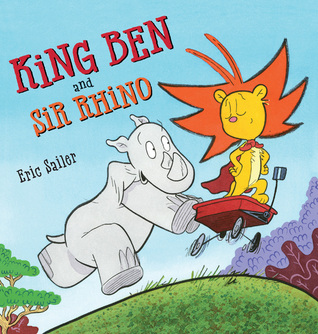
King Ben and Sir Rhino by Eric Sailer

Share

King Ben and Sir Rhino
Author and Illustrator: Eric Sailer
Published: August 7, 2018 by Two Lions

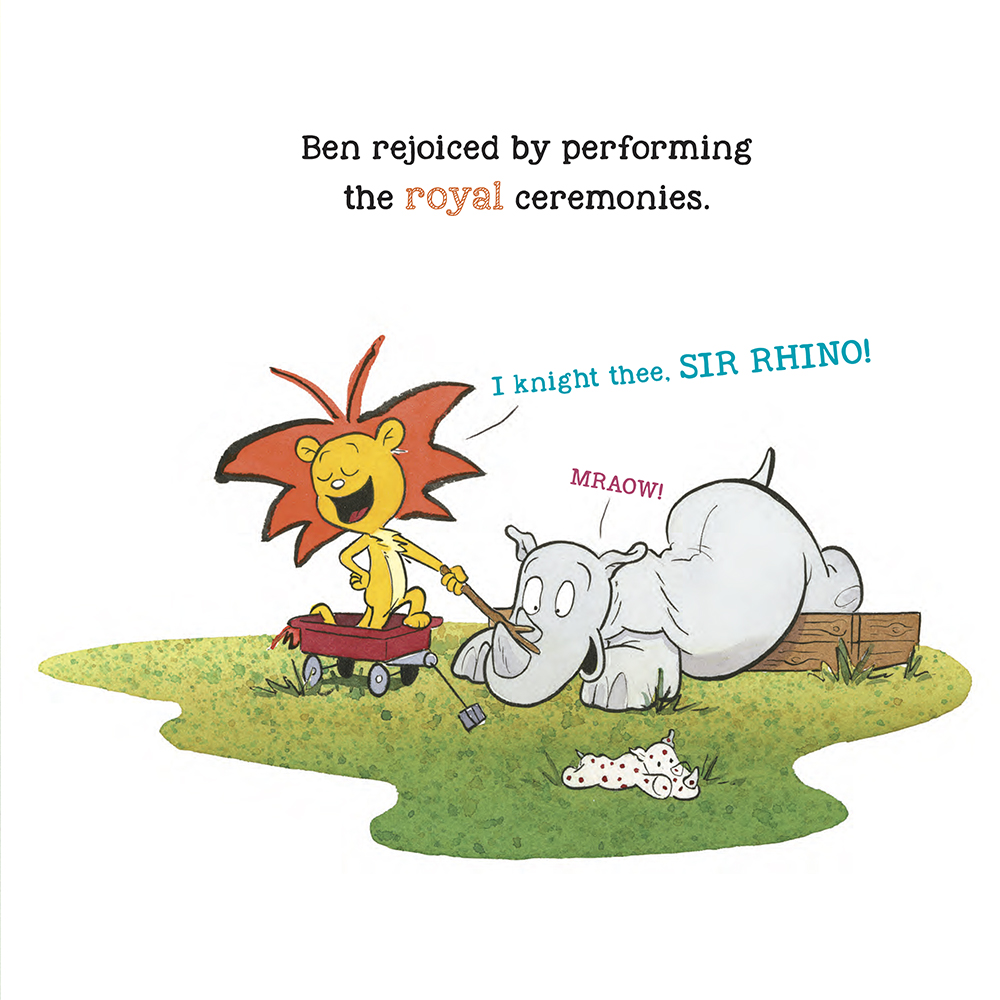
GoodReads Summary: Ben is king of the jungle. He does exactly what he pleases, as a king should. And he has everything a king could want: noble steeds, castles, and servants. What Ben doesn’t have is a loyal subject. Then he meets Rhino…and finds out what being a good king is all about.

Our Review: This adorable story offers teachers and parents opportunities to talk about bossiness! King Ben gets everything he pleases, and he decides he will make Rhino he loyal subjects. I feel like all children effort to make their parents their loyal subjects. I know that my own children have me wrapped around their fingers. This book offers opportunities to discuss why being King Ben might not always be the best approach. This makes for a very fun read-aloud.

Teachers’ Tools for Navigation: Students might have fun comparing and contrasting the King Bens and Sir Rhinos in popular culture and across history. For younger children, comparing and contrasting the good and bad things about being bossy would make for a fruitful discussion.

Discussion Questions: What are some of the things that King Ben makes Sir Rhino do?; Is King Ben being kind?; What could Sir Rhino do?; What might the characters learn from their relationship?

Flagged Passage: 

Read This If You Loved: Duck and Hippo series by Jonathan London; Elephant and Piggie series by Mo Willems; The Frog and Toad series by Arnold Lobel; Pug Meets Pig by Sue Lowell Gallion

Recommended For:

classroomlibrarybuttonsmall 

RickiSig

**Thank you to Kristin at Two Lions for providing a copy for review!**

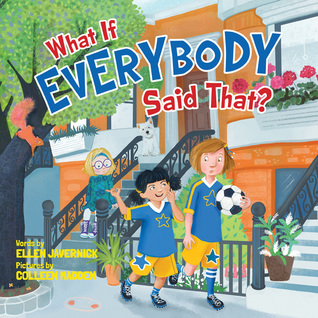
What If EVERYBODY Said That? by Ellen Javernick

Share

What If EVERYBODY Said That?
Author: Ellen Javernick
Illustrator: Colleen Madden
Published August 1st, 2018 by Two Lions

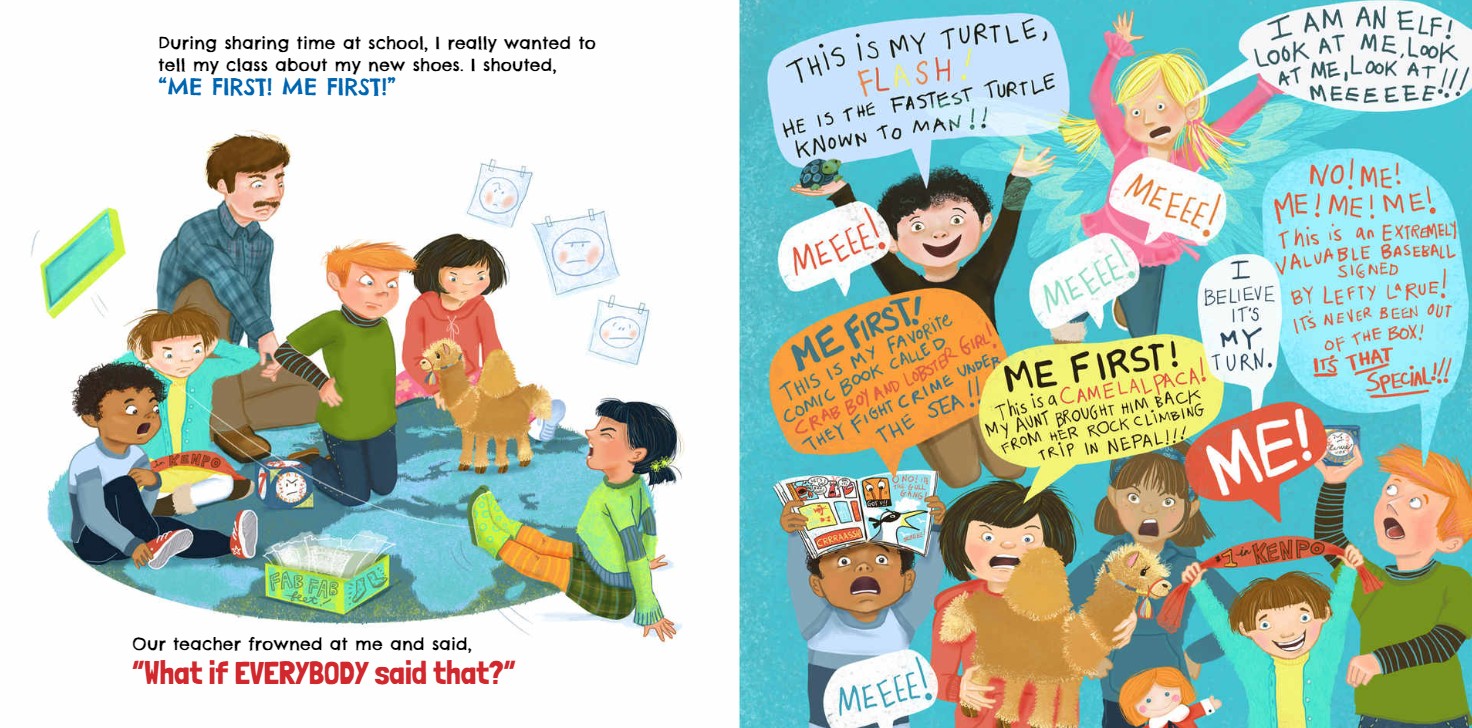
Summary: What if everybody chose to be kind?

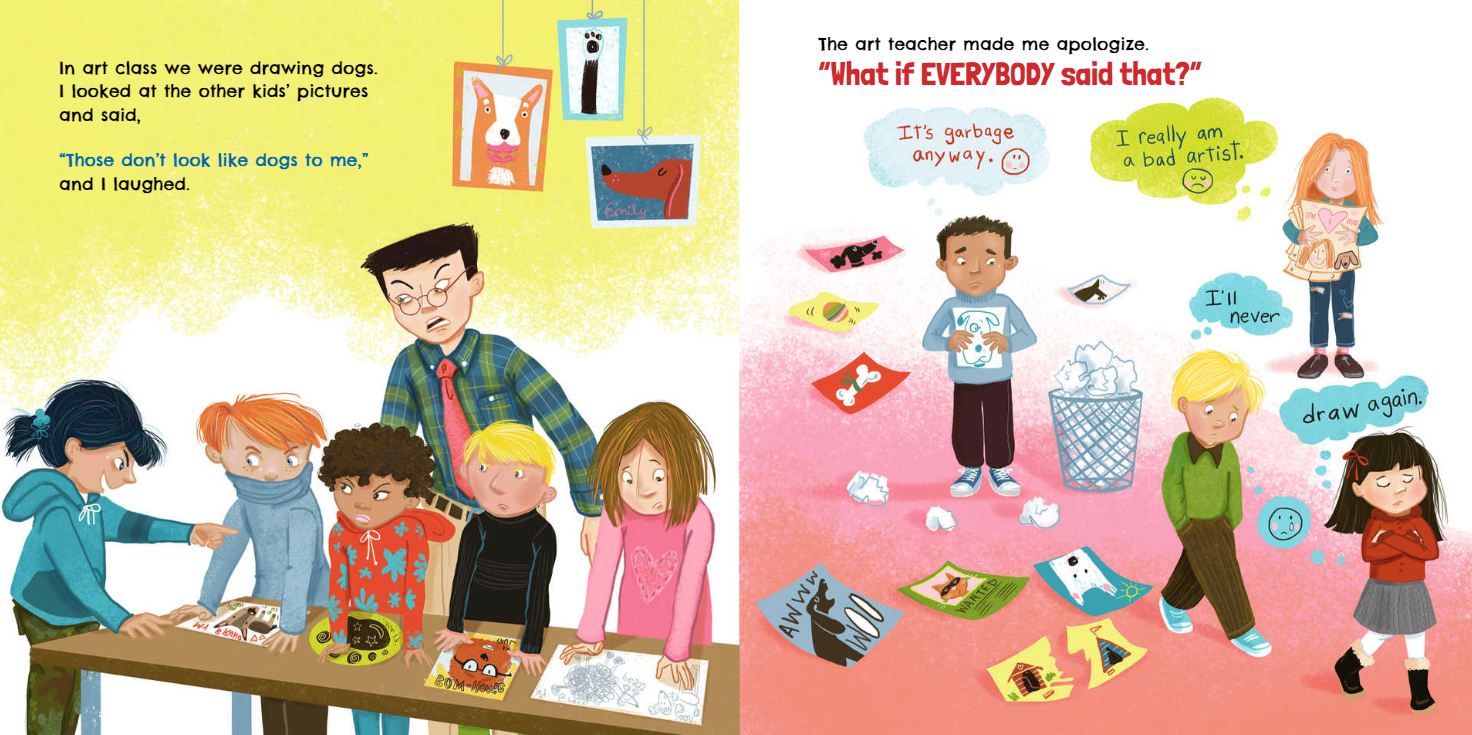
If you tell someone that they can’t play with you, there’s no harm done, right? But what if everybody said that? What if everybody forgot to be kind…and made fun of other kids’ artwork at school, or told a fib, or refused to share with a person in need? The world wouldn’t be a very nice place to live. But what if everybody thought before they spoke, so the world would be a kinder place?

With clear prose and lighthearted artwork, this companion book to the bestseller What If Everybody Did That? explores the power of words and shows kids that the things we say matter.

About the Creators: 

Ellen Javernick has taught 1-3 grade classes for over 20 years. Her B.A. is from DePauw University. Her M.A. in Early Childhood Education is from the University of Northern Colorado. She has completed classes with Barbara Wise and is Lindamood-Bell trained. In addition to being a teacher, Ellen has written more than 20 books for children. She currently teaches second grade in Loveland, CO.

The weird fourth kid in a family of 8, Colleen Madden made it through childhood pretending to be a wookie and doodling in her cardboard box art studio. Colleen spent some time acting and training at The Second City in Chicago, then went on to graduate from a small liberal arts school on the East coast. Colleen eats and works and runs around in the Philadelphia area.

Praise: “A reminder to be aware of what one says, as well as a discussion starter about actions and consequences.” —Kirkus Reviews

Review: Empathy and kindness are both things that I truly believe need to be directly taught to children. Kids are born thinking only of their own needs and maybe of the needs of their family, but they have to learn how to care about those around them. This teaching can start at a very young age but then needs to be reinforced for years to come. Anyone who teaches knows this is true. We may have some of the best students but even they make a mistake sometimes that is hurtful to someone else. What If Everybody Said That? is a testament of thinking about others. Though a bit didactical, the different scenarios put on each page truly do show a cause and effect of the words we say to others.

Teachers’ Tools for Navigation: This text is a perfect book to add to any community building, kindness, empathy, or anti-bullying text set.

Discussion Questions: 

  • How does each spread show the cause and effect of what she said?
  • What finally made the young girl realize she needed to apologize?
  • What if everybody said that? (Pick a page and discuss)
    • Look at the cause and effect from everybody saying what the girl said.
    • Compare and contrast the two pages.
  • What is something you can think of that you said before that may not have been the best choice?

Flagged Passages: 

Read This If You Love: Each Kindness by Jacqueline Woodson, Eraser by Anna Kang, I Walk with Vanessa by Kerascoët, and other books helping students think about the words and choices they make

Recommended For: 

classroomlibrarybuttonsmall 

Signature

**Thank you to Two Lions for providing a copy for review!**
Review and Giveaway!: Eraser by Anna Kang, Illustrated by Christopher Weyant

Share

Eraser
Author: Anna Kang
Illustrator: Christopher Weyant
Published August 1, 2018 by Two Lions

Summary: Eraser is always cleaning up everyone else’s mistakes. Except for Ruler and Pencil Sharpener, none of the other school supplies seem to appreciate her. They all love how sharp Pencil is and how Tape and Glue help everyone stick together. Eraser wants to create so that she can shine like the others. She decides to give it a try, but it’s not until the rubber meets the road that Eraser begins to understand a whole lot about herself.

Inspired by a school essay their daughter Kate wrote in the third grade, the author and illustrator behind Theodor Seuss Geisel Award–winner You Are (Not) Small have created a desktop drama about figuring out who you are, finding happiness, and the importance of second, third, and maybe even fourth chances.

About the Creators: Anna Kang and Christopher Weyant are the creators of Theodor Seuss Geisel Award winner You Are (Not) Small and its follow-ups That’s (Not) Mineand I Am (Not) Scared. Christopher’s work can be seen routinely in The New Yorker magazine and his cartoons are syndicated worldwide. As an author, Anna regularly goes through first, second, and third drafts. Chris wears down many erasers while making his art. This husband-and-wife team lives in New Jersey with their two daughters and their rescue dog. Visit them at www.annakang.com and www.christopherweyant.com.
Twitter: @annakang27 @chrisweyant05
Instagram: annakangbooks; christopherweyant
Facebook: Anna Kang – Author; Christopher Weyant

Ricki’s Review: I love this author-illustrator team. Every book that they’ve written has been brilliant. This book offers readers a glimpse inside the mind of the lesser-known characters in life. It forces us to think about who we are overlooking and who deserves more praise. It’s easy to get caught up in our own lives and the lives of those who are close to us, and we often forget to consider those who feel distant to us. My son and I talked about this together, and he said there are some kids at school that he doesn’t talk with often. I asked him what this book taught him, and he said that it reminded him to talk with more friends in his class and to be kind. With a valuable message and a powerful punch, this book is sure to become a favorite in classrooms.

Kellee’s Review: There are times in all of our lives that we question our purpose. Someone louder, prettier, more aggressive, or different than you may get recognition where you don’t even though you feel you deserve it. But it is all about valuing yourself and showing others that value, but we don’t need others to tell us our worth. That is what Eraser teaches us. When we finished, Trent said that Pencil learned that she needed help and Eraser learned she IS important. If that isn’t a message that I want my son to learn, I don’t know what is. Oh, and it is quite funny sometimes, and like Kang & Weyant’s other books, it is told in dialogue only so the illustrations play a big part in the telling of the story.

Teachers’ Tools for Navigation: Teachers might give students a list of the names of all of the students in their class. The students might look through this list and ask themselves, “Who do I talk to often? Who could I get to know more? Do I show every person on this list that they matter?” This activity connects well with the theme of the book and reminds students to support others in their world.

For more information, and to download a free activity kit, visit annakang.com, or download here.

Discussion Questions: 

  • How does Eraser’s feelings change throughout the book? What causes these changes?
  • How do the other school supplies act toward Eraser? Does this remind you of any instances in your life?
  • What is the message of the book? What does it teach us?

Book Trailer!:

Spreads:

Giveaway!:

a Rafflecopter giveaway

Read This If You Loved: Red: A Crayon’s Story by Michael Hall; The Day the Crayons Quit by Drew DaywaltThat’s (Not) Mine by Anna KangYou Are (Not) Small by Anna Kang

Recommended For:

readaloudbuttonsmall classroomlibrarybuttonsmall

RickiSigand  Signature

**Thank you to Barbara at Blue Slip Media for providing copies for review!**