Animal Planet’s Animal Atlas

Share

NFPB2016

Nonfiction Wednesday

Nonfiction Picture Book Wednesday is hosted by Kid Lit Frenzy and was started to help promote the reading of nonfiction texts. Most Wednesdays, we will be participating and will review a nonfiction text (though it may not always be a picture book).
Be sure to visit Kid Lit Frenzy and see what other nonfiction books are shared this week!

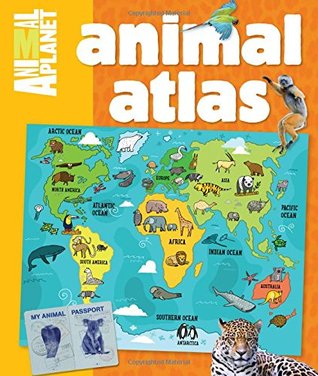
animal atlas

Animal Atlas
Published May 24th, 2016 by Animal Planet

Goodreads Summary: Animal Planet’s definitive atlas of animal life takes readers on a continent-by-continent and habitat-by-habitat passport to adventure!

What is a habitat? How is the North Pole’s animal life different from the South Pole’s? How and why do animals adapt to their environment? Is a food web different from a food chain? Animal Planet Animal Atlas answers all of these questions and many more. Through detailed maps, fun infographics, simple charts, and Find It! Fact boxes readers can track their favorite animals across the globe, learning about how animal habitats are affected by climate, food and water availability, migration, and human environmental impact.

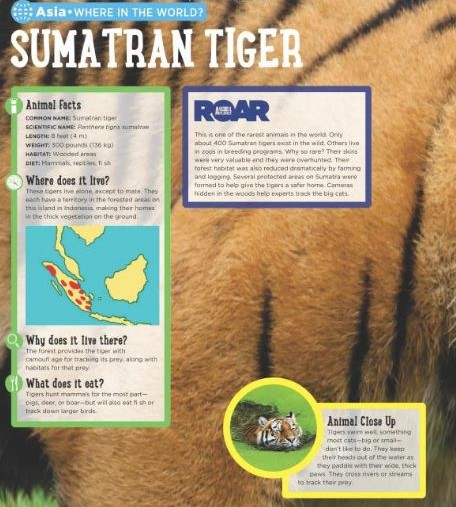
Kellee’s Review: Nonfiction informational texts are really stepping up their game! Over the last few months, we’ve been sharing a lot of Animal Planet and National Geographic texts, but it is because they are worth sharing! This text is filled with such a wealth of information. First and foremost, I see it as a beautiful atlas. It focuses on not only the different continents and oceans, but it teaches about the biomes within the world also. Within each biome in each continent, animals who lie and thrive are shared along with interesting information about the animals. Some of my favorite parts though are the “Animal Close Up” sections which focus on one animal, where it lives, why it lives there, and what it eats and the animal travel guides who pop up within each continent and give out tidbits of information. This plethora of information combined with breathtaking photographs allows this book to take you on a journey all around the world!

Ricki’s Review: I loved this book. My toddler and I probably spent 45 minutes reading it, and we didn’t even read all of the facts! There is so much information in this book, and it is all incredibly fascinating. I think we are going to enjoy this text for a long time yet! My favorite part about it was the way the book was divided up by continent and then further by biomes. My son and I were able to talk about the similarities between the animals and insects within biomes and why that might be. When we reached each new continent, we flipped back to the big atlas to talk about where that continent was in comparison to our home. I also loved the sections that compared the animals to humans. It was neat to talk about our similarities and differences. I’d highly recommend this text for any child of any age. I think it would appeal to all ages and interest levels!

Teachers’ Tools for Navigation: This is such a beautiful text that begs to be used cross curricularly. In Florida, 6th grade learns about life science and one of the unites focuses on habitats and biomes. This book would be an asset either in the science classroom or in an ELA classroom supporting the science standards. Also, in late elementary school this text would be a perfect way to combine science, social studies, reading, and writing.

Discussion Questions: Which biome is the hardest for animals to live in?; Which continent has the least amount of animals?; What are the differences between the different biomes?; Which animal/habitat/continent would you like to learn more about?

We Flagged: 

animal atlas spread
(c) 2016, Animal Planet

Read This If You Loved: National Geographic titles such as Awesome 8 or National Parks USA Guide, Animal Planets Animal Bites series, Seymour Simon’s animal books or Extreme Oceans

Recommended For: 

classroomlibrarybuttonsmall closereadinganalysisbuttonsmall

Signatureand RickiSig

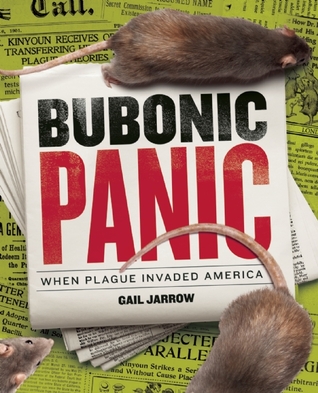
Blog Tour, Giveaway, and Review: Bubonic Panic: When Plague Invaded America by Gail Jarrow

Share

NFPB2016

Nonfiction Wednesday

Nonfiction Picture Book Wednesday is hosted by Kid Lit Frenzy and was started to help promote the reading of nonfiction texts. Most Wednesdays, we will be participating and will review a nonfiction text (though it may not always be a picture book).
Be sure to visit Kid Lit Frenzy and see what other nonfiction books are shared this week!

bubonic panic

Bubonic Panic: When Plague Invaded America
Author: Gail Jarrow
Published: May 10, 2016 by Calkins Creek

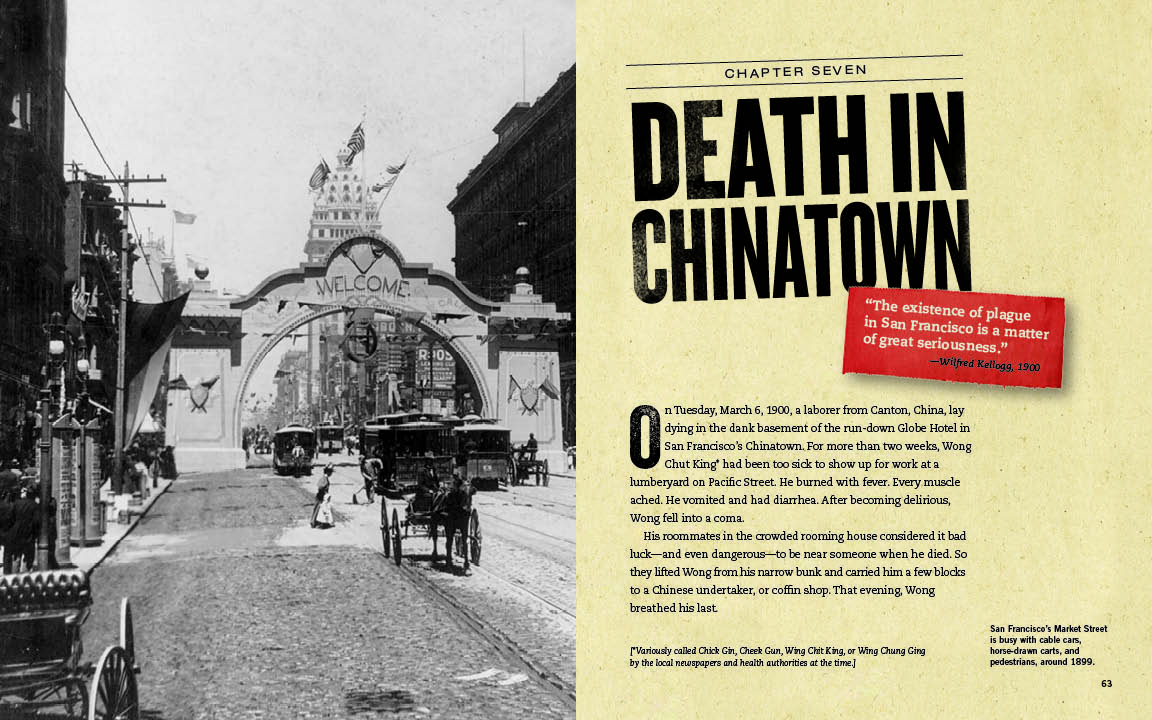
GoodReads Summary: In March 1900, San Francisco’s health department investigated a strange and horrible death in Chinatown. A man had died of bubonic plague, one of the world’s deadliest diseases. But how could that be possible? Bubonic Panic tells the true story of America’s first plague epidemic—the public health doctors who desperately fought to end it, the political leaders who tried to keep it hidden, and the brave scientists who uncovered the plague’s secrets. Once again, acclaimed author and scientific expert Gail Jarrow brings the history of a medical mystery to life in vivid and exciting detail for young readers. This title includes photographs and drawings, a glossary, a timeline, further resources, an author’s note, and source notes.

Review: I have read about the medieval plague, but I haven’t read much about the plague epidemic of the twentieth century. It was fascinating (and sad) to learn about this time period. Gail Jarrow has an incredible ability to make nonfiction material very accessible to readers. This book is a page-turner, and I had difficulty putting it down! The information is very easy to follow, yet it is complex and made me think! I will read any book by Jarrow because she really makes me think. Her texts go beyond medical information. There are themes, for example, about racism and prejudice that made me want to use this book in the classroom!

Teachers’ Tools for Navigation: As with Gail Jarrow’s Fatal Fever, I think it would be wise for teachers to explore other diseases and epidemics while teaching this book. It would be particularly interesting to make connections between this book and Jarrow’s Red Madness and Fatal Fever. Students could participate in literature circles and discuss their learning. I also found the prejudice and scapegoating included in the text to be very interesting and think this would make for very worthy classroom discussions.

Discussion Questions: What role does fear play in the text? How does fear evolve? Is it often validated or invalidated? What negative consequences come with fear?; Are there any heroes in this book? Why or why not?; How can we connect the text to the modern anti-vaccination movement?

Flagged Passage:

bubonic plague spread 

Read This If You Loved: Fatal Fever: Tracking Down Typhoid Mary by Gail Jarrow; Red Madness: How a Medical Mystery Changed What We Eat by Gail Jarrow; Invincible Microbe: Tuberculosis and the Never-Ending Search for a Cure by Jim Murphy and Alison Blank

Giveaway:

a Rafflecopter giveaway

Recommended For:

 classroomlibrarybuttonsmall litcirclesbuttonsmall

RickiSig

Check out the other stops on the blog tour!:

Monday, May 16

The Nonfiction Detectives

www.nonfictiondetectives.com

Tuesday, May 17

KidLit Frenzy

www.kidlitfrenzy.com

Wednesday, May 18

Unleashing Readers

www.unleashingreaders.com

Thursday, May 19

Teach Mentor Texts

www.teachmentortexts.com

Friday, May 20

Sally’s Bookshelf

www.sallysbookshelf.blogspot.com

*Thank you to Kerry at Boyds Mills Press for sending this book for review!*

Cody and the Mysteries of the Universe by Tricia Springstubb

Share

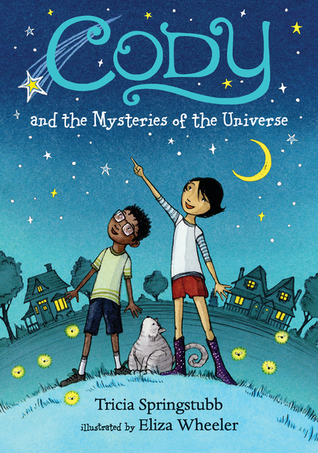
cody and the mysteries of the

Cody and the Mysteries of the Universe
Author: Tricia Springstubb
Illustrator: Eliza Wheeler
Published April 12th, 2016 by Candlewick Press

 Goodreads Summary: Not everything turns out to be as it first appears when Cody and her best friend, Spencer, navigate a neighborhood mystery and the start of a new school year.

Cody’s best friend, Spencer, and his parents are moving in with his grandmother right around the corner, and Cody can’t wait. For one thing, Cody needs Spencer to help solve the mystery of the never-seen Mr. Meen, who lives on the other side of the porch with a skull-and-crossbones sign in the window and an extermination truck out front. How’s Cody to know that a yellow jacket would sting her, making her scream “Ow! Ow!” just as they start spying? Or that the ominous window sign would change overnight to “Welcome home,” only deepening the mystery? In this second adventure, Spencer’s new-school jitters, an unexpected bonding with a teacher over Mozart, and turf-claiming kids next door with a reason for acting out are all part of Cody’s experiences as summer shifts into a new year at school.

My Review: I loved this one as much as the first one. (P.S. You don’t have to read the first one to enjoy this one, but they are both so good you should read both.) What I love most about the books is that Cody and Spencer and their families and the secondary characters are just so flawed and familiar and real. What I love second most about the book is how Tricia Springstubb writes. It is lyrical yet to the point. Beautiful yet not fluffy. See my example below. What I love third most about the book is the humor. Cody is one funny young lady!

Cody’s story this time revolves around two things: Spencer moving nearby and things not going as expected and the mystery behind the Meens, the bullying girls who live next to Spencer. Springstubb navigates both of these topics (bullying and friendship) with ease along with other minor topics like family and identity which makes Cody’s story perfect for all young readers because they will either relate or be able to use the story to help them in the future.

Teachers’ Tools for Navigation: Cody’s story represents so many different types of people: different races, different families, different situations, different popularity, different talents, etc., so her stories are perfect for reading aloud to a class/child.

It could also be used as a mentor text for language during a writing workshop’s narrative unit.

Discussion Questions: What does Cody mean by the baton of love?; Is it ever okay to fight?; Why does Payton’s behavior affect Wyatt so much?; How did Cody expect Spencer being at her school to be? How did it end up?

Flagged Passages: “He [Spencer] was getting ready to practice his violin. Mom and Cody sat down to listen. The song he played was called ‘Go Tell Aunt Rhody.’ The music was complicated. Was it sad? Was it happy? Could it be both at the same time? Cody decided it was perfect night-before-school music. All the while he played, her hand un-itched.” (p. 32)

Read This If You Loved: Cody and the Fountain of Happiness by Tricia Springstubb, The Trouble with Ants by Claudia Mills, Marty McGuire series by Kate Messner, Eleanor series by Julie Sternberg, Lola series by Christine Pakkala, The Top-Secret Diary of Cecile Valentine by Julie Sternberg

Recommended For: 

readaloudbuttonsmall classroomlibrarybuttonsmall

Kellee Signature
**Thank you to Candlewick for providing a copy for review!!**

The SLOWEST Book EVER by April Pulley Sayre

Share

NFPB2016

Nonfiction Wednesday

Nonfiction Picture Book Wednesday is hosted by Kid Lit Frenzy and was started to help promote the reading of nonfiction texts. Most Wednesdays, we will be participating and will review a nonfiction text (though it may not always be a picture book).
Be sure to visit Kid Lit Frenzy and see what other nonfiction books are shared this week!

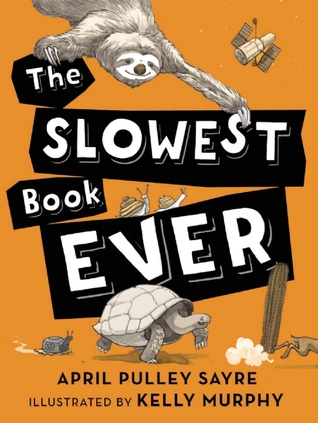
slowest book ever

The SLOWEST Book EVER
Author: April Pulley Sayre
Illustrator: Kelly Murphy
Published April 5th, 2016 by Boyds Miller Press

Goodreads Summary: April Pulley Sayre’s wry, quirky storytelling tone shines from the warning on the first page (“This is a S-L-O-W book. Do not read it while surfing, water skiing, or running to escape giant weasels.”) right through to the glossary at the end. In between, readers will explore an astounding variety of information about all things slow—in nature, geology, art, outer space, etc. Throughout, The SLOWEST Book EVER playfully encourages readers to slow down and savor everything. As Sayre shows: “If you think slowly enough, the entire world is amazing.” This innovative nonfiction work is a treasure trove of information that begs for multiple readings.  

Kellee’s Review: Anyone who teaches knows that the most popular nonfiction books are the ones that have a ton of information in short segments with fun pictures. Well, Sayre’s The SLOWEST Book EVER is exactly that but even better than you are picturing. Sayre does such a great job of having a small amount of information that packs a very big punch. Although each fact is over only a 2-page spread, the information is thorough, interesting, and specific. I loved the wide range of topics that were all covered under the big idea of SLOW, and I think students will be fascinated with all of the information.

Ricki’s Review: I read a lot of books, and I don’t think I’ve read a book that is quite like this one! It is a compilation of fascinating information that will compel readers to want to learn more about their world. It is apparent that a lot of thought and care went into the crafting and production of this book. Each page is a bit different, so if a reader is uninterested in a topic, he or she can flip the page and find something else entirely different. This book would make a great gift because all children will find sections that intrigue them, regardless of their interests. I’d look forward to going to a class where a teacher used this book used as a read-aloud, reading a few sections each day. This book makes learning fun!

Teachers’ Tools for Navigation: Since The SLOWEST Book EVER includes tidbits of information on many different topics, each spread could easily be used as a jumping off point for an inquiry project. Students browse through the book to determine which spread of information interests them the most then they do more research (using the back matter as a place to start) then share the extra information with their classmates.

The SLOWEST Book EVER also does an amazing thing by looking at all the different ways that SLOW can be defined. After finishing the book as a class, revisit all of the different ways slow was used then brainstorm different meanings of other subjective adjectives such as fast, large, and small. Then student, as a class, could write their own fact book using a different adjective but showing different meanings of that word.

Discussion Questions: Which fact surprised you the most?; The book doesn’t only focus on slow speeds–what ever definitions of slow did the author focus on?; What topics would you like to learn more about? Where could you go to get more information?

We Flagged: “Chewy Nature Thoughts
Read them. Think about them. S l o w l y.
Slow thoughts are often big thoughts. So don’t fret if it takes a while to understand them. Don’t worry if you need to read them twice. -Traveling in a circle is, after all, still traveling.” (p. 8-9)

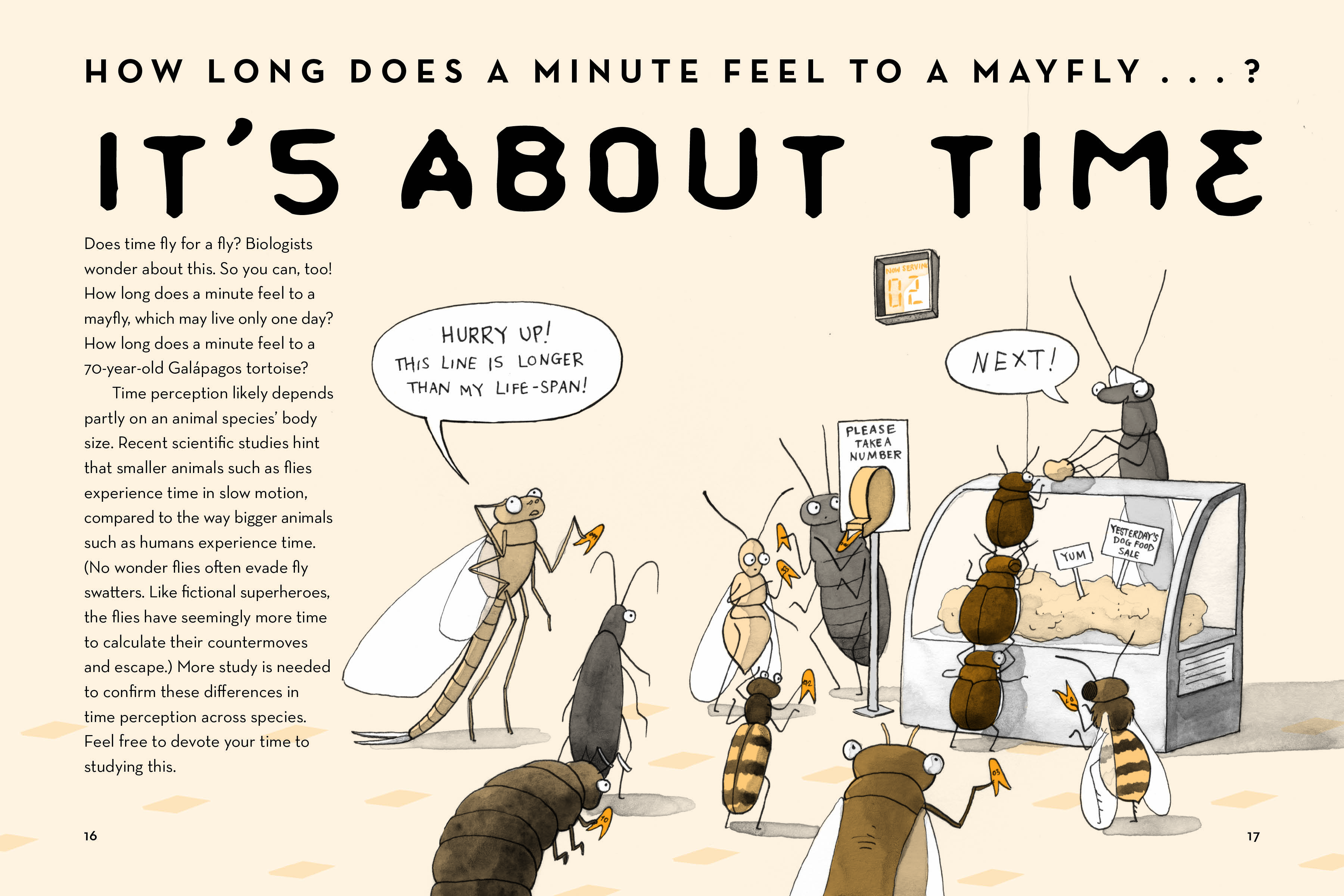
“How long does a minute feel to a mayfly…?
It’s About Time

Does time fly for a fly? Biologists wonder about this. So you can, too! How long does a minute feel to a mayfly, which may live only one day? How long does a minute feel to a 70-year-old Galápagos Tortoise?” (p. 16-17)

SLOWESTBOOK_16-17

Read This If You Loved: Nonfiction books such as Weird but True by National Geographic, Lifetime by Lola M. SchaeferExtreme Oceans and Extreme Earth Records by Seymour SimonIsland by Jason Chin, The Guinness Book of World Records

Recommended For: 

classroomlibrarybuttonsmall readaloudbuttonsmall closereadinganalysisbuttonsmall

Signatureand RickiSig

Blog Tour, Author Guest Post, and Review!: Dig In! by Cindy Jenson-Elliott

Share

NFPB2016

Nonfiction Wednesday

Nonfiction Picture Book Wednesday is hosted by Kid Lit Frenzy and was started to help promote the reading of nonfiction texts. Most Wednesdays, we will be participating and will review a nonfiction text (though it may not always be a picture book).
Be sure to visit Kid Lit Frenzy and see what other nonfiction books are shared this week!

dig in

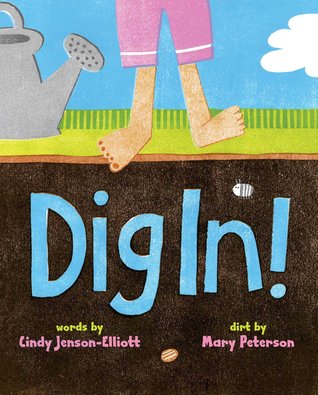
Dig In!
Author: Cindy Jenson-Elliott
Illustrator: Mary Peterson
Published March 1st, 2016 by Beach Lane Books

Summary: Dig in to this vibrant picture book that celebrates all the surprises found down in the dirt!

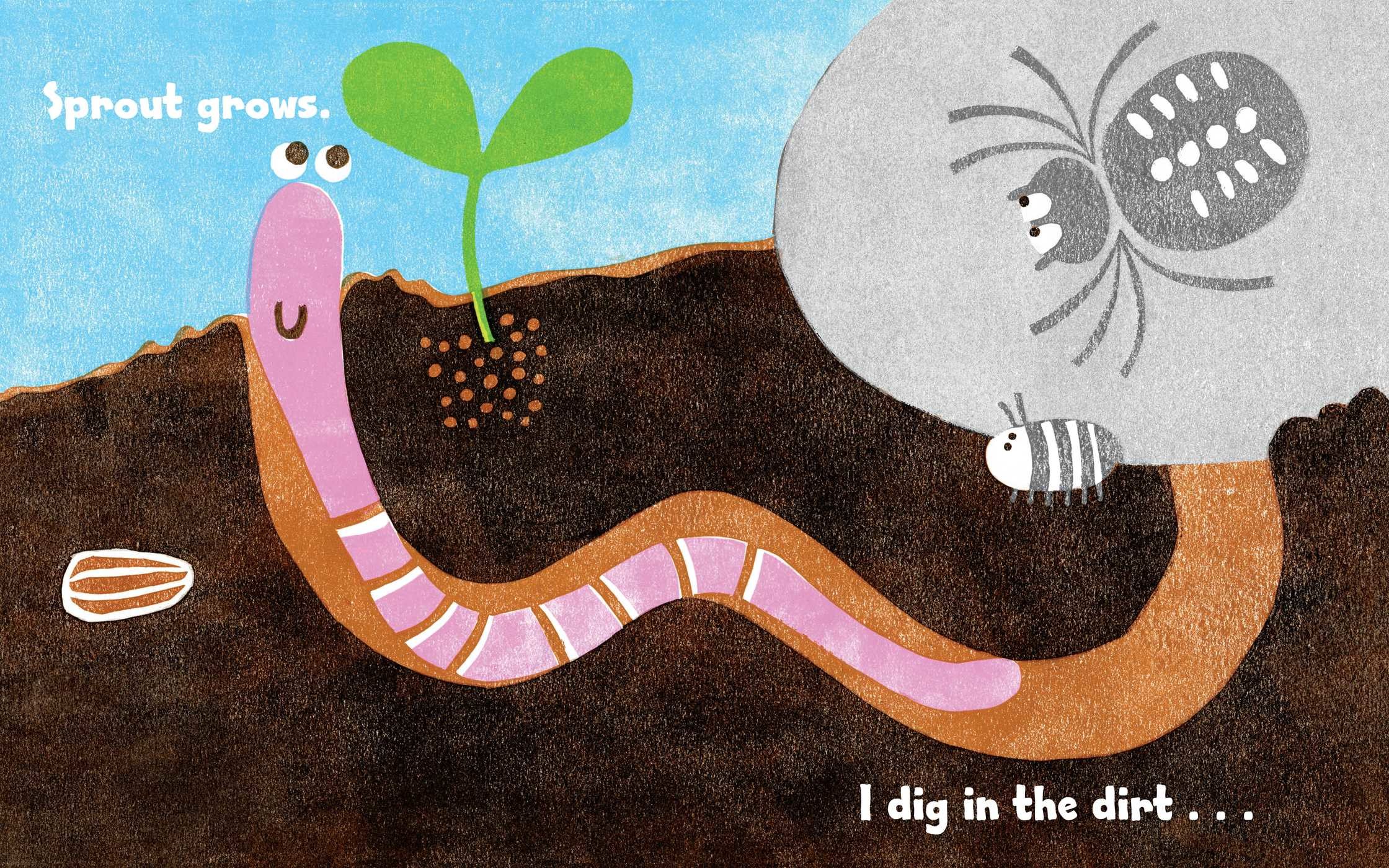
I dig in the dirt…and find a seed.
Seed waits.
I dig in the dirt…and find a spider.
Spider runs.

Explore all of the creepy, crawly, dirty, muddy, green, and growing things that can be found outside in the garden. From pill bugs to worms to leafy green sprouts, young readers will love discovering the muddy garden habitat within the pages of this book—and outside in their own backyards!

This sweet and playful celebration of outdoor exploration is a perfect read aloud for story time.

About the Author: Cindy Jenson-Elliott is the author of the celebrated Weeds Find a Way illustrated by Carolyn Fisher. She is a freelance writer for a variety of newspapers, magazines, and educational publishers, as well as a teacher and natural history instructor. She has an MA in education, and she enjoys spending time outdoors in San Diego, California, where she lives with her family. Visit her at CindyJensonElliott.com.

Kellee’s Review: Both of Cindy Jenson-Elliott’s books have truly made me want to get down and dirty in the garden which, if you know me, is exactly the opposite of what you would guess I want to do. Jenson-Elliott has a way of making the ordinary, and dirty, seem extraordinary. It would be great to have students catalog all of the things they find in a dirt. This would make their trips outside quite exciting!

Ricki’s Review: Kellee is absolutely right. Reading this book made me want to get outside in my garden! Oh, I cannot wait for spring! When my son and I read this book, I kept pointing to the pictures and telling him about all of the digging we will do this spring, and I am excited to have this book (and Jenson-Elliott’s Weeds Find a Way) on hand for when the time comes! We live in Connecticut (which is much colder than where Kellee lives), so we can’t quite do any digging yet. This book emanates warmth, and it will make kids want to go outside and start exploring! Cindy Jenson-Elliott seems to find the beauty in things that others may perceive negatively, and I love teaching my son to find the beauty in these unappreciated things!

Teachers’ Tools for Navigation: Cindy Jenson-Elliott has some amazing ideas on how to bring a garden into your curriculum (see below), but you can also use Dig In! to discuss sequencing and cause/effect. First, you can discuss sequencing by having students share each step of what needs to be done to plant and maintain a garden. You can also take the sequencing and extend it into cause/effect by discussing different things you can do to a garden to help or hurt it. It would also be interesting to ask students to research local dirt inhabitants. They might then research the garden plants and critters of another location to learn more about different habitats.

Some More Teachers’ Tools from Cindy Jenson-Elliott:  

“From Compost to Blossoms: Falling in Love with Literature in the School Garden”

An empty pile of dirt. A blank page. A great book. A tender idea. This is how most of my garden adventures with children begin.

Teaching in the garden is alive with possibility in more ways than one. Ideas spring up like weeds – a crazy tangle without discernable order. Bringing an idea to fruition –doing something I have never done before — feels like an enormous reach.  It is like trying to untangle a vine: where should the project begin? What are the steps? Who will help me figure it out? It’s terrifying — and thrilling! Teaching in the garden wakes you up to being a learner, even as you teach. You and the students are partners, learning together from nature. We all know teaching is risky business. Hands-on, project-based teaching – especially in the garden–  is downright dangerous.

Books take the edge off and give you a jumping off point for great projects that connect inside and outside learning. Here are some book ideas to get you started on some thrilling garden adventures of your own.

Sunflower House

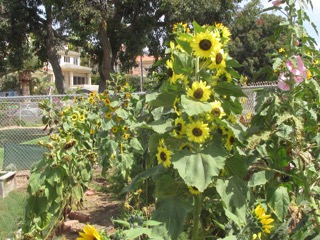
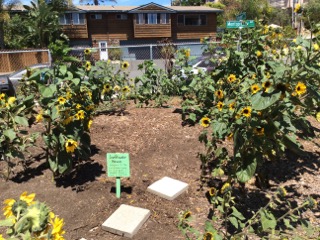
On one particular day in November, I shared Sunflower House by Eve Bunting with my TK- grade 3 students. My crazy idea was to grow our own sunflower house in a bare patch of dirt in the corner of the school garden.

First, I read the book to the children, and I shared my idea.

“We’re going to need a nice pile of garden dirt to go over in that corner,” I told them. “Right now it’s just hard clay.”

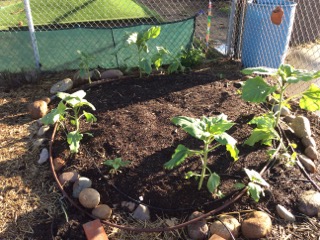
We piled dirt and compost on top of cafeteria trays reserved for gardening and students worked in partners to carry them over to the corner. We made a round, flat pad 1 foot high and 10 feet across. After school, I tapped into our drip-line watering system and ran a flexible watering tube over to the circle, looping around and around. The next garden time, students added a small amount of organic fertilizer and planted dozens of sunflower seeds. We planted Russian Mammoths, but also other multicolored and multi-sized varieties. We created a pathway leading to the dirt pad, and put up stakes protecting the area. Then we sat back and and waited, working on other garden projects all the while.

Winter rains in drought-stricken Southern California were sparse, but with dripping irrigation a few times a week, soon the sunflowers were sprouting. We measured them week by week, watching them grow higher and higher. Soon they were as high as a first grader’s head. Finally they were higher than my own head and shooting out buds.

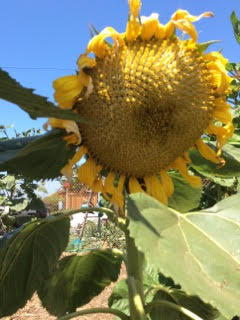
The Sunflower House gave us endless opportunities for learning. We measured and drew the growing plants with pastels and black paper to draw blossoms. Some teachers extended the activity by learning about Van Gough and looking at his paintings of sunflowers. We watched bees visit the blossoms and learned about pollination. When the stalks dried and the heads turned inside out, we learned about the birds that came to eat the seeds. And when the next generation of sunflowers sprouted up from fallen seeds, we could see the complete cycle of life in our circle of flowers. Best of all, students loved sitting in the Sunflower  House to write or draw, or just be. From one book, we developed an entire year’s worth of activities.

Weeds Find a Way

weeds find a way

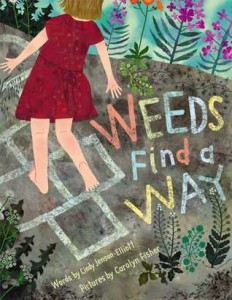
After reading my 2014 picture book Weeds Find a Way we searched our garden for the weeds pictured in the book. We drew weeds and researched them, asking how the weeds adapted for survival. Some classes used Weeds Find a Way as a mentor text to write their own “Something Finds a Way” books about another topic. We wrote poetry, and students developed social-emotional understandings by looking at the tenacity, grit and adaptability of weeds and comparing it with their own. Finally, we tried our hands at botanical drawing and we made a giant art piece to hang on the fence of the garden.

Trellis-Bridge Project

A trellis we built last year to hold up a new passion fruit vine in the garden  collapsed and we needed a new trellis. This problem was the catalyst for learning about bridges. Pop’s Bridge by Eve Bunting and Bridges! By Carol Johmann and Elizabeth J. Rieth, were jumping off points for learning about bridges, and designing and building a trellis to hold up our passion fruit plants.

Dig In! #1000HandsDigIn Photography Project

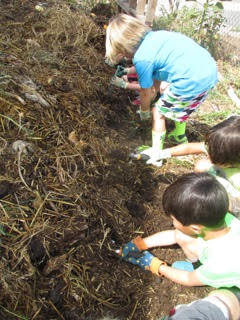
Last week we read Dig In! for the first time. Then we went out to the garden to dig in and photograph our hands and whatever our Mixed Age Class (MAC) grade 1 – 3 students found in the school garden. Students learned to frame, take and edit photos from fabulous teacher Margit Boyeson. Students are sharing their photos to twitter at #1000HandDigIn.

Engagement with Common Core Reading and Writing in the School Garden

            Picture books are the perfect way to connect inside learning and outside doing in the garden. Read Roxaboxen or Westlandia and create your  own special civilization. Read Creepy Carrots and plant a less scary variety. Then write your own creepy stories. Dive into Muncha, Munch, Muncha and see what critters are eating up your garden. Then write your own stories about the critters in the garden. And before you even plant seeds, take a look at your soil. Read Dig In! and discover the wonders living in your dirt.

What will you find when you Dig In! to gardening and literature? A world of wonder!

To see more literature-based projects you can do with students in the school garden, visit my website and follow the links to my naturexplorer blog at www.cindyjensonelliott.com.

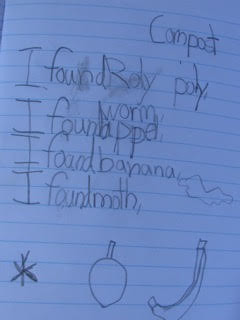
unnamed (1) unnamed Ava's 1000HandsPhoto unnamed (2)

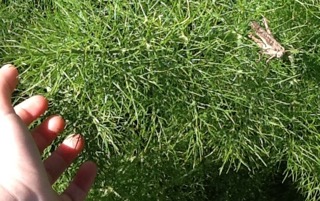
IMG_0211 IMG_3441 (1) IMG_1308

Discussion Questions: How are worms, spider, and pillbugs beneficial to a garden?; What other bugs are beneficial to gardens?; What else does a garden need to succeed?

We Flagged: 

dig-in-9781442412613.in03

Read This If You Loved: Weeds Find a Way by Cindy Jenson-ElliottThe Troublemaker by Lauren Castillo, In the Garden by Elizabeth Spurr

Recommended For: 

classroomlibrarybuttonsmall readaloudbuttonsmall

Kellee Signature andRickiSig

**Thank you Shifa at Simon & Schuster and Cindy Jenson-Elliott for providing a copy for review and for having us as part of the blog tour!**

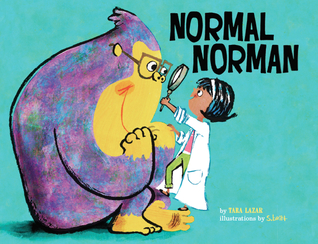
Normal Norman Written by Tara Lazar, Illustrated by S.britt

Share

normal norman

Normal Norman
Author: Tara Lazar; Illustrator: S. britt
Published March 1, 2016 by Sterling Children’s Books

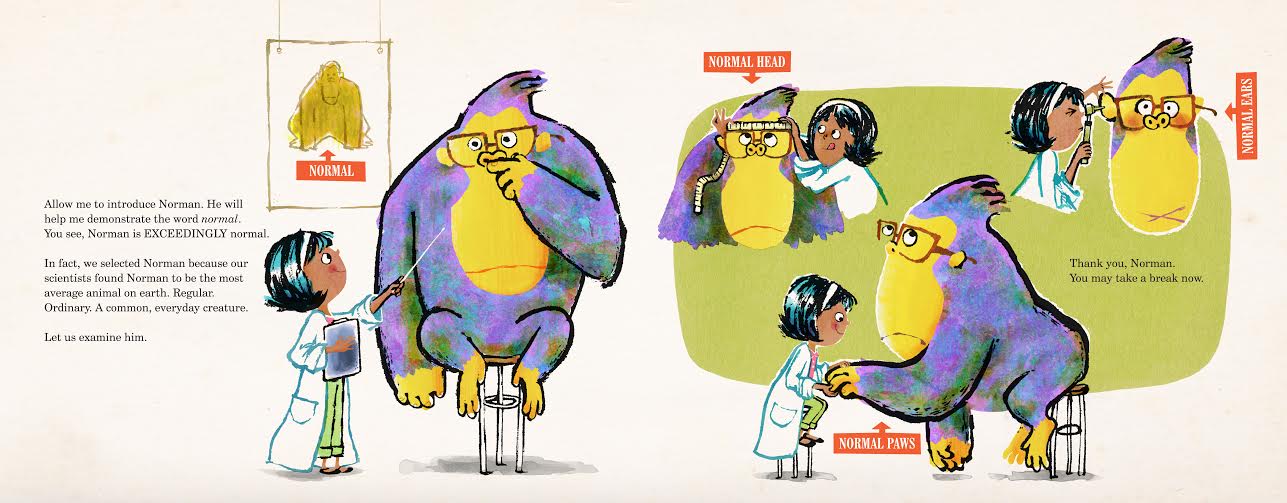
GoodReads Summary: What is “normal?” That’s the question an eager young scientist, narrating her very first book, hopes to answer. Unfortunately, her exceedingly “normal” subject—an orangutan named Norman—turns out to be exceptionally strange. He speaks English, sleeps in a bed, loves his stuffed toy, goes bananas over pizza, and even deep-sea dives! Oh, no: what’s a “normal” scientist to do?

Ricki’s Review: Norman is one of those great literary characters that will stick with readers for a long time. The book is quite humorous, and my son was giggling as we read it together. Norman is anything but normal, yet the young scientist makes strong efforts to prove that he is normal. She becomes very frustrated, and then Norman teaches her an important lesson. I enjoyed this book because it was a fresh take on the idea of: What does it mean to be normal? I also enjoyed the layout of each page. The quote bubbles from the characters added another layer to the text that would be great to discuss in the classroom with a close reading. This will be a favorite in classrooms, and I recommend it highly.

Kellee’s Review: I love everything that this book stands for. It shows that normal is whatever you make it, that everyone should be accepted for what they are, and normal isn’t always what it seems. Norman helps mold the young scientist’s mind which will hopefully lead readers to also rethink what they think normal is. I am definitely going to use this book as one of our “precepts” in the future because I really think it’ll make students think. 

Teachers’ Tools for Navigation: Teachers might consider using this text to teach broad conceptions of normalcy. Often, young students conceive of normalcy as anything similar to them. A teacher might introduce different groups, customs, and cultures to allow students to understand that normal is a socially constructed concept, and people can be different yet still normal. Or perhaps, students might determine that there is no such thing as being “normal.”

Discussion Questions: What does it mean to be normal? Is anyone normal? How might we conceive of normalcy more broadly?; What lessons does the scientist learn? How does she learn them?

We Flagged: “Allow me to introduce Norman. He will help me demonstrate the word normal. You see, Norman is EXCEEDINGLY normal.” 

normal norman spread

Reprinted with permission from Normal Norman © 2016 by Tara Lazar, Sterling Children’s Books, an imprint of Sterling Publishing Co., Inc. Illustrations © 2016 by Stephan Britt.

Read This If You Loved: You Are (Not) Small by Anna KangGiraffes Can’t Dance by Giles Andreae, Unicorn Thinks He’s Pretty Great by Bob SheaThe Magic of Maxwell and His Tail by Maureen Stolar Kanefield

Recommended For: 

closereadinganalysisbuttonsmall readaloudbuttonsmall classroomlibrarybuttonsmall

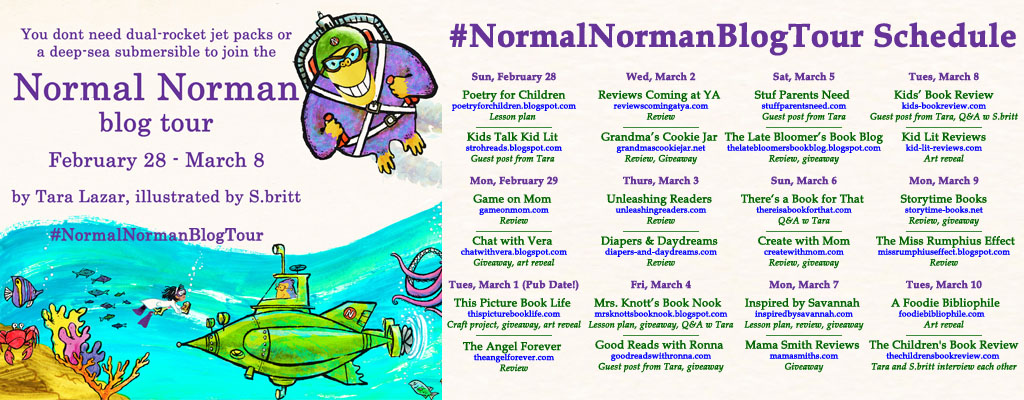
Check Out Normal Norman at the other stops on the tour!:

NN Tour Schedule - Sized for Twitter (1)

RickiSigandKellee Signature

**Thank you to Josh from Sterling books for providing copies for review!!**

Author Guest Post!: “Nurturing Nature in the Classroom” by Rebecca Bielawski, Author of the Mummy Nature series

Share

“Nurturing Nature in the Classroom” 

If you are having trouble getting your class out and into nature, there are a hundred ways you can get nature into your class.  If  you want your kids to run wild with nature-based crafts and projects, but your imagination feels as dried up as an autumn leaf, don’t despair – On the wonderful world wide web you can discover all the inspiration you need.  I especially recommend Pinterest boards and Google+ communities to look for specific ideas suited to your group’s age and other circumstances.

Here are a few tips for adapting nature projects and nature crafts that you might find, to your own classroom or home school environment.

Adapt ideas to your local area  e.g., seeds to germinate that are readily and cheaply available, plants that are easy to sprout and suited to the climate and of course child friendly. Your local garden centre can help out. Local plant species will always be more relevant to the kids. (Planting sunflowers was my favourite as a kid.)

Adapt ideas to your available resources  Most projects will not represent an elevated cost.  Here you can use recycled materials such as plastic bottles and yoghurt pots,  eg. hand trowels can be made from plastic milk or juice bottles with handles. You can also reinforce the Reuse, Reduce Recycle mantra. If you have more of a budget you could, for example, buy plants for the classroom that represent your nature goals.

Don’t forget about your human resources  Think about, how many people you have available to help out. Don’t be afraid to ask parents, grannies etc. for help. Get to know a bit about them, what sector do  they work in, do they have any interesting hobbies or contacts? Find out who has the wildest back yard and if they need it to be explored.  They will be able to help in a million ways with their expertise or simply their time and enthusiasm.

Plan an excursion  Think about what nature opportunities are offered by the surrounding countryside. Go with someone who has knowledge of the local plant life, to enrich the visit and be aware of dangerous or poisonous plants.

It’s great if you can go out to a local forest or mountain or other wild habitat but if that presents too much of a logistical or safety problem, even a local park or a corner of the playground can be ideal to focus on one point of interest, for tiny discoveries inside the grounds of the school.  Take them to see the weeds growing out of the cracks in the pavement. They can track how fast they grow, pull them out to observe the roots or discuss flowering or seed dispersal.  There is a lot to be learnt from the bugs under the rocks too, eg. observational drawings, questions: Why do they live there? What are they doing? Identify and compare species… Finding moss and lichen and other treasures is another option.

Plan ahead and imagine what restriction or problems you might encounter during the activity, especially if you are the only adult involved.

Here are a few juicy nature ideas to get you started:

Flower spotting
Flower pressing
Flower arrangements
Vaseline saucers – you put a thin layer of vaseline on a small plate and make circular patterns with different petal and small leaves
Finding animal tracks, burrows, nests
Collecting seed pods, cones, feathers, sticks, bark, leaves to make their own nests, collages, miniature habitats
Worm collecting for a class compost bin where the kids can throw their biodegradable rubbish from their snacks
Have a “dirty day.” In rural schools, everyday is pretty much a dirty day, but urban schools might find the concept more of a novelty and very liberating –  Kids come with old clothes and can play in the dirt, make mud pies and are allowed to get as dirty as they want

Remember, the opportunities to bring our little ones closer to their natural surrounding can be found in every corner.  Happy worm hunting!

About the Author: Rebecca Bielawski is the author of the educational series of children’s books MUMMY NATURE, designed for home and classroom use for under 6yrs.  With a background in biology, nutrition, art and graphic design.  She grew up in rural New Zealand, and now lives in the south of Spain where she is involved  in a community project teaching English to Spanish children through stories, games, arts and crafts. http://www.booksbeck.com/

author photo

About the Series: Each book in the series is one mini nature lesson wrapped up in colour and rhyme. These books are intended for very young children including toddlers and will give them just a glimpse into some of the wonders of the natural world. Illustrated for maximum vibrancy and visual impact, using rhyme to engage young minds and encourage participation. Read the rhymes to your children and soon they will be reading them to you!

The narrator is a small child and keen observer who tells us in short rhyming phrases everything she thinks we should know, and all about the magical things she sees around her. Sometimes she is camouflaged in the long grass and other times she has to climb a tree to get a better look.cover

Review of Meet Bacteria (Mummy Nature Book 1) here at Unleashing Readers: This book is a great introduction to scientific exploration and then to bacteria itself. I love that the protagonist is a young girl who is exploring the world around her. I think students will see themselves in her, and that along with the interesting, rhyming information about the different types of bacteria will really persuade kids to want to explore.

I do think that this is just an introduction though. Each bacteria is briefly mentioned along with a fun illustration. I would love to see this book be a jumping off point to an inquiry unit about bacteria.

Thank you Rebecca for tips on how to connect our kids/students with nature from such a young age!

Kellee Signature andRickiSig