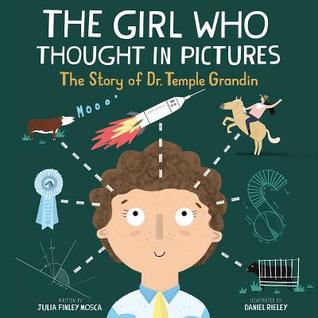
Guest Review: The Girl Who Thought in Pictures: The Story of Dr. Temple Grandin by Julia Finley Mosca, Illustrated by Daniel Rieley

Share

Guest Reviewer: Bree, UCF Elementary Education Student

The Girl Who Thought in Pictures: The Story of Dr. Temple Grandin
Author: Julia Finley Mosca
Illustrator: Daniel Rieley
Published March 5th, 2017 by The Innovation Press

Summary: Meet Dr. Temple Grandin—one of the world’s quirkiest science heroes!

When young Temple was diagnosed with autism, no one expected her to talk, let alone become one of the most powerful voices in modern science. Yet, the determined visual thinker did just that. Her unique mind allowed her to connect with animals in a special way, helping her invent groundbreaking improvements for farms around the globe!

The Girl Who Thought in Pictures: The Story of Dr. Temple Grandin is the first book in a brand new educational series about the inspirational lives of amazing scientists. In addition to the illustrated rhyming tale, you’ll find a complete biography, fun facts, a colorful timeline of events, and even a note from Temple herself!

About the Author: Julia Finley Mosca is a copywriter and former journalist who spent more than a decade in Hollywood crafting messages for money. After working with such recognizable brands as Entertainment Tonight, Yahoo!, American Greetings, and JibJab, she landed her most rewarding job yet―mom to one ferociously curious and spunky little girl. The Amazing Scientists series marks Mosca’s debut into the magical world of children’s books.

Review: A picture-book biography in verse introduces Dr. Temple Grandin, a major spokesperson for autism spectrum disorder.

The author employs easy, accessible language and simple rhyme to describe Grandin’s life, including her original misdiagnosis, the doctors’ advice to “send her away,” her mother’s advocacy, her learning to speak, the “new” diagnosis of autism, frustration with her classmates, her first visit to her aunt’s farm that led to her career as an animal specialist, her understanding of her talents, and the importance of her visual memory. The narrative goes on to describe her high school teacher’s support of her interest in science, her first invention (the “squeeze machine,” a self-calming device based on close-quartered enclosures for livestock), her work in treating cattle humanely, her efforts within the autism community, and the public recognition of her unique talents. The author speaks directly and inclusively: “Being DIFFERENT might just / be what makes you so NEAT!

Teachers’ Tools for Navigation: The Girl Who Thought in Pictures  is a great mentor text for teaching students important reading comprehension strategies, writing skills, and grammar concepts. All of our book companions come with activities that relate to these subject areas. Check out just some of the skills included in our book companion!

  • Practice identifying character traits that describe Temple.
  • Practice making personal connections to the book.
  • Integrate expository writing by asking students to write explanations for events that happened in the book.
  • Allow students to get creative by writing their own version of the book.
  • Use examples from the book to teach a lesson on action verbs and adjectives.
  • Teach a lesson on contractions.
  • Have a class discussion about diversity.

Discussion Questions: 

  • How will you use your talents and uniqueness to make the world better?
  • What do you think it was like to be the victim of teasing for being herself in school?
  • What skills would you like to develop that you are already interested in or good at?
  • What did you learn from The Girl Who Thought in Pictures or how did she inspire you?

Flagged Passages: 

“So here is the lesson: Feeling odd or off beat? Being DIFFERENT might just be what makes you so NEAT! Don’t let doubt hold you back, not one minute more. Stand tall, and like Temple… March right through that door!”

Book Trailer: 

Read This If You Love: Inclusion, Diversity, and above all autism and neurodiversity!

Recommended For: 

classroomlibrarybuttonsmall

Thank you, Bree, for your review!

Guest Review: All the Way to the Top by Annette Bay Pimental, Illustrated by Nabi H. Ali

Share

Guest Reviewer: Alicia, UCF Elementary Education Student

All the Way to the Top
Author: Annette Bay Pimental
Foreword by Jennifer Keelan-Chaffins
Illustrator: Nabi H. Ali
Published March 10th, 2020 by Sourcebooks Explore

Summary: This is the story of a little girl who just wanted to go, even when others tried to stop her.

Jennifer Keelan was determined to make a change―even if she was just a kid. She never thought her wheelchair could slow her down, but the way the world around her was built made it hard to do even simple things. Like going to school, or eating lunch in the cafeteria.

Jennifer knew that everyone deserves a voice! Then the Americans with Disabilities Act, a law that would make public spaces much more accessible to people with disabilities, was proposed to Congress. And to make sure it passed, Jennifer went to the steps of the Capitol building in Washington DC to convince them.

And, without her wheelchair, she climbed.

ALL THE WAY TO THE TOP!

Praise: 

“A powerful, empowering story!” – Washington Parent

“A necessary testament to the power of children’s voices.” –Kirkus Reviews

“Clear, accessible prose accompanied by Ali’s creamily textured digital illustrations…a jumping-off point for conversations.” –Publishers Weekly

“Pimentel’s compelling, present-tense narrative gives the story great immediacy, helping children connect with Jennifer’s reactions to physical barriers and social injustice…Still an activist, Jennifer Keelan-Chaffins offers a thought-provoking foreword to this inspiring picture book.” –Booklist

“Pimentel offers a great look at a young activist creating change and a better understanding of the importance of the ADA.” –School Library Journal

About the Creators: 

Annette Bay Pimentel has published two picture book biographies: Mountain Chef (Charlesbridge, 2016) about a Chinese American who helped inspire the creation of the National Park Service which won the Carter G. Woodson Award, and Girl, Running (Nancy Paulson, 2018) about the first female to run the Boston Marathon, which was a JLG pick and received a starred review.

​Jennifer Keelan-Chaffins joined the disability rights movement at the age of six and has been a passionate advocate ever since. In 1990, she received the Americans With Disabilities Act Award. She earned her B.S. in Family and Human Development. She really wants to help children with disabilities.She lives in Colorado with her mother , and her service dog Mya.

​Nabi H. Ali is an illustrator of Tamil descent based in Orange County, California. He really likes to be part of things that bring inclusivity into art and media. His hobbies include painting, researching South Asian culture, and writing poetry.

Review: This story is about a young girl named Jennifer. She suffers from Cerebral Palsy and uses a wheelchair. The story follows her as she first struggles to go around town when the sidewalks don’t have ramps, to get into the school where there is only stairs, and the teachers say she can’t come in–all because she is in a wheelchair. She learns to find her voice and works in groups to fight for equality. She goes to multiple protests around the states to fight for the ADA (Americans with Disabilities Act). When Congress denies the act, there is a rally in Washington, D.C. and because of the stairs, protestors in wheelchairs could get into the House; the older protesters left their chairs and climbed the stairs. When Jennifer tried, she was told she was too young and couldn’t do it. This did not stop her; she did it anyway. The bill was passed soon after.

I love this book so much as it shows students that everyone can do anything, and it’s something that they all should read about everyone regardless of how they look. One of my favorite things is that this book is based on a true story and in the back of the book it goes into more details as to why the ADA was such an important thing. It also has a timeline and milestones for legislation for those with disabilities.

Teachers’ Tools for Navigation: This book will be fantastic to use in the classroom in multiple ways:

Of course you can use it with history. This will teach students about important events with in our countries history. Teach them about how much the ADA changed the lives of many people.

This will also be used to teach students about inclusion and diversity and they are important tools to have in life. Making sure everyone feels included is not only good it’s important.

Discussion Questions: 

  • Why did Jennifer’s family let her protest?
  • Why was the ADA so important for Jennifer and her family?
  • How does the adaptation of the ADA impact the lives of those that needed it?
  • Why do you feel Jennifer wanted to climb the steps?
  • Why did it take them climbing the steps to actually pass the ADA?
  • How does the Illustrations paint the picture of how Jennifer struggled to feel included?
  • What is one thing you can do to make sure inclusion is part of your life?

Flagged Passages: 

Recommended For: 

classroomlibrarybuttonsmall

Thank you, Alicia, for your review!

Author Guest Post: “How to Create a Think Tank in Your Classroom” by Lowey Bundy Sichol, Author of Idea Makers: 15 Female Entrepreneurs

Share

“How to Create a Think Tank in Your Classroom”

It happens every Spring – ideas come to life in elementary and middle schools across the country. The end of the school year is in sight, curriculums are on track, and teachers are given the freedom to incorporate projects that interweave creativity, inventions, and out of the box thinking.

This is also the time of year when my inbox explodes with requests for author visits to help inspire these young minds to consider the world of entrepreneurship. I’ve spoken at “Invention Conventions,” listened to “Inventor Reports,” helped kids “Launch a Business,” and inspired students at “Career Days” – all wonderful ways to young minds thinking about the real world and how their ideas can change the world.

So how can you create a Think Tank in your classroom?

First, read how other people built their businesses.

Reading how others did it is one of the most important teaching strategies in business school so why shouldn’t it work for elementary and middle schools? Called Case Studies, they are the foundation for teaching MBA programs at Harvard, Stanford, Dartmouth, and Northwestern’s business schools. After graduating business school, I created a writing company that composed MBA case studies for some of the top business schools in the world. And it was those case studies that inspired my nonfiction children’s book series, From an Idea to… (LEGO, Nike, Google, Disney) as well as my new book entitled Idea Makers: 15 Fearless Female Entrepreneurs.

Lessons of perseverance, bravery, resilience, and creativity run deep throughout all my children’s books. They help inspire kids to think about their own ideas and teach them the steps it takes to turn an idea into reality.

Next, hold a Brainstorming Session

Most great ideas come from a person’s passion. Think Steve Jobs with computers, Walt Disney with animation, and Milton Hershey with candy. Each of these founders knew their industry inside and out and loved spending every waking minute working on it. Entrepreneurs need to have passion for their idea. So, it’s important that kids really understand who they are and where their passions lie. Here is one of my favorite brainstorming session exercises:

  • Have each student write their name in the middle of a piece of paper and circle it.
  • Next, have them write 4-10 things that is important to them and helps define them. I’ll call these Circles of Passion. This could be a sport, an instrument, a relative, a food they like to cook, a friend, a pet, a toy, a language… you get the point. Now circle each of those words.
  • From those 4-10 circles comes the real idea generation. Each student should think about those words. I mean really think about them. If it’s a sport, for example, what do you love about it, what do you hate about it, what problems are there with the equipment or the field, the uniform or the shoes or their hair when they play it, etc. If the child wrote down a sibling or cousin or grandma, what’s special about them, what do you admire about them, what do they struggle with or what do you help them with? There could be 20 branches coming from one passion and zero coming from another.
  • Looking down at the child’s paper, he or she should tons of words and phrases on their paper. Now have the student ask themselves: Is there a problem in here? Could they solve that problem?

Keep these business concepts in mind

A few ideas should start to pop out now. Hooray! Now it’s time for your students consider some business concepts to see if their idea has legs. We call these the 4 P’s in business school.

  • PRODUCT: What does your product do? What will it look like? What will the packaging look like? Take water, for example. You can find water bottles in plastic, aluminum, and glass. You can find small bottles, tall bottles, skinny bottles, fat bottles. Some water is from spring water, some from Fiji or Iceland, some are just purified tap water.
  • PRICE: How much it would cost to create the product? How much could it sell for? This is a great time to incorporate math into discussions about profit margins.
  • PLACE: Place is another way to say distribution. Where will the product be sold? Some examples include online, Amazon, Walmart, boutique stores, farmer’s market, door-to-door, etc. What are the steps to get the product into each of these options?
  • PROMOTION: How do people find out about the product or service? Examples include : social media, flyers, PR, etc.

Now it’s time to show off these ideas!

Consider holding a pitch day in your classroom or a Shark Tank competition with parent volunteer judges. Another idea is to hold a town fair where all the kids display their idea and parents are invited to visit each business and listen to their pitches.

Good luck and be sure to tag me if you post it online! @LoweySichol

Published March 1st, 2022 by Chicago Review Press

About the Book: Entrepreneurship can change your life—and even the world.

Idea Makers shares the incredible stories of 15 women who changed the world through their entrepreneurship. Author Lowey Bundy Sichol presents five industries that women are leading in recent years: food, fashion and clothing, health and beauty, science and technology, and education.

Jenn Hyman brought couture fashion to everyday women with her idea to Rent the Runway. Morgan DeBaun supports Black journalists through Blavity. And Sandra Oh Lin is inspiring kids everywhere with KiwiCo activity boxes.

Readers learn about how the women featured risked their early careers, gave up their salaries, and sometimes even went against the approval of their families to follow their passions and start their own businesses. Today, these women are modern leaders worth billions of dollars and employing tens of thousands of individuals.

Young women today are embracing innovation and idea making, and the women profiled in Idea Makers will show them how that can change the world.

Praise: 

Idea Makers: 15 Fearless Female Entrepreneurs leads with the notion that in growing the entrepreneurs of the future, representation matters.” —Suzanne Schaefer, Vice President, Bain & Company

“Lowey’s book is written with kids in mind—curious, creative, and ambitious kids.” —Rebecca Burstein, Founder and Principal, Burst Marketing Strategy

“It’s rare to find books that capture the attention of older and young readers alike, but Lowey Sichol has done it again.” —Karen Loggia, Director of Marketing and Communications, Tension Corporation

“A must read for every kid (and adult) who has a crazy idea and big dreams! In Idea Makers, Lowey Sichol tells the inspirational stories of 15 female entrepreneurs who had the vision, passion, and determination to build iconic companies.” —Alexis McLaughlin, CEO, 2020 On-Site

“This book is amazing! It is full of empowering stories that are sure to inspire a new generation of creative thinkers and future entrepreneurs. Readers are going to love it!” —Todd Burleson, School Library Journal 2016 Librarian of the Year

“Informative and inspiring, Idea Makers tells the transformational stories of 15 amazing women entrepreneurs. Lowey Sichol skillfully brings each of those stories to life with lessons of creativity, perseverance and passion.” —Kevin Lane Keller, E.B. Osborn Professor of Marketing, Tuck School of Business at Dartmouth College

About the Author: Lowey Bundy Sichol (her last name rhymes with pickle) is an award-winning children’s author with an MBA from the Tuck School of Business at Dartmouth College. She is a leading expert in teaching business and entrepreneurship to kids. Lowey’s nonfiction series, From an Idea to… is the world’s first business and entrepreneurship book series for kids, and has received a 2020 Best STEM Book, a Junior Library Guild Gold Selection, and a 2020 ILA-CBC Children’s Choices Book, among others. She is also the founder of Kids Idea Tank, the nation’s biggest entrepreneurship competition for kids age 13 and younger. She lives near Chicago, Illinois. Visit her online at www.loweybundysichol.com, https://twitter.com/LoweySichol, and https://www.instagram.com/loweysichol/.

Thank you so much for this amazing post about pushing our students to the next level!

Author Guest Post: “Bring Songwriting into your Classroom” by Chari Smith, Author of The Piano

Share

Bring songwriting into your classroom

Songs are memorable. Lyrics just stick to use, don’t they? Think about the abc song, much easier to remember the order of letters when it’s put to a song. When I taught music and theater grades K-6, I collaborated with teachers on their curriculum to incorporate what they were teaching into my classroom.

Teaching about the solar system? Let’s make a song about it.

Going through the multiplication table? Let’s put that into a tune.

The students sang these songs in the classroom, hallways, waiting for pick up, and more. Songs are memorable, and fun!

There are four ways you can bring this into your classroom:

  1. You create the song, by writing lyrics to a familiar tune or writing the music and lyrics yourself. Then, teach it to your class.
  2. Students write new lyrics to a familiar tune – individually or in groups
  3. Students write the song – music and lyrics
  4. Collaborate with the music teacher, or a local music school to do ongoing songwriting workshops

Let’s focus on option 2, having the students write new lyrics to a familiar tune. If you choose to have students work in groups, it’s an excellent opportunity to build their teamwork skills. You can start with basic songs they probably learned in pre-school to warm up.

The first step is to create a list of possible songs they can choose from. You can even create this list with students. When starting out, it’s best to start with simple songs. As they write more and more, moving on to longer songs such as pop tunes is fine. Starting with these short easy songs first helps them learn the process.

Some easy songs to start with include:

  • If You’re Happy and You Know It. If you’re happy and you know it. …
  • The Wheels on the Bus. What is this? …
  • Head, Shoulders, Knees and Toes. Head, shoulders, knees and toes, …
  • Here We Go Round the Mulberry Bush. …
  • The Ants Go Marching.
  • Itsy Bitsy Spider

The second step is to create a list of possible topics they can create a song about. You can do this for them or with them. For example, second grade science may include the following topics:

  • Properties of Matter(classifying matter, changing states, reversible and irreversible changes in matter, structures)
  • Living Things (needs of living things, seed dispersal and pollination, animal survival, migration, hibernation, dormancy, life cycles, inherited traits, fossils)
  • Habitats(desert, forests, grassland, marine, freshwater, polar, tundra, microhabitats
  • Earth’s Systems(landforms, wind, water, erosion)

(source: https://mrsjonessclass.com/2020/08/little-2nd-grade-science-thinkers.html)

Here’s an example of using the Itsy Bitsy Spider to sing about the stages of the butterfly:

Song: Itsy Bitsy Spider

Subject: Life stages of a butterfly

The butterfly starts as just an egg

Then grows into a caterpillar friend

Onto the chrysalis stage where it stays in a cocoon

Then at last the butterfly emerges and fly, fly’s away.

Did you try and sing it? I hope so. (Hear it HERE!)

Once students are in groups, have chosen the song as well as the topic, they are ready to get to the songwriting fun. Students should write lyrics in pencil. One approach may be to have each student write their own ideas for the song first, then share with each other to make decisions on what to include.

Once done, students can perform their songs. This songwriter’s showcase can be for each other, parents, or the whole school. It’s a great way for students to engage with your curriculum, build teamwork skills, encourage, and ultimately – have fun!

Published February 3rd, 2022 by Black Rose Writing

About the Book:The friendly piano is thrilled when a young musician named Katie first presses its keys. As Katie and the piano become daily companions, her musical skills grow and grow. Together they play beautiful music to match her every mood. But when Katie moves away for college, the piano is left behind, untouched and silent. What happens next helps the piano—and young readers—see learning as a never-ending cycle and music as a life-long source of joy.

“….a charming picture book about the experience of learning how to play an instrument from the perspective of a piano and its journey through one young musician’s life. The illustrations by Elle Smith, the author’s daughter, add warmth and depth to the story.” Amy Wang, The Oregonian, February 4, 2022

Full story: Catch up with these 10 picture books from Oregon authors and illustrators

“Together, Chari and Elle created a literary masterpiece, a children’s picture book called “The Piano”.  In it, children will be able to experience a beautiful combination of words that describes music in ways only a true musician could present. Phrases like “Bouncy beats” and “sounds that soared, and sank” helps the reader immerse in a musical moment even when there is no sound.”

The Reading Behaviorist, March 10, 2022 Full review here.

About the Author: Chari studied at Berklee College of Music and has been a writer/composer/pianist most of her life. In Boulder, Colorado, she wrote and produced two musicals with the Boulder Arts Academy. Chari also taught jazz piano to children as well as adults.

She is a published playwright — Extraordinary Women from U.S. History: Readers Theatre for Grades 4-8 (Teacher Ideas Press/ Libraries Unlimited, 2003) and Little Plays for Little People (Teacher Ideas Press/Libraries Unlimited, 1996). Her mini-musical Book Club was a part of the Portland Mini Musical Festival 2020. She is currently writing a full-length musical “Freedom: The Untold Story of Moses.”

Stay connected:
www.charismith.com
Instagram: charismusicaladventures
Facebook: @charismithwriter

Thank you, Chari, for this catchy author guest post!

Author Guest Post: “Why Isn’t There More Science Fiction for Young Children?” by Emily Midkiff, Author of Equipping Space Cadets: Primary Science Fiction for Young Children

Share

Why Isn’t There More Science Fiction for Young Children?

Science fiction shapes how we respond to our technology-infused world. Research has shown that the more science fiction you’re exposed to, the more you are likely to critically think through the benefits and consequences of science. Many scientists and engineers have reported that reading science fiction as a child influenced the way they thought about science as a young person, potentially leading to their careers! Science fiction is also great practice for developing higher-order reading skills like inferencing, since futuristic worlds often have their own rules that the reader must figure out through clues and background knowledge.

However, very little attention is given to science fiction books for young readers, or what I call “primary science fiction.” It’s not included in most reading lists or school curriculum until high school. In Encountering Enchantment: A Guide to Speculative Fiction for Teens, Susan Fichtelberg recommends 12 years old as the best time to introduce science fiction. This age is a popular choice. The science fiction entries in the Oxford Encyclopedia of Children’s Literature and Keywords for Children’s Literature both cite age 12 as the time when most kids will discover and enjoy science fiction.

Why 12-year-olds, specifically? Back in 1762, a philosopher named Jean-Jacques Rousseau theorized that children really only reached “the age of reason,” as he called it, at age 12. Before then, he thought, they just didn’t have the capacity to really understand anything. He even advised that reading could wait until age 12! We’ve dismissed most of his theories, but some of it still sticks around, like the “age of reason” being 12. Even when we’re not consciously thinking about the “the age of reason,” that sentiment lives on when we assume that science fiction—and all of its complex thinking about science—is better for older readers.

Adults perpetuate a self-fulfilling prophecy about what children want, and this results in a low supply of primary science fiction books. Jon Scieszka once told me that his editors tried to convince him that children would be put off by the science in his science fiction series, Frank Einstein. An indie publisher told me that children’s science fiction doesn’t sell well, so they don’t acquire it often.

In order to test the idea that science fiction is less suitable for younger readers, I conducted a large study of primary science fiction and those results are published in my new book Equipping Space Cadets: Primary Science Fiction for Young Children. I counted over 120,000 books in elementary school libraries in almost every region of the US and found that science fiction books only make up around 3% of each library collection. I surveyed teachers and librarians and learned that they recommend science fiction to the occasional individual reader, but don’t pick it for lessons or storytime because they feel it is too scarce and too hard.

However, real children and books tell a different story! Even though only 3% of those library collections were science fiction books, I found that science fiction had more average check-outs per book than any other genre. When I read science fiction picturebooks with elementary students, I listened to them cleverly apply their reading skills to comprehend and engage with the genre’s questions about science. I read 357 primary science fiction books and found that the best ones included features to help even the youngest readers figure out the genre. It turns out that readers are well-suited for science fiction long before they turn twelve.

Now all that’s left is for us adults to begin to break the cycle of assumptions about science fiction. Buy it! Teach it! Share it!

Published April, 2022 by University Press of Mississippi

About the Book: Equipping Space Cadets: Primary Science Fiction for Young Children argues for the benefits and potential of “primary science fiction,” or science fiction for children under twelve years old. Science fiction for children is often disregarded due to common misconceptions of childhood. When children are culturally portrayed as natural and simple, they seem like a poor audience for the complex scientific questions brought up by the best science fiction. The books and the children who read them tell another story.

Using three empirical studies and over 350 children’s books including If I Had a Robot DogBugs in Space, and Commander Toad in SpaceEquipping Space Cadets presents interdisciplinary evidence that science fiction and children are compatible after all. Primary science fiction literature includes many high-quality books that cleverly utilize the features of children’s literature formats in order to fit large science fiction questions into small packages. In the best of these books, authors make science fiction questions accessible and relevant to children of various reading levels and from diverse backgrounds and identities.

Equipping Space Cadets does not stop with literary analysis, but also presents the voices of real children and practitioners. The book features three studies: a survey of teachers and librarians, quantitative analysis of lending records from school libraries across the United States, and coded read-aloud sessions with elementary school students. The results reveal how children are interested in and capable of reading science fiction, but it is the adults, including the most well-intentioned librarians and teachers, who hinder children’s engagement with the genre due to their own preconceptions about the genre and children.

Equipping Space Cadets: Primary Science Fiction for Young Readers is available from all major retailers.

About the Author: Emily Midkiff teaches children’s literature and literacy at the University of North Dakota. She spent nine years performing fantasy stories alongside children for an improv children’s theater group, and she now studies children’s fantasy and science fiction stories with attention to what the children themselves have to say. Find out more about her at https://emidkiff.wordpress.com/

Thank you, Emily, for this wonderful post! This is a question we’ve often asked, so loved hearing your thoughts.

Author Guest Post: “There’s No Wrong Way” by Adam Lehrhaupt, Author of There Was a Hole

Share

“There’s No Wrong Way”

At it’s heart, There Was a Hole is a book about loss and helping readers learn a way to manage the complex emotions that come with it. These emotions can be BIG, scary, uncontrollable, and even unwanted. But that doesn’t mean they don’t exist. And it definitely doesn’t mean they should be ignored.

Everyone experiences loss in their lives. Even children’s book authors. Several years ago, I went through my own time of loss. As an author, my natural inclination in times like that is to look for books that deal with what I’m experiencing. Unfortunately, sometimes you just can’t find a book that lines up. When that happens, a good author takes matters in their own hands. They ask themselves; can I write a story that acknowledges the feelings I have. That shows they are valid, normal feelings everyone has? And most importantly, that there are things you can do to help yourself feel better?

It turns out that you don’t have to be a children’s book author to do this. Anyone can write a story for themselves. And the cool thing about writing for yourself, is that YOU get to choose what you write about. My path to writing this book is a long and winding one, but I’m going to lay out a few things that should help you write your own. Hopefully, writing your own story about loss, or fear, or whatever, helps you better understand how you are feeling and might even start you down the path of recovery.

First, and most important, there’s NO WRONG WAY to write a story for yourself. Writing the story doesn’t commit you to letting anyone read it. Remember, this exercise is for you and you alone. When, and to whom, you show your work is completely at your discretion. That said, here’s the steps I take when writing for myself.

  1. Come up with a great character name.
    We’re going to put this character through the ringer. It’s probably best not to give them your name. you don’t want to run yourself through the events we’re going to plan below. Pick a different name. Something cool. Something unique. Something fun to write about. Maybe Cleo, or Duke, or Ephemeralia. Any name you want.
  2. Decide what the big event should be.
    The main plot of our story will hinge on what this event is. It should be something extremely important to our main character. The bigger the event is to them the better. Maybe Cleo is a skiing champion who moves to a town with no snow. Or Duke’s pet gerbil passes away. Perhaps Ephemeralia has to start at a new school…with none of her best friends. These might not be huge issues to me, or even you, but they are MASSIVE for Cleo, Duke and Ephemeralia.
  3. Pick three bad things that our main character can do in response to this event.
    This is where the fun begins. What terrible, horrible actions can our main character take because of what happened to them? Do they yell? Do they scream? Are they scared to meet new people? Can they break something accidentally? Pick something you think might be scary, or would get you into A LOT of trouble. Once you have three, or more, put them in order from least bad, to most horrible.
  4. Think of something our character can do to atone for their actions.
    Sure, we’re talking about causing all kinds of trouble, but that doesn’t mean our character can get away with their behavior. In fact, until they acknowledge their actions, they will never be able to recover from the effects of the original event. So, how do they overcome, or at least address, the mess they’ve become making? They don’t need to make everything better, but it would help if they start down the path.
  5. Find a good place to sit and start writing.
    Now’s the moment we’ve been waiting for…writing. Don’t worry about making it perfect, or even good. Just get words down on paper. There’s plenty of time to revise and edit later. If that’s what you want. Remember, this is a story just for us. The key thing is to get it out. To write it. Once that’s done, you’ll already be on the path to recovery. The next steps are up to you.

Published March 15th, 2022 by Sleeping Bear Press

About the Book: Lily has a hole. It eats her joy, makes her angry, and–no matter what Daddy does to try to help–it just keeps growing. So Lily retreats. But a friend lets her in on a secret (he has a hole too!) and shows her the best way to repair holes: spend time on friends, family, the things you love, yourself, and kindness. Those patches don’t make the hole go away, but they help. A lyrical and age-appropriate story for learning to cope with grief and loss.

About the Author: Adam Lehrhaupt is the award-winning author of more than a dozen books for children, including Warning: Do Not Open This Book!Chicken in SpaceI Will Not Eat YouWordplayThis is a Good Story, and Sloth Went. He has traveled to six continents, performed on Broadway, and lived on a communal farm. He currently lives in the suburbs of Philadelphia, PA, with his wife and two sons. Follow Adam on Twitter and Instagram @Lehrhaupt, Facebook @adamlehrhaupt, and at adamlehrhaupt.com

Thank you, Adam, for this great guidance for writers!

Author Guest Post: “Why are we learning about maps in English class? (and other just questions)” by Michael D. Beil, Author of The Swallowtail Legacy: Wreck at Ada’s Reef

Share

“Why are we learning about maps in English class? (and other just questions)”

I know that I’m the minority here, but in my humble opinion, civilization as we know it began its final descent when swarms of satellites filled the sky and GPS replaced the paper maps that used to fill our glove compartments. In my teaching days, I was mildly concerned when more and more of my students (high school freshmen) were unable to tell time on the analog clock on my classroom wall. But when I realized that many of them had no idea of how to read a map, I was absolutely horrified. What would happen, I asked, if the power went out, or the satellites crashed, or hackers changed all of the street names? 

I’ve been accused of being a bit of a Luddite, but that’s not really it. It’s not that I fear technology, it’s just that I love maps. And literary maps—usually found printed on a book’s endpapers—well, those are the best. Whether it’s Milo on the road from Dictionopolis to Digitopolis, or Frodo and Sam crossing the Dead Marshes, the voyage of the Goblin in We Didn’t Mean to Go to Sea, or David Balfour wandering across Scotland in Kidnapped, there’s not much that I enjoy more than tracing characters’ paths across a map found in a favorite novel. 

One of my favorite parts of writing The Swallowtail Legacy 1: Wreck at Ada’s Reef was drawing and redrawing the map of Swallowtail Island. The book starts off with the protagonist and her family arriving by ferry at the island, which is in western Lake Erie. It’s fictional, a composite of some islands that I’ve gotten to know over the years: Put-in-Bay, Mackinac, Nantucket, Carleton, Harker’s, and more. For instance, I’ve always loved the “no cars” aspect of Mackinac Island, so I made that part of Swallowtail (although golf carts are allowed). 

The map of the island grew out of necessity; as I was writing, I needed to be able to see the buoy at Ada’s Reef where the fatal accident occurred so long ago. And when Lark and Pip ride their bikes out to Rabbit Ear Point at night to see if the light on the buoy is visible from Dinah Purdy’s porch (possibly a key piece of evidence in the case), I want readers to follow along on the map, to see the buoy for themselves, in a sense. I don’t have an Excel spreadsheet full of data to prove it, but I firmly believe that the kind of kid who does refer to the map is going to remember more details.  

If you choose a book for a classroom read that has a map, I suggest creating a bulletin-board-size copy of the map (The easiest way to do it is to project it onto a big sheet of paper and trace it; get students to help transfer the details that you want to include.) Whenever I taught The Fellowship of the Ring, I had a big version of the map on a bulletin board and used different colored push pins to mark the progress of the members of the Fellowship—much more effective than having students trying to figure out where they were on the four part map that’s included in the book.

As an English teacher, one of my goals was to help my students be more careful readers. (I’m hardly alone here; there are more strategies for close reading than there are teachers, I think.) My own experience tells me that even kids who are good readers don’t always read very carefully. The classic short story, Richard Connell’s “The Most Dangerous Game,” which appears in lot of high school English textbooks (and is now in the public domain) provides the basis for one of my favorite assignments: draw a map of Shiptrap Island that shows where all of the key plot events occur.  (A caveat: I’m not the only teacher to think of this, and student-created maps of the island can be found online.) The assignment works best as an in-class group project, with each group having to justify their decisions using the text for support. 

Other times, when students were writing narrative essays about their neighborhood (inspired by Charles Dickens’s “sketches” of London life), they had to include a hand drawn map of their neighborhood with key locations from the essay indicated and captioned. It’s a great opportunity for artistic students, and those with an eye for detail, to shine, and, as an added bonus, the visual aids made grading the papers loads more interesting for me! 

Published February 15, 2022 by Pixel + Ink

About the Book: In a time not long after the fifth extinction event, Edgar Award-nominated author Michael D. Beil came of age on the shores of Pymatuning Lake, where the ducks walk on the fish. (Look it up. Seriously.) He is the author of the Red Blazer Girls series, Summer at Forsaken Lake, Lantern Sam and the Blue Streak Bandits, and Agents of the Glass: A New Recruit. For reasons that can’t be disclosed until September 28, 2041, he now lives somewhere in Portugal with his wife and their two white cats, Bruno and Maisie. He still gets carsick if he has to ride in the back seat for long and feels a little guilty that he doesn’t keep a journal. For more on the author and his books, visit him online atMichaelDBeil.com.

About the Author: In a time not long after the fifth extinction event, Edgar Award-nominated author Michael D. Beil came of age on the shores of Pymatuning Lake, where the ducks walk on the fish. (Look it up. Seriously.) He is the author of the Red Blazer Girls series, Summer at Forsaken Lake, Lantern Sam and the Blue Streak Bandits, and Agents of the Glass: A New Recruit. For reasons that can’t be disclosed until September 28, 2041, he now lives somewhere in Portugal with his wife and their two white cats, Bruno and Maisie. He still gets carsick if he has to ride in the back seat for long and feels a little guilty that he doesn’t keep a journal. For more on the author and his books, visit him online atMichaelDBeil.com.

Thank you, Michael, for your guest post!