Review and Giveaway!: Once Upon a Camel by Kathi Appelt

Share

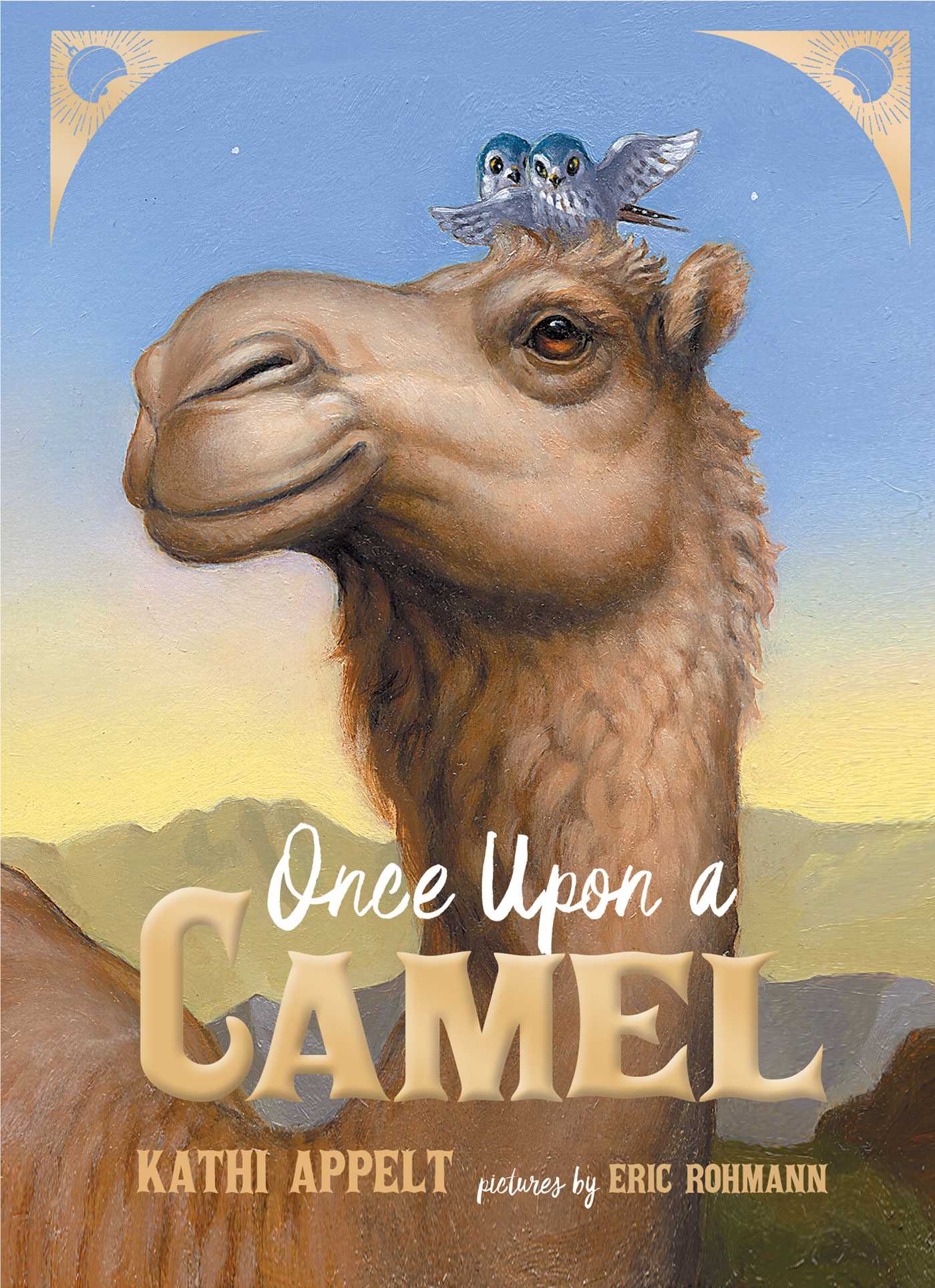
Once Upon a Camel
Author: Kathi Appelt
Illustrator: Eric Rohmann
Published September 7th, 2021 by Atheneum/Caitlyn Dlouhy Books

Summary: An old camel is out to save two baby kestrel chicks during a massive storm in the Texas desert.

Zada is a camel with a treasure trove of stories to tell. She’s won camel races for the royal Pasha of Smyrna, crossed treacherous oceans to new land, led army missions with her best camel friend by her side, and outsmarted a far too pompous mountain lion.

But those stories were from before. Now, Zada wanders the desert as the last camel in Texas. But she’s not alone. Two tiny kestrel chicks are nestled in the fluff of fur between her ears—kee-killy-keeing for their missing parents—and a dust storm the size of a mountain is taking Zada on one more grand adventure. And it could lead to this achy old camel’s most brilliant story yet.

About the Author: Kathi Appelt is the author of the Newbery Honoree, National Book Award Finalist, and bestselling The Underneath as well as the National Book Award Finalist for The True Blue Scouts of Sugar Man Swamp. Some of her award-winning books include Maybe a Fox (with Alison McGhee), Keeper, and Max Attacks to name just a few. She lives in College Station, Texas. To learn more, visit her website at kathiappelt.com.

Find Kathi Appelt on Facebook and Pinterest!

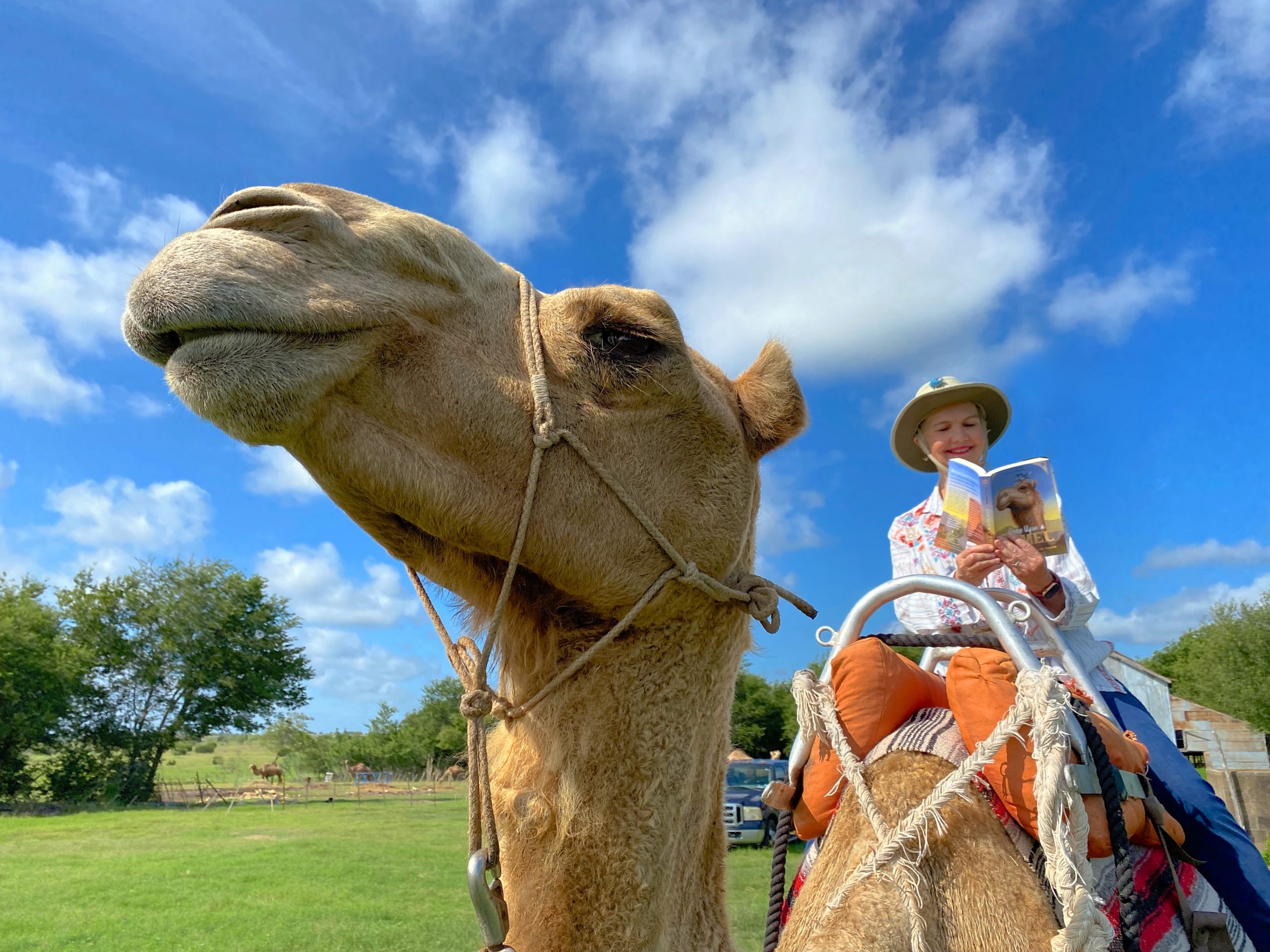
Richard, the camel, and Kathi Appelt taken at Texas Camel Corps. Photo credit: Doug Baum.

Review: Happy book birthday, Kathi & Once Upon a Camel! So honored to review this special book on your special day!

In all of Kathi Appelt’s books, what I have found that I adore the most is her ability to craft voice. She is brilliant. In this book, Zada the camel’s voice rings throughout with patience and determination. I was calmed by her stories of her upbringing as she works to keep the baby kestrels’ minds off of their parents. I think part of Appelt’s magic to craft voice is through her very specific word choice in all instances. Her descriptive words are so precise, and she is never deterred to use a word that may be challenging if it is the correct word. This leads to such lyrical prose–it is a pleasure to read!

There is also so much to learn throughout this story about stories: weather events (haboobs), animals of West Texas (kesterels, mountain lions, hawks, and more), and the history of camels. I found myself going on research tangents as I was introduced to different animals or different adventures that Zada goes on. It is no wonder that the Reading Group Guide is so extensive–there is so much to delve into!

Teachers’ Tools for Navigation (Excerpt from the publisher provided Reading Group Guide): 

  • Explain to students that alliteration is a literary device in which initial consonant sounds of successive or closely related words are repeated. This book contains tons of alliteration. Some examples include “arches and arroyos,” “moving mountain,” “posh Pasha palace,” “Pasha’s princess turns a little pale,” and “best beloved babies.” Using game tiles with letters or small pieces of paper with letters written on them, allow each student to draw a letter and write five alliterative sentences using that letter. Each sentence must contain a subject, verb, and describing words. Once everyone has written their sentences, each person should share their best alliterative sentence with the class.
  • Zada has had a long life filled with experiences and relationships. Her story in the book moves in time as she shares memories while continuing present experiences. Ask students to create a time line for Zada. There are online resources such as Adobe (https://www.adobe.com/express/create/timeline) and TimeGraphics (https://time.graphics) to help with organization. They may also do this in a slideshow format. Have them include dates, locations, and important experiences.
  • Beulah licks Wims, and he is upset. He is described as being “incensed. Put out. Piqued.” Discuss with students how this alliterative and repetitive approach to communicating his feelings is an effective way to convey the strength of those feelings as well as a lyrical way to engage the reader. Ask students to choose one emotion and make a list of synonyms or short expressions that express that emotion. Next, ask them to express the emotion in as many ways as possible in short sentences. Finally, ask them to use their list and sentences to write a paragraph that first explains why their character is feeling that emotion and that then elaborates on how they are feeling in as many ways and with as much creative imagery as possible.
  • Like humans and all other members of the animal kingdom, camels and kestrels have been classified based on shared characteristics. Looking at the list below, you can see that camels, kestrels, and humans are classified together in their kingdom and phylum, but begin to diverge at class groups and fully diverge in orders. Ask students to review the table and have a class discussion about classification. Give students the opportunity to consult some sources, if necessary, to answer their questions.
    • Camels: Animalia (Kingdom) / Chordata (Phylum) / Mammalia (Class) / Artiodactyla
      (Order) / Camelidae (Family) / Camelus (Genus) / Dromedarius or Bactrianus (Species)
    • American Kestrels: Animalia (Kingdom) / Chordata (Phylum) / Aves (Class) / Falconiformes
      (Order) / Falconidae (Family) / Falco (Genus) / F. tinnunculus (Species)
    • Humans: Animalia (Kingdom) / Chordata (Phylum) / Mammalia (Class) / Primates (Order) / Hominidae (Family) / Homo (Genus) / Homo Sapiens (Species)
    • After review and discussion, ask students to write short answers to the following questions:
      • Why do we classify animals and other living things in this manner?
      • What characteristics do all living things have in common?
      • Do camels, kestrels, and humans have the same basic needs?
      • Do humans understand more about animals than animals know about humans?
      • Even though humans and camels are both mammals, do humans or camels have more in common with kestrels than they do with one another?

Discussion Questions (Excerpt from the publisher provided Reading Group Guide): 

  • The story’s action begins with Pard and Perlita telling Zada that a mountain is eating everything and is soon going to eat them. Zada cannot comprehend this. Why do you think that is? How do you handle things you don’t understand? In truth, the mountain is a great sand-and-dust storm coming their way. How does knowing this change your perspective of the situation? How does Zada react?
  • The author explains how a camel has adapted to the desert, and how American kestrels are built for flight. All animals have adaptations: evolved physical and behavioral traits that help their species survive and thrive. Can you think of any other examples of this? What about cultural adaptations? Are there ways in which groups or individuals adapt for their own safety, comfort, or survival?
  • As Zada tries to outrun the storm, she wishes she could fly. This is not the first time in her life she has wished this. Why do you think she has continued to yearn for this ability? Thinking about your life and the environment in which you live, what other animal adaptations would come in handy for you? Explain your answers.
  • As Zada worries about Pecos de Leon, she reflects on the fact that she and the mountain lion have “both traveled a lot of miles and traversed a lot of country. That was worth something.” How can having many experiences help you? Do you think it’s important to experience situations similar to and different from your own life? What might you learn from someone who has lived a long time and done many things? Explain your answers.
  • As Zada moves through the storm carrying the chicks, an enormous old tree comes down behind them. “The wind had yanked it up by its roots. A hundred years, that old tree had stood there, watching over the creek, keeping generations of bird families safe. Now it lay in a heap on its side.” How does the falling tree make Zada feel? How did it make you feel? Do you think generations of bird families will be able to find a new home?
  • As the storm spins Perlita and Pard around, they call out, “‘Keep them safe!’” This is described as the “universal prayer” of parents. What does it mean for something to be universal? Do you have knowledge, ideas, or habits that are universal?
  • Zada’s and Asiye’s motto is “En parlak yildiz ol.” This means “Become the brightest star.” What do they mean by this? How do you see them striving to do this throughout the story?

Flagged Passages: “Chapter 1: Foothills, Chisos Mountains West Texas, 1910

“Incoming!”

Even in her sleep, Zada recognized that voice.

The old camel raised one eyelid. It was still dark. There was at least an hour left before dawn. She did not recall setting an early alarm bird.”

Book Trailer: 

Read This If You Love: Maybe a Fox by Kathi Appelt & Alison Mcghee, The Beatryce Prophecy by Kate DiCamillo, Journey of the Pale Bear by Susan Fletcher, Orphaned by Eliot Schrefer, Good Dog by Dan Gemeinhart, Granted by John David Anderson

Recommended For: 

classroomlibrarybuttonsmall 

Giveaway!

a Rafflecopter giveaway

Signature

**Thank you to Barbara at Blue Slip Media for providing a copy for review and giveaway!**

Blog Tour with Review: Stowaway by John David Anderson

Share

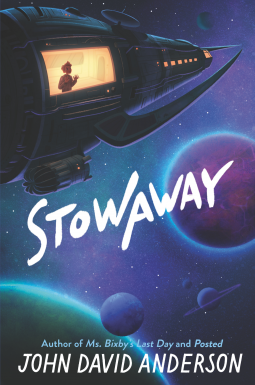
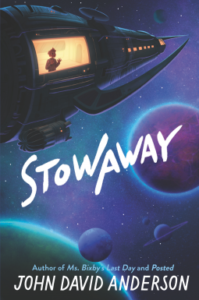
Stowaway
Author: John David Anderson
Published August 3rd, 2021 by Walden Pond Press

Summary: The beloved author of Posted and Ms. Bixby’s Last Day returns with the first book in a coming-of-age sci-fi duology about Leo, a kid trying to navigate the galaxy in order to save his family—and, possibly, the planet Earth.

When scientists discover a rare and mysterious mineral buried in the Earth’s crust, they have no idea that it just happens to be the most valuable substance in the entire universe. It’s not long before aliens show up to our little corner of the galaxy offering a promise of protection, some fabulous new technology, and entry into their intergalactic coalition—all in exchange for this precious resource. A material so precious that other alien forces are willing to start a war over it. A war that soon makes its way to Earth.

Leo knows this all too well. His mother was killed in one such attack, and soon after, his father, a Coalition scientist, decides it would be best for them to leave Earth behind. It’s on this expedition that their ship is attacked, Leo’s father is kidnapped, and Leo and his brother are stranded in the middle of space. The only chance they have is for Leo to stow away on a strange ship of mercenary space pirates bound for who knows where and beg the captain to help him find his father.

But the road is dangerous, and pirates, of course, only look out for themselves. Leo must decide who to trust as he tries to stay alive and save his family, even as he comes to understand that there aren’t many people—human or alien—that he can count on in this brave new universe.

Praise: “The Mandalorian meets Guardians of the Galaxy in this fast-paced space adventure that will have readers turning the pages as they are pulled into a unique yet strangely familiar world that reflects our own. This series opener is an ideal pick for middle-grade sci-fi fans.” – Booklist, starred review 

“This novel not only provides an otherworldly adventure, but a sincere tale about dealing with loss, finding bravery, and navigating the complexity of war. VERDICT: A page-turning space adventure that deals with complex issues.” – School Library Journal

“Anderson spins a fast-paced tale of piracy among the stars. Featuring a winning cast of misfits who stumble into unexpected kinship, Anderson employs warm humor and pop culture references to ground the narrative against cosmic-level stakes and underlying commentary about exploitation and the cost of war.” – Publishers Weekly

“Leo’s narration aches with pathos but also provides moments of humor and finally ends on a cliffhanger. A heartfelt adventure.” – Kirkus

About the Author: John David Anderson is the author of many highly acclaimed books for kids, including the New York Times Notable Book Ms. Bixby’s Last DayPostedGrantedOne Last Shot, and Stowaway. A dedicated root beer connoisseur and chocolate fiend, he lives with his wonderful wife, two frawesome kids, and clumsy cat, Smudge, in Indianapolis, Indiana. You can visit him online at www.johndavidanderson.org.

Review: There are very few authors that I have encountered that can write across genres and do it well. John David Anderson is one of those authors. I have read almost all of his books and they include fantasy, realistic fiction, and sci-fi, and all are so well done and so different than each other. Stowaway adds another awesome title to his works list.

Once again, Anderson is able to mix adventure, humor, and seriousness in a way that only he can to have the reader reflect on death, choices after loss, mental health, first impressions, and war while also making us laugh about snoring, clothing, descriptions of gyurt, and bad (GOOD!) puns.

And you will love the world-building in this one. Anderson did a great job of making the universe as vast and diverse as it is but not making it all so complicated that the reader cannot keep up with the planets and species.

But I think my favorite thing about this book is the characters. Each character is intriguing, has its own back story, and is so much more than you at first realize. And this is not just Leo’s character, it is all of the characters in the book. I love Baz and his crew, I love Leo and his family, and I love all of the aliens & humans that Leo meets along the way, good and bad! And I assume we’ll get to know even more in the 2nd book!

Teachers’ Tools for Navigation: On John David Anderson’s website, you can find writing prompts specifically for Stowaway: 

Hi All! John David Anderson here. If you’re like me, you like to ponder the really deep existential questions challenging humanity, such as, is there other intelligent life out there in the galaxy, and if so, are they friendly or do they want to eat us? And if they eat us, will they find us gamey or surprisingly moist and tender? What kinds of flavorings will they use? Have they heard of garlic?

Also if you are like me, you like to write down some of your thoughts when you are pondering what kind of meal you might make for our future alien overlords. So with that in mind I’ve penned a few writing prompts to get you started. You can use these to write a story, a novel, a poem, a list of things you should do to prepare for the impending invasion—whatever. The important thing is to use your imagination and have fun.

  • Imagine you are told that you have to leave Earth on a spaceship and you aren’t sure when you will return. All essentials such as clothes, food, toiletries, and medicine will be provided for you. Otherwise you are allowed to take one backpack with you. What do you put in your pack and why?
  • Imagine aliens show up at our doorstep tomorrow and bring with them all kind of advanced technology, the likes of which we’ve only dared to dream. What is one piece of technology or scientific advancement you would want the aliens to give us and why?
  • Imagine you and your sibling (or best friend) are both stricken by some terrible disease that only gives you days to live, but you are given one pill that you’re told might cure the disease. Would you take the pill yourself or give it to this other important person in your life (note: these are the only two available options. Don’t try to cut the pill in half or study it to determine its chemical compound in the hopes of recreating a duplicate)?
  • Describe the scariest possible alien you can imagine. Consider its appearance, temperament, technology, and desires. Give the alien a name. Now imagine it shows up at your doorstep.
  • Pick a necessity that we currently have plenty of (water, trees, daylight, rain, electricity) and imagine what the Earth would be like if what you chose suddenly disappeared. How would humans adjust to the sudden absence? What would it change about society and culture? What disastrous consequences could it lead to?

Discussion Questions: Here are some extra discussion questions I came up with:

  • How were the pirates different than what Leo, or you, assumed?
  • Why would Leo’s father make the choice that he made at the end of the book?
  • Although Baz wants to be a notorious, vicious pirate, I think he is much more than that. What words would you use to describe him as a character?
  • There are flashbacks throughout the book. Why did the author include these in the story?
  • Which side would you choose in the war? Is there a “right” side?
  • What do you think is going to happen in the next book?

Flagged Passages: Prologue “The explosion nearly threw them off their feet as the Beagle lurched sideways. The steel beams shuddered. Leo’s ears rang. The links blinked off, on , then off again, triggering the fluorescent yellow emergency lighting that ran along the floor. Leo put a hand on the wall to steady himself. His brother’s eyes shone like moons. “What was that?”

The question was answered with a second explosion, the ship quaking again. Every alarm screamed at once. Leo stumbled, falling into his brother’s ready arms. From down the corridor he could hear the crew of the Beagle shouting to one another, though it was impossible to hear anything over the ship’s wounded bleating until the captain’s voice echoed over the coms.

“Attention crew of the Beagle. We are under attack. Security personnel report to the bridge immediately. Engineering to the drive chamber.”

Leo looked at his brother, still holding him tight. “Did she just say we’re under attack?”

Gareth nodded, then looked sideways, startled by the sound of boot heels clomping down the hall.

Leo knew the sound. He’d learned to recognize the rhythm of his father’s footfalls. Like the sound of his brother’s snoring or his mother’s pensive sighs. Leo spied his father turning the corner, his eyes falling on him and Gareth, pressed together. Dr. Calvin Fender’s face softened, then hardened again. He spoke in a whirlwind. “What are you two doing out here? Didn’t you hear what Captain Saito said? You need to hide. Hurry!”

Their father pointed to the nearest door, leading to an empty bunk room barely half the size of the one the Fenders shared. He hustled Gareth and Leo into a corner, his white lab coat flapping on both sides like broken wings. Leo could tell he was scared–he could see it in his father’s eyes, even if he couldn’t hear it in his voice.

His father was seldom scared.”

Read This If You Love: Bloom by Kenneth Oppel, The Dark Side of Nowhere by Neal Shusterman, Children of Exile by Margaret Peterson Haddix, or if you are just a huge fan of John David Anderson

Recommended For: 

classroomlibrarybuttonsmall

Stop by the other Blog Tour Stops!

August 15, 2021 Nerdy Book Club
August 17, 2021 Writer’s Rumpus
August 23, 2021 A Library Mama
August 24, 2021 Unleashing Readers
August 26, 2021 Satisfaction for Insatiable Readers

Signature

**Thank you to Walden Pond Press for a copy for review!!**

Long Distance by Whitney Gardner

Share

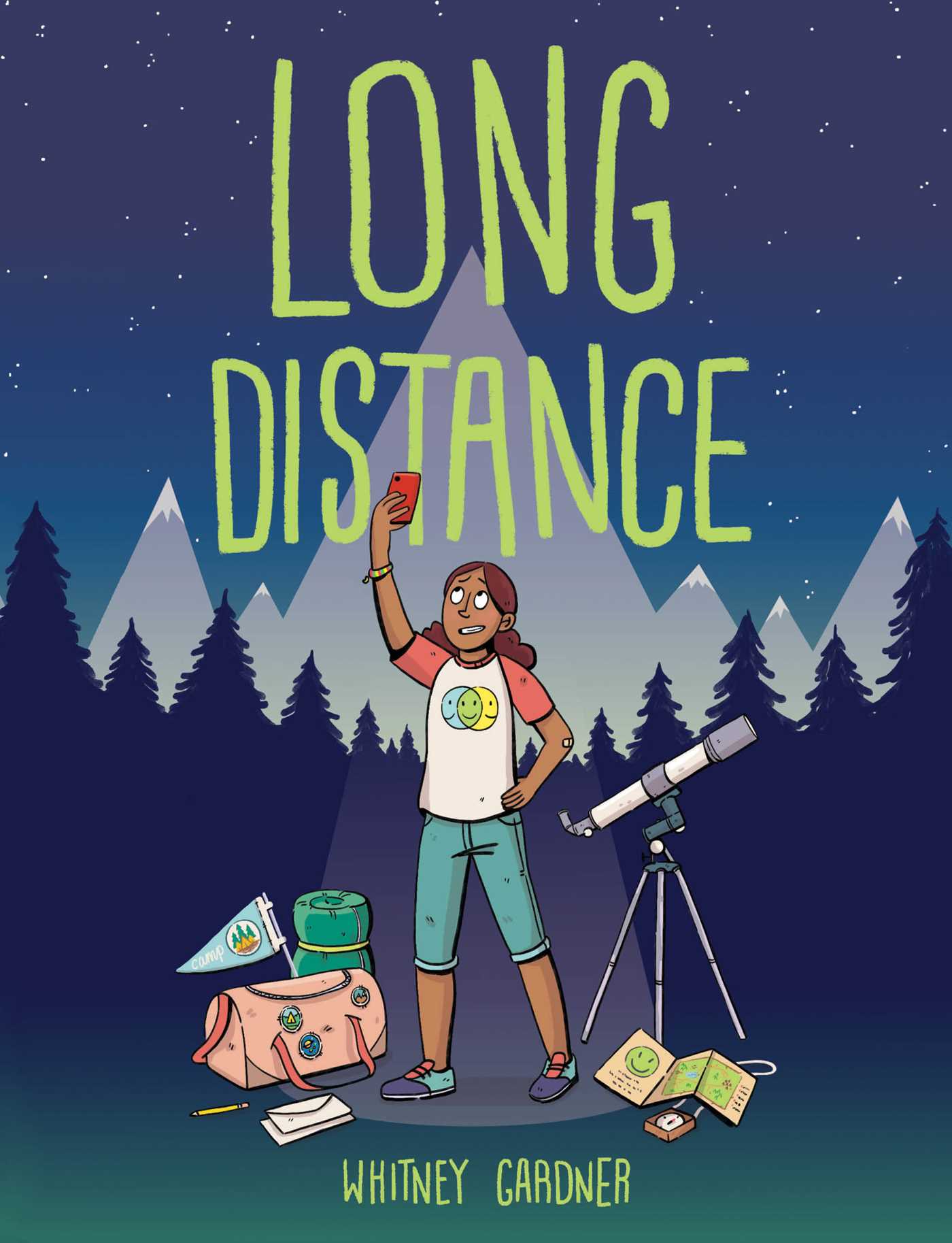
Long Distance
Author: Whitney Gardner
Published June 29th 2021 by Simon & Schuster Books for Young Readers

GoodReads Summary: From the creator of Fake Blood comes another exceptionally charming middle grade graphic novel about friendships both near and far, far away.

Vega’s summer vacation is not going well.

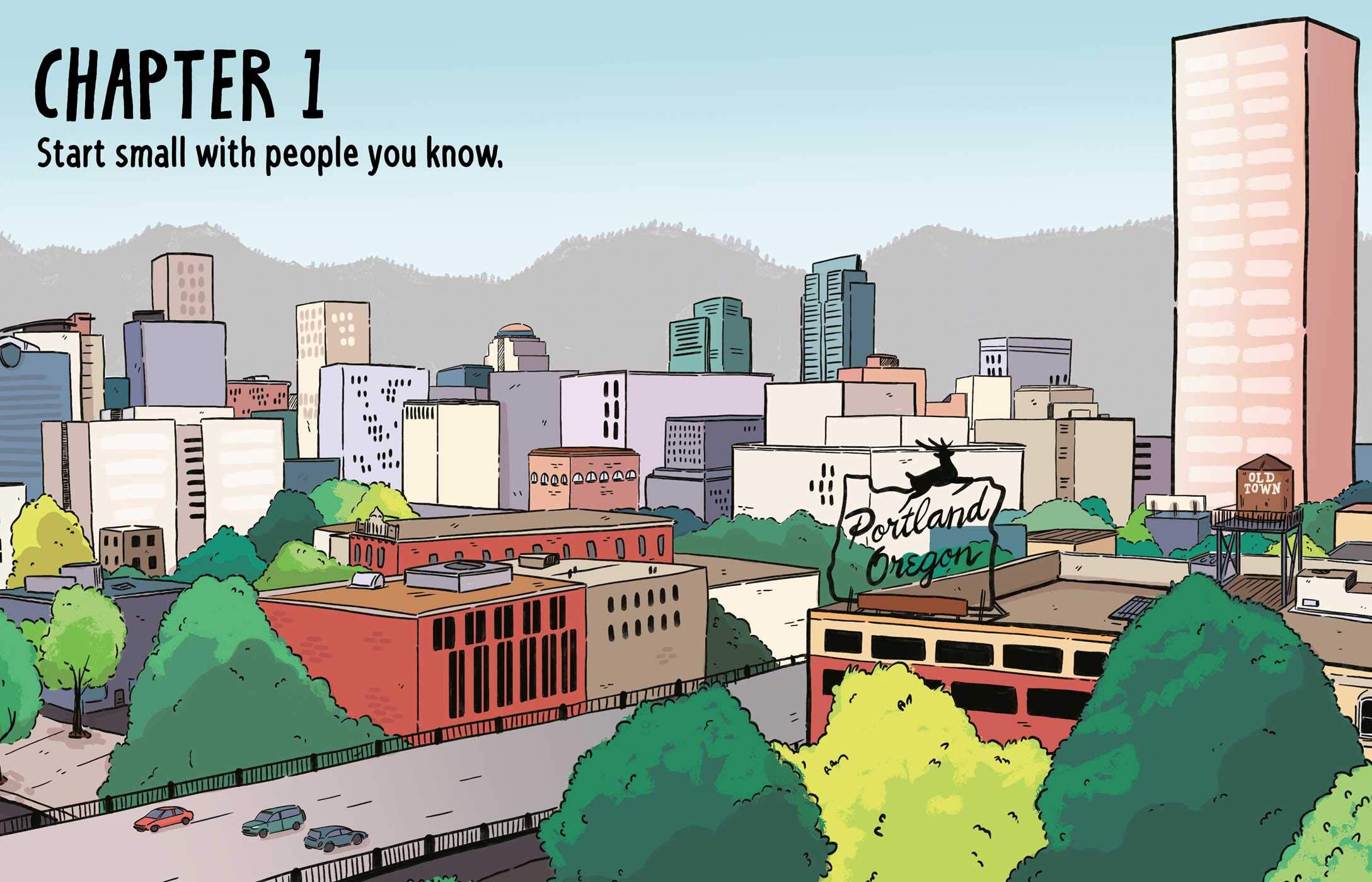
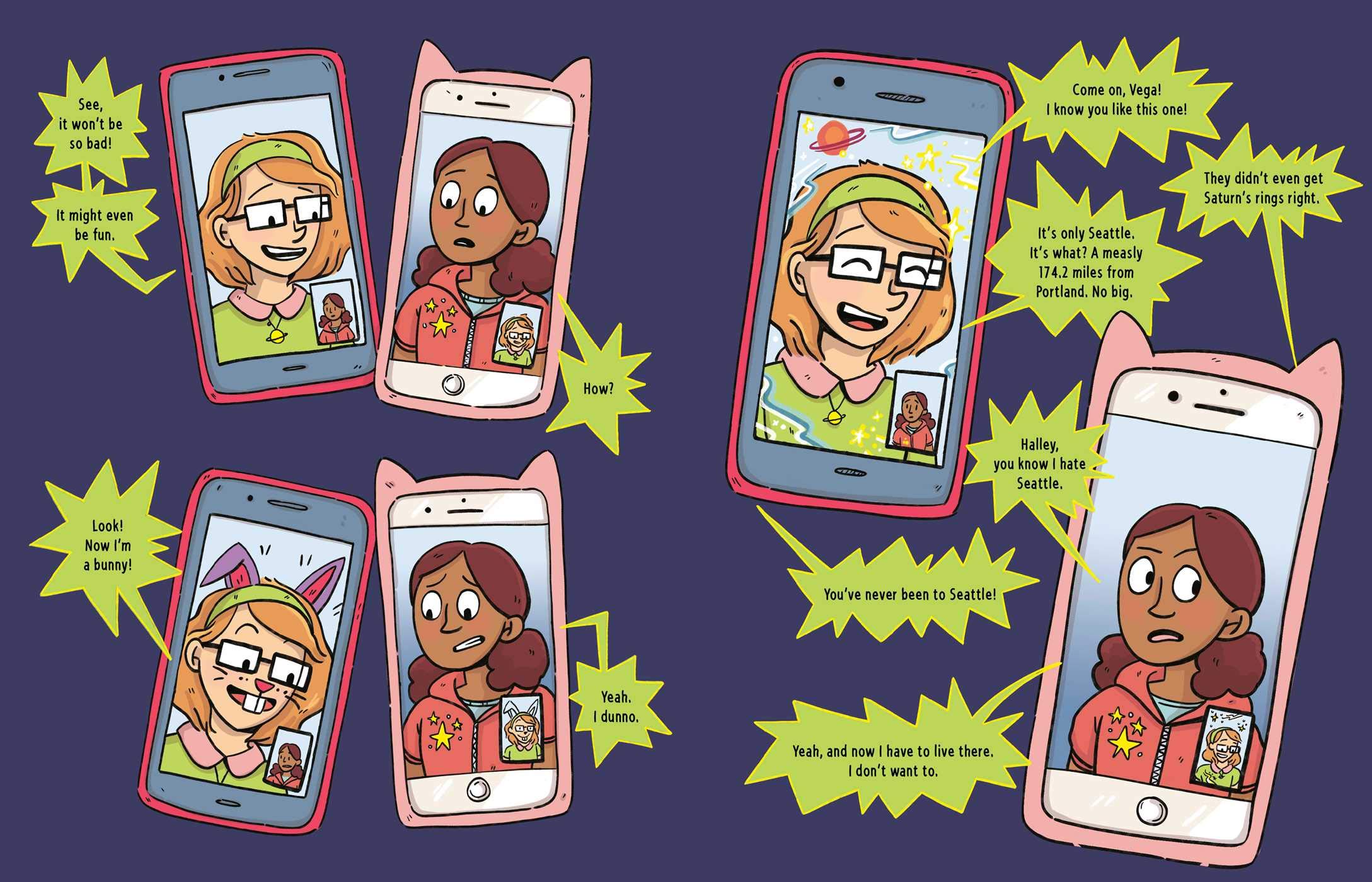
When her parents decide it’s time to pack up and leave her hometown of Portland, Oregon, behind for boring Seattle, Washington, Vega is more than upset—she’s downright miserable. Forced to leave her one and only best friend, Halley, behind, Vega is convinced she’ll never make another friend again.

To help her settle into her new life in Seattle, her parents send Vega off to summer camp to make new friends. Except Vega is determined to get her old life back. But when her cellphone unexpectedly calls it quits and things at camp start getting stranger and stranger, Vega has no choice but to team up with her bunkmates to figure out what’s going on!

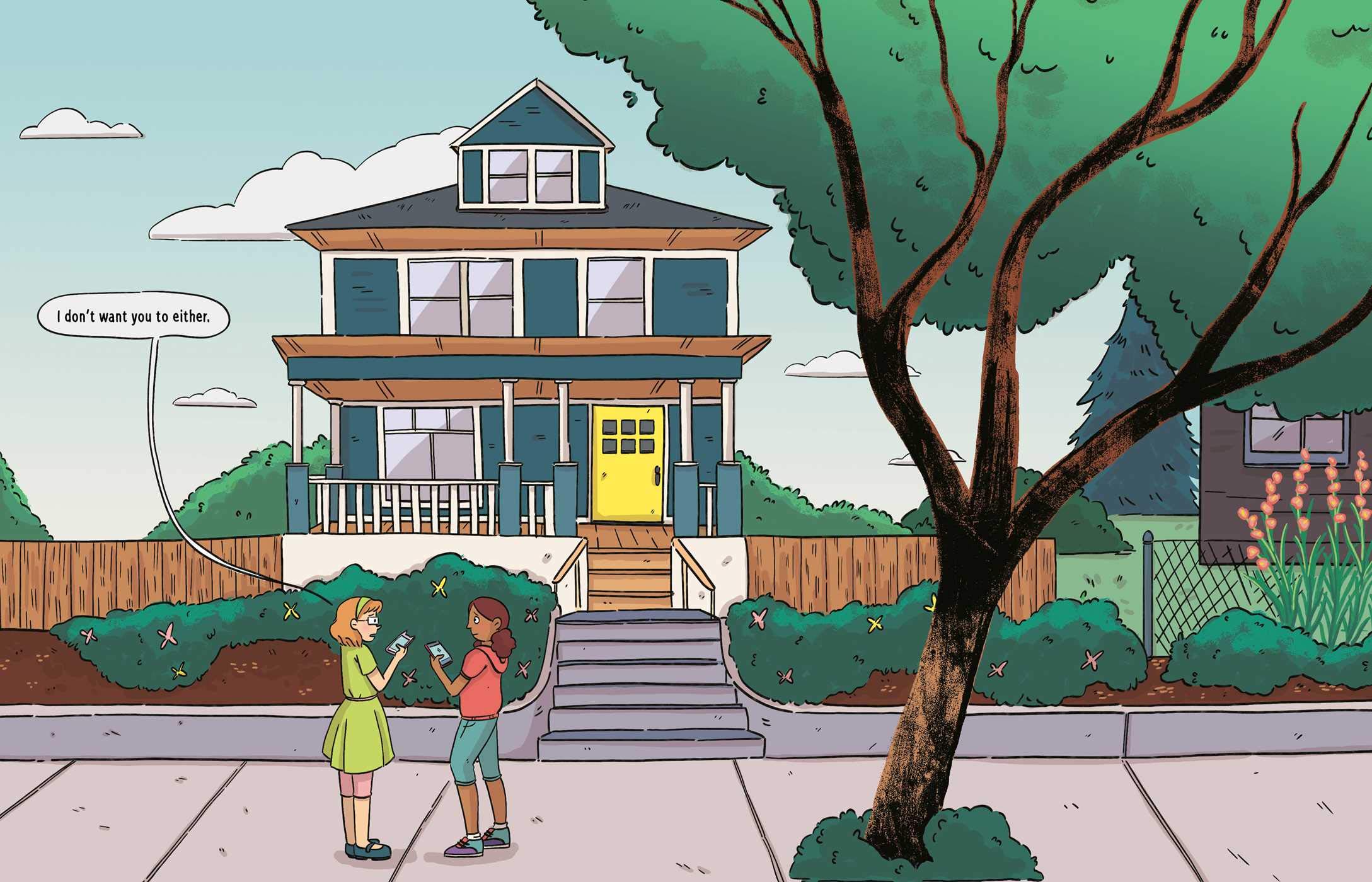
Ricki’s Review: I read this book with my 7-year-old (he is not the target audience), and we really enjoyed it. The book has a very drastic twist towards the end of the book that will shock readers. The illustrations are wonderful, and the characters are quirky and fun, and I am glad that I read the book. It teaches about the layers of friendship, and the different ways in which we judge (and don’t judge) humans. Long Distance will offer teachers and students rich opportunities to discuss and consider how we think about others, and how we engage and participate in friendships.

Kellee’s Review: What a fun new graphic novel to add to my library! This book is going to have no trouble finding readers because it has a great mix of realistic (moving, friendship), information (all the science), and sci fi (you’ll see!). Because of these three factors, it is going to have a wide range of readers. The diversity of characters will help with the reach also: Vega is a girl of color, she has two fathers who are both people of color, and the twins at camp are characters of color also. Additionally to the diverse representation of identities, the characters area all quite different personality-wise, so every reader is going to find someone that they are rooting for or connect with. 

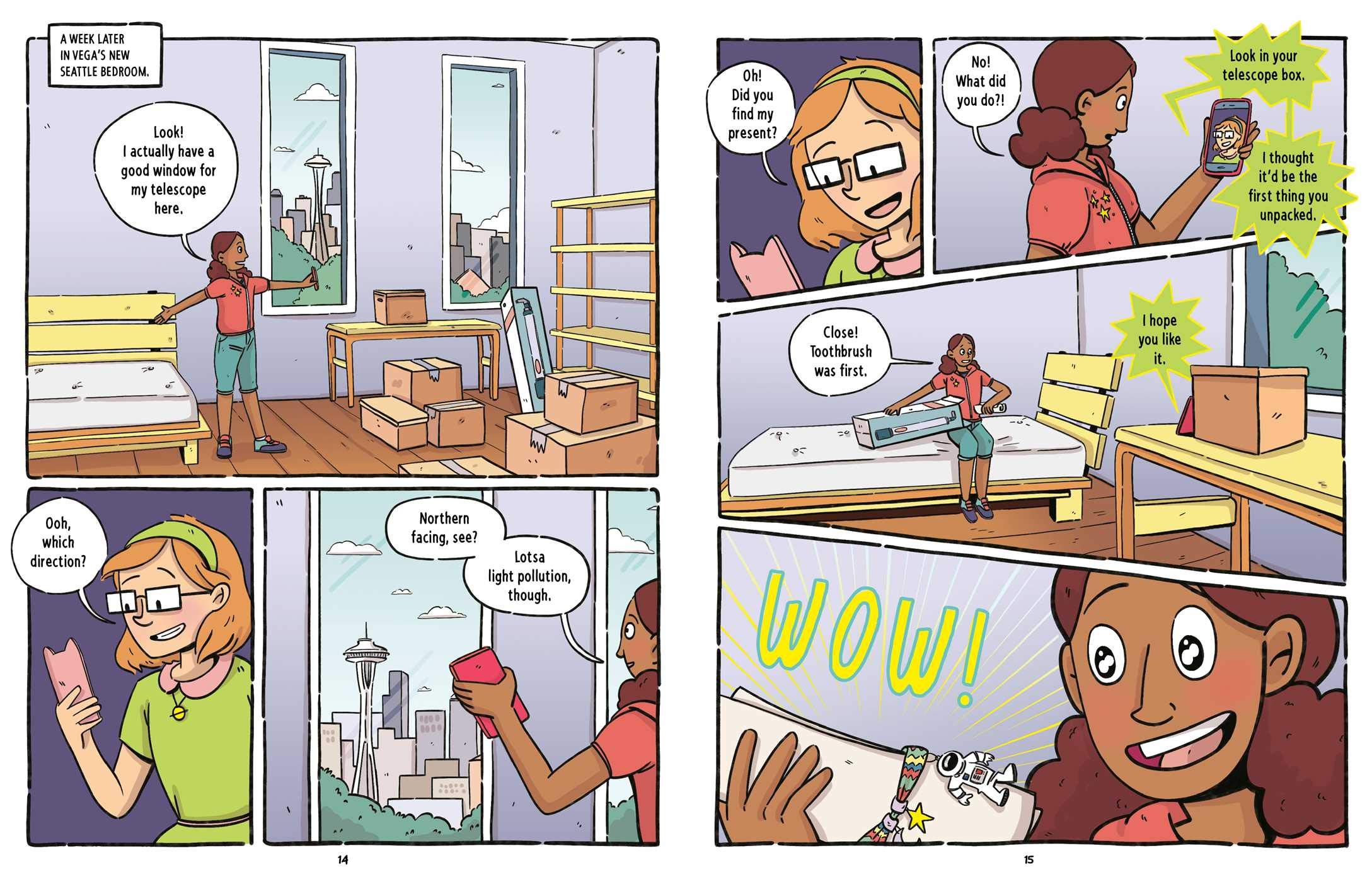
You’ll see below in the “Flagged Passages” that the illustrations are super colorful and eye catching, but not so busy that you lose focus. This is a huge benefit, specifically in middle school, because students love a color-filled graphic novel. 

Teachers’ Tools for Navigation: As described above, the twist in this book drastically shifts the storyline. Teachers might ask students to rewrite the twist to shift the story’s ending in a different direction.

The book also has a great SEL opportunity to look at how to make friends, using George as a great example of how not to. 

The text could also be used for prediction as the reader is as ignorant about the facts of the camp as Vega is but there are clues to something odd going on. As you read, students can look at the clues and try to make guesses about what the truth about the camp is. 

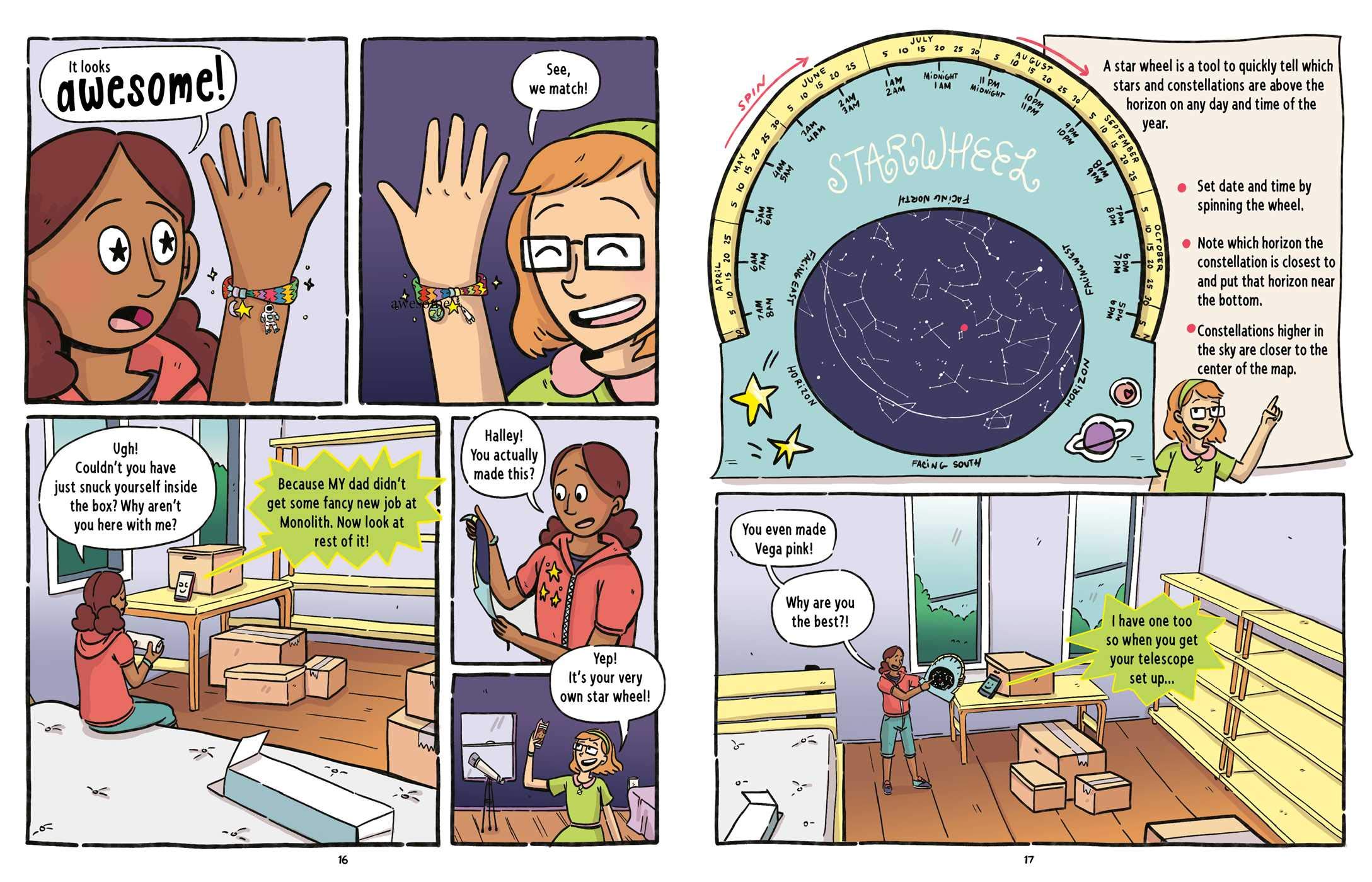
Also, the book has many cross overs with science! If you look at the “Flagged Passages” below, you’ll see that Vega is gifted a star chart by her friend and the author uses the opportunity to talk about what a star chart is. This happens a handful of times within the book with topics including astronomy, geology, and electrical engineering. In addition to the sidebars with info, there is science strewn throughout the narrative! 

Finally, Simon & Schuster has created “Drawn to Reading: A S&S Guide to Using Graphic Novels in the Classroom” which might assist you in utilizing this book with students. 

Discussion Questions: 

  • What does Vega learn about friendship?
  • Which camper was most interesting for you? What did you find interesting about them?
  • Many of the characters have different hobbies. What are your hobbies, and how do they compare with those of the characters in the book?
  • How did the author tie science into this science fiction graphic novel? 
  • How does Vega’s interest in stars and space help her discover the truth about the camp? 
  • If you had been in Vega’s position, would you have stayed with George? 
  • How did Halley figure out where Vega was? 
  • What scientific information that was shared in the book would you like to learn more about? 
  • Do you think we are alone in this universe? 

Flagged Passage: 

Read This If You Loved: Star Scouts by Mike Lawrence, HiLo series by Judd Winick, Katie the Catsitter by Colleen A.F. Venable, Real Friends series by Shannon Hale, Sisters by Raina Telgemeier, Drama by Raina Telgemeier, Fake Blood by Whitney Gardner

Recommended For:
 classroomlibrarybuttonsmall

RickiSigand

**Thank you, Audrey, at Simon & Schuster, for providing copies for review!**

Kingdom of Secrets by Christyne Morrell

Share

Kingdom of Secrets
Author: Christyne Morrell
Expected Publication August 3rd, 2021 by Delacorte Press

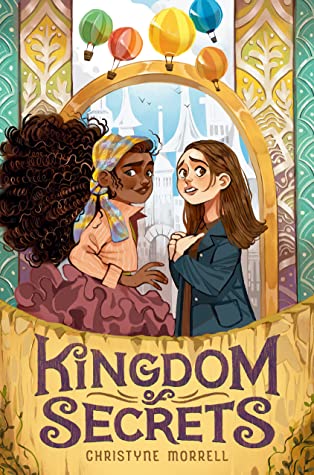
Summary: Prismena’s father is the hot air balloonist in the peaceful kingdom of Oren. She assists him by mending torn balloons, but she yearns to build and fly the complicated machines herself. One day, a waif named Abi steals Prissy’s only remaining memento of her deceased mother – a silk scarf – and promises to return it only if Prissy smuggles a mysterious box onto one of her father’s flights. Since balloon travel is strictly regulated in Oren, that single act of rebellion results in her father’s arrest and kicks off a spiraling series of events that will yank Prissy out of her predictable life.

Along the way to free her father from jail, she’ll get caught up in a bar fight, nabbed by a sadistic schoolmistress, tossed into a home for unwanted children, schooled in the art of stealing, and thrust into the center of a brewing rebellion. On her journey through Oren – with its glitzy neighborhoods and its seedy underbelly – Prismena will uncover secrets that change the way she views her family, her kingdom, herself, and even her beloved hot air balloons. She’ll have to break a few rules – and even forge metal – to save the people she loves, but she may also get a chance to soar.

About the Author: Christyne Morrell is a children’s book author and attorney. She lives in Decatur, Georgia with her husband, daughter, and hyperactive beagle. Christyne has been writing poems and stories since she could hold a pencil, but KINGDOM OF SECRETS (Delacorte 2021) is her debut middle-grade novel. 

Christyne is also the author of the picture book Abra, Cadabra & Bob (Clear Fork Publishing 2019), and her work has appeared in Highlights, Spider, and The School Magazine. She can be found online at christynewrites.com and on Twitter and Instagram at @ChristyneWrites. Christyne is represented by Danielle Chiotti at Upstart Crow Literary.

Review: When I started reading this book, it caught me right away because Abi comes out of nowhere, blackmails Prissy, then her dad gets arrested, and really I truly had no idea what was going on! Since the book is in Prissy’s point of view it gives the reader the suspense and disbelief that Prismena has as the story begins. This makes you want to just keep reading to figure everything out.

Then, add in a second story about a mysterious young lady named Wren from the past that will crash land into the main story in a very unexpected way–it just sucks the reader in more!

In addition to the plot, I found the characters intriguing and very well crafted. The development of Prismena is definitely the highlight as she learns how to be on her own and have her own thoughts, but even the secondary characters had stories that Morrell found time to tell in the book. I do wish I knew more about Abi’s life, but maybe that will come in another book!

I also think the book is timely as it looks at government corruption and propaganda based in fear of others and loss of power. Because of Prismena’s ignorance, we get to experience the realizations as she does, so this allows for good discussions about these topics without bringing up current events.

I am pretty picky about high fantasy, but this one is one of my recent favorites, and I cannot wait to share it with my students!

Teachers’ Tools for Navigation: The author’s website has a plethora of extra information to bring great discussions about this book to your classroom or book club!

First, there is an interview with balloonists which goes more into the science of the balloons, how Prissy’s valves would work, and other fun balloon anecdotes.

Second, she has Kingdom of Secret themed activities that are engineering, robotics, and science focused! These include making their own Dress Fit for a Queen, Rubber Band Flying Machine, Hot Air Balloon, and Mini-Catapult.

Finally, she has a section on “Fun Facts and Further Research” that looks at balloon history and fashion.

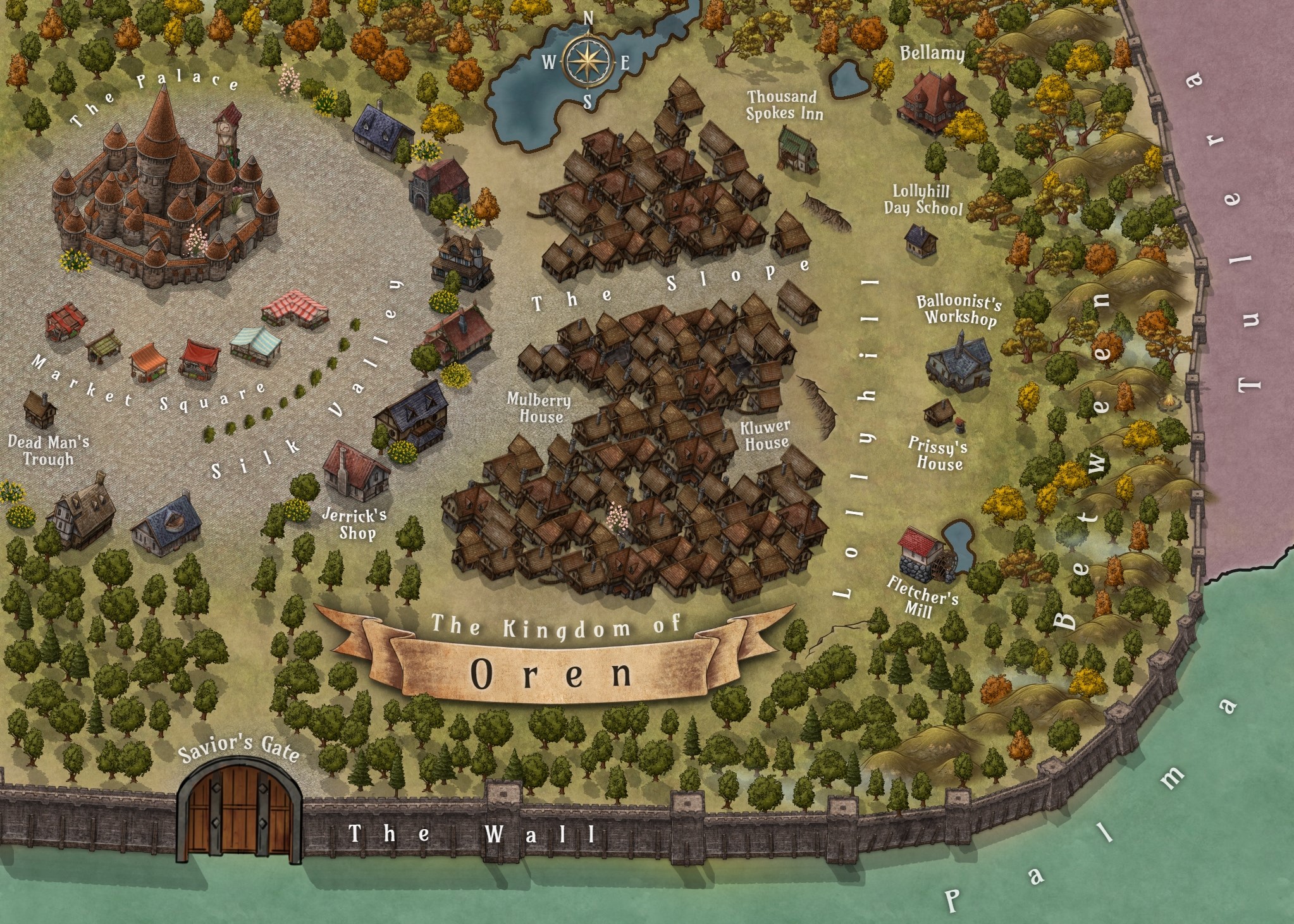
(And side note: I love a good map of a high fantasy setting, and the author gives us a very detailed and beautiful map of Oren.)

Discussion Questions: The Kingdom of Secrets Book Club Discussion Guide is available now and includes discussion questions such as:

  • At the beginning of A Blood Red Smile, a little girl treats Prissy like a celebrity because she’s the “balloonist’s daughter.” Later, Marybeth does the same. Why do you think that is?
  • Mr. Dudley is arrested for having “contraband,” including rubber. It may seem silly to you that something as common as rubber would be considered dangerous. Why do you think King Michael feels that rubber and other simple inventions are threatening?
  • When they first meet, Prissy and Abi don’t get along. Why not? What are some of their differences? What do they have in common? What changes over the course of the book that leads to them becoming friends?

Note: Some of the discussion questions in the complete guide are spoilers!!

Book Trailer:

Flagged Passages: Chapter 1. The Stranger and the Scarf

Abigail Smeade arrived like a black eye: sudden, fierce, and blossoming under my skin. When I met her, I was sitting in the shade of an old oak tree, minding my own business. I’d just removed a burlap sack from a hollow in the tree’s trunk and poured its contents out in the grass–scraps of metal, twisted brackets, and a few strips of a stretchy material called rubber. Most people would’ve described those things as junk fit for the bin, but I knew better. Pieced together just right, that “junk” would become more than the sum of its parts. And figuring out which way was just right happened to be one of my favorite pastimes.

But Father didn’t like me tinkering with the odds and ends I gathered (and sometimes even pinched from his workshop). It wasn’t proper, he said, and making something nobody had ever seen before might get a person looked at twice, which was the last thing we wanted. That’s why I kept my collection stashed inside an oak tree in the middle of Fletcher’s field. Nobody but Mr. Fletcher and me ever wandered into that field anymore, if you didn’t count the sheep.

At the bottom of the bundle, rolled up tight, was a scarf, a single piece of fabric more precious than all the rest of it put together. I unfurled it across my knees, and the silk shone and rippled like running water. It was cool to the touch, but the pattern–in shades of blue and yellow and purple–made me think of places drenched in sun. The kind of faraway places Mother liked to visit when she was flying hot-air balloons. In fact, the scarf had been a souvenir from one of her trips. She’d had a weakness for beautiful, unnecessary things. She’d filled the house with them once.

“Peanut brittle?”

Startled, I crumpled the scarf and crammed it back into the sack. Then I whipped my head left and right, hunting for the owner of that voice. It wasn’t until I looked up that I spotted her, sitting on a branch of the tree and kicking her legs like she was lounging on a swing. She peered down at me with shrewd, glittering brown eyes. Without prompting, she extended a half-eaten shard of candy through the leaves. It glistened with a semicircle of saliva where she’d taken the last bite.

“No, thanks,” I said.

“Your loss.” She wedged the peanut brittle into the far reaches of her mouth and cracked off a piece. It rattled against her teeth as she spoke. “What’s that?” She pointed down at one of my projects, something I was still trying to get just right. A small flying machine I’d made using those strips of rubber Mr. Dudley had given me.

“Excuse me . . . who are you?” I asked. She looked about my age–long-limbed and gangly, with light brown skin. Her hair had been pulled into a ponytail that erupted at the back of her head in a burst of copper corkscrews. She wore several layers of clothes–an apple-green vest, a striped jacket two sizes too small, and two gauzy skirts that looked like petticoats that had been dyed pink and cut short. Her scuffed boots kicked at the air over my head.

“Abigail Smeade, at your service,” she said. “You can call me Abi.” She smiled with a mouth full of crowded, crooked teeth, each one shoving its way to the front. She stretched her arm down to me again, this time offering her long, tapered fingers for a handshake. As though it were completely normal to meet someone while perched in a tree. I unpretzeled my legs and stood on tiptoes to give her hand a single uninspired shake.

“I’m Prismena,” I said. “What are you doing here?”

“Same as you,” she said. “Trespassing.”

(Read more of this excerpt at https://www.penguinrandomhouse.com/books/652736/kingdom-of-secrets-by-christyne-morrell/)

Read This If You Love: The Land of Stories books by Chris Colfer, The Trouble with Shooting Stars by Meg Cannistra, A Tear in the Ocean by H.M. Bouwman, and other middle grade fantasy books

Recommended For: 

classroomlibrarybuttonsmall 

Signature

**Thank you to the author and publisher for providing a copy for review!**

Zonia’s Rain Forest by Juana Martinez-Neal

Share

Zonia’s Rain Forest
Author and Illustrator: Juana Martinez-Neal
Published March 30th, 2021 by Candlewick Press

Summary: A heartfelt, visually stunning picture book from the Caldecott Honor and Sibert Medal Winner illuminates a young girl’s day of play and adventure in the lush rain forest of Peru.

Zonia’s home is the Amazon rain forest, where it is always green and full of life. Every morning, the rain forest calls to Zonia, and every morning she answers. She visits the sloth family, greets the giant anteater, and runs with the speedy jaguar. But one morning, the rain forest calls to her in a troubled voice. How will Zonia answer?

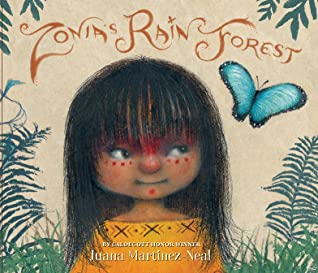
Acclaimed author-illustrator Juana Martinez-Neal explores the wonders of the rain forest with Zonia, an Asháninka girl, in her joyful outdoor adventures. The engaging text emphasizes Zonia’s empowering bond with her home, while the illustrations—created on paper made from banana bark—burst with luxuriant greens and delicate details. Illuminating back matter includes a translation of the story in Asháninka, information on the Asháninka community, as well as resources on the Amazon rain forest and its wildlife.

Praise: 

⭐“At its simplest level, this is a beautiful story about a child who loves her home and the animals she with whom she shares it. Martinez-Neal’s rounded, soft-textured illustrations are wonderfully inviting and involve linocut and woodcut leaves and fronds printed on natural banana-bark paper… The text is kept to two short sentences per double-page spread, reflecting Zonia’s uncomplicated and innocent view of the world, which is shaken when she stumbles upon a large section of clear-cut forest.” – Booklist (starred review)

⭐“This beautiful look at a young girl’s life and her determination to save her home is a perfect read for young environmentalists.” – School Library Journal (starred review)

“In Juana Martinez-Neal’s Zonia’s Rain Forest, super-cute critters are out in full force…A girl who lives in the rain forest begins each day by greeting her animal friends in this exuberant picture book crowned with an environmental message.” – Shelf Awareness

About the Author: Juana Martinez-Neal is the Peruvian-born daughter and granddaughter of painters. Her debut as an author-illustrator, Alma and How She Got Her Name, was awarded a Caldecott Honor and was published in Spanish as Alma y cómo obtuvo su nombre. She also illustrated La Princesa and the Pea by Susan Middleton Elya, for which she won a Pura Belpré Illustrator Award, Babymoon by Hayley Barrett, and Fry Bread: A Native American Family Story by Kevin Noble Maillard, which won a Robert F. Sibert Medal. Juana Martinez-Neal lives in Arizona with her family. Visit her online at www.juanamartinezneal.com.

Review : Zonia’s story starts as a story of family. We meet her mother and baby brother and the love between them is evident in the words and illustrations.

The book then moves to Zonia’s adventures visiting her friends throughout the rain forest. We get to meet all of her animal friends. With backmatter introducing the type of animals, Trent and I went on a research exploration of the different rain forest animals that Martinez-Neal introduced to us.

The book ends with a call to action. Zonia is Asháninka, Indigenous people of the Peruvian Amazon, so the rain forest is her home. Her family’s home. The book ends with Zonia running across deforestation near her home and realizing that the forest needs her, and all of our, help.

And finally, the backmatter of the book is incredible. Juana Martinez-Neal, who is Peruvian, is not Asháninka, so I am not sure of the accuracy of the portrayal, but the backmatter shows the work she did to do justice to them and their home. The back matter includes a translation of the entire book to Asháninka, information about the Asháninka People, a few facts about the Amazon, threats to the Amazon, and Zonia’s friends we met in the book. Finally, especially useful for in the classroom, she includes selected sources and resources, all which can be viewed at https://juanamartinezneal.com/books/zonia/.

With Martinez-Neal’s ability to craft the simplistic text in a beautiful way mixed with her signature illustrations, full of movement, color, and personality along with the rain forest elements, Zonia’s Rainforest is a perfect book for story time, science cross-curricular reading, a jumping off point for inquiry, or a mentor text.

Read “The story behind Zonia’s Rain Forest” by Juana Martinez-Neal here.

Watch an interview with Juana Martinez-Neal about Zonia’s Rain Forest: 

Teachers’ Tools for Navigation and Discussion Questions: Julia Torres created a Teacher’s Guide for Zonia for Candlewick Press, and it is the best resource for teaching Zonia. It includes 7 Discussion Questions and 8 Classroom Activities.

Flagged Passages: 

Read This If You Love: We Are Water Protectors by Carole Lindstrom, The Leaf Detective by Heather LangA Stone Sat Still by Brendan Wenzel

Recommended For: 

classroomlibrarybuttonsmall 

Signature

**Thank you to Candlewick Press for providing a copy for review!**

Review and Giveaway: The Caiman by María Eugenia Manrique, Illustrated by Ramón París, Translated by Amy Brill

Share

The Caiman
Author: María Eugenia Manrique
Illustrator: Ramón París
Translator: Amy Brill
Published: July 1, 2021 by Amazon Crossing Kids

Summary: The unforgettable story of a man and his alligator.

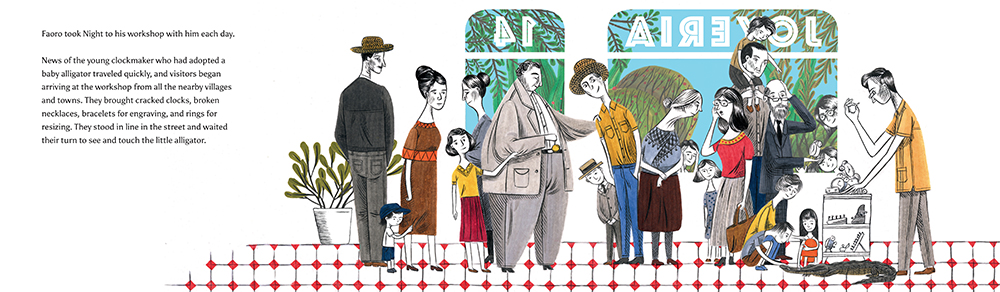
When Faoro the clockmaker adopts a baby alligator, he has no idea that someday their story will travel far and wide. But the town of San Fernando de Apure would never forget this kind young man and his adoring alligator, who played with the neighborhood children, took part in Faoro’s wedding, and, eventually, mourned his loss. Now their story is being shared with the world.

In this delightful picture book first published in Venezuela, the author brings us back to her own childhood in Venezuela, as one of the children who used to visit this famous caiman, to tell the story of a man who loved animals and how his friendship with his alligator sparked a lasting legacy.

A New York Times Globetrotting Pick!

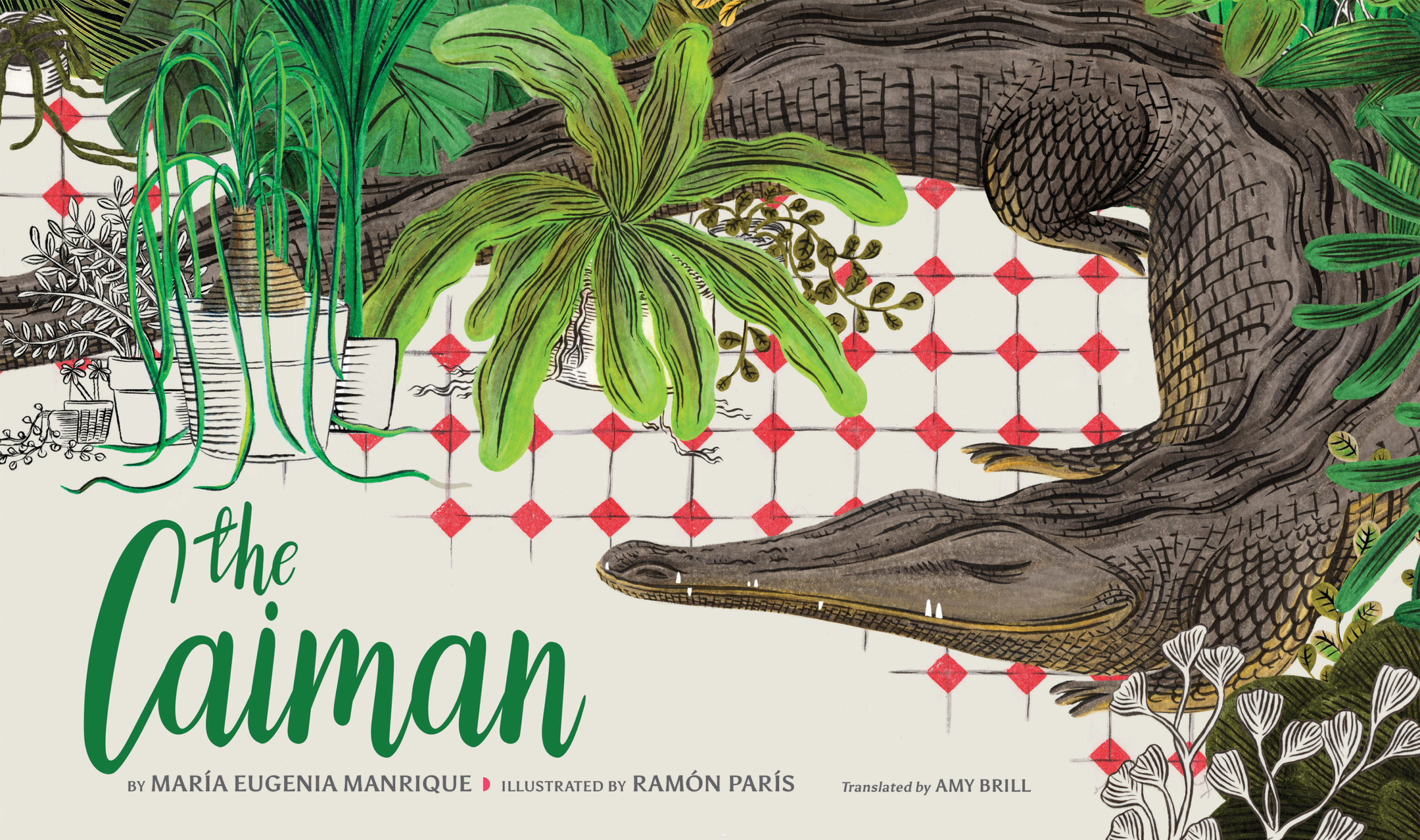
★“The striking illustrations…have a wild and whimsical feel about them, featuring lush foliage and expressive characters, including the eventually enormous caiman. It’s a memorable and unexpected demonstration of the universality of love, grief, and kindness.” —Booklist (starred review)

María Eugenia Manrique is one of the girls portrayed in this story. She rode the caiman when she visited her family in San Fernando de Apure. She was born in Caracas, Venezuela, and currently lives in Barcelona, Spain. She studied fine art in Mexico City, specializing in xylography and engraving; Eastern painting at Nankín University, China; and sumi-e and calligraphy at the Nihon Shuji Kyoiku Zaidan Foundation in Japan. Her work has been exhibited in museums and galleries around the world. The Caiman is her first children’s book. For more information, visit her website: https://mariaeugeniamanrique.wordpress.com/.

Instagram: @mem.manrique

Ramón París was born in Caracas, Venezuela, and as a child lived in Barinas, a plains state like Apure, where he also heard the story of the caiman. He currently lives in Barcelona, Spain. Hismost recent book for children, Duermevela, was selected for the Bologna Book Fair Illustrators Exhibition. His books have been recognized with honors including Los Mejores del Banco del Libro and  the IBBY Honor List, among others, and they have been translated into numerous languages. Visit him at: ramon.paris.

Instagram: @ramon_paris_ilustrador

Amy Brill’s fiction and nonfiction have appeared in numerous publications including the Washington Post, Medium, Real Simple, Oprah.com, and One Story. Her first novel, The Movement of Stars, was published by Riverhead Books. A native New Yorker, Amy lives in Brooklyn with her husband and two daughters.

Ricki’s Review: It’s NONFICTION. I read this book and couldn’t believe that the story was true, and it made me love it even more! The author beautifully tells the story of Jose Faoro, who adopts a baby alligator when it is just days old. My children have always dreamed of adopting a large animal such as this, so it offered a wonderfully intriguing read. Although, I might add that they now think that we can take in an alligator in our house (ha!). This is the story of a great man who loved animals and loved those around him. I absolutely adored the gentle telling, and it felt like a book that would be translated because children all over the world would be captivated by this story. The illustrations stand out to me because they are timeless. They feel contemporary to my boys, but they also filled my heart with a softness because they reminded me of the classic illustrations of the stories I read and loved as a child. Ahhh, I just adore this book.

Teachers’ Tools for Navigation: This book is accessible to all levels, but I’d love to see it in elementary school classrooms, where teachers ask their students to research examples of other people who did something out of the ordinary. They could write their own picture books.

Discussion Questions: 

  • How do the words and illustrations work together to form a cohesive story?
  • Does Faoro’s story surprise you? Why or why not?
  • What does Faoro’s life tell you about him?
  • What did you learn from the story?

Flagged Passages: 

Read This If You Love: Nonfiction Picture Books; Timeless Stories; Books about Animals

Giveaway:

a Rafflecopter giveaway

Recommended For: 

classroomlibrarybuttonsmall   

**Thank you to Barbara at Blue Slip Media for Providing a Copy for Review!**

Clap When You Land by Elizabeth Acevedo

Share

Clap When You Land
Author: Elizabeth Acevedo
Published March 5, 2020 by HarperTeen

Summary: In a novel-in-verse that brims with grief and love, National Book Award-winning and New York Times bestselling author Elizabeth Acevedo writes about the devastation of loss, the difficulty of forgiveness, and the bittersweet bonds that shape our lives.

Camino Rios lives for the summers when her father visits her in the Dominican Republic. But this time, on the day when his plane is supposed to land, Camino arrives at the airport to see crowds of crying people…

In New York City, Yahaira Rios is called to the principal’s office, where her mother is waiting to tell her that her father, her hero, has died in a plane crash.

Separated by distance—and Papi’s secrets—the two girls are forced to face a new reality in which their father is dead and their lives are forever altered.

And then, when it seems like they’ve lost everything of their father, they learn of each other.

Ricki’s Review: I was so happy to see that this book won the Amelia Elizabeth Walden Award. It is one of the most beautifully written books that I have ever read. It made me laugh, it made me weep, and it filled me with so many emotions and so many wonderings. The book is beautifully lyrical, and the voices are so strong. There’s a scene in the book that simply took my breath away. If you haven’t read this book yet, I recommend you head out and purchase it now. It’s absolutely magnificent.

Discussion Questions: 

  • How do the two perspectives of the story work together? How did it enhance your reading of the story?
  • How does place function in the story?
  • Where is home for the characters?
  • How do the characters in the story grieve? What understandings did it offer about grief and loss?
  • How do the characters in this book show strength in many different ways?

Flagged Passage: 

“Can you be from a place
you have never been?

You can find the island stamped all over me,
but what would the island find if I was there?

Can you claim a home that does not know you,
much less claim you as its own?”

Read This If You Love: Books. Seriously, it would be very difficult not to see the beauty of this book. Elizabeth Acevedo is one of the greatest writers of our time.

Recommended For: 

classroomlibrarybuttonsmall