Freedom Summer by Deborah Wiles (Ricki’s Review)

Share

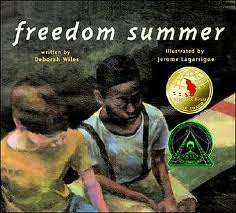
freedom summer

Freedom Summer
Author: Deborah Wiles; Illustrator: Jerome Lagarrigue
Published: January 1, 2005 by Aladdin

Summary: 

John Henry swims better than anyone I know.
He crawls like a catfish,
blows bubbles like a swamp monster,
but he doesn’t swim in the town pool with me.
He’s not allowed. 

Joe and John Henry are a lot alike. They both like shooting marbles, they both want to be firemen, and they both love to swim. But there’s one important way they’re different: Joe is white and John Henry is black, and in the South in 1964, that means John Henry isn’t allowed to do everything his best friend is. Then a law is passed that forbids segregation and opens the town pool to everyone. Joe and John Henry are so excited they race each other there…only to discover that it takes more than a new law to change people’s hearts.

Review: I rarely review picture books or texts that weren’t published recently. For me, the blog is a place for me to highlight newer books (whenever possible). I love picture books, but Kellee often reviews them, and I love young adult literature, so those are often the titles I review. After I read this book, I couldn’t wait to blog about it because it is easily one of the best picture books I have ever read and is worthy of the praise it receives. Set in the 1960s South, this moving, lyrical text depicts the Civil Rights Movement through the eyes of a child who just wants to adventure with his friend. The messages are powerful, and I plan to purchase it to read again and again with my son. After we read this as a family, my husband and I wondered if it was a work of nonfiction because it felt so very real to us. 

You can view Kellee’s review of Freedom Summer here.

Teachers’ Tools for Navigation: The most obvious choice would be to use this text to teach about diversity, discrimination or the Civil Rights Movement. I would also love to pair this with The Other Side by Jacqueline Woodson. Students would find great value in comparing and contrasting the imagery and messages of these two texts. I could also see it being paired with texts like To Kill a Mockingbird by Harper Lee. More than anything, this is a book about the power of friendship.

Discussion Questions: How do these boys view their world differently from the adults around them?; Why might the author have chosen to end the text the way she does? What message does it send?; How do the illustrations support the readers’ understanding of the text?

We Flagged: 

“John Henry’s skin is the color of

browned butter.

He smells like pine needles after a

good rain.

My skin is the color of the pale

moths that dance around the porch

light at night.

John Henry says I smell like a just-washed sock.

‘This means war!’ I shout.”

Read This If You Loved: The Other Side by Jacqueline Woodson, Something Beautiful by Sharon Dennis Wyeth, Goin’ Someplace Special by Patricia C. McKissack

Recommended For:

  readaloudbuttonsmall closereadinganalysisbuttonsmall classroomlibrarybuttonsmall

RickiSig

The Man with the Violin by Kathy Stinson (Kellee’s Review)

Share

NF PB 2014

Nonfiction Picture Book Wednesday

Nonfiction Picture Book Wednesday is hosted by Kid Lit Frenzy and was started to help promote the reading of nonfiction texts. Most Wednesdays, we will be participating and will review a nonfiction text (though it may not always be a picture book).
Be sure to visit Kid Lit Frenzy and see what other nonfiction books are shared this week!
violin

The Man with the Violin
Author: Kathy Stinson
Illustrated: Dušan Petričić
Published August 8, 2013 by Annick Press

Goodreads Summary: “Who is playing that beautiful music in the subway? And why is nobody listening?”

This gorgeous picture book is based on the true story of Joshua Bell, the renowned American violinist who famously took his instrument down into the Washington D.C. subway for a free concert. More than a thousand commuters rushed by him, but only seven stopped to listen for more than a minute. In “The Man With the Violin,” bestselling author Kathy Stinson has woven a heart-warming story that reminds us all to stop and appreciate the beauty that surrounds us.

Dylan is someone who notices things. His mom is someone who doesn’t. So try as he might, Dylan can’t get his mom to listen to the man playing the violin in the subway station. But Dylan is swept away by the soaring and swooping notes that fill the air as crowds of oblivious people rush by. With the beautiful music in his head all day long, Dylan can’t forget the violinist, and finally succeeds in making his mother stop and listen, too.

Vividly imagined text combined with illustrations that pulse with energy and movement expertly demonstrate the transformative power of music. With an afterword explaining Joshua Bell’s story, and a postscript by Joshua Bell himself.

My Review and Teachers’ Tools for Navigation: I must preface by saying that this book is not technically nonfiction. It is based on nonfiction, but the story is actually made up.

Too often our days go by without us slowing down and taking anything in. It may be that we are busy or stressed or late , but it has become too common to see people always rushing wherever they are going. This book shows how much we may be missing out on. It also shows the innocence of childhood, and how we need to allow children to explore and slow down even if we are moving fast. It is wonderful how the illustrations capture this for the reader. Combined with the story, this one definitely hits close to home.

Ricki also had some great thoughts and ideas in her review.

Discussion Questions: This book is an important discussion starter. What have you seen recently that was beautiful that others didn’t notice?; Sit ____ and listen to the sounds around you. What do you hear that is beautiful?; Why do you think people didn’t stop to hear Joshua Bell play?; Why did the author feel this was an important story to turn into a picture book?

Book Trailer: 

Read This If You Loved: The Noisy Paint Box by Barb Rosenstock, Herman and Rosie by Gus Gordon, Marvin Makes Music by Marvin Hamlisch

Recommended For: 

readaloudbuttonsmall classroomlibrarybuttonsmall

Signature

**Thank you to Annick Press and Netgalley for providing a copy for review**

Coyote Summer by J.S. Kapchinske

Share

coyote

Coyote Summer
Author: J.S. Kapchinske
Published March 17, 2013 by Moon Halo Books

Goodreads Summary: Heath always looked forward to summer visits at Grandpa’s—long days in the wild Rocky Mountains, fishing with Dad on the Piedra River, and nights sleeping on the screened-in porch. Plus this summer, Dad promised to finally tell him the secret about old Mrs. Baylis—a mysterious Native American woman living down the dusty dirt road… But now, after Dad’s accident, it can never happen that way. Heath and his mother go to Grandpa’s, but only to spread Dad’s ashes in the river. 

In the beginning, Heath feels like he’s been swallowed by the raging Piedra, held upside down in some dark and unforgiving eddy. But one day, wandering along the riverbank, he meets Annie, a wild-eyed tomboy who shows him a hidden cave with a litter of orphaned coyote pups. Together they discover the cave holds another secret—one that might help them figure out the mystery of old Mrs. Baylis. During that summer in the mountains, Heath comes to realize there is both beauty and ugliness in the world, sometimes all tangled together. By opening himself up to Annie and the coyotes, he rediscovers hope and joy in this big, beautiful, mixed-up world.

My Review: You have never heard of this book have you? That makes me so sad. How do such wonderful books fly under so many people’s radars? This is a special book that should be in the hands of middle schoolers everywhere! Heath is a character that so many kids will connect with, and his journey would definitely touch them like it did me.

Heath recently lost his father senselessly when he was hit by a drunk driver. The sudden loss of a man that Heath looked up to affects him tremendously, and he is struggling to find himself. Everything he does at his Grandpa’s house reminds him of his dad, and his mom and Grandpa are dealing with the death in a way that makes Heath feel alone.  But during this summer, his coyote summer, he finds his own identity, makes an everlasting friend, and begins to figure out how to deal without his dad. And there are other subplots that run throughout he book that just add to the depth of the narrative such as Annie’s story and the story of Mrs. Baylis.

Teachers’ Tools for Navigation: This book just needs to be shared. It could definitely be read as a read aloud, but it will probably find its home the best in the right students’ hands either through the classroom library or lit circles. Students who love nature, have suffered a loss, or enjoy identity books will find this one is perfect for them.

Discussion Questions: How does finding Annie and the coyotes change Heath’s summer?; Why is Grandpa acting the way he is?; Why was it important for Heath to spend the summer with the coyotes? How did it affect him?

We Flagged: “As we sat there, a heron swooped down on the far bank and began stalking the shallows for fish. He moved slowly and hardly made a ripple when he walked. Then he stretched his long neck over the water, cocked his head, and froze.

“He’s pretty,” the girl said under her breath, as if talking to herself.

Somehow, her saying that made me feel better. “Herons were my dad’s favorite. He told me we should all learn to be patient like one of them.”

“Your dad sounds nice.”

I looked down at my hands and felt that horrible lump in my throat.” (Location 196, Kindle book)

Read This If You Loved: Hoot, Flush, Chomp, or Scat by Carl Hiassen, Lost in the River of Grass by Ginny Rorby, My Side of the Mountain by Jean Craighead George, Hatchet by Gary Paulsen

Recommended For:

classroomlibrarybuttonsmall litcirclesbuttonsmall

Signature

**Thank you to the author for providing a copy for review**

Boys of Blur by N. D. Wilson

Share

boys of blur

Boys of Blur
Author: N. D. Wilson
Published: April 8, 2014 by Random House

Ricki’s Summary and Review: 12-year-old Charlie Reynolds’ family travels to town of Taper to attend the funeral of a beloved football coach. When Charlie’s stepfather is given the opportunity to coach the town’s football team, Charlie is not thrilled to learn that they will be living in this creepy town filled with ancient stories of runaway slaves, native tribes, and monsters that rise organically from the murky swamps. He tries to fit into this mysterious place, where boys chase rabbits through burning sugarcane and everything seems to revolve around football. As he comes to learn about this town of secrets, Charlie wonders if he has the courage to uncover the mysteries that surround him.

Set deep in the heart of the Florida Everglades, this text is sure to grip readers with its muck, swords, blood, and gore. Wilson integrates complex allusions to Beowulf, which will compel readers to uncover all of the parallels with the classic legend. The beautifully complex language of this fast-paced story inspires close readings while also teaching readers lessons about evilness, heroism, and family.

Kellee’s Review: What I found most intriguing about this book is that Wilson was able to allude to Beowulf in a middle grade book without completely scaring away the reader.  Although I have read in multiple reviews that this book will grab reluctant readers’ attention, I think that some of the allusions are hard to grasp without prior knowledge, so reluctant readers may need some assistance understanding thus making the book a great read aloud as it will grab attention and start deep discussion (see Tools for Navigation).  In addition to the allusions, there are opportunities to discuss hero’s quest, abuse, and loyalty.

You will also find some beautiful writing in this novel. Wilson has a way with words that made this novel lyrical yet easy to read. From the very first line: “When the sugarcane’s burning and the rabbits are running, look for the boys who are quicker than flame.” I was impressed with how literary the novel was.  

Teacher’s Tools for Navigation: There are obvious parallels between this novel and  the legend of Beowulf, and pairing these two texts for discussion would prove very rewarding. Perhaps, teachers could use this Boys of Blur in conjunction with Gareth Hinds’ graphic novel of Beowulf. Then, the class could compare and contrast both the story lines and the differing formats authors might employ to convey a story and message.

Discussion Questions: How is Charlie characterized? Do you find him to be a strong character?; What role does Cotton play in the story?; What role does Charlie’s father play in the story? Can he be forgiven?; How does the author use language effectively?

We Flagged: “‘Yes,’ Mrs. Wisdom said, ‘you are. You’re made of tiny spinning bits as fast as light. But those bits aren’t all of you. They fly off. They get lost, and new ones come on and join the swirling Charlie-shaped dance that is your body. And dwelling in that dance, woven through every racing bit, heating it all with life and guiding it, there is a fire, a soul—you. It takes a dream to see something like that, something closer to the way things really are” (110).

Read This If You Loved:  Beowulf by Unknown, 100 Cupboards by N. D. Wilson, Maniac Magee by Jerry Spinelli, Holes by Louis Sachar, Ophelia and the Marvelous Boy by Karen FoxleeRaining Sardines by Enrique Flores-Galbis

Recommended For:

 readaloudbuttonsmall litcirclesbuttonsmall closereadinganalysisbuttonsmall classroomlibrarybuttonsmall 

RickiSigand Signature

Review and Teaching Guide!: Frank Einstein and the Antimatter Motor by Jon Scieszka, Illustrated by Brian Biggs

Share

frank

Frank Einstein and the Antimatter Motor
Author: Jon Sciezska
Illustrator: Brian Biggs
Published August 19, 2014 by Amulet Books

Goodreads Summary: Frank Einstein loves figuring out how the world works by creating household contraptions that are part science, part imagination, and definitely unusual. After an uneventful experiment in his garage-lab, a lightning storm and flash of electricity bring Frank’s inventions—the robots Klink and Klank—to life! Not exactly the ideal lab partners, the wisecracking Klink and the overly expressive Klank nonetheless help Frank attempt to perfect his Antimatter Motor . . . until Frank’s archnemesis, T. Edison, steals Klink and Klank for his evil doomsday plan! Using real science, Jon Scieszka has created a unique world of adventure and science fiction—an irresistible chemical reaction for middle-grade readers.

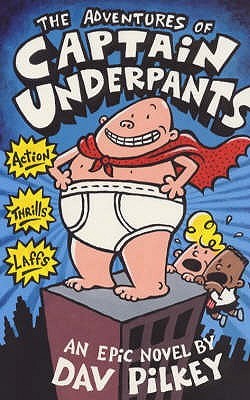
My Review: In the world of illustrated novels, we have many a class clown: Greg, Nate, George & Harold. But now we have our very own genius, and he is a genius that kids are going to love! This book combines the humor and fun plot that Diary of a Wimpy Kid, Big Nate, and Captain Underpants have, but adds in science (though the kids reading it will be none the wiser). The way that Sciezska combines humor, adventure, twists & turns, and science is perfection that will have a whole slew of readers waiting for the next Frank Einstein book.

Teachers’ Tools for Navigation: This book has so much that a teacher could touch on while reading it. It would be a perfect book for a read aloud in reading with cross-curricular activities based on the book in science.  I was very lucky to once again be able to write a teaching guide, this time for Frank Einstein. To see more specific class activities and discussion questions, view my teaching guide at the Abrams website. (I also wrote the teaching guide for Frank Einstein and the Electro-Finger!)


Discussion Questions: 

  • Frank has a double helix DNA slide. What would this look like?; Grandpa Al uses the phrase “Blow this pop stand” (p. 112). This is an idiom meaning “Let’s get out of here.”
  • What are idioms? What are some idioms you use in your daily life?
  • Frank’s parents are in Antarctica, where the ozone is getting a hole in it (p. 110). What is causing this hole? Frank mentions CFCs. What are they? How do they affect the ozone?
  • In Fig 1.1, Frank shows us that every second between light and sound equals 1/5 of a mile, because of the difference between the speed of light and the speed of sound. So, if there are 5 seconds between thunder and lightning, that means the storm is 1 mile away. What if there are 10 seconds between? 15 seconds? 12 seconds? 100 seconds?; On page 109, we learn that corn flakes were an accidental invention. Are there other accidental inventions?

We Flagged: “Night. Darkness. Flash! A bright bolt of lightning splits the dark and flickers over the skylight. Frank Einstein looks up from his work. He counts out loud, “One thousand one. One thousand two. One thousand three. One thousand four. One thousand five–” Craack boom! The sound-wave vibration of the thunder rattles the old iron-framed windows of Frank’s workshop and science laboratory. “Five seconds between light and sound for every mile. . . One mile away,” Frank calculates, using the difference between the almost-instant speed of light and the much slower speed of sound. “Right on time.”

Read This If You Loved: Series: Frankie Pickle by Eric Wight, Diary of a Wimpy Kid by Jeff Kinney, Captain Underpants by Dav Pilkey, Big Nate by Lincoln Peirce

Recommended For:

classroomlibrarybuttonsmall readaloudbuttonsmall closereadinganalysisbuttonsmall

Signature

**Thank you to Abrams Books for providing a copy for review**

brown girl dreaming by Jacqueline Woodson

Share

brown girl

brown girl dreaming
Author: Jacqueline Woodson
Published: August 28, 2014 by Nancy Paulsen Books

Summary: Jacqueline Woodson, one of today’s finest writers, tells the moving story of her childhood in mesmerizing verse. 
 
Raised in South Carolina and New York, Woodson always felt halfway home in each place. In vivid poems, she shares what it was like to grow up as an African American in the 1960s and 1970s, living with the remnants of Jim Crow and her growing awareness of the Civil Rights movement. Touching and powerful, each poem is both accessible and emotionally charged, each line a glimpse into a child’s soul as she searches for her place in the world. Woodson’s eloquent poetry also reflects the joy of finding her voice through writing stories, despite the fact that she struggled with reading as a child. Her love of stories inspired her and stayed with her, creating the first sparks of the gifted writer she was to become.
 
Praise for Jacqueline Woodson:
Ms. Woodson writes with a sure understanding of the thoughts of young people, offering a poetic, eloquent narrative that is not simply a story . . . but a mature exploration of grown-up issues and self-discovery.”—The New York Times Book Review

Ricki’s Review: This beautifully poignant book in verse captured my heart. I was swept away in the beauty of Jacqueline Woodson’s lyrical memories. This is a book that will embrace readers, wrapping them in Woodson’s childhood in the stormy 1960s. I couldn’t help but read and reread portions of the text–for every few pages that I read, I needed to flip back and relive the beauty of the previous verses. I will cherish this book, reading it again and again, for every word feels intentional and every memory vivid. brown girl dreaming is timeless, and it is universal. Above all, this book will give readers insight–unfolding the experiences of a “brown” child living during the heat of the civil rights movement; a young girl growing up in a house that identifies as Jehovah’s Witnesses; and a young writer, struggling to find the perfect words to reveal the truth. It will touch the hearts of readers of all backgrounds and ages in its messages of family, friendship, strength, and hope.

Kellee’s Review: Wow. I often worry about reading a book that has a lot of hype around it because I fear that I will not love it as much as others do. I should not have been worried about this book. It is beautiful. As Ricki said, I found myself rereading portions of the text just because of how well the verse flowed. By the end of this book, you will wish that you were Woodson’s friend and that you you could write as well as she does. The stories she tells are so true and heartfelt that you live her life along with her through the pages. You experience with her the hardship of growing up in the 1960s and 70s during the Civil Rights movement; the challenge of religion and finding the truth in it; the loss, addition, and conflict of family and everything that comes with these changes; and trying to find an identity as a person, sister, daughter, student and a writer. It is only a truly powerful, well-written book that can make you feel all of these elements.

Teacher’s Tools for Navigation: Writers will feel inspired by Woodson’s verse, and it would make an excellent mentor text for students to learn more about themselves and their own childhoods. We would suggest pairing passages with “I Am From” poems for students to be inspired to write verse memoirs of their own experiences. The figurative language and detail of this text make it a phenomenal resource for teachers, and we would find great value in close readings of Woodson’s intentional use of words and phrasing.

Discussion Questions: How does Jacqueline Woodson come to find herself? What are the strongest influences on her identity?; In what ways does Woodson show the power of family? How do Woodson’s siblings impact her decisions?; What role does history play in this book?; In what ways does Woodson manipulate words, phrasing, and white space? How does this influence your reading?

We Flagged: 

“Then I let the stories live
inside my head, again and again
until the real world fades back
into cricket lullabies
and my own dreams.” (p. 99)

“Sometimes, she pulls a chair to the window, looks
down over the yard.

The promise of glittering sidewalks feels a long time
behind us now, no diamonds anywhere to be found.

But some days, just after snow falls,
the sun comes out, shines down on the promise
of that tree from back home joining us here.

Shines down over the bright white ground.

And on those days, so much light and warmth fills
the room
that it’s hard not to believe
in a  little bit

of everything.”  (p. 285)

Please Note: The above excerpts are from advanced reader copies. The wording and punctuation may be different in the published text. Our blog interface does not allow us to accurately capture the indentions, but we wanted you to see the beauty of Woodson’s language.

Read This If You Loved: Other books by Jacqueline Woodson, The Rock and the River by Kekla Magoon, Sold by Patricia McCormick, Make Lemonade by Virginia Euwer Wolff, Mare’s War by Tanita S. Davis, Gaither Sisters (series) by Rita Williams- Garcia, Sit-In: How Four Friends Stood Up by Sitting Down by Andrea Davis Pinkney, The Silence of our Friends by Mark Long

Recommended For:

closereadinganalysisbuttonsmall readaloudbuttonsmall litcirclesbuttonsmall classroomlibrarybuttonsmall

RickiSigand Signature

And Tango Makes Three by Justin Richardson and Peter Parnell

Share

NF PB 2014

Nonfiction Picture Book Wednesday

Nonfiction Picture Book Wednesday is hosted by Kid Lit Frenzy and was started to help promote the reading of nonfiction texts. Most Wednesdays, we will be participating and will review a nonfiction text (though it may not always be a picture book).
Be sure to visit Kid Lit Frenzy and see what other nonfiction books are shared this week!

tango

And Tango Makes Three
Author: Justin Richardson and Peter Parnell
Illustrator: Henry Cole
Published June 1, 2005 by Simon & Schuster Books for Young Readers

Goodreads Summary: In the zoo there are all kinds of animal families. But Tango’s family is not like any of the others. This illustrated children’s book fictionalizes the true story of two male penguins who became partners and raised a penguin chick in the Central Park Zoo.

Kellee’s Review and Teachers’ Tools for Navigation: I love penguins. I hate books being challenged. And Tango Makes Three is a wonderful book, a true story about penguins, that is on the top ten list of most frequently challenged books in 2012, 2010 (#1), 2009, 2008 (#1), 2007 (#1), and 2006 (#1). Why you ask? Because it happens to be too real for some people.

This story is a beautiful story of love and parenthood, and there are people who do not want it to be shared just because the love is between two male penguins. With the recent focus on the need for diverse books for our children, And Tango Makes Three is a perfect way to introduce the idea of diverse families to children.

[Aside: I just don’t understand how someone can challenge a true story! Well, I don’t understand how anyone can challenge anything, but a true story just doesn’t make sense! It would be like trying to ban a nonfiction book about the Holocaust because it is too hard to read. This story is TRUE, how can you argue with it?! I am just flabbergasted. I think the idea of the challenge comes from A) the idea that the book may have an agenda; B) that this topic is inappropriate for children. However, if you have read the book, you know that the story is told without an agenda. Nowhere in the book does the author share opinions or have any sort of propaganda, they just tell Roy and Silo’s story which is a wonderful story about a family, nothing more.]

Ricki’s Review and Teachers’ Tools for Navigation: I chuckled as I read Kellee’s review. This is the reason I love blogging with her. She is very passionate, and she has students’ best interests in mind. I heard about the negativity behind this picture book before I read it. When I was making a list of the books I wanted to request from other libraries, this one came to mind. Censors often don’t realize that by banning a book, they are promoting it. The title stood out in my head because I knew it was controversial, even though it was published years ago. Like Kellee, I was surprised to read the book. There is no agenda! It is a true story about penguins—not a book where authors are trying to promote homosexuality or show anything about sexuality. To be honest, I found the book to be incredibly innocuous.

As Kellee stated, this is a book that would be great to show the various types of families. We need to face reality. Our students come from different types of families, and it is harmful solely to promote the “traditional family” to children. If students aren’t learning about different family structures, they may feel different or alienated. We must teach students to celebrate their differences, rather than push them to feel negativity because they don’t fit the mold of two parents, 2.5 children, and the dog named Spot.

I would also consider pairing this book with desire. Roy and Silo watch the other families and want an egg of their own. They even adopt a rock. I’d ask students to share what they most desire, and whether this desire is possible—even if it comes in a different form than they imagined. The egg Roy and Silo adopt is not what they imagine, but they make it their own. Students can learn a lot from this.

Discussion Questions: There are many different types of families and Roy and Silo are just one example of a diverse family. What are some other varieties of family?; How were Roy and Silo able to have a child?; How are you different? How is your family different? How might we celebrate these differences?

We Flagged: “Two penguins in the penguin house were a little bit different. One was named Roy, and the other was named Silo. Roy and Silo were both boys. But they did everything together. They bowed to each other. And walked together. They sang to each other. And swam together. Wherever Roy went, Silo went too.” (p. 10-11)

Read This If You Loved: Tacky the Penguin by Helen Lester, Penguin on Vacation by Salina Yoon, If You were a Penguin by Florence Minor, ABC A Family Alphabet Book by Bobbie Combs, Donovan’s Big Day by Lesléa Newman, The Family Book by Todd Parr

Recommended For: 

classroomlibrarybuttonsmall readaloudbuttonsmall litcirclesbuttonsmall

Signature