There’s Someone Inside Your House by Stephanie Perkins

Share

There’s Someone Inside Your House
Author: Stephanie Perkins
Published: September 26, 2017 by Dutton

Guest Review by Kaari von Bernuth

Goodreads Summary: One-by-one, the students of Osborne High are dying in a series of gruesome murders, each with increasing and grotesque flair. As the terror grows closer and the hunt intensifies for the killer, the dark secrets among them must finally be confronted.

International bestselling author Stephanie Perkins returns with a fresh take on the classic teen slasher story that’s fun, quick-witted, and completely impossible to put down.

My Review: This book was gripping from the first page. I found myself getting sucked into it, trying to figure out the mystery of who the killer was, but also of what Makani’s past entailed. The author, Stephanie Perkins, did an amazing job of planting foreshadowing and clues that hinted toward the answers to the multiple mysteries that kept my brain working the entire time that I was reading.

I also loved the emphasis on friendship groups, feeling like an outsider, and bullying/hazing as many adolescents face these topics every day. The way that these topics were portrayed in Makani’s friend group, and the way that the friends help Makani to deal with her hazing trials were something that I appreciated. However, there were two things that I wish were approached differently in this book. 1. Even though this is a small point, one of the characters was a stereotypical, loud Christian character who tried to force his beliefs on everyone else, including a mention of how he managed to get rid of any mention of evolution in his school textbooks. He was characterized as a Lutheran. While this probably wouldn’t mean much to other people, I am a Lutheran, and all of the Lutherans I know believe and support evolution, and don’t at all act like this negative christian stereotype character does. But, this book makes it look like all Lutherans act this way. I wish that there had been no mention of the character’s denomination.  2. I wish that more emphasis had been placed on dealing with the deaths that occurred in the books, as well as the motivations of the killer, as those were both just glanced over. This is problematic as it leaves a huge hole in understanding of the novel, and makes it harder to talk about some of the prominent events in the story. Overall though, it was a very entertaining novel.

Teachers’ Tools for Navigation: This would be a great book to have in a classroom library for kids to enjoy. Given the graphic, violent nature of some of the scenes, I wouldn’t recommend teaching to an entire class. However, it will appeal to students who enjoy the horror genre. This book also has great potential in literature circles. Perkins does a great job of foreshadowing and giving hints not only as to what is going to happen, but to stories that have already happened that the readers don’t know about yet. As I was reading, I loved being able to piece together the clues that were given to try to guess what had happened and also what was going to happen. A literature circle could have a lot of fun trying to piece those clues together as a group. This book also touches on other important topics such as bullying/hazing and family struggles which could be discussed in a literature circle, as well as the elements of forgiving oneself/dealing with guilt (which Makani experiences as a result of the hazing incident). The one thing that I found this book lacking was any form of dealing/acknowledging grief and death, as well as an acknowledgement of mental health issues (which the killer would have to have). These failings in the book could also be discussed in relation as to how to acknowledge those topics in a healthy way.

Discussion Questions: Where do you see foreshadowing in the early parts of the books?; How does Perkins create suspense in her novel?; What is Makani’s relationship with her parents like?; What was Makani’s experience with hazing like? Have you experienced something similar?; How does blame and justice appear in this book? Is it always fair?

We Flagged: “Sharing her story now, however, had opened a valve of tremendous internal pressure. Her secret- this self-inflicted burden- had finally been released.” (page 207 of Advanced Reading Copy)

Read This If You Loved: The Merciless by Danielle Vega; Dead by Morning by Kayla Krantz; The Forest Dweller by Deborah McClatchey; Confessions: The Private School Murders by James Patterson

Recommended For:

classroomlibrarybuttonsmall  

  RickiSig

**Thank you to Kaari for reviewing this book!**

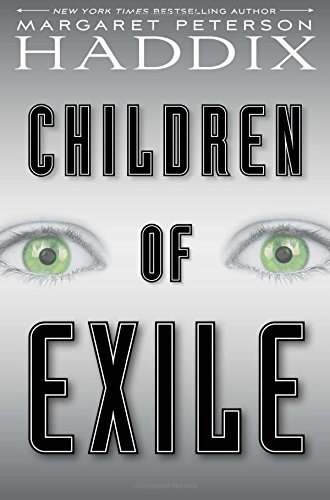
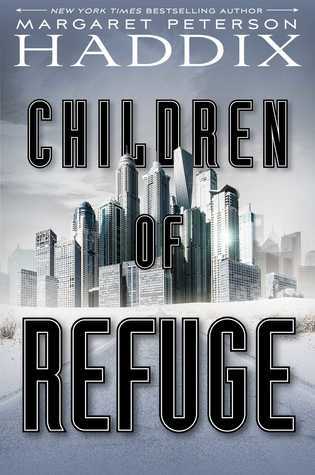
Children of Exile (#1) & Children of Refuge (#2) by Margaret Peterson Haddix

Share

Children of Exile
Published September 13th, 2016 by Simon & Schuster for Young Readers

Children of Refuge
Published September 12th, 2017 by Simon & Schuster for Young Readers

Author: Margaret Peterson Haddix

Children of Exile Summary: For the past twelve years, adults called “Freds” have raised Rosi, her younger brother Bobo, and the other children of their town, saying it is too dangerous for them to stay with their parents, but now they are all being sent back. Since Rosi is the oldest, all the younger kids are looking to her with questions she doesn’t have the answers to. She’d always trusted the Freds completely, but now she’s not so sure.

And their home is nothing like she’d expected, like nothing the Freds had prepared them for. Will Rosi and the other kids be able to adjust to their new reality?

Children of Refuge Summary: After Edwy is smuggled off to Refuge City to stay with his brother and sister, Rosi, Bobo, and Cana are stuck alone—and in danger—in Cursed Town in the thrilling follow-up to Children of Exile from New York Times bestselling author, Margaret Peterson Haddix.

It’s been barely a day since Edwy left Fredtown to be with his parents and, already, he is being sent away. He’s smuggled off to boarding school in Refuge City, where he will be with his brother and sister, who don’t even like him very much. The boarding school is nothing like the school that he knew, there’s no one around looking up to him now, and he’s still not allowed to ask questions!

Alone and confused, Edwy seeks out other children brought back from Fredtown and soon discovers that Rosi and the others—still stuck in the Cursed Town—might be in danger. Can Edwy find his way back to his friends before it’s too late?

ReviewOne thing you can always guarantee when you read a Haddix book is that it will suck you in and will be super unique! The Children of Exile series did not disappoint. I will admit, it is really hard to review either of the books without spoiling. The summaries above both did a really great job, but everything that happens after that suspense-building summary happens would spoil something for you. But I will promise you these things:

  • You will be on the edge of your seat and not be able to figure out what is going on for 90% of the first book.
  • You will be disgusted by the treatment of the children once they are returned to their parents.
  • You will want to help Edwy and his friends so badly throughout the entire second book.
  • You will have to stop reading when the reveal happens in the first book just to process it. Then you’ll reread. Then you’ll text someone who has read it.
  • You will want to know more than book 2 tells you, so we’ll all be waiting impatiently for #3.
  • You will realize that these books are actually a bit older and darker than they first seem.

Teachers’ Tools for Navigation: Like other Haddix books, you will find the best home for these books in the hands of kids. They are going to be talking about these books after they read them!

Discussion Questions: Discussion questions are available on Haddix’s website.

Flagged Passages: “‘Remember to be good little children!’

Good little children, good little children, good little children…

I saw children crying and clinging to their Fred-parents’ legs. I saw men yanking babies from their Fred-parents’ arms. I turned my back to my own Fred-mama and Fred-daddy — maybe to grab them as hard as I could — but the crowd surged just then, pushing Bobo and me up the stairs. I couldn’t see my Fred-parents anymore. I hadn’t even had a chance to tell them a proper good-bye.” (Children of Exile, Chapter 3)

“I’d been counting on being able to run fast enough no one caught up.

‘Good,’ an oily voice whispered in my ear. ‘Now you understand that screaming is useless.’

‘No, I was just–‘ Before I could add deciding what to scream next, a thick hand slid over my mouth. It smelled of onions and sweat and mud and, I don’t know, maybe puke as well.” (Children of Exile, Prologue)

Read This If You Love: Knife of Never Letting Go by Patrick Ness, Tesla’s Attic by Neal Shusterman, Masterminds by Gordon Korman, Spillzone by Scott Westerfeld

Recommended For: 

Signature

**Thank you to Casey at Media Masters for providing copies for review!**

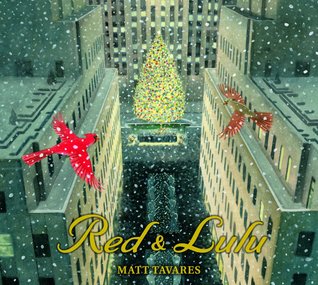
Red & Lulu by Matt Tavares

Share

Red & Lulu
Author & Illustrator: Matt Tavares
Published September 19th, 2017 by Candlewick Press

Summary: Separation and miles cannot keep a determined cardinal from his loved one in an ode to serendipity and belief that is destined to be a new Christmas classic.

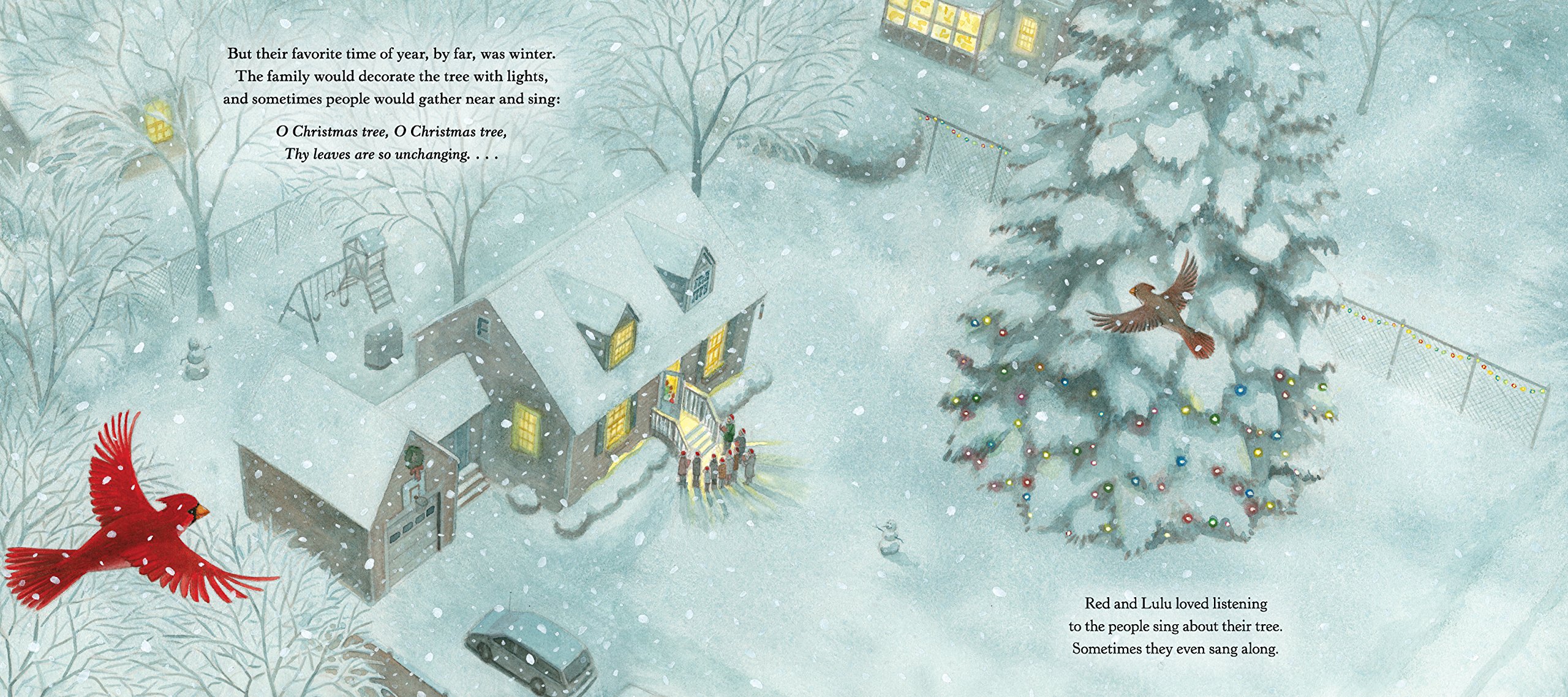
Red and Lulu make their nest in a particularly beautiful evergreen tree. It shades them in the hot months and keeps them cozy in the cold months, and once a year the people who live nearby string lights on their tree and sing a special song: O Christmas Tree, O Christmas Tree. But one day, something unthinkable happens, and Red and Lulu are separated. It will take a miracle for them to find each another again. Luckily, it’s just the season for miracles. . . .

From Matt Tavares comes a heart-tugging story combining the cheer of Christmas, the magic of New York City, and the real meaning of the holiday season: how important it is to be surrounded by love.

Review: Wow, Matt Tavares! So much is going on in this book, and it is all beautiful. First, we meet the stars of our book: Red & Lulu, and you’ll love them right away. Their love flies off the page. And the scene when they are separated broke my heart! And since I don’t read summaries, I had no idea what was going to happen, and it was so sad, but Red would not give up.

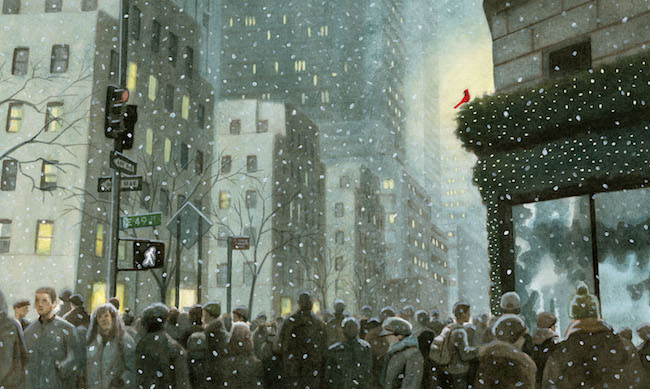
In addition to the story of love and separation, it is also a story of the Rockefeller Christmas Tree. Tavares includes back matter about the tree, its history, and traditions. Through its inclusion and the repetition of “O, Christmas Tree,” the mood is set and you are transported to NYC at Christmas time.

Finally, I cannot forget to mention the AMAZINGLY BEAUTIFUL illustrations. They took my breath away. They are edge to edge, inclusive, and so detailed.

Teachers’ Tools for Navigation: Red & Lulu is going to be an instantaneous Christmas classic! And I loved the discussion of Rockefeller Center which allows for a historical and American tradition conversation around the book.

Discussion Questions: 

  • What is so special about the very final page of the book?
  • How can you tell the difference between Red & Lulu? Why did the author choose to illustrate them that way?
  • How did the author’s repetition of “O, Christmas Tree” affect the mood of the book? And what did the lyrics indicate in the story?
  • Before you knew where Lulu ended up, what clues did Matt Tavares include to foreshadow where Lulu was?
  • Which spread of illustrations is your favorite? Why?
  • What did you learn about Rockefeller Center and its Christmas Tree from the book? What would you like to learn more about?

Flagged Passages: 

Book Trailer: 


Read This If You Love: CHRISTMAS!, Birds by Kevin Henkes, Bluebird by Bob Staake, A Christmas Wish for Corduroy by B.G. Hennessy, Other titles on my student Maria’s Top Christmas Books List

Recommended For: 

Signature

**Thank you to Candlewick Press for providing a copy for review!**


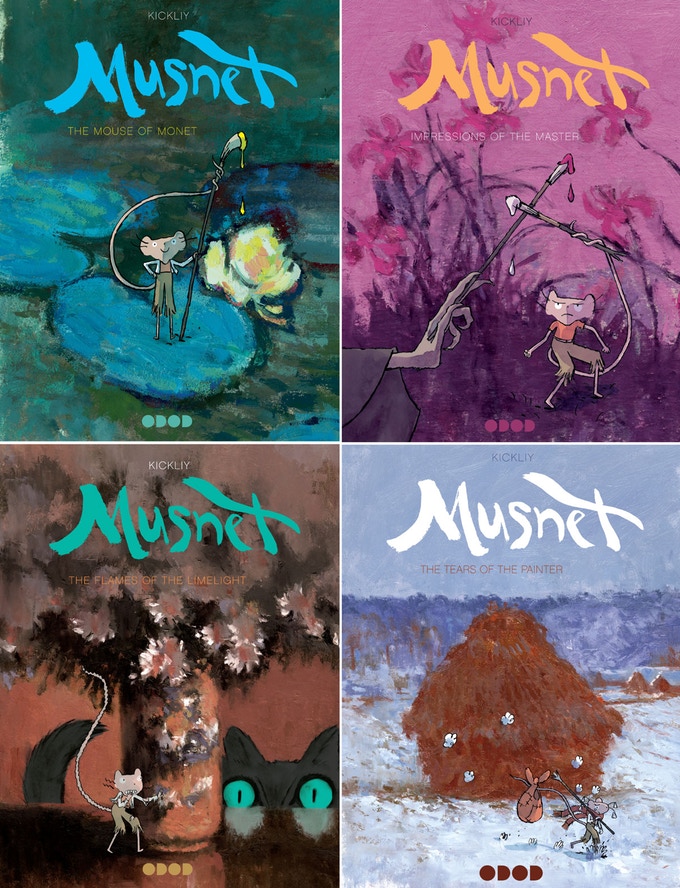
Musnet Series by Kickliy

Share

Musnet series
1. The Mouse of Monet
2. Impressions of the Master
3. The Flames of Limelight
4. The Tears of the Painter

Author: Kickliy
Published August 2nd, 2016; November 1st, 2016; April 11th, 2017; October 10th, 2017 by odod books

Summary: A young boy mouse travels the country side looking for work and happens upon the Monet’s garden. He takes on a job and becomes inspired to learn to paint. Will he paint in the classical ways, or in the new style of the impressionist? Which way will his brush sway?

Musnet wants to be the best mouse painter that ever was. But, he’s caught between two worlds. On one paw, Musnet loves the classical style of his old teacher, the squirrel Remi. On the other paw, Musnet can’t help to be drawn to the fresh and new art of the human master, Monet. Which path will the Mus choose?

It’s dark season in Musnet’s world. His adoptive family faces eviction, his Master Remi is deathly ill, he’s chased by snakes, cats, and vampire bats, and—on top of all that—Musnet faces the most challenging painting commission of his life! Can he rise to challenges and brush them all away?

As snow and ice chill Monet’s garden, even colder things await Musnet this winter season. Mya, Musnet’s best friend, gets her own adventure. Chiby, the Japanese spider, gets in a tangle with a certain muscular rat. Is there even any room left for our vagabond mouse? Drama, action, adventure, abound in the final volume of the award nominated series.

Musnet is drawn and painted in a beautiful, lush and inky style popularized by Paul Pope and French comics masters such Blutch and Christophe Blain.

“It’s a really enjoyable story that brings Monet’s paintings to life through some incredibly sweet and memorable characters. It’s challenging and imaginative, and I’m sure it will spark an obsession with painting (and maybe also mice).”—Girls Like Comics

“This new series revolves around a painting mouse found in Monet’s famous gardens in Giverny: the nameless, orphan mouse is befriended by Mya and her mouse family, who live inside the artist’s house. Introduced to painting after he begins working for Remy, an old squirrel painter, he is enchanted by Monet’s work. Beautifully painted […] charming tale of humour, art, and adventure, as the little mouse grows to find his meaning and place in the world.”—The Guardian

Musnet: The Mouse of Monet is a gorgeous and friendly story about a mouse discovering his calling in life and also what he wants to be called. Take a friendly and likable orphaned mouse, place him in a beautifully rendered watercolor and ink medium with miniature Monet masterpieces and you get a stunning and engaging story of a mouse learning to become an artist. He makes friends, finds a mentor, and even gets to sneak a peek inside Monet’s studio. It’s incredibly well executed, entertaining, informative, and absolutely absorbing. It is one of the best books I’ve read this year.” —The Picture Book Review

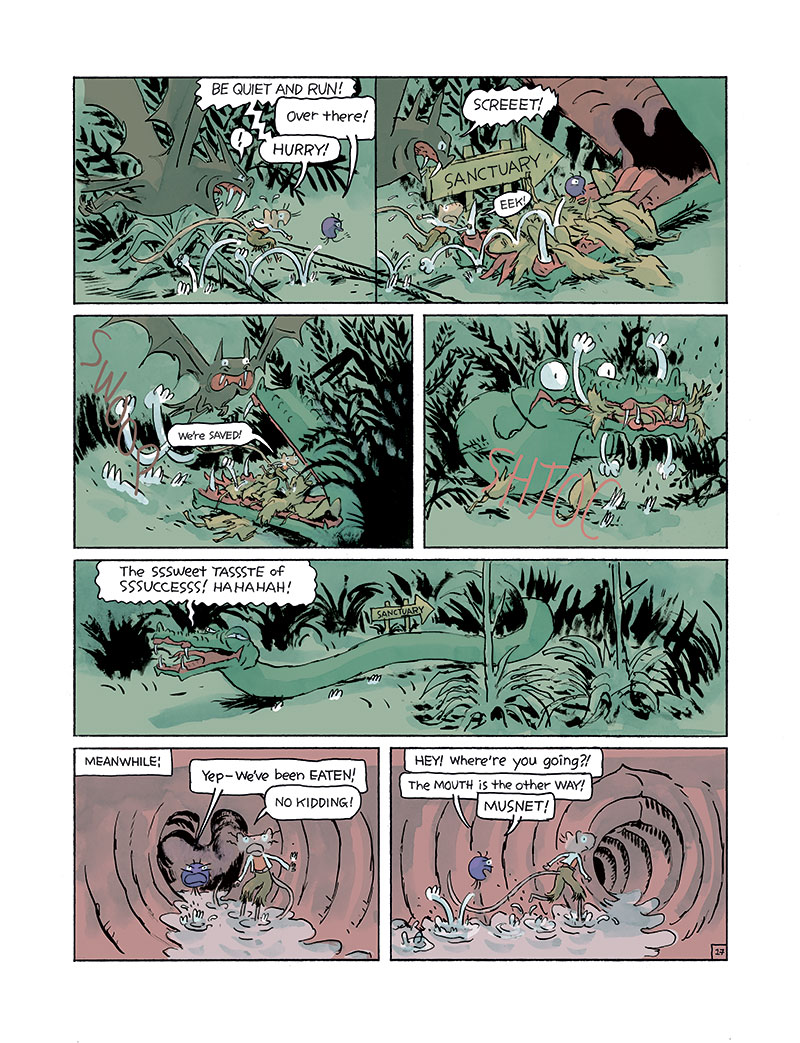
Review: After I read book one of this series, I could not wait to share it with everyone I talked to: “I love when books include art history in them because it makes me feel at home since I grew up in art museums as a museum director’s daughter. Musnet is no different. As soon as I realized that Musnet had ended up in Monet’s famous garden, I was fascinated with Musnet’s story and his journey to becoming an artist. Kickliy’s artwork pays perfect homage to Monet’s work and is a beautiful backdrop to Musnet’s story.” And I was really excited to read the rest of the books in the series.

Luckily they did not disappoint! Book one was just an introduction to the characters who continued to mature throughout the arc of the story. Musnet’s situation fluctuates causing the reader to quickly move from relief to panic which ensures the reader wants to keep going through the series. Although the series begins with Musnet just looking for a home, it ends with Musnet looking for what life has in store for him as an artist.

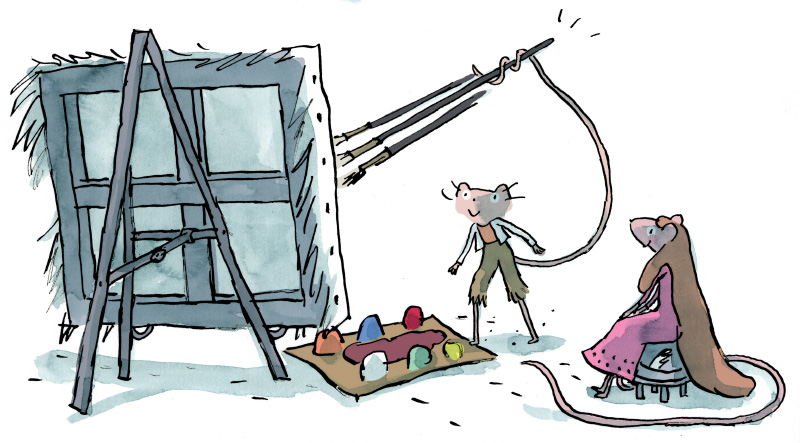
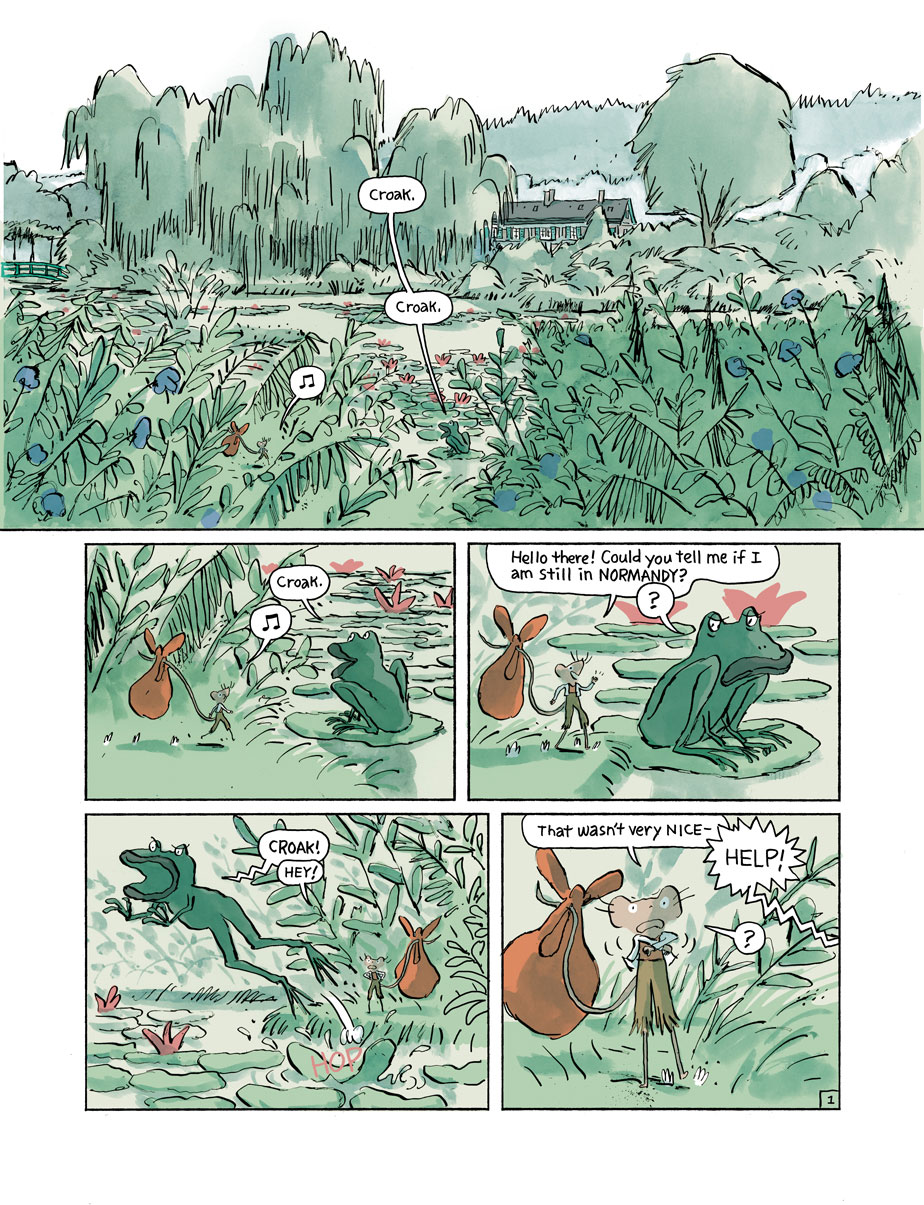
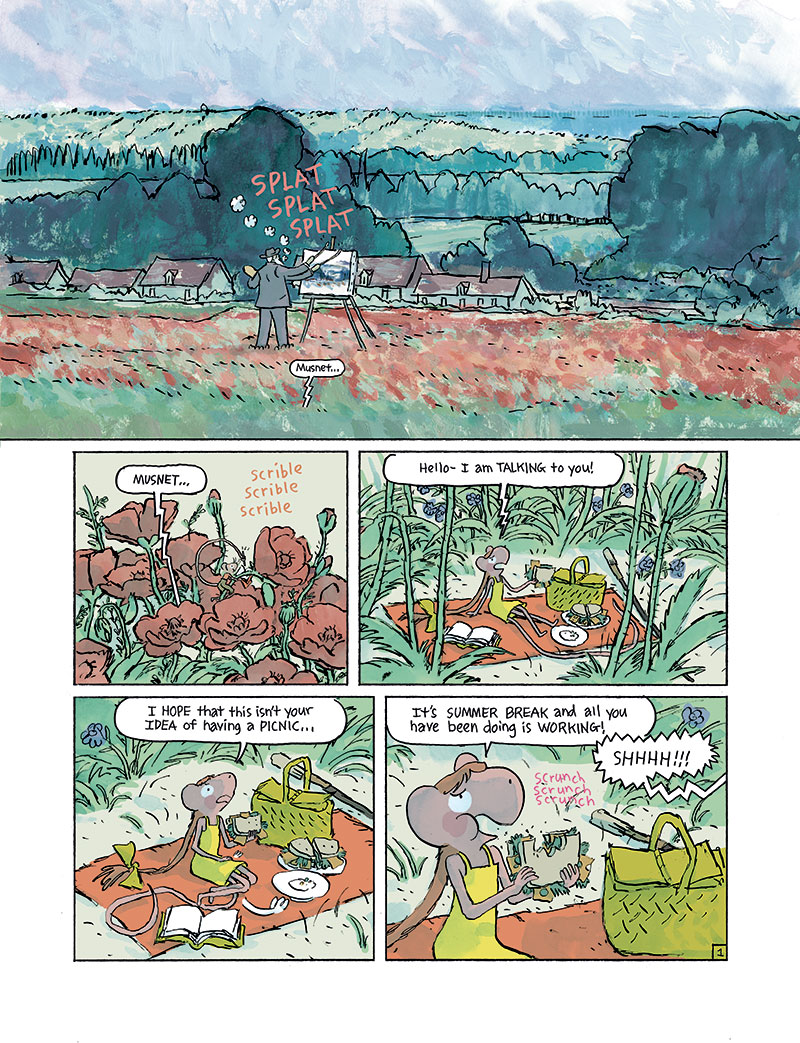
But what makes this series even more unique is the level of graphics. Kickliy’s ink, watercolor, and oil illustrations are reminiscent of the period in which Monet lived–it is like reading art. Kickliy even paints little oil paintings for the book for whenever a Musnet or Monet work is shown.

Teachers’ Tools for Navigation: “Musnet lives in Monet’s garden. Was there a roach under Van Gogh’s bed? Or a fish behind Munch’s Scream? If so, what would their story be like?” Have students create stories of animals that ‘live’ in the background of famous paintings. They’d need to research the art styles for illustrations and the time period/place of the painting for their setting, so this activity would be a perfect cross-curricular for writing, reading, art, and history.

Parts of the book would also be really great assets for engagement and information in art classrooms. Remi, Monet, and Musnet are talented artists who share insight throughout the series.

Discussion Questions: 

  • After book one, did you think Musnet was going to become a successful artist?
  • How does Kickliy’s illustrations fit the period of the book’s setting?
  • Which conflict in Musnet’s story affected Musnet’s conclusion the most?
  • Why do you think Kickliy chose Monet as the artist inspiration for his book?
  • What artist would you want to meet?
  • How did meeting Mya change Musnet’s life? Remi? Chiby?

Flagged Passages: 

Read This If You Love: Art, Graphic Novels, Monet, Mira’s Diary by Marissa Moss, The Museum by Susan Verde, Babymouse series by Jennifer and Matthew Holm, The Tale of Despereaux by Kate DiCamillo, Redwall by Brian Jacques, The Museum by Susan Verde

Recommended For: 

Signature

Teaching Guide with Activities and Discussion Questions for Charlie and Mouse and Grumpy by Laurel Snyder

Share

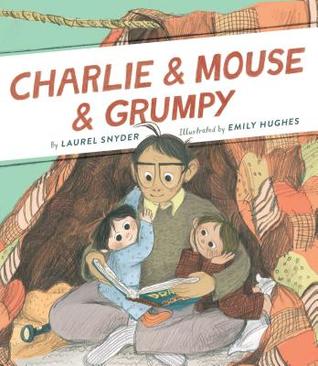
Charlie & Mouse & Grumpy
Author: Laurel Snyder
Illustrator: Emily Hughes
Published October 3rd, 2017 by Chronicle

Summary: In this heartwarming sequel to Laurel Snyder’s beginning chapter book Charlie & Mouse, the two brothers enjoy a special visit from their grandpa, Grumpy. Follow along as they discuss being medium, pounce each other, sing the wrong songs, build blanket forts, and more. Paired with effervescent illustrations by Emily Hughes, this touching, funny celebration of imagination and bonding will enchant readers young and old.

View our post about Charlie and Grumpy book one (with teaching guide) here!

Activities include: 

Bedtime Songs

Grumpy doesn’t know the right bedtime song to sing for Charlie and Mouse, so he tries to guess. Using the clues he gave, we can assume he was talking about “Circle Game” by Joni Mitchell, “Hush, Little Baby,” and possibly “Jump in the River” by Sinead O’Connor. Play these three songs for your students.

  • Which do you like the most? Why?
  • Which do you think would be the best bedtime song? Why?

After Grumpy guesses, Charlie sings the right bedtime song to Grumpy.

  • We don’t know what song Charlie sang, but what song would you have sung to Grumpy?

After gathering all of the bedtime songs discussed as a group, have students analyze the different songs (theirs and the three Grumpy mentioned) by having them (in groups or independently):

  • Identify rhyming words within the songs.
  • Does the author repeat any words? Why did the author choose to repeat these words?
  • How does the author supply rhythm in the song?

Infer

There are a few times in the book that the text doesn’t tell you what happened, but you can infer from the illustrations what occurred such as p. 17, p. 27, and p.37. Have students use the illustrations to see how each of these chapters concluded and have them write out what they see in the illustrations.

Rain

In the final chapter, it is raining while Charlie and Mouse say good-bye to Grumpy. Even though the rain seems to be happening because of the mood of the chapter, rain actually occurs because of the water cycle. After discussing the mood of the chapter (see discussion question), share the scientific reason for rain by sharing the water cycle. One activity that could be done to help students understand the water cycle is the “Simple Water Cycle in a Bag” experiment: http://www.rookieparenting.com/what-is-water-cycle/.

Discussion Questions include: 

  • The text never says that Grumpy is Charlie and Mouse’s grandfather, but you can infer he is. What clues from the text and illustration help you know that he is their grandfather?
  • In the final chapter, the author chose to have it be raining. Why does this type of weather make the most sense for this final chapter? What mood does it set for the chapter?
  • Using the clues throughout the book, how many days and nights did Grumpy stay with Charlie and Mouse? How did you know?

Teaching Guide Created by Me (Kellee): 

You can also access the teaching guide through Chronicle’s website here.

Recommended For: 

readaloudbuttonsmall classroomlibrarybuttonsmall closereadinganalysisbuttonsmall

Kellee Signature

Blog Tour with Author Guest Post with Activities and Discussion Questions!: Dragonfly Song by Wendy Orr

Share

Dragonfly Song
Author: Wendy Orr
Published October 27th, 2017 by Pajama Press

Summary: The whispers say it’s not true that the Lady’s firstborn died at birth. They say it’s worse—the baby was born with an extra thumb dangling from each wrist. If she’s not perfect, she can never follow in her mother’s footsteps.

Nobody but the old wise-woman knows what truly happened to Aissa, the firstborn daughter of the priestess. If they saw the half-moon scars on the servant girl’s wrists they would find it out, but who would look twice at lowly, mute No-Name? Then the soldiers of Crete come to the island, demanding children as tribute for their god-king’s bull dances as they do every year. Aissa is determined to seize this chance to fight for her own worth and change her destiny once and for all.

Lyrically written and refreshingly unpredictable, Dragonfly Song is a compelling Bronze Age fantasy that suggests a fascinating origin for the legend of the Minotaur and his dark tribute.

“As mesmerizing as a mermaid’s kiss, the story dances with emotion, fire, and promise.” -Kirkus Reviews, starred review

More information about Dragonfly Song: http://pajamapress.ca/book/dragonfly_song/

About the Author: Wendy Orr was born in Edmonton, Canada, but grew up in various places across Canada, France, and the USA. She studied occupational therapy in the UK, married an Australian farmer, and moved to Australia. She’s the author of many award-winning books, including Nim’s Island, Nim at Sea, Rescue on Nim’s Island, Raven’s Mountain, and Peeling the Onion.

More information about Wendy Orr: http://www.wendyorr.com/

Author-Created Activity Guide:

  • Art: In Chapter 2, Aissa and the potter’s daughter make ‘circles of flowers
    in a ring of stones.’ Later, Aissa makes patterns of flowers and shells for the fishers’ goddess (the first in Chapter 9) and patterns of rocks and her small treasures for the goddess in her sanctuary cave. Patterns are used in some religions and meditative practices; Indian or Tibetan mandalas and Navajo sandpaintings are probably the best known now.
    To draw a mandala: http://www.art-is-fun.com/how-to-draw-a-mandala/
    Ideas for mandala-type patterns using fresh flowers: http://twistedsifter.com/2014/07/flower-mandalas-by-kathy-klein/
    Make your own patterns with sea shells, flowers, pebbles, leaves, seeds, or other natural materials. Glue them into place on card, or photograph them.
  • Writing: In Chapter 24, Aissa learns to write on the clay tablets used for taxation records. The writing she used was called Linear B, and was a combination of a ‘syllabary’ – each symbol representing a syllable of a word – and ‘logograms,’ which are symbols of whole words. These tablets were supposed to be temporary, but were baked into pottery when the palaces burned down. Have students make their own clay tablets using real clay or as in these instructions: http://www.ehow.com/how_12110304_make-egyptian-hieroglyphics-tablet.html
    For some of the Linear B logograms: http://www.omniglot.com/writing/linearb.htm
  • Time Capsule: Without written historical records, interpreting archaeological finds can be very difficult. Put together ‘time capsules’ of small items – e.g. a birthday card, Barbie doll, shopping list, old iPod, CD… Break the class into small groups and have them use the items to ‘interpret’ questions such as this society’s religion, dress code, and social structure.

Author-Created Discussion Questions: 

  • Like The Hunger Games, Dragonfly Song draws on the Greek myth of Theseus, in which seven youths and seven maidens are sent as tribute from Athens to Crete, to be eaten by the monstrous half-man, half-bull Minotaur. However, Dragonfly Song looks back to the possible origins of the myth in Bronze Age Greece, and the palace of Knossos in Crete. The bull was obviously a very important symbol, probably even a god – even though the real animals would be sacrificed to their god – and there were many scenes, on paintings, vases, and gold jewellery, showing young acrobats somersaulting over the backs of bulls. What if these acrobats were part of a payment to Crete in return for protection by – or from – their powerful navy? If so, the tribute would have come from as far as the Minoan navy reached. Discuss the power of myth – why have some stories lasted for thousands of years?
  • Discuss how the physical setting of Aissa’s home is a metaphor for the grimness of her life there. (e.g. The island is rocky, poor and isolated; buildings are dark, built of rock or burrowed into the side of the mountain.) What about the springtime when she develops new strengths after being cast out of the servants’ kitchen?
  • In the Bull King’s palace, the buildings are awe-inspiring, filled with light and extraordinary art. The culture appears to be obsessed with beauty – but is there a darkness underpinning it?
  • Dragonfly Song is set in the Bronze Age, but the ordinary people of Aissa’s island still use stone tools as well. Why do you think that would be?
  • In the prologue, The Firstborn Daughter, what are the clues to tell us that this is a matriarchal society? How does it differ from a patriarchal society? The Mosuo of China are an example of a matriarchal society in the present day. https://www.youtube.com/watch?v=eoTrARDa8BU
  • Chapter 8 mentions that the chief killed the last lion for his cloak when he married the Lady. Why might he have wanted a lionskin cloak rather than a deerskin? Why do you think the islanders didn’t worry about conservation and keeping all their native species alive?
  • In Chapter 9, the servants are ‘screaming with joy at their game of hate.’ Why do you think the author described bullying Aissa as a game? How does bullying Aissa make the servants feel?
  • Aissa is an ‘elective mute’ because there is nothing physical or intellectual preventing her from speaking. However, that doesn’t mean that she could speak if she wanted to: Mama’s command, ‘Stay quiet, still as stone till I come back,’ is buried so deep in her subconscious, and is so mixed with the trauma of the family’s death and disappearance, that Aissa can’t simply decide to start talking, even when she’s safe. Would she have been more accepted by the other servants if she could talk? How might it have changed the story if she had regained her speech after singing the snake away from Luki? Do you think she could have regained her speech if she had been treated kindly after being rescued? Do you think that meeting Mama again was the only reason she regained her speech, or might it have been partly because she’d faced death in the bull ring, and was safe now? A real-life example of a child choosing to become mute after trauma is Maya Angelou’s story (summarized in Goodnight Stories for Rebel Girls).
  • Discuss the book’s structure with the students. What was their reaction to the combination of free verse and prose?
  • Wendy Orr says that using free verse made it easier for her to access and portray Aissa’s emotions. Have the students choose an emotion, e.g. rage, grief, or joy – and write about it in free verse. Next, have them write a short story using the ideas and images that arose from the verse.
  • Why do you think the author chose to write in free verse rather than rhyming, like the children’s rhyme in Chapter 10?
    Here comes rabbit, hippity hop
    See his ears flap and flop;
    Here comes hedgehog, curled up small
    Roll him over like a ball.
  • Wendy Orr says that she normally writes in silence, on the computer, but found that the verse sections for this story had to be written by hand, playing the album Agaetis Byrjun by the Icelandic band Sigur Ros. Experiment with playing different types of music as the students write verse.
  • For useful images and links, see the Pinterest board: https://www.pinterest.com/wendyorr1/dragonfly-song-bits-of-background-and-teaching-ideas/

Don’t Miss Out On the Rest of the Tour!

October 22: Unleashing Readers, Activity Guide and Discussion Questions https://www.unleashingreaders.com/
October 23: YA and Kids Book Central, Book Playlist http://www.yabookscentral.com/blog/
October 24: Log Cabin Library, Guest Post http://logcabinlibrary.blogspot.com/
October 25: The Children’s Book Review, Character Interview https://www.thechildrensbookreview.com/
October 26: Bluestocking Thinking, Review http://bluestockingthinking.blogspot.com/
October 27: Charlotte’s Library, Interview http://charlotteslibrary.blogspot.com/
October 28: A Foodie Bibliophile in Wanderlust, Interview http://www.foodiebibliophile.com/
October 29: Writers’ Rumpus, Guest Post https://writersrumpus.com/

Recommended For: 

Thank you to Wendy Orr for her fantastic activities and questions!

Review with Giveaway and YouTube Video!: Bruce’s Big Move by Ryan T. Higgins

Share

We’re so excited to be partnered with Disney-Hyperion to bring you this review and giveaway of Bruce’s Big Move! 

Bruce’s Big Move
Author & Illustrator: Ryan T. Higgins
Published September 27th, 2017 by Disney-Hyperion

Summary: After the events of Hotel Bruce, our favorite curmudgeonly bear shares his home with not only his four geese, but three rowdy mice besides! Fed up with their shenanigans, Bruce sets off to find a rodent-free household. But as usual, nothing goes quite according to plan…

A hilarious sequel for fans of the previous Bruce books, as well as a standalone discovery for new readers, Bruce’s next reluctant adventure is sure to keep kids giggling.

About the Author: Ryan T. Higgins (ryanthiggins.com) is an author and illustrator who likes the outdoors and cheese sandwiches. He is NOT a grumpy old black bear, but he DOES like making books about one—starting with the best-selling Mother Bruce, which received the E. B. White Read-Aloud Award and the Ezra Jack Keats New Illustrator Honor. He lives in Maine with his wife and kids… and too many pets.

LEARN MORE
Visit books.disney.com
Follow Disney-Hyperion on TwitterFacebook, and Instagram
#BrucesBigMove #FollowBruce

Kellee’s Review: Bruce is back and still a curmudgeon. Following the events in Mother Bruce where he becomes the mother to 4 geese and Hotel Bruce when 3 mice move in, Bruce decides enough is enough and wants to get away from the rodents once and for all, and he is willing to go to the extreme (moving) to get away. 

One of my favorite things about the Bruce books are the character’s expressions! Bruces’ stories are one only half told in the words, the rest can be found in the illustrations. The illustrations are so expressive and detailed giving each character a personality without it having to be explained.

And just like in the first two Bruce books, there is a definite message in the end! What do you think will make Bruce happy?

Ricki’s Review: I can’t decide whether I like the words or the illustrations more in this book. They are both hysterical! I absolutely adore Bruce. He makes me smile. Ryan T. Higgins is incredibly talented—I will read anything he writes!

Kellee is spot on. Bruce’s facial expressions make me laugh and laugh. I wish I captured my 4-year-old reading this book. He kept laughing and pointing to the pictures. I like the Bruce books because Higgins incorporates clear messages for readers, and he masterfully creates books that make great classroom read alouds!

Teachers’ Tools for Navigation: Use Bruce’s Big Move, and the other Bruce books, as read alouds to discuss illustrations’ purpose in stories, theme, and characterization with students. Alternatively, consider asking students to create their own Bruce fanfiction!

Discussion Questions: 

  • Why does Bruce want to get rid of the rodents?
  • On each page, look at the characters’ expressions and discuss what clues they give the reader about the character.
  • What do you think will make Bruce happy?; Did you predict the ending of the book?
  • What do you think the author’s message was at the end of the book?

Flagged Passages: 

“Bruce wished there was a way to get rid of the pesky rodents. But there wasn’t.”

Realtor Ryan help his bear friend Bruce find the perfect rodent-free home: 

Read This If You Love: The first two books in the Bruce series, You Will Be My Friend! by Peter Brown, This is a Moose by Richard T. Morris, Be Quiet by Ryan T. Higgins, Here Comes Teacher Cat by Deborah Underwood, Nibbles by Emma Yarlett

Recommended For: 

classroomlibrarybuttonsmall 

Disney-Hyperion is partnering with us for a Whole Lotta Bruce GIVEAWAY!
One (1) winner receives:
Copies of Bruce’s Big Move, Hotel Bruce, and Mother Bruce
Branded tote bag and stickers

a Rafflecopter giveaway

Signatureand 

**Thank you to Alex at Big Honcho Media for providing copies for review!**