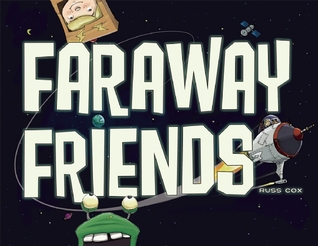
Faraway Friends Author and Illustrator: Russ Cox
Published May 5th, 2015 by Sky Pony Press
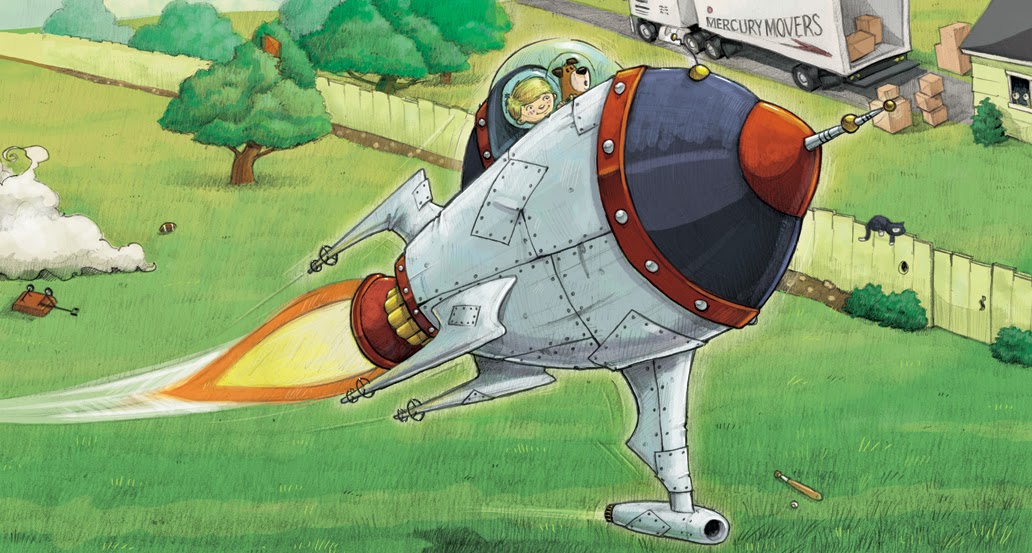
Goodreads Summary: This is the story of the adventure of a little boy named Sheldon and his dog, Jet. When Sheldon’s best friend moves away, Sheldon spies the word “Jupiter” painted on the side of the moving truck. Sheldon feels sad at first, but realizes that this is a sign—what he needs is a rocket ship! So Sheldon and Jet do some sketching and some scrounging, and, with a wagon full of equipment and supplies, the two future astronauts head to the backyard. With a glop and a wham, piece by piece the ship begins to take form, and soon it’s Commander Sheldon A. Flyer and Space Cadet Jet ready for takeoff! The duo jets around satellites, zooms by planets, speeds through space storms, and zips past other flying saucers . . . untilplop, they’ve arrived, somewhere with a green, alien life-form and a furry black blob.
This book encourages children to channel loneliness and boredom with creativity and imagination, and ultimately it is a story of new friendship. Featuring vibrant illustrations by debut author and illustrator Russ Cox, this action-packed story is sure to appeal to young readers in search of something that is out of this world!
My Review: I loved this story! It promotes imagination, has science elements, and is about the tough subject of friends moving away. When Sheldon’s best friend moves away, he believes he has moved to Jupiter so the only solution is to build a spaceship for himself and his dog, Jet, to go to Jupiter to see his friend. I adored that Sheldon went through a planning and sketching phase before building and “blasting off” with Jet. They then fly through outer space until a ship malfunction and a visiting alien change their plans. Children will love the colorful illustrations, fun adventure, and comic relief of Jet all while exploring themes of friendship, loss, and imagination.
P.S. The cover glows in the dark!!!!
Teachers’ Tools for Navigation: Like I shared above, there are some deep themes that can be addressed while/after reading this book. I also think it will promote a want to build a space ship, and it would be great to have students plan and build a spaceship (maybe not life size, but for an egg or pipe cleaner person?). The book also has onomatopoeias throughout which always makes me happy as they may be my favorite type of figurative language, and there is also great vocabulary words throughout to learn about.
Discussion Questions: Before reading, look at the cover and predict what you think the book is about. After reading, look back at the cover. What did you predict correctly and incorrectly based on the cover?; Has a friend of yours ever moved away? How did it make you feel? What did you do to help deal with the loss?; If you could build a spaceship and visit anywhere, where would you go?; When Sheldon and Jet blasted off into space, did you catch the clue for the ending in the background?
We Flagged:
(c) Russ Cox 2014
“BLAST OFF! In a spectacular plume of smoke Sheldon and Jet roared into space.”
Read This If You Loved: The Most Magnificent Thing by Ashley Spires, Journey by Aaron Becker
Recommended For:
**Thank you to Sara at Skyhorse Publishing for providing a copy for review!**
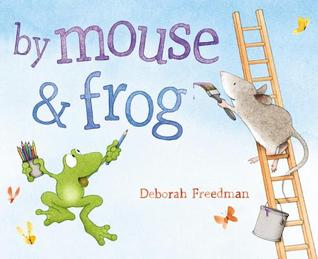
By Mouse & Frog Author and Illustrator: Deborah Freedman Published April 14th, 2015 by Viking Books for Young Readers
Goodreads Summary: Fastidious Mouse has one idea about how to tell a story. Free-spirited Frog has another. What happens when Frog crashes into Mouse’s story with some wild ideas? Chaos!…followed by the discovery that working together means being willing to compromise—and that listening to one another can lead to the most beautiful stories of all.
Kellee’s Review and Teachers’ Tools for Navigation:I love this book. There is so much wonderful in these pages. First, the book is just so funny! Mouse and Frog are so different and the back and forth is laugh-out-loud comedic. Second, the story really makes you look at personality types and think about how to work together. Frog and Mouse’s story would be a wonderful one to read and then talk about norms when working in groups on projects/assignments. Third, the book also looks at story writing and narrative elements. What is needed in a good story? Do all stories have to have the same things? All in all, this book is fun to read and will be a good jumping off point for all sorts of discussions. I think this book is going to find some major love in homes, schools, and libraries alike.
Ricki’s Review and Teachers’ Tools for Navigation: This magical story is about two friends who co-write a book together. It would be a great book to teach kids about the importance of listening and valuing others’ opinions. I would use this in the classroom at times when there is a lot of conflict. Very few students benefit from a pamphlet about conflict resolution. Instead, I would read this book aloud to students, and we could talk about the value of listening to and understanding each other. Overall, this is a great book to get students’ creative juices flowing. The whimsical creativeness of this title reminds me a bit of The Dot by Peter Reynolds, another picture book favorite.
Discussion Questions: What is needed in a good story? Do all stories have to have to have the same things?; Why didn’t Mouse and Frog get along at first? How did they compromise at the end?
We Flagged:
Read This If You Loved: Look! by Jeff Mack, The Story of Fish and Snail by Deborah Freedman, Little Red Writing by Joan Holub; The Dot by Peter Reynolds
Recommended For:
and
**Thank you to Penguin Young Readers for providing a copy for review!**
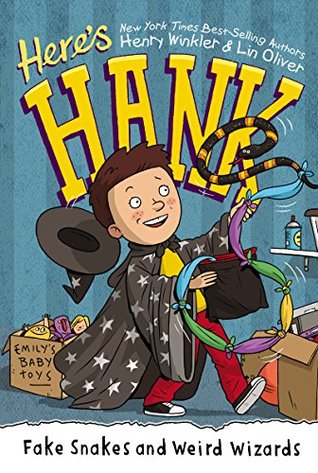
Here’s Hank #4: Fake Snakes and Weird Wizards Author: Henry Winkler and Lin Oliver
Illustrator: Scott Garrett
Published February 10th, 2015 by Grosset & Dunlap
Goodreads Summary: Hank’s sister Emily wants Ralph’s Reptile Show to perform at her birthday party more than anything, but Ralph is booked solid. So Hank comes up with a plan: he’ll disguise himself as a magician called The Westside Wizard and pull a snake from thin air! But when Hank’s true identity is revealed during his performance, his good deed might just turn into a huge disaster.
About the Authors: Henry Winkler is an actor, producer, and director, and he speaks publicly all over the world. In addition, he has a star on the Hollywood Boulevard, was awarded an honorary Order of the British Empire, and the jacket he wore as the Fonz hangs in the Smithsonian Museum in Washington, DC. But if you asked him what he was proudest of, he would say, “Writing the Hank Zipzer books with my partner, Lin Oliver,” He lives in Los Angeles with his wide, Stacey. They have three children named Jed, Zoe, and Max, and two dogs named Monty and Charlotte. Charlotte catches a ball so well that she could definitely play outfield for the New York Mets.
Lin Oliver is a writer and producer of movies, book, and television series for children and families. She has written more than twenty-five novels for children and one hundred episodes of television. She is cofounder and executive director of the Society of Children’s Book Writers and Illustrators, an international organization of twenty thousand authors and illustrators of children’s books. She lives in Los Angeles with her husband, Alan. They have three sons named Theo, Ollie, and Cole. She loves tuna melts, curious kids, any sport that involves a racket and children’s book writers everywhere.
My Review: I like Hank! I am so glad to be introduced to him! Hank is a good friend, a great brother, and just all around a good kid. This book was all about how he was going to make sure his sister’s birthday party was the best she could have. Throughout there are some funny moments and some definite “learning a lesson” times, but in the end, it is all about friends and family. I like that although Hank is a bit of a funny guy, he isn’t a trouble maker or bad kid. He is a good role model, but not over-the-top goody-goody. I think kids are going to really like him, and his books are a great early chapter book!
Teachers’ Tools for Navigation: This is the first book I’ve read that was published in Dyslexie, an easy-to-read font designed especially for dyslexic readers. Dyslexie is “designed to make letters more distinct from one another and to keep them tied down, so to speak, so that the readers are less likely to flip them in their minds. The letters in the font are also spaced wide apart to make reading them easier.” I love that Winkler, a dyslexic, is using his published novels to help make books more accessible to readers with learning disabilities.
A few facts about dyslexia:
1 in 10 Americans has dyslexia
Over 40 million American adults have dyslexia and only 2 million know it
20% of school-aged children in the US are dyslexic
Dyslexia is not tied to IQ (over 50% of NASA employees are dyslexic, as was Einstein and many other leading thinkers)
I would definitely recommend these books for classroom libraries! Not only because of the new font but because Hank is such a relatable and good kid!
Discussion Questions: Do you think Emily should have been mad at Hank?; What type of personality traits does Hank show by not giving up on learning the magic trick?; What is the one thing you would love to have at your next birthday party?
We Flagged: “Our family was spending the morning at the West End Avenue street fair. The whole block was lined with booths selling everything from blueberry muffins to tube socks. Leave it to Emily to find the one snake booth. That girl can sniff out a reptile better than my dog, Cheerio, can sniff out a hunk of pot roast under the dining-room table.” (p. 2)
Read This If You Loved: Cody and the Fountain of Happiness by Tricia Springstubb, Lulu and the Brontosaurus by Judith Viorst, Marty McGuire by Kate Messner, Leroy Ninker Saddles Up by Kate DiCamillo
Recommended For:
**Thank you to Penguin Young Readers for providing a copy for review!**
Rain Reign
Author: Ann M. Martin
Published October 7th, 2014 by Feiwel & Friends
Goodreads Summary: In her most powerful novel yet, Newbery Honor author Ann M. Martin tells the story of girl with mental/emotional challenges and the dog she loves.
Rose Howard has OCD, Asperger’s syndrome, and an obsession with homonyms (even her name is a homonym). She gave her dog Rain a name with two homonyms (Reign, Rein), which, according to Rose’s rules of homonyms, is very special. Rain was a lost dog Rose’s father brought home. Rose and Rain are practically inseparable. And they are often home alone, as Rose’s father spends most evenings at a bar, and doesn’t have much patience for his special-needs daughter.
Just as a storm hits town, Rain goes missing. Rose’s father shouldn’t have let Rain out. Now Rose has to find her dog, even if it means leaving her routines and safe places to search. Rose will find Rain, but so will Rain’s original owners.
Hearts will break and spirits will soar for this powerful story, brilliantly told from Rose’s point of view.
My Review and Teachers’ Tools for Navigation: Rose reminded me of a dear student I had when I was teaching. Because I had this strong connection with her character, I felt very attached to the story, in general. Rose is a passionate, caring young girl, and I think students will learn much from her.The story line is well-done, and I appreciated that it wasn’t a problem novel that only focused on her disorder. Her bond with her dog, her bravery, and her relationship with her uncle teach great lessons. This book reminded me of Wonder by R.J. Palacio because it teaches empathy quite well. It is one of those books that makes me want to be a better person. While Rose’s repetition may feel overdone, it is her reality, and Ann M. Martin hits that home. Rose pushes and pushes her father and teachers (at the same time as she pushes and pushes the reader) in ways that are a hallmark of Asperger’s. It shows the realities of individuals who live with this disorder. I think it is incredibly important for students to read books about people who are different from them, so they can see the similarities despite the differences in characters. I would love to use this book as a read-aloud.
Discussion Questions: Was Rose’s dad an evil man? What can we learn from him?; Do you think Rose made the right choice about Rain?; How does Rose make friends in school? What can we learn from her?
We Flagged: “I’m going to tell you a story. It’s a true story, which makes it a piece of nonfiction.”
Read This If You Loved: Rules by Cynthia Lord, Wonder by R.J. Palacio, Mockingbird by Kathryn Erskine, Out of my Mind by Sharon Draper, Each Kindness by Jaqueline Woodson; The Curious Incident of the Dog in the Night-Time by Mark Haddon
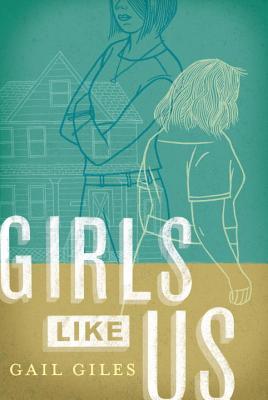
Girls Like Us Author: Gail Giles
Published May 27th, 2014 by Candlewick Press
Goodreads Summary: With gentle humor and unflinching realism, Gail Giles tells the gritty, ultimately hopeful story of two special ed teenagers entering the adult world.
We understand stuff. We just learn it slow. And most of what we understand is that people what ain’t Speddies think we too stupid to get out our own way. And that makes me mad.
Quincy and Biddy are both graduates of their high school’s special ed program, but they couldn’t be more different: suspicious Quincy faces the world with her fists up, while gentle Biddy is frightened to step outside her front door. When they’re thrown together as roommates in their first “real world” apartment, it initially seems to be an uneasy fit. But as Biddy’s past resurfaces and Quincy faces a harrowing experience that no one should have to go through alone, the two of them realize that they might have more in common than they thought — and more important, that they might be able to help each other move forward.
Hard-hitting and compassionate, Girls Like Us is a story about growing up in a world that can be cruel, and finding the strength — and the support — to carry on.
My Review: While reading this book, I had no question that it deserved the Schneider Teen Award. The Schneider Family Book Award honors a “book that embodies an artistic expression of the disability experience for adolescent audiences,” and Girls Like Us take us into Quincy and Biddy’s worlds as they learn to transition from a special-ed classroom in high school to real life in such a true matter, it definitely meets the criteria for the award. In many ways, the book is like any book about girls who just graduated from high school: learning to live with a roommate you don’t understand, learning to be responsible, etc. However, the challenges that these young ladies face because of their disabilities puts the book on a whole different level. Although the book is primarily about Quincy and Biddy’s life, it does illuminate some serious issues towards the treatment of differently abled individuals. (P.S. I love the ending very much!)
There is so much to talk about with this book! Because it impacted myself and a few of my friends, we decided to have a Twitter chat focused around it (#GLUChat). If you have read the book (because there are spoilers) check out our conversation: https://storify.com/trkravtin/girls-like-us-twitter-chat. Thank you to Teresa for archiving and Michele, Carrie, Alyson, and Leigh for taking part in it with me!
Teachers’ Tools for Navigation: The characters in this book are so complex! Even the secondary characters are fleshed out and have a presence. Girls Like Us is a wonderful example of character building and voice and how that can make (or break) a novel. It is especially fascinating to compare the voice and tone of the two girls’ sections. Extremely well crafted.
Discussion Questions: How do Quincy and Biddy complement each other?; How does Miss Lizzy help Quincy and Biddy overcome the challenges they face leaving school?; How did you (and Miss Lizzy) underestimate Quincy and Biddy? Why did you/she do so?; If you were going to record your feelings like Biddy and Quincy do, what would your recording say?; Did you predict why Biddy didn’t like males correctly? Did you predict the ending?
We Flagged: “My name is Biddy. Some call me other names. Granny calls me Retard. Quincy call me White Trash sometimes and Fool most of the time. Most kids call me Speddie. That’s short for Special Education.
I can’t write or read. A little bit, but not good enough to matter. There’s a lot of stuff I don’t know. If I could write I could make a long list. List might reach lal the way through Texas to someplace like Chicago. I don’t know where Chicago is. That’s another thing for the list.
But there’s some things I do know. And once I know a thing, I hold it tight and don’t let it stray off. Granny shouldn’t call me Retard. I know that. It ain’t nice. It hurts my feelings. I know it’s a wrong thing to hurt somebody’s feelings. I know that I ain’t White Trash. Trash is something you throw away. You don’t throw nobody away. That’s wrong. Even if my mama done it to me.” (p. 1)
Henry Aaron’s Dream Author: Matt Tavares
Published January 12th, 2010 by Candlewick Press
Goodreads Summary: Matt Tavares hits one out of the park with this powerful tale of a kid from the segregated south who would become baseball’s home-run king.
Before he was Hammerin’ Hank, Henry Aaron was a young boy grow ing up in Mobile, Alabama, with what seemed like a foolhardy dream: to be a big-league baseball player. He didn’t have a bat. He didn’t have a ball. And there wasn’t a single black ball player in the major leagues. B ut none of this could stop Henry Aaron. In a captivating biography of Henr y Aaron’s young life – from his sandlot days through his time in the Negro Leagues to the day he played his first spring training game for the Braves – Matt Tavares offers an inspiring homage to one of baseball’s all-time greats.
There Goes Ted Williams: The Greatest Hitter Who Ever Lived Author: Matt Tavares Published February 14th, 2012 by Candlewick Press
Goodreads Summary: A lively picture book biography of Ted Williams from a master of the genre — just in time for Fenway Park’s centennial.
Ted Williams lived a life of dedication and passion. He was an ordinary kid who wanted one thing: to hit a baseball better than anyone else. So he practiced his swing every chance he got. He did fingertip push-ups. He ate a lot of food. He practiced his swing again. And then practiced it some more. From his days playing ball in North Park as a kid to his unmatched .406 season in 1941 to his heroic tours of duty as a fighter pilot in World War II and Korea, the story of Teddy Ballgame is the story of an American hero. In this engrossing biography, a companion to Henry Aaron’s Dream, Matt Tavares makes Ted Williams’s life story accessible to a whole new generation of fans who are sure to admire the hard work, sacrifice, and triumph of the greatest hitter who ever lived.
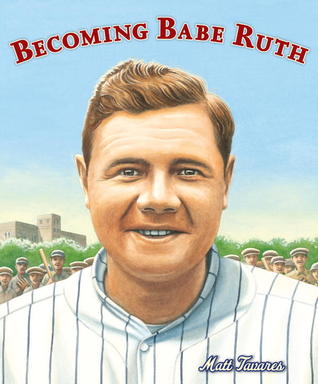
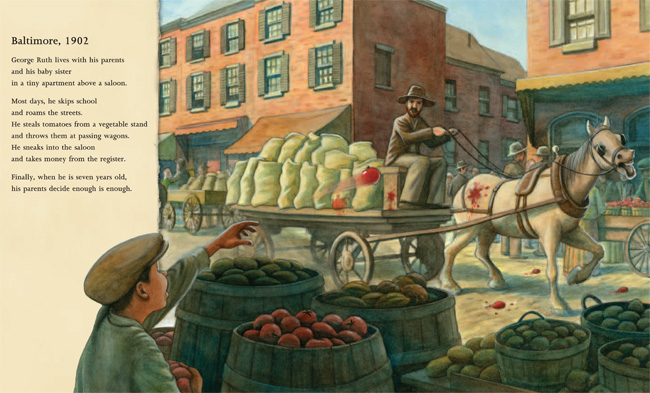
Becoming Babe Ruth Author: Matt Tavares Published February 12th, 2013 by Candlewick Press
Goodreads Summary: Matt Tavares’s striking homage to one of baseball’s legends offers a rare view into Babe Ruth’s formative years in “the House that built Ruth.”
Before he is known as the Babe, George Herman Ruth is just a boy who lives in Baltimore and gets into a lot of trouble. But when he turns seven, his father brings him to the gates of Saint Mary’s Industrial School for Boys, and his life is changed forever. At Saint Mary’s, he’s expected to study hard and follow a lot of rules. But there is one good thing about Saint Mary’s: almost every day, George gets to play baseball. Here, under the watchful eye of Brother Matthias, George evolves as a player and as a man, and when he sets off into the wild world of big-league baseball, the school, the boys, and Brother Matthias are never far from his heart. With vivid illustrations and clear affection for his subject, Matt Tavares sheds light on an icon who learned early that life is what you make of it — and sends home a message about honoring the place from which you came.
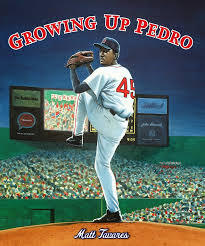
Growing Up Pedro: How the Martinez Brothers Made it From the Dominican Republic All Way to the Major Leagues Author: Matt Tavares Published February 10th, 2015
Goodreads Summary: The love between brothers is key to Matt Tavares’s tale of Dominican pitcher Pedro Martinez, from his days of throwing rocks at mangoes to his years as a major-league star.
Before Pedro Martinez pitched the Red Sox to a World Series championship, before he was named to the All-Star team eight times, before he won the Cy Young three times, he was a kid from a place called Manoguayabo in the Dominican Republic. Pedro loved baseball more than anything, and his older brother Ramon was the best pitcher he’d ever seen. He’d dream of the day he and his brother could play together in the major leagues—and here, Matt Tavares tells the story of how that dream came true. In a fitting homage to a modern day baseball star, the acclaimed author-illustrator examines both Pedro Martinez’s improbable rise to the top of his game and the power that comes from the deep bond between brothers.
My Review: These four superbly crafted biographies take a look at the life of each man, but as more than a baseball player. We learn about their childhoods, where they came from, and their dreams and hopes. Each book includes aspects of the history surrounding them including the Depression, wars, and racism. Additionally, these books are crafted beautiful with lyrically written prose. These books are must reads for lovers of baseball, history, and biographies in general.
Teachers’ Tools for Navigation: I was lucky enough to be asked to write a teachers’ guide for each of these books. For each book, I created discussion questions and activities (including cross-curricular activities). I plan on using this guide in my own classroom with the books in a lit circle type of setting. Each group will be given one of the biographies, will complete the discussion questions and activities, and then become experts on their player before presenting. These biographies are asking to be in classrooms, and I hope the guide helps show how they can fit into a language arts/reading class.
Becoming Babe Ruth
News spread differently in the early twentieth century. Discuss with your students the way news about Babe Ruth was spread during his lifetime and have students find examples in the text. Then have them discuss the way news is spread digitally nowadays. Invite the class to debate the pros and cons of digital news.; How did Babe Ruth’s life change when he left Saint Mary’s to play for the Orioles?
There Goes Ted Williams Have students write down Ted Williams’s batting average and home run stats as well as those of two other Hall of Famers. After comparing the players’ stats, have students write a paragraph discussing whether or not they believe that Ted Williams is the best hitter ever.; How did Ted Williams’s childhood perseverance help him become a professional baseball player?
Henry Aaron’s Dream Baseball began integrating before all cities in the United States had ended segregation. As a class, discuss how this reality affected black players on major-league baseball teams and how black players’ trips to segregated cities differed from those of their white teammates. Then, with your students, complete a graphic organizer comparing and contrasting the life of white and black baseball players during Hank Aaron’s lifetime. Invite students to write an essay about how life has changed for players of color over time.; How did Jackie Robinson influence Henry Aaron? What did Jackie Robinson’s accomplishments mean for other black baseball players?
Growing Up Pedro Pull up a map of North America. Have students mark all the different places that Pedro played: the Dominican Republic, Montana, Montreal, and so on. Ask students to determine the miles between each location. Which place was the farthest from Pedro’s home? Which place was the closest?; Have students write a journal entry as Pedro Martínez. Invite them to write, from Pedro’s point of view, what it feels like to move so far away from home when he is so young. Does he miss his family? Is he sad, happy, or excited to be in Montana.
Discussion Questions: Examples of discussion questions and activities for each of the biographies can be found in my teachers’ guide; however, after reading all four of the books, two discussion questions could be: Most of the baseball players had a mentor or idol that he looked up to and learned from. How did these mentors or idols help guide the players into becoming the greats they are?; Each of the baseball players helped a charity that was close to his heart. Who did each player help? Why did players choose the charity they did?
We Flagged:
http://www.matttavares.com/becomingbaberuth.html from Becoming Babe Ruth
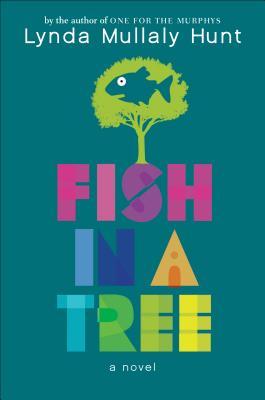
Fish in a Tree
Author: Lynda Mullaly Hunt
Published February 5th, 2015 by Nancy Paulsen Books
Goodreads Summary: The author of the beloved One for the Murphys gives readers an emotionally-charged, uplifting novel that will speak to anyone who’s ever thought there was something wrong with them because they didn’t fit in.
“Everybody is smart in different ways. But if you judge a fish by its ability to climb a tree, it will live its life believing it is stupid.”
Ally has been smart enough to fool a lot of smart people. Every time she lands in a new school, she is able to hide her inability to read by creating clever yet disruptive distractions. She is afraid to ask for help; after all, how can you cure dumb? However, her newest teacher Mr. Daniels sees the bright, creative kid underneath the trouble maker. With his help, Ally learns not to be so hard on herself and that dyslexia is nothing to be ashamed of. As her confidence grows, Ally feels free to be herself and the world starts opening up with possibilities. She discovers that there’s a lot more to her—and to everyone—than a label, and that great minds don’t always think alike.
My Review: I adore so much about this book.
Ally is so many students that I have had over the years that just needed a teacher to take the time.
Mr. Daniels is the teacher that I hope I am, that I wish I could be, that I want all teachers to be, and that I want to be friends with.
Ally’s journey is one that I hope I inspire my students to have.
Keisha is the friend I wish I’d had.
Albert is so many student in our schools that are just a bit different thus leading to a life of sorrows.
Shay shows that meanness often is because of meanness.
Travis shows that it is never too late to change a kid’s life.
So many special characters, and such a special story.
Once again, Lynda Mullaly Hunt made me cry. Well done!
Teachers’ Tools for Navigation: This book is written to be read by teachers and kids. Its home is in classrooms and libraries. Buy it, read it, and share it with some kids.
Discussion Questions: Why does Ally get in trouble so much at the beginning of the book?; What clues are given that Travis struggles with reading as well?; How does Keisha’s friendship help Ally?; Have you had a teacher like Mr. Daniels who changed your life? Tell us about him/her.
We Flagged: “Seven schools in seen years, and they’re all the same. Whenever I do my best, they tell me I don’t try hard enough. Too messy. Careless spelling. Annoyed that the same word is spelled different ways on the same page. And the headaches. I always get headaches from looking at the brightness of dark letters on white pages for too long.
Mrs. Hall clears her throat.
The rest of the class is getting tired of me again. Chairs slide. Loud sighs. Maybe they think I can’t hear their words: Freak. Dumb. Loser.” (p. 2-3)
Read This If You Loved: Bluefish by Pat Schmatz, The Secret Hum of Daisy by Tracy Holczer, Rain Reign by Ann M. Martin, Wonder by RJ Palacio
Recommended For:
**Thank you to Penguin and Susan Dee for providing copies for review**