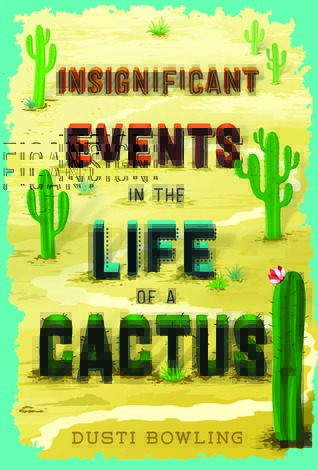
Insignificant Events in the Life of a Cactus by Dusti Bowling

Share

Insignificant Events in the Life of a Cactus
Author: Dusti Bowling
Published September 5th, 2017 by Sterling Children’s Books

Summary: Aven Green loves to tell people that she lost her arms in an alligator wrestling match, or a wildfire in Tanzania, but the truth is she was born without them. And when her parents take a job running Stagecoach Pass, a rundown western theme park in Arizona, Aven moves with them across the country knowing that she’ll have to answer the question over and over again.

Her new life takes an unexpected turn when she bonds with Connor, a classmate who also feels isolated because of his own disability, and they discover a room at Stagecoach Pass that holds bigger secrets than Aven ever could have imagined. It’s hard to solve a mystery, help a friend, and face your worst fears. But Aven’s about to discover she can do it all . . . even without arms.

Praise: 

*“Aven is a perky, hilarious, and inspiring protagonist whose attitude and humor will linger even after the last page has turned.” —School Library Journal (Starred review)

“Connor’s Tourette’s support-group meetings and Aven’s witty, increasingly honest discussions of the pros and cons of “lack of armage” give the book excellent educational potential. . . . its portrayal of characters with rarely depicted disabilities is informative, funny, and supportive.” —Kirkus Reviews

“Bowling’s sensitive and funny novel . . . demonstrates how negotiating others’ discomfort can be one of the most challenging aspects of having a physical difference and how friendship can mitigate that discomfort. . . . [an] openhearted, empathic book. —Publishers Weekly

Review: From the very first page, you know that Aven is awesome. In the first paragraph you learn that she doesn’t have arms but it doesn’t matter to her. The only reason why she is upset is because someone else freaked out about her armlessness. She is brave and funny and resilient. The way that she is able to joke around about her physical difference to help ease the reader and the other characters is a true talent. The stories she creates about what happened to her arms just to freak people out truly cracked me up. And Aven’s awesomeness is followed closely by her parents’. I adore them. They are the pinnacle of parents. They are kind yet tough and are raising an independent, wonderful young woman. Then there is Connor who is also so well-crafted. His Tourette’s syndrome is dealt with in a thoughtful way and also doesn’t define Connor just like Aven’s armlessness doesn’t define her. This is a book of amazing characters coming together to find their place in the world.

You are going to love this book. Your students are going to love this book. Parents are going to love this book. Your fellow teachers are going to love this book. This is a book that is going to get a lot of love!

Check out Dusti’s “Spotlight on Dusti Bowling” feature in Publishers Weekly to hear more about her inspirations.

Teachers’ Tools for Navigation: Please add this title to your collection of read aloud and classroom library books that you share with students to promote empathy, kindness, and friendship with those with differences as well as facing hardship and stepping up to challenges. You will not be disappointed!

Discussion Questions: After reading Aven and Connor’s story, how has your attitude and future actions towards those with differences changed?; How was Aven’s story inspiring to you?; Why did you feel that author made the choice to have Aven’s family move at the beginning of the book?; Did you predict the connection to Stagecoach Pass?; How were Connor and Aven able to help each other?

Flagged Passages: “When I was little, a kid pointed at me on the playground and shouted, ‘Her arms fell off!’ then ran away screaming in terror to his mom, who had to cuddle him on her lap and rub his head for like ten mintues to get him to calm down. I think, up until then, I hadn’t thought about the idea that my arms must have actually fallen off at some point in my life. I had never really thought about not having arms at all.

My missing arms weren’t an issue for me or my parents. I never once heard either of them say, ‘Oh, no, Aven can’t possibly do that because that’s only for armed people,’ or ‘Poor Aven is so helpless without arms,’ or ‘Maybe Aven can do that one day, you know, if she ever grows arms.’ They always said things like, ‘You’ll have to do this differently from other people, but you can manage,’ and ‘I know this is challenging for you. Keep trying,’ and ‘You’re capable of anything Aven.’

I had never realized just how different I was until that day that horrible kid shouted about my arms having fallen off. For the first time I found myself aware of my total armlessness, and I guess I felt like I was sort of naked all of a sudden. So I, too, ran to my mom, and she scooped me up and carried me away from the park, allowing my tears and snot to soak her shirt.” (Chapter 1)

Read This If You Love: Wonder by RJ Palacio, Forget Me Not by Ellie Terry, Out of My Mind by Sharon Draper, The Honest Truth by Dan GemeinhartFish in a Tree by Lynda Mullaly Hunt, How to Speak Dolphin by Ginny RorbyRain Reign by Ann M. MartinEmmanuel’s Dream by Laurie Ann Thompson

Recommended For: 

classroomlibrarybuttonsmall 

Signature

**Thank you to Dusti Bowling and Sterling for providing a copy for review!**

Interview with Kim Harrington, Author of the Gamer Squad Series

Share

Thank you, Kim, for telling us about your new series!

 Tell us about the GAMER SQUAD series.

GAMER SQUAD is three-book series about a group of gamer kids who have to save their town from mobile game related disasters. The books have humor and heart, encourage girls in STEM, and focus on a love for community. I had so much fun writing them!

Your main character, Bex, is a gamer girl and wants to be a programmer when she grows up. Do you have any of this in your background?

Yes! I’ve been playing computer games since I got my first TI-99 and Commodore 64 (really dating myself here-ha!). At Bex’s age, I enjoyed playing around with some light programming at home in BASIC. Like Bex, I was self-taught. In high school, I took Pascal. And my first job out of college was programming for the IBM AS/400. But I have no idea how to program apps, which is Bex’s interest. So I had to get some help with that when it became a plot point in the second book.

In addition to the gaming and action, are there any themes you touch upon in the books?

Middle school can be a rough time for a lot of kids (it was for me), and I include a lot of these issues across the three books—from first crushes to bullying, losing and gaining friendships. It’s also a time where kids are trying to figure out who they are and who they want to be. Due to some changes in Charlie’s life, a big theme of the second book is that you don’t have to put yourself in a box and be one thing. And this stems from me growing up with vastly different interests. I was a huge reader and writer but also loved gaming and programming. It seemed unusual at that age to be in both Creative Writing and Programming for Pascal, but you don’t have to commit to one interest or label yourself.

What was your favorite part of researching for the series?

The obvious answer would be playing games! But it’s actually something else. In book two, CLOSE ENCOUNTERS OF THE NERD KIND, the kids go on a field trip to an observatory. When they play their mobile game too close to a radio telescope, they accidentally summon real aliens to town. I knew I wanted the observatory scenes to be as realistic as possible so I actually toured an observatory. It was a blast! Their telescope was amazing, and we got to see a star, a nebula, and incredible details of the moon.

What’s happening next in the series?

After the Gamer Squad saves the town from not-so-virtual monsters in book one and aliens in book two, they find themselves up against the biggest challenge of all. In book three, APP OF THE LIVING DEAD (coming October 3rd), the kids must save their town from zombies and the game development company that has been causing all this trouble.

Author Bio

Kim Harrington is the author of Clarity, Perception, The Dead and Buried, and Forget Me for teens and the Sleuth or Dare and Gamer Squad series for kids. She lives in Massachusetts with her husband and son. When not writing, she’s most likely reading, watching one of her favorite TV shows, or fantasizing about her next vacation. She can be found on Twitter (@Kim_Harrington), Instagram (@KimHarringtonAuthor) and on her website: www.kimharringtonbooks.com.

Book Summaries

GAMER SQUAD #1: ATTACK OF THE NOT-SO-VIRTUAL MONSTERS
Sterling Children’s Books, August 1, 2017

What happens when your cool virtual-reality game . . . becomes REAL?

Pokémon GO meets The Goonies in this action-packed middle-grade series.

Monsters Unleashed—where you catch virtual-reality monsters on your cellphone—is one of the hottest mobile games around, and Bex and Charlie just can’t stop playing. They even check out an old map in Charlie’s grandfather’s attic in hopes of discovering some forgotten places in town where the rarest monsters might hide. But they find a strange machine up there too, and after Charlie switches it on, the WiFi goes down . . . and Bex’s entire catalog of monsters vanishes! And that’s not the worst of it: all the creatures she’s collected on her phone escape into the real world. Can the friends nab the beasts before they become monster lunch?

GAMER SQUAD #2: CLOSE ENCOUNTERS OF THE NERD KIND
Sterling Children’s Books, August 1, 2017

First they took on monsters. Now they have to face ALIENS.

Come join Bex and Charlie on their second thrilling adventure in the GAMER SQUAD series!

After their scary adventure, Bex and Charlie have sworn never to play Monsters Unleashed again. Then Veratrum Games Corp releases a new augmented reality game featuring aliens instead of monsters, and the best friends just can’t resist. After all, everyone loves it, even their science teacher, because it includes real star charts. But when they go to an observatory on a class trip, and open the game near a radio telescope, they get more than they bargained for: REAL aliens. One is sweet and kind; the other . . . not so much. Can Bex and Charlie capture the bad ET before it destroys their town?

Thank you, Kim, for stopping by Unleashing Readers! 

Everyone, make sure to check back on August 30th for Kellee’s review of the Gamer Squad’s first book!

 and

Author Guest Post and Giveaway!: “Creepy Crawley Science” by Kim Kasch, Author of Irma the Inventor and the Vampire Spiders

Share

“Creepy Crawley Science” 

S.T.E.M. (or Science, Technology, Engineering and Math) might not sound interesting to you. But, did you know when you play with Legos you’re using a form of engineering to create something?

And, who isn’t interested in flying cars, robots, and undersea ships? Well, those things are simply science, technology, engineering and math set in motion.

It’s all about finding easy ways to use these complicated disciplines to create new opportunities with common components…and some not so common ingredients, like spider silk.

Believe me, these teeny-tiny creatures create silk that can be used for breathtaking breakthroughs.

Spiders . . . ?

Yes. Spiders. I know you might think these eight-legged creatures sound more creepy than creative but did you know that spider silk is one of the strongest substances around? Well, it is. Scientists even call spider silk a “wonder material”.

I’m talking about that sticky stuff you sometimes walk through in the garden that sends shivers running up your spine.  Walking through a spider web immediately sends you searching for those little, unwelcome visitors which might be hiding in your hair. And, it’s stronger than steel and super flexible.

For decades scientists have been searching for a convenient way to harvest that silk so they would be able to use huge quantities.

It’s true. They have.

But, as you might expect, very few people want to become spider farmers simply to spend their afternoons walking up and down spider-infested rows to collect sticky webs dangling from trees, stuck to shrubs or clinging to bushes.

So what’s the answer to this scientific conundrum?

Well, you might want to read this article to find out more about sustainable spider silk: https://www.businessgreen.com/bg/news/3013893/scientists-develop-sustainable-spider-silk-in-green-materials-breakthrough in BusinessGreen.com

And if you think that’s interesting, you really might enjoy reading Irma the Inventor and the Vampire Spiders.

How many kids do you know who can build robotic spiders out of scrap metal, develop a substance that’s stronger than steel, or crash a cyber-wizard’s computer from an undetectable monitor? Well, that’s Irma. Still, all she really wants is to make some friends and blend in for once, but no matter how hard she tries, Irma always seems to stand out.

This laugh-out-loud middle grade novel encourages readers to explore the STEM fields while never losing its sense of fun.

Irma the Inventor & the Vampire Spiders
Author: Kim Kasch
Published August 21st, 2017 by 50/50 Press

About the Book: 

How many kids do you know who can build robotic spiders out of scrap metal, develop a substance that’s stronger than steel, or crash a cyber-wizard’s computer from an undetectable monitor? Well, that’s Irma. Still, all she really wants is to make some friends and blend in for once, but no matter how hard she tries, Irma always seems to stand out.

This laugh-out-loud middle grade novel encourages readers to explore the STEM fields while never losing its sense of fun.

About the Author Kim Kasch: 

I grew up in a family with 9 kids and grandma living in the back bedroom. Not surprising that I have a few stories to tell, especially since we only had 1 t.v.

I spent my days reading and, later, trying to create another world where I could escape all those brothers and sisters-and grandma-by writing. Maybe that’s why I love books so much. Well, that and the fact that I was near the end of that long sibling-chain and never had the clout to pick the t.v. shows we watched. But I’d run home after school to catch the last fifteen minutes of Barnabus Collins in Dark Shadows…

I still love to run or maybe I should say, I love to wog (a cross between walking and jogging).

Here in Portlandia, I love Halloween themed runs – where people don costumes and run. It’s a lot of fun…and I know those two words don’t always go together: fun…and…run. But here, in the damp days of fall, I think it is.

And, with all those Halloween themed runs, I guess Dark Shadows had more of an influence than some people might think. Even today my favorite author is Stephen King. My all-time favorite book is Salem’s Lot, which might have something to do with Irma the Inventor and the Vampire Spiders 🙂 

Sorry to be so long-winded but did I say I love to write, and talk, and knit, and sew, and bake… I could go on but I’ll stop by saying, I hope you’ll stop by my blog, send me a tweet, or check out my Facebook page. I’ll be sharing news about new books over there.

Thanks for listening and, hopefully, reading 🙂

Join me on Twitter or stop by and see what I’m pinning on  Pinterest and, if you read Irma the Inventor and have a question or simply want to share a comment, please feel free to send me an email. I love connecting with readers.

Goodreads
Amazon Author Page
Facebook
Website

GIVEAWAY!!!

Enter to win a STEM prize package and a copy of Irma the Inventor and the Vampire Spiders!

a Rafflecopter giveaway

Thank you, Kim, for this science-rific guest post and giveaway!

 and

Author Guest Post!: “How Do You Engage Restless Fourth Graders During the Last Weeks of School? With a Good Book, Of Course!” by Miriam Spitzer Franklin, Author of Call Me Sunflower

Share
 “How Do You Engage Restless Fourth Graders During the Last Weeks of School? With a Good Book, Of Course!”

This spring I was asked to fill in for a fourth grade teacher on maternity leave. I was excited to get back in the classroom, though a little nervous about taking over during those last hazy crazy days when students have already checked out and are dreaming of spending their homework-free vacation at the swimming pool or doing some other activity that doesn’t involve sitting still and listening to the teacher.

When I stepped in during April, most of the weeks were full of to-do lists with structured plans already in place. But once the end-of-year testing was completed, I was left with three weeks to fill. I was told I should continue the math lessons according to the manual, and should do some project-based learning to cover the science unit on matter.

But what was the best use of time during the language arts block? The director said I didn’t need to continue with vocabulary or spelling units. We had finished Junior Great Books, and there wasn’t a reading workshop set in place. So how was I going to keep my restless students engaged and involved for the last three weeks of school? The answer was simple: by reading an amazing book.

Luckily, I found a worn-out set of Number the Stars by Lois Lowry, one of my all-time favorites and a novel I had taught to sixth graders for many years. Since the students in my class were reading above grade level and this was a Jewish Day School, I felt the difficulty and content would be appropriate for fourth grade.

I introduced the book in the usual way: studying the cover, giving some author background, finding out what students knew about the Holocaust, doing a quick map study. The real fun began when I told the class we were going to hold Reader’s Theater each day to read and act out the chapters together. I set up some ground rules:

1) You may turn down a part if you don’t want it

2) We will rotate the parts each day

3) If you participate, you must try your best to read loudly and with expression

4) You should act out any motions described by the narrator

5) Anyone who does not take his/her part seriously will be replaced by another student for the day

Each day, I made a list of props that would be helpful for the next day’s reading and asked for volunteers to bring them in. Students began bringing in other props that they thought of as well. I used name cards to randomly draw parts until all students had been chosen. Sometimes I swapped out partway through a chapter, depending on the length.

I made up Rule #1 since some students did not want roles for the opposite gender, and I wanted to allow them the choice of just following along if they did not want to be onstage. (This would also be helpful if you have a classroom of varied reading skills so that everyone has the option of participating.) I began by reading the part of Narrator but about halfway through the book I chose others to read the part.

I included Rule #5 because I wanted the students to understand and respect the seriousness of the story. I had to give a few warnings and remind students of their goals, but I only had to replace a student once for talking in a silly voice during a serious scene. This was a learning experience for everyone as it led to journal responses and a discussion about what it would feel like if you were woken in the middle of the night by Nazi soldiers looking for your best friend.

We covered two chapters each day, one with Reader’s Theater and one read silently. Students kept journals where they wrote predictions along with other responses each day. Sometimes they responded to specific prompts; sometimes they wrote from the point of view of a character; sometimes they picked out the best descriptions and drew pictures to match. We started each day with a swapping of journals and a brief discussion in small groups. We finished the book in a little over two weeks, leaving the last week for final activities that included group murals, A to Z picture books, character interviews, and quiz bowls.

During the last few weeks of school, there were unexpected interruptions: extra practices for the end-of-year musical performance, an invitation to watch another class’s PBL presentations, a guest speaker. We may not have gotten to journal entries each day, but through it all, we never skipped the day’s reading. Students came in talking about the book in the morning, wanting to play with the props and act out parts.

No one can deny that it’s hard to hold a student’s attention during those hot last days of school when fourth graders are already looking at themselves as fifth graders and students are ready to escape the four walls of the classroom and run barefoot through the grass, the sun beating down on their shoulders.

But as I discovered when I taught fourth grade this year: if there was one time where I captured the attention of all of my students, it was during reading time. So if you want to beat the I’m-ready-for-summer-vacation blues, find a good book and read it from start to finish during the last weeks of school. Lois Lowry wove a spell over my students and made them forget that school was almost out. For an hour each day, we were transported to a different time and place where the challenges the characters faced became challenges of our own. This is the power of the well-chosen word; this is the magic of books.

About the Book:

Sunny Beringer hates her first name—her real first name—Sunflower. And she hates that her mom has suddenly left behind her dad, Scott, and uprooted their family miles away from New Jersey to North Carolina just so she can pursue some fancy degree. Sunny has to live with a grandmother she barely knows, and she’s had to leave her beloved cat and all her friends behind. And no one else seems to think anything is wrong.

So she creates “Sunny Beringer’s Super-Stupendous Plan to Get My Parents Back Together”—a list of sure-fire ways to make her mom and Scott fall madly in love again, including:

Send Mom flowers from a “Secret Admirer” to make Scott jealous and make him regret letting them move so far away.
Make a playlist of Scott’s favorite love songs—the mushier the better—and make sure it’s always playing in the car.
Ask them about the good old days when they first fell in love.

But while working on a photo album guaranteed to make Mom change her mind and rush them right back home, Sunny discovers a photo—one that changes everything.

Sunny’s family, the people she thought she could trust most in the world, have been keeping an enormous secret from her. And she’ll have to reconcile her family’s past and present, or she’ll lose everything about their future.

Review from Atlanta Journal Constitution: “Much as she did in her 2015 debut “Extraordinary,” North Carolina author Franklin delivers a moving and realistic story (with subplots, such as one that involves protesting the luxury fur business). “Sunflower” shines with emotion, convincing dialogue and relatable characters.”

About the Author:

Miriam Spitzer Franklin has taught elementary and middle school students for over 20 years in public, private, and homeschool settings. She is passionate about reading, writing, figure skating, and animal rights and environmental causes. She has coached her daughter’s Odyssey of the Mind team for the past five years and loves to see creativity in action! Her debut novel, EXTRAORDINARY, was published by Skypony Press in May 2015 and her second middle grade novel, CALL ME SUNFLOWER, was published by Skypony in May 2017.

Thank you to Miriam for this wonderful post!

and

Author Guest Post!: “Mature Poop” by A.J. Cosmo

Share

“Mature Poop”

In my middle-grade novel Poop (don’t giggle), the main character’s journey is one of finding his maturity. He goes from a ten year old boy who believes that the world is out to get him to realizing that not only is the world indifferent to him, it requires him to take action. Liam’s development is in contrast to his estranged father who is an example that age and maturity are not necessarily correlated. But what exactly is maturity? It’s an abstract concept worth an hour of class discussion. With that in mind, here is how maturity is presented in Poop along with some questions to get the conversation going. (Once the giggling dies down that is.)

Maturity is your view of the world

One of the ways we can assess our maturity is through our view of the world. Do we consider ourselves to be the center of the universe? If so, then we are immature. Likewise, understanding that the world is neither for or against us is a hallmark of a mature personality. Ask your students how important they think they are to their inner circle and to the world at large.

Maturity is putting the needs of others in front of your own

Parents are by default considered mature because they are responsible for the well being of their children. We recognize that taking care of other people, especially when it takes something away from yourself, is an earmark of maturity. It’s remarkable when this trait for charity develops without the presence of children though. Ask your students for examples of times where they put the needs of someone else before their own.

Maturity is doing what you fear

It’s no secret that life often puts the thing you fear most directly in your path. Overcoming your fears and pressing on, in acceptance of being scared, is another sign of maturity. Think of the heroes that we praise for doing the right thing when everyone else was too scared to act. This can be anything from a fear of public speaking to a fear of walking alone at night. A mature person knows that they have the tools to face what is uncomfortable. Ask your students to share a time when they overcame their fears.

Maturity is owning up to your faults

Ask a toddler to admit something they did wrong and what do you get? Without fail, they will give you excuses and distractions. Being able fess up to your own mistakes is a huge part of maturity. No one is perfect, yet we all seem to want to project that we cannot make mistakes. Perhaps it’s a fear of punishment, or maybe it comes from pride, but we have all diverted the truth at some point. Ask your students about a mistake that they made and then lied about. Then ask them what happened and if they eventually had to confess.

Maturity is constant improvement

Growing up means knowing your flaws and being open to correction and improvement. A mature adult knows that growth and change is a constant part of life and works with it rather than against it. Ask any great artist and they will tell you that they still aren’t as good as what they wished they could be. The best athletes never stop practicing and the greatest minds never stop thinking. There is no stopping point and that’s the point of being an adult. Ask your students what they need to work on.

Maturity is trying again after failure

Fear of failure cripples far too many people, which is ironic, because young children never seem to care if they fall down. Being a mature person also means not avoiding failure. Sure, you may have to take care of a scraped knee, but maturity means accepting that failure is a part of growth and experience. Avoiding failure, by being a perfectionist, is actually a refusal to engage with life. After all, many of the great achievements of mankind came only after significant failure (just look up the story of inventing the jet engine.) Ask your students about a time they learned from their own failures.

More questions for your students:

What other traits do you imagine a mature person possesses?
Why is maturity important?
What could you do today to act more mature?

Though it’s an abstract concept, maturity carries with it enough identifiers to allow us to measure ourselves against our own potential. I hope that this has given your students a lot to think about and discuss and, hopefully, reminded a few adults about their own life choices as well. The great irony in creating a middle-grade novel called Poop is that everyone automatically assumes that I am both immature and witless, however, that couldn’t be further from the truth. Just like how Liam learns important life lessons from a talking pile of you know what, it’s oftentimes the most juvenile aspects of life that provide the greatest opportunities for maturity to blossom.

You’re now free to giggle.

Poop
Author: A.J. Cosmo
Published September 12th, 2016 by Thought Bubble Publishing

Summary: Poor Liam. On the very first day of fifth grade, in a strange new town, and a large new school, he interrupts everyone to bolt out and into the girl’s bathroom. There, down in the far stall, in pain from a horrible stomach condition, he meets a new friend: Poop. The cheery little guy says he’s there to help Liam through a tough time in his life. But what does Liam need help with? And who, in their right mind, would want Poop for a friend?

About the Author: A.J. Cosmo is the writer and illustrator of over thirty children’s books including the best selling The Monster That Ate My Socks and I Don’t Want to Go to SchoolPoop is available online or by asking your local bookstore. Say hi on twitter @ajcosmokids or at www.ajcosmo.com

Thank you A.J. for this post! Maturity is something that is always a necessary conversation in middle school! Also, thank you to Chris from Thought Bubble Publishing for getting us in touch with A.J.

 and

Author Guest Post: “Using Your Personal Real Estate to Create Characters, Setting, and Conflict” by Fracaswell Hyman, Author of Mango Delight

Share

“Using Your Personal Real Estate to Create Characters, Setting, and Conflict”

One of the trickiest things for me, as a writer, is figuring out where to begin. I imagine it could be a challenge for students, too. So many decisions to make as you begin… Who is the main character? What does s/he want? What are their obstacles? Secret desires? What is important to her/him? What are they willing to sacrifice to protect what is important?

I have learned to tackle these questions by first taking stock of my personal real estate. By personal real estate, I mean the things that I own, things I know as much if not more about than anyone else. I’m not talking about property or anything that is tangible, but your own personal experiences, personality traits, interests, values, and lessons learned.

A couple of years ago, I was about to take a “Write A Novel In Six Weeks” class at UNCW. I was not sure of what to write about, but I kept rolling ideas around in my head. One morning I awoke with a name in the forefront of my mind, Mango Delight. I thought, what a ridiculous name! I’d feel sorry for a person with a name like that. Of course, with a name like Fracaswell Hyman I automatically empathize with those saddled with a strange name. As we all know, kids can be cruel, especially if there is something different about you that they can latch on to. My name made me stick out like a sore thumb. At the beginning of each school year, I would cringe when the teacher would make several attempts at pronouncing my name while taking attendance. When I would finally raise my hand and offer the correct pronunciation, the giggling would begin. Then the teasing would commence with several amusing distortions of my name, my least favorite (because I was a chunky boy) was “Fat-caswell.” That one stuck for years.

So, it only seemed natural for me to identify with a character with a weird name like Mango Delight. This was territory I knew intimately, hence real estate that I owned. I also decided to make this character a female, since I didn’t want to make the story autobiographical, changing the sex gave me a healthy amount of distance that allowed me the freedom to let my imagination fly and create an original story.

Next up, what does the character want? This is a hugely important step. What a character wants drives your story. I thought back to what it is that I wanted when I was in middle and high school. I remembered that I had friends yes, but no one who would claim me as their best friend. I wanted to have and to be a best friend and was always trying to figure out how to acquire and become one. The chemistry of friendships is complicated and something everyone struggles with at some point in their lives–even as adults.

I had recently lost a very good friend. It was a wound I was still tending, and so I decided to let Mango start off with a bestie, lose that relationship, and then try to find her way to, not necessarily replacing that friend, but gaining some understanding as to what kind of friend she wanted and what kind of friend she wanted to be. Once you know what a character wants, the obstacles will fall into place if you as the writer let yourself become ruthless. Yes, you love and care about your character, but you have to commit to putting him/her through the wringer to get what s/he wants. There is nothing more boring than an easy path to success, at least not when it comes to reading, so keep coming up with as many obstacles as possible and make each one more challenging than the one before.

Giving a character a secret desire and then making it public reveals something that is important to him/her that they can’t easily back away from. As a kid, I always wanted to be an actor. I’d see kid actors on sitcoms or in movies and something inside me knew that I could do that, but I never shared this desire with anyone.

In middle school, I watched from the sidelines as other students auditioned for the school plays, rehearsed and then had their moments in the spotlight during production. Even though my desire was strong, I was too shy to stand up in front of anyone and sing or try to act. I decided to have Mango share the same trait. Her secret desire was to be a singer, something she did well, but never in front of anyone.

In the book, Mango is set up by her ex-bestie to audition for the school play. It is a mortifying moment for Mango, to get up in front of an auditorium full of students and do the thing she’d only do alone in her bathroom. Yes, singing in front of people was just as scary as taking a shower in front of the entire school. So, how to get Mango to not run away and let her ex-bestie’s dirty trick succeed…? I looked into my personality trait real estate and decided to share my stubbornness with Mango. Yes, sometimes being stubborn can get you in a lot of trouble, but at other times it can lead to success. Stubborn folk won’t give up when faced with a dare or a challenge. So, Mango draws on the stubborn side of her personality and sings in public for the first time and it pays off. The payoff leads her to a place outside of her comfort zone, a lead role in a school production.

By the time I got to high school, I found the courage to try out for a school play and was cast in the chorus. It was daunting, but I had found my tribe. Now that my secret passion was public, I happily became a member of a group of kids that shared my interests. They were a great group whose desire led them to staying long hours after school rehearsing, time at home learning lines and songs and dances. These kids were as dedicated to theatrical productions as athletes were to their sports. With no grades or other rewards at the end they committed themselves just for the opportunity to do the thing they loved along with others that shared their passion. Yes, this was a piece of real estate that I knew tons about and I wanted to share how great these kids were, the ups and downs and challenges of learning to perform, and how important it is to follow your dream no matter how scary it can be at first.

Once I was confident in the real estate I shared with my main character, I was free to let my imagination fly and present her with obstacles, predicaments and other characters that would challenge her and make her a character worth rooting for.

At the end of The Wizard of Oz, Dorothy says, and I’m paraphrasing, “If I ever go looking for my heart’s desire again, I won’t have to go farther than my own backyard.” Good advice for when you’re looking to create a fresh new character. Explore your own emotional and experiential real estate; there are treasures to be found if you dig deep enough.

About the Book:
What happens when your BFF becomes your EFF . . . EX-Friend-Forever?
When seventh-grader Mango Delight Fuller accidentally breaks her BFF Brooklyn’s new cell phone, her life falls apart. She loses her friends and her spot on the track team, and even costs her father his job as a chef. But Brooklyn’s planned revenge—sneakily signing up Mango to audition for the school musical—backfires when Mango not only wins the lead role, but becomes a YouTube sensation and attracts the attention of the school’s queen bee, Hailey Jo. Hailey Jo is from a VERY wealthy family, and expects everyone to do her bidding. Soon Mango finds herself forced to make tough choices about the kind of friend she wants to have . . . and, just as important, the kind of friend she wants to be.

*“Hyman marries traditional tween elements with a fresh and original plot, and his multicultural cast sparkles with individuality and authenticity. . . . Hyman’s supporting characters, both kids and adults, are vivid and dynamic. Mango is as delightful as her middle name indicates, and middle-grade readers will easily recognize their own experiences in her friendship struggles. This is Hyman’s first novel; here’s hoping it’s not his last.” Booklist (Starred review)

“[T]he characters . . .  are deftly crafted, and their relationships play out in ways that carefully avoid cliché. . . . Mango’s supportive family is also well drawn, particularly her comforting Jamaican immigrant father and her no-nonsense, former athlete African-American mom, who’s a loving but demanding figure. Kids who’d settle for making it through middle school unscathed but still dream of shining in it will find a kindred spirit in Mango.” — Bulletin of the Center for Children’s Books

Thank you to Ardi for connecting us with Fracaswell!

and


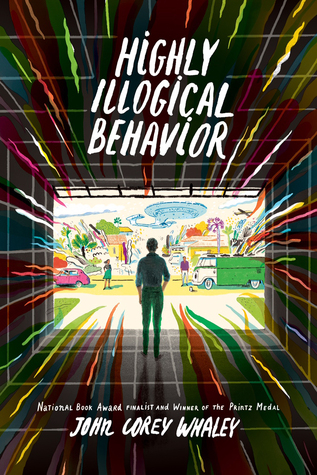
Highly Illogical Behavior by John Corey Whaley

Share

Highly Illogical Behavior
Author: John Corey Whaley
Published: May 10, 2016 by Dial

Summary: Sixteen-year-old Solomon is agoraphobic. He hasn’t left the house in three years, which is fine by him.

Ambitious Lisa desperately wants to get into the second-best psychology program for college (she’s being realistic). But is ambition alone enough to get her in?

Enter Lisa.

Determined to “fix” Sol, Lisa steps into his world, along with her charming boyfriend, Clark, and soon the three form an unexpected bond. But, as Lisa learns more about Sol and he and Clark grow closer and closer, the walls they’ve built around themselves start to collapse and their friendships threaten to do the same.

Ricki’s Review: I didn’t expect this book to hit me quite as hard as it did. The summary was compelling, and I enjoyed reading the first few chapters, and then I became personally invested in the characters’ lives. There are many complex emotions within this text. Because of the alternating perspectives, I’d be rooting for Lisa in a chapter and then feel like a jerk because I was betraying Solomon. And then I’d wonder if rooting for Lisa meant that I was also rooting for Solomon, in a way. This book makes readers question their values and consider ethics. I’ll be thinking about this one for quite some time.

Two other things I love about this book: 1. Solomon’s parents are great! I love when a YA book features good parents! 2. Sexuality is discussed in the book, but it isn’t the only (or main) feature of the book. This goes along with my belief that books that feature discussions about sexuality need not be purely focused on sexuality.

Teacher’s Tools for Navigation: I am a big advocate for literature circles that consider mental health. I think that placing texts like these in conversation allows us to consider the complexity of mental health issues. Some great texts to include in these literature circles follow: Dr. Bird’s Advice for Sad Poets by Evan Roskos, Forgive Me, Leonard Peacock by Matthew Quick, It’s Kind of a Funny Story by Ned Vizzini, The Perks of Being a Wallflower by Stephen Chbosky, Twisted by Laurie Halse Anderson, Everybody Sees the Ants by A.S. King, and 13 Reasons Why by Jay Asher. A discussion of these titles would foster incredibly rich discussions about phobias, depression, anxiety, and suicide. In my opinion, we must have these conversations with our students.

Discussion Questions: Do you think that Lisa “did the right thing” throughout the text? Were all of her decisions selfish, or could some of them be considered simultaneously selfless? Can a decision be selfish and selfless at the same time?

We Flagged: “We’re just floating in space trying to figure out what it means to be human.”

Read This If You Loved: (Many of these are listed above.) Dr. Bird’s Advice for Sad Poets by Evan Roskos, Forgive Me, Leonard Peacock by Matthew Quick, It’s Kind of a Funny Story by Ned Vizzini, The Perks of Being a Wallflower by Stephen Chbosky, Twisted by Laurie Halse Anderson, Everybody Sees the Ants by A.S. King, Reality Boy by A.S. King, Dear Life, You Suck by Scott Blagden, 13 Reasons Why by Jay Asher

Recommended For:

 closereadinganalysisbuttonsmall litcirclesbuttonsmall classroomlibrarybuttonsmall

RickiSig