Harlem: A Poem by Walter Dean Myers

Share

0-590-54340-7

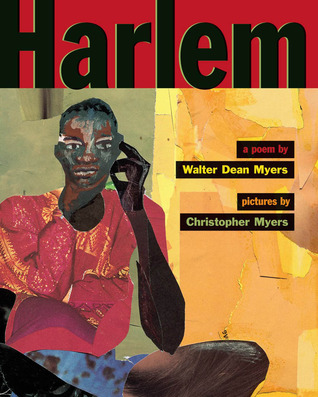
Harlem: A Poem
Author: Walter Dean Myers
Illustrator: Christopher Myers
Published 1997 by Scholastic Press

Goodreads Summary: Walter Dean Myers calls to life the deep, rich, and hope-filled history of Harlem, this crucible of American culture.

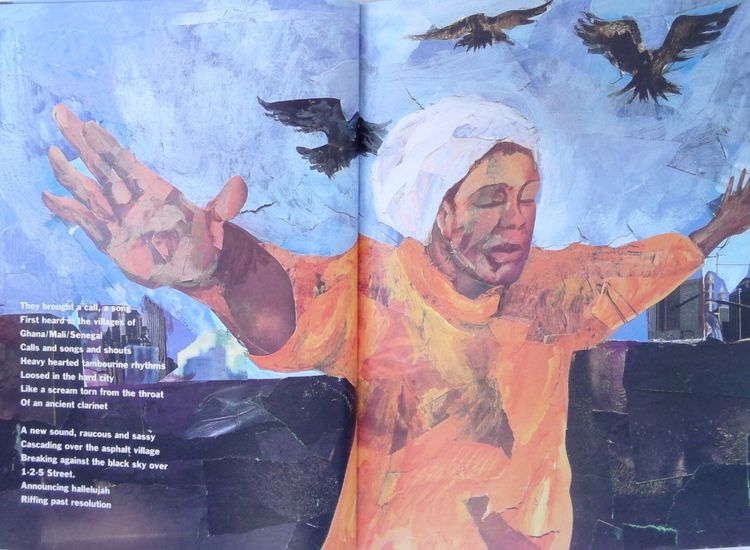
Christopher Myers’ boldly assembled collage art resonates with feeling, and tells a tale all its own. Words and pictures together connect readers -of all ages – to the spirit of Harlem in its music, art, literature, and everyday life, and to how it has helped shape us as a people.

My Review & Teacher’s Tools For Navigation: After reading this book the first time, I knew I was going to have to tackle it differently than just reading a picture book. I wanted to make sense of it and I knew that I didn’t have the background knowledge so I knew that the power of all of the words had not sunk in yet. So, I typed up the poem in Google Drive and began doing my very own close reading of the poem.  I started with research of terms and names that I didn’t know, building my knowledge of the culture and history of Harlem. Through this build up of knowledge, I began to understand the beauty behind Myers’s poem. The voice of this poem is one of heartbreak, but strength; proud of not only what he has become, but where he came from. This poem is a celebration of the history of Harlem and its citizens—a celebration of its religion, music, poets, authors, and everything that made/makes it a hub for the civil rights movement and African American culture.

This book would be a great one to use across many different subject areas- history, literature, and art.

Discussion Questions: What references to Harlem’s history did Myers intertwine into his poem?; How did Christopher Myers’s illustrations take the poem to another level?; (Writing) Do research about your ancestors and your heritage. Through this research, find people, places, literature, art, musicians, etc. that helped shape who you or your family are. Use this research to construct a poem about your heritage. Find a piece of artwork to accompany your poem. 

We Flagged: 

The uptown A
Rattles past 110th street
Unreal to real
Relaxing the soul

Shango and Jesus
Asante and Mende
One people, a hundred different
People
Huddled masses
And crowded dreams

Read This If You Loved: Duke Ellington: The Piano Prince and His Orchestra and Ella Fitzgerald: The Tale of a Vocal Virtuosa by Andrea Davis Pinkney, The Complete Poems including Harlem by Langston Hughes, Harlem Summer by Walter Dean Myers, Nonfiction books about Harlem

Recommended For: 

classroomlibrarybuttonsmall closereadinganalysisbuttonsmall readaloudbuttonsmall

Signature

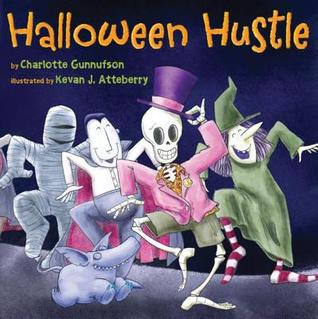
Halloween Hustle by Charlotte Gunnufson

Share

Halloween

halloween

Halloween Hustle
Author: Charlotte Gunnufson
Illustrator: Kevan J. Atteberry
Published September 3rd, 2013 by Two Lions

Goodreads Summary: In the dark, a funky beat. / Something white with bony feet. / Skeleton dancing up the street, / Doing the Halloween Hustle. Skeleton is dancing his way to a Halloween party but as he grooves across town, he keeps stumbling, tumbling, and falling apart! Can Skeleton stay in one piece long enough to make it to the party?

Kellee’s Review: This is a perfect Halloween book for young readers who want to get into the spirit yet do not want to be scared. The colorful illustrations add an extra element of fun to the book which will suck the readers even more into the book. My favorite part, though, is the rhyming and rhythm. It adds something special to the book that makes it different than other Halloween books.

Ricki’s Review: This is the first book I read to my pregnant belly. My future son was kicking the entire time! It was such an entertaining story, and my husband even listened in. My favorite aspect of this book would easily be the great examples of figurative language. For example, this alliteration: “Gets up and grooves with ghoulish grace” (p. 7), or this consonance: “Bones scatter / What a clatter / Spine is like a broken ladder!” (p. 4). You may also notice the simile in that last passage! Like Kellee, the colorful illustrations also drew me in, and I also loved all of the famous scary characters in the book, like Frankenstein’s Monster and Dracula.

Teacher’s Tools for Navigation: This book is made for reading aloud! It rhymes, has a great rhythm, and has repetitive text for students to read aloud with the teachers. It also has a great message to students and has opportunities for discussion about cause and effect, imagery, and rhyming. Teachers of any level would it beneficial to use this book to teach alliteration, assonance, consonance, similes, and other types of figurative language.

Discussion Questions: What characteristics does the Skeleton have that makes it so he is able to get to the party? What characteristics does the Skeleton have that would make him a new friend?; How does the author use rhymes to convey her message effectively?; Is this book a poem? Use textual evidence to defend your answer.

We Flagged:

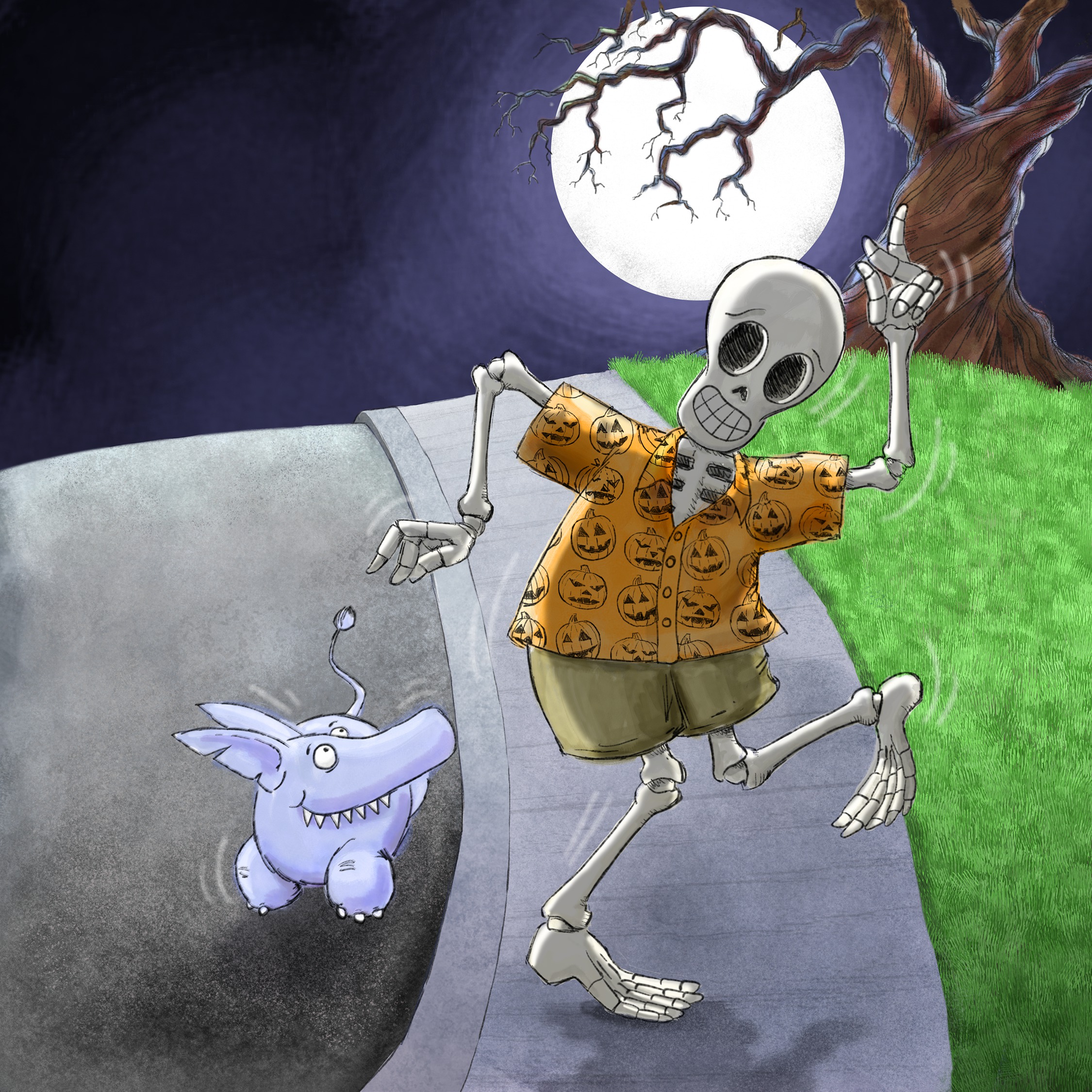
“In the dark, a funky beat,
Something white with bony feet.
Skeleton dancing up the street,
Doing the Halloween Hustle.

Bony thumbs and fingers snap.
Bony heels and toes tip-tap.
Knees knock-knock and elbows flap,
Doing the Halloween Hustle.” (p. 2-3)

Skeleton and his Sidekick

Read This If You Loved: Spider and the Fly by Mary Howitt, Dragon’s Halloween by Dav Pilkey, Goodnight Goon by Michael Rex, Monster Mash (Babymouse #9) by Jennifer L. Holm, Scaredy Squirrel Prepares for Halloween by Melanie Watt; Man Made Boy by Jon Skovron

Recommended For: 

readaloudbuttonsmall closereadinganalysisbuttonsmall

Signature andRickiSig

**Thank you to Charlotte Gunnufson for providing us copies for review!**

The Chatswood Spooks #1 & #2 by Notti Thistledore

Share

Halloween

chatswood1 chatswood2

The Chatswood Spooks
Author: Notti Thistledore
Illustrator: Nela Krzewniak
A Frightful Recipe published January 15th, 2013 by CreateSpace Independent Publishing
Sheets and Ladders published February 17th, 2013 by Crooked Chimney Books

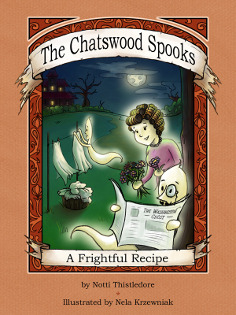
Goodreads Summary (A Frightful Recipe): The Chatswood Spooks are in trouble. If they don’t improve their scare tactics they’ll have to find somewhere else to haunt. But the spooks have lived their entire afterlives at the Chatswood Manor, and are determined to show just how scary they can be.

Unfortunately, they haven’t counted on having to scare Ivan the Fearless…

The Chatswood Spooks: A Frightful Recipe is the first in the Chatswood Spooks series. Each story is illustrated with detailed line drawings and is bursting with silliness.

Goodreads Summary (Sheets and Ladders): With his sheets, chains and pet spider, Jingo likes to look the part of the classic ghost. So when someone puts their red knickers in with Jingo’s favourite white haunting sheets, Jingo is devastated.

Feeling hurt and unloved, he decides to run away to join the local Carnival. But what Jingo has in spooking skills he lacks in street smarts, and he soon finds himself in trouble…

My Review: A cute (non)scary ghost story early chapter book that features 3 very different ghost personalities. I loved the vocabulary throughout this book that was not overwhelming yet showed that the author was obviously not writing down to her readers. She also had allusions to fairy tales, word play, and onomatopoeias making the narrative more interesting. I also found the author’s humor really rang throughout.

Teacher’s Tools for Navigation: I could definitely see these books being used as a read aloud in a classroom as well as a great mentor text to introduce narrative elements since it has a perfect plot arc, conflict, and interesting characters as well as an introduction into figurative and descriptive language and allusions.

Discussion Questions: Book 1: What do you think the ghosts are going to do to be scarier?; Book 2: Do you think Jingo did the right thing by running away?

We Flagged: “On Tuesday evening Toby, the caretaker of Chatswood Manor, called a meeting. All three Chatswood Manor ghosts were there, as well as two crows and a stone gargoyle.
“That gargoyle is worse than Hansel and Gretel,” muttered Winifred as she swept a trail of rocks from the carpet.
“Ahem!” Toby adjusted his half-moon spectacles and consulted a sheet of paper with a squiggly graph on it. Now, listen up, spooks. You’re here because my research shows that you’re all lazy to the bone!”” (Book #1, Location 5)

“Hauling his battered suitcase along behind him, Jingo wandered out onto Bridges Road. All the way he kept telling himself that the Chatswood ghosts were very disrespectful and didn’t deserve to work with him.” (Book #2, Location 34)

“The moon was starting to drag across the sky when the Ghost Bus appeared. Jingo stuck out his thumb to flad it down. The Ghost Bus was the sort of old-fashioned car that had to be started with a hand crank, and its headlights could only be turned on with a switch near the grille.”(Book #2, Location 40)

Read This If You Loved: Scaredy Squirrel Prepares for Halloween by Melanie Watts, The Witches by Roald Dahl, Ivy Bean and the Ghost that had to Go by Annie Barrows

Recommended For: 

classroomlibrarybuttonsmall readaloudbuttonsmall

Signature

**Thank you to Notti Thistledore for supplying copies of these books for review**

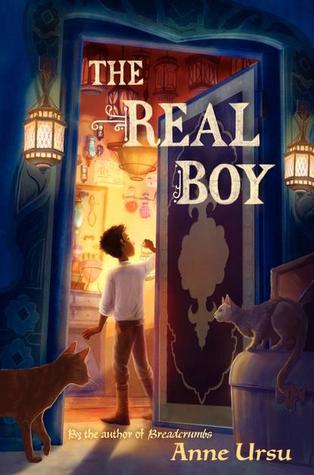
Blog Tour, Review, Giveaway, and Illustrator Interview!: The Real Boy by Anne Ursu, Illustrated by Erin McGuire

Share

RB - Blog Tour Banner

We are so excited to be part of The Real Boy Blog Tour hosted by Walden Pond Press!
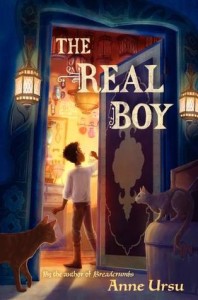
17349055

The Real Boy
Author: Anne Ursu
Illustrator: Erin McGuire
Published September 24th, 2013 by Walden Pond Press

Goodreads Summary: On an island on the edge of an immense sea there is a city, a forest, and a boy. The city is called Asteri, a perfect city that was saved by the magic woven into its walls from a devastating plague that swept through the world over a hundred years before. The forest is called the Barrow, a vast wood of ancient trees that encircles the city and feeds the earth with magic. And the boy is called Oscar, a shop boy for the most powerful magician in the Barrow. Oscar spends his days in a small room in the dark cellar of his master’s shop, grinding herbs and dreaming of the wizards who once lived on the island generations ago. Oscar’s world is small, but he likes it that way. The real world is vast, strange, and unpredictable. And Oscar does not quite fit in it.

But it’s been a long time since anyone who could call himself a wizard walked the world, and now that world is changing. Children in the city are falling ill, and something sinister lurks in the forest. Oscar has long been content to stay in his small room in the cellar, comforted in the knowledge that the magic that flows from the trees will keep his island safe. Now, even magic may not be enough to save it.

My Review: I love middle grade high fantasy! It is always amazing to me that an author is able to build an entire world that doesn’t exist and then puts these amazing characters and magic and story into this world. This is exactly what Anne Ursu did with The Real Boy. More importantly than my review of raving and raving about this book is the guest post I have to share today.

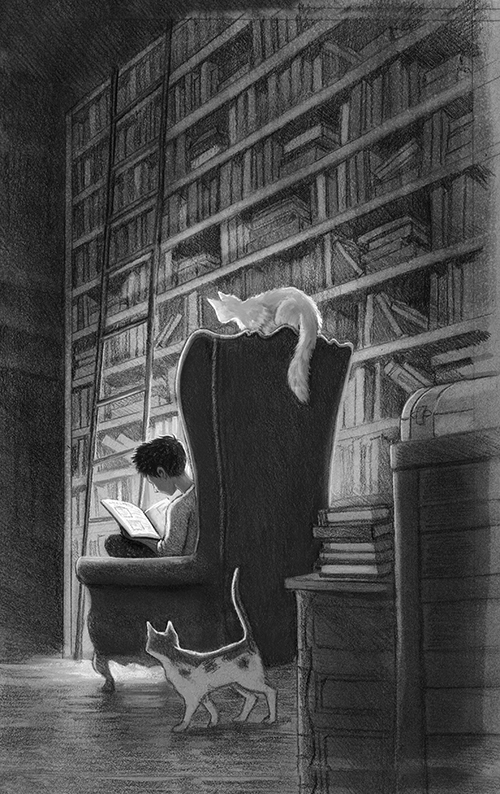
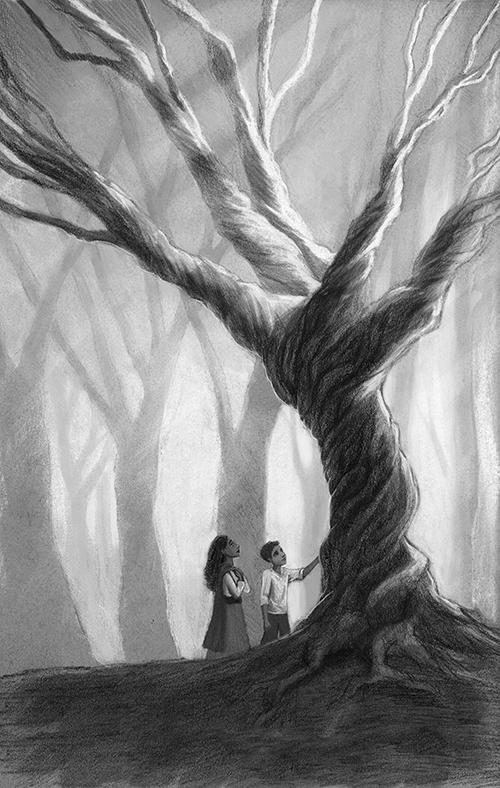
This is the second book that Erin McGuire and Anne Ursu collaborated on and Erin’s artwork adds an even more magic to an already magical story. Today, we are lucky to have Erin here to answer some questions about her work.

Kellee: I’d love to know about your past: When did you know you wanted to be an illustrator? Did you go to school for art? etc.

Erin McGuire: I’ve always loved drawing, and all throughout high school I kept sketchbooks, and still do to this day. My mother is a sixth grade teacher, so she often recommended new kid lit to me (she still does!) and always encouraged reading in general. 

As for my education- I attended Ringling College of Art and Design in Sarasota, Florida as an illustration major. While I was a student there, I worked as a student librarian for four years. That was where I discovered Lisbeth Zwerger, Shaun Tan, Adam Rex, and all of the other illustrators who would influence my work.

K: I’m very interested in knowing about how illustrators and authors work together. Did you get the entire manuscript before beginning? Did you just get snippets? Do illustrations have to be approved before they go in the book? How do you choose what the characters are going to look like? Do you get character descriptions from the author? etc. 

EM: Each project is a bit different depending on how much I’ll be involved. On books where I only do the covers, sometimes I don’t see the manuscript, just a book summary and a list of character descriptions. For Breadcrumbs and The Real Boy, I read the full manuscripts since I’d be illustrating all the interiors as well. Usually the editor or art director will email me a list of scenes they’d like for the interiors. The artwork always goes through an approval process, being approved by the art director, editor, and (in some cases, but not always) the author. 

I did a lot of sketches for the characters to create the look for this world, how the upper and lower classes look different, what the fashion would be, how the rooms should look, etc. All of that was sent to Anne, who gave me some insights into her thought process for the time period and style of the world.

Rarely do I get to work with the author directly, it’s almost always with the editor and art director as middle men. This is intentional, and helps the illustrator focus on their work and sets some limits on how much one can influence the other. 

K: You worked with Anne on Breadcrumbs as well – how did it come about that you became the illustrator for The Real Boy

EM: Breadcrumbs was a really fun project for me, I felt like I was a good fit for that world, and illustrating Anne’s writing felt very natural to me. I think the team felt that I’d be a good fit for The Real Boy as well since I’d done some other fantasy work. My agent asked me if I was interested and I immediately emailed her back an “Absolutely.” As it turns out, I think The Real Boy is now my favorite project ever. It helps that I like drawing cats!
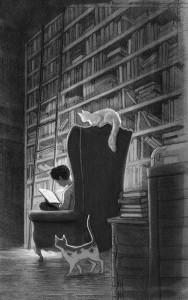
TRB_ill03

K: I noticed that The Real Boy is a mixture of pencil, ink, and possibly water color — How did you choose the style you are going to use for each book? 

EM: The Real Boy felt like a much warmer story than Breadcrumbs. There are so many natural materials, animals, trees, even the magic itself feels natural in the story. I painted all of the Breadcrumbs illustrations digitally, and I didn’t think that same style would make sense for The Real Boy. So for this book, I did all of the illustrations on toned paper in pencil, and a mix of gouache, white chalk, and sometimes ink. All of them were scanned and touched up digitally, but starting out with a more natural drawing felt right for this story.
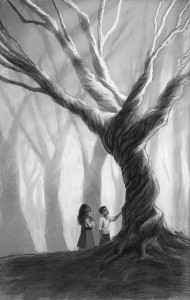
TRB_ill09

K: I also loved Darkbeast which you illustrated! Like The Real Boy and Breadcrumbs it is a middle grade fantasy novel. Many of the novels you have done the covers for or have illustrated are fantasy, but you also illustrated the new Nancy Drew Diaries — do you like illustrating fantasy or realistic fiction books better? 

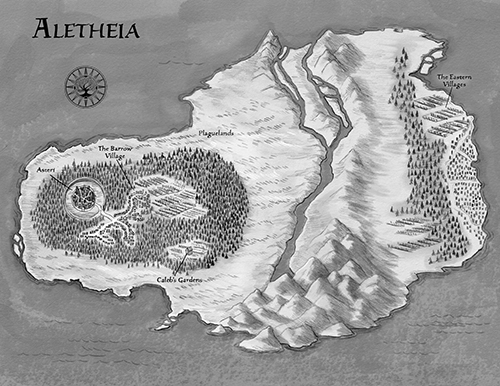
EM: It’s really hard to pick a favorite genre, but usually I prefer the stories that have a mix of both worlds (along the lines of Breadcrumbs, where the normal world is affected by fantasy elements in some way). Purely fantasy worlds are fun because you get to create how everything looks, how everyone dresses, and there are fewer rules. I spent a lot of time just gathering reference to create the world for The Real Boy. And I’ve always wanted to draw a fantasy map! 
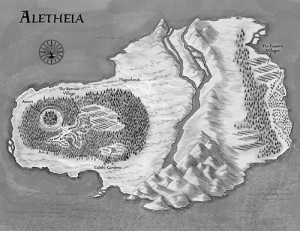
trb_interiors_map01

The more realistic work I’ve done (Nancy Drew) is fun in a different way because you just get to “go shopping” for those characters. I’ll go online to different clothing sites and pick out outfits for Nancy to wear. Every project has something different about it that appeals to me.

K: What are some other projects you’ve worked on? 

EM: Along with Breadcrumbs and The Real Boy, I’ve worked on the Nancy Drew Diaries series, the Saranormal series, the Higher Power of Lucky series, a picture book called French Ducks in Venice, and covers for many other books. (The whole list is on my website http://www.emcguire.net/).

K: Can you share with us what projects you are working on now? 

EM: I’m still working on Nancy Drew, and other projects that I’m not able to talk about yet. I’m also starting to write my own picture books, which is a totally different challenge, but exciting for me!

It is so fascinating how authors and illustrators work together. It really is magical.

Teacher’s Tools for Navigation: On top of the amazing world building and history building, Anne Ursu also writes beautifully. There are examples of figurative language usage all throughout the book. It would be an amazing piece of mentor text for writing workshop. Oh, and it would obviously be an amazing read aloud!

Discussion Questions: What makes someone human?; Do you think cats sense things that humans cannot?; If there was magic, do you think it’d make the world a better or worse place?

We Flagged: “Oscar and Callie sat in the library awhile longer, Callie scanning the books for more information, Oscar just sitting inside his mind. There were not answers about the children, but they did not even know what the questions were anymore. The world had ruptured once again. Even history could disappear under your feet.” (p. 185)

“There is a way the truth hist you, both hard and gentle at the same time. It punches you in the stomach as it puts it s loving arms around your shoulder.” (p. 206)

Read This If You Loved: The Darkbeast by Morgan Keyes, Princess Academy by Shannon Hale, Breadcrumbs by Anne UrsuTuck Everlasting by Natalie Babbit, Rump by Liesl Shurtliff

Recommended For: 

readaloudbuttonsmall classroomlibrarybuttonsmall closereadinganalysisbuttonsmall

Don’t forget to visit the other Real Boy Blog Tour Stops: 

Monday, 9/30 – Maria’s Melange – Maria’s Take on The Real Boy + Giveaway
Tuesday, 10/1 – There’s a Book – Danielle’s Take on The Real Boy + Giveaway
Wednesday, 10/2 – sharpread – Colby Interviews Anne
Thursday, 10/3 – Novel Sounds – Elena’s Take on The Real Boy + Giveaway
Friday, 10/4 – Word Spelunking – Aeicha Interviews Anne
Saturday, 10/5 – The Hiding Spot – Sara’s Take on The Real Boy + Giveaway
Sunday, 10/6 – The Brain Lair – Kathy’s Take on The Real Boy + Giveaway
Monday, 10/7 – Read, Write, Reflect – Anne Talks Oscar with Katherine
Tuesday, 10/8 – Librarian’s Quest – Margie’s Take on The Real Boy + Giveaway
Wednesday, 10/9 – Buried in Books – Heather’s Take on The Real Boy + Giveaway
Thursday, 10/10 – The Book Monsters – Kristen’s Take on The Real Boy + Giveaway
Friday, 10/11 – Cari’s Book Blog – Cari’s Take on The Real Boy + An Interview with Anne
Saturday, 10/12 – Unleashing Readers – Kellee Interviews Illustrator Erin McGuire + Giveaway
Sunday, 10/13 – Satisfaction for Insatiable Readers – Gina’s Take on The Real Boy + Giveaway
Monday, 10/14 – Heise Reads and Recommends – Editor Jordan Brown Interviews Anne
Tuesday, 10/15 – Bulldog Readers Blog – The Bulldog Readers Debut Their Book Trailer
GIVEAWAY

a Rafflecopter giveaway

Thank you to Kellie at Walden Pond Press for a copy of The Real Boy for review and giveaway, for setting up the blog tour and review, and to Erin McGuire for her wonderful interview!
Signature

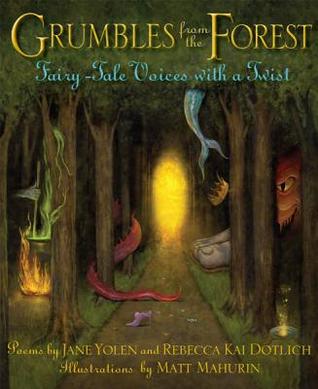
Grumbles from the Forest: Fairy-Tale Voices with a Twist by Jane Yolen and Rebecca Kai Dotlich

Share

grumbles

Grumbles from the Forest: Fairy-Tale Voices with a Twist
Authors: Jane Yolen and Rebecca Kai Dotlich
Illustrator: Matt Mahurin
Published March 1st, 2013 by Wordsong

Goodreads Summary: What were all those fairy-tale characters thinking? Jane Yolen and Rebecca Kai Dotlich answer this question in paired poems, with sometimes startling results. The Princess claims all those mattresses kept her awake–“not” a silly pea–while the poor pea complains that the princess snores. One Snow White begs the witch to settle by the bay and throw that mirror away. Another boldly tells the mirror she “won’t be guided by a glass that’s so one-sided.” Grumbles from the Forest is a bewitching brew of voices–grumbling, pleading, bragging, reminiscing, confiding–that bubbles with magic and wonder. The spectacular paintings that tie the poems together are full of surprise and intrigue. This stunning collection includes end notes that briefly describe the tales and their history and an introduction that invites readers to imagine their own poems from unusual perspectives.

My Review: Jane Yolen just doesn’t make bad books. Every time I read one of her books, I know I am reading a piece of great literature. This book is no different. Grumbles from the Forest takes 15 different fairy tales and then has a poem from two different perspectives for each fairy tale. Some are two different characters: Cinderella and her stepsisters, the frog and the princess, the wicked fairy and Sleeping Beauty, etc. including some characters who didn’t have a voice in the original fairy tale like the pea from The Princess and the Pea. Some are from one character, but two points of view: Snow White talking to the witch and with the magic mirror. I was fascinated with all of the poems they came up with!

Teacher’s Tools For Navigation: This book was built for being used in the classroom. First, each fairy tale section could start its own discussion about what the poem is saying vs. the original fairy tale. Second, the poetry itself stands alone. Look for figurative language and other poetic elements and there is even a haiku and cinquain. Third, we are always trying to get students to see things from different points of view and this is a perfect way. The introduction of the book even invites readers to: “Why not try writing a fairy-tale poem yourself? Pick a character or an object—maybe the bridge in Three Billy Goats Gruff, or Beauty’s father or the chair that Goldilocks broke. Imagine. Enchant. Write a poem that rewrites the tale. Make a little magic.”

Discussion Questions: Why do you think the authors chose to write from ____’s point of view? Do you agree with the point of view they gave the character/object? What would you have had them say instead? Who/what would you have written about instead?

We Flagged: Thumbelina 

“Thumbelina: A Cinquain”
Being
small has its down-
side, but what, pray tell, is
the choice of a little missy
at birth?

“Little Big: A Haiku”
I am just a bit
Of a proper young lady,
Still I got my prince.

(p. 34-35)

Read This If You Loved: The True Story of the Three Little Pigs by Jon Scieszka, Revolting Rhymes by Roald Dahl, and other fractured fairy tales; Stories told from different points of view like The Day the Crayons Quit by Drew Daywalt and Who Stole Mona Lisa? by Ruthie Knapp

Recommended For: 

closereadinganalysisbuttonsmall readaloudbuttonsmall

Signature

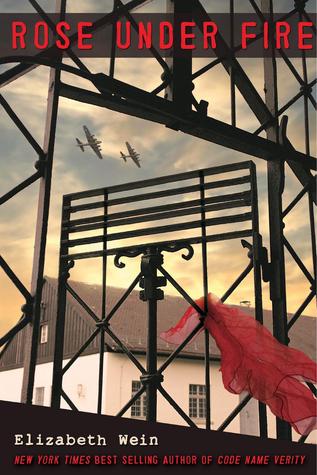
Rose Under Fire by Elizabeth Wein

Share

17262236
Title: Rose under Fire
Author: Elizabeth Wein
Expected Publication: September 10th, 2013 by Miramax (Disney)

Summary: While flying an Allied fighter plane from Paris to England, American ATA pilot and amateur poet, Rose Justice, is captured by the Nazis and sent to Ravensbrück, the notorious women’s concentration camp. Trapped in horrific circumstances, Rose finds hope in the impossible through the loyalty, bravery and friendship of her fellow prisoners. But will that be enough to endure the fate that’s in store for her?

Elizabeth Wein, author of the critically-acclaimed and best-selling Code Name Verity, delivers another stunning WWII thriller. The unforgettable story of Rose Justice is forged from heart-wrenching courage, resolve, and the slim, bright chance of survival.

Review: Out of the thousands of books I’ve read, this one is going to sit among my all-time favorites. There is a phenomenal balance of history and narrative that will engage readers while offering harrowing lessons in history. I am not an air and space girl. My husband loves planes, and he was giddy when we went to the Smithsonian Air and Space Museum in Washington D.C. As much as I want to love planes, I don’t find them to be interesting. This book changed my outlook.

Rose under Fire has many similarities with Wein’s Code Name Verity. They are both written in an epistolary format, involve pilots/airplanes, and are set during World War II. Both offer wonderfully complex themes about friendship, loyalty, and the strength of women. However, Rose under Fire focuses more on concentration camps, while Code Name Verity dealt more with the interrogation techniques used during World War II. Neither of these two elements drove the novels, but they are two plot features that make the texts quite different from one other. I found CNV to be a bit slow in the beginning (which isn’t the case with all readers), but I was hooked to Rose under Fire from the very first page. Wein writes characters so vividly that I still feel their presence in my life, long after I finish the books. I recommend this book to everyone. It will appeal to readers of all ages, backgrounds, genders, and interest levels.

Teacher’s Tools for Navigation: Teachers, this is a MUST-HAVE book. It is phenomenally written and shows the truly complexity of young adult literature. It can be used to teach elements like setting, character, dialogue, the epistolary format, imagery, voice, and theme. Students might write letters back to Rose, or they could analyze one of the many well-developed characters in this story. It would also make for a great research unit of topics like the Nuremberg Trials, female WWII pilots, flying bombs, or the experimentation on Holocaust prisoners. History teachers will also find this text to be invaluable.

Discussion Questions: What loyalties did the Holocaust prisoners have for each other? What are some examples of incidents that showed this loyalty?; Why were the Rabbits so important to the concentration camp? What did they add to the story as a whole?; How does Maddie’s friendship with Rose differ from her friendship with Julie?; Why was Nick’s character important throughout the story? How does his level of importance change, and why?; Rose has very different friendships with many of the characters. Describe how three of these friendships differ from one another.; Does the novel end in a hopeful way? Why or why not?

We Flagged: I marked so many passages that it is hard to choose just a few, so I selected two longer quotes that show the quality of Wein’s writing.

Incredible Imagery:

“…and the reason everyone in there was trying to get out in the rain was because they were dying of thirst.

Really dying of it, I think.

Hands and arms and heads stuck out anywhere there was a gap—cupped hands collecting rainwater, some holding bowls or even just a piece of cloth to collect moisture—I saw one woman lying on her back with her hair in the black cinder mud at the tent’s edge, her mouth open, letting a rivulet of water stream down the canvas and into her mouth.”

And Beautiful Figurative Language:

“Hope—you think of hope as a bright thing, a strong thing, sustaining. But it’s not. It’s the opposite. It’s simply this: lumps of stale bread stuck down your shirt. Stale gray bread eked out with ground fish bones, which you won’t eat because you’re going to give it away, and maybe you’ll get a message through to your friend. That’s all you need.

God, I was hungry.”

Please note: The above quotes are from the Advanced Reader Copy. The e-book (a galley) did not provide page or chapter numbers. The quotes may change when the book is published.

Read This If You Loved: Code Name Verity by Elizabeth Wein, Between Shades of Gray by Ruta Sepetys, Nazi Hunters by Neal Bascomb, Night by Elie Wiesel

Recommended For:

 litcirclesbuttonsmall closereadinganalysisbuttonsmall classroomlibrarybuttonsmall

026F3FBCC8C3913BD3A4D3F6920340D5

Thank you to NetGalley and Disney for sending me the Advanced Reader Copy!

The Day the Crayons Quit by Drew Daywalt

Share

crayons

The Day the Crayons Quit
Author: Drew Daywalt
Illustrator: Oliver Jeffers
Published June 27th, 2013 by Philomel

Goodreads Summary: Crayons have feelings, too, in this funny back-to-school story illustrated by the creator of Stuck and This Moose Belongs to Me 

Poor Duncan just wants to color. But when he opens his box of crayons, he finds only letters, all saying the same thing: His crayons have had enough! They quit! Beige Crayon is tired of playing second fiddle to Brown Crayon. Black wants to be used for more than just outlining. Blue needs a break from coloring all those bodies of water. And Orange and Yellow are no longer speaking—each believes he is the true color of the sun.

What can Duncan possibly do to appease all of the crayons and get them back to doing what they do best?

Review: Told through letters, this story of revolt reminds me a bit of Toy Story in that when I finished, I felt like I needed to get out my crayons and use each one and let them know they are loved. This is probably one of my favorite picture books this year (maybe in general) because it promotes so much that I believe in: art, imagination, and caring. This book would be a great addition to Dot Day activities (Sept. 15, 2013).

Teacher’s Tools for Navigation: Automatically, after reading, I saw that the best way to use this book in the classroom is to first use it to promote imagination. Too many kids aren’t told to use their imagination often any more.

Also, I would use the inanimate object point of views to have students participate in a RAFT writing activity which helps students think about different perspectives. RAFT stands for R: Role, A: Audience, F: Format, T: Topic. In the book, Drew Daywalt was writing as a crayon (R) to their owner (A) in a letter (F) about their use (T). The students could pick their own toy and write a letter to themselves about their use.  So many possibilities!

Discussion Questions: What toy do you use at home more than others? What would this toy say to you? What about a toy you don’t use?; Draw a picture of a zoo or ocean scene, but use your imagination when it comes to size, color, and placement.

We Flagged: “Dear Duncan, It has been great being your FAVORITE color this PAST year. And the year before. And the YEAR before THAT! I have really enjoyed all those oceans, lakes, rivers, raindrops, rain clouds, and clear skies. but the BAD NEWS is that I am so short and stubby, I can’t even see over the railing in the crayon box anymore! I need a break! Your very stubby friend, Blue Crayon”

Read This If You Loved: Who Stole Mona Lisa? by Ruthie Knapp, The Dot and Sky Color by Peter H. Reynolds, Chalk by Bill Thomson, Art & Max by David Weisner, Not a… series by Antoinette Portis, Art by Patrick McDonnell, Perfect Square by Michael Hall, Cloudette by Tom Lichtenheld

Recommended For: 

readaloudbuttonsmall classroomlibrarybuttonsmall

I think we should all get out some crayons today and color; enjoy your crayons, but make sure to use imagination and don’t show favoritism! 

Signature