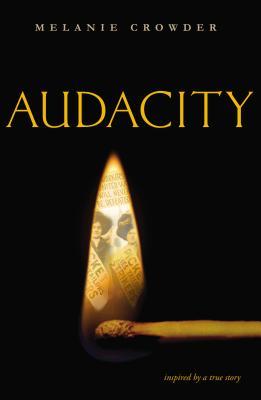
Audacity by Melanie Crowder

Share

audacity

Audacity
Author: Melanie Crowder
Published: January 8, 2015 by Philomel

Goodreads Summary: The inspiring story of Clara Lemlich, whose fight for equal rights led to the largest strike by women in American history

A gorgeously told novel in verse written with intimacy and power, Audacity is inspired by the real-life story of Clara Lemlich, a spirited young woman who emigrated from Russia to New York at the turn of the twentieth century and fought tenaciously for equal rights. Bucking the norms of both her traditional Jewish family and societal conventions, Clara refuses to accept substandard working conditions in the factories on Manhattan’s Lower East Side. For years, Clara devotes herself to the labor fight, speaking up for those who suffer in silence. In time, Clara convinces the women in the factories to strike, organize, and unionize, culminating in the famous Uprising of the 20,000.
Powerful, breathtaking, and inspiring, Audacity is the story of a remarkable young woman, whose passion and selfless devotion to her cause changed the world.

Ricki’s Review: This is an inspirational book in verse based on the true story of Clara Lemlich. She was a Russian Jewish immigrant who was forced to work in horrible factory conditions in the early 1900s. Clara stood up for her rights and fought with the union. What I liked most about this book is the author gives so much information about Orthodox Judaism, unions, and feminism, but she doesn’t hit readers over the head with the information. I don’t enjoy reading books about religion, and I don’t particularly seek out books about feminism (or unions, for that matter), yet I found Clara’s story to be both fascinating and compelling. All types of readers will love this story, and it is very teachable.

Teacher’s Tools for Navigation: I would love to teach this book. It offers great opportunities for building background knowledge about history. I wish this book existed when I used to teach The Jungle because the connections are innumerable. If I taught this book, I would use a jigsaw, research, and/or webquest activity where students spent time researching the 1900s, Russian immigration in the 1900s, unions, feminism, schooling in the 1900s, the Triangle Shirtwaist Factory fire, and Orthodox Judaism. This knowledge would provide a rich reading of this text.

Discussion Questions: How do Clara’s parents and siblings view her actions?; Make a list of your top five values. Then, make a list of Clara’s top five values. Are they the same? Different? Do you think your values differ from hers because of your personalities or because of the different time periods you live in?

We Flagged: “How can I tell Mama / who toils / sunup / to sundown / to be a good mother / a good wife / that this life / (her life) / is not enough for me, / that I dream instead / of words / ideas / a life that stretches far beyond / the bounds of this shtetl?” (p. 12).

*Please note that this quotation is from an advanced reader copy, and the quote may be different in the published version of the book.*

Read This If You Loved: The Jungle by Upton Sinclair, Like Water on Stone by Dana Walrath, A Northern Light by Jennifer Donnelly, Between Shades of Gray by Ruta Sepetys

Recommended For:

 litcirclesbuttonsmall classroomlibrarybuttonsmall

RickiSig

**A special thank you to Penguin for sending this book for review!**

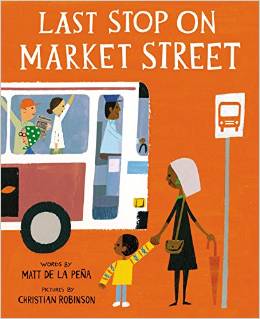
Last Stop on Market Street by Matt de la Pena

Share

last stop on market street

Last Stop on Market Street
Author: Matt de la Peña
Illustrator: Christian Robinson
Published: January 8, 2015 by Putnam Juvenile

Summary: Every Sunday after church, CJ and his grandma ride the bus across town. But today, CJ wonders why they don’t own a car like his friend Colby. Why doesn’t he have an iPod like the boys on the bus? How come they always have to get off in the dirty part of town? Each question is met with an encouraging answer from grandma, who helps him see the beauty—and fun—in their routine and the world around them.

This energetic ride through a bustling city highlights the wonderful perspective only grandparent and grandchild can share, and comes to life through Matt de la Pena’s vibrant text and Christian Robinson’s radiant illustrations.

Ricki’s Review: Matt de la Peña is a literary genius. I pre-ordered this book because I knew it would be excellent, but the story and illustrations blew me away. CJ wonders why he doesn’t have a car, and Nana reassures him that they are better off without one. They take an adventure on a bus to a soup kitchen. Nana sees the beauty in life, and her words are powerful. This is a story about giving back and appreciating what we have. My son and I have read this book dozens of times since we received it. My mother-in-law and husband also enjoyed reading it with him!

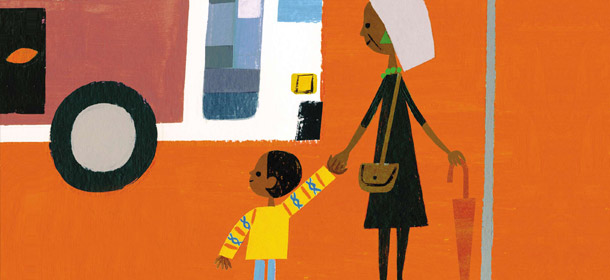
Kellee’s Review: This book is a celebration. A celebration of the little things we sometimes miss, of diversity, of kindness, of family, and of beauty. Matt de la Peña’s story is well written and beautifully illustrated with amazing collages by Christian Robinson. Although I haven’t read it with Trent yet, I feel that this book is an important one for him and all kids to read. 

Teacher’s Tool For Navigation: What a perfect book for a field trip on a bus to the soup kitchen? Students can describe the people and things they see. This would also make a great homework assignment. Alternatively, teachers might ask students to go to a public place with their parents and describe the people and things they see—they should be instructed to find the beautiful things in their environment.

Discussion Questions: What is Nana’s attitude about life? How do her words show this?; What kinds of things does CJ see on his trip?; How do the illustrations make this story stand out?

We Flagged: “The outside air smelled like freedom, but it also smelled like rain, which freckled CJ’s shirt and dripped down his nose.”

From Matt de la Pena’s website


Read This If You Loved:  Nana in the City by Lauren Castillo, Each Kindness by Jacqueline Woodson, A Bus Called Heaven by Bob Graham, Harlem by Walter Dean Myers

Recommended For: 

readaloudbuttonsmall classroomlibrarybuttonsmall 

RickiSig andSignature

**Thank you to Penguin for providing a copy for review**

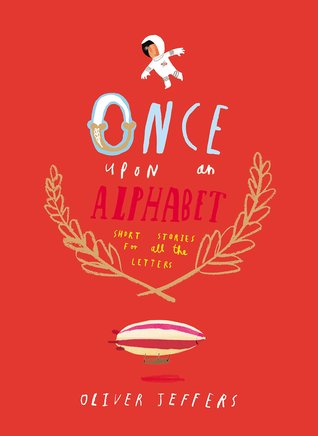
Once Upon an Alphabet by Oliver Jeffers

Share

Once Upon an Alphabet

Once Upon an Alphabet: Short Stories for all the Letters
Author: Oliver Jeffers
Published October 14th, 2014 by Philomel

Goodreads Summary: If words make up the stories and letters make up the words, then stories are made up of letters. In this menagerie we have stories made of words, made FOR all the letters.

The most inventive and irresistible book of the year spans a mere 26 letters (don’t they all!) and 112 pages. From an Astronaut who’s afraid of heights, to a Bridge that ends up burned between friends, to a Cup stuck in a cupboard and longing for freedom, Once Upon an Alphabet is a creative tour de force from A through Z. Slyly funny in a way kids can’t resist, and gorgeously illustrated in a way readers of all ages will pour over, this series of interconnected stories and characters explores the alphabet in a way that will forever raise the bar.

In Once Upon an Alphabet, #1 New York Times bestseller Oliver Jeffers has created a stunning collection of words and artwork that is a story book, alphabet book, and gorgeously designed art book all in one.

Kellee’s Review and Teachers’ Tools for Navigation: Oliver Jeffers is just brilliant. Everything he does is unique, and he actually keeps surprising me with each new book. And he makes me laugh out loud, which is always such a treat. This book has 26 quirky short stories, each corresponding with a letter. Each story has characters, plot, theme, and conflict, and each is quite clever and funny. It is just so well done!

I’d love to see this book used as a read aloud for 26 days. Each day as a different letter. With every letter, teachers could focus on different things: the letter, illustrations, voice, characterization, plot arc, conflict, theme, mood, figurative language, etc. It would be a great opener to the day and would also be a lot of fun to ask students to write their own stories for the letters. This pushes an alphabet book to a whole different level!

Ricki’s Review and Teachers’ Tools for Navigation: I agree with Kellee. Decades from now, children will still be enjoying Jeffers’ books. For me, he is comparable to the greats in children’s literature. My favorite part about this book was the way he connected the letters. It made me excited when he returned to some of the previous short stories.

This book begs for students to write. The short stories teach literary skills in an engaging way. Kellee’s idea was similar to my own. I would love to see a classroom book of these letters. Each student could be assigned a letter or two. With some funding, perhaps the students could bring a bound version home. It would be much more fun for students to practice letters when they can read their classmate’s stories! The way Jeffers flexes his creative muscles would also be inspiring to high school students.

Discussion Questions: Which letter’s story was your favorite? Why?; In what ways was Oliver Jeffers creative in his storytelling?; Can you think of other stories for each letter?

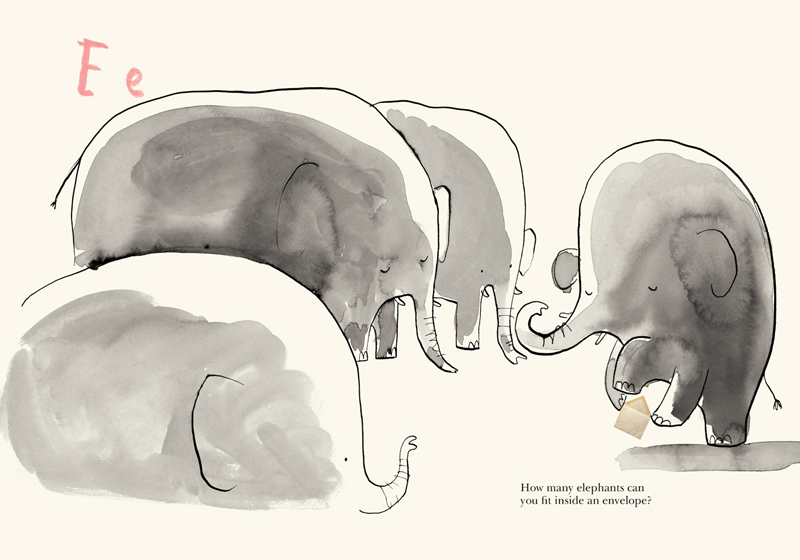
We Flagged: 

jeffers-e
http://www.oliverjeffers.com/media/5-e-2-web.jpg

Read This If You Loved: Any books by Oliver Jeffers, Eric Carle, or Dr. Seuss

Recommended For: 

classroomlibrarybuttonsmall readaloudbuttonsmall closereadinganalysisbuttonsmall

Signature andRickiSig

**Thank you to Penguin Young Readers Group for providing copies for review!**

Blog Tour and Review!: Catch that Cookie! by Hallie Durand

Share

cookie

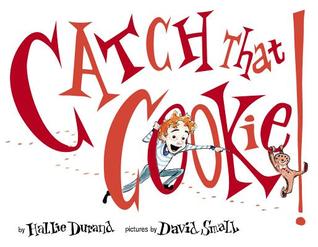
Catch That Cookie!
Author: Hallie Durand
Illustrator: David Small
Published August 14th, 2014 by Dial

Publisher Summary: Gingerbread men can play a mean game of sneaky tag!  Don’t believe it? Marshall didn’t either no matter how much his teacher, Ms. Gray, told him. But when the cookies go missing from the oven and the students find clues all around the classroom, Marshall can deny it no longer: Gingerbread men are real and they’re on the run!

From the author of the Dessert First Trilogy and Mitchell books, Hallie Durand, and Caldecott winner and two time honoree illustrator David Small, comes a tantalizing new tale that will have readers racing through the pages, eager to see where the gingerbread men have gone.

My Review and Teachers’ Tools for Navigation: This book has the potential to not only be a fun, interactive read for kids, but one that could definitely be used in a classroom. Since the reader, along with Mitchell, are given clues throughout the book, the reader can work with Mitchell to try to figure out where the gingerbread men went. It would be so much fun to read this with kids. The clues are rhyming with words left out, so they must use the context clues and rhyming skills to figure out the missing word. Also, to complete track the men down in the end, Mitchell has to make some inferences which would be a great discussion on how he figured it out. So, either in the classroom or at home, this book is definitely going to get some laughs and start good conversations.

Discussion Questions: If your gingerbread man could run, where do you think he would go?; Marshall gave his cookie six raisin eyes! Tell us how you would design your own gingerbread man.

I would make my gingerbread man look like a ninja so that he would be the hardest gingerbread man to find and he would always be where ever you weren’t looking!

Comment below OR share through Twitter using #catchthatcookie!

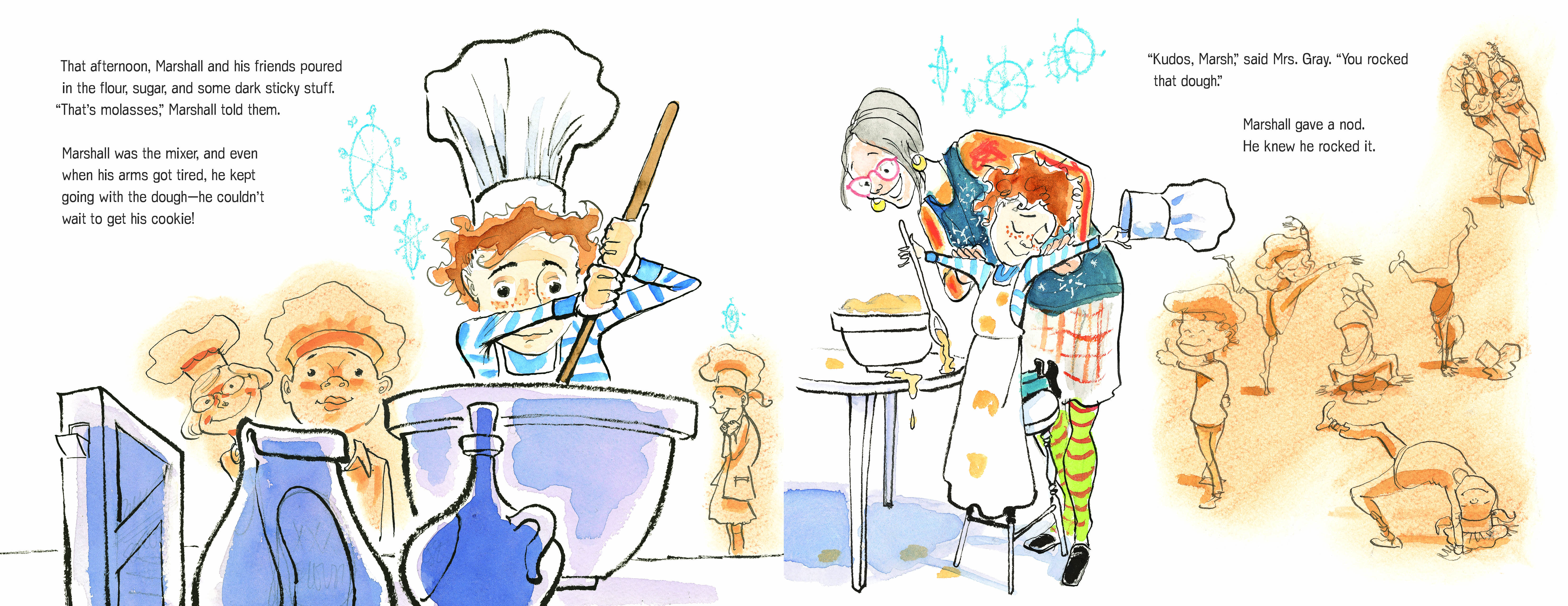
We Flagged: 

Cookie_10-11

Read This If You Loved: Mitchell books by Hallie Durand, Help! We Need a Title by Herve Tullet 

Recommended For: 

classroomlibrarybuttonsmall readaloudbuttonsmall

Signature

**Thank you to Rachel at Penguin for having us as a stop on the blog tour!**

Elizabeth, Queen of the Seas by Lynne Cox

Share

NF PB 2014

Nonfiction Picture Book Wednesday

Nonfiction Picture Book Wednesday is hosted by Kid Lit Frenzy and was started to help promote the reading of nonfiction texts. Most Wednesdays, we will be participating and will review a nonfiction text (though it may not always be a picture book).
Be sure to visit Kid Lit Frenzy and see what other nonfiction books are shared this week!

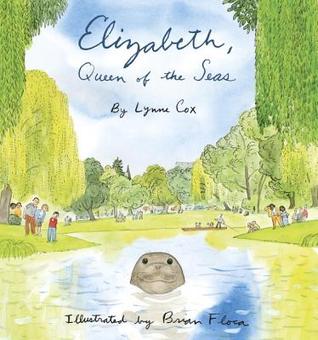
Elizabeth Queen of the Seas

Elizabeth, Queen of the Seas
Author: Lynne Cox
Illustrator: Brian Floca
Published May 13, 2014 by Schwartz & Wade

GoodReads Summary: World-renowned swimmer and bestselling author Lynne Cox and Caldecott Medal-winning illustrator Brian Floca team up to bring us this inspiring story of an elephant seal who knew exactly where she belonged.

Here is the incredible story of Elizabeth, a real-life elephant seal who made her home in the Avon River in the city of Christchurch, New Zealand. When Elizabeth decides to stretch out across a two-lane road, the citizens worry she might get hurt or cause traffic accidents, so a group of volunteers tows her out to sea. But Elizabeth swims all the way back to Christchurch. The volunteers catch her again and again—each time towing her farther, even hundreds of miles away—but, still, Elizabeth finds her way back home.

Includes back matter with information about elephant seals.

My Review and Teachers’ Tools for Navigation: I had never heard of this delightful elephant seal, and I was fascinated by this charming story. Lynne Cox excellently depicts this real-life seal who traveled hundreds of miles to return home. Floca’s illustrations are equally engaging, and children will be drawn to the beautiful details in this book. Readers will learn lessons of dogged determination and friendship. They will be spellbound by Elizabeth’s story and will long to learn more about elephant seals and New Zealand after reading this book. It would make a great pairing with a marine unit because of its connections to wildlife. Elizabeth is excellently personified, and children will feel connected to her.

Discussion Questions: How does Elizabeth show determination? How might you show determination in your own lives?; How does the author personify Elizabeth? Did you feel connected to her? How would the story be different if the author allowed Elizabeth to talk? Would you like the story more or less?

We Flagged: “Moving up the shore like a giant inchworm, she’d stretch herself out on the long, cool grass and take a nap in the bright sunshine.”

Read This If You Loved: And Tango Makes Three by Justin Richardson and Peter Parnell, Ivan: The Remarkable Ture Story of the Shopping Mall Gorilla by Katherine Applegate

Recommended For: 

closereadinganalysisbuttonsmall readaloudbuttonsmall classroomlibrarybuttonsmall


RickiSig

Blog Tour, Review, and Author Q&A!: Bramble and Maggie Series by Jessie Haas

Share

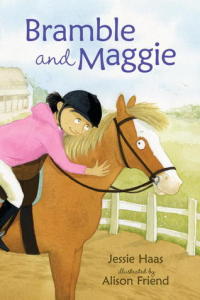
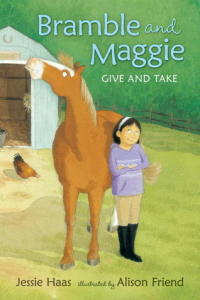
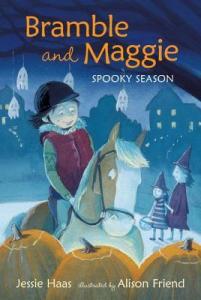
bramble1 bramble2 bramble3

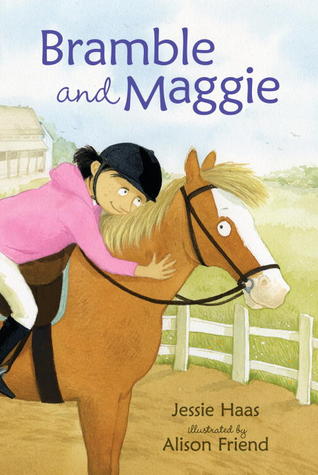
Bramble and Maggie: Horse Meets Girl
Published March 27th, 2012 by Candlewick Press
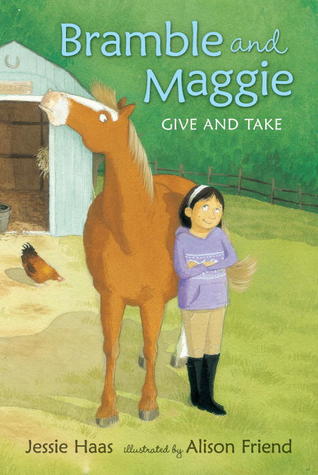
Bramble and Maggie: Give and Take
Published April 23, 2013 by Candlewick Press
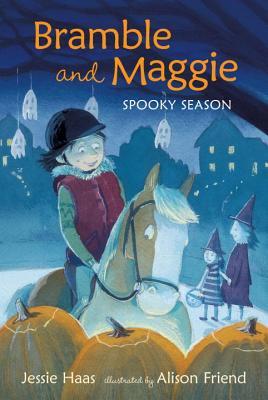
Bramble and Maggie: Spooky Season
Published August 12th, 2014 by Candlewick Press
Author: Jessie Haas
Illustrator: Alison Friend

Bramble and Maggie: Horse Meets Girl Goodreads Summary: Come along for a spirited ride as Bramble – a horse with interesting “little ways”- and her devoted girl, Maggie, make their debut in this inviting early reader.

Maggie wants a pony to ride and take care of, and to prepare she’s been reading a big book on horse care. Meanwhile, Bramble is bored with giving riding lessons and walking in circles. She’s looking for just the right person to take her away from her routine. Is it a perfect match? Maggie loves Bramble as soon as she sees her, but there are some things Bramble has to be sure of. Will Maggie let Bramble venture into new places? Will she protect Bramble from strange objects in the yard? Will she, most importantly, know when Bramble needs her undivided attention? This charming and funny early reader is an ideal match for young animal lovers and anyone who has ever longed for a friend who truly understands.

Bramble and Maggie: Give and Take Goodreads Summary: Maggie and her mischievous horse, Bramble, are back for another spirited romp through the ins and outs of friendship.

Maggie loves introducing her new horse, Bramble, to the neighborhood, the beach, and the backyard. Bramble has fun too, once she is cajoled into participating by a well-timed carrot or two. But when Maggie has to go to school, Bramble is bored and lonely and gets into some trouble with Mr. Dingle next door. A misbehaving hen and a midnight visitor finally help to turn Bramble into a good neighbor. This charming and funny early reader flows at just the right pace for kids who are learning that others don’t always do exactly what you want, but that friends find a way to give and take.

Bramble and Maggie: Spooky Season Goodreads Summary: Bramble, a persnickety but lovable horse, and Maggie, her patient owner, build an even stronger friendship as they brave the surprises of autumn.

In their third adventure, Bramble and Maggie explore a new season together — fall! Leaves crunch underfoot. Acorns ping off rooftops. It all makes Bramble feel wonderfully spooky. But Bramble’s frisky-pretend-scary gait makes Maggie jumpy, and soon Bramble really is nervous. There are alarming new sights and sounds everywhere, like Mr. Dingle’s scarecrow. When Maggie takes a fall, will she want to get back in the saddle? And when Halloween comes, can Maggie trust Bramble to brave the tricks and lead them both safely to the treats?

Kellee’s Review: There is a very specific time in a kid’s life where they are ready to begin reading longer books, but not ready to tackle chapter books yet. This is where Bramble and Maggie fits. These early chapter books will are perfect texts to help lead kids to longer chapter books. The work well for their targeted age level in that they never speak down to readers and have excellently paced stories that hold readers’ attention and will help them feel successful.  On top of all this, the Bramble and Maggie stories are just so sweet! I love all the different adventures they go on and the lessons they learn like overcoming fear, conquering loneliness, and gaining responsibility. Readers will adore these books. 

Ricki’s Review: Kellee hit the nail on the head. As I was reading, I thought to myself, “Why didn’t I have these books available to me when I was transitioning to chapter books?” I remember being devastated that my books no longer had pictures in them, and I resisted the longer texts for this reason. This series is engaging, educative, and fun! The words repeat in ways that will help students learn the vocabulary, particularly the more difficult words that relate to horses. Each book delivers a strong message, and the bond between Bramble and Maggie is one which will connect with readers. When I think about these books, I will always remember Maggie dragging her sleeping bag to the stable to sleep beside Bramble. I can’t wait to share these books with my pre-service elementary school teachers. They will have a special place in classrooms.

Teachers’ Tools for Navigation: Readers would be wise to explore how Haas develops theme in these texts. Each individual book has a different theme, and the content beautifully incorporates the messages. These books would be great models for students to learn about implicit versus explicit themes.

Discussion Questions: What lessons has Maggie learned since she has gotten Bramble? What lessons has Bramble learned since he’s met Maggie?; How has Bramble changed since he went to live with Maggie?; In what ways does the author show the bond of friendship throughout the books?

We Flagged: “Bramble lowered her head. Maggie gave her a carrot, and Bramble took it. She let Maggie put on the bridle. This was better. Give and take” (p. 9 of Bramble and Maggie: Give and Take)

Read This If You Loved: The Franklin School Friends series by Claudia Mills, The Pony Mysteries series by Jeanne Betancourt, and The Pony Scout series by Catherine Hapka

Recommended For:
  litcirclesbuttonsmall classroomlibrarybuttonsmall

Q & A with Jessie Haas

What inspired you to write this series? What inspired you to write about a horse?

I was inspired by two things in writing the Bramble and Maggie books. First, I had a story rejected by Candlewick, but with a request attached. The editor had girls who loved horses and horse books and had read some of mine and they noticed that they were always checked out of the public library. So Candlewick asked if I would like to write a couple of books for beginning readers.

At the time I had just gotten a new horse, Robin. She has a somewhat prickly personality, which I think inspired Bramble’s name, and the way horses and people mesh with each other was on my mind. Of course, I knew my version of events, but I’m always aware that horses have their own points of view, so the story would need to be told from both Bramble’s and Maggie’s perspectives.

What was it like to work with an illustrator? What does the process look like?

Like most authors, I don’t actually “work with” the illustrator. The editor and I work until we have a solid draft. Then the text is sent to the illustrator and she sends sketches. When the editor and I see them, it becomes obvious where we need to add or drop words (usually drop) to make space on the page. A lot of times, the art is telling the story already, and that makes some of the words unnecessary.

Alison Friend lives in England, so we did have one big change she needed to make in the first book. The wonderful picture at the beginning of Chapter Two, with Maggie and her family in the car, had the steering wheel on the right, as in British cars. I must admit, it took me a few times looking at the pictures to spot that. The pencil sketches are always funny and energetic, but the magic happens when Alison begins to paint, and it is always tremendously exciting to see the finished pages. And I got to see the original art for Spooky Season, which was thrilling. I think Spooky Season is one of the most beautiful books I have ever had published.

How do you envision your texts being taught in classrooms? Do you have any suggestions for our viewers who are teachers?

I’m usually stumped by that question. Now, though, I have a great new curriculum guide (it’s a free download on my website) I love some of the ideas there. Spooky Season, the newest book, explores the theme of fear—how we pretend to be afraid (for fun), how we scare ourselves (for fun), and how we sometimes get really scared—and that’s not fun! Bramble is truly afraid of some Halloween decorations like Mr. Dingle’s scarecrow—until she finds out it’s good to eat

Maggie runs into the situation every horseman faces sooner or later. You fall off, and you know you’re supposed to get right back on, or the fear will grow and you might not be able to. That’s easier said than done, of course. But Bramble takes care of Maggie the way good horses do, and Maggie has the experience that I remember from my own life as my very first time confronting and overcoming fear. These are great discussions to have around Halloween.

For Give and Take, the discussion is more about a truly basic issue in children’s—indeed, everyone’s—lives: power. Bramble feels that no one should be the boss all of the time. There should be some give and take. As well as story sequencing discussions, this is a chance for children to talk about—and draw—a time in their own lives when they learned to share, and give a little.

And Horse Meets Girl has a wonderful activity where children are encouraged to imagine, describe and draw their ideal pet. I also love the idea of Maggie needing a babysitter for Bramble, which could be a springboard for kids writing their own stories. The curriculum guide was created for me by Blue Slip Media, working with an educational consultant who’s also an elementary school teacher, and it’s keyed to Common Core curriculum standards—so it’s educationally sound as well as fun.
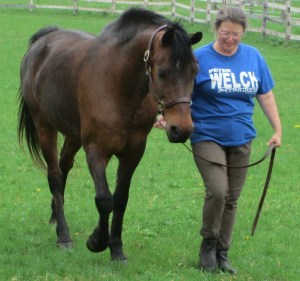
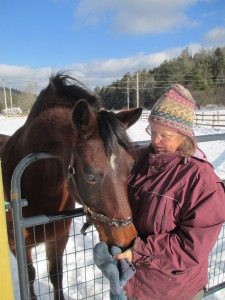
Jessie Haas 2 Jessie Haas w horse

Jessie Haas has always loved horses and has written more than thirty books, most of them about horses, including the first two books ab out Bramble and Maggie. She says, “Horses love pretending to be scared, just like us, and fall is the perfect season for that. Why do they call it fall?” Jessie Haas lives in Vermont with her husband, writer Michael J. Daley; her horse; two cats; a dog; and a hen. For more information, and to download a free curriculum guide, visit her website: http://www.jessiehaas.com/.

RickiSigand Signature

**Thank you to Barbara at Blue Slip Media and Jessie Haas for having us as part of the blog tour!**

Captain Underpants Series by Dav Pilkey

Share

captain1 captain11

Captain Underpants series
Author: Dav Pilkey
#1: Adventures of Captain Underpants published September 1st, 1997 by Scholastic, Inc.
#11: Captain Underpants and the Tyrannical Retaliation of the Turbo Toilet 2000 published August 26th, 2014 by Scholastic Inc.

Goodreads Summary #1: Pilkey plays with words and pictures, providing great entertainment. The story is immediately engaging – two fourth-grade boys who write comic books and love to pull pranks find themselves in big trouble. Mean Mr. Krupp, their principal, videotapes George and Harold setting up their stunts and threatens to expose them. The boys’ luck changes when they send for a 3-D Hypno-Ring and hypnotize Krupp, turning him into Captain Underpants, their own superhero creation.

Goodreads Summary #11: When the Incredible Robo-Plunger defeated the evil Turbo Toilet 2000, George and Harold thought their toilet troubles were over. Unfortunately, their porcelain problems were only beginning . . . Just when you thought it was safe to flush . . . The Turbo Toilet 2000 strikes back! The carnivorous commode known for devouring everything in its path has built up a real appetite . . . for REVENGE! Join Captain Underpants for another epic showdown of Wedgie Power vs. Potty Power as our tighty-whitey-wearing superhero GOES TO ELEVEN!

My Review and Teachers’ Tools for Navigation: Ever since I started teaching I have had Captain Underpants fans in my classroom. Readers (especially boys though, like all books, it is not exclusive) love these books. When I started teaching intensive reading, my students loved that I read so much but were astonished that I had never read a Captain Underpants book. So, during the summer of 2012, I read the entire series that was out at the time.  And suprsingly, I am happy I did. I enjoyed the books so much, and I found many different ways that I could use in the series in classroom. As I read I not only enjoyed the stories (well most of them; the booger one was quite gross), but I kept notes on different ways each book could be a mentor text.  I know that students already love the books so I would love to be able to use them in the classroom. I think that part of what makes Pilkey’s humor work is that he never talks down to his reader. The humor is intelligent and witty, and he makes sure to have his books be as entertaining as possible to keep the reader’s attention.

Teachers’ Tools for Navigation: Some of my favorite things that are addressed in the series are spelling, grammar, vocabulary, and puns. The spelling is not directly addressed; however, Harold and George misspell a lot of words and it would be good to use to talk about phonics and spelling.  Also, each book begins with an anagram which is great word play.  The grammar is sporadic only showing up in some books, but the vocabulary is in all of them.  Some vocabulary I found was billowing, narratively convenient, fizzled, improbability, jubilant, mock, scurried, and merciless and that is just in book 3! Also the puns in each book are really quite clever (check out p. 34 in #11 and any of the flip-o-ramas to see what I mean). Each book also has some great alliteration (#11, p. 29, 27, 208)- each title alone has alliteration in them. There are also allusions and onomatopoeias!

Additionally, I love the set up of the novels. They are a great mix of novel, graphic novel, comics, and picture books. It is a great transition between picture books and Diary of a Wimpy Kid. I especially like the flip-o-ramas. They are unique to the Captain Underpants books and I think it puts a great interactive and kinesthetic feel to the books.

One thing I do not understand is why these books are challenged. Yes, they have some potty humor. Yes, the adults aren’t the best representation of teachers. Yes, it is silly. But they are harmless and actually have some really great qualities to them.

Discussion Questions: In the first Captain Underpants, Harold and George brainstorm a superhero including his name and then create a comic based on their superhero. With a partner, brainstorm a name for a superhero and then complete a story to go along with your superhero. To expand it even more, complete a comic for your superhero.; In #11 novel, time travel plays a large part of in the plot. What event could you go back in time to try to change?; In some of the Captain Underpants books, there are grammar, convention, and spelling mistakes. Why do you think Dav Pilkey makes the choice to use incorrect grammar? What mistakes idd you find?; In #11, Harold and George end up being cloned (kind of). What would you do if there were two of you?

We Flagged (#11): 

Read These If You Loved: Diary of a Wimpy Kid series by Jeff Kinney, Big Nate series by Lincoln Peirce, Charlie Joe Jackson series by Tommy Greenwald, The Adventures of Ook & Gluk and Super Diaper Baby series by Dav Pilkey, Lunch Lady series by Jarrett Krosoczka, Frankie Pickle series by Eric Wight, Knights of the Lunch Table series by Frank Cammuso 

Recommended For: 

readaloudbuttonsmall classroomlibrarybuttonsmall

Signature