Touched by Paul Maurer

Share

touched

Touched
Author: Paul Maurer
Published February 6th, 2013 by New Libri Press

Goodreads Summary: Landmines. Quicksand. Class warfare. Now if Jimmy Parker could only find high school that simple. It only gets more complicated when a mysterious female classmate with a special gift enters his life. Jimmy finds out quickly that a simple touch of her hand allows her unwanted clairvoyance into his most sacred thoughts. Soon after the revelation adolescent sparks fly in directions that culminate in Jimmy’s admittance into the sinister Gritch Club. There he is confronted with social and sexual dilemmas that shake his very core. It is only when his classmate’s mental frailties bubbles to the surface he realizes seemingly harmless actions have powerful consequences that end one life and transform another.

My Review: This book’s ending was so shocking. I sat with my mouth hanging open, just shocked. It was so sudden and really caught me off guard.  The emotion I felt starts with the characters. Jimmy is a nobody in his high school until Renee enters his life. Renee is special. She doesn’t care about what others think, she stands up to the bullies, and she actually befriends Jimmy. Renee is who propels our plot. She gets Jimmy to get out of his comfort zone, she is mysterious so I was always trying to figure her out, and she was smart and beautiful.

Teacher Tools’ For Navigation: There is almost a sub-genre of books that Touched fits in, though I don’t know if it has a name yet. They all have smart or outcast main characters, and another character enters their life who helps them realize their identity. Teens who like those book will enjoy Touched as well.

Discussion Questions: How does Renee change Jimmy’s life?; What events caused the surprising ending to happen? Did you see it happen? Was their foreshadowing that could have given away the ending?

We Flagged: “Most of high school was about as thrilling as getting a Slushee brain-freeze. But in my first class after lunch a thin vein of gold appeared within the red bricks of the building. English Composition was taught by Clarice Weatherspoon, a wrinkly lady that just about everybody called Mrs. Spoon. She was about eighty years old and one of those teachers who probably probably taught during the depression and was never going to die. I could see her in a coma maybe, but not dead. I never cared much for writing but Mrs. Spoon was supposed to be different. Fun was too strong a word for her class, but at least it wasn’t supposed to bore the living crap out of you. She only weighted a hundred pounds caring a backpack full of Big Macs, but when she spoke she came on as tough as a leather boot. Probably tougher.” (Location 335, Kindle ebook)

Read This If You Loved: The Beginning of Everything by Robyn Schneider, Speak by Laurie Halse Anderson, Jumped In by Patrick Flores-Scott

Recommended For: 

classroomlibrarybuttonsmall

Signature

Boys of Blur by N. D. Wilson

Share

boys of blur

Boys of Blur
Author: N. D. Wilson
Published: April 8, 2014 by Random House

Ricki’s Summary and Review: 12-year-old Charlie Reynolds’ family travels to town of Taper to attend the funeral of a beloved football coach. When Charlie’s stepfather is given the opportunity to coach the town’s football team, Charlie is not thrilled to learn that they will be living in this creepy town filled with ancient stories of runaway slaves, native tribes, and monsters that rise organically from the murky swamps. He tries to fit into this mysterious place, where boys chase rabbits through burning sugarcane and everything seems to revolve around football. As he comes to learn about this town of secrets, Charlie wonders if he has the courage to uncover the mysteries that surround him.

Set deep in the heart of the Florida Everglades, this text is sure to grip readers with its muck, swords, blood, and gore. Wilson integrates complex allusions to Beowulf, which will compel readers to uncover all of the parallels with the classic legend. The beautifully complex language of this fast-paced story inspires close readings while also teaching readers lessons about evilness, heroism, and family.

Kellee’s Review: What I found most intriguing about this book is that Wilson was able to allude to Beowulf in a middle grade book without completely scaring away the reader.  Although I have read in multiple reviews that this book will grab reluctant readers’ attention, I think that some of the allusions are hard to grasp without prior knowledge, so reluctant readers may need some assistance understanding thus making the book a great read aloud as it will grab attention and start deep discussion (see Tools for Navigation).  In addition to the allusions, there are opportunities to discuss hero’s quest, abuse, and loyalty.

You will also find some beautiful writing in this novel. Wilson has a way with words that made this novel lyrical yet easy to read. From the very first line: “When the sugarcane’s burning and the rabbits are running, look for the boys who are quicker than flame.” I was impressed with how literary the novel was.  

Teacher’s Tools for Navigation: There are obvious parallels between this novel and  the legend of Beowulf, and pairing these two texts for discussion would prove very rewarding. Perhaps, teachers could use this Boys of Blur in conjunction with Gareth Hinds’ graphic novel of Beowulf. Then, the class could compare and contrast both the story lines and the differing formats authors might employ to convey a story and message.

Discussion Questions: How is Charlie characterized? Do you find him to be a strong character?; What role does Cotton play in the story?; What role does Charlie’s father play in the story? Can he be forgiven?; How does the author use language effectively?

We Flagged: “‘Yes,’ Mrs. Wisdom said, ‘you are. You’re made of tiny spinning bits as fast as light. But those bits aren’t all of you. They fly off. They get lost, and new ones come on and join the swirling Charlie-shaped dance that is your body. And dwelling in that dance, woven through every racing bit, heating it all with life and guiding it, there is a fire, a soul—you. It takes a dream to see something like that, something closer to the way things really are” (110).

Read This If You Loved:  Beowulf by Unknown, 100 Cupboards by N. D. Wilson, Maniac Magee by Jerry Spinelli, Holes by Louis Sachar, Ophelia and the Marvelous Boy by Karen FoxleeRaining Sardines by Enrique Flores-Galbis

Recommended For:

 readaloudbuttonsmall litcirclesbuttonsmall closereadinganalysisbuttonsmall classroomlibrarybuttonsmall 

RickiSigand Signature

Voices of the Sea by Bethany Masone Harar

Share

21845621

Voices of the Sea
Author: Bethany Masone Harar
Expected Publication: July 22, 2014 by WiDo Publishing

Summary: Seventeen-year-old Loralei is the future Guardian of her Siren clan. To outsiders, she appears to live the average life of a teenager, but like her ancestors, her voice has the power to entrance men. But the Sons of Orpheus are determined to destroy all Sirens, and when members from her clan are savagely murdered, Loralei feels a responsibility to protect her people. When Lora meets Ryan, a new student in her school, she can’t help but be drawn to him in a way that feels both exhilarating and unsettling. The sea’s dark whispers urge Lora to find the Sons of Orpheus, and she quickly learns that no one can be trusted.

Review: I was drawn to the mystery of this novel. I found myself turning the pages quickly, eager to uncover the mystery of Half-Moon Bay. This is a book that would be very appealing to my students as it is very engaging. The romance is passionate and fiery, and it is a text that would be easily passed amongst peers. Loralei is a strong, independent woman who works fearlessly to lead her clan. She faces danger with her eyes wide open, and teens can learn much from her strength. The book is cleverly crafted with the perfect amount of detail to leave readers guessing.

Teacher’s Tools for Navigation: My heart swelled at the many references to mythology. This text is unlike others that may be defined as paranormal romance in that the author includes a rich history of Sirens. Teachers can capitalize on this by asking students to explore Sirens further or research other mythological creatures.

Discussion Questions: How does the author develop the plot to keep readers engaged? Which details does she withhold? Which does she provide? Can you see any foreshadowing?; Can Loralei trust the people in her life? Which characters feel nefarious to you? Which can be trusted?

We Flagged: “She could no more ignore the ocean than she could her own soul” (Chapter Two).

Please note: This quotation was taken from an advanced reader copy. It may change in the final publication.

Read This If You Loved:  Of Poseidon by Anna Banks, Nightshade by Andrea Cremer, Hush Hush by Becca Fitzpatrick

Recommended For:

  classroomlibrarybuttonsmall

RickiSig

The Fox in the Library by Lorenz Pauli

Share

the fox in the library

The Fox in the Library
Author: Lorenz Pauli
Illustrator: Kathrin Schaerer
Published August 1st, 2013 by NorthSouth

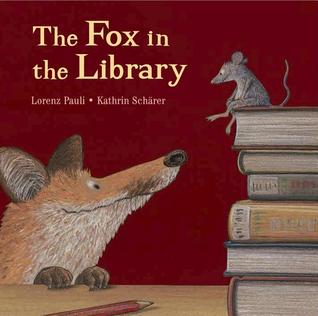
Summary: Fox didn’t come to the library to read a book–he came to catch a mouse! But  Mouse offers the fox a book, Fox gets all sorts of creative new ideas.  Like eating chickens!  Until Chicken points out that chicken bones are dangerous. But then all the animals must band together when the chicken eating, hating-Farmer walks into the library.

Review: I am a sucker for books about bookstores, books, and libraries. I imagine this is the same for all book lovers. The illustrations in this book are bright, and it was very fun to read it to my son. I don’t think you can read too many books about books to kids. They need to understand that there is a world of books out there, and going to the library is cool! Some books lend themselves to silly voices—and this is certainly one of those books. The mouse even mocks the fox for calling the library a “lie-berry.” I suspect that kids won’t ever forget the pronunciation after hearing this book.

Teacher’s Tool For Navigation: This would be a great book to read to children before a trip to the library. It would stir their imaginations and make them excited to discover all of the creatures that may lurk while they visit.

Discussion Questions: How does Mouse outsmart the fox?; What do the animals learn in their trip?; What kinds of books appeal to each of the animals?


We Flagged: “‘Nothing here belongs to you,’ Mouse said with a giggle. ‘You can only borrow things here. And I’ll never be yours. This isn’t the forest; this is the library'” (6).

Read This If You Loved:  Library Lion by Michelle Knudsen, Wild About Books by Judy Sierra, The Boy who was Raised by Librarians by Carla Morris, Tomas and the Library Lady by Pat Mora

Recommended For: 

readaloudbuttonsmall classroomlibrarybuttonsmall

RickiSig

Amulet Books Graphic Novel Teaching Guide

Share

abrams

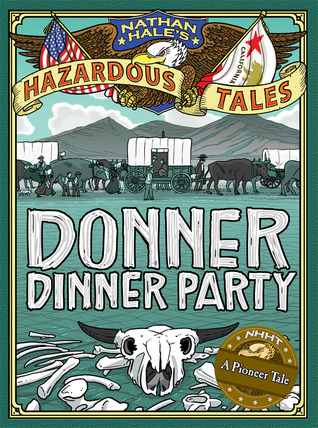
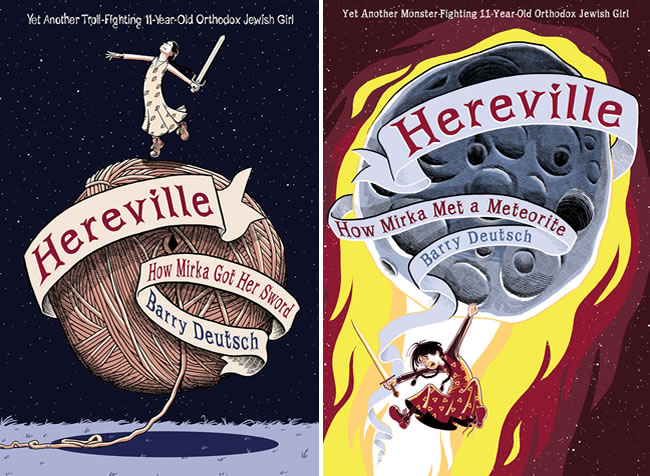
In January, I was contacted by a publicity and marketing associate from Abrams Books/Amulet Books out of the blue. In this email, I was asked to work on a teaching guide about their graphic novels: The Misadventures of Salem Hyde, Nathan Hale’s Hazardous Tales, Hereville, and the Explorer series.

1729025518405488 

13591161135911621729026018405492

1283377017290285

I was beyond honored! And, of course, I said that I would definitely love to do it as I had read all of the graphic novels, and I am a huge fan of them.

First, they asked me to write an introduction about graphic novels and their importance in the classroom. I am a huge advocate for using graphic novels in schools, so I immediately began researching and writing. Here is the introduction:

What are graphic novels? The easiest way to describe graphic novels is to say that they are book-length comic books. However, a more complex definition that educators and librarians use is “book-length narratives told using a combination of words and sequential art, often presented in comic book style” (Fletcher-Spear, 37). Graphic novels are not written in just one genre; they can be in any genre, since graphic novels are a format/medium. Graphic novels are much like novels, but they’re told through words and visuals. They have all narrative elements, including characters, a complete plot, a conflict, etc.

Middle grade and young adult graphic novels cover a wide spectrum of themes and topics. Some common themes found in graphic novels for this age include the hero’s journey; overcoming hardship; and finding one’s identity. For example, in Hereville, we meet Mirka, an everyday girl who learns to use her brains and brawn to overcome her foes. In The Misadventures of Salem Hyde, Salem is working on finding out just who she is (both as a witch and as a person) with the help of her friend Whammy. Graphic novels can cross curricular lines. One example is the Nathan Hale’s Hazardous Tales series—comical nonfiction that takes historical events and presents them in interesting ways, using graphics and humor that will make students want to learn even more about the historical time periods. In the Explorer series, stories include topics such as animal adaptation, volcanic eruptions, and the fate of humanity. Like novels, graphic novels offer opportunities in all subject areas to extend students’ thinking.

Over the past few years, graphic novels have become a hot topic, growing in popularity with both children and educators. While many teachers are beginning to include them in the classroom, there are still teachers, administrators, and librarians who struggle with including this format in their schools. So, why should you use them in your classroom and have them available for students?

  • Graphic novels can make a difficult subject interesting and relatable. (Cohen)
  • Students are visual learners, and today’s students have a much wider visual vocabulary than students in the past. (Karp)
  • Graphic novels can help foster complex reading skills by building a bridge from what students know to what they still have to learn. (NCTE)
  • Graphic novels can help with scaffolding when trying to teach higher-order thinking skills or other complex ideas.
  • For students who struggle to visualize while they read, graphic novels provide visuals that shows what good readers do. (NCTE)
  • Many graphic novels rely on symbol, allusion, satire, parody, irony, and characters/plot and can be used to teach these, and other, literary devices. (Miller; NCTE)
  • Often, in between panels (called the gutter), the reader must make inferences to understand how the events in one panel lead to the events in the next. (McCloud)
  • Graphic novels can make differentiating easier. (Miller)
  • Graphic novels can help ELL (English Language Learners) and reluctant and struggling readers since they divide the text into manageable chunks, use images (which help students understand unknown vocabulary), and are far less daunting than prose. (Haines)
  • Graphic novels do not reduce the vocabulary demand; instead, they provide picture support, quick and appealing story lines, and less text, which allow the reader to understand the vocabulary more easily. (Haines)
  • Research shows that comic books are linguistically appropriate reading material, bearing no negative impact on school achievement or language acquisition. (Krashen)
  • Students love them.

Although you can find graphic novel readers at all reading levels, graphic novels can truly be a gateway to the joys of reading for reluctant and struggling readers. Reluctant readers often find reading to be less fun than video games, movies, and other media, but many will gravitate toward graphic novels because of the visuals and the fast pace. Struggling readers will pick up graphic novels for these reasons as well but also because the graphic novel includes accommodations directly in the book: images, less text, etc.

All in all, graphic novels can interest your most reluctant and struggling readers and also extend all of your readers, including your most gifted.  

Resources

  • Cohen, Lisa S. “But This Book Has Pictures! The Case for Graphic Novels in an AP Classroom.” AP Central. CollegeBoard.
  • Fletcher-Spear, Kristin, Merideth Jenson-Benjamin, and Teresa Copeland. “The Truth About Graphic Novels: A Format, Not a Genre.” The ALAN Review Winter (2005): 37­–44.
  • Haines, Jennifer. “Why Use Comics in The Classroom?” Comic Book Daily. N.p., 20 Mar. 2012.
  • Karp, Jesse. “The Case for Graphic Novels in Education.” American Libraries. N.p., 1 Aug. 2011.
  • Krashen, Stephen. The Power of Reading. Englewood, CO: Libraries Unlimited, Inc. 1993.
  • McCloud, Scott. Understanding Comics. Northampton, Mass.: Kitchen Sink, 1993. 
  • Miller, Andrew. “Using Graphic Novels and Comics in the Classroom.” Edutopia. N.p., 11 Jan. 2012.
  • NCTE, comp. “Using Comics and Graphic Novels in the Classroom.” The Council Chronicle September (2005) http://www.ncte.org/magazine/archives/122031.

 I then began reading and rereading the graphic novels and planning activities and discussion questions that could go along with each book. I was asked to come up with activities for all subjects, so this pushed me out of my comfort zone a bit; however, I loved trying to figure out how these amazing books could be used throughout all classes.  Some examples:

  • Salem Hyde [Science]: At the end of Spelling Trouble, Salem and Whammy have to rescue a whale, but it is done in a very unconventional way. How would real scientists rescue a whale in distress?
  • Hazardous Tales [Language Arts/History]: The Provost (a British soldier) and Nathan Hale disagree about the cause of the Revolutionary War. Based on One Dead Spy, what events caused the Americans to revolt? Do you agree with the Provost or with Nathan Hale about the causes of the war? (This could also be used as a debate question in class.)
  • Hereville [Math]: On pages 31–32 [of Hereville 1], Mirka is given a math problem: Three people are splitting a cake, so they cut it into thirds. But then a fourth person shows up. How can they cut the cake so that each person gets an equalamount of cake? (Mirka comes up with a solution, but are there others?) What if two more people had shown up? Three more? Four more? 
  • Explorer [History]: On page 84 [of The Mystery Boxes], in The Soldier’s Daughter, the man says, “War is a dark power.” Where in history have we seen war consume someone? Have there been wars that did not need to be fought? Research past wars and determine if a war was started because of the need for power or if there was a legitimate reason for it. 

These are just some examples.

I am happy to share the entire teaching guide with you. It can be found at http://www.abramsbooks.com/academic-resources/teaching-guides/ along with other teaching guides. The direct link to the PDF is http://www.abramsbooks.com/pdfs/academic/GraphicNovels_TeachingGuide.pdf.

I hope you find it useful as I am very proud of it,

Signature

Little Red Writing by Joan Holub

Share

little

Little Red Writing
Author: Joan Holub
Illustrator: Melissa Sweet
Published September 24th, 2013 by Chronicle Books

Goodreads Summary: Acclaimed writer Joan Holub and Caldecott Honoree Melissa Sweet team up in this hilarious and exuberant retelling of Little Red Riding Hood, in which a brave, little red pencil finds her way through the many perils of writing a story, faces a ravenous pencil sharpener (the Wolf 3000)… and saves the day.

My Review and Teachers’ Tools for Navigation: I really think these wonderful woman created this book for just for teachers. It is a perfect, perfect, perfect book for a read aloud AND for a mentor text!

First, the book is a direct allusion to Red Riding Hood and is a great book to throw into the mix when looking at different versions of Red Riding Hood. I can just picture this book, with a version of the original story, Hoodwinked the movie, and Lon Po Po. Wow! What great discussions and activities you could do with this.

Second, this book is not just an awesome narrative and it includes a great lesson about writing a narrative. Red, our main character, is given the job to write a story and the book takes us through her journey of writing the story where she needs to include characters, setting, trouble, and fixing the trouble. A perfect opportunity to discuss narrative elements.  Taking this even further, it would be so much fun to look at the ideas that each of the other pencils had for their stories and write the entire story. You would have to look at each pencil’s personality and think about how s/he would write the story.

Finally, the book also deals with some parts of speech and how to use them. First are verbs where Red looks for more interesting verbs. She then looks for adjectives to add description. Then learns the importance of conjunctions (but watch out! They can lead to run-on sentences). Finally came adverbs with a bit of punctuation and capitalization discussion. Each part of speech is discussed in a nonboring way and the introduction could be a jumping off point to a deeper discussion.

Discussion Questions: How did Red use adjectives throughout the story to help you visualize the action?; What ended up being Red’s trouble, how did it get worse, and how did she fix it?; Pick one of the other pencils’ stories. How do you think it would end?

We Flagged: 

Read This If You Loved: Red Riding Hood by Brothers Grimm, Lon Po Po by Ed Young, The Day the Crayons Quit by Drew Daywalt

Recommended For: 

readaloudbuttonsmall closereadinganalysisbuttonsmall classroomlibrarybuttonsmall

Signature

Battle Bunny by Jon Scieszka and Mac Barnett

Share

battle

Battle Bunny
Authors: Jon Scieszka and Mac Barnett
Illustrator: Matthew Myers
Published October 22nd, 2013 by Simon & Schuster Books for Young Readers

Goodreads Summary: Alex has been given a saccharine, sappy, silly-sweet picture book about Birthday Bunny that his grandma found at a garage sale. Alex isn’t interested; until he decides to make the book something he’d actually like to read. So he takes out his pencil, sharpens his creativity, and totally transforms the story!

Birthday Bunny becomes Battle Bunny, and the rabbit’s innocent journey through the forest morphs into a supersecret mission to unleash an evil plan; a plan that only Alex can stop.

Featuring layered, original artwork that emphasizes Alex’s additions, this dynamic exploration of creative storytelling is sure to engage and inspire.

My Review: This book made me laugh out loud! What a perfect insight into the mind of a young boy (reminds me of so many doodles I’ve seen on papers over the year!).  Also, I was blown away by the creativity of Sceiszka and Barnett.  I wish I was teaching in a classroom because it would have been a book that I would have brought into the classroom to share with kids (yes, even my middle schoolers. Actually, definitely my middle schoolers.) because it is just so awesome!

Teachers Tools for Navigation: This picture book would be so much fun as a read aloud (original story than the modified one). Also, I can also picture bringing in picture books (maybe older ones or bought at a used book store) and letting the students modify their own! And so much creativity, vocabulary, cleverness, imagination, etc. are needed to transform a text the way Alex did–it’d be such a fun yet tough activity.

There is even a Battle Bunny website (http://mybirthdaybunny.com) where you can make your own story. They give you the original Birthday Bunny text and let you make your own. They actually provide PDFs of the entire text!  Also on the website are educators information that includes a curriculum guide.

Discussion Questions: What other stories could you build around Birthday Bunny?; (Writing activity) Using the picture book you were given, create a new story by changing words and adding photos.

We Flagged: 

Read This If You Loved: Scaredy Squirrel books by Melanie Watts, Bananas in my Ears by Michael Rosen, The Stinky Cheese Man by Jon Scieszka, You Will Be My Friend by Peter Brown

Recommended For: 

classroomlibrarybuttonsmall readaloudbuttonsmall closereadinganalysisbuttonsmall

Signature