Blog Tour and Review!: Weeds Find a Way by Cindy Jenson-Elliot

Share

NF PB 2014

Nonfiction Picture Book Wednesday

Nonfiction Picture Book Wednesday is hosted by Kid Lit Frenzy and was started to help promote the reading of nonfiction texts. Most Wednesdays, we will be participating and will review a nonfiction text (though it may not always be a picture book).
Be sure to visit Kid Lit Frenzy and see what other nonfiction books are shared this week!
weeds find a way

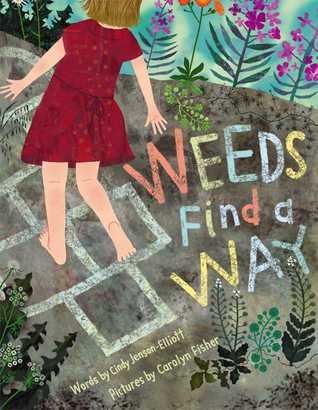
Weeds Find a Way
Author: Cindy Jenson-Elliot
Illustrator: Carolyn Fisher
Published: February 4, 2014 by Beach Lane Books

Goodreads Summary: Weeds are wonderful! Persistent, exuberant…these plants have personalities, and this nonfiction picture book puts them on colorful display!

From bright yellow dandelions popping through cracks in sidewalks to purple loosestrife growing rampant along roadways, weeds offer unexpected splashes of color and life to the least likely of places. With lovely language and a sly sense of humor, this beautiful picture book celebrates the tenacious temperaments of these pesky plants and is sure to have little ones chanting, “Way to go, weeds!”

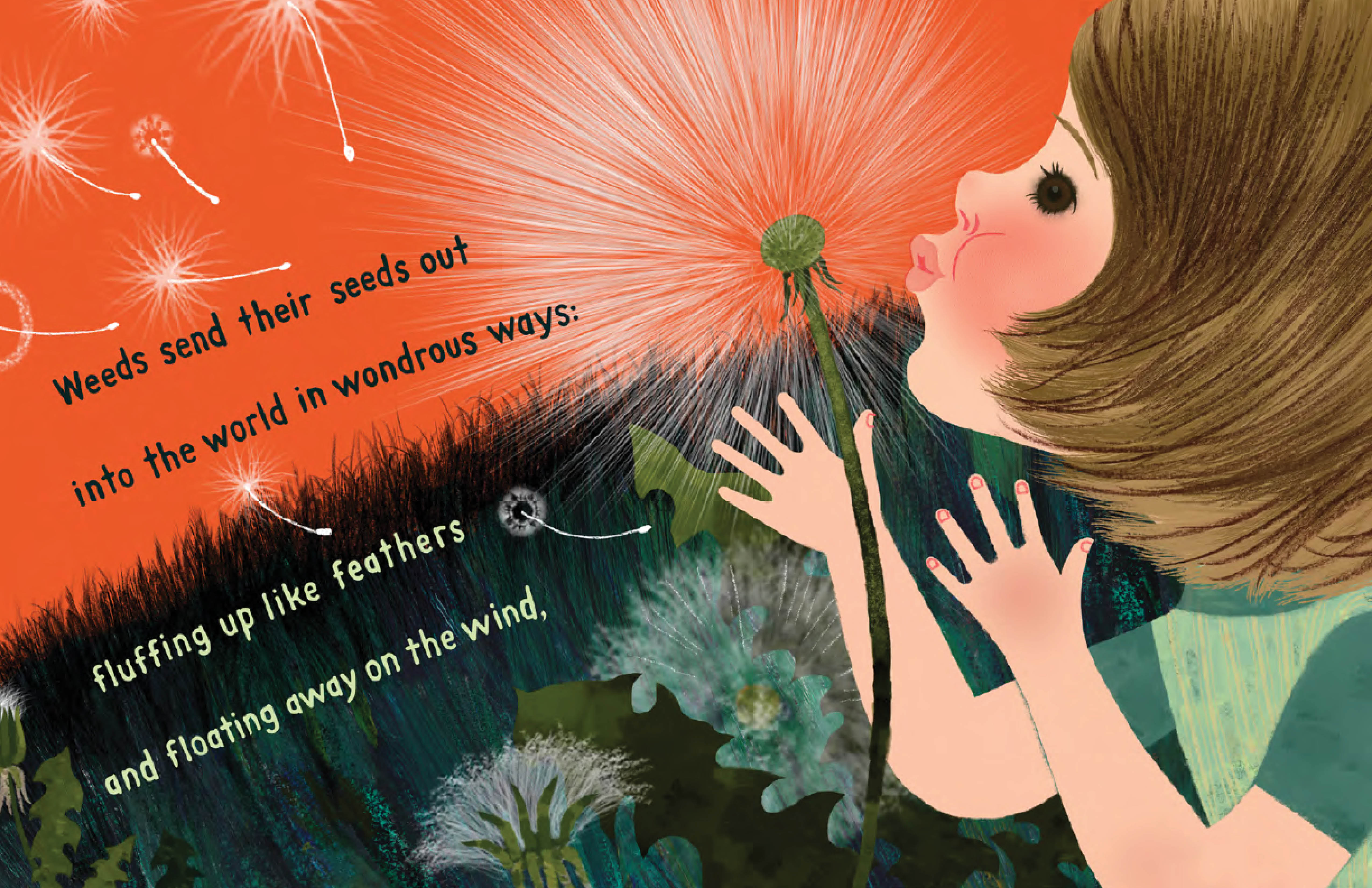
Ricki’s Review: The illustrations! The illustrations! I was mesmerized by the gorgeous artwork in this text. As I read it aloud to my son and husband, I was oohing and aahing at the bright, luscious colors. It made me want to go outdoors and lay among the weeds. If it wasn’t the dead of the winter, I would pull my son outside and read the book to him in our garden. There are beautiful passages of figurative language–alliteration that reads like a song, and readers will be sucked into the sprawling passages that evoke lovely images. The book turns readers’ assumptions on their heads. The words and images show that we can find beauty in, of all things, weeds. While I learned much about weeds and found the informational passages at the end (about different types of weeds) to be quite informative, I found the idea of weeds to be symbolic, too.

Kellee’s Review: I was blown away with how fascinating the author made something that we walk by every day and ignore. The text itself is quite lyrical and has the amazing illustrations with it; however, I found the goodies in the research in the afterword.  It was very interesting for me to learn that these plants, which we treat like pests, are actually so very useful. I second much of what Ricki says about the figurative language. I love seeing these elements being used in a nonfiction book! Overall, this is a nonfiction book that should be shared with kids and will definitely start some major discussions.

Teachers’ Tool for Navigation: Teachers will find multiple opportunities with this text. They can use it to teach different types of figurative language, or they might ask students to explore weeds in a more symbolic way. We love the idea of using nonfiction at such a young age, and we wonder if teachers might try literature circles with this text. While it is marketed for ages 4-8, it could be used for different purposes with a variety of age groups. The informational passages at the end might allow teachers to help students research about different types of plants. We also love the illustrations so much that we would love to have kids take the pictures and write their own stories to match the images. It would show that nonfiction can be accessible and fun.
Interior illus from WEEDS FIND A WAY_Copyright � 2014 by Carolyn Fisher

Discussion Questions: Why do weeds get a bad reputation? What else might we compare weeds to? Are there other things in the world that are unfairly loathed?; How does the author use figurative language to draw the reader in?; What makes a plant a weed?; Some of the plants shared at the end of the book are useful (for foods, medication, etc.); however, we still treat them as weeds. Why do we have this perspective of these plants?

We Flagged: “Weeds find  way to stay, reaching deep with a  grip so strong, the stem always breaks first, leaving the living roots behind to sprout again; or pinching into pieces the minute you try to tug them out, spreading into a spray of plant parts that find new spots to take root” (p. 21-22).

Read This If You Loved: The Lorax by Dr. Seuss, Evolution of Calpurnia Tate by Jacqueline Kelly, The Tree Lady by H. Joseph Hopkins
Cindy Jenson-Elliott photo

About the Author: Cindy Jenson-Elliott is the author of fourteen books of nonfiction and hundreds of articles for newspapers, magazines and educational publishers. She is a teacher and environmental educator with an MA in education and a passion for connecting children with nature. In her free time, she enjoys swimming in the ocean and spending time outdoors in San Diego, where she lives and gardens with her family of four humans and three Buff Orpington chickens. Visit her at CindyJensonElliott.com.

Recommended For: 

readaloudbuttonsmall classroomlibrarybuttonsmall closereadinganalysisbuttonsmall

 Check out all the stops on the WEEDS FIND A WAY blog tour!

Mon, Feb 24
Growing with Science
Tues, Feb 25
As They Grow Up
Wed, Feb 26
Kid Lit Frenzy
Thurs, Feb 27
Sharpread
Fri, Feb 28
Children’s Book Review
Mon, Mar 3
Let’s Go Chipper!
Tues, Mar 4
Just a Little Creativity
Wed, Mar 5
Unleashing Readers
Thurs, Mar 6
5 Minutes for Books
Fri, Mar 7
Archimedes Notebook


Signature andRickiSig

**Thank you to Barbara Fisch at Blue Slip Media for providing us with copies for review**
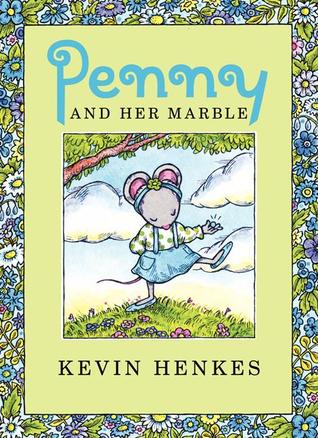
Penny and Her Marble by Kevin Henkes

Share

penny

Penny and her Marble
Author and Illustrator: Kevin Henkes
Published February 19th, 2013 by GreenwillowBooks

Goodreads Summary: In the third easy-to-read book about Penny the mouse, written by Caldecott Medalist and bestselling author Kevin Henkes, Penny finds a beautiful marble on her neighbor’s lawn and must decide whether or not to keep it. With age-appropriate vocabulary, compelling characters, and a memorable storyline, this is just right for newly independent readers.

Kevin Henkes is known for his mouse characters, including Lilly, Owen, Chrysanthemum, Wemberly, and now Penny! In Penny and her Marble, the third book in the Penny series, Penny finds a marble on Mrs. Goodwin’s yard and takes it home. But does the marble really belong to Penny? Kevin Henkes is a master at creating beautifully illustrated books that resonate with young children. The Penny books are new classics for beginning readers and will appeal to fans of Frog and Toad, Little Bear, and Henry and Mudge.

Review and Teacher’s Tools for Navigation: I am a huge fan of Kevin Henkes. I really enjoy everything he writes—he is so talented! His work ranges from picture books to early readers to chapter books to middle grade novels and all that I’ve read, I’ve enjoyed, and Penny and Her Marble was no different. Like the Goodreads summary says, Penny’s story is perfect for our early readers. Her story is one that children will connect with; however, Henkes never talks down to his readers. What struck me was the beautiful language that he used throughout–to describe Penny’s feelings, the marble, the day, etc.

Discussion Questions: If you were Penny, would you have kept the marble?; Is there anything you’ve taken without asking? What did you do?; Like Kevin Henkes does, look at different marbles and use similes to describe them.

We Flagged: “The marble was so blue it looked like a piece of the sky. Penny went to the window and held up the marble. She was right. The marble was like a piece of the sky.” (p. 16-17)

Read This If You Loved: Other Kevin Henkes books, Frog and Toad by Arnold Lobel, Little Bear by Else Holmelund Minarik, Scaredy Squirrel by Melanie Watt

Recommended For: 

readaloudbuttonsmall classroomlibrarybuttonsmall

Signature

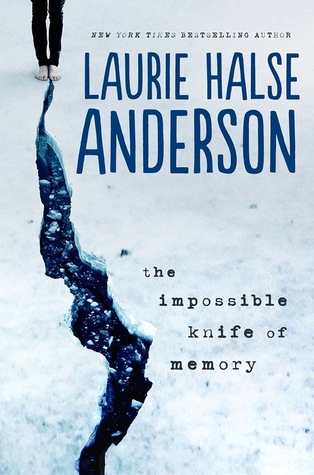
The Impossible Knife of Memory by Laurie Halse Anderson

Share

impossible knife of memory

The Impossible Knife of Memory
Author: Laurie Halse Anderson
Published: January 7th, 2014 by Viking Juvenile

GoodReads Summary: For the past five years, Hayley Kincaid and her father, Andy, have been on the road, never staying long in one place as he struggles to escape the demons that have tortured him since his return from Iraq. Now they are back in the town where he grew up so Hayley can attend school. Perhaps, for the first time, Hayley can have a normal life, put aside her own painful memories, even have a relationship with Finn, the hot guy who obviously likes her but is hiding secrets of his own.

Will being back home help Andy’s PTSD, or will his terrible memories drag him to the edge of hell, and drugs push him over? The Impossible Knife of Memory is Laurie Halse Anderson at her finest: compelling, surprising, and impossible to put down.

Review: This book reminded me of something incredibly important to remember as a reader—even when I read a book’s summary and feel as if I have read dozens of books with a similar plot, an amazing author like Laurie Halse Anderson will make me feel as if I have never read a book quite like it before. Hayley’s father’s pain ripped right through me. I felt his anguish and wanted to sit beside him to try to comfort him. This book sheds light on an issue that is often kept in the dark. With the war veterans coming home, it is all the more important that we talk about PTSD and try to come together as a country to help these soldiers find peace. This book made me want to stand up and help our veterans, and I think teenagers will feel a similar sense of need for social justice.

Teacher’s Tools for Navigation: Teachers would be wise to have students research further about PTSD and learn more about other soldiers who struggle with this issue. It is also important for students to learn about what our country is doing for these men and women who served our nation.

Discussion Questions: Can Andy be helped? Does Hayley deal with her father’s condition in a beneficial way?; Why does Hayley hate Trish? Is she justified in her feelings?; How does Finn’s family situation add to the story?

We Flagged: “I needed to hear the world but didn’t want the world to know I was listening.”

“Leaning against my father, the sadness finally broke open inside me, hollowing out my heart and leaving me bleeding. My feet felt rooted in the dirt. There were more than two bodies buried here. Pieces of me that I didn’t even know were under the ground. Pieces of dad, too.”

Read This If You Loved: Personal Effects by E.M. Kokie, The Things a Brother Knows by Dana Reinhardt, If I Lie by Corrine Jackson, Purple Heart by Patricia McCormick, Sunrise over Fallujah by Walter Dean Myers

Recommended For:

 litcirclesbuttonsmall classroomlibrarybuttonsmall

RickiSig

Who Says Women Can’t Be Doctors? by Tanya Lee Stone

Share

NF PB 2014

Nonfiction Picture Book Wednesday

Nonfiction Picture Book Wednesday is hosted by Kid Lit Frenzy and was started to help promote the reading of nonfiction texts. Most Wednesdays, we will be participating and will review a nonfiction text (though it may not always be a picture book).
Be sure to visit Kid Lit Frenzy and see what other nonfiction books are shared this week!

doctors

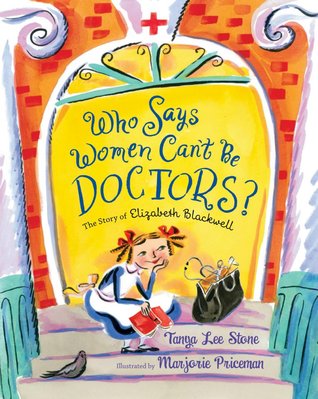
Who Says Women Can’t Be Doctors?
Author: Tanya Lee Stone
Illustrator: Marjorie Priceman
Published February 19th, 2013 by Henry Holt and Co.

Goodreads Summary: In the 1830s, when a brave and curious girl named Elizabeth Blackwell was growing up, women were supposed to be wives and mothers. Some women could be teachers or seamstresses, but career options were few. Certainly no women were doctors.

But Elizabeth refused to accept the common beliefs that women weren’t smart enough to be doctors, or that they were too weak for such hard work. And she would not take no for an answer. Although she faced much opposition, she worked hard and finally—when she graduated from medical school and went on to have a brilliant career—proved her detractors wrong. This inspiring story of the first female doctor shows how one strong-willed woman opened the doors for all the female doctors to come.

My Review: I love that Tanya Lee Stone chose to write about a women in history that changed our world in a big way, but has not get the credit for it.  It is amazing to think that one young lady was brave enough to be the first to try to get into medical school to help pave the way for millions of woman doctors today.  Although I realize there has to be a first for everything when overcoming prejudice and inequality, it is not often that you hear about who this one person was and how s/he had to do it alone, but that is how it was for Elizabeth Blackwell. No one had tried to jump over the barrier, but she did. This is such an inspirational story and such a big part of history–it should be shared with everyone.  And what tops off the book is the vibrant, colorful, playful illustrations that will draw the reader in even more.

Teachers’ Tools for Navigation: A couple of interesting themes that can definitely pulled out of this story is resilience (she never gave up after all of the rejections), the power of friendship (she has never considered being a doctor until a friend suggested it), and selflessness (just read the author’s note about the rest of Elizabeth’s life at the end). All three of these would lead to phenomenal discussions and can be connected to other historical figures and fiction texts.

Discussion Questions: Why do you think it took the townspeople longer to accept Elizabeth?; We learn that Elizabeth’s sister also became a doctor and the two of them eventually start a hospital. What type of people would Elizabeth and her sister have to be to be able to go from not being allowed to be a doctor to owning a hospital? What traits would they need?; How would life be different now if Elizabeth had never tried to become a doctor?

We Flagged: “I’ll bet you’ve met plenty of doctors in your life. And I’ll bet lots of them were women. Well, you might find this hard to believe, but there was once a time when girls weren’t allowed to become doctors.” (p. 3)

Read This If You Loved: Brave Girl by Michelle Markel, Me…Jane by Patrick McDonnell, Daredevil by Meghan McCarthy, Here Come the Girl Scouts by Shana Corey

Recommended For: 

readaloudbuttonsmall classroomlibrarybuttonsmall

Signature

Blog Tour and Author Guest Post!: Storm Watcher by Maria V. Snyder

Share

The Storm Watcher Blog Tour

Welcome to the Storm Watcher blog tour!

Feb 19 – Mar 5, 2014

Hosted by readnowsleeplater.com

Print 

Storm Watcher
Author: Maria V. Snyder
Published October 19th, 2013 by Leap Books

Goodreads Summary: Luke Riley is lost. His mother’s recent death has set Luke and his family adrift. Even though his father, twin brothers, and their three Bloodhounds are search and rescue volunteers, they have been unable to rescue themselves and become a family again. The summer after sixth grade looms in Luke’s mind as a long, lonely three months where the only thing he can look forward to is watching The Weather Channel. Luke is fascinated with the weather, but since his mother’s death in a storm, he is also terrified. Even the promised 13th birthday present of a Bloodhound puppy fails to lift Luke’s spirits. He would rather have a different breed – a petite Papillon, but his father insists he get a Bloodhound.

When Luke decides to get the Bloodhound from Willajean, a dog breeder who owns Storm Watcher Kennel, he works out a deal to help at her kennel in exchange for the expensive dog. Thrilled to have a summer with a purpose, Luke befriends Willajean’s daughter, Megan and together they plan how Luke can get a Papillon puppy instead of a Bloodhound. But nothing seems to work as they struggle with stubborn fathers, summer storms, unhelpful siblings, and hidden guilt. Can one little white dog really save both families?

So, how does one come to write a book about weather?

It all begins with a fascination with hydrometeors and a great teacher.
Squish this together with a writing career and VOILA! 

Hydrometeors are Falling on my Head
By Maria V. Snyder

Let me set the scene – sixth grade at Our Lady of Ransom, a Catholic school in the city of Philadelphia – my teacher, Miss Kane is doing a science unit on meteorology.  Meteo…what? At the time (1978), I’d never heard of it, except I had.  “Oh, you mean the weather, why didn’t you say so?” a beat later, “There are people who study the weather? Wow.”  Little did I know it at the time, but that unit was the vital first step to my eventually careers in both meteorology and writing.

I love big storms and loved the idea of studying them.  Not only was it super cool that Miss Kane made it rain in our classroom, but I was able to be a real smart-alecky kid.  You see I soon discovered that the adults in my life had never heard the word meteorology either. So when they asked me what I wanted to be when I grew up, I’d reply, “A meteorologist.”  Their blank look was always followed be a quizzical, “You want to study…meteors? Like from space?” and I chirped, “Not space meteors, hydrometeors.”  No comprehension so I’d explain in a I-can’t-believe-you-don’t-know-this tone that, “hydrometeors are raindrops.”  I did warn you that I was bratty – I was also eleven so I had a good excuse J.

As I continued in my education, the questions about my future remained the same, and so did the answer (except, by now my family was well acquainted with those pesky hydrometeors).  Sure, I loved acting, dancing, painting, and playing the cello, but I wasn’t a stand out in any of them.  However my math and science grades remained strong and nothing else sparked my interest.

Fast forward to my college graduation.  I’d earned my BS in Meteorology from Penn State University.  My forecasting skills were dismal so I ventured in the exciting new profession of environmental meteorology (whew – I think I have to rest my fingers after typing all that!).  Too bad envir meteo wasn’t all that exciting.  My creativity eventually woke from its catatonic state (caused by enduring endless hours of fluid dynamics and differential equations).  I started writing stories ‘cause it would have been awkward if I started practicing the cello in my cubicle at work.

Writing was a blast and, in my stories, I controlled the weather – hydrometeors fell at my whim – muuhhhaaawwwaaahhh!  Er…sorry.  Eventually I switched careers to writing, but I never lost my love for storms.  In fact, I incorporated the weather in many of my books.  However, the one book that brought me back to that snarky sixth grader is Storm Watcher, my debut novel for readers ages 8 to 14 years old.  I was able to geek-out along with the main protagonist, Luke.

While writing the story was fun, I was thrilled when my editor asked me to write an appendix of weather facts for those readers who also have a fascination with storms.  It’s called “Luke’s Weather Notebook.” For the appendix I drew pictures, found quirky weather facts, wrote a quiz, and included safety tips – delighting my inner weather weenie.  We hoped that the teachers who teach that meteorology unit would find the information helpful and maybe hook another student.

I’d like to thank Miss Kane in person – she probably has no idea she set me on this path.  Or…maybe she does.  Maybe she saw that spark in my eyes as she taught me about clouds and precipitation.  In either case, Thank You Miss Kane wherever you are!

Now, I’ve a question for you.  How many of you knew hydrometeors were raindrops?  Come on, be honest! 🙂

Just shows how one great teacher can truly change your life! 

Also, don’t forget to stop by each blog tour stop to learn more about the book.

Tour Schedule

Wed 2/19 – The Book Monsters – review

Thu 2/20 – I Am a Reader – interview

Fri 2/21 – Unleashing Readers – guest post

Mon 2/24 – Bookalicious – review

Tue 2/25 – Kid Lit Frenzy – guest post

Wed 2/26 – Sharpreads – review

Thu 2/27 – The Mod Podge Bookshelf – guest post

Fri 2/28 – The Windy Pages – review, interview

Mon 3/3 – Teenage Reader – review

Tue 3/4 – Read Now Sleep Later – review

Wed 3/5 – The Brain Lair – review

Signature

**Thank you to Alethea and Maria for allowing us to be part of the blog tour**

Green by Laura Vaccaro Seeger

Share

 green
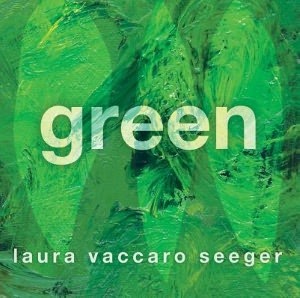
Green
Author: Laura Vaccaro Seeger
Published March 27th, 2012 by Roaring Brook Press

Goodreads Summary: Die cut pages bring surprise after surprise in this magical new book from the “Queen of the concept book”—an intricate and satisfying homage to green, the color of all creation.
How many kinds of green are there? There’s the lush green of a forest on a late spring day, the fresh, juicy green of a just-cut lime, the incandescent green of a firefly, and the vivid aquamarine of a tropical sea. In her newest book, Caldecott and Geisel Honor Book author Laura Vaccaro Seeger fashions an homage to a single color and, in doing so, creates a book that will delight and, quite possibly astonish you.

Green is a Kirkus Reviews Best Children’s Book of 2012.

Review: The limited words on each page allow the reader to get lost in the beauty of the illustrations of this gorgeous children’s book. I was expecting the typical greens but was pleasantly surprised to see the clever takes on wacky green, slow green, and no green at all. I glided from page to page, appreciating the clever cutouts and visual appeal of this incredible children’s book.

Teacher’s Tools for Navigation: This text could be used at a variety of levels. In my reading, I felt it is really asking readers: “How many different ways can you look at the color green?” We see objects, colors, and basic things in our world one way, but how can we interpret them differently? I would love to see this used in a creative writing classroom.

Discussion Questions: Where do we see the color green in our world? Go beyond the expected interpretations.; How does the author creatively present this book? What makes a book with so few worlds so very powerful?

Read This If You Loved: A Very Hungry Caterpillar by Eric Carle, One Fish, Two Fish, Red Fish, Blue Fish by Dr. Seuss

Recommended For: 

readaloudbuttonsmall classroomlibrarybuttonsmall

RickiSig

Press Here by Hervé Tullet

Share

press here

Press Here
Author: Hervé Tullet
Translator: Christopher Franceschelli
Published March 20th, 2011 by Chronicle Books

Goodreads Summary: Press the yellow dot on the cover of this book, follow the instructions within, and embark upon a magical journey! Each page of this surprising book instructs the reader to press the dots, shake the pages, tilt the book, and who knows what will happen next! Children and adults alike will giggle with delight as the dots multiply, change direction, and grow in size! Especially remarkable because the adventure occurs on the flat surface of the simple, printed page, this unique picture book about the power of imagination and interactivity will provide read-aloud fun for all ages!

Review: This is a wonderfully innovative book. It asks the child to interact with the story—pressing, tilting, shaking, etc. at each page. I am not ashamed to admit that I was smiling and following the instructions, eagerly wondering what awaited me on the next pages. I suspect I am going to have a very active child (based on the stories about my husband), and this book will allow him to wiggle and jump as he reads. This is a book that makes reading fun.

Teacher’s Tools for Navigation: I could see this being a great book for buddy/paired reading. It will evoke a lot of laughter and giggles from kids. I also wonder how this might be used to teach writing to middle and high schoolers. It is certainly innovative, and I bet teachers might use it to teach creativity and breaking the mold of typical writing.

Discussion Questions: What might the author’s purpose be for writing this book?; How does the author creatively reach readers? How can this be incorporated into your own writing?

We Flagged: “There. Well done. Now tilt the page to the left…just to see what happens.”

Read This If You Loved: Perfect Square by Michael Hall, Green by Laura Vaccaro Seeger, Is Everyone Ready for Fun? by Jan Thomas

Recommended For: 

litcirclesbuttonsmall classroomlibrarybuttonsmall

RickiSig