The Salem Witch Trials: An Unsolved Mystery from History by Jane Yolen & Heidi Elisabet Yolen Stemple

Share

NF PB 2013

Nonfiction Picture Book Wednesday

Nonfiction Picture Book Wednesday is hosted by Kid Lit Frenzy and was started to help promote the reading of nonfiction texts. Most Wednesdays, we will be participating and will review a nonfiction text (though it may not always be a picture book).
Be sure to visit Kid Lit Frenzy and see what other nonfiction books are shared this week!

salem

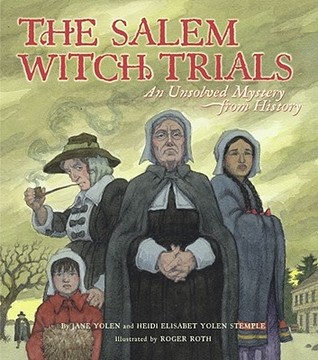
The Salem Witch Trials: An Unsolved Mystery from History
Authors: Jane Yolen & Heidi Elisabet Yolen Stemple
Illustrated by: Roger Roth
Published September 7th, 2004 by Simon & Schuster Books for Young Readers

Goodreads Summary: In 1692 Salem, Massachusetts, witnessed one of the saddest and most inexplicable chapters in American history. When a group of girls came down with a horrible, mysterious bout of illness, the town doctor looked in his medical books but failed to find a reasonable diagnosis. Pretty soon everyone in town was saying the same thing: The girls were ill because they were under a spell, the spell of witchcraft! And still, the question remains: Why did the hysteria occur? The townspeople had many things to worry about back then: smallpox, strife with the local Indians, a preacher demanding higher wages, and the division of land in the community. But did all of those problems justify a witch hunt?

Become a detective as you read this true story, study the clues, and try to understand the hysteria! The Unsolved Mystery from History series is written by acclaimed author Jane Yolen and former private investigator Heidi Elisabet Yolen Stemple. This is an innovative history lesson that’s sure to keep kids thinking throughout.

Review: The mystery of the Salem Witch Trials is one that has haunted the United States for over 3oo years now and is one that students love to read about (and I do, too!). Most of my thoughts about this book are about how awesome this book is for the classroom. The Yolens seemed to have written it specifically for teachers to use.

Teacher’s Tools For Navigation: This book promotes studying history, inquiry, and vocabulary. The book begins with an introduction to a young girl who enjoys unsolved mysteries from history and then the book is set up like her case notebook. Each page of the case notebook includes a narrative nonfiction section about what was going on in Salem, an informational nonfiction section where facts about the story are explained even more in detail, and then there are vocabulary words from the two sections defined for the reader. Finally, in the back of the book the different theories about what could be the answer to the unsolved mystery are shared and briefly discussed. The set up of this book leads to infinite possibilities of being used in the classroom. Students could debate, write research papers, could do their very own case notebook about a different mystery, etc. Another option is to get all of the Unsolved Mystery from History books and have students get into lit circle groups and have each group read a different mystery then research and share.

Discussion Questions: What do you think happened in Salem? [Could be a wonderful debate or cooperative research presentation/paper in class. Have each students, after reading the different theories, decide which they believe is true. Then within their groups come up with evidence that supports the theory that they believe in.]

We Flagged: Narrative Nonfiction Section: One bitterly cold day in February, Betty and Abigail both fell ill, collapsing onto their small rope beds. They convulsed. They contorted. Their arms and legs jerked about. They shouted bizarre, unintelligible words. They crouched under chairs and cowered as if frightened. In other houses in Salem Village several of their friends began to act the same way.

Informational Nonfiction Section: The other sick girls in Salem village included Ann Punam Jr. (age 12), Mercy Lewis (age 19), Mary Walcott (age 16), Elizabeth Hubbard (age 17), and Mary Warren (age 20). Like Abigail, Elizabeth and Mercy were orphans; Mercy may have witnessed her parents being killed in an Indian attack three years earlier in Main. Mary Walcott had lost her mother when she was eight. Ann and Betty were daughters of landowners, but Marry Warren, Elizabeth, and Mercy were maidservants.

Vocabulary: Convulsed: shook violently, Contorted: Twisted into unusual shapes, Unintelligible: Impossible to understand” (p. 12-13)

Read This If You Loved: I Walk in Dread by Lisa Rowe Fraustino, The Sacrifice by Kathleen Benner Duble, Witch Child by Celia Rees, The Witch of Blackbird Pond by Elizabeth George Speare, Witches: The Absolutely True Tale of Disaster in Salem by Rosalyn Schanzer and other nonfiction books about Salem

Recommended For: 

closereadinganalysisbuttonsmall readaloudbuttonsmall

classroomlibrarybuttonsmall litcirclesbuttonsmall

Signature

Jim Henson: The Guy Who Played with Puppets by Kathleen Krull

Share

NF PB 2013

Nonfiction Picture Book Wednesday

Nonfiction Picture Book Wednesday is hosted by Kid Lit Frenzy and was started to help promote the reading of nonfiction texts. Most Wednesdays, we will be participating and will review a nonfiction text (though it may not always be a picture book).
Be sure to visit Kid Lit Frenzy and see what other nonfiction books are shared this week!\

henson

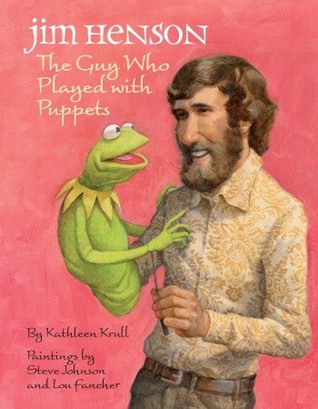
Jim Henson: The Guy Who Played with Puppets
Author: Kathleen Krull
Paintings by: Steve Johnson and Lou Fancher
Published August 23rd, 2011 by Random House Books for Young Readers

Goodreads Summary: Sesame Street and The Muppet Show introduced Jim Henson’s Muppets to the world, making Kermit the Frog, Oscar the Grouch, and Big Bird household names. But even as a child in rural Mississippi, listening to the radio and putting on comedy shows for his family, Jim recognized the power of laughter to bring people together. On Sesame Street, Jim’s Muppets transformed children’s television by making learning fun for kids everywhere. A visionary, Jim always believed that puppets could reach a wider audience. In 1976, he proved it, drawing millions of family viewers to The Muppet Show. With his feature film The Dark Crystal and his Star Wars characters—including Yoda—Jim continued to push the boundaries of what was possible in puppetry until his death in 1990 at the age of 53.

Kathleen Krull, recipient of the Children’s Book Guild 2011 Non-fiction Award and many other accolades, once again does what she does so well—illuminating the life of an important figure in history, art, and culture with her informative but approachable writing style.

Review: I love Jim Henson. I remember when he passed away and I was devastated. I thought that Sesame Street was dead too, but Jim Henson’s influence is stronger than death. He has continued to live through his show, characters, and legacy. Kathleen Krull does an amazing job of sharing with the reader what made Jim Henson who he was and how he became (I believe) the most influential person when it came to children and children’s entertainment in the 20th century.

Teacher’s Tools For Navigation: Jim’s story is a great story to tell children, because like many successful creative persons, he was passionate and went for what he enjoyed, was good at, and was his passion. Jim also will be someone that many students will connect with as he was quiet, smart, not athletic, in school plays, a reader, a story teller, and fascinated with TV.  There are more students like Jim than unlike him and they need to hear about those like them who were successful.

This book would also be a great way to incorporate the CCSS’s diverse media and formats by showing clips of Jim Henson’s work as they are discussed in the book. For example, Jim got his very own TV show when he was in college, Sam and Friends, and clips of this show are on You Tube.

Discussion Questions: How has television changed since Jim Henson got his first TV?; How did not listening to what others thought influence Jim Henson’s decisions in life? If he listened to others, what would be different?

We Flagged: “Puppets struck some people as babyish, but Jim really wanted to go on TV. Now! He checked out books from the library and joined his high school’s puppet club as a way to learn how to make them.” (p. 16)

“He practiced for hours in front of a mirror, trying to get his puppets’ movements and expressions just right, voicing silly and witty thoughts he normally kept to himself.” (p. 18)

Read This If You Loved: Before You Leap by Kermit the Frog, Who Was Jim Henson? by Joan Holub, On A Beam of Light: A Story of Albert Einstein by Jennifer Berne, The Fantastic Undersea Life of Jacques Cousteau by Dan Yaccarino, Lost Boy: The Story of the Man Who Created Peter Pan by Jane Yolen, Sandy’s Circus: A Story about Alexander Calder by Tanya Lee Stone

Recommended For: 

classroomlibrarybuttonsmall readaloudbuttonsmall

Signature

Imogene’s Last Stand by Candace Fleming

Share

6399414

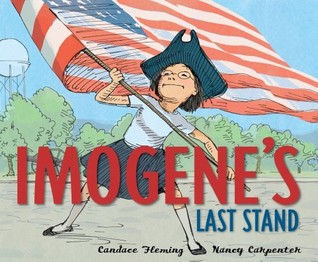
Imogene’s Last Stand
Author: Candace Fleming
Illustrator: Nancy Carpenter
Published October 13th, 2009 by Schwartz & Wade

Goodreads Summary: Meet Imogene, a plucky heroine with a passion for history.

As a baby, Imogene’s first words were “Four score and seven years ago.” In preschool, she fingerpainted a map of the Oregon Trail. So it’s not surprising that when the mayor wants to tear down the long-neglected Liddleton Historical Society to make room for a shoelace factory, Imogene is desperate to convince the town how important its history is. But even though she rides through the streets in her Paul Revere costume shouting, “The bulldozers are coming, the bulldozers are coming!” the townspeople won’t budge. What’s a history-loving kid to do?

Filled with quotes from history’s biggest players—not to mention mini-bios on the endpapers—and lots of humor, here’s the perfect book for budding historians.

Review: Imogene is awesome! Her whole life she has loved history and has promoted history. History is her passion. When she finds out that the Liddleville Historical Center is up for demolition, she does everything in her power to save the history center. This, in a nutshell, is what makes her awesome: she is intelligent, passionate, and willing to stand up for her passion. Because of this, and the history allusions throughout the book, make this such an excellent book to use in classrooms. Imogene is such a great role model for any child.

The history aspects of this book were done so cleverly. Throughout Imogene’s story, she uses famous historical quotes to express how she feels at certain points. For example, when she was trying to get others to stop the bulldozing of the historical center dressed in her Paul Revere costume, she rode around Main Street (on her stick horse) yelling, “The bulldozers are coming! The bulldozers are coming!” These clever quotes are throughout the book. Then in the back and front end sheets Imogene’s historical tidbits are shared explaining all of the quotes.

Teacher’s Tools for Navigation: Like I said in the review, this book is a great for promoting history, intelligence, and passion. Like many of the amazing picture books I’ve been reading lately, it also promotes inquiry because it makes history interesting and fun.

Discussion Questions: What is a historical landmark in your city? Find out about what made it a landmark.; Imogene is passionate about history. What are you passionate about? Share the essentials of your passion.

We Flagged: “Imogene loved history. When she was a baby, her first words were “Four score and seven years ago.” As a preschooler, she finger-painted an accurate map of the Oregon Trail. And as a kindergartner, she used her show-and-tell time to give a series of lectures on important woman in history.” (p. 6)

To see a preview of the illustrations, visit Amazon’s “Look Inside” for Imogene’s Last Stand.

Read This If You Loved: Abe Lincoln’s Dream and John, Paul, George, & Ben by Lane Smith, Of Thee I Sing by Barack Obama,  Looking at Lincoln by Maira Kalman, Nonfiction books about the historical figures mentioned

Recommended For: 

readaloudbuttonsmall classroomlibrarybuttonsmall

Signature

On a Beam of Light: A Story of Albert Einstein by Jennifer Berne

Share

NF PB 2013

Nonfiction Picture Book Wednesday

Nonfiction Picture Book Wednesday is hosted by Kid Lit Frenzy and was started to help promote the reading of nonfiction texts. Most Wednesdays, we will be participating and will review a nonfiction text (though it may not always be a picture book).
Be sure to visit Kid Lit Frenzy and see what other nonfiction books are shared this week!

on a beam

On a Beam of Light: A Story of Albert Einstein
Author: Jennifer Berne
Illustrator: Vladimir Radunsky
Published April 23rd, 2013 by Chronicle Books

Summary: Albert wasn’t like other children. He didn’t speak; he thought. He didn’t play with others; he was fascinated with everything around him. But it is all of this curiosity that led to his revolutionary ideas.

Review: I love how this book focuses on how Albert’s creativity is one of the keys to what made him the amazing scientist that he is. Also, as a teacher of struggling and gifted students, I love the focus on how he didn’t do well in school. It shows how just because a student is different or a disturbance or thinks differently doesn’t mean that they aren’t intelligent. The book definitely promotes wonderings, thinking, and imagination!

I also loved learning about the fun side of Einstein and how he likes to not wear socks, he liked to eat ice cream cones, and overall he just did what he want to have time to think.

Finally, the Author’s Note puts all of Einstein’s theories together so that the reader also gets this information.

Teacher’s Tools for Navigation: This book is perfect for a read aloud to promote creativity and intelligence. It also has a direct connection to science since it is about Albert Einstein. It would be a great discussion starter for an elementary classroom and is also a great jumping off point for discussing the basic Einstein theories.

Discussion Questions: After knowing about Albert’s experiences in school, what would you go back and tell Albert’s teachers? What does his experience and then who he became tell us about behavior, students, and teachers?; Albert said, “Imagination is more important than knowledge.” What parts of this book supports this quote?

We Flagged: “Albert started asking questions. Questions at home. Questions at school. So many questions taht some of his teachers told him he was a disruption to his class. They said he would never amount to anything unless he learned to behave like the other students. But Albert didn’t want to be like other students. He wanted to discover the hidden mysteries in the world.” (p. 14-15)

To see a preview of the illustrations, visit Amazon’s “Look Inside” for On a Beam of Light.

Read This If You Loved: Odd Boy Out by Don Brown, Who Was Albert Einstein? by Jess M. Brallier, Me…Jane by Patrick McDonnell, Jim Henson by Kathleen Krull, A Boy Called Dickens by Deborah Hopkinson

Recommended For: 

readaloudbuttonsmall

Signature

Brave Girl by Michelle Markel

Share

NF PB 2013

Nonfiction Picture Book Wednesday

Nonfiction Picture Book Wednesday is hosted by Kid Lit Frenzy and was started to help promote the reading of nonfiction texts. Most Wednesdays, we will be participating and will review a nonfiction text (though it may not always be a picture book).
Be sure to visit Kid Lit Frenzy and see what other nonfiction books are shared this week!

brave

Brave Girl: Clara and the Shirtwaist Makers’ Strike of 1909
Author: Michelle Markel
Illustrator: Melissa Sweet
Published January 22nd, 2013 by Balzer + Bray

Summary: Clara and her family immigrated to New York. They were searching for the American dream. When her father could not find a job, Clara quit school and became a garment worker to support her family. The conditions at her factory were appalling: low wages, unfair rules, and locks on the door. After discussions between the workers, Clara helps urge the girls to fight for their rights.

Review: I am sucker for this biographical picture book for two reasons: 1) I had not known about the Shirtwaist Makers’ Strike of 1909 before and I love learning about new historical moments. I know that it interested me (as I know it would for kids), because after I read the additional information about the garment industry I was on the internet searching for more information. 2) Clara is such a great example of girl power! AND she is a historical figure that shows girls (and boys) that girls can stand up for themselves when they are not being treated well (in real life). I love that she overcame so much to not only stand up for her rights, but also to get an education and take care of her family. What an amazing person to learn about.

Teacher’s Tools for Navigation: The main way that I would use this book is as a read aloud. It will definitely cause a great discussion and may push students to do further research. It would also be a perfect read aloud for a unit on women’s rights, immigration, overcoming obstacles, girl power, labor laws, or the early 1900s to help make connections to history. 

Discussion Questions: Do you think that Clara continuing her education helped her in being able to fight for her labor rights?; Clara made a tough decision between continuing school during the day or working. Do you agree or disagree with her decision? Why or why not? How did her decision affect her life?; What caused the garment workers to strike?

We Flagged: “But Clara is uncrushable. She wants to read, she wants to learn! At the end of her shift, though her eyes hurt from straining in the gaslight and her back hurts from hunching over the sewing machine, she walks to the library. She fills her empty stomach with a single glass of milk and goes to school at night. When she gets home in the late evening, she sleeps only a few hours before rising again.” (p. 12-13)

To see a preview of the illustrations, visit Amazon’s “Look Inside” for Brave Girl.

Read This If You Loved: Here Comes the Girl Scouts! by Shana Corey, The Price of Freedom by Dennis Brindell Fradin, Boycott Blues by Andrea Davis Pinkney, Annie and Helen by Deborah Hopkinson

Recommended for: 

readaloudbuttonsmall closereadinganalysisbuttonsmall classroomlibrarybuttonsmall

Who is a female historical figure who shows as much girl power as Clara that you believe should be talked about more?

Signature

North of Nowhere by Liz Kessler

Share

north

North of Nowhere
Author: Liz Kessler
Publication: August 6th, 2013 by Candlewick Press

Summary: After a frantic call from her grandmother about her grandad vanishing, Mia and her mother go to the seaside village home of her grandparents to help.  Disconnected from everyone and without any clues in the vanishing, Mia finds herself walking on the beach often where she stumbles upon a diary on an abandoned fishing boat. Through the diary, she begins exchanging notes with a girl named Dee, a young girl who lives on a nearby island, who she instantly connects with. It is through these exchanges that Mia begins to notice some weird things and a new mystery opens up right in front of her.

My Review: I really like Mia’s voice. Her voice is so authentic teenager that it was like listening to an 8th grader telling me the story. I think this is key because I think it’ll help readers draw into the story since it is a mystery that slowly unravels. Hearing Mia tell it will mean that it is almost like hearing the story from a friend.  I also thought that the whole idea behind the mystery was quite clever, but I can’t really talk about it because it would give away the ending! So, read and we’ll discuss.

Teacher’s Tools for Navigation: I would love to listen to students discuss this book! Although I figured out the mystery earlier than revealed, but I know that middle school students would be predicting and trying to figure out the mystery the whole book until the reveal. It would keep them on the edge of their seats!

Discussion Questions: Why do you think that Dee’s diary entries and Mia’s observations are not matching up?; What do you think happened to Mia’s grandad?

We Flagged: “I need to write it all down. That’s the only way I’ll believe it’s true. Spring break, eighth grade. All those incredible, impossible things. Did they really happen? I’ve tried a hundred times to tell myself that they couldn’t have. That none of it is possible. And I’m right; none of it is possible. But that doesn’t change the fact that it is true. Everything did happen, exactly as I’m going to tell it now.” (p. 1)

Read This If You Loved: Red Kayak by Patricia Cummings, The Wig in the Window by Kristen Kittscher, Capture the Flag by Kate Messner, Liar & Spy by Rebecca Stead, Undercurrents by Willo Davis Roberts

Recommended For: 

litcirclesbuttonsmall classroomlibrarybuttonsmall

Signature

**Thank you to Candlewick Press for providing a copy for review**

More Than This by Patrick Ness

Share

more than this

More Than This
Author: Patrick Ness
Expected Publication September 10th, 2013 by Candlewick Press

Summary: Readers are thrown into the action right from the beginning of this book. Seth is drowning–he is dying. When he wakes up, he is naked, alone, and unfamiliar with his surroundings. Seth knows he has died, but he isn’t sure where he is. In his distant memories, he remembers the English town that he is in, but he moved away after an enormous tragedy in his childhood, so why has he returned? The town looks very different from the way he remembers it–as if no one has lived there in over a decade. Seth sets out to try to discover where he is. He hopes he isn’t alone, the world hasn’t ended, and he hasn’t arrived in his personal Hell.

Review: At the beginning of my reading, I felt the same feelings as I felt with The Maze Runner by James Dashner. I was bewildered, confused, and very curious about where the book was headed. Patrick Ness phenomenally reveals details so slowly that it makes it very difficult to put this one down. It is highly unpredictable and extremely engaging. This book evades the typical features that would lock it into one genre–it is a thriller, an adventure, and a, frankly, an incredibly thoughtful work of science fiction. More Than This teaches readers about loyalty, resilience, hope, and bravery, amongst other messages that I can’t express without revealing details of the plot. Dive into this one–it will send you to a world that will make you ponder elements of life you may not have ever considered before.

Teacher’s Tools for Navigation: This is one of the best books that I’ve read that can be used for helping students make predictions. Teachers can use the whole book or excerpts of the text, and students would love predicting plot details, grounded in the evidence the plot provides. Like all of Ness’s writing, this book experiments with language and sentence structure, and students could examine how Ness uses language to advance the plot and overall meaning of the book. 

Discussion Questions: How does Ness reveal plot details as a way to engage his audience? Is he effective?; Where is Seth? What might Ness be telling us about the world we live in?; In the beginning of the book, Seth wonders if he has woken up in his personal Hell. Where would your personal Hell be?; What memories shape who you are as a person? Have you learned from them? How?

We Flagged: “There’s an unreality under all the dust, all the weeds. Ground that seems solid but that might give way any moment” (p. 51).

“A book, he thinks at one point, rubbing his eyes, tired from so much focused reading. It’s a world all on its own, too. […] A world made of words, Seth thinks, where you live for a while” (p. 143).

Please note: The above quotes are from the Advanced Reader Copy. They may change when the book is published.

Read This If You Loved: Maze Runner by James Dashner, The 5th Wave by Rick Yancey, The Hunger Games by Suzanne Collins

Recommended For:

litcirclesbuttonsmall closereadinganalysisbuttonsmall classroomlibrarybuttonsmall

026F3FBCC8C3913BD3A4D3F6920340D5

Thank you to Candlewick Press for sending me the Advanced Reader Copy!

Any Patrick Ness fans out there? Have you read this one or pre-ordered it?

What are your favorite science fiction books?