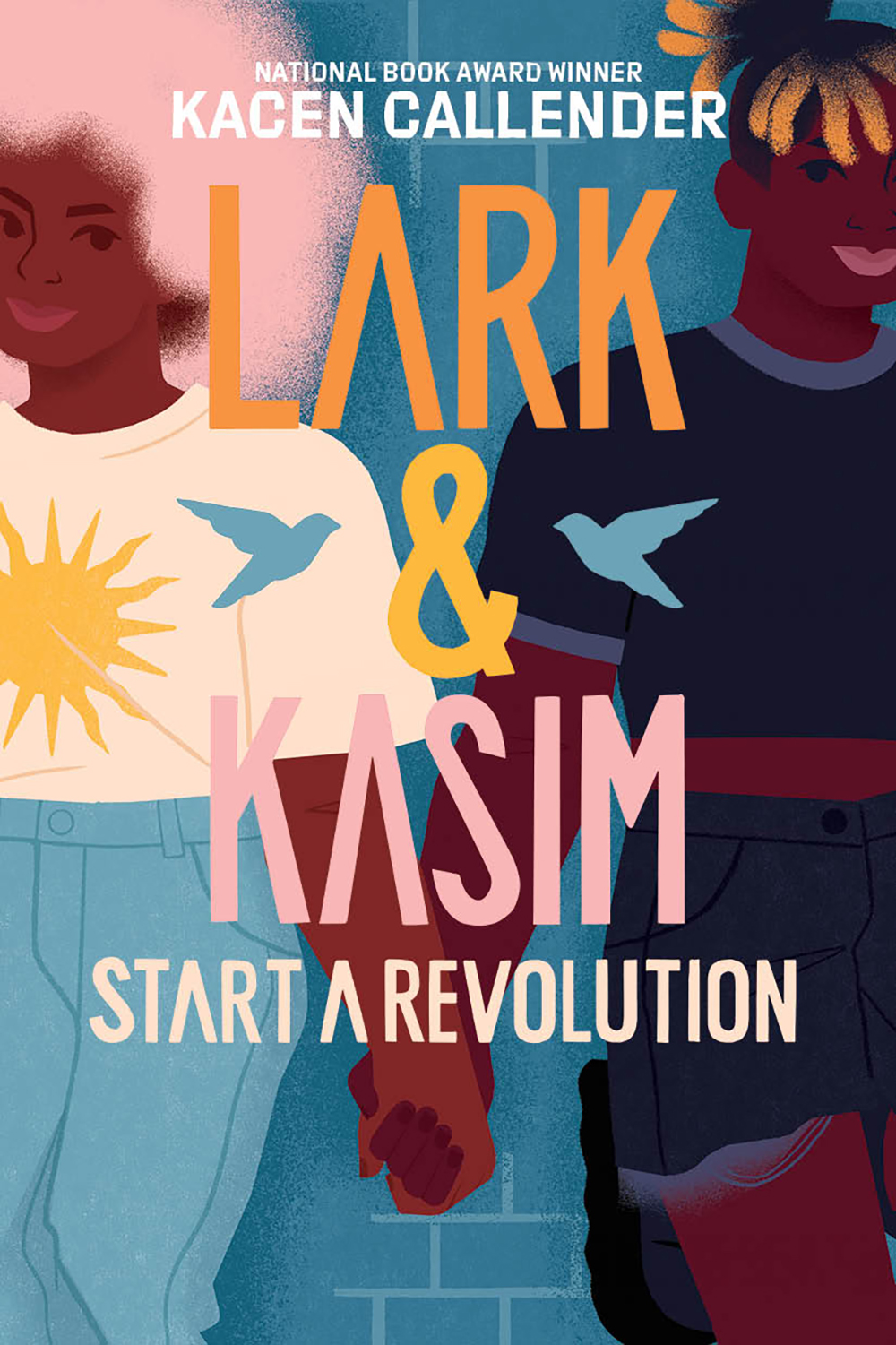
Lark & Kasim Start a Revolution by Kacen Callender

Share

Lark & Kasim Start a Revolution
Author: Kacen Callender
Published: September 27, 2022 by Amulet

Summary: From National Book Award–winner Kacen Callender, a contemporary YA that follows Lark’s journey to speak the truth and discover how their own self-love can be a revolution

Lark Winters wants to be a writer, and for now that means posting on their social media accounts––anything to build their platform. When former best friend Kasim accidentally posts a thread on Lark’s Twitter declaring his love for a secret, unrequited crush, Lark’s tweets are suddenly the talk of the school—and beyond. To protect Kasim, Lark decides to take the fall, pretending they accidentally posted the thread in reference to another classmate. It seems like a great idea: Lark gets closer to their crush, Kasim keeps his privacy, and Lark’s social media stats explode. But living a lie takes a toll—as does the judgment of thousands of Internet strangers. Lark tries their best to be perfect at all costs, but nothing seems good enough for the anonymous hordes––or for Kasim, who is growing closer to Lark, just like it used to be between them . . .

In the end, Lark must embrace their right to their messy emotions and learn how to be in love.

Review: This is a beautiful book that has so much heart. It feels as if Kacen Callender put their whole soul into it. The characterization, in particular, stood out to me. Even minor characters feel very developed. The characters remind us of the imperfections that we all have, and the value of remembering that we won’t get everything right. I was particular impressed by the ways in which love is depicted throughout the text. It is vast and expansive and knows no rules or boundaries. The LGBTQ representation and attention to intersectionality was among the best I’ve read (and I read a lot of YAL). Callender also depicts the raw brutality that can come with social media. There were moments in this text where I felt sick to my stomach.

The word “revolution” is in the title, and there are many moments where readers are given space to explore conceptions and understanding of activism. I particularly liked that the revolution isn’t explicit, which made me think deeply long after I turned the last page of the text.

I loved this book, and I can’t wait to discuss it with others. I certainly have many pages flagged to read again and again!

As one side note, I couldn’t decide if this book was realistic fiction or if the splash of magical realism made it magical realism. I am not much of a genre sorter, but I thought I’d throw that out there in case you are. 😉

Teachers’ Tools for Navigation: The rep in this book! The rep! I wish I’d been exposed to more books with representation like this when I was in school. If I was teaching this book, I would introduce some of Crenshaw’s intersectionality articles to allow students to dive into these concepts together.

Discussion Questions: 

  • What does Lark learn in this book?
  • How does Kasim develop as a character?
  • What do we, the readers, learn from Sable?
  • What did you learn (or think about) related to social media?
  • How are the characters in this book imperfectly human?

Flagged Passage: “That feeling when you read the last line of a book that you love? I can’t think of a lonelier feeling in the world.”

Read This If You Loved:  Books by Kacen Callender,

Recommended For:

 litcirclesbuttonsmall closereadinganalysisbuttonsmall classroomlibrarybuttonsmall

RickiSig

Blog Tour with Review by our 8-Year-Olds!: My Pet Feet by Josh Funk, Illustrated by Billy Yong

Share

My Pet Feet
Author: Josh Funk
Illustrator: Billy Yong
Anticipated Publication: August 23, 2022 by Simon & Schuster

Goodreads Summary: When the letter R suddenly vanishes, a whole town goes upside-down in this side-splitting picture book of alphabet chaos that’s Can I Be Your Dog? meets P Is for Pterodactyl.

A little girl wakes up one day to find that R, a vital piece of the alphabet, has vanished! Suddenly, she has pet feet instead of a ferret. Flocks of cows replace crows flying in the sky. Giant shoes (not shores!) live on the sandy beaches of her town.

What could have happened to the eighteenth letter of the alphabet? Did it get lost—or stolen? One way or another, the town needs to be saved!

When Trent first read this book, he said (and I quote), “This book should win all the awards! Not just now but forever!” Because of how much he loved the book, we decided to let him and Henry chat about and review the book for us!

Our 8-Year-Olds Chat About the Book:

Henry: Did you notice on the background on the first page that it said “fist place” instead of “first place”? That was so funny!

Trent: Hahahaha! Fist place! Hahahaha! What do you think will happen next because the bees are taking the Zs?

Henry: I would say that…hmm… I don’t know. I think the bees will just be quiet and will say Zs. What do you think?

Trent: Same.

Henry: Have you seen the mice? Have you seen the mice on most of the pages? There’s a little mouse holding a donut on the pages. I love that! Why do you think they did that?

Trent: I didn’t notice that. Oh look at that! I think they are actually rats.

Henry: Yah! Rats without the Rs. 

Trent: They are taking the donuts at the bake shop! What are three words without Rs and what would they say?

Henry: Hmm….[looking around the room] Roar would be oa! Hahahahaha! Grown would be gown! Growl would be gowl! Hahaha! Those are so funny!

Trent: In the book, the doo is the door. The cows are the crows. The cane is the crane.

Henry: Oh. You meant from the book! Hahaha! I just picked words!

Trent: Well we are talking about the book, silly.

Henry: Reading would be eading, like eating. Isn’t that funny?

Henry’s little brother: I love this book! 

Henry: The go-carts are go-cats! The feet is ferret! The fist is first! What do you think another good letter missing book would be, like this one, that is just as funny as this one?

Trent: But we are talking about this book!

Henry: I know, but I am talking about how this book is funny and thinking about other ones Josh Funk could make.

Trent: E would be good!

Henry: Oh nice! Like “see” would be “ssssss,” hahaha! I like that. Good one, Trent. “Fled” would be “fld.”

Trent: Oh! Compare the spreads on pages 8 and 20. What is the same and what is different? Bake shop, brake shop. That stuff. I like these ones. Taco caves! What do you think taco caves is?

Henry: Oh! Ha! I don’t know! I don’t know! It sounds so funny! 

Trent: It’s taco cravers, I think. If you look at the toon town closely inside the brake shop sign, you see posters. And then they are actually different, too.

Henry: Oh!! Taco cravers! Toon Town. Oh! Tires on Brake Shop! I love this book. Oh! Instead of Brake Shop, it is Bake Shop, Trent! We also fix ties instead of tires, it says. Cool! Haha. 

Trent: What could the sequel be called with the Zs? It could be My Pet Zzzs. 

Henry: Instead of Zzzs for sleeping, it would just say NOTHING! Ha! Why do you think the Bs are taking the Zs away?

Trent: I already asked you that question. Haha!

Henry: On the final page, page 20, in the corner, near Pam’s Bake Shop, the rats are finally eating the donut. Haha! It’s cute. There’s a dog on top, too!

Trent: Oh yah! I see it!

Henry: On page 15, in the left top corner, there is a shoe!

Trent: I know. The sea shore. Shoe, shore. And the pie is the pier.

Henry: Oh yah! 

Trent: Josh Funk told me that the illustrator and him didn’t meet before, and there are jokes in the illustration that he didn’t write. Henry, go to the butt page! The gassy field! Page 13!

Henry: Oh, hahahaha! I love this page. Did Josh Funk put that in?

Trent: I think that the illustrator put that in.

Henry: What is your favorite part about the book? 

Trent: I like the gassy field the best.

Henry: Hahahaha! I like how they take out the Rs. And I like the gassy fields. And I like the big, giant cow poop. On page 9, they are chasing the poop. And it says “town hall” and it has the poop in front of it.

Trent: It’s the door. It’s supposed to be the door!

Henry: On page 10, if you look in the corner, the door or doo is even bigger.

Trent: Hahahah poop. Hahaha poop.

Henry: What would you rate this book from 1 to 10?

Trent: 10! 10! 10! It was a really good book.

Henry: Same! I rate it a 10, too! I love the crane. The cane!

Trent: Yah, the cane! I like the cane, too. And I like the cows.

Henry: What kind of kids do you think would like to read this book?

Trent: Kindergarten to third, like us.

Henry: Yah, and fourth grade, too. And kids who like potty talk like me. And words.

Trent: Kids who like funny things would really like this book.


Parent Perspective: Not only does this book allow our kids to play with words, they maintained a long conversation about the book without parent prompts. It offered them so much to talk about. In particular, they loved the humor. It made them laugh, and it made them think about different word combinations. This book pushed our kids as readers because they had to pause and consider where the Rs were missing. 

We loved this book and think it would be a wonderful addition to classrooms. Although our kids were limited to their own age group, we think readers of all ages would find great joy in the play on words in this book. 


Recommended For: 

readaloudbuttonsmall classroomlibrarybuttonsmall closereadinganalysisbuttonsmall


It’s Monday! What Are You Reading? #IMWAYR 8/22/22

Share

It’s Monday! What Are You Reading?
Sharing Picture Books, Early Readers, Middle Grade Books, and Young Adult Books for All Ages!

It’s Monday! What Are You Reading? is a weekly blog hop co-hosted by Unleashing Readers and Teach Mentor Texts which focuses on sharing books marketed for children and young adults. It offers opportunities to share and recommend books with each other.

The original IMWAYR, with an adult literature focus, was started by Sheila at Book Journeys and is now hosted by Kathryn at The Book Date.

We encourage you to write your own post sharing what you’re reading, link up below, leave a comment, and support other IMWAYR bloggers by visiting and commenting on at least three of the other linked blogs.

Happy reading!

Bold_line


Tuesday: Review and Giveaway!!: A Dream of Birds by by Shenaz Patel, Illustrated by Emmanuelle Tchoukriel, and Translated by Edwig-Renée Dro
Giveaway closes this evening!

Thursday: Guest Post: Classroom Uses for All Thirteen by Christina Soontornvat, Astronaut-Aquanaut by Jennifer Swanson, Call and Response by Veronica Chambers, She Persisted: Claudette Colvin by Lesa Cline-Ransome, and History Smashers: Women’s Rights to Vote by Kate Messner

Saturday: Guest Post: Classroom Uses for Latinitas by Juliet Menendez, Lost in the Antarctic by Tod Olson, On the Horizon by Lois Lowry, and Stamped adapted by Sonja Cherry-Paul

Sunday: Author Guest Post by Vanessa Garcia, Author of What the Bread Says: Baking with Love, History and Papan

**Click on any picture/link to view the post**

Bold_line

Kellee

Hi!! It is Ricki’s week for a long post, so I’ll update next week 🙂 But as always, you can learn more about what I’ve been reading by checking out my 2022 Goodreads Challenge page or my read bookshelf on Goodreads.

Ricki

Well, my reading is kind of a mess! I start school on Tuesday and of course I spent hours designing a new bitmoji classroom. I am going to combine this section with the currently reading section because I have many books going on right now. Two finished and many substantially in progress. I like to read a lot of books at the same time. Just me? 😉

I finished Kacen Callender’s Lark & Kasim Start a Revolution, and you need to stop everything and read this book. Seriously, right now. It is so good.

I can’t wait for this book to come out in two days! My Pet Feet by Josh Funk is so creative! Check out our 8-year-olds’ review tomorrow!

I am listening to Black Enough, which is edited by Ibi Zoboi. The stories are fantastic, and I keep thinking about how well they’d fit into instructional units. I love that the collection emphasizes the diversity within diversity.

I have read a good amount of Blackout by Dhonielle Clayton, Tiffany D. Jackson, Nic Stone, Angie Thomas, Ashley Woodfolk, and Nicola Yoon. I just finished the story that could be described as the beginning of something new. Ahh, it was so good!

My son and I are reading Healer of the Water Monster by Brian Young. It is so, so good. We rotate reading chapters, and it has offered so much to talk about.

Bold_line

Tuesday: Guest Post: Classroom Uses for One Crazy Summer by Rita Williams-Garcia, A Place to Hang the Moon by Kate Albus, Planet Earth is Blue by Nicole Panteleakos, Shooting Kabul by N.H. Senzai, and The Dreamer by Pam Muñoz Ryan

Thursday: Guest Post: Guest Post: Classroom Uses for Front Desk by Kelly Yang, Indian No More by Charlene Willing McManis with Traci Sorell, Lucky Broken Girl by Ruth Behar, Mary and the Trail of Tears by Andrea L. Rogers, and Night Diary by Veera Hiranandani post

Saturday: Blog Tour and Guest Review from our 8 Year Olds!: My Pet Feet by Josh Funk

Sunday: Author Guest Post: “In Praise of the Standalone Book” by Stacy Nockowitz, Author of The Prince of Steel Pier

Bold_line

Link up below and go check out what everyone else is reading. Please support other bloggers by viewing and commenting on at least 3 other blogs. If you tweet about your Monday post, tag the tweet with #IMWAYR!

 Signature andRickiSig

Review and Giveaway!: A Dream of Birds by Shenaz Patel, Illustrated by Emmanuelle Tchoukriel, Translated by Edwige-Renée Dro

Share

A Dream of Birds
Author: Shenaz Patel
Illustrator: Emmanuelle Tchoukriel; Translator: Edwige-Renée Dro
Published August 16, 2022 by Amazon Crossing

Summary: Sara has a thing for birds. They remind her of her grandfather, who loved birds, and the wonderful show the creatures would put on in his yard each day―like a cloud of colorful flowers carried by the wind.

As Sara walks to school in her island town, she longs for the freedom of those birds. Then she spots a new birdhouse full of parakeets in someone’s yard. Sara feels drawn to them and unable to forget them. So what happens the next time, when she finds the door to the birdhouse unlocked?

With poetic language and beautiful art, this story set on the African island of Mauritius brings to life a little girl’s deep love of nature, her brash but well-meaning choice, and ultimately, her redemption and dream for a better world.

About the Creators:

Shenaz Patel was born and lives on Mauritius Island. She has several jobs: journalist, playwright, novelist, and translator, and she is also a comics and children’s book author. She has written nine books for children, including A Dream of Birdswhich was first published in French and English in Mauritius and France. She was named Chevalier des Arts et des Lettres in 2013, a high honor given by the French minister of culture.

Emmanuelle Tchoukriel was born and lives in France. Passionate about nature, she studied visual communication before entering the Estienne School in Paris. She specialized in scientific drawing, and she excels in illustrating flora and fauna. On Instagram: @emanuelle_tchoukriel

Edwige-Renée Dro is a writer, translator, and literary activist from the Ivory Coast, in Africa. Her writings have been published in anthologies such as New Daughters of Africa and Africa39, among others. She has judged many literary prizes, including the PEN International New Voices Award and the Etisalat Prize for Literature. She was awarded the Miles Morland Writing Scholarship in 2018 and is a 2021 resident of the International Writing Program at the University of Iowa. Learn more at edwigedro.wordpress.com. Twitter: @DroEdwige; Facebook: Renée Edwige Dro

Ricki’s Review: For me, this beautiful translation is about freedom and preservation. It reminds readers to pause and pay attention to the world around them and to act. It allows readers opportunities to evaluate the decisions they have made in their lives and the impact they have. It also allows readers to consider the lessons they have learned throughout their lives. A Dream of Birds celebrates the diversity of birds in Mauritius, an African island in the Indian Ocean, and it celebrates the passion and commitment of a child.

I loved how the backmatter gave more background of the story. This book is a translation, and there are more words on the page than stories I’d typically find in US households. Yet my kids (ages 8, 5, and 3) sat and listened to the story without breaking their gaze. They were drawn in by the onomatopoeias, the engaging story, and the bright illustrations. We need more international literature in our schools and homes, and this book shines brightly.

Kellee’s Review: Sara’s story is multi-faceted. It is a story of captivity and longing and family and memories. It is a story of beauty and nature and freedom and dreams. It is also a story of reality and consequences.

The story looks at Sara who meets a man with pet birds which reminds her of feeding wild flocks of birds with her grandfather. She hates seeing the captured books, all wings and beauty, not allowed to be free, so she makes a rash decision and frees the birds. Although her motives are made clear, her mother also explains to her that it was wrong to let domesticated birds go–this is a good lesson because it distinguishes between a well meaning action and a well thought out positive action. The book ends with a celebration of the diverse birds on Mauritius, an African Island in the Indian Ocean, and a reminder to celebrate animals’ wildness.

Although the narrative was a bit wordy for me at some points, the beautiful illustrations make the reader want to savor each page which helps move you through Sara’s story.

Teachers’ Tools for Navigation: Students might use this book as a jumping off point to learn more about Mauritius, Africa, and the Indian Ocean. They could pick a specific topic of exploration related to their interests.

Discussion Questions: 

  • What does Sara learn? Do you agree with the decisions she made?
  • What did you learn about Mauritius, Africa, and/or the Indian Ocean?
  • What lessons have you learned in your life?
  • What birds do you observe around your home?
  • Why was it wrong for Sara to let the birds go? Were her intentions good or bad?
  • Why is it important to leave wild animals wild?

Flagged Spreads: 

Read This If You Love: Birds, Animals, Environment

Giveaway:

a Rafflecopter giveaway

Recommended For: 

and Signature

**Thank you to Barbara at Blue Slip Media for providing a copy for review!**

Instagram: @blue_slip_media; Facebook: Blue Slip Media

Author Guest Post: “Why I Write Science Books for Children” by Mary Batten, Author of Life in Hot Water: Wildlife at the Bottom of the Ocean

Share

“Why I Write Science Books for Children”

One day some years ago when I was writing scripts for the Children’s Television Workshop science series 3-2-1 Contact, I took my four-year-old daughter to my office and introduced her to the show’s actors. Afterwards, she looked at me and said, “I didn’t know they were real.” I was astounded. She had learned from watching Sesame Street and the show I was working on–the only TV shows we allowed her to watch–that what you see on TV is pretend. Big Bird, Cookie Monster and the other muppets were imaginary characters. Sesame Street was an imaginary street. My little daughter had learned the difference between fact and fiction.

From toddler age, children are fascinated by the real world. I consider them budding field biologists. They pick up the tiniest pieces of their environment–a pebble, a shell, a feather, a blade of grass–and excitedly present it to their parent or caretaker. As soon as they can, they repeatedly ask “Why?” About everything! These questions are the beginning of scientific curiosity. And it is my hope that my books tap into and nourish that curiosity.

By third grade, most children have learned about the two literary genres, fiction and nonfiction. The books I write are nonfiction–science, nature. When people ask me why I write nonfiction, I have two answers: First, I am fascinated and excited by the complex interrelationships among animals, plants, microbes, soil, sun and water that hold ecosystems together. Secondly, what goes on in nature is more fantastic, more bizarre than anything science fiction writers have imagined. Sex-changing fishes, flowers that use trickery to attract pollinators, insects that look like leaves and sticks, symbiotic partnerships between totally different species, and creatures that live in water hot enough to melt lead–these and many more are all real!

My newest book, Life in Hot Water: Wildlife at the Bottom of the Ocean, is about animals that live in the hottest, most extreme environment on Earth–hydrothermal vents. It is the second book in a series I created called “Life in the Extreme,” about the incredible ability of living things to evolve and take up residence in nooks and crannies of the most extreme environments. Discovery of hydrothermal vents in 1977 is one of the greatest adventures in science. 

Hydrothermal vents are underwater hot springs that form along the mid-ocean ridge, the longest mountain range on Earth. You can’t see it because it’s at the bottom of the sea. There it snakes more than 40,000 miles (65,000 kilometers) around the planet. When scientists first descended into this world, nobody expected to find any living thing. But the porthole of their tiny submarine revealed fish, clams, shrimp, crabs, and giant red-tipped tube worms never seen before. How could anything live amidst plumes of superhot, toxic liquid gushing from strange chimney-like structures?

Like toddlers who develop by asking questions, scientists also gather knowledge by asking questions and searching for answers. Questions open doors to discovery and the mind-blowing discovery of hydrothermal vents raised many questions. One of the most important was, “What are these creatures eating?”

Until vents were discovered, scientists thought that green plants and the sun were the base of all food chains–a process called photosynthesis. But no sunlight reaches the total darkness of the vent world miles below the ocean’s surface. And no green plants grow in this world. What then?

Following up these and other questions, scientists discovered an entirely new food chain–one that depends on energy from the Earth instead of energy from the sun. Amazingly, vent animals eat bacteria that feed on toxic chemicals such as hydrogen sulfide, which smells like rotten eggs, spewed from Earth’s interior by undersea volcanoes that create the vents. Scientists called this process chemosynthesis. Robert Ballard, the oceanographer who discovered where the sunken ship Titanic lay, called it “Probably one of the biggest biological discoveries ever made on Earth.”*

Textbooks had to be rewritten to include chemosynthesis as well as photosynthesis. Today research to learn more about hydrothermal vents is going on all over the world.

For me, one of the joys of writing nonfiction is reaching out to scientists who are doing the real work and interviewing them. One of the scientists whom I consulted for this book, Dr. Janet Voight, Associate Curator at the Field Museum in Chicago, said, “There’s so much about the deep sea that we haven’t even begun to explore. It’s all discovery, and that makes it exciting.”

Children are natural born explorers. Tapping into their questions is one of the most exciting and productive ways to foster children’s developmental curiosity, engage them in the basic scientific process, and encourage them to write their own nonfiction. Children’s science books, such as Life in Hot Water, can be used to create multi-disciplinary units engaging biology, geography, art, and creative writing. 

*Bill Nye discusses discovery of hydrothermal vents with Robert Ballard: http://www.youtube.com/watch?v=D69hGvCsWgA

Published June 21, 2022 by Peachtree

About the Book: .A dramatic overview of the deep-sea extremophiles that thrive in scalding water and permanent darkness at the bottom of the ocean

The scalding-hot water gushing from vents at the bottom of the ocean is one of the most extreme environments on Earth. Yet over millions of years, many organisms—from chemical-eating bacteria to eyeless crabs and iron-shelled snails—have evolved in amazing ways that enable them to thrive in this unlikely habitat. Scientists are hard at work to learn more about the complex ecosystems of the ocean depths.

Award-winning science writer Mary Batten and NYT best-selling illustrator Thomas Gonzalez, the masterful duo that created Life in a Frozen World, team up again in this impressive overview of hydrothermal ocean vents. Her clear, informative text coupled with his unique and eerily realistic paintings of sights never seen on land—gushing “black smokers,” ghostly blind shrimp, red-plumed tube worms—will entice readers to learn more about this once-hidden world at the bottom of the sea.

About the Author: Mary Batten is an award-winning writer for television, film and publishing. Her many writing projects have taken her into tropical rainforests, astronomical observatories, and scientific laboratories. She scripted some 50 television documentaries, was nominated for an Emmy, and is the author of many children’s science books, including Aliens From Earth, and Life in a Frozen World: Wildlife of Antarctica. Her most recent book is Life in Hot Water: Wildlife at the Bottom of the Ocean.

Thank you, Sara at Holiday House, for connecting us with Mary!

Warrior Princess: The Story of Khutulun by Sally Deng

Share


Warrior Princess: The Story of Khutulun
Author and Illustrator: Sally Deng
Published: August 23, 2022 by Farrar, Straus, and Giroux

Summary: This picture book follows the life of the great-great granddaughter of Genghis Khan, a princess who could rule on the battlefield as well as—or better—than any soldier, and when faced with a potential marriage, learns that sometimes the best way to serve one’s community is to stay true to oneself.

Ricki’s Review: This creative nonfiction text shares what we know about the life of Khutulun, great-great granddaughter of Genghis Khan. She was a princess who had never been defeated in a wrestling match and was a force on the battlefield. When she is forced to marry, she agrees that she will only do so if a man can defeat her in a wrestling match. If they lose, they owe her family ten horses. I really, really enjoyed reading this story. I started reading it to two of my sons, and my third son creeped on over because he was listening and was hooked. It is captivating! The characters are well drawn and the pacing is perfect. 

Teachers’ Tools for Navigation: This book would inspire students to research and learn more about Khutulun and Genghis Khan. Teachers might include other books that creatively imagine people of the past to talk about writers craft and agency in reimagining people of our past.

Discussion Questions: 

  • In what ways does Khutulun show strength?
  • What important decisions does she make in the text? Why does she make it?
  • What themes does this text teach you?

Flagged Spread:

Read This If You Love: Creative nonfiction, historical fiction, autobiographies, reading about historical figures


**Thank you, Macmillan for sending an advanced reading copy for an honest review!**

It’s Monday! What Are You Reading? #IMWAYR 8/1/22

Share

It’s Monday! What Are You Reading?
Sharing Picture Books, Early Readers, Middle Grade Books, and Young Adult Books for All Ages!

It’s Monday! What Are You Reading? is a weekly blog hop co-hosted by Unleashing Readers and Teach Mentor Texts which focuses on sharing books marketed for children and young adults. It offers opportunities to share and recommend books with each other.

The original IMWAYR, with an adult literature focus, was started by Sheila at Book Journeys and is now hosted by Kathryn at The Book Date.

We encourage you to write your own post sharing what you’re reading, link up below, leave a comment, and support other IMWAYR bloggers by visiting and commenting on at least three of the other linked blogs.

Happy reading!

Bold_line

**Click on any picture/link to view the post**

Tuesday: Student Voices: Recommendations by Anna Liz R., Brielle P., Ava G., Chase S., and Silvia S.

Thursday: Guest Post: Classroom Uses for Dragons in a Bag by Zetta Elliott, Magnificent Makers: How to Test a Friendship by Theanne Griffith, Polly Diamond and the Magic Book by Alice Kuipers, and Sisters of the Neversea by Cynthia Leitich Smith

Saturday: Guest Review: The Bad Seed by Jory John, Illustrated by Pete Oswald

Sunday: Author Guest Post by Kerry L. Malawista, Author of Meet the Moon

Bold_line

Kellee

Hi! I am unexpectedly out this week, so Ricki is covering for me! As always, you can learn more about what I’ve been reading by checking out my 2022 Goodreads Challenge page or my read bookshelf on Goodreads.

Ricki

The Coquíes Still Sing by Karina Nicole González is a picture book about the rebuilding of Puerto Rico after Hurricane Maria. It offers readers a window into the devastation of the hurricane and shares the power of community and togetherness.

Warrior Princess: The Story of Khutulun by Sally Deng is a creative nonfiction text that shares what we know about the life of Khutulun, great-great granddaughter of Genghis Khan. I absolutely loved this book, and I am going to review it in full this Thursday!

I read the middle grade graphic novel Sunny the Shark by Remy Lai with my sons. They loved it, and we read the book in one sitting. It teaches kids about the whitetip shark, pilot fish, and water pollution. It’s laugh out loud funny, and we loved it.

My sons and I read Ride On by Faith Erin Hicks. This is a middle grade graphic novel that I think would also be appreciated by young adult readers (and adult readers, of course!). It reminds readers of the great emotions that come with friendship—falling out with friends, meeting new friends. This was the book I needed in middle school.

Bold_line

Ricki

I am reading Ibi Zoboi’s (edited collection) Black Enough. I’ve read three of the stories so far, and they were all fantastic!

Bold_line

Thursday: Warrior Princess: The Story of Khutulun by Sally Deng

Saturday: Guest Review: Hidden Figures: The True Story of Four Black Women and the Space Race by Margot Lee Shetterly, Illustrated by Laura Freeman

Sunday: Author Guest Post by Mary Batten, Author of Life in Hot Water: Wildlife at the Bottom of the Ocean

Bold_line

Link up below and go check out what everyone else is reading. Please support other bloggers by viewing and commenting on at least 3 other blogs. If you tweet about your Monday post, tag the tweet with #IMWAYR!

 Signature andRickiSig