Blog Tour and Author Guest Post!: Storm Watcher by Maria V. Snyder

Share

The Storm Watcher Blog Tour

Welcome to the Storm Watcher blog tour!

Feb 19 – Mar 5, 2014

Hosted by readnowsleeplater.com

Print 

Storm Watcher
Author: Maria V. Snyder
Published October 19th, 2013 by Leap Books

Goodreads Summary: Luke Riley is lost. His mother’s recent death has set Luke and his family adrift. Even though his father, twin brothers, and their three Bloodhounds are search and rescue volunteers, they have been unable to rescue themselves and become a family again. The summer after sixth grade looms in Luke’s mind as a long, lonely three months where the only thing he can look forward to is watching The Weather Channel. Luke is fascinated with the weather, but since his mother’s death in a storm, he is also terrified. Even the promised 13th birthday present of a Bloodhound puppy fails to lift Luke’s spirits. He would rather have a different breed – a petite Papillon, but his father insists he get a Bloodhound.

When Luke decides to get the Bloodhound from Willajean, a dog breeder who owns Storm Watcher Kennel, he works out a deal to help at her kennel in exchange for the expensive dog. Thrilled to have a summer with a purpose, Luke befriends Willajean’s daughter, Megan and together they plan how Luke can get a Papillon puppy instead of a Bloodhound. But nothing seems to work as they struggle with stubborn fathers, summer storms, unhelpful siblings, and hidden guilt. Can one little white dog really save both families?

So, how does one come to write a book about weather?

It all begins with a fascination with hydrometeors and a great teacher.
Squish this together with a writing career and VOILA! 

Hydrometeors are Falling on my Head
By Maria V. Snyder

Let me set the scene – sixth grade at Our Lady of Ransom, a Catholic school in the city of Philadelphia – my teacher, Miss Kane is doing a science unit on meteorology.  Meteo…what? At the time (1978), I’d never heard of it, except I had.  “Oh, you mean the weather, why didn’t you say so?” a beat later, “There are people who study the weather? Wow.”  Little did I know it at the time, but that unit was the vital first step to my eventually careers in both meteorology and writing.

I love big storms and loved the idea of studying them.  Not only was it super cool that Miss Kane made it rain in our classroom, but I was able to be a real smart-alecky kid.  You see I soon discovered that the adults in my life had never heard the word meteorology either. So when they asked me what I wanted to be when I grew up, I’d reply, “A meteorologist.”  Their blank look was always followed be a quizzical, “You want to study…meteors? Like from space?” and I chirped, “Not space meteors, hydrometeors.”  No comprehension so I’d explain in a I-can’t-believe-you-don’t-know-this tone that, “hydrometeors are raindrops.”  I did warn you that I was bratty – I was also eleven so I had a good excuse J.

As I continued in my education, the questions about my future remained the same, and so did the answer (except, by now my family was well acquainted with those pesky hydrometeors).  Sure, I loved acting, dancing, painting, and playing the cello, but I wasn’t a stand out in any of them.  However my math and science grades remained strong and nothing else sparked my interest.

Fast forward to my college graduation.  I’d earned my BS in Meteorology from Penn State University.  My forecasting skills were dismal so I ventured in the exciting new profession of environmental meteorology (whew – I think I have to rest my fingers after typing all that!).  Too bad envir meteo wasn’t all that exciting.  My creativity eventually woke from its catatonic state (caused by enduring endless hours of fluid dynamics and differential equations).  I started writing stories ‘cause it would have been awkward if I started practicing the cello in my cubicle at work.

Writing was a blast and, in my stories, I controlled the weather – hydrometeors fell at my whim – muuhhhaaawwwaaahhh!  Er…sorry.  Eventually I switched careers to writing, but I never lost my love for storms.  In fact, I incorporated the weather in many of my books.  However, the one book that brought me back to that snarky sixth grader is Storm Watcher, my debut novel for readers ages 8 to 14 years old.  I was able to geek-out along with the main protagonist, Luke.

While writing the story was fun, I was thrilled when my editor asked me to write an appendix of weather facts for those readers who also have a fascination with storms.  It’s called “Luke’s Weather Notebook.” For the appendix I drew pictures, found quirky weather facts, wrote a quiz, and included safety tips – delighting my inner weather weenie.  We hoped that the teachers who teach that meteorology unit would find the information helpful and maybe hook another student.

I’d like to thank Miss Kane in person – she probably has no idea she set me on this path.  Or…maybe she does.  Maybe she saw that spark in my eyes as she taught me about clouds and precipitation.  In either case, Thank You Miss Kane wherever you are!

Now, I’ve a question for you.  How many of you knew hydrometeors were raindrops?  Come on, be honest! 🙂

Just shows how one great teacher can truly change your life! 

Also, don’t forget to stop by each blog tour stop to learn more about the book.

Tour Schedule

Wed 2/19 – The Book Monsters – review

Thu 2/20 – I Am a Reader – interview

Fri 2/21 – Unleashing Readers – guest post

Mon 2/24 – Bookalicious – review

Tue 2/25 – Kid Lit Frenzy – guest post

Wed 2/26 – Sharpreads – review

Thu 2/27 – The Mod Podge Bookshelf – guest post

Fri 2/28 – The Windy Pages – review, interview

Mon 3/3 – Teenage Reader – review

Tue 3/4 – Read Now Sleep Later – review

Wed 3/5 – The Brain Lair – review

Signature

**Thank you to Alethea and Maria for allowing us to be part of the blog tour**

The Living by Matt de la Peña

Share

living

The Living
Author: Matt de la Peña
Published: November 12th, 2013 by Delacorte

GoodReads Summary: Shy took the summer job to make some money. In a few months on a luxury cruise liner, he’ll rake in the tips and be able to help his mom and sister out with the bills. And how bad can it be? Bikinis, free food, maybe even a girl or two—every cruise has different passengers, after all.

But everything changes when the Big One hits. Shy’s only weeks out at sea when an earthquake more massive than ever before recorded hits California, and his life is forever changed.

The earthquake is only the first disaster. Suddenly it’s a fight to survive for those left living.

Review: It is difficult to review this book without giving any spoilers! It is a thrilling, action-packed text that is sure to keep readers on their toes. I loved how it kept me guessing, and I found it to be utterly unpredictable. By the end, I was surprised when I realized there would be a sequel! I fell in love with Shy’s honest voice, and he reminded me of many teens I know. Matt de la Peña proves, once again, that he can write books that are incredibly different from each other. His character development truly shines in this title.

Teacher’s Tools for Navigation: This would make a great literature circle text. I loved all of the directions that the plot took, and it would be interesting to have students map the plot in a diagram. This book proves that all books don’t fit a perfect mold, and I think students could have a lot of fun trying to capture the different turns the plot took. I would also use this text to have students make predictions.

Discussion Questions: How does the author develop Shy’s voice? What defines Shy, as a character?; Which genres can this book fit into? If a librarian assigns this book to one of these genres, how might it be limiting?; How does Shy’s family influence his decisions?

Read This If You Loved: We Were Here by Matt de la Peña, Life of Pi by Yann Martel, Lord of the Flies by William Golding, Maze Runner by James Dashner

Recommended For:

 litcirclesbuttonsmall classroomlibrarybuttonsmall

026F3FBCC8C3913BD3A4D3F6920340D5

Frog Song by Brenda Z. Guiberson

Share

NF PB 2014

Nonfiction Picture Book Wednesday

Nonfiction Picture Book Wednesday is hosted by Kid Lit Frenzy and was started to help promote the reading of nonfiction texts. Most Wednesdays, we will be participating and will review a nonfiction text (though it may not always be a picture book).
Be sure to visit Kid Lit Frenzy and see what other nonfiction books are shared this week!
frogsong

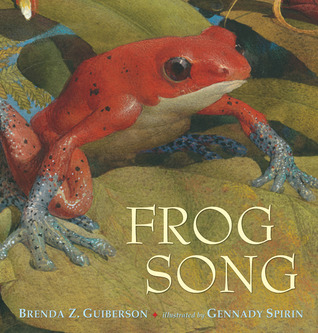
Frog Song
Author: Brenda Z. Guiberson
Illustrator: Gennady Spirin
Published February 5th, 2013 by Henry Holt and Co.

Goodreads Summary: Since the time of the dinosaurs, frogs have added their birrups and bellows to the music of the earth. Frogs are astonishing in their variety and crucial to ecosystems. Onomatopoeic text and stunning illustrations introduce young readers to these fascinating and important creatures, from Chile to Nepal to Australia.

Review and Teacher’s Tools for Navigation: I must admit–I am not a fan of frogs. They actually scare me quite a bit. They are so sporadic and unpredictable–one even jumped on my head at a party once! However, animals of all kind fascinate me and this is a book full of amazing facts about these slimy, jumpy creatures.  The book is set up so that it is easy to navigate with quick interesting facts about 11 different frogs (& toads) with extra information in the back.  I also liked the information given in the back about the trouble that frogs are in because of human activity. I think this book would be a great asset in any science classroom studying biology or ecology (would also be wonderful in a reading class or even a geography lesson because of the different places the frogs came from). Another wonderful way this book could be used in a reading class is because of all of the onomatopoeias within the book. I would love to hear the actual sounds of the frogs and then see the onomatopoeia that the author chose.

Discussion Questions: Which frog fact fascinates you the most? Do extra research about this frog and find other interesting facts about the animal.; Compare and contrast two of the frogs.; Write a fact book about animals like Frog Songs and include the sounds the animals make.

We Flagged: “In Chile, the Darwin’s frog sings in the beech forest. CHIRP-CHWEEET! The male guards 30 eggs in the damp leaves for three weeks. when the tadpoles wiggle, he scoops them into his mouth. SLURP! They slither into his vocal sacs, where he keeps them safe and moist for seven weeks. Then he gives a big yawn, and the little froglets pop out.” (p. 16)

Read This If You Loved: Lifetime by Lola Schaefer, Actual Size by Steve Jenkins, Island by Jason Chin, Seabird in the Forest by Joan Dunning, Slap, Squeak, and Scatter by Steve Jenkins

Recommended For: 

classroomlibrarybuttonsmall readaloudbuttonsmall closereadinganalysisbuttonsmall

Signature

Lifetime: The Amazing Numbers in Animal Lives by Lola M. Schaefer

Share

NF PB 2014

Nonfiction Picture Book Wednesday

Nonfiction Picture Book Wednesday is hosted by Kid Lit Frenzy and was started to help promote the reading of nonfiction texts. Most Wednesdays, we will be participating and will review a nonfiction text (though it may not always be a picture book).
Be sure to visit Kid Lit Frenzy and see what other nonfiction books are shared this week!

lifetime

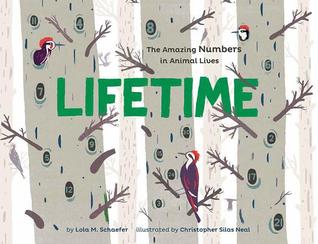
Lifetime: The Amazing Numbers in Animal Lives
Author: Lola Schaefer
Illustrator: Christopher Silas Neal
Published September 20th, 2013 by Chronicle Books

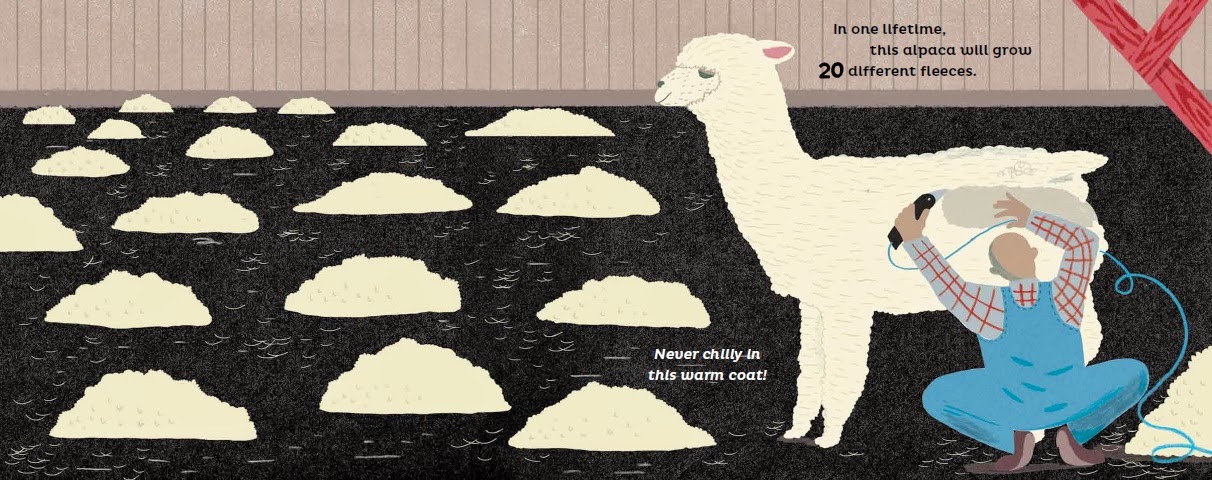
Goodreads Summary: In one lifetime, a caribou will shed 10 sets of antlers, a woodpecker will drill 30 roosting holes, a giraffe will wear 200 spots, a seahorse will birth 1,000 babies.

Count each one and many more while learning about the wondrous things that can happen in just one lifetime. This extraordinary book collects animal information not available anywhere else—and shows all 30 roosting holes, all 200 spots, and, yes!, all 1,000 baby seahorses in eye-catching illustrations. A book about picturing numbers and considering the endlessly fascinating lives all around us, Lifetime is sure to delight young nature lovers.

Review and Teacher’s Tools for Navigation: I learned so much reading this book. My friend Amanda actually read it first and kept yelling out the facts because they are just so interesting; obviously students would find them interesting as well. On top of it just being interesting, this book is a little book of gold! It is a perfect combination of reading, math, and science! Also, the illustrations are just so well done! Throughout the book, scientific facts about animals are shared with the reader (all with numbers) and then in the end of the book Lola Schaefer also shares with the reader even more information about the animals, how to find an average, and other math facts.  And not once does the book even feel a bit boring–it is a perfect read aloud and cross-curricular text.

Discussion Questions: Which of the animals interests you the most?; Using how the author teaches you to find an average, pick an animal and determine the average number of offspring they will have in a lifetime.

We Flagged: 

Read This If You Loved: Frog Song by Brenda Z. Guiberson, Weird but True! by National Geographic, Island by Jason Chin, Can We Save the Tiger? by Martin Jenkins, Actual Size by Steve Jenkins

Recommended For: 

closereadinganalysisbuttonsmall classroomlibrarybuttonsmall readaloudbuttonsmall

Signature

For the Good of Mankind?: The Shameful History of Human Medical Experimentation by Vicki O. Wittenstein

Share

NF PB 2013

Nonfiction Picture Book Wednesday

Nonfiction Picture Book Wednesday is hosted by Kid Lit Frenzy and was started to help promote the reading of nonfiction texts. Most Wednesdays, we will be participating and will review a nonfiction text (though it may not always be a picture book). Be sure to visit Kid Lit Frenzy and see what other nonfiction books are shared this week!

for the good of mankind

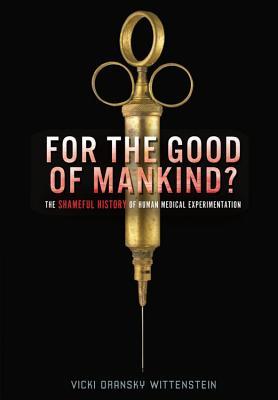
For the Good of Mankind?: The Shameful History of Human Medical Experimentation
Author: Vicki O. Wittenstein
Published: August 1st, 2013 by Lerner Publishing Group

Summary: 

Experiment: A child is deliberately infected with the deadly smallpox disease without his parents’ informed consent.
Result: The world’s first vaccine.
Experiment: A slave woman is forced to undergo more than thirty operations without anesthesia.
Result: The beginnings of modern gynecology.
Experiment: From 1946 to 1953, seventy-four boys are fed oatmeal laced with radioactive iron and calcium.
Result: A better understanding of the effects of radioactivity on the human body.

Experimental incidents such as these paved the way for crucial medical discoveries and lifesaving cures and procedures. But they also violated the rights of their subjects, many of whom did not give their consent to the experiments. The subjects suffered excruciating pain and humiliation. Some even died as a result of the procedures. Even in the twenty-first century—despite laws, regulations, and ethical conventions—the tension between medical experimentation and patient rights continues.

How do doctors balance the need to test new medicines and procedures with their ethical and moral duty to protect the rights of human subjects? What price has been paid for medical knowledge? Can we learn from the broken oaths of the past?

Take a harrowing journey through some of history’s greatest medical advances—and its most horrifying medical atrocities. You’ll read about orphans injected with lethal tuberculosis and concentration camp inmates tortured by Nazi doctors. You’ll also learn about radiation experimentation and present-day clinical trials that prove fatal. Through these stories, explore the human suffering that has gone hand in hand with medical advancement.

Review: Human experimentation is a very difficult subject matter, one that both horrifies and fascinates teens. I always try to believe in the good of mankind, but books like this always seem to challenge that assumption. It was difficult for me to read this book because I cannot fathom how any person could justify using individuals (including CHILDREN!) for experimentation. This book is incredibly well-researched and documents a variety of cases of experimentation. I couldn’t put it down because I was so astonished by the details of the cases. It is colorful and eye-appealing, and this will captivate reluctant readers. I think teenagers would see nonfiction in a very positive light if they were given books like this one. I absolutely recommend it to teachers.

Teacher’s Tools for Navigation: Teachers might assign different chapters to groups of students. Students will enjoy reading about and presenting the material covered in this book. Persuasive essays are always a chore, but there are many controversial issues within this book, and I think students would really enjoy writing essays about this subject matter. This book also includes discussion questions for readers.

Discussion Questions: Can we justify the experimentation on a human being if it will better the lives of millions of people?; Why do you think human experimentation was allowed for such a long time? Can we judge the doctors who experimented on people centuries ago?; Applying the stories to animals, do you think animal experimentation is justifiable? Why or why not?

Read This If You Loved: The Immortal Life of Henrietta Lacks by Rebecca Skloot, books in the Real Justice series, Brave New World by Aldous Huxley


Recommended For:

closereadinganalysisbuttonsmall classroomlibrarybuttonsmall

RickiSig

Lost in the River of Grass by Ginny Rorby

Share

This week I am celebrating with my friend and author Ginny Rorby as she receives her award from the Florida Association for Media in Education (FAME) for winning the Sunshine State Young Readers Award (as voted by 6-8 grade students in Florida) for Lost in the River of Grass. To celebrate, I will be reviewing all of her books this week.

SSYRA


lost

Lost in the River of Grass
Author: Ginny Rorby
Published February 9th, 2011 by Carolrhoda Books

Goodreads Summary: “I don’t realize I’m crying until he glances at me. For a moment, I see the look of anguish in his eyes, then he blinks it away and slips off into the water. I immediately think of the gator. It’s still down there somewhere…”

A science-class field trip to the Everglades is supposed to be fun, but Sarah’s new at Glades Academy, and her fellow freshmen aren’t exactly making her feel welcome. When an opportunity for an unauthorized side trip on an airboat presents itself, it seems like a perfect escape—an afternoon without feeling like a sore thumb. But one simple oversight turns a joyride into a race for survival across the river of grass. They’re forced to walk out of the Everglades (they’ve got a knife, a small amount of Gatorade and some suspicious Spam). Sarah will have to count on her instincts—and a guy she barely knows—if they have any hope of making it back alive.

Lost in the River of Grass takes on the classic survival genre using one of the country’s most unique wild places as a backdrop. It is in the tradition of survival stories like Hatchet or My Side of the Mountain, where the young protagonist finds herself as she struggles to survive in an unforgiving wilderness. In this tense, character-driven thriller, Sarah must overcome prejudice and the unforgiving wilderness in a struggle to survive.

My Review: This is Ginny’s most human of a novel. It is about survival and finding the strength inside of yourself to stand up to anything- even something that has always terrified you. Throughout the novel, Sarah and Andy, who are lost in the Everglades, face things that are only in most of our nightmares. I learned, quite quickly, that I probably wouldn’t survive if I was lost in the river of grass. But Sarah, who is scared of EVERYTHING, grows up right in front of our eyes. This book made me gasp, cry, laugh- go through the cycle of emotions, but that is what makes a book so wonderful. Ginny Rorby knows how to write characters that the reader can connect with and this is no exception- Sarah is just a normal girl and Andy is just a normal boy, but through their journey they found out how extraordinary they are.

Teacher’s Tools for Navigation: This book is loved by students. I saw it when it was an SSYRA nominee—students devoured it and loved talking about the crazy survival moments and the surprise ending. Because of the love that students have for it, Lost in the River of Grass is perfect for classroom libraries and for read alouds.

Discussion Questions: Sarah is afraid of snakes.  How does she overcome her fear?  What are you afraid of? How could you overcome your fear?; What does Lost in the River of Grass teach us about prejudice?

We Flagged: “I onlly get a dozen feet ahead of him when my leg hits something hard and knobby. In a heart-stopping moment, I know it’s the gator, yet I can’t move. In my mind I see its pink throat and huge teeth coming up through the murky water. something brushes the back of my neck, and I scream.” (p. 72)

Read This If You Loved: Brian books by Gary Paulsen, My Side of the Mountain by Jean Craighead George, Trapped by Michael Northrop, Island of the Blue Dolphins by Scott O’Dell, The Great Wide Sea by M.H. Herlong

Recommended For: 

classroomlibrarybuttonsmall readaloudbuttonsmall

Congratulations again Ginny! You deserve it!

Signature

Man Made Boy by Jon Skovron

Share

9780670786206_ManMadeBoy_JK.indd

Man Made Boy
Author: Jon Skovron
Published: October 3rd, 2013 by Viking Penguin

GoodReads Summary: Love can be a real monster.

Sixteen-year-old Boy’s never left home. When you’re the son of Frankenstein’s monster and the Bride, it’s tough to go out in public, unless you want to draw the attention of a torch-wielding mob. And since Boy and his family live in a secret enclave of monsters hidden under Times Square, it’s important they maintain a low profile.

Boy’s only interactions with the world are through the Internet, where he’s a hacker extraordinaire who can hide his hulking body and stitched-together face behind a layer of code. When conflict erupts at home, Boy runs away and embarks on a cross-country road trip with the granddaughters of Jekyll and Hyde, who introduce him to malls and diners, love and heartbreak. But no matter how far Boy runs, he can’t escape his demons—both literal and figurative—until he faces his family once more.

This hilarious, romantic, and wildly imaginative tale redefines what it means to be a monster—and a man.

My Review: I was completely engrossed in this book. My favorite part about it dips into a wide variety of genres. Lovers of fantasy, romance, sci fi, and/or steampunk will find something to enjoy in the text. There are monsters, werewolves, computers, and lovers. Students will have a lot of fun exploring aspects of the book (because who doesn’t love to read about monsters?). Boy takes readers for quite a ride, and I envision this would make for a great literature circle choice. This modern extension of Frankenstein allows readers to place the classic text in a more relevant context. Readers will be able to revisit a few classics that they know and loved (or didn’t love). This is my favorite Jon Skovron book that I have read. It shows how clever he is.

Teacher’s Tools for Navigation: Man Made Boy is an English teacher’s dream. It can be paired quite well with mythology and other classic monsters in history. I would love to pair Medusa’s scenes with a mythology unit. This would also bridge very well with The Strange Case of Dr. Jekyll and Mr. Hyde. The monsters of this book are ubiquitous in the literary canon, and I think students would have a lot of fun picking and researching classic monsters from the text.

Discussion Questions: What is a monster? Can humans be monsters? What kinds of demons do people confront?; Does Boy make the right decision when he decides to leave home?; Choose three monsters in the story. What do each of them teach us? How do their interactions with Boy help us understand him better?

Read This If You Loved: Frankenstein by Mary Shelley, The Strange Case of Dr. Jekyll and Mr. Hyde by Robert Louis Stevenson, Raven Boys by Maggie Stiefvater, A Monster Calls by Patrick Ness, Anna Dressed in Blood by Kendare Blake, Hold Me Closer, Necromancer by Lish McBride

Recommended For:

  litcirclesbuttonsmall closereadinganalysisbuttonsmall classroomlibrarybuttonsmall

026F3FBCC8C3913BD3A4D3F6920340D5

**Thank you to NetGalley and Penguin for providing the Advanced Reader Copy for review!**