Author Guest Post: “Why I Write Science Books for Children” by Mary Batten, Author of Life in Hot Water: Wildlife at the Bottom of the Ocean

Share

“Why I Write Science Books for Children”

One day some years ago when I was writing scripts for the Children’s Television Workshop science series 3-2-1 Contact, I took my four-year-old daughter to my office and introduced her to the show’s actors. Afterwards, she looked at me and said, “I didn’t know they were real.” I was astounded. She had learned from watching Sesame Street and the show I was working on–the only TV shows we allowed her to watch–that what you see on TV is pretend. Big Bird, Cookie Monster and the other muppets were imaginary characters. Sesame Street was an imaginary street. My little daughter had learned the difference between fact and fiction.

From toddler age, children are fascinated by the real world. I consider them budding field biologists. They pick up the tiniest pieces of their environment–a pebble, a shell, a feather, a blade of grass–and excitedly present it to their parent or caretaker. As soon as they can, they repeatedly ask “Why?” About everything! These questions are the beginning of scientific curiosity. And it is my hope that my books tap into and nourish that curiosity.

By third grade, most children have learned about the two literary genres, fiction and nonfiction. The books I write are nonfiction–science, nature. When people ask me why I write nonfiction, I have two answers: First, I am fascinated and excited by the complex interrelationships among animals, plants, microbes, soil, sun and water that hold ecosystems together. Secondly, what goes on in nature is more fantastic, more bizarre than anything science fiction writers have imagined. Sex-changing fishes, flowers that use trickery to attract pollinators, insects that look like leaves and sticks, symbiotic partnerships between totally different species, and creatures that live in water hot enough to melt lead–these and many more are all real!

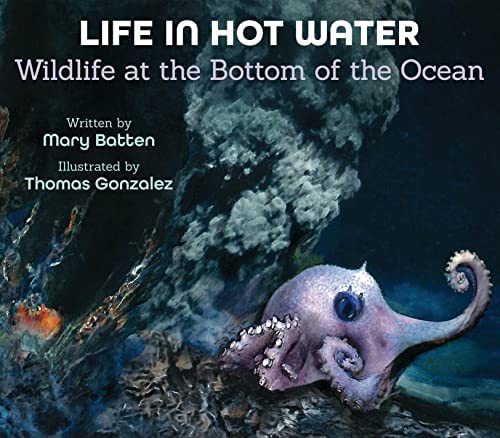
My newest book, Life in Hot Water: Wildlife at the Bottom of the Ocean, is about animals that live in the hottest, most extreme environment on Earth–hydrothermal vents. It is the second book in a series I created called “Life in the Extreme,” about the incredible ability of living things to evolve and take up residence in nooks and crannies of the most extreme environments. Discovery of hydrothermal vents in 1977 is one of the greatest adventures in science. 

Hydrothermal vents are underwater hot springs that form along the mid-ocean ridge, the longest mountain range on Earth. You can’t see it because it’s at the bottom of the sea. There it snakes more than 40,000 miles (65,000 kilometers) around the planet. When scientists first descended into this world, nobody expected to find any living thing. But the porthole of their tiny submarine revealed fish, clams, shrimp, crabs, and giant red-tipped tube worms never seen before. How could anything live amidst plumes of superhot, toxic liquid gushing from strange chimney-like structures?

Like toddlers who develop by asking questions, scientists also gather knowledge by asking questions and searching for answers. Questions open doors to discovery and the mind-blowing discovery of hydrothermal vents raised many questions. One of the most important was, “What are these creatures eating?”

Until vents were discovered, scientists thought that green plants and the sun were the base of all food chains–a process called photosynthesis. But no sunlight reaches the total darkness of the vent world miles below the ocean’s surface. And no green plants grow in this world. What then?

Following up these and other questions, scientists discovered an entirely new food chain–one that depends on energy from the Earth instead of energy from the sun. Amazingly, vent animals eat bacteria that feed on toxic chemicals such as hydrogen sulfide, which smells like rotten eggs, spewed from Earth’s interior by undersea volcanoes that create the vents. Scientists called this process chemosynthesis. Robert Ballard, the oceanographer who discovered where the sunken ship Titanic lay, called it “Probably one of the biggest biological discoveries ever made on Earth.”*

Textbooks had to be rewritten to include chemosynthesis as well as photosynthesis. Today research to learn more about hydrothermal vents is going on all over the world.

For me, one of the joys of writing nonfiction is reaching out to scientists who are doing the real work and interviewing them. One of the scientists whom I consulted for this book, Dr. Janet Voight, Associate Curator at the Field Museum in Chicago, said, “There’s so much about the deep sea that we haven’t even begun to explore. It’s all discovery, and that makes it exciting.”

Children are natural born explorers. Tapping into their questions is one of the most exciting and productive ways to foster children’s developmental curiosity, engage them in the basic scientific process, and encourage them to write their own nonfiction. Children’s science books, such as Life in Hot Water, can be used to create multi-disciplinary units engaging biology, geography, art, and creative writing. 

*Bill Nye discusses discovery of hydrothermal vents with Robert Ballard: http://www.youtube.com/watch?v=D69hGvCsWgA

Published June 21, 2022 by Peachtree

About the Book: .A dramatic overview of the deep-sea extremophiles that thrive in scalding water and permanent darkness at the bottom of the ocean

The scalding-hot water gushing from vents at the bottom of the ocean is one of the most extreme environments on Earth. Yet over millions of years, many organisms—from chemical-eating bacteria to eyeless crabs and iron-shelled snails—have evolved in amazing ways that enable them to thrive in this unlikely habitat. Scientists are hard at work to learn more about the complex ecosystems of the ocean depths.

Award-winning science writer Mary Batten and NYT best-selling illustrator Thomas Gonzalez, the masterful duo that created Life in a Frozen World, team up again in this impressive overview of hydrothermal ocean vents. Her clear, informative text coupled with his unique and eerily realistic paintings of sights never seen on land—gushing “black smokers,” ghostly blind shrimp, red-plumed tube worms—will entice readers to learn more about this once-hidden world at the bottom of the sea.

About the Author: Mary Batten is an award-winning writer for television, film and publishing. Her many writing projects have taken her into tropical rainforests, astronomical observatories, and scientific laboratories. She scripted some 50 television documentaries, was nominated for an Emmy, and is the author of many children’s science books, including Aliens From Earth, and Life in a Frozen World: Wildlife of Antarctica. Her most recent book is Life in Hot Water: Wildlife at the Bottom of the Ocean.

Thank you, Sara at Holiday House, for connecting us with Mary!

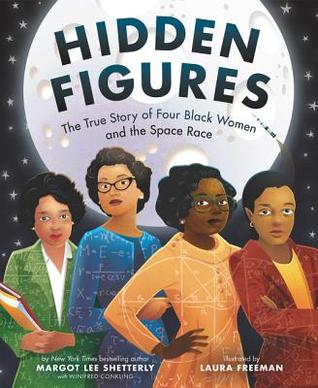
Guest Review: Hidden Figures: The True Story of Four Black Women and the Space Race by Margot Lee Shetterly, Illustrated by Laura Freeman

Share

Guest Reviewer: Kayla, UCF Elementary Education Student

Hidden Figures: The True Story of Four Black Women and the Space Race
Author: Margot Lee Shetterly
Illustrator: Laura Freeman
Published

Summary: Dorothy Vaughan, Mary Jackson, Katherine Johnson, and Christine Darden were good at math…really good.

They participated in some of NASA’s greatest successes, like providing the calculations for America’s first journeys into space. And they did so during a time when being black and a woman limited what they could do. But they worked hard. They persisted. And they used their genius minds to change the world.

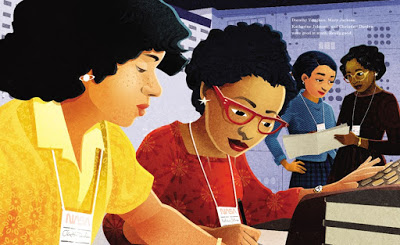
In this illustrated picture book edition, we explore the story of four female African American mathematicians at NASA, known as “colored computers,” and how they overcame gender and racial barriers to succeed in a highly challenging STEM-based career.

About the Creators: 

Margot Lee Shetterly is the author of  Hidden Figures: The American Dream and the Untold Story of the Black Women Mathematicians Who Helped Win the Space Race (William Morrow/HarperCollins). Shetterly is also the founder of The Human Computer Project, an endeavor that is recovering the names and accomplishments of all of the women who worked as computers, mathematicians, scientists and engineers at the NACA and NASA from the 1930s through the 1980s. Shetterly is a Virginia native, University of Virginia graduate, an entrepreneur, and an intrepid traveler who spent 11 years living in Mexico. She currently lives in Charlottesville, VA.

Originally from New York City, Laura Freeman now live in Atlanta with her husband and their two children. Freeman received my BFA from the School of Visual Arts and began her career working for various editorial clients. She has illustrated over thirty children’s books, including Hidden Figures written by Margot Lee Shetterly, the Nikki & Deja series by Karen English and Fancy Party Gowns by Deborah Blumenthal. In addition to illustrating books and editorial content, Freeman’s art can be found on a wide range of products, from dishes and textiles to greeting cards.

Review: This book was a gem to find. I didn’t really know the story of how NASA got the skills to make it to space when planning the exploration. I was very intrigued when I read the story of these four African American women who were mathematical geniuses. These women were around during the segregation era but that didn’t stop them from doing what they loved even through tough times. In this picture book I was able to explore their story and how they made everything possible to help NASA put the first man into space. I also really like the message of women entering a career we only see men in but overcoming gender and racial barriers will allow any women to be successful in her career.

Teachers’ Tools for Navigation: This book can be used in many ways. We can use in social studies when talking and exploring segregation and how these women overcame a lot of obstacles to help NASA but men into space. We can also speak about STEM based careers and how difficult it was for many women to enter science or engineering jobs or schools because it was considered a “mans” job. This book will allow many children to see that hard work and dedication pays off. We should follow are dream and work hard and overall, not let any obstacle allow us to fail.

Discussion Questions: 

  • How did these 4 women make NASA hire them to work on the program to allow humans into space?
  • Was it easy for these women to get into school or even work for NASA? Why?
  • Who would you identify more with Dorothy, Mary, Katherine or Christine?
  • Descried how the segregation affected Black people?
  • What two major obstacles did Dorothy Vaughan face to become a computer at the Langley Laboratory?
  • Using the timeline in the book what were the most important events in the story?

Flagged Passages: 

Read This If You Love: Counting on Katherine by Helaine Becker, Mae Among the Stars by Roda Ahmed

Recommended For: 

classroomlibrarybuttonsmall

Thank you, Kayla, for your review!

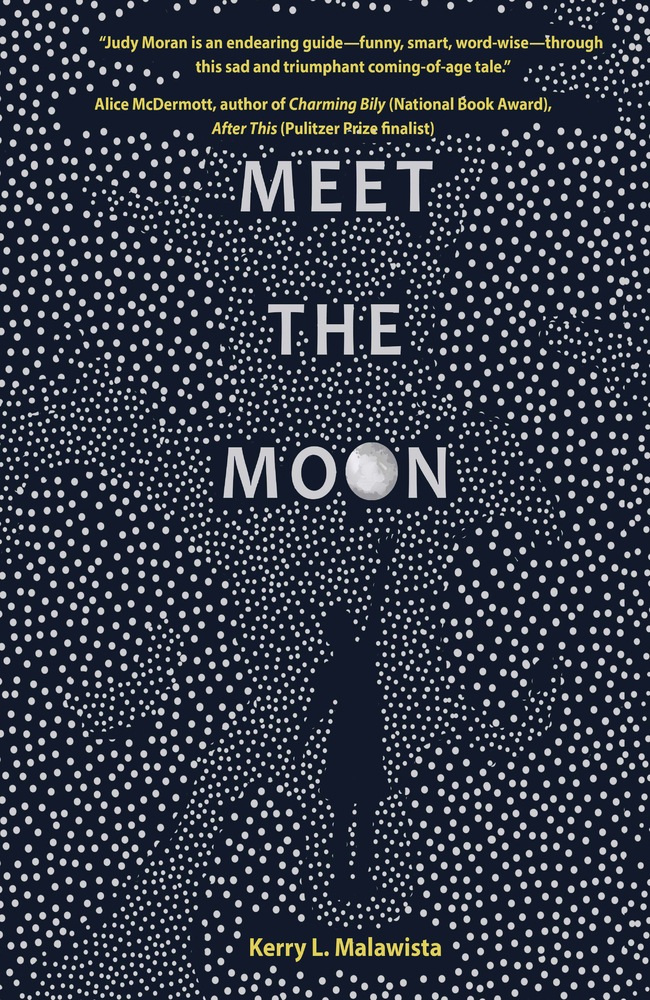
Author Guest Post: “Unforgotten” by Kerry L. Malawista, Author of Meet the Moon

Share

“Unforgotten”

In my thirties, newly pregnant, I returned to my hometown library in search of my mother.

Once inside that maroon brick building, I was transported back in time. The thrill of possibilities lining the shelves, the card catalog with its array of seemingly endless wooden drawers, and the metal water fountain—where I struggled with how to simultaneously hold down the foot pedal and rise up on tiptoes to take a sip of water.

A gray-haired woman approached me. “Can I help you?” she whispered into the hush.

“Yes, I am trying to find the Bergen Record—from 1970.”

“Any newspapers over a year old are kept on microfiche. Follow me.” She drifted toward a side room full of machines that had clearly seen better days. A mysterious room, where grown-ups had unspooled reels and loaded slides into carousels, forgotten ways of recording the world. She demonstrated how to load the microfiche into the viewer and how to move the film around to find past articles, then she left me to my task.

“Good luck!” she said as she walked out of the room.

My eyes blurred as the years flew by. I slowed down as I reached 1970. Even more slowly I scrolled. January…March… April. I noticed the headline for the Apollo 13 launch on April 17 of that year, and stopped. I remembered that day at Shaler Elementary School in Ridgefield, New Jersey. It was a Friday, and my teacher, Mrs. McCurry, had marched us single file down the hall to the all-purpose room to watch the splash down with the entire school. Two large televisions were set up on the stage at the front of the room.

I overheard talk among the teachers that something might have gone wrong with the space shuttle and that the astronauts were at risk of burning up as they re-entered the Earth’s atmosphere. A tense chatter filled the room until we saw the first sight of the parachutes opening, and like purple butterflies the astronauts floated down to safety. Everyone cheered. But for me, the thought of those men floating around in a capsule, out in space, away from their families, left a sad and lonely sensation in the pit of my stomach.

I never understood why that feeling about Apollo 13 stayed with me so long. The astronauts had made it back to earth. They hadn’t blown up.

Sitting beside the industrial metal bulk of the microfiche viewer, carefully sliding the brittle plastic film forward, I was launched back to my childhood bedroom. Running along the wall next to my bed, right where my eyes landed was a line of white trim that extended out from the center windows. On the wood was a tiny indentation with some chipped paint, shaped just like a rocket ship, with what I thought at the time looked like fire, blasting it off into outer space. As I settled into sleep each night I would check to see that my rocket ship, my Apollo 13, was still there.

Scrolling down to May, I realized that the desolation lingering from that long-ago Apollo landing was actually from three weeks later, when my mother’s capsule didn’t protect her. Till that moment I hadn’t realized how close these two events were in real time. My memory had fused them together, overlaying the later dread with the earlier Apollo 13 landing.

Now I wondered if had it always been a rocket I saw there, or did it only become one after our lives exploded?

Increasing the magnification, I zoomed in to the top of the front page—May 8, 1970. At first all I saw was the large faded photograph of the demolished Ford Country Squire station wagon, smashed in, glass shattered.

I read the caption below, “A woman was killed and her small son critically injured in Palisades Park.” I didn’t want to imagine a “woman,” my mother, pressed inside what looked like an enormous accordion with all the air pressed out of it.

The story below unfolded: “Police say Mrs. Leddy, 32, of 389 Mayer Court, Ridgefield, was driving south on Grand Avenue when her car swerved into the northbound lane and crashed head on into a truck driven by Edward Martini, 45, of Staten Island. According to police, Martini was sitting in his van reading a road map when the accident occurred.”

When I paused the flat black and white microfiche, I thought how little of the story those spare words told. I knew the facts: My mother, with my baby brother in the back seat, was on her way to pick up my little sister from nursery school. An eyewitness saw my mother slump to her side, that it appeared she had fainted, resulting in her foot pressing down on the accelerator. The autopsy stated, with high certainty, that an aneurysm exploded in her brain.

Yet, in that moment, staring at the picture, the intoxicating smell of the burgundy leather seats returned—just months before the accident we had celebrated the arrival of our very first new car—and the reel of that long-ago day unfurled through my brain.

My nine-year-old self, along with my four siblings, staring at my father sitting on the edge of the bed.

“Girls, there’s been…”

My knees weak, I glanced away, trying to land my eyes anywhere but on my father’s face. Not wanting to see his tears.

“There has been a terrible accident,” he said. I was like one of my lightening bug trapped in a jar, looking for a way out.

Slowly he choked out the rest of the words. “Mom’s gone.”

“What do you mean she’s gone?” I understood, but I didn’t want to.

Barely audible, he said, “She died.”

One of us asked, “What happened?”

“We aren’t sure yet, but she was in a car accident.” He might have said more. I couldn’t take in his words—a wall had gone up between my ears and my mind.

After I left the library, eager for more memories of that day I called the Palisades Police Department. While I realized it was unlikely, I wanted to see if there might be a small chance someone there remembered the accident. Something they could tell me. A desk officer answered the phone.

“Palisades Police Department. Is this an emergency?”

“No. I just have a question. I’m wondering if there might be someone working in the police department that was here in 1970.” Adding, “There was a car accident…I was hoping to ask about.”

He said, “Well our Captain was here then. Maybe he’d remember. Hold on a moment. What was your name?”

“It was Kerry Leddy back then.”

As I waited, my self-consciousness grew. Should I hang up? This guy has better things to do. Who calls the cops twenty years later, expecting someone to remember a car accident?

“I can’t believe I’m hearing from you,” a voice said, nearly as whispery as the librarian. He sounded as if he had been sitting by the phone, awaiting my call. “How is your brother?” His voice choked.

“He’s fine.” I said, doing my best to keep my own voice steady. “Really well. He’s in the army.”

“I’m so glad. . . . He was so . . . badly hurt. . . . I had gone to the hospital to check on him.” I could hear him struggling to find the words.

I said, “I’m shocked you remember.”

“How could I forget? It’s like it was yesterday. . . I was a new officer, just there a couple of months, and going to that scene and seeing the accident and your Mom. . . five kids. . . Well. . . Man. . . jeez. . . .” His voice once again caught in his throat. “I think about your family all the time. . . it was so awful. . . you kids…your brother like that. . . your mom. I never could get her out of my head. My wife had just had a baby. I never forgot it. I’m so glad to hear you all did so well.”

Captain Stanton had nothing new to tell me about the accident. Nothing new to tell me about my mother.

Yet he gave me just what I was needed, what truly mattered: Captain Stanton remembered. Remembered my mother. Remembered our family. All these years he had carried her and us with him, linking the past to the present. That’s what I was searching for, to not forget.

I found my mother in the newspaper that day in the library, and I discovered that I’d merged our family history with that of the space program. Then I found an eye witness to the devastation our family faced—a man who’d just started a family of his own when my mother died—and he’d spent time inventing a future for our family. That factual and emotional confirmation, together on the same day, launched me to write my novel, Meet the Moon. I remembered, embellished, and invented a family grappling with grief in hopes of reaching readers the way I reached the policeman, who gratefully said to me, “I can’t believe I’m hearing from you.”

Expected Publication: September 15th, 2022 by Fitzroy Books/Regal House Publishing

About the Book: In 1970, 13-year-old Jody Moran wants pierced ears, a kiss from a boy, and more attention from her mother. It’s not fair. Seems like her mother is more worked up about the Apollo 13 astronauts, who may not make it back to earth safely. As it happens, the astronauts are spared a crash landing, but Jody is not, for three days after splashdown, her mother dies in a car accident. Now, Jody will never know if her mother really loved her. Jody’s father has taught them to believe in the “Power of Intention.” Announce what you want to the world to make it happen. But could the power of Jody’s jealousy and anger have caused Mom’s accident? To relieve her guilt and sadness, she devotes herself to mothering her three younger siblings and helping Dad, which quickly proves too much for her, just as persuading quirky Grandma Cupcakes to live with them proves too much for Grandma. That’s when Jody decides to find someone to marry her father, a new mom who will love her best. Jody reads high and low to learn about love, marriage and death. For her adolescent firsts—kiss, bra, and boyfriend—she has the help of her popular older sister, her supportive father, and comical Grandma. But each first, which makes her miss her mother, teaches her that death doesn’t happen just once.

About the Author: Kerry L. Malawista, PhD is a writer and psychoanalyst in Potomac, MD. She is co-chair of New Directions in Writing and founder of the recent project The Things They Carry – offering virtual writing workshops for healthcare and frontline workers. Her essays have appeared nationally in newspapers, magazines and literary journals including The New York Times, The Washington PostThe Baltimore SunThe Boston GlobeZone 3Washingtonian MagazineThe Huffington PostBethesda MagazineArlington MagazineThe Account Magazine, and Delmarva Review, which nominated her for a Pushcart Prize. She is the co-author of Wearing my Tutu to Analysis and Other Stories (2011), The Therapist in Mourning: From the Faraway Nearby (2013), both published by Columbia University Press, and Who’s Behind the Couch (2017) published by Routledge Press. When the Garden Isn’t Eden: More Psychoanalytic Concepts from Life will be published by Columbia University Press spring 2022 and her novel, Meet the Moon will be released September 2022 by Regal House Publishing. Her website is KerryMalawista.com.

Thank you, Kerry, for this beautifully written post!

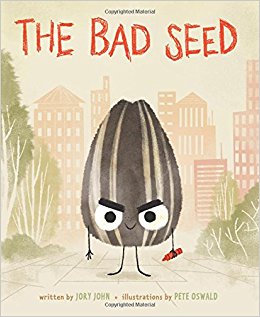
Guest Review: The Bad Seed by Jory John, Illustrated by Pete Oswald

Share

Guest Reviewer: Katie, UCF Elementary Education Student

The Bad Seed
Author: Jory John
Illustrator: Pete Oswald
Published August 29th, 2017 by HarperCollins Publishers

Summary: This is a book about a bad seed. A baaaaaaaaaad seed. How bad? Do you really want to know?

He has a bad temper, bad manners, and a bad attitude. He’s been bad since he can remember! This seed cuts in line every time, stares at everybody and never listens. But what happens when one mischievous little seed changes his mind about himself, and decides that he wants to be—happy?

About the Creators:

Jory John is a New York Times bestselling author and two-time E. B. White Read Aloud Honor recipient. Jory’s work includes the award-winning Goodnight Already! series; the bestselling Terrible Two series; the popular picture books The Bad Seed, Penguin Problems, and Quit Calling Me a Monster!; and the national bestseller All My Friends Are Dead, among other books. He lives in Oregon.

Pete Oswald is an LA-based artist, kid lit author/illustrator, and production designer. He is the co-creator of Mingo the Flamingo, published in 2017 by HarperCollins. Pete is also the illustrator of The Bad Seed, by Jory John. When Pete is not working on books he is helping to uplift many of the most successful animated franchises as a character designer, concept artist, and production designer. Pete lives in Santa Monica, California, with his wife and two sons.

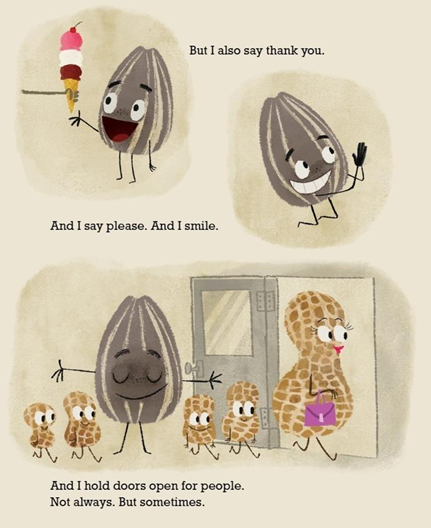
Review: I personally love this book and the character development it possesses throughout. There is a background on how the seed became to be “The Bad Seed”, which helps readers understand that there is always a reason behind their peers’ behaviors. The seed shared the things he does and the reasons he believes himself to be so bad but also a chance in his mindset, he no longer wants to be a bad seed. He starts changing his behavior and wants to be happy. This shows kids that it’s okay to want to make positive changes in themselves and it is possible for their peers to do so too. The seed also shares that he may not continue these positive behaviors at all times but does so from time to time. This shows that you can not be the perfect person at all times but it’s all about you trying to do so. With this, I think this would be a great book to start the year out with to show students that it is okay to start out being “bad” and changing for the better. It also gives students a chance to understand behaviors without telling them.

Teachers’ Tools for Navigation: I think this book would be best for a classroom read aloud. This is because it would be a great introduction book or even if you notice there are a lot of negative behaviors happening in the classroom. It shows character development and how you can turn your behavior around. It also shows that there is a reason behind all negative behaviors and that these reasons are justifiable as well showing that you can get past it.

Some activities you could also do with it are:

Mapping: Mapping could be used for this book as you can map the journey the character takes to change his behavior from being bad to being good. You can have points that begin with the seed being happy, what happened that made him change his behavior, what he did while he was being bad, and what he started doing to become good.

Literature Logs: This could be used for older age groups, they can stop at the beginning to make connections or write down their initial thoughts after a picture walk. They can stop at different points to make inferences about what’s going to happen next or things they believe the character can do to turn around his behavior.

Graffiti Boards: This could be used just like the literature logs but may be more fun for the students as it is less structured. Here they have a chance to write, draw and interpret ideas on their own with little guidance other then the initial instructions and it can be done at any point without having to stop as a whole class to complete.

Discussion Questions: 

  • Describe in your own words the reasoning behind the bad seed becoming bad?
  • Why do you think the seed is considered to be the bad seed just from looking at the cover?
  • Do you think the seed will be able to overcome his “bad” behavior? Why or why not?
  • Describe a time in your life where you interacted with someone who acted like the bad seed? How did it make you feel?
  • Why do you think the seed wanted to turn his behavior around and become good again?
  • What do you think we can learn from the bad seed and his journey to become good?

Flagged Passages: 

Read This If You Love: Understanding behavior, colorful illustrations

Recommended For: 

classroomlibrarybuttonsmall

Thank you, Katie, for your review!

Guest Post: Classroom Uses for Dragons in a Bag by Zetta Elliott, Magnificent Makers: How to Test a Friendship by Theanne Griffith, Polly Diamond and the Magic Book by Alice Kuipers, and Sisters of the Neversea by Cynthia Leitich Smith

Share

One of the assignments during my Spring Children’s Literature course at UCF was creating a mini-teaching guide for the books we read for book clubs. We started with picture books for practice then students created them in their book clubs each week.

Today, I am happy to share the classroom uses and discussion questions found by my UCF Elementary Education students about fantasy novels.

Dragons in a Bag
Author: Zetta Elliott
Published October 23rd, 2018 by Random House

Summary: Jax is left by his mom to an old lady by the name of Ma. Jax later finds out that Ma is a witch who has 3 dragon eggs that hatched. They need to return the eggs because they won’t survive in the regular world due to lack of magic. They go to portals through time that takes them to the time of dinosaurs. Along the way, Jax meets his grandfather who also knows magic, and has him return two of the dragons to the magic council but accidentally left one left behind so he returns to the regular world. He forces his mom and the witch to hash out their problems.

Teachers’ Tools for Navigation: When using fantasy in the classroom it is always a good way to spark your students’ creativity. This source could be used as a creative writing prompt to boost off their creativity of the story: Conduct an activity based upon the book like have them write a short story about what they would do if they were in Jax’s shoes and have them draw pictures of dragons, name them, and design the dragons how they would like them to be pictured.

Discussion Questions: 

  • What was Jax’s first impression of Ma?
  • How do you think Jax will return the last dragon to the magic council?
  • Who do agree with and why? Ma who wants to keep the world of magic separate or L. Roy who wants magic to come back to earth.
  • Why do you think Jax decided to open the window for the squirrel?
  • What were 2 things the dragons were not allowed to have?
  • When you first hear the word apprentice what comes to mind?  Did you have the same thinking as Jax?
  • How does the story tie in with real-life scenarios with the fantasy?
  • Who are the most influential character apart from Jax?
  • When do we see the change of events come in play throughout the story?
  • When reading the book your imagination goes wild,in what other circumstances does your mind go other places when reading this story?

Recommended For: 

classroomlibrarybuttonsmall


The Magnificent Makers: How to Test Friendship
Author: Theanne Griffith
Illustrator: Reggie Brown
Published May 19th, 2020 by Random House Children’s Books

Summary: Pablo, Violet and Deepak are three friends who get sucked into a telescope and must play science games to come back and play again. Deepak is the new kid who makes Pablo jealous with his presence. Throughout the book, the team works together and build their friendship to complete the games.

Teachers’ Tools for Navigation: The book could be used as a classroom read-aloud over the course of a few days or a week.  Due to the science elements, this book would be a good way to start off science discussions in the classroom. For example, the second chapter includes the students learning about food chains. This book is perfect to make connections back to science.

Discussion Questions: 

  •   Why do you think Pablo was jealous of Deepak?
  •   What were some of the challenges they had and what did they have to do?
  •   Why do you think Pablo, Violet, and Deepak were chosen for the Maker’s Maze?
  •    What do you know about producers, consumers, decomposers, and scavengers?
  • What were your favorite aspects of science that you learned from the book?
  • What type of emotion did the characters experience in the book?
  • When Deepak arrived to class, what did Pablo notice about him?
  • How does Pablo overcome is jealous toward Deepak?
  • Toward the end of the book why did they relate their friendship to the ecosystems?

Recommended For: 

classroomlibrarybuttonsmall


Polly Diamond and the Magic Book
Author: Alice Kuipers
Illustrator: Diana Toledano
Published April 22nd, 2018 by Chronicle Books

Summary: Polly Diamond is a little girl who receives a magic book that lets her bring to life the things that she writes and draws. She has a little sister who she doesn’t like very much and a brother on the way. Polly loves to write, she writes lists and stories and anything that she thinks is worth writing. When she starts writing in her magic book she realizes that the book can talk back to her. She writes to her book and comes up with lists and stories to write. She realizes that whatever she writes in the book comes to life when she writes about making a ladder to paint her room and the books on the floor magically move to make a ladder. The book tells her that is what she’s for and Polly quickly learns she can do anything she writes. She makes herself invisible and her sister into a banana. But she realizes that the book is taking everything she says literally. When she writes about eating a club sandwich the book gives her two slices of bread with a bat in between because it took the definition of a club literally. She told the house to fix up the carpet and turn her room into an aquarium. But the carpet was on the ceiling and fish were swimming around her room. She then realizes that everything she wrote was crazy and tries to put the house back to normal because she can’t even recognize it anymore. She fixes it just in time for her parents to come home with her new baby brother. At the end of the story she gives the book a name, Spell. And looks forward to writing and drawing another day with her new book, and friend Spell.

Teachers’ Tools for Navigation: Polly uses and explains words like metaphor, affixes, alliteration, and hyperbole.  This is a great opportunity to talk about these definitions, make lists of words and phrases that relate to these words, and do activities where the students use metaphors, alliteration, homophones, homonyms etc.  It seems like a useful book to have in a first grade classroom and use with a higher level reading small group or a second grade class.    It could also be used as a read aloud, again discussing the key words and their meanings, then practicing using those skills.  There is a lot of use of imagery in this book as well as understanding literal meaning and how words matter.

After reading the text, students can respond to the story by engaging in a free write activity after they finish the reading. As a teacher, we could set a timer for five minutes and ask the students to write continuously about their thoughts on the book, good or bad, and afterwards, go over it as a small group.

Discussion Questions:

  • Polly had many favorite words throughout the book, what are some of your favorite words and why?
  • Make a list of activities you would do to have a Super-Fantastic-Day.
  • In the book, Polly writes down what her dream bedroom would look like. If you could have your dream bedroom, what would it look like?
  • When Polly writes in the magic book, she learns that she needs to write clearly and use as much detail as possible. What are some important rules to follow when writing so people can understand your message clearly?
  • When Polly is playing hide-and-seek, why does she become invisible?
  • Imagine the turquoise notebook has changed your house like Polly’s. Please write a short story explaining what your home looks like in order to get it back to normal.
  • How does Polly feel having to share a room with her little sister when her brother is born?
  • If you had a magic notebook that could bring three things you wrote about to life, what 3 things would you write or draw and why?
  • Polly loves words with double letters like “Dizzy.” List 5 words you can think of that have double letters.
  • Polly loves alliteration.  That’s when  two or more words in a row begin with the same letter.  What alliterations can you think of?

Recommended For: 

classroomlibrarybuttonsmall


Sisters of the Neversea
Author: Cynthia Leitich Smith
Published June 1st, 2021 by Heartdrum

Summary: This book is a tale about three children, Lily, Wendy, and Michael. Their parents, Mr. Darling and Ms. Florene Roberts-Darling are separating, splitting the family between two different locations.  The night before Wendy and Mr. Darling are supposed to leave, the children are visited by a boy named Peter Pan and Belle. Stories of pirates and merfolk persuade the children to follow Peter Pan and Belle off to a mystical land called Neverland.  Upon arriving the children are separated and discover once you arrive you can never leave.  The children meet merfolk, pirates, native children, the lost, and fairies in a desperate attempt to figure out how to get home.

Teachers’ Tools for Navigation: This book will be great for a read aloud, book club, or close reading because it involves a lot of higher level vocabulary than some students may currently be reading at and it has long sentences and dialogue which again, some children could struggle with. These classroom uses would allow for discussions.

Geography could also be tied in because students could illustrate and demonstrate caves and waterways the Merfolk might have dwelled in. They also could show their knowledge of what an island like Neverland might have, and include what trees they think the lost boys were living in.

And, of course, it could be looked at versus Peter Pan as it is a retelling.

Discussion Questions: 

  • If you were a character in this book, who would you be and why?
  • If you were to create a different ending, How would it go?
  • Why do you think Mr. Darling and Ms. Florene wanted to separate?
  • What was your favorite part of the book?
  • What were some challenges that the children had to face or overcome?
  • Why do you think Peter Pan and Belle appeared?
  • Why do you think it was hard for the lost boys to remember who they are?
  • Why do you think Peter Pan never wanted to grow up?
  • Why do you think Belle brought Peter Pan to the island?
  • Why do you think the crocodile made a TikTok sound?
  • Does this book remind you of any other children’s stories?  If so why?

Recommended For: 

classroomlibrarybuttonsmall  


Guest Review: There’s Only One You by Kathryn Heling and Deborah Hembrook, Illustrated by Rosie Butcher

Share

Guest Reviewer: Jessica G., UCF Elementary Education Student

There’s Only One You
Authors: Kathryn Heling and Deborah Hembrook
Illustrator: Rosie Butcher
Published May 7th, 2019 by Union Square Kids

Summary: This feel-good book reassures kids that, whoever and whatever they are, it’s awesome being YOU! Expertly written to include all kinds of children and families, it embraces the beauty in a range of physical types, personalities, and abilities. Kids will love discovering and recognizing themselves in these pages—and they’ll feel proud to see their special qualities acknowledged. Adorable illustrations by Rosie Butcher show a diverse community that many will find similar to their own. (Goodreads)

About the Creators:

Kathryn Heling and Deborah Hembrook have coauthored several books for children, including Ten Lucky Leprechauns (Scholastic) and Mouse Makes Words: A Phonics Reader (Random House). Kathryn is a school psychologist and Deborah is a kindergarten teacher. They both live in WI. Learn more at helinghembrook.com.

Rosie Butcher lives in East Yorkshire and spends her summers in Sweden. Follow her @scrimmle.

Review: I really enjoyed reading There’s Only One You. It is a wonderful book embracing diversity, inclusion, and individuality. The book is filled with beautiful illustrations demonstrating what makes us unique. The book is written in a rhythmic style, so it is engaging for young readers. Each spread beautifully displays the range of physical characteristics, personalities, or abilities individuals may have. The book is filled with bright vivid colors. Each page is filled with many details. Readers will enjoy exploring each page. The book and the illustrations go beyond inclusion of physical characteristics and incorporate physical attributes and challenges such as being in a wheelchair, using arm crutches, a walker, or using a hearing aid. The book also includes multiple spreads showing differences in families. Illustrations include families that comprise of a mom and a dad, or two moms, or two dads, or a single mom, or a single dad. The authors and illustrator do an excellent job displaying diversity within each page. The book also addresses differences in personalities, such as “crying when you’re sad, or keep tears inside”. The story emphasizes that being unique is what we all have in common. It is what makes us extraordinary.

Teachers’ Tools for Navigation: I believe There’s Only One You is a wonderful book to kick start a new school year. It is a great read aloud choice that reminds students that we are all unique and that is special. The story celebrates all learners. It also encourages empathy among students. It is an excellent aide to teach social emotional learning concepts such as self-esteem, managing thoughts, emotions,

and behaviors, and being against bullying. The book can also be used interdisciplinary in reading, social studies, and art. The text and illustrations are filled with many details that prompt discussion among readers. Students may also respond in a journal entry to some of the subjects addressed in the book or write and draw about their own family. Students may also respond by creating an acrostic poem. In social studies, students can utilize individuality to explore what makes us diverse. For example, exploring

what country each student is from, their culture, traditions, and norms. In art, students can draw a self-portrait of themselves, then share with their classmates.There’s Only One You provides a great opportunity to build a classroom community.

Discussion Questions: 

  • On page 3, the author writes, “It’s awesome being unique!” Based on what we have read so far, what do you think being unique means?
  • On page 4, the author writes, “Do your feelings spill out? Do they lay low and hide? You might cry when you’re sad or keep tears inside.” The author is trying to tell us we differ in how we express our emotions. What are ways you can respond if you do not like something or it is not what you may have wanted?
  • On pages 8 and 9, we see students at the zoo. The author wants us to know how they are different and special. How does the author tell us that the students are different? What can we see from the illustrations?
  • Is there something that makes you unique or different from your classmates?
  • On pages 12 and 13, we can see all the children doing different activities. What kind of activities do we see in the picture? Do you have an activity that you love to do?
  • On pages 14 and 15, we can see some cool tools that may help our friends. Can you recall any of these tools? How do they help?

Flagged Passages: 


Read This If You Love: Just Ask!: Be Different, Be Brave, Be You by Sonia Sotomayor, illustrated by Rafael López; You Are Enough: A Book about Inclusion by Margaret O’ Hair, illustrated by Sofia Cardoso; Different–A Great Thing to Be! by Heather Avis, illustrated by Sarah Mensinga

Recommended For: 

classroomlibrarybuttonsmall

Thank you, Jessica, for your review!

Guest Post: Classroom Uses for Concealed by Christina Diaz Gonzalez, Last Gate of the Emperor by Kwame Mbalia and Prince Joel David Makonnen, Maya and the Robot by Eve Ewing, and The Last Last-Day-of-Summer by Lamar Giles

Share

One of the assignments during my Spring Children’s Literature course at UCF was creating a mini-teaching guide for the books we read for book clubs. We started with picture books for practice then students created them in their book clubs each week.

Today, I am happy to share the classroom uses and discussion questions found by my UCF Elementary Education students about science fiction novels.

Concealed
Author: Christina Diaz Gonzalez
Published October 19th, 2021 by Scholastic

Summary: Ivette, Joanna, and now: Katrina

Whatever her name is, it won’t last long. Katrina doesn’t know any of the details about her past, but she does know that she and her parents are part of the Witness Protection Program. Whenever her parents say they have to move on and start over, she takes on a new identity. A new name, new hair color, new story.

Until their location leaks and her parents disappear. Katrina embarks on a dangerous rescue mission to save them-and find out the truth of her past at last.

Yet every new discovery shows that the Katrina’s entire life has been nothing but lies. Katrina has always kept her parents’ secrets. But it turns out, they were the ones keeping secrets from her this whole time. Could she be the reason they’ve been hiding all these years? The truth will throw everything Katrina has ever believed about herself into question.

Concealed is an action-packed adventure story by award-winning author Christina Diaz Gonzalez.

Teachers’ Tools for Navigation: This is a great relatable book for young adults! Throughout the story, Katrina, the main character, fights for more information about herself and her family and why they are on the run, but she often gets overlooked and ignored when she’s asks questions. A lot of teens experience this and I think it would be a great book for a book club or even an assigned read for the class to explore sci-fi and have good discussions.

This books interdisciplinary elements include science and family and friendship values. It touches on the development of science in the DNA and gene makeup, which students may be unaware of at the time of reading which may lead them to explore more on their own. The family and friendship values show that no matter what a family goes through there is still love there. Along with this it shows the importance of friendship and everything that goes along with having a good friend by your side, even when at first you don’t think it is important.

Discussion Questions: 

  • What would you do if you were Katrina and no one would answer your questions?
  • Would you have wanted to go with Katrina on this adventure? Why or why not?
  • Katrina’s skill is drawing and Parker’s skill is computers, describe what your skill is.
  • Describe how you would feel if you found out that you had a lost twin sister/brother.
  • What did you think of X in the story? Did you think he was a good character or a bad character? Why?
  • What would be your name if you had to choose another one?
  • Describe the relationship between Katrina and Parker.
  • Describe one event in the book that stood out to you the most and give your reasoning.
  • Why do you think Katrina didn’t like moving so much? How would you have felt if you were in her shoes?
  • Why do you think the main character’s family has to run and change their identity so many times?
  • Do you think it would be safer for Katrina to leave Parker out of her life? Why or why not?
  • Describe the relationship Katrina has with her parents as the book goes along. What about Parker? X?
  • Why do you think Katrina was so open with Parker, even at the beginning of their friendship?
  • Do you believe X is trustworthy? Why or why not?
  • Why do you believe B and L refuse to tell Katrina the truth about what happened before she lost her memory?
  • Do you think Ellla will side with her family or Mr. Sterling?
  • Describe what part of the book surprised you the most.
  • Do you think it is a good idea for Ellla and Katrina to share their life story on social media? Why or why not?

Recommended For: 

classroomlibrarybuttonsmall


The Last Gate of the Emperor
Authors: Kwame Mbalia & Prince Joel Makonnen
Published May 4th, 2021 by Scholastic Press

Summary: An Afrofuturist adventure about a mythical Ethiopian empire. Sci-fi and fantasy combine in this journey to the stars.

Yared Heywat lives an isolated life in Addis Prime — a hardscrabble city with rundown tech, lots of rules, and not much to do. His worrywart Uncle Moti and bionic lioness Besa are his only family… and his only friends.

Often in trouble for his thrill-seeking antics and smart mouth, those same qualities make Yared a star player of the underground augmented reality game, The Hunt for Kaleb’s Obelisk. But when a change in the game rules prompts Yared to log in with his real name, it triggers an attack that rocks the city. In the chaos, Uncle Moti disappears.

Suddenly, all the stories Yared’s uncle told him as a young boy are coming to life, of kingdoms in the sky and city-razing monsters. And somehow Yared is at the center of them.

Together with Besa and the Ibis — a game rival turned reluctant ally — Yared must search for his uncle… and answers to his place in a forgotten, galaxy-spanning war.

Teachers’ Tools for Navigation: In a way, students can learn about culture in this book. From there, diversity can be introduced into the lesson. Also, it would be great for discussing using your own personal interests and culture in your writing. The story also intertwines Ethiopian history and culture with space adventure and science fiction. This will be entertaining for the students while also educational. Another thing that can be taught while reading this book is that you will have to face the consequences of your own actions. If you are going to do something that you know is wrong, something bad will happen afterwards.

Students could also make timeline of events which would be interesting to see Yared’s adventure and battles laid out.

This novel would be considered interdisciplinary because it intertwines history with science fiction. It also introduces the idea of secret underground games, space & robots, as well as intergalactic war. These topics are mostly seen in movies but the main plot line is finding the uncle who would have the answers. It shows the students that even in stressful situations, never giving up and determination in hard times shows better outcomes.

Discussion Questions: 

  • Think about what makes up you. What aspects of yourself would you reflect in your stories?
  • Compare a time when Yared was brave to one where he was scared? How did he overcome his fear?
  • Describe a time Yared had to ask for help?
  • What futuristic items in the book do you wish we had now? Why?
  • Describe the relationship between Yared and his uncle.
  • Predict what you think Yared will do in the next book.
  • How would you characterize Besa? How does the author convey her feelings without talking?
  • Why do you think the story starts with an audio transcript? Did it grab your attention or confuse you?
  • How do you feel about the rules on Addis Prime? Would you want to follow them?
  • Does this novel remind you of any movies or maybe other literature you have read?
  • How would you feel if you were in the same situation as Yared?
  • Do you think Yared has good qualities or does he often find himself in trouble because of them?
  • What other Ethiopian stories have we read in class before? Do you find similarities in the novels?
  • Do you think the illustrations on the cover with Yared and the robots in space gave you a good summary of what the book might be about?
  • What inferences can you make by looking at the cover of the book?
  • How and why did the setting change?
  • What key words from the novel stood out to you the most and why?
  • If the authors were to write another novel using Yared and Besa, what do you think it would be about?

Recommended For: 

classroomlibrarybuttonsmall


Maya and the Robot
Author: Eve Ewing
Illustrator: Christine Almeda
Published July 13th, 2021 by Kokila

Summary: An illustrated middle grade novel about a forgotten homemade robot who comes to life just when aspiring fifth-grade scientist Maya needs a friend—and a science fair project.

Maya’s nervous about fifth grade. She tries to keep calm by reminding herself she knows what to expect. But then she learns that this year won’t be anything like the last. For the first time since kindergarten, her best friends Jada and MJ are placed in a different class without her, and introverted Maya has trouble making new friends.

She tries to put on a brave face since they are in fifth grade now, but Maya is nervous! Just when too much seems to be changing, she finds a robot named Ralph in the back of Mr. Mac’s convenience store closet. Once she uses her science skills to get him up and running, a whole new world of connection opens up as Ralph becomes a member of her family and Maya begins to step into her power.

Teachers’ Tools for Navigation: This book would be useful in the classroom in order to get children interested in STEM:

Students could learn more about robotics and electrical elements. Following along with Maya as they learn students are introduced to new ideas and definitions that will bridge their understanding of STEM.

Students will be able to create their own science fair projects. Students can present their own ideas and also learn about how projects in the book worked

Discussion Questions: 

  • Do you think that her finding the robot impacted her in a good or bad way? Why?
  • What piece of modern technology does Ralph remind us of?
  • What modern upgrade would you give Ralph?
  • What is something in your life that you would consider your Ralph?
  • Who can relate to Maya? Explain why?
  • Throughout Maya and the Robot there are many different lessons you can take away. What lessons can you take away from the book and why?
  • How did Ralph allow Mr. Mac to heal after Christopher’s death?
  • Throughout the book Maya often feels alone in the classroom. What is one way to make your classmates feel included?
  • Could Maya have fixed her relationship with MJ and Jada earlier in the book? Why or why not?
  • Throughout the book Maya’s teacher calls her by the incorrect name. Why is it important to stand up for yourself when you feel uncomfortable?

Recommended For: 

classroomlibrarybuttonsmall


The Last Last-Day-of-Summer
Author: Lamar Giles
Illustrator: Dapo Adeola
Published April 2nd, 2019 by Versify

Summary: When two adventurous cousins accidentally extend the last day of summer by freezing time, they find the secrets hidden between the unmoving seconds, minutes, and hours are not the endless fun they expected.

Otto and Sheed are the local sleuths in their zany Virginia town, masters of unraveling mischief using their unmatched powers of deduction. And as the summer winds down and the first day of school looms, the boys are craving just a little bit more time for fun, even as they bicker over what kind of fun they want to have. That is, until a mysterious man appears with a camera that literally freezes time. Now, with the help of some very strange people and even stranger creatures, Otto and Sheed will have to put aside their differences to save their town—and each other—before time stops for good.

Teachers’ Tools for Navigation: Using this book in the classroom could help students become more brave or confident. Majority of the students should be able to relate to this story because it is almost like a dream come true. This book could open up a lot of “What if” questions for students and I love it. Students will be able to use their imaginations, better their reading skills, and have fun at the same time.

This story would also be a fun story to read together as a class and it is a fun novel to get students eager to read!

Once students are done reading this book, there could be a class reflection on how we can all be brave heroes in real life in our homes and at school. To make this even more exciting students can create their own super hero crest and name. Students will practice helping others and I will make sure their parents know about this assignment to help the students with understanding that we help each other all of the time not just at school, but to practice it everywhere if applicable and not dangerous.

Students can also respond by writing their own fictional story about their own adventures on the last day of summer.

Discussion Questions: 

  • In the novel the acronym BTSFOASTF is written by Grandma. What does it mean?
  • With a partner, come up with an answer together and write it on the white board. Grandma is diabetic, What medicine did she take and what is it for?
  • When Otto and Sheed took the picture, what happened?
  • Why did Sheed decide not to tear up the picture?
  • What was the one thing Otto discovered had been consistent since time had been frozen, and in which chapter was this discovered? Would you have noticed the same thing? Why?
  • For how long did Otto and Sheed’s adventure last, and why do you think so?
  • How do you unfreeze a person in the story?
  • Why did TimeStar lie?
  • Who is TimeStar and why do you think so?
  • What role did the clock watchers play in this story?
  • How are Otto and Sheed alike? Different?
  • How do Otto and Sheed work together and overcome their differences?
  • What were some clues that you noticed when reading, that something was not right after the boys took the photo?
  • Describe the boys relationship with their grandmother
  • If you could time travel, would you rather go forward in time or backward in time?
  • What was your favorite part about Sheed and Otto’s day?
  • Are you surprised by who Mr. Flux is?
  • Is this how you would want to spend your last day of summer?

Recommended For: 

classroomlibrarybuttonsmall