Secondhand Dogs by Carolyn Crimi

Share

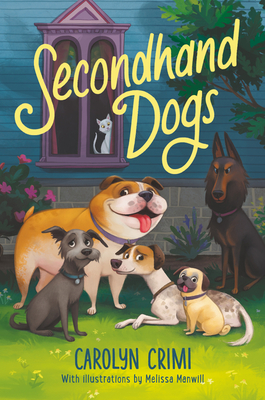
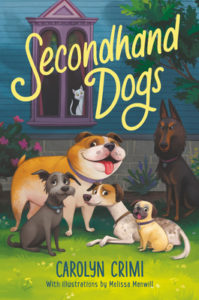
Secondhand Dogs
Author: Carolyn Crimi
Illustrator: Melissa Manwill
Published July 6th, 2021 by Balzer + Bray

Summary: Miss Lottie’s home was for second chances.

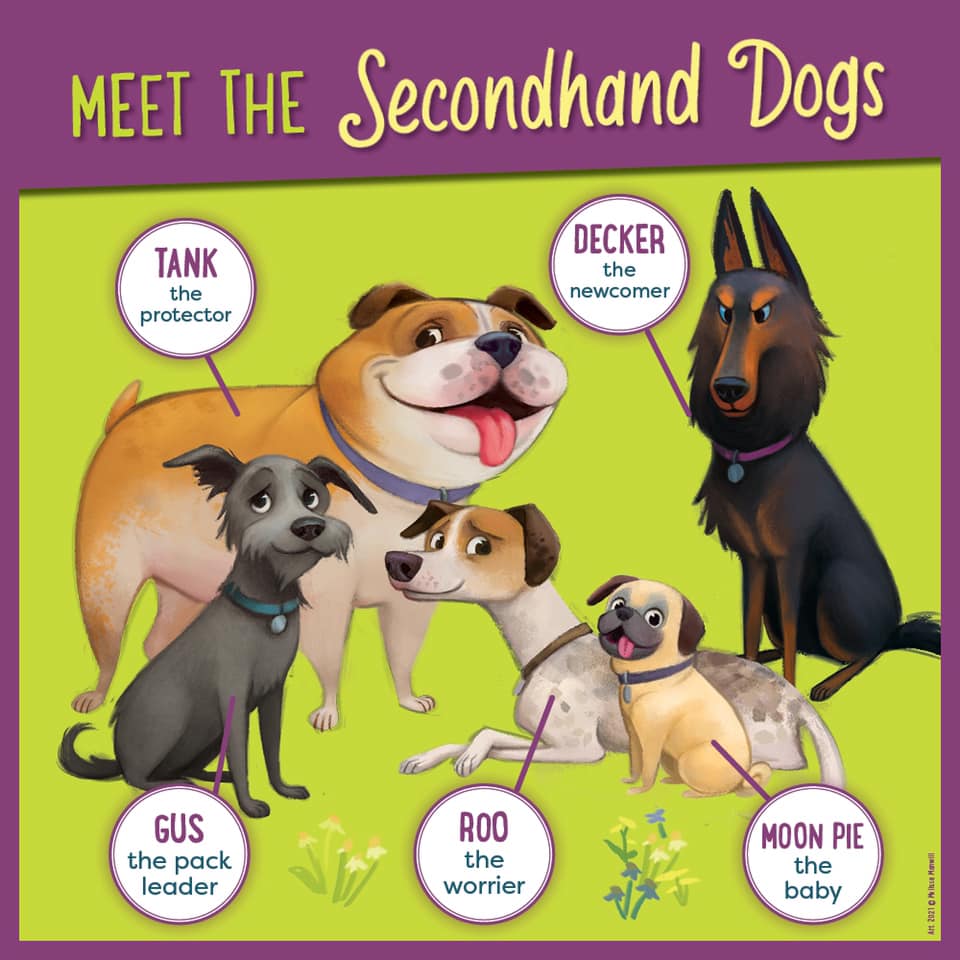
When she adopted Gus, Roo, Tank, and Moon Pie, Miss Lottie rescued each member of the pack—including herself, her helper, Quinn, and her reclusive cat, Ghost—and turned them into a family. But when a new dog, Decker, arrives and tries to hoard Miss Lottie’s heart and home for himself, the pack’s future is threatened.

At first, Gus, the insecure pack leader, only notices little things, like tiny Moon Pie being kicked out of the bed and Ghost acting spooked (then again…Ghost is a cat). But things soon go from bad to worse as Decker’s presence causes disharmony in the group.

When Decker convinces Moon Pie to embark on an impossible journey, it’s up to Gus to gather his courage, rally his splintered pack, and bring Moon Pie home. And with coyotes and cars on the loose, the pack must push through obstacles and dangers to reunite with Moon Pie before he can get hurt—or nearly as bad, get his heart broken.

A heartwarming—and heart-tugging—middle grade novel about love, loyalty, and what to means to be part of a family, featuring a motley pack of rescue dogs—from author Carolyn Crimi, with adorable illustrations by Melissa Manwill. Perfect for fans of A Dog’s Life and Because of Winn-Dixie.

Praise: “Pervading themes of bullying, leadership, loyalty, and family—among humans and canines alike—raise important issues while the comic-style illustrations feature character cameos and highlight key scenes. A sensitive, satisfying, and intriguing canine tale” –Kirkus Reviews

About the Author: Carolyn Crimi received her MFA in Writing for Children from Vermont College in 2000. She has published over 15 books, including Dear Tabby, Don’t Need Friends, Boris and Bella, Henry and the Buccaneer Bunnies, Where’s My Mummy?, and I Am the Boss of this Chair. Her book, There Might Be Lobsters, won The Golden Kite Award in 2018 for Best Picture Book Text, and her middle grade debut, Weird Little Robots, was named a BEA Book Buzz pick. Carolyn has received over thirty state awards and award nominations and was given The Prairie State Award in 2012 for her body of work. You can visit Carolyn at carolyncrimi.com.

Facebook: Carolyn Crimi
Twitter: @crims10

Review: First, I must say: kids are going to love this book. Seriously. Go pick it up for the kid(s) in your life.

I always go hesitantly into dog books because, as I am sure it is with all of you, the emotions when it comes to animal books are on high alert! And please know that your emotions are going to be going on a roller coaster of emotions in this one! 

The first emotion you are going to feel is love. As soon as you hear Gus’s voice, you know that he is a dog you can trust. Then as you meet each of the pack, they automatically go into your heart. Crimi does an amazing job telling the current narrative while also flashing back to show the dogs’ (and Miss Lottie’s, Quinn’s, and Ghost the cat’s) past. This allows you to jump into the story while also learning about how the pack gets together.

The next emotion you are going to feel is anger. Decker is a challenger to the pack. The way he manipulates and bullies, specifically Moon Pie, is devastating. It is true manipulation. You will definitely feel anger. Also, you learn more about Quinn’s life which will definitely make you feel angry.

Then comes the feelings of suspense, sadness, happiness, pride, and more! I can’t get more into the story because I don’t want to spoil! It is a good ride, I promise!

Teachers’ Tools for Instruction: First, this book is going to make an awesome read aloud!! Great topics and themes will lead to wonderful conversations.

But I think a huge asset for this book in the classroom is the different point of views that the author tackles. It is a wonderful mentor text for looking at voice. Each dog, cat, and person, although in 3rd person, had a different distinct tone and voice. It would be a great activity to have your students write a story from a certain POV then rewrite it from a different. Then they can even change 1st person to 3rd or vice versa. 

There is also a publisher-provided curriculum guide that is an awesome resource:

Discussion Questions: 

  • Why did the pack lie to Moon Pie and was it okay?
  • Why was Dexter the way he was?
  • Why did Roo originally side with Dexter?
  • Each of the dogs had a special skill: What would your special skill be?
  • What are some times during the book that shows you Quinn is special?
  • How does Quinn finally stand up to his brother?
  • What does Gus’s choice about what he did with the coyote tell you about him?
  • Why is the book titled Secondhand Dogs?
  • What is the differences between Dexter and Gus as the pack leader?
  • What does Miss Lottie’s choice about what she did with Dexter tell you about her?
  • How did the ending make you rethink Dexter’s character?
  • Who do you think was the hero of the book?

Flagged Passages: Gus: The new dog walked calmly next to Miss Lottie. His ears and his tail were both up. Alert, but not alarmed.

He wasn’t nervous. Not like the other dogs had been when they first approached the pack.

He was sizing them up, Gus decided. Gus didn’t know what to think about that. Usually new dogs pulled back a bit, or wiggled a little too much, or stood their ground and barked.

Not this dog.

Gus sniffed the air again. The scent that wafted off the new dog was bright and cold, like the metal water bowl in Miss Lottie’s kitchen.

Gus had always hated that bowl.” (Chapter 2)
Read a sample: https://preview.aer.io/Secondhand_Dogs-Mzk3MzU1?social=0&retail=0&emailcap=0

Read This If You Love: The One and Only Bob by Katherine Applegate, Good Dog by Dan Gemeinhart, Granted by John David Anderson

Recommended For: 

classroomlibrarybuttonsmall 

Signature

**Thank you to Blue Slip Media for providing a copy for review!!**

Review and Giveaway: The Caiman by María Eugenia Manrique, Illustrated by Ramón París, Translated by Amy Brill

Share

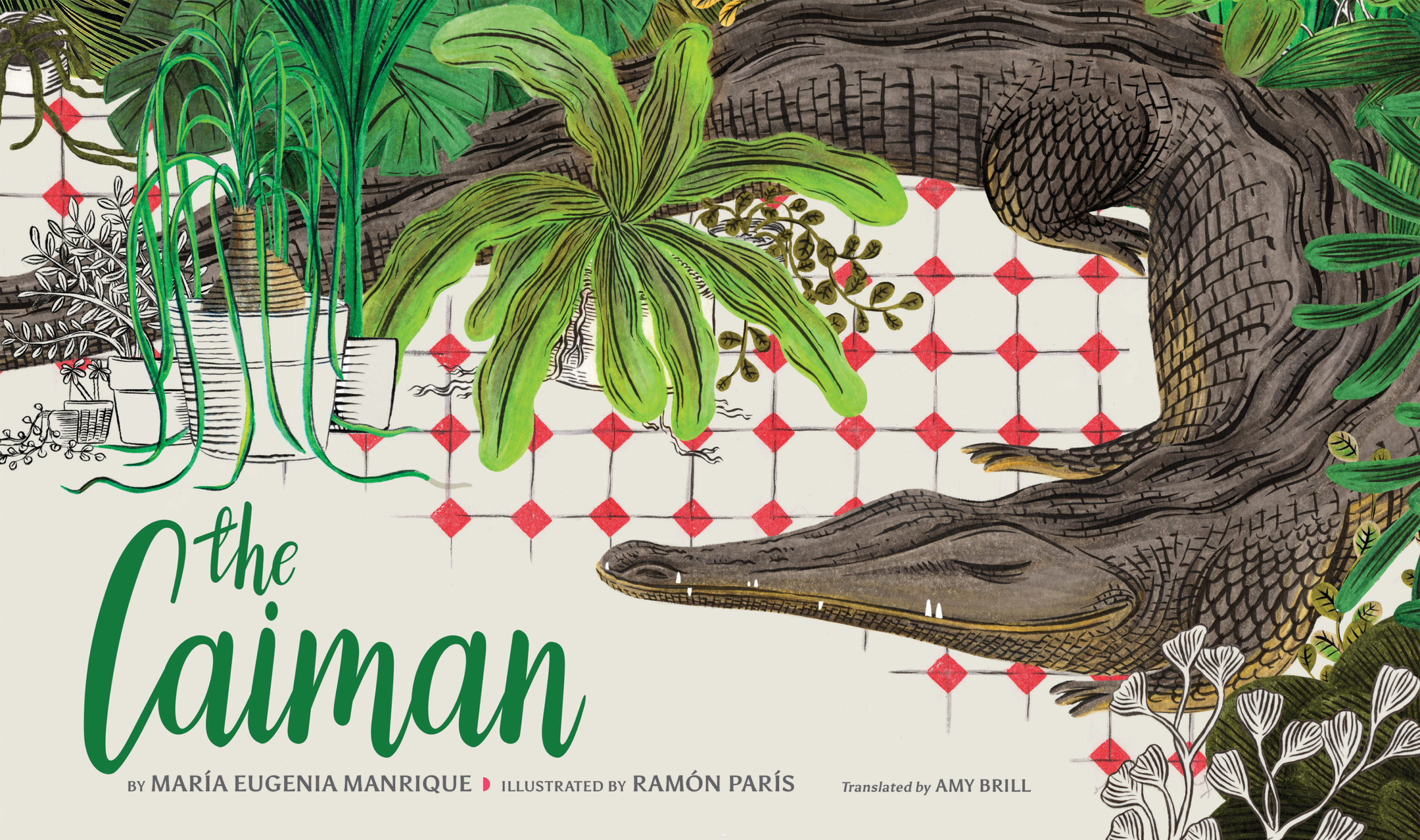
The Caiman
Author: María Eugenia Manrique
Illustrator: Ramón París
Translator: Amy Brill
Published: July 1, 2021 by Amazon Crossing Kids

Summary: The unforgettable story of a man and his alligator.

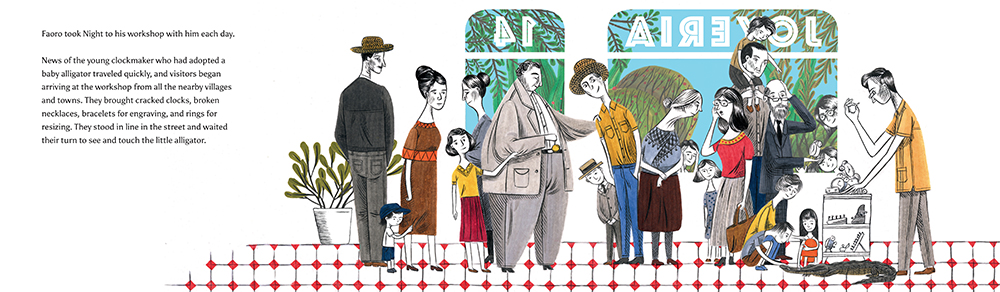
When Faoro the clockmaker adopts a baby alligator, he has no idea that someday their story will travel far and wide. But the town of San Fernando de Apure would never forget this kind young man and his adoring alligator, who played with the neighborhood children, took part in Faoro’s wedding, and, eventually, mourned his loss. Now their story is being shared with the world.

In this delightful picture book first published in Venezuela, the author brings us back to her own childhood in Venezuela, as one of the children who used to visit this famous caiman, to tell the story of a man who loved animals and how his friendship with his alligator sparked a lasting legacy.

A New York Times Globetrotting Pick!

★“The striking illustrations…have a wild and whimsical feel about them, featuring lush foliage and expressive characters, including the eventually enormous caiman. It’s a memorable and unexpected demonstration of the universality of love, grief, and kindness.” —Booklist (starred review)

María Eugenia Manrique is one of the girls portrayed in this story. She rode the caiman when she visited her family in San Fernando de Apure. She was born in Caracas, Venezuela, and currently lives in Barcelona, Spain. She studied fine art in Mexico City, specializing in xylography and engraving; Eastern painting at Nankín University, China; and sumi-e and calligraphy at the Nihon Shuji Kyoiku Zaidan Foundation in Japan. Her work has been exhibited in museums and galleries around the world. The Caiman is her first children’s book. For more information, visit her website: https://mariaeugeniamanrique.wordpress.com/.

Instagram: @mem.manrique

Ramón París was born in Caracas, Venezuela, and as a child lived in Barinas, a plains state like Apure, where he also heard the story of the caiman. He currently lives in Barcelona, Spain. Hismost recent book for children, Duermevela, was selected for the Bologna Book Fair Illustrators Exhibition. His books have been recognized with honors including Los Mejores del Banco del Libro and  the IBBY Honor List, among others, and they have been translated into numerous languages. Visit him at: ramon.paris.

Instagram: @ramon_paris_ilustrador

Amy Brill’s fiction and nonfiction have appeared in numerous publications including the Washington Post, Medium, Real Simple, Oprah.com, and One Story. Her first novel, The Movement of Stars, was published by Riverhead Books. A native New Yorker, Amy lives in Brooklyn with her husband and two daughters.

Ricki’s Review: It’s NONFICTION. I read this book and couldn’t believe that the story was true, and it made me love it even more! The author beautifully tells the story of Jose Faoro, who adopts a baby alligator when it is just days old. My children have always dreamed of adopting a large animal such as this, so it offered a wonderfully intriguing read. Although, I might add that they now think that we can take in an alligator in our house (ha!). This is the story of a great man who loved animals and loved those around him. I absolutely adored the gentle telling, and it felt like a book that would be translated because children all over the world would be captivated by this story. The illustrations stand out to me because they are timeless. They feel contemporary to my boys, but they also filled my heart with a softness because they reminded me of the classic illustrations of the stories I read and loved as a child. Ahhh, I just adore this book.

Teachers’ Tools for Navigation: This book is accessible to all levels, but I’d love to see it in elementary school classrooms, where teachers ask their students to research examples of other people who did something out of the ordinary. They could write their own picture books.

Discussion Questions: 

  • How do the words and illustrations work together to form a cohesive story?
  • Does Faoro’s story surprise you? Why or why not?
  • What does Faoro’s life tell you about him?
  • What did you learn from the story?

Flagged Passages: 

Read This If You Love: Nonfiction Picture Books; Timeless Stories; Books about Animals

Giveaway:

a Rafflecopter giveaway

Recommended For: 

classroomlibrarybuttonsmall   

**Thank you to Barbara at Blue Slip Media for Providing a Copy for Review!**

Educators’ Guide for The Rock from the Sky by Jon Klassen

Share

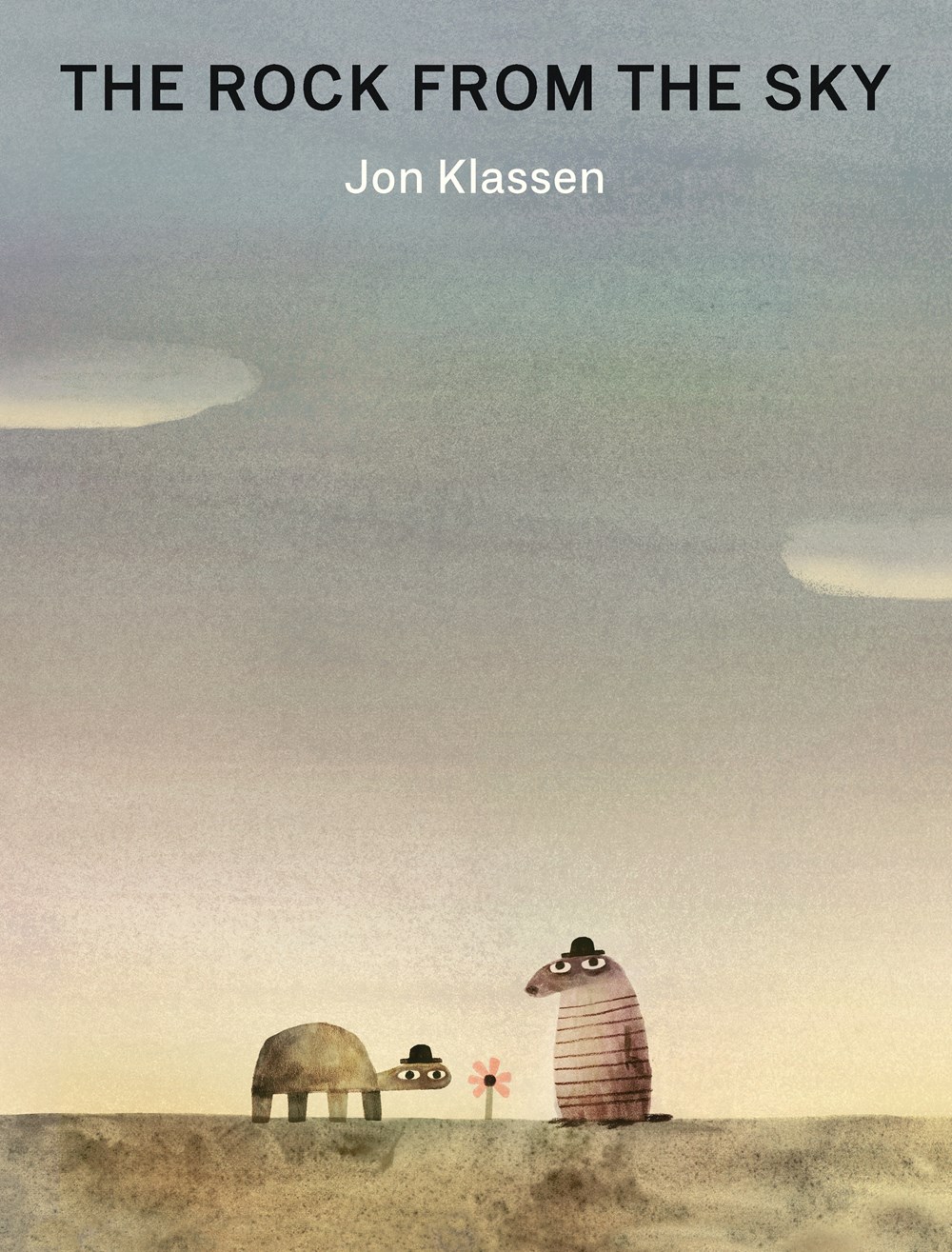
The Rock from the Sky
Author & Illustrator: Jon Klassen
Published: April 13, 2021 by Candlewick Press

Summary: Look up!

Turtle really likes standing in his favorite spot. He likes it so much that he asks his friend Armadillo to come over and stand in it, too. But now that Armadillo is standing in that spot, he has a bad feeling about it . . .

Here comes The Rock from the Sky, a meditation on the workings of friendship, fate, shared futuristic visions, and that funny feeling you get that there’s something off somewhere, but you just can’t put your finger on it.

Teachers’ Tools for Navigation and Discussion Questions: 

Please view and enjoy the teachers’ guide I created for Candlewick Press for The Rock from the Sky:

You can also access the teaching guide here.

You can learn more about The Rock in the Sky on Candlewick’s page.

Recommended For: 

readaloudbuttonsmall classroomlibrarybuttonsmall litcirclesbuttonsmall closereadinganalysisbuttonsmall

Kellee Signature

Review and Giveaway!: Chickens on the Loose by Jane Kurtz, Illustrated by John Joseph

Share

Chickens on the Loose
Author: Jane Kurtz
Illustrator: John Joseph
Published May 11, 2021 by West Margin Press

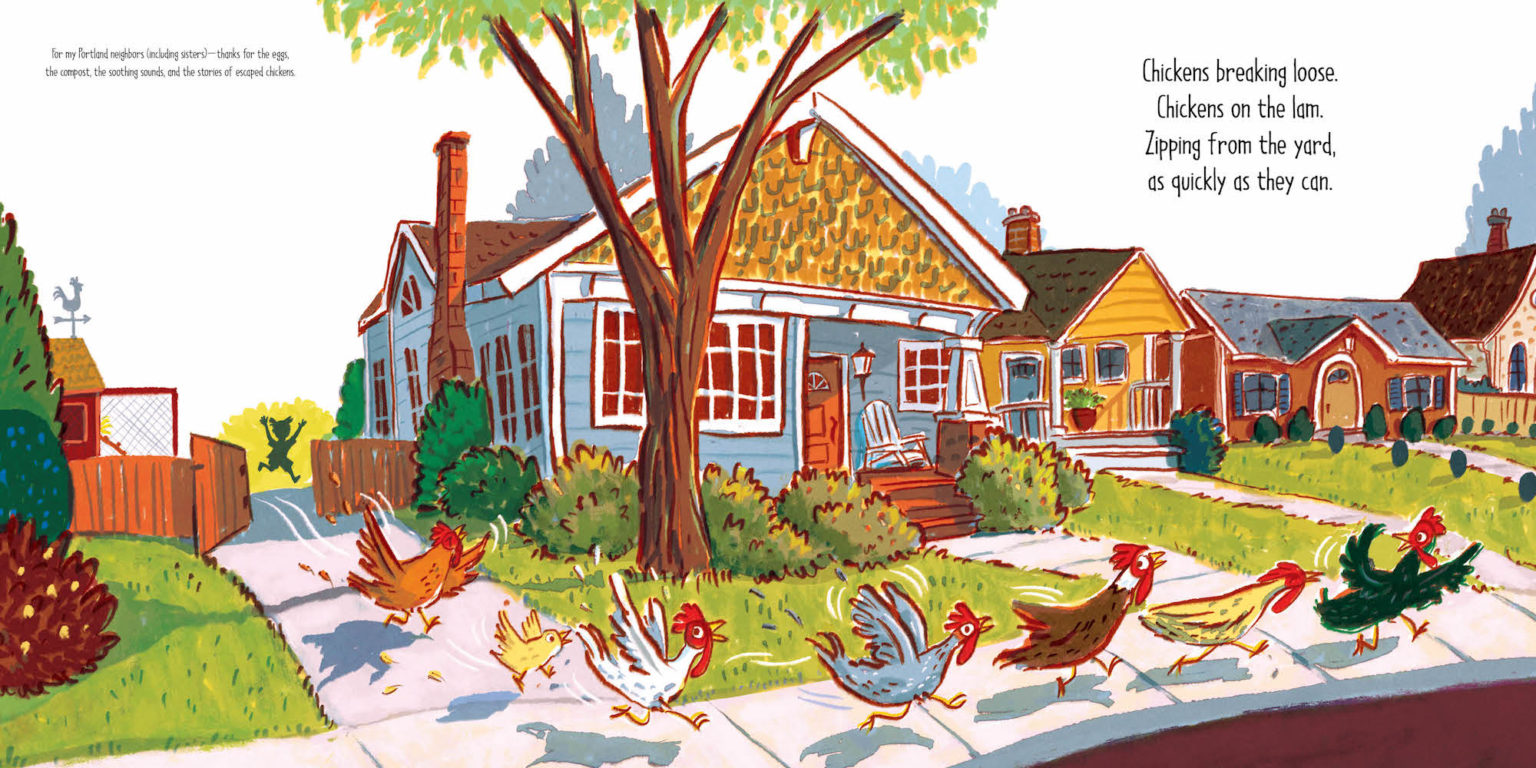
Summary: A happy-go-plucky rhyme adventure of chickens frolicking in an urban environment as they run rampant all around town!

Chickens on the loose.
Chickens on the lam.
Zipping from the yard,
As quickly as they can.

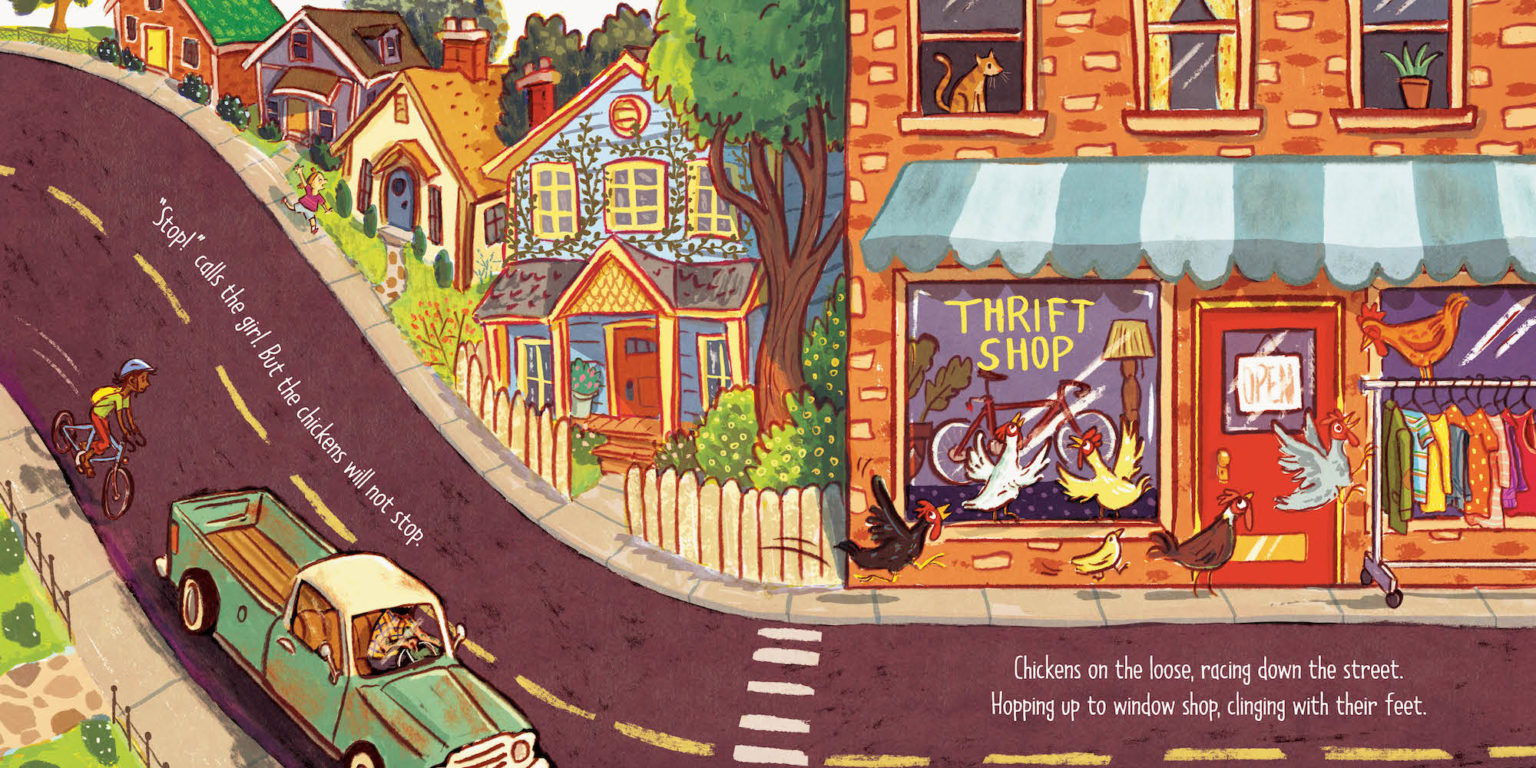
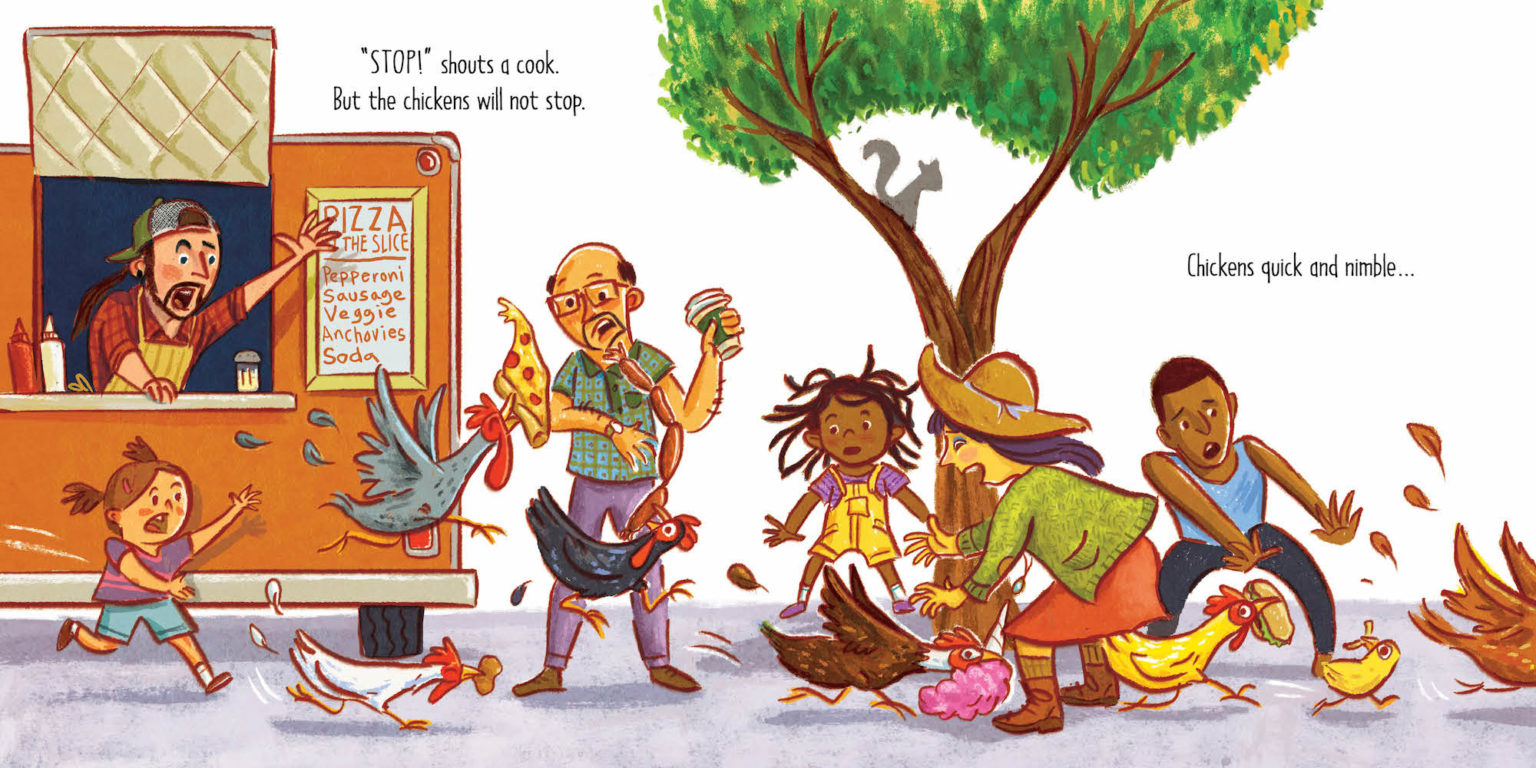
Chickens don’t just live on farms—they’re in the city too! In the store, on the street, they bring mayhem and excitement to all the surprised people. See where these mischievous chickens go in this brightly illustrated picture book told in verse. Also included at the back are fun facts and tips for the urban chicken farmer.

About the Creators: 

Jane Kurtz is an award-winning children’s book author, speaker, educator, and she is on the faculty of the Vermont College of Fine Arts MFA in Children’s and YA Literature. She is a co-founder of the nonprofit Ethiopia Reads, an organization that brings books and literacy to the children in Ethiopia, where Jane grew up. She also heads the creative team of Ready Set Go Books, a project of Open Hearts Big Dreams to create fun, colorful, local language books for people in Ethiopia. She is the author of many books for children, including River Friendly River Wild, winner of the SCBWI Golden Kite award for picture book text, and What Do They Do With All That Poo?, a finalist to the AAAS/Subaru SB&F Excellence in Science Books list; it has also been named to several state reading lists, voted on by children.

Author website

Instagram: @writerjanie

Twitter: @janekurtz

John Joseph is an artist, illustrator, elementary school teacher, avid gardener, and community leader. He earned a degree in visual arts from Colorado State University and a Masters from Lesley University, and has won the ACP Excellence in Publishing Award for Best Picture Book. He lives in Colorado with his wife, two sons, and a German shepherd.

Artist website

Meet Jane Kurtz and learn more about Chickens on the Loose

Praise: 

“Urban backyard chickens go on a madcap tour of the city in this rhyming romp. . . the narrative bounces off the tongue. The marker-bright illustrations are frenetic and filled with humorous details.” ~ Kirkus Reviews

“In jaunty pitch-perfect rhyme and splendiferous, chaotic color, Jane Kurtz and John Joseph combine forces to tell the story of recalcitrant urban chickens who burst forth from forced chicken coopery to explore a lively, diverse neighborhood rich with thrift shops, yoga studios, food carts, pet shops, and street art–all free for the pecking. At the end of an energetic day, the chickens-on-the-loose return to their henhouse, bedraggled but with plans for a rerun! Prepare for a rambunctious reading experience.” ~ Toni Buzzeo, Author of 28 picture books for children, including the 2013 Caldecott Honor Book, ONE COOL FRIEND

Review and Teachers’ Tools for Navigation: I love urban chickens! We have a town nearby (Oviedo) which has chickens that roam in their downtown, Jim has a cousin with chickens, and I have a past student with chickens. I love the idea of mixing farm animals and cities because it adds a bit of whimsy and quietness to the bustle and hustle.

Though in Chickens on the Loose the chickens definitely add whimsy but are not quiet–instead they add a bit of chaos. 😂

Reading this out loud was so much fun! The rhyming and rhythm added a musical element to reading the book. And within the rhymes there are great vocabulary moments, too! For example, some words Trent and I got to talk about were lam, peckish, and plucky.

Also while reading, Trent definitely saw that the book alludes to the gingerbread man story. It was fun listening to him share how the book is similar and different to The Gingerbread Man. There’s also a chicken Mona Lisa at the end that cracked him up! Great way to introduce allusion!

Additionally, the backmatter of the book gives information about keeping urban chickens and some fun chicken facts. It is a great way to connect the story to science.

The publisher also has an activity kit available for the book:

Discussion Questions: 

  • What would you name the painting the chick painted at the end?
  • Where do you think chickens would run to in your town?
  • Write your own rhyme that starts with “Chickens on the loose,…”
  • What new words did you see in the book?

Flagged Passages: 

Book Trailer: 

Read This If You Love: The Gingerbread Man by various; Other chicken picture books like Chicken Butt by Erica S. Perl, Chicken Dance by Tammi Sauer, Little Chicken’s Big Day by Jerry Davis, Blue Chicken by Deborah Freedman, Chicken Story Time by Sandy Asher, Pirate Chicken by Brian Yanish, Interrupting Chicken by David Ezra Stein, Chicken Little by Sam Wedelich; Follow that Frog! by Philip C. Stead; Nibbles series by Emma Yarlett

Recommended For: 

classroomlibrarybuttonsmall 

GIVEAWAY!

a Rafflecopter giveaway

Signature

**Thank you to Barbara at Blue Slip Media for providing copies for review and giveaway!**

Review and Giveaway!: Hudson and Tallulah Take Sides by Anna Kang, Illustrated by Christopher Weyant

Share

Hudson and Tallulah Take Sides
Author: Anna Kang; Illustrator: Christopher Weyant
Published: May 1, 2021 by Two Lions

Goodreads Summary: A tale about a cat and a dog who discover that even though they don’t look at things the same way, they can still be friends.

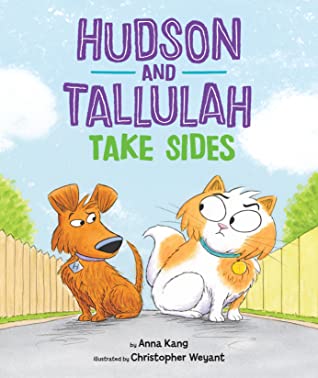
Hudson and Tallulah may be neighbors, but the fence between their yards isn’t the only thing that divides them. They can’t see eye to eye on anything. One day they venture out, and after nonstop disagreement, they realize something surprising: they don’t always have to agree to be on each other’s side.

About the Author and Illustrator: Anna Kang and Christopher Weyant are the creators of Theodor Seuss Geisel Award winner You Are (Not) Small as well as series titles That’s (Not) Mine, I Am (Not) Scared, and We Are (Not) Friends. They also wrote and illustrated Eraser, Can I Tell You a Secret?, and Will You Help Me Fall Asleep? Christopher’s work can also be seen in The New Yorker, and his cartoons are syndicated worldwide. This husband-and-wife team lives in New Jersey with their two daughters and their rescue dog, Hudson, the inspiration behind the character in this book. Visit them at www.annakang.com and www.christopherweyant.com.

Twitter: @annakang27 @ChristophWeyant

Instagram: annakangbookschristopherweyant 

Facebook: Anna Kang – AuthorChristopher Weyant

★“New Yorker cartoonist Weyant’s illustrations, which use gouache, graphite, and lots of white space, carry the day, filling the dog’s and cat’s reactions to what they encounter with plenty of comic details (like the bold lettering conveying the dog-park dogs’ frantic barking at the cat). Madcap fun.” —Booklist (starred review)

“Charming cartoons convey the nearly wordless story augmented with dialogue between the two rivals…An amusing exploration of how opposite personalities can learn to appreciate their unique relationship.” —Kirkus Reviews

“Aptly captured by married team Kang and Weyant (You Are (Not) Small), the unlikely friends’ comic path to camaraderie unfolds nearly wordlessly, with expressive gouache and graphite scenes that burst with physical humor, showing that even those who fight like cats and dogs can be friends.” —Publishers Weekly

Review: I was really excited to received this book because I love Kang and Weyant’s work. But there was a 4-year-old thief in my house. He stole the book from right under me and loved it so much that he hid it in his room. I still had a week until the review, so I was casually looking for it from time to time. One night, I heard uproarious giggles. Curious what was making my son laugh so hard, I peeked in his room. There it was! Hudson and Tallulah Take Sides!

Me: Buddy, I need to review that book!

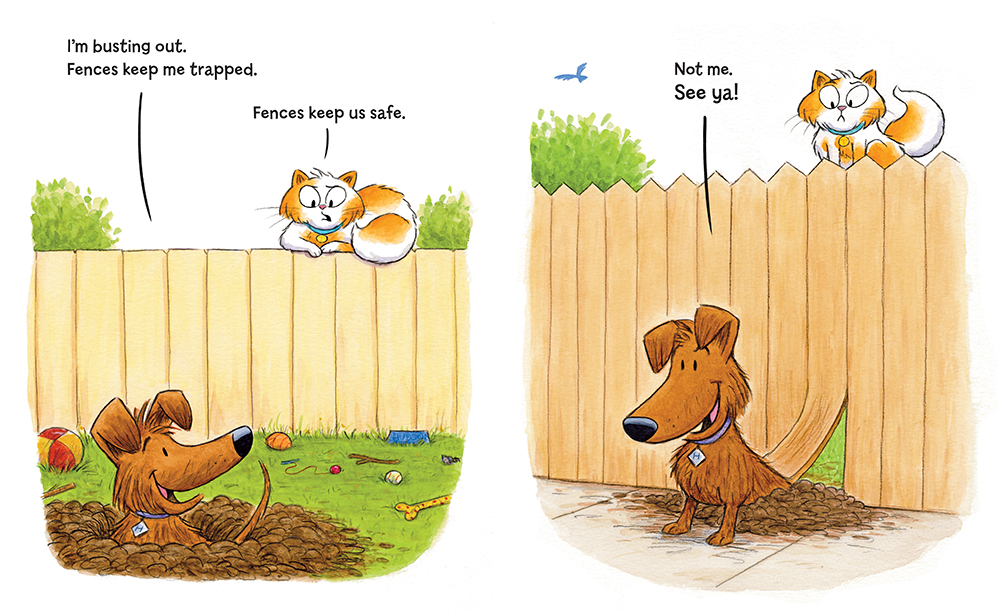
4yo: But I love it so much. Look! The dog slides under the fence and says “SEE YA!” [Lots of giggling.]

Me: Okay, well can you leave it outside your door tonight when you are done with it?

4yo: Only if you put it back in my room after YOU are done.

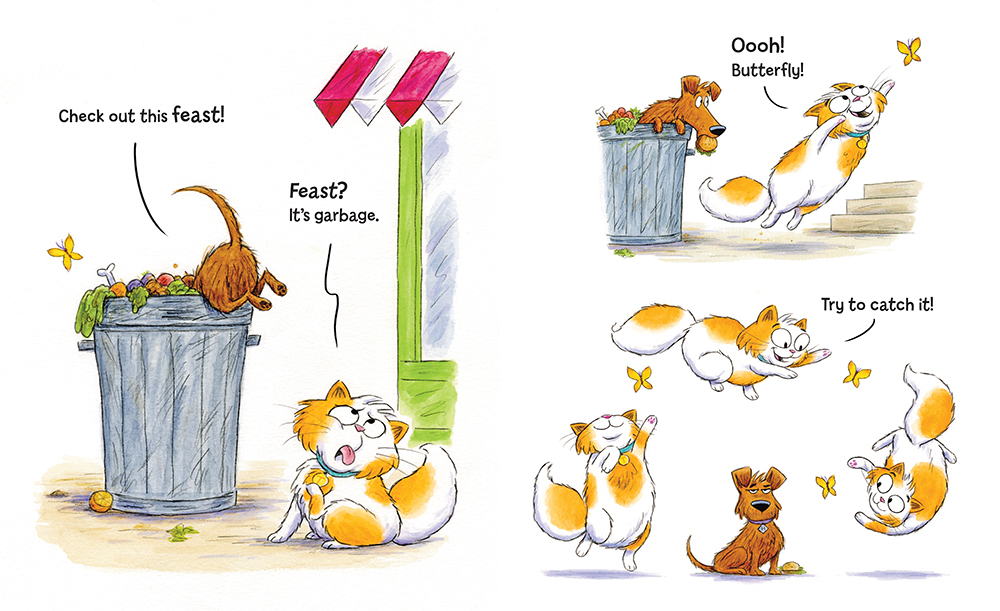
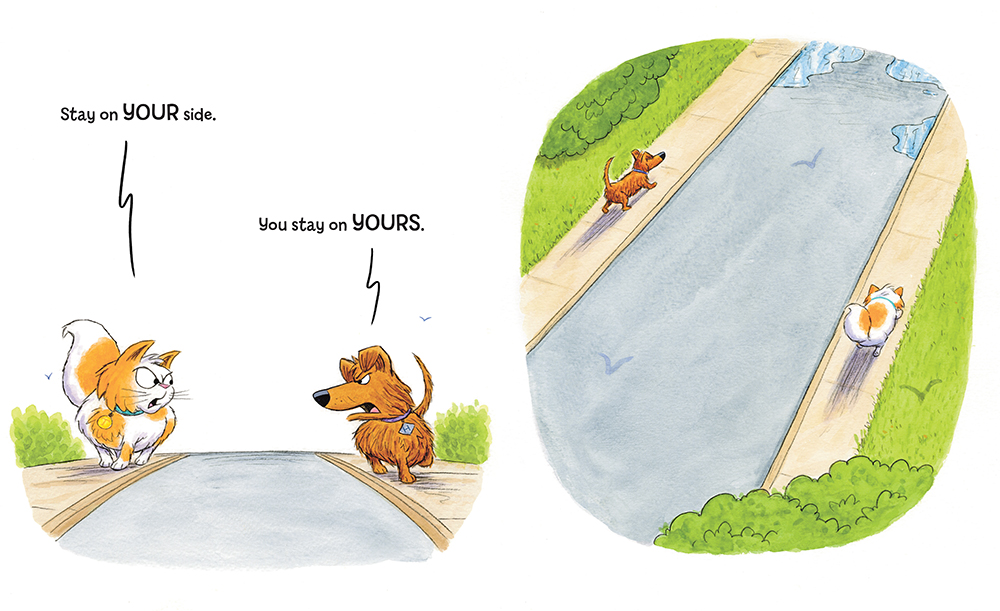
Needless to say, this book is very well loved in my house. I will admit that I can’t read it from start to finish without giggling myself. The facial expressions of Hudson and Tallulah are so funny. The words are spread across the page in a way that they invite my 4yo to read them. Kang and Weyant are masterful in their ability to capture character, and their characters are so accessible to early readers. This book is simply fantastic, and I recommend it highly.

Teachers’ Tools for Navigation:  This belongs in every Pre-K, K, and 1st grade classroom (at a minimum!). Readers of all ages will love it, but specifically, it is a book that encourages kids to read. The personification of the animals is magnificent, and it would offer a good case study on figurative language and humor.

Discussion Questions: 

  • How are Hudson and Tallulah different? How are they similar?
  • How do the author and illustrator each use personification to enhance the story?
  • Why do you take sides? When might it be valuable to avoid taking sides?
  • What makes a good friend? Are Hudson and Tallulah good friends? Are you a good friend?

Flagged Passages: 

Read This If You Loved: You Are (Not) Small by Anna Kang and Christopher Weyant; That’s (Not) Mine by Anna Kang and Christopher Weyant; It’s (Not) Perfect by Anna Kang and Christopher Weyant; We Are (Not) Friends by Anna Kang and Christopher Weyant; Dog vs. Cat by Chris Gall

Recommended For: 

readaloudbuttonsmall classroomlibrarybuttonsmall

Book Giveaway!

a Rafflecopter giveaway

RickiSig

**Thank you to Barbara at Blue Slip Media for providing a copy for review!**

Review and Giveaway!: Rescue at Lake Wild by Terry Lynn Johnson

Share

Rescue at Lake Wild
Author: Terry Lynn Johnson
Published April 27, 2021 by HMH Books for Young Readers

Summary: In this funny and moving animals-in-peril adventure, a twelve-year-old girl and her two best friends determine to rescue two orphaned beaver kits—and soon find themselves trying to solve a local environmental crisis.

Everyone knows that twelve-year-old Madison “Madi” Lewis is not allowed to bring home any more animals. After she’s saved hairless mice, two birds, a rabbit, and a stray tom cat that ended up destroying the front porch, Madi’s parents decide that if they find one more stray animal in the house, she won’t be allowed to meet Jane Goodall at an upcoming gala event.

But when Madi and her two best friends, Aaron and Jack, rescue beaver kits whose mother was killed, they find themselves at the center of a local conspiracy that’s putting the beavers and their habitats in danger. As Madi and her friends race to uncover the threat targeting the beavers, Madi must put her animal whisperer skills to the test in both raising the orphaned beaver kits and staying out of trouble long enough.

About the Author: Terry Lynn Johnson writes about the wild with the wisdom and passion of someone who has spent her life working to preserve and protect it – both as a backcountry canoe ranger in Quetico Provincial Park and in her current job as a conservation officer with the Ontario Ministry of Natural Resources and Forestry. She lives at the edge of a lake in northern Ontario, Canada, where she loves watching all wildlife, including beavers. Visit her online at terrylynnjohnson.com

Twitter: @TerryLynnJ
Instagram: terry_lynn_johnson

Review: This book is everything the summary promises and more. I read it in one sitting because I couldn’t put it down. It was so interesting learning about beavers and conservation, but also watching Madi and her friends figure out the solution to a problem that adults automatically went to the extreme about.

Kids are going to love Madi and her friends. Their banter is so funny yet right on point for their age. I also love seeing how close they are even as they grow up and change.

In addition to the main story about the beaver rescue, Madi’s family situation will bring about good conversation about different types of families.

But truly, the real stars of this book are the beavers. I never knew as much about them as I do now, and they are such interesting animals. This book definitely led to inquiry as I wanted to learn so much more about environmental conservation and beavers.

Teachers’ Tools for Navigation: In addition to being a book that so many kids are going to want to pick up and read, this book lends itself perfectly to so much in the classroom!

Madi talks often in the book about her grandmother and Jane Goodall and all of the work they did to help preserve animals; however, there are tons of other scientists who help converse nature and animals’ habitats. Have students research these scientists, and remind them to think about local and smaller rescue facilities who do work that often aren’t recognized.

Madi LOVES animals and we learn so much about beavers in this book. Use the idea of Madi’s notebook to have students pick an animal and research it.

Madi solves a problem by going step by step through the problem solving process. Look at the six-step problem solving process and work through how Madi made her way through to help her town and the beavers.

Finally, learn about Terry Lynn Johnson’s inspiration for Rescue at Lake Wild here. This would lend to a great discussion about author’s purpose and point of view.

Discussion Questions: 

  • Why do the adults of the town automatically start killing beavers?
  • How does Madi figure out a solution to the problem?
  • How did the setting play a part in the story?
  • Which character did you most relate to and why?
  • Who do you look up to like Madi looks up to Jane Goodall?
  • What is your passion and how can you pursue it in your life?
  • How did having her two friends to help her lend to Madi being successful?
  • How did Madi’s grandmother inspire her? Who has inspired you in your life?
  • Madi’s mother said no more animals, which Madi obviously disagreed with, and although it seems harsh, she has her reasons. What do you feel about this? Can someone be right and wrong at the same time?

Flagged Passages: Chapter 1

I hear it again.

Urgent chattering reaches us from the mound of sticks and mud just off the bow of our boat.

“We’re going to have to do it,” I say, and then can’t help add, “I told you they were here.”

As an animal whisperer, I know these things, but sometimes I have to remind certain people.

A breeze catches the boat and swings us around the anchor line. The channel’s empty except for the beaver lodge, the three of us, and one bored dog.

“We’re sure the parents aren’t coming back, Madi?” Aaron asks.

“You saw their parents,” I say. “They’re not coming.” We’ve been here almost two hours to make sure there were no other adults in the lodge.

Finally Jack says, “Let’s do it already.”

“Before you say I should do it because I’m smallest,” Aaron says, “let me remind you I’ve been the rescuer the last two times.”

He’s talking about when we boosted him into a tree to save a raccoon that turned out not to need saving. Okay, I was wrong that one time. But the day we lowered him from the window by his feet to save the baby bird? That bird would have died without us.

“Out of the three of us, you’re the easiest to hang by the feet,” I say reasonably.

“It’s not my turn.” Aaron shifts on the aluminum seat. “And I’m not that small.”

“We’ve never done this before,” Jack says. “So it starts over.”

“What starts over?”

“Turns,” Jack says.

Adjusting the tiller handle, I move to sit next to Aaron in the middle of the boat. “We should play for it.” I hold up a fist, the universal sign for rock-paper-scissors. “So it’s fair.”

The three of us stick our fists together. Jack’s black Lab, Lid, pokes his nose into the circle too, ever hopeful that we’re about to unveil food.

“One, two, three!

“No!” Aaron yells at our scissors to his paper. “Rigged!”

“I’d take your shirt off if I were you,” Jack advises. “So it doesn’t get stuck and snag you down there. We probably wouldn’t be able to pull you up.”

Aaron pales but tries to look brave. “I always end up doing it,” he grumbles, reaching behind his back to pull off his T-shirt. The hot July sun bounces off his blinding white torso.

Aaron scowls at us and then glances over the side of the boat. He studies the brown water and mutters something about leeches.

“Maybe you should keep your shirt on for protection,” I suggest, eyeing his stick-thin arms covered in rust-brown freckles, and his pale shoulder blades that could cut a breakfast sausage.

“Are they even still alive?” Aaron says. “I can’t hear them anymore.”

He’s right. There’d been no sounds from the lodge in the last few minutes we’ve been sitting here arguing.

Earlier, we’d found two adult beavers floating dead on the other side of the channel. Jack, as usual, had wanted to investigate the crime scene immediately. But the noises from the lodge mean babies inside. Those babies will starve to death if we don’t rescue them.

We’ve been waiting here long enough to know there are no other adult beavers coming to take care of them. But how long have the young ones been alone in there? Maybe they’re starved already.

“Shhh!” I say. “Listen.”

We still our movements in the boat and drift. An enthusiastic frog trills next to us. The wind rustles the leaves of trembling aspen towering above. The water gently laps at the aluminum beneath us. We strain to hear anything. The silence stretches.

A long, high-pitched noise erupts from Lid’s rear end. It echoes strangely from the bottom of the boat, sounding like an optimistic elephant. Surprised, Lid looks behind him.

Aaron and Jack both burst out laughing. It’s so hard to keep boys focused.

“Guys, I don’t hear them. Maybe we waited too long.” Maybe the little beavers are just too weak now to make noise and desperately need help right this very second. I grab the anchor and haul it up. “We have to hurry!”

I yank at the oars and thrust the boat up onto the muddy bank of the lodge. Lid jumps out first, followed by Jack, who ties us off on a log. Aaron warms up, swinging his arms, further accentuating his shoulder blades.

Stepping onto the latticed sticks, I peer at a section of the lodge’s roof that’s been ripped apart, most likely by wolves. But the predators haven’t gotten through. The only way into an indestructible beaver lodge is underwater.

“Okay. You’re looking for the opening to the tunnel,” I say to Aaron. “It’ll be hidden among all the sticks. Hopefully it’ll be wide enough for you to fit. You can breathe once you get into the chamber. It’ll be a room above water like a den. That’s where you’ll find the baby beavers.”

Aaron nods while staring at the lodge. He examines the murky water.

I watch him uneasily and think about when we’d boosted him into that tree. He’d spent most of the time clutching the trunk and yelling for us to bring him down. And when we’d lowered him for the bird he insisted over and over, “Pull me up!”

This is actually dangerous. If Aaron panics, he could drown for real. He could get lost under there, or get caught on something, like Jack said.

A fluttery feeling builds inside my chest. Did Jane Goodall let someone else face aggressive chimps at the Tanzania research center? No.

It should be me.

Read This If You Love: Lost in the River of Grass and Hurt Go Happy by Ginny Rorby; Song for a Whale by Lynne Kelly;  Vet Volunteers by Laurie Halse Anderson; Primates: The Fearless Science of Jane Goodall, Dian Fossey, and Biruté Galdikas by Jim Ottaviani

Recommended For: 

classroomlibrarybuttonsmall

Giveaway!

a Rafflecopter giveaway

Signature

**Thank you to Barbara at Blue Slip Media for providing a copy for review and giveaway!**

Aven Green, Sleuthing Machine by Dusti Bowling, Illustrated by Gina Perry

Share

Aven Green, Sleuthing Machine
Author: Dusti Bowling
Illustrator: Gina Perry
Published April 13th, 2021 by Sterling Children’s Books

Summary: Third-grader Aven Green has been solving mysteries for a whole month—cracking such cases as The Mystery of the Cranky Mom. But can this perceptive detective solve two cases at the same time? First her teacher’s lunch bag disappears. Then Aven’s great-grandma’s dog goes missing. Fortunately, since Aven was born without arms, all the “arm” cells went to her super-powered brain instead. (That’s her theory.) This hilarious chapter book showcases a new side to Dusti Bowling’s unforgettable protagonist.

About the Creators:

DUSTI BOWLING is the award-winning, bestselling author of Insignificant Events in the Life of a CactusMomentous Events in the Life of a Cactus24 Hours in NowhereThe Canyon’s Edge, and the forthcoming Across the Desert and Aven Green chapter book series. Dusti currently lives in New River, Arizona with her husband, three daughters, a dozen tarantulas, a gopher snake named Burrito, a king snake name Death Noodle, and a cockatiel named Gandalf the Grey.

Gina Perry graduated from Syracuse University, worked as a compositor in animation, then an art director for a stationery manufacturer, before discovering her true passion—writing and illustrating children’s books. She lives with her family in NH.

Praise:

“[Bowling] infuses her writing with humor and empathy.” —School Library Journal (starred) 

“A fun series opener with a feisty protagonist who’ll keep readers on their toes.” —Kirkus Reviews

“Unapologetically smart and refreshingly confident in her abilities, this super-sleuth extraordinaire is a joy to tag along with.” —Booklist

“Aven’s candid voice ensures that this chapter book series starter will draw a young audience.” —Publishers Weekly

Review: I am so happy that Aven is now starring in chapter books. Her voice is one of my favorites in middle grade literature because it is full of truth and humor. Her voice is just as strong in this chapter book as it was in Insignificant Events in the Life of a Cactus and Momentous Events in the Life of a Cactus, just a bit younger.

In addition to Aven’s voice, the story is a compelling one! I’m a fan of mysteries, and this is a fun kid lit mystery. Also, the cast of characters are wonderful! I am a huge fan of Aven’s friends.

And I cannot wait until August when Aven Green, Baking Machine comes out!

Teachers’ Tools for Navigation: I would love to see Aven Green read in classrooms! It would be such a fun book to read together as a class! The class could even keep track of all of the clues and see if they can figure out the mystery!

There are also opportunities in the book to talk about acronyms and word play!

Discussion Questions: 

  • How did Aven keep track of her clues?
  • What type of materials does Aven need to be a good detective?
  • How did Aven help Sujata with acclimating with the new school?
  • What are your slumber party traditions?
  • What is a time you have heard a word incorrectly like Emily heard hen droids?
  • Have you ever lost something? How did you work to find it?
  • If you were going to do a report on a country

Flagged Passages: 

Read This If You Love: The Magnificent Makers series by Theanne Griffith; King and Kayla series by Dori Hillestad Butler; The Misadventures of Toni Macaroni in The Mad Scientists by Cetonia Weston-Roy; The Misadventures of Salem Hyde series by Frank Cammuso; Meena series by Karla Manternach; Questioneers series by Andrea Beaty; Weird Little Robots by Carolyn Crimi; A Boy Called Bat series by Elana K. Arnold

Recommended For: 

classroomlibrarybuttonsmall

Signature

**Thank you to Sterling for providing a copy for review!**