Mr. Watson’s Chickens by Jarrett Dapier, Illustrated by Andrea Tsurumi

Share

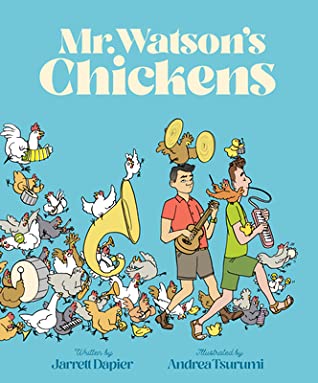
Mr. Watson’s Chickens
Author: Jarrett Dapier
Illustrator: Andrea Tsurumi
Published: October 5, 2021 by Chronicle Books

GoodReads Summary: Interrupting Chicken meets Click, Clack, Moo in this zany classic-in-the-making!

With rollicking rhythms, nonsensical refrains, and too many chickens to count, this modern classic will inspire unstoppable giggles and endless rereads. Bawka-bawka!

Mr. Watson has 456 chickens in the sink, on the bed, in the bread box. When his partner, Mr. Nelson, threatens to leave, Mr. Watson takes his chickens to town to sell only for them to escape! Young readers will follow Mr. Watson all around town as he gathers up his chickens. But, when they’re all rounded up, does he have the heart to sell them? Does a different fate await these chickens?

This quirky, irresistible book is full of read-aloud fun with its onomatopoeia, rollicking rhythm, and familiar refrains and ends with a touch of sweetness. It has all the makings of a classic, with a farm theme, hilarious refrains, and a familiar narrative structure that unfolds in threes. Librarians, teachers, and parents looking for a new book that feels traditional will love sharing this book with children.

A JOY TO REREAD: This is a very classic-feeling storybook. Paired with its funny farm setting and hilarious refrains, this book is sure to inspire countless rereads and endless giggles.

PERFECT READ-ALOUD: This book is full of nonsensical sounds and repetition that make it fun to read out loud and invite audience participation. It’s a perfect choice for classroom events and laptime reads.

LIKE CHICKA CHICKA BOOM BOOM, WITH CHICKENS!: With its bouncy refrains and rollicking rhythms, this book will remind readers of classic bestsellers like Don’t Let the Pigeon Drive the Bus! and Chicka Chicka Boom Boom.

REALISTIC RELATIONSHIP UNUSUAL IN PICTURE BOOKS: This book features a gay couple at its center, but doesn’t call specific attention to it. It simply portrays a healthy relationship between two men (and their chickens!).

WRITTEN BY A NEW TALENT WHO REALLY UNDERSTANDS KIDS: This is Jarret Dapier’s first book! He’s a popular, award-winning teen librarian who works with kids, knows what they like, and is well-versed in the rhythms of the classic children’s book—and he has many more stories up his sleeves.

DELIGHTFUL, DETAILED DRAWINGS OF OVER 400 CHICKENS!: With hundreds of chickens to find and scenes crammed with action and detail, the pages of this book are chock-full of things to look at. Young readers will spend hours poring over each spread.

Perfect for: parents, families looking for LGBTQIA+ stories, fans of funny books.

Ricki’s Review: This book is hysterical. The chickens cracked me up. Teachers will love reading this book aloud. Mr. Watson’s partner Mr. Nelson is threatening to leave because they have TOO MANY CHICKENS (456, actually). So they take their chickens into town to give them away to chicken homes, but all does not go as planned. There is so much care and thought in this book–from the writing to the illustrations of all of the chickens. Kids will love it.

Teachers’ Tools for Navigation: This book takes a twist on typical counting books and adds a delightful story. Kids might consider the numbers used in this book and how this may be intentional and create their own counting books.

Discussion Questions: 

  • What are some of the reasons that Mr. Nelson got frustrated with the chickens? Do you think he had a valid reason to be frustrated? How does Mr. Watson respond?
  • Where was Aunt Agnes? How does this enhance your reading of the story?
  • How does the story end? What do you think a sequel might look like?

Read This If You Love: Funny stories; counting stories; animal stories

Recommended For:

classroomlibrarybuttonsmall 

RickiSig

**Thank you to Eva at Chronicle for providing copies for review!**

Teachers’ Guide for The Beatryce Prophecy by Kate DiCamillo, Illustrated by Sophie Blackall

Share

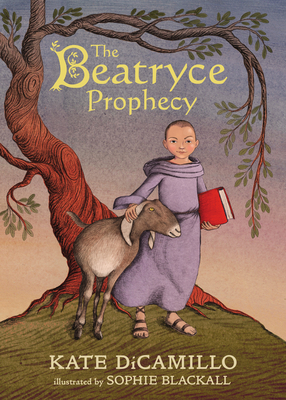
The Beatryce Prophecy
Author: Kate DiCamillo
Illustrator: Sophie Blackall
Publishing September 28th, 2021 by Candlewick Press

Summary: From two-time Newbery Medalist Kate DiCamillo and two-time Caldecott Medalist Sophie Blackall comes a fantastical meditation on fate, love, and the power of words to spell the world.

We shall all, in the end, be led to where we belong. We shall all, in the end, find our way home.

In a time of war, a mysterious child appears at the monastery of the Order of the Chronicles of Sorrowing. Gentle Brother Edik finds the girl, Beatryce, curled in a stall, wracked with fever, coated in dirt and blood, and holding fast to the ear of Answelica the goat. As the monk nurses Beatryce to health, he uncovers her dangerous secret, one that imperils them all–for the king of the land seeks just such a girl, and Brother Edik, who penned the prophecy himself, knows why.

And so it is that a girl with a head full of stories–powerful tales-within-the-tale of queens and kings, mermaids and wolves–ventures into a dark wood in search of the castle of one who wishes her dead. But Beatryce knows that, should she lose her way, those who love her–a wild-eyed monk, a man who had once been king, a boy with a terrible sword, and a goat with a head as hard as stone–will never give up searching for her, and to know this is to know everything. With its timeless themes, unforgettable cast, and magical medieval setting, Kate DiCamillo’s lyrical tale, paired with resonant black-and-white illustrations by Caldecott Medalist Sophie Blackall, is a true collaboration between masters.

Teachers’ Tools for Navigation and Discussion Questions: 

Please view and enjoy the teachers’ guide I created for Candlewick Press for The Beatryce Prophecy:

You can also access the teaching guide here.

You can learn more about The Beatryce Prophecy on Candlewick’s page.

Recommended For: 

readaloudbuttonsmall classroomlibrarybuttonsmall litcirclesbuttonsmall closereadinganalysisbuttonsmall

Kellee Signature

It Fell From the Sky by the Fan Brothers

Share

It Fell From the Sky
By the Fan Brothers
Published: September 28, 2021 by Simon & Schuster

Summary: From the creators of the critically acclaimed The Night Gardener and Ocean Meets Sky comes a whimsical and elegantly illustrated picture book about community, art, the importance of giving back—and the wonder that fell from the sky.

It fell from the sky on a Thursday.

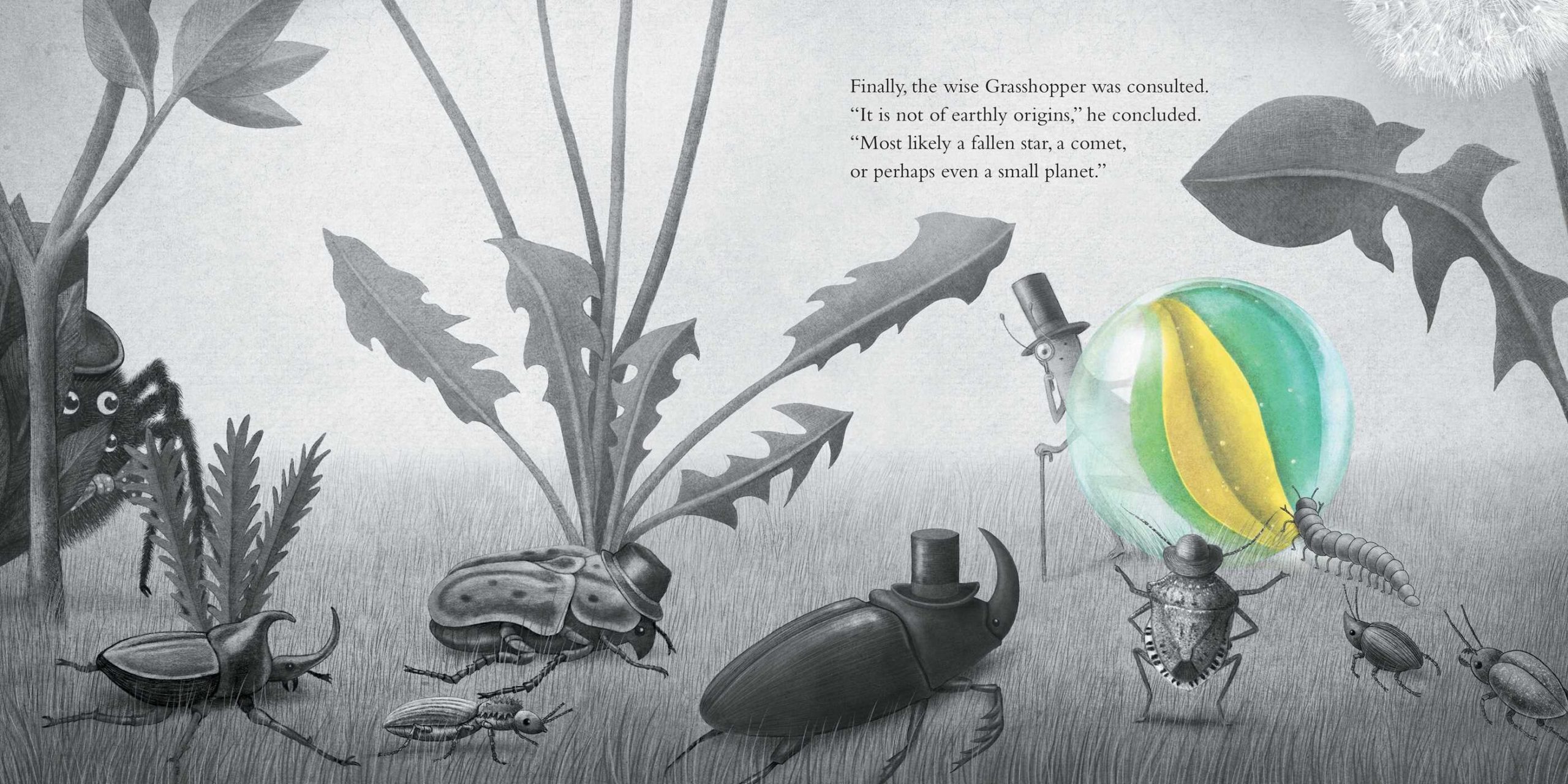
None of the insects know where it came from, or what it is. Some say it’s an egg. Others, a gumdrop. But whatever it is, it fell near Spider’s house, so he’s convinced it belongs to him.

Spider builds a wonderous display so that insects from far and wide can come look at the marvel. Spider has their best interests at heart. So what if he has to charge a small fee? So what if the lines are long? So what if no one can even see the wonder anymore?

But what will Spider do after everyone stops showing up?

Review: I cannot get enough of this book. I just want to hug it every time I see it. The story and illustrations work in a way that is simply magical. Their talent is simply remarkable. When an object falls from the sky (“A marble!” -My 7-year-old), the insects are convinced it must be from another world. Spider decides to develop a display and invites the insects far and wide. They merely need to pay a leaf to see the object. But spider learns an important lesson—one that serves as a good reminder to all of us. I loved this book and expect it to see some awards. It dazzled me.

Teachers’ Tools for Navigation: Teachers might to ask students to choose an object to examine from a different perspective than their own. They could write their own picture books.

Discussion Questions: 

  • How do the creators of the book use color to enhance their story?
  • How do the creators of the story use personification to teach a lesson?
  • What do we learn from this story? What does the spider teach us?

Flagged Passages: 

Read This If You Love: The Night Gardener by The Fan Brothers; What Do You Do With an Idea? by Kobi Yamada; What Do You Do With a Chance? by Kobi Yamada; What Do You Do With a Problem? by Kobi Yamada; Magic Candies by Heena Baek; The Caiman by María Eugenia Manrique; Sam & Dave Dig a Hole by Mac Barnett; Hug Machine by Scott Campbell

Recommended For: 

  classroomlibrarybuttonsmall

**Thank you to Beth from Simon & Schuster for Providing a Copy for Review!**

Review and Giveaway!: Once Upon a Camel by Kathi Appelt

Share

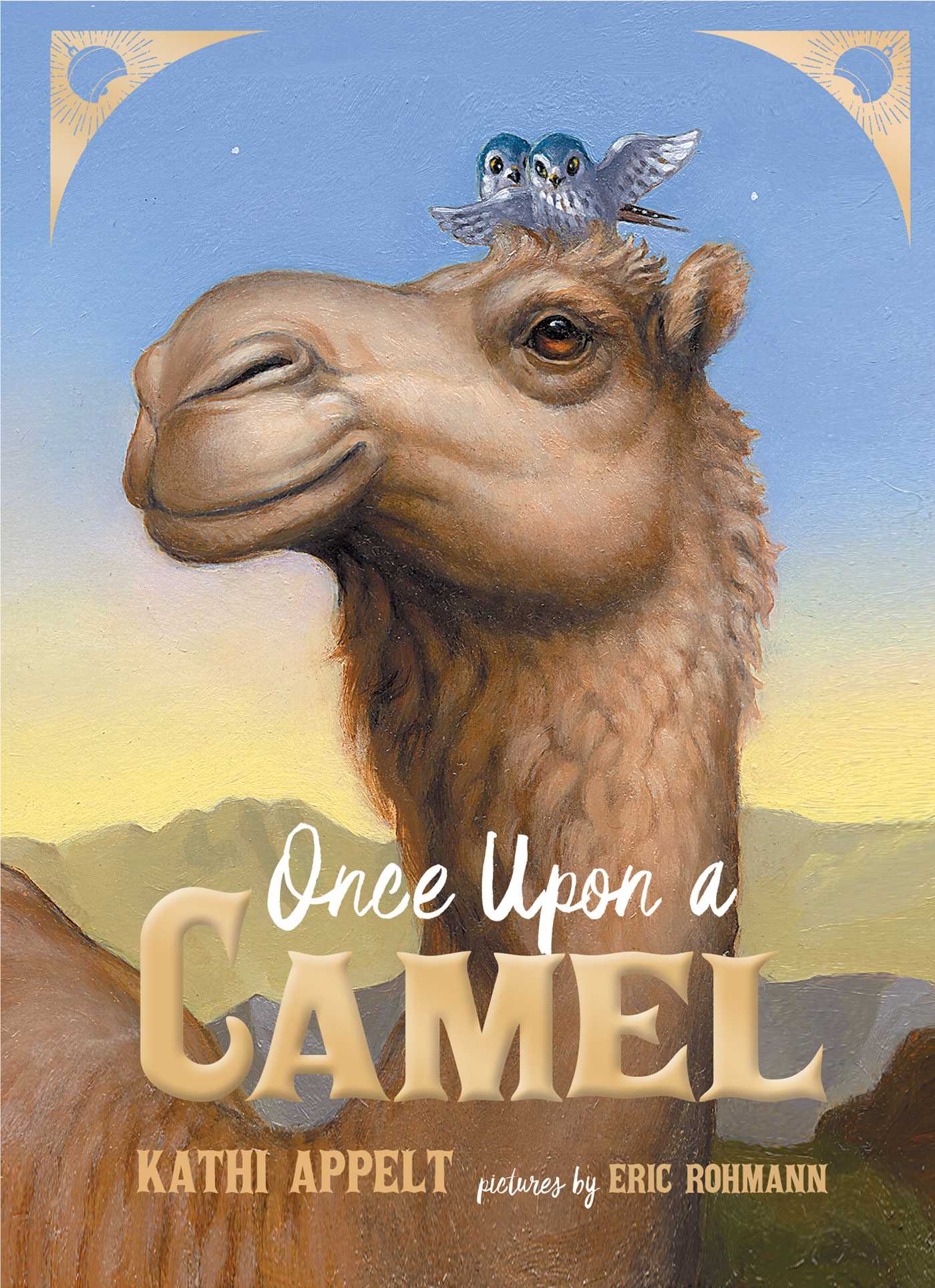
Once Upon a Camel
Author: Kathi Appelt
Illustrator: Eric Rohmann
Published September 7th, 2021 by Atheneum/Caitlyn Dlouhy Books

Summary: An old camel is out to save two baby kestrel chicks during a massive storm in the Texas desert.

Zada is a camel with a treasure trove of stories to tell. She’s won camel races for the royal Pasha of Smyrna, crossed treacherous oceans to new land, led army missions with her best camel friend by her side, and outsmarted a far too pompous mountain lion.

But those stories were from before. Now, Zada wanders the desert as the last camel in Texas. But she’s not alone. Two tiny kestrel chicks are nestled in the fluff of fur between her ears—kee-killy-keeing for their missing parents—and a dust storm the size of a mountain is taking Zada on one more grand adventure. And it could lead to this achy old camel’s most brilliant story yet.

About the Author: Kathi Appelt is the author of the Newbery Honoree, National Book Award Finalist, and bestselling The Underneath as well as the National Book Award Finalist for The True Blue Scouts of Sugar Man Swamp. Some of her award-winning books include Maybe a Fox (with Alison McGhee), Keeper, and Max Attacks to name just a few. She lives in College Station, Texas. To learn more, visit her website at kathiappelt.com.

Find Kathi Appelt on Facebook and Pinterest!

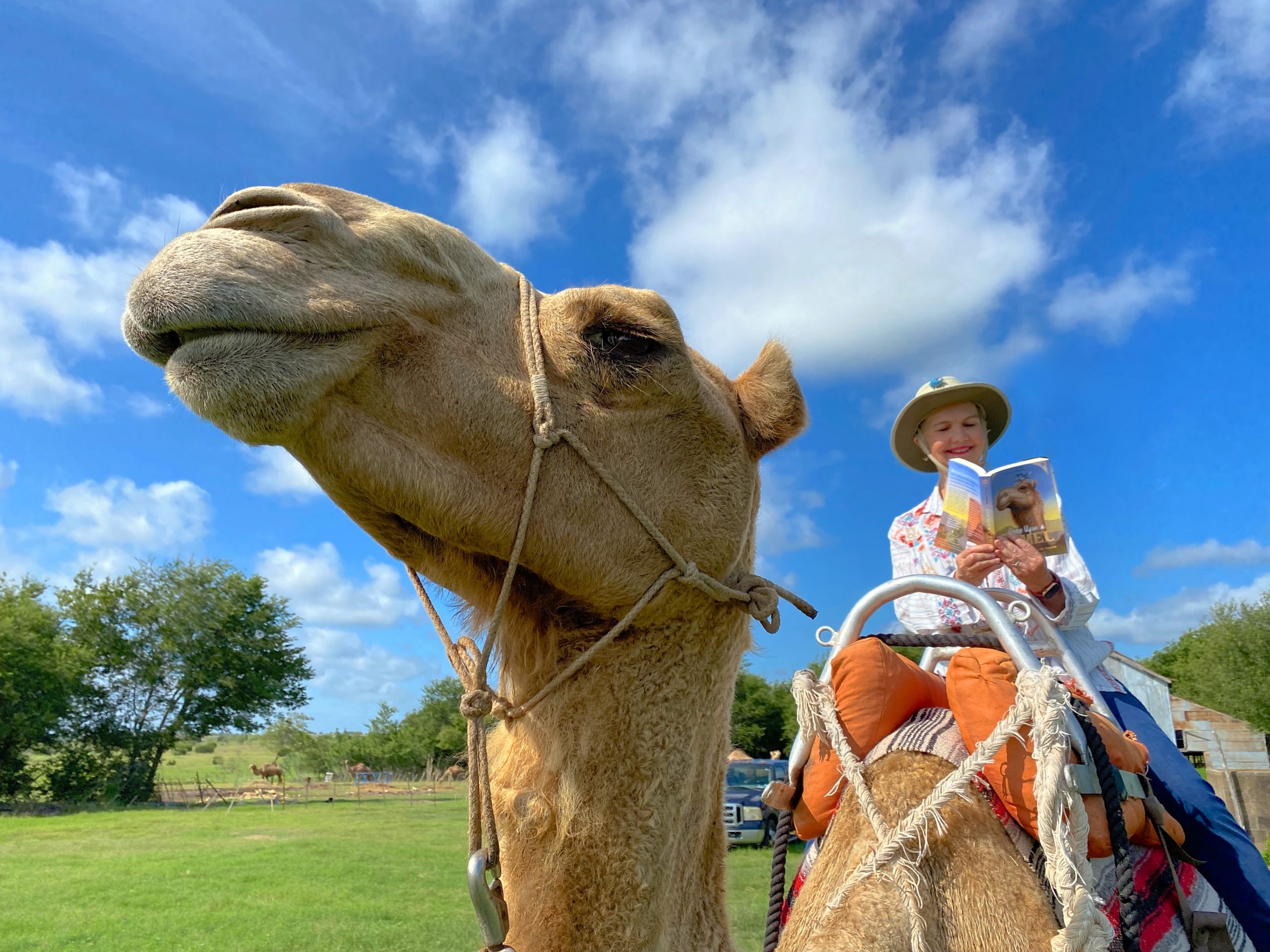
Richard, the camel, and Kathi Appelt taken at Texas Camel Corps. Photo credit: Doug Baum.

Review: Happy book birthday, Kathi & Once Upon a Camel! So honored to review this special book on your special day!

In all of Kathi Appelt’s books, what I have found that I adore the most is her ability to craft voice. She is brilliant. In this book, Zada the camel’s voice rings throughout with patience and determination. I was calmed by her stories of her upbringing as she works to keep the baby kestrels’ minds off of their parents. I think part of Appelt’s magic to craft voice is through her very specific word choice in all instances. Her descriptive words are so precise, and she is never deterred to use a word that may be challenging if it is the correct word. This leads to such lyrical prose–it is a pleasure to read!

There is also so much to learn throughout this story about stories: weather events (haboobs), animals of West Texas (kesterels, mountain lions, hawks, and more), and the history of camels. I found myself going on research tangents as I was introduced to different animals or different adventures that Zada goes on. It is no wonder that the Reading Group Guide is so extensive–there is so much to delve into!

Teachers’ Tools for Navigation (Excerpt from the publisher provided Reading Group Guide): 

  • Explain to students that alliteration is a literary device in which initial consonant sounds of successive or closely related words are repeated. This book contains tons of alliteration. Some examples include “arches and arroyos,” “moving mountain,” “posh Pasha palace,” “Pasha’s princess turns a little pale,” and “best beloved babies.” Using game tiles with letters or small pieces of paper with letters written on them, allow each student to draw a letter and write five alliterative sentences using that letter. Each sentence must contain a subject, verb, and describing words. Once everyone has written their sentences, each person should share their best alliterative sentence with the class.
  • Zada has had a long life filled with experiences and relationships. Her story in the book moves in time as she shares memories while continuing present experiences. Ask students to create a time line for Zada. There are online resources such as Adobe (https://www.adobe.com/express/create/timeline) and TimeGraphics (https://time.graphics) to help with organization. They may also do this in a slideshow format. Have them include dates, locations, and important experiences.
  • Beulah licks Wims, and he is upset. He is described as being “incensed. Put out. Piqued.” Discuss with students how this alliterative and repetitive approach to communicating his feelings is an effective way to convey the strength of those feelings as well as a lyrical way to engage the reader. Ask students to choose one emotion and make a list of synonyms or short expressions that express that emotion. Next, ask them to express the emotion in as many ways as possible in short sentences. Finally, ask them to use their list and sentences to write a paragraph that first explains why their character is feeling that emotion and that then elaborates on how they are feeling in as many ways and with as much creative imagery as possible.
  • Like humans and all other members of the animal kingdom, camels and kestrels have been classified based on shared characteristics. Looking at the list below, you can see that camels, kestrels, and humans are classified together in their kingdom and phylum, but begin to diverge at class groups and fully diverge in orders. Ask students to review the table and have a class discussion about classification. Give students the opportunity to consult some sources, if necessary, to answer their questions.
    • Camels: Animalia (Kingdom) / Chordata (Phylum) / Mammalia (Class) / Artiodactyla
      (Order) / Camelidae (Family) / Camelus (Genus) / Dromedarius or Bactrianus (Species)
    • American Kestrels: Animalia (Kingdom) / Chordata (Phylum) / Aves (Class) / Falconiformes
      (Order) / Falconidae (Family) / Falco (Genus) / F. tinnunculus (Species)
    • Humans: Animalia (Kingdom) / Chordata (Phylum) / Mammalia (Class) / Primates (Order) / Hominidae (Family) / Homo (Genus) / Homo Sapiens (Species)
    • After review and discussion, ask students to write short answers to the following questions:
      • Why do we classify animals and other living things in this manner?
      • What characteristics do all living things have in common?
      • Do camels, kestrels, and humans have the same basic needs?
      • Do humans understand more about animals than animals know about humans?
      • Even though humans and camels are both mammals, do humans or camels have more in common with kestrels than they do with one another?

Discussion Questions (Excerpt from the publisher provided Reading Group Guide): 

  • The story’s action begins with Pard and Perlita telling Zada that a mountain is eating everything and is soon going to eat them. Zada cannot comprehend this. Why do you think that is? How do you handle things you don’t understand? In truth, the mountain is a great sand-and-dust storm coming their way. How does knowing this change your perspective of the situation? How does Zada react?
  • The author explains how a camel has adapted to the desert, and how American kestrels are built for flight. All animals have adaptations: evolved physical and behavioral traits that help their species survive and thrive. Can you think of any other examples of this? What about cultural adaptations? Are there ways in which groups or individuals adapt for their own safety, comfort, or survival?
  • As Zada tries to outrun the storm, she wishes she could fly. This is not the first time in her life she has wished this. Why do you think she has continued to yearn for this ability? Thinking about your life and the environment in which you live, what other animal adaptations would come in handy for you? Explain your answers.
  • As Zada worries about Pecos de Leon, she reflects on the fact that she and the mountain lion have “both traveled a lot of miles and traversed a lot of country. That was worth something.” How can having many experiences help you? Do you think it’s important to experience situations similar to and different from your own life? What might you learn from someone who has lived a long time and done many things? Explain your answers.
  • As Zada moves through the storm carrying the chicks, an enormous old tree comes down behind them. “The wind had yanked it up by its roots. A hundred years, that old tree had stood there, watching over the creek, keeping generations of bird families safe. Now it lay in a heap on its side.” How does the falling tree make Zada feel? How did it make you feel? Do you think generations of bird families will be able to find a new home?
  • As the storm spins Perlita and Pard around, they call out, “‘Keep them safe!’” This is described as the “universal prayer” of parents. What does it mean for something to be universal? Do you have knowledge, ideas, or habits that are universal?
  • Zada’s and Asiye’s motto is “En parlak yildiz ol.” This means “Become the brightest star.” What do they mean by this? How do you see them striving to do this throughout the story?

Flagged Passages: “Chapter 1: Foothills, Chisos Mountains West Texas, 1910

“Incoming!”

Even in her sleep, Zada recognized that voice.

The old camel raised one eyelid. It was still dark. There was at least an hour left before dawn. She did not recall setting an early alarm bird.”

Book Trailer: 

Read This If You Love: Maybe a Fox by Kathi Appelt & Alison Mcghee, The Beatryce Prophecy by Kate DiCamillo, Journey of the Pale Bear by Susan Fletcher, Orphaned by Eliot Schrefer, Good Dog by Dan Gemeinhart, Granted by John David Anderson

Recommended For: 

classroomlibrarybuttonsmall 

Giveaway!

a Rafflecopter giveaway

Signature

**Thank you to Barbara at Blue Slip Media for providing a copy for review and giveaway!**

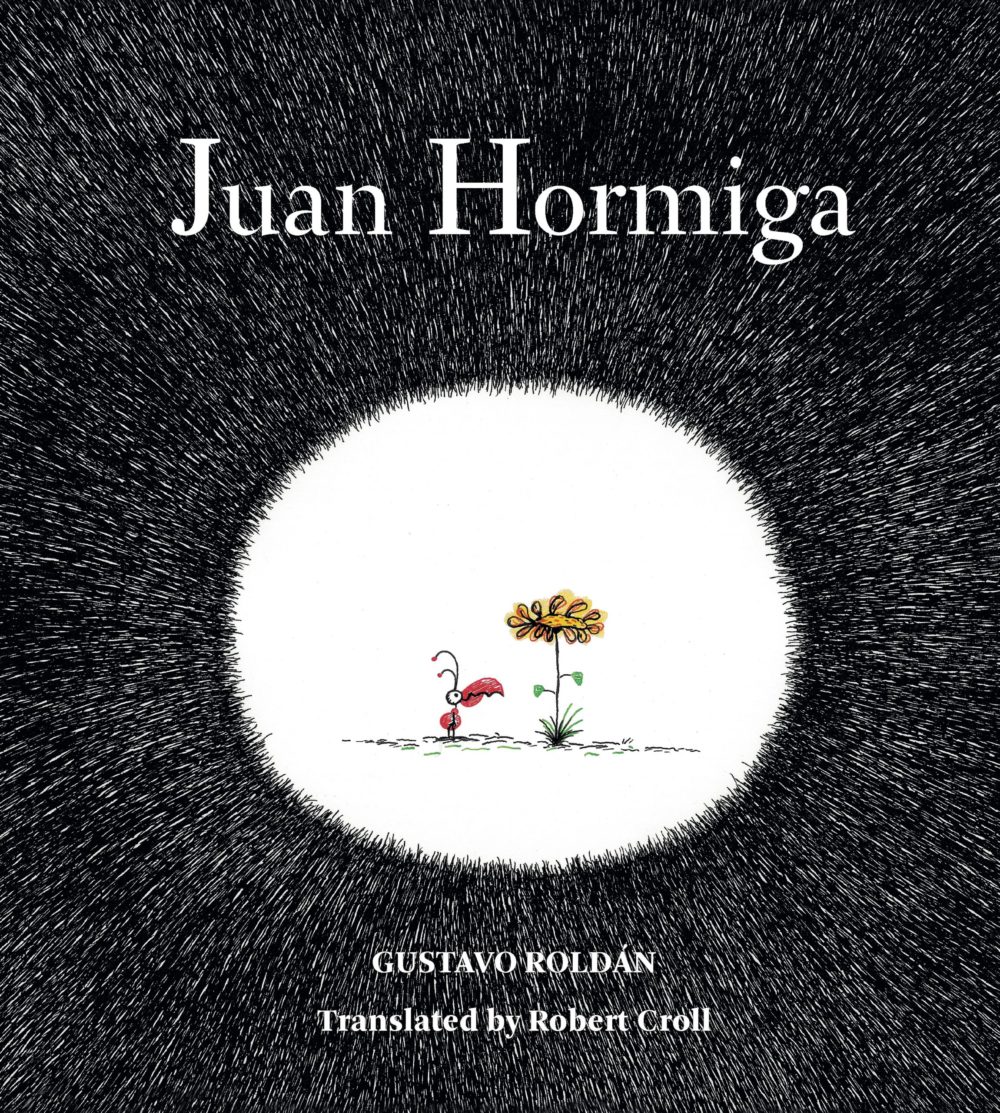
Juan Hormiga by Gustavo Roldán, Translated by Robert Croll

Share

Juan Hormiga
Author & Illustrator: Gustavo Roldán
Translator: Robert Croll
Published Originally in 2013, Translated and Published May 4th, 2021 by Elsewhere Editions

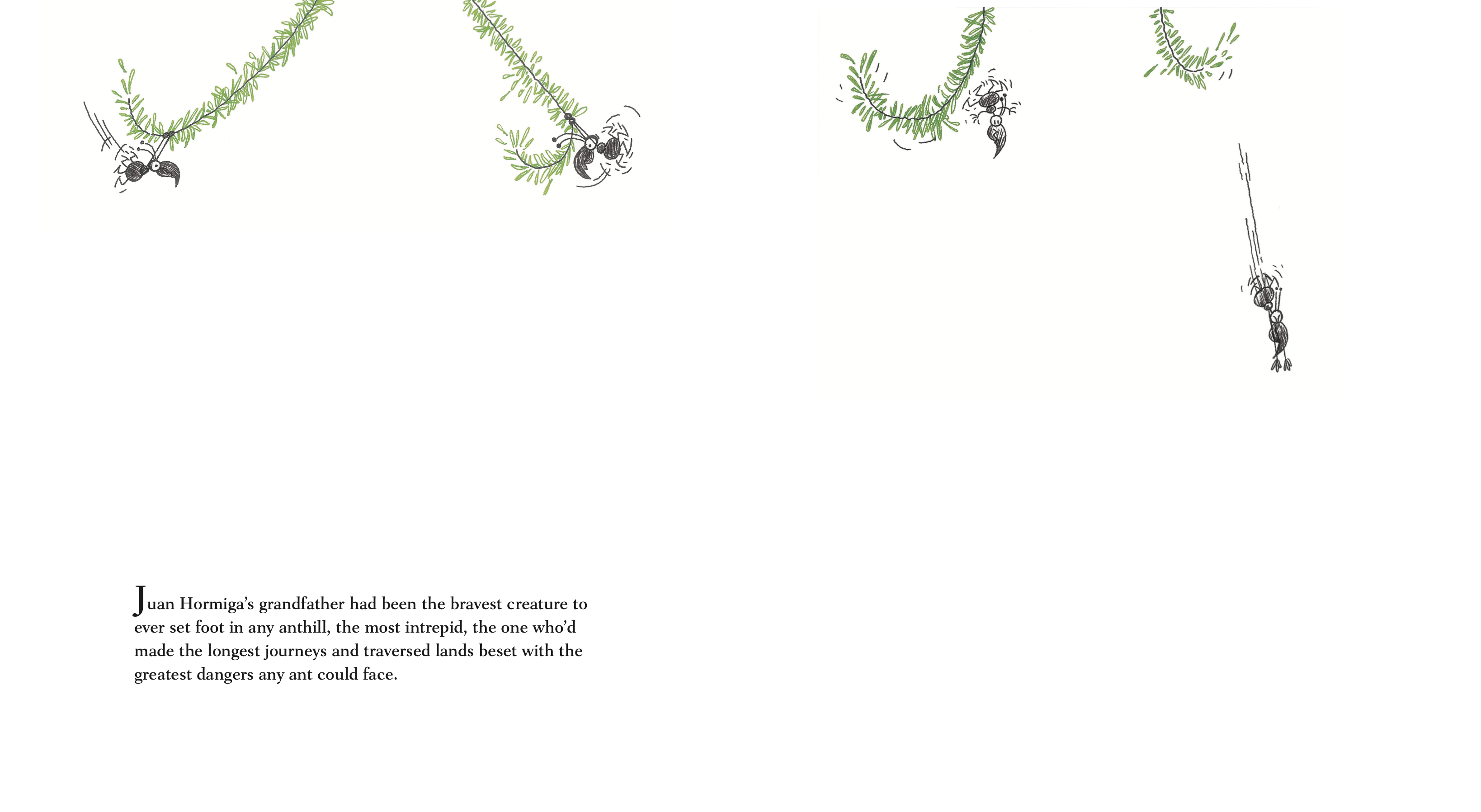
Summary: Juan Hormiga, the greatest storyteller of his entire anthill, loves to recount his fearless grandfather’s adventures. When Juan and his fellow ants gather around for story time, he hypnotizes all with tales of his grandfather’s many exploits – including his escape from an eagle’s talons and the time he leapt from a tree with just a leaf for a parachute. When he’s through telling these tales, Juan loves to cozy up for a nice long nap. He’s such a serious napper that he takes up to ten siestas every day! Though well loved by his ant friends, Juan decides telling tales and sleeping aren’t quite enough for him – it’s time to set off on his own adventure. With whimsical, irresistible illustrations, Juan Hormiga affirms the joys of sharing stories, and of creating your own out in the world.

About the Author: Gustavo Roldán was born in Argentina in 1965. His illustrations are widely published, and he has been exhibiting his work since 1985. His books have been published in numerous countries including Mexico, Belgium, Spain, the Netherlands, Brazil, South Korea, and Switzerland and have earned him recognition from A.L.I.J.A., the Prix Octogone, and inclusion in the White Ravens catalogue created by the Jugendbibliothek. His other books include El señor G and Historias de conejo y elefante, both published internationally. He currently lives in Barcelona, where he is a contributor to several publishing houses.

About the Translator: Robert Croll is a writer, translator, musician, and visual artist from Asheville, North Carolina. He first came to translation during his undergraduate studies at Amherst College, where he focused on Julio Cortázar’s short fiction. His translations include The Diaries of Emilio Renzi by Ricardo Piglia, published by Restless Books.

Review: From the first couple of pages when Juan Hormiga napped his way around the spread and showed his curiosity, I fell in love with this little ant. He may not fit what we normally think of when we think of ants, but he is an example of the importance of different types of people in a community: every time Juan Hormiga speaks to tell a story, all of the other ants stop and listen because that is the power of a good story. This message is also one that made my heart happy as I read it.

I also loved that there was no shunning or pushes to be different involved in the story. The ants loved Juan Hormiga for who he was and utilized him for his strengths.

Author Rivka Galchen called Juan Hormiga “magnificent and silly and tender all at once–a perfect book,” and I can attest that all is there: magnificent in the message and stories, silliness in the illustrations and conversation, and tender in the love for each other.

Teachers’ Tools for Navigation: Students will love hearing this book read out loud, and it will lend itself nicely to a creative writing activity where students can create their own adventures for Juan Hormiga’s grandfather–what other adventures did he go on?

Discussion Questions: 

  • How is Juan Hormiga different from his fellow ants?
  • Why is Juan Hormiga so important to his colony even though he doesn’t do the same labor the other ants do?
  • The author shared that this book was inspired by nights when his family camped in the mountains and his mother told them stories. How do you see this inspiration in the story?
  • What do you think the author is trying to portray about the power of storytelling?
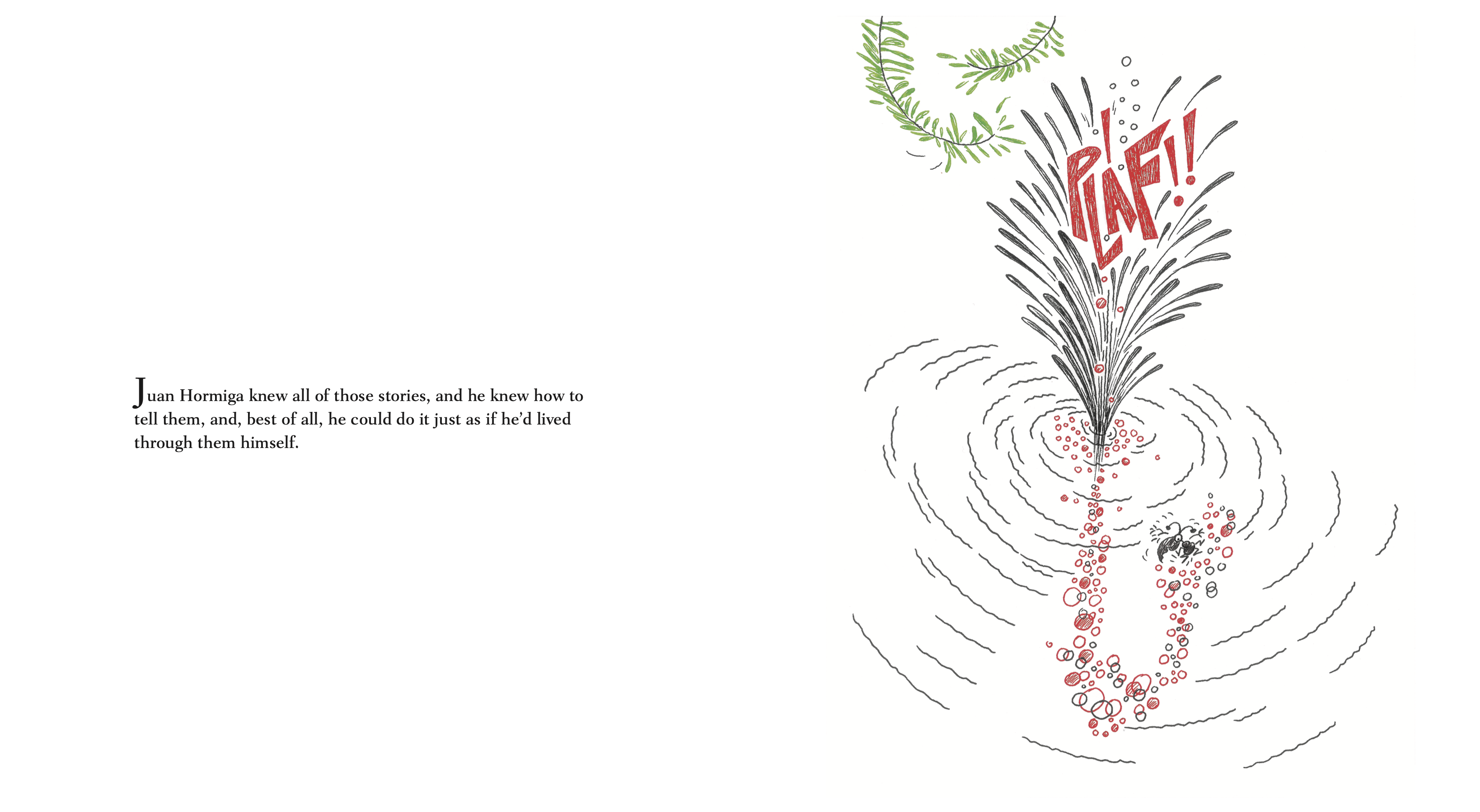
  • How do you think the ants feel when they find Juan in the willow tree?

Flagged Passages: 


Read This If You Love: Little Fox by Edward van de Vendel, Lucy by Randy Cecil, Normal Norman by Tara Lazar

Recommended For: 

classroomlibrarybuttonsmall

Signature

**Thank you to Elsewhere Editions for providing a copy for review!**

Weird but True!: Ocean: 300 Fin-Tastic Facts from the Deep Blue Sea by National Geographic Kids

Share

Weird but True!: Ocean: 300 Fin-Tastic Facts from the Deep Blue Sea
Published June 8, 2021 by National Geographic Kids

Goodreads Summary: Dive into these fishy facts: Did you know that the prehistoric shark, megalodon, had jaws so big that it could swallow a car? Or that goats, pigs, dogs, cats, and even an alpaca have all learned how to surf? And if that’s not weird enough for ya, one man even rowed solo across the Pacific Ocean for 312 days!
In this book filled with 300 wacky facts and pictures, you’ll glimpse the ocean’s weirdest wildlife, uncover shocking shipwrecks, and meet sensational seafarers, from pirates and sailors to ground-breaking marine scientists. Perfect for ocean enthusiasts and trivia-loving landlubbers alike!

My Review: This book is the perfect size for little hands! All three of my boys (ages 7, 4, and 2) loved it and really enjoyed looking through the pages. My older two boys were able to read the facts aloud, which made for a very fun experience. My 4-year-old kept shouting, “WHOA!” as they learned new facts. The photographs are absolutely stunning, and the pages offer really, really interesting facts that even adults will enjoy! 

Teachers’ Tools for Navigation: Check out this cool activity that Kellee did with her students as a classroom connection for these books!

Discussion Questions: 

  • Which facts were the most interesting to you?
  • Which ocean creature do you think is the coolest?
  • How can you learn more about this creature?

Flagged Passage: 

Read This If You Loved: Animal Books, National Geographic’s 100 Things to Know Before You Grow UpMastermind by National Geographic, Weird but True series by National Geographic, Animal Atlas, Almanacs

Recommended For: 

classroomlibrarybuttonsmall

RickiSig

**Thank you to Karen at Media Masters Publicity for providing a copy for review!**
Zonia’s Rain Forest by Juana Martinez-Neal

Share

Zonia’s Rain Forest
Author and Illustrator: Juana Martinez-Neal
Published March 30th, 2021 by Candlewick Press

Summary: A heartfelt, visually stunning picture book from the Caldecott Honor and Sibert Medal Winner illuminates a young girl’s day of play and adventure in the lush rain forest of Peru.

Zonia’s home is the Amazon rain forest, where it is always green and full of life. Every morning, the rain forest calls to Zonia, and every morning she answers. She visits the sloth family, greets the giant anteater, and runs with the speedy jaguar. But one morning, the rain forest calls to her in a troubled voice. How will Zonia answer?

Acclaimed author-illustrator Juana Martinez-Neal explores the wonders of the rain forest with Zonia, an Asháninka girl, in her joyful outdoor adventures. The engaging text emphasizes Zonia’s empowering bond with her home, while the illustrations—created on paper made from banana bark—burst with luxuriant greens and delicate details. Illuminating back matter includes a translation of the story in Asháninka, information on the Asháninka community, as well as resources on the Amazon rain forest and its wildlife.

Praise: 

⭐“At its simplest level, this is a beautiful story about a child who loves her home and the animals she with whom she shares it. Martinez-Neal’s rounded, soft-textured illustrations are wonderfully inviting and involve linocut and woodcut leaves and fronds printed on natural banana-bark paper… The text is kept to two short sentences per double-page spread, reflecting Zonia’s uncomplicated and innocent view of the world, which is shaken when she stumbles upon a large section of clear-cut forest.” – Booklist (starred review)

⭐“This beautiful look at a young girl’s life and her determination to save her home is a perfect read for young environmentalists.” – School Library Journal (starred review)

“In Juana Martinez-Neal’s Zonia’s Rain Forest, super-cute critters are out in full force…A girl who lives in the rain forest begins each day by greeting her animal friends in this exuberant picture book crowned with an environmental message.” – Shelf Awareness

About the Author: Juana Martinez-Neal is the Peruvian-born daughter and granddaughter of painters. Her debut as an author-illustrator, Alma and How She Got Her Name, was awarded a Caldecott Honor and was published in Spanish as Alma y cómo obtuvo su nombre. She also illustrated La Princesa and the Pea by Susan Middleton Elya, for which she won a Pura Belpré Illustrator Award, Babymoon by Hayley Barrett, and Fry Bread: A Native American Family Story by Kevin Noble Maillard, which won a Robert F. Sibert Medal. Juana Martinez-Neal lives in Arizona with her family. Visit her online at www.juanamartinezneal.com.

Review : Zonia’s story starts as a story of family. We meet her mother and baby brother and the love between them is evident in the words and illustrations.

The book then moves to Zonia’s adventures visiting her friends throughout the rain forest. We get to meet all of her animal friends. With backmatter introducing the type of animals, Trent and I went on a research exploration of the different rain forest animals that Martinez-Neal introduced to us.

The book ends with a call to action. Zonia is Asháninka, Indigenous people of the Peruvian Amazon, so the rain forest is her home. Her family’s home. The book ends with Zonia running across deforestation near her home and realizing that the forest needs her, and all of our, help.

And finally, the backmatter of the book is incredible. Juana Martinez-Neal, who is Peruvian, is not Asháninka, so I am not sure of the accuracy of the portrayal, but the backmatter shows the work she did to do justice to them and their home. The back matter includes a translation of the entire book to Asháninka, information about the Asháninka People, a few facts about the Amazon, threats to the Amazon, and Zonia’s friends we met in the book. Finally, especially useful for in the classroom, she includes selected sources and resources, all which can be viewed at https://juanamartinezneal.com/books/zonia/.

With Martinez-Neal’s ability to craft the simplistic text in a beautiful way mixed with her signature illustrations, full of movement, color, and personality along with the rain forest elements, Zonia’s Rainforest is a perfect book for story time, science cross-curricular reading, a jumping off point for inquiry, or a mentor text.

Read “The story behind Zonia’s Rain Forest” by Juana Martinez-Neal here.

Watch an interview with Juana Martinez-Neal about Zonia’s Rain Forest: 

Teachers’ Tools for Navigation and Discussion Questions: Julia Torres created a Teacher’s Guide for Zonia for Candlewick Press, and it is the best resource for teaching Zonia. It includes 7 Discussion Questions and 8 Classroom Activities.

Flagged Passages: 

Read This If You Love: We Are Water Protectors by Carole Lindstrom, The Leaf Detective by Heather LangA Stone Sat Still by Brendan Wenzel

Recommended For: 

classroomlibrarybuttonsmall 

Signature

**Thank you to Candlewick Press for providing a copy for review!**