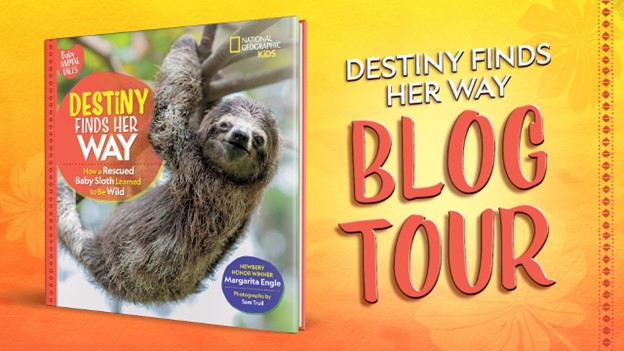
Blog Tour, Giveaway, and Author Guest Post!: Let Nonfiction Sing by Margarita Engle, Author of Destiny Finds Her Way: How a Rescued Baby Sloth Learned to be Wild

Share

Welcome to the

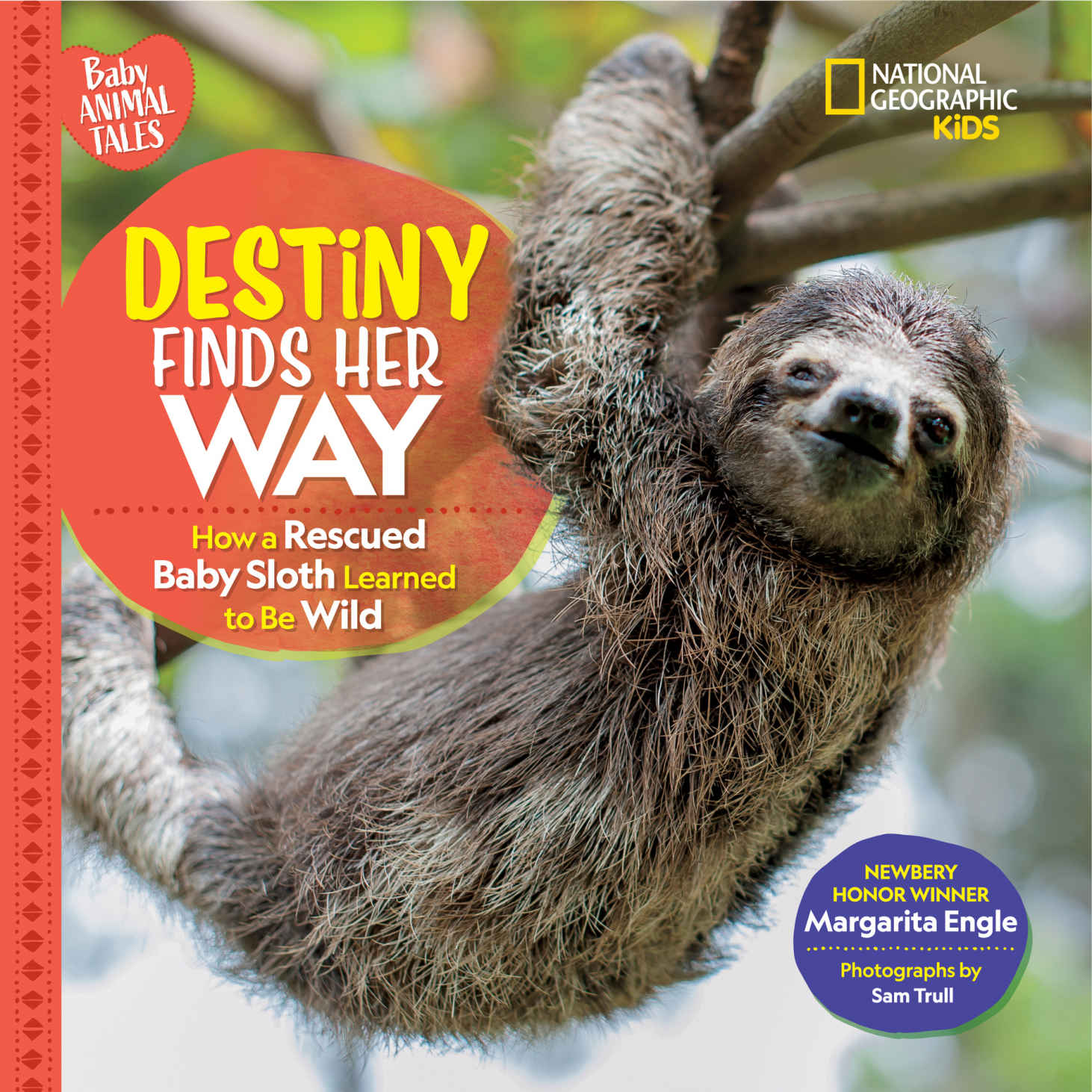
Destiny Finds Her Way

Blog Tour & Giveaway!

To celebrate the release of Destiny Finds Her Way by Newbery Honor winner Margarita Engle, blogs across the web are hosting guest posts from Margarita as well as the book’s photographer, Sam Trull, who is also the co-founder and Executive Director of the Sloth Institute — a sloth rescue organization based in Costa Rica. Join us for a journey behind the scenes of how these two amazingly talented women teamed up to bring this inspiring, true story to readers everywhere and learn more about sloths and the work being done to protect them.

Let Nonfiction Sing!

by Margarita Engle

Destiny Finds Her Way is a book I feel honored to have written. When I saw Sam Trull’s beautiful photos of Destiny the sloth, I decided to visit the Sloth Institute in Costa Rica. There, I had the chance to witness Sam in action, rescuing baby sloths and teaching them how to live in the wild. The experience was inspiring.

I wanted to write Destiny’s story in a way that might inspire young readers to learn more about wildlife conservation. The tropical rain forest has its own rhythm, and poetry is musical language. However, nonfiction is usually presented in a more detailed prose style. I decided to combine poetic devices with facts. The first device I used is onomatopoeia, where words resemble their real-life sources. Examples are the eee, eee, eee of darting squirrel monkeys, and ah, ah of a frightened baby sloth. Instead of rhymes at the ends of lines, I included words with vowels that rhyme. In ‘macaws squawking,’ all the “a “sounds rhyme. I’m sure readers will be able to find many other parts of the story that sound musical.

Readers will also discover the other senses—sight, smell, touch, taste, as well as sound. In addition, movement is an important aspect of the story’s musical nature. I hope words like scratched, swayed, and climbed will help make Destiny’s journey come to life in a joyful, dancelike way. There is nothing more celebratory than knowing she is now healthy and free in the wild!
Buy | Buy on Bookshop.org | Add to GoodReads

About Destiny Finds Her Way

(ages 4-8, Hardcover Picture Book, National Geographic Kids Books)

Newbery Honor winner Margarita Engle and photographer and Sloth Institute Executive Director Sam Trull team up to bring the inspiring and true story to life of how Destiny, a motherless baby sloth, sightless in one eye and rescued by Sam in the Costa Rican rain forest, defies the odds, overcomes her obstacles of limited sight and learns the skills she will need to return to her wild, forest home.

Without her mother to protect her or teach her, Destiny is found and taken to a rescue center in Costa Rica. The little sloth soon befriends other orphaned sloths. Her poor eyesight, however, makes it hard for her to keep her balance. Eventually Destiny begins to use all of her senses to explore the world around her. But can she learn to climb? Can she master the other skills she needs to survive on her own? And will Destiny be brave enough to return to her wild, forest home?

In addition to learning about Destiny and her journey, readers are immersed in the world of sloths and sloth rescue in this uplifting story about overcoming obstacles and believing in yourself.

About the Author:

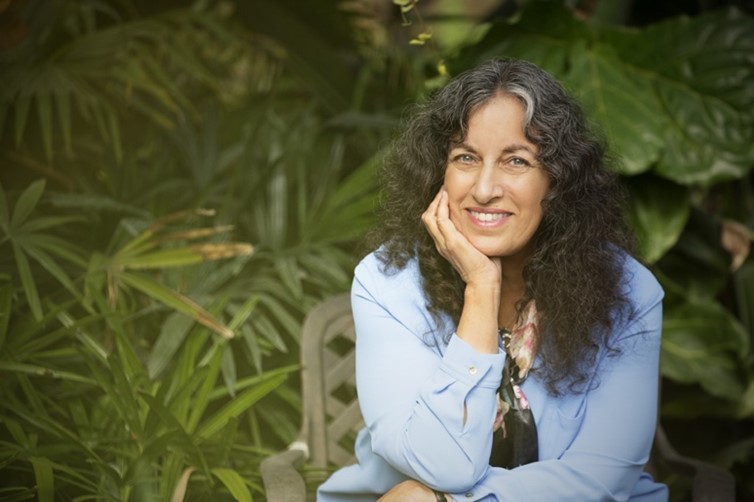
Margarita Engle is the Cuban-American author of many verse novels, memoirs, and picture books, including The Surrender Tree, Enchanted Air, Drum Dream Girl, and Dancing Hands. Awards include a Newbery Honor, Pura Belpré, Golden Kite, Walter, Jane Addams, PEN U.S.A., and NSK Neustadt, among others. Margarita served as the national 2017-2019 Young People’s Poet Laureate. She is a three-time U.S. nominee for the Astrid Lindgren Book Award. Her most recent books are Rima’s Rebellion, Singing With Elephants, and Destiny Finds Her Way. Her next young adult verse novel is Wings in the Wild, and her next picture book is Water Day.
Margarita was born in Los Angeles, but developed a deep attachment to her mother’s homeland during childhood summers with relatives on the island. She studied agronomy and botany along with creative writing, and now lives in central California with her husband.
Website | Instagram | Facebook | Twitter

About the Photographer:

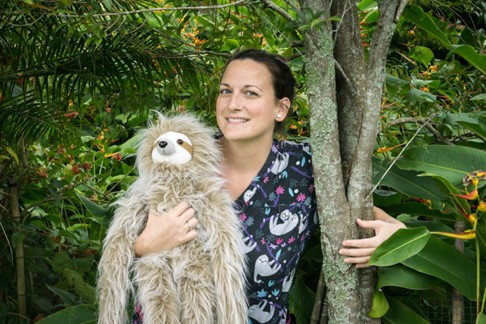
Sam Trull has been a photographer and a wildlife biologist for decades. After many expeditions to Madagascar, West Africa, and Central America, in January 2013, she settled in Costa Rica, where she co-founded and is the executive director of the Sloth Institute. Her first photo book, Slothlove, was published in April 2016.
Website | Instagram

About the Sloth Institute:

The Sloth Institute (TSI) is a nonprofit organization located in Costa Rica with the mission to enhance and expand the welfare and conservation of sloths through rescue, rehabilitation, release, research, and education. In addition, TSI works on targeted conservation projects to improve the safety and quality of sloth habitats and teaches other rescue centers how to better care for and release their sloths. TSI believes that all sloths were born to be wild and deserve that second chance at freedom.


Website | Instagram | Facebook | Twitter

GIVEAWAY

  • One (1) winner will receive a copy of Destiny Finds Her Way
  • US/Can only
  • Ends 3/18 at 11:59 pm ET
  • Enter via the Rafflecopter below
  • Visit the other stops on the tour for more chances to win!

a Rafflecopter giveaway

Blog Tour Schedule:

March 6th — Pragmatic Mom

March 7th — Heise Reads and Recommends

March 8th – Mom Read It

March 9th — Unleashing Readers

March 10th — Imagination Soup
Nonfiction Picture Book Round Up!: The Universe in You by Jason Chin; Of Walden Pond by Lesa Cline-Ransome, illustrated by Ashley Benham-Yazdani; Polar Bear by Candace Fleming, illustrated by Eric Rohmann; We’re Not Weird by Michael Garland; & The Science of Light by Margaret Peot

Share

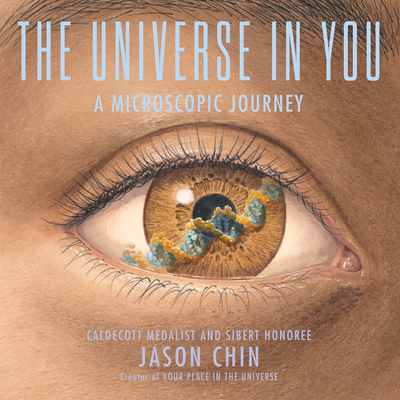
The Universe in You: A Microscopic Journey
Author & Illustrator: Jason Chin
Published October 18th, 2022

Summary: Caldecott Medalist Jason Chin’s companion book to the award-winning Your Place in the Universe explores the world of the very small, delving deep into the microscopic world just beneath our skin.

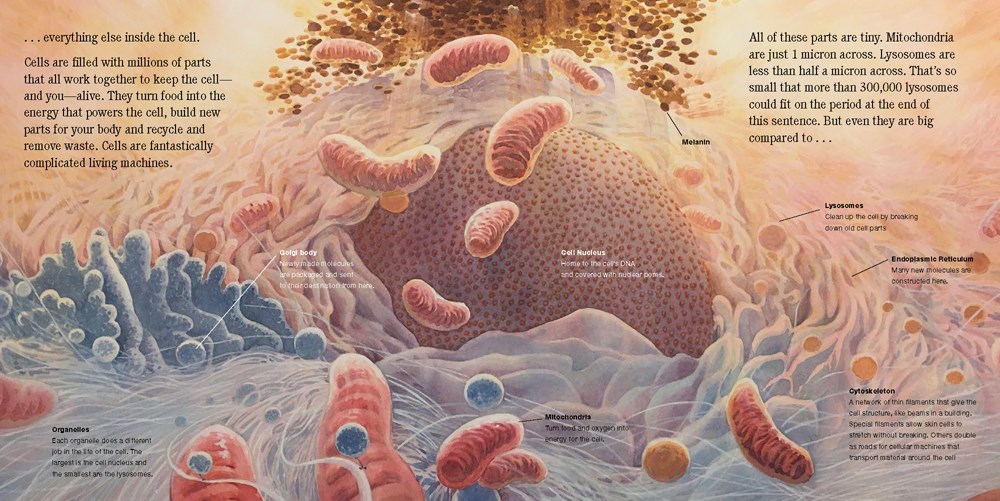
From Jason Chin, Caldecott Medalist for Watercress and Cook Prize winning author and illustrator of Your Place in the Universe comes The Universe in You: A Microscopic Journey, a companion book about the very small, from the tiniest mammals to the intricate structures of microscopic organisms and subatomic particles that make up every human body. This deep dive into an unseen world explores the building blocks of all matter and life, demonstrating how much we have in common with everything around us.

A Kirkus Reviews Best Book of the Year
A Horn Book Fanfare Title
A School Library Journal Best Book of the Year
A Junior Library Guild Gold Standard Selection

Review & Teachers’ Tools for Navigation: Jason Chin does it again: combining impeccable illustrations with science to take the reader into the microscopic world within our universe. Chin is such a master at bringing the reader into whatever world he has decided to explore and share with us. His writing is thorough and interesting, his illustrations are detailed and labeled, and the book together is definitely the journey he promises.

Educator Guide Available HERE!

Discussion Questions: 

  • What is so special about the structure of the book? Why do you think the author set the structure up this way?
  • What is the smallest thing in the universe? How do these small particles impact us?
  • How does the author make this nonfiction book like a journey?

Flagged Passages: 

Recommended For: 

classroomlibrarybuttonsmall  


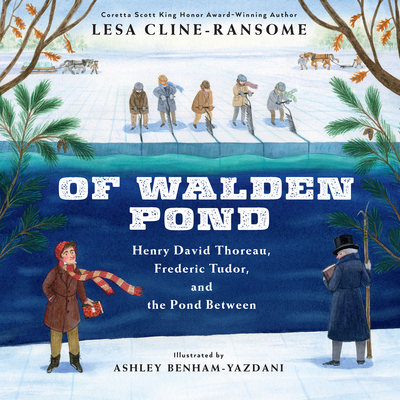
Of Walden Pond: Henry David Thoreau, Frederic Tudor, and the Pond Between
Author: Lesa Cline-Ransome
Illustrator: Ashley Benham-Yazdani
Published November 15th, 2022 by Holiday House

Summary: From the award-winning author of Before She Was Harriet comes another work of lyrical beauty, the story of Henry David Thoreau and businessman Frederic Tudor–and a changing world.

Thoreau and Tudor could not have been more different from each other. Yet both shared the bounties of Walden Pond and would change the course of history through their writings and innovations.

This study in opposites contrasts the austere philosopher with the consummate capitalist (whose innovations would change commercial ice harvesting and home refrigerators) to show how two seemingly conflicting American legacies could be built side by side.

Oddball/ tax dodger/ nature lover/ dreamer/ That’s what they called/ Thoreau.
Bankrupt/ disgrace/ good for nothing/ dreamer/ That’s what they called/ Tudor.

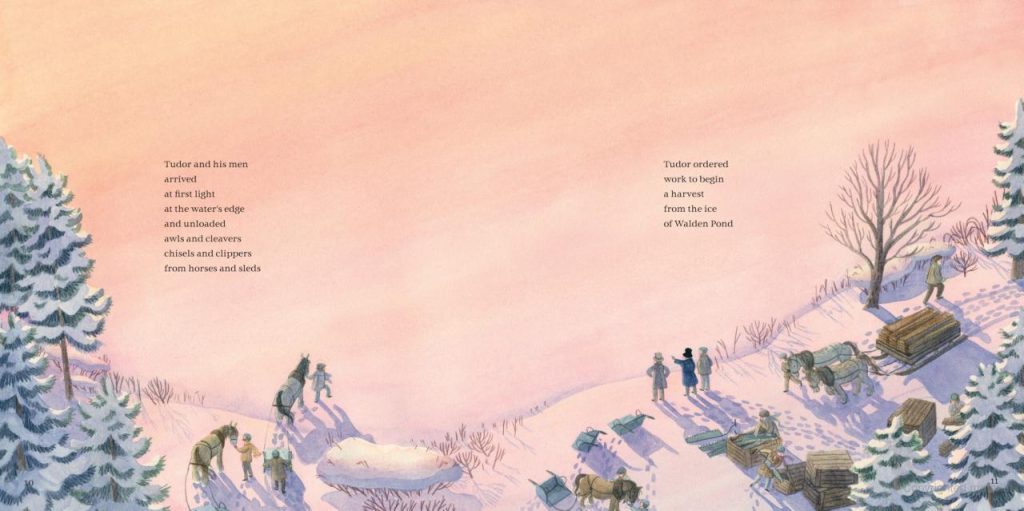
Celebrated author Lesa Cline-Ransome takes her magnificent talent for research and detail to plumb the depths of these two history-makers. The graceful text is paired with Ashley Benham-Yazdani’s period accurate watercolor and pencil artwork. In winter, readers see Tudor’s men sawing through the ice, the workhorses dragging the ice, and Thoreau observing it all; in spring, summer, and fall, the ice continues its journey across the globe with Thoreau and Tudor writing and reflecting in their respective diaries.

An Author’s Note, which explores how Thoreau’s writings influenced such figures as Martin Luther King Jr., Robert Frost, and Mohandas Gandhi, is included.

Review & Teachers’ Tools for Navigation: Lesa Cline-Ransome introduces us to another aspect of Walden Pond that Thoreau fans may not know about: Tudor’s industrial side of the pond. Cline Ransome’s verse shows us the contrast between the two lives that are tied together by the pond that they both loved, for very different reasons. Beautifully written with rhythm that yells for it to be read aloud.

Benham-Yazdani’s “period accurate watercolor” reminds me of Grandma Moses which is perfect for this story!

Educator Guide Available HERE!

Discussion Questions: 

  • What does the different fascinations with the pond show you about the two men?
  • Why do you think the author chose to write the book in verse separated by seasons?
  • What did you learn about the past of ice that surprised you?

Flagged Passages:

Recommended For: 

classroomlibrarybuttonsmall  


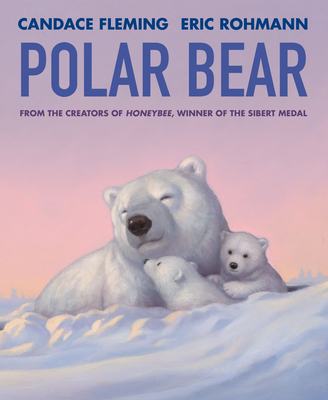
Polar Bear
Author: Candace Fleming
Illustrator: Eric Rohmann
Published November 22nd, 2022 by Holiday House

Summary: This companion book to the authors’ Sibert award-winning Honeybee explores the life and habitat of a majestic endangered species through dramatic text and sumptuous illustration.

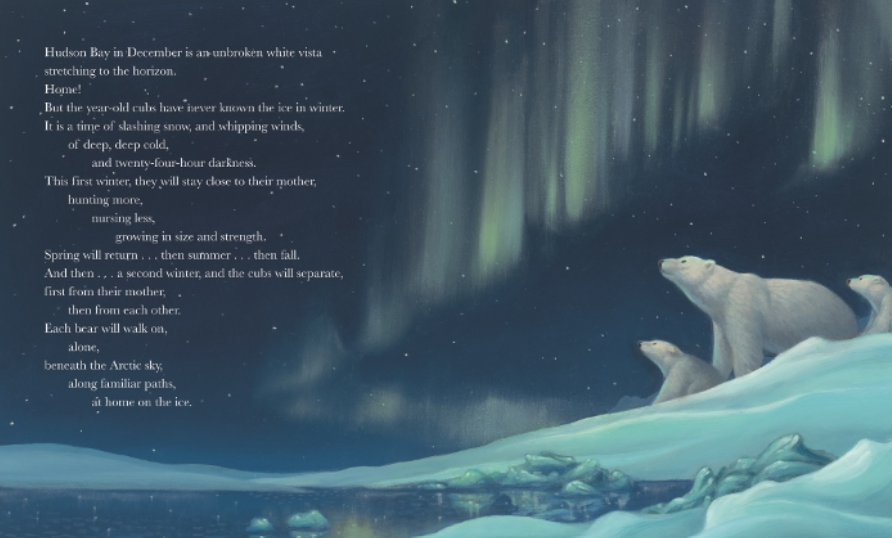
April in the Arctic . . .
Cold winds send snow clouds scuttling across the sky.
Temperatures barely nudge above freezing.
But every now and again,
The cloud cover parts,
The sun shines down,
And the frozen world stretches awake.

As spring approaches in the Arctic, a mother polar bear and her two cubs tentatively emerge from hibernation to explore the changing landscape. When it is time, she takes her cubs on a forty-mile journey, back to their home on the ice. Along the way, she fends off wolves, hunts for food, and swims miles and miles.

This companion book to Honeybee and Giant Squid features the unique talents of Fleming and Rohmann on a perennially popular subject. Eric Rohmann’s magnificent oil paintings feature (as in Honeybee) a spectacular gatefold of the polar landscape.

A Junior Library Guild Gold Standard Selection

Review & Teachers’ Tools for Navigation: Candace Fleming’s beautiful verse introduces us to the polar bear and all of the trials and tribulations she faces with her cubs in the Arctic. Within the narrative, we learn so much information about them and their habitat. The verse adds an extra poetic element to the book that just brings it to the next leve.

Add to that Rohmann’s illustrations, and this stunning picture book sucks in the reader through word and pictures. Backmatter adds even more information through shared research and fun facts.

Educator Guide Available HERE!

Discussion Questions: 

  • Why do you think that author chose to write the book in verse?
  • What does the gatefold add to the experience of reading Polar Bear?
  • What are the biggest threats to polar bears?
  • Why does the back matter include the statement “I’s All About the Ice?”

Flagged Passages: 

Recommended For: 

classroomlibrarybuttonsmall  


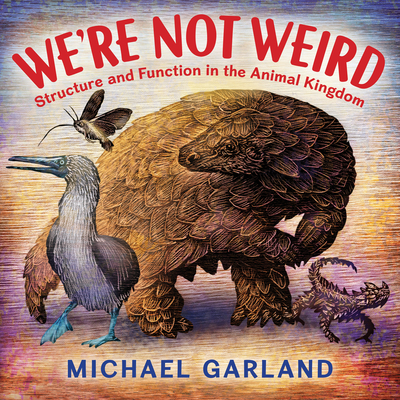
We’re Not Weird: Structure and Function in the Animal Kingdom
Author & Illustrator: Michael Garland
Published January 3rd, 2023 by Holiday House

Summary: Meet nature’s most extraordinary looking creatures. But they aren’t weird!

Birds with blue feet, fish that walk, unicorns in the sea, and more! Learn how these animals’ quirks help them survive. Perfect for budding naturalists who are always ready to share a cool (or gross) animal fact.

Very hard scales protect me, and my long tongue is perfect for eating ants. When I feel threatened, I roll myself into a ball. I am a Pangolin.

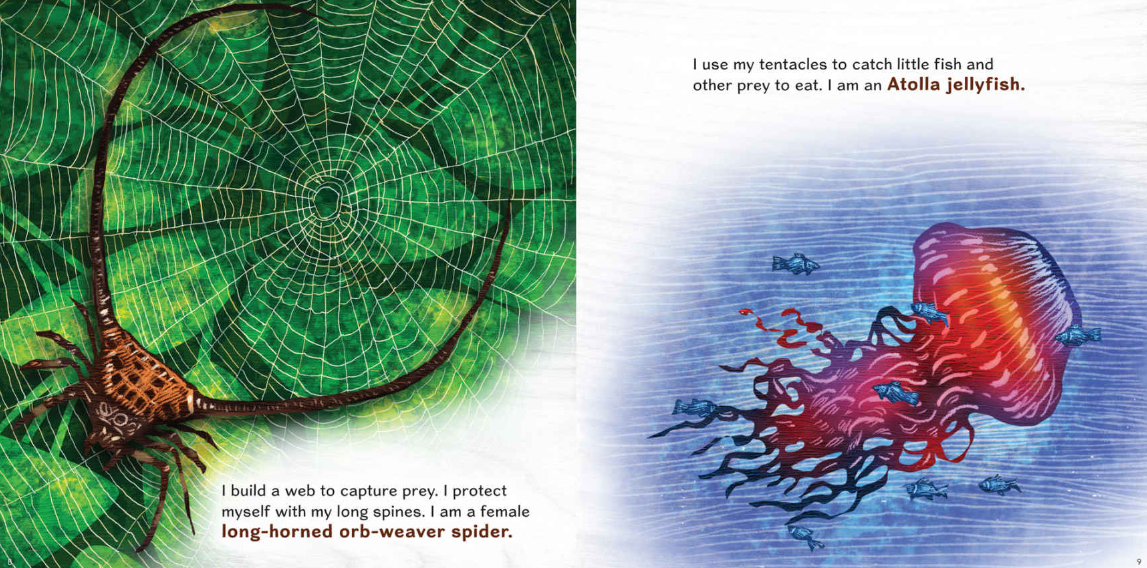
See these animals’ amazing body parts in vibrant and detailed woodcut illustrations, from the thorny dragon’s spiky skin to the star-nosed mole’s twenty-two feelers. Read how these creatures’ unique traits help them thrive and survive in their environments. Learn where they live, what they eat, how they protect themselves, and more.

With easy-to-read text vetted by an expert, this book aligns with the Next Generation Science Standards on adaptation, structure, and function for kindergarten through 3rd grade. With supplementary information on each animal’s habitat and diet.

Review: This book introduces the reader to so many different unique animals (20 of them!), featuring what makes them different than others. The text in the book is written in 1st person with interesting facts and an introduction to the animal. Additional info on each animal is on in the back matter giving even more information about the animal including their habitat and diet.

Discussion Questions: 

  • Which of the animals would you like to learn more about? Why?
  • Choose your own animal to research and write an introduction, in 1st person, highlighting the animal’s uniqueness and interesting facts.
  • What is similar about all of the animals’ unique features?

Flagged Passages: 

Recommended For: 

classroomlibrarybuttonsmall  


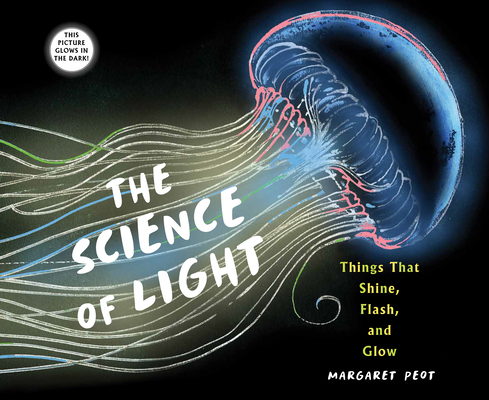
The Science of Light: Things that Shine, Flash, and Glow
Author & Illustrator: Margaret Peot
Published December 6th, 2022 by Holiday House

Summary: With a striking glow-in-the-dark cover, this intriguing science book invites young readers to find light all around.

Sun shines.
Stars twinkle.
Aurora borealis glimmers.

Dramatic paintings of lightning, fire, fireworks and more introduces the sources of light–both natural and manmade–and encourage children to look around and observe.

Kids will gasp in surprise at the beautiful glow-in-the-dark cover, and the bold spreads within. Margaret Peot’s distinctive art style captures the elusive nature of light. Bioluminescent squid, fireflies and phytoplankton reveal light sources in living things. Fireworks and light bubbles sparkle on the page.

This foundational science book will kindle curiosity in physical science and the natural world. The simple text makes science accessible to all ages.

Toddlers will delight in the colorful art at storytime. As they grow, kids will return to this nonfiction favorite and discover new ideas each time. Science vocabulary and definitions are included in the back of the book.

An Orbis Pictus Honor Book

Review: This beautifully illustrated book with sparse text gives an introduction to light in science including natural sources of light, bioluminescence, and artificial light. All of the animals, nature, and items in the book are tied together by the light that they make.

The author’s backmatter adds even more depth to the text by sharing more information on the different types of light, a bibliography, and websites to learn more.

Discussion Questions: 

  • What are the differences between the three types of light shared in the book?
  • Which of the types fascinates you the most?
  • How does bioluminescence work?

Flagged Passages: 

Recommended For: 

classroomlibrarybuttonsmall 


Signature

**Thank you to Sara at Holiday House for providing copies for review!**

Everybody Counts! by Matt Forrest Esenwine, Illustrated by Emma Graham

Share

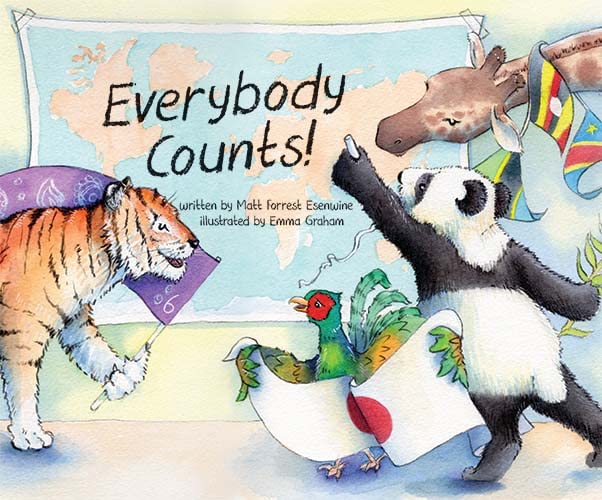
Everybody Counts!
Author: Matt Forrest Esenwine
Illustrator: Emma Graham
Published January 1st, 2023 by Little Fig

Summary: “Everyone is helpful, in large and small amounts. Everybody matters. Everybody counts!”

So begins Everybody Counts!, a creative foreign-language counting picture book. Get a taste of diversity as you explore this far-reaching festival of food and count your way to a full plate of fun.

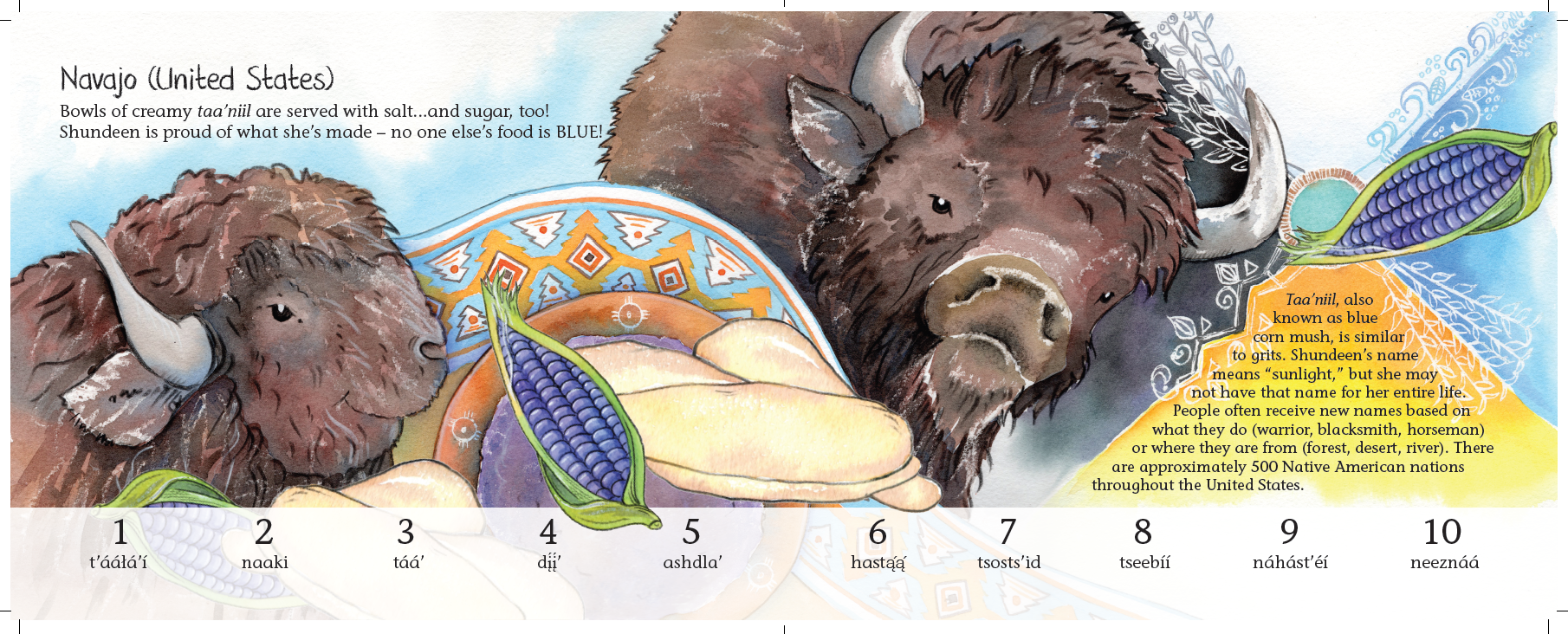
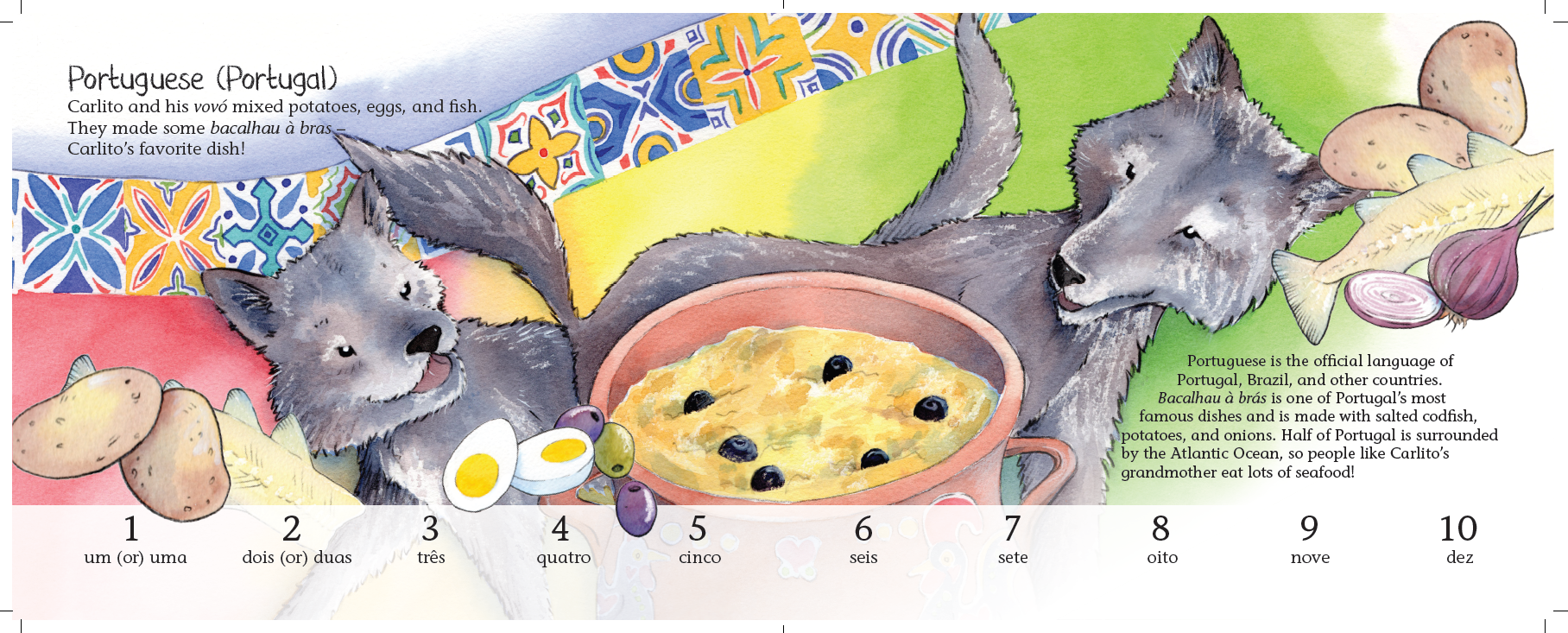
 Everybody Counts! makes learning numbers fun as young ones discover new foods and languages from around the world. Explore favorite foods from twelve countries. Illustrations highlight the animals and numerical symbols that represent each country.

Review: Esenwine’s Everybody Counts shows the ties between us all as it counts through 12 different languages along with animals from that country sharing now only the language with us but also food and culture of each country. Each spread is so thoughtfully created with colorful illustrations of each animal and their favorite food fill the spread.

Learn more about the book and its creation at Matt Forrest Esenwine’s Cover Reveal Blog Post.

Teachers’ Tools for Navigation: Everybody Counts is created for the classroom with opportunities to learn different languages as well as a guide to share each students’ favorite food and more!

Flagged Passages: 

Read This If You Love: Counting books, Books about food, Books about different countries

Recommended For: 

classroomlibrarybuttonsmall

Signature

**Thank you to the author for providing a copy of the book in exchange for an honest review!!**

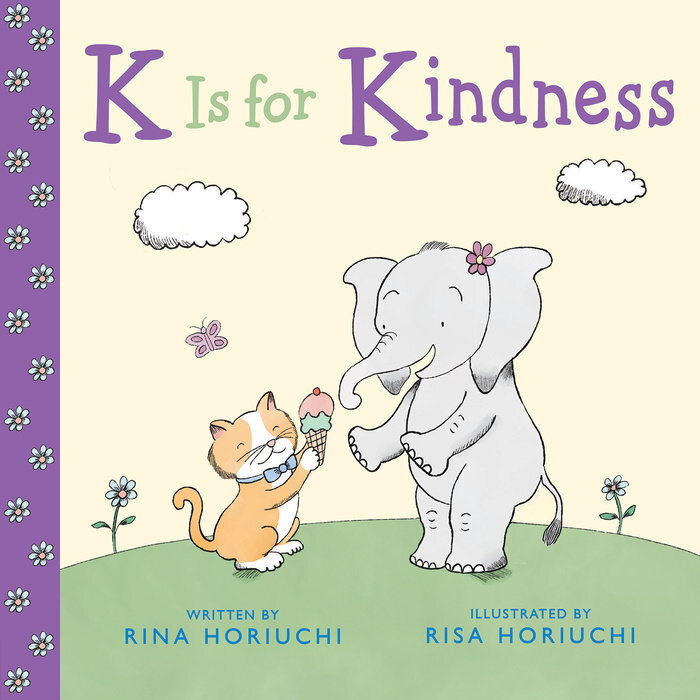
K is for Kindness by Rina Horiuchi, Illustrated by Risa Horiuchi

Share

K is for Kindness
Author: Rina Horiuchi
Illustrator: Risa Horiuchi
Published: April 26, 2022 by Viking Books

Goodreads Summary: Debut author/illustrator and sister duo have crafted a sweet ABC book that expresses how kindness can be found anywhere.

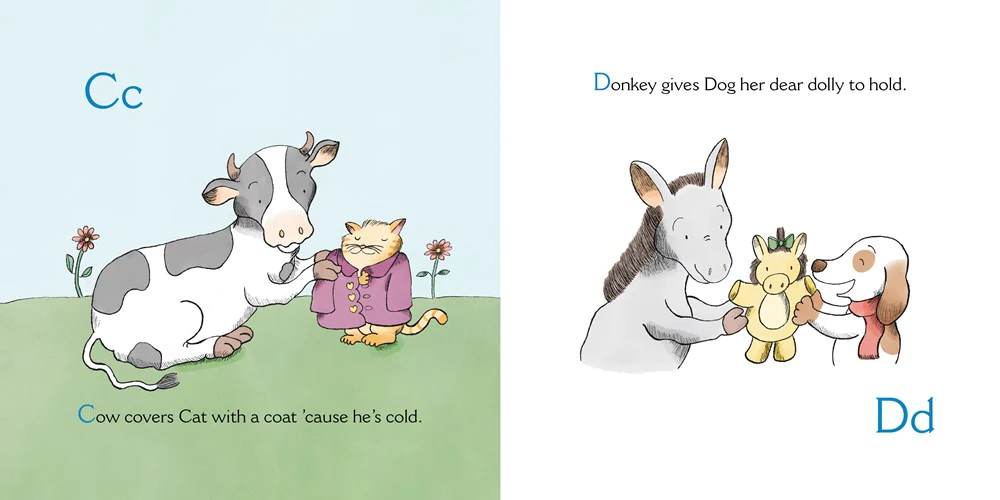
Ape picks an apple for Aardvark below.
Bat puts a bandage on Brown Bear’s big toe.

From aardvark to zebra, this delightful cast of animal characters illustrates the many ways to show kindness to others, while teaching the youngest readers their ABCs.

Debut author/illustrator and sister duo Rina Horiuchi and Risa Horiuchi have crafted a warm and tender gift that affirms kindness can be found anywhere.

Ricki’s Review: This book is just so charming. It is a great way to learn the alphabet along with all of the ways that we can be kind. The book doesn’t feel didactic, and it was enjoyable for me, as an adult reader. There aren’t just simple animal names on each page, but instead, they read like this: ““Narwhal takes Newt, his new neighbor, to lunch.” The repetition is really helpful for young readers. I’ve been having my 6-year-old read it to my 3-year-old, and it makes my heart swell. I love the ending, in which readers are asked how they are kind—this allowed for some great discussions in our house.

Teachers’ Tools for Navigation: This book inspires me to want to choose an emotion or an abstract concept to make my own alphabet book! Kids would have a lot of fun making a shared book together!

Discussion Questions: 

  • Which page was your favorite, and why?
  • How do you demonstrate kindness?
  • How do the pictures and words work together to create a vivid representation of kindness?

Flagged Spread: 

Recommended For: 

readaloudbuttonsmall classroomlibrarybuttonsmall 

RickiSig

**Thank you to Rina and Risa for this phenomenal book! It is a great addition to children’s literature!**

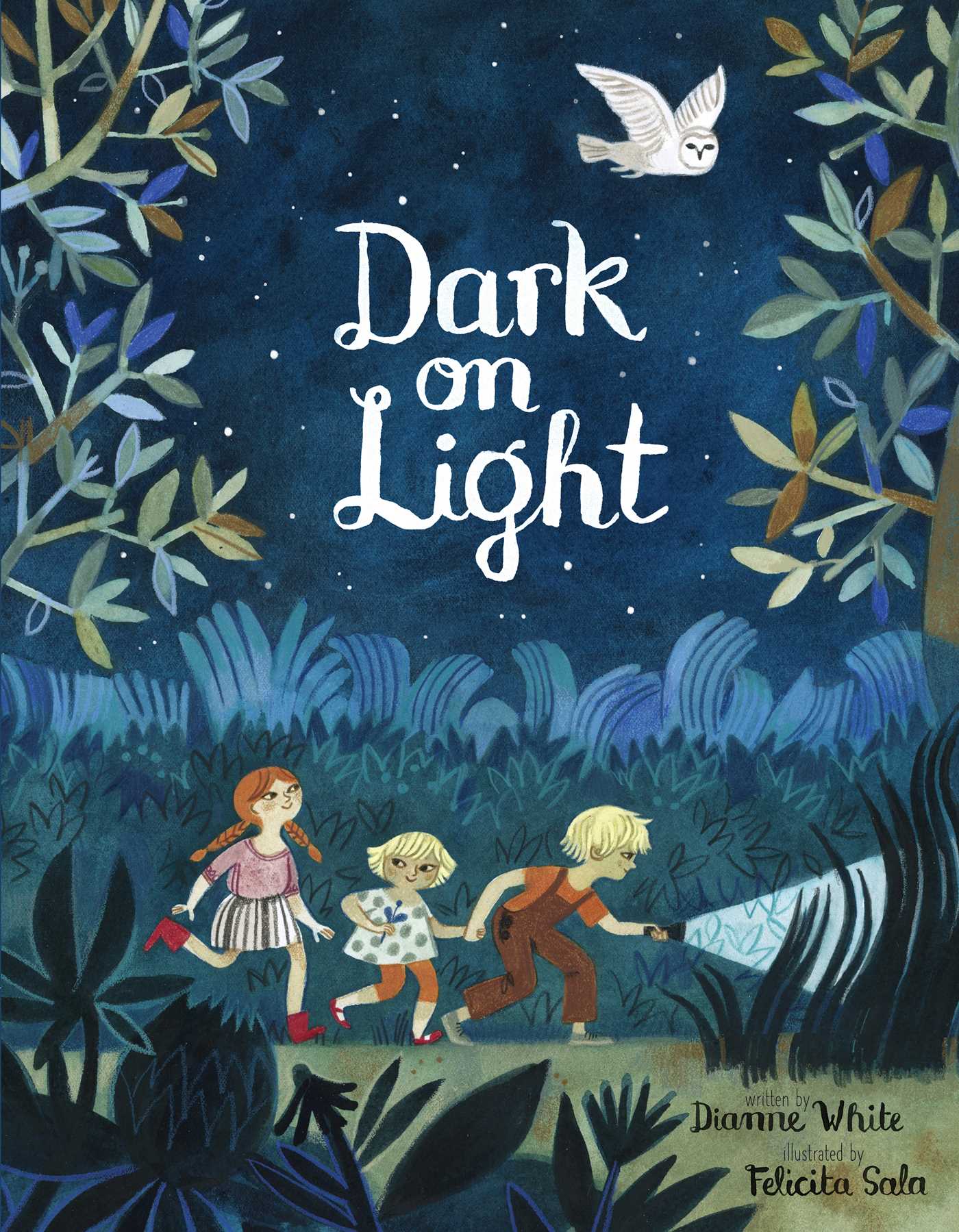
Dark on Light by Dianne White, Illustrated by Felicita Sala

Share

Dark on Light
Author: Dianne White
Illustrator: Felicita Sala
Publishing December 6, 2022 by Beach Lane Books

Summary: As the sun sets, three siblings discover nature’s nighttime beauty in this soothingly rhythmic and gorgeously illustrated bedtime picture book from the acclaimed author-illustrator team behind Green on Green.

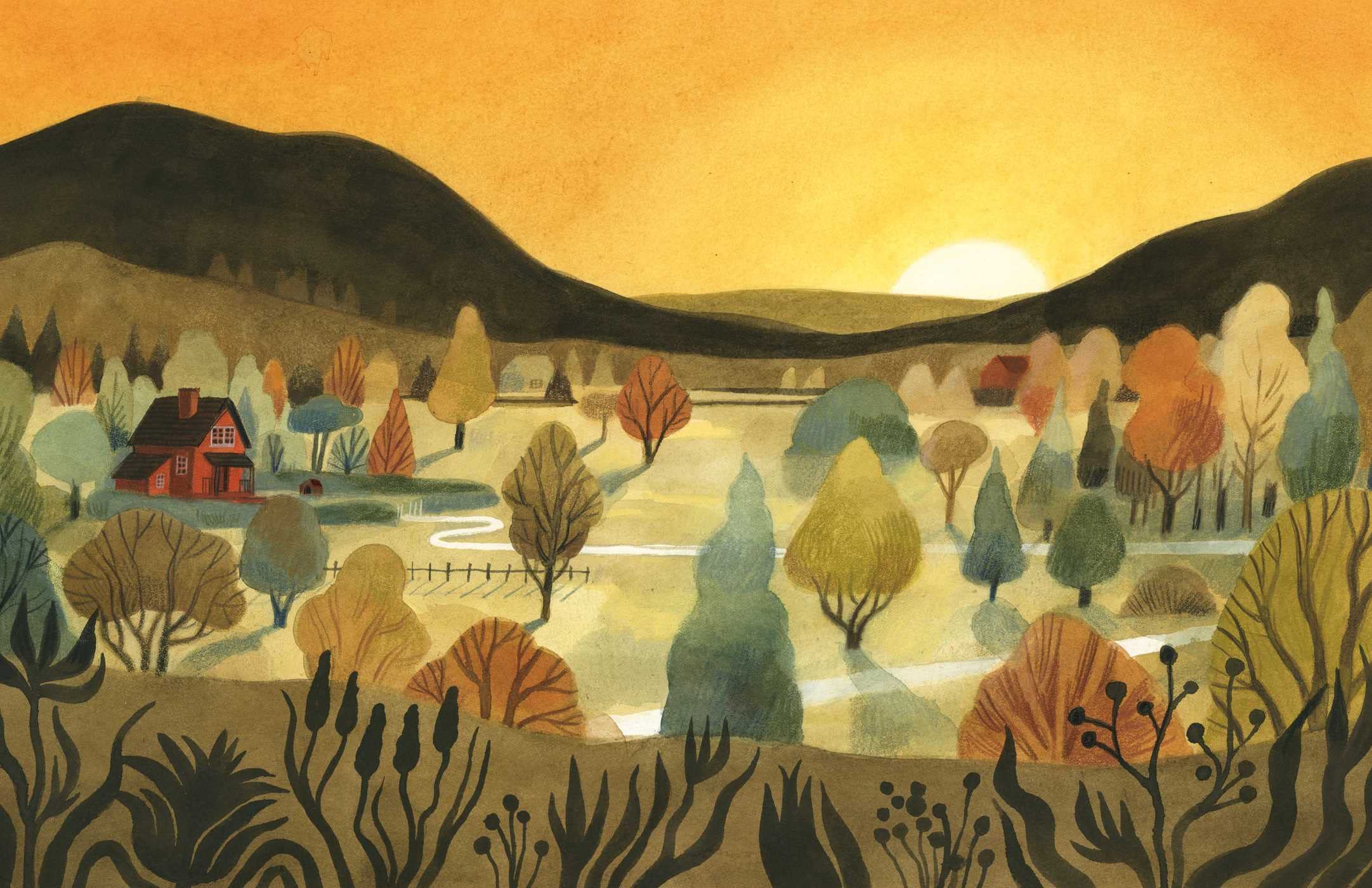
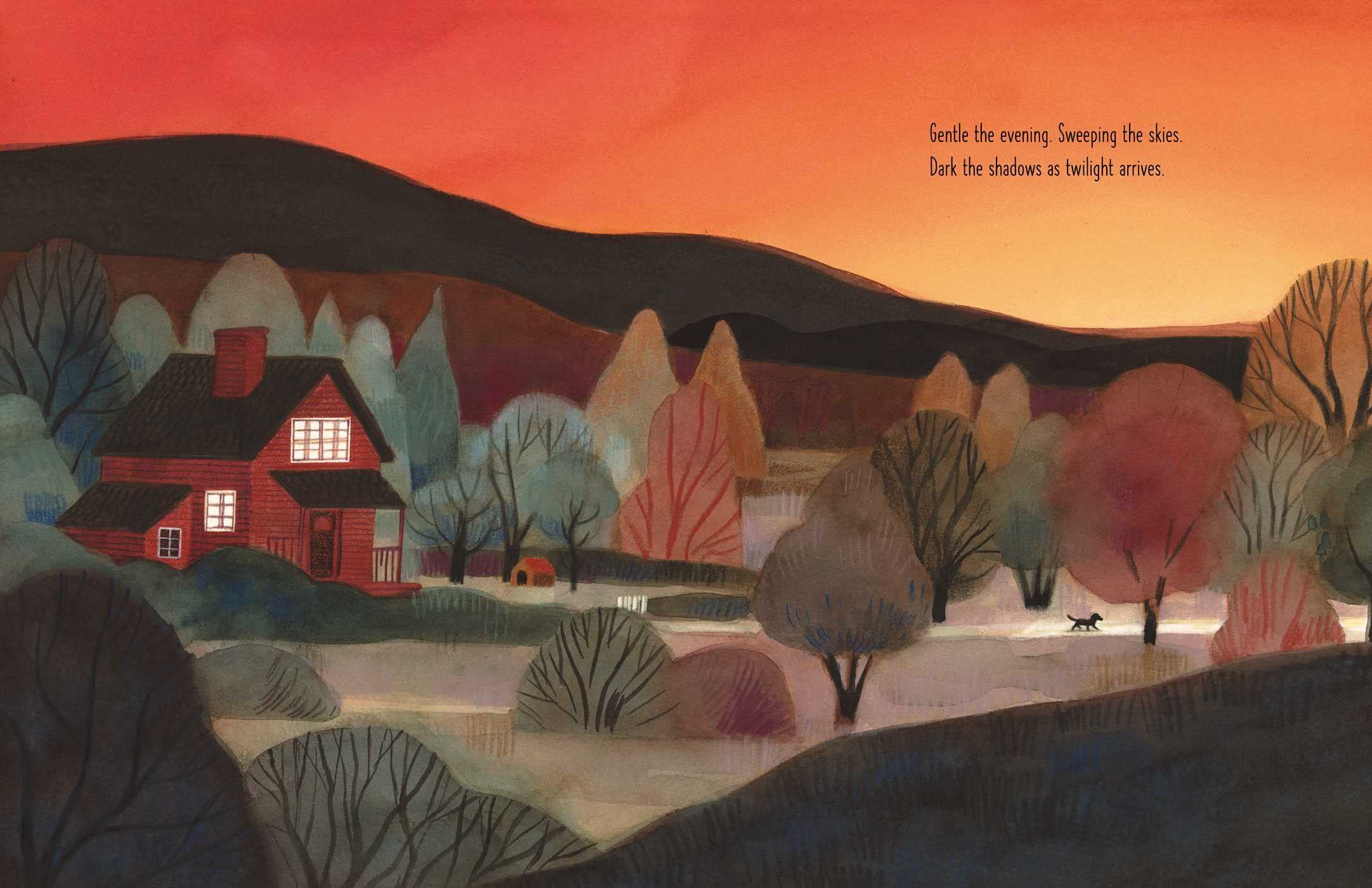
Gentle the evening. Sweeping the skies.
Dark the shadows as twilight arrives.
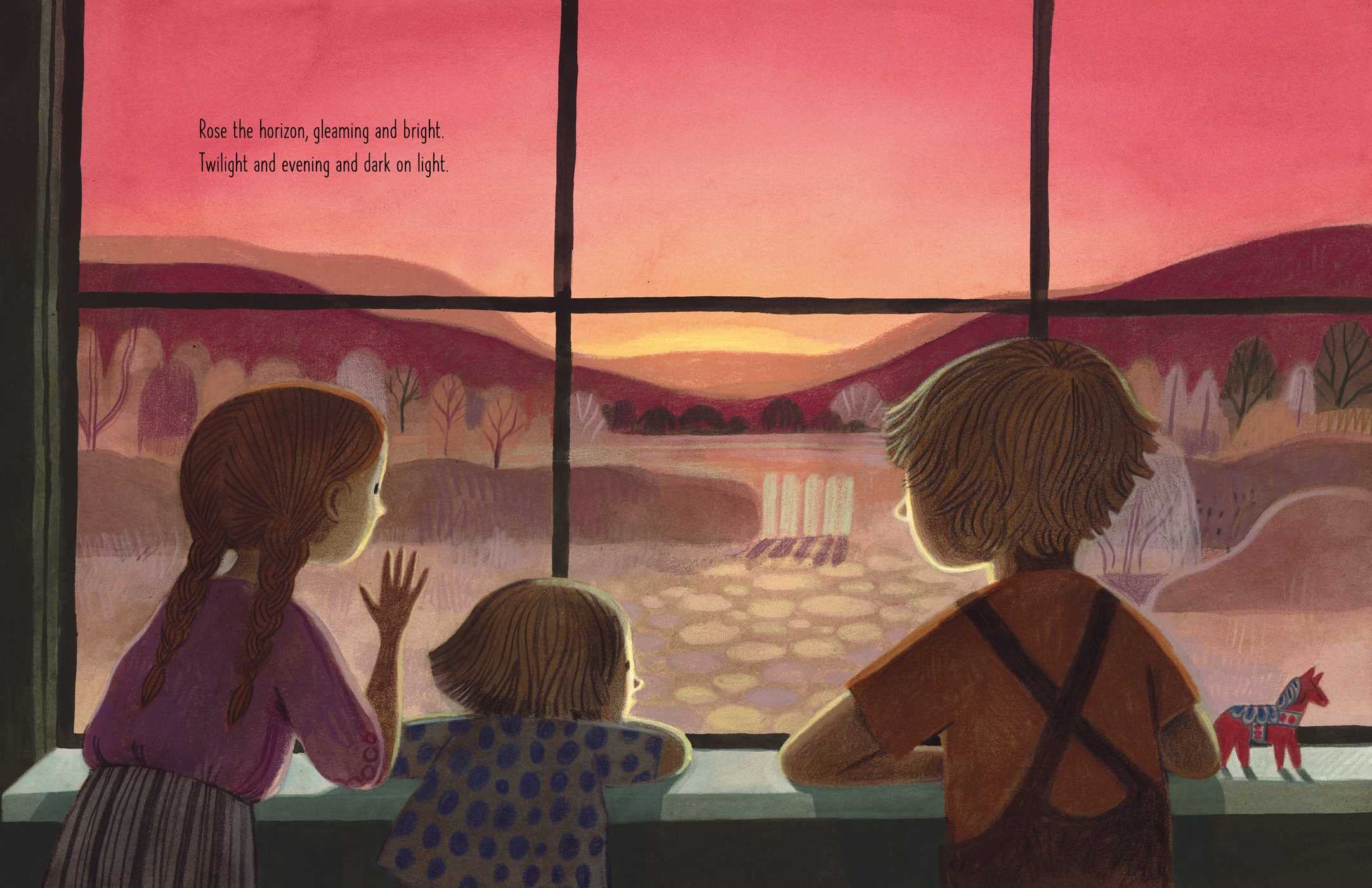
Rose the horizon, gleaming and bright.
Twilight and evening and dark on light.

When the family dog trots away from the house at sunset, three siblings tumble out the door to go find him. Soon they find themselves immersed in the luminous colors, shades, and shadows of nature at night—both dark and light. They wander through moonlit lavender meadows, past a timid fawn, beneath a snowy white owl, and much, much more as the night deepens until, at last, they find their sneaky pup.

With beautiful illustrations by Felicita Sala and lyrical text by Dianne White that’s perfect for reading aloud, this book invites young readers to step into the wondrous, colorful nighttime natural world.

Praise: 

“A bedtime chant capable of transforming anyone into a night owl. Sumptuous watercolor, gouache, and colored pencil illustrations show a day shifting from sunshine to twilight to a deepening night sky. Meanwhile, three children are pulling on their boots, grabbing their flashlights, and heading out into a nighttime world as alive as it is welcoming. As the children search and explore, the text repeats the words dark on light through mesmeric rhymes. “Orange the moon, burnished and bright. / Meadow and owl and dark on light.” At last the children peek into a burrow and find their dog, the object of their search. The nighttime is welcoming here, and the children return home to the cozy arms of their parents. Truly the entire enterprise feels similar in tone to Janice May Udry’s Moon Jumpers (1959), illustrated by Maurice Sendak, as when the children ramble through fields of fragrant lavender beneath a brilliant sky. This is a book capable of banishing nighttime fears, showing the night to be a time of wonder, exploration, and even comfort. Sala’s art matches the cadences of the text beat for beat, offering consistently beautiful images of this undiscovered nighttime world…. Lilting, haunting, rhyming, and as unforgettable as a dream the daylight just can’t quite erase.” – Kirkus Reviews, *STARRED REVIEW*, 9/15/2022

“The creators of Green on Green follow that seasonal work with one focused on shadow and light, centering lulling, mesmerizing sensate verse accompanied by artwork in warm, saturated hues…. Closing bedtime scenes in a shared bedroom embody warmth and security… in this quiet celebration of chiaroscuro in the natural world.” – Publishers Weekly, *STARRED REVIEW*, 10/24/2022

About the Creators: 

Dianne White lives in Gilbert, Arizona, with her family. She is the author of Who Eats Orange?, Blue on Blue, Green on Green, and Dark on Light.

Felicita Sala is a self-taught illustrator and painter. She has a degree in philosophy from the University of Western Australia. She now lives and works in Rome. She draws inspiration from nature, children, mid-century illustration, folk art, and architecture.

Review: Dianne White’s verse with Felicita Sala’s illustrations makes this book an instant read aloud need! The verse is so rhythmic and rolls off the tongue in a way that will make the book fun to read and listen to. The illustrations add another dimension to the words taking a beautiful poem and turning it into a narrative also. This book will make any reader want to go on a nighttime hike to investigate the beauty of the night.

Teachers’ Tools for Navigation: Here’s an author-provided activity kit!

Discussion Questions: 

  • How did the illustrator use colors to add to the mood of the book?
  • Pick a spread. What words in the stanza stands out to you? Why?
  • The reviews mention that Dark on Light is a book that is meant to read aloud. What about the verse written by White makes it so much fun to read aloud?
  • What fun things do you see in the illustrations as the kids venture outdoors?
  • Why do you think the creators chose to have the book end in daylight instead of nighttime?
  • With an adult, go on a nighttime walk and write a journal about what you saw.

Flagged Passages: 

“Gentle the evening. Sweeping the skies. Dark the shadows as twilight arrives.”

Rose the horizon, gleaming and bright. Twilight and evening and dark on light.

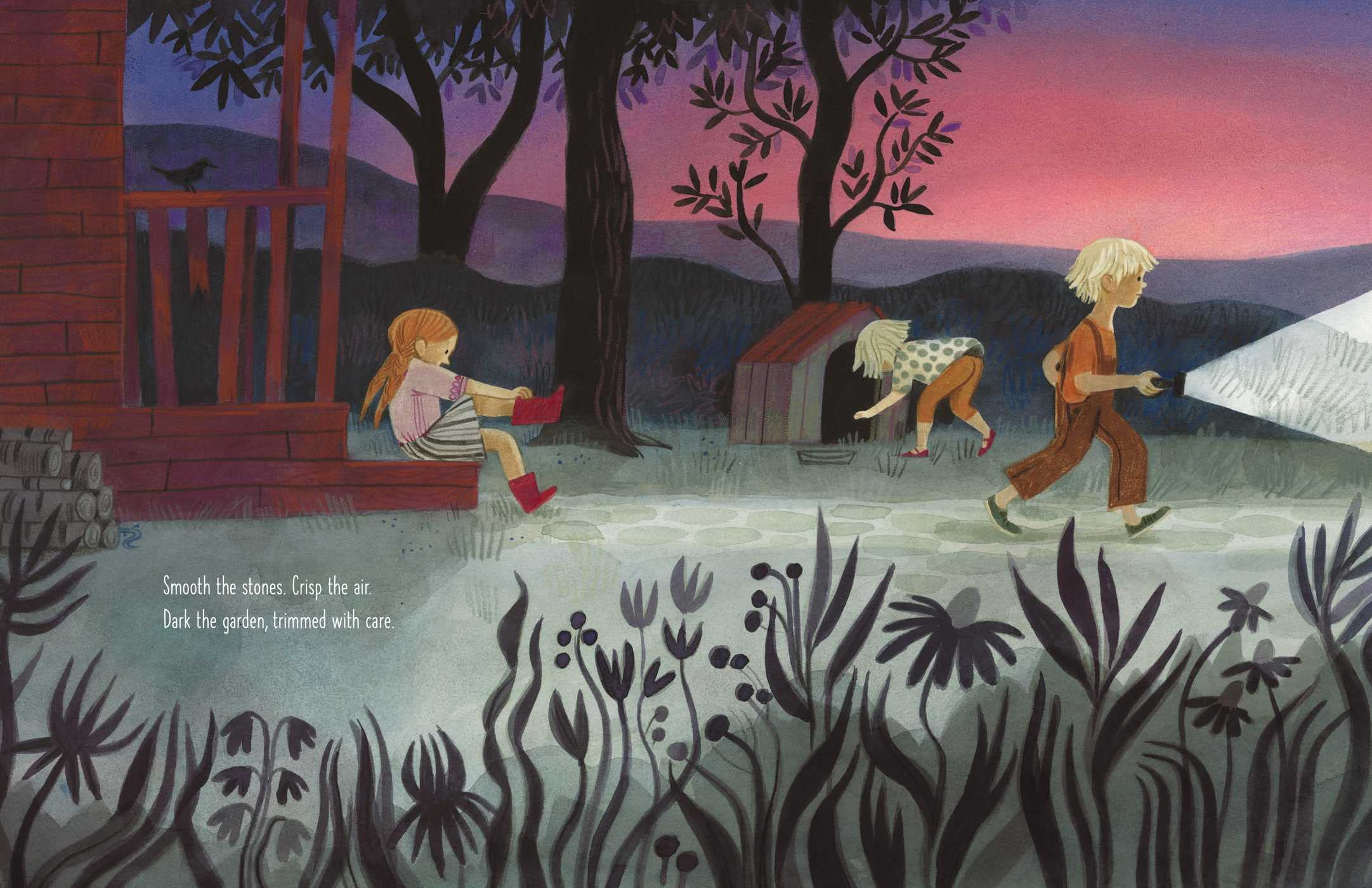
Smooth the stones. Crisp the air. Dark the garden, trimmed with care.

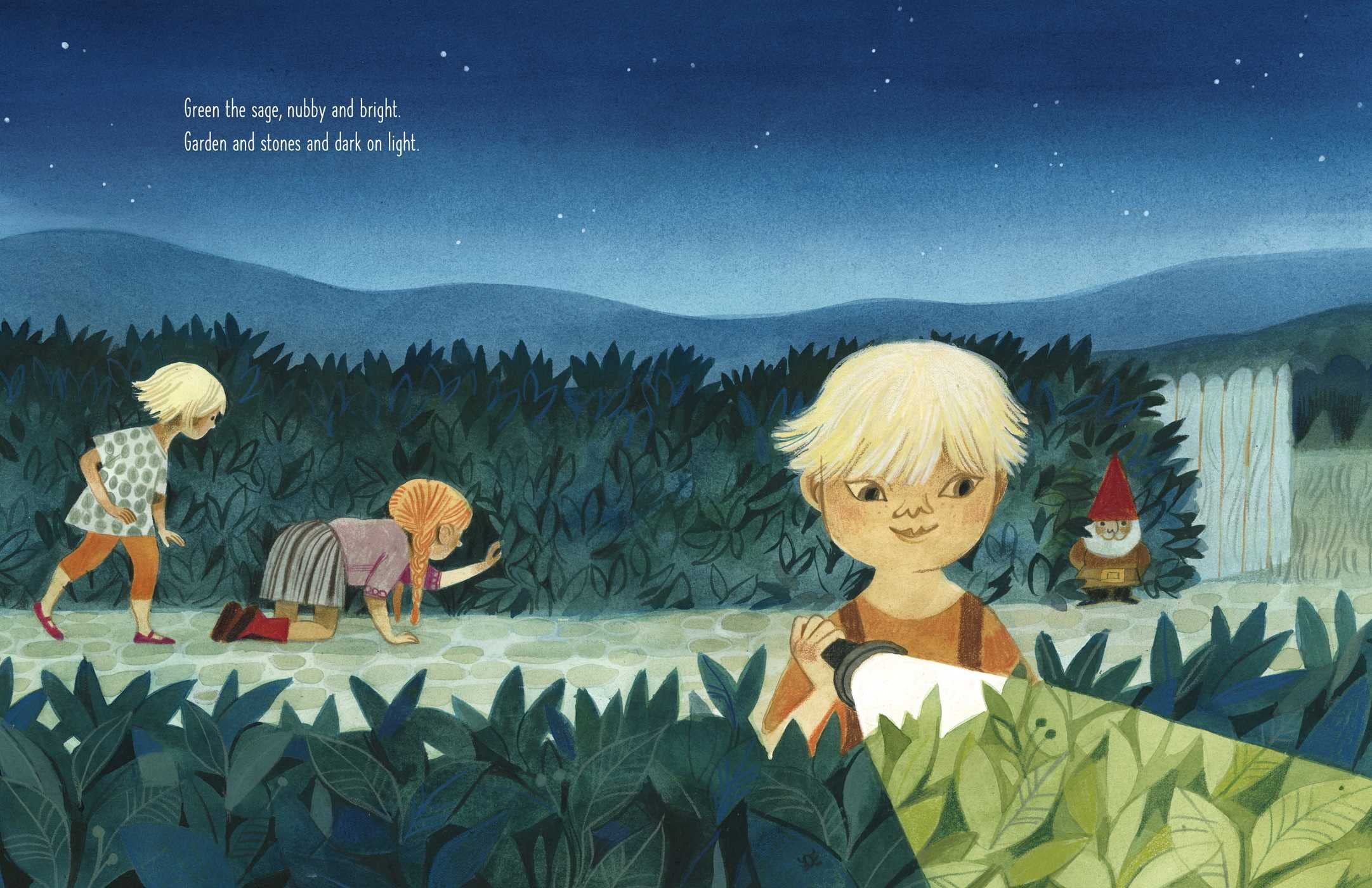
Green the sage, nubby and bright. Garden and stones and dark on light.”

Read This If You Love: Flashlight Night by Matt Forrest Esenwine; Night Animals by Gianna Marino; Noisy Night by Mac Barnett; The Night Gardener by Terry Fan; Goodnight, Butterfly by Ross Burach; Nighttime Symphony by Timbaland, Max at Night by Ed Vere

Recommended For: 

classroomlibrarybuttonsmall

Signature

**Thank you to Blue Slip Media for providing a copy for review!**

Review and Giveaway!: A Dream of Birds by Shenaz Patel, Illustrated by Emmanuelle Tchoukriel, Translated by Edwige-Renée Dro

Share

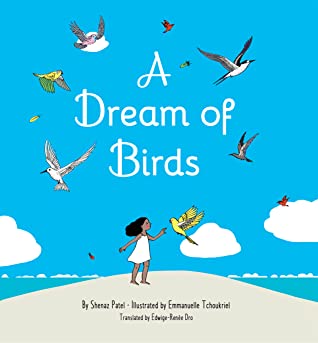
A Dream of Birds
Author: Shenaz Patel
Illustrator: Emmanuelle Tchoukriel; Translator: Edwige-Renée Dro
Published August 16, 2022 by Amazon Crossing

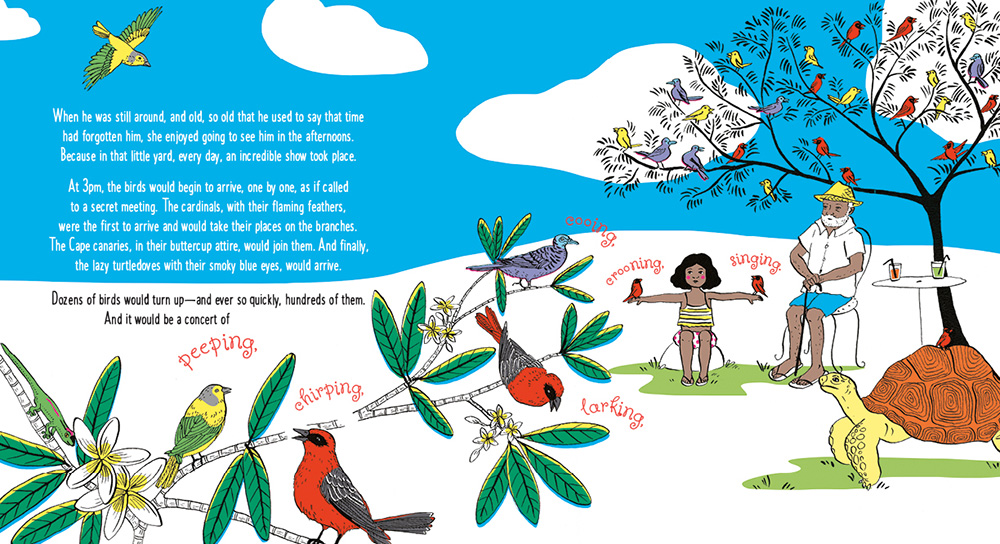
Summary: Sara has a thing for birds. They remind her of her grandfather, who loved birds, and the wonderful show the creatures would put on in his yard each day―like a cloud of colorful flowers carried by the wind.

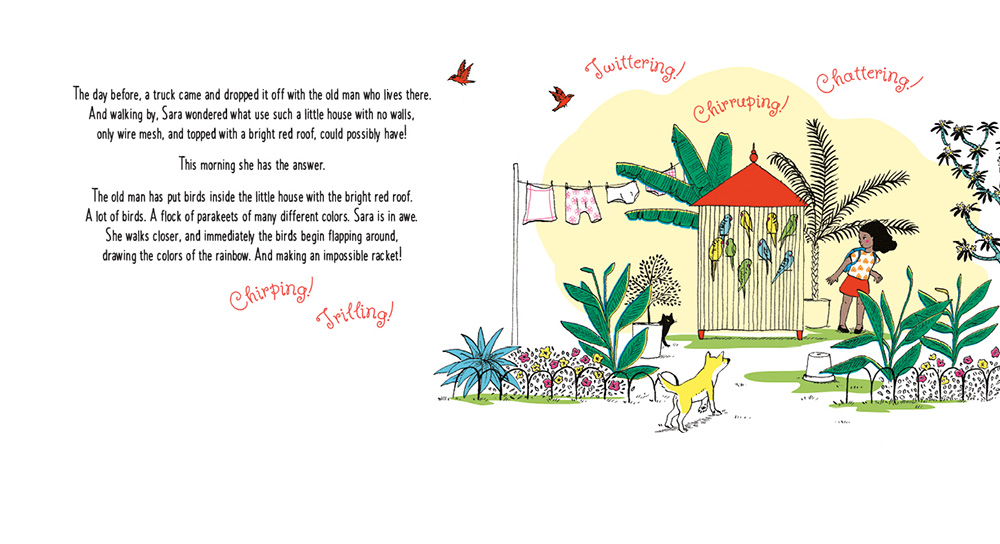
As Sara walks to school in her island town, she longs for the freedom of those birds. Then she spots a new birdhouse full of parakeets in someone’s yard. Sara feels drawn to them and unable to forget them. So what happens the next time, when she finds the door to the birdhouse unlocked?

With poetic language and beautiful art, this story set on the African island of Mauritius brings to life a little girl’s deep love of nature, her brash but well-meaning choice, and ultimately, her redemption and dream for a better world.

About the Creators:

Shenaz Patel was born and lives on Mauritius Island. She has several jobs: journalist, playwright, novelist, and translator, and she is also a comics and children’s book author. She has written nine books for children, including A Dream of Birds, which was first published in French and English in Mauritius and France. She was named Chevalier des Arts et des Lettres in 2013, a high honor given by the French minister of culture.

Emmanuelle Tchoukriel was born and lives in France. Passionate about nature, she studied visual communication before entering the Estienne School in Paris. She specialized in scientific drawing, and she excels in illustrating flora and fauna. On Instagram: @emanuelle_tchoukriel

Edwige-Renée Dro is a writer, translator, and literary activist from the Ivory Coast, in Africa. Her writings have been published in anthologies such as New Daughters of Africa and Africa39, among others. She has judged many literary prizes, including the PEN International New Voices Award and the Etisalat Prize for Literature. She was awarded the Miles Morland Writing Scholarship in 2018 and is a 2021 resident of the International Writing Program at the University of Iowa. Learn more at edwigedro.wordpress.com. Twitter: @DroEdwige; Facebook: Renée Edwige Dro

Ricki’s Review: For me, this beautiful translation is about freedom and preservation. It reminds readers to pause and pay attention to the world around them and to act. It allows readers opportunities to evaluate the decisions they have made in their lives and the impact they have. It also allows readers to consider the lessons they have learned throughout their lives. A Dream of Birds celebrates the diversity of birds in Mauritius, an African island in the Indian Ocean, and it celebrates the passion and commitment of a child.

I loved how the backmatter gave more background of the story. This book is a translation, and there are more words on the page than stories I’d typically find in US households. Yet my kids (ages 8, 5, and 3) sat and listened to the story without breaking their gaze. They were drawn in by the onomatopoeias, the engaging story, and the bright illustrations. We need more international literature in our schools and homes, and this book shines brightly.

Kellee’s Review: Sara’s story is multi-faceted. It is a story of captivity and longing and family and memories. It is a story of beauty and nature and freedom and dreams. It is also a story of reality and consequences.

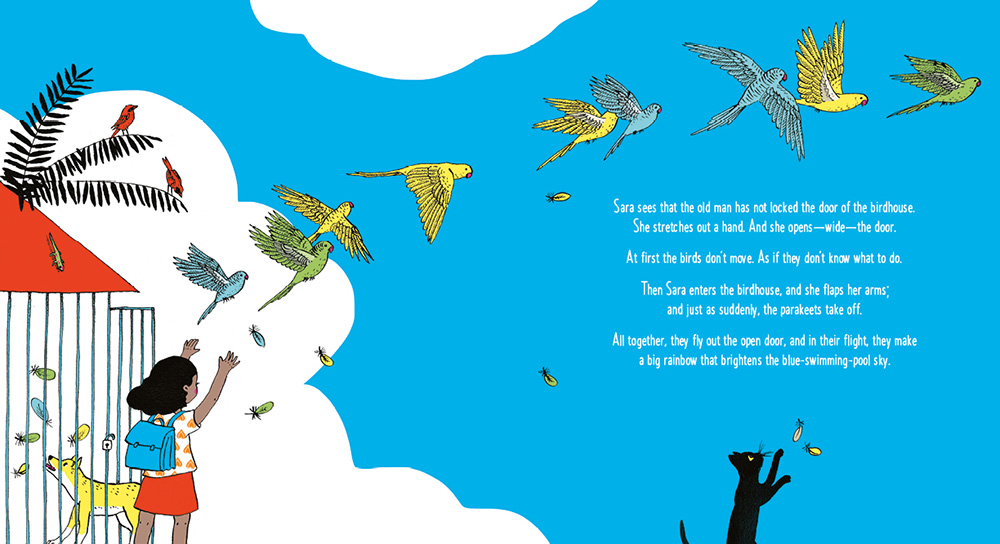
The story looks at Sara who meets a man with pet birds which reminds her of feeding wild flocks of birds with her grandfather. She hates seeing the captured books, all wings and beauty, not allowed to be free, so she makes a rash decision and frees the birds. Although her motives are made clear, her mother also explains to her that it was wrong to let domesticated birds go–this is a good lesson because it distinguishes between a well meaning action and a well thought out positive action. The book ends with a celebration of the diverse birds on Mauritius, an African Island in the Indian Ocean, and a reminder to celebrate animals’ wildness.

Although the narrative was a bit wordy for me at some points, the beautiful illustrations make the reader want to savor each page which helps move you through Sara’s story.

Teachers’ Tools for Navigation: Students might use this book as a jumping off point to learn more about Mauritius, Africa, and the Indian Ocean. They could pick a specific topic of exploration related to their interests.

Discussion Questions: 

  • What does Sara learn? Do you agree with the decisions she made?
  • What did you learn about Mauritius, Africa, and/or the Indian Ocean?
  • What lessons have you learned in your life?
  • What birds do you observe around your home?
  • Why was it wrong for Sara to let the birds go? Were her intentions good or bad?
  • Why is it important to leave wild animals wild?

Flagged Spreads: 

Read This If You Love: Birds, Animals, Environment

Giveaway:

a Rafflecopter giveaway

Recommended For: 

and Signature

**Thank you to Barbara at Blue Slip Media for providing a copy for review!**

Instagram: @blue_slip_media; Facebook: Blue Slip Media

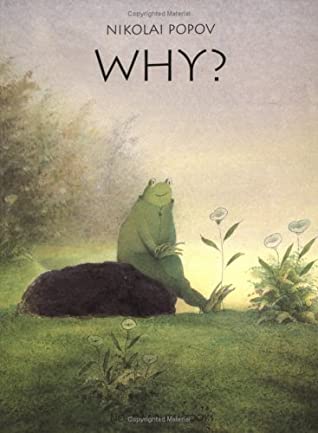
Guest Review: Why? by Nikolai Popov

Share

Guest Reviewer: Heather, UCF Elementary Education Student

Why?
Author & Illustrator: Nikolai Popov
Published 1996 by North-South Books

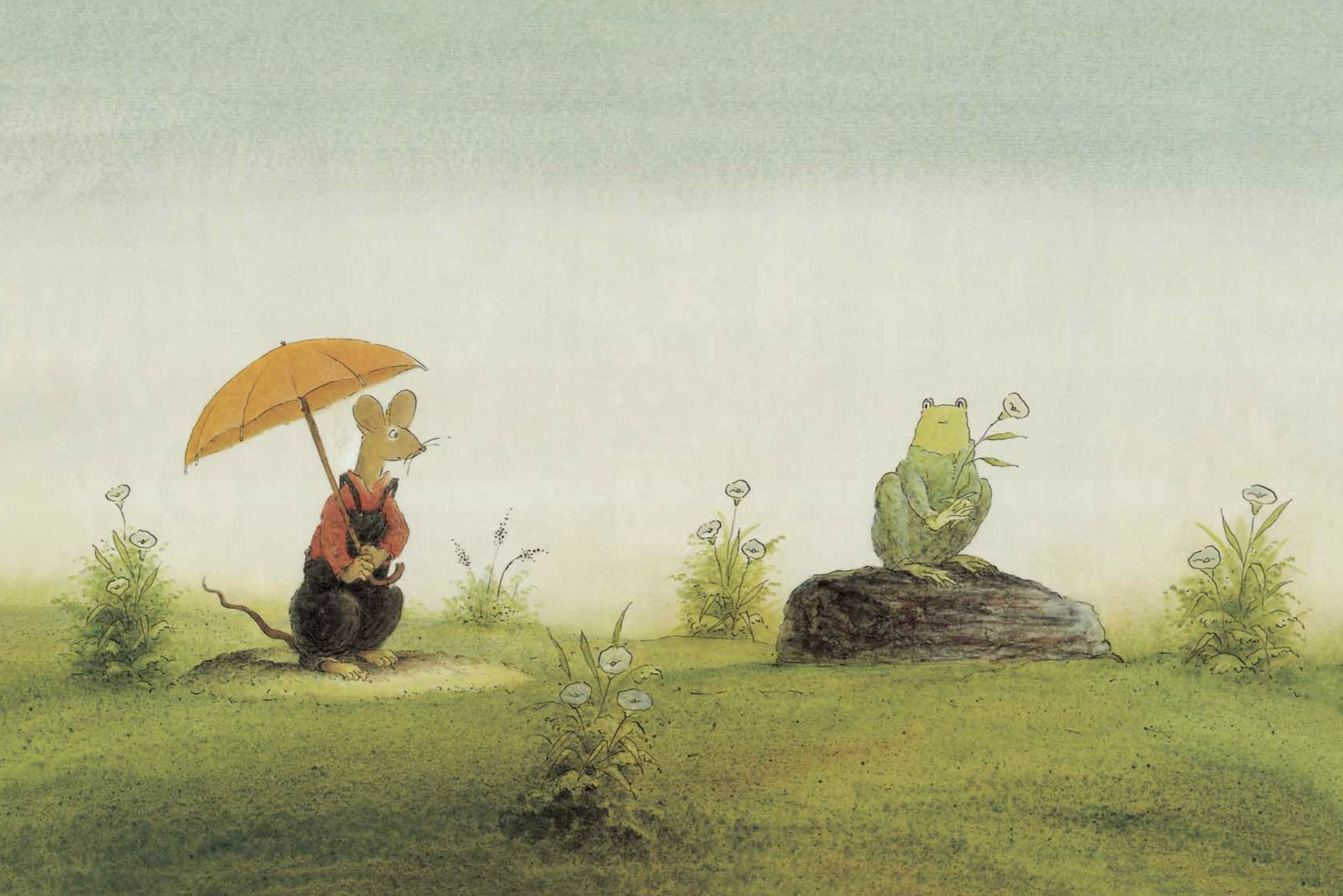
Summary: A frog sits peacefully in a meadow. Suddenly, for no apparent reason, he is attacked by an umbrella-wielding mouse in a confrontation that quickly turns into a full-scale war.

About the Author: Nikolai Popov is a well-known Russian visual artist and illustrator. He has won multiple gold medals and Grand Prix at international exhibitions of children’s book illustration. Popov has had personal exhibitions in many cities of the world, including Moscow, Tokyo, Rome and Venice. He is an honorary member of the Russian Academy of Arts.

Review: I found this book to be a beautiful way to describe the trials and tribulations of war without using words or realistic art depicting the violence war contributes to. It is a E-rated way to show that war is seemingly senseless and can be an endless cycle, where ultimately no one wins. I think on top of that, the artwork of watercolor and animals was really beautiful, and seemed very fairytale-like. I liked that the frog found a pretty flower and that the mouse is shown to be jealous even though he is surrounded by similar florals. I think this is a good way to show (not only a war aspect) but just a way to describe how we may not know what we have available to us because we are so focused on what others have instead. The fact that this book has no words and the story is completely implied by the images is also an important thing to note here because it can be up for debate as to what the actual goal of the story is – is it war? Or could it be selfishness, jealousy, or some could even think maybe the mouse doesn’t like frogs (micro-aggressions?). This availability for interpretation is a good way to get a multitude of ideas started without given any hints as to the authors key goals (if not getting author/book background information before reading).

Teachers’ Tools for Navigation: This book would be supplemental in unison with history lessons revolving around a time-period of another war scenario, like WWI or WWII. It would be a good way to help students navigate how easily wars can start and how hard it is to find a real reason for violence when the outcome is unclear. This book would also be good to use when discussing the problem with bullying or isolating others, it would be a good way to give students an idea of why it is crucial to be kind and think of others because in the end, you end up asking WHY did we even do this in the first place? Students can learn about needless fighting and apply this mindset/theory to their own lives, from how they treat others, to family and school environments as well.

And the last page! Looking at it I get that “throat swelling” feeling right before you cry. Its a painful image. The flowers are gone, the animals are sad, everything is ruined – the worst part is, no one got to enjoy what an entire field had to offer.

Discussion Questions: 

  • On page 4, the mouse looks around after coming up from the ground, what do you think he is looking at?
  • On page 5, we see the mouse looking at the frog – what is he thinking?
  • On page 7, the frog looks upset, and on the next page, more frogs come into the picture – do you think the frog called for them? What if the frogs didn’t come?
  • What kind of weapons are the animals using? Why do you think the illustrator chose these items?
  • In the end, how do the frog and mouse appear to be feeling?

Flagged Passages: 

Read This If You Love: Concepts of peace, unity, discussing the issues with our world and problems with humanity

Recommended For: 

classroomlibrarybuttonsmall

Thank you, Heather, for your review!