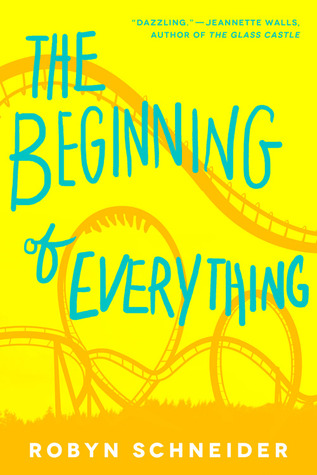
The Beginning of Everything by Robyn Schneider

Share

beginning

The Beginning of Everything
Author: Robyn Schneider
Published August 27, 2013 by Katerine Tegen

Goodreads Summary: Golden boy Ezra Faulkner believes everyone has a tragedy waiting for them—a single encounter after which everything that really matters will happen. His particular tragedy waited until he was primed to lose it all: in one spectacular night, a reckless driver shatters Ezra’s knee, his athletic career, and his social life.

No longer a front-runner for Homecoming King, Ezra finds himself at the table of misfits, where he encounters new girl Cassidy Thorpe. Cassidy is unlike anyone Ezra’s ever met, achingly effortless, fiercely intelligent, and determined to bring Ezra along on her endless adventures.

But as Ezra dives into his new studies, new friendships, and new love, he learns that some people, like books, are easy to misread. And now he must consider: if one’s singular tragedy has already hit and everything after it has mattered quite a bit, what happens when more misfortune strikes?

Robyn Schneider’s The Beginning of Everything is a lyrical, witty, and heart-wrenching novel about how difficult it is to play the part that people expect, and how new beginnings can stem from abrupt and tragic endings.

My Review: Another novel filled with smart high schoolers—that makes me so happy!! I hope this is a trend because I love seeing brainy characters in my book and not stereotypical ones. The Beginning of Everything is described as witty, and it is very much so. The sarcasm and wit just bleeds out of this book. I found myself laughing out loud at parts, and usually just because a character had the audacity to say something they shouldn’t have.

In The Beginning of Everything, I actually connected more with the secondary characters than the protagonist. They were so well established and had such unique voices while Ezra sounded like any good-0le boy; however, I will say that by making his voice less distinct allowed for him to grow even in his prose. As he found his new, true identity, his voice became to ring out more true. I am not sure if the author did this on purpose or not, but either way it worked!

Oh, and the final pages. Guys, they were so good! Although it felt a bit rushed to me, the lyrical writing got me in the end. Perfect.

Teachers’ Tools for Navigation: Although this book’s main home is in teens’ hands from a classroom, school, or public library, there are definitely parts that can be pulled out to be used in a classroom.

Since the characters are intelligent, many of the conversations have allusions to literature (Mary Oliver, Shakespeare, Fitzgerald, Frost) or their topics are quite deep (connecting organic chemistry to life, panopticon, Banksy, German insults). Also, there are debate topics that would be so interesting to look into such as imperialism, capitalism, and the economy.

One fun activity that I would definitely pull out of this book is fake debates. When Ezra, Toby, Cassidy, etc. were at their debate tournament, they had fake debates where they had to choose a side of quite silly topics like “Should vampires be allowed to vote?” This would be a great activity to do in classes to work on persuasion and arguments. (However, be careful about actually reading aloud the scene this is in as they also make it a drinking game.)

Discussion Questions: Do you feel like we live in a society similar to the panopticon? [If you don’t know what this is, it is quite fascinating: http://en.wikipedia.org/wiki/Panopticon]; Do you think Cassidy made the right choice in the end?; Ezra truly connects with The Great Gatsby because of all the changes his life is going through. What book to you connect with and why?

Flagged: “Her face was inches from mine. I could see the freckles that dusted her nose and the gold flecks in the disquieting blue of her eyes.” (p. 111)

“My admirable opponent argues that vampires do not deserve suffrage, as many great yet misinformed politicians have done before her while calling for the continued marginalization of women, or other minorities.” Cassidy began. “Yet vampires were, at some point human. At what point can a man’s voting rights be revoked, if he is proven to be of rational mind?” (p. 157)

Read This If You Loved: Life in Outer Space by Melissa Kiel, Stargirl by Jerry Spinelli, Paper Towns by John Green

Recommended For: 

classroomlibrarybuttonsmall closereadinganalysisbuttonsmall

Signature

What Do You Do When Something Wants To Eat You? by Steve Jenkins

Share

NF PB 2014

Nonfiction Picture Book Wednesday

Nonfiction Picture Book Wednesday is hosted by Kid Lit Frenzy and was started to help promote the reading of nonfiction texts. Most Wednesdays, we will be participating and will review a nonfiction text (though it may not always be a picture book).
Be sure to visit Kid Lit Frenzy and see what other nonfiction books are shared this week!

eatyou

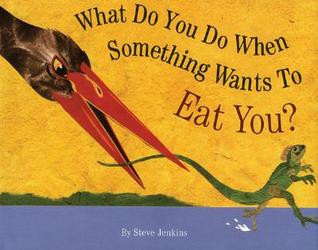
What Do You Do When Something Wants To Eat You?
Author and Illustrator: Steve Jenkins
Published October 27th, 1997 by HMH Books for Young Readers

Goodreads Summary: What would you do if something wanted to eat you? Walk on water? Stick out your tongue? Play dead? Animals in the wild use all kinds of methods to protect themselves from their enemies. Using dynamic and intricate cut-paper collages, Steve Jenkins explores the many fascinating and unique defense mechanisms creatures use to escape from danger.

My Review: Steve Jenkins just has a way of making nonfiction more interesting than other authors, and this book is no different than his others. This book takes different animals and shows the different ways they protect themselves: from squirting ink to camouflage.  The illustrations are done in Steve Jenkins’s paper-cut style and are done as well as his other books. The text, though simple, is full of information and definitely makes the reader want to learn more.

Teachers’ Tools for Navigation: This book can definitely be used in reading and science class. It is a good introduction to animal defenses and animal adaptations. It can lead to inquiry and research of each of these animals. It would be a great first research project for students to choose one of the animals and learn more about them. It is also a good introduction to cause and effect. What causes _____ to need to defend themselves? What is the effect of ____ being attacked?

Discussion Questions: What type of defenses do animals use to keep themselves from being harmed?; How does camouflage work?; What causes animals to need to defend themselves? What are the effects of them being attacked?

We Flagged: “A flying fish escapes danger by leaping from the water, spreading its winglike fins, and gliding as far as a thousand feet.”

Read This If You Loved: Any Steve Jenkins book, Any Seymour Simon animal book, Lifetime by Lola M. Schaefer, Frog Song by Brenda Z. Guiberson

Recommended For: 

readaloudbuttonsmall closereadinganalysisbuttonsmall
classroomlibrarybuttonsmall litcirclesbuttonsmall

Signature

The Fox in the Library by Lorenz Pauli

Share

the fox in the library

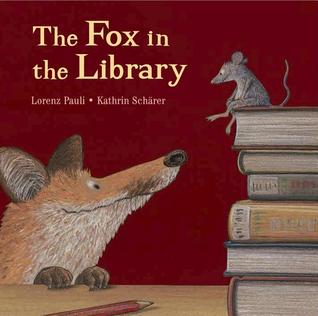
The Fox in the Library
Author: Lorenz Pauli
Illustrator: Kathrin Schaerer
Published August 1st, 2013 by NorthSouth

Summary: Fox didn’t come to the library to read a book–he came to catch a mouse! But  Mouse offers the fox a book, Fox gets all sorts of creative new ideas.  Like eating chickens!  Until Chicken points out that chicken bones are dangerous. But then all the animals must band together when the chicken eating, hating-Farmer walks into the library.

Review: I am a sucker for books about bookstores, books, and libraries. I imagine this is the same for all book lovers. The illustrations in this book are bright, and it was very fun to read it to my son. I don’t think you can read too many books about books to kids. They need to understand that there is a world of books out there, and going to the library is cool! Some books lend themselves to silly voices—and this is certainly one of those books. The mouse even mocks the fox for calling the library a “lie-berry.” I suspect that kids won’t ever forget the pronunciation after hearing this book.

Teacher’s Tool For Navigation: This would be a great book to read to children before a trip to the library. It would stir their imaginations and make them excited to discover all of the creatures that may lurk while they visit.

Discussion Questions: How does Mouse outsmart the fox?; What do the animals learn in their trip?; What kinds of books appeal to each of the animals?


We Flagged: “‘Nothing here belongs to you,’ Mouse said with a giggle. ‘You can only borrow things here. And I’ll never be yours. This isn’t the forest; this is the library'” (6).

Read This If You Loved:  Library Lion by Michelle Knudsen, Wild About Books by Judy Sierra, The Boy who was Raised by Librarians by Carla Morris, Tomas and the Library Lady by Pat Mora

Recommended For: 

readaloudbuttonsmall classroomlibrarybuttonsmall

RickiSig

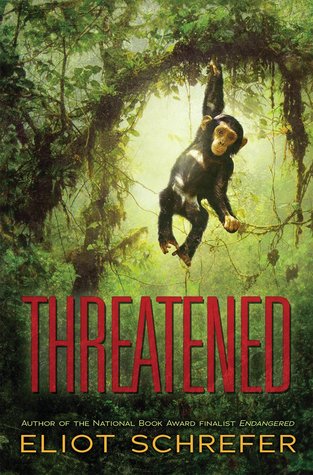
Threatened by Eliot Schrefer

Share

threatened

Threatened
Author: Eliot Schrefer
Published: February 25th, 2014 by Scholastic Press

GoodReads Summary: Into the jungle. Into the wild. Into harm’s way. When he was a boy, Luc’s mother would warn him about the “mock men” living in the trees by their home — chimpanzees whose cries would fill the night. Luc is older now, his mother gone. He lives in a house of mistreated orphans, barely getting by. Then a man calling himself Prof comes to town with a mysterious mission. When Luc tries to rob him, the man isn’t mad. Instead, he offers Luc a job. Together, Luc and Prof head into the rough, dangerous jungle in order to study the elusive chimpanzees. There, Luc finally finds a new family — and must act when that family comes under attack.

As he did in his acclaimed novel Endangered, a finalist for the National Book Award, Eliot Schrefer takes us somewhere fiction rarely goes, introducing us to characters we rarely get to meet. The unforgettable result is the story of a boy fleeing his present, a man fleeing his past, and a trio of chimpanzees who are struggling not to flee at all.

Review: If you follow this blog, you know that Kellee and I are advocates for Eliot Schrefer’s writing. He is an incredibly talented writer; his settings feel authentic in that he makes far away places seem very close to home. I develop a strong kinship with his characters—animal or human. Kellee has been raving about Threatened since the ALAN conference, and I knew I wanted to read it as soon as I got a hang of being a new mom. It didn’t disappoint. The writing is stunning.

I expected Threatened to be very similar to Endangered, but I was wrong. Endangered is about an American girl visiting her mother in a Congolese bonobo sanctuary when a civil war breaks out. Threatened, on the other hand, is about an orphan boy from Gabon who goes into the wild with a professor in order to learn more about chimpanzees. But these books are more than their settings and the animals. They teach us about what it means to be human. Threatened, in particular, made me think about humanity’s evolution and the difficulties that come from living in the wild. I couldn’t help but think about how far humanity has strayed from nature. Even when Luc feels that he wants for nothing, he is ashamed that he still holds material desires. This book makes readers think critically, and it would be a great book to use in the classroom.

Teacher’s Tools for Navigation: After reading this book, I wanted to learn more about chimpanzees and how they are different from humans. Schrefer’s book has a call to action. He gives suggestions of how we might help these endangered animals. In particular, he discusses the sad state of animal testing and provides readers with ways to take action. This book will help students become critical thinkers, and hopefully, teachers will help students enact social justice for these animals which are so genetically close to us.

Discussion Questions: Are humans too far removed from nature?; How does Luc become more animalistic after he lives for extensive time in the wild? Are his changes mental? Physical?; What do the chimpanzees teach us about humanity? How are they similar and different from us?; What can we do to help these endangered species?

We Flagged: “We can try so hard, but in some basic way we’re bound by how we’re raised. There’s no escaping it. We can love someone and want to be open to the feeling but fail because our hearts got wired one way long before we knew it was happening. We can break our own hearts because of what our souls believe” (Chapter 10).

**Please note: This quote is taken from the NetGalley. It may be different in the published version of the book.**

Read This If You Loved: Endangered by Eliot Schrefer, Into That Forest by Louis Nowra, Dog Boy by Eva Hornung, Second Nature by Alice Hoffman, Into the Wild by Jon Krakauer

Recommended For:

 readaloudbuttonsmalllitcirclesbuttonsmallclassroomlibrarybuttonsmall

RickiSig

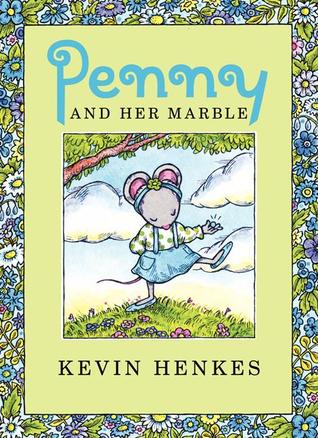
Penny and Her Marble by Kevin Henkes

Share

penny

Penny and her Marble
Author and Illustrator: Kevin Henkes
Published February 19th, 2013 by GreenwillowBooks

Goodreads Summary: In the third easy-to-read book about Penny the mouse, written by Caldecott Medalist and bestselling author Kevin Henkes, Penny finds a beautiful marble on her neighbor’s lawn and must decide whether or not to keep it. With age-appropriate vocabulary, compelling characters, and a memorable storyline, this is just right for newly independent readers.

Kevin Henkes is known for his mouse characters, including Lilly, Owen, Chrysanthemum, Wemberly, and now Penny! In Penny and her Marble, the third book in the Penny series, Penny finds a marble on Mrs. Goodwin’s yard and takes it home. But does the marble really belong to Penny? Kevin Henkes is a master at creating beautifully illustrated books that resonate with young children. The Penny books are new classics for beginning readers and will appeal to fans of Frog and Toad, Little Bear, and Henry and Mudge.

Review and Teacher’s Tools for Navigation: I am a huge fan of Kevin Henkes. I really enjoy everything he writes—he is so talented! His work ranges from picture books to early readers to chapter books to middle grade novels and all that I’ve read, I’ve enjoyed, and Penny and Her Marble was no different. Like the Goodreads summary says, Penny’s story is perfect for our early readers. Her story is one that children will connect with; however, Henkes never talks down to his readers. What struck me was the beautiful language that he used throughout–to describe Penny’s feelings, the marble, the day, etc.

Discussion Questions: If you were Penny, would you have kept the marble?; Is there anything you’ve taken without asking? What did you do?; Like Kevin Henkes does, look at different marbles and use similes to describe them.

We Flagged: “The marble was so blue it looked like a piece of the sky. Penny went to the window and held up the marble. She was right. The marble was like a piece of the sky.” (p. 16-17)

Read This If You Loved: Other Kevin Henkes books, Frog and Toad by Arnold Lobel, Little Bear by Else Holmelund Minarik, Scaredy Squirrel by Melanie Watt

Recommended For: 

readaloudbuttonsmall classroomlibrarybuttonsmall

Signature

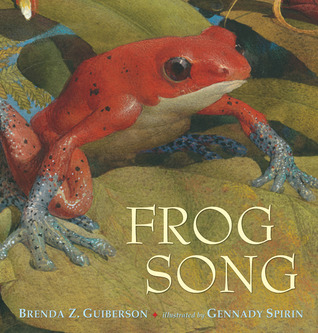
Frog Song by Brenda Z. Guiberson

Share

NF PB 2014

Nonfiction Picture Book Wednesday

Nonfiction Picture Book Wednesday is hosted by Kid Lit Frenzy and was started to help promote the reading of nonfiction texts. Most Wednesdays, we will be participating and will review a nonfiction text (though it may not always be a picture book).
Be sure to visit Kid Lit Frenzy and see what other nonfiction books are shared this week!

frogsong

Frog Song
Author: Brenda Z. Guiberson
Illustrator: Gennady Spirin
Published February 5th, 2013 by Henry Holt and Co.

Goodreads Summary: Since the time of the dinosaurs, frogs have added their birrups and bellows to the music of the earth. Frogs are astonishing in their variety and crucial to ecosystems. Onomatopoeic text and stunning illustrations introduce young readers to these fascinating and important creatures, from Chile to Nepal to Australia.

Review and Teacher’s Tools for Navigation: I must admit–I am not a fan of frogs. They actually scare me quite a bit. They are so sporadic and unpredictable–one even jumped on my head at a party once! However, animals of all kind fascinate me and this is a book full of amazing facts about these slimy, jumpy creatures.  The book is set up so that it is easy to navigate with quick interesting facts about 11 different frogs (& toads) with extra information in the back.  I also liked the information given in the back about the trouble that frogs are in because of human activity. I think this book would be a great asset in any science classroom studying biology or ecology (would also be wonderful in a reading class or even a geography lesson because of the different places the frogs came from). Another wonderful way this book could be used in a reading class is because of all of the onomatopoeias within the book. I would love to hear the actual sounds of the frogs and then see the onomatopoeia that the author chose.

Discussion Questions: Which frog fact fascinates you the most? Do extra research about this frog and find other interesting facts about the animal.; Compare and contrast two of the frogs.; Write a fact book about animals like Frog Songs and include the sounds the animals make.

We Flagged: “In Chile, the Darwin’s frog sings in the beech forest. CHIRP-CHWEEET! The male guards 30 eggs in the damp leaves for three weeks. when the tadpoles wiggle, he scoops them into his mouth. SLURP! They slither into his vocal sacs, where he keeps them safe and moist for seven weeks. Then he gives a big yawn, and the little froglets pop out.” (p. 16)

Read This If You Loved: Lifetime by Lola Schaefer, Actual Size by Steve Jenkins, Island by Jason Chin, Seabird in the Forest by Joan Dunning, Slap, Squeak, and Scatter by Steve Jenkins

Recommended For: 

classroomlibrarybuttonsmall readaloudbuttonsmall closereadinganalysisbuttonsmall

Signature

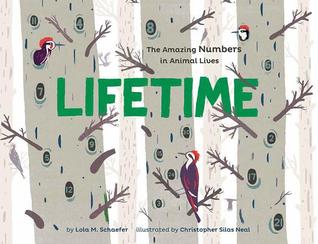
Lifetime: The Amazing Numbers in Animal Lives by Lola M. Schaefer

Share

NF PB 2014

Nonfiction Picture Book Wednesday

Nonfiction Picture Book Wednesday is hosted by Kid Lit Frenzy and was started to help promote the reading of nonfiction texts. Most Wednesdays, we will be participating and will review a nonfiction text (though it may not always be a picture book).
Be sure to visit Kid Lit Frenzy and see what other nonfiction books are shared this week!

lifetime

Lifetime: The Amazing Numbers in Animal Lives
Author: Lola Schaefer
Illustrator: Christopher Silas Neal
Published September 20th, 2013 by Chronicle Books

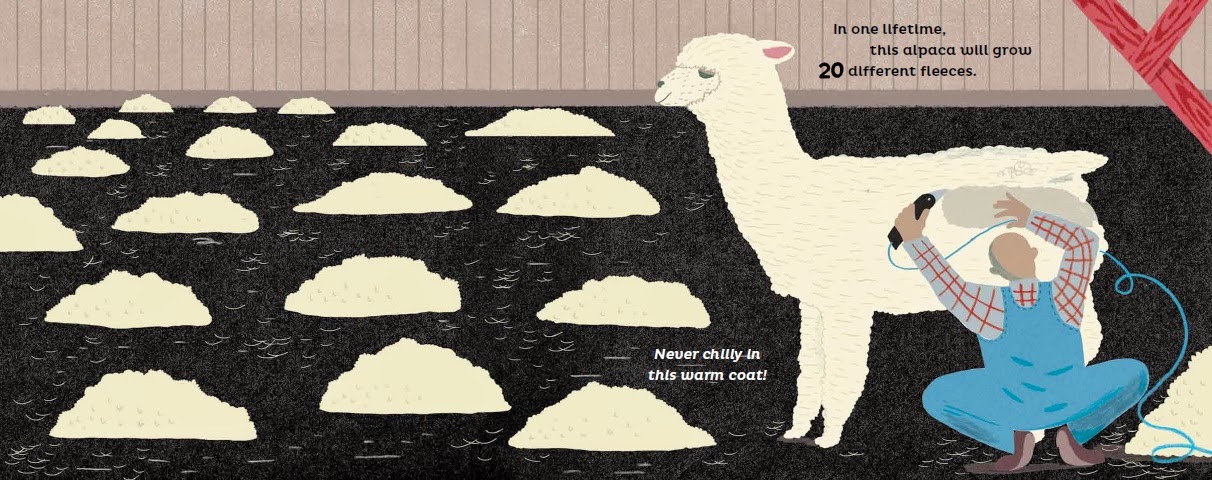
Goodreads Summary: In one lifetime, a caribou will shed 10 sets of antlers, a woodpecker will drill 30 roosting holes, a giraffe will wear 200 spots, a seahorse will birth 1,000 babies.

Count each one and many more while learning about the wondrous things that can happen in just one lifetime. This extraordinary book collects animal information not available anywhere else—and shows all 30 roosting holes, all 200 spots, and, yes!, all 1,000 baby seahorses in eye-catching illustrations. A book about picturing numbers and considering the endlessly fascinating lives all around us, Lifetime is sure to delight young nature lovers.

Review and Teacher’s Tools for Navigation: I learned so much reading this book. My friend Amanda actually read it first and kept yelling out the facts because they are just so interesting; obviously students would find them interesting as well. On top of it just being interesting, this book is a little book of gold! It is a perfect combination of reading, math, and science! Also, the illustrations are just so well done! Throughout the book, scientific facts about animals are shared with the reader (all with numbers) and then in the end of the book Lola Schaefer also shares with the reader even more information about the animals, how to find an average, and other math facts.  And not once does the book even feel a bit boring–it is a perfect read aloud and cross-curricular text.

Discussion Questions: Which of the animals interests you the most?; Using how the author teaches you to find an average, pick an animal and determine the average number of offspring they will have in a lifetime.

We Flagged: 

Read This If You Loved: Frog Song by Brenda Z. Guiberson, Weird but True! by National Geographic, Island by Jason Chin, Can We Save the Tiger? by Martin Jenkins, Actual Size by Steve Jenkins

Recommended For: 

closereadinganalysisbuttonsmall classroomlibrarybuttonsmall readaloudbuttonsmall

Signature