Blog Tour with Review!: Granted by John David Anderson

Share

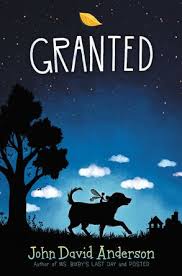
Granted
Author: John David Anderson
Published February 13th, 2018 from Walden Pond Press

Summary: From the author of beloved novels Ms. Bixby’s Last Day and Posted comes a hilarious, heartfelt, and unforgettable novel about a fairy-in-training.

Everyone who wishes upon a star, or a candle, or a penny thrown into a fountain knows that you’re not allowed to tell anyone what you’ve wished for. But even so, there is someone out there who hears it.

In a magical land called the Haven lives a young fairy named Ophelia Delphinium Fidgets. Ophela is no ordinary fairy—she is a Granter: one of the select fairies whose job it is to venture out into the world and grant the wishes of unsuspecting humans every day.

It’s the work of the Granters that generates the magic that allows the fairies to do what they do, and to keep the Haven hidden and safe. But with worldwide magic levels at an all-time low, this is not as easy as it sounds. On a typical day, only a small fraction of the millions of potential wishes gets granted.

Today, however, is anything but typical. Because today, Ophelia is going to get her very first wish-granting assignment.

And she’s about to discover that figuring out how to truly give someone what they want takes much more than a handful of fairy dust.
About the Author: John David Anderson is the author of Ms. Bixby’s Last Day, Posted, Sidekicked, Minion, and The Dungeoneers. A dedicated root beer connoisseur and chocolate fiend, he lives with his wife, two kids, and perpetually whiny cat in Indianapolis, Indiana. You can visit him online at www.johndavidanderson.org.

ReviewJohn David Anderson never ceases to amaze me. I have read all but one of his books, and I am learning that I cannot even guess what he’s going to tackle next; although, I can assume he is going to do it well!

But I will be honest, I would not have guessed that his newest would be about a super sweet, determined, and a bit quirky fairy named Ophelia Fidgets. But yes, Ophelia is our phenomenal fairy protagonist who every reader will immediately love. She is a perfectionist but also does things her own way–she just has very high standards for her own way. She also has a silly sidekick in both Charlie, a fellow granting fairy, and Sam, a homeless dog, and I must say that Anderson does one of the best dog voices I’ve ever read, I could hear it while I read.

Other than the characters, I think there were two other things that this novel did exceptionally well: world building and making the reader think about priorities. Everywhere Ophelia went, Anderson described enough to make sure that we could visualize it, but he also ensured that he didn’t overwhelm the reader with too much information. He also did a truly fantastic job at setting up the fairy world and all the rules within it to where the reader understood Ophelia’s task, her job, etc. Also, through Ophelia’s journey to grant the wish she’s been assigned, Anderson gets the reader to look at wishing and what is truly important in the world.

Lastly, I loved that in the backmatter of the book, Anderson acknowledges the long history of fairies, including Tinkerbell!, and reminds readers to keep reading about them.

Teachers’ Tools for Navigation: Like all of Anderson’s books, I know this one will find readers on my shelves. This book is perfect for fans of fairy, animal, or quirky adventure books. And it will also be a wonderful read aloud! Even if you don’t have enough time to read the entire book, the first chapter and synopsis will truly suck readers in.

Discussion Questions: 

  • What does Sam teach Ophelia?
  • Why does Ophelia make the choice she does make when granting the wish?
  • Do you agree with Ophelia or Squint when it comes to wish granting?
  • Do you believe that Charlie deserved the punishment he received?
  • What character traits does Ophelia possess that led her on not giving up?
  • How does Granted allude to other fairy tales you know? How does it break fairy stereotypes often found in other fairy tales?

Flagged Passages: “The last time you blew out your birthday candles, what did you wish for?

Did you blot them all out on the first breath? It doesn’t count otherwise. Also, do not let your brother or sister help you; at best they will waste your wish. At worst they will steal it for themselves.

Same for dandelions–the one breathe rule–or else the wish won’t fly. It’s harder than you think, getting all those seeds off in one huff. Harder than candles on a cake. If you can’t manage it, though, don’t worry. There are a dozen more ways to make a wish. A quarter flipped into a fountain. A penny dropped down a well. Some might tell you that bigger coins make stronger wishes, but that’s simply not true. A silver dollar or even a gold doubloon doesn’t increase the chances you’ll get what you want. Your dollar is better spent on gumballs or ice cream; use a nickel instead. Wishes aren’t for sale to the highest bidder.” (p. 1-2)

And my favorite passage:

“‘Humans are bad,’ [Sam] agreed.

Ophelia stopped fidgeting with her petal and looked over at Sam. Of course he would think so. And she couldn’t blame him. Not after how he’d been treated. She leaned into him, nestling in his fur.

‘Maybe they’re not all bad,’ she amended. ‘They just lose sight of what’s important sometimes, worrying so much about what they don’t have that they forget what they’ve already got.’

‘Like home,’ Sam said.” (p. 207)

Read This If You Love: Tinker Bell, Folk lore about fairies, Wishapick by M.M. Allen, Spiderwick Chronicles by Holly Black, Seekers by Erin Hunter, Mez’s Magic by Eliot Schrefer

Recommended For: 

Signature

**Thank you to Danielle at Blue Slip Media for setting up the blog tour!**
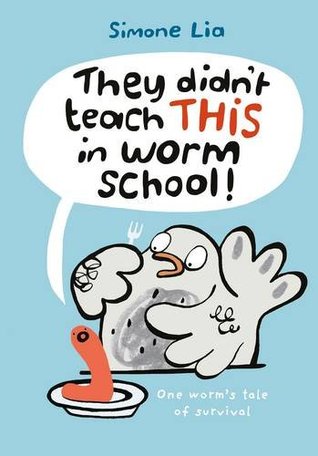
They Didn’t Teach THIS in Worm School by Simone Lia

Share

They Didn’t Teach THIS in Worm School!
Author: Simone Lia
Published February 13th, 2018 by Candlewick Press

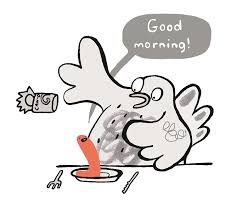
Summary: A hungry chicken (who thinks he’s a flamingo) and a quick-thinking worm set off on a madcap adventure — and forge an unlikely friendship.

Marcus is a worm, and a bird named Laurence who looks very much like a chicken is about to eat him for breakfast. So what does Marcus do? He strikes up a conversation, of course! But even after talking his way out of being eaten, Marcus’s troubles are just beginning: soon he is clinging to Laurence’s neck as the designated navigator on an absurd journey to Kenya, where his feathered companion dreams of finding happiness with other flamingos like himself. Except Marcus can’t actually read a map, and this bird is clearly not a flamingo. Will Marcus be able to get them both to Africa — or even manage to survive the day? Filled with kid-friendly illustrations, this is a buddy comedy that will have readers wriggling with laughter.

ReviewOh man! What a voice this book has. Marcus and Laurence are just hilarious and part of what makes them so funny is the very evident voice that both characters have. Marcus is a rule follower and is trying to figure everything out. Laurence is confused and so full of goals and ambition that are just not realistic. And the two of them on an adventure are just ridiculous and really did make me laugh out loud.

Also, at a deeper level, Laurence is also teaching us about identity. He may not look like a flamingo, but he knows he is. That is all that matters.

Teachers’ Tools for Navigation: As I was reading, the very first thing I thought of was how perfect this book will be for our late elementary readers who love Bird and Squirrel or Narwhal and Jelly and want to try a non-graphic novel. It is still hilarious and illustrated yet may be a ladder up for these students. Also, with really short chapters and hilarity, it would be a wonderful read aloud as well.

Discussion Questions: 

  • How did Marcus’s decision to start a conversation with Laurence change the course of the plot? What could have happened?
  • There are other animal characters throughout the book. Why do you think the character includes them? What is their purpose? How do they advance the story?
  • How did Laurence and Marcus finally make it to Africa?
  • How was Laurence different than what Marcus originally assumed?

Flagged Passages: 

Then, I dreamed I fell out of a can into a cereal bowl. Staring at me was a scruffy, fat bird who looked a lot like a chicken. It was a really good dream until it got tothe bird part. The bird had intense and menacing eyes.

The worst things was that the last part of the dream wasn’t a dream at all. I really had been in a can, and there really was a big fat bird staring at me!

What would you do if you were a worm and there was a bird two inches away from your face, looking at you with hsi beak open so wide that you could see his tonsils.

Maybe you would do what I did. I smiled a big smile and said in my most cheerful voice,


Read This If You Love: Bird and Squirrel by James Burks, Narwhal by Ben Clanton

Recommended For: 

Signature

**Thank you Candlewick for providing a copy for review!**

Love, Mama by Jeanette Bradley

Share

Love, Mama
Author and Illustrator: Jeanette Bradley
Published January 9th, 2018

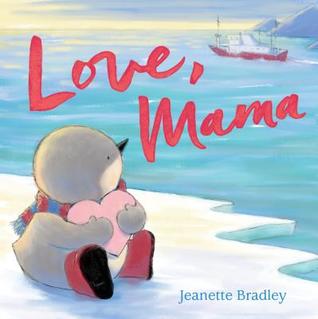
Summary: With a heartwarming story and tender illustrations, Jeanette Bradley’s debut picture book Love, Mama is perfect for Valentine’s Day, Mother’s Day, and any day when a child needs a reminder of the strength of a mother’s love.

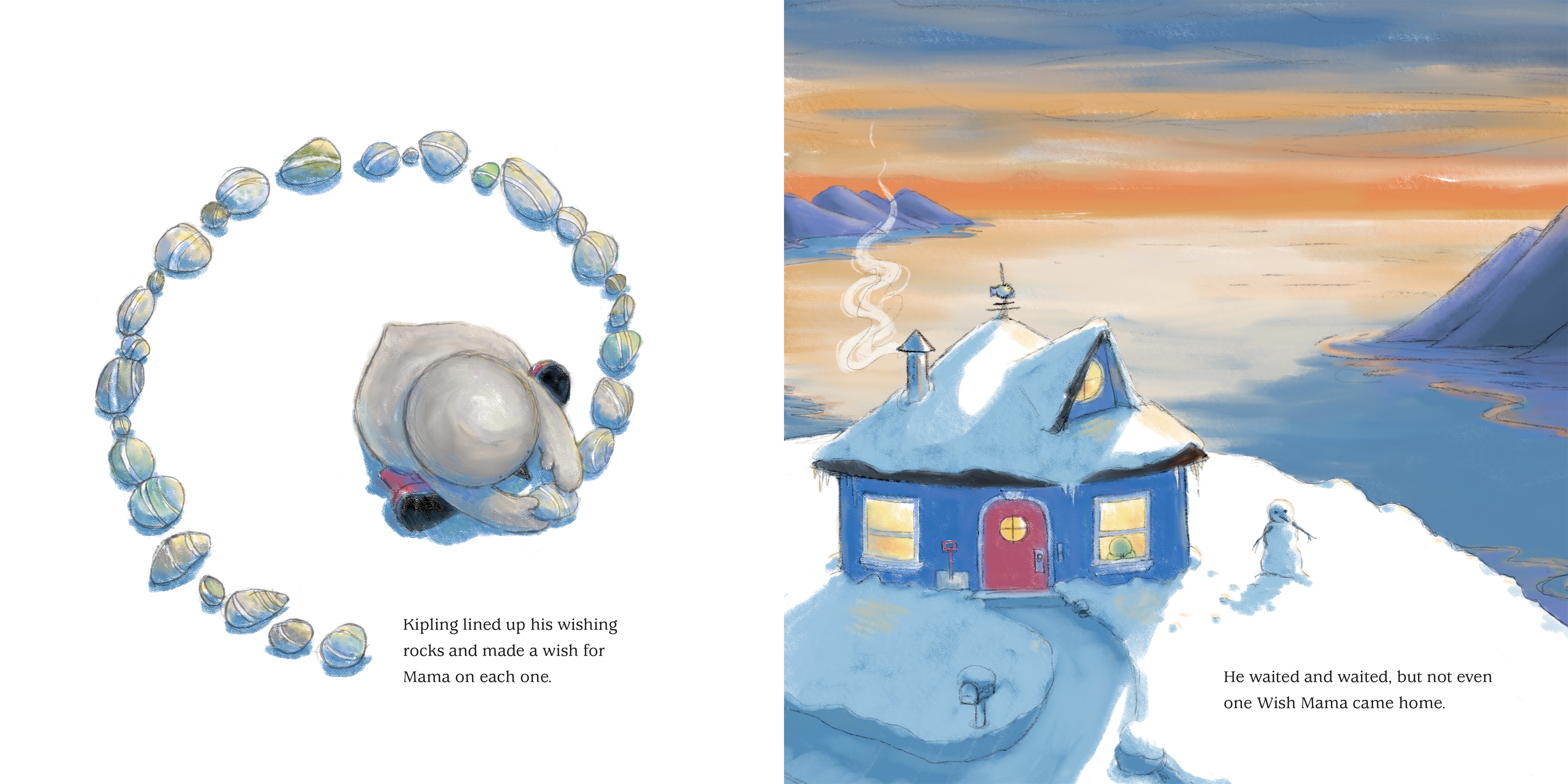
When Mama leaves her young penguin Kipling, he knows she’ll return home soon—yet he still can’t help but miss her. After all, Pillow Mama won’t read, Picture Mama won’t laugh, and Snow Mama is too cold to cuddle.

But then Kipling receives a special delivery from Mama, including a note that reads:

My love for you stretches across the wide ocean, 
through day and night, 
from earth to sky 
and back again.

And Kipling knows that no matter where Mama is, he is loved. Soon, Mama comes home, and Kipling ends the day where he belongs—right in her arms.

Ricki’s Review: This is a charming book that is perfect for Valentine’s Day week. I was thinking of Kipling today when I walked into my son’s school, and he said, “Why did it take you so long to get here?” I remember always feeling like I was waiting interminably long for my parents to get to school. It’s very tricky for kids to understand a sense of time. This book is a great conversation starter between parents and kids. It might be particularly good for kids who are living across multiple houses due do a divorce. The note that Mama writes does a beautiful job capturing a mother’s love. 

Kellee’s Review: I am such a sucker for penguin books! And a penguin book about a son’s love for his mama? Melted my heart! And I can see so many different times this book will come in handy to read to Trent including when I have to leave for longer than a day, when he asks how much I love him, or if he asks why I need to leave. The author complimented her sweet text so nicely with soft, detailed illustrations that help support the mood of the story. Trent and I have already read this more than once, and I know there will be more reads in the future. 

Discussion Questions: 

  • What does Kipling do while he waits for Mama? Does it help? What does he learn?
  • What personification do you see in Mama’s note to Kipling? Other figurative language?
  • What is the message of the story? What does Mama’s return teach Kipling?
  • Have you ever waited for someone you love? What did that feel like?
  • Who do you think the other adult penguin in the book is?

Teachers’ Tools for Navigation: Teachers might ask students to write their own metaphor letters to family members to describe their love. This would be a great activity that teaches figurative language and also allows students to show their families their appreciation. Alternatively, teachers might ask students to compare and contrast the things that Kipling does to try to recreate Mama while she is gone. Then, they might think of other things that Kipling might do while he waits for Mama.

Flagged Passage:

Read This If You Love: Llama Llama Misses Mama by Anna Dewdney, The Kissing Hand by Audrey Penn, And Tango Makes Three by Justin Richardson and Peter Parnell, Love by Matt de la Peña, Forever by Emma Dodd, If I Were a Penguin by Anne Wilkinson,

Recommended For: 

andSignature

Pandamonia by Chris Owens

Share

Pandamonia
Author: Chris Owen
Illustrator: Chris Nixon
Published 2017 by Kane Miller Books

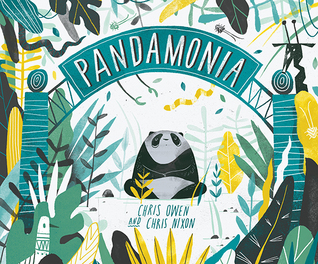
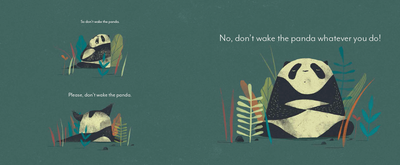
Summary: Here’s something to remember: when visiting the zoo, whatever you do, DON’T WAKE THE PANDA!

Join in the fantastic fun of Chris Owen and Chris Nixon’s Pandamonia, as one could-be-grumpy-if-woken-up sleeping panda sets off a frenzy of wild partying.

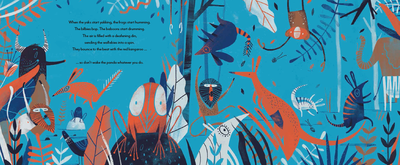
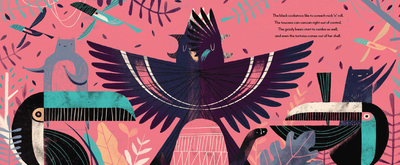
There’s grunting and growling and prancing and prowling and … so much more in this rollicking, rhyming text. It is so filled with energetic art and action and noise and alliteration that it just begs to be read aloud.

There is a playfulness, a rhythm and an energy to both the text and the illustrations, a cumulative growing and building of words and pictures, plus a whole bunch of animals you might never have seen in a picture book before. And the hilarity will have listeners and readers on their feet!

This is one for story time, or anytime!

ReviewThis picture book quickly became a regular in our reading because my son is just a bit obsessed with animals and there is such a wide variety introduced and shared in this title. Sometimes we read all the way through and just have fun with it while other times we look up the animals and find them in the pictures and find videos of the sounds they make. A different experience each time. And with the party-filled pages and colorful illustrations, every experience is fun.

Teachers’ Tools for Navigation: This book will be such a fun read aloud! The illustrations are really colorful, the text is alliterative with a ton of onomatopoeias, and there’s lots of fun to be had! In addition to alliteration and sound words, it can also be a way to talk about animals or zoos.

Discussion Questions: 

  • How did the author use the word pandemonium and panda as a premise to his book?
  • What animals did the author include that you didn’t know?
  • What type of medium do you think the illustrator used to make the illustration?
  • How did the author use onomatopoeias and alliteration in the story?
  • What do you think will happen if the panda gets woken up?!?!

Flagged Passages: 

Read This If You Love: Du Iz Tak? by Carson Ellie, Nothing Rhymes with Orange by Adam Rex, The Curious Case of the Missing Mammoth by Ellie HattieHello Hippo! Goodbye Bird! by Kristyn Crow, Can Aardvark Barkby Melissa Stewart, Other books about animals or zoos

Recommended For: 

Signature

**Thank you to Lynn Kelly from Kane Miller for providing a copy for review!**

Red & Lulu by Matt Tavares

Share

Red & Lulu
Author & Illustrator: Matt Tavares
Published September 19th, 2017 by Candlewick Press

Summary: Separation and miles cannot keep a determined cardinal from his loved one in an ode to serendipity and belief that is destined to be a new Christmas classic.

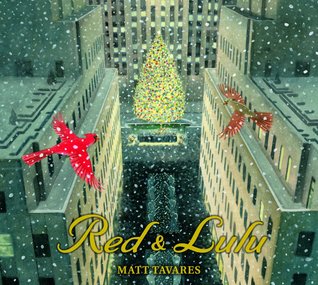
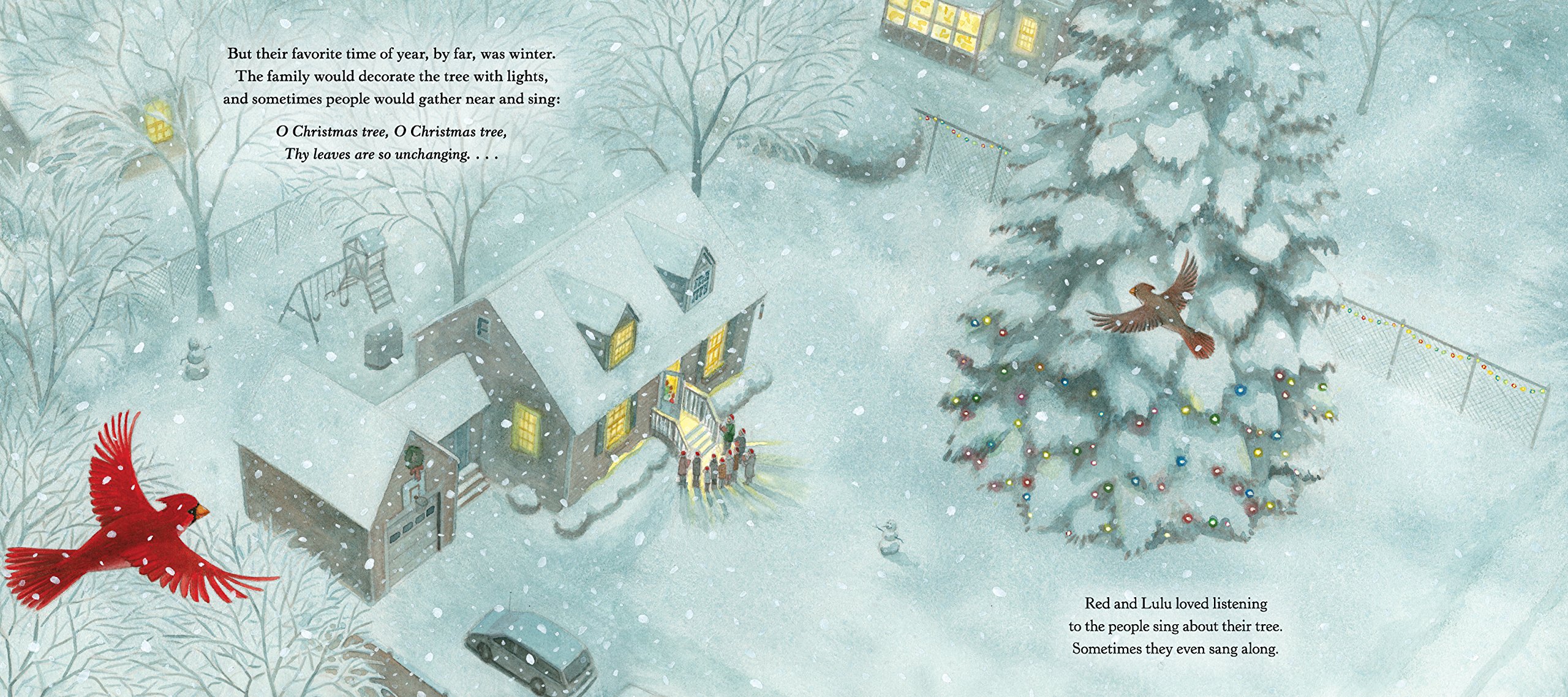
Red and Lulu make their nest in a particularly beautiful evergreen tree. It shades them in the hot months and keeps them cozy in the cold months, and once a year the people who live nearby string lights on their tree and sing a special song: O Christmas Tree, O Christmas Tree. But one day, something unthinkable happens, and Red and Lulu are separated. It will take a miracle for them to find each another again. Luckily, it’s just the season for miracles. . . .

From Matt Tavares comes a heart-tugging story combining the cheer of Christmas, the magic of New York City, and the real meaning of the holiday season: how important it is to be surrounded by love.

Review: Wow, Matt Tavares! So much is going on in this book, and it is all beautiful. First, we meet the stars of our book: Red & Lulu, and you’ll love them right away. Their love flies off the page. And the scene when they are separated broke my heart! And since I don’t read summaries, I had no idea what was going to happen, and it was so sad, but Red would not give up.

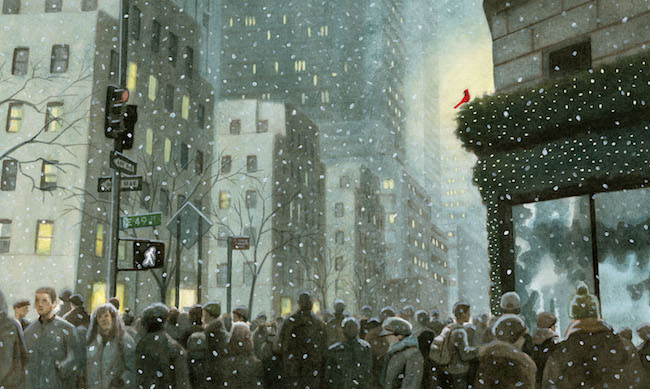
In addition to the story of love and separation, it is also a story of the Rockefeller Christmas Tree. Tavares includes back matter about the tree, its history, and traditions. Through its inclusion and the repetition of “O, Christmas Tree,” the mood is set and you are transported to NYC at Christmas time.

Finally, I cannot forget to mention the AMAZINGLY BEAUTIFUL illustrations. They took my breath away. They are edge to edge, inclusive, and so detailed.

Teachers’ Tools for Navigation: Red & Lulu is going to be an instantaneous Christmas classic! And I loved the discussion of Rockefeller Center which allows for a historical and American tradition conversation around the book.

Discussion Questions: 

  • What is so special about the very final page of the book?
  • How can you tell the difference between Red & Lulu? Why did the author choose to illustrate them that way?
  • How did the author’s repetition of “O, Christmas Tree” affect the mood of the book? And what did the lyrics indicate in the story?
  • Before you knew where Lulu ended up, what clues did Matt Tavares include to foreshadow where Lulu was?
  • Which spread of illustrations is your favorite? Why?
  • What did you learn about Rockefeller Center and its Christmas Tree from the book? What would you like to learn more about?

Flagged Passages: 

Book Trailer: 


Read This If You Love: CHRISTMAS!, Birds by Kevin Henkes, Bluebird by Bob Staake, A Christmas Wish for Corduroy by B.G. Hennessy, Other titles on my student Maria’s Top Christmas Books List

Recommended For: 

Signature

**Thank you to Candlewick Press for providing a copy for review!**


Inky’s Great Escape by Casey Lyall

Share

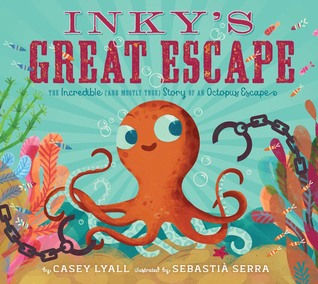
Inky’s Great Escape: The Incredible (and Mostly True) Story of an Octopus Escape
Author: Casey Lyall
Illustrator: Sebastia Serra
Published: November 7, 2017 by Sterling Children’s Books

Goodreads Summary: Inky’s Incredible Idea for an Ingenious Escape .
Based on a true story, this tale follows a daring, Houdini-esque octopus as he performs his greatest escape act yet.

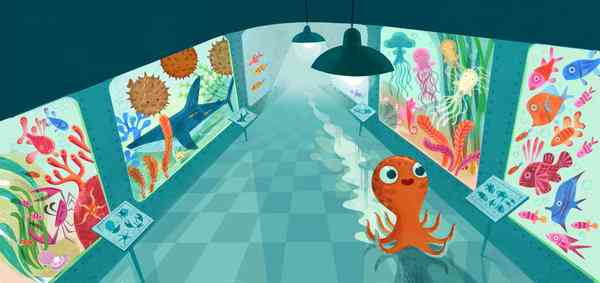
In April 2016, The New York Times published an article about an octopus named Inky who escaped from the National Aquarium of New Zealand through a drainpipe and into the sea. In this charming fictionalized account, Inky, worn out from his exciting life in the ocean, has retired to the aquarium. There he quietly plays cards, makes faces at the visitors, and regales his tankmate Blotchy with tales of his past adventures. Then Blotchy dares Inky to make one more great escape: out of their tank. Will Inky succeed?

Ricki’s Review: Inky! This is a fun, thrilling text that will surely entertain a classroom of kids. I can imagine all of the questions that would accompany a read-aloud of this book. When my son and I read it, the first thing we did was research Inky’s story on the internet (see Kellee’s review for more info about this). We talked about all of the exciting ways that an octopus might escape from an aquarium. I love how the author creatively interpreted Inky’s story and made it a sort of challenge from Inky’s friend Blotchy. This made me chuckle. This text is versatile and could be used in many ways in the classroom, and it has high appeal. Kids will love it.

Kellee’s Review: Although Inky’s Great Escape is a fictionalized version of the events that happened at the National Aquarium of New Zealand in 2016, if you go and research about the escape, you’ll learn that the Inky truly is one incredible octopus! Although Lyall used creative freedom to build up Inky’s backstory (he’d retired to the aquarium after many daring escapes, and only escaped from the aquarium because Blotchy challenged him), much of the escape sequence was what truly transpired when Inky made his escape. Kids will fall in love with Inky’s bravery, personality, and with his contrasting friend, Blotchy, who stayed behind. With colorful full page illustrations and two octopuses with character traits and personalities that will start conversations, Inky’s Great Escape is going to be a favorite read aloud and classroom library book in elementary classrooms (and would be a great companion to a cephalapoda discussion!).

Teachers’ Tools for Navigation: Teachers might take some time to point out New Zealand on a map and to research the habitat in New Zealand. They might specifically look into Inky’s story and how the author took a bit of creative license to interpret the truth a bit. Teachers might also ask students to create their own escape stories with another animal. They could illustrate these and bind them into books!

Discussion Questions: Why does Inky decide to escape? What does he do?; What is Blotchy’s role in the story? How might we compare this to situations in our lives?; What is the true story? How did the author creatively interpret that story?

Flagged Spread: 

Read This If You Loved: Prince and Pirate by Charlotte Gunnufson; Lady Pancake & Sir French Toast by Josh Funk; Whose Story is This, Anyway? by Mike Flaherty; Dragons Love Tacos by Adam Rubin

Recommended For: 

readaloudbuttonsmall classroomlibrarybuttonsmall

RickiSigandSignature

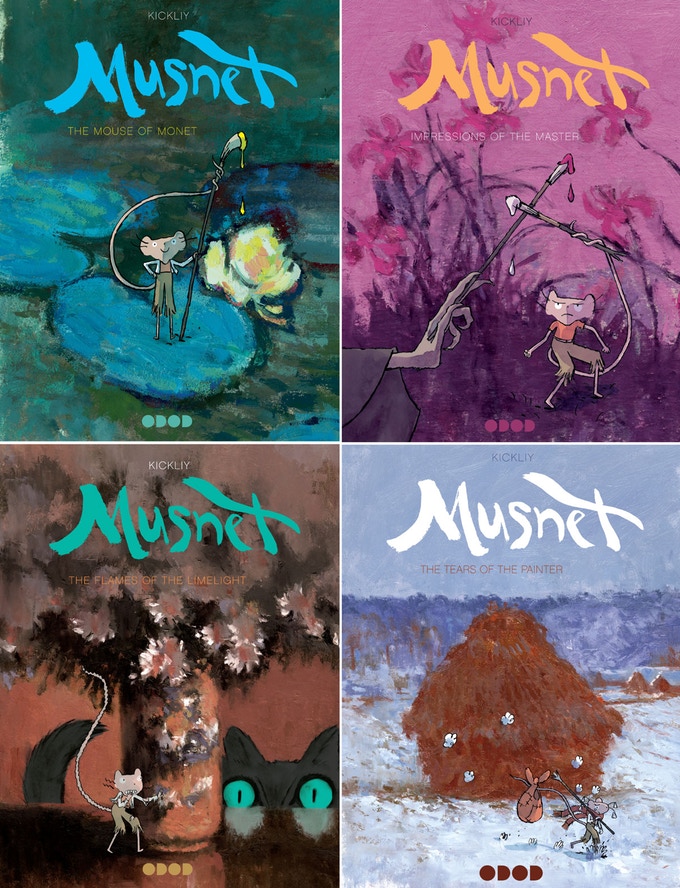
Musnet Series by Kickliy

Share

Musnet series
1. The Mouse of Monet
2. Impressions of the Master
3. The Flames of Limelight
4. The Tears of the Painter

Author: Kickliy
Published August 2nd, 2016; November 1st, 2016; April 11th, 2017; October 10th, 2017 by odod books

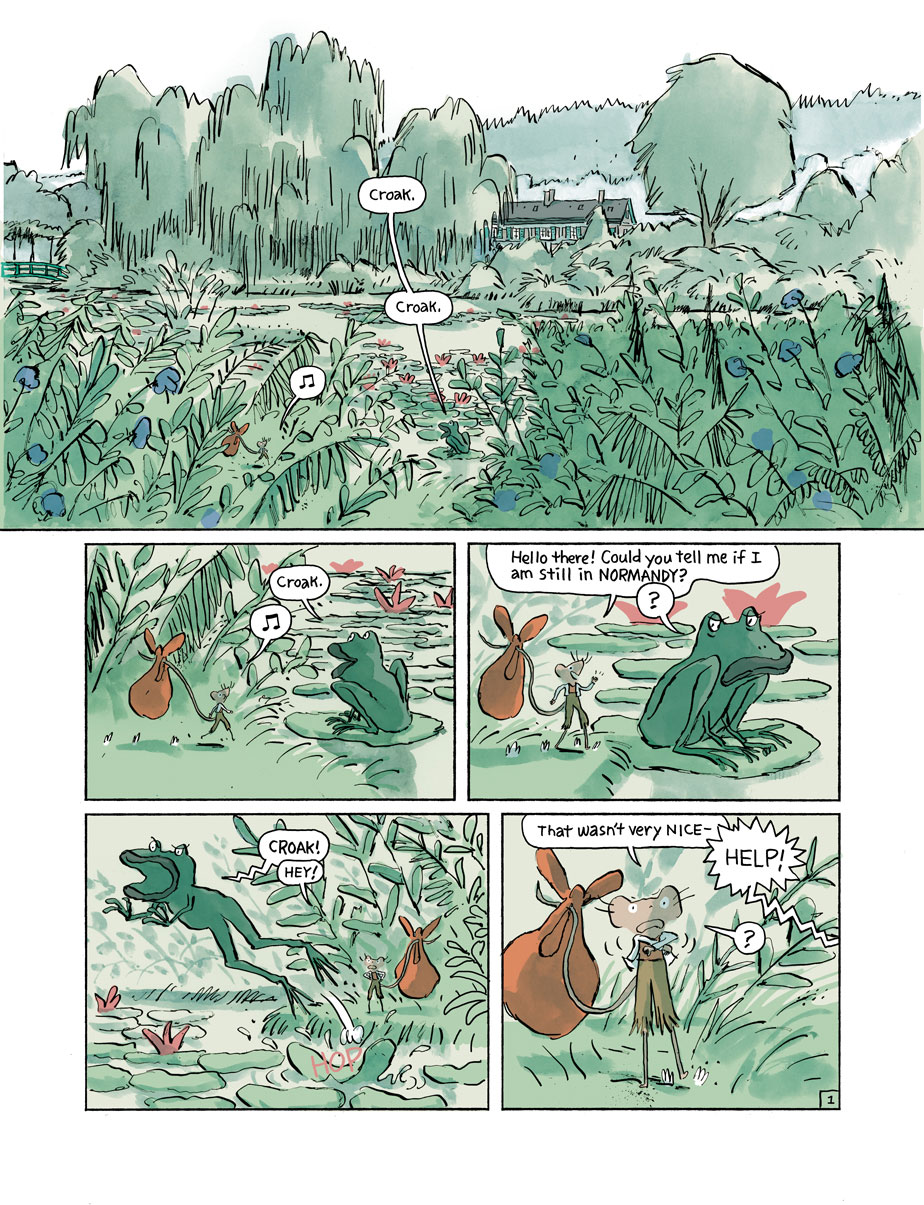
Summary: A young boy mouse travels the country side looking for work and happens upon the Monet’s garden. He takes on a job and becomes inspired to learn to paint. Will he paint in the classical ways, or in the new style of the impressionist? Which way will his brush sway?

Musnet wants to be the best mouse painter that ever was. But, he’s caught between two worlds. On one paw, Musnet loves the classical style of his old teacher, the squirrel Remi. On the other paw, Musnet can’t help to be drawn to the fresh and new art of the human master, Monet. Which path will the Mus choose?

It’s dark season in Musnet’s world. His adoptive family faces eviction, his Master Remi is deathly ill, he’s chased by snakes, cats, and vampire bats, and—on top of all that—Musnet faces the most challenging painting commission of his life! Can he rise to challenges and brush them all away?

As snow and ice chill Monet’s garden, even colder things await Musnet this winter season. Mya, Musnet’s best friend, gets her own adventure. Chiby, the Japanese spider, gets in a tangle with a certain muscular rat. Is there even any room left for our vagabond mouse? Drama, action, adventure, abound in the final volume of the award nominated series.

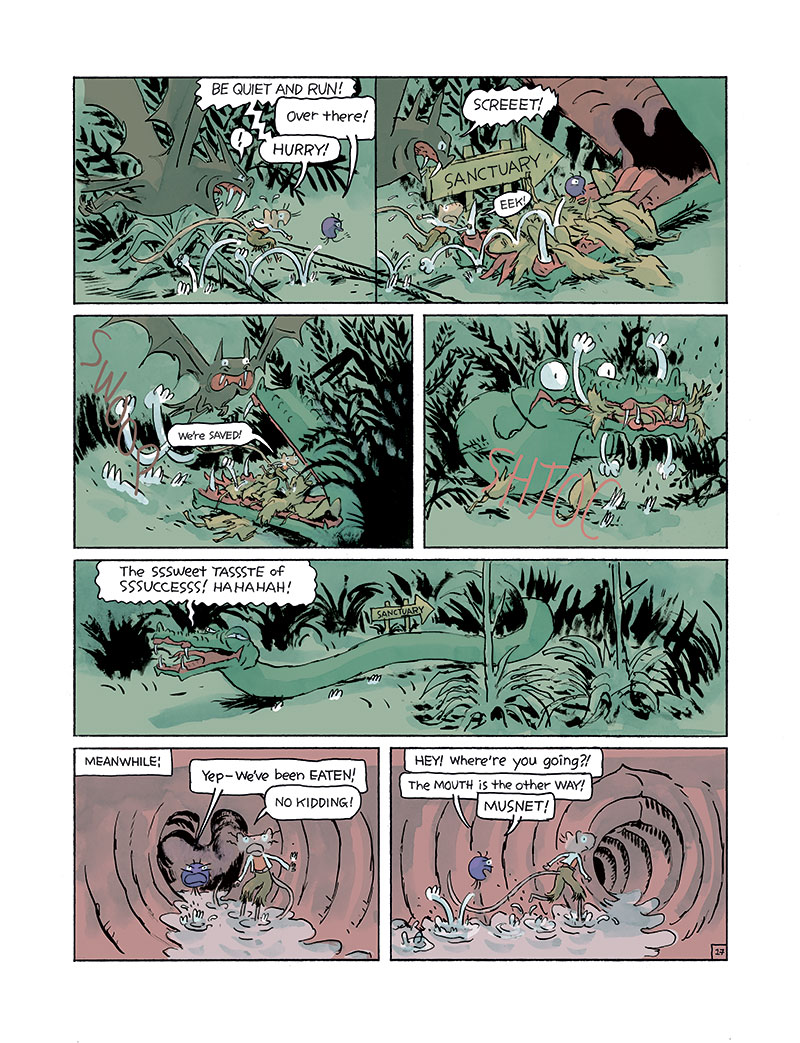
Musnet is drawn and painted in a beautiful, lush and inky style popularized by Paul Pope and French comics masters such Blutch and Christophe Blain.

“It’s a really enjoyable story that brings Monet’s paintings to life through some incredibly sweet and memorable characters. It’s challenging and imaginative, and I’m sure it will spark an obsession with painting (and maybe also mice).”—Girls Like Comics

“This new series revolves around a painting mouse found in Monet’s famous gardens in Giverny: the nameless, orphan mouse is befriended by Mya and her mouse family, who live inside the artist’s house. Introduced to painting after he begins working for Remy, an old squirrel painter, he is enchanted by Monet’s work. Beautifully painted […] charming tale of humour, art, and adventure, as the little mouse grows to find his meaning and place in the world.”—The Guardian

Musnet: The Mouse of Monet is a gorgeous and friendly story about a mouse discovering his calling in life and also what he wants to be called. Take a friendly and likable orphaned mouse, place him in a beautifully rendered watercolor and ink medium with miniature Monet masterpieces and you get a stunning and engaging story of a mouse learning to become an artist. He makes friends, finds a mentor, and even gets to sneak a peek inside Monet’s studio. It’s incredibly well executed, entertaining, informative, and absolutely absorbing. It is one of the best books I’ve read this year.” —The Picture Book Review

Review: After I read book one of this series, I could not wait to share it with everyone I talked to: “I love when books include art history in them because it makes me feel at home since I grew up in art museums as a museum director’s daughter. Musnet is no different. As soon as I realized that Musnet had ended up in Monet’s famous garden, I was fascinated with Musnet’s story and his journey to becoming an artist. Kickliy’s artwork pays perfect homage to Monet’s work and is a beautiful backdrop to Musnet’s story.” And I was really excited to read the rest of the books in the series.

Luckily they did not disappoint! Book one was just an introduction to the characters who continued to mature throughout the arc of the story. Musnet’s situation fluctuates causing the reader to quickly move from relief to panic which ensures the reader wants to keep going through the series. Although the series begins with Musnet just looking for a home, it ends with Musnet looking for what life has in store for him as an artist.

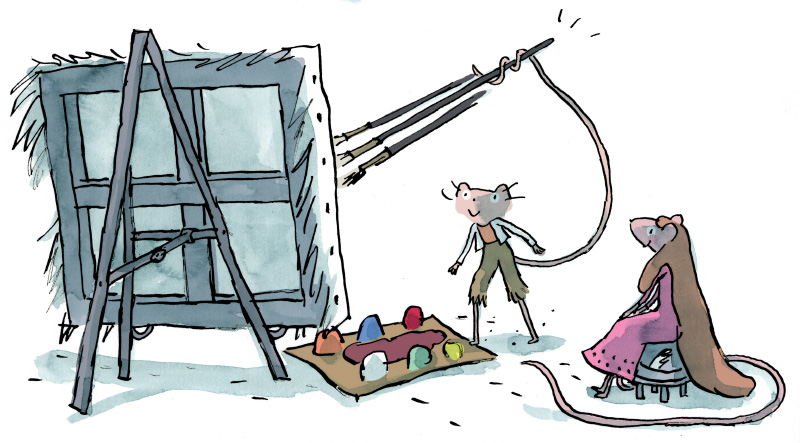
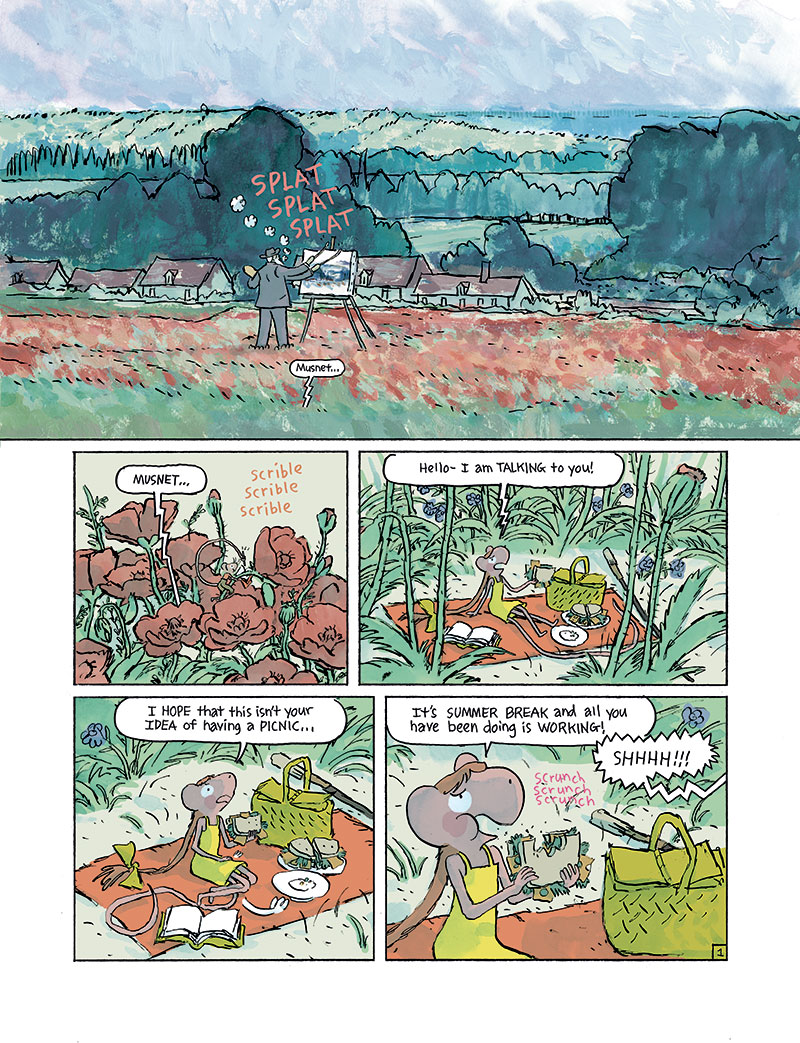
But what makes this series even more unique is the level of graphics. Kickliy’s ink, watercolor, and oil illustrations are reminiscent of the period in which Monet lived–it is like reading art. Kickliy even paints little oil paintings for the book for whenever a Musnet or Monet work is shown.

Teachers’ Tools for Navigation: “Musnet lives in Monet’s garden. Was there a roach under Van Gogh’s bed? Or a fish behind Munch’s Scream? If so, what would their story be like?” Have students create stories of animals that ‘live’ in the background of famous paintings. They’d need to research the art styles for illustrations and the time period/place of the painting for their setting, so this activity would be a perfect cross-curricular for writing, reading, art, and history.

Parts of the book would also be really great assets for engagement and information in art classrooms. Remi, Monet, and Musnet are talented artists who share insight throughout the series.

Discussion Questions: 

  • After book one, did you think Musnet was going to become a successful artist?
  • How does Kickliy’s illustrations fit the period of the book’s setting?
  • Which conflict in Musnet’s story affected Musnet’s conclusion the most?
  • Why do you think Kickliy chose Monet as the artist inspiration for his book?
  • What artist would you want to meet?
  • How did meeting Mya change Musnet’s life? Remi? Chiby?

Flagged Passages: 

Read This If You Love: Art, Graphic Novels, Monet, Mira’s Diary by Marissa Moss, The Museum by Susan Verde, Babymouse series by Jennifer and Matthew Holm, The Tale of Despereaux by Kate DiCamillo, Redwall by Brian Jacques, The Museum by Susan Verde

Recommended For: 

Signature