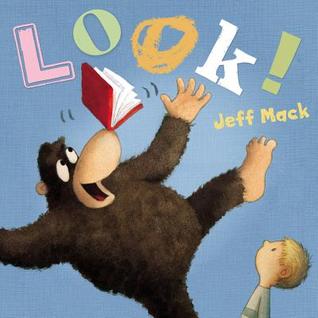
Look! Author and Illustrator: Jeff Mack
Published April 7th, 2015 by Philomel Books
Goodreads Summary: This hilarious tale of a friendship that develops over a love of books is the perfect picture book for fans of It’s a Book and Officer Buckle and Gloria!
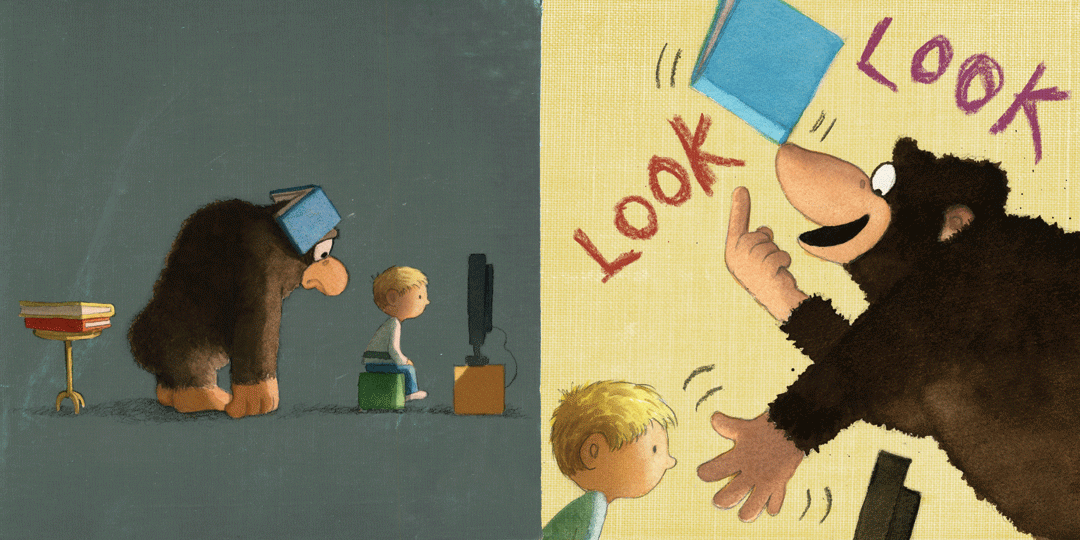
Everyone needs a little attention from time to time. Just ask our gorilla who will stop at nothing to be noticed by the boy with his eyes glued to the TV set. But for the gorilla, it’s going to take more than a quiet nudge to steal away the boy’s attention. When his usual antics fail to catch the boy’s eye—LOOK OUT! The gorilla has some other tricks up his sleeve.
Using only two words—LOOK and OUT—Jeff Mack relates an adorably hilarious story about an attention-loving gorilla, a television-loving boy, and a friendship that develops over books. Simple in construct yet richly creative, this interactive and colorful tale will leave children laughing and loving books for years to come.
Ricki’s Review:Ah! It only uses two words! This creative story about a friendship between a gorilla and a boy captured my heart. It teaches kids the importance of avoiding the TV and picking up a book instead. I am an unapologetic book pusher, so I always appreciate books that promote reading. Readers are forced to use their imaginations to follow the storyline, and the illustrations and characters’ personalities will make them giggle. This playful tale is sure to capture readers’ hearts.
Kellee’s Review:I love how this book teaches a lesson about the importance of getting away from electronics without seeming preaching. The gorilla is entertaining, and it’d be fun to predict what he is going to do next to try to get the boy’s attention. I also think the book will make kids get mad at the boy then will need help realizing that they may be doing the same thing on a daily basis. The use of only two words is also going to be a big conversation starter as well. Look! would also be a good first book to introduce the idea of theme. What is this book trying to teach the reader? And like Ricki, I am big fan of books that promote reading, and this one is a great addition to those out there!
Teachers’ Tools for Navigation: We are suckers for books that feature only a few words. One great, fun way to improve speaking skills is to give students only the words of the book to start (the book should remain hidden). Students pair up or work in small groups to speak the words in expressive way to tell a story. They perform a skit for the class, and then the class discusses the various ways that words can be interpreted. Then, the teacher reads the book for the first time to the students. Ricki used to do this in her class each year to introduce speaking skills. She stole the idea from her methods class with Wendy Glenn. 🙂
Discussion Questions: How do the illustrations help you understand the book? What do the characters teach you?; Why might the author have chosen to feature only two words in the book? Did you think it was effective?; What is the theme of Look!?
Read This If You Loved: Yo! Yes? by Chris Raschka, Moo by David LaRochelle, Ball by Mary Sullivan, It’s a Book by Lane Smith, Officer Buckle and Gloria by Peggy Rathmann, Smick by Doreen Cronin, Miss Books Loves Books! by Barbara Bottner
Recommended For:
and
**Thank you to Penguin Young Readers for providing a copy for review!**
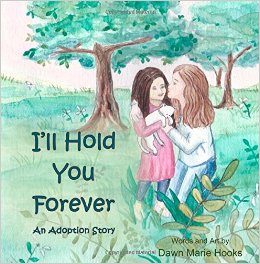
I’ll Hold You Forever: An Adoption Story Author and Illustrator: Dawn Marie Hooks
Published January 2nd, 2015 by Paper Moon Publications
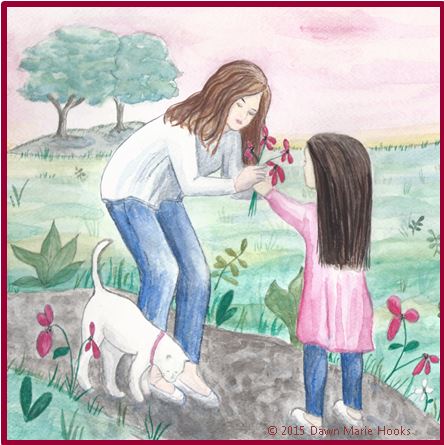
Goodreads Summary: A young girl walks through the countryside when she begins to wonder: Is Mommy really her real mom? Mommy turns the question into a story of the child’s adoption. Soon the child is reassured that her mom is real and will hold her forever. A touching story about the beauty of adoption and the warmth of a mother’s love is told through charming watercolor illustrations and clear, simple text that even the youngest child can understand. Notes from the author include suggestions on how to talk to children about adoption.
Kellee’s Review: I think this book has two very important purposes. First, I think it would be a wonderful book to read with a child who was adopted. It does a very good job of honoring all parts of adoption. The “Notes from the Author” section gives some great suggestions for talking to children about adoption which is a wonderful jumping off point after reading the book. Second, I think this book could be used to discuss adoption with students who are not adopted. It is so important to talk to kids about all kinds of different types of families. This book beautifully captures the power of love between a mother and her child and would be a great text for classrooms.
Author Interview: We are so happy to have Dawn Marie Hooks here to answer some of our questions about I’ll Hold You Forever:
Unleashing Readers:What was your main purpose in writing I’ll Hold You Forever?
Dawn Marie Hooks: My main purpose in writing I’ll Hold You Forever is to communicate the love surrounding adoption. I hope adoptive families will use this book to talk to their children about their adoption stories and all readers will be touched and inspired by the beauty of adoption.
UR:What inspired you to write I’ll Hold You Forever?
DMH: This story comes from my heart, the heart of a mom. It was inspired by the adoptions of my two beautiful daughters. Actually, I drew and painted some of the illustrations using our personal photographs. We adopted our girls through a private adoption agency in Redmond, WA called Antioch Adoptions. Both children were adopted at different times and through different circumstances. Every step was full of ups and downs, but I wouldn’t trade it for anything. We were extremely blessed to finally become parents to two precious girls who “fit perfectly in our family.”
UR: What other picture books do you recommend that discuss adoption?
DMH: My favorite picture books about adoption are God Found Us You by Lisa Tawn Bergren and How I Was Adopted by Joanna Cole. For the very young, there is a cute board book called Tell Me Again About the Night I Was Born by Jamie Lee Curtis. There are many more but these are the ones that I’ve read over and over.
I also recommend that families who adopt create their own photo books to tell the children their unique story.
UR:What do you hope readers of I’ll Hold You Forever will take away?
DMH: I love when moms they get tears in their eyes and that “ahhhh” feeling. I love when children ask lots of questions.
I hope the readers will feel the love surrounding adoption and I hope they learn a little more about the adoption process. At the end of the book, I included a few notes for adults about how to talk to children about adoption. Of course, since it’s a picture book, it’s brief. So, on my website (www.dawnmariehooks.com), I posted an information sheet about adoption as well as a discussion & activity guide on the topic of FAMILY for I’ll Hold You Forever. (I’m a former teacher, so I love writing those helpful little tools to go along with children’s books.)
Read This If You Loved: And Tango Makes Three by Justin Richardson, When Otis Courted Mama by Kathi Appelt, The Red Thread: An Adoption Fairy Tale by Grace Lin, A Mother for Choco by Keiko Kasza
Recommended For:
**Thank you to Melanie at Paper Moon Publications for providing copies for review!**
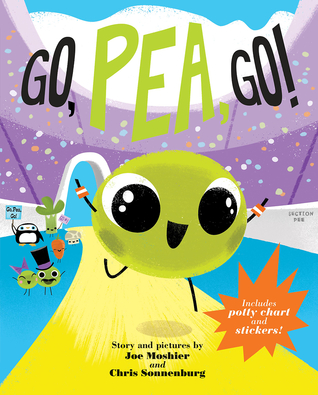
Go, Pea, Go!
Authors and Illustrators: Joe Moshier and Chris Sonnenburg
Published April 28th, 2015 by Running Press Kids
Goodreads Summary: Pea Junior has to go, go, go, go! The end feels so far away, but with his family and friends cheering him on, Pea knows he can make it and go number one!
My Review: This is a perfect book to use during potty training! The fun illustrations, which remind me of Wreck-It-Ralph, make the whole activity seem like a game instead of a chore. The book comes with a chart and stickers which make the whole training even more fun! Anyone with small children, enter below to win your own copy of Go, Pea, Go! and a prize pack that includes a pea plush, pea beach ball, pea tote bag, pea hair clips, stickers, and a copy of the book. THREE people will win a pack including a pea beach ball, pea postcards, stickers, and a copy of the book. FIVE runners up will receive a copy of the book and stickers.
A Message From The Authors: Everyone loves to cheer and root someone on!
It is in our nature as humans to cheer for someone to win a race, to hit a homerun, to score a goal, to ace a test, or even to be brave and make a new friend. As parents, we cheer on our children from day one from their cute little coo’s to their first roll-over and then to their first steps and on and on and on it goes. It feels good for everyone involved. Cheering is a positive feeling, and happiness, like a smile, is contagious.
Our new book, Go, Pea, Go! is all about cheering and rooting on Pea Junior as he races towards the giant Pea Bowl, ignoring all the fun distractions along the way. Children who read the book get to interact and yell out the phrase “GO, PEA, GO! “at the end of every page to show their support. Just like in real life, there is a point in the book where Pea Junior starts to loose his focus and doubt himself. It’s during these times of struggle and difficulty that cheering from loved ones and friends has an even stronger impact.
As with Pea Junior running the race, there will be obstacles, there will be distractions but there will also be victories and there will always be someone who loves you to cheer you on!
Make sure to visit the other stops on the blog tour:
Nonfiction Picture Book Wednesday is hosted by Kid Lit Frenzy and was started to help promote the reading of nonfiction texts. Most Wednesdays, we will be participating and will review a nonfiction text (though it may not always be a picture book).
Be sure to visit Kid Lit Frenzy and see what other nonfiction books are shared this week!
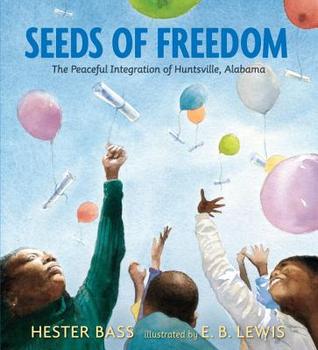
Seeds of Freedom: The Peaceful Integration of Huntsville, Alabama Author: Hester Bass
Illustrator: E.B. Lewis
Published January 27th, 2015 by Candlewick Press
Goodreads Summary: Explore a little-known story of the Civil Rights movement, in which black and white citizens in one Alabama city worked together nonviolently to end segregation.
Mention the Civil Rights era in Alabama, and most people recall images of terrible violence. But something different was happening in Huntsville. For the citizens of that city, creativity, courage, and cooperation were the keys to working together to integrate their city and schools in peace. In an engaging celebration of this lesser-known chapter in American and African-American history, author Hester Bass and illustrator E. B. Lewis show children how racial discrimination, bullying, and unfairness can be faced successfully with perseverance and ingenuity.
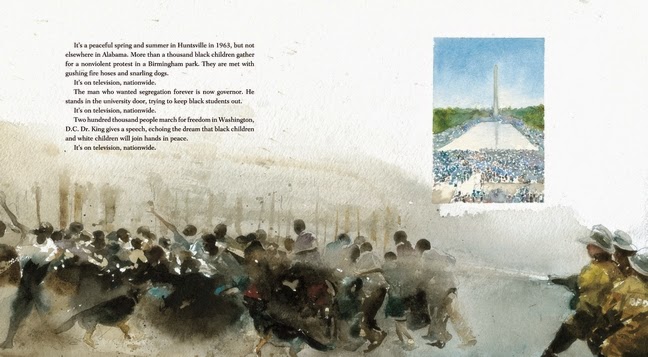
Kellee’s Review: I loved learning about Huntsville! It is amazing that in the middle of the violence and ignorance that ran rampant during the Civil Rights Movement, there was a Southern town that was peaceful and worked together to integrate. The story is so inspiring and gives me faith in humanity! I love how Bass ties together history and the movement throughout the nation to what was going on in Huntsville. It really shows the comparison between the rest of the nation and Huntsville. The illustrations are also extremely beautiful. I fell in love with his art in Each Kindness, and I am so happy to experience it again.
Ricki’s Review: The metaphor of the seeds of freedom dances across the pages of this book. E. B. Lewis’ illustrations are masterful. I spent a long time on each spread, soaking in the way the artwork connected with the words. This is a book about civil rights, and it is also a book about the goodness of people and the quiet persistence of the people of Huntsville, Alabama as they saw injustice, and they pressed on to fight against it. Students will learn a bit about history, but they will learn a lot about themselves. I plan to use this book in my methods classes to show how history can come alive in picture books. This book shines brightly.
Teachers’ Tools for Navigation: This book is a wonderful introduction to the civil rights movement. It gives a peaceful account and also shares information about the dark times. We think it would be fascinating to take the events mentioned in Seeds of Freedom and put them on a timeline, so students can visually see when each event was happening. It was also be interesting to compare and contrast Birmingham and Huntsville during this time period. Additionally, Seeds would be a perfect companion to Lions of Little Rock. Teachers might consider using this book in a text set to give students a rich understanding of the civil rights movement, or they might create a text set around themes such as persistence or protest in history.
Discussion Questions: How was Huntsville’s civil rights movement different than other cities around the nation?; How did the author use a seed as a metaphor for the civil rights movement?; What is reverse integration?; Who are some of the main people who helped integration within the United States?
Nonfiction Picture Book Wednesday is hosted by Kid Lit Frenzy and was started to help promote the reading of nonfiction texts. Most Wednesdays, we will be participating and will review a nonfiction text (though it may not always be a picture book).
Be sure to visit Kid Lit Frenzy and see what other nonfiction books are shared this week!
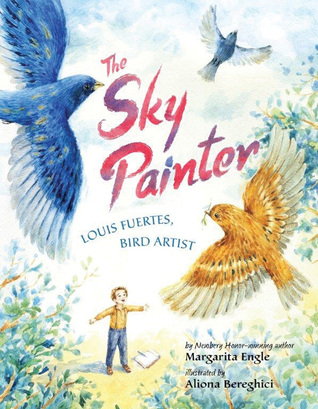
The Sky Painter: Louis Fuertes, Bird Artist Author: Margarita Engle
Illustrator: Aliona Bereghici
Published April 28th, 2015 by Two Lions
Goodreads Summary: Louis loves to watch birds. He takes care of injured birds and studies how they look and how they move. His father wants him to become an engineer, but Louis dreams of being a bird artist. To achieve this dream, he must practice, practice, practice. He learns from the art of John James Audubon. But as Louis grows up, he begins to draw and paint living, flying birds in their natural habitats.
Louis Agassiz Fuertes (1874–1927) is now known as the father of modern bird art. He traveled with many scientific expeditions all over the world. His best-known works—paintings for habitat exhibits at the American Museum of Natural History in New York—are still beloved by visitors today. His art helped to encourage wildlife conservation, inspiring people to celebrate and protect the world of wings.
Poems by Newbery Honor–winning author Margarita Engle and illustrations by Aliona Bereghici capture the life of Louis Fuertes and the deep sense of wonder that he felt when he painted the sky.
About the Author: Margarita Engle is a Cuban American poet and novelist whose work has been published in many countries. Her books include The Poet Slave of Cuba, winner of the Pura Belpré Award for narrative and the Américas Award; The Surrender Tree, a Newbery Honor book; Summer Birds: The Butterflies of Maria Merian, a Kirkus Best Book for Children; and The Lightning Dreamer, Cuba’s Greatest Abolitionist, winner of the 2014 PEN Center USA Literary Award for Young Adult/Children’s Literature. Margarita lives in California, where she enjoys bird-watching and helping her husband with his volunteer work for wilderness search-and-rescue dog training programs. To learn more, and to download a free activity kit for The Sky Painter, visit: www.margaritaengle.com
Kellee’s Review:Louis Fuertes is an inspirational man, and Engle’s biography of him is perfect. I think what I enjoyed most was how Fuertes was not only an artist, but an animal activist, family man, and educator. He is a role model for any kid that wants to grow up to be happy. Like Ricki shares below, this book shares an important lesson about how there are so many different special things out there to be observed. Nature is phenomenal.
I loved learning not only of Fuertes and his journey to live his passion, I loved the beautiful poetry and watercolor that were used to craft his story. Both the poetry and the artwork do Fuertes’s story justice like no other format would have. The format also gives the reader a chance to look at each poem as a stand alone and also part of the whole biography which gives each poem two different purposes and two different ways they can be analyzed.
Ricki’s Review:Louis Fuertes is a remarkable man, and this book not only pays homage to his extraordinary life, but it teaches young people important lessons. He nurtures and cares for birds in ways that children can emulate in many aspects of their lives. The book shows he devoted his life to birds and wanted others to see their beauty. I’ve seen Fuertes’ artwork in a variety of places, but I never considered him as an artist. This book reminded me that sometimes I go about life, not considering something very important and special. I am so glad I learned about Fuertes’ story and will think about him whenever I read or learn about birds. This book would be an excellent gift to give to a child. The poetry is gorgeous, and the illustrations are breath-taking.
Teachers’ Tools for Navigation: As a teacher, we can think of a plethora of ways to use this text in the classroom. We love to offer our students options, so we might provide them opportunities to read different biographies of different people who are following their passion. Students the could get in lit circles to discuss the biography then come back together to share what they learned. They could also choose any artist or person in history and write poems reflecting this individual’s biography. It would be fun to illustrate and bind these books to share them with others. We can imagine a class sitting in a circle, reading their poetry and learning about lesser-known individuals in history.
Discussion Questions: How did Fuertes change animal painting/drawing forever?; How do you feel that some artists kill animals to draw or paint them?; How did following his passions help make Fueres’s life happier?
Book Trailer:
Interview with Margarita Engle
Unleashing Readers: What inspired you to write about Fuertes?
Margarita Engle: I became fascinated by Fuertes while I was researching rain forest ecology and visiting wildlife preserves, during the process of writing a historical verse novel called Silver People: Voices From the Panama Canal. In many references, Fuertes was mentioned as the bird artist for all the great geographic expeditions of the early twentieth century. When I learned that he was a conservationist who pioneered the painting of living birds in flight—instead of killing and posing them like Audubon—I was astonished. Why wasn’t he a household name, like Audubon? Instantly, Fuertes became the most important link in my ongoing quest for biographical picture books about great Latino naturalists who have been forgotten by history. I hope The Sky Painter helps teachers, librarians, and parents introduce children from all backgrounds to this amazing Puerto Rican/American scientist. Fuertes is a fantastic role model because he was a creative thinker who decided to learn how to paint faster, to save the lives of birds.
UR: What did your research process look like? Do you have any recommendations for students who are doing research?
ME: I try to read every book I can find, in addition to online sources. Many historical studies simply have not yet been digitized, so interlibrary loan is really helpful. I rely on bibliographies to help me move farther and farther back in time, until I discover first person narratives. Diaries, letters, field notes, etc. are incredibly helpful. Fortunately, Fuertes and the scientists he worked with on expeditions recorded fascinating details!
UR: Was there any information that you found interesting that you decided not to include in the book?
ME: Yes, because this book is for young children, I decided not to include the tragic way he died. Soon after he returned from his expedition to Africa, he was driving to show new paintings to another ornithologist. His car was hit by a train. The paintings survived, but he did not.
UR: Because we are a blog devoted to teachers, do you have any ideas about how you envision your book in classrooms?
ME: The Sky Painter can fit into science, art, poetry, or multicultural programs. One of the really clever cartoon exercises Fuertes taught children who visited his studio was simply sketching three circles, then deciding how to connect them. Two circles could become arms or wings, depending on how they’re connected. One circle is always the head. Children decide whether to create a person, a bird, or some sort of funny hybrid.
For older children, I think The Sky Painter can also be used to teach history, if a teacher discusses the way important accomplishments are sometimes omitted from textbooks. Because there’s a tendency for each generation of textbooks to include material from past editions, incredibly important topics may be gradually forgotten.
Fuertes was not only a great artist and scientist, he was also a groundbreaking conservationist. It would make me very happy to see The Sky Painter featured during Hispanic Heritage Month in September–October, as well as on Earth Day, which happens to fall during National Poetry Month in April. It would be especially thrilling to see The Sky Painter used by a teacher preparing students for a field trip, whether it’s a video or a virtual trip on a nature website, an outdoor nature walk on the school-grounds, a walk in a nearby park, or a visit to the Natural History Museum in New York to see the murals Fuertes painted as backgrounds for habitat displays. The possibilities are incredible!
Perhaps most important, The Sky Painter can be used to teach about creative thinking. Are there old attitudes we might try changing—just as Fuertes did—to promote conservation of wildlife and natural habitats?
Read This If You Loved: Feathers: Not Just For Flying by Melissa Stewart, A Boy and a Jaguar by Alan Rabinowitz, Manfish by Jennifer Berne, Look Up!: Bird-Watching In Your Own Backyard by Annette LeBlanc Cate
Nonfiction Picture Book Wednesday is hosted by Kid Lit Frenzy and was started to help promote the reading of nonfiction texts. Most Wednesdays, we will be participating and will review a nonfiction text (though it may not always be a picture book).
Be sure to visit Kid Lit Frenzy and see what other nonfiction books are shared this week!
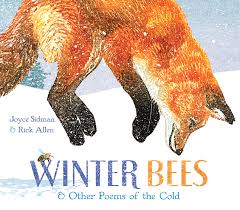
Winter Bees & Other Poems of the Cold
Author: Joyce Sidman
Illustrator: Rick Allen
Published November 4th, 2014 by HMH Books for Young Readers
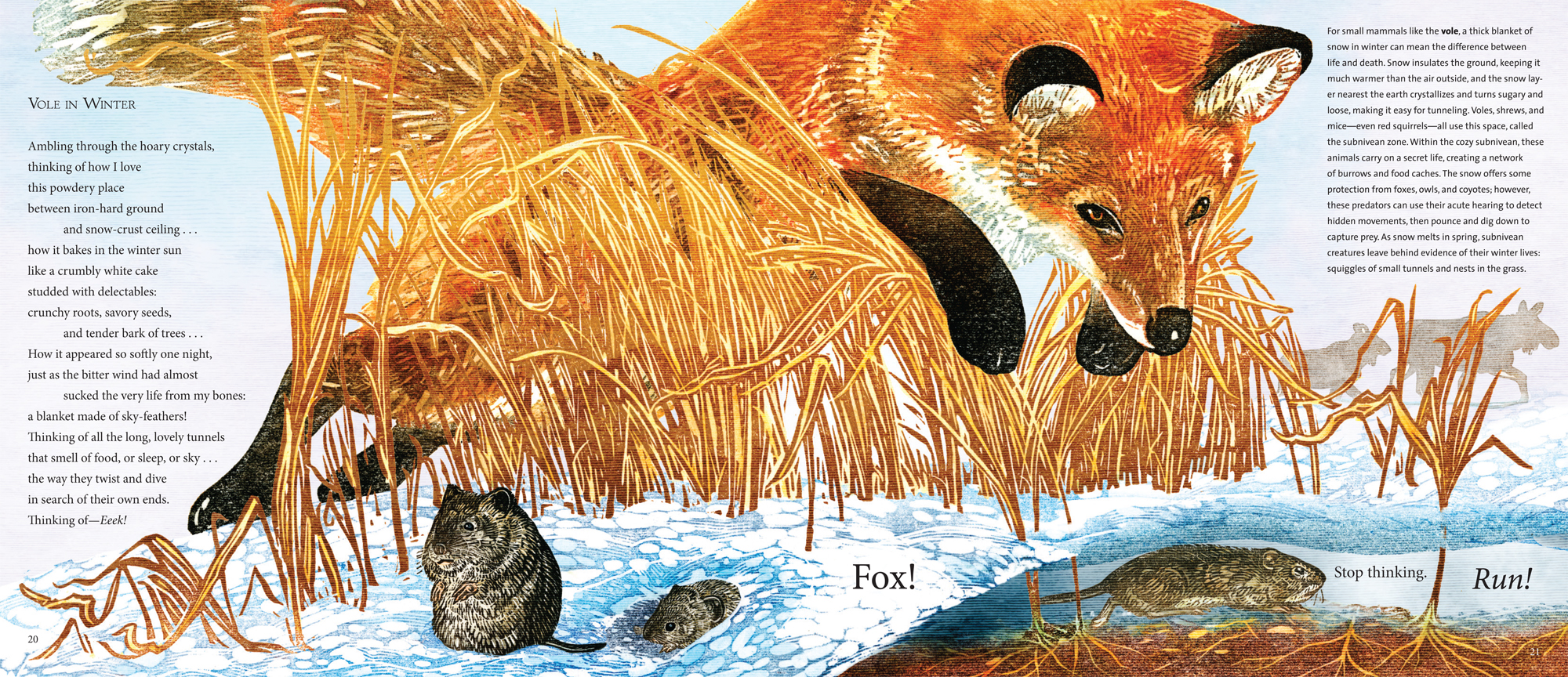
Goodreads Summary: In this outstanding picture book collection of poems by Newbery Honor-winning poet, Joyce Sidman (Song of the Water Boatman, Dark Emperor and Other Poems of the Night), discover how animals stay alive in the wintertime and learn about their secret lives happening under the snow. Paired with stunning linoleum print illustrations by Rick Allen, that celebrate nature’s beauty and power.
My Review: Alyson and Carrie both nominated this book for our Mock Sibert Award, so I knew it was a book I had to read. After requesting that my library purchase it, I was so happy to finally receive the book. This book is beautiful. Each aspect of the book can stand alone: the poetry is full of imagery and figurative language, the informational aspects are interesting and fact-based, and the illustrations are exceptional and bring the animals to life.
Teachers’ Tools for Navigation: First, this book can be used as a mentor text for poetry. Many different types of poetry are represented and each poem is different. Second, I think this book can be a great jumping off point for an inquiry-based project where students research an animal, write a poem about it, and also write an informational piece of text to accompany the poem. This book is also a great companion to Kate Messner’s Over and Under Snow and other animal survival books which would cause for a great unit as well.
Discussion Questions: Which of the winter animals has the best plan for survival?; What fact in Winter Bees surprised you the most about how an animal survives during the winter?
We Flagged:
Read This If You Loved: Firefly July by Paul Janeczko, Feathers by Melissa Stewart, Born in the Wild by Lita Judge, Forest Has a Song by Amy Ludwig VanDerwater, Over and Under Snow by Kate Messner
Because of It’s Monday! What Are You Reading? posts, I find myself often with huge piles of picture books from the library that were highly recommended by fellow bloggers. I celebrate many of the nonfiction pictures books on Wednesdays, but I want to share some of the fiction picture books I have enjoyed. So, I decided to start series here on UR where I can pass on the love for these books sporadically as I read them. Here is a list of some great pictures books that I’ve read recently from my huge library pile (part 6!).
When I was watching the ALA Book Award announcements, I realized that there were many that I had not read, so I immediately ordered them from my library. While reading, I was so happy to see so many diverse picture books (fiction and nonfiction) winning awards. This week I wanted to highlight the picture books I read that were full of diversity. On Wednesday I shared the nonfiction titles, and today I will share the fiction titles.
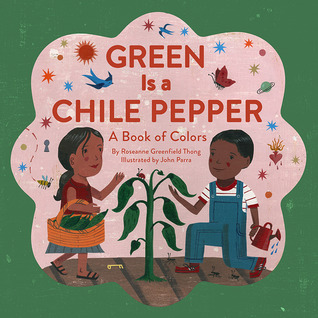
Green is a Chile Pepper: A Book of Colors Author: Roseanne Thong
Illustrator: John Parra
Published February 18th, 2014 by Chronicle Books
2015 Pura Belpré Illustrator Honor
A color book told through the eyes of a young girl as she explores her Hispanic neighborhood. The illustrations are so vibrant and vivid and show such a diversity of people, traditions, and families. The text includes bilingual words thrown throughout the rhymes.
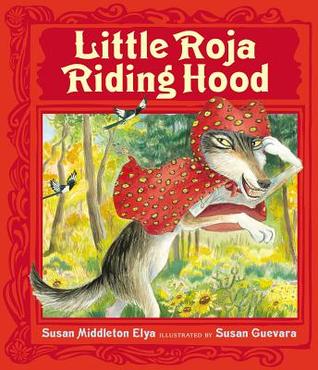
Little Roja Riding Hood Author: Susane Middleton Elya
Illustrator: Susan Guevara
Published April 10th, 2014 by G.P. Putnam’s Sons Books for Young Readers
2015 Pura Belpré Illustrator Honor
I loved this modern and bilingual rhythmic retelling of Red Riding Hood. It really is a funny fractured fairy tale that is so much fun to read aloud because of its couplets filled with Spanish vocabulary and Hispanic references.
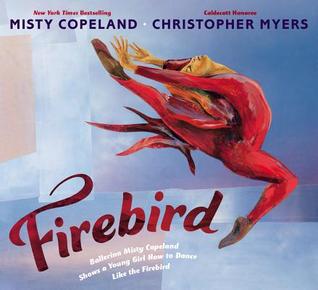
Firebird Author: Misty Copeland
Illustrator: Christopher Myers
Published September 4th, 2014 by G.P. Putnam’s Sons Books for Young Readers
2015 Coretta Scott King Award for Illustrator Honor
This text is powerful on two levels. First, Misty Copeland’s open letter to young girls who want to become a ballet dancer and may not see herself reflected in the dancers that they see on stage is so powerful. The power behind it is that Misty might as well be speaking to herself. Second, Christopher Myers’s illustrations bring the dance to life. As the two dancers dance, the illustrations seem to bring them to life.
H.O.R.S.E: A Game of Basketball and Imagination Author and Illustrator: Christopher Myers
Published October 9th, 2012 by EgmontUSA
2013 Coretta Scott King Award for Illustrator Honor, 2015 Odyssey Award for Excellence in Audiobook Production Winner
I had not heard of this book until it won the Odyssey Award this year. Although I could not get the audiobook, I wanted to read the picture book because of my love of Myers’s work. I thought this book was so much fun! It is the story of a blown-out-of-proportion game of HORSE between two friends that keep trash talking the other and one-upping their shots. I love the humor that Myers finds in the grand old tradition of banter on the court. What makes the book even better is the inspiration that Myers shares at the end of the book.
What picture books should I add to my pile next?
Want to see Part One? You can view it HERE. Want to see Part Two? You can view it HERE.
Want to see Part Three? You can view it HERE.
Want to see Part Four? You can view it HERE.
Want to see Part Five? You can view it HERE.



 and
and