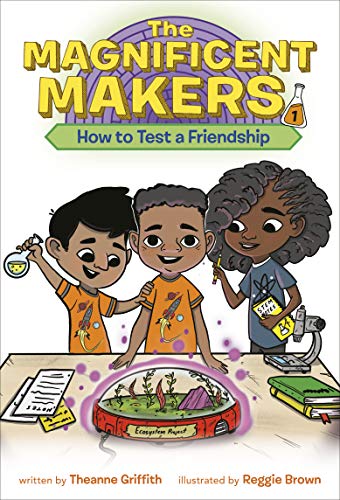
Magnificent Makers: How to Test a Friendship
Author: Theanne Griffith
Illustrator: Reggie Brown
Published May 19, 2020 by Random House Children’s Books
Summary: BOOM! SNAP! WHIZ! ZAP! The Magnificent Makers series is filled with science, adventure, and characters that readers will love!
A modern-day Magic School Bus for chapter book readers!
Violet and Pablo are best friends who love science! So when they discover a riddle that opens a magic portal in the Science Space at school, they can’t wait to check it out! Along with their new classmate, Deepak, the friends discover a magical makerspace called the Maker Maze. It’s a laboratory full of robots, 3D printers, an antigravity chamber, and more. Doors line the walls of the makerspace, with a new science adventure waiting behind each one.
Ricki’s Review:I think I’ve recommended this book to about fifteen people since we’ve read it. I really admire the way in which Griffith incorporates science in such a fun way. The book almost feels interactive. I am going to admit that I, an adult, learned some cool science information as we read this one. We read this book with our virtual book club of kids, and they all loved it. It was very easy to host discussions, and the kids were very animated as they talked about the sections that they loved most. This is a great early chapter book series that is going to be well-loved by teachers. The interdisciplinary nature of the text makes it very easy to teach. We will definitely be getting the next book in the series.
Kellee’s Review:As a mom of 1st grader who loves to read, we are always looking for new early chapter books that will grab his attention and this book is everything we could want. First, it is relatable. The dynamics between the three characters are accurate and just on point. It also deals with real feelings like jealousy and competitiveness. Second, it is about science! Trent is definitely a science loving kid, and adding some science into his books makes him love them more. Third, it is a reflection of the real world (even though they travel to another dimension) because there are a diversity of kids and adults both in looks and behavior. We have already gone to buy the next three in the series, and we cannot wait to see what adventure happens next!
Teachers’ Tools for Navigation: This book offers many questions that can lead to inquiry and many topics that can be explored further by kids. Teachers might ask students to select a topic in science and write a fictional story about it. This would require some research and thinking about how information is presented in fiction.
Discussion Questions:
What was your favorite aspect of science that you learned from the book?
What emotions did the characters experience in the book? Have you been in situations where you’ve felt these emotions?
What could you research from this book to learn more (e.g. robots, 3D printers, an antigravity chamber, the ecosystem)?
Flagged Passage: “Producers, consumers, decomposers, oh my! All are necessary for an ecosystem to survive. Most animals are __________. Living things, beware! If ____________ disappeared, we wouldn’t have fresh air. And without ______________, nature’s garbage would be everywhere! Solve this riddle to enter the maker maze” (p. 11).
Read This If You Love: Science books, early chapter books, interdisciplinary learning
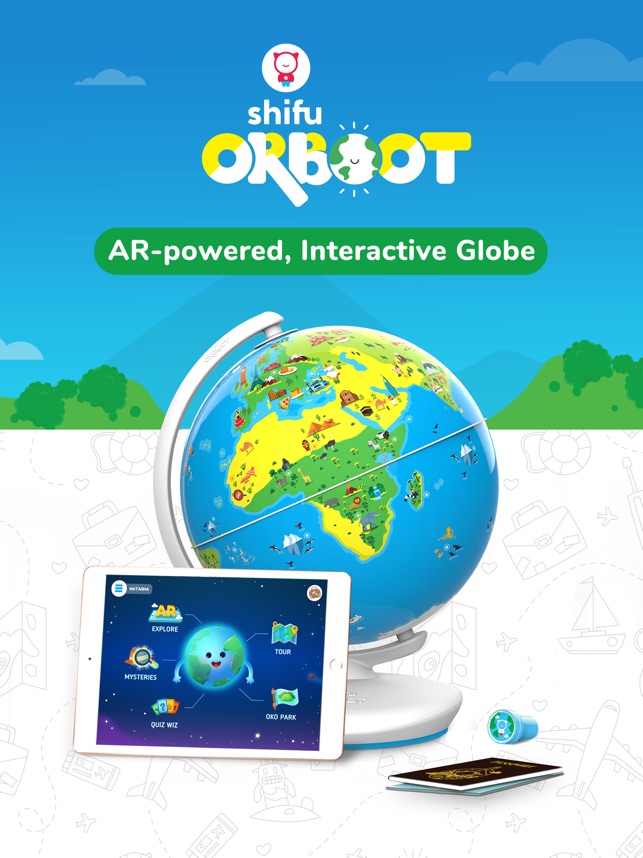
An award-winning educational toy, Orboot is a no-borders globe that connects with the fun & interactive Orboot app.
A STEM toy that sparks the imagination and creativity, Orboot encourages the little ones to explore and discover on their own. It builds knowledge as well as develops linguistic and cognitive abilities in the process.
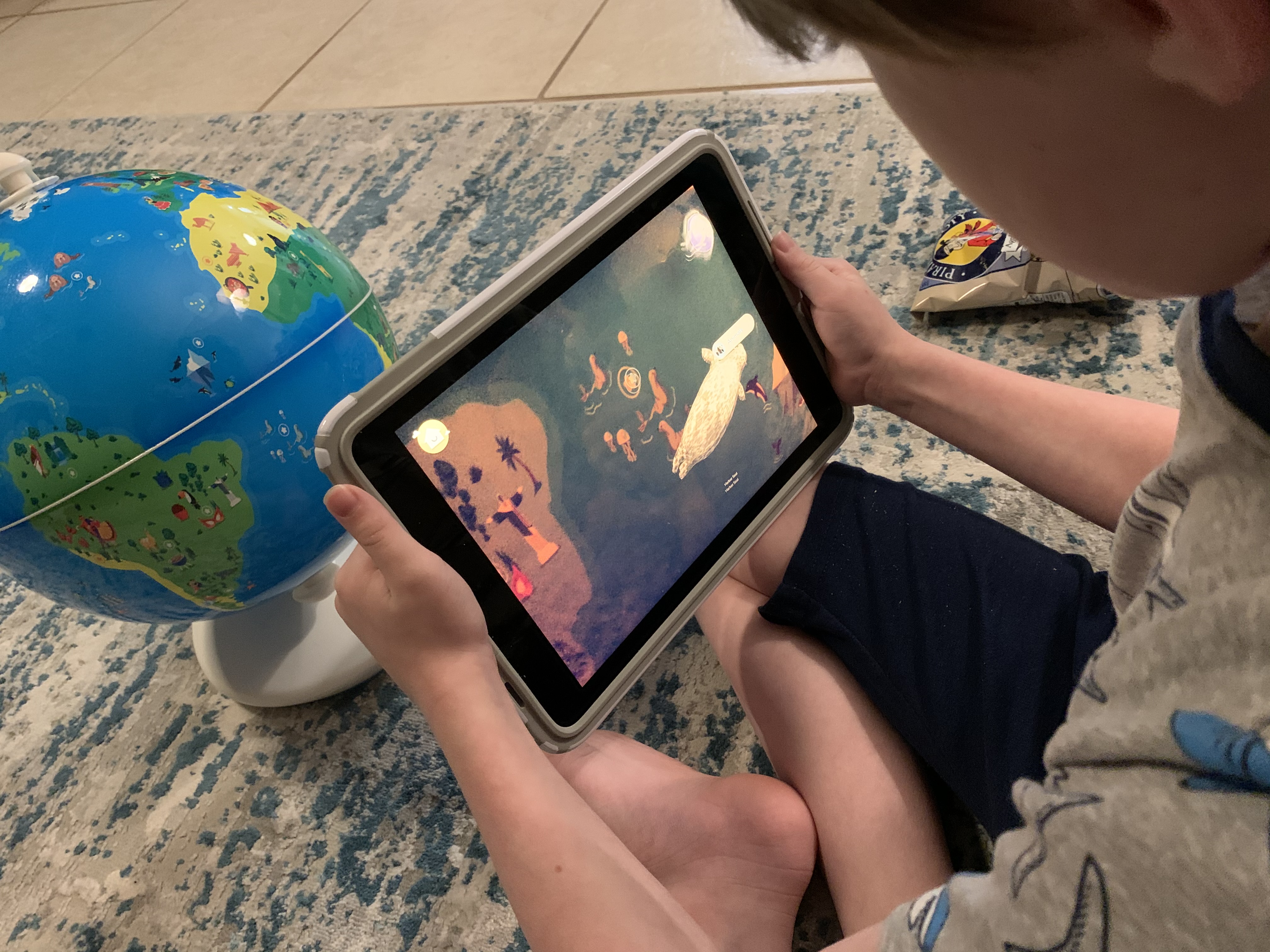
Explore the world with 400+ highlights and 1000+ cool facts across 6 categories – cultures, cuisines, monuments, inventions, animals and maps (national and state boundaries of countries).
What makes Orboot stand out versus other globes and other geography apps is that it combines the two: hands on and technology. The globe can be used like a standard globe but it also can be taken to the next level by using the AR-powered app to dig in!
There are some awesome pluses to the app: all aspects of it is free, it is available in many different languages, and once you download the app WiFi isn’t needed. Also, there is a portion of the app that can be used if the physical globe is not available!
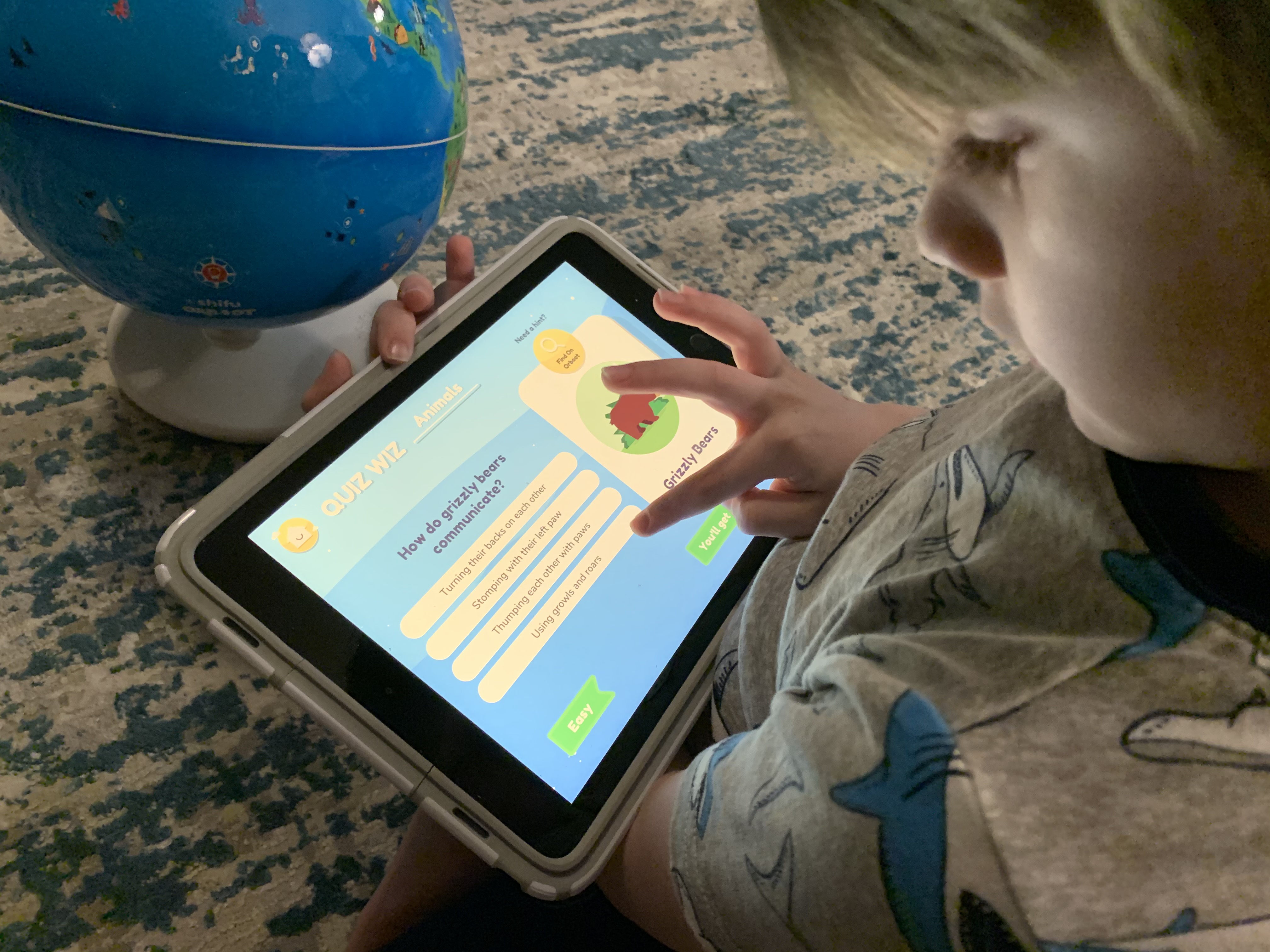
There are so many different ways to play with your globe with its app. First, you can learn information about six different categories: maps, monuments, animals, food, inventions, and culture. There is also a scavenger hunt type game, quizzes, and the ability to build their own national park. And that is the digital puzzles and activities.
In addition to the digital activities, the user also gets a passport, stickers, guide, and stamps to keep track of the countries you “visit” while using Orboot.
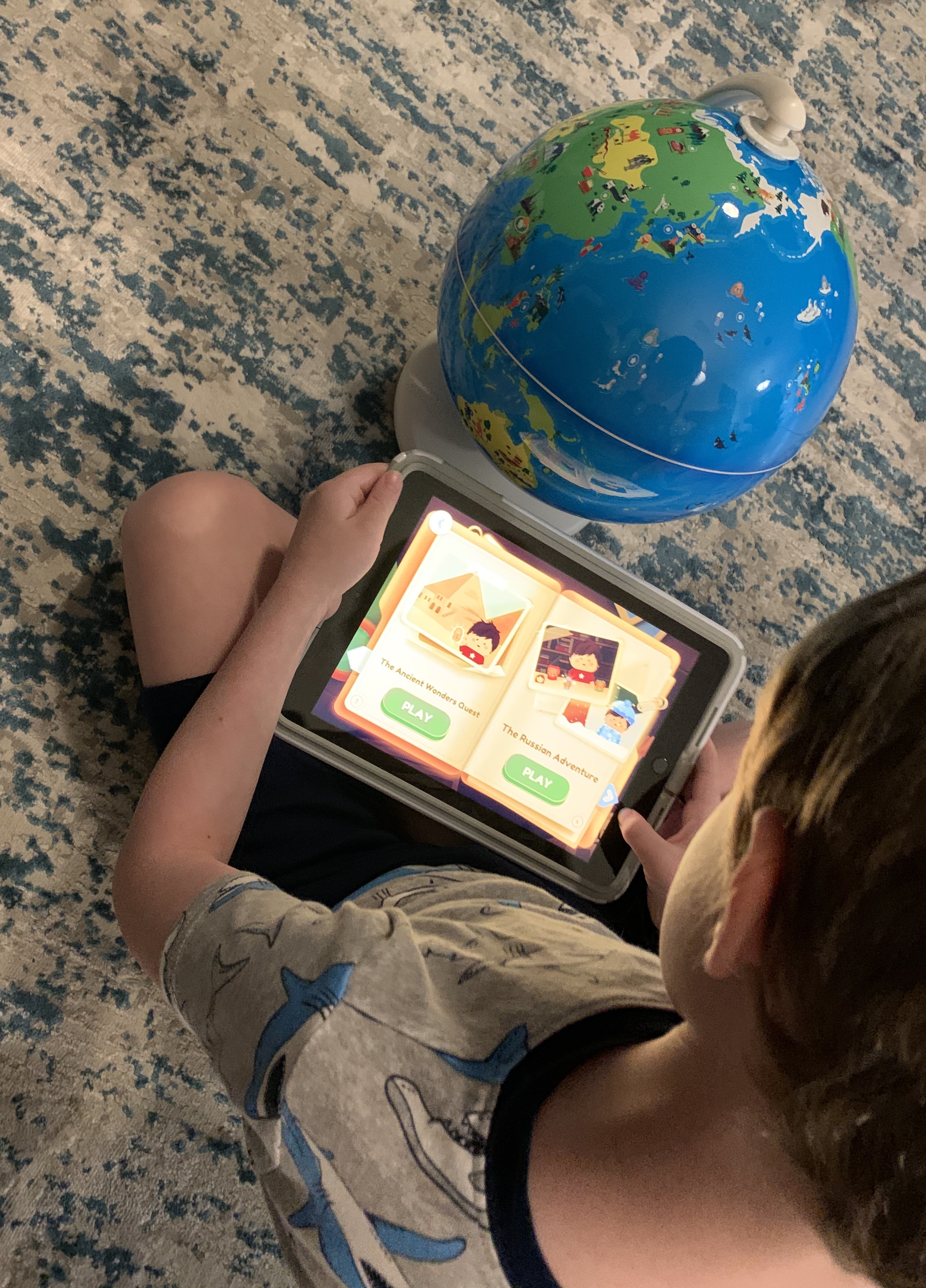
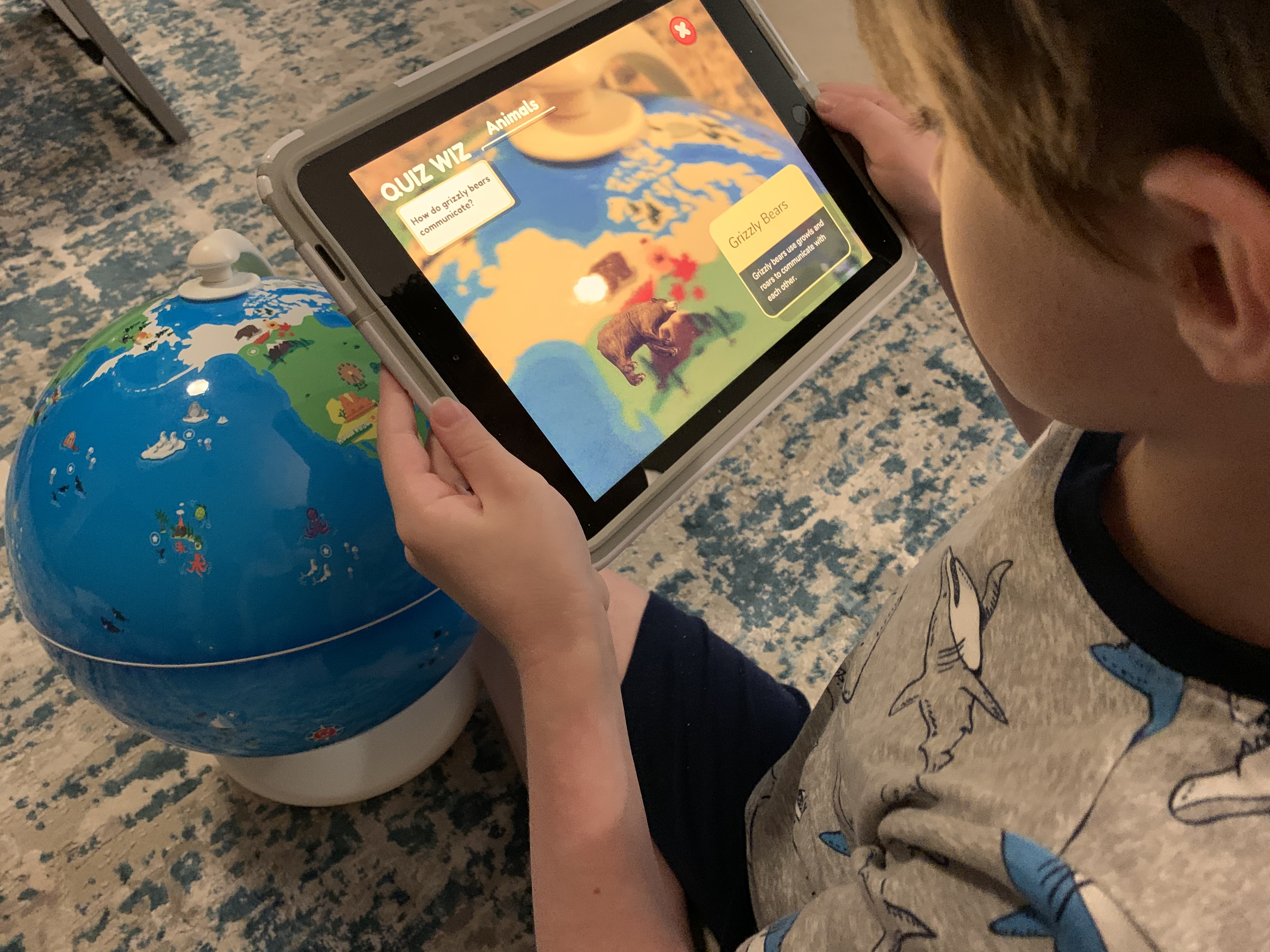
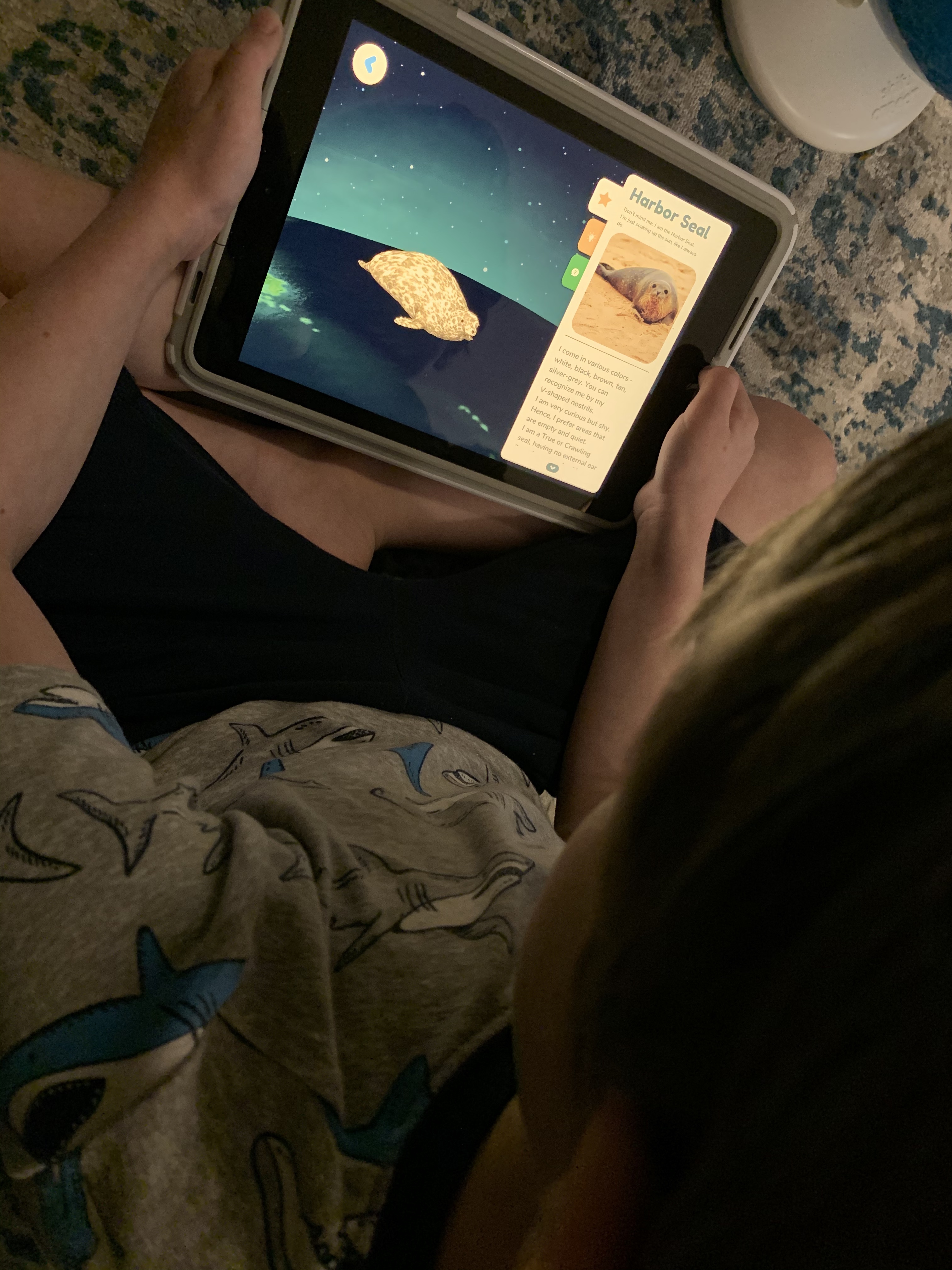
Trent adores his globe! He will sit with it for hours, listening to facts, interacting with the information, telling me about the places he traveled to, and making connections between what he is learning and what he knows. Trent says, “I like that I can learn about different places!”
I was surprised that the coins, stars, gems, and badges he could earn wasn’t what kept him going back to the globe, it was the knowledge and the mysteries. He loved figuring out all of the clues in the scavenger hunt type mysteries, and he likes throwing out the “Did you know?” questions at us. He likes looking up places he sees in books or entertainment to learn about them. Who can argue with a learning toy that engages kids this way?
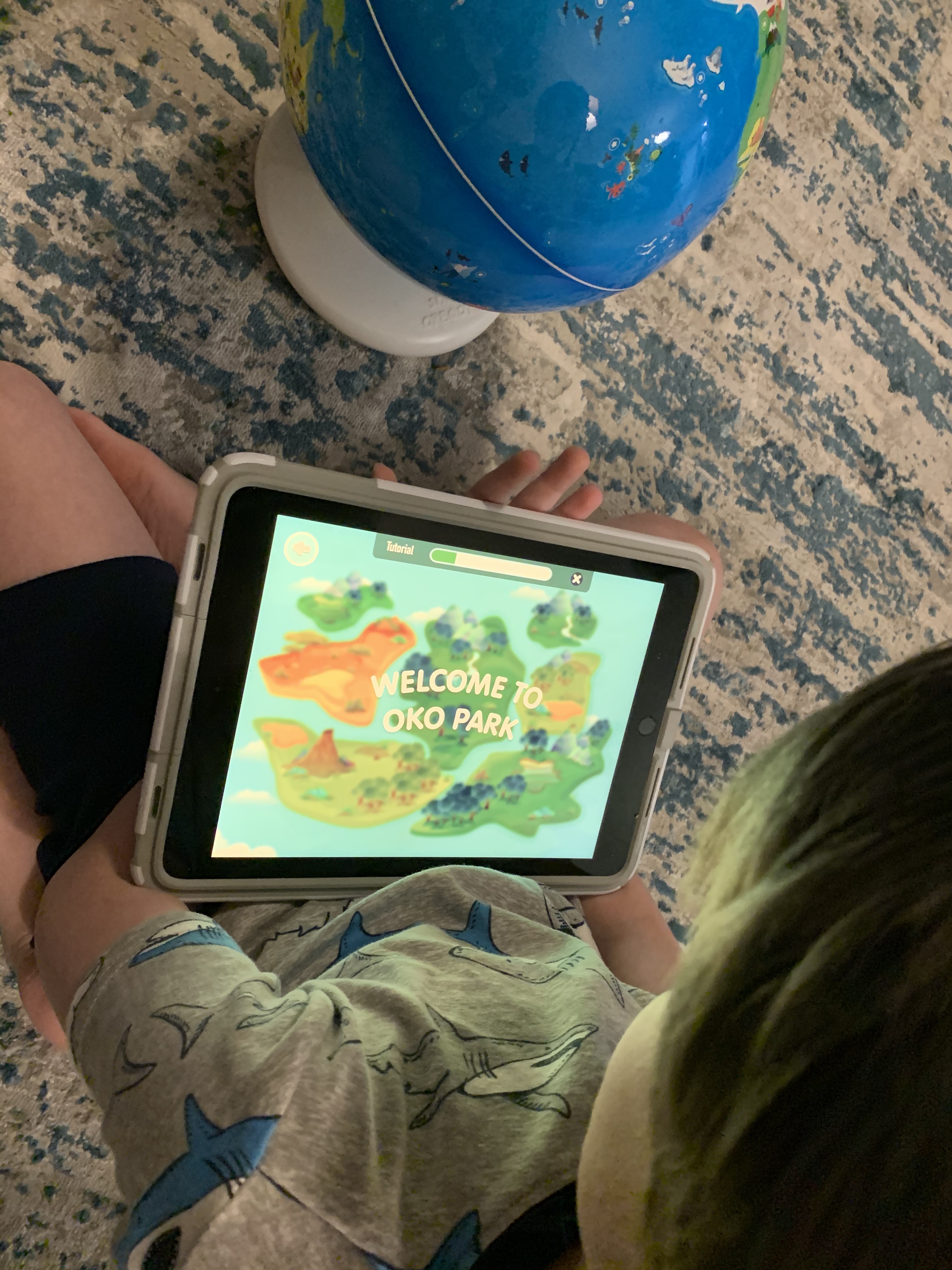
He also really likes the Oko Park aspect because it allows him to take his knowledge about the world and apply it to make a virtual national park. In the park the user looks at the balance of the national park, problems in the national park, and ways to keep their national park healthy. Trent says, “I love that I can learn to help nature.”
As a teacher, I could see Orboot as a center all by itself. It has such possibilities that it, by itself, could fill a center need and would allow students to dive into geography, social studies, and science!
Orboot takes kids on an adventure that they’ll love!
**Thank you to Shifu for providing a globe for review!!**
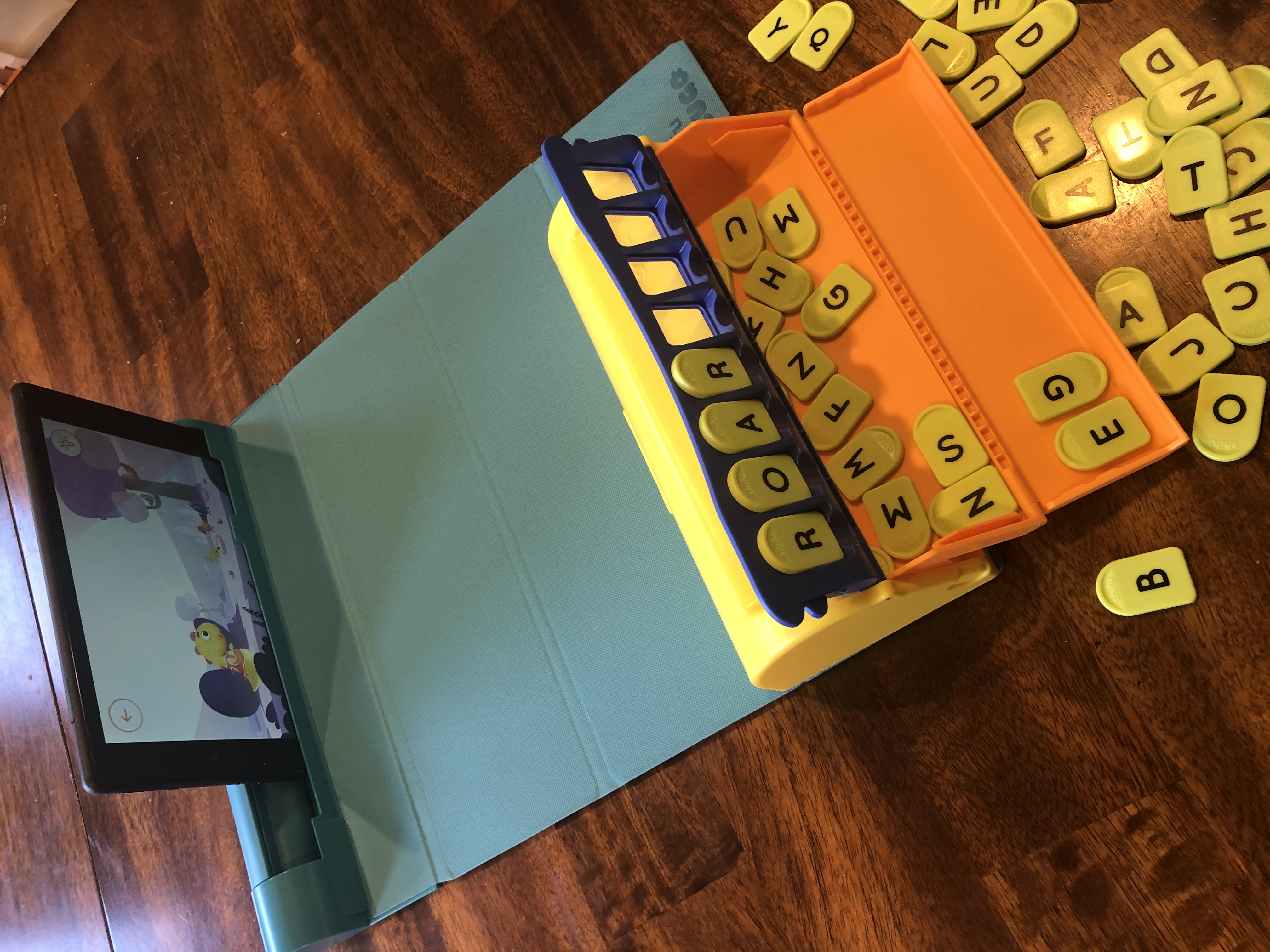
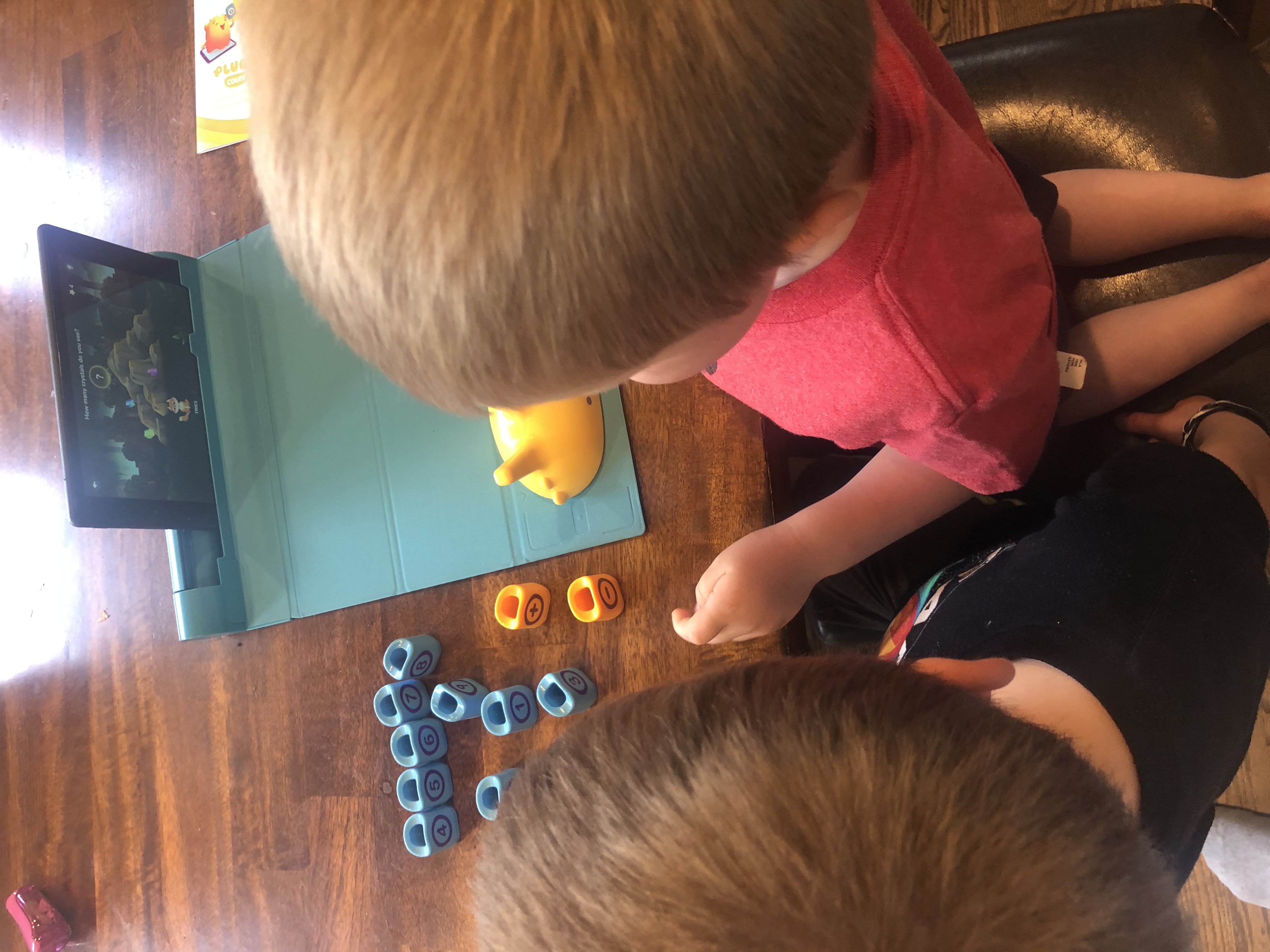
I am extremely excited to share this virtual-hands on learning system with you because my kids love it. Plugo offers a variety of learning options, and I elected to get their Letters, Count, and Link package. I chose the Letters kit by itself, and it came with a very high quality gameboard and alphabet kit (a lot of letters and a display that allows the app to read the letters). I also chose to get the Count and Link dual package, which also came with the gameboard, a three-spiked device named Spike, a lot of numbers that fit on spike, and magnetic patterned tiles for building. All of the materials are very well-made, and the app is very easy to download and follow (my three-year-old, for instance, figured it out immediately).
One thing I love about this system as opposed to other similar systems is that it adapts to the child’s age level. Each of my children have a profile with their grade level noted, and the app saves their progress.
I also like how well-made the product is. The magnets are strong, and the system feels very sturdy. My three-year-old has dropped several of the activity kits a few times, and they are still doing well.
Below, I share more details about each of the systems, all of which I recommend highly. As a family who is home for the summer (we’ve canceled all summer camps), this is what we’ve needed. The kids used to beg me for television, which we only use as a real treat, but now they beg me to play Plugo. This is much, much more exciting than their workbooks, and they love to engage in the varied games that each of the system offers.
Plugo Letters
An alphabet kit that goes beyond word-building. Develop grammar concepts like verbs, vowels, synonyms & more. Learn to spell & use new words through story-based games.
5 story-based games in the app
250+ challenges and puzzles
Age-adaptive challenges, PreK to Grade 5
Skills: language development, comprehension, storytelling
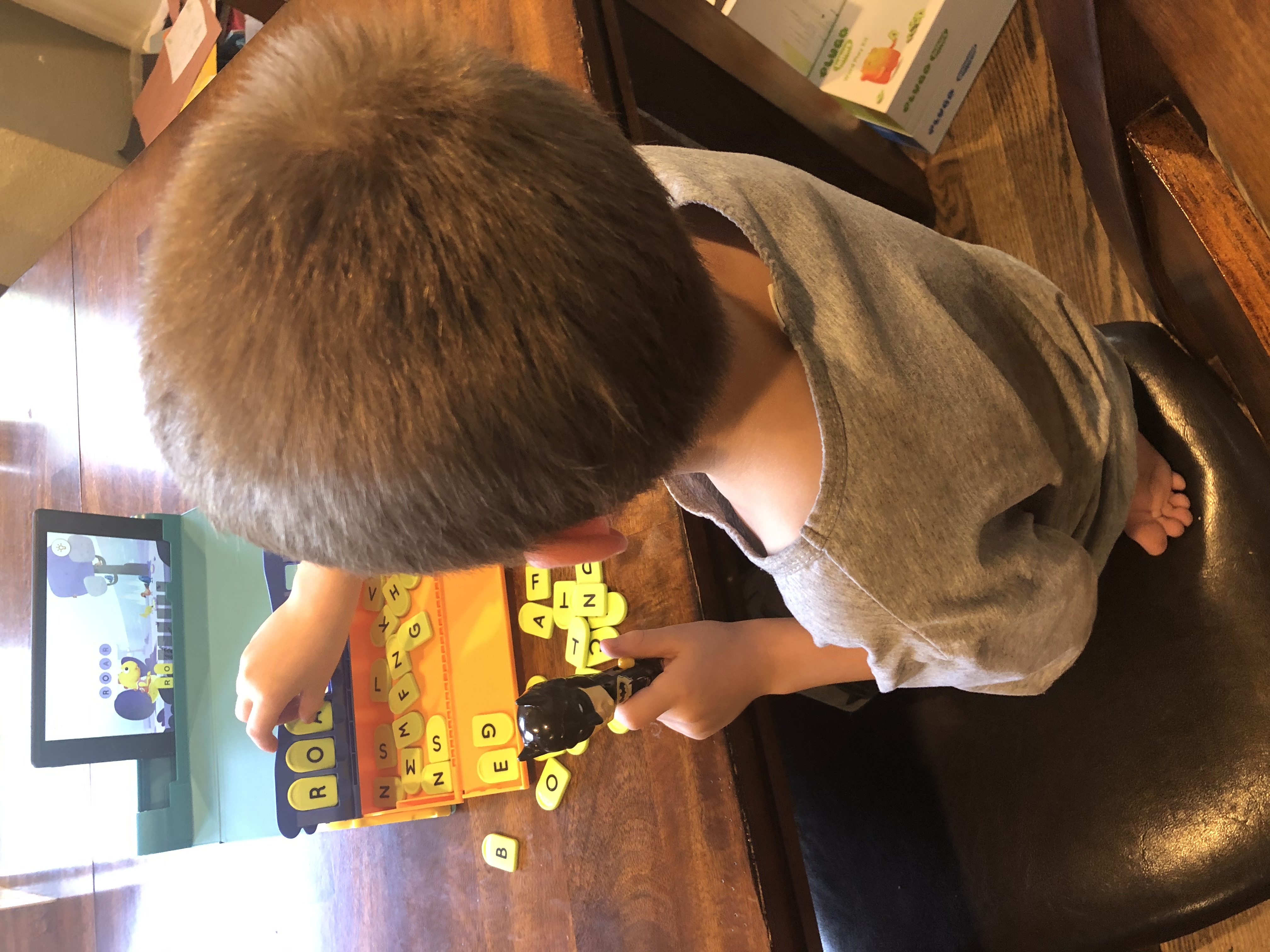
I love how my kids use this system and are reading and developing their language without even knowing it. I can hear them whispering the words as they sound them out. I see them trying out different vowels and experimenting with words.
Here, my 6-year-old spells out words along his pathway.
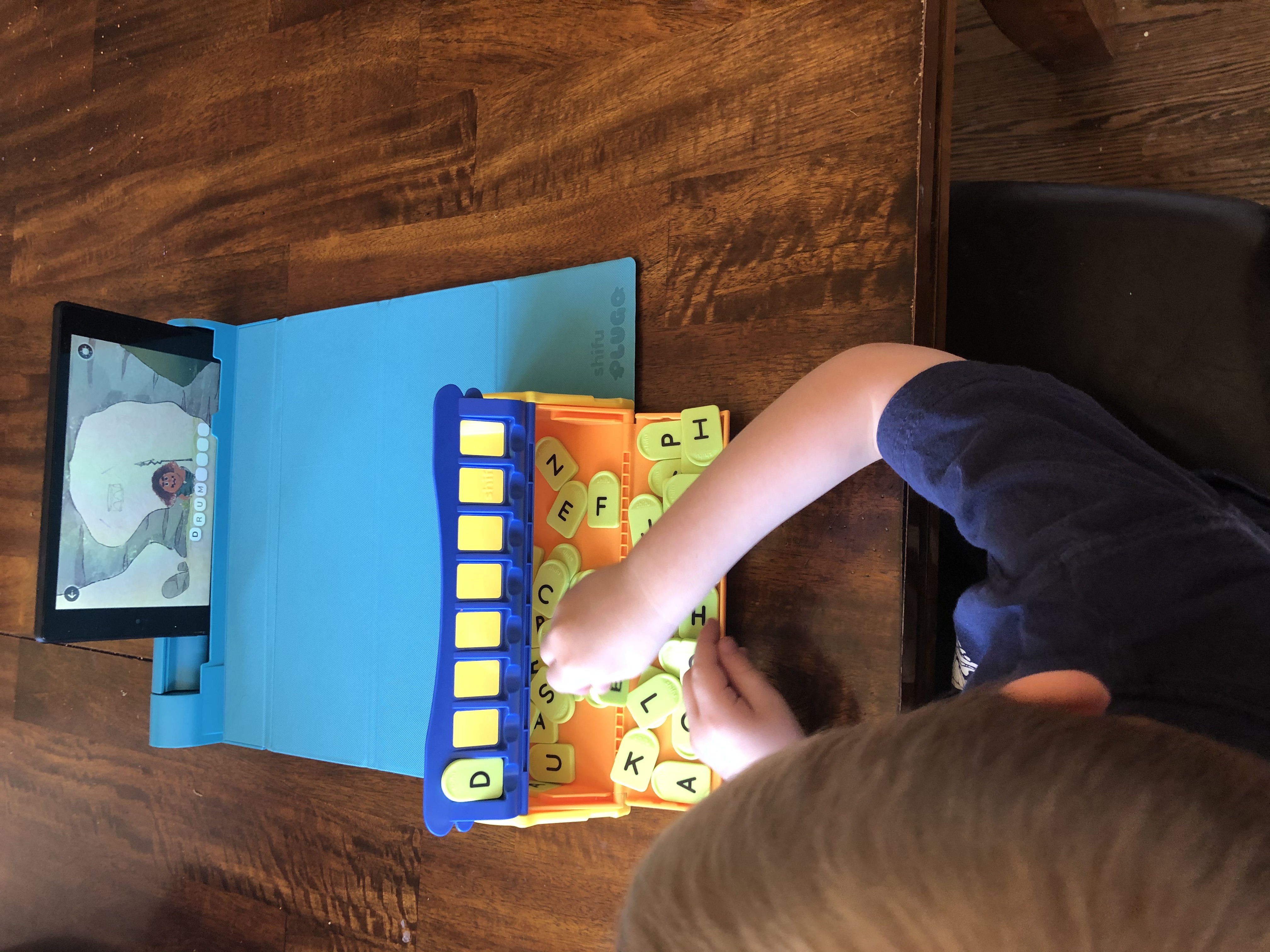
I thought my 3-year-old would be too young for the game, but sure enough, he played for almost an hour (when I cut him off).
The games are fun, and it goes all the way up to fifth grade. This is going to be a learning system that grows with our kids, and I am glad that they are learning letters and words through story. Rather than a video game, the app is more of a narrative that kids follow and stop at selected points to interact with the story using the letter tiles. If they get tired of a story, there are other games within the app to play!
Plugo Count
Traditional math made fun with an innovative hands-on approach. Plugo Count reinvents math with engaging stories that help kids understand and fall in love with numbers.
5 story-based games in the app
250+ challenges and puzzles
Age-adaptive challenges, PreK to Grade 5
Skills: math (+ – x /), problem-solving, logical reasoning
I love, love, love how this system adapts to the age level of the child, too. My 6-year-old loved playing the games and using operators like addition and subtraction. The repetition of the addition phrases is helping strengthen his memory of common equations. He goes through the story and learns math through authentic examples. I am looking forward to him being able to try out the multiplication and division operators in the future.
When my 3-year-old asked to play Count, I hesitated because I didn’t think he’d be able to play it. Imagine my relief when he started playing and the game asked him to count items in the story and complete the missing number (3, 4, 5, ___). I think about all of the worksheets within workbooks that ask kids to do these same skills, but with Count, he is able to count images that go along with a story. This feels more authentic and exciting!
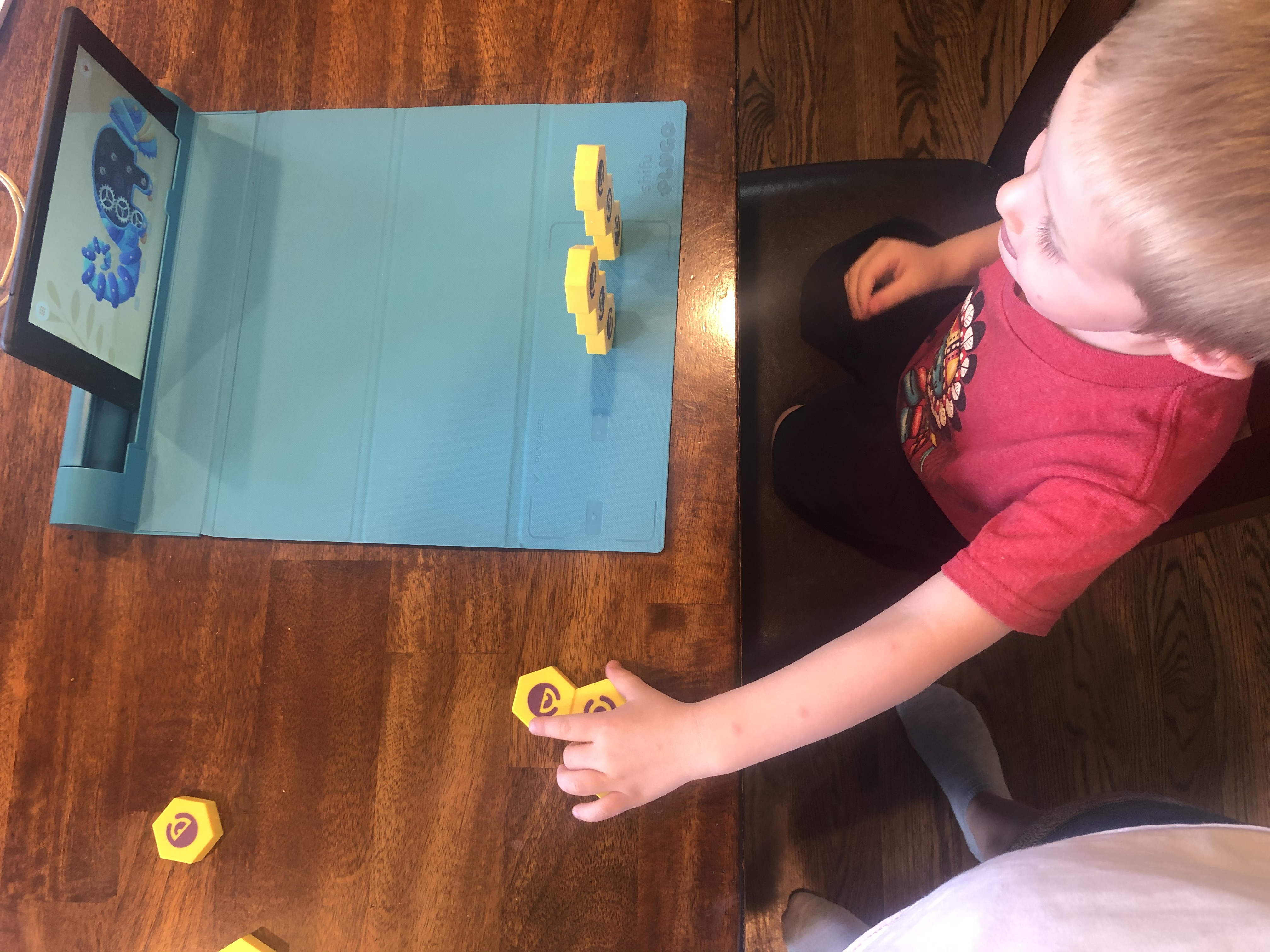
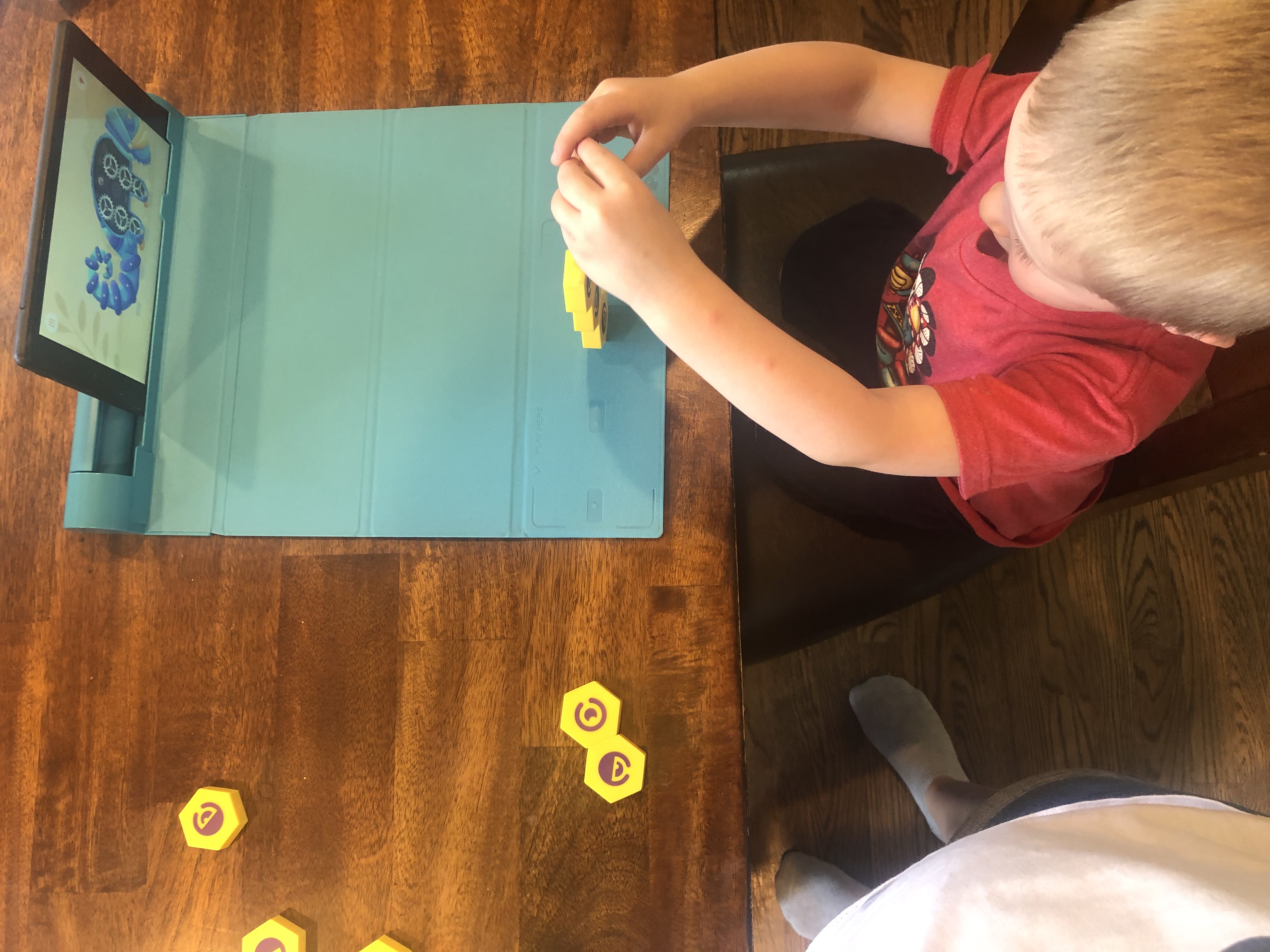
Plugo Link
Classic building blocks meet modern digital play with Plugo Link! Build and balance the magnetic blocks in real world to solve exciting engineering puzzles on the screen.
My kids are Lego lovers. They could sit at the table for hours with a new Lego kit. So it comes as no surprise that they are obsessed with Link. In the image above, you see my 3-year-old linking up gears to complete an animal. In another game in the app, for instance, He is figuring out how to build pipes to prevent water from flowing out. Older kids can play a game like a word search to connect letters to make words with the patterned tiles. The kids absolutely love Link and enjoy all of the different building games.
Among Letters, Count, and Link, do I have a favorite? No. All three feel very educational and offer something different that is valuable for a child. It would be like asking me if I wanted my kids to attend math, reading, or engineering class. We’ve had a lot of fun with all three of the systems, and we recommend them all. For parents who are looking for more learning options and for parents who are looking to engage kids with hands-on learning, Plugo offers a fun and exciting option that kids will love.
From a teacher perspective, these systems would be really great options for learning stations and fast finishers. I would be really, really excited to see them in my kids’ classrooms because they offer a kinesthetic approach to learning.
**Thank you to PlayShifu for providing Letters and Count for Review!**
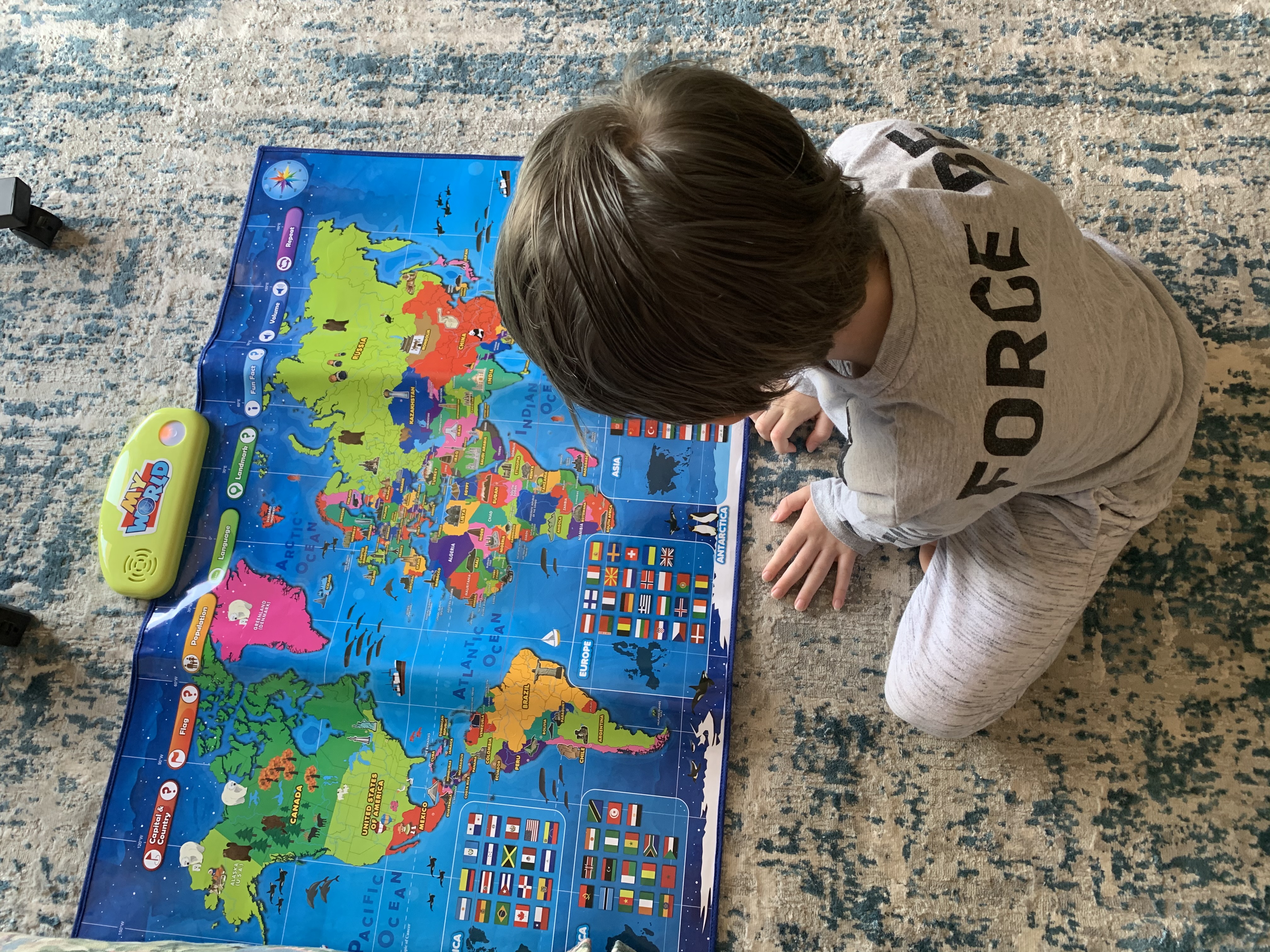
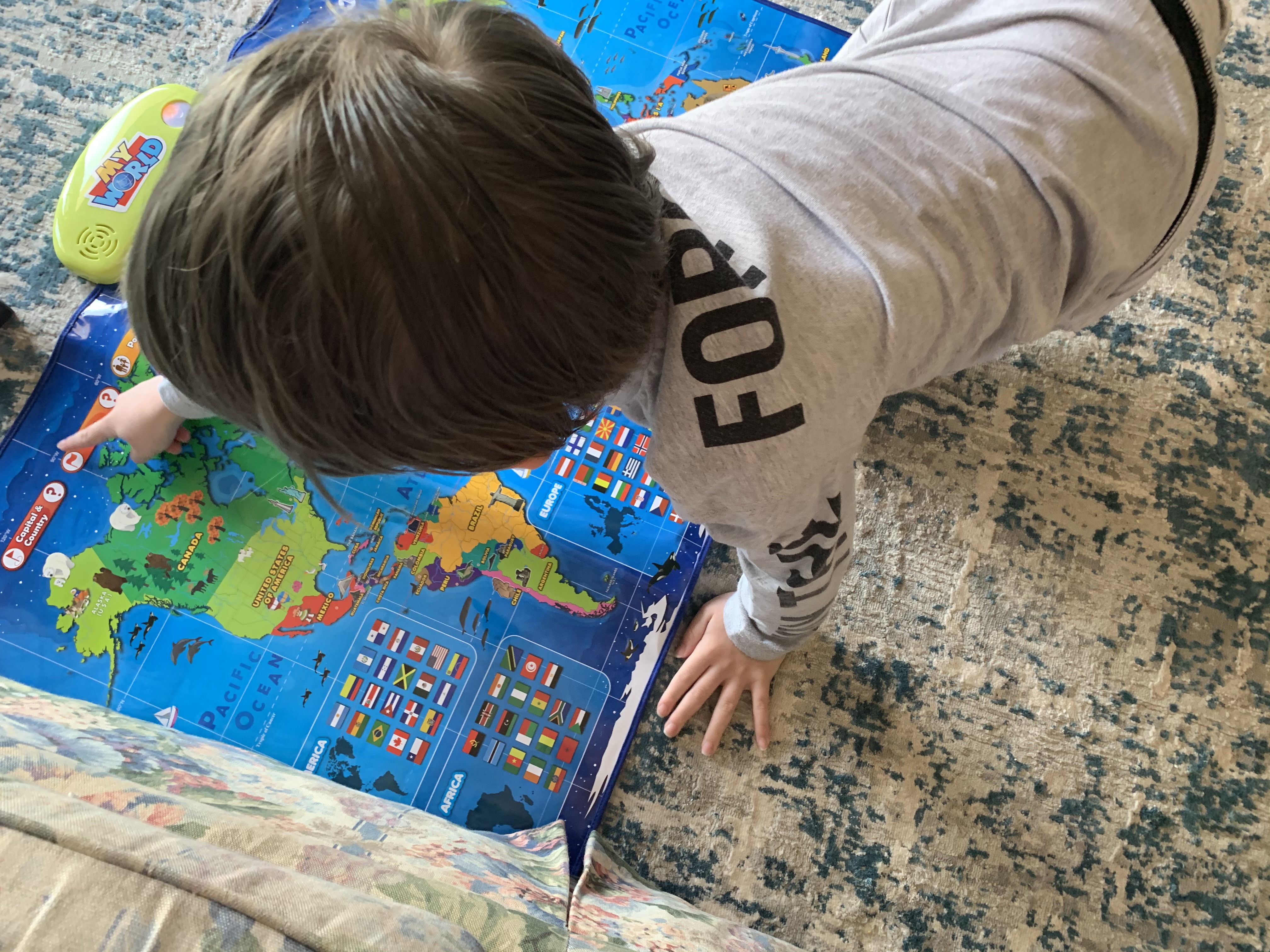
Best Learning’s iPoster My WORLD Interactive Map is a “beautifully illustrated large floor map for kids, great for interactive lessons in school or at home. Explore and discover the world with your fingertips!
The smartest way to learn the world which includes 92 countries, capital cities, flag, population, languages spoken, important landmarks, fun facts with 4 challenging quiz modes.
Learn over 1,000 facts about the world we live in!
Capital & Country – Learn about each country and its capital cities with quiz.
Flag – Learn about each country’s flag with quiz.
Population – Learn about the population of each country.
Language – Learn about the languages spoken in each country.
Landmark – Learn about the important landmark or monument of each country with quiz.
Fun Fact – Learn a fun fact of each country with quiz.
Family Choice, Mom’s Choice Gold Metal & Tillywig Brain Child Award Winner 2018! The most valuable interactive touch activated talking map.
Learning has never been so much easy and fun. Hang on a wall, play on the floor or use as a colorful play mat.
Learn capital cities, countries with their flags, population, languages spoken in each country, important landmarks, fun facts with volume control.
Skills learned include concentration, earth science, memory, problem solving, geography and environment.
Requires 3 AAA batteries (included); intended for Preschoolers and early learners of ages 5 and up.”
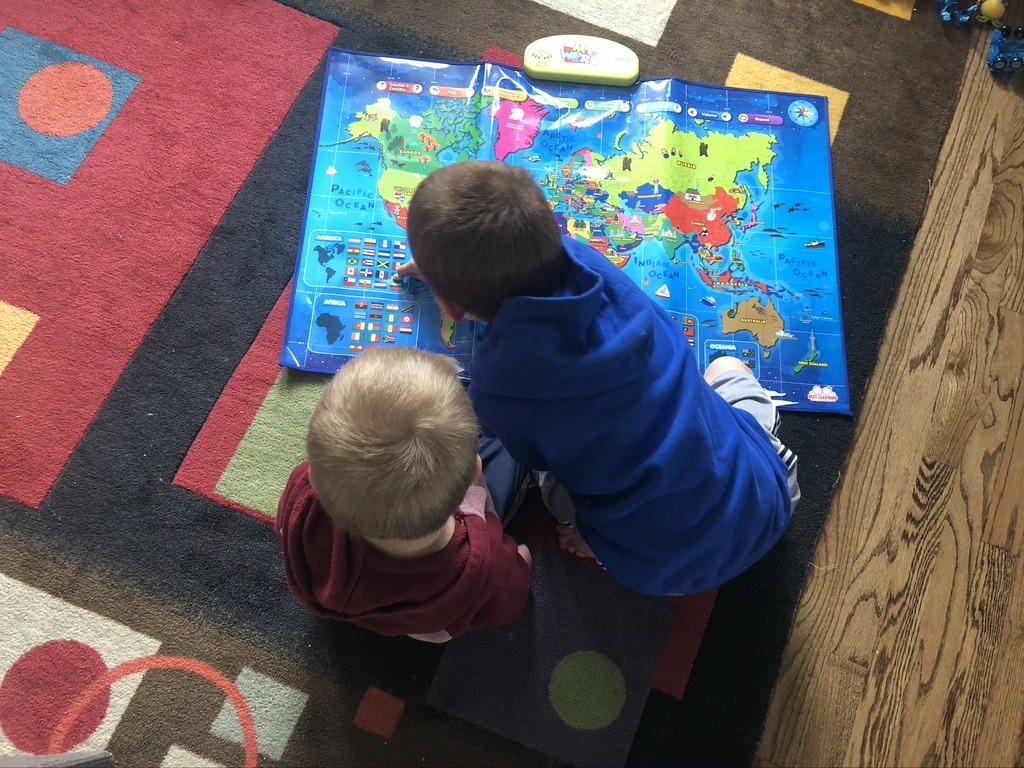
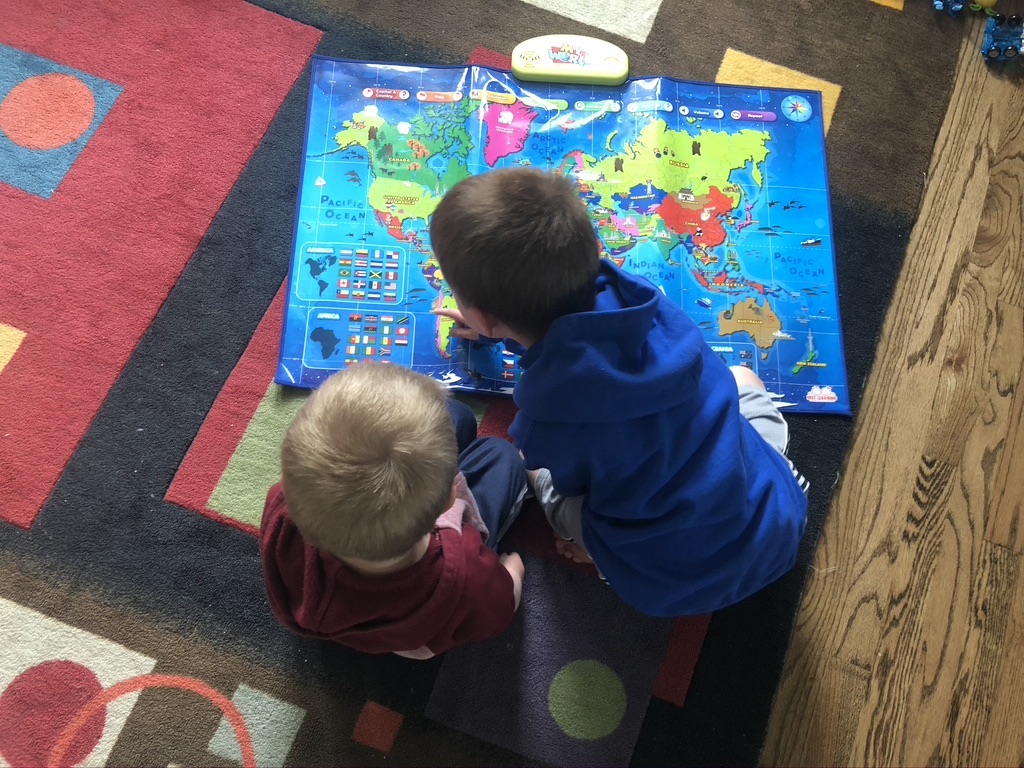
Ricki’s Review:We received this map a few weeks ago, and my kids take it out to explore again and again. I love how it isn’t just a simple, straightforward map with just countries. The different settings allow kids to explore more about our world. For instance, my older son seems to gravitate towards learning the country names, capital cities, and landmarks, yet my younger son is fascinated with the flags, and he regularly puts the map on the flag mode.
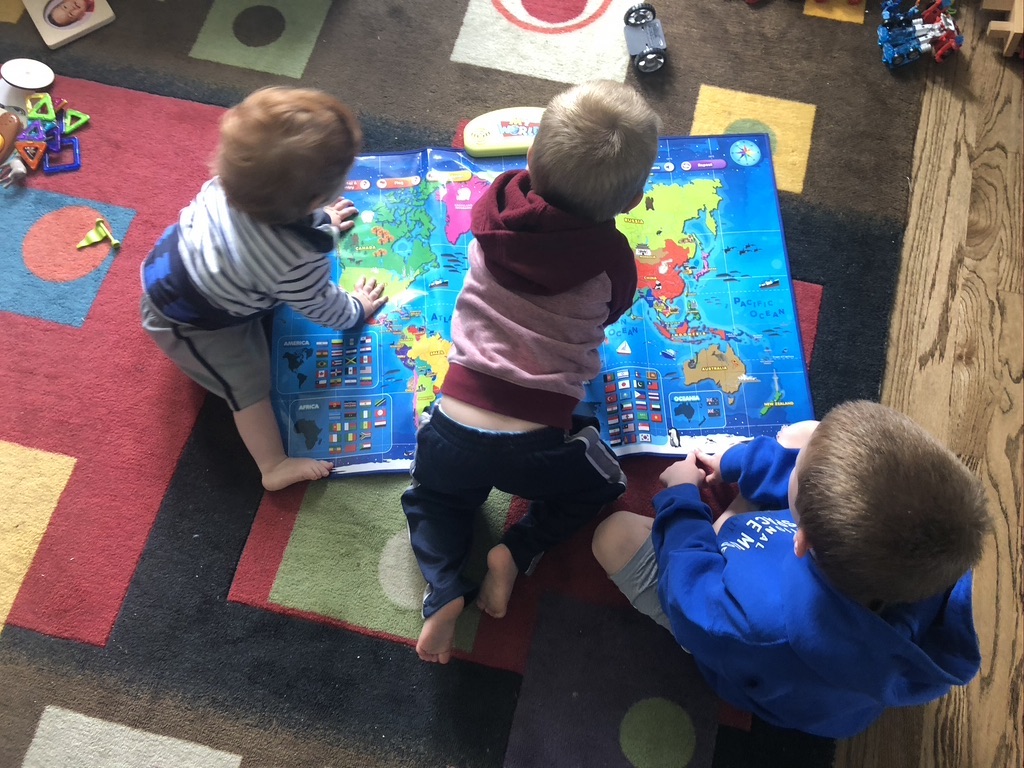
When we first opened the map, all three boys were interested. They learned to take turns learning about the countries. The baby is only included in this picture because as you see, he prefers to push everything at once.
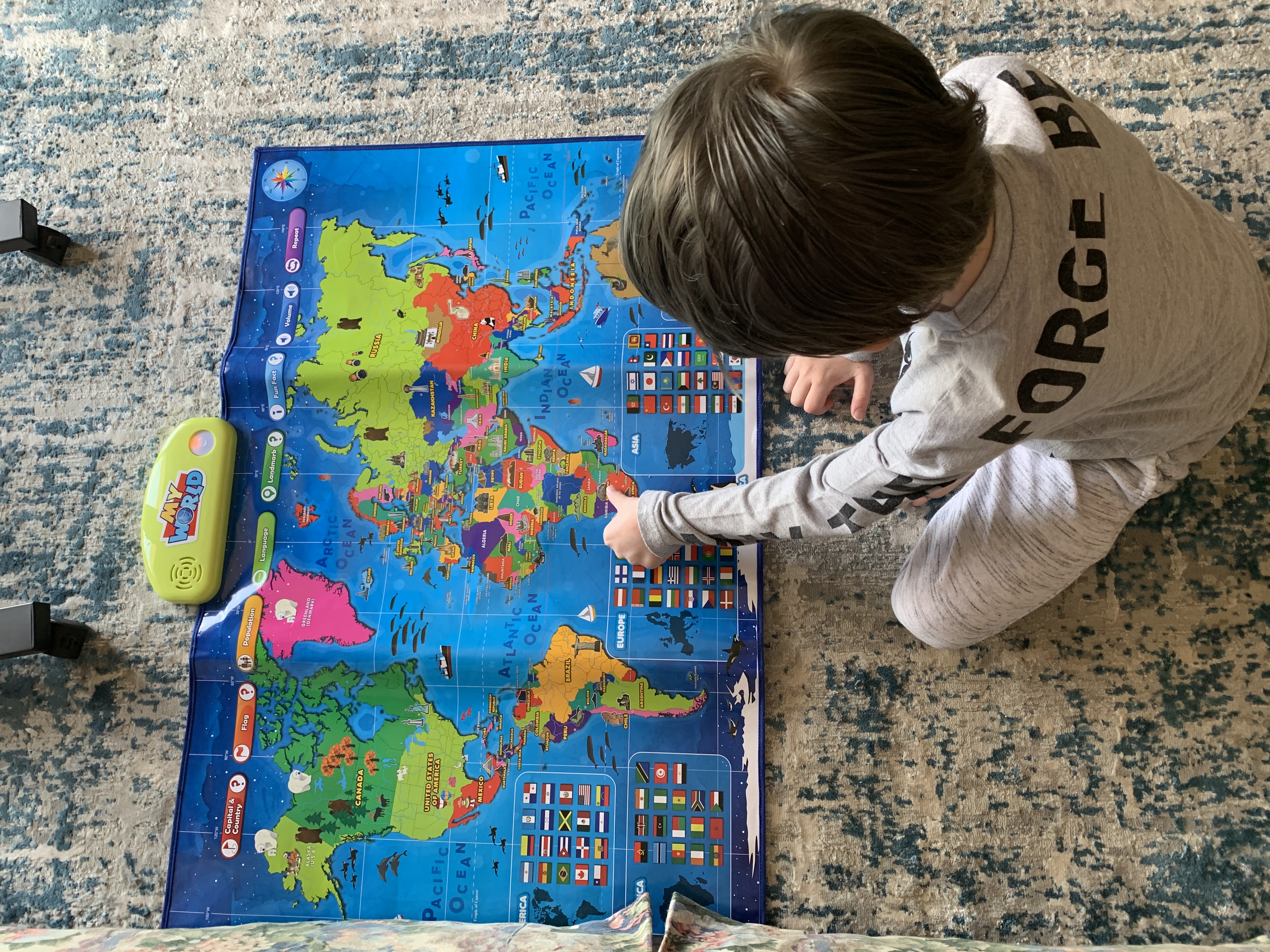
Here, my oldest son clicks on the flags to learn about the countries they come from.
And here, the kids take turns trying to identify the correct country in a fun quiz.
We plan to move the map to the wall this week, and we are happy that it will be something that the kids can keep referring to. I can’t count the number of times that one of them asks something like, “Where is XXXX country, city, or monument?” The map will offer a fun way to not only identify the location but to also learn more about the countries as they pop up in teachable moments.
Kellee’s Review: This map is endless entertainment and information! For those of us who have inquiry-driven kids, the freedom of the map and plethora of information just lends to their natural curiousity. So often I would get questions about a setting of a book or movie or just a random country that he heard somewhere, and now we can visit the map to find the country and learn all about it.
Trent is a fan of landmarks. He can tell you where the Eiffel Tower, Statue of Liberty, Pyramids of Giza, etc. are, so he immediately gravitates towards learning about them with the map. And he just adores quizzes and will relisten to information and retake quizzes until he knows things by heart and will randomly share information with strangers. He says that this is his favorite part: “I love that the map tells you what the place is and tells you everything about the place.” It is all of the interesting information that keeps him gravitating towards it.
While Ricki loves that it isn’t just a simple map, I understand what she means, but I love that in the end it is still a map. Although there are some graphics, it isn’t overwhelming, and we can still use the map as a map also. I love that something that Trent goes back to over and over is fun and educational!
Teachers’ Tools for Navigation: This map would be a beautiful addition to classroom walls. It offers so much more than a simple, paper map, and it allows kids to learn more about our world. We would recommend using velcro strips to hang this map on classroom walls to allow kids to pull the map off of the wall and bring it to their seats for further investigation.
and
**Thank you to Best Learning for providing maps for review!**
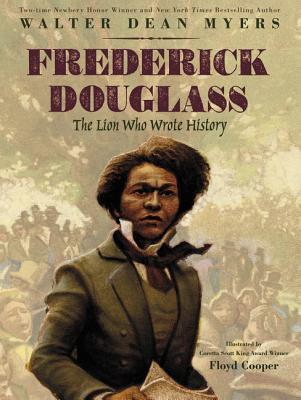
Frederick Douglass: The Lion Who Wrote History
Author: Walter Dean Myers
Illustrator: Floyd Cooper
Publication Date: January 24, 2017 by HarperCollins
Summary: In this picture book biography, the late New York Times bestselling author Walter Dean Myers and acclaimed artist Floyd Cooper take readers on an inspiring journey through the life of Frederick Douglass.
Frederick Douglass was a self-educated slave in the South who grew up to become an icon. He was a leader of the abolitionist movement, a celebrated writer, an esteemed speaker, and a social reformer, proving that, as he said, “Once you learn to read, you will be forever free.”
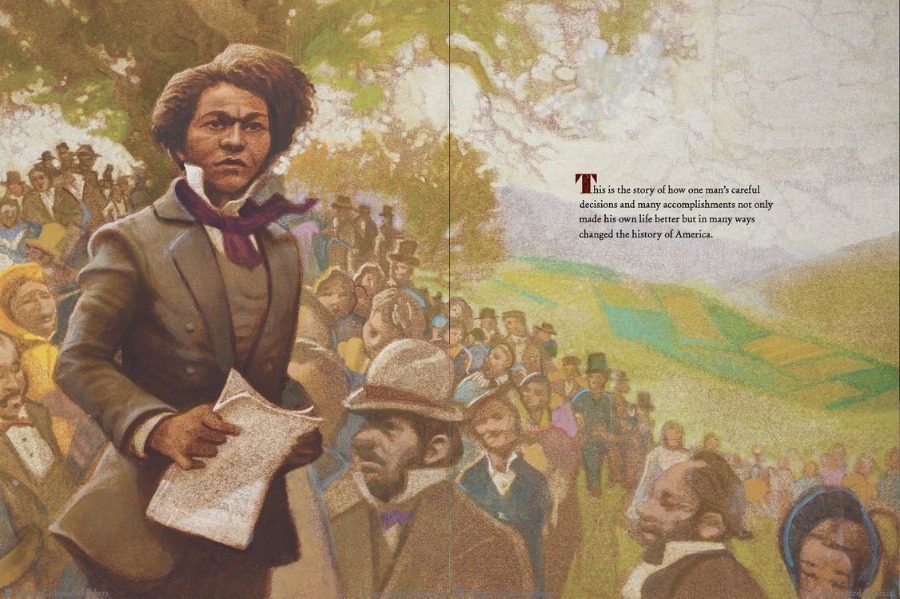
The story of one of America’s most revered figures is brought to life by the text of award-winning author Walter Dean Myers and the sweeping, lush illustrations of artist Floyd Cooper.
Review: We bought this book in 2017 when it first came out, and we read it again and again and again. My kids love to listen and learn about one of the most brilliant people to have ever lived. His story is incredibly inspiring. Even as a young boy, Douglass defied the world and never took no as an answer. The details of his story within this book show children (and adults) that they must push for what is right and commit to changing the world for the better. This book belongs in every classroom (and not just relegated to the classroom library). It should be shared collectively and purposefully with kids.
Teachers’ Tools for Navigation: There are endless uses for this book. One suggestion is that it could serve as a read-aloud and close reading at the start of a research or biography unit. Kids might look at the use of pictures and the pacing of the story to write their own nonfiction picture book.
Discussion Questions:
How does Douglass regularly display strength and resolve throughout his life?
How is the book paced to reveal key moments of Douglass’ life?
What other famous figures related to issues of equity showed this kind of resolve? How do their stories connect to Douglass’ story?
Flagged Passage:
Read This If You Love: Nonfiction picture books, Hidden Figures by Margot Lee Shetterly, Schomburg: The Man Who Built the Library by Carole Boston Weatherford, Radiant Child: The Story of Young Artist Jean-Michel Basquiat by Javaka Steptoe, Duke Ellington: The Piano Prince and His Orchestra by Andrea Davis Pinkney, We March by Shane W. Evans, Harlem’s Little Blackbird: The Story of Florence Mills by Renee Watson, Freedom in Congo Square by Carole Boston Weatherford
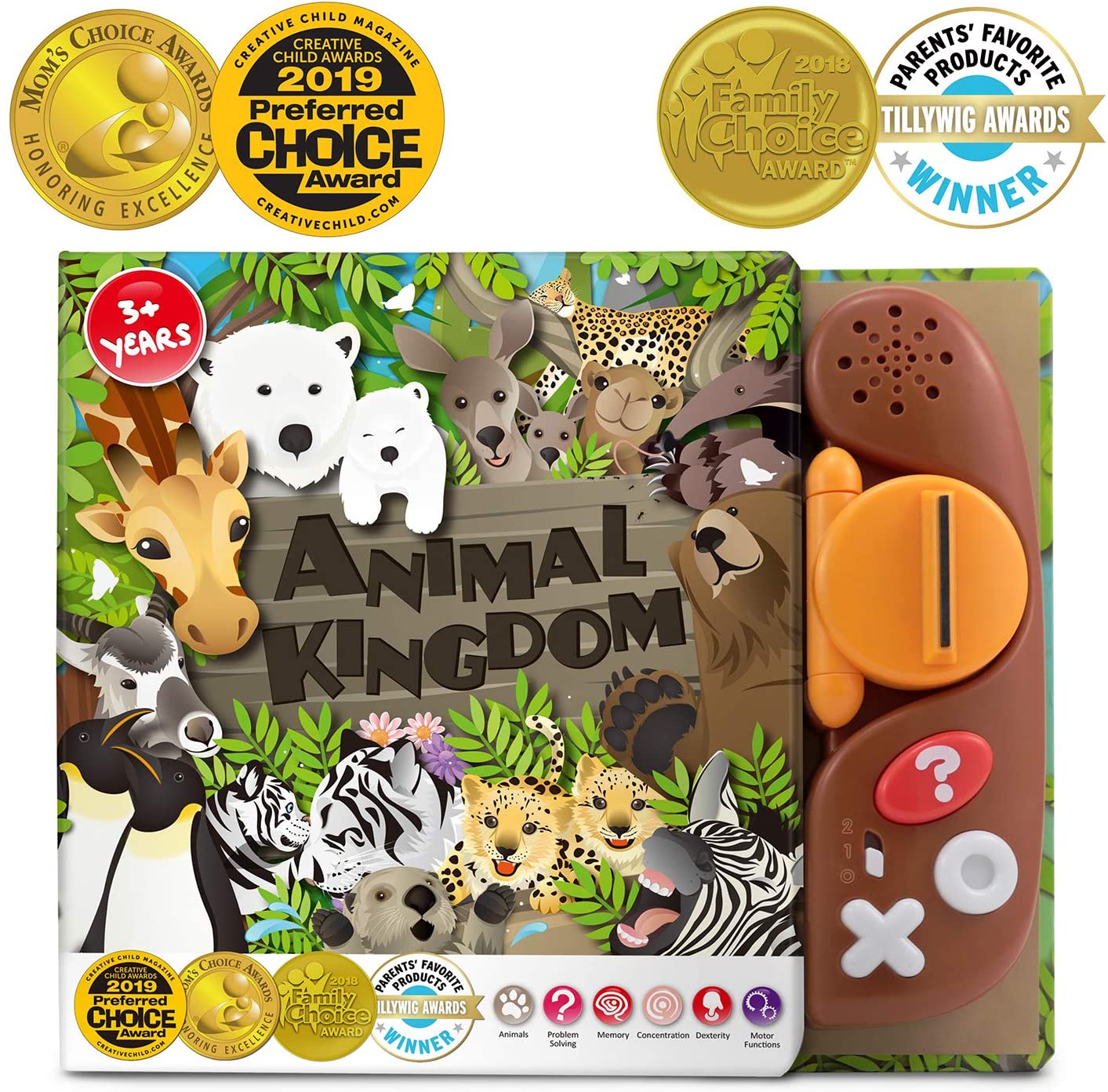
Book Reader Animal Kingdom is an interactive book reader for children to learn about 12 animals through 27 book pages about their appearance, behaviors, habitats and much more! Filled with playful melodies, friendly voices, and interesting sounds of animals and nature! Also comes with Quiz mode for those up for a challenge to keep them enthusiastic and learning at the same time!
Family Choice & Tillywig Parents’ Favorite Products Award Winner 2018! An interactive book reader for children to teach 12 animals about their appearance, behaviors, habitats and much more!
Simply press the paw down against the page as it reads aloud the contents.
Comes with a true and false quiz mode for those up for a challenge to keep them enthusiastic and learning at the same time.
Skills learned include animals, memory, dexterity, motor functions, concentration and problem solving.
Requires 3 AAA batteries (included); intended for preschoolers and early learners of ages 3 years and up.
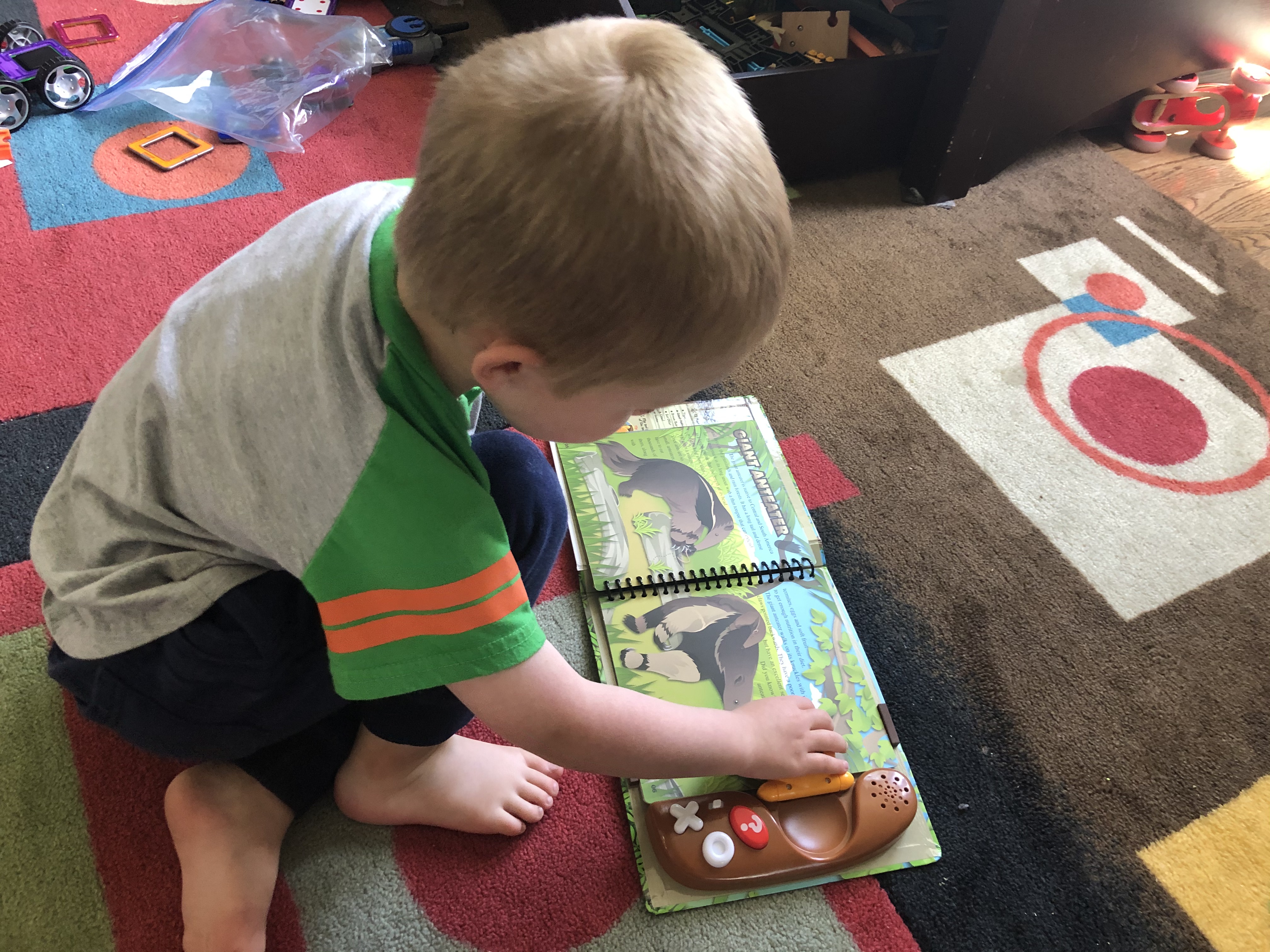
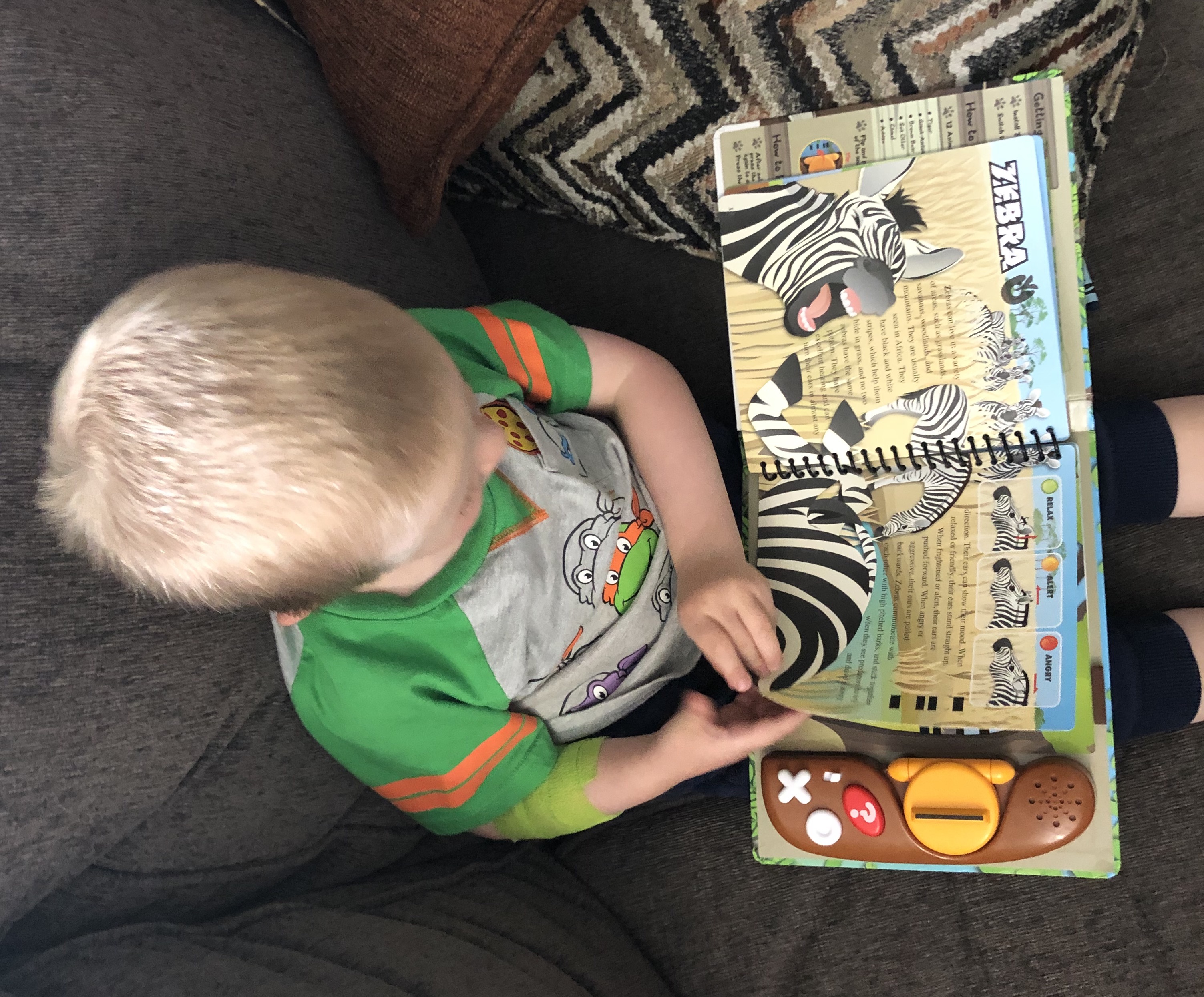
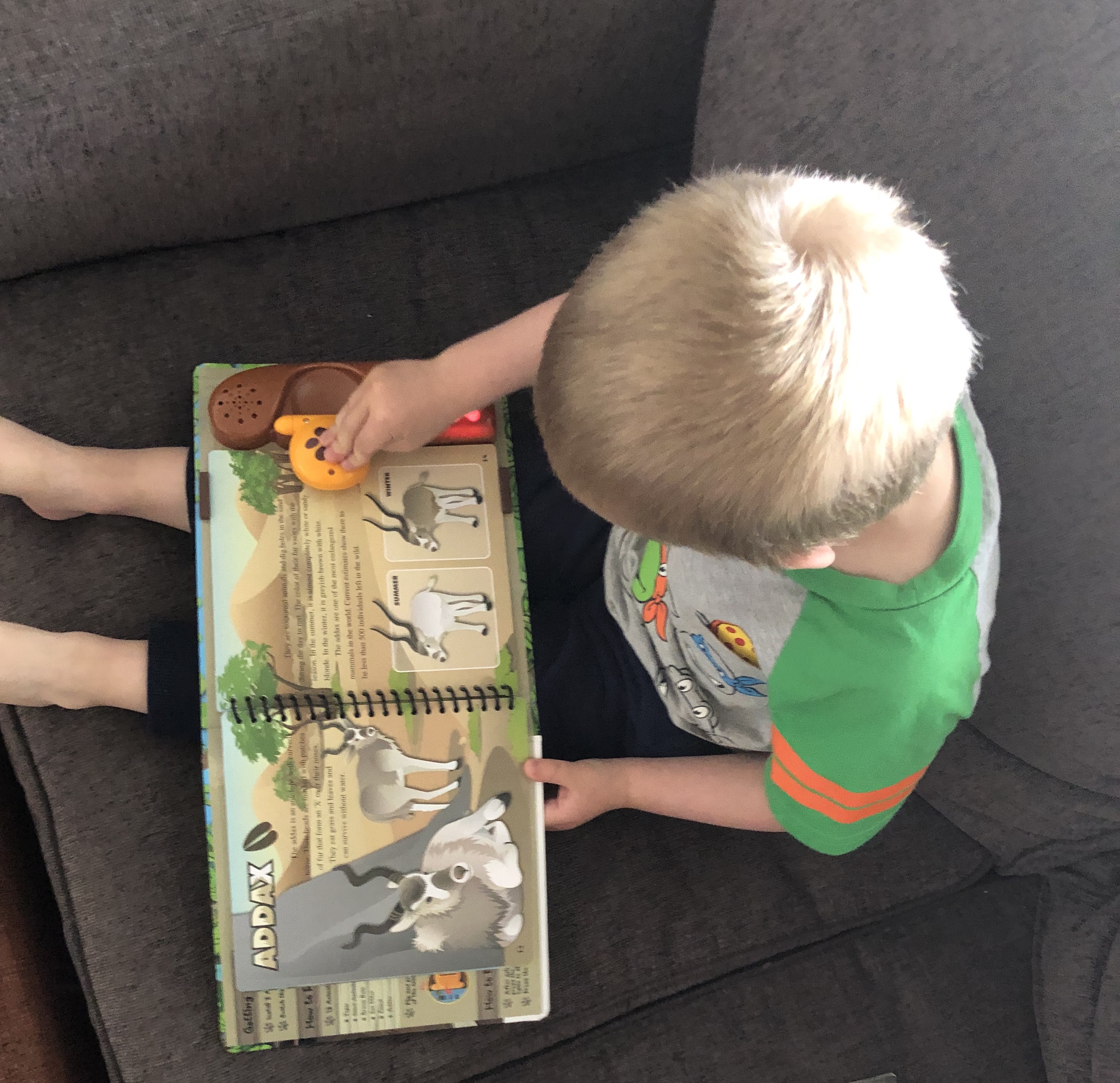
Ricki’s Review:About twenty minutes after my 3-year-old started playing with this book, I messaged Kellee because I had to share about it. I wrote, “The Animal Kingdom book is SO COOL. He’s been playing with it for twenty minutes and hasn’t let his older brother have a turn. It would be so good for classrooms, too. It teaches reading comprehension really well!” Within about five minutes, Kellee had ordered one for her son, too. Although I was supposed to be reviewing this book alone, Kellee is joining me because she loved it just as much.
(This is how my 3yo started the book—he immediately placed it on the ground to start reading.)
This is a book (and product) worth sharing about. As you can see in the video above, the pages offer fascinating facts about animals, and the reader is clear and easy to understand. My kids listen intently to the reading, and they are always excited to take the true/false quiz to test their listening skills. Soon, my six-year-old will be able to easily follow along as she reads aloud. My three-year-old typically guesses the answers to the quiz (the concept of true/false is still a bit confusing for him), and my six-year-old is able to practice his listening and reading comprehension skills independently. The both love this product equally, despite their different reading abilities. Even my one-year-old gets a kick out of pushing down the reader to get her talking!
(20 minutes later…)
(I kid you not, 20 minutes after that…)
My three-year-old spent almost an hour with this book and even moved to a comfier spot. It is a favorite in our toy room (they consider it to be a toy!). We’ll be gifting this book to friends. (And I plan to write an email begging Best Learning to produce more of these books.)
Kellee’s Review: Like Ricki said, she shared with me how informative and engaging this book was, so I immediately jumped on and bought one for Trent. Trent adores animals but is more interested in watching documentaries and shows about them than reading about them (he is a fiction loving reader), but this book defies his normal interests, and he loves learning everything he can about each of the animals in the book. He’ll re-listen to pages, redo the quiz, and look back at the images over and over. This book is a hit in our household (it is in the living room because he keeps grabbing it to bring out here as a choice activity), and I, like Ricki, look forward to sharing as a gift and hoping for Best Learning to make more readers like this.
Teachers’ Tools for Navigation: ELA teachers focus on reading, writing, speaking, and listening (among the obvious other things like thinking). This is a beautiful example of a book that teaches listening. It would be a great learning tool to place at an independent or group station for reading comprehension. Alternatively, it could also be used for fast finishers. Even adults will find joy in this book.
Additionally, it would be a great mentor text for early education animal research projects. Students can emulate the format of a spread about an aimal of their choice.
and
**Thank you to Best Learning for providing a copy of Animal Kingdom for review!**
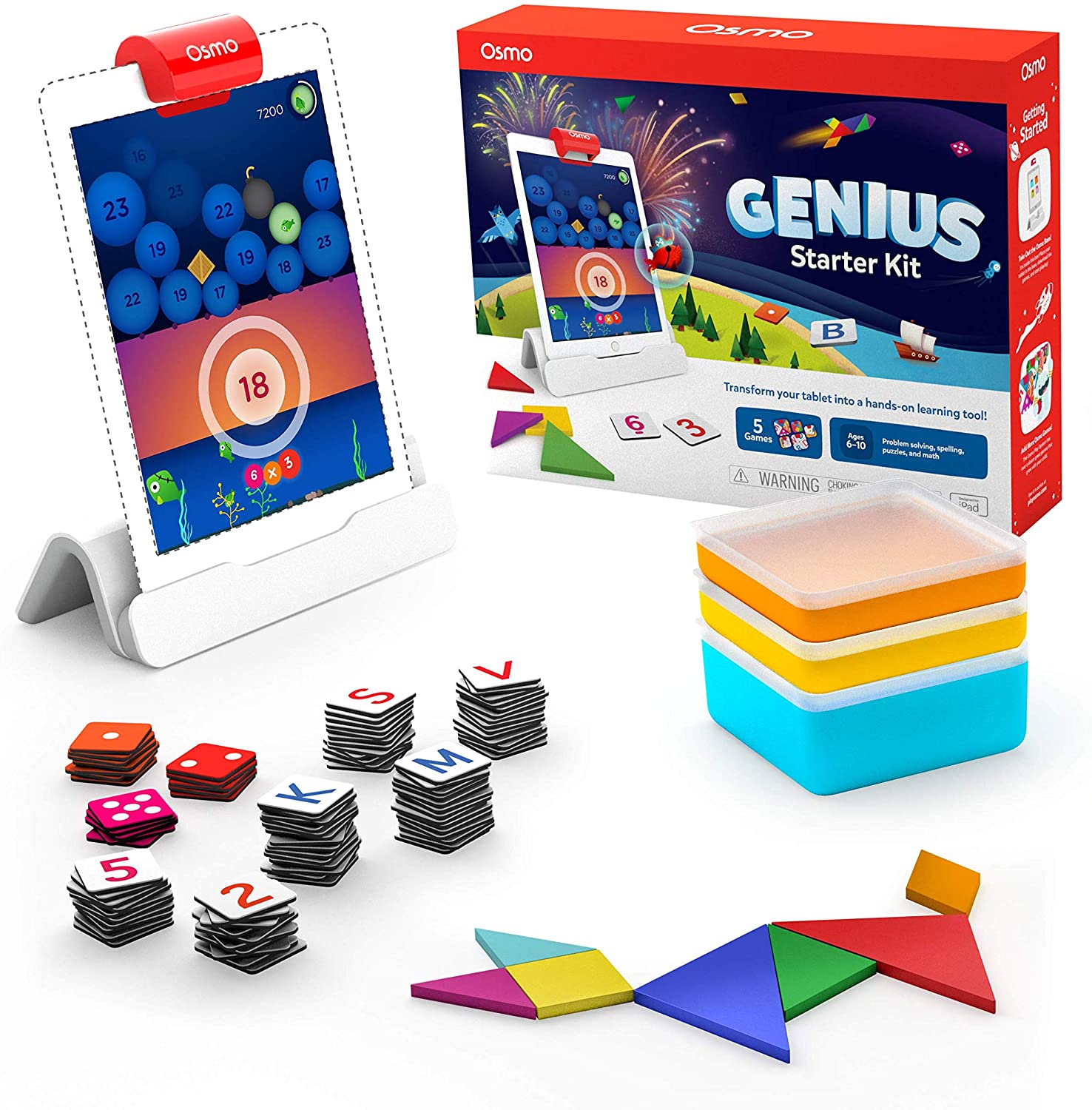
Osmo is an add on for your tablet (iPad or Fire) that brings digital learning to life! The Osmo Genius Starter Kit (from Tangible Play, Inc.) comes with materials for 3 of their different apps and with the Osmo stand and reflector, there are 2 other apps availabe to play without any materials.
Osmo knows kids learn by doing, so each game uses physical action. Whether it’s arranging tangrams, zooming number tiles around, or even freehand drawing, Osmo sees and reacts to every real-live move. Users will receive real-time feedback which lets kids learn through experimentation in a stress-free environment.
To date Osmo has been named one of Time Magazine’s Best Inventions, is a Parents’ Choice award winner, a winner of the prestigious Oppenheim award, and a 2016 finalist for Toy of The Year.
Kellee’s Review: What I love about Osmo is that it takes technology and adds kinesthetic aspects to it. It is truly the best of both worlds. This combination of hands-on learning and technology is how we are going to prepare our students for their life journey.
Trent loves Osmo because he thinks everything about it is fun. Even when there is a challenge, he faces it, figures it out, and moves forward because of the engagement he has for the activities. And if it gets too tough, the app is intuitive and helps him out when needed.
It is hard to pick his favorites apps. I think Masterpiece and Newton would be what he picked first to play, but he wouldn’t argue about playing any of them.
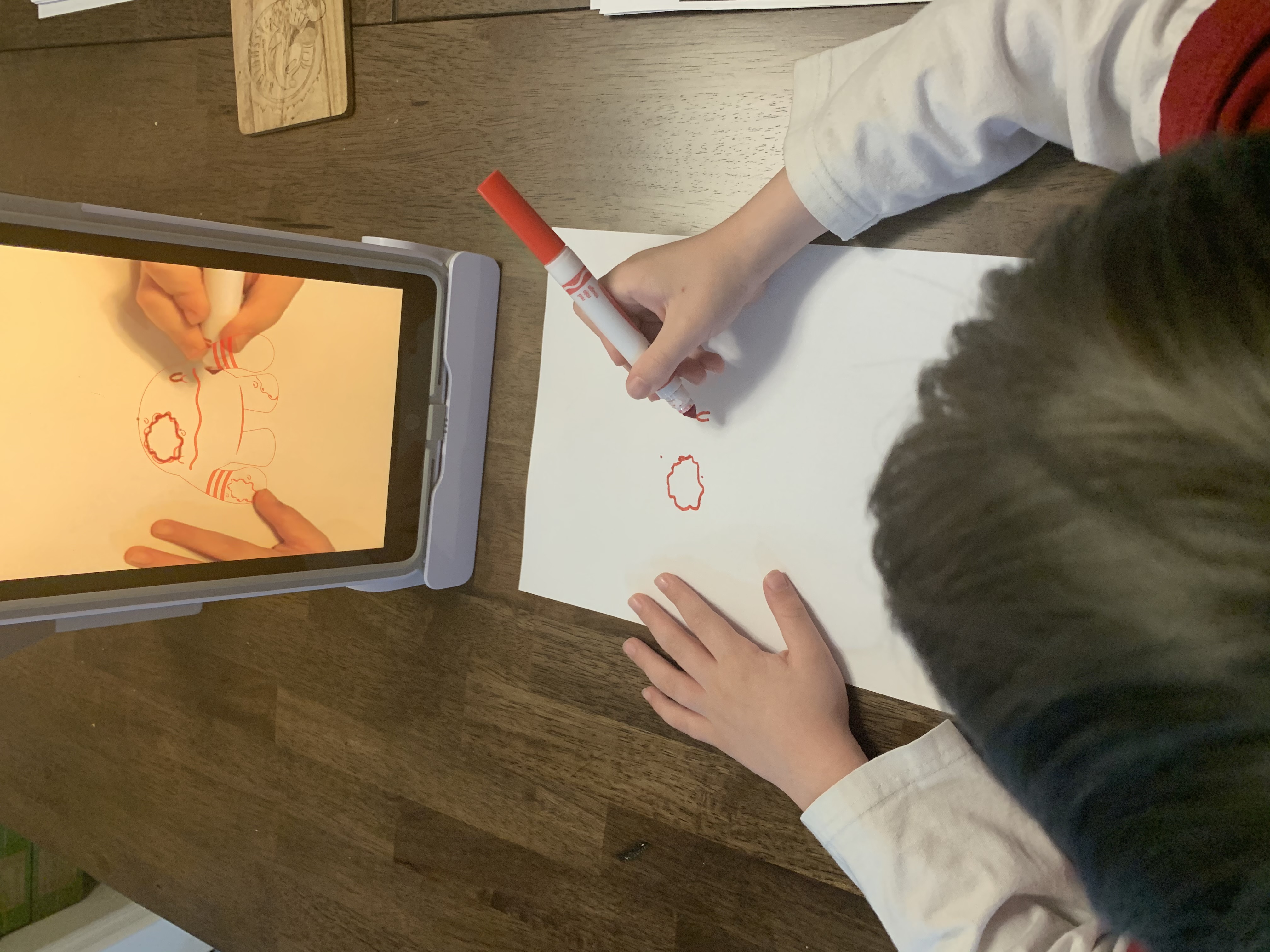
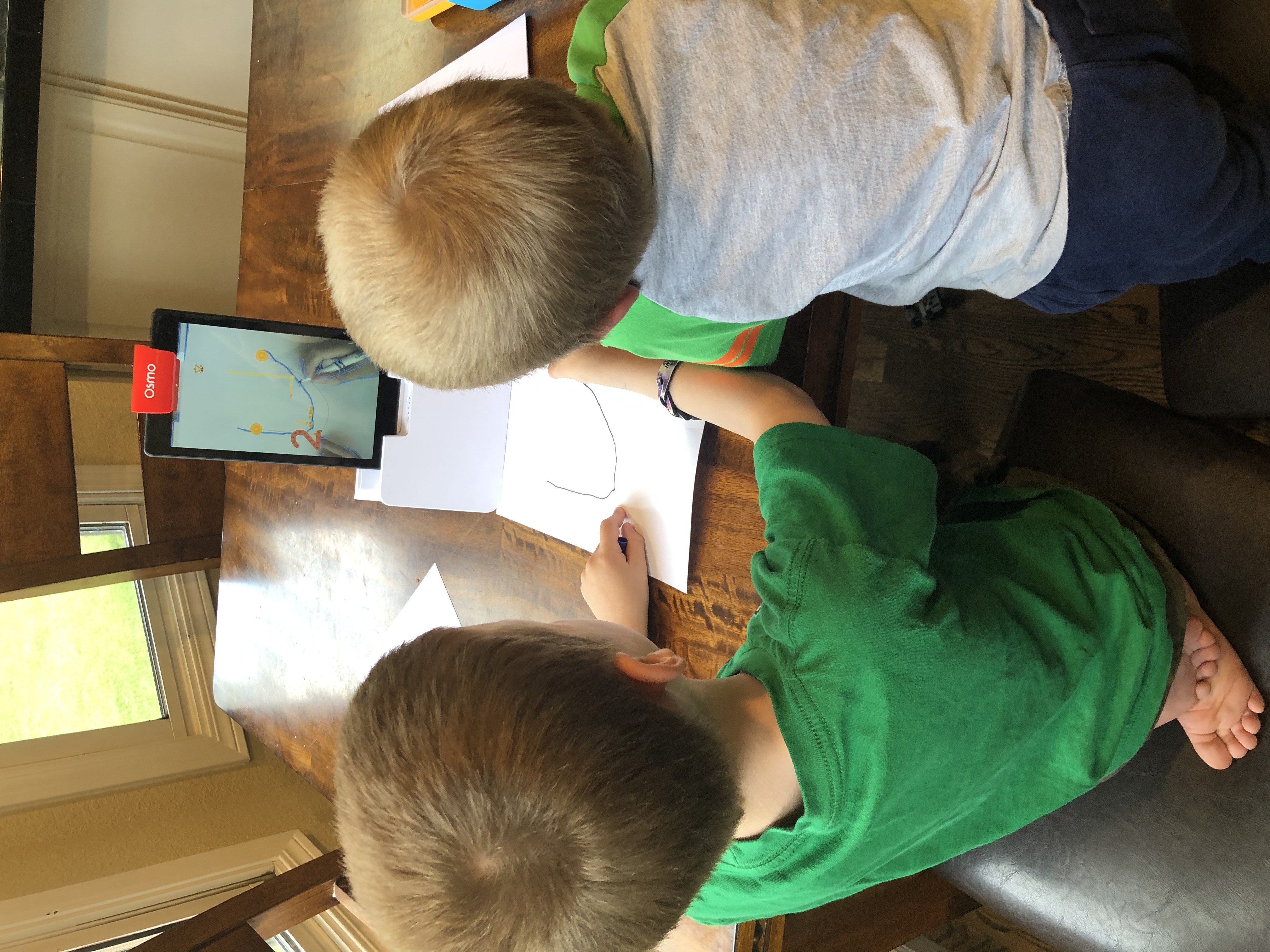
Masterpiece shows his paper on the screen and an outline of what he wants to draw. It can be from their gallery, online, or even a picture he took. Then he can look at the screen and follow the lines. He loves drawing, so him loving Masterpiece makes so much sense.
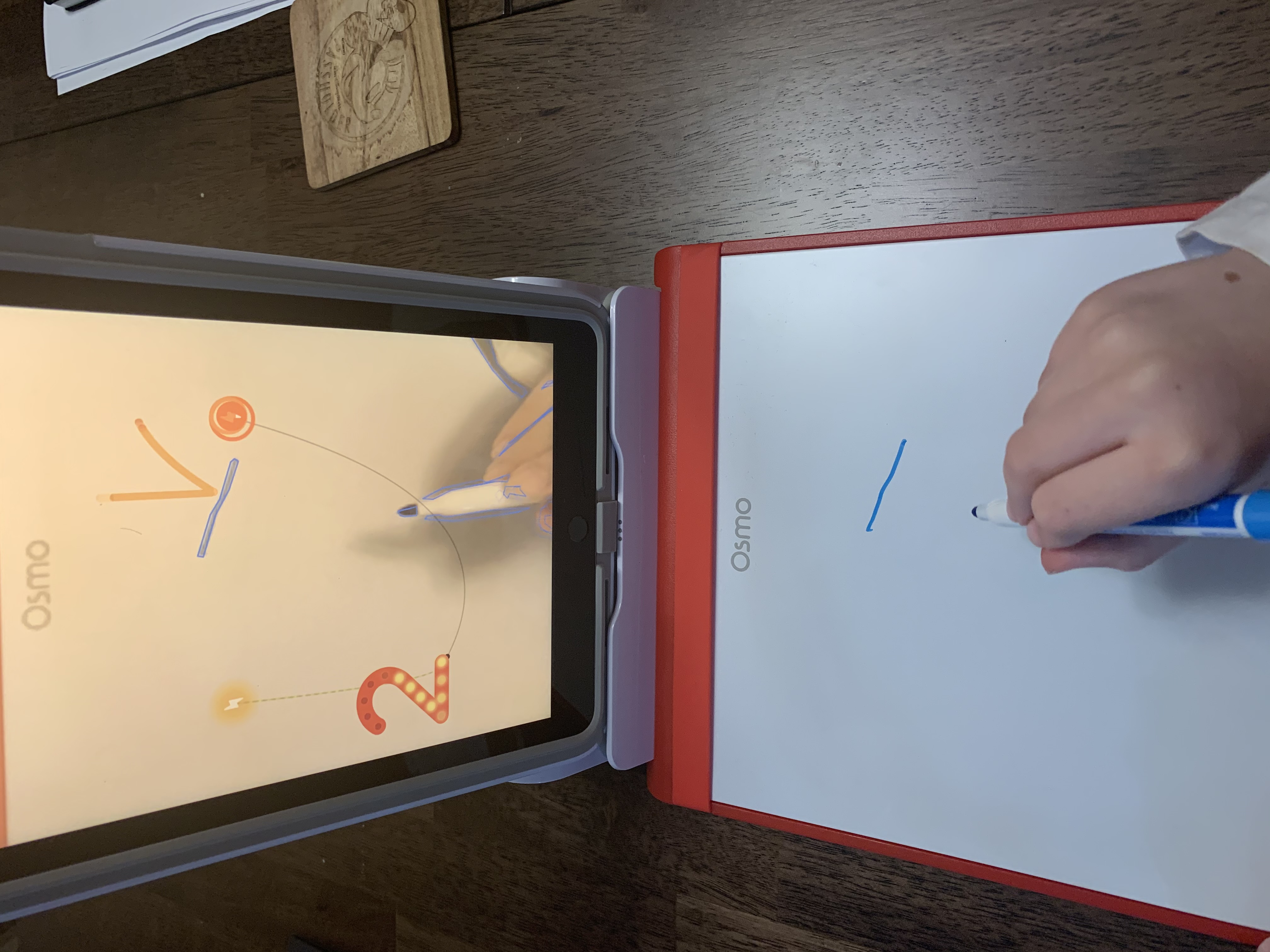
As for Newton, which is a problem-solving physics platform. I found it to be extremely difficult, so I was pleasantly surprised that Trent loved it so much. He figured out so many creative ways to solve the puzzles, past the drawing that it initially instructs the user to do. It was fascinating watching him! (Please note: the Osmo whiteboard in the image is not from the Genius Starter Kit. Trent loved the starter kit so much, we bought other games and it came with another game; however, any white board or paper would work for Newton.)
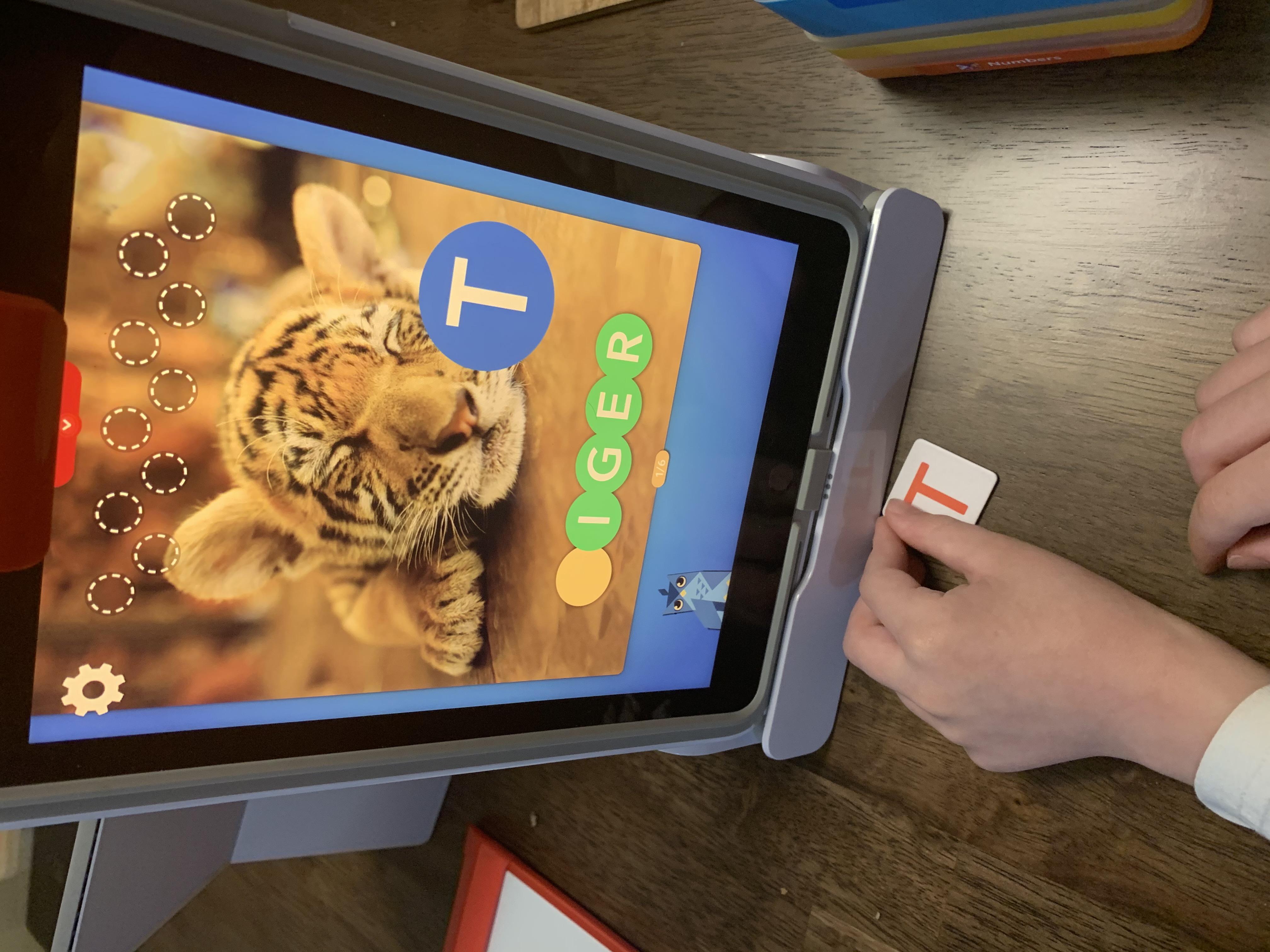
Words is at this point a bit easy for him, but I know there are ways to up the difficulty, but he is really enjoying it and getting used to searching for the letters, so I don’t want to frustrate him.
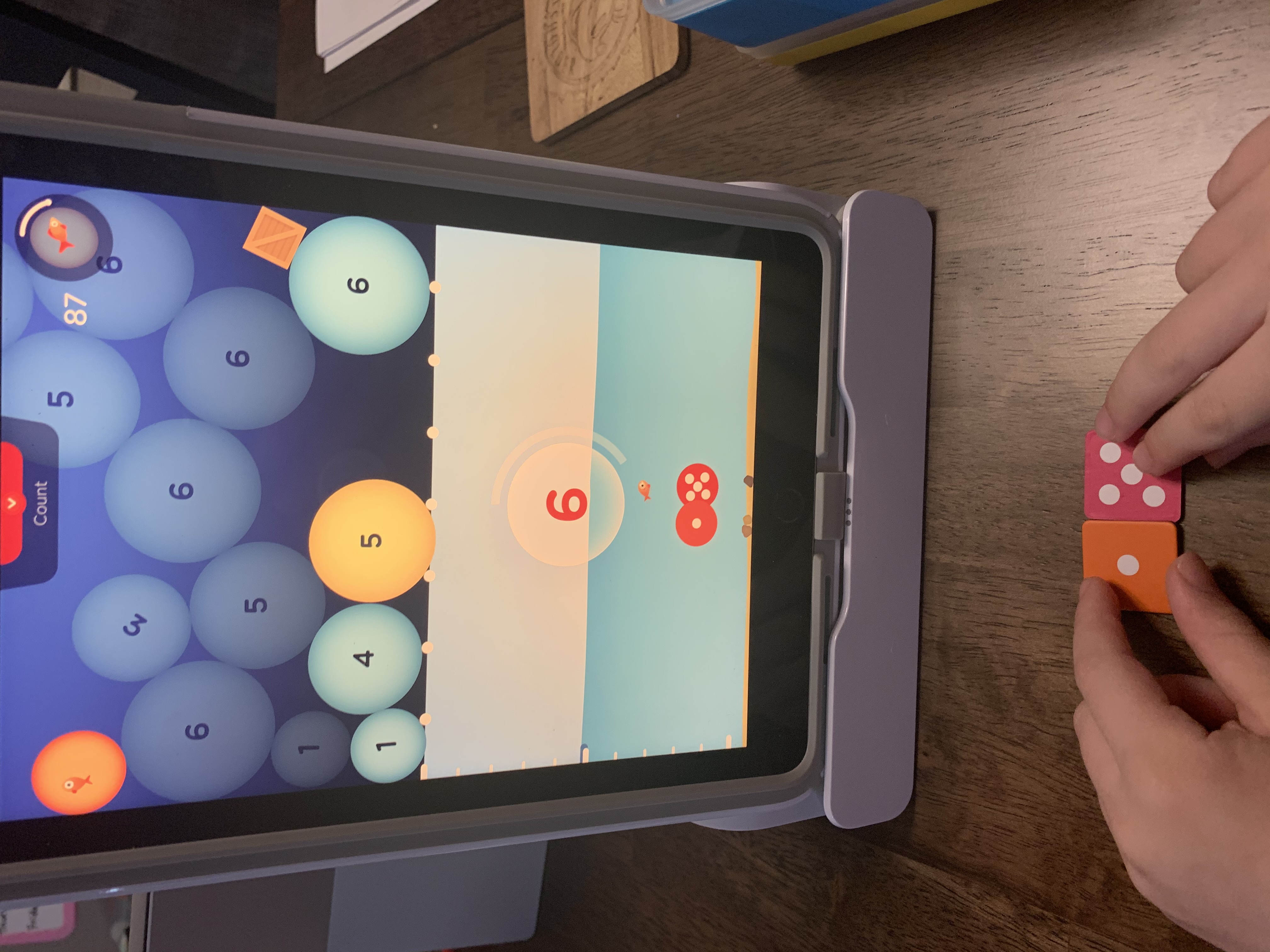
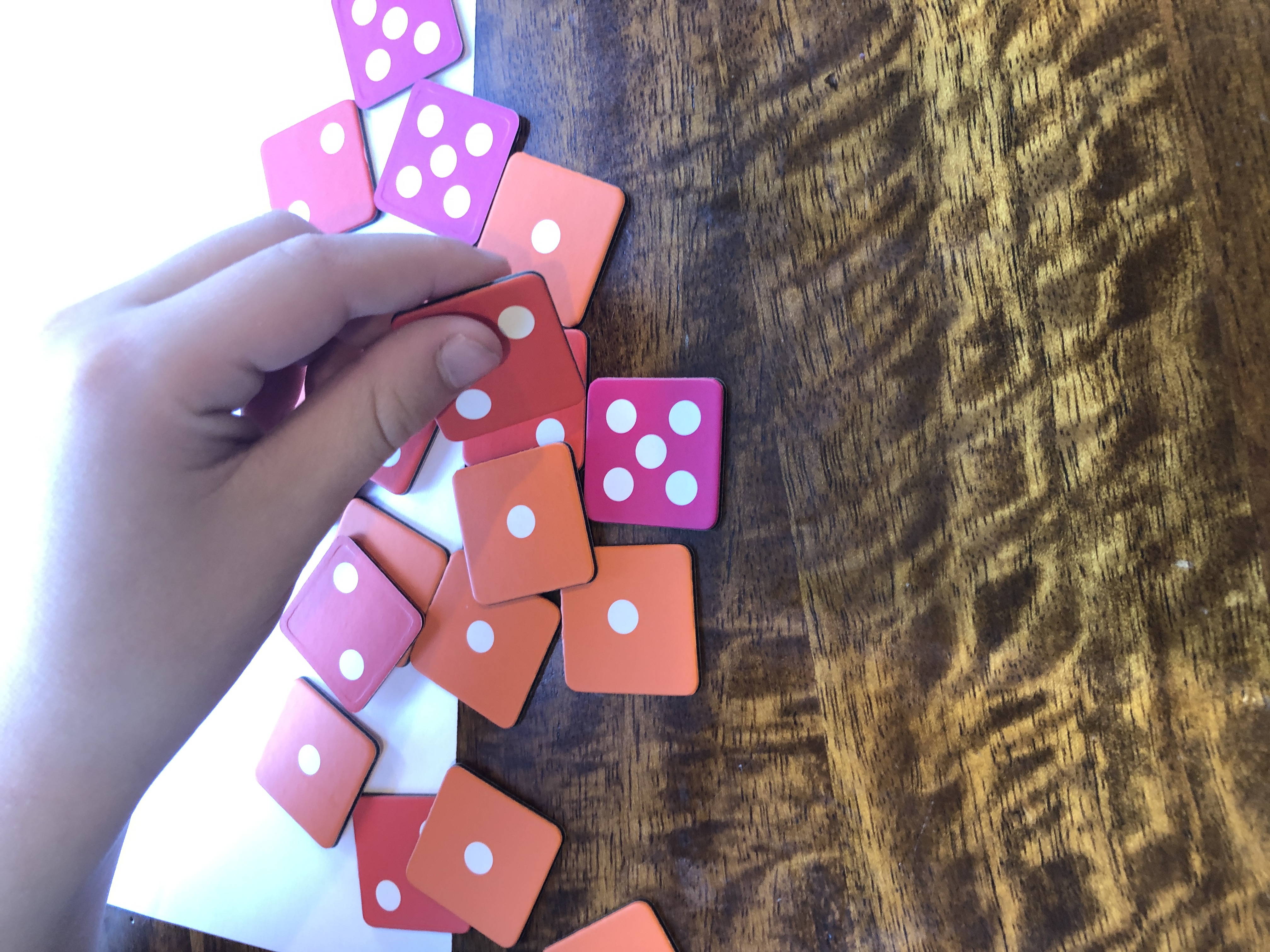
Numbers starts with addition which is perfect for Trent and lets him practice his number skills in a low-stakes, fun environment. He is a math fan, so this is another favorite app.
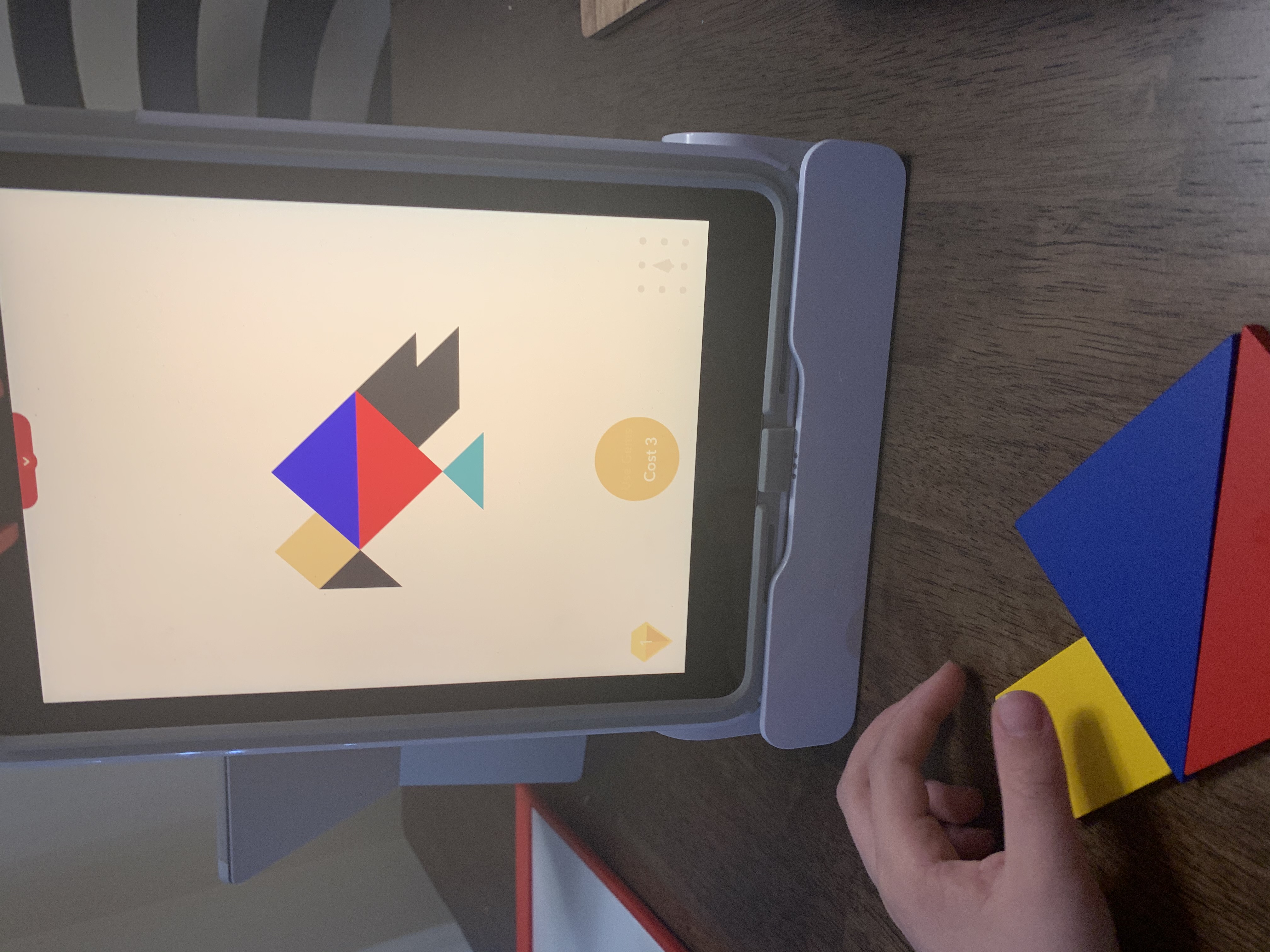
Tangrams is probably the one he struggles with the most. When the tasks get more difficult and do not show which shapes go where, Trent has trouble visualizing which are correct (but I’m the same way, so maybe like mom, like son).
And like I mentioned above, we loved Osmo so much, we’ve purchased other kits which Trent have all enjoyed also! I highly recommend Osmo to parents and teachers as an extension to other learning.
Ricki’s Review:Kellee did an amazing overview of each of the games within the kit, so I will offer more of a holistic overview and perspective from two different kids’ age levels. We have been staying at home pretty much exclusively for three months. My kids are in need of something different. My 3yo is able to read simplistic books and words, and my 6yo is reading fairly fluently now. They are tired of workbooks, they are tired of any book that looks like an early reader, and they are looking for something more interactive. Osmo is the answer.
The kids beg me to play with it during the day. We are pretty strict about screentime in our house, but the Osmo is so interactive that it doesn’t feel like screentime to me. As a parent, it feels remarkably guilt-free as the kids cheer and play the games together.
What intrigues me the most is that Kellee’s son, who is the same age as Henry and has similar interests, has different favorite games than my son. (Although, truly, my kids love ALL of the games.) Tangrams is both of my kids’ favorites. It seems to come naturally to them (which surprises me because I am not very good at spatial recognition). Masterpiece is the hardest for them, and I wonder if they will progress more with it with some time. Regardless, all of the games are huge hits, and they want to play all of them every time they play with the Osmo.
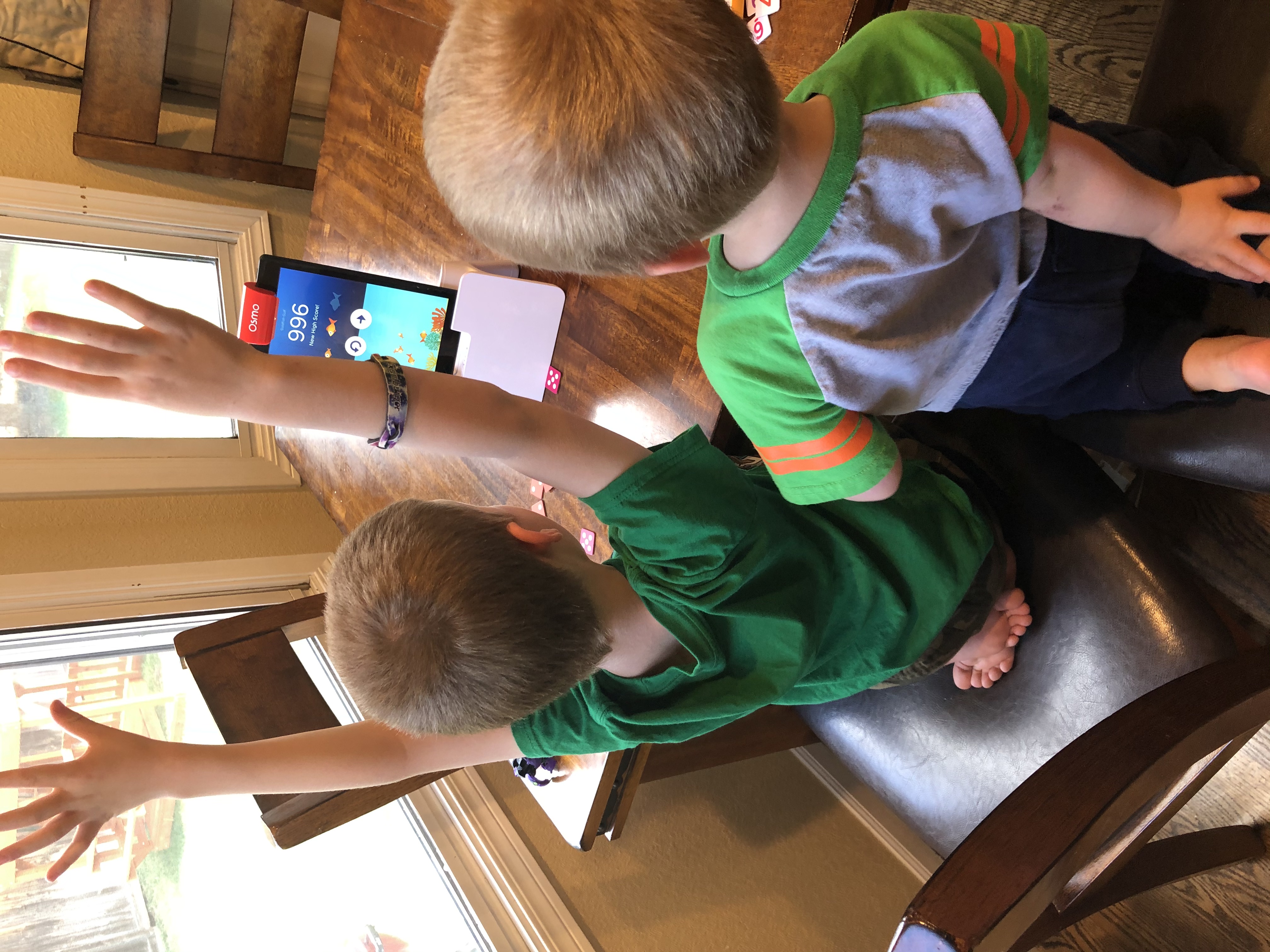
Here, you see my 6yo cheering wildly for himself while he plays numbers. When he met his teacher for a small math group at the end of the school year, she spent a lot of time decomposing numbers. As a parent, I have been focused with addition, subtraction, and number sentences. I hadn’t realized how much decomposing numbers helps their math sense. Osmo’s Numbers does just this. My son is breaking down numbers and figuring out how they work. Using this game in repetition will surely help his math abilities.
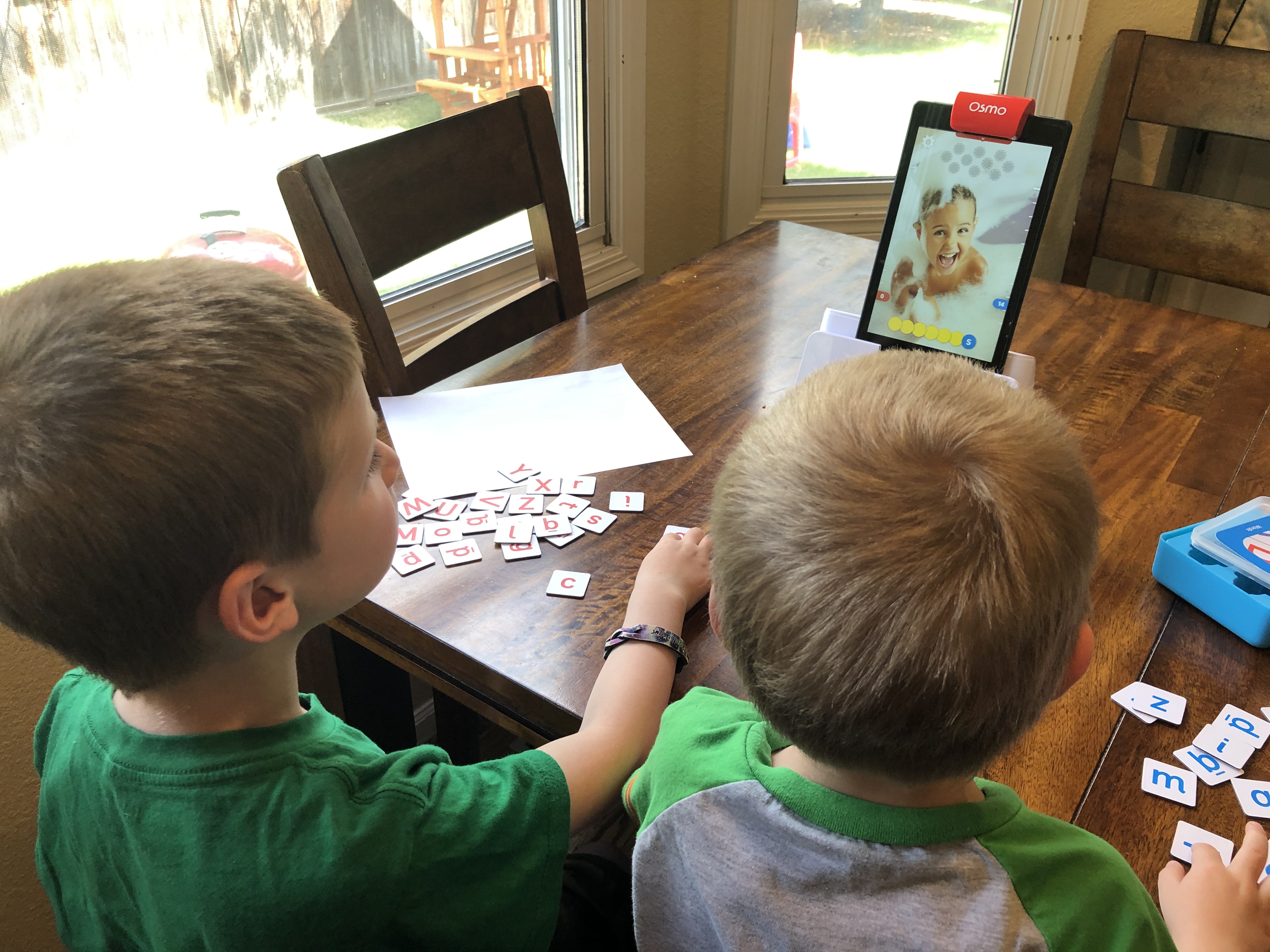
Not pictured: the INTENSITY of this shot. Here, the boys are playing two-player Words. They are each tossing letters into the center and hoping to guess the spelling of the word. For the 6yo, it is conscientious. He is able to consider which vowels are the right fit. For the 3yo, it is a lot of guesswork. He focuses on the first and last vowels. The middle is still confusing, as is suspected. I stress here that despite the 3yo being outside of the age level, he is still able to have fun and try out words, which is fun and exciting for him (and for me!).
And lastly, I share a picture of the boys playing Newton together. (Kellee highlights Tangrams and Masterpiece above.) I said earlier that Tangrams is my kids’ favorite, but now I wonder if their favorite might also be Newton. Gosh this game is so fun. They are considering gravity and physics. The game forces them to problem solve. If they mess up, they might slide the paper a little bit.
If you are on the fence, we recommend the Osmo highly. The kids have been having a BLAST, and it makes learning really fun. As an educator who doesn’t believe much in worksheets, this is a phenomenal system that has brought a lot of joy to our house.
The kids have been making big plans for which kits they are going to put on their wishlists for birthdays and holidays! I am very intrigued by the Pizza kit, so that might be next!
Teachers’ Tools for Navigation: We highly recommend Osmo for centers in classrooms. There are ways to set up multiple profiles which will make it so students can each have their own progress and with the hands-on + technology, students will have so much fun while learning!
Here are the subjects that the Genius Starter Kit compliments:
Math: Tangram and Numbers
Reading: Words
Handwriting: Masterpiece
Science: Newton
Basic geography (maps): Masterpiece
Spatial relationships: Tangram
and
**Thank you to Tangible Play, Inc. for providing starter kits for review!**




 and
and