The Salem Witch Trials: An Unsolved Mystery from History by Jane Yolen & Heidi Elisabet Yolen Stemple

Share

NF PB 2013

Nonfiction Picture Book Wednesday

Nonfiction Picture Book Wednesday is hosted by Kid Lit Frenzy and was started to help promote the reading of nonfiction texts. Most Wednesdays, we will be participating and will review a nonfiction text (though it may not always be a picture book).
Be sure to visit Kid Lit Frenzy and see what other nonfiction books are shared this week!

salem

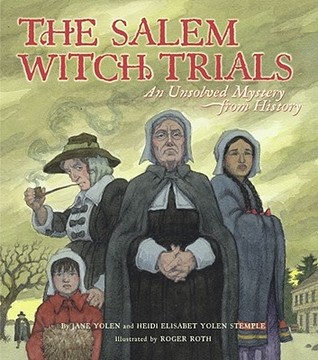
The Salem Witch Trials: An Unsolved Mystery from History
Authors: Jane Yolen & Heidi Elisabet Yolen Stemple
Illustrated by: Roger Roth
Published September 7th, 2004 by Simon & Schuster Books for Young Readers

Goodreads Summary: In 1692 Salem, Massachusetts, witnessed one of the saddest and most inexplicable chapters in American history. When a group of girls came down with a horrible, mysterious bout of illness, the town doctor looked in his medical books but failed to find a reasonable diagnosis. Pretty soon everyone in town was saying the same thing: The girls were ill because they were under a spell, the spell of witchcraft! And still, the question remains: Why did the hysteria occur? The townspeople had many things to worry about back then: smallpox, strife with the local Indians, a preacher demanding higher wages, and the division of land in the community. But did all of those problems justify a witch hunt?

Become a detective as you read this true story, study the clues, and try to understand the hysteria! The Unsolved Mystery from History series is written by acclaimed author Jane Yolen and former private investigator Heidi Elisabet Yolen Stemple. This is an innovative history lesson that’s sure to keep kids thinking throughout.

Review: The mystery of the Salem Witch Trials is one that has haunted the United States for over 3oo years now and is one that students love to read about (and I do, too!). Most of my thoughts about this book are about how awesome this book is for the classroom. The Yolens seemed to have written it specifically for teachers to use.

Teacher’s Tools For Navigation: This book promotes studying history, inquiry, and vocabulary. The book begins with an introduction to a young girl who enjoys unsolved mysteries from history and then the book is set up like her case notebook. Each page of the case notebook includes a narrative nonfiction section about what was going on in Salem, an informational nonfiction section where facts about the story are explained even more in detail, and then there are vocabulary words from the two sections defined for the reader. Finally, in the back of the book the different theories about what could be the answer to the unsolved mystery are shared and briefly discussed. The set up of this book leads to infinite possibilities of being used in the classroom. Students could debate, write research papers, could do their very own case notebook about a different mystery, etc. Another option is to get all of the Unsolved Mystery from History books and have students get into lit circle groups and have each group read a different mystery then research and share.

Discussion Questions: What do you think happened in Salem? [Could be a wonderful debate or cooperative research presentation/paper in class. Have each students, after reading the different theories, decide which they believe is true. Then within their groups come up with evidence that supports the theory that they believe in.]

We Flagged: Narrative Nonfiction Section: One bitterly cold day in February, Betty and Abigail both fell ill, collapsing onto their small rope beds. They convulsed. They contorted. Their arms and legs jerked about. They shouted bizarre, unintelligible words. They crouched under chairs and cowered as if frightened. In other houses in Salem Village several of their friends began to act the same way.

Informational Nonfiction Section: The other sick girls in Salem village included Ann Punam Jr. (age 12), Mercy Lewis (age 19), Mary Walcott (age 16), Elizabeth Hubbard (age 17), and Mary Warren (age 20). Like Abigail, Elizabeth and Mercy were orphans; Mercy may have witnessed her parents being killed in an Indian attack three years earlier in Main. Mary Walcott had lost her mother when she was eight. Ann and Betty were daughters of landowners, but Marry Warren, Elizabeth, and Mercy were maidservants.

Vocabulary: Convulsed: shook violently, Contorted: Twisted into unusual shapes, Unintelligible: Impossible to understand” (p. 12-13)

Read This If You Loved: I Walk in Dread by Lisa Rowe Fraustino, The Sacrifice by Kathleen Benner Duble, Witch Child by Celia Rees, The Witch of Blackbird Pond by Elizabeth George Speare, Witches: The Absolutely True Tale of Disaster in Salem by Rosalyn Schanzer and other nonfiction books about Salem

Recommended For: 

closereadinganalysisbuttonsmall readaloudbuttonsmall

classroomlibrarybuttonsmall litcirclesbuttonsmall

Signature

Jim Henson: The Guy Who Played with Puppets by Kathleen Krull

Share

NF PB 2013

Nonfiction Picture Book Wednesday

Nonfiction Picture Book Wednesday is hosted by Kid Lit Frenzy and was started to help promote the reading of nonfiction texts. Most Wednesdays, we will be participating and will review a nonfiction text (though it may not always be a picture book).
Be sure to visit Kid Lit Frenzy and see what other nonfiction books are shared this week!\

henson

Jim Henson: The Guy Who Played with Puppets
Author: Kathleen Krull
Paintings by: Steve Johnson and Lou Fancher
Published August 23rd, 2011 by Random House Books for Young Readers

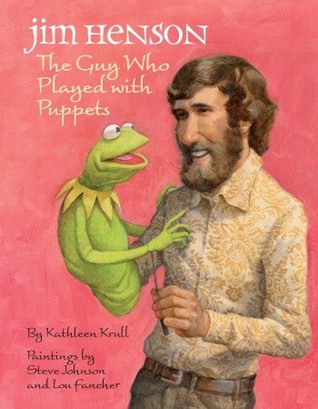
Goodreads Summary: Sesame Street and The Muppet Show introduced Jim Henson’s Muppets to the world, making Kermit the Frog, Oscar the Grouch, and Big Bird household names. But even as a child in rural Mississippi, listening to the radio and putting on comedy shows for his family, Jim recognized the power of laughter to bring people together. On Sesame Street, Jim’s Muppets transformed children’s television by making learning fun for kids everywhere. A visionary, Jim always believed that puppets could reach a wider audience. In 1976, he proved it, drawing millions of family viewers to The Muppet Show. With his feature film The Dark Crystal and his Star Wars characters—including Yoda—Jim continued to push the boundaries of what was possible in puppetry until his death in 1990 at the age of 53.

Kathleen Krull, recipient of the Children’s Book Guild 2011 Non-fiction Award and many other accolades, once again does what she does so well—illuminating the life of an important figure in history, art, and culture with her informative but approachable writing style.

Review: I love Jim Henson. I remember when he passed away and I was devastated. I thought that Sesame Street was dead too, but Jim Henson’s influence is stronger than death. He has continued to live through his show, characters, and legacy. Kathleen Krull does an amazing job of sharing with the reader what made Jim Henson who he was and how he became (I believe) the most influential person when it came to children and children’s entertainment in the 20th century.

Teacher’s Tools For Navigation: Jim’s story is a great story to tell children, because like many successful creative persons, he was passionate and went for what he enjoyed, was good at, and was his passion. Jim also will be someone that many students will connect with as he was quiet, smart, not athletic, in school plays, a reader, a story teller, and fascinated with TV.  There are more students like Jim than unlike him and they need to hear about those like them who were successful.

This book would also be a great way to incorporate the CCSS’s diverse media and formats by showing clips of Jim Henson’s work as they are discussed in the book. For example, Jim got his very own TV show when he was in college, Sam and Friends, and clips of this show are on You Tube.

Discussion Questions: How has television changed since Jim Henson got his first TV?; How did not listening to what others thought influence Jim Henson’s decisions in life? If he listened to others, what would be different?

We Flagged: “Puppets struck some people as babyish, but Jim really wanted to go on TV. Now! He checked out books from the library and joined his high school’s puppet club as a way to learn how to make them.” (p. 16)

“He practiced for hours in front of a mirror, trying to get his puppets’ movements and expressions just right, voicing silly and witty thoughts he normally kept to himself.” (p. 18)

Read This If You Loved: Before You Leap by Kermit the Frog, Who Was Jim Henson? by Joan Holub, On A Beam of Light: A Story of Albert Einstein by Jennifer Berne, The Fantastic Undersea Life of Jacques Cousteau by Dan Yaccarino, Lost Boy: The Story of the Man Who Created Peter Pan by Jane Yolen, Sandy’s Circus: A Story about Alexander Calder by Tanya Lee Stone

Recommended For: 

classroomlibrarybuttonsmall readaloudbuttonsmall

Signature

Feynman by Jim Ottaviani

Share

9844623

Feynman
Author: Jim Ottaviani
Art by: Leland Myrick
Coloring by: Hilary Sycamore
Published August 30th, 2011 by First Second

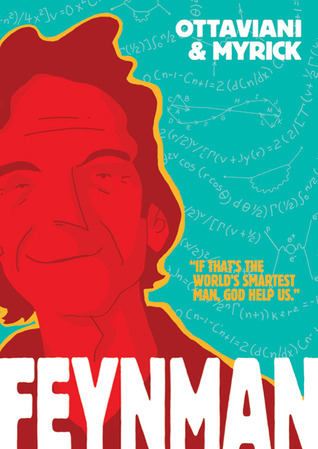
Goodreads Summary: Richard Feynman: physicist . . . Nobel winner . . . bestselling author . . . safe-cracker. In this substantial graphic novel biography, First Second presents the larger-than-life exploits of Nobel-winning quantum physicist, adventurer, musician, world-class raconteur, and one of the greatest minds of the twentieth century: Richard Feynman. Written by nonfiction comics mainstay Jim Ottaviani and brilliantly illustrated by First Second author Leland Myrick, Feynman tells the story of the great man’s life from his childhood in Long Island to his work on the Manhattan Project and the Challenger disaster. Ottaviani tackles the bad with the good, leaving the reader delighted by Feynman’s exuberant life and staggered at the loss humanity suffered with his death. Anyone who ever wanted to know more about Richard P. Feynman, quantum electrodynamics, the fine art of the bongo drums, the outrageously obscure nation of Tuva, or the development and popularization of the field of physics in the United States need look no further than this rich and joyful work.

Review: This book definitely showed me that I have HUGE gaps in knowledge in history, science, and math. Reading this book was so challenging for me – probably one of the hardest books I’ve read in a very, very long time. It took me 10 days because most days I didn’t read much because I’d find myself rereading or going online to research or just overwhelmed by the little bit I read. Makes me feel for our struggling readers who are given text that are too hard for them and not given scaffolding. If anyone ever tells you that graphic novels are not complex or challenging texts, hand them this book.

Now, all of this is saying things about myself, not about the book. The book itself was fascinating. I learned so much! I’ll be honest. Physics is still so over my head and most of the physics stuff talked about in the book (and that I researched) just didn’t make sense to me; however, this book also includes a great story of Feynman’s life and history about the atomic bomb, NASA, and the Nobel Prize. All of which I did truly enjoy and learn something from. It was also quite funny at times- Feynman was a character!

Teacher’s Tools for Navigation: I cannot wait to show this text to the physical science teachers at my school. It is a great text to show content area teachers that there are wonderful texts out there that can be used in the classroom. This book then can expand to even more instruction on Feynman and all of his physics. You can even view Feynman’s lectures online!!

Discussion Questions: When Feynman was working on the atomic bomb, some of his colleagues felt that it was a devastating invention while others continued working on it without thinking of the destruction it would cause. How do you feel about the construction of the atomic bomb? Were the use/construction of them justified?; After watching one of Feynman’s lectures, why was he better at explaining physics than other lecturers?

We Flagged: “But then a miracle occurred. And it’s occurred again and again in my life, and it’s very lucky for me. The moment I start to think about physics and concentrate on what I’m explaining, I’m completely immune to being nervous. No worries about the audience and the personalities. I was calm, everything was good. My talk wasn’t good because I wasn’t used to giving lectures, but there was no nervousness until I sat down. Einstein appreciated that things might be different from his famous theory of relativity – very nice, and very interesting. Pauli had more objections, but Wheeler kept his promise and answered all of them.” (p. 48-49)

Read This If You Loved: Surely Your Joking, Mr. Feynman! and other books by Richard P. Feynman On a Beam of Light by Jennifer Berne, Who Was Albert Einstein? by Jess M. Brallier, Nonfiction physics books

Recommended For: 

classroomlibrarybuttonsmall closereadinganalysisbuttonsmall

Signature

Imogene’s Last Stand by Candace Fleming

Share

6399414

Imogene’s Last Stand
Author: Candace Fleming
Illustrator: Nancy Carpenter
Published October 13th, 2009 by Schwartz & Wade

Goodreads Summary: Meet Imogene, a plucky heroine with a passion for history.

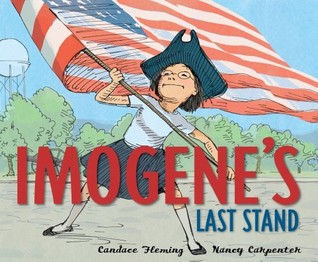
As a baby, Imogene’s first words were “Four score and seven years ago.” In preschool, she fingerpainted a map of the Oregon Trail. So it’s not surprising that when the mayor wants to tear down the long-neglected Liddleton Historical Society to make room for a shoelace factory, Imogene is desperate to convince the town how important its history is. But even though she rides through the streets in her Paul Revere costume shouting, “The bulldozers are coming, the bulldozers are coming!” the townspeople won’t budge. What’s a history-loving kid to do?

Filled with quotes from history’s biggest players—not to mention mini-bios on the endpapers—and lots of humor, here’s the perfect book for budding historians.

Review: Imogene is awesome! Her whole life she has loved history and has promoted history. History is her passion. When she finds out that the Liddleville Historical Center is up for demolition, she does everything in her power to save the history center. This, in a nutshell, is what makes her awesome: she is intelligent, passionate, and willing to stand up for her passion. Because of this, and the history allusions throughout the book, make this such an excellent book to use in classrooms. Imogene is such a great role model for any child.

The history aspects of this book were done so cleverly. Throughout Imogene’s story, she uses famous historical quotes to express how she feels at certain points. For example, when she was trying to get others to stop the bulldozing of the historical center dressed in her Paul Revere costume, she rode around Main Street (on her stick horse) yelling, “The bulldozers are coming! The bulldozers are coming!” These clever quotes are throughout the book. Then in the back and front end sheets Imogene’s historical tidbits are shared explaining all of the quotes.

Teacher’s Tools for Navigation: Like I said in the review, this book is a great for promoting history, intelligence, and passion. Like many of the amazing picture books I’ve been reading lately, it also promotes inquiry because it makes history interesting and fun.

Discussion Questions: What is a historical landmark in your city? Find out about what made it a landmark.; Imogene is passionate about history. What are you passionate about? Share the essentials of your passion.

We Flagged: “Imogene loved history. When she was a baby, her first words were “Four score and seven years ago.” As a preschooler, she finger-painted an accurate map of the Oregon Trail. And as a kindergartner, she used her show-and-tell time to give a series of lectures on important woman in history.” (p. 6)

To see a preview of the illustrations, visit Amazon’s “Look Inside” for Imogene’s Last Stand.

Read This If You Loved: Abe Lincoln’s Dream and John, Paul, George, & Ben by Lane Smith, Of Thee I Sing by Barack Obama,  Looking at Lincoln by Maira Kalman, Nonfiction books about the historical figures mentioned

Recommended For: 

readaloudbuttonsmall classroomlibrarybuttonsmall

Signature