Mr. Watson’s Chickens by Jarrett Dapier, Illustrated by Andrea Tsurumi

Share

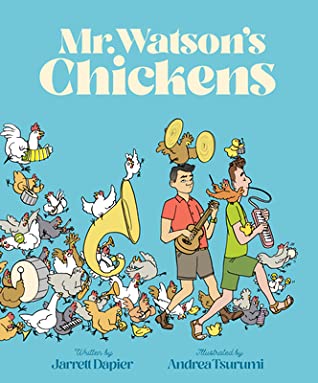
Mr. Watson’s Chickens
Author: Jarrett Dapier
Illustrator: Andrea Tsurumi
Published: October 5, 2021 by Chronicle Books

GoodReads Summary: Interrupting Chicken meets Click, Clack, Moo in this zany classic-in-the-making!

With rollicking rhythms, nonsensical refrains, and too many chickens to count, this modern classic will inspire unstoppable giggles and endless rereads. Bawka-bawka!

Mr. Watson has 456 chickens in the sink, on the bed, in the bread box. When his partner, Mr. Nelson, threatens to leave, Mr. Watson takes his chickens to town to sell only for them to escape! Young readers will follow Mr. Watson all around town as he gathers up his chickens. But, when they’re all rounded up, does he have the heart to sell them? Does a different fate await these chickens?

This quirky, irresistible book is full of read-aloud fun with its onomatopoeia, rollicking rhythm, and familiar refrains and ends with a touch of sweetness. It has all the makings of a classic, with a farm theme, hilarious refrains, and a familiar narrative structure that unfolds in threes. Librarians, teachers, and parents looking for a new book that feels traditional will love sharing this book with children.

A JOY TO REREAD: This is a very classic-feeling storybook. Paired with its funny farm setting and hilarious refrains, this book is sure to inspire countless rereads and endless giggles.

PERFECT READ-ALOUD: This book is full of nonsensical sounds and repetition that make it fun to read out loud and invite audience participation. It’s a perfect choice for classroom events and laptime reads.

LIKE CHICKA CHICKA BOOM BOOM, WITH CHICKENS!: With its bouncy refrains and rollicking rhythms, this book will remind readers of classic bestsellers like Don’t Let the Pigeon Drive the Bus! and Chicka Chicka Boom Boom.

REALISTIC RELATIONSHIP UNUSUAL IN PICTURE BOOKS: This book features a gay couple at its center, but doesn’t call specific attention to it. It simply portrays a healthy relationship between two men (and their chickens!).

WRITTEN BY A NEW TALENT WHO REALLY UNDERSTANDS KIDS: This is Jarret Dapier’s first book! He’s a popular, award-winning teen librarian who works with kids, knows what they like, and is well-versed in the rhythms of the classic children’s book—and he has many more stories up his sleeves.

DELIGHTFUL, DETAILED DRAWINGS OF OVER 400 CHICKENS!: With hundreds of chickens to find and scenes crammed with action and detail, the pages of this book are chock-full of things to look at. Young readers will spend hours poring over each spread.

Perfect for: parents, families looking for LGBTQIA+ stories, fans of funny books.

Ricki’s Review: This book is hysterical. The chickens cracked me up. Teachers will love reading this book aloud. Mr. Watson’s partner Mr. Nelson is threatening to leave because they have TOO MANY CHICKENS (456, actually). So they take their chickens into town to give them away to chicken homes, but all does not go as planned. There is so much care and thought in this book–from the writing to the illustrations of all of the chickens. Kids will love it.

Teachers’ Tools for Navigation: This book takes a twist on typical counting books and adds a delightful story. Kids might consider the numbers used in this book and how this may be intentional and create their own counting books.

Discussion Questions: 

  • What are some of the reasons that Mr. Nelson got frustrated with the chickens? Do you think he had a valid reason to be frustrated? How does Mr. Watson respond?
  • Where was Aunt Agnes? How does this enhance your reading of the story?
  • How does the story end? What do you think a sequel might look like?

Read This If You Love: Funny stories; counting stories; animal stories

Recommended For:

classroomlibrarybuttonsmall 

RickiSig

**Thank you to Eva at Chronicle for providing copies for review!**

Teacher Guide for Astro-Nuts Mission Three: The Perfect Planet by Jon Scieszka, Illustrated by Steven Weinberg

Share

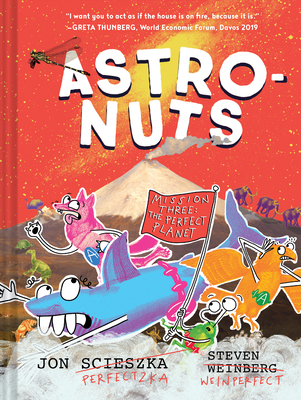
Astro-Nuts Mission Three: The Perfect Planet
Author: Jon Scieszka
Illustrator: Steven Weinberg
Published: September 21st, 2021 by Chronicle Books

Summary: This series is The Hitchhiker’s Guide to the Galaxy meets The Bad Guys in a funny, visually daring adventure series for reluctant readers, teachers, and librarians alike.

This hilarious, visually groundbreaking read is the conclusion to a major series by children’s literature legend Jon Scieszka.

The book follows a final mission, where AlphaWolf, LaserShark, SmartHawk, and StinkBug must find a planet fit for human life after we’ve finally made Earth unlivable.

Time is up for our friends the AstroNuts. In fact, time is up for you, too. If they don’t succeed on this mission, Earth is doomed! So when the team finds out they’re being sent to a place called “the perfect planet,” their mission sounds way too easy. Unfortunately, the second they land, they realize they’ll be dealing with the most dangerous species of all time . . . humans. Huh? Where in the universe is this supposedly perfect place? And how will the Nuts manage to convince the humans to risk death . . . for the sake of their lives?!

Featuring full-color illustrations throughout, Planet Earth as the narrator, an out-of-this-world gatefold, and how-to-draw pages in the back, eager and reluctant readers alike will be over the moon about this new mission. Full of laugh-out-loud humor with a thoughtful commentary on the reality of climate change at the core of the story, this creatively illustrated, full-color, action-packed space saga is a can’t-put-it-down page-turner for readers of all levels and fans ready to blast past Dogman.

  • EXCITING BIG-NAME TALENT: Jon Scieszka is one of the biggest names in children’s books. The first National Ambassador of Young People’s literature, he and Steven Weinberg toured extensively for this series. They’ll continue making their way around the world for Book 3!
  • POPULAR SERIES: MISSIONS 1 and 2 received starred reviews, amazing blurbs, and tons of industry love. MISSION 1 was an Amazon Best Book of the Year! Dav Pilkey, Jennifer Holm, LeUyen Pham, and Gene Luen Yang are all big fans—check out those blurbs!
  • FUN AND SCIENTIFIC: The book incorporates STEM elements in a way that readers will find fun and entertaining, while teachers and librarians will find it clever and original.
  • PERFECT FOR BUDDING GRETA THUNBERGS: This book successfully talks about the effect of climate change and impels its readers to take action, without feeling didactic or message-y at all.
  • TIES TO REAL-WORLD ISSUES: Readers will recognize quite a few dilemmas the AstroNuts face from current events on Earth. Making connections between fiction and non-fiction is a big developmental milestone for young readers, and this book works as an effective allegory for our most dire contemporary concerns.
  • RELUCTANT READER–FRIENDLY: The book is a great vehicle for reluctant readers, featuring cool topics and bright art, and relying on visual literacy and very few words.
  • A CONSTELLATION OF TOPICS: Space, STEM, and talking animals: There’s something here for every reader!
  • LOLs FOR DAYS: The book is funny and will delight kids who love books like Wimpy Kid, The 39-Story Treehouse, Dog Man, and Captain Underpants. While it contains serious ideas, it’s a quick, easy, and fun visual read.
  • GROUNDBREAKING DESIGN: The hundreds of pages of full-color art are dynamic and engaging—and it doesn’t look like anything else out there. Steven Weinberg bases his art on public domain pieces from the Smithsonian museum! Teachers turn to the books for this element of the art and use it in classrooms to talk about collage, idea sourcing, history, and art medium.
  • PERFECT ART PROJECT: On the website, kids can download pages of the “original” art and use it to make their own hybrid animal collages.

Teachers Guide with Teachers’ Tools & Discussion Questions: 

Please view and enjoy the teachers’ guide I (Kellee) created for Chronicle Books for Astro-Nuts Vol. 3:

You can also access the teaching guide here.

You can learn more about Astro-Nuts Vol 3 on Chronicle’s page.

Recommended For: 

readaloudbuttonsmall classroomlibrarybuttonsmall litcirclesbuttonsmall closereadinganalysisbuttonsmall

Kellee Signature

It Fell From the Sky by the Fan Brothers

Share

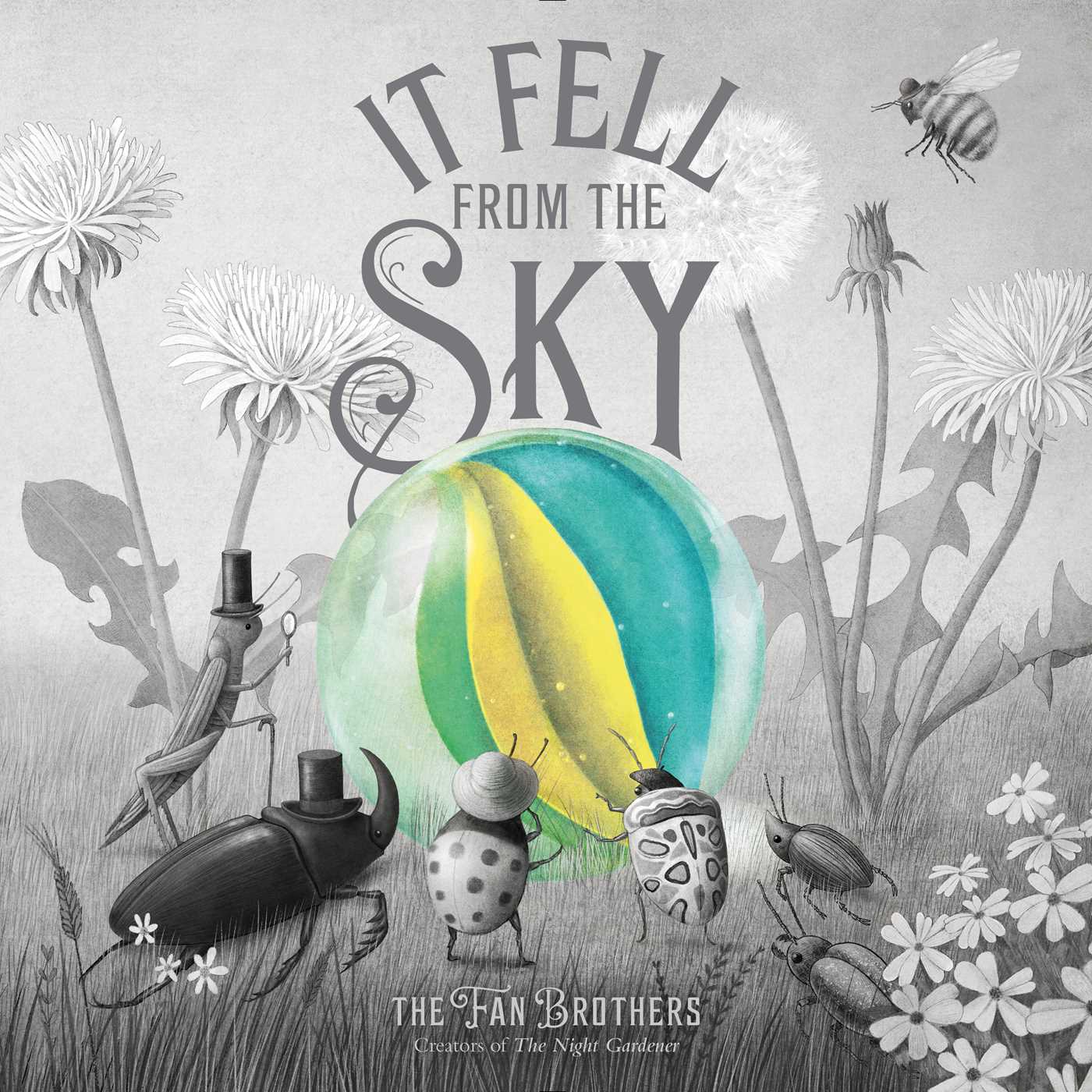
It Fell From the Sky
By the Fan Brothers
Published: September 28, 2021 by Simon & Schuster

Summary: From the creators of the critically acclaimed The Night Gardener and Ocean Meets Sky comes a whimsical and elegantly illustrated picture book about community, art, the importance of giving back—and the wonder that fell from the sky.

It fell from the sky on a Thursday.

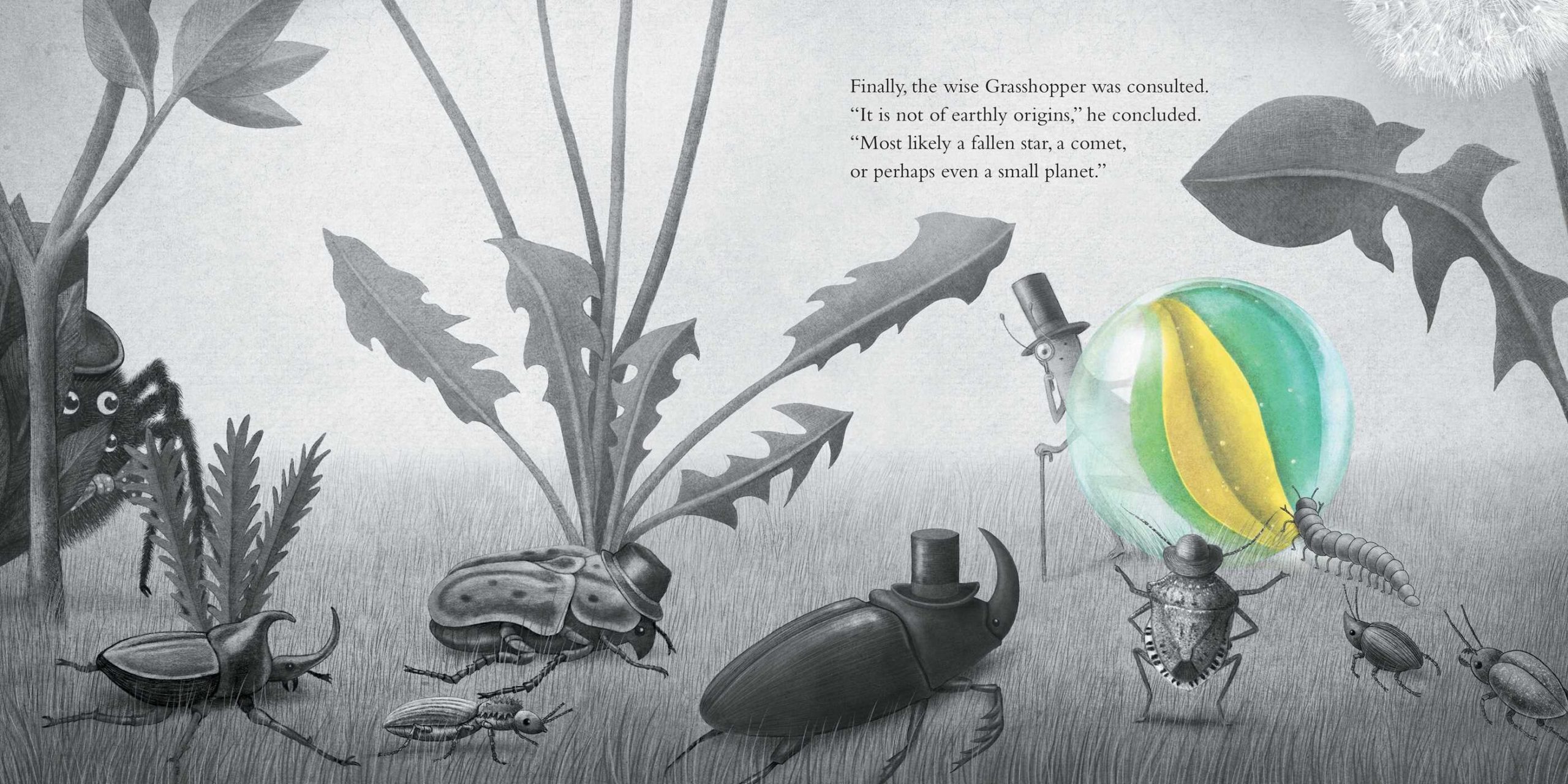
None of the insects know where it came from, or what it is. Some say it’s an egg. Others, a gumdrop. But whatever it is, it fell near Spider’s house, so he’s convinced it belongs to him.

Spider builds a wonderous display so that insects from far and wide can come look at the marvel. Spider has their best interests at heart. So what if he has to charge a small fee? So what if the lines are long? So what if no one can even see the wonder anymore?

But what will Spider do after everyone stops showing up?

Review: I cannot get enough of this book. I just want to hug it every time I see it. The story and illustrations work in a way that is simply magical. Their talent is simply remarkable. When an object falls from the sky (“A marble!” -My 7-year-old), the insects are convinced it must be from another world. Spider decides to develop a display and invites the insects far and wide. They merely need to pay a leaf to see the object. But spider learns an important lesson—one that serves as a good reminder to all of us. I loved this book and expect it to see some awards. It dazzled me.

Teachers’ Tools for Navigation: Teachers might to ask students to choose an object to examine from a different perspective than their own. They could write their own picture books.

Discussion Questions: 

  • How do the creators of the book use color to enhance their story?
  • How do the creators of the story use personification to teach a lesson?
  • What do we learn from this story? What does the spider teach us?

Flagged Passages: 

Read This If You Love: The Night Gardener by The Fan Brothers; What Do You Do With an Idea? by Kobi Yamada; What Do You Do With a Chance? by Kobi Yamada; What Do You Do With a Problem? by Kobi Yamada; Magic Candies by Heena Baek; The Caiman by María Eugenia Manrique; Sam & Dave Dig a Hole by Mac Barnett; Hug Machine by Scott Campbell

Recommended For: 

  classroomlibrarybuttonsmall

**Thank you to Beth from Simon & Schuster for Providing a Copy for Review!**

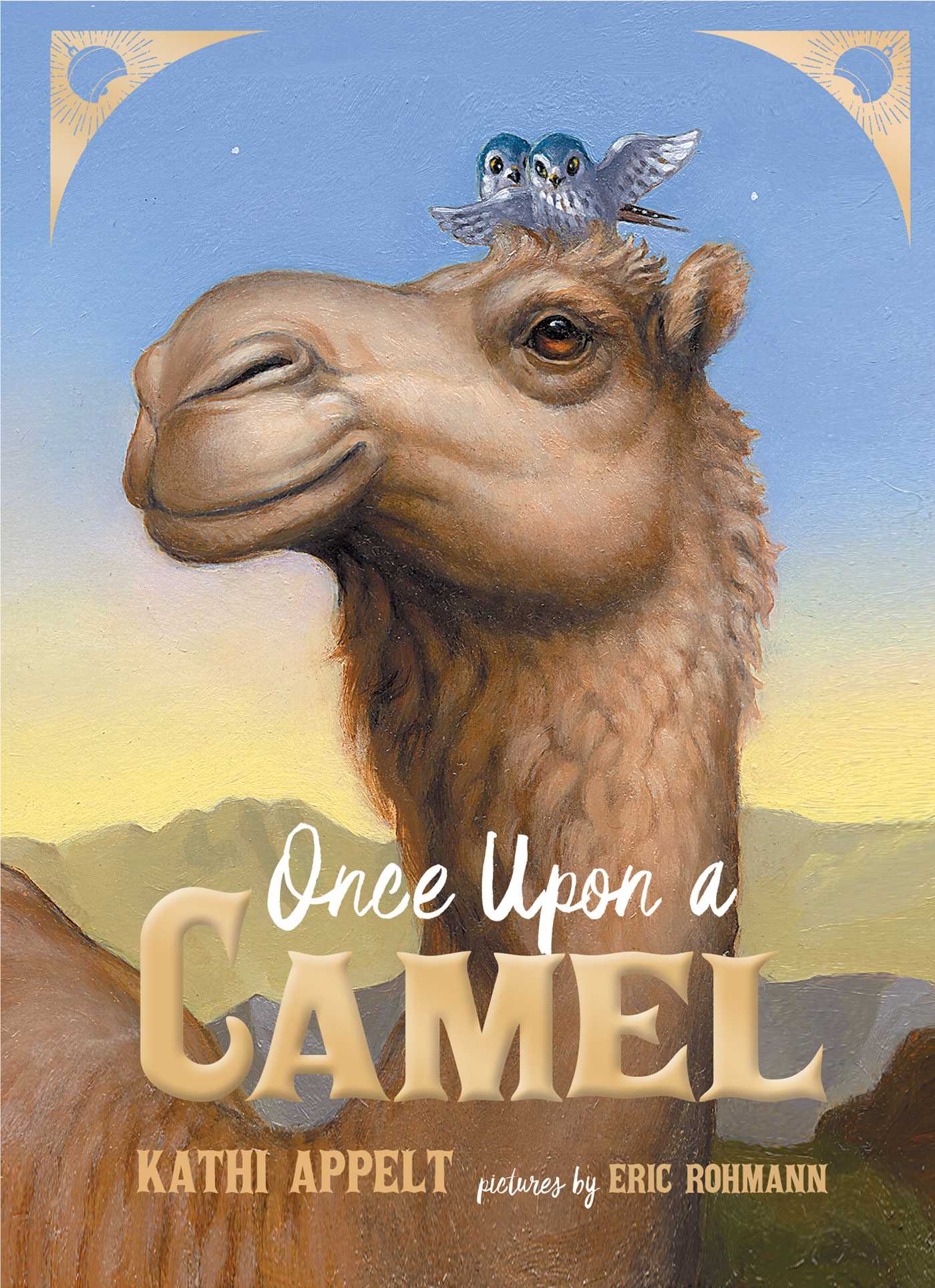
Review and Giveaway!: Once Upon a Camel by Kathi Appelt

Share

Once Upon a Camel
Author: Kathi Appelt
Illustrator: Eric Rohmann
Published September 7th, 2021 by Atheneum/Caitlyn Dlouhy Books

Summary: An old camel is out to save two baby kestrel chicks during a massive storm in the Texas desert.

Zada is a camel with a treasure trove of stories to tell. She’s won camel races for the royal Pasha of Smyrna, crossed treacherous oceans to new land, led army missions with her best camel friend by her side, and outsmarted a far too pompous mountain lion.

But those stories were from before. Now, Zada wanders the desert as the last camel in Texas. But she’s not alone. Two tiny kestrel chicks are nestled in the fluff of fur between her ears—kee-killy-keeing for their missing parents—and a dust storm the size of a mountain is taking Zada on one more grand adventure. And it could lead to this achy old camel’s most brilliant story yet.

About the Author: Kathi Appelt is the author of the Newbery Honoree, National Book Award Finalist, and bestselling The Underneath as well as the National Book Award Finalist for The True Blue Scouts of Sugar Man Swamp. Some of her award-winning books include Maybe a Fox (with Alison McGhee), Keeper, and Max Attacks to name just a few. She lives in College Station, Texas. To learn more, visit her website at kathiappelt.com.

Find Kathi Appelt on Facebook and Pinterest!

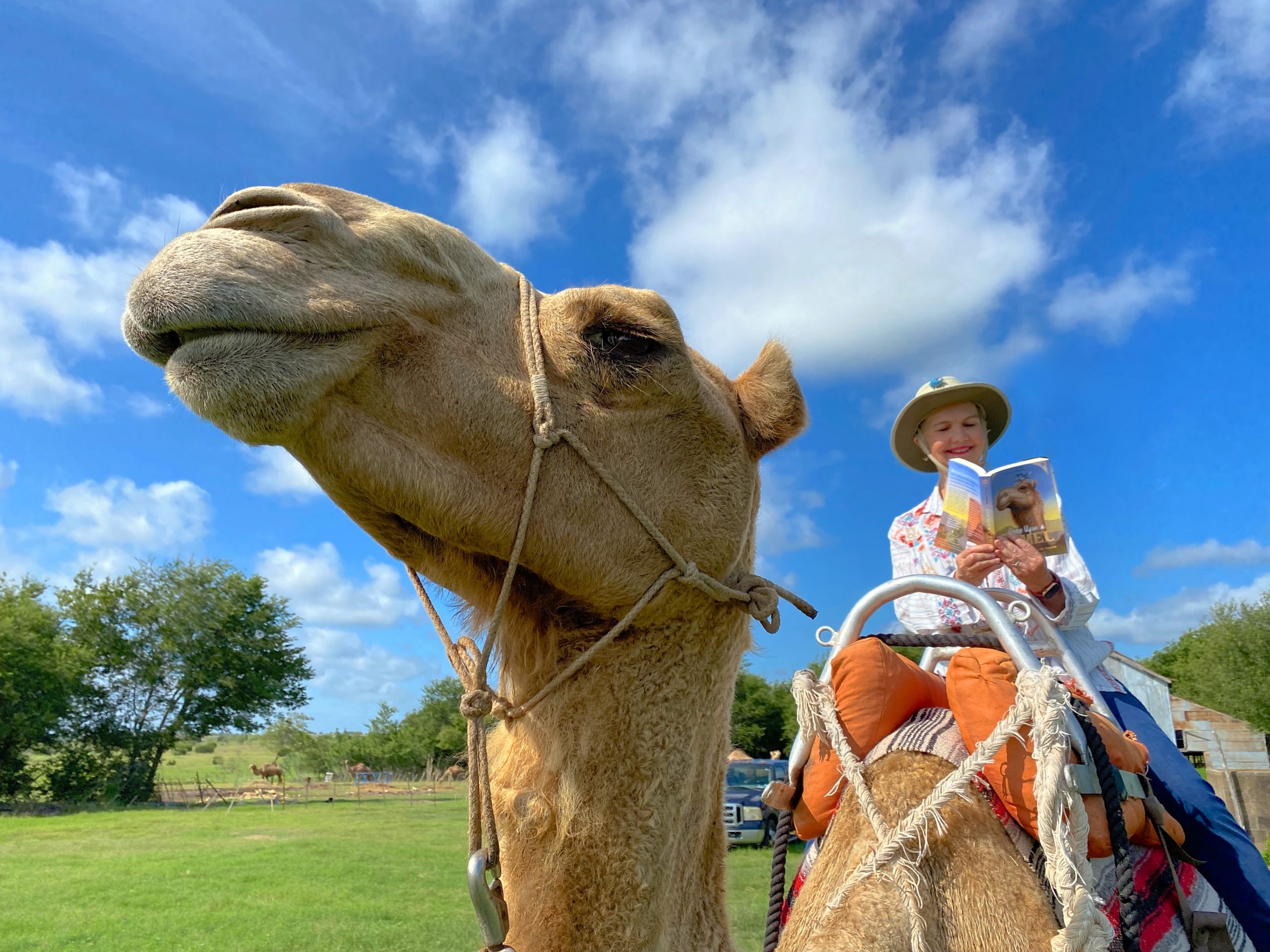
Richard, the camel, and Kathi Appelt taken at Texas Camel Corps. Photo credit: Doug Baum.

Review: Happy book birthday, Kathi & Once Upon a Camel! So honored to review this special book on your special day!

In all of Kathi Appelt’s books, what I have found that I adore the most is her ability to craft voice. She is brilliant. In this book, Zada the camel’s voice rings throughout with patience and determination. I was calmed by her stories of her upbringing as she works to keep the baby kestrels’ minds off of their parents. I think part of Appelt’s magic to craft voice is through her very specific word choice in all instances. Her descriptive words are so precise, and she is never deterred to use a word that may be challenging if it is the correct word. This leads to such lyrical prose–it is a pleasure to read!

There is also so much to learn throughout this story about stories: weather events (haboobs), animals of West Texas (kesterels, mountain lions, hawks, and more), and the history of camels. I found myself going on research tangents as I was introduced to different animals or different adventures that Zada goes on. It is no wonder that the Reading Group Guide is so extensive–there is so much to delve into!

Teachers’ Tools for Navigation (Excerpt from the publisher provided Reading Group Guide): 

  • Explain to students that alliteration is a literary device in which initial consonant sounds of successive or closely related words are repeated. This book contains tons of alliteration. Some examples include “arches and arroyos,” “moving mountain,” “posh Pasha palace,” “Pasha’s princess turns a little pale,” and “best beloved babies.” Using game tiles with letters or small pieces of paper with letters written on them, allow each student to draw a letter and write five alliterative sentences using that letter. Each sentence must contain a subject, verb, and describing words. Once everyone has written their sentences, each person should share their best alliterative sentence with the class.
  • Zada has had a long life filled with experiences and relationships. Her story in the book moves in time as she shares memories while continuing present experiences. Ask students to create a time line for Zada. There are online resources such as Adobe (https://www.adobe.com/express/create/timeline) and TimeGraphics (https://time.graphics) to help with organization. They may also do this in a slideshow format. Have them include dates, locations, and important experiences.
  • Beulah licks Wims, and he is upset. He is described as being “incensed. Put out. Piqued.” Discuss with students how this alliterative and repetitive approach to communicating his feelings is an effective way to convey the strength of those feelings as well as a lyrical way to engage the reader. Ask students to choose one emotion and make a list of synonyms or short expressions that express that emotion. Next, ask them to express the emotion in as many ways as possible in short sentences. Finally, ask them to use their list and sentences to write a paragraph that first explains why their character is feeling that emotion and that then elaborates on how they are feeling in as many ways and with as much creative imagery as possible.
  • Like humans and all other members of the animal kingdom, camels and kestrels have been classified based on shared characteristics. Looking at the list below, you can see that camels, kestrels, and humans are classified together in their kingdom and phylum, but begin to diverge at class groups and fully diverge in orders. Ask students to review the table and have a class discussion about classification. Give students the opportunity to consult some sources, if necessary, to answer their questions.
    • Camels: Animalia (Kingdom) / Chordata (Phylum) / Mammalia (Class) / Artiodactyla
      (Order) / Camelidae (Family) / Camelus (Genus) / Dromedarius or Bactrianus (Species)
    • American Kestrels: Animalia (Kingdom) / Chordata (Phylum) / Aves (Class) / Falconiformes
      (Order) / Falconidae (Family) / Falco (Genus) / F. tinnunculus (Species)
    • Humans: Animalia (Kingdom) / Chordata (Phylum) / Mammalia (Class) / Primates (Order) / Hominidae (Family) / Homo (Genus) / Homo Sapiens (Species)
    • After review and discussion, ask students to write short answers to the following questions:
      • Why do we classify animals and other living things in this manner?
      • What characteristics do all living things have in common?
      • Do camels, kestrels, and humans have the same basic needs?
      • Do humans understand more about animals than animals know about humans?
      • Even though humans and camels are both mammals, do humans or camels have more in common with kestrels than they do with one another?

Discussion Questions (Excerpt from the publisher provided Reading Group Guide): 

  • The story’s action begins with Pard and Perlita telling Zada that a mountain is eating everything and is soon going to eat them. Zada cannot comprehend this. Why do you think that is? How do you handle things you don’t understand? In truth, the mountain is a great sand-and-dust storm coming their way. How does knowing this change your perspective of the situation? How does Zada react?
  • The author explains how a camel has adapted to the desert, and how American kestrels are built for flight. All animals have adaptations: evolved physical and behavioral traits that help their species survive and thrive. Can you think of any other examples of this? What about cultural adaptations? Are there ways in which groups or individuals adapt for their own safety, comfort, or survival?
  • As Zada tries to outrun the storm, she wishes she could fly. This is not the first time in her life she has wished this. Why do you think she has continued to yearn for this ability? Thinking about your life and the environment in which you live, what other animal adaptations would come in handy for you? Explain your answers.
  • As Zada worries about Pecos de Leon, she reflects on the fact that she and the mountain lion have “both traveled a lot of miles and traversed a lot of country. That was worth something.” How can having many experiences help you? Do you think it’s important to experience situations similar to and different from your own life? What might you learn from someone who has lived a long time and done many things? Explain your answers.
  • As Zada moves through the storm carrying the chicks, an enormous old tree comes down behind them. “The wind had yanked it up by its roots. A hundred years, that old tree had stood there, watching over the creek, keeping generations of bird families safe. Now it lay in a heap on its side.” How does the falling tree make Zada feel? How did it make you feel? Do you think generations of bird families will be able to find a new home?
  • As the storm spins Perlita and Pard around, they call out, “‘Keep them safe!’” This is described as the “universal prayer” of parents. What does it mean for something to be universal? Do you have knowledge, ideas, or habits that are universal?
  • Zada’s and Asiye’s motto is “En parlak yildiz ol.” This means “Become the brightest star.” What do they mean by this? How do you see them striving to do this throughout the story?

Flagged Passages: “Chapter 1: Foothills, Chisos Mountains West Texas, 1910

“Incoming!”

Even in her sleep, Zada recognized that voice.

The old camel raised one eyelid. It was still dark. There was at least an hour left before dawn. She did not recall setting an early alarm bird.”

Book Trailer: 

Read This If You Love: Maybe a Fox by Kathi Appelt & Alison Mcghee, The Beatryce Prophecy by Kate DiCamillo, Journey of the Pale Bear by Susan Fletcher, Orphaned by Eliot Schrefer, Good Dog by Dan Gemeinhart, Granted by John David Anderson

Recommended For: 

classroomlibrarybuttonsmall 

Giveaway!

a Rafflecopter giveaway

Signature

**Thank you to Barbara at Blue Slip Media for providing a copy for review and giveaway!**

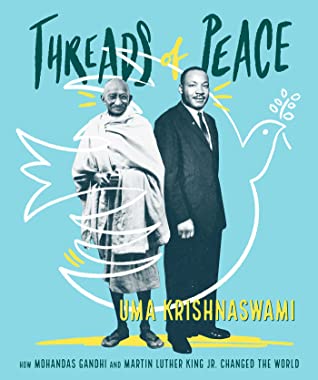
Threads of Peace: How Mohandas Gandhi and Martin Luther King Jr. Changed the World by Uma Krishnaswami

Share

Threads of Peace: How Mohandas Gandhi and Martin Luther King Jr. Changed the World 
Author: Uma Krishnaswami
Published August 17th, 2021 

Summary: Mahatma Gandhi and Reverend Martin Luther King Jr. both shook, and changed, the world, in their quest for peace among all people, but what threads connected these great activists together in their shared goal of social revolution?

A lawyer and activist, tiny of stature with giant ideas, in British-ruled India at the beginning of the 20th century.

A minister from Georgia with a thunderous voice and hopes for peace at the height of the civil rights movement in America.

Born more than a half-century apart, with seemingly little in common except one shared wish, both would go on to be icons of peaceful resistance and human decency. Both preached love for all human beings, regardless of race or religion. Both believed that freedom and justice were won by not one, but many. Both met their ends in the most unpeaceful of ways—assassination.

But what led them down the path of peace? How did their experiences parallel…and diverge? Threads of Peace keenly examines and celebrates these extraordinary activists’ lives, the threads that connect them, and the threads of peace they laid throughout the world, for us to pick up, and weave together.

Praise: “The book’s attractive design, lucid text, and carefully chosen details combine to create an inviting and original treatment of its subjects. History has been carefully intertwined with the present in this engaging and reflective book.” —Kirkus Reviews (starred)

About the Author: Uma Krishnaswami is the author of several books for children including Book Uncle and Me (International Literacy Association Social Justice Literature Award, USBBY Outstanding International Book) and Step Up to the Plate, Maria Singh (Asian Pacific American Librarians Award, FOCAL Award). She was born in New Delhi, India, and now lives in British Columbia, Canada. To learn more, visit her website: umakrishnaswami.org.

Review: First, happy book birthday!!!!!! 🎉 

In the Author’s Note, Krishnaswami notes, “Then, in 2008, I read The End of Empires: African Americans and India by historian and African American studies professor Gerald Horne. It was an eye-opener. I was born in India and I’d lived in the United States for nearly thirty years, but in neither country had I ever learned this history.” As I’ve noted over and over again when I review nonfiction or historical fiction, it is only through brilliant books that I have learned true history as my history classes were so US-centered that we hardly learn anything other than basic history about the world and it is so white-washed that even when slavery or Civil Rights is covered, it very much focuses on the successes. It is because of this that I am so thankful that books like this exist and allow me to share the erased history with students. Because even with Martin Luther King Jr., who all are familiar with, there is so much of him and his journey and point of view that are erased in history books. 

Everything I learned about India’s history was from some books before I read this: The Night Diary by Veera Hiranandani, I am Gandhi (both picture book & graphic novel) by Brad Meltzer, and A Taste of Freedom: Gandhi and the Great Salt March by Elizabeth Cody Kimmel. That was all of my prior knowledge, so I was taken aback by the breadth of India’s history that I was ignorant about. Krishnaswami did a brilliant job telling about Gandhi’s personal life while also teaching about Indian history. In the second half of the book, we switch to Martin Luther King Jr.’s life and the racial injustices happening in the United States. Again, the book focuses not only on King’s personal life but the history of the US at the time as well. I learned so much in this book. It made me think, reflect, get angry, cry, and have purpose for continuing with a focus on anti-racism. 

Uma Krishnaswami does a beautiful job using the imagery of threads figuratively throughout this book to tie Gandhi and King through their views on peace and nonviolence as well as Gandhi and King to the histories they helped shape. 

Teachers’ Tools for Navigation & Discussion Questions: There is so much to discuss in this book! I could see parts of it being used to supplement curriculum, I could see it being used AS the curriculum, I could see it being used as a resource for research, I could see it being an independent reading book for an interested student…. It has endless potential. 

  • Why would the author choose thread to be the figurative imagery in the book? 
  • Although Gandhi and King both were focused on equality and nonviolence, they differed in many ways also–how so? 
  • In both cases, Gandhi and King continued their work despite potentially putting their family in danger. Why would they do this? 
  • How was India’s reach for freedom similar to the Civil Rights Movement in the United States? 
  • Both Gandhi and King had assassination attempts multiple times in their life. They both did not want their attackers charged–why not? What does this tell you about them? 
  • In the end they were both assassinated, how did hatred, fear, and ignorance lead to both of their deaths? 
  • Both had such strong women as wives. How did both women help support their husband’s mission? 
  • Do you believe that Martin Luther King Jr. would have the same beliefs without Gandhi pathing the way? 

Flagged Passages: “Chapter 25: Spinning New Threads of Peace”

To spin thread on a spilling wheel like the one Gandhi designed when he was in jail, you bein with a roll of fluffy, carded cotton. In the Hindi language, this is called pooni. You attach the pooni to a length of thread looped around a small metal spindle. You hold the fluffy cotton loosely in one hand and draw it slowly, outward and upward, to arm’s length. With your other hand, you turn a flat wheel. A few turns clockwise, then a quarter turn counterclockwise, over and over, until the rhythm takes hold of you and you no longer have to link about it. 

It takes patience. It takes time. Each had has to learn to do its work without getting distracted. 

At first, the cotton drifts apart. The yarn is not twisted enough. This it’s twisted too tightly. It breaks. The spindle falls off its course. The cord that drives the spinning wheel slips from its grove. But slowly, slowly, if you keep at it, the thousands of fibers contained within a single handful of cotton begin to twist around one another, becoming one, united and strong enough to endure. The cotton springs to life, and a thread begins to form! Only inches of it, but it is real cotton thread. 

The threads of peace movements are like that. They continue to spin outward over and over, long after they have been created. 

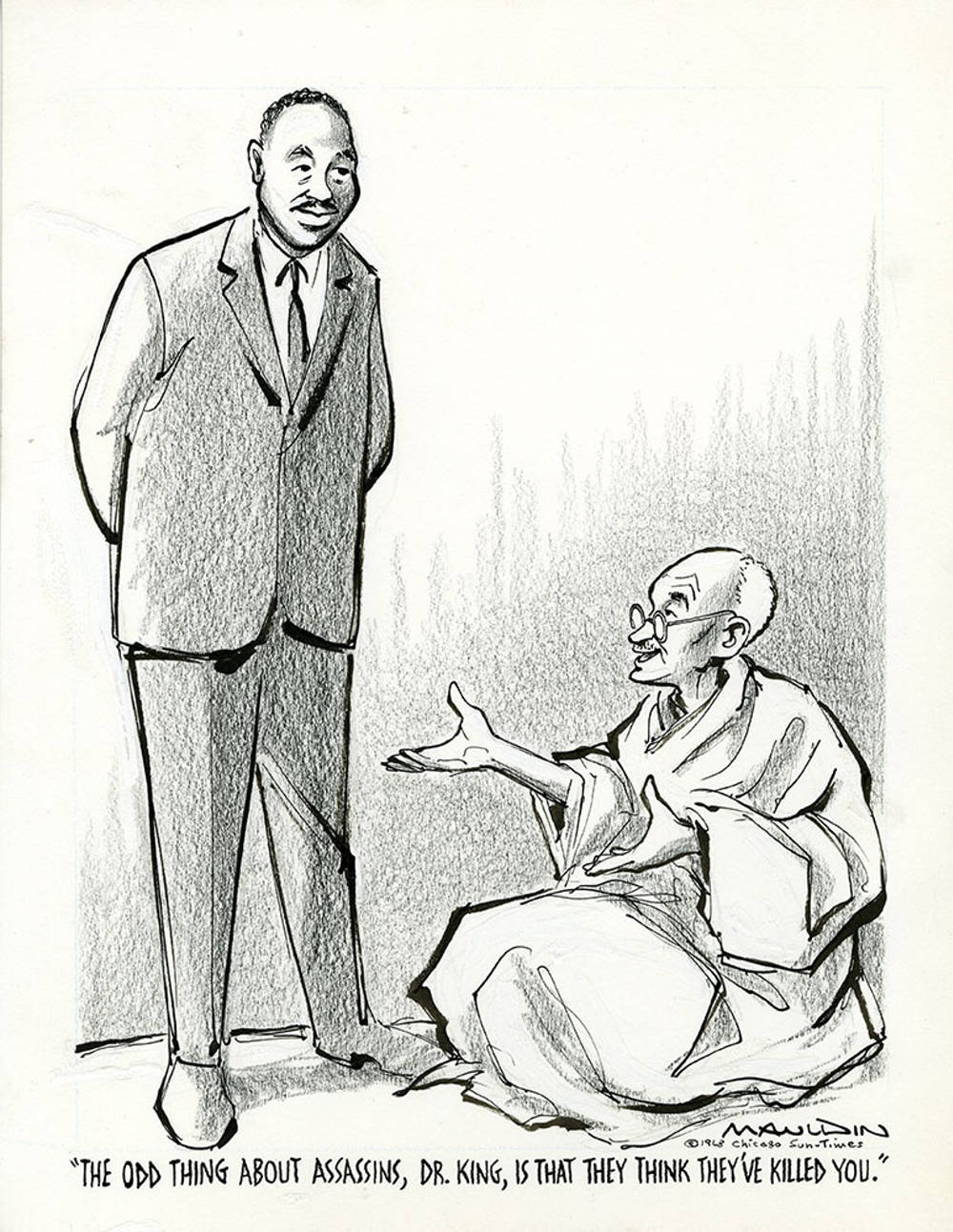
In April 1968, after Dr. King’s assassination, the Chicago Sun-Times published this cartoon: 

Look at Gandhi, seated on the floor, his hand outstretched, making his point to an attentive Dr. King. You’d think they were old friends. There they are in this alternate reality, perhaps even in the artist’s imagined heaven, reminding us that the voices of peacemakers can resonate long after they are gone. 

Although they never met, Gandhi and King were kindred spirits. Gandhi was aware of racial injustice in the United States and hoped that Black American would create their own nonviolent movement. 

Martin Luther King Jr. read books by and about Gandhi. He knew people who had met Gandhi. Gandhi’s teaching supported King’s own beliefs that grew out of the love of family, of community, of Jesus. King integrated Gandhian methods and principles into the work of his life, much as he did with the Christian gospel.”

Read This If You Love: I am Gandhi (both picture book & graphic novel) by Brad Meltzer; A Taste of Freedom: Gandhi and the Great Salt March by Elizabeth Cody Kimmel; Chasing Lincoln’s Killer by James L. Swanson; Martin’s Big Words: The Life of Dr. Martin Luther King Jr. by Doreen Rappaport; Be a King: Dr. Martin Luther King Jr.’s Dream and You by Carole Boston Weatherford; Memphis, Martin, and the Mountaintop: The Sanitation Strike of 1968 by Alice Faye Duncan; March trilogy by John Lewis with Andrew Aydin; A Good Kind of Trouble by Lisa Ramée; The Night Diary by Veera Hiranandani

Recommended For: 

classroomlibrarybuttonsmall 

Signature

**Thank you to Barbara at Blue Slip Media for providing a copy for review!**
 

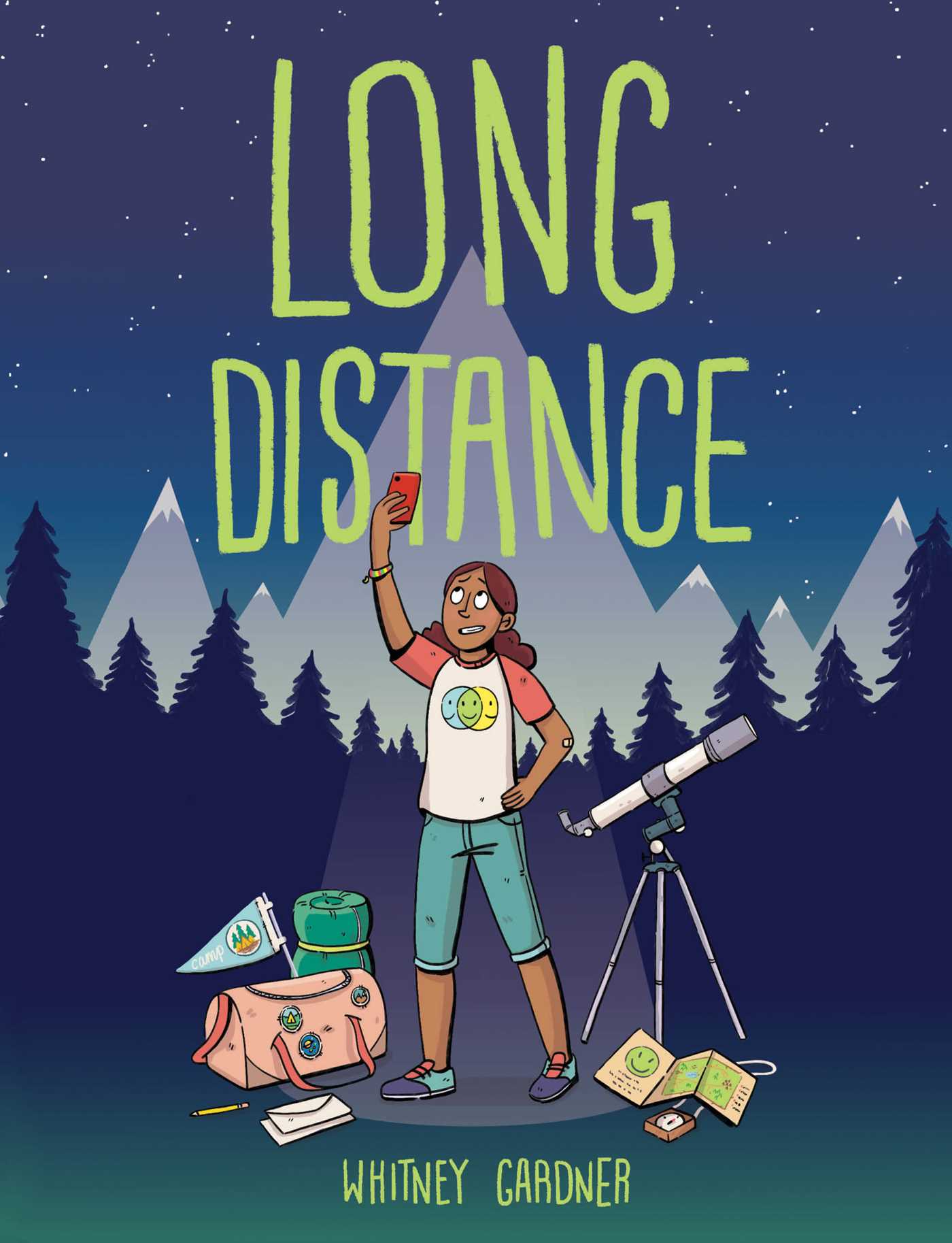
Long Distance by Whitney Gardner

Share

Long Distance
Author: Whitney Gardner
Published June 29th 2021 by Simon & Schuster Books for Young Readers

GoodReads Summary: From the creator of Fake Blood comes another exceptionally charming middle grade graphic novel about friendships both near and far, far away.

Vega’s summer vacation is not going well.

When her parents decide it’s time to pack up and leave her hometown of Portland, Oregon, behind for boring Seattle, Washington, Vega is more than upset—she’s downright miserable. Forced to leave her one and only best friend, Halley, behind, Vega is convinced she’ll never make another friend again.

To help her settle into her new life in Seattle, her parents send Vega off to summer camp to make new friends. Except Vega is determined to get her old life back. But when her cellphone unexpectedly calls it quits and things at camp start getting stranger and stranger, Vega has no choice but to team up with her bunkmates to figure out what’s going on!

Ricki’s Review: I read this book with my 7-year-old (he is not the target audience), and we really enjoyed it. The book has a very drastic twist towards the end of the book that will shock readers. The illustrations are wonderful, and the characters are quirky and fun, and I am glad that I read the book. It teaches about the layers of friendship, and the different ways in which we judge (and don’t judge) humans. Long Distance will offer teachers and students rich opportunities to discuss and consider how we think about others, and how we engage and participate in friendships.

Kellee’s Review: What a fun new graphic novel to add to my library! This book is going to have no trouble finding readers because it has a great mix of realistic (moving, friendship), information (all the science), and sci fi (you’ll see!). Because of these three factors, it is going to have a wide range of readers. The diversity of characters will help with the reach also: Vega is a girl of color, she has two fathers who are both people of color, and the twins at camp are characters of color also. Additionally to the diverse representation of identities, the characters area all quite different personality-wise, so every reader is going to find someone that they are rooting for or connect with. 

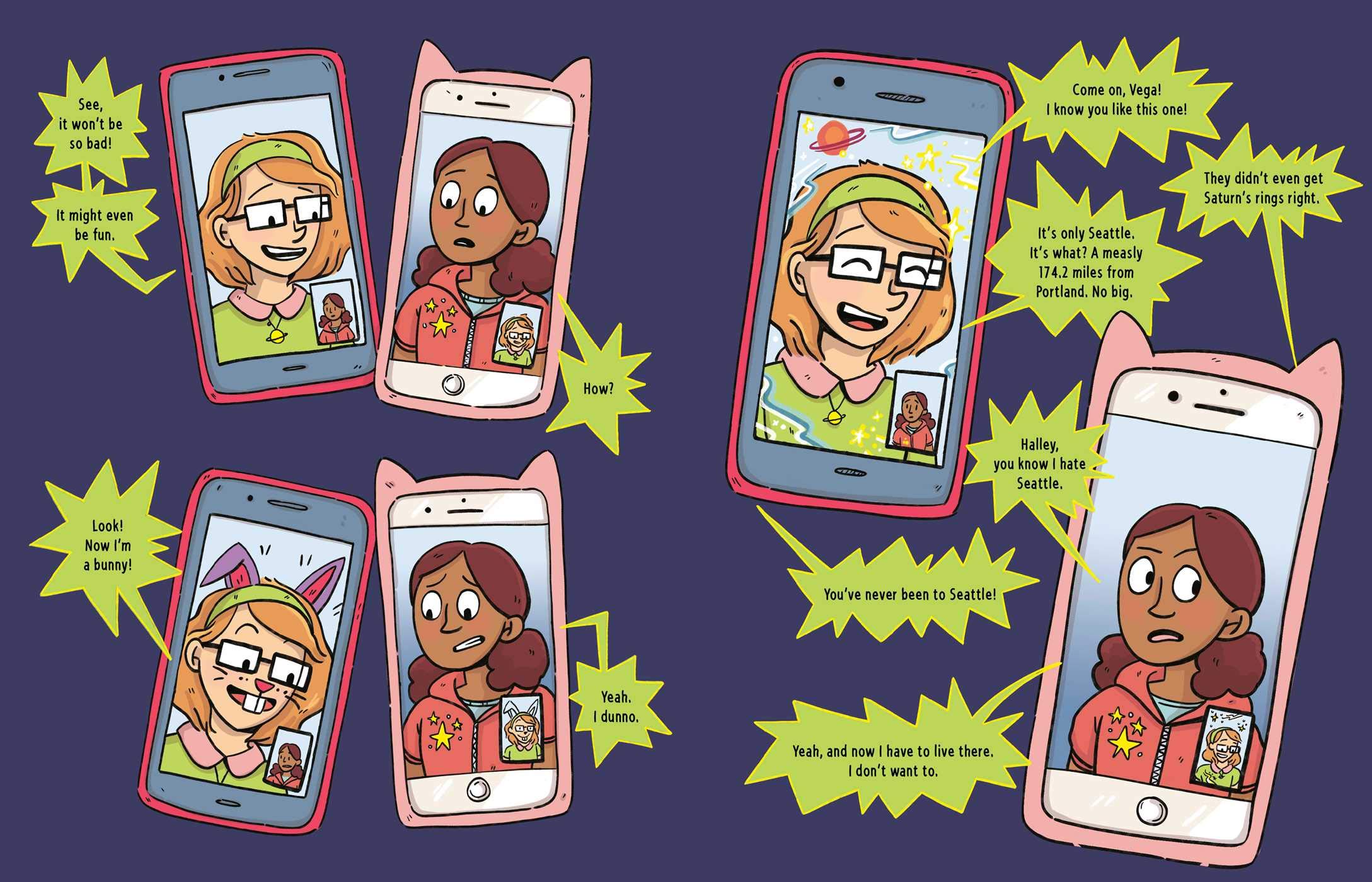
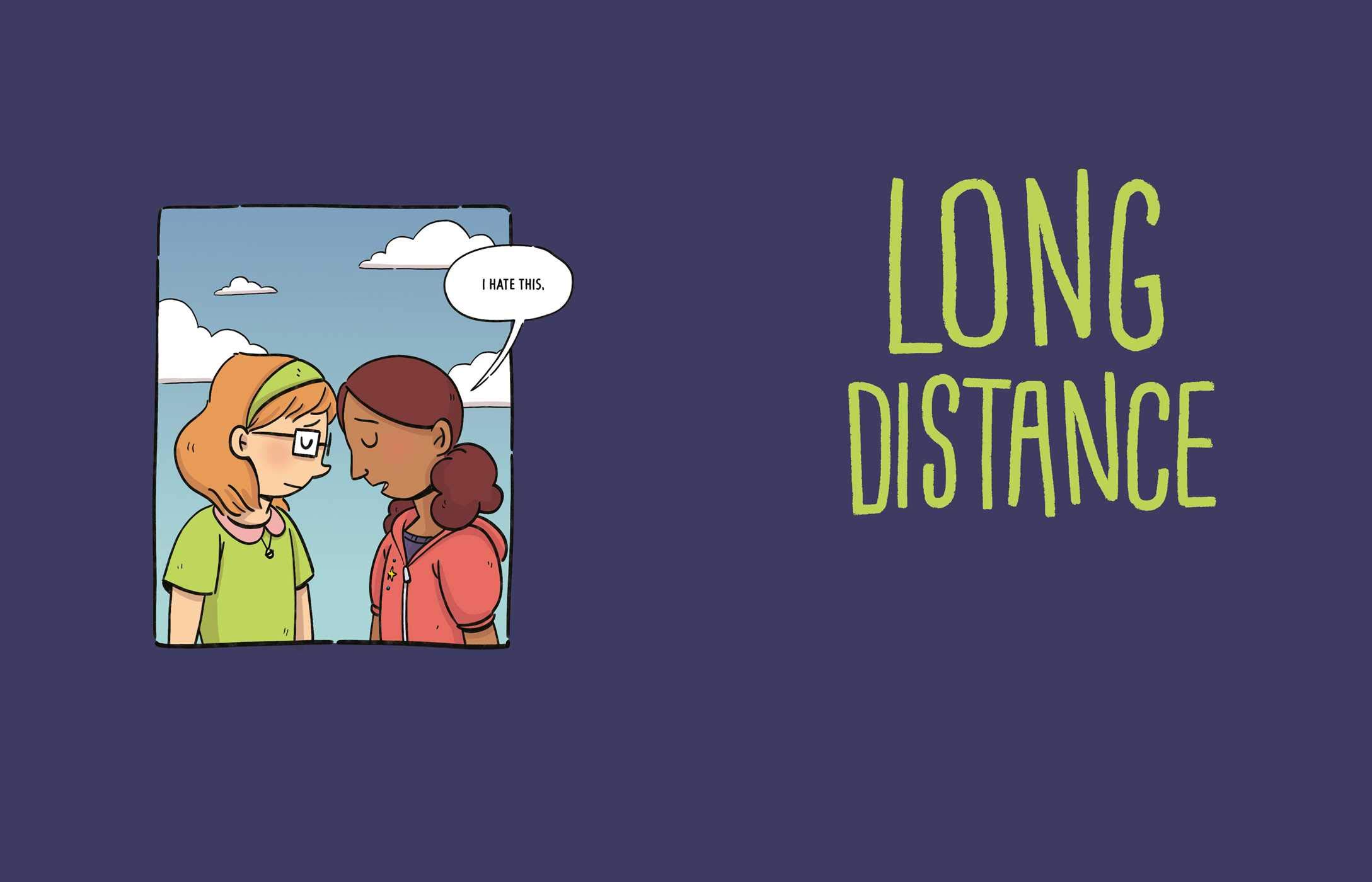
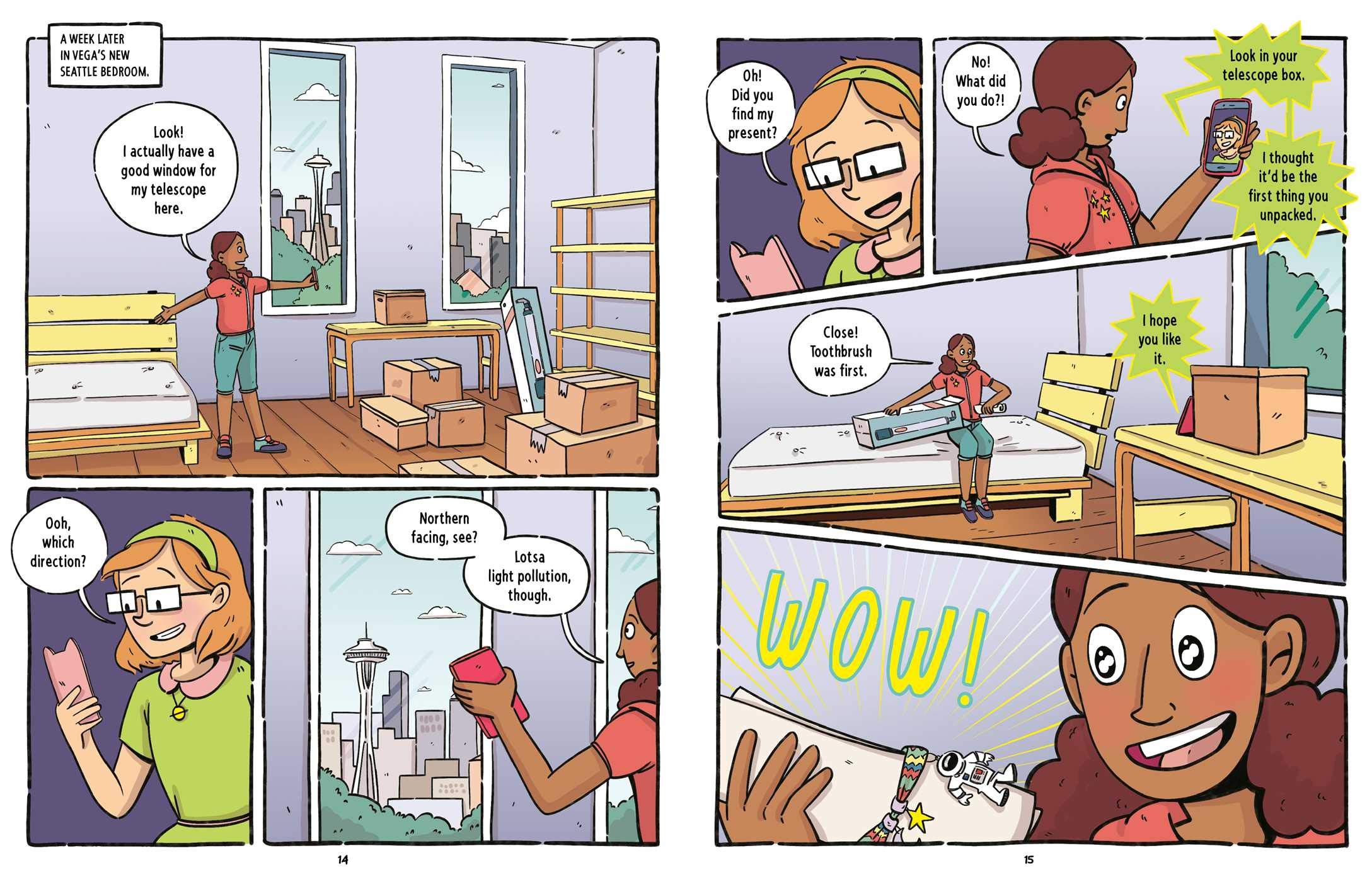
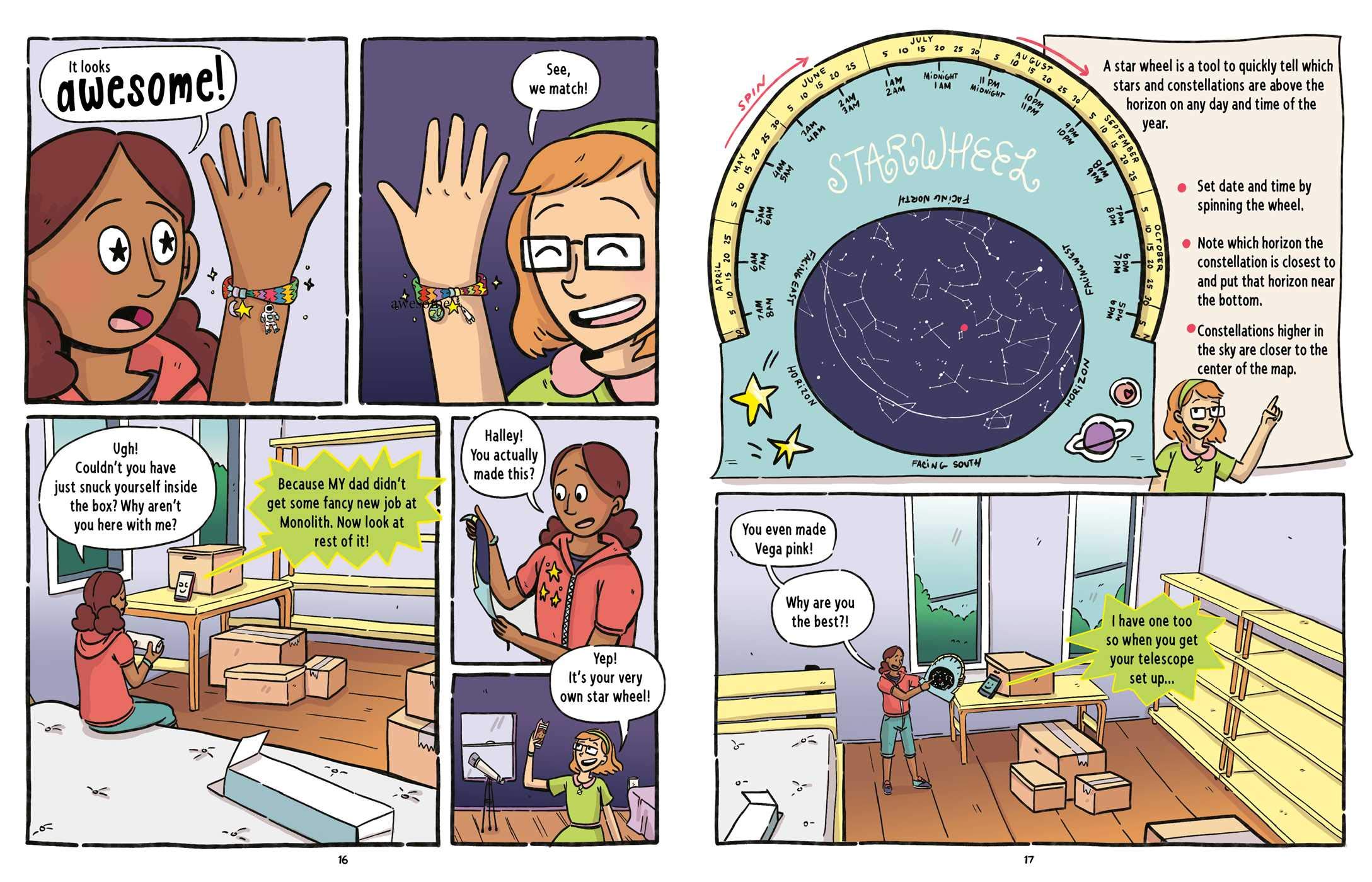
You’ll see below in the “Flagged Passages” that the illustrations are super colorful and eye catching, but not so busy that you lose focus. This is a huge benefit, specifically in middle school, because students love a color-filled graphic novel. 

Teachers’ Tools for Navigation: As described above, the twist in this book drastically shifts the storyline. Teachers might ask students to rewrite the twist to shift the story’s ending in a different direction.

The book also has a great SEL opportunity to look at how to make friends, using George as a great example of how not to. 

The text could also be used for prediction as the reader is as ignorant about the facts of the camp as Vega is but there are clues to something odd going on. As you read, students can look at the clues and try to make guesses about what the truth about the camp is. 

Also, the book has many cross overs with science! If you look at the “Flagged Passages” below, you’ll see that Vega is gifted a star chart by her friend and the author uses the opportunity to talk about what a star chart is. This happens a handful of times within the book with topics including astronomy, geology, and electrical engineering. In addition to the sidebars with info, there is science strewn throughout the narrative! 

Finally, Simon & Schuster has created “Drawn to Reading: A S&S Guide to Using Graphic Novels in the Classroom” which might assist you in utilizing this book with students. 

Discussion Questions: 

  • What does Vega learn about friendship?
  • Which camper was most interesting for you? What did you find interesting about them?
  • Many of the characters have different hobbies. What are your hobbies, and how do they compare with those of the characters in the book?
  • How did the author tie science into this science fiction graphic novel? 
  • How does Vega’s interest in stars and space help her discover the truth about the camp? 
  • If you had been in Vega’s position, would you have stayed with George? 
  • How did Halley figure out where Vega was? 
  • What scientific information that was shared in the book would you like to learn more about? 
  • Do you think we are alone in this universe? 

Flagged Passage: 

Read This If You Loved: Star Scouts by Mike Lawrence, HiLo series by Judd Winick, Katie the Catsitter by Colleen A.F. Venable, Real Friends series by Shannon Hale, Sisters by Raina Telgemeier, Drama by Raina Telgemeier, Fake Blood by Whitney Gardner

Recommended For:
 classroomlibrarybuttonsmall

RickiSigand

**Thank you, Audrey, at Simon & Schuster, for providing copies for review!**

Jump at the Sun: The True Life Tale of Unstoppable Storycatcher Zora Neale Hurston by Alicia D. Williams, Illustrated by Jacqueline Alcántara

Share

Jump at the Sun: The True Life Tale of Unstoppable Storycatcher Zora Neale Hurston
Author: Alicia D. Williams
Illustrator: Jacqueline Alcántara
Published January 12th, 2021 by Atheneum/Caitlyn Dlouhy Books

Summary: A picture book that shines the light on Zora Neale Hurston, the writer and storycatcher extraordinaire who changed the face of American literature.

Zora was a girl who hankered for tales like bees for honey. Now, her mama always told her that if she wanted something, “to jump at de sun”, because even though you might not land quite that high, at least you’d get off the ground. So Zora jumped from place to place, from the porch of the general store where she listened to folktales, to Howard University, to Harlem. And everywhere she jumped, she shined sunlight on the tales most people hadn’t been bothered to listen to until Zora. The tales no one had written down until Zora. Tales on a whole culture of literature overlooked…until Zora. Until Zora jumped.

About the Creators:

Alicia D. Williams is the author of Genesis Begins Again, which received a Newbery and Kirkus Prize honors, was a William C. Morris Award finalist, and for which she won the Coretta Scott King – John Steptoe Award for New Talent. A graduate of the MFA program at Hamline University, and an oral storyteller in the African American tradition, she is also a teacher in Charlotte, North Carolina.

Jacqueline Alcántara is the illustrator of the critically acclaimed The Field and Freedom Soup. Her favorite days are spent drawing, painting, writing, and walking her dog. In 2016, she was awarded the inaugural We Need Diverse Books Illustrator mentorship. Find out more at JacquelineAlcantara.com.

Praise: 

*”A lively, joyfully rendered portrait of a literary legend.” – Publisher Weekly, starred review

* “Williams’ narration is a readaloud dream….it will be a joyful guide for folklore enthusiasts” – BCCB, starred review

* “This introduction to an American icon feels just right.” – Kirkus Reviews, starred review

* “A welcome addition to any picture book biography collection.” – School Library Journal, starred review

Review: Zora Neale Hurston has a special place in my heart as Eatonville is right around the corner, and I love the opportunity to be so close to Zora’s home, be inspired by her story, and learn from her. If you are ever here, stop by the Zora Neale Hurston National Museum of Fine Arts!

Alicia D. Williams does a beautiful job capturing the spirit of Zora and showing how truly special she was as a person and story teller. And I loved learning new things about her that I hadn’t known before (like that she graduated from high school at 28 and that she may have been lost to white-washed history if not for Alice Walker). And Alicia’s words mixed with the colorful and active illustrations of Alcántara, Zora is brought to life through the pages of this book.

Teachers’ Tools for Navigation: The publisher provided Curriculum Guide is the best resource for using this book in your classroom:

Discussion Questions: 

  • How are the end pages representative of Zora?
  • How were Zora’s stories important to American literature?
  • Why did the author call Zora a “storycatcher?”
  • How did the author integrate fictional characters and stories within her nonfiction biography of Zora Neale Hurston?
  • Why was some of Zora’s storytelling looked down upon?
  • What does the figurative phrase “reach/jump to the sun” mean?

Flagged Passages: 

Read This If You Love: Zora Neale Hurston, Picture book biographies

Recommended For: 

classroomlibrarybuttonsmall 

Signature

**Thank you to Simon & Schuster for a copy of the book to review!**