The Scary Places Map Book by B.G. Hennessy

Share

Over the next 2 weeks, many of my reviews are going to be in honor of Halloween.
Halloween

I am so happy to begin my two weeks of scary with: 

scaryplaces

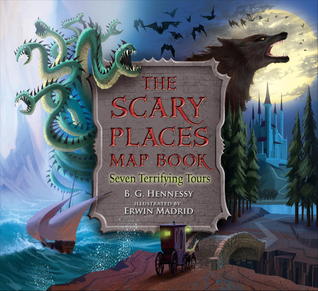
The Scary Places Map Book: Seven Terrifying Tours
Author: B.G. Hennessy
Illustrator: Erwin Madrid
Published July 10th, 2012 by Candlewick

Goodreads Summary: Grab a flashlight for an after-dark exploration of seven very scary places. Giggles and goose bumps are in store!

Take a tour of seven spooky places, among them the Wicked Woods, a Ghostly Galleon, and the Western Terror-tories. Along the way, avoid booby traps, search for hidden objects, and learn basic map reading skills! A map key, items to look for, and points of interest, such as Dracula’s Castle and Dr. Frankenstein’s laboratory, are included for each eerie region. Tips for touring (never take the Transylvania tour during a full moon) add to the fun. Kids who love to mix the ghoulish with the humorous will pore over the atmospheric pictures time and again, transported to strange, mysterious, very scary places.

My Review: This book tells you seven stories through an interactive tour of a map. Each map has a different theme and starts with an introductory story. I loved  thinking of all of the fun ways this could be used in the classroom!

Teacher’s Tools For Navigation: While reading, I thought of so many different ways that this book could be utilized in a classroom:

First, the book teaches map skills because it has a key and directs the reader to different sections of the map by using the grid system and the scale.

Second, the setting of each map would be a great jumping off point to writing a story.

Third, many of the settings are based off of books or history and would be easy to connect to novels. For example, the first map is “The Ghostly Galleon Cruise of the Seven Seas” which could be connected with the Young Jack Sparrow books. “Land of Mythical Monsters” is set in Greece so could connect to mythology and any book like The Lightning Thief. “Roundup of the Western Terror-tories” to The Case of the Deadly Desperados, “Tour of the Wicked Woods and Witchfield Village” to Tales of Dark and Grimm, “Trip Through Transylvania” to Dracula Doesn’t Drink Lemonade, “Sleepwalking Tour of Nightmare House” to All the Lovely Bad Ones, and “Museum of Haunted Objects” to The Strange Case of Dr. Jekyl and Mr. Hyde.

I have been very lucky that over the last year or so to be in touch with B.G. Hennessy about this book. I’m honored that based on my original review, B.G. has begun to make a comprehensive list of books to go with each book. This list is so awesome! She includes picture books, beginning readers, chapter books, nonfiction books, and activity books for EACH MAP.

I am sure there are even more ways I am going to keep thinking about it. I, personally, cannot wait to use this in my classroom. (I also found out there is a facebook page for the book where teachers and the author can share their ideas- https://www.facebook.com/ScaryPlacesMapBook) B.G. Hennessy has also put together a teacher’s guide for the book which includes standards, vocabulary, activities, and more (which is written for elementary, but it can definitely by used for middle school as well!). Check it out on her website: http://bghennessy.com/ What a wonderful resource for teachers!

Discussion Questions: For each map, what are some books that you can connect the map to? How do the map and book connect?; [Writing Prompt] Using one of the maps in the Scary Places Map Book to be the setting of a narrative that you write. Challenge yourself and try to include at least 5 of the events or characters mentioned in the map.

We Flagged: “Land of Mythical Monsters: Who better to lead a tour through the birthplace of the foulest, ugliest, and fiercest monsters of all time than Hercules, a legend himself. This tour is for experts only. Pack your best hiking shoes and sunscreen. Mighty Hercules will meet you at Athena’s Temple. You will trek through snowcapped mountains, sail to the sunny island of Crete, and hike back to the dark door to the Underworld. Test your skills and see if you can make it through the Minotaur’s famous labyrinth.” (p. 7)

Read This If You Loved: Lightning Thief (series) by Rick Riordan, Dracula Doesn’t Drink Lemonade by Debbie Dadey, All the Lovely Bad Ones (and others) by Marry Downing Hahn, The Case of the Deadly Desperados by Caroline Lawrence, A Tale Dark & Grimm by Adam Gidwitz, The Coming Storm (series) by Rob Kidd, The Strange Case of Dr. Jeckyl and Mr. Hyde by Robert Louis Stevenson

Recommended For: 

closereadinganalysisbuttonsmall readaloudbuttonsmall classroomlibrarybuttonsmall

Signature

History News: Greek News by Anton Powell and Philip Steele

Share

NF PB 2013

Nonfiction Picture Book Wednesday

Nonfiction Picture Book Wednesday is hosted by Kid Lit Frenzy and was started to help promote the reading of nonfiction texts. Most Wednesdays, we will be participating and will review a nonfiction text (though it may not always be a picture book).
Be sure to visit Kid Lit Frenzy and see what other nonfiction books are shared this week!
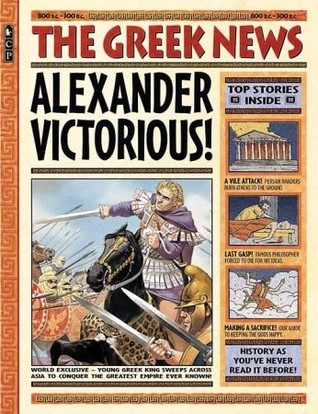
greeknews

History News: The Greek News
Author: Anton Powell and Philip Steele
Illustrator: Various
Published March 10th, 2009 by Candlewick Press

Goodreads Summary: At home or at school, these innovative titles make history come alive

Read all About it Now, with The Greek News and The Roman News, life in ancient Greece and Rome is presented in the form of a daily newspaper written at the time. As accessible as your morning paper, The Greek News and The Roman News will give young readers the unforgettable sense of actually being a citizen of an ancient nation.

Stop the presses! What if ancient civilizations had daily newspapers? And they were amusing and compellingly informative? They might just look like this innovative series of historical nonfiction, presented in a unique, kid-friendly format.

Presents a “special edition” of a Greek newspaper which spans the years 1500 to 146 B.C. and contains articles about history, politics, feasts, fashions, theater, gods, and wars.

My Review: Set up like a Greek newspaper, The Greek News takes important events from the history of Greece and transcribes them as articles. The articles range in topics including Sparta, Alexander the Great, politics, army/navy life, trades, sports, woman, mythology, arts, education, philosophy, and traditions.

Teacher’s Tools For Navigation: The book is so well done with each page including a main article as well as other features including sidebars, maps, advertisements, diagrams, illustrations and political cartoons. I think students will like reading/learning about Greece more from this text than other because the unique format shares the information as if it was happening in the present and puts the reader in the middle of Greece. It also throws in some humor which students will love. This text can lead to such great discussions about not only Greece, but war, philosophy, mythology, propaganda, and so many other things.

Discussion Questions: [Writing prompt] Use The Greek News as a guide to create your own newspaper-esque piece sharing the history of a historical fiction book which you have read.

We Flagged: “In 415 B.C., Athens tried to add to its territory by conquering the island of Sicily. The results were disastrous – thousands of Athenian soldiers and hundreds of warships were lost. The Spartans leaped on Athens’s weakness and cut off the city’s supply of wealth from its silver mines…” (“Sparta Attacks!” p. 6)

“You know what it’s like. One minute your life is going smoothly, then, just when you least expect it, the gods turn their back on you and disaster strikes! Don’t panic – The Greek News will tell you everything you need to know about keeping the gods on your side.” (Lead paragraph for “Pleasing the Gods” p. 20-21)

“Socrates is to die! The jury of 501 men has made its decision – Socrates is guilty of not believing in the state-approved gods and of leading young people astray with his teaching.” (“Death by Poison, pg. 27)

Read This If You Loved: Any non-fiction or fiction text about Greece

Recommended For: 

classroomlibrarybuttonsmall closereadinganalysisbuttonsmall

Signature

Man Made Boy by Jon Skovron

Share

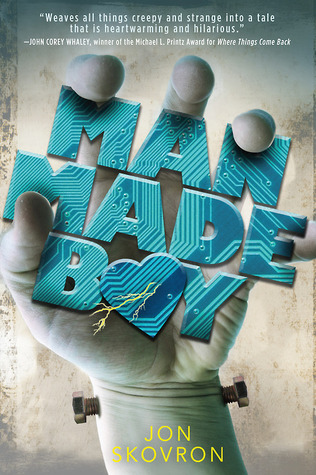
9780670786206_ManMadeBoy_JK.indd

Man Made Boy
Author: Jon Skovron
Published: October 3rd, 2013 by Viking Penguin

GoodReads Summary: Love can be a real monster.

Sixteen-year-old Boy’s never left home. When you’re the son of Frankenstein’s monster and the Bride, it’s tough to go out in public, unless you want to draw the attention of a torch-wielding mob. And since Boy and his family live in a secret enclave of monsters hidden under Times Square, it’s important they maintain a low profile.

Boy’s only interactions with the world are through the Internet, where he’s a hacker extraordinaire who can hide his hulking body and stitched-together face behind a layer of code. When conflict erupts at home, Boy runs away and embarks on a cross-country road trip with the granddaughters of Jekyll and Hyde, who introduce him to malls and diners, love and heartbreak. But no matter how far Boy runs, he can’t escape his demons—both literal and figurative—until he faces his family once more.

This hilarious, romantic, and wildly imaginative tale redefines what it means to be a monster—and a man.

My Review: I was completely engrossed in this book. My favorite part about it dips into a wide variety of genres. Lovers of fantasy, romance, sci fi, and/or steampunk will find something to enjoy in the text. There are monsters, werewolves, computers, and lovers. Students will have a lot of fun exploring aspects of the book (because who doesn’t love to read about monsters?). Boy takes readers for quite a ride, and I envision this would make for a great literature circle choice. This modern extension of Frankenstein allows readers to place the classic text in a more relevant context. Readers will be able to revisit a few classics that they know and loved (or didn’t love). This is my favorite Jon Skovron book that I have read. It shows how clever he is.

Teacher’s Tools for Navigation: Man Made Boy is an English teacher’s dream. It can be paired quite well with mythology and other classic monsters in history. I would love to pair Medusa’s scenes with a mythology unit. This would also bridge very well with The Strange Case of Dr. Jekyll and Mr. Hyde. The monsters of this book are ubiquitous in the literary canon, and I think students would have a lot of fun picking and researching classic monsters from the text.

Discussion Questions: What is a monster? Can humans be monsters? What kinds of demons do people confront?; Does Boy make the right decision when he decides to leave home?; Choose three monsters in the story. What do each of them teach us? How do their interactions with Boy help us understand him better?

Read This If You Loved: Frankenstein by Mary Shelley, The Strange Case of Dr. Jekyll and Mr. Hyde by Robert Louis Stevenson, Raven Boys by Maggie Stiefvater, A Monster Calls by Patrick Ness, Anna Dressed in Blood by Kendare Blake, Hold Me Closer, Necromancer by Lish McBride

Recommended For:

  litcirclesbuttonsmall closereadinganalysisbuttonsmall classroomlibrarybuttonsmall

026F3FBCC8C3913BD3A4D3F6920340D5

**Thank you to NetGalley and Penguin for providing the Advanced Reader Copy for review!**

The Mary Celeste: An Unsolved Mystery from History by Jane Yolen and Heidi Elisabet Yolen Stemple

Share

NF PB 2013

Nonfiction Picture Book Wednesday

Nonfiction Picture Book Wednesday is hosted by Kid Lit Frenzy and was started to help promote the reading of nonfiction texts. Most Wednesdays, we will be participating and will review a nonfiction text (though it may not always be a picture book).
Be sure to visit Kid Lit Frenzy and see what other nonfiction books are shared this week!

122102

The Mary Celeste: An Unsolved Mystery from History
Author: Jane Yolen and Heidi Elisabet Yolen Stemple
Illustrator: Roger Roth
Published July 1st, 2002 by Simon & Schuster Books for Young Readers

Goodreads Summary: The Mary Celeste was discovered adrift on the open sea by another ship in 1872 — with no sign of captain or crew. What happened? Did the crew mutiny? Were they attacked by pirates? Caught in a storm? No one ever found out.

Inside this book are the clues that were left behind and the theories of what people think happened aboard that ship. Become a detective, study the clues, and see if you can help solve this chilling mystery from history.

My Review: This is the final book in the Unsolved Mystery from History series and I think it may be my favorite yet. Like The Wolf Girls, I had not heard about the Mary Celeste before this book, but this mystery was just so enthralling! A crew that just disappears?!?! How?!?! After reading the book, I spent hours online reading about the Mary Celeste and it is so interesting. There are so many websites and opinions and theories—all which would be so much fun to share with students.

Teacher’s Tools for Navigation: Like the other books in this series, I would love to see these books used in classrooms (history or language arts/reading). These books promote studying history, asking questions, inquiry, and vocabulary. Each book begins with an introduction about a young girl who enjoys unsolved mysteries from history and then the books are set up like her case notebook. Each page of the case notebook includes a narrative nonfiction section, an informational nonfiction section where facts about the story are explained even more in detail, and then there are vocabulary words from the two sections defined for the reader. Finally, in the back of the books the different theories about what could be the answer to the unsolved mystery are shared and briefly discussed. The set up of this book leads to infinite possibilities of being used in the classroom. Students could debate, write research papers, could do their very own case notebook about a different mystery, etc. Another option is to get all of the Unsolved Mystery from History books and have students get into lit circle groups and have each group read a different mystery then research and share. The other books in the series are about the Salem Witch Trials, the Wolf Girls, and Roanoke.

Discussion Questions: Which of the theories do you think happened?; Do you trust Captain Morehouse? Why or why not?; One theory mentions a kraken. Do you think sea monsters exist?; Study the weather of the Pacific during the time period the ship disappeared. Is weather an option for the crew’s disappearance?

We Flagged: Narrative Nonfiction “The last place the men looked was in the ship’s hold where her cargo- 1,700 barrels of raw alcohol- was well stowed. Not a single barrel had been opened. All in all, Deveau and Wright looked around the Mary Celeste for over half an hour. They found no sign of anyone on board, no signs of struggle.”

Informative Nonfiction “The cargo was alcohol stored in red oak barrels. Red oak is a porous wood that lets alcohol fumes escape. When the barrels were examined, some of the alcohol was found to be gone, but that was entirely due to evaporation. According to reports, the barrels were “in good order” and not “in any way injury.” Besides, the alcohol was was raw alcohol which was to be used for fortifying Italian wines. Anyone drinking it unprocessed would not become drunk, but would rather lapse into a coma or die. Only one hatch was found open, but there was no sign of smoke damage or an explosion in the unventilated hold.”

Vocabulary “Hold: the area inside the ship where cargo is stored; Cargo: the goods being transported by the ship” (p. 20-21)

Read This If You Loved: The other Unsolved Mystery from History books

Recommended For: 

closereadinganalysisbuttonsmall readaloudbuttonsmall

classroomlibrarybuttonsmall litcirclesbuttonsmall

I’m so sad that I am done reviewing the Unsolved Mystery from History series, but I hope you have enjoyed learning about them as I enjoyed reading them. 

Signature

Journey by Aaron Becker

Share

journey

Journey
Author and Illustrator: Aaron Becker
Published August 6th, 2013 by Candlewick Press

Goodreads Summary: Follow a girl on an elaborate flight of fancy in a wondrously illustrated, wordless picture book about self-determination — and unexpected friendship.

A lonely girl draws a magic door on her bedroom wall and through it escapes into a world where wonder, adventure, and danger abound. Red marker in hand, she creates a boat, a balloon, and a flying carpet that carry her on a spectacular journey toward an uncertain destiny. When she is captured by a sinister emperor, only an act of tremendous courage and kindness can set her free. Can it also lead her home and to her heart’s desire? With supple line, luminous color, and nimble flights of fancy, author-illustrator Aaron Becker launches an ordinary child on an extraordinary journey toward her greatest and most exciting adventure of all.

My Review: This book is very hard to explain the magic of it. Lorna (@notforlunch) described it the best, I think: “a wonderful mashup of a David Wiesner book and Harold and the Purple Crayon.” I think this is perfect. It has the illustration beauty and magic of a wordless David Wiesner picture book and it is about creativity (and a crayon) like Harold. The beauty of the castle she visted also reminded me of Cathedral by David Macaulay. This book is just full of amazing! (You know it is good if it is a topic of #SharpSchu book club!)

Teacher’s Tools For Navigation: This was a bit hard for me. I can envision how this book would be used in the middle grades, but I was blanking on ideas for primary. I know this book needs to be shared, but how?

In my classroom, the first thing I would do is project the book and just have the students read it with me. No talking; just looking. Then we’d go back and discuss what is going on in the book, talk about some of the smaller parts of the illustrations, relive the journey. If I wanted to include a writing activity, we could add words to the book (although, I think this book’s illustrations stand alone). We could also discuss what we’d do if we had a magic crayon. I think this book would be a great addition to Dot Day and discussing creativity. Finally, I think a discussion of observing your surroundings would be appropriate as what the girl wanted the most was right in front of her at the beginning of the book.

Discussion Questions: What would you do with a magic crayon?; What was your favorite part of the journey?; Two parts remind me of Where the Wild Things Are, can you figure out which parts?; What do you think the girl’s name is?; Aaron Becker grew up in many different parts of the world including Japan. Can you find influences of Japan in this story? What about some of the other places he lived?

We Flagged: 

Read This If You Loved: Harold and the Purple Crayon by Crockett Johnson, Blackout by John Rocco, David Weisner wordless picture books, Cathedral by David Macaulay, Where the Wild Things Are by Maurice Sendak, Henri Mouse by George Mendoza, Chalk by Bill Thomson, Art & Max by David Weisner, Weslandia by Paul Fleishman, Narnia (series) by C.S. Lewis

Recommended For: 

closereadinganalysisbuttonsmall classroomlibrarybuttonsmall readaloudbuttonsmall

I put “Read Aloud” although this book is wordless; however, I know it needs to be shared with students. How would you share this book with your students in a read aloud fashion? 

Signature

Grumbles from the Forest: Fairy-Tale Voices with a Twist by Jane Yolen and Rebecca Kai Dotlich

Share

grumbles

Grumbles from the Forest: Fairy-Tale Voices with a Twist
Authors: Jane Yolen and Rebecca Kai Dotlich
Illustrator: Matt Mahurin
Published March 1st, 2013 by Wordsong

Goodreads Summary: What were all those fairy-tale characters thinking? Jane Yolen and Rebecca Kai Dotlich answer this question in paired poems, with sometimes startling results. The Princess claims all those mattresses kept her awake–“not” a silly pea–while the poor pea complains that the princess snores. One Snow White begs the witch to settle by the bay and throw that mirror away. Another boldly tells the mirror she “won’t be guided by a glass that’s so one-sided.” Grumbles from the Forest is a bewitching brew of voices–grumbling, pleading, bragging, reminiscing, confiding–that bubbles with magic and wonder. The spectacular paintings that tie the poems together are full of surprise and intrigue. This stunning collection includes end notes that briefly describe the tales and their history and an introduction that invites readers to imagine their own poems from unusual perspectives.

My Review: Jane Yolen just doesn’t make bad books. Every time I read one of her books, I know I am reading a piece of great literature. This book is no different. Grumbles from the Forest takes 15 different fairy tales and then has a poem from two different perspectives for each fairy tale. Some are two different characters: Cinderella and her stepsisters, the frog and the princess, the wicked fairy and Sleeping Beauty, etc. including some characters who didn’t have a voice in the original fairy tale like the pea from The Princess and the Pea. Some are from one character, but two points of view: Snow White talking to the witch and with the magic mirror. I was fascinated with all of the poems they came up with!

Teacher’s Tools For Navigation: This book was built for being used in the classroom. First, each fairy tale section could start its own discussion about what the poem is saying vs. the original fairy tale. Second, the poetry itself stands alone. Look for figurative language and other poetic elements and there is even a haiku and cinquain. Third, we are always trying to get students to see things from different points of view and this is a perfect way. The introduction of the book even invites readers to: “Why not try writing a fairy-tale poem yourself? Pick a character or an object—maybe the bridge in Three Billy Goats Gruff, or Beauty’s father or the chair that Goldilocks broke. Imagine. Enchant. Write a poem that rewrites the tale. Make a little magic.”

Discussion Questions: Why do you think the authors chose to write from ____’s point of view? Do you agree with the point of view they gave the character/object? What would you have had them say instead? Who/what would you have written about instead?

We Flagged: Thumbelina 

“Thumbelina: A Cinquain”
Being
small has its down-
side, but what, pray tell, is
the choice of a little missy
at birth?

“Little Big: A Haiku”
I am just a bit
Of a proper young lady,
Still I got my prince.

(p. 34-35)

Read This If You Loved: The True Story of the Three Little Pigs by Jon Scieszka, Revolting Rhymes by Roald Dahl, and other fractured fairy tales; Stories told from different points of view like The Day the Crayons Quit by Drew Daywalt and Who Stole Mona Lisa? by Ruthie Knapp

Recommended For: 

closereadinganalysisbuttonsmall readaloudbuttonsmall

Signature

The Wolf Girls: An Unsolved Mystery from History by Jane Yolen and Heidi Elisabet Yolen Stemple

Share

NF PB 2013

Nonfiction Picture Book Wednesday

Nonfiction Picture Book Wednesday is hosted by Kid Lit Frenzy and was started to help promote the reading of nonfiction texts. Most Wednesdays, we will be participating and will review a nonfiction text (though it may not always be a picture book).
Be sure to visit Kid Lit Frenzy and see what other nonfiction books are shared this week!
wolf

The Wolf Girls: An Unsolved Mystery from History
Authors: Jane Yolen and Heidi Elisabet Yolen Stemple
Illustrator: Roger Roth
Published August 1st, 2000 by Simon & Schuster Books for Young Readers

Goodreads Summary: In 1920 a missionary brought two young girls to an orphanage in India. The girls didn’t know how to talk, walk, or eat from a plate. Some people thought the girls had been abandoned by their parents. Some people said the girls were brought up by wolves in the wild. Still others thought that the missionary who ran the orphanage made up the story about the girls. No one knows for sure.

Become a detective as you read this true story, study the clues, and try to figure out the fate of the wolf girls of Midnapore. The Unsolved Mystery from History series is written by acclaimed author Jane Yolen and former private investigator Heidi Elisabet Yolen Stemple. Read carefully and check your clues. You might be the first to solve a puzzle that has baffled people for years.

My Review: This story was fascinating as I had never heard of the wolf girls and came in with no prior knowledge about the mystery. It was so much fun to be full on submerged in the mystery and following the clues that are given throughout the “case notebook”.

Teacher’s Tools for Navigation: This book is set up just like the Salem Witch Trials: An Unsolved Mystery from History and could be used the same way in the classroom: This book promotes studying history, inquiry, and vocabulary. The book begins with an introduction to a young girl who enjoys unsolved mysteries from history and then the book is set up like her case notebook. Each page of the case notebook includes a narrative nonfiction section, an informational nonfiction section where facts about the story are explained even more in detail, and then there are vocabulary words from the two sections defined for the reader. Finally, in the back of the book the different theories about what could be the answer to the unsolved mystery are shared and briefly discussed. The set up of this book leads to infinite possibilities of being used in the classroom. Students could debate, write research papers, could do their very own case notebook about a different mystery, etc. Another option is to get all of the Unsolved Mystery from History books and have students get into lit circle groups and have each group read a different mystery then research and share.

What I like particularly about this one is that there is so much to debate as there aren’t many clues given throughout the story. Many of the eye witnesses are unreliable and there aren’t many facts shared throughout the book. I think this book would lead to a great discussion about primary and secondary sources as well as reliability.

Discussion Questions: Which theory do you believe about the wolf girls?; Do you think a journal written a year after an incident is reliable?; Many of the scientific facts and theories shared are from the 18th and 19th century, are these facts still what science believes?; Why do you think the missionary’s wife never spoke of the wolf girls?; Why do you think that Singh’s accounts were different than his daughter’s?; Singh said he did not want to exploit the girls yet he let people come to see her – is this exploitation? Do you think what he did was wrong?

We Flagged: Narrative nonfiction “After nursing the two girls back to health, the Reverend Singh loaded them into the cart and drove them for eight days to his orphanage in Midnapore. But the wolf girls were so weak and emaciated, they could not move about, so at first no one outside of the orphanage saw them. Singh wrote in his journal, ‘They were accepted simply as neglected children.’

Informational Nonfiction Singh wrote in his journal that the girls were mud-covered, with scratches, scars, and fleas. The heels of their hands were callused from running on all fours. Their ears trembled like a dog’s when they were excited. Their brows were bushy and long. Each had arms almost reaching their knees. Their teeth were close-set, uneven, with fine, sharp edges, the canines longer and more pointed than is usual in humans. However, Singh took no scientific measurements and invited no scientists to examine the girls. He took photographs that were fuzzy and indistinct. Years later, his own daughter, when interviewed, did not remember the distinctive teeth or exceptional ears or terrifically bushy brows.

Vocabulary Emaciated: thin and feeble due to disease or poor food; Neglected: not take proper care of” (p. 20-21)

Read This If You Loved: Yolen’s other Unsolved Mystery from History books

Recommended For: 

classroomlibrarybuttonsmall litcirclesbuttonsmall

closereadinganalysisbuttonsmall readaloudbuttonsmall

What mystery from history do you wish Jane Yolen had written about? 

Signature