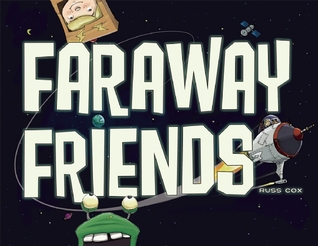
Faraway Friends Author and Illustrator: Russ Cox
Published May 5th, 2015 by Sky Pony Press
Goodreads Summary: This is the story of the adventure of a little boy named Sheldon and his dog, Jet. When Sheldon’s best friend moves away, Sheldon spies the word “Jupiter” painted on the side of the moving truck. Sheldon feels sad at first, but realizes that this is a sign—what he needs is a rocket ship! So Sheldon and Jet do some sketching and some scrounging, and, with a wagon full of equipment and supplies, the two future astronauts head to the backyard. With a glop and a wham, piece by piece the ship begins to take form, and soon it’s Commander Sheldon A. Flyer and Space Cadet Jet ready for takeoff! The duo jets around satellites, zooms by planets, speeds through space storms, and zips past other flying saucers . . . untilplop, they’ve arrived, somewhere with a green, alien life-form and a furry black blob.
This book encourages children to channel loneliness and boredom with creativity and imagination, and ultimately it is a story of new friendship. Featuring vibrant illustrations by debut author and illustrator Russ Cox, this action-packed story is sure to appeal to young readers in search of something that is out of this world!
My Review: I loved this story! It promotes imagination, has science elements, and is about the tough subject of friends moving away. When Sheldon’s best friend moves away, he believes he has moved to Jupiter so the only solution is to build a spaceship for himself and his dog, Jet, to go to Jupiter to see his friend. I adored that Sheldon went through a planning and sketching phase before building and “blasting off” with Jet. They then fly through outer space until a ship malfunction and a visiting alien change their plans. Children will love the colorful illustrations, fun adventure, and comic relief of Jet all while exploring themes of friendship, loss, and imagination.
P.S. The cover glows in the dark!!!!
Teachers’ Tools for Navigation: Like I shared above, there are some deep themes that can be addressed while/after reading this book. I also think it will promote a want to build a space ship, and it would be great to have students plan and build a spaceship (maybe not life size, but for an egg or pipe cleaner person?). The book also has onomatopoeias throughout which always makes me happy as they may be my favorite type of figurative language, and there is also great vocabulary words throughout to learn about.
Discussion Questions: Before reading, look at the cover and predict what you think the book is about. After reading, look back at the cover. What did you predict correctly and incorrectly based on the cover?; Has a friend of yours ever moved away? How did it make you feel? What did you do to help deal with the loss?; If you could build a spaceship and visit anywhere, where would you go?; When Sheldon and Jet blasted off into space, did you catch the clue for the ending in the background?
We Flagged:
(c) Russ Cox 2014
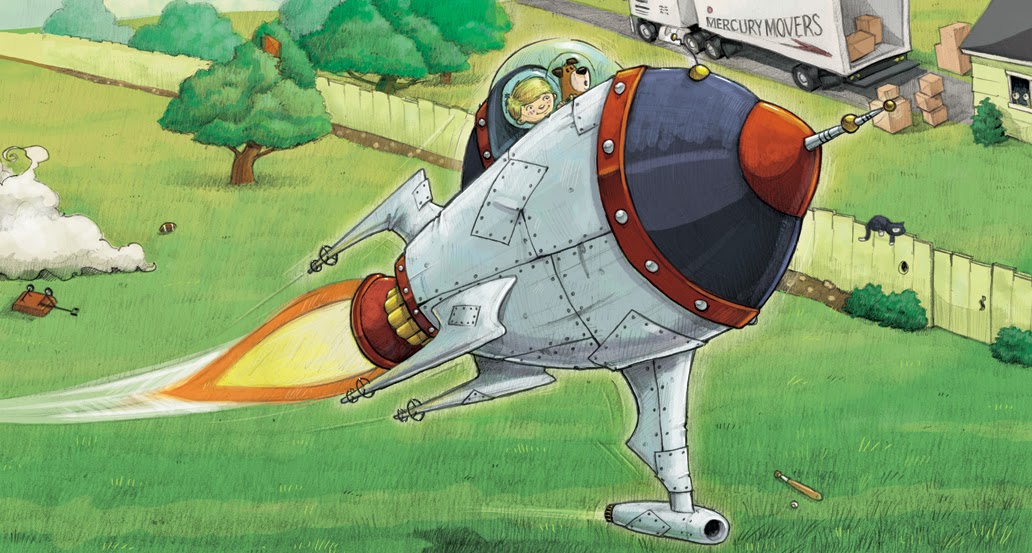
“BLAST OFF! In a spectacular plume of smoke Sheldon and Jet roared into space.”
Read This If You Loved: The Most Magnificent Thing by Ashley Spires, Journey by Aaron Becker
Recommended For:
**Thank you to Sara at Skyhorse Publishing for providing a copy for review!**
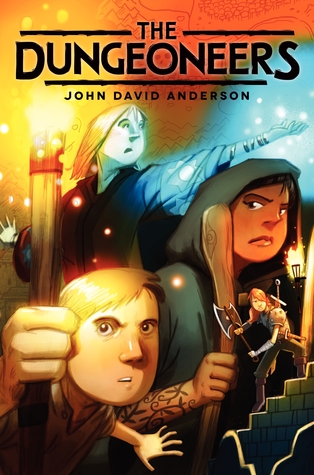
The Dungeoneers Author: John David Anderson
Published June 23, 2015 by Walden Pond Press
Publishers Summary: The Dungeoneers is an action-packed, funny, and heartbreaking middle grade fantasy-adventure from the author of the acclaimed Sidekicked and Minion, John David Anderson.
The world is not a fair place, and Colm Candorly knows it. While his parents and eight sisters seem content living on a lowly cobbler’s earnings, Colm can’t help but feel that everyone has the right to a more comfortable life. It’s just a question of how far you’re willing to go to get it.
In an effort to help make ends meet, Colm uses his natural gift for pickpocketing to pilfer a pile of gold from the richer residents of town, but his actions place him at the mercy of a mysterious man named Finn Argos, a gilded-toothed, smooth-tongued rogue who gives Colm a choice: he can be punished for his thievery, or he can become a member of Thwodin’s Legions, a guild of dungeoneers who take what they want and live as they will. Colm soon finds himself part of a family of warriors, mages, and hunters, learning to work together in their quest for endless treasure. But not all families are perfect, and even as Colm hones his skills with fellow recruits, it becomes clear that something from outside threatens the dungeoneers–and perhaps something from inside as well.
My Review: This is one of those fantasy novels that transports you to another place and throws you into an adventure that keeps you guessing and reading. In The Dungeoneers, I loved going to school with Colm and learning all about dungeoneering ways including how to be the best rogue, history of dungeoneering, swordplay, and all about monsters. This aspect reminded me a bit of Harry Potter because I got so sucked into his schooling and education, like I did with Harry’s, because I wanted to know everything I could about this world. The Dungeoneers also has some majorly suspenseful moments which makes sense in a book about stealing treasure from dungeons. In addition to his world building, he really knows how to build some characters! The three other members of Colm’s guild are such well-rounded characters and all so different. I can picture each of them, and I so want to be their friends (even Lena, who is a bit barbaric). I also loved the plot twist at the climax of the book! I did not see it coming! Just wait for it everyone!
Teachers’ Tools for Navigation/We Flagged: First and foremost, if you teach middle school, you should probably buy this for your classroom. High fantasy and adventure lovers are going to eat this one up.
Also, if you want to talk to students about building characters or setting, this book can definitely be a help with either. There are specific sections in this book that could be pulled out and used to discuss imagery, word choice, and characterization:
“In the flickering torchlight it was hard to make out all of her features clearly, but he couldn’t miss the sharp chisel of her chin, like a weapon itself. Her crimson hair was cropped short in the back, falling across one eye in front, the other shining brown in the flicker of light. Her lips were pursed, pulled tight against her teeth in a determined smirk.” (p. 93)
“Except Quinn didn’t look like he could call lightning from the sky or produce fireballs from his fingers. Colm had expected the first wizard he met to be more in keeping with the descriptions from his book–white-bearded and billowing and larger than life. Quinn looked barely big enough to summon his own shadow.” (p. 96)
“In contrast to the dreary tunnel behind them, the great hall before them was filled with light. Huge chandeliers hung from chains of gold, the flicker of a thousand candles casting fiery halos against the ceiling. Giant marble pillars anchored the four corners of the room, and a hug winding staircase with gold rails led both up and down in its center like a vortex. The floors were polished marble as well, dark green and buffed to a mirror sheen. A strange clock with twenty-four separate hourglasses hung over a set of huge double doors…” (p. 115)
Discussion Questions: If you were Colm, would you have gone with Finn?; What secret do you think Wolfe is keeping?; Lena is expected by her family to do well as a barbarian because of her upbringing. How would it feel to have that type of pressure put on you?; Colm makes a decision at the end of the book–do you agree with it or not?
Book Trailer:
John David Anderson’s Top Five Dungeoneers
Obviously The Dungeoneers owes a lot to fantasy tropes and conventions that have been around since Gandalf packed his first pipe. In fact, while writing it I sometimes felt like I should roll a d20 to see what my characters would do next (here’s hoping the book is a critical hit—ah, nerd humor). Afternoons spent playing Baldur’s Gate or reading Mercedes Lackey (or in my younger days, Lloyd Alexander) coalesced into a love of sword-swinging, lock-picking, monster-bashing rogues who risk everything on the hopes of finding that fabled cache of riches at the end of the corridor. In short, I was raised by dragons. Maybe I’m a Targaryen.
Obviously popular culture is not hurting for dungeoneers of interest, but I thought I would pick five key dungeon divers that had a distinct influence on me and the book. Note: I am defining a dungeoneer as anyone who willingly enters into some dank, creature-and-trap-infested cavern, catacomb, crypt, tomb or lair with the express purpose of taking whatever shiny, valuable objects are to be had. In other words, I’m kind of liberal with my use of the word.
5. Minsc and Boo: If you’ve ever played the game Baldur’s Gate, you will know these two. Minsc, the butt-kicking, infinitely quotable ranger, and his trusty hamster, Boo. Minsc was a tank and liked to carry big swords. More than that he had a big heart and recognized a noble enterprise, especially when it required some head bashing. Favorite quote: “Make way evil! I’m armed to the teeth and packing a hamster!
4. Ellen Ripley. All right, this one is a stretch, I admit, but in Aliens she does go down into a lair and fight off monsters (lots of them, including a queen) to rescue something she treasures (the little girl, Newt). Plus ever since I saw Aliens I’ve been drawn to tough female characters. I won’t lie—there’s a little bit of warrant officer Ripley’s feistiness in The Dungeoneers’ Lena Proudmore, though Lena doesn’t get to fire a grenade launcher (much to her chagrin).
3. Bilbo Baggins. You could name several characters from Tolkien’s mythos that fought their way out of dungeons, but Bilbo gets the cake for not coming out empty-handed. In fact, it’s the Burglar’s snatching of the Precious that drives the mythology. What did you find down there in the goblin caves, Bilbo? Oh—just the makings of a gazillion-dollar franchise. Finn Argos would be proud.
2. Link. Yes, it’s another video game, but for me, Link was the start of my love affair with dungeoneering. Link never met a rupee he didn’t like and spelunking through monster-infested lairs in search of Zelda was in his spritely 8-bit blood. I can still remember playing the original Zelda and getting eaten by an undulating stack of pancakes or impaled by a triceratops all because I didn’t know I was supposed to feed it bombs. To this day I still carry around a candle and a big stick of meat. Thank you Nintendo for stimulating my imagination and sucking away my time.
1. Indiana Jones. No sword (except in the second movie, and then it’s more of a machete). No armor. No dragons or ogres or orcs (though the Nazis are monstrous enough). But Indy, for me, is the archetypal treasure-hunter. Not only was he the dashing film hero of my childhood (and what I wanted to be when I grew up until I realized that everything cool had already been dug up already), he also helped engender my love for wise-cracking, whip-smart, ruggedly-charming, and occasionally flawed protagonists. His make-it-up-as-you go philosophy and daredevil antics were often replicated by a young, eight year old boy named Dave, who would pretend the floor was made of lava as he jumped from dining room table to couch and back again. Plus Indy knew that the greatest treasures always came at a price, a lesson that struck a chord with me.
So those are my top five. I’m sure your list is different. That’s the cool thing about inspiration—there are a lot of wells, and we get to drink from whichever ones we please. Who knows, maybe in twenty years some kid will be making a list of his favorite dungeoneers and put Colm Candorly somewhere near the top.
Read This If You Loved:Hero’s Guide (series) by Christopher Healy, Harry Potter (series) by J.K. Rowling, Foiled (series) by Jane Yolen, Giants Beware! (series) by Jorge Aguirre
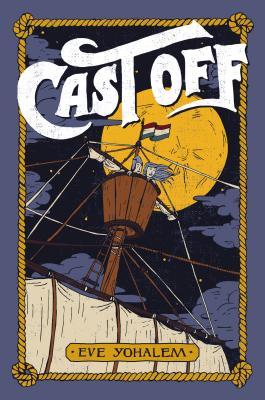
Cast Off: The Strange Adventures of Petra de Winter and Bram Broen Author: Eve Yohalem
Published: March 10, 2015 by Calkins Creek
GoodReads Summary: It’s 1663 and there is an extra passenger on board a Dutch merchant ship setting sail for the East Indies. Twelve-year-old Petra has stowed away to escape her abusive father. But she quickly realizes that surviving for months at sea will be impossible without help. So when Bram, the half-Dutch / Half-Javanese son of the ship’s carpenter, finds her hiding spot, Petra convinces him to help her stay hidden . . .and help disguise her as a boy.
If Petra is discovered and exposed as a girl, she could be tossed overboard, or worse . . . returned to her father. And if Bram is exposed for helping her, he could lose the only home—and family—he has. As tensions rise on the ship, with pirates attacking, deadly illness, and even mutiny, Petra and Bram face impossible decisions that test their friendship and threaten their dreams of freedom.
Told in alternating voices and filled with secrets and intrigue, this richly researched novel is historical fiction at its best.
Review: Take me away! This book whisked me off on a marvelous adventure filled with grave dangers, stow aways, tall ships, and mutiny. I couldn’t help but be reminded of one of my childhood favorites, The True Confessions of Charlotte Doyle by Avi. Petra escapes from a horribly abusive relationship with her father, and her bravery is an excellent model for young readers. She is discovered by Bram, the illegitimate son of the ship’s carpenter, and they form a very special friendship. This book delivers richly realized themes—particularly those of loyalty, heroism, sexism, and racism—that are very relevant to readers across time. I imagine a wide variety of audiences would appreciate this text because it touches on so many fascinating topics. It is clear that the author did her homework, and the result is magnificently entertaining.
Teachers’ Tools for Navigation: This book is an excellent example of a text that could be analyzed with a critical theorist lens. (See Appleman’s book about teaching critical theory to students of all levels.) I imagine rich classroom discussions would evolve from the application of gender theory or race theory, for instance, to this text. This is a compliment to the author and the depth of this book.
Discussion Questions: In what ways do gender and race play a role in this text?; How does the author weave history into the story?; What does Petra and Bram’s friendship teach us about humans in general?; How do the main characters display qualities of bravery?
Read This If You Loved: The True Confessions of Charlotte Doyle by Avi; Leviathan by Scott Westerfeld; Secrets of the Realm by Bev Stout; Peter Pan by J.M. Barrie
Recommended For:
Giveaway!
One lucky winner will receive a copy of CAST OFF: The Strange Adventures of Petra De Winter and Bram Broen (U.S. addresses; allow 4-6 weeks for delivery; offer ends 7/10/15).
In 2009 I got this great idea for a seafaring adventure about two kids who sail from Amsterdam to the East Indies in the seventeenth century. There was just one problem: I knew next to nothing about the seventeenth century. Or the Netherlands. Or the East Indies. Or sailing.
No matter. I like a challenge. I researched for a full year before I started writing, and after I started writing, I kept researching. I’m still researching. (I like researching.)
Today my Cast Off file has more than four hundred different source notes. I read lots of books: scholarly academic stuff, journalistic stuff, fiction, memoirs, journals, every first person account I could find. I spoke to people who knew much more than me—VOC scholars, maritime scholars, curators, my husband (he sails), surgeons, and dentists. I hung out in oddball museums. I traveled to Indonesia, where I slept in the jungle and held baby orangutans, and to the Netherlands, where I retraced every step of my characters that I could and explored the dark nooks of two different full-scale East Indiamen replicas.
I have no research training. It would have helped if I’d majored in history in college, but I didn’t. Mostly, I followed my nose. I knew that my story would begin in Amsterdam and take place mostly at sea on an East Indiaman bound for Batavia. I knew two of my characters: a Dutch girl and an East Indian boy, both twelve years old. That’s a lot to get started with.
What’s surgery like by candlelight below deck on a rocking ship before the invention of anesthesia? How do you fire a 4,000 pound canon without getting crushed by the recoil? These were the kinds of questions I tried to answer.
I tried to convey what it felt like to cram three hundred men onto a 150-foot long vessel for six months (damp, dark, and airless below, smelled bad, no privacy). The layout of the ship is based on actual ships of the period, as are the various jobs, daily schedule, terrible food.
For my characters’ medical knowledge, I have to thank John Woodall’s The Surgeon’s Mate, a seventeenth century medical guide no ship’s surgeon would have been without.
And in case anyone’s wondering, I got most of my slang from the always entertaining A New Dictionary of the Terms Ancient and Modern of the Canting Crew: In Its Several Tribes of Gypsies, Beggars, Thieves, Cheats, &c., with an Addition of Some Proverbs, Phrases, Figurative Speeches, &c. by B. E. Gent, c 1698. In my opinion, some of these terms should be brought back into everyday use. Please help make “Kiss my blind cheeks!” go viral!
Nonfiction Picture Book Wednesday is hosted by Kid Lit Frenzy and was started to help promote the reading of nonfiction texts. Most Wednesdays, we will be participating and will review a nonfiction text (though it may not always be a picture book).
Be sure to visit Kid Lit Frenzy and see what other nonfiction books are shared this week!
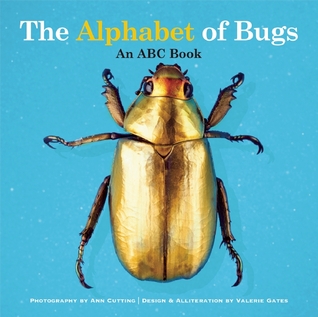
The Alphabet of Bugs: An ABC Book Author: Valerie Gates
Photographer: Ann Cutting
Published June 2nd, 2015 by Sky Pony Press
Goodreads Summary: Do you know what a Chrysina resplendens or a Papilionidae butterfly looks like? Travel through the alphabet with The Alphabet of Bugs to learn about the many beautiful and unusually named bugs found in nature—and brush up on those ABCs as well! Valerie Gates’s charming alliterative style paired with Ann Cutting’s stunning photographs of all types of bugs is sure to delight curious children and adults alike.
With silly alliterative sentences and vivid photographs, The Alphabet of Bugs will capture the attention of young kids and teach them about the many beautiful and unusually named bugs found in nature as they learn their ABCs. Ultimately, the book will encourage young kids to go outside and explore nature as they try to find the bugs pictured in the book.
Children who already know their basic bugs will broaden their horizons, and parents who are tired of simple butterflies and beetles will find this book worth rereading. Spectacular photographs of insects of all kinds will inspire children to learn more about the different creatures found in the natural world. And while children learn about bugs, they are also learning the alphabet through silly sentences.
Kellee’s Review and Teachers’ Tools for Navigation:ABC books can get repetitive, so it is so nice to find one that is different and unique. The Alphabet of Bugs not only introduces the reader to 26 different insects, the bugs are accompanied by close-up, detailed photos and alphabetic sentences with intense vocabulary. I could see this book being used as a daily read aloud with each day having a different letter which would lead into a study of the insect and the vocabulary introduced.
Ricki’s Review and Teachers’ Tools for Navigation:I loved the photography of this book. Admittedly, I don’t like bugs very much, but I know many kids who do! I feel fortunate to have this book because I suspect my son will love it when he is a bit older. Each photograph is juxtaposed with a bright background color that reflects the letter. This would be a great mentor text to teach alliteration. Readers at any level would find it to be interesting. I would challenge younger students to create their own alphabet book about a topic of interest.
Discussion Questions: What other bugs can you think of that start with this letter?; After doing some research, what else have you learned about this bug?; How does the use of photography and alliteration enhance this text?
We Flagged:
Read This If You Love: Nonfiction books about insects; Alphabet books
Recommended For:
and
**Thank you to Sara at Skyhorse Publishing for providing copies for review!**
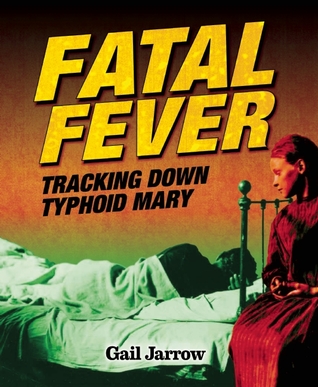
Fatal Fever: Tracking Down Typhoid Mary Author: Gail Jarrow
Published: March 10, 2015 by Calkins Creek
GoodReads Summary: In March 1907, the lives of three remarkable people collided at a New York City brownstone where Mary Mallon worked as a cook. They were brought together by typhoid fever, a dreaded scourge that killed tens of thousands of Americans each year. Fatal Fever: Tracking Down Typhoid Mary is the first middle-grade trade book that tells the true story of the woman who unwittingly spread deadly bacteria, the epidemiologist who discovered her trail of infection, and the health department that decided her fate. This gripping story follows this tragic disease as it shatters lives from the early twentieth century to today. It will keep readers on the edges of the seats wondering what happened to Mary and the innocent typhoid victims. With glossary, timeline, list of well-known typhoid sufferers and victims, further resource section, author’s note, and source notes.
Review: This narrative nonfiction essentially begins with in media res—Typhoid Mary is running from people who want to catch her and take her blood. By chapter two, the text shifts back to the history of typhoid fever and gives readers a no-nonsense look at the gory realities of this horrid disease. My father and brother are doctors and my mom was a nurse, and I was finally able to take part in medical conversations at a family gathering! It would have been easy for the author to slip into the extreme technical details of this disease, but she does an excellent job balancing science, history, and story. I was engaged in the book from beginning to end. I never thought I would find the sanitation systems in the early 1900s to be so fascinating!
Teachers’ Tools for Navigation: Students will read this book and want to learn more about other deadly epidemics in history. They would likely be interested in the ways this disease still impacts countries today. I found Typhoid Mary’s story to be very interesting, and I wanted to learn more about medical scapegoats in history. All in all, this book inspires readers to want to learn more about medical topics. I imagine this book would be a good choice for students interested in medical professions, but it will also captivate students who are interested in science and history. This makes it a true interdisciplinary text.
Discussion Questions: How was Typhoid Mary treated by the community? Why? Do you think she deserved her treatment at the end of her life?; What other diseases have impacted history? How do they compare to typhoid fever?
We Flagged: “She didn’t know it, but she wasn’t alone in that cramped, cold closet. Deep insider her body, billions of deadly microorganisms were hiding, too.”
Read This If You Loved: Red Madness: How a Medical Mystery Changed What We Eat by Gail Jarrow; Invincible Microbe: Tuberculosis and the Never-Ending Search for a Cure by Jim Murphy and Alison Blank
Recommended For:
*Thank you to Kerry at Boyds Mills Press for sending this book for review!*
Nonfiction Picture Book Wednesday is hosted by Kid Lit Frenzy and was started to help promote the reading of nonfiction texts. Most Wednesdays, we will be participating and will review a nonfiction text (though it may not always be a picture book).
Be sure to visit Kid Lit Frenzy and see what other nonfiction books are shared this week!
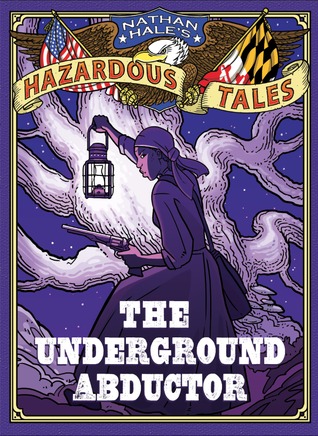
The Underground Abductor
Author and Illustrator: Nathan Hale
Published April 21st, 2015 by Amulet Books
Goodreads Summary: Araminta Ross was born a slave in Delaware in the early 19th century. Slavery meant that her family could be ripped apart at any time, and that she could be put to work in dangerous places and for abusive people. But north of the Mason-Dixon line, slavery was illegal. If she could run away and make it north without being caught or killed, she’d be free. Facing enormous danger, Araminta made it, and once free, she changed her name to Harriet Tubman. Tubman spent the rest of her life helping slaves run away like she did, every time taking her life in her hands. Nathan Hale tells her incredible true-life story with the humor and sensitivity he’s shown in every one of the Hazardous Tales—perfect for reluctant readers and classroom discussions.
My Review: I love this entire series! Nathan Hale has taken history and made it accessible (with a dash of humor!). If you don’t the concept of the series, it revolves around Nathan Hale the Revolutionary War spy who, in the first book, was eaten by a history book so now knows all that has happened in history and is sharing it with the hangman and British officer who are guarding him before he is executed. The first book is Hale’s own story and then each of the following are his telling of different times in history.
This installment of Hale’s graphic novel series may be my favorite so far. I found it to be the most intense of his stories even though it is up against stories of wars, but Harriet Tubman’s story is one of one person’s resilience in the face of pure doom. Although it is evident through any story you hear of Harriet how truly brave she was, Nathan Hale’s story immerses you into Harriet’s life and shows you how much she truly did and faced.
Teachers’ Tools for Navigation: This book is written to start discussions (in reading/language arts OR social studies)! I was lucky enough to write the teaching guide for The Underground Abductor (as well as the rest of the series!), and I have included some of my discussion questions below.
I could also see Hale’s Hazardous Tales being used in lit circles with each group reading a different one of the tales. This could lead to wonderful discussions about each time in history. Students could then present their history to the rest of the class.
Discussion Questions:
When Araminta heard the story of Moses and the pharaoh, she envisioned Moses as a slave and the pharaoh as an owner (page 15). How does Moses’s story compare to a traditional story of a slave? Harriet is later called “Moses” or “Black Moses.” How does Harriet’s story compare to Moses’s?
How did Nat Turner’s rebellion affect slave laws (page 21)? He meant to make a positive change, but it actually turned negative. How? Why?
On page 44, Nathan Hale personifies debt as the ghosts and men Minty had been dreaming about. Why is debt shown as a terrifying thing? How did Mr. Brodess’s debt affect Mindy and her family?
Complete a character web with adjectives describing Harriet Tubman. What type of person was she that allowed her to overcome a debilitating injury and slavery?
Book Trailer:
Read This If You Loved: Hazardous Tales series by Nathan Hale, March by John Robert Lewis, Stolen Into Slavery by Judith Bloom Fradin, Elijah Buxton by Christopher Paul Curtis
Recommended For:
**Thank you to Morgan at Abrams Books for providing a copy of the book!**
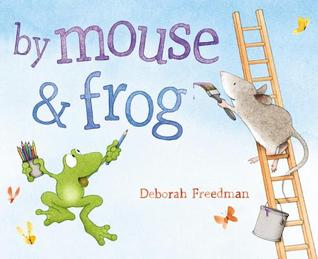
By Mouse & Frog Author and Illustrator: Deborah Freedman Published April 14th, 2015 by Viking Books for Young Readers
Goodreads Summary: Fastidious Mouse has one idea about how to tell a story. Free-spirited Frog has another. What happens when Frog crashes into Mouse’s story with some wild ideas? Chaos!…followed by the discovery that working together means being willing to compromise—and that listening to one another can lead to the most beautiful stories of all.
Kellee’s Review and Teachers’ Tools for Navigation:I love this book. There is so much wonderful in these pages. First, the book is just so funny! Mouse and Frog are so different and the back and forth is laugh-out-loud comedic. Second, the story really makes you look at personality types and think about how to work together. Frog and Mouse’s story would be a wonderful one to read and then talk about norms when working in groups on projects/assignments. Third, the book also looks at story writing and narrative elements. What is needed in a good story? Do all stories have to have the same things? All in all, this book is fun to read and will be a good jumping off point for all sorts of discussions. I think this book is going to find some major love in homes, schools, and libraries alike.
Ricki’s Review and Teachers’ Tools for Navigation: This magical story is about two friends who co-write a book together. It would be a great book to teach kids about the importance of listening and valuing others’ opinions. I would use this in the classroom at times when there is a lot of conflict. Very few students benefit from a pamphlet about conflict resolution. Instead, I would read this book aloud to students, and we could talk about the value of listening to and understanding each other. Overall, this is a great book to get students’ creative juices flowing. The whimsical creativeness of this title reminds me a bit of The Dot by Peter Reynolds, another picture book favorite.
Discussion Questions: What is needed in a good story? Do all stories have to have to have the same things?; Why didn’t Mouse and Frog get along at first? How did they compromise at the end?
We Flagged:
Read This If You Loved: Look! by Jeff Mack, The Story of Fish and Snail by Deborah Freedman, Little Red Writing by Joan Holub; The Dot by Peter Reynolds
Recommended For:
and
**Thank you to Penguin Young Readers for providing a copy for review!**